Mathematical Olympiads 
throughout the world 
Prepared by – Shreet Mishra ( class – XI) 
roll no. - 47
INTRODUCTION 
• A general Mathematical Olympiad is an 
exam in which questions of only 
mathematics is asked. The person who 
scores first rank gets gold medal, the 
person who scores second position gets 
silver medal and the person who scores 
third rank gets bronze medal. Today, 
there are thousands of mathematical 
Olympiads going throughout the world.
INTRODUCTION 
Today, there are thousands of mathematical Olympiads going throughout the 
world some of them are -: 
• International Mathematical Olympiad (IMO) 
• AITMO (Asian Inter-city Teenagers Mathematics Olympiad) — for junior 
secondary students around the Eastern Asian region 
• APMO (Asian Pacific Mathematics Olympiad) — Pacific rim 
• APMCM (Asian Pacific Mathematics Contest in Modeling) 
• The Indian National Mathematical Olympiad (INMO) 
• The United States of America Mathematical Olympiad (USAMO) 
• The British Mathematical Olympiad 
• William Lowell Putnam Mathematical Competition — USA and Canada
The International Mathematical 
Olympiad (IMO) 
• The International Mathematical Olympiad (IMO) is an 
annual six-problem, 42-point mathematical 
Olympiad for pre-collegiate students and is the oldest 
of the International Science Olympiads. The first IMO 
was held in Romania in 1959. It has since been held 
annually, except in 1980. About 100 countries send 
teams of up to six students plus one team leader, one 
deputy leader, and observers. Ever since its inception 
in 1959, the Olympiad has developed a rich legacy and 
has established itself as the pinnacle of mathematical 
competition among high school students.
The International Mathematical 
Olympiad (IMO)
The International Mathematical 
Olympiad (IMO) 
• The content ranges from precalculus problems that are 
extremely difficult to problems on branches of mathematics 
not conventionally covered at school and often not at 
university level either, such 
as projective and complex geometry, functional 
equations and well-grounded number theory, of which 
extensive knowledge of theorems is required. Calculus, 
though allowed in solutions, is never required, as there is a 
principle at play that anyone with a basic understanding of 
mathematics should understand the problems, even if the 
solutions require a great deal more knowledge. Supporters 
of this principle claim that this allows more universality 
and creates an incentive to find elegant, deceptively simple-looking 
problems which nevertheless require a certain level 
of ingenuity.
The International Mathematical 
Olympiad (IMO) 
• The selection process differs by country, but it often 
consists of a series of tests which admit fewer students 
at each progressing test. Awards are given to a top 
percentage of the individual contestants. Teams are 
not officially recognized—all scores are given only to 
individual contestants, but team scoring is unofficially 
compared more so than individual scores. Contestants 
must be under the age of 20 and must not be 
registered at any tertiary institution. Subject to these 
conditions, an individual may participate any number 
of times in the IMO.
The Indian National Mathematical 
Olympiad (INMO) 
• The Indian National Mathematical Olympiad 
(INMO) is a high school 
mathematics competition held annually 
in India since 1989. It is the second tier in the 
Indian team selection procedure for 
the International Mathematical Olympiad and 
is conducted by the Homi Bhaba Centre for 
Science Education (HBCSE) under the aegis of 
the National Board of Higher Mathematics 
(NBHM).
The Indian National Mathematical 
Olympiad (INMO) 
• The INMO is conducted by the MO Cell in February of every 
year. Prospective candidates first need to write the Regional 
Mathematical Olympiad of their respective state or region, 
usually held on the first Sunday of December of the 
previous year. Around thirty students are selected from 
each region, to write the INMO, which is usually held on the 
first Sunday of February. Among these 500 or more 
students, a total of around thirty qualify the INMO. Students 
qualifying the INMO are automatically eligible for 
admission to the B.Sc. (Hons) Mathematics course in the 
[Chennai Mathematical Institute]. Since 2008, INMO 
awardees applying for B. Stat or B. Math courses of the 
Indian Statistical Institute are directly called for the 
interview without having to write the written test.
The United States of America 
Mathematical Olympiad (USAMO) 
• The United States of America Mathematical 
Olympiad (USAMO) is a highly selective high 
school mathematics competition held annually in 
the United States. Since its debut in 1972, it has served as 
the final round of the AMC series of contests. The United 
States of America Junior Mathematical Olympiad (USAJMO) 
was introduced in 2010 to recognize top scorers based on 
their AMC10-based index. Qualifying for the USAMO is 
considered one of the most prestigious awards for high 
school students in the United States, with only 264 students 
qualifying in 2013 out of over 350,000 students 
competing. Top scorers on the USAMO are invited to 
the Mathematical Olympiad Summer Program and 
represent the United States at the International 
Mathematical Olympiad.
The United States of America 
Mathematical Olympiad (USAMO) 
• In 2011 we will have slightly revised 
qualification rules for the USA 
Mathematical Olympiad and USA Junior 
Mathematical Olympiad. The goal is to 
select approximately 500 students total 
for the two Olympiads, split 
approximately 270 for the USAMO and 
230 for the USAJMO respectively.
The British Mathematical Olympiad 
• The British Mathematical Olympiad forms part of the 
selection process for the UK International Mathematical 
Olympiad team. It is organised by the British Mathematical 
Olympiad Sub trust, which is part of the United Kingdom 
Mathematics Trust. There are two rounds, the BMO1 and 
the BMO2. 
• The first round of the BMO is held in December, and from 
2006 is an open entry competition, costing £17 to 
enter. However, this fee is waived for those who (1) achieve 
the qualifying mark in the Senior Mathematical 
Challenge and (2) are British citizens, or will have studied 
for 3 full years of full-time secondary education in the UK 
by the time they leave school. The paper lasts 3½ hours, 
and consists of six questions (from 2005), each worth 10 
marks.
The British Mathematical Olympiad 
• Candidates are encouraged to write full proofs to the 
questions they attempt, as a full answer to a question 
is worth many more marks than incomplete answers 
to several questions. This is because of the marking 
scheme: an answer is marked on either a "0+" or a "10- 
" mark scheme, depending on whether the answer 
looks generally complete or not. So if an answer is 
judged incomplete or unfinished, it is awarded a few 
marks for progress and relevant observations, 
whereas if it is presented as complete and correct, 
marks are deducted for faults, poor reasoning, or 
unproven assumptions. As a result, it is quite 
uncommon for an answer to score a middling mark 
(e.g. 4–6).
The Asian Pacific Mathematics 
Olympiad (APMO) 
• The Asian Pacific Mathematics Olympiad (APMO) 
starting from 1989 is a regional mathematics 
competition which involves countries from the Asian 
Pacific region. The USA also takes part in the APMO. 
Every year, APMO is held in the afternoon of the 
second Monday of March for participating countries in 
the North and South Americas, and in the morning of 
the second Tuesday of March for participating 
countries on the Western Pacific and in Asia.
APMO's Aims -: 
• the discovering, encouraging and challenging of 
mathematically gifted school students in all Pacific-Rim 
countries 
• the fostering of friendly international relations and 
cooperation between students and teachers in the Pacific- 
Rim Region 
• the creating of an opportunity for the exchange of 
information on school syllabi and practice throughout the 
Pacific Region 
• The encouragement and support of mathematical 
involvement with Olympiad type activities, not only in the 
APMO participating countries, but also in other Pacific-Rim 
countries.
The Southeast Asian Mathematics 
Olympiad 
• The Southeast Asian Mathematics Olympiad, or SEA-MO, 
is the Regional Mathematics 
Competition in Southeast Asia. This competition is 
organised by the Southeast Asian Ministers of 
Education Organization Regional Centre for Education 
in Science and Mathematics (SEAMEO RECSAM), 
which bases its operations in Penang, Malaysia. Unlike 
the International Mathematical Olympiad, the venue 
for this competition is not rotated from country to 
country and it has been held in Penang, Malaysia since 
its conception.
The Southeast Asian Mathematics 
Olympiad 
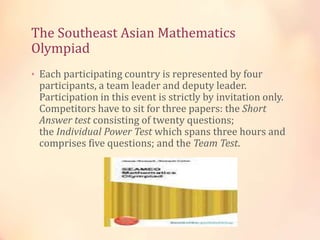
• Each participating country is represented by four 
participants, a team leader and deputy leader. 
Participation in this event is strictly by invitation only. 
Competitors have to sit for three papers: the Short 
Answer test consisting of twenty questions; 
the Individual Power Test which spans three hours and 
comprises five questions; and the Team Test.
The William Lowell Putnam 
Mathematical Competition 
• The William Lowell Putnam Mathematical Competition, 
often abbreviated to the Putnam Competition, is an 
annual mathematics 
competition for undergraduate college students enrolled at 
institutions of higher learning in the United 
States and Canada (regardless of the students' 
nationalities). It awards a scholarship and cash prizes 
ranging from $250 to $2,500 for the top students and 
$5,000 to $25,000 for the top schools, plus one of the top 
five individual scorers (designated as Putnam Fellows) gets 
graduate tuition waived at Harvard (Putnam Fellow Prize 
Fellowship), and the top 100 individual scorers have their 
names mentioned in the American Mathematical Monthly's 
October issue (alphabetically ordered within rank).
The William Lowell Putnam 
Mathematical Competition 
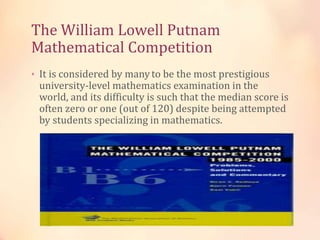
• It is considered by many to be the most prestigious 
university-level mathematics examination in the 
world, and its difficulty is such that the median score is 
often zero or one (out of 120) despite being attempted 
by students specializing in mathematics.
Thank 
you

Mathematical olympiads throughout the world

  • 1.
    Mathematical Olympiads throughoutthe world Prepared by – Shreet Mishra ( class – XI) roll no. - 47
  • 2.
    INTRODUCTION • Ageneral Mathematical Olympiad is an exam in which questions of only mathematics is asked. The person who scores first rank gets gold medal, the person who scores second position gets silver medal and the person who scores third rank gets bronze medal. Today, there are thousands of mathematical Olympiads going throughout the world.
  • 3.
    INTRODUCTION Today, thereare thousands of mathematical Olympiads going throughout the world some of them are -: • International Mathematical Olympiad (IMO) • AITMO (Asian Inter-city Teenagers Mathematics Olympiad) — for junior secondary students around the Eastern Asian region • APMO (Asian Pacific Mathematics Olympiad) — Pacific rim • APMCM (Asian Pacific Mathematics Contest in Modeling) • The Indian National Mathematical Olympiad (INMO) • The United States of America Mathematical Olympiad (USAMO) • The British Mathematical Olympiad • William Lowell Putnam Mathematical Competition — USA and Canada
  • 4.
    The International Mathematical Olympiad (IMO) • The International Mathematical Olympiad (IMO) is an annual six-problem, 42-point mathematical Olympiad for pre-collegiate students and is the oldest of the International Science Olympiads. The first IMO was held in Romania in 1959. It has since been held annually, except in 1980. About 100 countries send teams of up to six students plus one team leader, one deputy leader, and observers. Ever since its inception in 1959, the Olympiad has developed a rich legacy and has established itself as the pinnacle of mathematical competition among high school students.
  • 5.
  • 6.
    The International Mathematical Olympiad (IMO) • The content ranges from precalculus problems that are extremely difficult to problems on branches of mathematics not conventionally covered at school and often not at university level either, such as projective and complex geometry, functional equations and well-grounded number theory, of which extensive knowledge of theorems is required. Calculus, though allowed in solutions, is never required, as there is a principle at play that anyone with a basic understanding of mathematics should understand the problems, even if the solutions require a great deal more knowledge. Supporters of this principle claim that this allows more universality and creates an incentive to find elegant, deceptively simple-looking problems which nevertheless require a certain level of ingenuity.
  • 7.
    The International Mathematical Olympiad (IMO) • The selection process differs by country, but it often consists of a series of tests which admit fewer students at each progressing test. Awards are given to a top percentage of the individual contestants. Teams are not officially recognized—all scores are given only to individual contestants, but team scoring is unofficially compared more so than individual scores. Contestants must be under the age of 20 and must not be registered at any tertiary institution. Subject to these conditions, an individual may participate any number of times in the IMO.
  • 8.
    The Indian NationalMathematical Olympiad (INMO) • The Indian National Mathematical Olympiad (INMO) is a high school mathematics competition held annually in India since 1989. It is the second tier in the Indian team selection procedure for the International Mathematical Olympiad and is conducted by the Homi Bhaba Centre for Science Education (HBCSE) under the aegis of the National Board of Higher Mathematics (NBHM).
  • 9.
    The Indian NationalMathematical Olympiad (INMO) • The INMO is conducted by the MO Cell in February of every year. Prospective candidates first need to write the Regional Mathematical Olympiad of their respective state or region, usually held on the first Sunday of December of the previous year. Around thirty students are selected from each region, to write the INMO, which is usually held on the first Sunday of February. Among these 500 or more students, a total of around thirty qualify the INMO. Students qualifying the INMO are automatically eligible for admission to the B.Sc. (Hons) Mathematics course in the [Chennai Mathematical Institute]. Since 2008, INMO awardees applying for B. Stat or B. Math courses of the Indian Statistical Institute are directly called for the interview without having to write the written test.
  • 10.
    The United Statesof America Mathematical Olympiad (USAMO) • The United States of America Mathematical Olympiad (USAMO) is a highly selective high school mathematics competition held annually in the United States. Since its debut in 1972, it has served as the final round of the AMC series of contests. The United States of America Junior Mathematical Olympiad (USAJMO) was introduced in 2010 to recognize top scorers based on their AMC10-based index. Qualifying for the USAMO is considered one of the most prestigious awards for high school students in the United States, with only 264 students qualifying in 2013 out of over 350,000 students competing. Top scorers on the USAMO are invited to the Mathematical Olympiad Summer Program and represent the United States at the International Mathematical Olympiad.
  • 11.
    The United Statesof America Mathematical Olympiad (USAMO) • In 2011 we will have slightly revised qualification rules for the USA Mathematical Olympiad and USA Junior Mathematical Olympiad. The goal is to select approximately 500 students total for the two Olympiads, split approximately 270 for the USAMO and 230 for the USAJMO respectively.
  • 12.
    The British MathematicalOlympiad • The British Mathematical Olympiad forms part of the selection process for the UK International Mathematical Olympiad team. It is organised by the British Mathematical Olympiad Sub trust, which is part of the United Kingdom Mathematics Trust. There are two rounds, the BMO1 and the BMO2. • The first round of the BMO is held in December, and from 2006 is an open entry competition, costing £17 to enter. However, this fee is waived for those who (1) achieve the qualifying mark in the Senior Mathematical Challenge and (2) are British citizens, or will have studied for 3 full years of full-time secondary education in the UK by the time they leave school. The paper lasts 3½ hours, and consists of six questions (from 2005), each worth 10 marks.
  • 13.
    The British MathematicalOlympiad • Candidates are encouraged to write full proofs to the questions they attempt, as a full answer to a question is worth many more marks than incomplete answers to several questions. This is because of the marking scheme: an answer is marked on either a "0+" or a "10- " mark scheme, depending on whether the answer looks generally complete or not. So if an answer is judged incomplete or unfinished, it is awarded a few marks for progress and relevant observations, whereas if it is presented as complete and correct, marks are deducted for faults, poor reasoning, or unproven assumptions. As a result, it is quite uncommon for an answer to score a middling mark (e.g. 4–6).
  • 14.
    The Asian PacificMathematics Olympiad (APMO) • The Asian Pacific Mathematics Olympiad (APMO) starting from 1989 is a regional mathematics competition which involves countries from the Asian Pacific region. The USA also takes part in the APMO. Every year, APMO is held in the afternoon of the second Monday of March for participating countries in the North and South Americas, and in the morning of the second Tuesday of March for participating countries on the Western Pacific and in Asia.
  • 15.
    APMO's Aims -: • the discovering, encouraging and challenging of mathematically gifted school students in all Pacific-Rim countries • the fostering of friendly international relations and cooperation between students and teachers in the Pacific- Rim Region • the creating of an opportunity for the exchange of information on school syllabi and practice throughout the Pacific Region • The encouragement and support of mathematical involvement with Olympiad type activities, not only in the APMO participating countries, but also in other Pacific-Rim countries.
  • 16.
    The Southeast AsianMathematics Olympiad • The Southeast Asian Mathematics Olympiad, or SEA-MO, is the Regional Mathematics Competition in Southeast Asia. This competition is organised by the Southeast Asian Ministers of Education Organization Regional Centre for Education in Science and Mathematics (SEAMEO RECSAM), which bases its operations in Penang, Malaysia. Unlike the International Mathematical Olympiad, the venue for this competition is not rotated from country to country and it has been held in Penang, Malaysia since its conception.
  • 17.
    The Southeast AsianMathematics Olympiad • Each participating country is represented by four participants, a team leader and deputy leader. Participation in this event is strictly by invitation only. Competitors have to sit for three papers: the Short Answer test consisting of twenty questions; the Individual Power Test which spans three hours and comprises five questions; and the Team Test.
  • 18.
    The William LowellPutnam Mathematical Competition • The William Lowell Putnam Mathematical Competition, often abbreviated to the Putnam Competition, is an annual mathematics competition for undergraduate college students enrolled at institutions of higher learning in the United States and Canada (regardless of the students' nationalities). It awards a scholarship and cash prizes ranging from $250 to $2,500 for the top students and $5,000 to $25,000 for the top schools, plus one of the top five individual scorers (designated as Putnam Fellows) gets graduate tuition waived at Harvard (Putnam Fellow Prize Fellowship), and the top 100 individual scorers have their names mentioned in the American Mathematical Monthly's October issue (alphabetically ordered within rank).
  • 19.
    The William LowellPutnam Mathematical Competition • It is considered by many to be the most prestigious university-level mathematics examination in the world, and its difficulty is such that the median score is often zero or one (out of 120) despite being attempted by students specializing in mathematics.
  • 20.