Chinese Language Teacher Preparation: Experience Gained & Lesson Learned Juefei Wang, Freeman Foundation Mary Curran, Rutgers University Frank Lixing Tang, New York University
Rutgers Chinese Language Teacher Programs Experiences Gained and  Lessons Learned Mary Curran [email_address] Graduate School of Education Rutgers, The State University of New Jersey National Chinese Language Conference,  2009
Plan for Presentation Rutgers Chinese Language Teacher Initiatives Critical Issues Lessons We Are Learning
Rutgers University Chinese Language Teacher Initiatives Program Models Graduate School of Education Traditional Ed.M. Degree and Certification Chinese Language Teacher Alternate Route Program Asian Languages and Cultures Department Chinese Masters of Arts for Teachers
Traditional Master’s Degree with Certification Programs 45 Credit Programs Two-years, Full-time Study Five-year Program Post-Baccalaureate Program
Chinese Language Teacher Alternate Route Program 19 Credit Program Pre-Service Summer Component Methods Course Assessment Course Practicum  In-Service Academic-Year Component
Chinese Master of Arts  for Teachers 30 Credit Program Students select courses in Chinese language, literature, culture, and pedagogy.
Generous Support Chinese Language Teaching Initiatives Freeman Foundation Chinese Summer Practicum Settings Freeman Foundation STARTALK
The Guiding Framework Standards-based  ACTFL Standards  Professional Standards Knowing the content matter Knowing how to design instruction and assessments Understanding developmental appropriateness Working with diverse learners Using technology Knowing how to communicate effectively with students, co-workers, parents Connecting learning to the local and global communities Managing life-long professional development
Experiences Gained? Lessons Learned?
Critical Issues Collaborative Nature of Developing a High Quality Program Individual Variation in Teacher Candidates’ Needs Pool of Expert Teachers and Teacher Educators
Critical Issues Need for Teacher Candidates to buy into Standards-Based Pedagogy Teacher Candidates’ Knowledge Students Language and Culture for U.S. Schools Target Language and Culture Teacher Identity
Collaboration University Units: Graduate School of Education, Asian Languages and Cultures Department, and World Language Institute New Jersey Department of Education Local School Districts  Princeton Regional School District West Windsor-Plainsboro School District Highland Park School District And many others who regularly take our student teachers… Community Guests Expert Teachers Teacher Candidates Students and Parents International Partners
Making Collaborations Work Freeman Foundation and STARTALK Funding Investment of Energy and Enthusiasm Time to Develop Trust Regular Communication Planning and evaluation meetings for all collaborators Pre-Program advising for teacher candidates One-on-one feedback sessions with teacher candidates
Individual Variation  in Teacher Candidate Needs Heritage and non-heritage background Chinese dialectal variation Preparation (coursework) in Chinese Previous teaching experience  Citizenship or visa status  Life situation
How We Work to Meet   Teacher Candidates’ Needs Created multiple routes to professional development and certification Hired a bilingual, bicultural program coordinator Have regular one-on-one feedback sessions with participants Created a Roundtable Networking Group Meets regularly Uses on-line forum for communication and sharing of resources
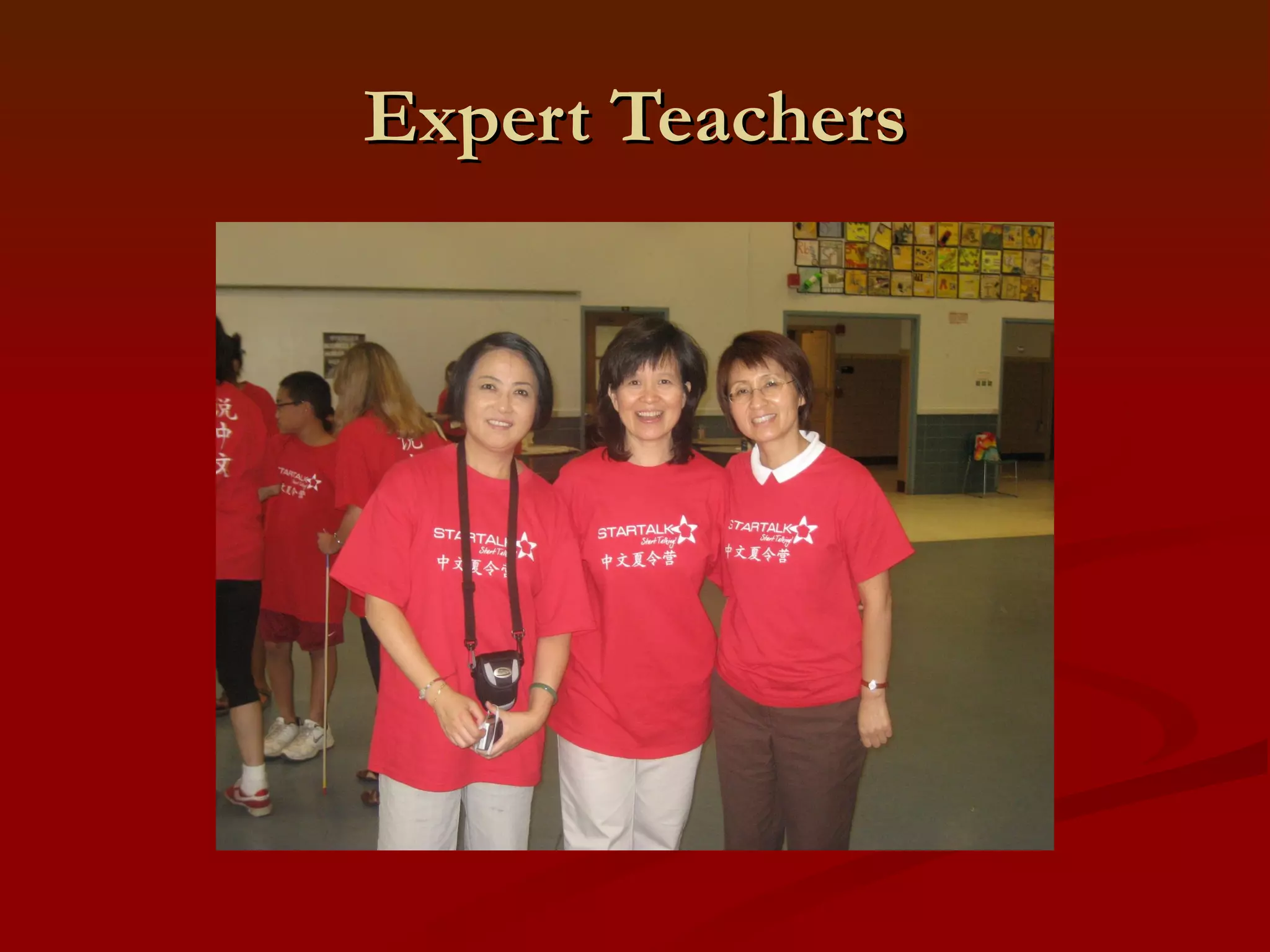
Expert Teachers
Previous participants take on new roles. Practicum: Program Support Materials Development Teaching Mentoring Traditional Program: Hosts for Student Teachers Continue on for a Master’s Degree Roundtable Network
Need to Buy into Standards-Based Pedagogy Target Language Instruction Focus is on Learning to USE language in authentic, meaningful ways, not learning ABOUT language  Understanding that language teaching is a field of expertise in its own right
Solutions Work with districts where teacher candidates will observe and participate in best practice;  Expose them to flexible settings (summer camps, for example); Have participants reflect upon their own experiences learning languages; and Connect the practical experiences to theory.
Teacher Knowledge about Students Knowledge about Students in the U.S. Knowledge about Heritage Students Knowledge about K-12 Students
Knowledge about Students Developmentally appropriate instruction Practicum experiences with elementary students Practicum experiences with secondary students
Heritage Language Instruction Teachers need to bridge the gap  between their experiences and  the experiences of the heritage learners  in their classrooms.
Heritage Language Instruction Understand the Chinese language learning experience from an American Born Chinese/Taiwanese (ABC/T) perspective Understand that ABC/Ts have their unique understanding and need of what it means to be Chinese Design curriculum that appropriately takes into consideration the language and cultural needs of ABC/Ts
Solutions Open communication about the sensitive issues of language and identity Hiring teachers who reflect the multiple identities of our Chinese learners Advanced, graduate-level coursework in language socialization and identity
Teacher Knowledge about Language and Culture English in a U.S. context Chinese in a U.S. context
English Proficiency Interpersonal, intrapersonal, and presentational competence for academic work and life at school and interactions with administrators, staff, and parents Intercultural competence
Solutions Designed and will implement a new course,  English for World Language Teachers.  Teacher candidates need to build relationships with teachers outside the Chinese language teaching community.
Chinese Proficiency Coursework for Native Speakers Assessment Whose Chinese? Which Chinese?
Solutions Collaborations to create new courses Create new assessments Help students understand the multiplicity within the Chinese language and culture, and the unique Chinese American culture
These efforts lead to the possibility of creating a new kind of Chinese language teacher identity.
We promote a  teacher identity where the  Teacher is a facilitator to language USE in the classroom as opposed to an absolute authority ABOUT language; Teacher is a bilingual/bicultural bridge between Chinese and American societies; Teacher is a model and promoter of a hybrid and global identity that blends Chinese and American experiences; and Teacher is a life-long learner.
A Lifelong Journey
Chinese language teacher preparation program at NYU M.A. in Foreign language education (Mandarin Chinese—leading to NYS teacher certification) M.A. in Foreign language education (Mandarin Chinese—not leading to NYS teacher certification) M.A. in FLE and TESOL (leading to dual certification in ESOL and Chinese)
Department of Teaching and Learning  M.A. Teaching Chinese a Foreign Language 7-12  (44 Credits) Content Core (3-9 credits): - Linguistic analysis (3) - Adv Ch for teachers of Chinese (I-3) - Adv Ch for teachers of Chinese (II-3) - Applied linguistics in Chinese (3)
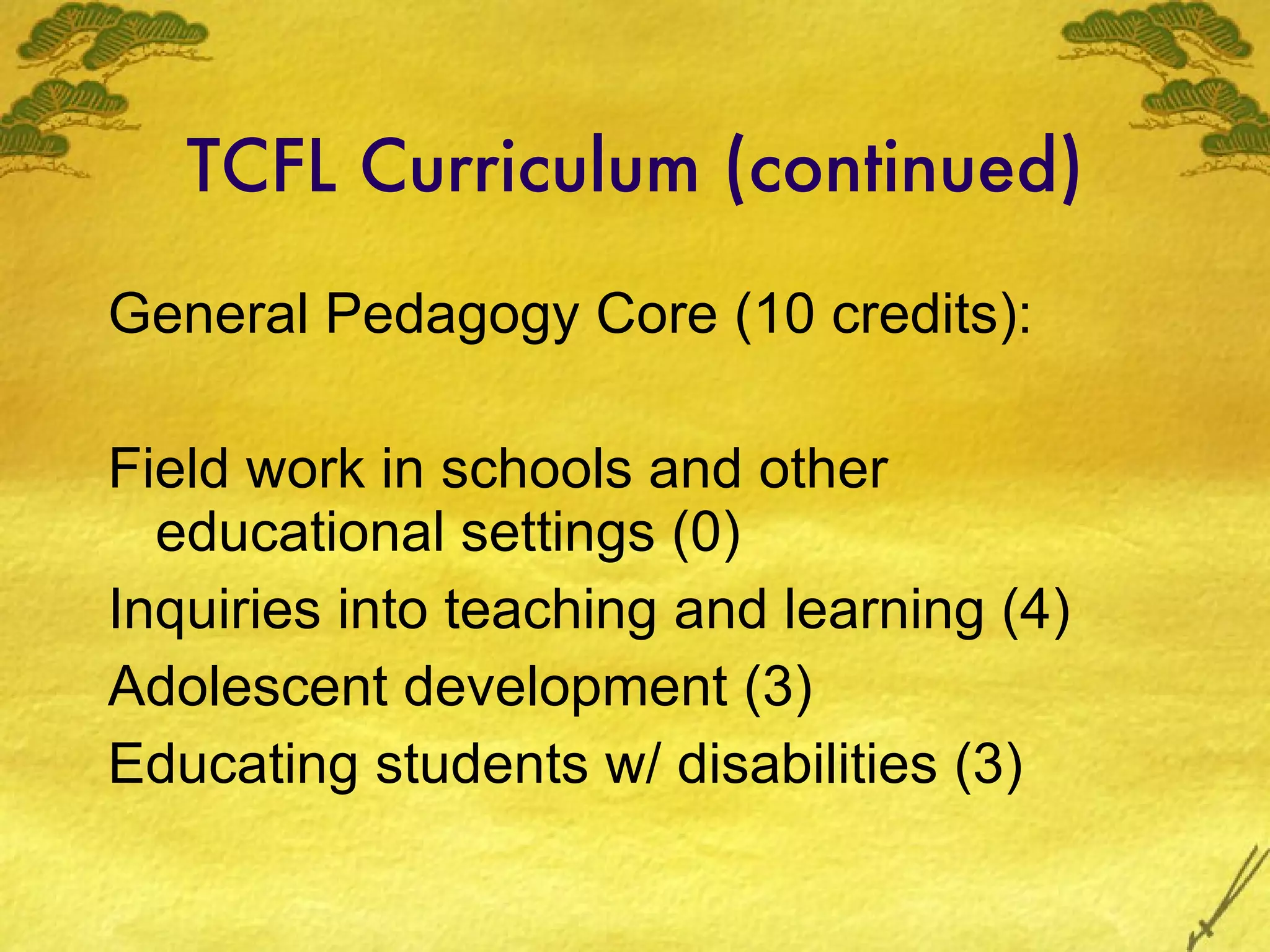
TCFL Curriculum (continued) General Pedagogy Core (10 credits): Field work in schools and other educational settings (0) Inquiries into teaching and learning (4) Adolescent development (3) Educating students w/ disabilities (3)
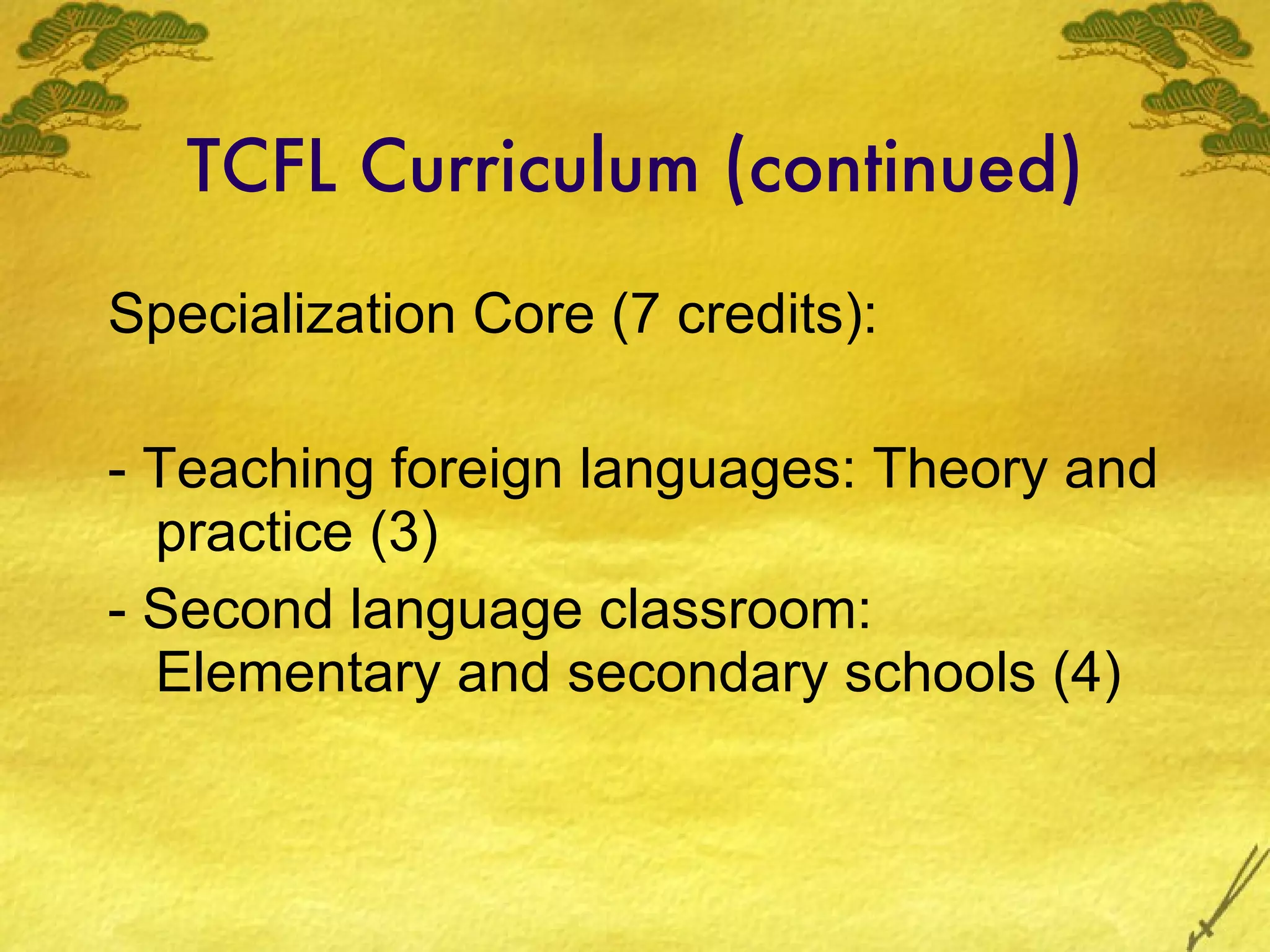
TCFL Curriculum (continued) Specialization Core (7 credits): - Teaching foreign languages: Theory and practice (3) - Second language classroom: Elementary and secondary schools (4)
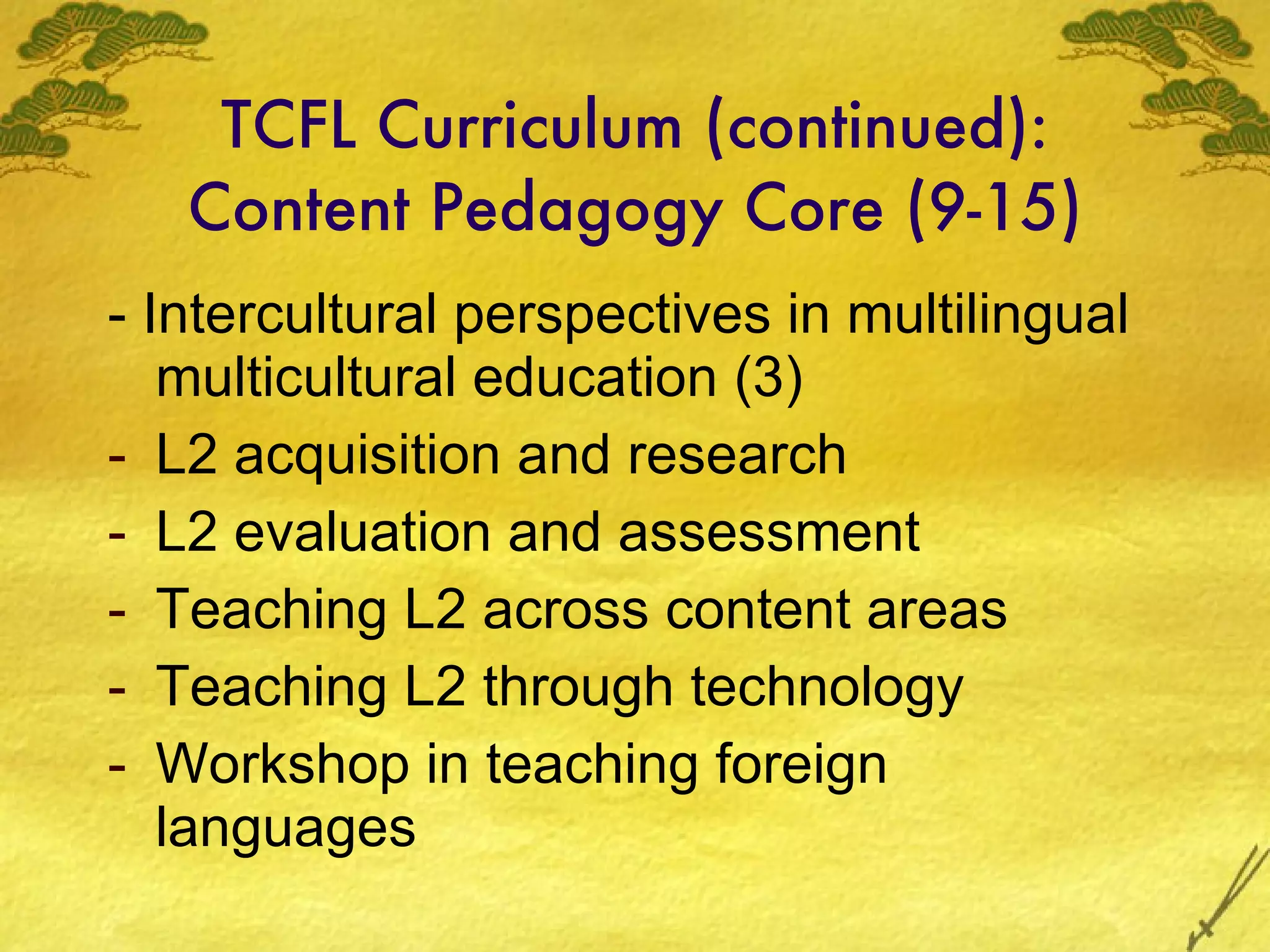
TCFL Curriculum (continued): Content Pedagogy Core (9-15) - Intercultural perspectives in multilingual multicultural education (3) L2 acquisition and research L2 evaluation and assessment Teaching L2 across content areas Teaching L2 through technology Workshop in teaching foreign languages
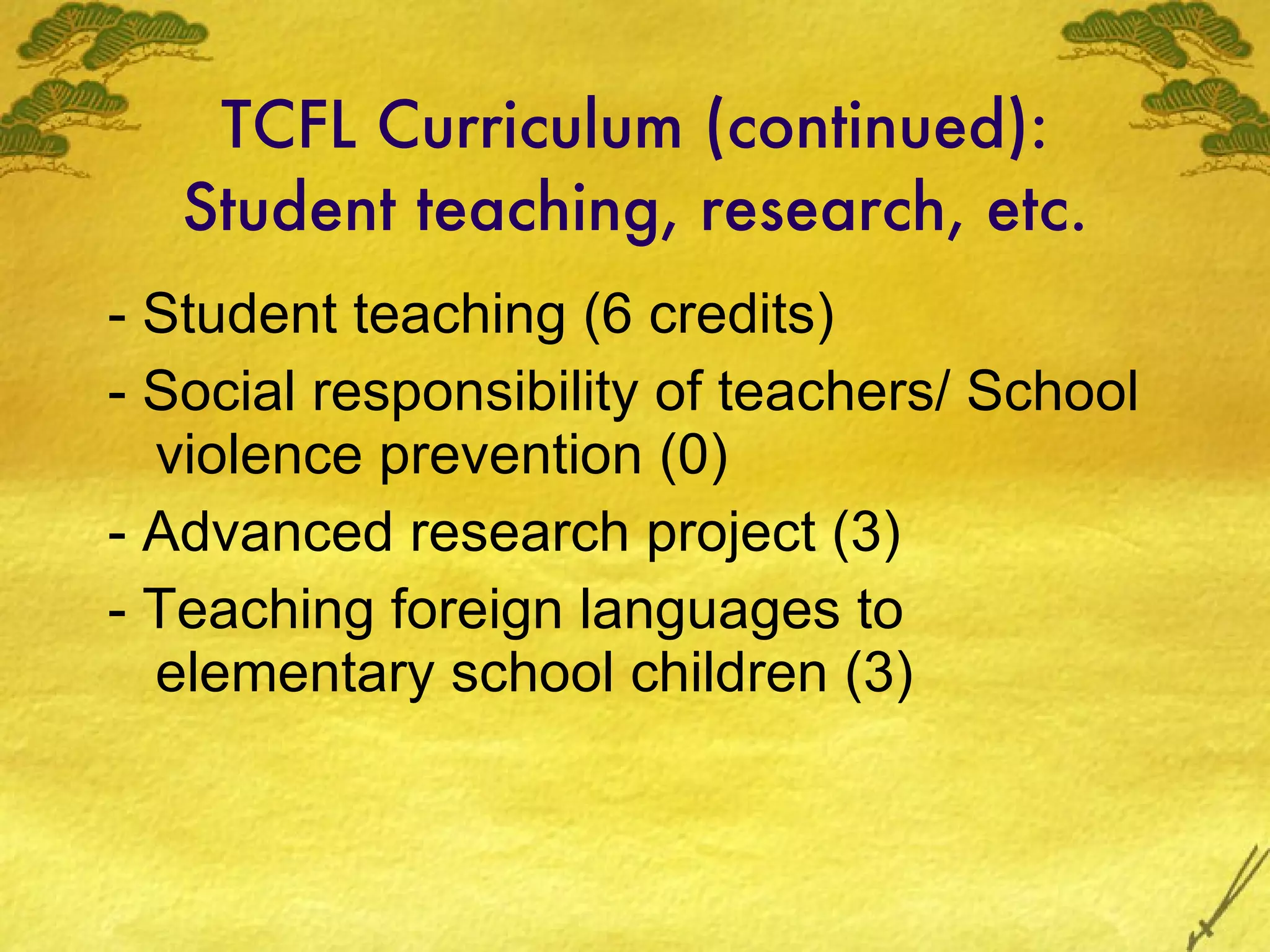
TCFL Curriculum (continued): Student teaching, research, etc. - Student teaching (6 credits) - Social responsibility of teachers/ School violence prevention (0) - Advanced research project (3) - Teaching foreign languages to elementary school children (3)
A Mini-Study on teaching & learning of NYU graduates & students The data is used to reflect on the curriculum and on the quality of learning at NYU Participants were asked to list: - Three skills or areas of knowledge that they have learned in teaching and learning  - Three areas that are most challenging in teaching and learning
Top Ten Challenges in Learning 1. Engage in class discussions with American peers in English 2. Writing academic papers 3. Handle academic reading 4. Learning research skills 5. Understand American education systems
Top Ten Challenges in Learning 6. Adjust to different teaching and  learning style 7. Expressing your own thoughts in class 8. Intensive schedule 9. Time arrangement 10.Interactions with fellow students
Sample response #1: (1)  对美国文化了解不够,如种族歧视、黑人白人、教育均衡化、特殊教育等问题,以及美国教育史方面不占上风 (2)  对美国的基础教育体系没有亲身经历,对很多现实性的问题,没有过亲身体会 (3)  美国的学术研究和中国有很大不同,从格式到研究方法,都非常严肃、标准很高 (4)  听说读写和  native  毕竟还是有差距,表达思想不及母语学生自如
Top Ten Gains in Learning 1. Foreign language teaching techniques 2. Second language acquisition theories 3. Research skills/methods 4. Academic writing and reading skills 5. English proficiency improved
Top Ten Gains in Learning 6. Grouping methods 7. Lesson planning 8. Differentiated instructions 9. The overview of the education system in US 10.Special education
Top Ten Challenges in Teaching 1. Classroom management 2. Hard to motivate students and know what  topics students are interested in 3. Heavy workload 4. Communications with students 5. Diverse students
Top Ten Challenges in Teaching 6. Communication with parents 7. Lack of curriculum and textbook 8. Short break between classes 9. Not respected as a Chinese teacher 10.Little time to communicate with other teachers
Sample #2: (1)   课堂管理比在国内难得多 (2)  用英语教育学生,跟学生讲道理 (3)  和美国学生没有共同语言和兴趣 (4)  如何鼓励美国学生学习中文好不容易 ( 5 )没有教学大纲和教学要求
Top Ten Gains in Teaching 1. Foreign language teaching methodology and effective teaching techniques 2. Classroom management techniques 3. Set ting  class procedures 4. Attending to students’ needs 5. Communications with students
Top Ten Gains in Teaching 6. Lesson planning 7. Technology in teaching 8. Communication with coworkers 9. Curriculum development 10.Differentiated instruction
Experience Gained Modification needed on the existing curriculum Emphasis on foundation on education Emphasis on learning about American school system, students, teachers, and parents
More experience gained More field experiences Classroom management  Emphasis on learning  about  the  Chinese language Emphasis on teaching Chinese to a diverse student population and mixed levels
Lessons Learned Less is better:  Do not try to include everything in the curriculum.  Haste makes waste. Setting realistic goals: High enough to aim at but low enough to achieve. Developing strong communication skills. Creating a personal tool box.
Thank you!

Wang Curran Tang Chinese Language Teacher Preparation

  • 1.
    Chinese Language TeacherPreparation: Experience Gained & Lesson Learned Juefei Wang, Freeman Foundation Mary Curran, Rutgers University Frank Lixing Tang, New York University
  • 2.
    Rutgers Chinese LanguageTeacher Programs Experiences Gained and Lessons Learned Mary Curran [email_address] Graduate School of Education Rutgers, The State University of New Jersey National Chinese Language Conference, 2009
  • 3.
    Plan for PresentationRutgers Chinese Language Teacher Initiatives Critical Issues Lessons We Are Learning
  • 4.
    Rutgers University ChineseLanguage Teacher Initiatives Program Models Graduate School of Education Traditional Ed.M. Degree and Certification Chinese Language Teacher Alternate Route Program Asian Languages and Cultures Department Chinese Masters of Arts for Teachers
  • 5.
    Traditional Master’s Degreewith Certification Programs 45 Credit Programs Two-years, Full-time Study Five-year Program Post-Baccalaureate Program
  • 6.
    Chinese Language TeacherAlternate Route Program 19 Credit Program Pre-Service Summer Component Methods Course Assessment Course Practicum In-Service Academic-Year Component
  • 7.
    Chinese Master ofArts for Teachers 30 Credit Program Students select courses in Chinese language, literature, culture, and pedagogy.
  • 8.
    Generous Support ChineseLanguage Teaching Initiatives Freeman Foundation Chinese Summer Practicum Settings Freeman Foundation STARTALK
  • 9.
    The Guiding FrameworkStandards-based ACTFL Standards Professional Standards Knowing the content matter Knowing how to design instruction and assessments Understanding developmental appropriateness Working with diverse learners Using technology Knowing how to communicate effectively with students, co-workers, parents Connecting learning to the local and global communities Managing life-long professional development
  • 10.
  • 11.
    Critical Issues CollaborativeNature of Developing a High Quality Program Individual Variation in Teacher Candidates’ Needs Pool of Expert Teachers and Teacher Educators
  • 12.
    Critical Issues Needfor Teacher Candidates to buy into Standards-Based Pedagogy Teacher Candidates’ Knowledge Students Language and Culture for U.S. Schools Target Language and Culture Teacher Identity
  • 13.
    Collaboration University Units:Graduate School of Education, Asian Languages and Cultures Department, and World Language Institute New Jersey Department of Education Local School Districts Princeton Regional School District West Windsor-Plainsboro School District Highland Park School District And many others who regularly take our student teachers… Community Guests Expert Teachers Teacher Candidates Students and Parents International Partners
  • 14.
    Making Collaborations WorkFreeman Foundation and STARTALK Funding Investment of Energy and Enthusiasm Time to Develop Trust Regular Communication Planning and evaluation meetings for all collaborators Pre-Program advising for teacher candidates One-on-one feedback sessions with teacher candidates
  • 15.
    Individual Variation in Teacher Candidate Needs Heritage and non-heritage background Chinese dialectal variation Preparation (coursework) in Chinese Previous teaching experience Citizenship or visa status Life situation
  • 16.
    How We Workto Meet Teacher Candidates’ Needs Created multiple routes to professional development and certification Hired a bilingual, bicultural program coordinator Have regular one-on-one feedback sessions with participants Created a Roundtable Networking Group Meets regularly Uses on-line forum for communication and sharing of resources
  • 17.
  • 18.
    Previous participants takeon new roles. Practicum: Program Support Materials Development Teaching Mentoring Traditional Program: Hosts for Student Teachers Continue on for a Master’s Degree Roundtable Network
  • 19.
    Need to Buyinto Standards-Based Pedagogy Target Language Instruction Focus is on Learning to USE language in authentic, meaningful ways, not learning ABOUT language Understanding that language teaching is a field of expertise in its own right
  • 20.
    Solutions Work withdistricts where teacher candidates will observe and participate in best practice; Expose them to flexible settings (summer camps, for example); Have participants reflect upon their own experiences learning languages; and Connect the practical experiences to theory.
  • 21.
    Teacher Knowledge aboutStudents Knowledge about Students in the U.S. Knowledge about Heritage Students Knowledge about K-12 Students
  • 22.
    Knowledge about StudentsDevelopmentally appropriate instruction Practicum experiences with elementary students Practicum experiences with secondary students
  • 23.
    Heritage Language InstructionTeachers need to bridge the gap between their experiences and the experiences of the heritage learners in their classrooms.
  • 24.
    Heritage Language InstructionUnderstand the Chinese language learning experience from an American Born Chinese/Taiwanese (ABC/T) perspective Understand that ABC/Ts have their unique understanding and need of what it means to be Chinese Design curriculum that appropriately takes into consideration the language and cultural needs of ABC/Ts
  • 25.
    Solutions Open communicationabout the sensitive issues of language and identity Hiring teachers who reflect the multiple identities of our Chinese learners Advanced, graduate-level coursework in language socialization and identity
  • 26.
    Teacher Knowledge aboutLanguage and Culture English in a U.S. context Chinese in a U.S. context
  • 27.
    English Proficiency Interpersonal,intrapersonal, and presentational competence for academic work and life at school and interactions with administrators, staff, and parents Intercultural competence
  • 28.
    Solutions Designed andwill implement a new course, English for World Language Teachers. Teacher candidates need to build relationships with teachers outside the Chinese language teaching community.
  • 29.
    Chinese Proficiency Courseworkfor Native Speakers Assessment Whose Chinese? Which Chinese?
  • 30.
    Solutions Collaborations tocreate new courses Create new assessments Help students understand the multiplicity within the Chinese language and culture, and the unique Chinese American culture
  • 31.
    These efforts leadto the possibility of creating a new kind of Chinese language teacher identity.
  • 32.
    We promote a teacher identity where the Teacher is a facilitator to language USE in the classroom as opposed to an absolute authority ABOUT language; Teacher is a bilingual/bicultural bridge between Chinese and American societies; Teacher is a model and promoter of a hybrid and global identity that blends Chinese and American experiences; and Teacher is a life-long learner.
  • 33.
  • 34.
    Chinese language teacherpreparation program at NYU M.A. in Foreign language education (Mandarin Chinese—leading to NYS teacher certification) M.A. in Foreign language education (Mandarin Chinese—not leading to NYS teacher certification) M.A. in FLE and TESOL (leading to dual certification in ESOL and Chinese)
  • 35.
    Department of Teachingand Learning M.A. Teaching Chinese a Foreign Language 7-12 (44 Credits) Content Core (3-9 credits): - Linguistic analysis (3) - Adv Ch for teachers of Chinese (I-3) - Adv Ch for teachers of Chinese (II-3) - Applied linguistics in Chinese (3)
  • 36.
    TCFL Curriculum (continued)General Pedagogy Core (10 credits): Field work in schools and other educational settings (0) Inquiries into teaching and learning (4) Adolescent development (3) Educating students w/ disabilities (3)
  • 37.
    TCFL Curriculum (continued)Specialization Core (7 credits): - Teaching foreign languages: Theory and practice (3) - Second language classroom: Elementary and secondary schools (4)
  • 38.
    TCFL Curriculum (continued):Content Pedagogy Core (9-15) - Intercultural perspectives in multilingual multicultural education (3) L2 acquisition and research L2 evaluation and assessment Teaching L2 across content areas Teaching L2 through technology Workshop in teaching foreign languages
  • 39.
    TCFL Curriculum (continued):Student teaching, research, etc. - Student teaching (6 credits) - Social responsibility of teachers/ School violence prevention (0) - Advanced research project (3) - Teaching foreign languages to elementary school children (3)
  • 40.
    A Mini-Study onteaching & learning of NYU graduates & students The data is used to reflect on the curriculum and on the quality of learning at NYU Participants were asked to list: - Three skills or areas of knowledge that they have learned in teaching and learning - Three areas that are most challenging in teaching and learning
  • 41.
    Top Ten Challengesin Learning 1. Engage in class discussions with American peers in English 2. Writing academic papers 3. Handle academic reading 4. Learning research skills 5. Understand American education systems
  • 42.
    Top Ten Challengesin Learning 6. Adjust to different teaching and learning style 7. Expressing your own thoughts in class 8. Intensive schedule 9. Time arrangement 10.Interactions with fellow students
  • 43.
    Sample response #1:(1) 对美国文化了解不够,如种族歧视、黑人白人、教育均衡化、特殊教育等问题,以及美国教育史方面不占上风 (2) 对美国的基础教育体系没有亲身经历,对很多现实性的问题,没有过亲身体会 (3) 美国的学术研究和中国有很大不同,从格式到研究方法,都非常严肃、标准很高 (4) 听说读写和 native 毕竟还是有差距,表达思想不及母语学生自如
  • 44.
    Top Ten Gainsin Learning 1. Foreign language teaching techniques 2. Second language acquisition theories 3. Research skills/methods 4. Academic writing and reading skills 5. English proficiency improved
  • 45.
    Top Ten Gainsin Learning 6. Grouping methods 7. Lesson planning 8. Differentiated instructions 9. The overview of the education system in US 10.Special education
  • 46.
    Top Ten Challengesin Teaching 1. Classroom management 2. Hard to motivate students and know what topics students are interested in 3. Heavy workload 4. Communications with students 5. Diverse students
  • 47.
    Top Ten Challengesin Teaching 6. Communication with parents 7. Lack of curriculum and textbook 8. Short break between classes 9. Not respected as a Chinese teacher 10.Little time to communicate with other teachers
  • 48.
    Sample #2: (1) 课堂管理比在国内难得多 (2) 用英语教育学生,跟学生讲道理 (3) 和美国学生没有共同语言和兴趣 (4) 如何鼓励美国学生学习中文好不容易 ( 5 )没有教学大纲和教学要求
  • 49.
    Top Ten Gainsin Teaching 1. Foreign language teaching methodology and effective teaching techniques 2. Classroom management techniques 3. Set ting class procedures 4. Attending to students’ needs 5. Communications with students
  • 50.
    Top Ten Gainsin Teaching 6. Lesson planning 7. Technology in teaching 8. Communication with coworkers 9. Curriculum development 10.Differentiated instruction
  • 51.
    Experience Gained Modificationneeded on the existing curriculum Emphasis on foundation on education Emphasis on learning about American school system, students, teachers, and parents
  • 52.
    More experience gainedMore field experiences Classroom management Emphasis on learning about the Chinese language Emphasis on teaching Chinese to a diverse student population and mixed levels
  • 53.
    Lessons Learned Lessis better: Do not try to include everything in the curriculum. Haste makes waste. Setting realistic goals: High enough to aim at but low enough to achieve. Developing strong communication skills. Creating a personal tool box.
  • 54.