Why do we need Rectifiers?
Electrical gadgets like tube, light, fan and refrigerators run on 220V-50Hz main line ac.
However, electronic equipment like radio, mobile charger and computer run on various
values of dc voltages.
Thus we need to be able to convert the ac voltage to various values of dc voltages based
on our requirements.
The process in which a simple harmonic a.c. voltage is converted into unidirectional
voltage, is known as rectification and the circuit used for this conversion is called a
rectifier.
The property of a junction diode is used for rectification.
Transformer is another important element to construct a complete rectifier.
Transformer
In most practical cases, it is required to either
increase or decrease the ac voltage value.
Such type of enhancement or decrement of ac
voltage or current are conveniently achieved with
different types of transformers.
It is a passive device consisting of two closely
wound and electrically isolated coils: primary and
secondary.
It works on the principle of Electromagnetic
Mutual Induction.
When current flows in the Primary Winding, it
behaves as electromagnet. Thus an EMFisinduced in
the Secondary winding as it comes in thearea having
magnetic field lines due to primary winding.
Working Principle
The secondary voltage depends on the ratio of the
number of turns (NP) in primary to the number of turns
(NS) in secondary.
If NS > NP , the secondary voltage becomes larger than
the primary and the secondary current decreases by the
same amount with respect to primary current. This
configuretion is called step-up transformer. Use: the
ac main is substituted by battery power (inverter,
emergency light).
If NS < NP , the secondary voltage decreases than the
primary and the secondary current increases by the
same amount with respect to primary current. This
configuretion is called step-down transformer. Use:
the battery is eliminated by ac main (radio, tape
recorder).
Use of Transformers in Rectifiers
t
Sin
V
v m
P 

The ac voltage applied to the primary of the transformer is assumed to be sinusoidal,
thus can be expressed as:
The amount of the stepped-down ac voltage across the secondary depends upon the
number of secondary coil turns.
The stepped-down sinusoidal voltage amplitude (Vm) is kept much larger than the diode
cut-in voltage.
Thus the voltage drop across the diode is often neglected.
Piecewise Linear Model of Diode
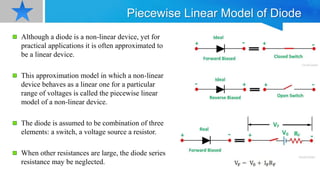
Although a diode is a non-linear device, yet for
practical applications it is often approximated to
be a linear device.
This approximation model in which a non-linear
device behaves as a linear one for a particular
range of voltages is called the piecewise linear
model of a non-linear device.
The diode is assumed to be combination of three
elements: a switch, a voltage source a resistor.
When other resistances are large, the diode series
resistance may be neglected.
Half-wave Rectifier
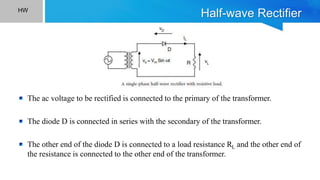
The ac voltage to be rectified is connected to the primary of the transformer.
The diode D is connected in series with the secondary of the transformer.
The other end of the diode D is connected to a load resistance RL and the other end of
the resistance is connected to the other end of the transformer.
HW
Working Principle of Half-wave Rectifier
Voltage & Current Waveforms of Half-wave Rectifier
Average DC Voltage
figure
(1)
(2)
(3)
(1)
Root Mean Square Voltage
(4)
(5)
(6)
(4)
Ripple Factor
(15)
(16)
(16)
(15)
(17)
(18)
Center-tapped Transformer
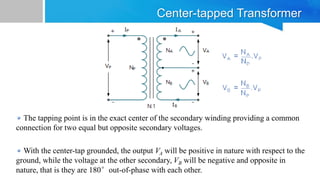
The tapping point is in the exact center of the secondary winding providing a common
connection for two equal but opposite secondary voltages.
With the center-tap grounded, the output VA will be positive in nature with respect to the
ground, while the voltage at the other secondary, VB will be negative and opposite in
nature, that is they are 180°out-of-phase with each other.
Full-wave Rectifier
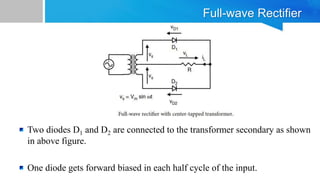
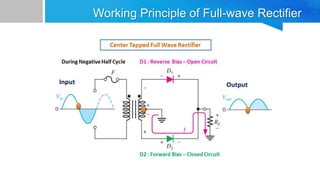
Two diodes D1 and D2 are connected to the transformer secondary as shown
in above figure.
One diode gets forward biased in each half cycle of the input.
Working Principle of Full-wave Rectifier
Average DC Voltage
(1)
(23)
(24)
the figure
/
Root Mean Square Voltage
(25)
(26)
(4)
(26)
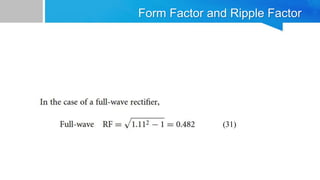
Form Factor and Ripple Factor
(30)
(31)
(28) (27) (13)
Comparison of Full-wave and Half-wave Rectifier
0.572
Bridge Rectifier
An alternative implementation of the full-wave
rectifier is bridge rectifier.
It does not require center-tapped transformer.
Four diodes are utilized instead of two.
/
Working Principle of Bridge Rectifier
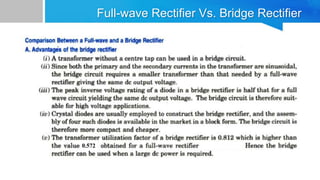
Full-wave Rectifier Vs. Bridge Rectifier
0.572
Disadvantages of Bridge Rectifier

Half- wave and Full-wave Rectifiers.pptx

  • 2.
    Why do weneed Rectifiers? Electrical gadgets like tube, light, fan and refrigerators run on 220V-50Hz main line ac. However, electronic equipment like radio, mobile charger and computer run on various values of dc voltages. Thus we need to be able to convert the ac voltage to various values of dc voltages based on our requirements. The process in which a simple harmonic a.c. voltage is converted into unidirectional voltage, is known as rectification and the circuit used for this conversion is called a rectifier. The property of a junction diode is used for rectification. Transformer is another important element to construct a complete rectifier.
  • 3.
    Transformer In most practicalcases, it is required to either increase or decrease the ac voltage value. Such type of enhancement or decrement of ac voltage or current are conveniently achieved with different types of transformers. It is a passive device consisting of two closely wound and electrically isolated coils: primary and secondary. It works on the principle of Electromagnetic Mutual Induction. When current flows in the Primary Winding, it behaves as electromagnet. Thus an EMFisinduced in the Secondary winding as it comes in thearea having magnetic field lines due to primary winding.
  • 4.
    Working Principle The secondaryvoltage depends on the ratio of the number of turns (NP) in primary to the number of turns (NS) in secondary. If NS > NP , the secondary voltage becomes larger than the primary and the secondary current decreases by the same amount with respect to primary current. This configuretion is called step-up transformer. Use: the ac main is substituted by battery power (inverter, emergency light). If NS < NP , the secondary voltage decreases than the primary and the secondary current increases by the same amount with respect to primary current. This configuretion is called step-down transformer. Use: the battery is eliminated by ac main (radio, tape recorder).
  • 5.
    Use of Transformersin Rectifiers t Sin V v m P   The ac voltage applied to the primary of the transformer is assumed to be sinusoidal, thus can be expressed as: The amount of the stepped-down ac voltage across the secondary depends upon the number of secondary coil turns. The stepped-down sinusoidal voltage amplitude (Vm) is kept much larger than the diode cut-in voltage. Thus the voltage drop across the diode is often neglected.
  • 6.
    Piecewise Linear Modelof Diode Although a diode is a non-linear device, yet for practical applications it is often approximated to be a linear device. This approximation model in which a non-linear device behaves as a linear one for a particular range of voltages is called the piecewise linear model of a non-linear device. The diode is assumed to be combination of three elements: a switch, a voltage source a resistor. When other resistances are large, the diode series resistance may be neglected.
  • 8.
    Half-wave Rectifier The acvoltage to be rectified is connected to the primary of the transformer. The diode D is connected in series with the secondary of the transformer. The other end of the diode D is connected to a load resistance RL and the other end of the resistance is connected to the other end of the transformer. HW
  • 9.
    Working Principle ofHalf-wave Rectifier
  • 10.
    Voltage & CurrentWaveforms of Half-wave Rectifier
  • 11.
  • 12.
    Root Mean SquareVoltage (4) (5) (6) (4)
  • 13.
  • 15.
    Center-tapped Transformer The tappingpoint is in the exact center of the secondary winding providing a common connection for two equal but opposite secondary voltages. With the center-tap grounded, the output VA will be positive in nature with respect to the ground, while the voltage at the other secondary, VB will be negative and opposite in nature, that is they are 180°out-of-phase with each other.
  • 16.
    Full-wave Rectifier Two diodesD1 and D2 are connected to the transformer secondary as shown in above figure. One diode gets forward biased in each half cycle of the input.
  • 17.
    Working Principle ofFull-wave Rectifier
  • 18.
    Working Principle ofFull-wave Rectifier
  • 19.
  • 20.
    Root Mean SquareVoltage (25) (26) (4) (26)
  • 21.
    Form Factor andRipple Factor (30) (31) (28) (27) (13)
  • 22.
    Comparison of Full-waveand Half-wave Rectifier 0.572
  • 24.
    Bridge Rectifier An alternativeimplementation of the full-wave rectifier is bridge rectifier. It does not require center-tapped transformer. Four diodes are utilized instead of two. /
  • 25.
    Working Principle ofBridge Rectifier
  • 26.
    Working Principle ofBridge Rectifier
  • 27.
    Full-wave Rectifier Vs.Bridge Rectifier 0.572
  • 28.