SYSTEMATIC REVIEWS
PRESENTED BY:
Clara Fowler
Manager of Research Services & Assessment
Part 2: EMBASE, GreyLit, and Citation
Management
Daniel Parks. “The Bridges of UC Berkeley.” March 12, 2012. https://www.flickr.com/photos/parksdh/6879107592/
AGENDA
1. Construct a EMBASE Search that
complements your MEDLINE search
2. Discuss other databases to consider for
searching
3. Understand the role of GreyLit in
systematic reviews
4. Searching for clinical trials
5. Download and manage results
EMBASE
• Run the MEDLINE search in EMBASE – identify syntax
and term problems
• Pay attention to methods filters
Randomized Controlled Trial Filters:
https://guides.library.ualberta.ca/health-sciences-
search-filters/study-type-filters
• EMBASE usually yields more results than MEDLINE
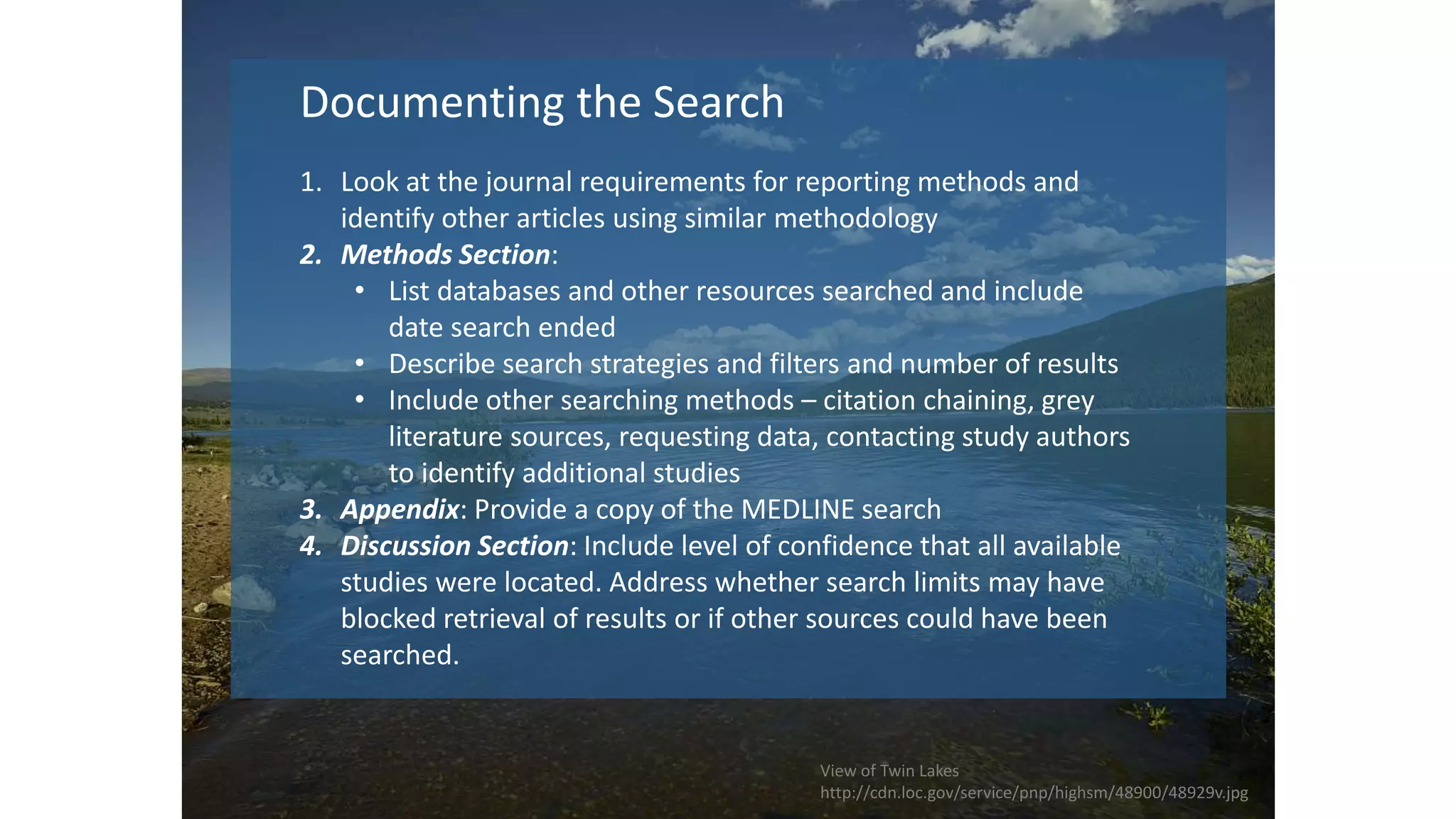
View of Twin Lakes
http://cdn.loc.gov/service/pnp/highsm/48900/48929v.jpg
Search Tips
• Select ‘Advanced Search’ to access additional tools for creating complex search
strategies and to search using index terms (MeSH).
• Supports common search syntax: Boolean operators (AND, OR, NOT); proximity
operators (NEAR, NEXT); and truncation (*, or ?).
• [mh] is used to indicate the search term/string contains a MeSH heading
• Phrases must be placed in double quotation marks, e.g. [mh “cholesteatoma,
middle ear”]
• ^ can be placed before the MeSH heading to turn explosion off.
Parker Dam: http://cdn.loc.gov/service/pnp/habshaer/az/az0400/az0467/photos/193678pv.jpg
Common Database Searching Problems
• Different interfaces and search options
• Maximum number of records downloaded
simultaneously
• Automatic log outs
• Errors in database records
• Time it takes to do a thorough search
• Saving strategies to rerun later
• Tracking results
Andreas Levers. “Impact.” February 17, 2009. https://www.flickr.com/photos/96dpi/3287904733/
Searching: Shortcuts and Timesavers
• Systematic Review Accelerator
http://crebp-sra.com/#/polyglot
Translates search syntax into different databases
• Literature Search Hedges & Filters
http://mdanderson.libguides.com/searchhedges
Use tested strategies to help you construct a search
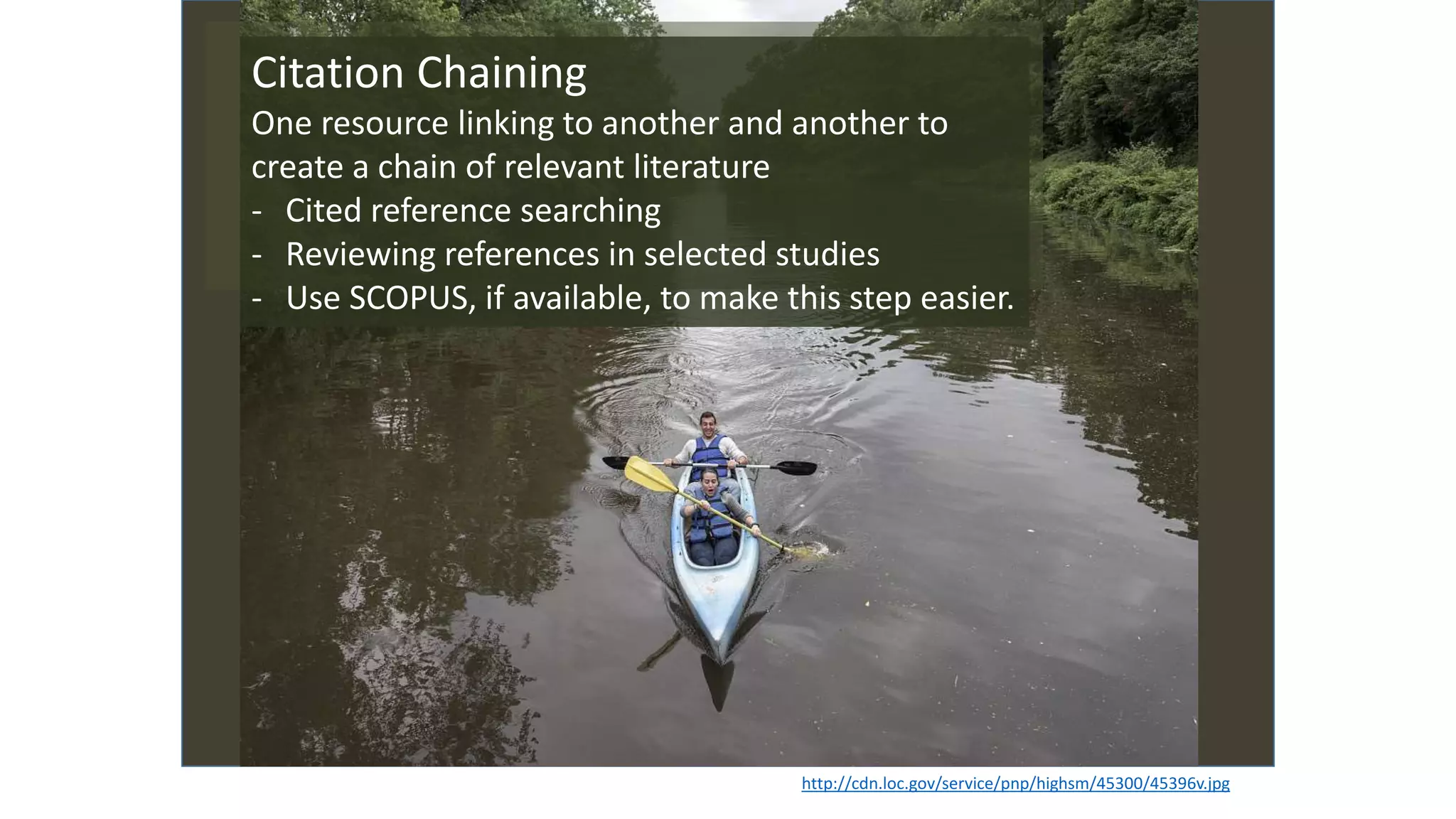
http://cdn.loc.gov/service/pnp/highsm/45300/45396v.jpg
Citation Chaining
One resource linking to another and another to
create a chain of relevant literature
- Cited reference searching
- Reviewing references in selected studies
- Use SCOPUS, if available, to make this step easier.
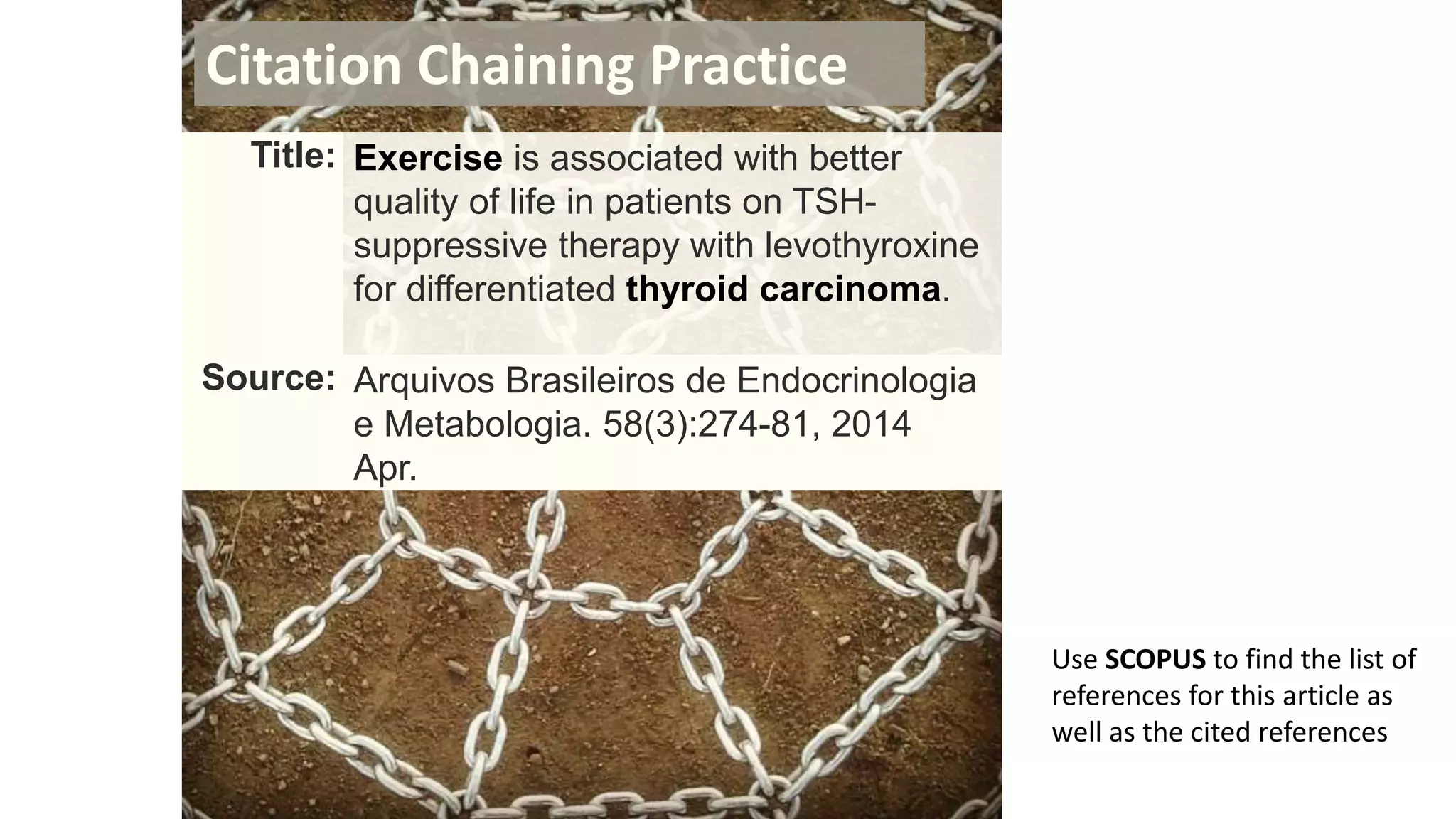
Title: Exercise is associated with better
quality of life in patients on TSH-
suppressive therapy with levothyroxine
for differentiated thyroid carcinoma.
Source: Arquivos Brasileiros de Endocrinologia
e Metabologia. 58(3):274-81, 2014
Apr.
Citation Chaining Practice
Use SCOPUS to find the list of
references for this article as
well as the cited references
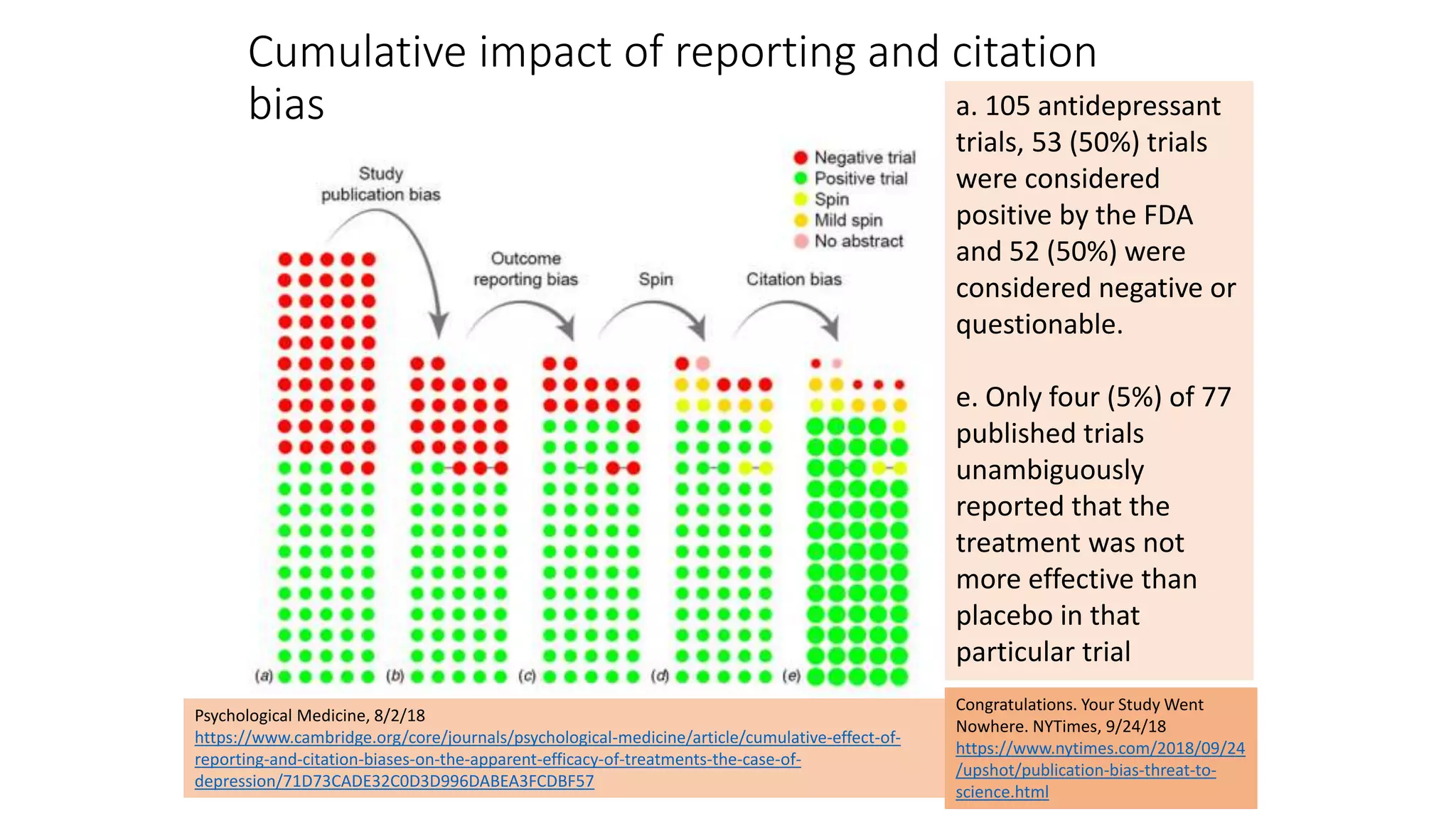
Cumulative impact of reporting and citation
bias a. 105 antidepressant
trials, 53 (50%) trials
were considered
positive by the FDA
and 52 (50%) were
considered negative or
questionable.
e. Only four (5%) of 77
published trials
unambiguously
reported that the
treatment was not
more effective than
placebo in that
particular trial
Psychological Medicine, 8/2/18
https://www.cambridge.org/core/journals/psychological-medicine/article/cumulative-effect-of-
reporting-and-citation-biases-on-the-apparent-efficacy-of-treatments-the-case-of-
depression/71D73CADE32C0D3D996DABEA3FCDBF57
Congratulations. Your Study Went
Nowhere. NYTimes, 9/24/18
https://www.nytimes.com/2018/09/24
/upshot/publication-bias-threat-to-
science.html
GREY Literature
1. Identify key societies
in the field and at
least one source for
clinical trials
2. Keep the search very
simple and use only
core concepts
3. Record where, when,
and how you searched
so that you can report
it in the methods
section
4. Contact study authors
for additional data
Grey Literature is produced at all levels of government,
academics, business and industry in print and
electronic formats, but it is not controlled by
commercial publishers
Results from grey literature can significantly affect the
outcome of the systematic review as grey literature
often reports more negative or inconclusive results
Examples of Grey Literature:
reports, conference abstracts, dissertations,
unpublished clinical trials, and white papers
Sources of Grey Literature:
Dissertations:
https://pqdtopen.proquest.com/search.html
Clinical Trials:
http://mdanderson.libguides.com/clinicaltrials
Conference Abstracts and White Papers – professional
society websites
Global Index Medicus (WHO):
http://www.globalhealthlibrary.net/php/index.php
DATABASE
Tutorials
Ovid including MEDLINE, EMBASE, PsycInfo
http://www.ovid.com/site/support/training.jsp
EBSCO including CINAHL and other EBSCO-hosted databases
https://help.ebsco.com/interfaces/CINAHL_MEDLINE_Databases/Training_
Promotion/CINAHL_Databases_Basic_Searching_Tutorial
Cochrane Library
http://www.cochranelibrary.com/help/how-to-use-cochrane-library.html
Web of Science
https://www.youtube.com/watch?v=xwhy0JBHlMw
SCOPUS
https://youtu.be/4_gGIuZhMnw
PubMed
https://www.nlm.nih.gov/bsd/disted/pubmedtutorial/cover.html
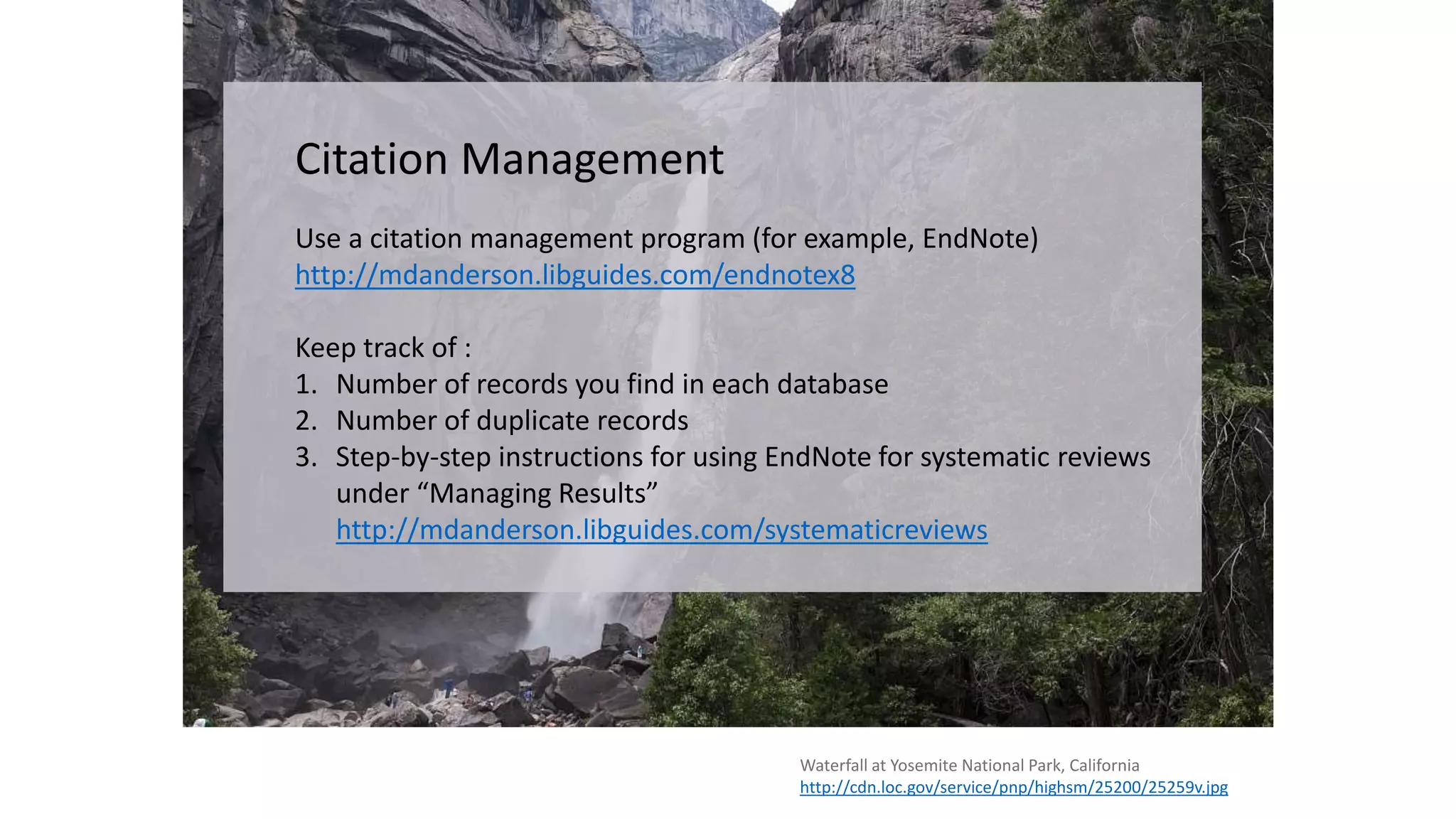
Waterfall at Yosemite National Park, California
http://cdn.loc.gov/service/pnp/highsm/25200/25259v.jpg
Citation Management
Use a citation management program (for example, EndNote)
http://mdanderson.libguides.com/endnotex8
Keep track of :
1. Number of records you find in each database
2. Number of duplicate records
3. Step-by-step instructions for using EndNote for systematic reviews
under “Managing Results”
http://mdanderson.libguides.com/systematicreviews
Citation Management
Using systematic review software
Rayyan,
https://rayyan.qcri.org/
freely available systematic
review software
Covidence,
https://www.covidence.org/
Free to Cochrane Reviewers
and a limited number of
projects are supported by
the library.
Documenting the Search
1. Look at the journal requirements for reporting methods and
identify other articles using similar methodology
2. Methods Section:
• List databases and other resources searched and include
date search ended
• Describe search strategies and filters and number of results
• Include other searching methods – citation chaining, grey
literature sources, requesting data, contacting study authors
to identify additional studies
3. Appendix: Provide a copy of the MEDLINE search
4. Discussion Section: Include level of confidence that all available
studies were located. Address whether search limits may have
blocked retrieval of results or if other sources could have been
searched.
View of Twin Lakes
http://cdn.loc.gov/service/pnp/highsm/48900/48929v.jpg
Clara Fowler
Manager of Research Services & Assessment
cfowler@mdanderson.org
Questions

Systematic reviews searching part 2 2019

  • 1.
    SYSTEMATIC REVIEWS PRESENTED BY: ClaraFowler Manager of Research Services & Assessment Part 2: EMBASE, GreyLit, and Citation Management
  • 2.
    Daniel Parks. “TheBridges of UC Berkeley.” March 12, 2012. https://www.flickr.com/photos/parksdh/6879107592/ AGENDA 1. Construct a EMBASE Search that complements your MEDLINE search 2. Discuss other databases to consider for searching 3. Understand the role of GreyLit in systematic reviews 4. Searching for clinical trials 5. Download and manage results
  • 3.
    EMBASE • Run theMEDLINE search in EMBASE – identify syntax and term problems • Pay attention to methods filters Randomized Controlled Trial Filters: https://guides.library.ualberta.ca/health-sciences- search-filters/study-type-filters • EMBASE usually yields more results than MEDLINE View of Twin Lakes http://cdn.loc.gov/service/pnp/highsm/48900/48929v.jpg
  • 4.
    Search Tips • Select‘Advanced Search’ to access additional tools for creating complex search strategies and to search using index terms (MeSH). • Supports common search syntax: Boolean operators (AND, OR, NOT); proximity operators (NEAR, NEXT); and truncation (*, or ?). • [mh] is used to indicate the search term/string contains a MeSH heading • Phrases must be placed in double quotation marks, e.g. [mh “cholesteatoma, middle ear”] • ^ can be placed before the MeSH heading to turn explosion off.
  • 5.
    Parker Dam: http://cdn.loc.gov/service/pnp/habshaer/az/az0400/az0467/photos/193678pv.jpg CommonDatabase Searching Problems • Different interfaces and search options • Maximum number of records downloaded simultaneously • Automatic log outs • Errors in database records • Time it takes to do a thorough search • Saving strategies to rerun later • Tracking results
  • 6.
    Andreas Levers. “Impact.”February 17, 2009. https://www.flickr.com/photos/96dpi/3287904733/ Searching: Shortcuts and Timesavers • Systematic Review Accelerator http://crebp-sra.com/#/polyglot Translates search syntax into different databases • Literature Search Hedges & Filters http://mdanderson.libguides.com/searchhedges Use tested strategies to help you construct a search
  • 7.
    http://cdn.loc.gov/service/pnp/highsm/45300/45396v.jpg Citation Chaining One resourcelinking to another and another to create a chain of relevant literature - Cited reference searching - Reviewing references in selected studies - Use SCOPUS, if available, to make this step easier.
  • 8.
    Title: Exercise isassociated with better quality of life in patients on TSH- suppressive therapy with levothyroxine for differentiated thyroid carcinoma. Source: Arquivos Brasileiros de Endocrinologia e Metabologia. 58(3):274-81, 2014 Apr. Citation Chaining Practice Use SCOPUS to find the list of references for this article as well as the cited references
  • 9.
    Cumulative impact ofreporting and citation bias a. 105 antidepressant trials, 53 (50%) trials were considered positive by the FDA and 52 (50%) were considered negative or questionable. e. Only four (5%) of 77 published trials unambiguously reported that the treatment was not more effective than placebo in that particular trial Psychological Medicine, 8/2/18 https://www.cambridge.org/core/journals/psychological-medicine/article/cumulative-effect-of- reporting-and-citation-biases-on-the-apparent-efficacy-of-treatments-the-case-of- depression/71D73CADE32C0D3D996DABEA3FCDBF57 Congratulations. Your Study Went Nowhere. NYTimes, 9/24/18 https://www.nytimes.com/2018/09/24 /upshot/publication-bias-threat-to- science.html
  • 10.
    GREY Literature 1. Identifykey societies in the field and at least one source for clinical trials 2. Keep the search very simple and use only core concepts 3. Record where, when, and how you searched so that you can report it in the methods section 4. Contact study authors for additional data Grey Literature is produced at all levels of government, academics, business and industry in print and electronic formats, but it is not controlled by commercial publishers Results from grey literature can significantly affect the outcome of the systematic review as grey literature often reports more negative or inconclusive results Examples of Grey Literature: reports, conference abstracts, dissertations, unpublished clinical trials, and white papers Sources of Grey Literature: Dissertations: https://pqdtopen.proquest.com/search.html Clinical Trials: http://mdanderson.libguides.com/clinicaltrials Conference Abstracts and White Papers – professional society websites Global Index Medicus (WHO): http://www.globalhealthlibrary.net/php/index.php
  • 11.
    DATABASE Tutorials Ovid including MEDLINE,EMBASE, PsycInfo http://www.ovid.com/site/support/training.jsp EBSCO including CINAHL and other EBSCO-hosted databases https://help.ebsco.com/interfaces/CINAHL_MEDLINE_Databases/Training_ Promotion/CINAHL_Databases_Basic_Searching_Tutorial Cochrane Library http://www.cochranelibrary.com/help/how-to-use-cochrane-library.html Web of Science https://www.youtube.com/watch?v=xwhy0JBHlMw SCOPUS https://youtu.be/4_gGIuZhMnw PubMed https://www.nlm.nih.gov/bsd/disted/pubmedtutorial/cover.html
  • 12.
    Waterfall at YosemiteNational Park, California http://cdn.loc.gov/service/pnp/highsm/25200/25259v.jpg Citation Management Use a citation management program (for example, EndNote) http://mdanderson.libguides.com/endnotex8 Keep track of : 1. Number of records you find in each database 2. Number of duplicate records 3. Step-by-step instructions for using EndNote for systematic reviews under “Managing Results” http://mdanderson.libguides.com/systematicreviews
  • 13.
    Citation Management Using systematicreview software Rayyan, https://rayyan.qcri.org/ freely available systematic review software Covidence, https://www.covidence.org/ Free to Cochrane Reviewers and a limited number of projects are supported by the library.
  • 14.
    Documenting the Search 1.Look at the journal requirements for reporting methods and identify other articles using similar methodology 2. Methods Section: • List databases and other resources searched and include date search ended • Describe search strategies and filters and number of results • Include other searching methods – citation chaining, grey literature sources, requesting data, contacting study authors to identify additional studies 3. Appendix: Provide a copy of the MEDLINE search 4. Discussion Section: Include level of confidence that all available studies were located. Address whether search limits may have blocked retrieval of results or if other sources could have been searched. View of Twin Lakes http://cdn.loc.gov/service/pnp/highsm/48900/48929v.jpg
  • 15.
    Clara Fowler Manager ofResearch Services & Assessment cfowler@mdanderson.org Questions