Faculty of Dentistry
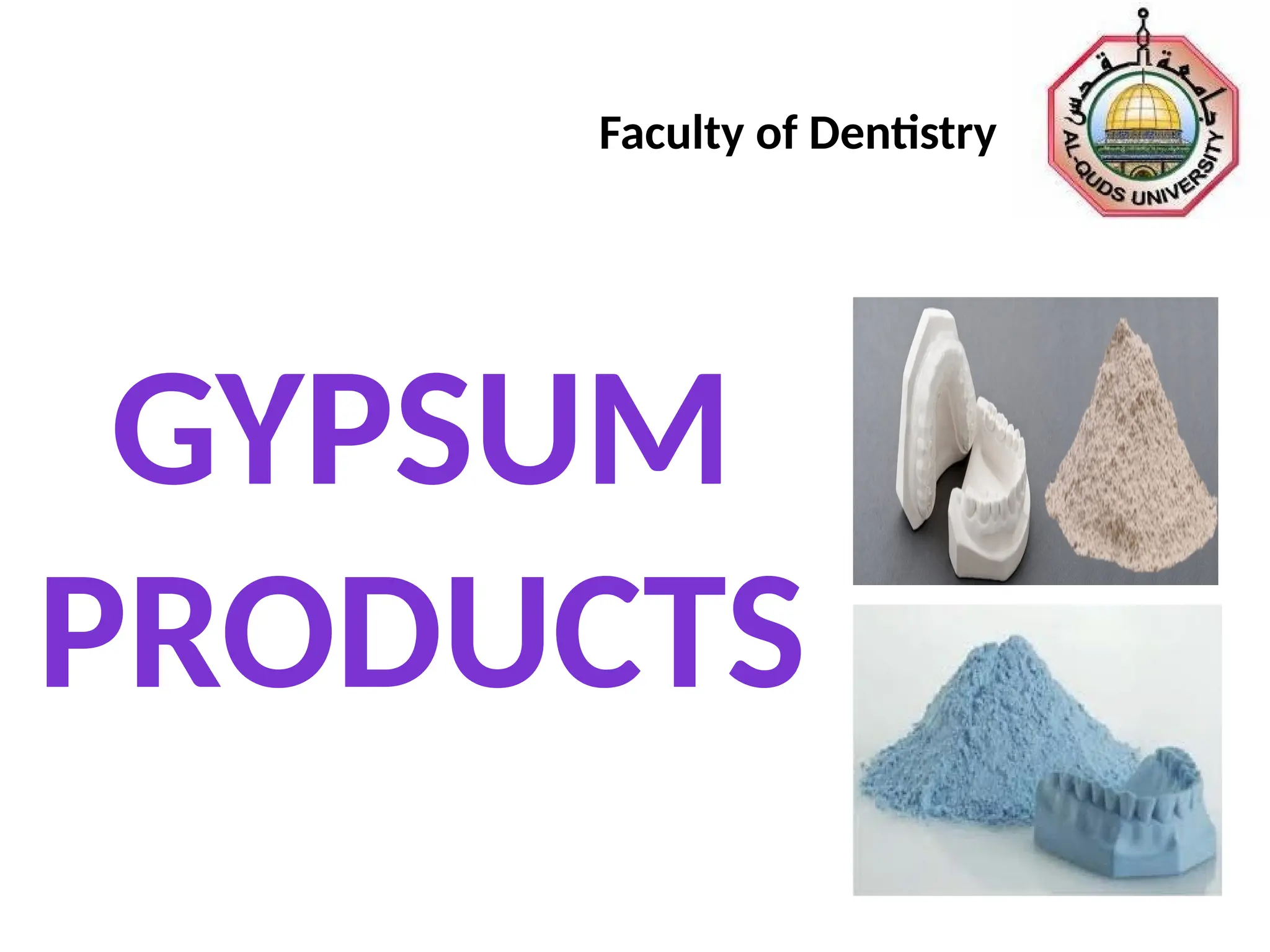
GYPSUM
PRODUCTS
The outline of this presentation
• Introduction
• Gypsom types
• Requirements of dental cast materials
• Composition
• Manipulation and setting characteristics
• Setting Time
• Control expantion
• Properties of setting
• Applications
• Advantages and disadvantages
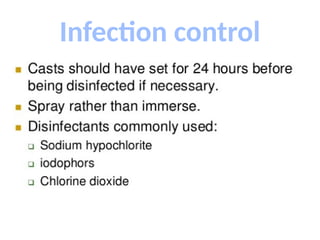
• Infection control
• References
Introduction
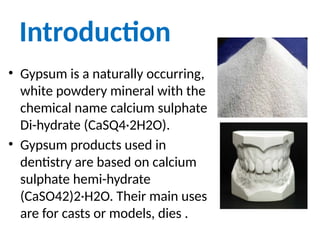
• Gypsum is a naturally occurring,
white powdery mineral with the
chemical name calcium sulphate
Di-hydrate (CaSQ4·2H2O).
• Gypsum products used in
dentistry are based on calcium
sulphate hemi-hydrate
(CaSO42)2·H2O. Their main uses
are for casts or models, dies .
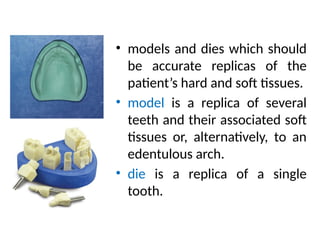
• models and dies which should
be accurate replicas of the
patient’s hard and soft tissues.
• model is a replica of several
teeth and their associated soft
tissues or, alternatively, to an
edentulous arch.
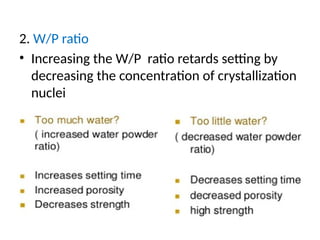
• die is a replica of a single
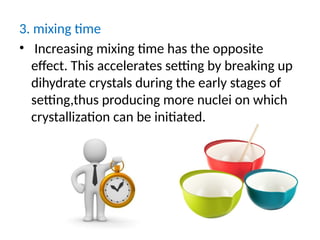
tooth.
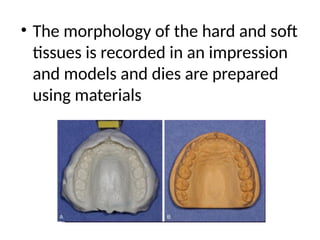
• The morphology of the hard and soft
tissues is recorded in an impression
and models and dies are prepared
using materials
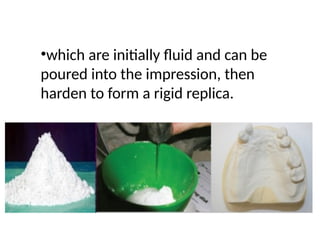
•which are initially fluid and can be
poured into the impression, then
harden to form a rigid replica.
Types of Gypsom products according to
current ISO
F I V E T Y P E S
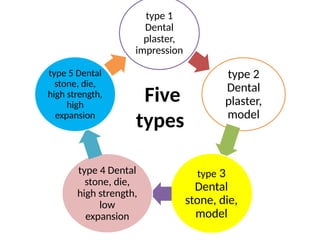
type 1
Dental
plaster,
impression
type 2
Dental
plaster,
model
type 3
Dental
stone, die,
model
type 4 Dental
stone, die,
high strength,
low
expansion
type 5 Dental
stone, die,
high strength,
high
expansion
Five
types
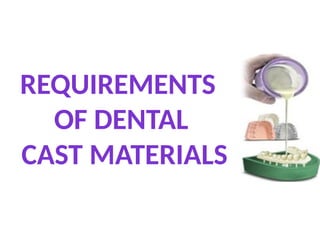
REQUIREMENTS
OF DENTAL
CAST MATERIALS
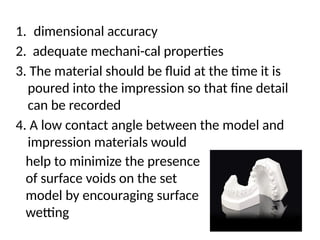
1. dimensional accuracy
2. adequate mechani-cal properties
3. The material should be fluid at the time it is
poured into the impression so that fine detail
can be recorded
4. A low contact angle between the model and
impression materials would
help to minimize the presence
of surface voids on the set
model by encouraging surface
wetting
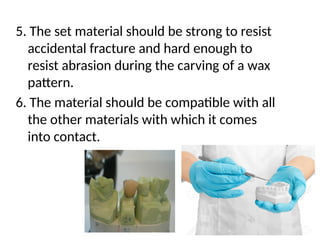
5. The set material should be strong to resist
accidental fracture and hard enough to
resist abrasion during the carving of a wax
pattern.
6. The material should be compatible with all
the other materials with which it comes
into contact.
COMPOSITION
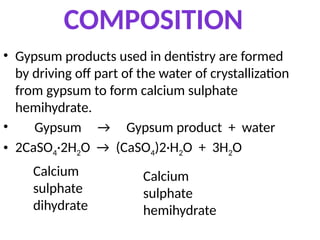
• Gypsum products used in dentistry are formed
by driving off part of the water of crystallization
from gypsum to form calcium sulphate
hemihydrate.
• Gypsum → Gypsum product + water
• 2CaSO4·2H2O → (CaSO4)2·H2O + 3H2O
Calcium
sulphate
dihydrate
Calcium
sulphate
hemihydrate
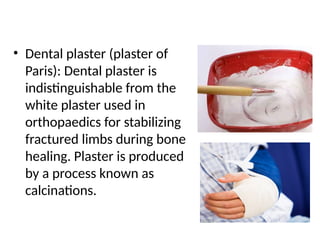
• Dental plaster (plaster of
Paris): Dental plaster is
indistinguishable from the
white plaster used in
orthopaedics for stabilizing
fractured limbs during bone
healing. Plaster is produced
by a process known as
calcinations.
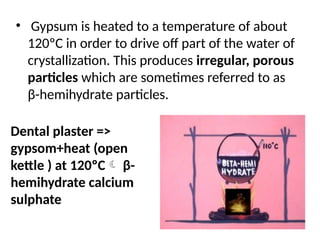
• Gypsum is heated to a temperature of about
120ºC in order to drive off part of the water of
crystallization. This produces irregular, porous
particles which are sometimes referred to as
β-hemihydrate particles.
Dental plaster =>
gypsom+heat (open
kettle ) at 120ºC β-
hemihydrate calcium
sulphate
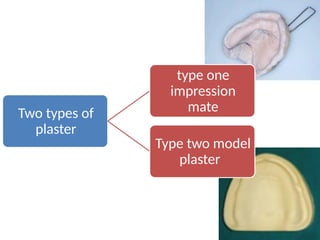
Two types of
plaster
type one
impression
mate
Type two model
plaster
• Overheating the gypsum may cause further
loss of water to form calcium sulphate
anhydrite (CaSO4)
• underheating produces a significant
concentration of residual dihydrate. The
presence of both components has a marked
influence upon the setting characteristics of
the resultant plaster.
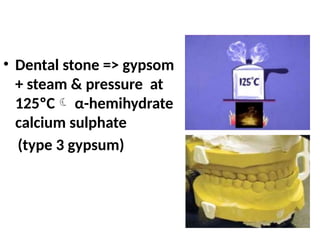
• Dental stone => gypsom
+ steam & pressure at
125ºC α-hemihydrate
calcium sulphate
(type 3 gypsum)
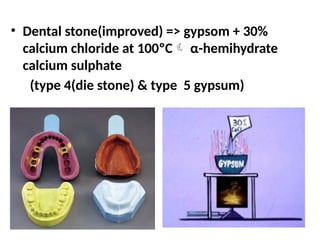
• Dental stone(improved) => gypsom + 30%
calcium chloride at 100ºC α-hemihydrate
calcium sulphate
(type 4(die stone) & type 5 gypsum)
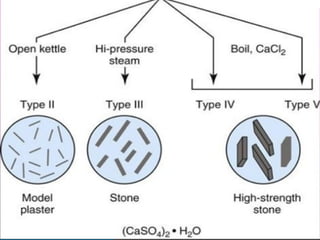
• Dental stone: Dental stones may be produced
byone of two methods. If gypsum is heated to
about125ºC under steam pressure in an
autoclave a more regular and less porous
hemihydrate is formed This is sometimes
referred to as an α-hemihydrate. Alternatively,
gypsum may be boiled in a solution of a salt
such as CaCl2. This gives a material similar to
that produced by autoclaving but with even
less porosity. Manufacturers normally add
small quantities of a dye to dental stones in
order that they may be differentiated from
dental plaster, which is white.
Manipulation
and setting
characteristics
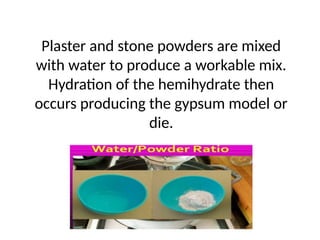
Plaster and stone powders are mixed
with water to produce a workable mix.
Hydration of the hemihydrate then
occurs producing the gypsum model or
die.
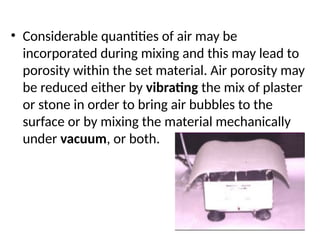
• Considerable quantities of air may be
incorporated during mixing and this may lead to
porosity within the set material. Air porosity may
be reduced either by vibrating the mix of plaster
or stone in order to bring air bubbles to the
surface or by mixing the material mechanically
under vacuum, or both.
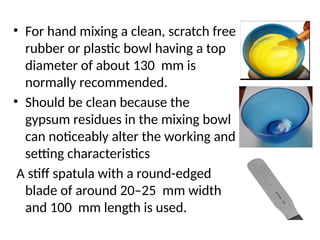
• For hand mixing a clean, scratch free
rubber or plastic bowl having a top
diameter of about 130 mm is
normally recommended.
• Should be clean because the
gypsum residues in the mixing bowl
can noticeably alter the working and
setting characteristics
A stiff spatula with a round-edged
blade of around 20–25 mm width
and 100 mm length is used.
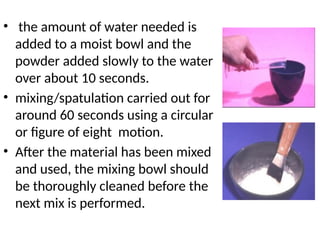
• the amount of water needed is
added to a moist bowl and the
powder added slowly to the water
over about 10 seconds.
• mixing/spatulation carried out for
around 60 seconds using a circular
or figure of eight motion.
• After the material has been mixed
and used, the mixing bowl should
be thoroughly cleaned before the
next mix is performed.
• The crystals of dihydrate are spherulitic in nature
and grow from specific sites called nuclei of
crystallization. These may be small particles of
impurity, such as unconverted gypsum crystals,
within the hemihydrate powder. If a thin mix of
material is used, containing more water, the
formation of the super-saturated solution of
dihydrate which is a precursor to crystallization is
delayed and the centers of nucleation are more
widely dispersed by the dilution effect. The set
plaster is therefore less dense with greater spaces
between crystals leading to a significant reduction
in strength.
• The material should be used as soon as
possible after mixing since its viscosity
increases to the stage where the material
is unworkable within a few minutes.
• The setting reaction is exothermic
• The setting characteristics of gypsum products
can be affected
1.by the presence of unconverted dihydrate
2.by the presence of anhydrite
3.the age of the material
4. the storage conditions
• Small quantities of unconverted dihydrate act
as centres of nucleation as mentioned earlier.
• Anhydrite reacts very rapidly with water
producing a marked acceleration in setting.
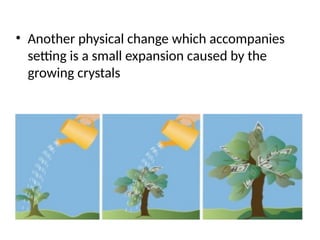
• Another physical change which accompanies
setting is a small expansion caused by the
growing crystals
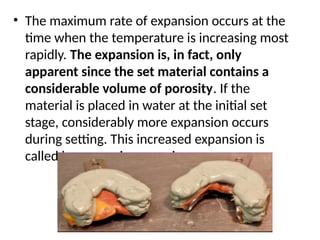
• The maximum rate of expansion occurs at the
time when the temperature is increasing most
rapidly. The expansion is, in fact, only
apparent since the set material contains a
considerable volume of porosity. If the
material is placed in water at the initial set
stage, considerably more expansion occurs
during setting. This increased expansion is
called hygroscopic expansion
Setting time
Factors under the control of the operator are
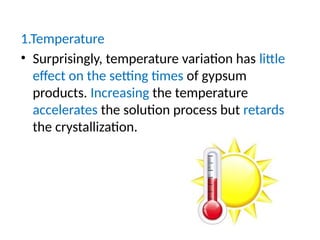
1.Temperature
• Surprisingly, temperature variation has little
effect on the setting times of gypsum
products. Increasing the temperature
accelerates the solution process but retards
the crystallization.
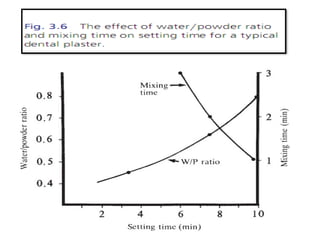
2. W/P ratio
• Increasing the W/P ratio retards setting by
decreasing the concentration of crystallization
nuclei
3. mixing time
• Increasing mixing time has the opposite
effect. This accelerates setting by breaking up
dihydrate crystals during the early stages of
setting,thus producing more nuclei on which
crystallization can be initiated.
• A higher concentration of nucleating agent, pro-
duced by ageing or from unconverted calcium
sulphate dihydrate, results in more rapid
crystallization. Also, the manufacturers may add
chemical accelerators or retarders to dental
stones.
• Potassium sulphate is a commonly used
accelerator which is thought to act by increasing
the solubility of the hemihydrate. Borax is the
most widely used retarder, although the
mechanism by which it works is not clear.
Control of setting expansion
• In order to produce an accurate model or die it is
necessary to maintain the setting expansion at as
low a value as possible.
• Accelerators or retarders which are added by
manufacturers to dental stones in order to control
the setting time also have the effect of reducing the
setting expansion and are sometimes referred to as
antiexpansion agents.
• Alterations in W/P ratio and mixing time have only a
minimal effect on setting expansion.
Properties of setting
Strength
• The strength of gypsum depends, primarily,
on the
1. porosity of the set material
2. the time for which the material is allowed to
dry out after setting.
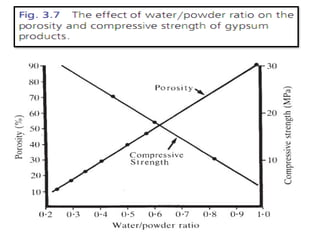
• The porosity, and hence the strength, is
proportional to the W/P ratio
• Since stone is always mixed at a lower W/P
ratio than plaster it is less porous and
consequently much stronger and harder.
• Although a gypsum model or die may appear
completely set within a relatively short period its
strength increases significantly if it is allowed to
stand for a few hours.
• Greatest surface hardness
reach its dry strength ,
it should be allowed to set
for one or two hours
preferable for night before
laboratory procuders
occurs when product
• gypsum is a very brittle material.
• very low value of flexural strength of plaster
• Stone is less fragile but must be treated with
care if fracture is to be avoided. It is relatively
rigid but has a poor impact strength and is
likely to fracture if dropped.
• Attempts to improve the mechanical
properties have involved
1.the impregnation by a polymer such as acrylic
resin
2.lower W/P ratio.
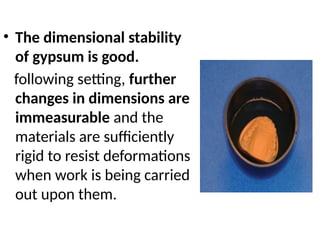
• The dimensional stability
of gypsum is good.
following setting, further
changes in dimensions are
immeasurable and the
materials are sufficiently
rigid to resist deformations
when work is being carried
out upon them.
• Set plaster is slightly soluble in water.
Solubility increases with the temperature of the
water and if hot water is poured over the surface
of a plaster cast, as happens during the boiling
out of a denture mould, a portion of the surface
layer becomes dissolved leaving the surface
roughened. Frequent washing of the surface with
hot water should therefore be avoided.
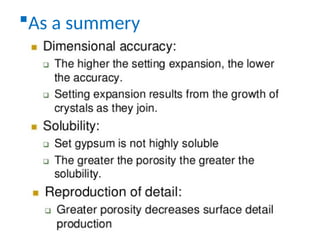
As a summery
Applications
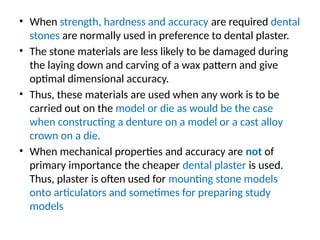
• When strength, hardness and accuracy are required dental
stones are normally used in preference to dental plaster.
• The stone materials are less likely to be damaged during
the laying down and carving of a wax pattern and give
optimal dimensional accuracy.
• Thus, these materials are used when any work is to be
carried out on the model or die as would be the case
when constructing a denture on a model or a cast alloy
crown on a die.
• When mechanical properties and accuracy are not of
primary importance the cheaper dental plaster is used.
Thus, plaster is often used for mounting stone models
onto articulators and sometimes for preparing study
models
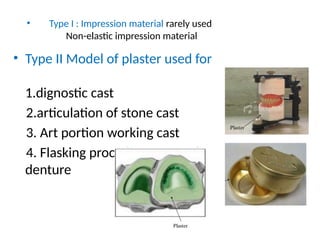
• Type I : Impression material rarely used
Non-elastic impression material
• Type II Model of plaster used for
1.dignostic cast
2.articulation of stone cast
3. Art portion working cast
4. Flasking procedure for acrylic
denture
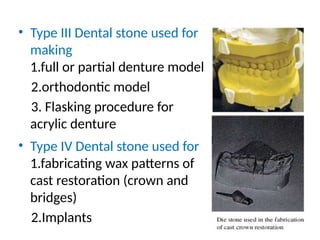
• Type III Dental stone used for
making
1.full or partial denture model
2.orthodontic model
3. Flasking procedure for
acrylic denture
• Type IV Dental stone used for
1.fabricating wax patterns of
cast restoration (crown and
bridges)
2.Implants
Advantages and
disadvantages
• Gypsum model and die materials have the
advantages of
1.being inexpensive
2.easy to use.
3.The accuracy and dimensional stability are good
4. reproduce fine detail from the impression
Disadvantages
1. The mechanical properties are not ideal
2. the brittle nature of gypsum occasionally leads to
fracture – particularly through the teeth, which
form the weakest part of any model.
• Problems occasionally arise when gypsumproducts
are used in conjunction with alginate impression.
• The surface of the model may remain relatively soft
due to an apparent retarding effect which
hydrocolloids have on the setting of gypsum
products. It is not certain whether the retarding
effect is due to borax in the hydrocolloid or to the
absorption of hydrocolloid onto the gypsum crystals
which act as nuclei of crystallization.
• Despite these observations it cannot be said that
gypsum products are incompatible with alginate
impression materials since problems arise very
infrequently.
• Alternative materials for the production of
models and dies exist but are hardly ever
used.
• These include various resins, cements and
dental amalgam.
• The alternatives may be stronger but are
generally less stable, difficult to use and more
expensive.
• Another treatment which has been suggested
for improving the durability of gypsum is to
partly saturate the set material in a
polymerizable monomer such as
methylmethacrylate or styrene.
• Polymerisation of the monomer produces a
polymer phase which increases its strength and
toughness.
• Despite these apparent advantages these
techniques are rarely used in practice.
Infection control
refrences
• Applied Dental Material
-ninth edition
by John F McCabe &Angus
W.G. Walls
Chapter 3 (pages from41-48)
• Done by :
Weam Mahmoud Faroun
Third Year Dental Student
• Under supervision :
DR. Mudar Kamal
• Course :
Prosthodontics
• Date :
30/11 /2016
•Any Questions

gypsumproducts in prosthodontic dentistry

  • 1.
  • 2.
    The outline ofthis presentation • Introduction • Gypsom types • Requirements of dental cast materials • Composition • Manipulation and setting characteristics • Setting Time • Control expantion • Properties of setting • Applications • Advantages and disadvantages • Infection control • References
  • 3.
    Introduction • Gypsum isa naturally occurring, white powdery mineral with the chemical name calcium sulphate Di-hydrate (CaSQ4·2H2O). • Gypsum products used in dentistry are based on calcium sulphate hemi-hydrate (CaSO42)2·H2O. Their main uses are for casts or models, dies .
  • 4.
    • models anddies which should be accurate replicas of the patient’s hard and soft tissues. • model is a replica of several teeth and their associated soft tissues or, alternatively, to an edentulous arch. • die is a replica of a single tooth.
  • 5.
    • The morphologyof the hard and soft tissues is recorded in an impression and models and dies are prepared using materials
  • 6.
    •which are initiallyfluid and can be poured into the impression, then harden to form a rigid replica.
  • 7.
    Types of Gypsomproducts according to current ISO F I V E T Y P E S
  • 8.
    type 1 Dental plaster, impression type 2 Dental plaster, model type3 Dental stone, die, model type 4 Dental stone, die, high strength, low expansion type 5 Dental stone, die, high strength, high expansion Five types
  • 9.
  • 10.
    1. dimensional accuracy 2.adequate mechani-cal properties 3. The material should be fluid at the time it is poured into the impression so that fine detail can be recorded 4. A low contact angle between the model and impression materials would help to minimize the presence of surface voids on the set model by encouraging surface wetting
  • 11.
    5. The setmaterial should be strong to resist accidental fracture and hard enough to resist abrasion during the carving of a wax pattern. 6. The material should be compatible with all the other materials with which it comes into contact.
  • 12.
    COMPOSITION • Gypsum productsused in dentistry are formed by driving off part of the water of crystallization from gypsum to form calcium sulphate hemihydrate. • Gypsum → Gypsum product + water • 2CaSO4·2H2O → (CaSO4)2·H2O + 3H2O Calcium sulphate dihydrate Calcium sulphate hemihydrate
  • 13.
    • Dental plaster(plaster of Paris): Dental plaster is indistinguishable from the white plaster used in orthopaedics for stabilizing fractured limbs during bone healing. Plaster is produced by a process known as calcinations.
  • 14.
    • Gypsum isheated to a temperature of about 120ºC in order to drive off part of the water of crystallization. This produces irregular, porous particles which are sometimes referred to as β-hemihydrate particles. Dental plaster => gypsom+heat (open kettle ) at 120ºC β- hemihydrate calcium sulphate
  • 15.
    Two types of plaster typeone impression mate Type two model plaster
  • 16.
    • Overheating thegypsum may cause further loss of water to form calcium sulphate anhydrite (CaSO4) • underheating produces a significant concentration of residual dihydrate. The presence of both components has a marked influence upon the setting characteristics of the resultant plaster.
  • 17.
    • Dental stone=> gypsom + steam & pressure at 125ºC α-hemihydrate calcium sulphate (type 3 gypsum)
  • 18.
    • Dental stone(improved)=> gypsom + 30% calcium chloride at 100ºC α-hemihydrate calcium sulphate (type 4(die stone) & type 5 gypsum)
  • 19.
    • Dental stone:Dental stones may be produced byone of two methods. If gypsum is heated to about125ºC under steam pressure in an autoclave a more regular and less porous hemihydrate is formed This is sometimes referred to as an α-hemihydrate. Alternatively, gypsum may be boiled in a solution of a salt such as CaCl2. This gives a material similar to that produced by autoclaving but with even less porosity. Manufacturers normally add small quantities of a dye to dental stones in order that they may be differentiated from dental plaster, which is white.
  • 21.
  • 22.
    Plaster and stonepowders are mixed with water to produce a workable mix. Hydration of the hemihydrate then occurs producing the gypsum model or die.
  • 23.
    • Considerable quantitiesof air may be incorporated during mixing and this may lead to porosity within the set material. Air porosity may be reduced either by vibrating the mix of plaster or stone in order to bring air bubbles to the surface or by mixing the material mechanically under vacuum, or both.
  • 24.
    • For handmixing a clean, scratch free rubber or plastic bowl having a top diameter of about 130 mm is normally recommended. • Should be clean because the gypsum residues in the mixing bowl can noticeably alter the working and setting characteristics A stiff spatula with a round-edged blade of around 20–25 mm width and 100 mm length is used.
  • 25.
    • the amountof water needed is added to a moist bowl and the powder added slowly to the water over about 10 seconds. • mixing/spatulation carried out for around 60 seconds using a circular or figure of eight motion. • After the material has been mixed and used, the mixing bowl should be thoroughly cleaned before the next mix is performed.
  • 26.
    • The crystalsof dihydrate are spherulitic in nature and grow from specific sites called nuclei of crystallization. These may be small particles of impurity, such as unconverted gypsum crystals, within the hemihydrate powder. If a thin mix of material is used, containing more water, the formation of the super-saturated solution of dihydrate which is a precursor to crystallization is delayed and the centers of nucleation are more widely dispersed by the dilution effect. The set plaster is therefore less dense with greater spaces between crystals leading to a significant reduction in strength.
  • 27.
    • The materialshould be used as soon as possible after mixing since its viscosity increases to the stage where the material is unworkable within a few minutes. • The setting reaction is exothermic
  • 28.
    • The settingcharacteristics of gypsum products can be affected 1.by the presence of unconverted dihydrate 2.by the presence of anhydrite 3.the age of the material 4. the storage conditions • Small quantities of unconverted dihydrate act as centres of nucleation as mentioned earlier. • Anhydrite reacts very rapidly with water producing a marked acceleration in setting.
  • 29.
    • Another physicalchange which accompanies setting is a small expansion caused by the growing crystals
  • 30.
    • The maximumrate of expansion occurs at the time when the temperature is increasing most rapidly. The expansion is, in fact, only apparent since the set material contains a considerable volume of porosity. If the material is placed in water at the initial set stage, considerably more expansion occurs during setting. This increased expansion is called hygroscopic expansion
  • 31.
    Setting time Factors underthe control of the operator are
  • 32.
    1.Temperature • Surprisingly, temperaturevariation has little effect on the setting times of gypsum products. Increasing the temperature accelerates the solution process but retards the crystallization.
  • 33.
    2. W/P ratio •Increasing the W/P ratio retards setting by decreasing the concentration of crystallization nuclei
  • 34.
    3. mixing time •Increasing mixing time has the opposite effect. This accelerates setting by breaking up dihydrate crystals during the early stages of setting,thus producing more nuclei on which crystallization can be initiated.
  • 36.
    • A higherconcentration of nucleating agent, pro- duced by ageing or from unconverted calcium sulphate dihydrate, results in more rapid crystallization. Also, the manufacturers may add chemical accelerators or retarders to dental stones. • Potassium sulphate is a commonly used accelerator which is thought to act by increasing the solubility of the hemihydrate. Borax is the most widely used retarder, although the mechanism by which it works is not clear.
  • 37.
    Control of settingexpansion • In order to produce an accurate model or die it is necessary to maintain the setting expansion at as low a value as possible. • Accelerators or retarders which are added by manufacturers to dental stones in order to control the setting time also have the effect of reducing the setting expansion and are sometimes referred to as antiexpansion agents. • Alterations in W/P ratio and mixing time have only a minimal effect on setting expansion.
  • 38.
  • 39.
    • The strengthof gypsum depends, primarily, on the 1. porosity of the set material 2. the time for which the material is allowed to dry out after setting. • The porosity, and hence the strength, is proportional to the W/P ratio • Since stone is always mixed at a lower W/P ratio than plaster it is less porous and consequently much stronger and harder.
  • 41.
    • Although agypsum model or die may appear completely set within a relatively short period its strength increases significantly if it is allowed to stand for a few hours. • Greatest surface hardness reach its dry strength , it should be allowed to set for one or two hours preferable for night before laboratory procuders occurs when product
  • 42.
    • gypsum isa very brittle material. • very low value of flexural strength of plaster • Stone is less fragile but must be treated with care if fracture is to be avoided. It is relatively rigid but has a poor impact strength and is likely to fracture if dropped. • Attempts to improve the mechanical properties have involved 1.the impregnation by a polymer such as acrylic resin 2.lower W/P ratio.
  • 43.
    • The dimensionalstability of gypsum is good. following setting, further changes in dimensions are immeasurable and the materials are sufficiently rigid to resist deformations when work is being carried out upon them.
  • 44.
    • Set plasteris slightly soluble in water. Solubility increases with the temperature of the water and if hot water is poured over the surface of a plaster cast, as happens during the boiling out of a denture mould, a portion of the surface layer becomes dissolved leaving the surface roughened. Frequent washing of the surface with hot water should therefore be avoided.
  • 45.
  • 46.
  • 47.
    • When strength,hardness and accuracy are required dental stones are normally used in preference to dental plaster. • The stone materials are less likely to be damaged during the laying down and carving of a wax pattern and give optimal dimensional accuracy. • Thus, these materials are used when any work is to be carried out on the model or die as would be the case when constructing a denture on a model or a cast alloy crown on a die. • When mechanical properties and accuracy are not of primary importance the cheaper dental plaster is used. Thus, plaster is often used for mounting stone models onto articulators and sometimes for preparing study models
  • 48.
    • Type I: Impression material rarely used Non-elastic impression material • Type II Model of plaster used for 1.dignostic cast 2.articulation of stone cast 3. Art portion working cast 4. Flasking procedure for acrylic denture
  • 49.
    • Type IIIDental stone used for making 1.full or partial denture model 2.orthodontic model 3. Flasking procedure for acrylic denture • Type IV Dental stone used for 1.fabricating wax patterns of cast restoration (crown and bridges) 2.Implants
  • 50.
  • 51.
    • Gypsum modeland die materials have the advantages of 1.being inexpensive 2.easy to use. 3.The accuracy and dimensional stability are good 4. reproduce fine detail from the impression Disadvantages 1. The mechanical properties are not ideal 2. the brittle nature of gypsum occasionally leads to fracture – particularly through the teeth, which form the weakest part of any model.
  • 52.
    • Problems occasionallyarise when gypsumproducts are used in conjunction with alginate impression. • The surface of the model may remain relatively soft due to an apparent retarding effect which hydrocolloids have on the setting of gypsum products. It is not certain whether the retarding effect is due to borax in the hydrocolloid or to the absorption of hydrocolloid onto the gypsum crystals which act as nuclei of crystallization. • Despite these observations it cannot be said that gypsum products are incompatible with alginate impression materials since problems arise very infrequently.
  • 53.
    • Alternative materialsfor the production of models and dies exist but are hardly ever used. • These include various resins, cements and dental amalgam. • The alternatives may be stronger but are generally less stable, difficult to use and more expensive.
  • 54.
    • Another treatmentwhich has been suggested for improving the durability of gypsum is to partly saturate the set material in a polymerizable monomer such as methylmethacrylate or styrene. • Polymerisation of the monomer produces a polymer phase which increases its strength and toughness. • Despite these apparent advantages these techniques are rarely used in practice.
  • 55.
  • 56.
    refrences • Applied DentalMaterial -ninth edition by John F McCabe &Angus W.G. Walls Chapter 3 (pages from41-48)
  • 57.
    • Done by: Weam Mahmoud Faroun Third Year Dental Student • Under supervision : DR. Mudar Kamal • Course : Prosthodontics • Date : 30/11 /2016
  • 58.

Editor's Notes

  • #11 For example, the set model should easily be removed from the impression without damage to its surface and fracture of teeth. It should give a good colour contrast with the various waxes which are often used to produce wax patterns.
  • #13 This produces irregular, porous particles which are sometimes referred to as β-hemihydrate particles.
  • #41 يعني انه قوة الجبسوم بروداكت بتزيد ازا تركتها فترة بعد ال ستنج The increase in strength is a function of the loss of excess water by evaporation. It is thought that evaporation of water causes a precipitation of any dissolved dihydrate and that this effectively cements together the crystals of gypsum formed during setting