11
22
IntroductionIntroduction
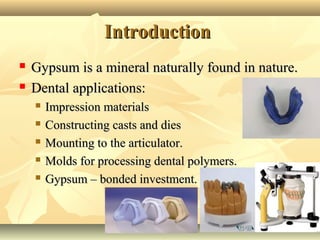
 Gypsum is a mineral naturally found in nature.Gypsum is a mineral naturally found in nature.
 Dental applications:Dental applications:
 Impression materialsImpression materials
 Constructing casts and diesConstructing casts and dies
 Mounting to the articulator.Mounting to the articulator.
 Molds for processing dental polymers.Molds for processing dental polymers.
 Gypsum – bonded investment.Gypsum – bonded investment.
33
Ideal properties of die materialsIdeal properties of die materials
 Dimensional accuracy(no expansion or contractionDimensional accuracy(no expansion or contraction
during or after setting)during or after setting)..
 Ease of use as soft material, hardness after setting.Ease of use as soft material, hardness after setting.
 Accurate reproduction of fine detail.Accurate reproduction of fine detail.
 Inert and can be disinfected without damaging theInert and can be disinfected without damaging the
surface .surface .
 High compressive & good strength to withstand theHigh compressive & good strength to withstand the
force applied on it.force applied on it.
 Inexpensive, reasonable setting time.Inexpensive, reasonable setting time.
 Abrasion resistant.Abrasion resistant.
 Good color contrast &compatible with the impressionGood color contrast &compatible with the impression
material.material.
44
Properties and behaviourProperties and behaviour
 Chemical properties: (exothermic reaction),gypsum product areChemical properties: (exothermic reaction),gypsum product are
produced by partial dehydration of mineral gypsum, which is calciumproduced by partial dehydration of mineral gypsum, which is calcium
sulfate dihydrate(CaSO4.2H2O). They are supplied as powder whensulfate dihydrate(CaSO4.2H2O). They are supplied as powder when
mixed with water they form slurry or paste which is set to form a rigidmixed with water they form slurry or paste which is set to form a rigid
mass.mass.
 Ca sulfate dihydrate heatCa sulfate dihydrate heat water loss groundwater loss ground CaCa sulfatesulfate
hemihydratehemihydrate
 The production of various types of gypsum is basically the same:The production of various types of gypsum is basically the same:
 If the heating processIf the heating process occurs in atmospheric pressure(openoccurs in atmospheric pressure(open
container) at 115 -120°C, the powder particles are porous andcontainer) at 115 -120°C, the powder particles are porous and
irregular (beta hemihydrate, plaster).irregular (beta hemihydrate, plaster).
 if heating process is under pressure(wet condition under superif heating process is under pressure(wet condition under super
heat steam) to 125 C, powder particles are regular and less porousheat steam) to 125 C, powder particles are regular and less porous
(a hemihydrate, or dental stone).(a hemihydrate, or dental stone).
55
 A further increase in pressure( by boiling gypsum with 30% CaClA further increase in pressure( by boiling gypsum with 30% CaCl22
(calcium chloride) and refining of the powder by grinding results(calcium chloride) and refining of the powder by grinding results
in denser stone, high-strength or die stone and have prismaticin denser stone, high-strength or die stone and have prismatic
shape, called alpha.shape, called alpha.
 When stone is mixed with silica: dental investmentWhen stone is mixed with silica: dental investment,, a material thata material that
can withstand high heat and stress produced when molten metal iscan withstand high heat and stress produced when molten metal is
forced into molds to form indirect restorations.forced into molds to form indirect restorations.
 Types: The various types of gypsum products used in dentistry areTypes: The various types of gypsum products used in dentistry are
chemically identical.chemically identical.
 1 – Type I: Impression plaster.1 – Type I: Impression plaster.
 2 – Type II: Plaster.2 – Type II: Plaster.
 3 – Type III: Stone.3 – Type III: Stone.
 4 – Type IV: High strength low expansion stone (die stone).4 – Type IV: High strength low expansion stone (die stone).
 5 – Type V: High strength high expansion stone.5 – Type V: High strength high expansion stone.
66
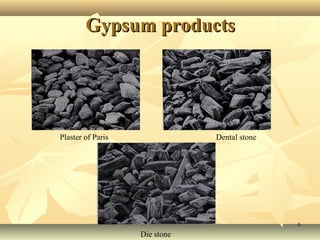
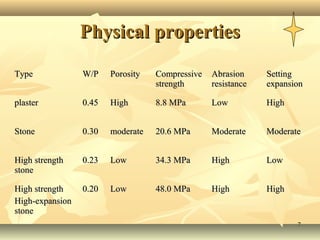
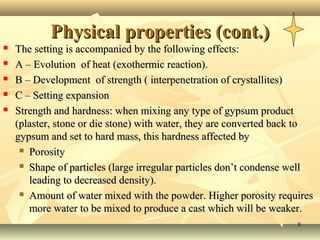
Gypsum productsGypsum products
Plaster of Paris Dental stone
Die stone
77
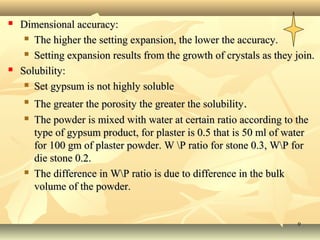
Physical propertiesPhysical properties
TypeType W/PW/P PorosityPorosity CompressiveCompressive
strengthstrength
AbrasionAbrasion
resistanceresistance
SettingSetting
expansionexpansion
plasterplaster 0.450.45 HighHigh 8.8 MPa8.8 MPa LowLow HighHigh
StoneStone 0.300.30 moderatemoderate 20.6 MPa20.6 MPa ModerateModerate ModerateModerate
High strengthHigh strength
stonestone
0.230.23 LowLow 34.3 MPa34.3 MPa HighHigh LowLow
High strengthHigh strength
High-expansionHigh-expansion
stonestone
0.200.20 LowLow 48.0 MPa48.0 MPa HighHigh HighHigh
88
Physical properties (cont.)Physical properties (cont.)
 The setting is accompanied by the following effects:The setting is accompanied by the following effects:
 A – Evolution of heat (exothermic reaction).A – Evolution of heat (exothermic reaction).
 B – Development of strength ( interpenetration of crystallites)B – Development of strength ( interpenetration of crystallites)
 C – Setting expansionC – Setting expansion
 Strength and hardness: when mixing any type of gypsum productStrength and hardness: when mixing any type of gypsum product
(plaster, stone or die stone) with water, they are converted back to(plaster, stone or die stone) with water, they are converted back to
gypsum and set to hard mass, this hardness affected bygypsum and set to hard mass, this hardness affected by
 PorosityPorosity
 Shape of particles (large irregular particles don’t condense wellShape of particles (large irregular particles don’t condense well
leading to decreased density).leading to decreased density).
 Amount of water mixed with the powder. Higher porosity requiresAmount of water mixed with the powder. Higher porosity requires
more water to be mixed to produce a cast which will be weaker.more water to be mixed to produce a cast which will be weaker.
99
 Dimensional accuracy:Dimensional accuracy:
 The higher the setting expansion, the lower the accuracy.The higher the setting expansion, the lower the accuracy.
 Setting expansion results from the growth of crystals as they join.Setting expansion results from the growth of crystals as they join.
 Solubility:Solubility:
 Set gypsum is not highly solubleSet gypsum is not highly soluble

The greater the porosity the greater the solubilityThe greater the porosity the greater the solubility..
 The powder is mixed with water at certain ratio according to theThe powder is mixed with water at certain ratio according to the
type of gypsum product, for plaster is 0.5 that is 50 ml of watertype of gypsum product, for plaster is 0.5 that is 50 ml of water
for 100 gm of plaster powder. W P ratio for stone 0.3, WP forfor 100 gm of plaster powder. W P ratio for stone 0.3, WP for
die stone 0.2.die stone 0.2.
 The difference in WP ratio is due to difference in the bulkThe difference in WP ratio is due to difference in the bulk
volume of the powder.volume of the powder.
1010
 Reproduction of detail:Reproduction of detail:
 Greater porosity decreases surface detail productionGreater porosity decreases surface detail production
 The impression material should be compatible with the gypsum toThe impression material should be compatible with the gypsum to
improve detail reproduction. The best compatibility is betweenimprove detail reproduction. The best compatibility is between
silicon and polyether's and gypsum.silicon and polyether's and gypsum.
 Initial and final set: The crystallization of gypsum from theInitial and final set: The crystallization of gypsum from the
saturated solution requires a mechanism of NUCLEATION whichsaturated solution requires a mechanism of NUCLEATION which
is conveniently provided by impurities and, particularly, byis conveniently provided by impurities and, particularly, by
particles of unreacted gypsum which seed the crystal growth.particles of unreacted gypsum which seed the crystal growth.
 Setting time: Is the time from beginning of mixing the powderSetting time: Is the time from beginning of mixing the powder
with water until the material hardness. This time may be measuredwith water until the material hardness. This time may be measured
by GILMORE NEEDLE APPARATUS.by GILMORE NEEDLE APPARATUS.
1111
Classification of gypsumClassification of gypsum
 Impression plaster (Type I)Impression plaster (Type I)
*seldom used**seldom used*
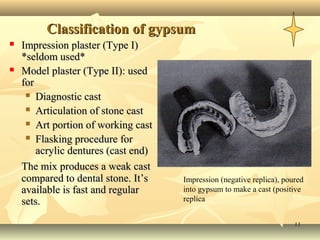
 Model plaster (Type II): usedModel plaster (Type II): used
forfor
 Diagnostic castDiagnostic cast
 Articulation of stone castArticulation of stone cast
 Art portion of working castArt portion of working cast
 Flasking procedure forFlasking procedure for
acrylic dentures (cast end)acrylic dentures (cast end)
The mix produces a weak castThe mix produces a weak cast
compared to dental stone. It’scompared to dental stone. It’s
available is fast and regularavailable is fast and regular
sets.sets.
Impression (negative replica), poured
into gypsum to make a cast (positive
replica
1212
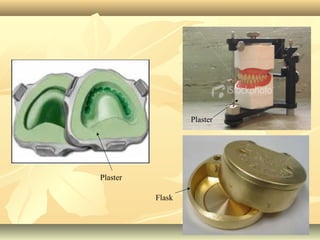
Plaster
Plaster
Flask
1313
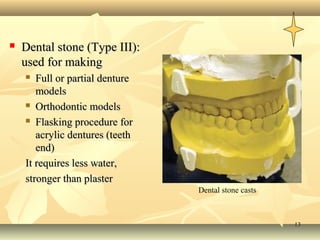
 Dental stone (Type III):Dental stone (Type III):
used for makingused for making
 Full or partial dentureFull or partial denture
modelsmodels
 Orthodontic modelsOrthodontic models
 Flasking procedure forFlasking procedure for
acrylic dentures (teethacrylic dentures (teeth
end)end)
It requires less water,It requires less water,
stronger than plasterstronger than plaster
Dental stone casts
1414
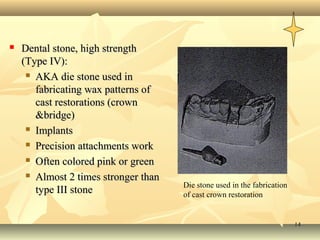
 Dental stone, high strengthDental stone, high strength
(Type IV):(Type IV):
 AKA die stone used inAKA die stone used in
fabricating wax patterns offabricating wax patterns of
cast restorations (crowncast restorations (crown
&bridge)&bridge)
 ImplantsImplants
 Precision attachments workPrecision attachments work
 Often colored pink or greenOften colored pink or green
 Almost 2 times stronger thanAlmost 2 times stronger than
type III stonetype III stone
Die stone used in the fabrication
of cast crown restoration
1515
 High strength, high expansion dental stone (Type V)High strength, high expansion dental stone (Type V)
 Colored blue or greenColored blue or green
 Most costly of all gypsum materialsMost costly of all gypsum materials
 Lowest W:P ratio, higher compressive strengthLowest W:P ratio, higher compressive strength
 The need for higher expansion (0.1%) was toThe need for higher expansion (0.1%) was to
compensate for the solidification shrinkage ofcompensate for the solidification shrinkage of
some alloys used as base metals used for dentalsome alloys used as base metals used for dental
castingcasting
1616
 Selection: based on the desired properties andSelection: based on the desired properties and
dental application. e.g.:dental application. e.g.:
 For a diagnostic cast, plaster can be used.For a diagnostic cast, plaster can be used.
 For a working cast, strength is required andFor a working cast, strength is required and
accuracy, dental stone is the gypsum of choiceaccuracy, dental stone is the gypsum of choice
 Working models for cast restorations require dieWorking models for cast restorations require die
stonestone
ManipulationManipulation
1717
Manipulation (cont.)Manipulation (cont.)
 Proportioning (W:P ratio)Proportioning (W:P ratio)
 Golden ruleGolden rule: Manufacturer instructions should: Manufacturer instructions should
always be followed.always be followed.
 Variations in W:P ratio affect the set materials’Variations in W:P ratio affect the set materials’
properties such as strength and accuracy.properties such as strength and accuracy.
 Too much water the mix will be runny, the model willToo much water the mix will be runny, the model will
be weaker.be weaker.
 Too little water difficult to mix, chance to get bubblesToo little water difficult to mix, chance to get bubbles
inside the mixture.inside the mixture.
1818
Manipulation (cont.)Manipulation (cont.)
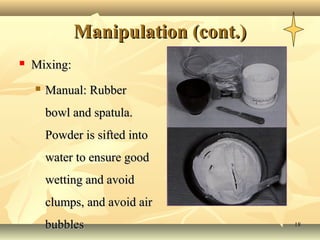
 Mixing:Mixing:
 Manual: RubberManual: Rubber
bowl and spatula.bowl and spatula.
Powder is sifted intoPowder is sifted into
water to ensure goodwater to ensure good
wetting and avoidwetting and avoid
clumps, and avoid airclumps, and avoid air
bubblesbubbles
1919
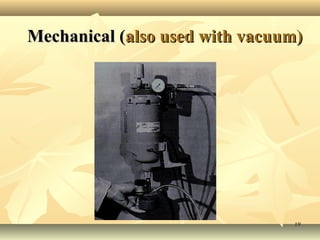
Mechanical (Mechanical (also used with vacuum)also used with vacuum)
2020
Manipulation (cont.)Manipulation (cont.)
 Initial setting time-working timeInitial setting time-working time
 Working time start after mixing for 1 minuteWorking time start after mixing for 1 minute
 Initial setting time: time elapsed from the start ofInitial setting time: time elapsed from the start of
mix until loss of gloss (8-10 minutes)mix until loss of gloss (8-10 minutes)
 6-10 minutes of working time are available to pour6-10 minutes of working time are available to pour
the gypsum.the gypsum.
2121
 Final setting time: is reached when the materials can beFinal setting time: is reached when the materials can be
safely handled, the gypsum is cool (exothermic reactionsafely handled, the gypsum is cool (exothermic reaction
is over).is over).
 Setting expansion: Results from crystal growth duringSetting expansion: Results from crystal growth during
setting. Can be decreased by the addition of potassiumsetting. Can be decreased by the addition of potassium
sulfate, sodium chloride, borax.sulfate, sodium chloride, borax.
 Hygroscopic expansion. If gypsum soaked duringHygroscopic expansion. If gypsum soaked during
setting, water fills pores and increases volumesetting, water fills pores and increases volume
 It’s recommended to separate the cast from impressionIt’s recommended to separate the cast from impression
after 1 hour.after 1 hour.
 Strength increases 2-3 times after 24 hoursStrength increases 2-3 times after 24 hours
2222
Tests for initial setting, and finalTests for initial setting, and final
setting timessetting times
 Loss of gloss test for initial setting time: loss of glossLoss of gloss test for initial setting time: loss of gloss
occurs as water is taken up by gypsum to form theoccurs as water is taken up by gypsum to form the
dihydrate. The materials does not have measurabledihydrate. The materials does not have measurable
compressive strengthcompressive strength..
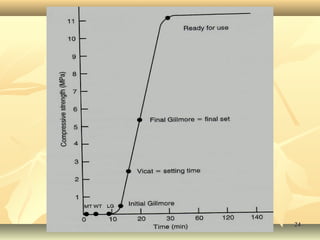
 Initial Gillmore test for initial set: needles are used toInitial Gillmore test for initial set: needles are used to
indent the material until no indentation can be seen =indent the material until no indentation can be seen =
initial setting time.initial setting time.
2323
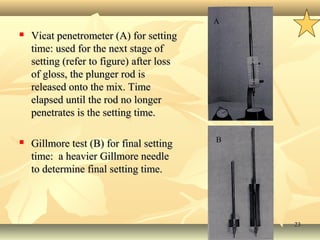
 Vicat penetrometer (A) for settingVicat penetrometer (A) for setting
time: used for the next stage oftime: used for the next stage of
setting (refer to figure)setting (refer to figure) after lossafter loss
of gloss, the plunger rod isof gloss, the plunger rod is
released onto the mix. Timereleased onto the mix. Time
elapsed until the rod no longerelapsed until the rod no longer
penetrates is the setting time.penetrates is the setting time.
 Gillmore test (B) for final settingGillmore test (B) for final setting
time: a heavier Gillmore needletime: a heavier Gillmore needle
to determine final setting time.to determine final setting time.
B
A
B
2424
2525
Ready for use criteriaReady for use criteria
 The ability to judge readiness of gypsum to beThe ability to judge readiness of gypsum to be
handled improves with experience.handled improves with experience.
 Technically, the material is considered readyTechnically, the material is considered ready
when compressive strength reaches 80% of thewhen compressive strength reaches 80% of the
strength attained after 1 hour.strength attained after 1 hour.
 Most products are ready to use in 30 minutes.Most products are ready to use in 30 minutes.
2626
 Clinical tip: before separating cast fromClinical tip: before separating cast from
impression, ensure that no part of the tray isimpression, ensure that no part of the tray is
connected to the gypsumconnected to the gypsum
 Clinical tip: if alginate impression dried beforeClinical tip: if alginate impression dried before
cast separation, soak in water for 15 minutes.cast separation, soak in water for 15 minutes.
2727
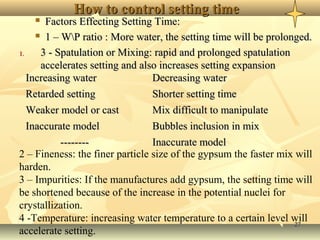
How to control setting timeHow to control setting time
 Factors Effecting Setting Time:Factors Effecting Setting Time:
 1 – WP ratio : More water, the setting time will be prolonged.1 – WP ratio : More water, the setting time will be prolonged.
1.1. 3 - Spatulation or Mixing: rapid and prolonged spatulation3 - Spatulation or Mixing: rapid and prolonged spatulation
accelerates setting and also increases setting expansionaccelerates setting and also increases setting expansion
Increasing waterIncreasing water Decreasing waterDecreasing water
Retarded settingRetarded setting Shorter setting timeShorter setting time
Weaker model or castWeaker model or cast Mix difficult to manipulateMix difficult to manipulate
Inaccurate modelInaccurate model Bubbles inclusion in mixBubbles inclusion in mix
---------------- Inaccurate modelInaccurate model
2 – Fineness: the finer particle size of the gypsum the faster mix will
harden.
3 – Impurities: If the manufactures add gypsum, the setting time will
be shortened because of the increase in the potential nuclei for
crystallization.
4 -Temperature: increasing water temperature to a certain level will
accelerate setting.
2828
5 - Spatulation or Mixing: rapid and prolonged spatulation5 - Spatulation or Mixing: rapid and prolonged spatulation
accelerates setting and also increases setting expansionaccelerates setting and also increases setting expansion
6 -6 -Accelerators and retarders:Accelerators and retarders:
1 - Manufacturers add accelerators or retarders to gypsum. These1 - Manufacturers add accelerators or retarders to gypsum. These
chemicals increase or decrease gypsum solubility respectivelychemicals increase or decrease gypsum solubility respectively
which will alter setting time accordingly.which will alter setting time accordingly.
2 - Clinicians can add accelerators such as potassium sulfate or set2 - Clinicians can add accelerators such as potassium sulfate or set
gypsum (slurry water), they act as sites for crystallization.gypsum (slurry water), they act as sites for crystallization.
3 - Setting reaction retarders: blood, saliva, alginate. If left on3 - Setting reaction retarders: blood, saliva, alginate. If left on
impression, can affect surface details of impression.impression, can affect surface details of impression.
Impression surface need to be properly rinsed before beingImpression surface need to be properly rinsed before being
poured.poured.
2929
Factors affecting the setting expansion:Factors affecting the setting expansion:
1 – WP ratio: The higher the wp ratio, the less the expansion because of1 – WP ratio: The higher the wp ratio, the less the expansion because of
fewer nuclei of crystallization per unit volume are present than thefewer nuclei of crystallization per unit volume are present than the
thicker mixes.thicker mixes.
2 – Addition of chemicals( accelerator and retarders): Both will reduce2 – Addition of chemicals( accelerator and retarders): Both will reduce
the setting expansion. The reduction of the expansion is due to thatthe setting expansion. The reduction of the expansion is due to that
the initial rate of crystallization is so rapid that subsequent growththe initial rate of crystallization is so rapid that subsequent growth
is resisted with accelerators.is resisted with accelerators.
HYGROSCOPIC EXPANSION:HYGROSCOPIC EXPANSION:
If setting process is allowed to occur under water, the setting expansionIf setting process is allowed to occur under water, the setting expansion
may be more than double in magnitude, this is called hygroscopicmay be more than double in magnitude, this is called hygroscopic
expansion. This increased expansion is due to the additional growthexpansion. This increased expansion is due to the additional growth
of crystals permitted and not to any difference in the chemicalof crystals permitted and not to any difference in the chemical
reaction.reaction.
Factors affecting the strength:Factors affecting the strength:
1 – W  P ratio. 3 – Drying. 5 – Porosity.1 – W  P ratio. 3 – Drying. 5 – Porosity.
2 – Mixing . 4 – Chemicals.2 – Mixing . 4 – Chemicals.
3030
TheThe strength of the gypsum increases rapidly as the material hardensstrength of the gypsum increases rapidly as the material hardens
after the initial setting time. The excess water presents in the setafter the initial setting time. The excess water presents in the set
mass affect the strength. Therefore, there is wet strength and drymass affect the strength. Therefore, there is wet strength and dry
strength. The wet strength is when there is excess water left in thestrength. The wet strength is when there is excess water left in the
mass. The dry strength is that when the excess water has been driedmass. The dry strength is that when the excess water has been dried
in air or in oven in warm temperature. The dry strength may be twoin air or in oven in warm temperature. The dry strength may be two
times greater than the wet.times greater than the wet.
Drying period compressive strength kgcmDrying period compressive strength kgcm
2 h 982 h 98
8 h 1198 h 119
24 h 23824 h 238
W P ratio the greater the porosity and the fewer the crystals. MixingW P ratio the greater the porosity and the fewer the crystals. Mixing
time also effect the strength. Increasing mixing increase the strengthtime also effect the strength. Increasing mixing increase the strength
but over mixing will reduce strength because it will break up thebut over mixing will reduce strength because it will break up the
crystals which are formed and will result in less crystal interlocking.crystals which are formed and will result in less crystal interlocking.
The addition of accelerators and retarders lowers both the wet and dryThe addition of accelerators and retarders lowers both the wet and dry
strength this is due to the reduction in the intercrystalline cohesion.strength this is due to the reduction in the intercrystalline cohesion.
3131
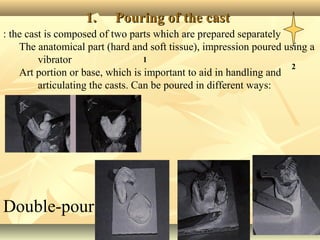
1.1. Pouring of the castPouring of the cast
1
2
Double-pour
: the cast is composed of two parts which are prepared separately
The anatomical part (hard and soft tissue), impression poured using a
vibrator
Art portion or base, which is important to aid in handling and
articulating the casts. Can be poured in different ways:
3232
2.2. Single stepSingle step
 Both anatomical and art portions of the castBoth anatomical and art portions of the cast
are prepared at the same time. This methodare prepared at the same time. This method
requires skill and accurate timing. Difficultyrequires skill and accurate timing. Difficulty
encountered:encountered:
 If mix is too runny?If mix is too runny?
 If mix started to initially set?If mix started to initially set?
3333
3.3. Boxing methodBoxing method
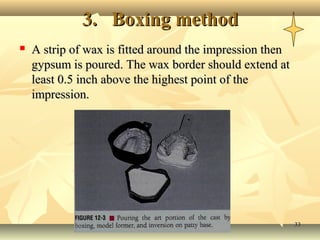
 A strip of wax is fitted around the impression thenA strip of wax is fitted around the impression then
gypsum is poured. The wax border should extend atgypsum is poured. The wax border should extend at
least 0.5 inch above the highest point of theleast 0.5 inch above the highest point of the
impression.impression.
3434
Storage and clean upStorage and clean up
 Gypsum should be stored in airtight dry area.Gypsum should be stored in airtight dry area.
Prolonged exposure to moisture can retardProlonged exposure to moisture can retard
setting due to decreased solubility of powder.setting due to decreased solubility of powder.
 Relevant equipment should be kept clean toRelevant equipment should be kept clean to
avoid unwanted acceleration of setting by setavoid unwanted acceleration of setting by set
gypsum.gypsum.
3535
Infection controlInfection control
 Casts should have set for 24 hours beforeCasts should have set for 24 hours before
being disinfected if necessary.being disinfected if necessary.
 Spray rather than immerseSpray rather than immerse
 Disinfectants commonly used:Disinfectants commonly used:
 Sodium hypochloriteSodium hypochlorite
 iodophorsiodophors
 Chlorine dioxideChlorine dioxide
3636
TrimmingTrimming
 Plaster bases are recommended since trimmingPlaster bases are recommended since trimming
them is easier than dental stone.them is easier than dental stone.
 If base is made from stone, it should be soakedIf base is made from stone, it should be soaked
in water for 5-10 minutes to soften it beforein water for 5-10 minutes to soften it before
trimming. Important considerations whentrimming. Important considerations when
trimming?trimming?
3737
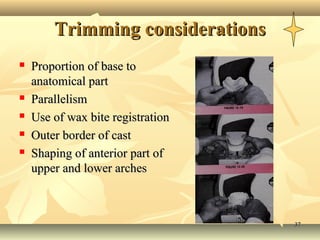
Trimming considerationsTrimming considerations
 Proportion of base toProportion of base to
anatomical partanatomical part
 ParallelismParallelism
 Use of wax bite registrationUse of wax bite registration
 Outer border of castOuter border of cast
 Shaping of anterior part ofShaping of anterior part of
upper and lower archesupper and lower arches
3838
 Metal plated die stone: silver or copper platedMetal plated die stone: silver or copper plated
to increase abrasion resistanceto increase abrasion resistance
 Epoxy die stone: resin and a hardener are usedEpoxy die stone: resin and a hardener are used
to increase abrasion resistance.to increase abrasion resistance.
 Resin reinforced die stone: resin isResin reinforced die stone: resin is
incorporated into the gypsum material toincorporated into the gypsum material to
increase abrasion resistance.increase abrasion resistance.
Other types of Die stoneOther types of Die stone
3939
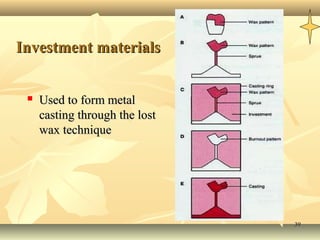
Investment materialsInvestment materials
 Used to form metalUsed to form metal
casting through the lostcasting through the lost
wax techniquewax technique
4040
ReferencesReferences
 Dental materials, clinical applications forDental materials, clinical applications for
dental assistants and dental hygienists.dental assistants and dental hygienists.
Chapter 12Chapter 12
 Phillips’ science of dental materials.Phillips’ science of dental materials.
Chapter10Chapter10

Gypsum material-3

  • 1.
  • 2.
    22 IntroductionIntroduction  Gypsum isa mineral naturally found in nature.Gypsum is a mineral naturally found in nature.  Dental applications:Dental applications:  Impression materialsImpression materials  Constructing casts and diesConstructing casts and dies  Mounting to the articulator.Mounting to the articulator.  Molds for processing dental polymers.Molds for processing dental polymers.  Gypsum – bonded investment.Gypsum – bonded investment.
  • 3.
    33 Ideal properties ofdie materialsIdeal properties of die materials  Dimensional accuracy(no expansion or contractionDimensional accuracy(no expansion or contraction during or after setting)during or after setting)..  Ease of use as soft material, hardness after setting.Ease of use as soft material, hardness after setting.  Accurate reproduction of fine detail.Accurate reproduction of fine detail.  Inert and can be disinfected without damaging theInert and can be disinfected without damaging the surface .surface .  High compressive & good strength to withstand theHigh compressive & good strength to withstand the force applied on it.force applied on it.  Inexpensive, reasonable setting time.Inexpensive, reasonable setting time.  Abrasion resistant.Abrasion resistant.  Good color contrast &compatible with the impressionGood color contrast &compatible with the impression material.material.
  • 4.
    44 Properties and behaviourPropertiesand behaviour  Chemical properties: (exothermic reaction),gypsum product areChemical properties: (exothermic reaction),gypsum product are produced by partial dehydration of mineral gypsum, which is calciumproduced by partial dehydration of mineral gypsum, which is calcium sulfate dihydrate(CaSO4.2H2O). They are supplied as powder whensulfate dihydrate(CaSO4.2H2O). They are supplied as powder when mixed with water they form slurry or paste which is set to form a rigidmixed with water they form slurry or paste which is set to form a rigid mass.mass.  Ca sulfate dihydrate heatCa sulfate dihydrate heat water loss groundwater loss ground CaCa sulfatesulfate hemihydratehemihydrate  The production of various types of gypsum is basically the same:The production of various types of gypsum is basically the same:  If the heating processIf the heating process occurs in atmospheric pressure(openoccurs in atmospheric pressure(open container) at 115 -120°C, the powder particles are porous andcontainer) at 115 -120°C, the powder particles are porous and irregular (beta hemihydrate, plaster).irregular (beta hemihydrate, plaster).  if heating process is under pressure(wet condition under superif heating process is under pressure(wet condition under super heat steam) to 125 C, powder particles are regular and less porousheat steam) to 125 C, powder particles are regular and less porous (a hemihydrate, or dental stone).(a hemihydrate, or dental stone).
  • 5.
    55  A furtherincrease in pressure( by boiling gypsum with 30% CaClA further increase in pressure( by boiling gypsum with 30% CaCl22 (calcium chloride) and refining of the powder by grinding results(calcium chloride) and refining of the powder by grinding results in denser stone, high-strength or die stone and have prismaticin denser stone, high-strength or die stone and have prismatic shape, called alpha.shape, called alpha.  When stone is mixed with silica: dental investmentWhen stone is mixed with silica: dental investment,, a material thata material that can withstand high heat and stress produced when molten metal iscan withstand high heat and stress produced when molten metal is forced into molds to form indirect restorations.forced into molds to form indirect restorations.  Types: The various types of gypsum products used in dentistry areTypes: The various types of gypsum products used in dentistry are chemically identical.chemically identical.  1 – Type I: Impression plaster.1 – Type I: Impression plaster.  2 – Type II: Plaster.2 – Type II: Plaster.  3 – Type III: Stone.3 – Type III: Stone.  4 – Type IV: High strength low expansion stone (die stone).4 – Type IV: High strength low expansion stone (die stone).  5 – Type V: High strength high expansion stone.5 – Type V: High strength high expansion stone.
  • 6.
    66 Gypsum productsGypsum products Plasterof Paris Dental stone Die stone
  • 7.
    77 Physical propertiesPhysical properties TypeTypeW/PW/P PorosityPorosity CompressiveCompressive strengthstrength AbrasionAbrasion resistanceresistance SettingSetting expansionexpansion plasterplaster 0.450.45 HighHigh 8.8 MPa8.8 MPa LowLow HighHigh StoneStone 0.300.30 moderatemoderate 20.6 MPa20.6 MPa ModerateModerate ModerateModerate High strengthHigh strength stonestone 0.230.23 LowLow 34.3 MPa34.3 MPa HighHigh LowLow High strengthHigh strength High-expansionHigh-expansion stonestone 0.200.20 LowLow 48.0 MPa48.0 MPa HighHigh HighHigh
  • 8.
    88 Physical properties (cont.)Physicalproperties (cont.)  The setting is accompanied by the following effects:The setting is accompanied by the following effects:  A – Evolution of heat (exothermic reaction).A – Evolution of heat (exothermic reaction).  B – Development of strength ( interpenetration of crystallites)B – Development of strength ( interpenetration of crystallites)  C – Setting expansionC – Setting expansion  Strength and hardness: when mixing any type of gypsum productStrength and hardness: when mixing any type of gypsum product (plaster, stone or die stone) with water, they are converted back to(plaster, stone or die stone) with water, they are converted back to gypsum and set to hard mass, this hardness affected bygypsum and set to hard mass, this hardness affected by  PorosityPorosity  Shape of particles (large irregular particles don’t condense wellShape of particles (large irregular particles don’t condense well leading to decreased density).leading to decreased density).  Amount of water mixed with the powder. Higher porosity requiresAmount of water mixed with the powder. Higher porosity requires more water to be mixed to produce a cast which will be weaker.more water to be mixed to produce a cast which will be weaker.
  • 9.
    99  Dimensional accuracy:Dimensionalaccuracy:  The higher the setting expansion, the lower the accuracy.The higher the setting expansion, the lower the accuracy.  Setting expansion results from the growth of crystals as they join.Setting expansion results from the growth of crystals as they join.  Solubility:Solubility:  Set gypsum is not highly solubleSet gypsum is not highly soluble  The greater the porosity the greater the solubilityThe greater the porosity the greater the solubility..  The powder is mixed with water at certain ratio according to theThe powder is mixed with water at certain ratio according to the type of gypsum product, for plaster is 0.5 that is 50 ml of watertype of gypsum product, for plaster is 0.5 that is 50 ml of water for 100 gm of plaster powder. W P ratio for stone 0.3, WP forfor 100 gm of plaster powder. W P ratio for stone 0.3, WP for die stone 0.2.die stone 0.2.  The difference in WP ratio is due to difference in the bulkThe difference in WP ratio is due to difference in the bulk volume of the powder.volume of the powder.
  • 10.
    1010  Reproduction ofdetail:Reproduction of detail:  Greater porosity decreases surface detail productionGreater porosity decreases surface detail production  The impression material should be compatible with the gypsum toThe impression material should be compatible with the gypsum to improve detail reproduction. The best compatibility is betweenimprove detail reproduction. The best compatibility is between silicon and polyether's and gypsum.silicon and polyether's and gypsum.  Initial and final set: The crystallization of gypsum from theInitial and final set: The crystallization of gypsum from the saturated solution requires a mechanism of NUCLEATION whichsaturated solution requires a mechanism of NUCLEATION which is conveniently provided by impurities and, particularly, byis conveniently provided by impurities and, particularly, by particles of unreacted gypsum which seed the crystal growth.particles of unreacted gypsum which seed the crystal growth.  Setting time: Is the time from beginning of mixing the powderSetting time: Is the time from beginning of mixing the powder with water until the material hardness. This time may be measuredwith water until the material hardness. This time may be measured by GILMORE NEEDLE APPARATUS.by GILMORE NEEDLE APPARATUS.
  • 11.
    1111 Classification of gypsumClassificationof gypsum  Impression plaster (Type I)Impression plaster (Type I) *seldom used**seldom used*  Model plaster (Type II): usedModel plaster (Type II): used forfor  Diagnostic castDiagnostic cast  Articulation of stone castArticulation of stone cast  Art portion of working castArt portion of working cast  Flasking procedure forFlasking procedure for acrylic dentures (cast end)acrylic dentures (cast end) The mix produces a weak castThe mix produces a weak cast compared to dental stone. It’scompared to dental stone. It’s available is fast and regularavailable is fast and regular sets.sets. Impression (negative replica), poured into gypsum to make a cast (positive replica
  • 12.
  • 13.
    1313  Dental stone(Type III):Dental stone (Type III): used for makingused for making  Full or partial dentureFull or partial denture modelsmodels  Orthodontic modelsOrthodontic models  Flasking procedure forFlasking procedure for acrylic dentures (teethacrylic dentures (teeth end)end) It requires less water,It requires less water, stronger than plasterstronger than plaster Dental stone casts
  • 14.
    1414  Dental stone,high strengthDental stone, high strength (Type IV):(Type IV):  AKA die stone used inAKA die stone used in fabricating wax patterns offabricating wax patterns of cast restorations (crowncast restorations (crown &bridge)&bridge)  ImplantsImplants  Precision attachments workPrecision attachments work  Often colored pink or greenOften colored pink or green  Almost 2 times stronger thanAlmost 2 times stronger than type III stonetype III stone Die stone used in the fabrication of cast crown restoration
  • 15.
    1515  High strength,high expansion dental stone (Type V)High strength, high expansion dental stone (Type V)  Colored blue or greenColored blue or green  Most costly of all gypsum materialsMost costly of all gypsum materials  Lowest W:P ratio, higher compressive strengthLowest W:P ratio, higher compressive strength  The need for higher expansion (0.1%) was toThe need for higher expansion (0.1%) was to compensate for the solidification shrinkage ofcompensate for the solidification shrinkage of some alloys used as base metals used for dentalsome alloys used as base metals used for dental castingcasting
  • 16.
    1616  Selection: basedon the desired properties andSelection: based on the desired properties and dental application. e.g.:dental application. e.g.:  For a diagnostic cast, plaster can be used.For a diagnostic cast, plaster can be used.  For a working cast, strength is required andFor a working cast, strength is required and accuracy, dental stone is the gypsum of choiceaccuracy, dental stone is the gypsum of choice  Working models for cast restorations require dieWorking models for cast restorations require die stonestone ManipulationManipulation
  • 17.
    1717 Manipulation (cont.)Manipulation (cont.) Proportioning (W:P ratio)Proportioning (W:P ratio)  Golden ruleGolden rule: Manufacturer instructions should: Manufacturer instructions should always be followed.always be followed.  Variations in W:P ratio affect the set materials’Variations in W:P ratio affect the set materials’ properties such as strength and accuracy.properties such as strength and accuracy.  Too much water the mix will be runny, the model willToo much water the mix will be runny, the model will be weaker.be weaker.  Too little water difficult to mix, chance to get bubblesToo little water difficult to mix, chance to get bubbles inside the mixture.inside the mixture.
  • 18.
    1818 Manipulation (cont.)Manipulation (cont.) Mixing:Mixing:  Manual: RubberManual: Rubber bowl and spatula.bowl and spatula. Powder is sifted intoPowder is sifted into water to ensure goodwater to ensure good wetting and avoidwetting and avoid clumps, and avoid airclumps, and avoid air bubblesbubbles
  • 19.
    1919 Mechanical (Mechanical (alsoused with vacuum)also used with vacuum)
  • 20.
    2020 Manipulation (cont.)Manipulation (cont.) Initial setting time-working timeInitial setting time-working time  Working time start after mixing for 1 minuteWorking time start after mixing for 1 minute  Initial setting time: time elapsed from the start ofInitial setting time: time elapsed from the start of mix until loss of gloss (8-10 minutes)mix until loss of gloss (8-10 minutes)  6-10 minutes of working time are available to pour6-10 minutes of working time are available to pour the gypsum.the gypsum.
  • 21.
    2121  Final settingtime: is reached when the materials can beFinal setting time: is reached when the materials can be safely handled, the gypsum is cool (exothermic reactionsafely handled, the gypsum is cool (exothermic reaction is over).is over).  Setting expansion: Results from crystal growth duringSetting expansion: Results from crystal growth during setting. Can be decreased by the addition of potassiumsetting. Can be decreased by the addition of potassium sulfate, sodium chloride, borax.sulfate, sodium chloride, borax.  Hygroscopic expansion. If gypsum soaked duringHygroscopic expansion. If gypsum soaked during setting, water fills pores and increases volumesetting, water fills pores and increases volume  It’s recommended to separate the cast from impressionIt’s recommended to separate the cast from impression after 1 hour.after 1 hour.  Strength increases 2-3 times after 24 hoursStrength increases 2-3 times after 24 hours
  • 22.
    2222 Tests for initialsetting, and finalTests for initial setting, and final setting timessetting times  Loss of gloss test for initial setting time: loss of glossLoss of gloss test for initial setting time: loss of gloss occurs as water is taken up by gypsum to form theoccurs as water is taken up by gypsum to form the dihydrate. The materials does not have measurabledihydrate. The materials does not have measurable compressive strengthcompressive strength..  Initial Gillmore test for initial set: needles are used toInitial Gillmore test for initial set: needles are used to indent the material until no indentation can be seen =indent the material until no indentation can be seen = initial setting time.initial setting time.
  • 23.
    2323  Vicat penetrometer(A) for settingVicat penetrometer (A) for setting time: used for the next stage oftime: used for the next stage of setting (refer to figure)setting (refer to figure) after lossafter loss of gloss, the plunger rod isof gloss, the plunger rod is released onto the mix. Timereleased onto the mix. Time elapsed until the rod no longerelapsed until the rod no longer penetrates is the setting time.penetrates is the setting time.  Gillmore test (B) for final settingGillmore test (B) for final setting time: a heavier Gillmore needletime: a heavier Gillmore needle to determine final setting time.to determine final setting time. B A B
  • 24.
  • 25.
    2525 Ready for usecriteriaReady for use criteria  The ability to judge readiness of gypsum to beThe ability to judge readiness of gypsum to be handled improves with experience.handled improves with experience.  Technically, the material is considered readyTechnically, the material is considered ready when compressive strength reaches 80% of thewhen compressive strength reaches 80% of the strength attained after 1 hour.strength attained after 1 hour.  Most products are ready to use in 30 minutes.Most products are ready to use in 30 minutes.
  • 26.
    2626  Clinical tip:before separating cast fromClinical tip: before separating cast from impression, ensure that no part of the tray isimpression, ensure that no part of the tray is connected to the gypsumconnected to the gypsum  Clinical tip: if alginate impression dried beforeClinical tip: if alginate impression dried before cast separation, soak in water for 15 minutes.cast separation, soak in water for 15 minutes.
  • 27.
    2727 How to controlsetting timeHow to control setting time  Factors Effecting Setting Time:Factors Effecting Setting Time:  1 – WP ratio : More water, the setting time will be prolonged.1 – WP ratio : More water, the setting time will be prolonged. 1.1. 3 - Spatulation or Mixing: rapid and prolonged spatulation3 - Spatulation or Mixing: rapid and prolonged spatulation accelerates setting and also increases setting expansionaccelerates setting and also increases setting expansion Increasing waterIncreasing water Decreasing waterDecreasing water Retarded settingRetarded setting Shorter setting timeShorter setting time Weaker model or castWeaker model or cast Mix difficult to manipulateMix difficult to manipulate Inaccurate modelInaccurate model Bubbles inclusion in mixBubbles inclusion in mix ---------------- Inaccurate modelInaccurate model 2 – Fineness: the finer particle size of the gypsum the faster mix will harden. 3 – Impurities: If the manufactures add gypsum, the setting time will be shortened because of the increase in the potential nuclei for crystallization. 4 -Temperature: increasing water temperature to a certain level will accelerate setting.
  • 28.
    2828 5 - Spatulationor Mixing: rapid and prolonged spatulation5 - Spatulation or Mixing: rapid and prolonged spatulation accelerates setting and also increases setting expansionaccelerates setting and also increases setting expansion 6 -6 -Accelerators and retarders:Accelerators and retarders: 1 - Manufacturers add accelerators or retarders to gypsum. These1 - Manufacturers add accelerators or retarders to gypsum. These chemicals increase or decrease gypsum solubility respectivelychemicals increase or decrease gypsum solubility respectively which will alter setting time accordingly.which will alter setting time accordingly. 2 - Clinicians can add accelerators such as potassium sulfate or set2 - Clinicians can add accelerators such as potassium sulfate or set gypsum (slurry water), they act as sites for crystallization.gypsum (slurry water), they act as sites for crystallization. 3 - Setting reaction retarders: blood, saliva, alginate. If left on3 - Setting reaction retarders: blood, saliva, alginate. If left on impression, can affect surface details of impression.impression, can affect surface details of impression. Impression surface need to be properly rinsed before beingImpression surface need to be properly rinsed before being poured.poured.
  • 29.
    2929 Factors affecting thesetting expansion:Factors affecting the setting expansion: 1 – WP ratio: The higher the wp ratio, the less the expansion because of1 – WP ratio: The higher the wp ratio, the less the expansion because of fewer nuclei of crystallization per unit volume are present than thefewer nuclei of crystallization per unit volume are present than the thicker mixes.thicker mixes. 2 – Addition of chemicals( accelerator and retarders): Both will reduce2 – Addition of chemicals( accelerator and retarders): Both will reduce the setting expansion. The reduction of the expansion is due to thatthe setting expansion. The reduction of the expansion is due to that the initial rate of crystallization is so rapid that subsequent growththe initial rate of crystallization is so rapid that subsequent growth is resisted with accelerators.is resisted with accelerators. HYGROSCOPIC EXPANSION:HYGROSCOPIC EXPANSION: If setting process is allowed to occur under water, the setting expansionIf setting process is allowed to occur under water, the setting expansion may be more than double in magnitude, this is called hygroscopicmay be more than double in magnitude, this is called hygroscopic expansion. This increased expansion is due to the additional growthexpansion. This increased expansion is due to the additional growth of crystals permitted and not to any difference in the chemicalof crystals permitted and not to any difference in the chemical reaction.reaction. Factors affecting the strength:Factors affecting the strength: 1 – W P ratio. 3 – Drying. 5 – Porosity.1 – W P ratio. 3 – Drying. 5 – Porosity. 2 – Mixing . 4 – Chemicals.2 – Mixing . 4 – Chemicals.
  • 30.
    3030 TheThe strength ofthe gypsum increases rapidly as the material hardensstrength of the gypsum increases rapidly as the material hardens after the initial setting time. The excess water presents in the setafter the initial setting time. The excess water presents in the set mass affect the strength. Therefore, there is wet strength and drymass affect the strength. Therefore, there is wet strength and dry strength. The wet strength is when there is excess water left in thestrength. The wet strength is when there is excess water left in the mass. The dry strength is that when the excess water has been driedmass. The dry strength is that when the excess water has been dried in air or in oven in warm temperature. The dry strength may be twoin air or in oven in warm temperature. The dry strength may be two times greater than the wet.times greater than the wet. Drying period compressive strength kgcmDrying period compressive strength kgcm 2 h 982 h 98 8 h 1198 h 119 24 h 23824 h 238 W P ratio the greater the porosity and the fewer the crystals. MixingW P ratio the greater the porosity and the fewer the crystals. Mixing time also effect the strength. Increasing mixing increase the strengthtime also effect the strength. Increasing mixing increase the strength but over mixing will reduce strength because it will break up thebut over mixing will reduce strength because it will break up the crystals which are formed and will result in less crystal interlocking.crystals which are formed and will result in less crystal interlocking. The addition of accelerators and retarders lowers both the wet and dryThe addition of accelerators and retarders lowers both the wet and dry strength this is due to the reduction in the intercrystalline cohesion.strength this is due to the reduction in the intercrystalline cohesion.
  • 31.
    3131 1.1. Pouring ofthe castPouring of the cast 1 2 Double-pour : the cast is composed of two parts which are prepared separately The anatomical part (hard and soft tissue), impression poured using a vibrator Art portion or base, which is important to aid in handling and articulating the casts. Can be poured in different ways:
  • 32.
    3232 2.2. Single stepSinglestep  Both anatomical and art portions of the castBoth anatomical and art portions of the cast are prepared at the same time. This methodare prepared at the same time. This method requires skill and accurate timing. Difficultyrequires skill and accurate timing. Difficulty encountered:encountered:  If mix is too runny?If mix is too runny?  If mix started to initially set?If mix started to initially set?
  • 33.
    3333 3.3. Boxing methodBoxingmethod  A strip of wax is fitted around the impression thenA strip of wax is fitted around the impression then gypsum is poured. The wax border should extend atgypsum is poured. The wax border should extend at least 0.5 inch above the highest point of theleast 0.5 inch above the highest point of the impression.impression.
  • 34.
    3434 Storage and cleanupStorage and clean up  Gypsum should be stored in airtight dry area.Gypsum should be stored in airtight dry area. Prolonged exposure to moisture can retardProlonged exposure to moisture can retard setting due to decreased solubility of powder.setting due to decreased solubility of powder.  Relevant equipment should be kept clean toRelevant equipment should be kept clean to avoid unwanted acceleration of setting by setavoid unwanted acceleration of setting by set gypsum.gypsum.
  • 35.
    3535 Infection controlInfection control Casts should have set for 24 hours beforeCasts should have set for 24 hours before being disinfected if necessary.being disinfected if necessary.  Spray rather than immerseSpray rather than immerse  Disinfectants commonly used:Disinfectants commonly used:  Sodium hypochloriteSodium hypochlorite  iodophorsiodophors  Chlorine dioxideChlorine dioxide
  • 36.
    3636 TrimmingTrimming  Plaster basesare recommended since trimmingPlaster bases are recommended since trimming them is easier than dental stone.them is easier than dental stone.  If base is made from stone, it should be soakedIf base is made from stone, it should be soaked in water for 5-10 minutes to soften it beforein water for 5-10 minutes to soften it before trimming. Important considerations whentrimming. Important considerations when trimming?trimming?
  • 37.
    3737 Trimming considerationsTrimming considerations Proportion of base toProportion of base to anatomical partanatomical part  ParallelismParallelism  Use of wax bite registrationUse of wax bite registration  Outer border of castOuter border of cast  Shaping of anterior part ofShaping of anterior part of upper and lower archesupper and lower arches
  • 38.
    3838  Metal plateddie stone: silver or copper platedMetal plated die stone: silver or copper plated to increase abrasion resistanceto increase abrasion resistance  Epoxy die stone: resin and a hardener are usedEpoxy die stone: resin and a hardener are used to increase abrasion resistance.to increase abrasion resistance.  Resin reinforced die stone: resin isResin reinforced die stone: resin is incorporated into the gypsum material toincorporated into the gypsum material to increase abrasion resistance.increase abrasion resistance. Other types of Die stoneOther types of Die stone
  • 39.
    3939 Investment materialsInvestment materials Used to form metalUsed to form metal casting through the lostcasting through the lost wax techniquewax technique
  • 40.
    4040 ReferencesReferences  Dental materials,clinical applications forDental materials, clinical applications for dental assistants and dental hygienists.dental assistants and dental hygienists. Chapter 12Chapter 12  Phillips’ science of dental materials.Phillips’ science of dental materials. Chapter10Chapter10

Editor's Notes

  • #18 Too much water, runny mix, weaker cast Too little water, mix is difficult to manipulate, does not produce a flowable mix.
  • #19 Strong vigorous mixing motion against sides of the bowl. Mix for 1-2 minutes until mix is smooth, homogenous and glossy.
  • #29 Water temperature above 100°F will retard setting, above 212°F gypsum will not set.