Guidelines regarding Point of
Care Testing (POCT)
NABL 112 Issue 4
Dr. Jayesh Warade
Scope of POCT
• Test done at or near patient‟s bedside in
ICCU, ITU / HDU, surgical wards,
emergency wards, OT, bedside,
physician's office etc., i.e. essentially when
it is outside the main laboratory.
Definition
• “Any test that is performed at the time at
which the test results enables a decision
to be made and results in an action
leading to better patient care.”
Requirements
• The laboratory will have the overall
responsibility of all POCT applied in the
scope
1. The results must be concordant with those from central
laboratory and consistent with clinical needs.
2. TAT must be significantly lower than central laboratory.
3. In built or integrated calibration quality control. Major
requirements of the quality management system as per
15189 and NABL 112 must be met. (E.g. SOP, training, test
requisition & report format, quality control, etc.)
4. It is desirable to form a committee in hospital setting who will
decide on the tests to be done under POCT and also monitor
the activities.
5. Only persons who have been trained and authorized by the
laboratory shall perform POCT
Quality control of POCT
• POCT must be subjected to structured
internal quality control as well as EQAS
participation.
• Quality control practice will depend on the
technology and test methods.
• POCT can be broadly categorized into
three groups as below
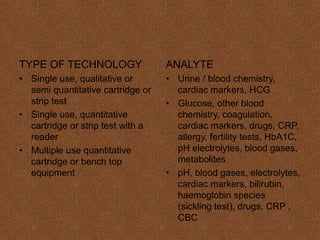
TYPE OF TECHNOLOGY
• Single use, qualitative or
semi quantitative cartridge or
strip test
• Single use, quantitative
cartridge or strip test with a
reader
• Multiple use quantitative
cartridge or bench top
equipment
ANALYTE
• Urine / blood chemistry,
cardiac markers, HCG
• Glucose, other blood
chemistry, coagulation,
cardiac markers, drugs, CRP,
allergy, fertility tests, HbA1C,
pH electrolytes, blood gases,
metabolites
• pH, blood gases, electrolytes,
cardiac markers, bilirubin,
haemoglobin species
(sickling test), drugs, CRP ,
CBC
• The protocols of standard quality control
systems are difficult or self defeating in
POCT.
• A greater dependence has to be placed on
the manufacturer claim of precision when
dealing with single test devices.
• In consideration of the inherent problems
of POCT quality control the following
recommendations are given:
• As far as possible use devices with in-built controls for
single test devices
• For single test devices run QC samples when, a) Lot
changes, b) When operator changes and c) when the
system is recalibrated.
• For multi test or bench top analyzer QC samples must
be run at least once every 8 hours or after every 10
samples
• Harmonization between main laboratory equipment and
POCT devices is essential
• Laboratory shall participate in proficiency testing for
POCT
• CV% must be within acceptable limits

Guidelines regarding point of care testing

  • 1.
    Guidelines regarding Pointof Care Testing (POCT) NABL 112 Issue 4 Dr. Jayesh Warade
  • 2.
    Scope of POCT •Test done at or near patient‟s bedside in ICCU, ITU / HDU, surgical wards, emergency wards, OT, bedside, physician's office etc., i.e. essentially when it is outside the main laboratory.
  • 3.
    Definition • “Any testthat is performed at the time at which the test results enables a decision to be made and results in an action leading to better patient care.”
  • 4.
    Requirements • The laboratorywill have the overall responsibility of all POCT applied in the scope 1. The results must be concordant with those from central laboratory and consistent with clinical needs. 2. TAT must be significantly lower than central laboratory. 3. In built or integrated calibration quality control. Major requirements of the quality management system as per 15189 and NABL 112 must be met. (E.g. SOP, training, test requisition & report format, quality control, etc.) 4. It is desirable to form a committee in hospital setting who will decide on the tests to be done under POCT and also monitor the activities. 5. Only persons who have been trained and authorized by the laboratory shall perform POCT
  • 5.
    Quality control ofPOCT • POCT must be subjected to structured internal quality control as well as EQAS participation. • Quality control practice will depend on the technology and test methods. • POCT can be broadly categorized into three groups as below
  • 6.
    TYPE OF TECHNOLOGY •Single use, qualitative or semi quantitative cartridge or strip test • Single use, quantitative cartridge or strip test with a reader • Multiple use quantitative cartridge or bench top equipment ANALYTE • Urine / blood chemistry, cardiac markers, HCG • Glucose, other blood chemistry, coagulation, cardiac markers, drugs, CRP, allergy, fertility tests, HbA1C, pH electrolytes, blood gases, metabolites • pH, blood gases, electrolytes, cardiac markers, bilirubin, haemoglobin species (sickling test), drugs, CRP , CBC
  • 7.
    • The protocolsof standard quality control systems are difficult or self defeating in POCT. • A greater dependence has to be placed on the manufacturer claim of precision when dealing with single test devices. • In consideration of the inherent problems of POCT quality control the following recommendations are given:
  • 8.
    • As faras possible use devices with in-built controls for single test devices • For single test devices run QC samples when, a) Lot changes, b) When operator changes and c) when the system is recalibrated. • For multi test or bench top analyzer QC samples must be run at least once every 8 hours or after every 10 samples • Harmonization between main laboratory equipment and POCT devices is essential • Laboratory shall participate in proficiency testing for POCT • CV% must be within acceptable limits