2010
Saskatchewan Curriculum


English
Language
Arts


                 1
English Language Arts 1
ISBN 978-1-926841-06-9
1. Language arts (Elementary school) - Saskatchewan - Curricula. 2. Competency-
based education - Saskatchewan.
Saskatchewan. Ministry of Education. Curriculum and E-Learning. Humanities Unit.
All rights are reserved by the original copyright owners.
Table of Contents
Acknowledgements . . . . . . . . . . . . . . . . . . . . . . . . . . . . . . . . . . . . . . . . . . . . . . . . . . . . . . . . . . . . . . . . . . . . . . . . . . . . . . . . . v
Introduction . . . . . . . . . . . . . . . . . . . . . . . . . . . . . . . . . . . . . . . . . . . . . . . . . . . . . . . . . . . . . . . . . . . . . . . . . . . . . . . . . . . . . . . . 1
Core Curriculum . . . . . . . . . . . . . . . . . . . . . . . . . . . . . . . . . . . . . . . . . . . . . . . . . . . . . . . . . . . . . . . . . . . . . . . . . . . . . . . . . . . . 2
Broad Areas of Learning . . . . . . . . . . . . . . . . . . . . . . . . . . . . . . . . . . . . . . . . . . . . . . . . . . . . . . . . . . . . . . . . . . . . . . . . . . . . . 3
        Lifelong Learners . . . . . . . . . . . . . . . . . . . . . . . . . . . . . . . . . . . . . . . . . . . . . . . . . . . . . . . . . . . . . . . . . . . . . . . . . . . . . . . 3
        Sense of Self, Community, and Place . . . . . . . . . . . . . . . . . . . . . . . . . . . . . . . . . . . . . . . . . . . . . . . . . . . . . . . . . . . . 3
        Engaged Citizens . . . . . . . . . . . . . . . . . . . . . . . . . . . . . . . . . . . . . . . . . . . . . . . . . . . . . . . . . . . . . . . . . . . . . . . . . . . . . . . 3
Cross-curricular Competencies . . . . . . . . . . . . . . . . . . . . . . . . . . . . . . . . . . . . . . . . . . . . . . . . . . . . . . . . . . . . . . . . . . . . . . 3
        Developing Thinking . . . . . . . . . . . . . . . . . . . . . . . . . . . . . . . . . . . . . . . . . . . . . . . . . . . . . . . . . . . . . . . . . . . . . . . . . . . 3
        Developing Identity and Interdependence . . . . . . . . . . . . . . . . . . . . . . . . . . . . . . . . . . . . . . . . . . . . . . . . . . . . . . 4
        Developing Literacies . . . . . . . . . . . . . . . . . . . . . . . . . . . . . . . . . . . . . . . . . . . . . . . . . . . . . . . . . . . . . . . . . . . . . . . . . . 4
        Developing Social Responsibility . . . . . . . . . . . . . . . . . . . . . . . . . . . . . . . . . . . . . . . . . . . . . . . . . . . . . . . . . . . . . . . 4
K-12 Aim and Goals of English Language Arts . . . . . . . . . . . . . . . . . . . . . . . . . . . . . . . . . . . . . . . . . . . . . . . . . . . . . . . . 5
An Effective English Language Arts Program . . . . . . . . . . . . . . . . . . . . . . . . . . . . . . . . . . . . . . . . . . . . . . . . . . . . . . . . . 6
        Provides Meaningful Contexts and Questions for Deeper Understanding . . . . . . . . . . . . . . . . . . . . . . . . . 8
        Focuses on Grade-specific Outcomes . . . . . . . . . . . . . . . . . . . . . . . . . . . . . . . . . . . . . . . . . . . . . . . . . . . . . . . . . .14
        Focuses on Language . . . . . . . . . . . . . . . . . . . . . . . . . . . . . . . . . . . . . . . . . . . . . . . . . . . . . . . . . . . . . . . . . . . . . . . . .16
        Uses Critical and Powerful Learning Strategies . . . . . . . . . . . . . . . . . . . . . . . . . . . . . . . . . . . . . . . . . . . . . . . . .19
        Includes a Range of Texts . . . . . . . . . . . . . . . . . . . . . . . . . . . . . . . . . . . . . . . . . . . . . . . . . . . . . . . . . . . . . . . . . . . . . .22
        Encourages Inquiry, Social Responsibility, and Self-reflection . . . . . . . . . . . . . . . . . . . . . . . . . . . . . . . . . . .22
Outcomes and Indicators . . . . . . . . . . . . . . . . . . . . . . . . . . . . . . . . . . . . . . . . . . . . . . . . . . . . . . . . . . . . . . . . . . . . . . . . . . .26
Assessment and Evaluation of Student Learning . . . . . . . . . . . . . . . . . . . . . . . . . . . . . . . . . . . . . . . . . . . . . . . . . . . .32
Connections with Other Areas of Study . . . . . . . . . . . . . . . . . . . . . . . . . . . . . . . . . . . . . . . . . . . . . . . . . . . . . . . . . . . . .41
Glossary . . . . . . . . . . . . . . . . . . . . . . . . . . . . . . . . . . . . . . . . . . . . . . . . . . . . . . . . . . . . . . . . . . . . . . . . . . . . . . . . . . . . . . . . . . .43
References . . . . . . . . . . . . . . . . . . . . . . . . . . . . . . . . . . . . . . . . . . . . . . . . . . . . . . . . . . . . . . . . . . . . . . . . . . . . . . . . . . . . . . . . .46
Feedback Form . . . . . . . . . . . . . . . . . . . . . . . . . . . . . . . . . . . . . . . . . . . . . . . . . . . . . . . . . . . . . . . . . . . . . . . . . . . . . . . . . . . .49


English Language Arts 1                                                                                                                                                                       iii
iv   English Language Arts 1
Acknowledgements
The Ministry of Education wishes to acknowledge the professional contributions and advice given by Elementary
Level teachers and consultants in the following First Nations tribal council and Saskatchewan school divisions:
  • Holy Trinity Roman Catholic School Division
  • Battleford Tribal Council
  • Prairie South School Division
  • Saskatchewan Rivers School Division
  • South East Cornerstone School Division
  • Sun West School Division.

The Ministry of Education also wishes to thank many others who contributed to the development of this
curriculum including:
  • University faculty members
  • Other educators and reviewers.

The curriculum is based on the Western and Northern Canadian Protocol (WNCP) The Common Curriculum
Framework for English Language Arts (Kindergarten to Grade 12) (1998).


English Language Arts 1                                                                                       v
Introduction
English language arts (ELA) is a Required Area of Study in
Saskatchewan’s Core Curriculum. The purpose of this curriculum is to
outline the provincial requirements for Grade 1 English Language Arts.
Time Allotment
The Saskatchewan Ministry of Education has established a provincial
policy for the amount of time that must be allocated to language
arts instruction at each grade level. The required minutes for English
language arts allotted to Grade 1 is 560 minutes per week.
Curriculum Content
This curriculum provides the intended learning outcomes that Grade 1
students are expected to achieve in English language arts by the end
of the year. Indicators are included to provide the breadth and depth
of what students should know, understand, and be able to do in order
to achieve the outcomes.
The learning experiences planned for students will support student
achievement of the provincial Goals of Education through attending to
the Broad Areas of Learning for Saskatchewan and the Cross-curricular
Competencies described on the following pages.
The English language arts curriculum provides:
  • direction for supporting student achievement of the Broad Areas
    of Learning and the Cross-curricular Competencies
  • the K-12 aim and goals for English language arts in Saskatchewan
  • the characteristics of an effective English language arts program
  • Grade 1 English Language Arts outcomes and indicators
  • sample assessment and evaluation criteria for determining student
    growth and achievement in relation to the outcomes in English
    language arts
  • connections with other areas of study.

Additional support resources will appear online.


English Language Arts 1                                                  1
Core Curriculum
    Core Curriculum is intended to provide all Saskatchewan students
    with an education that will serve them well regardless of their choices
    after leaving school. Through its components and initiatives, Core
    Curriculum supports student achievement of the Goals of Education
    for Saskatchewan. For current information regarding Core Curriculum,
    please refer to Core Curriculum: Principles, Time Allocations, and
    Credit Policy on the Saskatchewan Ministry of Education website.
    For additional information related to the various components and
    initiatives of Core Curriculum, please refer to the Ministry website at
    www.education.gov.sk.ca/policy for policy and foundation documents
    including the following:
      • Understanding the Common Essential Learnings: A Handbook for
        Teachers (1988)
      • Objectives for the Common Essential Learnings (CELs) (1998)
      • Renewed Objectives for the Common Essential Learnings of Critical
        and Creative Thinking (CCT) and Personal and Social Development
        (PSD) (2008)
      • The Adaptive Dimension in Core Curriculum (1992)
      • Policy and Procedures for Locally-developed Courses of Study (2004)
      • Connections: Policy and Guidelines for School Libraries in
        Saskatchewan (2008)
      • Diverse Voices: Selecting Equitable Resources for Indian and Métis
        Education (2005)
      • Gender Equity: Policies and Guidelines for Implementation (1991)
      • Instructional Approaches: A Framework for Professional Practice
        (1991)
      • Multicultural Education and Heritage Language Education Policies
        (1994)
      • Classroom Curriculum Connections: A Teacher’s Handbook for
        Personal-Professional Growth (2001).


2                                                       English Language Arts 1
Broad Areas of Learning
There are three Broad Areas of Learning that reflect Saskatchewan’s
Goals of Education. K-12 English language arts contributes to the Goals
of Education through helping students achieve knowledge, skills, and
attitudes related to the following:

Lifelong Learners                                                         Related to the following Goals of
                                                                          Education:
Students who are engaged in constructing and applying English
                                                                           • Basic Skills
language arts knowledge naturally build a positive disposition towards
                                                                           • Lifelong Learning
learning. Throughout their study of English language arts, students
                                                                           • Positive Lifestyle
gain understandings, skills, and strategies to become more competent
and confident language users.

Sense of Self, Community, and Place                                       Related to the following Goals of
                                                                          Education:
To learn English language arts, students need not only to use the
English language but also to interact with each other. Through the         • Understanding and Relating to
English language arts, students learn about themselves, others, and          Others
the world around them. They use language to define who they are and        • Self-concept Development
                                                                           • Spiritual Development
to explore who they might become. They use language to interact and
to respond effectively with others and to build community.

Engaged Citizens
                                                                          Related to the following Goals of
In the English language arts, students learn how language can             Education:
empower them to make a difference in their personal, peer, family,
                                                                           • Career and Consumer Decisions
and community lives. Language gives them a sense of agency and an
                                                                           • Membership in Society
ability to make a difference in their community and the world in which
                                                                           • Growing with Change
they live.


Cross-curricular Competencies
The Cross-curricular Competencies are four interrelated areas
containing understandings, values, skills, and processes which
are considered important for learning in all areas of study. These
competencies reflect the Common Essential Learnings and are
intended to be addressed in each area of study at each grade level.

Developing Thinking
Learners construct knowledge to make sense of the world around            K-12 Goals for Developing Thinking:
them. They develop understanding by building on what is already            • thinking and learning
known. This key competency concerns the ability to make sense of             contextually
information, experiences, and ideas through thinking contextually,         • thinking and learning creatively
critically, and creatively. English language arts is inquiry-based, and    • thinking and learning critically
students use their language and thinking skills to explore a range of
topics, issues, and themes.

English Language Arts 1                                                                                         3
Developing Identity and Interdependence
K-12 Goals for Developing Identity       The ability to act autonomously in an interdependent world requires
and Interdependence:                     an awareness of the natural environment, of social and cultural
    • understanding, valuing, and
                                         expectations, and of the possibilities for individual and group
      caring for oneself                 accomplishments. It assumes the possession of a positive self-
    • understanding, valuing, and        concept and the ability to live in harmony with others and with the
      caring for others                  natural and constructed worlds. Achieving this competency requires
    • understanding and valuing          understanding, valuing, and caring for oneself and for others, and
      social, economic, and              understanding and valuing social and environmental interdependence
      environmental interdependence      and sustainability. English language arts requires students to explore
      and sustainability                 ideas and issues of identity, community, social responsibility, diversity,
                                         and sustainability. Students study texts and ideas about personal and
                                         philosophical; social, historical, and cultural; imaginative and literary;
                                         communicative; and environmental and technological topics.

                                         Developing Literacies
K-12 Goals for Developing Literacies:    Literacies provide many ways, including the use of various language
    • constructing knowledge related     systems and media, to interpret the world and express understanding
      to various literacies              of it. Literacies involve the evolution of interrelated skills, strategies,
    • exploring and interpreting the     and knowledge that facilitate an individual’s ability to participate fully
      world through various literacies   and equitably in a variety of roles and contexts – school, home, and
    • expressing understanding and       local and global communities. To achieve this competency requires
      communicating meaning using        developing skills, strategies, and knowledge related to various
      various literacies.                literacies in order to explore and interpret the world and communicate
                                         meaning. English language arts requires students to use different
                                         literacies, including language literacy, effectively and contextually to
                                         represent ideas and understanding in multiple, flexible ways.

                                         Developing Social Responsibility
K-12 Goals for Developing Social         Social responsibility is how people positively contribute to their
Responsibility:                          physical, social, and cultural environments. It requires the ability to
    • using moral reasoning              participate with others in accomplishing goals. This competency
    • engaging in communitarian          is achieved through using moral reasoning processes, engaging in
      thinking and dialogue              communitarian thinking and dialogue, and taking action. Socially
    • taking action                      responsible learners contribute to their physical, social, and cultural
                                         environments. In English language arts, students explore their social
                                         responsibility and work toward common goals to improve the lives of
                                         others and the natural and constructed worlds.


4                                                                                            English Language Arts 1
K-12 Aim and Goals of English Language
Arts
The K-12 aim of the Saskatchewan English language arts curricula is
to help students understand and appreciate language, and to use it
confidently and competently in a variety of situations for learning,
communication, work, life, and personal satisfaction.
The K-12 goals are broad statements identifying what students are
expected to know and be able to do upon completion of study in a
particular subject (e.g., English language arts). The K-12 goals of the
Saskatchewan English language arts curricula are to:
Comprehend and Respond (CR) – Students will develop their abilities
to view, listen to, read, comprehend, and respond to a variety of
contemporary and traditional grade-level-appropriate texts in a variety
of forms (oral, print, and other media) from First Nations, Métis, and
other cultures for a variety of purposes including for learning, interest,
and enjoyment.
Compose and Create (CC) – Students will develop their abilities to
speak, write, and use other forms of representation to explore and
present thoughts, feelings, and experiences in a variety of forms for a
variety of purposes and audiences.
Assess and Reflect (AR) – Students will develop their abilities to assess
and reflect on their own language skills, discuss the skills of effective
viewers, listeners, readers, representers, speakers, and writers, and set
goals for future improvement.
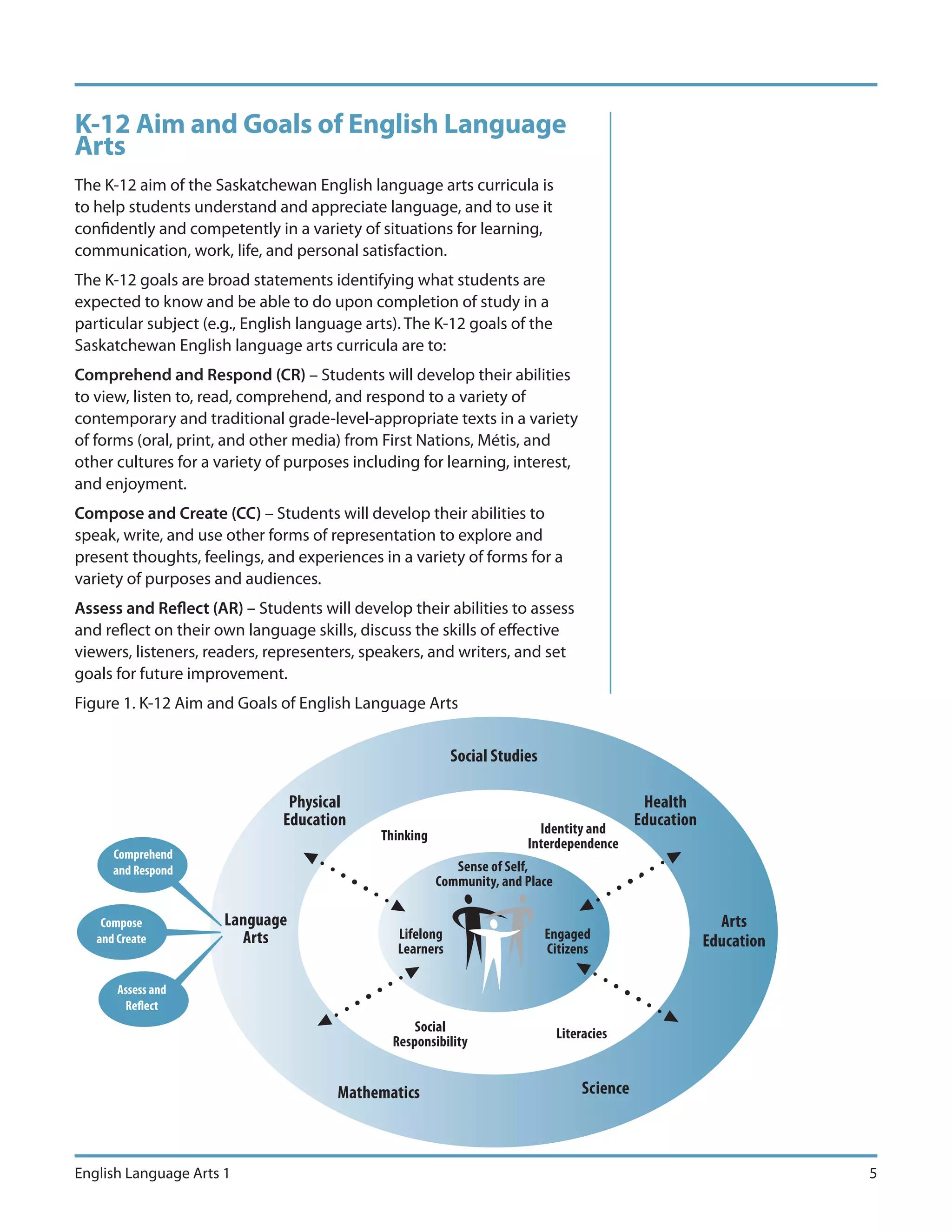
Figure 1. K-12 Aim and Goals of English Language Arts


                                                           Social Studies

                               Physical                                                        Health
                              Education                                  Identity and
                                                                                              Education
                                             Thinking
                                                                       Interdependence
      Comprehend
      and Respond                                          Sense of Self,
                                                        Community, and Place

    Compose           Language                                                                              Arts
                        Arts                    Lifelong                    Engaged
   and Create
                                                Learners                    Citizens                      Education

       Assess and
        Re ect
                                                   Social                      Literacies
                                               Responsibility


                                       Mathematics                                  Science


English Language Arts 1                                                                                               5
An Effective English Language Arts
    Program
    An English language arts program is effective when it is purposeful,
    dynamic, fulfilling, and authentic. This curriculum invites and
    challenges educators to think about education, schooling, and
    English language arts as it might be rather than the way educators
    might know it to be. How can schooling and English language arts be
    more purposeful, dynamic, fulfilling, and authentic? How can it help
    students become competent, confident users of the English language
    and, at the same time, become knowledgeable about themselves, their
    community, and the world as a whole in a deep and meaningful way?
    How can it help them find fulfillment, be socially responsible, and act
    in ways that will make their community and world better places? How
    can it help students become effective self-directed, self-regulated,
    strategic, and collaborative learners to meet the demands of personal,
    social, work, and global life in the 21st century?
    “When a learner makes connections and learning takes place, it is
    because of focused teaching ....” (Fullan, Hill, & Crévola, 2006, p. 34).
    Focused teaching requires:
      • a detailed map of what is expected that students will know and be
        able to do, clearly stated in outcomes and associated indicators
      • a set of powerful and aligned assessment and evaluation tools tied
        to the outcomes
      • a detailed knowledge of how best to teach to these learning
        outcomes in the classroom, including explicit teaching strategies
        and methods and classroom routines.
                                       (Fullan, Hill, & Crévola, 2006, pp. 36-37)
    This curriculum is designed to be the starting point for instructional
    planning. It includes the philosophical underpinnings of the area
    of study and provides the knowledge (i.e., factual, conceptual,
    procedural, metacognitive, or a combination of these) that students
    are expected to know, understand, and be able to do at the end of
    Grade 1. A careful analysis of the outcomes supports teachers in
    determining the types of evidence that they might look for to assess
    whether students have achieved these outcomes. This knowledge
    supports teachers in designing and/or choosing assessment and
    evaluation tools to monitor and report on student learning in English
    language arts. It is the starting point that will allow English language
    arts teachers “to develop and deepen students’ understanding of
    important ideas and a process in the discipline[s] equipping them
    to transfer their learning in meaningful and effective ways, and
    cultivating lifelong habits of mind” (Wiggins & McTighe, 2007, p. 13).
    An effective English language arts program is rooted in research-based
    practice that specifies what is and is not effective in teaching English
    language arts (see next page).

6                                                        English Language Arts 1
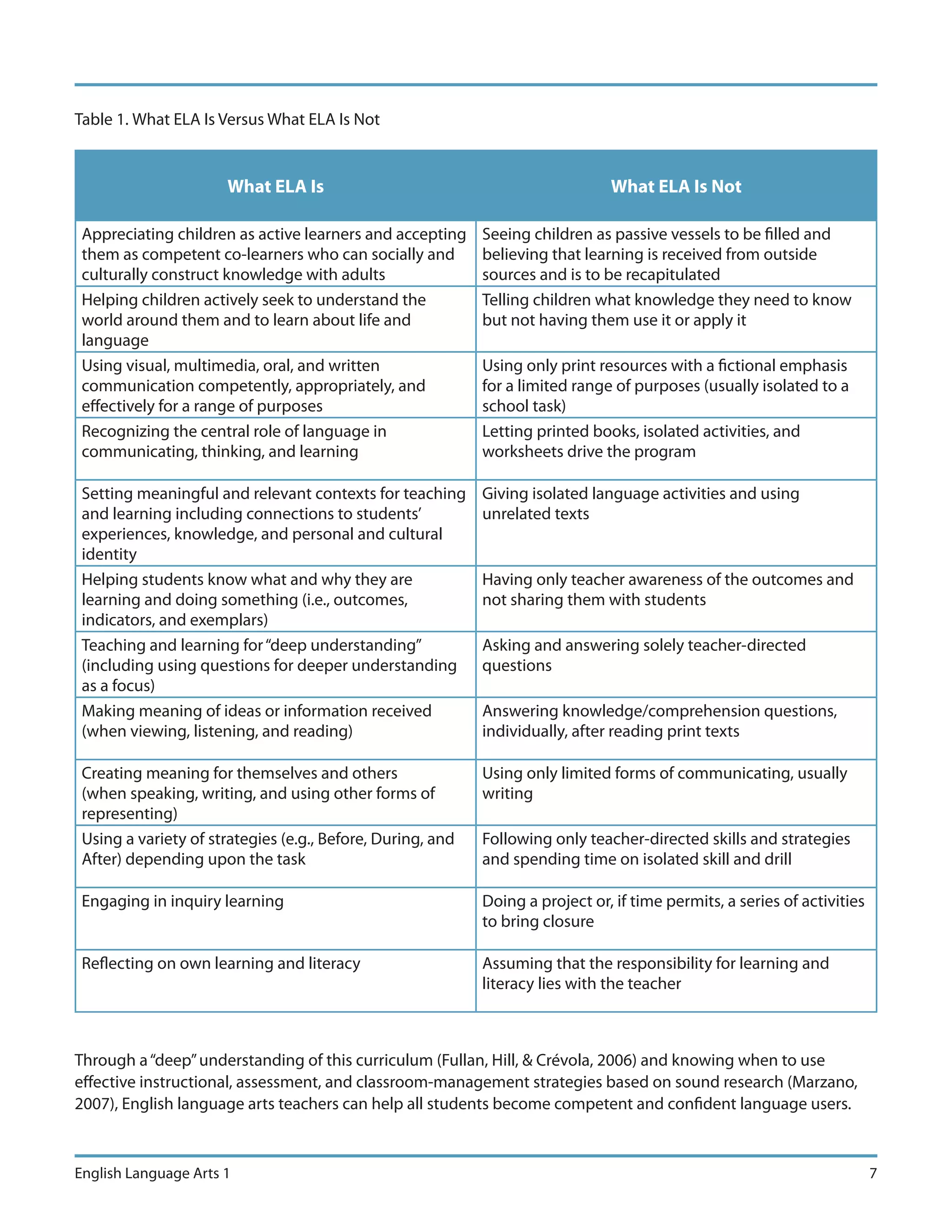
Table 1. What ELA Is Versus What ELA Is Not


                      What ELA Is                                              What ELA Is Not

 Appreciating children as active learners and accepting     Seeing children as passive vessels to be filled and
 them as competent co-learners who can socially and         believing that learning is received from outside
 culturally construct knowledge with adults                 sources and is to be recapitulated
 Helping children actively seek to understand the           Telling children what knowledge they need to know
 world around them and to learn about life and              but not having them use it or apply it
 language
 Using visual, multimedia, oral, and written                Using only print resources with a fictional emphasis
 communication competently, appropriately, and              for a limited range of purposes (usually isolated to a
 effectively for a range of purposes                        school task)
 Recognizing the central role of language in                Letting printed books, isolated activities, and
 communicating, thinking, and learning                      worksheets drive the program

 Setting meaningful and relevant contexts for teaching      Giving isolated language activities and using
 and learning including connections to students’            unrelated texts
 experiences, knowledge, and personal and cultural
 identity
 Helping students know what and why they are                Having only teacher awareness of the outcomes and
 learning and doing something (i.e., outcomes,              not sharing them with students
 indicators, and exemplars)
 Teaching and learning for “deep understanding”             Asking and answering solely teacher-directed
 (including using questions for deeper understanding        questions
 as a focus)
 Making meaning of ideas or information received            Answering knowledge/comprehension questions,
 (when viewing, listening, and reading)                     individually, after reading print texts
 Creating meaning for themselves and others                 Using only limited forms of communicating, usually
 (when speaking, writing, and using other forms of          writing
 representing)
 Using a variety of strategies (e.g., Before, During, and   Following only teacher-directed skills and strategies
 After) depending upon the task                             and spending time on isolated skill and drill

 Engaging in inquiry learning                               Doing a project or, if time permits, a series of activities
                                                            to bring closure

 Reflecting on own learning and literacy                    Assuming that the responsibility for learning and
                                                            literacy lies with the teacher


Through a “deep” understanding of this curriculum (Fullan, Hill, & Crévola, 2006) and knowing when to use
effective instructional, assessment, and classroom-management strategies based on sound research (Marzano,
2007), English language arts teachers can help all students become competent and confident language users.


English Language Arts 1                                                                                                   7
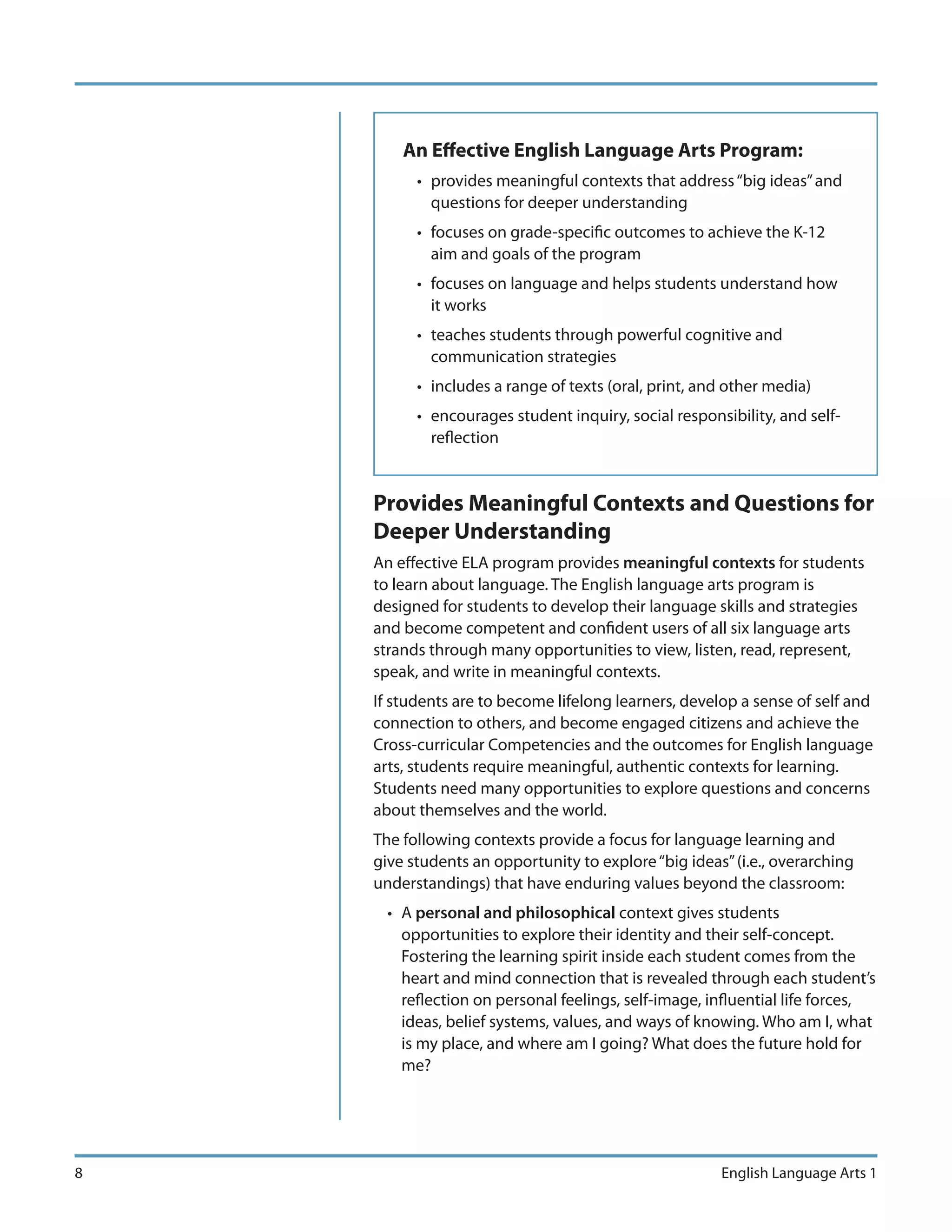
An Effective English Language Arts Program:
          • provides meaningful contexts that address “big ideas” and
            questions for deeper understanding
          • focuses on grade-specific outcomes to achieve the K-12
            aim and goals of the program
          • focuses on language and helps students understand how
            it works
          • teaches students through powerful cognitive and
            communication strategies
          • includes a range of texts (oral, print, and other media)
          • encourages student inquiry, social responsibility, and self-
            reflection


    Provides Meaningful Contexts and Questions for
    Deeper Understanding
    An effective ELA program provides meaningful contexts for students
    to learn about language. The English language arts program is
    designed for students to develop their language skills and strategies
    and become competent and confident users of all six language arts
    strands through many opportunities to view, listen, read, represent,
    speak, and write in meaningful contexts.
    If students are to become lifelong learners, develop a sense of self and
    connection to others, and become engaged citizens and achieve the
    Cross-curricular Competencies and the outcomes for English language
    arts, students require meaningful, authentic contexts for learning.
    Students need many opportunities to explore questions and concerns
    about themselves and the world.
    The following contexts provide a focus for language learning and
    give students an opportunity to explore “big ideas” (i.e., overarching
    understandings) that have enduring values beyond the classroom:
      • A personal and philosophical context gives students
        opportunities to explore their identity and their self-concept.
        Fostering the learning spirit inside each student comes from the
        heart and mind connection that is revealed through each student’s
        reflection on personal feelings, self-image, influential life forces,
        ideas, belief systems, values, and ways of knowing. Who am I, what
        is my place, and where am I going? What does the future hold for
        me?


8                                                     English Language Arts 1
• A social, cultural, and historical context gives students
    opportunities to explore relationships with others, community,
    culture, customs, multiple ways of knowing, national and
    international events and issues, and the history of humanity.
    What are my rights and responsibilities in communities, cultures,
    and economies? How and who am I in relation to communities,
    cultures, and economies? How am I defined by these relationships?
  • An imaginative and literary context gives students opportunities
    to use their intuition and imagination to explore alternative worlds
    and possibilities; different types of classical and contemporary
    genres including fantasy, science fiction, and humour; and
    particular authors. How do I use my imagination and intuition
    and that of others to understand and relate to people, the
    community, the world, and society in a positive way? How do I
    foster imaginative ideas of self and others? How do I use intuitive
    hunches to support creative problem solving or inquiry?
  • A communicative context gives students opportunities to
    explore different methods, forms, and issues related to language,
    communication, and the mass media. How do I make sense of and
    communicate with the world? How do I support communication
    with differing audiences? How do I know if communication is
    effective?
  • An environmental and technological context gives students
    opportunities to explore the natural and constructed worlds
    including the land, the sky, animals, the sea, space, technologies,
    and environmental and technological issues. How do I describe,
    analyze, and shape the world around me? How does that natural
    and technological world affect and shape me?
Each English language arts unit of study can be related to and             How we envision literacy makes a
developed under one or more of these broader contexts. Each context        difference. If we see it as meaning
is to be explored at each grade. Each context provides opportunities       making and not meaning making
for integration with topics of study in other subject areas.               plus inquiry, we fail to envision
                                                                           all that literacy might be. If we
Teachers in Grade 1 should plan a minimum of five units for the year,      see literacy as language and not
basing at least one unit on each of the five contexts. Table 4 gives an    language plus other sign systems, we
overview of possible unit themes and topics, and questions for deeper      also fail to envision all that literacy
understanding for each context.                                            might be.
In addition to considering the five contexts, Elementary Level English     (Harste, 2000, p.1)
language arts teachers need to think about the types of units to plan.
Language arts units, designed around the themes and topics within
each context, can ensure that the outcomes for the language strands
are achieved in meaningful ways. Minimal guidelines are provided for
each type of unit.


English Language Arts 1                                                                                          9
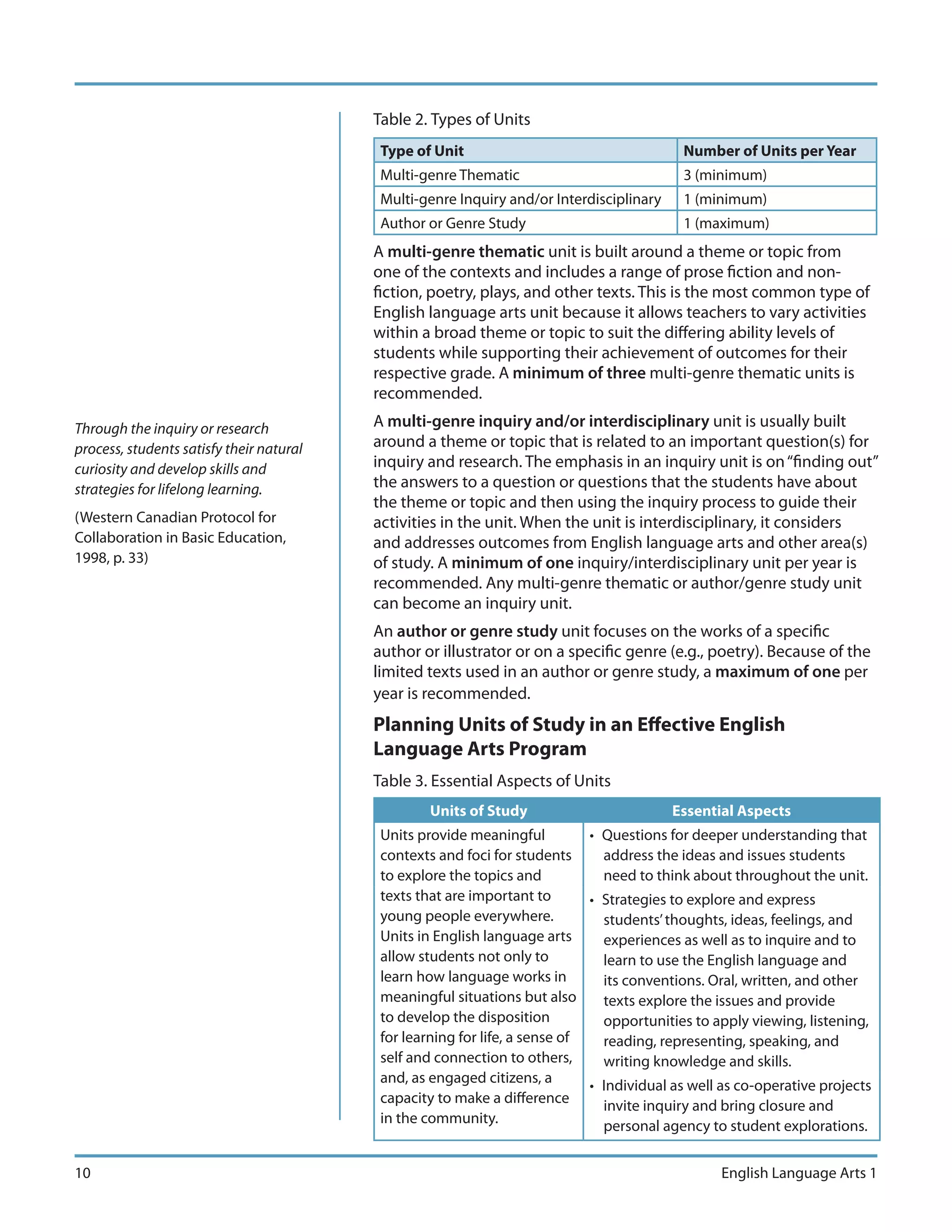
Table 2. Types of Units
                                           Type of Unit                                    Number of Units per Year
                                           Multi-genre Thematic                            3 (minimum)
                                           Multi-genre Inquiry and/or Interdisciplinary    1 (minimum)
                                           Author or Genre Study                           1 (maximum)
                                          A multi-genre thematic unit is built around a theme or topic from
                                          one of the contexts and includes a range of prose fiction and non-
                                          fiction, poetry, plays, and other texts. This is the most common type of
                                          English language arts unit because it allows teachers to vary activities
                                          within a broad theme or topic to suit the differing ability levels of
                                          students while supporting their achievement of outcomes for their
                                          respective grade. A minimum of three multi-genre thematic units is
                                          recommended.

Through the inquiry or research           A multi-genre inquiry and/or interdisciplinary unit is usually built
process, students satisfy their natural   around a theme or topic that is related to an important question(s) for
curiosity and develop skills and          inquiry and research. The emphasis in an inquiry unit is on “finding out”
strategies for lifelong learning.         the answers to a question or questions that the students have about
                                          the theme or topic and then using the inquiry process to guide their
(Western Canadian Protocol for            activities in the unit. When the unit is interdisciplinary, it considers
Collaboration in Basic Education,         and addresses outcomes from English language arts and other area(s)
1998, p. 33)                              of study. A minimum of one inquiry/interdisciplinary unit per year is
                                          recommended. Any multi-genre thematic or author/genre study unit
                                          can become an inquiry unit.
                                          An author or genre study unit focuses on the works of a specific
                                          author or illustrator or on a specific genre (e.g., poetry). Because of the
                                          limited texts used in an author or genre study, a maximum of one per
                                          year is recommended.
                                          Planning Units of Study in an Effective English
                                          Language Arts Program
                                          Table 3. Essential Aspects of Units
                                                  Units of Study                          Essential Aspects
                                           Units provide meaningful          • Questions for deeper understanding that
                                           contexts and foci for students      address the ideas and issues students
                                           to explore the topics and           need to think about throughout the unit.
                                           texts that are important to       • Strategies to explore and express
                                           young people everywhere.            students’ thoughts, ideas, feelings, and
                                           Units in English language arts      experiences as well as to inquire and to
                                           allow students not only to          learn to use the English language and
                                           learn how language works in         its conventions. Oral, written, and other
                                           meaningful situations but also      texts explore the issues and provide
                                           to develop the disposition          opportunities to apply viewing, listening,
                                           for learning for life, a sense of   reading, representing, speaking, and
                                           self and connection to others,      writing knowledge and skills.
                                           and, as engaged citizens, a       • Individual as well as co-operative projects
                                           capacity to make a difference       invite inquiry and bring closure and
                                           in the community.                   personal agency to student explorations.


10                                                                                               English Language Arts 1
An effective English language arts program also provides
opportunities to explore “big ideas” (e.g., extinction versus the topic of
dinosaurs) and to consider questions for deeper understanding.
Questions for deeper understanding are used to initiate and guide a
unit and give students direction for developing deep understandings
about a topic or issue under study. It is essential to develop questions
that are evoked by student interests and have potential for rich
and deep learning. The process of constructing questions can help
students to grasp the important disciplinary or transdisciplinary ideas
that are situated at the core of a particular curricular focus or context.
These broad questions will lead to more specific questions that can          Effective Questions for Deeper
provide a framework, purpose, and direction for the learning activities      Understanding:
in a lesson, or series of lessons, and help students connect what they        • Cause genuine and relevant
are learning to their experiences and life beyond school.                       inquiry into the key ideas and
Effective questions for deeper understanding in English language                core content
arts are the key to initiating and guiding students’ investigations and       • Provide for thoughtful, lively
                                                                                discussion, sustained inquiry, and
critical thinking, problem solving, and reflection on students’ own
                                                                                new understanding as well as
learning. Questions such as the following are examples of questions
                                                                                more questions
that will move Grade 1 students toward deeper understanding:                  • Require students to consider
  • Who am I?                                                                   alternatives, weigh evidence,
                                                                                support their ideas, and justify
  • What does it mean to be me?
                                                                                their answers
  • What choices are right for me?                                            • Stimulate vital, ongoing
                                                                                rethinking of ideas, assumptions,
  • How do I want others to see me?
                                                                                or prior lessons
  • What “power” do I have to cause or promote change?                        • Spark meaningful connections
Effective questioning is essential for teaching and student learning            with prior learning, personal
                                                                                experiences, and ways of knowing
and should be an integral part of planning in English language arts.
                                                                              • Naturally recur, creating
Questioning should also be used to encourage students to reflect on
                                                                                opportunities for transfer to other
their own learning. The following chart identifies the five contexts            situations and subjects.
for English language arts and suggests some possible questions for
deeper understanding and some possible unit topics or themes for             (Adapted from Wiggins & McTighe,
                                                                             2005, p. 110)
each context.


English Language Arts 1                                                                                         11
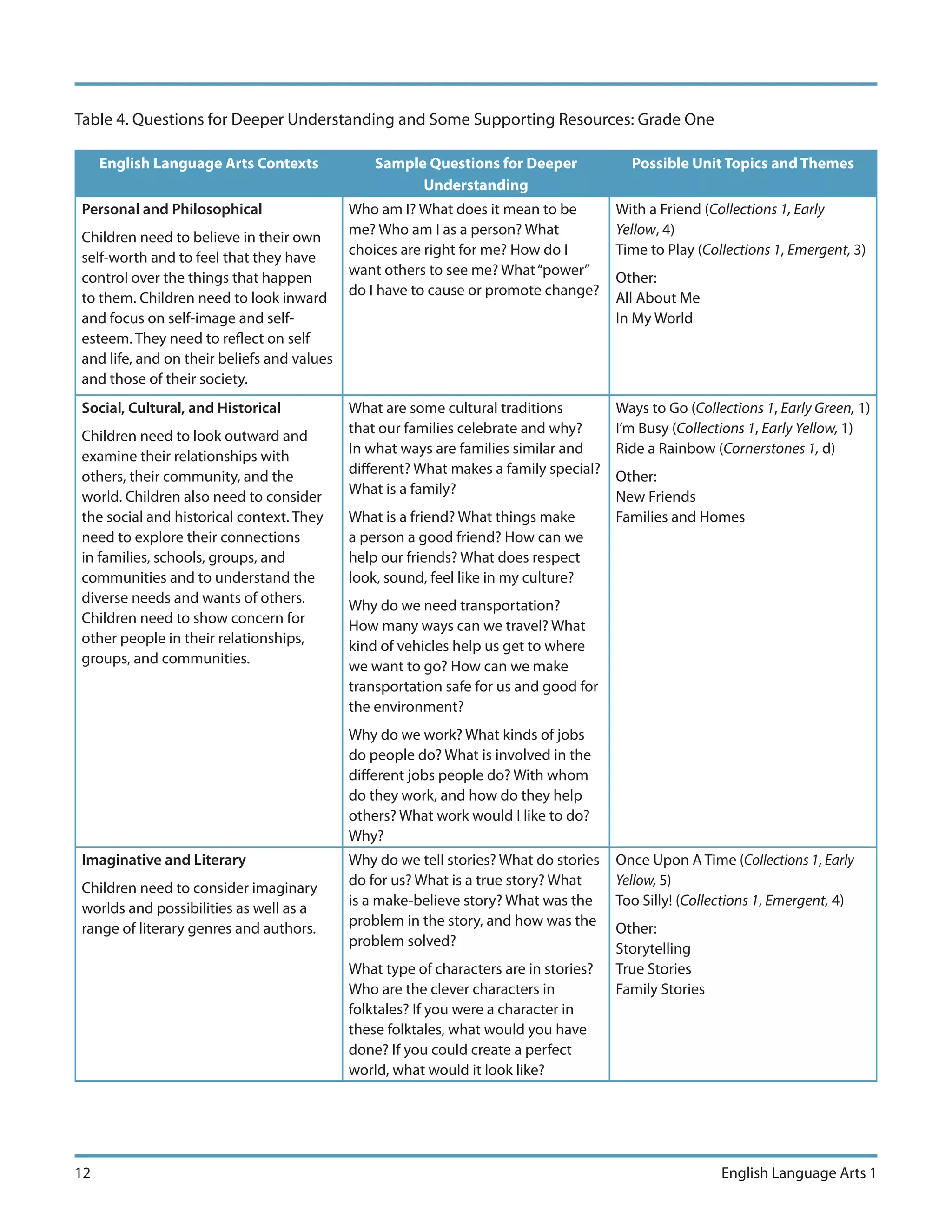
Table 4. Questions for Deeper Understanding and Some Supporting Resources: Grade One

     English Language Arts Contexts             Sample Questions for Deeper             Possible Unit Topics and Themes
                                                      Understanding
Personal and Philosophical                  Who am I? What does it mean to be         With a Friend (Collections 1, Early
                                            me? Who am I as a person? What            Yellow, 4)
Children need to believe in their own
                                            choices are right for me? How do I        Time to Play (Collections 1, Emergent, 3)
self-worth and to feel that they have
                                            want others to see me? What “power”
control over the things that happen                                                   Other:
                                            do I have to cause or promote change?
to them. Children need to look inward                                                 All About Me
and focus on self-image and self-                                                     In My World
esteem. They need to reflect on self
and life, and on their beliefs and values
and those of their society.
Social, Cultural, and Historical            What are some cultural traditions         Ways to Go (Collections 1, Early Green, 1)
                                            that our families celebrate and why?      I’m Busy (Collections 1, Early Yellow, 1)
Children need to look outward and
                                            In what ways are families similar and     Ride a Rainbow (Cornerstones 1, d)
examine their relationships with
                                            different? What makes a family special?
others, their community, and the                                                      Other:
                                            What is a family?
world. Children also need to consider                                                 New Friends
the social and historical context. They     What is a friend? What things make        Families and Homes
need to explore their connections           a person a good friend? How can we
in families, schools, groups, and           help our friends? What does respect
communities and to understand the           look, sound, feel like in my culture?
diverse needs and wants of others.          Why do we need transportation?
Children need to show concern for           How many ways can we travel? What
other people in their relationships,        kind of vehicles help us get to where
groups, and communities.                    we want to go? How can we make
                                            transportation safe for us and good for
                                            the environment?
                                            Why do we work? What kinds of jobs
                                            do people do? What is involved in the
                                            different jobs people do? With whom
                                            do they work, and how do they help
                                            others? What work would I like to do?
                                            Why?
Imaginative and Literary                    Why do we tell stories? What do stories   Once Upon A Time (Collections 1, Early
                                            do for us? What is a true story? What     Yellow, 5)
Children need to consider imaginary
                                            is a make-believe story? What was the     Too Silly! (Collections 1, Emergent, 4)
worlds and possibilities as well as a
                                            problem in the story, and how was the
range of literary genres and authors.                                                 Other:
                                            problem solved?                           Storytelling
                                            What type of characters are in stories?   True Stories
                                            Who are the clever characters in          Family Stories
                                            folktales? If you were a character in
                                            these folktales, what would you have
                                            done? If you could create a perfect
                                            world, what would it look like?


12                                                                                                     English Language Arts 1
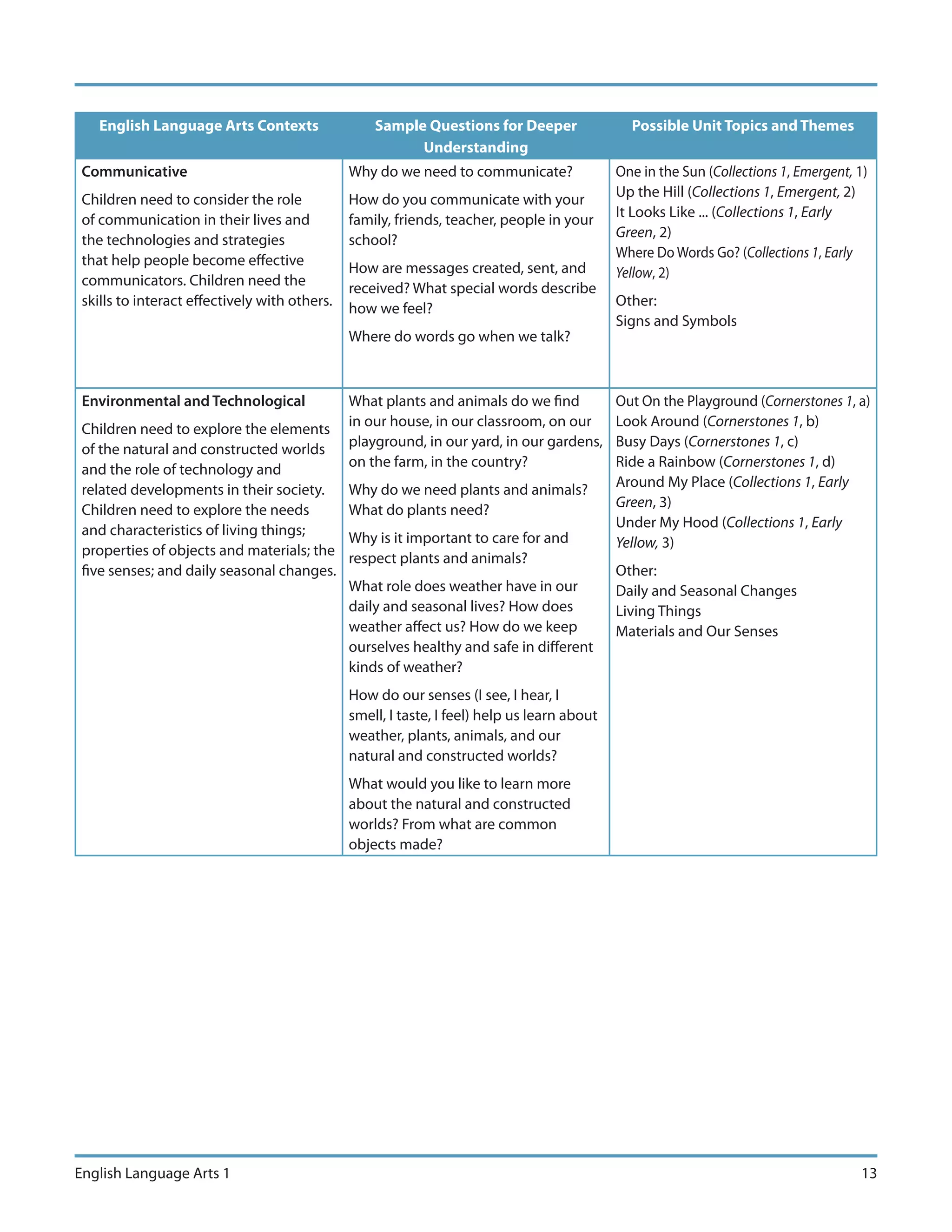
English Language Arts Contexts                 Sample Questions for Deeper                 Possible Unit Topics and Themes
                                                         Understanding
 Communicative                                 Why do we need to communicate?                One in the Sun (Collections 1, Emergent, 1)
                                                                                             Up the Hill (Collections 1, Emergent, 2)
 Children need to consider the role            How do you communicate with your
                                                                                             It Looks Like ... (Collections 1, Early
 of communication in their lives and           family, friends, teacher, people in your
                                                                                             Green, 2)
 the technologies and strategies               school?
                                                                                             Where Do Words Go? (Collections 1, Early
 that help people become effective             How are messages created, sent, and           Yellow, 2)
 communicators. Children need the              received? What special words describe
 skills to interact effectively with others.                                                 Other:
                                               how we feel?
                                                                                             Signs and Symbols
                                               Where do words go when we talk?


 Environmental and Technological               What plants and animals do we find            Out On the Playground (Cornerstones 1, a)
                                               in our house, in our classroom, on our        Look Around (Cornerstones 1, b)
 Children need to explore the elements
                                               playground, in our yard, in our gardens,      Busy Days (Cornerstones 1, c)
 of the natural and constructed worlds
                                               on the farm, in the country?                  Ride a Rainbow (Cornerstones 1, d)
 and the role of technology and
                                                                                             Around My Place (Collections 1, Early
 related developments in their society.        Why do we need plants and animals?
                                                                                             Green, 3)
 Children need to explore the needs            What do plants need?
                                                                                             Under My Hood (Collections 1, Early
 and characteristics of living things;         Why is it important to care for and           Yellow, 3)
 properties of objects and materials; the      respect plants and animals?
 five senses; and daily seasonal changes.                                                    Other:
                                               What role does weather have in our            Daily and Seasonal Changes
                                               daily and seasonal lives? How does            Living Things
                                               weather affect us? How do we keep             Materials and Our Senses
                                               ourselves healthy and safe in different
                                               kinds of weather?
                                               How do our senses (I see, I hear, I
                                               smell, I taste, I feel) help us learn about
                                               weather, plants, animals, and our
                                               natural and constructed worlds?
                                               What would you like to learn more
                                               about the natural and constructed
                                               worlds? From what are common
                                               objects made?


English Language Arts 1                                                                                                               13
Focuses on Grade-specific Outcomes
     An effective English language arts program focuses on grade-specific
     curriculum outcomes. Student learning outcomes describe what
     students will learn in a particular discipline over a specific time frame
     (e.g., Grade 1). Outcomes specify the skills, knowledge, and attitudes
     that students are expected to know, understand, and be able to
     demonstrate.
     Critical Characteristics of Outcomes and Indicators
     Outcomes:
       • focus on what students will learn rather than what teachers will
         teach
       • specify the skills, strategies, abilities, understandings, and
         knowledge students are expected to be able to demonstrate
       • are observable, assessable, and attainable
       • are grade and subject specific
       • are supported by indicators which provide the breadth and depth
         of expectations
       • are written using action-based verbs
       • identify the most important understandings and abilities to be
         developed in the specific grade level
       • guide course, unit, and lesson planning.

     Indicators:
       • are a representative list of what students need to know and/or be
         able to do in order to achieve an outcome
       • represent the breadth and depth of the outcomes.
     Note: Additional and/or alternative indicators may be developed, but
     they must be reflective of and consistent with the breadth and depth
     that is defined by the given indicators.


14                                                      English Language Arts 1
English Language Arts Goals and Outcomes Overview
Each of the three goals for English language arts has a set of outcomes for the specific grade level. The following
are the outcomes for Grade 1 ELA.

 Comprehend and Respond (CR). Students will develop their abilities to view, listen to, read, comprehend,
 and respond to a variety of contemporary and traditional grade-level-appropriate texts in a variety of
 forms (oral, print, and other media) from First Nations, Métis, and other cultures for a variety of purposes
 including for learning, interest, and enjoyment.
CR1.1 Comprehend and respond to a variety of grade-level texts (including contemporary and traditional visual,
oral, written, and multimedia) that address:
  • identity (e.g., All About Me)
  • community (e.g., Friends and Family)
  • social responsibility (e.g., Conservation) and relate to own feelings, ideas, and experiences.

CR1.2 View and comprehend the explicit messages, feelings, and features in a variety of visual and multimedia
texts (including pictures, photographs, simple graphs, diagrams, pictographs, icons, and illustrations).
CR1.3 Listen to and comprehend a variety of texts (including a book read aloud, a person speaking, and
directions) to retell the sequence and key points (who, what, when, where, why, and how).
CR1.4 Read and comprehend grade-appropriate texts (including narratives, informational texts, scripts, and
poems) by relating the sequence (i.e., beginning, middle, and end), the key points (who, what, when, where,
why), and the problems and solutions.

 Compose and Create (CC). Students will develop their abilities to speak, write, and use other forms of
 representation to explore and present thoughts, feelings, and experiences in a variety of forms for a
 variety of purposes and audiences.

CC1.1 Compose and create a range of visual, multimedia, oral, and written texts that explore and present
thoughts on:
  • identity (e.g., Feelings)
  • community (e.g., Neighbourhood)
  • social responsibility (e.g., Plants and Trees).

CC1.2 Represent key ideas and events, in a logical sequence and with detail, in different ways (including
dramatization, pictures, sounds, physical movement, charts, models, and drawings).
CC1.3 Speak clearly and audibly about ideas, experiences, preferences, questions, and conclusions in a logical
sequence, using expression and dramatization when appropriate.

CC1.4 Write and share stories and short informational texts about familiar events and experiences in a minimum
of five sentences.

 Assess and Reflect (AR). Students will develop their abilities to assess and reflect on their own language
 skills, discuss the skills of effective viewers, listeners, readers, representers, speakers, and writers, and set
 goals for future improvement.

AR1.1 Identify, with teacher guidance, what good viewers, listeners, readers, representers, speakers, and writers
do.

AR1.2 Set and monitor, in consultation with the teacher, goals for more effective viewing, listening, reading,
representing, speaking, and writing experiences.

English Language Arts 1                                                                                              15
Focuses on Language
Good language and literacy skills lay   Language and language study are at the centre of the Elementary
the foundation for social, academic,    Level English language arts program. The study of the English
economic, personal, and national        language arts (viewing, listening, reading, representing, speaking,
success.                                and writing) and of the elements and conventions associated with
(Jamieson & Tremblay, 2005, p. 1)       each language cueing system (i.e., pragmatic, textual, syntactic,
                                        semantic/lexical/morphological, graphophonic, and other) enables
                                        students to understand and appreciate language and to use it in a
                                        variety of situations for communication, for learning, and for personal
                                        satisfaction.
                                        An effective English language arts program that develops students’
                                        facility with language provides students with opportunities to:
                                          • learn to use language in a variety of meaningful ways, considering
                                            and determining their audience, purpose, and situation
                                          • learn about language as a necessary tool for thinking and
                                            communicating effectively, considering the cues and conventions
                                            of language
                                          • learn through language by applying their knowledge of language
                                            in their viewing, listening, reading, representing, speaking, and
                                            writing experiences.
                                        Language study is an integral part of an English language arts
                                        program. Students in each grade are expected to understand the
                                        concepts related to the language cues and conventions. As students
                                        view, listen, read, represent, speak, and write, they are expected
                                        to apply the concepts as students construct and communicate
                                        meaning in their English language arts program and in their daily
                                        communication.


16                                                                                        English Language Arts 1
Table 5. Key Language Cues and Conventions for Grade 1


     Language Cue or Convention                    Comprehend and Respond                            Compose and Create
                                              When viewing, listening, or reading,           When speaking, writing, or using
                                                      Grade 1 students:                    other forms of representing, Grade 1
                                                                                                        students:
 Pragmatic                                    Identify a purpose for viewing,              Use common social greetings and
                                              listening, and reading.                      expressions (e.g., “Thank you”); use
 Pragmatics is the study of how people
                                                                                           language appropriate to situation.
 choose what and how to communicate
 from a range of possibilities available in
 the language and how the receiver will
 be affected by these choices.
 Textual                                   Recognize different text forms                  Create simple stories of several
 Ideas and information are organized in (including poem, story, fairy tale,                sentences; organize main idea with
 oral, written, and other formats. Textual informational text) and some of their           two or more related details.
 cues and conventions include the form structures and features (e.g., title,
                                           page number, sequence, description,
 or structure and elements of a text.
                                           problem/resolution); recognize the
                                           difference between fiction and non-
                                           fiction.
 Syntactic                               Understand sentence structure and                 Use and write simple complete
                                         predictable word order (e.g., I                   sentences often with six or more words
 Syntax is the predictable structure of
                                         can . . . , I can . . . ); recognize a complete   (in speech, 6.8; in writing, 6.0 by June);
 a sentence and the ways words are
 combined to form phrases, clauses, and sentence and its end punctuation; use              understand and use conventions of a
                                         punctuation (including period and                 sentence (including word order, capital
 sentences. Syntax includes classes of
                                         comma) to help understanding.                     letters at the beginning of a sentence,
 words (e.g., verbs) and their functions
                                                                                           period at the end of a statement).
 (e.g., subjects).

 Semantic/Lexical/Morphological               Recognize 100 of the most commonly           Choose and use words to add interest
                                              used words in print; use context, visual     or to clarify; use conventional spellings
 The lexicon of a language includes
                                              cues (e.g., pictures and illustrations),     of high-frequency words; recognize
 all the words or vocabulary of that
                                              and sound patterns (e.g., rhyming            the difference between invented and
 language that are used or understood
                                              words); recognize common antonyms            conventional Canadian spelling; form
 by a particular person or groups.
                                              and synonyms.                                correctly the plural of single-syllable
 Words can also be studied for their
                                                                                           words (e.g., dog/dogs); use capitals
 meaningful parts or morphemes.
                                                                                           for the pronoun I, names, days of the
                                                                                           week, and months; spell name and
                                                                                           high-frequency words such as are, and,
                                                                                           I, from, was, that, the, they, with, you, ....


English Language Arts 1                                                                                                                17
Language Cue or Convention               Comprehend and Respond                       Compose and Create
                                        When viewing, listening, or reading,         When speaking, writing, or using
                                                Grade 1 students:                  other forms of representing, Grade 1
                                                                                                students:
Phonological/Graphophonic               Count phonemes and segment or              Use phonics (including letter/sound
                                        blend phonemes at the beginning            relationships and patterns in words)
Graphophonics is the study of the
                                        of words containing one, two, and          to spell unfamiliar words; sound
relationship between the symbols and
                                        three phonemes to make new words;          out (elongating) and represent all
sounds of a language and includes
                                        recognize and use the alphabet;            substantial sounds in spelling a word;
letter or sound relationships and
                                        recognize letter/sound relationships       use a mixture of conventional and
patterns.
                                        and patterns in words; identify all        temporary spelling for three- and four-
                                        consonant sounds in spoken words;          letter short vowel words.
                                        use phonics to help decode individual
                                        words including using basic phonetic
                                        analysis and consonant sounds in
                                        some blends and digraphs (e.g., bl, br,
                                        th, wh) in regular one-syllable words;
                                        recognize rhyming words; recognize
                                        features of words including word
                                        patterns and differences.
Other Cues and Conventions              Recognize key features such as             Use simple gestures, volume, and
                                        captions, illustrations, colours, sizes,   tone of voice to communicate ideas
Other cues and conventions are also
                                        and movements in different types of        and needs; hold pencils, crayons, and
found in communication acts and
                                        texts.                                     markers with a comfortable and correct
include such elements as graphics,
                                                                                   grip; use correct letter and number
layout, colour, sound, movement, font
                                                                                   formation (capitals and small letters);
choices, and handwriting.
                                                                                   leave spaces between words; use
                                                                                   pictures, charts, graphs, and physical
                                                                                   movement to show what is learned.


18                                                                                                 English Language Arts 1
Uses Critical and Powerful Learning Strategies
An effective ELA program teaches students how to use critical and powerful learning strategies. In order to
achieve the English language arts outcomes, students need to learn and use a range of language skills and
strategies. Effective language arts teachers employ a range of instructional approaches to help students move
from teacher-supported and guided lessons to independent learning that requires varied instructional methods
and strategies to help students learn these language skills and strategies. Teachers model and discuss key
procedural and metacognitive strategies for language learning and thinking. Students need to learn how to
select and to use strategies before, during, and after viewing, listening, reading, representing, speaking, and
writing.
If students are to be successful in English language arts, they need to learn and use thinking and learning skills
and strategies on their own. In order to help students gain control over a repertoire of key skills and strategies,
the skills and strategies need to be explicitly taught and practised using a model such as the following:
  •   Introduce and explain the purpose of the skill or strategy.
  •   Demonstrate and model its use.
  •   Provide guided practice for students to apply the skill or strategy with feedback.
  •   Allow students to apply the skill or strategy independently and in teams.
  •   Reflect regularly on the appropriate uses of the skills or strategies and their effectiveness.
  •   Assess the students’ ability to transfer the repertoire of skills or strategies with less and less teacher
      prompting over time.
                                                                                     (Wiggins & McTighe, 2007, pp. 97-98)

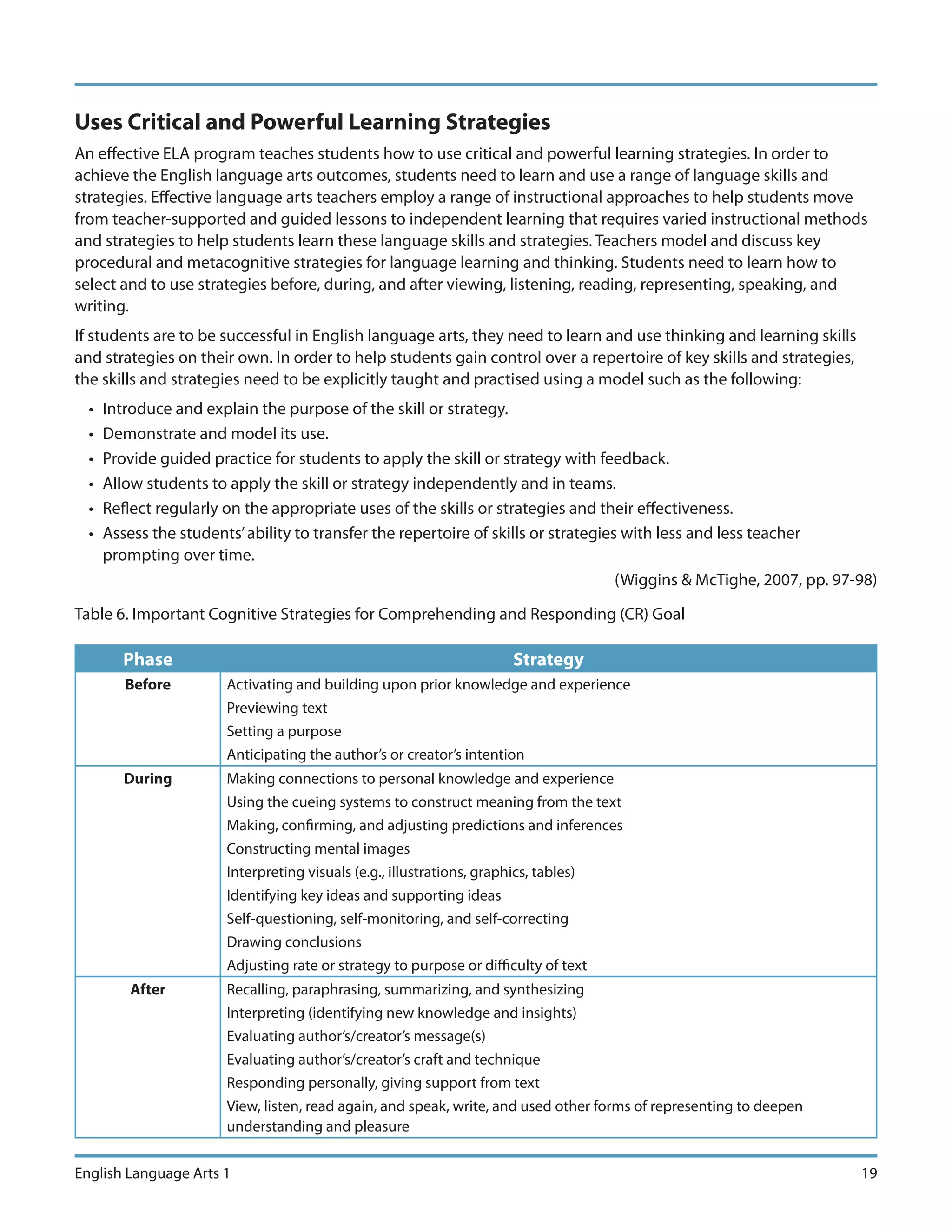
Table 6. Important Cognitive Strategies for Comprehending and Responding (CR) Goal

         Phase                                                      Strategy
         Before         Activating and building upon prior knowledge and experience
                        Previewing text
                        Setting a purpose
                        Anticipating the author’s or creator’s intention
         During         Making connections to personal knowledge and experience
                        Using the cueing systems to construct meaning from the text
                        Making, confirming, and adjusting predictions and inferences
                        Constructing mental images
                        Interpreting visuals (e.g., illustrations, graphics, tables)
                        Identifying key ideas and supporting ideas
                        Self-questioning, self-monitoring, and self-correcting
                        Drawing conclusions
                        Adjusting rate or strategy to purpose or difficulty of text
          After         Recalling, paraphrasing, summarizing, and synthesizing
                        Interpreting (identifying new knowledge and insights)
                        Evaluating author’s/creator’s message(s)
                        Evaluating author’s/creator’s craft and technique
                        Responding personally, giving support from text
                        View, listen, read again, and speak, write, and used other forms of representing to deepen
                        understanding and pleasure


English Language Arts 1                                                                                               19
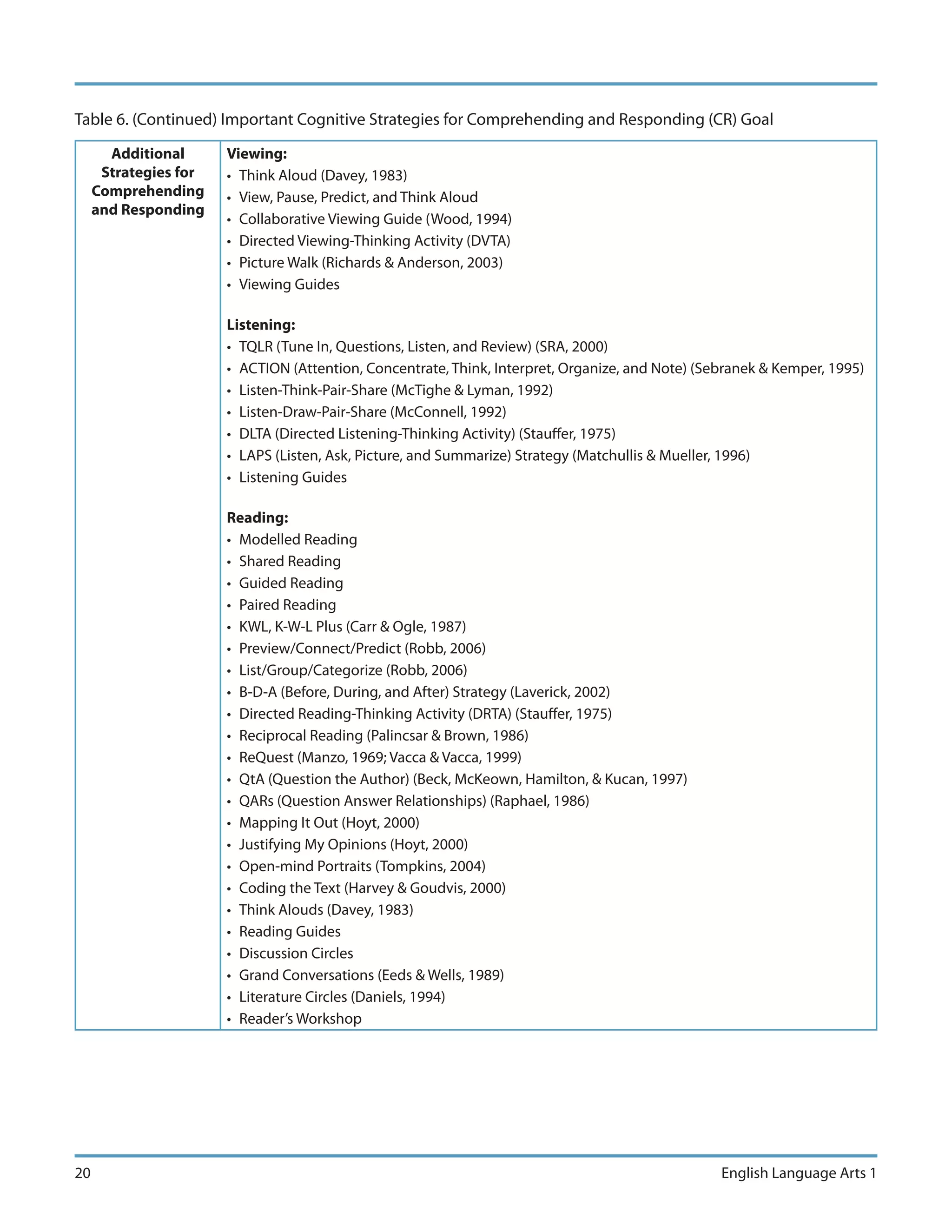
Table 6. (Continued) Important Cognitive Strategies for Comprehending and Responding (CR) Goal
       Additional      Viewing:
      Strategies for   • Think Aloud (Davey, 1983)
     Comprehending     • View, Pause, Predict, and Think Aloud
     and Responding
                       • Collaborative Viewing Guide (Wood, 1994)
                       • Directed Viewing-Thinking Activity (DVTA)
                       • Picture Walk (Richards & Anderson, 2003)
                       • Viewing Guides

                       Listening:
                       • TQLR (Tune In, Questions, Listen, and Review) (SRA, 2000)
                       • ACTION (Attention, Concentrate, Think, Interpret, Organize, and Note) (Sebranek & Kemper, 1995)
                       • Listen-Think-Pair-Share (McTighe & Lyman, 1992)
                       • Listen-Draw-Pair-Share (McConnell, 1992)
                       • DLTA (Directed Listening-Thinking Activity) (Stauffer, 1975)
                       • LAPS (Listen, Ask, Picture, and Summarize) Strategy (Matchullis & Mueller, 1996)
                       • Listening Guides

                       Reading:
                       • Modelled Reading
                       • Shared Reading
                       • Guided Reading
                       • Paired Reading
                       • KWL, K-W-L Plus (Carr & Ogle, 1987)
                       • Preview/Connect/Predict (Robb, 2006)
                       • List/Group/Categorize (Robb, 2006)
                       • B-D-A (Before, During, and After) Strategy (Laverick, 2002)
                       • Directed Reading-Thinking Activity (DRTA) (Stauffer, 1975)
                       • Reciprocal Reading (Palincsar & Brown, 1986)
                       • ReQuest (Manzo, 1969; Vacca & Vacca, 1999)
                       • QtA (Question the Author) (Beck, McKeown, Hamilton, & Kucan, 1997)
                       • QARs (Question Answer Relationships) (Raphael, 1986)
                       • Mapping It Out (Hoyt, 2000)
                       • Justifying My Opinions (Hoyt, 2000)
                       • Open-mind Portraits (Tompkins, 2004)
                       • Coding the Text (Harvey & Goudvis, 2000)
                       • Think Alouds (Davey, 1983)
                       • Reading Guides
                       • Discussion Circles
                       • Grand Conversations (Eeds & Wells, 1989)
                       • Literature Circles (Daniels, 1994)
                       • Reader’s Workshop


20                                                                                                English Language Arts 1
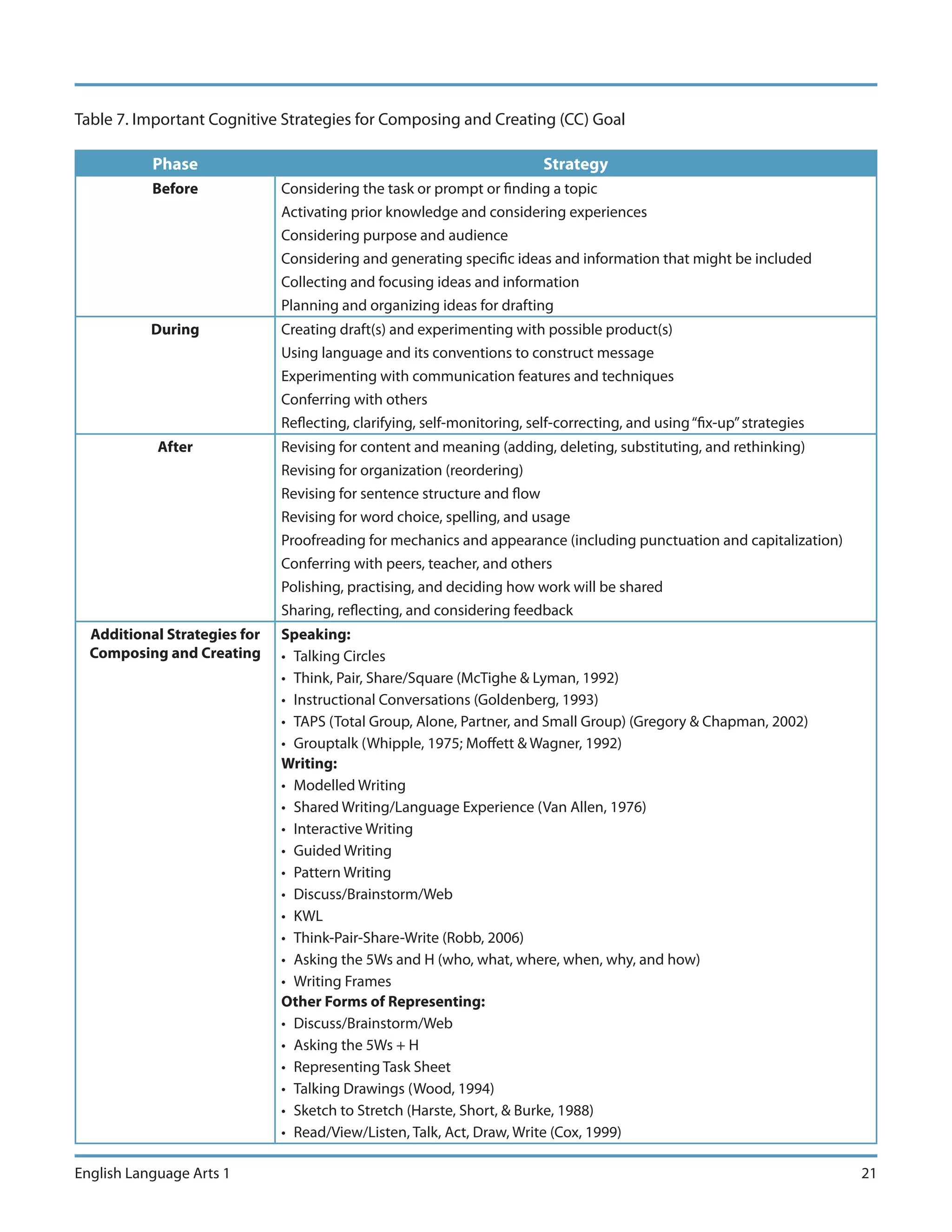
Table 7. Important Cognitive Strategies for Composing and Creating (CC) Goal

           Phase                                                         Strategy
           Before             Considering the task or prompt or finding a topic
                              Activating prior knowledge and considering experiences
                              Considering purpose and audience
                              Considering and generating specific ideas and information that might be included
                              Collecting and focusing ideas and information
                              Planning and organizing ideas for drafting
           During             Creating draft(s) and experimenting with possible product(s)
                              Using language and its conventions to construct message
                              Experimenting with communication features and techniques
                              Conferring with others
                              Reflecting, clarifying, self-monitoring, self-correcting, and using “fix-up” strategies
            After             Revising for content and meaning (adding, deleting, substituting, and rethinking)
                              Revising for organization (reordering)
                              Revising for sentence structure and flow
                              Revising for word choice, spelling, and usage
                              Proofreading for mechanics and appearance (including punctuation and capitalization)
                              Conferring with peers, teacher, and others
                              Polishing, practising, and deciding how work will be shared
                              Sharing, reflecting, and considering feedback
  Additional Strategies for   Speaking:
  Composing and Creating      • Talking Circles
                              • Think, Pair, Share/Square (McTighe & Lyman, 1992)
                              • Instructional Conversations (Goldenberg, 1993)
                              • TAPS (Total Group, Alone, Partner, and Small Group) (Gregory & Chapman, 2002)
                              • Grouptalk (Whipple, 1975; Moffett & Wagner, 1992)
                              Writing:
                              • Modelled Writing
                              • Shared Writing/Language Experience (Van Allen, 1976)
                              • Interactive Writing
                              • Guided Writing
                              • Pattern Writing
                              • Discuss/Brainstorm/Web
                              • KWL
                              • Think-Pair-Share-Write (Robb, 2006)
                              • Asking the 5Ws and H (who, what, where, when, why, and how)
                              • Writing Frames
                              Other Forms of Representing:
                              • Discuss/Brainstorm/Web
                              • Asking the 5Ws + H
                              • Representing Task Sheet
                              • Talking Drawings (Wood, 1994)
                              • Sketch to Stretch (Harste, Short, & Burke, 1988)
                              • Read/View/Listen, Talk, Act, Draw, Write (Cox, 1999)

English Language Arts 1                                                                                                 21
Includes a Range of Texts
                                       In order for students to achieve the outcomes stated in this curriculum,
                                       students need to have access to a wide range of high-quality learning
                                       resources in visual, oral, print, multimedia, and electronic formats. The
                                       lists of learning resources that support this curriculum identify core
                                       and additional learning resources to support the English language
                                       arts program and student achievement of the learning outcomes
                                       designated for this grade level. Resources that have been evaluated
                                       for curriculum fit are listed on the Ministry of Education website. An
                                       effective English language arts program:
                                         • provides learning resources that help students achieve the
                                           curriculum outcomes
                                         • balances a variety of texts including print, non-print, human,
                                           electronic, and virtual resources
                                         • offers resources that are current, relevant, credible, and
                                           representative of many viewpoints that reflect the perspectives,
                                           cultures, and ways of knowing of First Nations, Métis, and other
                                           cultures
                                         • presents the cultural, literary, and artistic heritages of societies,
                                           past and present
                                         • responds to students’ interests and supports independent reading
                                           and inquiry
                                         • fosters opportunities for inquiry learning.
                                       Grade 1 students should have access to picture books, pattern books,
                                       chapter books, non-fiction, children’s classics, poetry, folk tales, and
                                       traditional narratives. Refer to the ministry website for a listing of
                                       various grade-appropriate texts that Grade 1 students might explore.

                                       Encourages Inquiry, Social Responsibility, and
                                       Self-reflection
                                       An effective English language arts program provides opportunities
                                       for student inquiry, encourages social responsibility, and invites self-
                                       reflection.
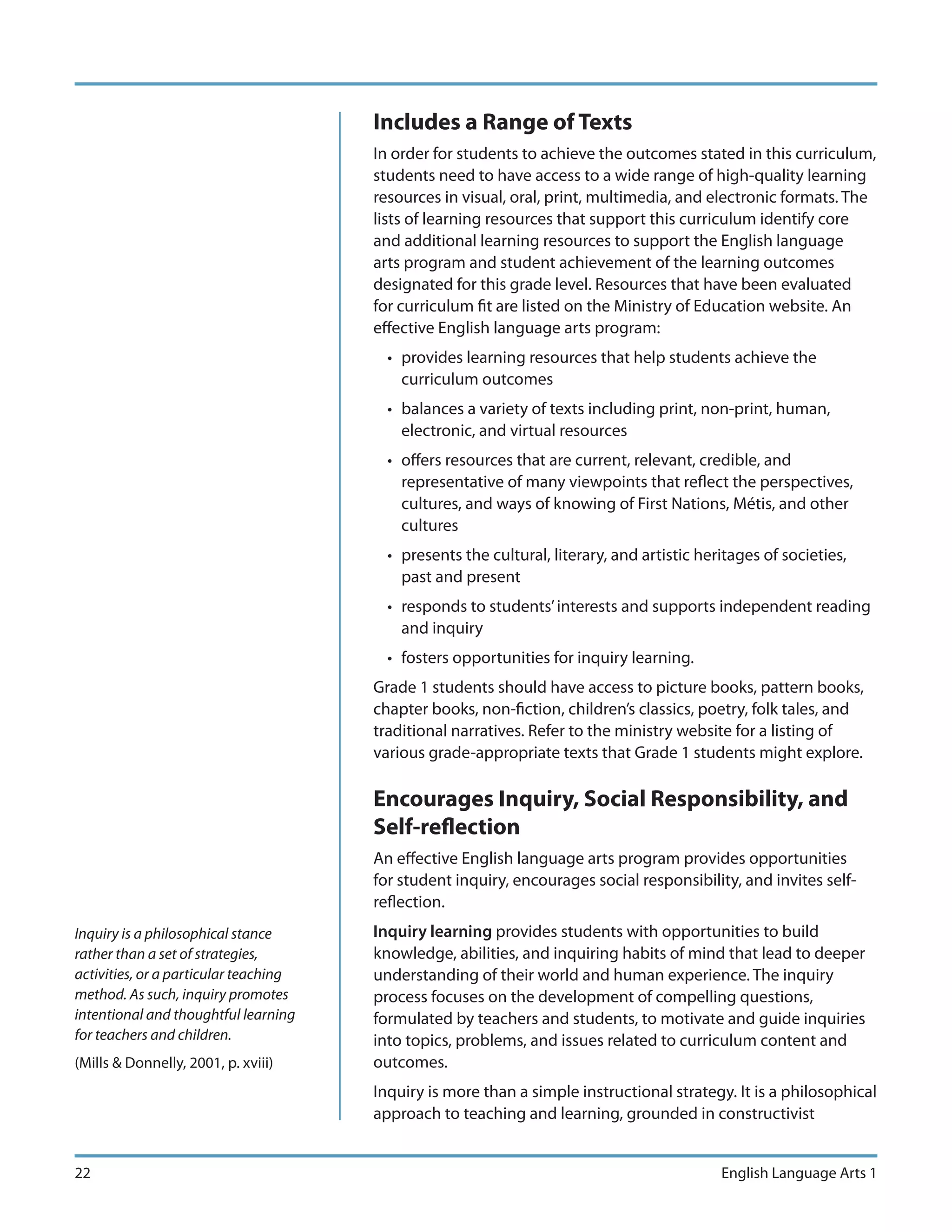
Inquiry is a philosophical stance      Inquiry learning provides students with opportunities to build
rather than a set of strategies,       knowledge, abilities, and inquiring habits of mind that lead to deeper
activities, or a particular teaching   understanding of their world and human experience. The inquiry
method. As such, inquiry promotes      process focuses on the development of compelling questions,
intentional and thoughtful learning    formulated by teachers and students, to motivate and guide inquiries
for teachers and children.             into topics, problems, and issues related to curriculum content and
(Mills & Donnelly, 2001, p. xviii)     outcomes.
                                       Inquiry is more than a simple instructional strategy. It is a philosophical
                                       approach to teaching and learning, grounded in constructivist


22                                                                                          English Language Arts 1
research and methods, which engages students in investigations
that lead to disciplinary and transdisciplinary understanding. Inquiry
builds on students’ inherent sense of curiosity and wonder, drawing
on their diverse backgrounds, interests, and experiences. The process
provides opportunities for students to become active participants in
a collaborative search for meaning and understanding. Students who
are engaged in inquiry:
  • construct deep knowledge and deep understanding rather than
    passively receiving information
  • are directly involved and engaged in the discovery of new
    knowledge
  • encounter alternative perspectives and differing ideas
    that transform prior knowledge and experience into deep
    understandings
  • transfer new knowledge and skills to new circumstances
  • take ownership and responsibility for their ongoing learning and
    mastery of curriculum content and skills.
                      (Adapted from Kuhlthau, Maniotes, & Caspari, 2007)

Inquiry learning is not a step-by-step process but rather a cyclical
process, with parts of the process being revisited and rethought as a
result of students’ discoveries, insights, and co-construction of new
knowledge. Figure 2 represents this cyclical inquiry process.
Figure 2. Constructing Understanding Through Inquiry


Curriculum Outcomes                 What are the things we wonder
                                  about and want to know more about?

                                   What questions do we have about
                                 the deeper mysteries or aspects of life?


                                                 Interpret
                                 Collaborate                       Conclude
                                                 Analyze
                        Plan                                            Investigate
        Re ect and                                                                        Re ect and
          Revise                     How are we going to proceed?                           Revise
                      Explore                                                    Create

                                  Observe                           Synthesize
                            Acknowledge Sources              Document Processes                        Resources


                               What have we discovered and how
                            will we show our deeper understanding?
                                How are we going to use what we have
                                     discovered (e.g., apply, act,
                                            implement)?


English Language Arts 1                                                                                            23
Inquiry prompts and motivates students to investigate topics within
     meaningful contexts. The inquiry process is not linear or lock-step
     but is flexible and recursive. As they become more comfortable with
     the process, experienced inquirers will move back and forth among
     various phases as new questions arise.
     Well-formulated inquiry questions are broad in scope and rich in
     possibilities. Such questions encourage students to explore, observe,
     gather information, plan, analyze, interpret, synthesize, problem solve,
     take risks, create, conclude, document, reflect on learning, and develop
     new questions for further inquiry.
     Teachers and students can begin their inquiry at one or more
     curriculum entry points; however, the process may evolve into
     transdisciplinary integrated learning opportunities, as reflective of the
     holistic nature of our lives and interdependent global environment.
     An important part of any inquiry process is students’ reflection on
     their learning and the documentation needed to assess the learning
     and make it visible to students. Student documentation of the inquiry
     process in English language arts may take the form of reflective
     journals, notes, drafts, three-dimensional models, works of art,
     photographs, and video footage.
     Social responsibility encourages students to extend their learning
     beyond the classroom into the local, national, and international
     community. It invites students to consider how individuals or groups
     can shape the future in a positive way or address an issue, question,
     challenge, or problem that is important. Each unit at each grade level
     in English language arts offers opportunities to challenge students
     to consider what particular local, national, or global issues, questions,
     challenges, or problems are important and to consider what students
     might do to make their community or the world a better place.
     Social responsibility challenges students to address the important or
     compelling questions for deeper understanding posed in a unit. In any
     English language arts unit, teachers and students can plan and create a
     project to support efficacy.
     Social responsibility can help students:
       • Become complex thinkers by encouraging them to synthesize
         their learning and apply it to their community, country, and/or
         international world.
       • Become more aware of the interconnectedness of all things and
         the reciprocal relationships between themselves and their local
         and international community.
       • Become more independent by using the language skills and
         strategies that students are learning in ELA beyond the classroom.


24                                                      English Language Arts 1
• Become more motivated by choosing individual or group projects
    related to each unit.
  • Become contributors to their community and the world beyond
    that community.
  • Become more collaborative and respectful as they work with
    others to address the questions, issues, and problems considered
    in the unit.
  • Become agents of change.
  • Become socially responsible.
Student self-reflection helps students take ownership of their own
learning and become more self-directed and self-confident. The
Assess and Reflect K-12 goal in English language arts expects students
to consider what they know and have learned, the progress and
achievements made, and the goals they need to set to improve. Using
tools such as learning logs and diaries, discussion, questionnaires,
reflective writing, and portfolios, students can reflect on their learning
both as a team and as individuals. Through self-reflection, students
can determine their current and future learning needs and set goals
for growth. Using Bloom’s taxonomy of questioning, teachers can help
students become self-reflective and self-directed:
  • What did I do? (Remember/Knowledge)
  • What knowledge, skills, and strategies did I use to complete the
    task? (Understand/Comprehension)
  • What steps did I take to achieve this? (Application)
  • What challenges or problems did I encounter, and how did I
    address these? (Analysis)
  • What are my strengths, and what would I like to learn more about,
    or what skills and strategies do I want to develop? (Evaluation)
  • How can I use this new knowledge and these new skills and
    strategies? (Create)


English Language Arts 1                                                      25
Outcomes and Indicators
Focus: Making Connections among Oral Discourse, Written Communication, and Other
Forms of Representing

  Comprehend and Respond (CR) - Students will develop their abilities to view, listen to, read, comprehend,
  and respond to a variety of contemporary and traditional grade-level-appropriate texts in a variety of
  forms (oral, print, and other media) from First Nations, Métis, and other cultures for a variety of purposes
  including for learning, interest, and enjoyment.


Outcomes                                 Indicators
CR1.1 Comprehend and                     a. View, listen to, read, and respond to a variety of texts including
respond to a variety of                     First Nations and Métis resources that present different viewpoints
grade-level texts (including                and perspectives on issues related to identity, community, and
contemporary and traditional                social responsibility.
visual, oral, written, and
                                         b. Make and share connections among texts, prior knowledge, and
multimedia) that address:
                                            personal experiences (e.g., family traditions).
 • identity (e.g., All About Me)
                                         c. Relate aspects of stories and characters from various texts to
 • community (e.g., Friends
                                            personal feelings and experiences.
   and Family)
 • social responsibility (e.g.,          d. Show awareness of the experiences and ideas of other persons
   Conservation) and relate                 encountered through texts.
   to own feelings, ideas, and           e. Describe characters, the way they might feel, and the way
   experiences.                             situations might cause them to feel.
                                         f.   Show respect for own culture and the various cultures, lifestyles,
                                              and experiences represented in texts including First Nations and
                                              Métis cultures.

CR1.2 View and comprehend                a. Identify and locate the key information in pictures, charts, and
the explicit messages, feelings,            other visual forms (e.g., photographs, physical movement, icons)
and features in a variety                   including traditional and contemporary First Nations and Métis
of visual and multimedia                    resources and performances.
texts (including pictures,
                                         b. Select and use the appropriate before, during, and after strategies
photographs, simple graphs,
                                            when viewing.
diagrams, pictographs, icons,
and illustrations).                      c. Use applicable pragmatic, textual, syntactic, semantic/lexical/
                                            morphological, graphophonic, and other communication cues
                                            and conventions to construct and communicate meaning when
                                            viewing.
                                         d. Recognize the commonalities in works by the same illustrator.
                                         e. View a video version of a print book and discuss how the two
                                            versions are the same and different.
                                         f.   Distinguish between daily life and life depicted in television shows,
                                              cartoons, and films.

26                                                                                          English Language Arts 1
Outcomes                        Indicators
CR1.2 continued                 g. Recognize feelings portrayed in visual and multimedia texts,
                                   including pictures, photographs, diagrams, pictographs, and icons.
                                h. View and demonstrate understanding that visual texts are sources
                                   of information including ideas and information about First Nations,
                                   Métis, Inuit peoples, and other cultures.


CR1.3 Listen to and             a. Listen and respond appropriately to a range of oral
comprehend a variety of            communications including selected works of children’s literature
texts (including a book read       and traditional and contemporary First Nations and Métis stories.
aloud, a person speaking,       b. Select and use the appropriate before, during, and after strategies
and directions) to retell the      when listening.
sequence and key points (who,
                                c. Use applicable pragmatic, textual, syntactic, semantic/lexical/
what, when, where, why, and
                                   morphological, graphophonic, and other communication cues
how).
                                   and conventions to construct and communicate meaning when
                                   listening.
                                d. Retell stories (including oral traditions shared by Elders and
                                   Knowledge Keepers) by relating the sequence of story events by
                                   answering who, what, when, where, why, and how questions.
                                e. Listen to texts and retell the most important information (e.g., who,
                                   what, when, where, why, and how).
                                f.   Listen courteously and attentively to understand the meaning and
                                     intent of others.
                                g. Demonstrate attentiveness and comprehension as a listener
                                   through body language and facial expressions (e.g., nodding in
                                   agreement).
                                h. Listen to carry out directions with four to six simple steps.


CR1.4 Read and comprehend       a. Read and interpret own writing, experience charts, labels, symbols,
grade-appropriate texts            and print in environment.
(including narratives,          b. Select and use the appropriate before, during, and after strategies
informational texts, scripts,      when reading.
and poems) by relating the      c. Use applicable pragmatic, textual, syntactic, semantic/lexical/
sequence (i.e., beginning,         morphological, graphophonic, and other communication cues
middle, and end), the key          and conventions to construct and communicate meaning when
points (who, what, when,           reading.
where, and why), and the
problems and solutions.         d. Distinguish between fiction and non-fiction.
                                e. Read aloud with fluency, expression, and comprehension any text
                                   that is already familiar and is at an independent reading level.
                                f.   Identify the sequence of an informational text and respond to who,
                                     what, when, where, why, and how questions.


English Language Arts 1                                                                              27
Outcomes                                Indicators
CR1.4 continued                         g. Read and follow one-step, two-step, and three-step written
                                           instructions.
                                        h. Retell the central ideas of simple expository and narrative
                                           passages (including contemporary and traditional First Nations
                                           and Métis stories), identify and describe where and when stories
                                           take place, the characters in a story (and their feelings), and the
                                           story’s beginning, middle, and end, as well as the problem and the
                                           solution.
                                        i.   Read and re-read “just-right” texts independently for a sustained
                                             minimum 10-15 minute period daily for enjoyment and to improve
                                             fluency (30-60 wcpm orally) and comprehension.
                                        j.   Begin to utilize silent reading.


 Compose and Create (CC). Students will develop their abilities to speak, write, and use other forms of
 representation to explore and present thoughts, feelings, and experiences in a variety of forms for a
 variety of purposes and audiences.

Outcomes                                Indicators
CC1.1 Compose and create a              a. Use words, symbols, and other forms, including appropriate
range of visual, multimedia,               technology, to express understanding of topics, themes, and issues
oral, and written texts that               related to identity, community, and social responsibility.
explore and present thoughts
                                        b. Dictate to another person and compose stories that tell personal
on:
                                           feelings, ideas, experiences, opinions, observations, and reactions.
 • identity (e.g., Feelings)
                                        c. Create stories, explanations, poems, and dramatizations using
 • community (e.g.,
                                           known patterns and later developing own patterns.
   Neighbourhood)
 • social responsibility (e.g.,         d. Create stories and short informational texts of several sentences
   Plants and Trees).                      to communicate ideas and information about self, others, and the
                                           natural and constructed environments.
                                        e. Use inquiry to explore a question or topic of interest related to the
                                           themes and topics being studied:
                                               • Discuss personal knowledge and understanding of a topic to
                                                 discover research interests and needs.
                                               • Use the language of inquiry (e.g., “I want to find out if ...”, “I
                                                 know ...”).
                                               • Ask questions to satisfy personal curiosity on a topic and
                                                 discuss information needs.
                                               • Ask and answer questions to help satisfy group curiosity and
                                                 information needs on a specific topic.


28                                                                                             English Language Arts 1
Outcomes                         Indicators
CC1.1 continued                         • Answer questions using visual, multimedia, oral, and print
                                          sources.
                                        • Understand that resource centre materials have a specific
                                          organization system and use titles to locate information and
                                          ideas.
                                        • Recognize when information answers the questions asked.
                                        • Collect and organize relevant ideas and information.
                                        • Represent and tell key ideas and facts in own words.
                                        • Share with peers and teacher what was learned through
                                          inquiry.
CC1.2 Represent key ideas and    a. Understand that making pictures, illustrations, and other
events, in a logical sequence       representations clarify and extend understanding.
and with detail, in different    b. Select and use the appropriate before, during, and after strategies
ways (including dramatization,      when using various forms of representing to communicate
pictures, sounds, physical          meaning.
movement, charts, models, and
drawings).                       c. Use applicable pragmatic, textual, syntactic, semantic/lexical/
                                    morphological, graphophonic, and other communication cues and
                                    conventions to construct and communicate meaning when using
                                    various forms of representing.
                                 d. Check for details in work.
                                 e. Dramatize a story (e.g., a traditional First Nations, Métis, or Inuit
                                    story).
                                 f.   Explore electronic technology to represent ideas and events.


CC1.3 Speak clearly and          a. Use oral language to bring meaning to what is listened to,
audibly about ideas,                observed, felt, viewed, and read.
experiences, preferences,        b. Select and use the appropriate before, during, and after strategies
questions, and conclusions          when speaking to communicate meaning.
in a logical sequence, using
expression and dramatization     c. Use applicable pragmatic, textual, syntactic, semantic/lexical/
when appropriate.                   morphological, graphophonic, and other communication cues
                                    and conventions to construct and communicate meaning when
                                    speaking.
                                 d. Share and talk about what is being learned, and stay on topic
                                    when speaking.
                                 e. Participate in small-group work.
                                 f.   Answer questions in complete sentences.
                                 g. Give directions that include several sequenced steps.
                                 h. Retell stories using a beginning, middle, and end, and include
                                    details regarding who, what, when, where, why, and how.

English Language Arts 1                                                                                     29
Outcomes                        Indicators
CC1.3 continued                 i.   Relate an important event or personal experience in a simple
                                     sequence.
                                j.   Rehearse and deliver brief short poems, rhymes, songs, stories
                                     (including contemporary and traditional First Nations, Métis, and
                                     Inuit poems and stories) or lines from a play and oral presentations
                                     about familiar experiences or interests.

CC1.4 Write and share stories   a. Recognize that writing is a process focused upon conveying
and short informational texts      meaning to self and others.
about familiar events and
                                b. Select and use the appropriate before, during, and after strategies
experiences in a minimum of
                                   when writing to communicate meaning.
five sentences.
                                c. Use applicable pragmatic, textual, syntactic, semantic/lexical/
                                   morphological, graphophonic, and other communication cues
                                   and conventions to construct and communicate meaning when
                                   writing.
                                d. Write about familiar topics using the learned vocabulary to express
                                   ideas.
                                e. Create short texts including informational texts, autobiographical
                                   narratives, imaginative stories, and poems with own ideas
                                   following a model.
                                f.   Write brief explanations and descriptions (accompanied by
                                     pictures) of real objects, persons, and places.
                                g. Begin to include related details with main idea and edit with
                                   teacher support.
                                h. Attempt to choose interesting words in independent writing.
                                i.   Write a complete sentence with six words or more using capitals,
                                     correct spacing, and some punctuation.
                                j.   Share work with others for feedback.

                                Note: Grade 1 students usually write a single draft. They employ a
                                simple writing process (e.g., pre-writing, drafting, and “fixing up”) with
                                teacher support.


30                                                                                 English Language Arts 1
Assess and Reflect (AR). Students will develop their abilities to assess and reflect on their own language
  skills, discuss the skills of effective viewers, listeners, readers, representers, speakers, and writers, and set
  goals for future improvement.

Outcomes                                   Indicators
AR1.1 Identify, with teacher               a. Reflect on viewing, listening, reading, speaking, writing, and other
guidance, what good viewers,                  representing experiences in the context of teacher-led discussions.
listeners, readers, representers,          b. Co-reflect on viewing, listening, reading, speaking, writing, and
speakers, and writers do.                     other forms of representing to identify strengths and to discuss
                                              attributes of, and strategies used by, good viewers, listeners,
AR1.2 Set and monitor, in
                                              readers, representers, speakers, and writers.
consultation with the teacher,
goals for more effective                   c. Seek feedback from peers, teacher, and others.
viewing, listening, reading,               d. Consider and reflect upon pre-set goals.
representing, speaking, and
                                           e. Self-check for meaning.
writing experiences.


English Language Arts 1                                                                                               31
Assessment and Evaluation of Student
                                     Learning
Assessment involves the systematic   Assessment and evaluation require thoughtful planning and
collection of information about      implementation to support the learning process and to inform
student learning with respect to:    teaching. All assessment and evaluation of student achievement must
 • achievement of provincial         be based on the outcomes in the provincial curriculum.
   curricula outcomes                There are three interrelated purposes of assessment. Each type of
 • effectiveness of teaching         assessment, systematically implemented, contributes to an overall
   strategies employed
                                     picture of an individual student’s achievement.
 • student self-reflection on
   learning.                         Assessment for learning involves the use of information about
                                     student progress to support and improve student learning, inform
                                     instructional practices, and:
                                      • is teacher-driven for student, teacher, and parent use
                                      • occurs throughout the teaching and learning process, using a
                                        variety of tools
                                      • engages teachers in providing differentiated instruction, feedback
                                        to students to enhance their learning, and information to parents
                                        in support of learning.
                                     Assessment as learning actively involves student reflection on
                                     learning, monitoring of her/his own progress, and:
                                      • supports students in critically analyzing learning related to
                                        curricular outcomes
                                      • is student-driven with teacher guidance
                                      • occurs throughout the learning process.
                                     Assessment of learning involves teachers’ use of evidence of student
                                     learning to make judgements about student achievement and:
                                      • provides opportunity to report evidence of achievement related to
                                        curricular outcomes
                                      • occurs at the end of a learning cycle using a variety of tools
                                      • provides the foundation for discussions on placement or
                                        promotion.
                                     Evaluation compares assessment information against criteria based on
                                     curriculum outcomes for the purpose of communicating to students,
                                     teachers, parents/caregivers, and others about student progress and to
                                     make informed decisions about the teaching and learning process.
                                     The following pages show a sample holistic rubric for assessment and
                                     evaluation of the Comprehending and Responding and Composing
                                     and Creating Goals for English language arts with the Assessing and
                                     Reflecting Goal embedded.


32                                                                                     English Language Arts 1
Table 8. Grade One Rubric - Comprehend and Respond

                     Comprehend and Respond (Viewing, Listening, Reading): Grade 1
                                      Exceeding Expectations
           Comprehension                             Use of Strategies                     Cues and Conventions
 Has a significant understanding and       Feels confident using task-relevant      Uses confidently and consistently
 recall of what one views, listens to,     strategies before, during, and after     the cues and conventions of
 and reads and provides insightful         viewing, listening, or reading.          communication and language to
 interpretations with evidence to                                                   construct meaning.
 support responses.

 Views and explains explicit messages,   Uses, independently, before, during,       Identifies and explains independently
 identifies key features, and makes      and after viewing, listening, and          the purpose of a text.
 inferences about feelings.              reading strategies (e.g., thinking about   Recognizes, independently, the
                                         topic, setting purpose, predicting,
 Listens and retells and elaborates                                                 text structures and elements in oral
                                         making connections, identifying
 independently the key ideas (who,                                                  presentation, fiction, informational
 what, when, where, how, why) of a text. key messages and details, drawing          texts, poems, and plays including the
                                         inferences).
 Carries out directions with more than                                              beginning, middle, and end.
 six steps.                              Sets goals for viewing, listening, and     Understands what a sentence is.
 Reads and retells independently, using reading.                                    Has extensive sight-word vocabulary.
 inferences, the key events and ideas of   Reads smoothly and uses voice            Applies topic-related vocabulary to
 a story and of an informational text.     to make the reading sound more           new situations.
                                           interesting.
                                                                                    Knows sounds and letters. Identifies
                                                                                    initial, medial, and final sounds;
                                                                                    dipthongs; and digraphs in spoken
                                                                                    words (e.g., ship, chicken, beep,
                                                                                    playing).
                                                                                    Uses visual cues such as colour, form,
                                                                                    shape, size, movement, and space to
                                                                                    construct and confirm meaning in a
                                                                                    variety of texts.


English Language Arts 1                                                                                                      33
Table 8. (Continued) Grade One Rubric - Comprehend and Respond

                     Comprehend and Respond (Viewing, Listening, Reading): Grade 1
                                       Meeting Expectations
           Comprehension                              Use of Strategies                       Cues and Conventions
Has a good understanding and                Uses, with practice and teacher            Uses the cues and conventions of
recall of what one views, listens           support, before, during, and after         communication and language to
to, and reads. Provides adequate            strategies relevant to the task.           construct meaning.
interpretations and gives reasonable
evidence to support responses.

Views and explains explicit messages,       Uses, with guidance, viewing, listening,   Identifies the purpose of the text.
and recognizes feelings and specific        and reading strategies before,             Identifies the beginning, middle,
features of a text.                         during, and after (e.g., considering       and end, the type of text (e.g., poem,
                                            what is known, making connections,
Listens and retells the sequence and                                                   fiction, non-fiction), and some key
                                            predicting, drawing inferences, looking
key points (who, what when, where,                                                     elements of the text.
                                            for details, justifying what might
how, and why) of a text; follows
                                            happen, and recalling key ideas and        Recognizes basic statement and
directions with four to six simple steps.
                                            events in a logical order).                question sentences and understands
Reads and retells the sequence and key                                                 what a sentence and its punctuation
                                            Listens to the ideas of others.
points (who, what, when, where, how,                                                   do to communicate meaning.
why) of a text; shows understanding         Identifies what good viewers, listeners,   Understands new concept words and
of story elements, character, problem,      and readers do.                            identifies word families in texts; knows
and solution; answers literal and           Explains favourites.                       100 commonly used words in print.
inferential questions.
                                            Sets goals, with teacher guidance, for     Understands and identifies all the
                                            viewing, listening, and reading.           letters and most Grade 1 sounds;
                                                                                       identifies initial, medial, and final
                                            Uses eye tracking most of the time.
                                                                                       sounds in spoken words (e.g., cat).
                                            Reads according to the punctuation
                                            and is beginning to use phrasing.          Uses visual cues such as colour, form,
                                            Reads at a reasonable rate with fluent     shape, size, movement, and space to
                                            pacing.                                    construct meaning from texts.


34                                                                                                      English Language Arts 1
Table 8. (Continued) Grade One Rubric - Comprehend and Respond

                     Comprehend and Respond (Viewing, Listening, Reading): Grade 1
                                  Beginning to Meet Expectations
           Comprehension                              Use of Strategies                      Cues and Conventions
 Comprehends the basic ideas and            Uses, with prompting and support, a      Uses some of the cues and
 understands most of what one views,        few before, during, and after viewing,   conventions of communication and
 listens to, and reads. Gives some          listening, and reading strategies.       language to construct meaning.
 interpretation and provides some           Does not always know when to apply
 evidence to support it.                    them to a new task.

 Views and understands the basic            Uses, with prompting, some before,       Begins to recognize a purpose for
 message in a visual text.                  during, and after viewing, listening,    viewing, listening, and reading.
                                            and reading strategies to construct
 Listens and retells with some detail the                                            Identifies, with prompting, the
                                            meaning. Makes appropriate personal
 basic ideas of a text. Follows two- and                                             beginning, middle, and end and type
                                            connections.
 three-step instructions.                                                            of text (e.g., poem, fiction, non-fiction).
                                            Listens attentively and with respect.
 Reads and retells stories and                                                       Recognizes sentence boundaries (e.g.,
 informational text by relating most key    Works towards more fluency but reads     capital letter beginning and period
 points.                                    mostly word-for-word.                    ending).
                                            Identifies, with teacher guidance, what Understands specific key words;
                                            good viewers, listeners, and readers do. has a bank of words that are readily
                                                                                     recognized in print.
                                                                                     Recognizes letter names and letter
                                                                                     sounds of the alphabet as well as
                                                                                     some phonic generalizations such as
                                                                                     “ee,” “sh,” “ch,” “ing”; identifies rhymes
                                                                                     within a shared text; identifies initial
                                                                                     and final sounds in a spoken word;
                                                                                     manipulates phonemes by deleting
                                                                                     and substituting.
                                                                                     Uses, with prompting, visual cues such
                                                                                     as colour, form, shape, size, movement,
                                                                                     and space to construct meaning from
                                                                                     texts.


English Language Arts 1                                                                                                           35
Table 8. (Continued) Grade One Rubric - Comprehend and Respond

                    Comprehend and Respond (Viewing, Listening, Reading): Grade 1
                                   Not Yet Meeting Expectations
          Comprehension                             Use of Strategies                    Cues and Conventions
Understands some or little of what       Requires repeated modelling of           Has an uncertain grasp of the
one views, listens to, and reads and     before, during, and after viewing,       basic cues and conventions of
does not recall much of it. Gives        listening, and reading strategies and    communication and language to
simple or inadequate interpretations     continuous coaching on when and          construct meaning.
and little or no evidence to support     how to use them.
responses.
Views and grasps part of the meaning       Uses, with much prompting, some        Recognizes, with explicit guidance,
from the visuals in texts.                 before, during, and after strategies   a purpose for viewing, listening, and
                                           when viewing, listening, and reading   reading.
Listens and retells a few or little of
ideas or details in the text. Follows one- such as looking for details, making    Identifies a beginning and end;
                                           connections, and predicting. Makes
step oral directions correctly.                                                   understands that what can be said can
                                           some personal connections.             be read.
Reads and retells some ideas in simple
                                           Listens, with prompting. Takes turns
narrative and informational texts.                                                Recognizes a basic sentence and
                                           most of the time.                      identifies and attends to periods when
                                         Reads slowly and “sounds out”            used at the end of sentences.
                                         frequently used words; pauses or stops   Knows some sight words (e.g., I, a, the);
                                         frequently when reading.                 understands some general concept
                                         Reflects, with teacher guidance,         words; identifies some rhymes; knows
                                         on viewing, listening, and reading       that spaces separate words.
                                         experiences.                             Recognizes most letter names and
                                                                                  letter sounds, and begins to use initial
                                                                                  sounds to decode words; identifies
                                                                                  most initial sounds in a spoken word.
                                                                                  Uses, with explicit direction and
                                                                                  modelling, visual cues such as colour,
                                                                                  form, shape, size, movement, and
                                                                                  space to construct meaning from texts.


36                                                                                                 English Language Arts 1
Table 9. Grade One Rubric - Compose and Create

          Compose and Create (Speaking, Writing, and Other Forms of Representing): Grade 1
                                     Exceeding Expectations
                Message                               Use of Strategies                      Cues and Conventions
 Compositions and presentations are         Uses, confidently, task-relevant         Demonstrates confident control of
 original and insightful.                   strategies before, during, and after     the elements of expressive language.
                                            a speaking, writing, or other form of    Language is rich and varied.
                                            representing task.
 Representing: Represents key ideas         Considers and chooses independently      Identifies and maintains,
 and events with elaboration and            various ways (e.g., drama, pictures,     independently, a clear purpose and
 details that enhance the message.          simple charts, models, drawings,         focus.
                                            written compositions) to communicate
 Speaking: Generates and contributes                                                 Chooses an appropriate form; sticks
                                            ideas and understanding to class.
 ideas on particular topics with                                                     to topic; organizes from beginning to
 appropriate facts and details.             Speaks when appropriate; contributes     middle to end and strives to have one
                                            suitable details; sticks to topic;       part flow smoothly into the next part;
 Writing: Writes original stories and
                                            paraphrases.                             uses details that are pertinent and
 informational texts to narrate, explain,
                                                                                     specific.
 and describe.                              Uses planning strategies such as
                                            making a plan, sketch, or map.          Uses complete sentences with capital
                                            Organizes ideas with a clear beginning, letters and periods consistently.
                                            middle, and end.                        Chooses and uses words (including
                                                                                    strong verbs and descriptive words) to
                                            Adds to what is drafted.
                                                                                    add interest and detail; spells correctly
                                            Edits own writing and “fixes up.”       common sight words and applies
                                            Sets, independently, goals for          spelling conventions in independent
                                            speaking, writing, and other forms of   writing.
                                            representing.                           Forms letters fluently and
                                                                                     automatically. Uses upper and lower
                                                                                     case letters correctly and consistently.
                                                                                     Speaks clearly, using correct phrasing,
                                                                                     modulation, pitch, and tone.
                                                                                     Experiments and elaborates with
                                                                                     colour, shape, movement, sound,
                                                                                     and space with thought and a clear
                                                                                     purpose.


English Language Arts 1                                                                                                         37
Table 9. (Continued) Grade One Rubric - Compose and Create

         Compose and Create (Speaking, Writing, and Other Forms of Representing): Grade 1
                                     Meeting Expectations
              Message                             Use of Strategies                       Cues and Conventions
Compositions and presentations are      Uses, with practice and teacher            Demonstrates control over the
clear and thoughtful.                   support, the important before,             elements of communication and
                                        during, and after speaking, writing,       language. Few errors. Errors do not
                                        and other forms of representing            interfere with communication.
                                        strategies.
Representing: Represents key ideas      Considers and chooses the best way to      Establishes a purpose and a focus.
and events with elaboration.            present ideas; presents to the class.      Sticks to the topic and makes sense;
Speaking: Talks about ideas,            Uses, with support, planning strategies    begins to organize a main idea with
experiences, and preferences related to such as making a plan, sketching, or       related detail; tells things in order;
texts and familiar topics.              mapping.                                   uses some details that are specific and
                                                                                   makes ideas clear.
Writing: Writes stories and short       Begins to organize a main idea with
informational texts about familiar      related detail and stays on topic; takes   Makes requests and answers questions
events and experiences, with a          turns when speaking; contributes           in complete sentences; uses complete
minimum of five sentences.              ideas in order and with appropriate        sentences with six words or more using
                                        pacing in a variety of shared language     capitals, correct spacing, and some
                                        experiences.                               punctuation.
                                        Edits, with teacher support, for           Uses appropriate and descriptive
                                        completeness and adds detail.              words in a variety of situations.
                                        Sets goals, with teacher guidance, for     Spells correctly grade-appropriate
                                        speaking, writing, and other forms of      high-frequency words; represents
                                        representing.                              most beginning and ending consonant
                                                                                   digraphs and regular short vowels;
                                                                                   uses a mixture of conventional and
                                                                                   temporary (phonetic) strategies to
                                                                                   spell three- or four- letter words.
                                                                                   Uses consistently appropriate letter
                                                                                   formation and spacing on lined page
                                                                                   in independent writing; uses upper
                                                                                   and lower case letters correctly and
                                                                                   consistently (e.g., name); speaks clearly
                                                                                   using appropriate pitch, volume, and
                                                                                   articulation; chooses elements (e.g.,
                                                                                   colour, shape, movement, sound, and
                                                                                   space) with thought and reflection.


38                                                                                                  English Language Arts 1
Table 9. (Continued) Grade One Rubric - Compose and Create

          Compose and Create (Speaking, Writing, and Other Forms of Representing): Grade 1
                                 Beginning to Meet Expectations
               Message                            Use of Strategies                     Cues and Conventions
 Compositions and presentations are     Uses, with prompting and support,        Demonstrates some control over the
 straightforward and unrefined.         only a few before, during, and after     elements of expressive language
                                        speaking, writing, and other forms of    and a basic use of the conventions.
                                        representing strategies but does not     Errors interfere somewhat with
                                        always know when to employ them.         communication.
 Representing: Represents ideas and     Uses a step-by-step process, with        Has a limited awareness of audience
 events with few details.               teacher direction, to communicate        and/or task. Attempts to establish the
                                        ideas; presents to a small group with    purpose.
 Speaking: Conveys own thoughts
                                        support.
 clearly when relating own events and                                            Shows some awareness of format;
 retelling a story; asks appropriate    Stays on topic generally; takes turns;   lacks a smooth flow from beginning
 questions; participates in group       contributes ideas in order and with      to middle to end and details are not
 experiences.                           appropriate pacing.                      specific enough to add to the clarity
                                                                                 of ideas or may simply be listed or
 Writing: Creates short text with own   Follows modelled or patterned writing
                                                                                 repeated.
 ideas following a model.               and attempts to write independently;
                                        shares writing with peers and teacher    Writes complete sentences in three to
                                        willingly.                               four words (e.g., This is my house.) but
                                                                                 sometimes uses incomplete sentences.
                                        Identifies, with teacher guidance,
                                        what good speakers, writers, and         Chooses and uses environmental
                                        representers do.                         print to assist in independent writing;
                                                                                 uses some appropriate words and
                                                                                 experiments with descriptive words.
                                                                                 Uses initial and final sounds in own
                                                                                 writing; incorporates vowel sounds
                                                                                 taught; spells some high-frequency
                                                                                 words correctly.
                                                                                 Speaks but not always clearly or
                                                                                 always using appropriate pitch and
                                                                                 articulation.
                                                                                 Uses appropriate letter formation with
                                                                                 spaces between words in independent
                                                                                 writing consistently.
                                                                                 Has some awareness of some visual
                                                                                 formats and elements.


English Language Arts 1                                                                                                    39
Table 9. (Continued) Grade One Rubric - Compose and Create
         Compose and Create (Speaking, Writing, and Other Forms of Representing): Grade 1
                                 Not Yet Meeting Expectations
               Message                           Use of Strategies                    Cues and Conventions
Compositions and presentations are     Requires repeated modelling of          Demonstrates an uncertain and
basic. They are limited, unfocused,    before, during, and after speaking,     simplistic grasp of the basic elements
and/or unclear.                        writing, and other forms of             of expressive language. Errors
                                       representing strategies and requires    interfere with communication.
                                       continuous coaching on when and
                                       how to use them.
Representing: Represents basic ideas   Follows a step-by-step process          Has little or no awareness of audience
and events with limited details.       with direction and modelling to         and/or task and is not clear about
                                       communicate basic ideas and             purpose or focus.
Speaking: Talks about basic ideas
                                       understanding.
and experiences; recalls and retells                                           Follows a given format but details are
directions; asks permission.           Does not always take turns sharing      lacking, inappropriate, or random; does
                                       ideas; tries to make connections.       not stick to the topic or always make
Writing: Draws pictures and attempts
                                                                               sense and does not clearly organize
to add print to communicate ideas      Follows a step-by-step format in
                                                                               communications.
following teacher modelling.           patterned and shared writing, with
                                       direction, to convey meaning through    Presents ideas in simple sentences or
                                       pictures, letters/words, and symbols.   incomplete sentences; copies a three-
                                                                               to four-word sentence frame and
                                       Shares with others what was
                                                                               includes own choice of a word to fill in
                                       composed or created but does not
                                                                               the blank.
                                       always understand or reflect on
                                       what effective speakers, writers, or    Relies on basic vocabulary to convey
                                       representers do.                        meaning; chooses words correctly
                                                                               from a model (e.g., brainstormed list,
                                                                               environmental print).
                                                                               Represents most initial and final
                                                                               consonant sounds (e.g., ran, tub) and is
                                                                               beginning to use some vowels in word
                                                                               families.
                                                                               Has difficulty articulating some words.
                                                                               Forms, in a legible manner, all upper
                                                                               and lower case letters taught. Begins
                                                                               to use lower case letters correctly in
                                                                               writing. Follows a given format for
                                                                               a specific purpose; begins to use a
                                                                               range of elements (e.g., colour, shape,
                                                                               movement, sound, and space) to
                                                                               represent ideas and understanding.


40                                                                                              English Language Arts 1
Progress Reporting
Effective language arts programs employ appropriate assessment, evaluation, and reporting processes. In English
language arts, assessment and evaluation should:
  • reflect the three K-12 goals of English language arts and the grade-level learning outcomes associated with
    each goal
  • focus on what students have learned and can do
  • be congruent with instruction and based on meaningful tasks
  • be based on appropriate criteria that students know and understand
  • inform students and parents in a clear, accurate, and practical way.
In addition to newsletters, folders, and portfolios, report cards and parent-student-teacher interviews are part of
school communication with parents. Although report card formats vary, there should be space for feedback on
the language arts K-12 goals and strands (see sample form below).
Table 10. Sample Feedback Form

   English Language Arts                  Outcomes        Achievement                   Comments
         K-12 Goals                                          Level             (Strengths, Needs, Next Steps)
 Comprehends and               Views.
 responds competently and
 confidently to a range of     Listens.
 texts.
                               Reads.

 Composes and creates          Speaks.
 competently and
 confidently in a variety of   Writes.
 forms.
                               Uses other forms of
                               representing.
 Assesses and reflects on      Assesses strengths and
 learning.                     needs.
                               Sets goals.


How teachers determine grades, marks, or comments should be based on the grade-level outcomes and reflect
the knowledge, process, and product evaluations used throughout the reporting period.


Connections with Other Areas of Study
There are many possibilities for connecting Grade 1 English Language Arts learning with the learning occurring
in other subject areas. When making such connections, however, teachers must be cautious not to lose the
integrity of the learning in any of the subjects. Making connections between subject areas gives students
experience with transferring knowledge, skills, and strategies and provides rich contexts in which students
are able to initiate, make sense of, and extend their learnings. When students and teachers make connections
between subject areas, the possibilities for transdisciplinary inquiries and deeper understanding arise.


English Language Arts 1                                                                                           41
All areas of study share a common interest in students developing
     their abilities to communicate their learning through speaking,
     writing, and other forms of representing (Compose and Create Goal).
     All areas of study require students to apply their skills and strategies
     for viewing, listening, and reading (Comprehend and Respond Goal).
     All areas of study require students to develop their abilities to reflect
     upon their knowledge, skills, and strategies (Assess and Reflect Goal).
     Students should have many opportunities in each area of study to
     apply authentically what they are learning in English language arts.
     English language arts also provides many opportunities for students
     to apply learning from other subject areas. The contexts, units,
     questions for deeper understanding, and oral, print, and other texts
     in the English language arts program provide many opportunities for
     meaningful connections and possible integration with other areas of
     study. Some examples are shown in Table 11.
     Table 11. Connections to Other Areas of Study

                Context            Opportunities to Make Connections With ...
      Personal and Philosophical Health Education, Physical Education, Arts
                                 Education
      Social, Cultural, and       Social Studies, Arts Education, Physical
      Historical                  Education, Health Education
      Imaginative and Literary    Arts Education
      Communicative               Arts Education, Social Studies, Science, Health
                                  Education, Physical Education, Mathematics
      Environmental and           Science, Health Education, Physical Education
      Technological
     By using a particular context and identifying a common theme to use
     as an organizer, teachers can ensure that the outcomes from more than
     one subject area can be achieved and students can make connections.
     Integrated, interdisciplinary instruction in a thematic, inquiry, author/
     genre, or interdisciplinary unit, however, must be more than just
     a series of activities. An integrated unit must facilitate students’
     learning of the related disciplines and students’ understanding of
     the conceptual connections. The unit must support understanding
     of ways of knowing the world. In addition, it is necessary to address
     each subject area’s outcomes. If deep understanding is to occur, the
     unit cannot be based on superficial or arbitrarily connected activities
     (Brophy & Alleman, 1991). The outcomes and activities of one area of
     study must not be obscured by the outcomes or activities of another
     area of study (Education Review Office, 1996, p. 13).


42                                                       English Language Arts 1
Glossary
Contexts are broad organizers for balancing an English language arts program by ensuring different perspectives
and ways of knowing are included at each grade level. All instructional units should be related to one or
more of the five contexts identified in the English language arts curriculum. The five contexts are (i) personal
and philosophical, (ii) social, cultural, and historical, (iii) imaginative and literary, (iv) communicative, and (v)
environmental and technological. These contexts also allow for interdisciplinary integration.
Convention is an accepted practice or agreed-upon rule in representational, spoken, or written language.
Cueing Systems are sets of cues or clues built into the structure or patterns of communication texts.
Discourse is a continuous stretch of communication longer than a sentence.
Efficacy is producing or ensuring the desired effect; power or capacity to produce desired effect; effectiveness in
operation; effective as a means of addressing an issue, question, challenge, or problem.
Genre is an identifiable category used to classify texts, usually by form, technique, or content (e.g., novel).
Grade-appropriate Texts are oral, visual, multimedia (including electronic), and print texts designated as being
appropriate for shared, guided, and independent viewing, listening, and reading at a specific grade level. These
texts are intended to reflect curriculum outcomes at different levels of difficulty, in different genres, and from
different cultural and social perspectives.
Gradual Release of Responsibility (Scaffolding) is instructional support that moves students in stages from a
high level of teacher support to independent practice.
Graphic Organizer is a visual means by which the relationships between and among ideas are portrayed (e.g., a
Venn diagram).
Graphophonic Cues and Conventions refer to the sounds of speech (phonology) and how these sounds are
organized in patterns, pronounced, and graphically represented (spelled).
Guided Reading is when the teacher uses a before, during, and after structure to guide students as they read a
selected text and the teacher models key reading strategies.
Guided Writing is writing in which the teacher teaches a procedure, strategy, or skill and the students then use
what they have learned to do their own writing.
Indicators are representative of what students need to know and/or be able to do in order to achieve an
outcome. Indicators represent the breadth and the depth of the outcome. The list provided in the curriculum
is not an exhaustive list. Teachers may develop additional and/or alternative indicators but those teacher-
developed indicators must be reflective of and consistent with the breadth and depth that is defined by the
given indicators.
Inquiry involves students in some type of “research” on a specific topic, problem, or issue for learning and action.
Inquiry is a way of opening up spaces for students’ interests and involving them in as many different aspects of a
topic, problem, or issue as students can find.
Interactive Writing is when the teacher and students create the text and share the pen to do the writing and talk
about the conventions.


English Language Arts 1                                                                                              43
Language Literacy, in a contemporary view, is broader and more demanding than the traditional definitions that
were limited to the ability to read and write. Literacy now includes the capacity to accomplish a wide range of
viewing, listening, reading, representing, speaking, writing, and other language tasks associated with everyday
life. It is multimodal in that meaning can be represented and communicated through multiple channels –
linguistic (including print), visual, audio, and multimedia (including digital media).
Listening is attending to and getting meaning from what is heard using cognitive processing including
associating ideas, organizing, imagining, and appreciating what is heard – the receptive form of oral language.
Metacognition is the ability to think about and reflect on one’s own thinking and learning processes.
Modelled Reading is when the teacher or other fluent reader reads aloud to the students.
Modelled Writing is when the teacher demonstrates in front of students, creating the text and thinking aloud
about the writing strategies and skills being used.
Multimedia Texts are texts that use a combination of two or more media (i.e., audio, images, video, animation,
graphics, print text, digital applications). Multimedia texts can encompass interactive texts and complex
interactive simulations.
Onsets are part of the single-syllable word that precedes the vowel.
Other Cues and Conventions associated with effective communication include handwriting, font choices,
graphics, illustrations, layout, and additional enhancements such as colour, sound, and movement.
Outcome is a statement of what students are expected to know and be able to do by the end of a course in a
particular area of study at a particular grade level.
Phoneme is the smallest unit of sound in the language.
Phonemic awareness is to consciously attend to the sounds in the language.
Portfolio Assessment is a compilation of evidence collected over time of a student’s learning. It demonstrates
the student’s efforts, progress, and achievement. A portfolio can be cumulative, working/developmental, or
showcase in nature.
Pragmatic Cues and Conventions refer to the style of language that is used in a given context and take into
consideration the communication purpose, situation, and audience. The pragmatic cueing system is often
considered to be the social aspect of language.
Questions for Deeper Understanding are questions that are thought provoking, probe a matter of considerable
importance, and require movement beyond present understanding and studying. They often lead to other
questions posed by students.
Reading is an interactive-constructive process in which readers comprehend, interpret, and respond to print text
using the cues and conventions of that text.
Register (language) is a socially defined variety of language such as conversational, informal, formal, frozen, or
slang.
Representing is conveying information or expressing oneself using verbal or written means as well as non-verbal
means such as drawings, models, graphics, photography, dramatization, video, or physical performance.
Rimes are part of the single syllable word that includes the vowel and all succeeding consonants.


44                                                                                            English Language Arts 1
Rubrics offer criteria that describe student performance at various levels of proficiency. They provide guidelines
for judging quality and make expectations explicit. Holistic (yield a single score or rating) and analytic (yield
feedback on specific dimensions or features) rubrics can be used to judge the degree, understanding, or
proficiency revealed through students’ products or presentations.
Semantic, Lexical, and Morphological Cues and Conventions refer to the meaning and structure of words.
Shared Reading is reading aloud by the teacher while the students follow along using individual copies, a class
chart, or a big book.
Shared Writing/Language Experience is when the teacher and students create the text together; the teacher
does the actual writing, and the students assist with spelling.
Skill is an acquired ability to perform well and proficiently.
Speaking is the act of communicating through oral language. It is the act of transmitting and exchanging
information, ideas, and experiences using oral language in formal and informal situations. Speech is the
expressive form of oral language.
Strand is one of the core elements of an integrated English language arts program. The six language strands
identified in this curriculum are viewing, listening, reading, representing, speaking, and writing.
Strategy is a systematic plan for solving a problem or executing a task.
Syntactical Cues and Conventions refer to the structure (word order) and parts of sentences, and the rules that
govern the sentences (e.g., subject-verb agreement).
Text is any form of communication, whether visual, oral, written, or multimedia (including digital media), that
constitutes a coherent, identifiable unit or artefact (e.g., poem, poster, conversation, model) with a definable
communicative function. It refers to visual communications such as illustrations, video, and computer displays;
oral communications, including conversations, speeches, dramatizations; and printed communications in their
varied forms.
Textual Cues and Conventions refer to the type or kind of text and the features that are associated with its
organization.
Theme is an overarching idea, question, or topic that is developed in a unit and provides a focus and frame for
the unit. The theme acts as a unifying concept through which all the content, skills, strategies, materials, and
actions for both teachers and students can be organized.
Unit (an instructional unit) is a focused and organized block of time that helps students through a variety of
experiences, lessons, and texts. It is planned to help students achieve a set of curriculum outcomes. A multi-
genre thematic or topical unit is built around a theme or topic and includes a range of visual, oral, print, and
multimedia (including electronic) texts. A multi-genre inquiry unit is built around important questions or issues
that students want to learn more about through research. A genre unit is focused on a specific genre of text (e.g.,
narrative) and an author unit is focused on the work of a particular author or illustrator.
Viewing is attending to and getting meaning from visual representation including pictures, signs, videos, charts,
drawings, diagrams, sculptures, mime, tableaux, drama/dance, and other performances.
WCPM stands for Words Correct per Minute.
Writing is a recursive process of recording language graphically by hand or other means to explore and
communicate ideas, information, and experiences; the writing process consists of many aspects including
planning, drafting, revising, and publishing.


English Language Arts 1                                                                                            45
References
Beck, I. L., McKeown, M. G., Hamilton, R. L., & Kucan, L. (1997). Questioning the author: An approach for enhancing
         student engagement with text. Newark, DE: International Reading Association.
Brophy, J. & Alleman, J. (1991). A caveat: Curriculum integration isn’t always a good idea. Educational Leadership,
       49, 66.
Carr, E. M. & Ogle, D. (1987). K-W-L plus: A strategy for comprehension and summarization. Journal of Reading, 30,
         626-631.
Cox, C. (1999). Teaching language arts: A student- and response-centered classroom. Boston, MA: Allyn & Bacon.
Daniels, H. (1994). Literature circles: Voice and choice in the student-centered classroom. York, ME: Stenhouse.
Davey, B. (1983). Think aloud – modelling the cognitive process of reading comprehension. Journal of Reading,
       27, 44-47.
Education Review Office. (1996). Science in schools – Implementing the 1995 science curriculum (5). Wellington:
       Crown Copyright.
Eeds, M. & Wells, D. (1989). Grand conversations: An exploration of meaning construction in literary study groups.
       Research in the Teaching of English, 23, 4-29.
Fullan, M., Hill, P., & Crévola, C. (2006). Breakthrough. Thousand Oaks, CA: Corwin Press.
Goldenberg, C. (1993). Instructional conversations: Promoting comprehension through discussion. The Reading
      Teacher, 46, 316-326.
Gregory, G. H. & Chapman, C. (2002). Differentiated instructional strategies: One size doesn’t fit all. Thousand Oaks,
       CA: Corwin Press, Inc.
Harste, J. C. (2000). Six points of departure. In Berghoff, B., Egawa, K. A., Harste, J. C., & Hoonan, B. T. (Eds.). Beyond
        reading and writing: Inquiry, curriculum, and multiple ways of knowing. Urbana, IL: National Council of
        Teachers of English.
Harste, J. C., Short, K. B., & Burke, C. L. (1988). Creating classrooms for authors: The reading-writing connection.
        Portsmouth, NH: Heinemann.
Harvey, S. & Goudvis, A. (2000). Strategies that work: Teaching comprehension to enhance understanding. York, ME:
       Stenhouse.
Hoyt, L. (2000). Snapshots: Literacy minilessons up close. Portsmouth, NH: Heinemann.
Jamieson, D. G. & Tremblay, R.E. (2005). Newsletter. Ottawa, ON: Canadian Language and Literacy Research
       Network.
Kuhlthau, C. C., Maniotes, L.K., & Caspari, A.K. (2007). Guided inquiry: A framework for learning through school
       libraries in 21st century schools. Westport, CN: Libraries Unlimited.
Laverick, C. (2002). B-D-A strategy: Reinventing the wheel can be a good thing. Journal of Adolescent and Adult
        Literacy, 46, 144-149.
Manzo, A. V. (1969). The reQuest procedure. Journal of Reading, 11, 123-126.


46                                                                                                  English Language Arts 1
Marzano, R. J. (2007). The art and science of teaching: A comprehensive framework for effective instruction.
      Alexandria, VA: Association for Supervision and Curriculum Development.
Matchullis, L. & Mueller, B. (1996). Success for all learners: A handbook on differentiating instruction, a resource for
      kindergarten to senior 4. Winnipeg, MB: Manitoba Education and Training.
McConnell, S. (1992). Talking drawings: A strategy for assisting learners. Journal of Reading, 36, 260-269.
McTighe, J. & Lyman, F. T. (1992). Mind tools for matters of the mind. In A. Costa, J. Bellanca, & R. Fogarty (Eds.). If
      minds matter: A foreword to the future, 2, 71-90. Palantine, IL: IRI/Skylight Pub.
Mills, H. & Donnelly, A. (2001). From the ground up: Creating a culture of inquiry. Portsmouth, NH: Heinemann
         Educational Books, Ltd.
Moffett, J. & Wagner, B. (1992). Student-centered language arts and reading, K-12: A handbook for teachers. Boston,
       MA: Houghton Mifflin Co.
Palincsar, A. S. & Brown, A. L. (1986). Interactive teaching to promote independent learning from text. The Reading
        Teacher, 39, 771-777.
Raphael, T. (1986). Teaching question answer relationships, revisited. The Reading Teacher, 39, 516-522.
Richards, J. C. & Anderson, N. A. (2003). What do I see? What do I think? What do I wonder? (STW): A visual literacy
       strategy to help emergent readers focus on storybook illustrations. The Reading Teacher, 56, 442-444.
Robb, L. (2006). Teaching reading. New York, NY: Scholastic Inc.
Saskatchewan Ministry of Education. (2009). Core Curriculum: Principles, time allocations, and credit policy. Regina,
       SK: Government of Saskatchewan.
Science Research Associates. (2000). “TQLR”, SRA reading laboratory, level 3. Chicago, IL: Science Research
       Associates, Inc.
Sebranek, P. & Kemper, D. (1995). Sourcebook 8000. Burlington, WI: Write Source Education Publishing House.
Stauffer, R. (1975). Directing the reading-thinking process. New York, NY: Harper & Row.
Tompkins, G. E. (2004). 50 literacy strategies step by step (2nd ed.). Upper Saddle River, NJ: Pearson Education.
Vacca, R. T. & Vacca, J. L. (1999). Content area reading: Literacy and learning across the curriculum. New York, NY:
        Addison-Wesley Education Publishers Inc.
Van Allen, R. (1976). Language experience activities. Boston, MA: Houghton Mifflin.
Western Canadian Protocol for Collaboration in Basic Education. (1998). The common curriculum framework for
       English language arts, kindergarten to grade 12. Winnipeg, MB: The Crown in right of Governments of
       Alberta, British Columbia, Manitoba, Northwest Territories, Saskatchewan, and Yukon Territory.
Whipple, B. (1975). Dynamics of discussion: Grouptalk. Belmont, MA: Porthole Press.
Wiggins, G. & McTighe, J. (2005). Understanding by design (2nd ed.). Alexandria, VA: Association for Supervision
       and Curriculum Development.
Wiggins, G. & McTighe, J. (2007). Schooling by design: Mission, action, and achievement. Alexandria, VA: Association
       for Supervision and Curriculum Development.
Wood, K. D. (1994). Practical strategies for improving instruction. Columbus, OH: National Middle School
       Association.

English Language Arts 1                                                                                                    47
Feedback Form
The Ministry of Education welcomes your response to this curriculum and invites you to complete and return this
feedback form.
Grade 1 English Language Arts Curriculum
1. Please indicate your role in the learning community:

       parent                          teacher                 resource teacher

       guidance counsellor             school administrator    school board trustee

       teacher librarian               school community council member

       other ___________________________________________________

    What was your purpose for looking at or using this curriculum?


2. a) Please indicate which format(s) of the curriculum you used:

       print

       online

    b) Please indicate which format(s) of the curriculum you prefer:

       print

       online

4. Please respond to each of the following statements by circling the applicable number.

The curriculum content is:                  Strongly Agree       Agree                Disagree     Strongly
                                                                                                   Disagree
appropriate for its intended purpose              1                    2                 3             4
suitable for your use                             1                    2                 3             4
clear and well organized                          1                    2                 3             4
visually appealing                                1                    2                 3             4
informative                                       1                    2                 3             4
5. Explain which aspects you found to be:

    Most useful:


    Least useful:


English Language Arts 1                                                                                       49
6. Additional comments:


7. Optional:

     Name: ______________________________________

     School: ______________________________________

     Phone: ____________________ Fax: ____________________


Thank you for taking the time to provide this valuable feedback.


Please return the completed feedback form to:


          Executive Director
          Curriculum and E-Learning Branch
          Ministry of Education
          2220 College Avenue
          Regina SK S4P 4V9
          Fax: 306-787-2223


50                                                                 English Language Arts 1

Grade 1 ELA curriculum

  • 1.
  • 2.
    English Language Arts1 ISBN 978-1-926841-06-9 1. Language arts (Elementary school) - Saskatchewan - Curricula. 2. Competency- based education - Saskatchewan. Saskatchewan. Ministry of Education. Curriculum and E-Learning. Humanities Unit. All rights are reserved by the original copyright owners.
  • 3.
    Table of Contents Acknowledgements. . . . . . . . . . . . . . . . . . . . . . . . . . . . . . . . . . . . . . . . . . . . . . . . . . . . . . . . . . . . . . . . . . . . . . . . . . . . . . . . . v Introduction . . . . . . . . . . . . . . . . . . . . . . . . . . . . . . . . . . . . . . . . . . . . . . . . . . . . . . . . . . . . . . . . . . . . . . . . . . . . . . . . . . . . . . . . 1 Core Curriculum . . . . . . . . . . . . . . . . . . . . . . . . . . . . . . . . . . . . . . . . . . . . . . . . . . . . . . . . . . . . . . . . . . . . . . . . . . . . . . . . . . . . 2 Broad Areas of Learning . . . . . . . . . . . . . . . . . . . . . . . . . . . . . . . . . . . . . . . . . . . . . . . . . . . . . . . . . . . . . . . . . . . . . . . . . . . . . 3 Lifelong Learners . . . . . . . . . . . . . . . . . . . . . . . . . . . . . . . . . . . . . . . . . . . . . . . . . . . . . . . . . . . . . . . . . . . . . . . . . . . . . . . 3 Sense of Self, Community, and Place . . . . . . . . . . . . . . . . . . . . . . . . . . . . . . . . . . . . . . . . . . . . . . . . . . . . . . . . . . . . 3 Engaged Citizens . . . . . . . . . . . . . . . . . . . . . . . . . . . . . . . . . . . . . . . . . . . . . . . . . . . . . . . . . . . . . . . . . . . . . . . . . . . . . . . 3 Cross-curricular Competencies . . . . . . . . . . . . . . . . . . . . . . . . . . . . . . . . . . . . . . . . . . . . . . . . . . . . . . . . . . . . . . . . . . . . . . 3 Developing Thinking . . . . . . . . . . . . . . . . . . . . . . . . . . . . . . . . . . . . . . . . . . . . . . . . . . . . . . . . . . . . . . . . . . . . . . . . . . . 3 Developing Identity and Interdependence . . . . . . . . . . . . . . . . . . . . . . . . . . . . . . . . . . . . . . . . . . . . . . . . . . . . . . 4 Developing Literacies . . . . . . . . . . . . . . . . . . . . . . . . . . . . . . . . . . . . . . . . . . . . . . . . . . . . . . . . . . . . . . . . . . . . . . . . . . 4 Developing Social Responsibility . . . . . . . . . . . . . . . . . . . . . . . . . . . . . . . . . . . . . . . . . . . . . . . . . . . . . . . . . . . . . . . 4 K-12 Aim and Goals of English Language Arts . . . . . . . . . . . . . . . . . . . . . . . . . . . . . . . . . . . . . . . . . . . . . . . . . . . . . . . . 5 An Effective English Language Arts Program . . . . . . . . . . . . . . . . . . . . . . . . . . . . . . . . . . . . . . . . . . . . . . . . . . . . . . . . . 6 Provides Meaningful Contexts and Questions for Deeper Understanding . . . . . . . . . . . . . . . . . . . . . . . . . 8 Focuses on Grade-specific Outcomes . . . . . . . . . . . . . . . . . . . . . . . . . . . . . . . . . . . . . . . . . . . . . . . . . . . . . . . . . .14 Focuses on Language . . . . . . . . . . . . . . . . . . . . . . . . . . . . . . . . . . . . . . . . . . . . . . . . . . . . . . . . . . . . . . . . . . . . . . . . .16 Uses Critical and Powerful Learning Strategies . . . . . . . . . . . . . . . . . . . . . . . . . . . . . . . . . . . . . . . . . . . . . . . . .19 Includes a Range of Texts . . . . . . . . . . . . . . . . . . . . . . . . . . . . . . . . . . . . . . . . . . . . . . . . . . . . . . . . . . . . . . . . . . . . . .22 Encourages Inquiry, Social Responsibility, and Self-reflection . . . . . . . . . . . . . . . . . . . . . . . . . . . . . . . . . . .22 Outcomes and Indicators . . . . . . . . . . . . . . . . . . . . . . . . . . . . . . . . . . . . . . . . . . . . . . . . . . . . . . . . . . . . . . . . . . . . . . . . . . .26 Assessment and Evaluation of Student Learning . . . . . . . . . . . . . . . . . . . . . . . . . . . . . . . . . . . . . . . . . . . . . . . . . . . .32 Connections with Other Areas of Study . . . . . . . . . . . . . . . . . . . . . . . . . . . . . . . . . . . . . . . . . . . . . . . . . . . . . . . . . . . . .41 Glossary . . . . . . . . . . . . . . . . . . . . . . . . . . . . . . . . . . . . . . . . . . . . . . . . . . . . . . . . . . . . . . . . . . . . . . . . . . . . . . . . . . . . . . . . . . .43 References . . . . . . . . . . . . . . . . . . . . . . . . . . . . . . . . . . . . . . . . . . . . . . . . . . . . . . . . . . . . . . . . . . . . . . . . . . . . . . . . . . . . . . . . .46 Feedback Form . . . . . . . . . . . . . . . . . . . . . . . . . . . . . . . . . . . . . . . . . . . . . . . . . . . . . . . . . . . . . . . . . . . . . . . . . . . . . . . . . . . .49 English Language Arts 1 iii
  • 4.
    iv English Language Arts 1
  • 5.
    Acknowledgements The Ministry ofEducation wishes to acknowledge the professional contributions and advice given by Elementary Level teachers and consultants in the following First Nations tribal council and Saskatchewan school divisions: • Holy Trinity Roman Catholic School Division • Battleford Tribal Council • Prairie South School Division • Saskatchewan Rivers School Division • South East Cornerstone School Division • Sun West School Division. The Ministry of Education also wishes to thank many others who contributed to the development of this curriculum including: • University faculty members • Other educators and reviewers. The curriculum is based on the Western and Northern Canadian Protocol (WNCP) The Common Curriculum Framework for English Language Arts (Kindergarten to Grade 12) (1998). English Language Arts 1 v
  • 7.
    Introduction English language arts(ELA) is a Required Area of Study in Saskatchewan’s Core Curriculum. The purpose of this curriculum is to outline the provincial requirements for Grade 1 English Language Arts. Time Allotment The Saskatchewan Ministry of Education has established a provincial policy for the amount of time that must be allocated to language arts instruction at each grade level. The required minutes for English language arts allotted to Grade 1 is 560 minutes per week. Curriculum Content This curriculum provides the intended learning outcomes that Grade 1 students are expected to achieve in English language arts by the end of the year. Indicators are included to provide the breadth and depth of what students should know, understand, and be able to do in order to achieve the outcomes. The learning experiences planned for students will support student achievement of the provincial Goals of Education through attending to the Broad Areas of Learning for Saskatchewan and the Cross-curricular Competencies described on the following pages. The English language arts curriculum provides: • direction for supporting student achievement of the Broad Areas of Learning and the Cross-curricular Competencies • the K-12 aim and goals for English language arts in Saskatchewan • the characteristics of an effective English language arts program • Grade 1 English Language Arts outcomes and indicators • sample assessment and evaluation criteria for determining student growth and achievement in relation to the outcomes in English language arts • connections with other areas of study. Additional support resources will appear online. English Language Arts 1 1
  • 8.
    Core Curriculum Core Curriculum is intended to provide all Saskatchewan students with an education that will serve them well regardless of their choices after leaving school. Through its components and initiatives, Core Curriculum supports student achievement of the Goals of Education for Saskatchewan. For current information regarding Core Curriculum, please refer to Core Curriculum: Principles, Time Allocations, and Credit Policy on the Saskatchewan Ministry of Education website. For additional information related to the various components and initiatives of Core Curriculum, please refer to the Ministry website at www.education.gov.sk.ca/policy for policy and foundation documents including the following: • Understanding the Common Essential Learnings: A Handbook for Teachers (1988) • Objectives for the Common Essential Learnings (CELs) (1998) • Renewed Objectives for the Common Essential Learnings of Critical and Creative Thinking (CCT) and Personal and Social Development (PSD) (2008) • The Adaptive Dimension in Core Curriculum (1992) • Policy and Procedures for Locally-developed Courses of Study (2004) • Connections: Policy and Guidelines for School Libraries in Saskatchewan (2008) • Diverse Voices: Selecting Equitable Resources for Indian and Métis Education (2005) • Gender Equity: Policies and Guidelines for Implementation (1991) • Instructional Approaches: A Framework for Professional Practice (1991) • Multicultural Education and Heritage Language Education Policies (1994) • Classroom Curriculum Connections: A Teacher’s Handbook for Personal-Professional Growth (2001). 2 English Language Arts 1
  • 9.
    Broad Areas ofLearning There are three Broad Areas of Learning that reflect Saskatchewan’s Goals of Education. K-12 English language arts contributes to the Goals of Education through helping students achieve knowledge, skills, and attitudes related to the following: Lifelong Learners Related to the following Goals of Education: Students who are engaged in constructing and applying English • Basic Skills language arts knowledge naturally build a positive disposition towards • Lifelong Learning learning. Throughout their study of English language arts, students • Positive Lifestyle gain understandings, skills, and strategies to become more competent and confident language users. Sense of Self, Community, and Place Related to the following Goals of Education: To learn English language arts, students need not only to use the English language but also to interact with each other. Through the • Understanding and Relating to English language arts, students learn about themselves, others, and Others the world around them. They use language to define who they are and • Self-concept Development • Spiritual Development to explore who they might become. They use language to interact and to respond effectively with others and to build community. Engaged Citizens Related to the following Goals of In the English language arts, students learn how language can Education: empower them to make a difference in their personal, peer, family, • Career and Consumer Decisions and community lives. Language gives them a sense of agency and an • Membership in Society ability to make a difference in their community and the world in which • Growing with Change they live. Cross-curricular Competencies The Cross-curricular Competencies are four interrelated areas containing understandings, values, skills, and processes which are considered important for learning in all areas of study. These competencies reflect the Common Essential Learnings and are intended to be addressed in each area of study at each grade level. Developing Thinking Learners construct knowledge to make sense of the world around K-12 Goals for Developing Thinking: them. They develop understanding by building on what is already • thinking and learning known. This key competency concerns the ability to make sense of contextually information, experiences, and ideas through thinking contextually, • thinking and learning creatively critically, and creatively. English language arts is inquiry-based, and • thinking and learning critically students use their language and thinking skills to explore a range of topics, issues, and themes. English Language Arts 1 3
  • 10.
    Developing Identity andInterdependence K-12 Goals for Developing Identity The ability to act autonomously in an interdependent world requires and Interdependence: an awareness of the natural environment, of social and cultural • understanding, valuing, and expectations, and of the possibilities for individual and group caring for oneself accomplishments. It assumes the possession of a positive self- • understanding, valuing, and concept and the ability to live in harmony with others and with the caring for others natural and constructed worlds. Achieving this competency requires • understanding and valuing understanding, valuing, and caring for oneself and for others, and social, economic, and understanding and valuing social and environmental interdependence environmental interdependence and sustainability. English language arts requires students to explore and sustainability ideas and issues of identity, community, social responsibility, diversity, and sustainability. Students study texts and ideas about personal and philosophical; social, historical, and cultural; imaginative and literary; communicative; and environmental and technological topics. Developing Literacies K-12 Goals for Developing Literacies: Literacies provide many ways, including the use of various language • constructing knowledge related systems and media, to interpret the world and express understanding to various literacies of it. Literacies involve the evolution of interrelated skills, strategies, • exploring and interpreting the and knowledge that facilitate an individual’s ability to participate fully world through various literacies and equitably in a variety of roles and contexts – school, home, and • expressing understanding and local and global communities. To achieve this competency requires communicating meaning using developing skills, strategies, and knowledge related to various various literacies. literacies in order to explore and interpret the world and communicate meaning. English language arts requires students to use different literacies, including language literacy, effectively and contextually to represent ideas and understanding in multiple, flexible ways. Developing Social Responsibility K-12 Goals for Developing Social Social responsibility is how people positively contribute to their Responsibility: physical, social, and cultural environments. It requires the ability to • using moral reasoning participate with others in accomplishing goals. This competency • engaging in communitarian is achieved through using moral reasoning processes, engaging in thinking and dialogue communitarian thinking and dialogue, and taking action. Socially • taking action responsible learners contribute to their physical, social, and cultural environments. In English language arts, students explore their social responsibility and work toward common goals to improve the lives of others and the natural and constructed worlds. 4 English Language Arts 1
  • 11.
    K-12 Aim andGoals of English Language Arts The K-12 aim of the Saskatchewan English language arts curricula is to help students understand and appreciate language, and to use it confidently and competently in a variety of situations for learning, communication, work, life, and personal satisfaction. The K-12 goals are broad statements identifying what students are expected to know and be able to do upon completion of study in a particular subject (e.g., English language arts). The K-12 goals of the Saskatchewan English language arts curricula are to: Comprehend and Respond (CR) – Students will develop their abilities to view, listen to, read, comprehend, and respond to a variety of contemporary and traditional grade-level-appropriate texts in a variety of forms (oral, print, and other media) from First Nations, Métis, and other cultures for a variety of purposes including for learning, interest, and enjoyment. Compose and Create (CC) – Students will develop their abilities to speak, write, and use other forms of representation to explore and present thoughts, feelings, and experiences in a variety of forms for a variety of purposes and audiences. Assess and Reflect (AR) – Students will develop their abilities to assess and reflect on their own language skills, discuss the skills of effective viewers, listeners, readers, representers, speakers, and writers, and set goals for future improvement. Figure 1. K-12 Aim and Goals of English Language Arts Social Studies Physical Health Education Identity and Education Thinking Interdependence Comprehend and Respond Sense of Self, Community, and Place Compose Language Arts Arts Lifelong Engaged and Create Learners Citizens Education Assess and Re ect Social Literacies Responsibility Mathematics Science English Language Arts 1 5
  • 12.
    An Effective EnglishLanguage Arts Program An English language arts program is effective when it is purposeful, dynamic, fulfilling, and authentic. This curriculum invites and challenges educators to think about education, schooling, and English language arts as it might be rather than the way educators might know it to be. How can schooling and English language arts be more purposeful, dynamic, fulfilling, and authentic? How can it help students become competent, confident users of the English language and, at the same time, become knowledgeable about themselves, their community, and the world as a whole in a deep and meaningful way? How can it help them find fulfillment, be socially responsible, and act in ways that will make their community and world better places? How can it help students become effective self-directed, self-regulated, strategic, and collaborative learners to meet the demands of personal, social, work, and global life in the 21st century? “When a learner makes connections and learning takes place, it is because of focused teaching ....” (Fullan, Hill, & Crévola, 2006, p. 34). Focused teaching requires: • a detailed map of what is expected that students will know and be able to do, clearly stated in outcomes and associated indicators • a set of powerful and aligned assessment and evaluation tools tied to the outcomes • a detailed knowledge of how best to teach to these learning outcomes in the classroom, including explicit teaching strategies and methods and classroom routines. (Fullan, Hill, & Crévola, 2006, pp. 36-37) This curriculum is designed to be the starting point for instructional planning. It includes the philosophical underpinnings of the area of study and provides the knowledge (i.e., factual, conceptual, procedural, metacognitive, or a combination of these) that students are expected to know, understand, and be able to do at the end of Grade 1. A careful analysis of the outcomes supports teachers in determining the types of evidence that they might look for to assess whether students have achieved these outcomes. This knowledge supports teachers in designing and/or choosing assessment and evaluation tools to monitor and report on student learning in English language arts. It is the starting point that will allow English language arts teachers “to develop and deepen students’ understanding of important ideas and a process in the discipline[s] equipping them to transfer their learning in meaningful and effective ways, and cultivating lifelong habits of mind” (Wiggins & McTighe, 2007, p. 13). An effective English language arts program is rooted in research-based practice that specifies what is and is not effective in teaching English language arts (see next page). 6 English Language Arts 1
  • 13.
    Table 1. WhatELA Is Versus What ELA Is Not What ELA Is What ELA Is Not Appreciating children as active learners and accepting Seeing children as passive vessels to be filled and them as competent co-learners who can socially and believing that learning is received from outside culturally construct knowledge with adults sources and is to be recapitulated Helping children actively seek to understand the Telling children what knowledge they need to know world around them and to learn about life and but not having them use it or apply it language Using visual, multimedia, oral, and written Using only print resources with a fictional emphasis communication competently, appropriately, and for a limited range of purposes (usually isolated to a effectively for a range of purposes school task) Recognizing the central role of language in Letting printed books, isolated activities, and communicating, thinking, and learning worksheets drive the program Setting meaningful and relevant contexts for teaching Giving isolated language activities and using and learning including connections to students’ unrelated texts experiences, knowledge, and personal and cultural identity Helping students know what and why they are Having only teacher awareness of the outcomes and learning and doing something (i.e., outcomes, not sharing them with students indicators, and exemplars) Teaching and learning for “deep understanding” Asking and answering solely teacher-directed (including using questions for deeper understanding questions as a focus) Making meaning of ideas or information received Answering knowledge/comprehension questions, (when viewing, listening, and reading) individually, after reading print texts Creating meaning for themselves and others Using only limited forms of communicating, usually (when speaking, writing, and using other forms of writing representing) Using a variety of strategies (e.g., Before, During, and Following only teacher-directed skills and strategies After) depending upon the task and spending time on isolated skill and drill Engaging in inquiry learning Doing a project or, if time permits, a series of activities to bring closure Reflecting on own learning and literacy Assuming that the responsibility for learning and literacy lies with the teacher Through a “deep” understanding of this curriculum (Fullan, Hill, & Crévola, 2006) and knowing when to use effective instructional, assessment, and classroom-management strategies based on sound research (Marzano, 2007), English language arts teachers can help all students become competent and confident language users. English Language Arts 1 7
  • 14.
    An Effective EnglishLanguage Arts Program: • provides meaningful contexts that address “big ideas” and questions for deeper understanding • focuses on grade-specific outcomes to achieve the K-12 aim and goals of the program • focuses on language and helps students understand how it works • teaches students through powerful cognitive and communication strategies • includes a range of texts (oral, print, and other media) • encourages student inquiry, social responsibility, and self- reflection Provides Meaningful Contexts and Questions for Deeper Understanding An effective ELA program provides meaningful contexts for students to learn about language. The English language arts program is designed for students to develop their language skills and strategies and become competent and confident users of all six language arts strands through many opportunities to view, listen, read, represent, speak, and write in meaningful contexts. If students are to become lifelong learners, develop a sense of self and connection to others, and become engaged citizens and achieve the Cross-curricular Competencies and the outcomes for English language arts, students require meaningful, authentic contexts for learning. Students need many opportunities to explore questions and concerns about themselves and the world. The following contexts provide a focus for language learning and give students an opportunity to explore “big ideas” (i.e., overarching understandings) that have enduring values beyond the classroom: • A personal and philosophical context gives students opportunities to explore their identity and their self-concept. Fostering the learning spirit inside each student comes from the heart and mind connection that is revealed through each student’s reflection on personal feelings, self-image, influential life forces, ideas, belief systems, values, and ways of knowing. Who am I, what is my place, and where am I going? What does the future hold for me? 8 English Language Arts 1
  • 15.
    • A social,cultural, and historical context gives students opportunities to explore relationships with others, community, culture, customs, multiple ways of knowing, national and international events and issues, and the history of humanity. What are my rights and responsibilities in communities, cultures, and economies? How and who am I in relation to communities, cultures, and economies? How am I defined by these relationships? • An imaginative and literary context gives students opportunities to use their intuition and imagination to explore alternative worlds and possibilities; different types of classical and contemporary genres including fantasy, science fiction, and humour; and particular authors. How do I use my imagination and intuition and that of others to understand and relate to people, the community, the world, and society in a positive way? How do I foster imaginative ideas of self and others? How do I use intuitive hunches to support creative problem solving or inquiry? • A communicative context gives students opportunities to explore different methods, forms, and issues related to language, communication, and the mass media. How do I make sense of and communicate with the world? How do I support communication with differing audiences? How do I know if communication is effective? • An environmental and technological context gives students opportunities to explore the natural and constructed worlds including the land, the sky, animals, the sea, space, technologies, and environmental and technological issues. How do I describe, analyze, and shape the world around me? How does that natural and technological world affect and shape me? Each English language arts unit of study can be related to and How we envision literacy makes a developed under one or more of these broader contexts. Each context difference. If we see it as meaning is to be explored at each grade. Each context provides opportunities making and not meaning making for integration with topics of study in other subject areas. plus inquiry, we fail to envision all that literacy might be. If we Teachers in Grade 1 should plan a minimum of five units for the year, see literacy as language and not basing at least one unit on each of the five contexts. Table 4 gives an language plus other sign systems, we overview of possible unit themes and topics, and questions for deeper also fail to envision all that literacy understanding for each context. might be. In addition to considering the five contexts, Elementary Level English (Harste, 2000, p.1) language arts teachers need to think about the types of units to plan. Language arts units, designed around the themes and topics within each context, can ensure that the outcomes for the language strands are achieved in meaningful ways. Minimal guidelines are provided for each type of unit. English Language Arts 1 9
  • 16.
    Table 2. Typesof Units Type of Unit Number of Units per Year Multi-genre Thematic 3 (minimum) Multi-genre Inquiry and/or Interdisciplinary 1 (minimum) Author or Genre Study 1 (maximum) A multi-genre thematic unit is built around a theme or topic from one of the contexts and includes a range of prose fiction and non- fiction, poetry, plays, and other texts. This is the most common type of English language arts unit because it allows teachers to vary activities within a broad theme or topic to suit the differing ability levels of students while supporting their achievement of outcomes for their respective grade. A minimum of three multi-genre thematic units is recommended. Through the inquiry or research A multi-genre inquiry and/or interdisciplinary unit is usually built process, students satisfy their natural around a theme or topic that is related to an important question(s) for curiosity and develop skills and inquiry and research. The emphasis in an inquiry unit is on “finding out” strategies for lifelong learning. the answers to a question or questions that the students have about the theme or topic and then using the inquiry process to guide their (Western Canadian Protocol for activities in the unit. When the unit is interdisciplinary, it considers Collaboration in Basic Education, and addresses outcomes from English language arts and other area(s) 1998, p. 33) of study. A minimum of one inquiry/interdisciplinary unit per year is recommended. Any multi-genre thematic or author/genre study unit can become an inquiry unit. An author or genre study unit focuses on the works of a specific author or illustrator or on a specific genre (e.g., poetry). Because of the limited texts used in an author or genre study, a maximum of one per year is recommended. Planning Units of Study in an Effective English Language Arts Program Table 3. Essential Aspects of Units Units of Study Essential Aspects Units provide meaningful • Questions for deeper understanding that contexts and foci for students address the ideas and issues students to explore the topics and need to think about throughout the unit. texts that are important to • Strategies to explore and express young people everywhere. students’ thoughts, ideas, feelings, and Units in English language arts experiences as well as to inquire and to allow students not only to learn to use the English language and learn how language works in its conventions. Oral, written, and other meaningful situations but also texts explore the issues and provide to develop the disposition opportunities to apply viewing, listening, for learning for life, a sense of reading, representing, speaking, and self and connection to others, writing knowledge and skills. and, as engaged citizens, a • Individual as well as co-operative projects capacity to make a difference invite inquiry and bring closure and in the community. personal agency to student explorations. 10 English Language Arts 1
  • 17.
    An effective Englishlanguage arts program also provides opportunities to explore “big ideas” (e.g., extinction versus the topic of dinosaurs) and to consider questions for deeper understanding. Questions for deeper understanding are used to initiate and guide a unit and give students direction for developing deep understandings about a topic or issue under study. It is essential to develop questions that are evoked by student interests and have potential for rich and deep learning. The process of constructing questions can help students to grasp the important disciplinary or transdisciplinary ideas that are situated at the core of a particular curricular focus or context. These broad questions will lead to more specific questions that can Effective Questions for Deeper provide a framework, purpose, and direction for the learning activities Understanding: in a lesson, or series of lessons, and help students connect what they • Cause genuine and relevant are learning to their experiences and life beyond school. inquiry into the key ideas and Effective questions for deeper understanding in English language core content arts are the key to initiating and guiding students’ investigations and • Provide for thoughtful, lively discussion, sustained inquiry, and critical thinking, problem solving, and reflection on students’ own new understanding as well as learning. Questions such as the following are examples of questions more questions that will move Grade 1 students toward deeper understanding: • Require students to consider • Who am I? alternatives, weigh evidence, support their ideas, and justify • What does it mean to be me? their answers • What choices are right for me? • Stimulate vital, ongoing rethinking of ideas, assumptions, • How do I want others to see me? or prior lessons • What “power” do I have to cause or promote change? • Spark meaningful connections Effective questioning is essential for teaching and student learning with prior learning, personal experiences, and ways of knowing and should be an integral part of planning in English language arts. • Naturally recur, creating Questioning should also be used to encourage students to reflect on opportunities for transfer to other their own learning. The following chart identifies the five contexts situations and subjects. for English language arts and suggests some possible questions for deeper understanding and some possible unit topics or themes for (Adapted from Wiggins & McTighe, 2005, p. 110) each context. English Language Arts 1 11
  • 18.
    Table 4. Questionsfor Deeper Understanding and Some Supporting Resources: Grade One English Language Arts Contexts Sample Questions for Deeper Possible Unit Topics and Themes Understanding Personal and Philosophical Who am I? What does it mean to be With a Friend (Collections 1, Early me? Who am I as a person? What Yellow, 4) Children need to believe in their own choices are right for me? How do I Time to Play (Collections 1, Emergent, 3) self-worth and to feel that they have want others to see me? What “power” control over the things that happen Other: do I have to cause or promote change? to them. Children need to look inward All About Me and focus on self-image and self- In My World esteem. They need to reflect on self and life, and on their beliefs and values and those of their society. Social, Cultural, and Historical What are some cultural traditions Ways to Go (Collections 1, Early Green, 1) that our families celebrate and why? I’m Busy (Collections 1, Early Yellow, 1) Children need to look outward and In what ways are families similar and Ride a Rainbow (Cornerstones 1, d) examine their relationships with different? What makes a family special? others, their community, and the Other: What is a family? world. Children also need to consider New Friends the social and historical context. They What is a friend? What things make Families and Homes need to explore their connections a person a good friend? How can we in families, schools, groups, and help our friends? What does respect communities and to understand the look, sound, feel like in my culture? diverse needs and wants of others. Why do we need transportation? Children need to show concern for How many ways can we travel? What other people in their relationships, kind of vehicles help us get to where groups, and communities. we want to go? How can we make transportation safe for us and good for the environment? Why do we work? What kinds of jobs do people do? What is involved in the different jobs people do? With whom do they work, and how do they help others? What work would I like to do? Why? Imaginative and Literary Why do we tell stories? What do stories Once Upon A Time (Collections 1, Early do for us? What is a true story? What Yellow, 5) Children need to consider imaginary is a make-believe story? What was the Too Silly! (Collections 1, Emergent, 4) worlds and possibilities as well as a problem in the story, and how was the range of literary genres and authors. Other: problem solved? Storytelling What type of characters are in stories? True Stories Who are the clever characters in Family Stories folktales? If you were a character in these folktales, what would you have done? If you could create a perfect world, what would it look like? 12 English Language Arts 1
  • 19.
    English Language ArtsContexts Sample Questions for Deeper Possible Unit Topics and Themes Understanding Communicative Why do we need to communicate? One in the Sun (Collections 1, Emergent, 1) Up the Hill (Collections 1, Emergent, 2) Children need to consider the role How do you communicate with your It Looks Like ... (Collections 1, Early of communication in their lives and family, friends, teacher, people in your Green, 2) the technologies and strategies school? Where Do Words Go? (Collections 1, Early that help people become effective How are messages created, sent, and Yellow, 2) communicators. Children need the received? What special words describe skills to interact effectively with others. Other: how we feel? Signs and Symbols Where do words go when we talk? Environmental and Technological What plants and animals do we find Out On the Playground (Cornerstones 1, a) in our house, in our classroom, on our Look Around (Cornerstones 1, b) Children need to explore the elements playground, in our yard, in our gardens, Busy Days (Cornerstones 1, c) of the natural and constructed worlds on the farm, in the country? Ride a Rainbow (Cornerstones 1, d) and the role of technology and Around My Place (Collections 1, Early related developments in their society. Why do we need plants and animals? Green, 3) Children need to explore the needs What do plants need? Under My Hood (Collections 1, Early and characteristics of living things; Why is it important to care for and Yellow, 3) properties of objects and materials; the respect plants and animals? five senses; and daily seasonal changes. Other: What role does weather have in our Daily and Seasonal Changes daily and seasonal lives? How does Living Things weather affect us? How do we keep Materials and Our Senses ourselves healthy and safe in different kinds of weather? How do our senses (I see, I hear, I smell, I taste, I feel) help us learn about weather, plants, animals, and our natural and constructed worlds? What would you like to learn more about the natural and constructed worlds? From what are common objects made? English Language Arts 1 13
  • 20.
    Focuses on Grade-specificOutcomes An effective English language arts program focuses on grade-specific curriculum outcomes. Student learning outcomes describe what students will learn in a particular discipline over a specific time frame (e.g., Grade 1). Outcomes specify the skills, knowledge, and attitudes that students are expected to know, understand, and be able to demonstrate. Critical Characteristics of Outcomes and Indicators Outcomes: • focus on what students will learn rather than what teachers will teach • specify the skills, strategies, abilities, understandings, and knowledge students are expected to be able to demonstrate • are observable, assessable, and attainable • are grade and subject specific • are supported by indicators which provide the breadth and depth of expectations • are written using action-based verbs • identify the most important understandings and abilities to be developed in the specific grade level • guide course, unit, and lesson planning. Indicators: • are a representative list of what students need to know and/or be able to do in order to achieve an outcome • represent the breadth and depth of the outcomes. Note: Additional and/or alternative indicators may be developed, but they must be reflective of and consistent with the breadth and depth that is defined by the given indicators. 14 English Language Arts 1
  • 21.
    English Language ArtsGoals and Outcomes Overview Each of the three goals for English language arts has a set of outcomes for the specific grade level. The following are the outcomes for Grade 1 ELA. Comprehend and Respond (CR). Students will develop their abilities to view, listen to, read, comprehend, and respond to a variety of contemporary and traditional grade-level-appropriate texts in a variety of forms (oral, print, and other media) from First Nations, Métis, and other cultures for a variety of purposes including for learning, interest, and enjoyment. CR1.1 Comprehend and respond to a variety of grade-level texts (including contemporary and traditional visual, oral, written, and multimedia) that address: • identity (e.g., All About Me) • community (e.g., Friends and Family) • social responsibility (e.g., Conservation) and relate to own feelings, ideas, and experiences. CR1.2 View and comprehend the explicit messages, feelings, and features in a variety of visual and multimedia texts (including pictures, photographs, simple graphs, diagrams, pictographs, icons, and illustrations). CR1.3 Listen to and comprehend a variety of texts (including a book read aloud, a person speaking, and directions) to retell the sequence and key points (who, what, when, where, why, and how). CR1.4 Read and comprehend grade-appropriate texts (including narratives, informational texts, scripts, and poems) by relating the sequence (i.e., beginning, middle, and end), the key points (who, what, when, where, why), and the problems and solutions. Compose and Create (CC). Students will develop their abilities to speak, write, and use other forms of representation to explore and present thoughts, feelings, and experiences in a variety of forms for a variety of purposes and audiences. CC1.1 Compose and create a range of visual, multimedia, oral, and written texts that explore and present thoughts on: • identity (e.g., Feelings) • community (e.g., Neighbourhood) • social responsibility (e.g., Plants and Trees). CC1.2 Represent key ideas and events, in a logical sequence and with detail, in different ways (including dramatization, pictures, sounds, physical movement, charts, models, and drawings). CC1.3 Speak clearly and audibly about ideas, experiences, preferences, questions, and conclusions in a logical sequence, using expression and dramatization when appropriate. CC1.4 Write and share stories and short informational texts about familiar events and experiences in a minimum of five sentences. Assess and Reflect (AR). Students will develop their abilities to assess and reflect on their own language skills, discuss the skills of effective viewers, listeners, readers, representers, speakers, and writers, and set goals for future improvement. AR1.1 Identify, with teacher guidance, what good viewers, listeners, readers, representers, speakers, and writers do. AR1.2 Set and monitor, in consultation with the teacher, goals for more effective viewing, listening, reading, representing, speaking, and writing experiences. English Language Arts 1 15
  • 22.
    Focuses on Language Goodlanguage and literacy skills lay Language and language study are at the centre of the Elementary the foundation for social, academic, Level English language arts program. The study of the English economic, personal, and national language arts (viewing, listening, reading, representing, speaking, success. and writing) and of the elements and conventions associated with (Jamieson & Tremblay, 2005, p. 1) each language cueing system (i.e., pragmatic, textual, syntactic, semantic/lexical/morphological, graphophonic, and other) enables students to understand and appreciate language and to use it in a variety of situations for communication, for learning, and for personal satisfaction. An effective English language arts program that develops students’ facility with language provides students with opportunities to: • learn to use language in a variety of meaningful ways, considering and determining their audience, purpose, and situation • learn about language as a necessary tool for thinking and communicating effectively, considering the cues and conventions of language • learn through language by applying their knowledge of language in their viewing, listening, reading, representing, speaking, and writing experiences. Language study is an integral part of an English language arts program. Students in each grade are expected to understand the concepts related to the language cues and conventions. As students view, listen, read, represent, speak, and write, they are expected to apply the concepts as students construct and communicate meaning in their English language arts program and in their daily communication. 16 English Language Arts 1
  • 23.
    Table 5. KeyLanguage Cues and Conventions for Grade 1 Language Cue or Convention Comprehend and Respond Compose and Create When viewing, listening, or reading, When speaking, writing, or using Grade 1 students: other forms of representing, Grade 1 students: Pragmatic Identify a purpose for viewing, Use common social greetings and listening, and reading. expressions (e.g., “Thank you”); use Pragmatics is the study of how people language appropriate to situation. choose what and how to communicate from a range of possibilities available in the language and how the receiver will be affected by these choices. Textual Recognize different text forms Create simple stories of several Ideas and information are organized in (including poem, story, fairy tale, sentences; organize main idea with oral, written, and other formats. Textual informational text) and some of their two or more related details. cues and conventions include the form structures and features (e.g., title, page number, sequence, description, or structure and elements of a text. problem/resolution); recognize the difference between fiction and non- fiction. Syntactic Understand sentence structure and Use and write simple complete predictable word order (e.g., I sentences often with six or more words Syntax is the predictable structure of can . . . , I can . . . ); recognize a complete (in speech, 6.8; in writing, 6.0 by June); a sentence and the ways words are combined to form phrases, clauses, and sentence and its end punctuation; use understand and use conventions of a punctuation (including period and sentence (including word order, capital sentences. Syntax includes classes of comma) to help understanding. letters at the beginning of a sentence, words (e.g., verbs) and their functions period at the end of a statement). (e.g., subjects). Semantic/Lexical/Morphological Recognize 100 of the most commonly Choose and use words to add interest used words in print; use context, visual or to clarify; use conventional spellings The lexicon of a language includes cues (e.g., pictures and illustrations), of high-frequency words; recognize all the words or vocabulary of that and sound patterns (e.g., rhyming the difference between invented and language that are used or understood words); recognize common antonyms conventional Canadian spelling; form by a particular person or groups. and synonyms. correctly the plural of single-syllable Words can also be studied for their words (e.g., dog/dogs); use capitals meaningful parts or morphemes. for the pronoun I, names, days of the week, and months; spell name and high-frequency words such as are, and, I, from, was, that, the, they, with, you, .... English Language Arts 1 17
  • 24.
    Language Cue orConvention Comprehend and Respond Compose and Create When viewing, listening, or reading, When speaking, writing, or using Grade 1 students: other forms of representing, Grade 1 students: Phonological/Graphophonic Count phonemes and segment or Use phonics (including letter/sound blend phonemes at the beginning relationships and patterns in words) Graphophonics is the study of the of words containing one, two, and to spell unfamiliar words; sound relationship between the symbols and three phonemes to make new words; out (elongating) and represent all sounds of a language and includes recognize and use the alphabet; substantial sounds in spelling a word; letter or sound relationships and recognize letter/sound relationships use a mixture of conventional and patterns. and patterns in words; identify all temporary spelling for three- and four- consonant sounds in spoken words; letter short vowel words. use phonics to help decode individual words including using basic phonetic analysis and consonant sounds in some blends and digraphs (e.g., bl, br, th, wh) in regular one-syllable words; recognize rhyming words; recognize features of words including word patterns and differences. Other Cues and Conventions Recognize key features such as Use simple gestures, volume, and captions, illustrations, colours, sizes, tone of voice to communicate ideas Other cues and conventions are also and movements in different types of and needs; hold pencils, crayons, and found in communication acts and texts. markers with a comfortable and correct include such elements as graphics, grip; use correct letter and number layout, colour, sound, movement, font formation (capitals and small letters); choices, and handwriting. leave spaces between words; use pictures, charts, graphs, and physical movement to show what is learned. 18 English Language Arts 1
  • 25.
    Uses Critical andPowerful Learning Strategies An effective ELA program teaches students how to use critical and powerful learning strategies. In order to achieve the English language arts outcomes, students need to learn and use a range of language skills and strategies. Effective language arts teachers employ a range of instructional approaches to help students move from teacher-supported and guided lessons to independent learning that requires varied instructional methods and strategies to help students learn these language skills and strategies. Teachers model and discuss key procedural and metacognitive strategies for language learning and thinking. Students need to learn how to select and to use strategies before, during, and after viewing, listening, reading, representing, speaking, and writing. If students are to be successful in English language arts, they need to learn and use thinking and learning skills and strategies on their own. In order to help students gain control over a repertoire of key skills and strategies, the skills and strategies need to be explicitly taught and practised using a model such as the following: • Introduce and explain the purpose of the skill or strategy. • Demonstrate and model its use. • Provide guided practice for students to apply the skill or strategy with feedback. • Allow students to apply the skill or strategy independently and in teams. • Reflect regularly on the appropriate uses of the skills or strategies and their effectiveness. • Assess the students’ ability to transfer the repertoire of skills or strategies with less and less teacher prompting over time. (Wiggins & McTighe, 2007, pp. 97-98) Table 6. Important Cognitive Strategies for Comprehending and Responding (CR) Goal Phase Strategy Before Activating and building upon prior knowledge and experience Previewing text Setting a purpose Anticipating the author’s or creator’s intention During Making connections to personal knowledge and experience Using the cueing systems to construct meaning from the text Making, confirming, and adjusting predictions and inferences Constructing mental images Interpreting visuals (e.g., illustrations, graphics, tables) Identifying key ideas and supporting ideas Self-questioning, self-monitoring, and self-correcting Drawing conclusions Adjusting rate or strategy to purpose or difficulty of text After Recalling, paraphrasing, summarizing, and synthesizing Interpreting (identifying new knowledge and insights) Evaluating author’s/creator’s message(s) Evaluating author’s/creator’s craft and technique Responding personally, giving support from text View, listen, read again, and speak, write, and used other forms of representing to deepen understanding and pleasure English Language Arts 1 19
  • 26.
    Table 6. (Continued)Important Cognitive Strategies for Comprehending and Responding (CR) Goal Additional Viewing: Strategies for • Think Aloud (Davey, 1983) Comprehending • View, Pause, Predict, and Think Aloud and Responding • Collaborative Viewing Guide (Wood, 1994) • Directed Viewing-Thinking Activity (DVTA) • Picture Walk (Richards & Anderson, 2003) • Viewing Guides Listening: • TQLR (Tune In, Questions, Listen, and Review) (SRA, 2000) • ACTION (Attention, Concentrate, Think, Interpret, Organize, and Note) (Sebranek & Kemper, 1995) • Listen-Think-Pair-Share (McTighe & Lyman, 1992) • Listen-Draw-Pair-Share (McConnell, 1992) • DLTA (Directed Listening-Thinking Activity) (Stauffer, 1975) • LAPS (Listen, Ask, Picture, and Summarize) Strategy (Matchullis & Mueller, 1996) • Listening Guides Reading: • Modelled Reading • Shared Reading • Guided Reading • Paired Reading • KWL, K-W-L Plus (Carr & Ogle, 1987) • Preview/Connect/Predict (Robb, 2006) • List/Group/Categorize (Robb, 2006) • B-D-A (Before, During, and After) Strategy (Laverick, 2002) • Directed Reading-Thinking Activity (DRTA) (Stauffer, 1975) • Reciprocal Reading (Palincsar & Brown, 1986) • ReQuest (Manzo, 1969; Vacca & Vacca, 1999) • QtA (Question the Author) (Beck, McKeown, Hamilton, & Kucan, 1997) • QARs (Question Answer Relationships) (Raphael, 1986) • Mapping It Out (Hoyt, 2000) • Justifying My Opinions (Hoyt, 2000) • Open-mind Portraits (Tompkins, 2004) • Coding the Text (Harvey & Goudvis, 2000) • Think Alouds (Davey, 1983) • Reading Guides • Discussion Circles • Grand Conversations (Eeds & Wells, 1989) • Literature Circles (Daniels, 1994) • Reader’s Workshop 20 English Language Arts 1
  • 27.
    Table 7. ImportantCognitive Strategies for Composing and Creating (CC) Goal Phase Strategy Before Considering the task or prompt or finding a topic Activating prior knowledge and considering experiences Considering purpose and audience Considering and generating specific ideas and information that might be included Collecting and focusing ideas and information Planning and organizing ideas for drafting During Creating draft(s) and experimenting with possible product(s) Using language and its conventions to construct message Experimenting with communication features and techniques Conferring with others Reflecting, clarifying, self-monitoring, self-correcting, and using “fix-up” strategies After Revising for content and meaning (adding, deleting, substituting, and rethinking) Revising for organization (reordering) Revising for sentence structure and flow Revising for word choice, spelling, and usage Proofreading for mechanics and appearance (including punctuation and capitalization) Conferring with peers, teacher, and others Polishing, practising, and deciding how work will be shared Sharing, reflecting, and considering feedback Additional Strategies for Speaking: Composing and Creating • Talking Circles • Think, Pair, Share/Square (McTighe & Lyman, 1992) • Instructional Conversations (Goldenberg, 1993) • TAPS (Total Group, Alone, Partner, and Small Group) (Gregory & Chapman, 2002) • Grouptalk (Whipple, 1975; Moffett & Wagner, 1992) Writing: • Modelled Writing • Shared Writing/Language Experience (Van Allen, 1976) • Interactive Writing • Guided Writing • Pattern Writing • Discuss/Brainstorm/Web • KWL • Think-Pair-Share-Write (Robb, 2006) • Asking the 5Ws and H (who, what, where, when, why, and how) • Writing Frames Other Forms of Representing: • Discuss/Brainstorm/Web • Asking the 5Ws + H • Representing Task Sheet • Talking Drawings (Wood, 1994) • Sketch to Stretch (Harste, Short, & Burke, 1988) • Read/View/Listen, Talk, Act, Draw, Write (Cox, 1999) English Language Arts 1 21
  • 28.
    Includes a Rangeof Texts In order for students to achieve the outcomes stated in this curriculum, students need to have access to a wide range of high-quality learning resources in visual, oral, print, multimedia, and electronic formats. The lists of learning resources that support this curriculum identify core and additional learning resources to support the English language arts program and student achievement of the learning outcomes designated for this grade level. Resources that have been evaluated for curriculum fit are listed on the Ministry of Education website. An effective English language arts program: • provides learning resources that help students achieve the curriculum outcomes • balances a variety of texts including print, non-print, human, electronic, and virtual resources • offers resources that are current, relevant, credible, and representative of many viewpoints that reflect the perspectives, cultures, and ways of knowing of First Nations, Métis, and other cultures • presents the cultural, literary, and artistic heritages of societies, past and present • responds to students’ interests and supports independent reading and inquiry • fosters opportunities for inquiry learning. Grade 1 students should have access to picture books, pattern books, chapter books, non-fiction, children’s classics, poetry, folk tales, and traditional narratives. Refer to the ministry website for a listing of various grade-appropriate texts that Grade 1 students might explore. Encourages Inquiry, Social Responsibility, and Self-reflection An effective English language arts program provides opportunities for student inquiry, encourages social responsibility, and invites self- reflection. Inquiry is a philosophical stance Inquiry learning provides students with opportunities to build rather than a set of strategies, knowledge, abilities, and inquiring habits of mind that lead to deeper activities, or a particular teaching understanding of their world and human experience. The inquiry method. As such, inquiry promotes process focuses on the development of compelling questions, intentional and thoughtful learning formulated by teachers and students, to motivate and guide inquiries for teachers and children. into topics, problems, and issues related to curriculum content and (Mills & Donnelly, 2001, p. xviii) outcomes. Inquiry is more than a simple instructional strategy. It is a philosophical approach to teaching and learning, grounded in constructivist 22 English Language Arts 1
  • 29.
    research and methods,which engages students in investigations that lead to disciplinary and transdisciplinary understanding. Inquiry builds on students’ inherent sense of curiosity and wonder, drawing on their diverse backgrounds, interests, and experiences. The process provides opportunities for students to become active participants in a collaborative search for meaning and understanding. Students who are engaged in inquiry: • construct deep knowledge and deep understanding rather than passively receiving information • are directly involved and engaged in the discovery of new knowledge • encounter alternative perspectives and differing ideas that transform prior knowledge and experience into deep understandings • transfer new knowledge and skills to new circumstances • take ownership and responsibility for their ongoing learning and mastery of curriculum content and skills. (Adapted from Kuhlthau, Maniotes, & Caspari, 2007) Inquiry learning is not a step-by-step process but rather a cyclical process, with parts of the process being revisited and rethought as a result of students’ discoveries, insights, and co-construction of new knowledge. Figure 2 represents this cyclical inquiry process. Figure 2. Constructing Understanding Through Inquiry Curriculum Outcomes What are the things we wonder about and want to know more about? What questions do we have about the deeper mysteries or aspects of life? Interpret Collaborate Conclude Analyze Plan Investigate Re ect and Re ect and Revise How are we going to proceed? Revise Explore Create Observe Synthesize Acknowledge Sources Document Processes Resources What have we discovered and how will we show our deeper understanding? How are we going to use what we have discovered (e.g., apply, act, implement)? English Language Arts 1 23
  • 30.
    Inquiry prompts andmotivates students to investigate topics within meaningful contexts. The inquiry process is not linear or lock-step but is flexible and recursive. As they become more comfortable with the process, experienced inquirers will move back and forth among various phases as new questions arise. Well-formulated inquiry questions are broad in scope and rich in possibilities. Such questions encourage students to explore, observe, gather information, plan, analyze, interpret, synthesize, problem solve, take risks, create, conclude, document, reflect on learning, and develop new questions for further inquiry. Teachers and students can begin their inquiry at one or more curriculum entry points; however, the process may evolve into transdisciplinary integrated learning opportunities, as reflective of the holistic nature of our lives and interdependent global environment. An important part of any inquiry process is students’ reflection on their learning and the documentation needed to assess the learning and make it visible to students. Student documentation of the inquiry process in English language arts may take the form of reflective journals, notes, drafts, three-dimensional models, works of art, photographs, and video footage. Social responsibility encourages students to extend their learning beyond the classroom into the local, national, and international community. It invites students to consider how individuals or groups can shape the future in a positive way or address an issue, question, challenge, or problem that is important. Each unit at each grade level in English language arts offers opportunities to challenge students to consider what particular local, national, or global issues, questions, challenges, or problems are important and to consider what students might do to make their community or the world a better place. Social responsibility challenges students to address the important or compelling questions for deeper understanding posed in a unit. In any English language arts unit, teachers and students can plan and create a project to support efficacy. Social responsibility can help students: • Become complex thinkers by encouraging them to synthesize their learning and apply it to their community, country, and/or international world. • Become more aware of the interconnectedness of all things and the reciprocal relationships between themselves and their local and international community. • Become more independent by using the language skills and strategies that students are learning in ELA beyond the classroom. 24 English Language Arts 1
  • 31.
    • Become moremotivated by choosing individual or group projects related to each unit. • Become contributors to their community and the world beyond that community. • Become more collaborative and respectful as they work with others to address the questions, issues, and problems considered in the unit. • Become agents of change. • Become socially responsible. Student self-reflection helps students take ownership of their own learning and become more self-directed and self-confident. The Assess and Reflect K-12 goal in English language arts expects students to consider what they know and have learned, the progress and achievements made, and the goals they need to set to improve. Using tools such as learning logs and diaries, discussion, questionnaires, reflective writing, and portfolios, students can reflect on their learning both as a team and as individuals. Through self-reflection, students can determine their current and future learning needs and set goals for growth. Using Bloom’s taxonomy of questioning, teachers can help students become self-reflective and self-directed: • What did I do? (Remember/Knowledge) • What knowledge, skills, and strategies did I use to complete the task? (Understand/Comprehension) • What steps did I take to achieve this? (Application) • What challenges or problems did I encounter, and how did I address these? (Analysis) • What are my strengths, and what would I like to learn more about, or what skills and strategies do I want to develop? (Evaluation) • How can I use this new knowledge and these new skills and strategies? (Create) English Language Arts 1 25
  • 32.
    Outcomes and Indicators Focus:Making Connections among Oral Discourse, Written Communication, and Other Forms of Representing Comprehend and Respond (CR) - Students will develop their abilities to view, listen to, read, comprehend, and respond to a variety of contemporary and traditional grade-level-appropriate texts in a variety of forms (oral, print, and other media) from First Nations, Métis, and other cultures for a variety of purposes including for learning, interest, and enjoyment. Outcomes Indicators CR1.1 Comprehend and a. View, listen to, read, and respond to a variety of texts including respond to a variety of First Nations and Métis resources that present different viewpoints grade-level texts (including and perspectives on issues related to identity, community, and contemporary and traditional social responsibility. visual, oral, written, and b. Make and share connections among texts, prior knowledge, and multimedia) that address: personal experiences (e.g., family traditions). • identity (e.g., All About Me) c. Relate aspects of stories and characters from various texts to • community (e.g., Friends personal feelings and experiences. and Family) • social responsibility (e.g., d. Show awareness of the experiences and ideas of other persons Conservation) and relate encountered through texts. to own feelings, ideas, and e. Describe characters, the way they might feel, and the way experiences. situations might cause them to feel. f. Show respect for own culture and the various cultures, lifestyles, and experiences represented in texts including First Nations and Métis cultures. CR1.2 View and comprehend a. Identify and locate the key information in pictures, charts, and the explicit messages, feelings, other visual forms (e.g., photographs, physical movement, icons) and features in a variety including traditional and contemporary First Nations and Métis of visual and multimedia resources and performances. texts (including pictures, b. Select and use the appropriate before, during, and after strategies photographs, simple graphs, when viewing. diagrams, pictographs, icons, and illustrations). c. Use applicable pragmatic, textual, syntactic, semantic/lexical/ morphological, graphophonic, and other communication cues and conventions to construct and communicate meaning when viewing. d. Recognize the commonalities in works by the same illustrator. e. View a video version of a print book and discuss how the two versions are the same and different. f. Distinguish between daily life and life depicted in television shows, cartoons, and films. 26 English Language Arts 1
  • 33.
    Outcomes Indicators CR1.2 continued g. Recognize feelings portrayed in visual and multimedia texts, including pictures, photographs, diagrams, pictographs, and icons. h. View and demonstrate understanding that visual texts are sources of information including ideas and information about First Nations, Métis, Inuit peoples, and other cultures. CR1.3 Listen to and a. Listen and respond appropriately to a range of oral comprehend a variety of communications including selected works of children’s literature texts (including a book read and traditional and contemporary First Nations and Métis stories. aloud, a person speaking, b. Select and use the appropriate before, during, and after strategies and directions) to retell the when listening. sequence and key points (who, c. Use applicable pragmatic, textual, syntactic, semantic/lexical/ what, when, where, why, and morphological, graphophonic, and other communication cues how). and conventions to construct and communicate meaning when listening. d. Retell stories (including oral traditions shared by Elders and Knowledge Keepers) by relating the sequence of story events by answering who, what, when, where, why, and how questions. e. Listen to texts and retell the most important information (e.g., who, what, when, where, why, and how). f. Listen courteously and attentively to understand the meaning and intent of others. g. Demonstrate attentiveness and comprehension as a listener through body language and facial expressions (e.g., nodding in agreement). h. Listen to carry out directions with four to six simple steps. CR1.4 Read and comprehend a. Read and interpret own writing, experience charts, labels, symbols, grade-appropriate texts and print in environment. (including narratives, b. Select and use the appropriate before, during, and after strategies informational texts, scripts, when reading. and poems) by relating the c. Use applicable pragmatic, textual, syntactic, semantic/lexical/ sequence (i.e., beginning, morphological, graphophonic, and other communication cues middle, and end), the key and conventions to construct and communicate meaning when points (who, what, when, reading. where, and why), and the problems and solutions. d. Distinguish between fiction and non-fiction. e. Read aloud with fluency, expression, and comprehension any text that is already familiar and is at an independent reading level. f. Identify the sequence of an informational text and respond to who, what, when, where, why, and how questions. English Language Arts 1 27
  • 34.
    Outcomes Indicators CR1.4 continued g. Read and follow one-step, two-step, and three-step written instructions. h. Retell the central ideas of simple expository and narrative passages (including contemporary and traditional First Nations and Métis stories), identify and describe where and when stories take place, the characters in a story (and their feelings), and the story’s beginning, middle, and end, as well as the problem and the solution. i. Read and re-read “just-right” texts independently for a sustained minimum 10-15 minute period daily for enjoyment and to improve fluency (30-60 wcpm orally) and comprehension. j. Begin to utilize silent reading. Compose and Create (CC). Students will develop their abilities to speak, write, and use other forms of representation to explore and present thoughts, feelings, and experiences in a variety of forms for a variety of purposes and audiences. Outcomes Indicators CC1.1 Compose and create a a. Use words, symbols, and other forms, including appropriate range of visual, multimedia, technology, to express understanding of topics, themes, and issues oral, and written texts that related to identity, community, and social responsibility. explore and present thoughts b. Dictate to another person and compose stories that tell personal on: feelings, ideas, experiences, opinions, observations, and reactions. • identity (e.g., Feelings) c. Create stories, explanations, poems, and dramatizations using • community (e.g., known patterns and later developing own patterns. Neighbourhood) • social responsibility (e.g., d. Create stories and short informational texts of several sentences Plants and Trees). to communicate ideas and information about self, others, and the natural and constructed environments. e. Use inquiry to explore a question or topic of interest related to the themes and topics being studied: • Discuss personal knowledge and understanding of a topic to discover research interests and needs. • Use the language of inquiry (e.g., “I want to find out if ...”, “I know ...”). • Ask questions to satisfy personal curiosity on a topic and discuss information needs. • Ask and answer questions to help satisfy group curiosity and information needs on a specific topic. 28 English Language Arts 1
  • 35.
    Outcomes Indicators CC1.1 continued • Answer questions using visual, multimedia, oral, and print sources. • Understand that resource centre materials have a specific organization system and use titles to locate information and ideas. • Recognize when information answers the questions asked. • Collect and organize relevant ideas and information. • Represent and tell key ideas and facts in own words. • Share with peers and teacher what was learned through inquiry. CC1.2 Represent key ideas and a. Understand that making pictures, illustrations, and other events, in a logical sequence representations clarify and extend understanding. and with detail, in different b. Select and use the appropriate before, during, and after strategies ways (including dramatization, when using various forms of representing to communicate pictures, sounds, physical meaning. movement, charts, models, and drawings). c. Use applicable pragmatic, textual, syntactic, semantic/lexical/ morphological, graphophonic, and other communication cues and conventions to construct and communicate meaning when using various forms of representing. d. Check for details in work. e. Dramatize a story (e.g., a traditional First Nations, Métis, or Inuit story). f. Explore electronic technology to represent ideas and events. CC1.3 Speak clearly and a. Use oral language to bring meaning to what is listened to, audibly about ideas, observed, felt, viewed, and read. experiences, preferences, b. Select and use the appropriate before, during, and after strategies questions, and conclusions when speaking to communicate meaning. in a logical sequence, using expression and dramatization c. Use applicable pragmatic, textual, syntactic, semantic/lexical/ when appropriate. morphological, graphophonic, and other communication cues and conventions to construct and communicate meaning when speaking. d. Share and talk about what is being learned, and stay on topic when speaking. e. Participate in small-group work. f. Answer questions in complete sentences. g. Give directions that include several sequenced steps. h. Retell stories using a beginning, middle, and end, and include details regarding who, what, when, where, why, and how. English Language Arts 1 29
  • 36.
    Outcomes Indicators CC1.3 continued i. Relate an important event or personal experience in a simple sequence. j. Rehearse and deliver brief short poems, rhymes, songs, stories (including contemporary and traditional First Nations, Métis, and Inuit poems and stories) or lines from a play and oral presentations about familiar experiences or interests. CC1.4 Write and share stories a. Recognize that writing is a process focused upon conveying and short informational texts meaning to self and others. about familiar events and b. Select and use the appropriate before, during, and after strategies experiences in a minimum of when writing to communicate meaning. five sentences. c. Use applicable pragmatic, textual, syntactic, semantic/lexical/ morphological, graphophonic, and other communication cues and conventions to construct and communicate meaning when writing. d. Write about familiar topics using the learned vocabulary to express ideas. e. Create short texts including informational texts, autobiographical narratives, imaginative stories, and poems with own ideas following a model. f. Write brief explanations and descriptions (accompanied by pictures) of real objects, persons, and places. g. Begin to include related details with main idea and edit with teacher support. h. Attempt to choose interesting words in independent writing. i. Write a complete sentence with six words or more using capitals, correct spacing, and some punctuation. j. Share work with others for feedback. Note: Grade 1 students usually write a single draft. They employ a simple writing process (e.g., pre-writing, drafting, and “fixing up”) with teacher support. 30 English Language Arts 1
  • 37.
    Assess and Reflect(AR). Students will develop their abilities to assess and reflect on their own language skills, discuss the skills of effective viewers, listeners, readers, representers, speakers, and writers, and set goals for future improvement. Outcomes Indicators AR1.1 Identify, with teacher a. Reflect on viewing, listening, reading, speaking, writing, and other guidance, what good viewers, representing experiences in the context of teacher-led discussions. listeners, readers, representers, b. Co-reflect on viewing, listening, reading, speaking, writing, and speakers, and writers do. other forms of representing to identify strengths and to discuss attributes of, and strategies used by, good viewers, listeners, AR1.2 Set and monitor, in readers, representers, speakers, and writers. consultation with the teacher, goals for more effective c. Seek feedback from peers, teacher, and others. viewing, listening, reading, d. Consider and reflect upon pre-set goals. representing, speaking, and e. Self-check for meaning. writing experiences. English Language Arts 1 31
  • 38.
    Assessment and Evaluationof Student Learning Assessment involves the systematic Assessment and evaluation require thoughtful planning and collection of information about implementation to support the learning process and to inform student learning with respect to: teaching. All assessment and evaluation of student achievement must • achievement of provincial be based on the outcomes in the provincial curriculum. curricula outcomes There are three interrelated purposes of assessment. Each type of • effectiveness of teaching assessment, systematically implemented, contributes to an overall strategies employed picture of an individual student’s achievement. • student self-reflection on learning. Assessment for learning involves the use of information about student progress to support and improve student learning, inform instructional practices, and: • is teacher-driven for student, teacher, and parent use • occurs throughout the teaching and learning process, using a variety of tools • engages teachers in providing differentiated instruction, feedback to students to enhance their learning, and information to parents in support of learning. Assessment as learning actively involves student reflection on learning, monitoring of her/his own progress, and: • supports students in critically analyzing learning related to curricular outcomes • is student-driven with teacher guidance • occurs throughout the learning process. Assessment of learning involves teachers’ use of evidence of student learning to make judgements about student achievement and: • provides opportunity to report evidence of achievement related to curricular outcomes • occurs at the end of a learning cycle using a variety of tools • provides the foundation for discussions on placement or promotion. Evaluation compares assessment information against criteria based on curriculum outcomes for the purpose of communicating to students, teachers, parents/caregivers, and others about student progress and to make informed decisions about the teaching and learning process. The following pages show a sample holistic rubric for assessment and evaluation of the Comprehending and Responding and Composing and Creating Goals for English language arts with the Assessing and Reflecting Goal embedded. 32 English Language Arts 1
  • 39.
    Table 8. GradeOne Rubric - Comprehend and Respond Comprehend and Respond (Viewing, Listening, Reading): Grade 1 Exceeding Expectations Comprehension Use of Strategies Cues and Conventions Has a significant understanding and Feels confident using task-relevant Uses confidently and consistently recall of what one views, listens to, strategies before, during, and after the cues and conventions of and reads and provides insightful viewing, listening, or reading. communication and language to interpretations with evidence to construct meaning. support responses. Views and explains explicit messages, Uses, independently, before, during, Identifies and explains independently identifies key features, and makes and after viewing, listening, and the purpose of a text. inferences about feelings. reading strategies (e.g., thinking about Recognizes, independently, the topic, setting purpose, predicting, Listens and retells and elaborates text structures and elements in oral making connections, identifying independently the key ideas (who, presentation, fiction, informational what, when, where, how, why) of a text. key messages and details, drawing texts, poems, and plays including the inferences). Carries out directions with more than beginning, middle, and end. six steps. Sets goals for viewing, listening, and Understands what a sentence is. Reads and retells independently, using reading. Has extensive sight-word vocabulary. inferences, the key events and ideas of Reads smoothly and uses voice Applies topic-related vocabulary to a story and of an informational text. to make the reading sound more new situations. interesting. Knows sounds and letters. Identifies initial, medial, and final sounds; dipthongs; and digraphs in spoken words (e.g., ship, chicken, beep, playing). Uses visual cues such as colour, form, shape, size, movement, and space to construct and confirm meaning in a variety of texts. English Language Arts 1 33
  • 40.
    Table 8. (Continued)Grade One Rubric - Comprehend and Respond Comprehend and Respond (Viewing, Listening, Reading): Grade 1 Meeting Expectations Comprehension Use of Strategies Cues and Conventions Has a good understanding and Uses, with practice and teacher Uses the cues and conventions of recall of what one views, listens support, before, during, and after communication and language to to, and reads. Provides adequate strategies relevant to the task. construct meaning. interpretations and gives reasonable evidence to support responses. Views and explains explicit messages, Uses, with guidance, viewing, listening, Identifies the purpose of the text. and recognizes feelings and specific and reading strategies before, Identifies the beginning, middle, features of a text. during, and after (e.g., considering and end, the type of text (e.g., poem, what is known, making connections, Listens and retells the sequence and fiction, non-fiction), and some key predicting, drawing inferences, looking key points (who, what when, where, elements of the text. for details, justifying what might how, and why) of a text; follows happen, and recalling key ideas and Recognizes basic statement and directions with four to six simple steps. events in a logical order). question sentences and understands Reads and retells the sequence and key what a sentence and its punctuation Listens to the ideas of others. points (who, what, when, where, how, do to communicate meaning. why) of a text; shows understanding Identifies what good viewers, listeners, Understands new concept words and of story elements, character, problem, and readers do. identifies word families in texts; knows and solution; answers literal and Explains favourites. 100 commonly used words in print. inferential questions. Sets goals, with teacher guidance, for Understands and identifies all the viewing, listening, and reading. letters and most Grade 1 sounds; identifies initial, medial, and final Uses eye tracking most of the time. sounds in spoken words (e.g., cat). Reads according to the punctuation and is beginning to use phrasing. Uses visual cues such as colour, form, Reads at a reasonable rate with fluent shape, size, movement, and space to pacing. construct meaning from texts. 34 English Language Arts 1
  • 41.
    Table 8. (Continued)Grade One Rubric - Comprehend and Respond Comprehend and Respond (Viewing, Listening, Reading): Grade 1 Beginning to Meet Expectations Comprehension Use of Strategies Cues and Conventions Comprehends the basic ideas and Uses, with prompting and support, a Uses some of the cues and understands most of what one views, few before, during, and after viewing, conventions of communication and listens to, and reads. Gives some listening, and reading strategies. language to construct meaning. interpretation and provides some Does not always know when to apply evidence to support it. them to a new task. Views and understands the basic Uses, with prompting, some before, Begins to recognize a purpose for message in a visual text. during, and after viewing, listening, viewing, listening, and reading. and reading strategies to construct Listens and retells with some detail the Identifies, with prompting, the meaning. Makes appropriate personal basic ideas of a text. Follows two- and beginning, middle, and end and type connections. three-step instructions. of text (e.g., poem, fiction, non-fiction). Listens attentively and with respect. Reads and retells stories and Recognizes sentence boundaries (e.g., informational text by relating most key Works towards more fluency but reads capital letter beginning and period points. mostly word-for-word. ending). Identifies, with teacher guidance, what Understands specific key words; good viewers, listeners, and readers do. has a bank of words that are readily recognized in print. Recognizes letter names and letter sounds of the alphabet as well as some phonic generalizations such as “ee,” “sh,” “ch,” “ing”; identifies rhymes within a shared text; identifies initial and final sounds in a spoken word; manipulates phonemes by deleting and substituting. Uses, with prompting, visual cues such as colour, form, shape, size, movement, and space to construct meaning from texts. English Language Arts 1 35
  • 42.
    Table 8. (Continued)Grade One Rubric - Comprehend and Respond Comprehend and Respond (Viewing, Listening, Reading): Grade 1 Not Yet Meeting Expectations Comprehension Use of Strategies Cues and Conventions Understands some or little of what Requires repeated modelling of Has an uncertain grasp of the one views, listens to, and reads and before, during, and after viewing, basic cues and conventions of does not recall much of it. Gives listening, and reading strategies and communication and language to simple or inadequate interpretations continuous coaching on when and construct meaning. and little or no evidence to support how to use them. responses. Views and grasps part of the meaning Uses, with much prompting, some Recognizes, with explicit guidance, from the visuals in texts. before, during, and after strategies a purpose for viewing, listening, and when viewing, listening, and reading reading. Listens and retells a few or little of ideas or details in the text. Follows one- such as looking for details, making Identifies a beginning and end; connections, and predicting. Makes step oral directions correctly. understands that what can be said can some personal connections. be read. Reads and retells some ideas in simple Listens, with prompting. Takes turns narrative and informational texts. Recognizes a basic sentence and most of the time. identifies and attends to periods when Reads slowly and “sounds out” used at the end of sentences. frequently used words; pauses or stops Knows some sight words (e.g., I, a, the); frequently when reading. understands some general concept Reflects, with teacher guidance, words; identifies some rhymes; knows on viewing, listening, and reading that spaces separate words. experiences. Recognizes most letter names and letter sounds, and begins to use initial sounds to decode words; identifies most initial sounds in a spoken word. Uses, with explicit direction and modelling, visual cues such as colour, form, shape, size, movement, and space to construct meaning from texts. 36 English Language Arts 1
  • 43.
    Table 9. GradeOne Rubric - Compose and Create Compose and Create (Speaking, Writing, and Other Forms of Representing): Grade 1 Exceeding Expectations Message Use of Strategies Cues and Conventions Compositions and presentations are Uses, confidently, task-relevant Demonstrates confident control of original and insightful. strategies before, during, and after the elements of expressive language. a speaking, writing, or other form of Language is rich and varied. representing task. Representing: Represents key ideas Considers and chooses independently Identifies and maintains, and events with elaboration and various ways (e.g., drama, pictures, independently, a clear purpose and details that enhance the message. simple charts, models, drawings, focus. written compositions) to communicate Speaking: Generates and contributes Chooses an appropriate form; sticks ideas and understanding to class. ideas on particular topics with to topic; organizes from beginning to appropriate facts and details. Speaks when appropriate; contributes middle to end and strives to have one suitable details; sticks to topic; part flow smoothly into the next part; Writing: Writes original stories and paraphrases. uses details that are pertinent and informational texts to narrate, explain, specific. and describe. Uses planning strategies such as making a plan, sketch, or map. Uses complete sentences with capital Organizes ideas with a clear beginning, letters and periods consistently. middle, and end. Chooses and uses words (including strong verbs and descriptive words) to Adds to what is drafted. add interest and detail; spells correctly Edits own writing and “fixes up.” common sight words and applies Sets, independently, goals for spelling conventions in independent speaking, writing, and other forms of writing. representing. Forms letters fluently and automatically. Uses upper and lower case letters correctly and consistently. Speaks clearly, using correct phrasing, modulation, pitch, and tone. Experiments and elaborates with colour, shape, movement, sound, and space with thought and a clear purpose. English Language Arts 1 37
  • 44.
    Table 9. (Continued)Grade One Rubric - Compose and Create Compose and Create (Speaking, Writing, and Other Forms of Representing): Grade 1 Meeting Expectations Message Use of Strategies Cues and Conventions Compositions and presentations are Uses, with practice and teacher Demonstrates control over the clear and thoughtful. support, the important before, elements of communication and during, and after speaking, writing, language. Few errors. Errors do not and other forms of representing interfere with communication. strategies. Representing: Represents key ideas Considers and chooses the best way to Establishes a purpose and a focus. and events with elaboration. present ideas; presents to the class. Sticks to the topic and makes sense; Speaking: Talks about ideas, Uses, with support, planning strategies begins to organize a main idea with experiences, and preferences related to such as making a plan, sketching, or related detail; tells things in order; texts and familiar topics. mapping. uses some details that are specific and makes ideas clear. Writing: Writes stories and short Begins to organize a main idea with informational texts about familiar related detail and stays on topic; takes Makes requests and answers questions events and experiences, with a turns when speaking; contributes in complete sentences; uses complete minimum of five sentences. ideas in order and with appropriate sentences with six words or more using pacing in a variety of shared language capitals, correct spacing, and some experiences. punctuation. Edits, with teacher support, for Uses appropriate and descriptive completeness and adds detail. words in a variety of situations. Sets goals, with teacher guidance, for Spells correctly grade-appropriate speaking, writing, and other forms of high-frequency words; represents representing. most beginning and ending consonant digraphs and regular short vowels; uses a mixture of conventional and temporary (phonetic) strategies to spell three- or four- letter words. Uses consistently appropriate letter formation and spacing on lined page in independent writing; uses upper and lower case letters correctly and consistently (e.g., name); speaks clearly using appropriate pitch, volume, and articulation; chooses elements (e.g., colour, shape, movement, sound, and space) with thought and reflection. 38 English Language Arts 1
  • 45.
    Table 9. (Continued)Grade One Rubric - Compose and Create Compose and Create (Speaking, Writing, and Other Forms of Representing): Grade 1 Beginning to Meet Expectations Message Use of Strategies Cues and Conventions Compositions and presentations are Uses, with prompting and support, Demonstrates some control over the straightforward and unrefined. only a few before, during, and after elements of expressive language speaking, writing, and other forms of and a basic use of the conventions. representing strategies but does not Errors interfere somewhat with always know when to employ them. communication. Representing: Represents ideas and Uses a step-by-step process, with Has a limited awareness of audience events with few details. teacher direction, to communicate and/or task. Attempts to establish the ideas; presents to a small group with purpose. Speaking: Conveys own thoughts support. clearly when relating own events and Shows some awareness of format; retelling a story; asks appropriate Stays on topic generally; takes turns; lacks a smooth flow from beginning questions; participates in group contributes ideas in order and with to middle to end and details are not experiences. appropriate pacing. specific enough to add to the clarity of ideas or may simply be listed or Writing: Creates short text with own Follows modelled or patterned writing repeated. ideas following a model. and attempts to write independently; shares writing with peers and teacher Writes complete sentences in three to willingly. four words (e.g., This is my house.) but sometimes uses incomplete sentences. Identifies, with teacher guidance, what good speakers, writers, and Chooses and uses environmental representers do. print to assist in independent writing; uses some appropriate words and experiments with descriptive words. Uses initial and final sounds in own writing; incorporates vowel sounds taught; spells some high-frequency words correctly. Speaks but not always clearly or always using appropriate pitch and articulation. Uses appropriate letter formation with spaces between words in independent writing consistently. Has some awareness of some visual formats and elements. English Language Arts 1 39
  • 46.
    Table 9. (Continued)Grade One Rubric - Compose and Create Compose and Create (Speaking, Writing, and Other Forms of Representing): Grade 1 Not Yet Meeting Expectations Message Use of Strategies Cues and Conventions Compositions and presentations are Requires repeated modelling of Demonstrates an uncertain and basic. They are limited, unfocused, before, during, and after speaking, simplistic grasp of the basic elements and/or unclear. writing, and other forms of of expressive language. Errors representing strategies and requires interfere with communication. continuous coaching on when and how to use them. Representing: Represents basic ideas Follows a step-by-step process Has little or no awareness of audience and events with limited details. with direction and modelling to and/or task and is not clear about communicate basic ideas and purpose or focus. Speaking: Talks about basic ideas understanding. and experiences; recalls and retells Follows a given format but details are directions; asks permission. Does not always take turns sharing lacking, inappropriate, or random; does ideas; tries to make connections. not stick to the topic or always make Writing: Draws pictures and attempts sense and does not clearly organize to add print to communicate ideas Follows a step-by-step format in communications. following teacher modelling. patterned and shared writing, with direction, to convey meaning through Presents ideas in simple sentences or pictures, letters/words, and symbols. incomplete sentences; copies a three- to four-word sentence frame and Shares with others what was includes own choice of a word to fill in composed or created but does not the blank. always understand or reflect on what effective speakers, writers, or Relies on basic vocabulary to convey representers do. meaning; chooses words correctly from a model (e.g., brainstormed list, environmental print). Represents most initial and final consonant sounds (e.g., ran, tub) and is beginning to use some vowels in word families. Has difficulty articulating some words. Forms, in a legible manner, all upper and lower case letters taught. Begins to use lower case letters correctly in writing. Follows a given format for a specific purpose; begins to use a range of elements (e.g., colour, shape, movement, sound, and space) to represent ideas and understanding. 40 English Language Arts 1
  • 47.
    Progress Reporting Effective languagearts programs employ appropriate assessment, evaluation, and reporting processes. In English language arts, assessment and evaluation should: • reflect the three K-12 goals of English language arts and the grade-level learning outcomes associated with each goal • focus on what students have learned and can do • be congruent with instruction and based on meaningful tasks • be based on appropriate criteria that students know and understand • inform students and parents in a clear, accurate, and practical way. In addition to newsletters, folders, and portfolios, report cards and parent-student-teacher interviews are part of school communication with parents. Although report card formats vary, there should be space for feedback on the language arts K-12 goals and strands (see sample form below). Table 10. Sample Feedback Form English Language Arts Outcomes Achievement Comments K-12 Goals Level (Strengths, Needs, Next Steps) Comprehends and Views. responds competently and confidently to a range of Listens. texts. Reads. Composes and creates Speaks. competently and confidently in a variety of Writes. forms. Uses other forms of representing. Assesses and reflects on Assesses strengths and learning. needs. Sets goals. How teachers determine grades, marks, or comments should be based on the grade-level outcomes and reflect the knowledge, process, and product evaluations used throughout the reporting period. Connections with Other Areas of Study There are many possibilities for connecting Grade 1 English Language Arts learning with the learning occurring in other subject areas. When making such connections, however, teachers must be cautious not to lose the integrity of the learning in any of the subjects. Making connections between subject areas gives students experience with transferring knowledge, skills, and strategies and provides rich contexts in which students are able to initiate, make sense of, and extend their learnings. When students and teachers make connections between subject areas, the possibilities for transdisciplinary inquiries and deeper understanding arise. English Language Arts 1 41
  • 48.
    All areas ofstudy share a common interest in students developing their abilities to communicate their learning through speaking, writing, and other forms of representing (Compose and Create Goal). All areas of study require students to apply their skills and strategies for viewing, listening, and reading (Comprehend and Respond Goal). All areas of study require students to develop their abilities to reflect upon their knowledge, skills, and strategies (Assess and Reflect Goal). Students should have many opportunities in each area of study to apply authentically what they are learning in English language arts. English language arts also provides many opportunities for students to apply learning from other subject areas. The contexts, units, questions for deeper understanding, and oral, print, and other texts in the English language arts program provide many opportunities for meaningful connections and possible integration with other areas of study. Some examples are shown in Table 11. Table 11. Connections to Other Areas of Study Context Opportunities to Make Connections With ... Personal and Philosophical Health Education, Physical Education, Arts Education Social, Cultural, and Social Studies, Arts Education, Physical Historical Education, Health Education Imaginative and Literary Arts Education Communicative Arts Education, Social Studies, Science, Health Education, Physical Education, Mathematics Environmental and Science, Health Education, Physical Education Technological By using a particular context and identifying a common theme to use as an organizer, teachers can ensure that the outcomes from more than one subject area can be achieved and students can make connections. Integrated, interdisciplinary instruction in a thematic, inquiry, author/ genre, or interdisciplinary unit, however, must be more than just a series of activities. An integrated unit must facilitate students’ learning of the related disciplines and students’ understanding of the conceptual connections. The unit must support understanding of ways of knowing the world. In addition, it is necessary to address each subject area’s outcomes. If deep understanding is to occur, the unit cannot be based on superficial or arbitrarily connected activities (Brophy & Alleman, 1991). The outcomes and activities of one area of study must not be obscured by the outcomes or activities of another area of study (Education Review Office, 1996, p. 13). 42 English Language Arts 1
  • 49.
    Glossary Contexts are broadorganizers for balancing an English language arts program by ensuring different perspectives and ways of knowing are included at each grade level. All instructional units should be related to one or more of the five contexts identified in the English language arts curriculum. The five contexts are (i) personal and philosophical, (ii) social, cultural, and historical, (iii) imaginative and literary, (iv) communicative, and (v) environmental and technological. These contexts also allow for interdisciplinary integration. Convention is an accepted practice or agreed-upon rule in representational, spoken, or written language. Cueing Systems are sets of cues or clues built into the structure or patterns of communication texts. Discourse is a continuous stretch of communication longer than a sentence. Efficacy is producing or ensuring the desired effect; power or capacity to produce desired effect; effectiveness in operation; effective as a means of addressing an issue, question, challenge, or problem. Genre is an identifiable category used to classify texts, usually by form, technique, or content (e.g., novel). Grade-appropriate Texts are oral, visual, multimedia (including electronic), and print texts designated as being appropriate for shared, guided, and independent viewing, listening, and reading at a specific grade level. These texts are intended to reflect curriculum outcomes at different levels of difficulty, in different genres, and from different cultural and social perspectives. Gradual Release of Responsibility (Scaffolding) is instructional support that moves students in stages from a high level of teacher support to independent practice. Graphic Organizer is a visual means by which the relationships between and among ideas are portrayed (e.g., a Venn diagram). Graphophonic Cues and Conventions refer to the sounds of speech (phonology) and how these sounds are organized in patterns, pronounced, and graphically represented (spelled). Guided Reading is when the teacher uses a before, during, and after structure to guide students as they read a selected text and the teacher models key reading strategies. Guided Writing is writing in which the teacher teaches a procedure, strategy, or skill and the students then use what they have learned to do their own writing. Indicators are representative of what students need to know and/or be able to do in order to achieve an outcome. Indicators represent the breadth and the depth of the outcome. The list provided in the curriculum is not an exhaustive list. Teachers may develop additional and/or alternative indicators but those teacher- developed indicators must be reflective of and consistent with the breadth and depth that is defined by the given indicators. Inquiry involves students in some type of “research” on a specific topic, problem, or issue for learning and action. Inquiry is a way of opening up spaces for students’ interests and involving them in as many different aspects of a topic, problem, or issue as students can find. Interactive Writing is when the teacher and students create the text and share the pen to do the writing and talk about the conventions. English Language Arts 1 43
  • 50.
    Language Literacy, ina contemporary view, is broader and more demanding than the traditional definitions that were limited to the ability to read and write. Literacy now includes the capacity to accomplish a wide range of viewing, listening, reading, representing, speaking, writing, and other language tasks associated with everyday life. It is multimodal in that meaning can be represented and communicated through multiple channels – linguistic (including print), visual, audio, and multimedia (including digital media). Listening is attending to and getting meaning from what is heard using cognitive processing including associating ideas, organizing, imagining, and appreciating what is heard – the receptive form of oral language. Metacognition is the ability to think about and reflect on one’s own thinking and learning processes. Modelled Reading is when the teacher or other fluent reader reads aloud to the students. Modelled Writing is when the teacher demonstrates in front of students, creating the text and thinking aloud about the writing strategies and skills being used. Multimedia Texts are texts that use a combination of two or more media (i.e., audio, images, video, animation, graphics, print text, digital applications). Multimedia texts can encompass interactive texts and complex interactive simulations. Onsets are part of the single-syllable word that precedes the vowel. Other Cues and Conventions associated with effective communication include handwriting, font choices, graphics, illustrations, layout, and additional enhancements such as colour, sound, and movement. Outcome is a statement of what students are expected to know and be able to do by the end of a course in a particular area of study at a particular grade level. Phoneme is the smallest unit of sound in the language. Phonemic awareness is to consciously attend to the sounds in the language. Portfolio Assessment is a compilation of evidence collected over time of a student’s learning. It demonstrates the student’s efforts, progress, and achievement. A portfolio can be cumulative, working/developmental, or showcase in nature. Pragmatic Cues and Conventions refer to the style of language that is used in a given context and take into consideration the communication purpose, situation, and audience. The pragmatic cueing system is often considered to be the social aspect of language. Questions for Deeper Understanding are questions that are thought provoking, probe a matter of considerable importance, and require movement beyond present understanding and studying. They often lead to other questions posed by students. Reading is an interactive-constructive process in which readers comprehend, interpret, and respond to print text using the cues and conventions of that text. Register (language) is a socially defined variety of language such as conversational, informal, formal, frozen, or slang. Representing is conveying information or expressing oneself using verbal or written means as well as non-verbal means such as drawings, models, graphics, photography, dramatization, video, or physical performance. Rimes are part of the single syllable word that includes the vowel and all succeeding consonants. 44 English Language Arts 1
  • 51.
    Rubrics offer criteriathat describe student performance at various levels of proficiency. They provide guidelines for judging quality and make expectations explicit. Holistic (yield a single score or rating) and analytic (yield feedback on specific dimensions or features) rubrics can be used to judge the degree, understanding, or proficiency revealed through students’ products or presentations. Semantic, Lexical, and Morphological Cues and Conventions refer to the meaning and structure of words. Shared Reading is reading aloud by the teacher while the students follow along using individual copies, a class chart, or a big book. Shared Writing/Language Experience is when the teacher and students create the text together; the teacher does the actual writing, and the students assist with spelling. Skill is an acquired ability to perform well and proficiently. Speaking is the act of communicating through oral language. It is the act of transmitting and exchanging information, ideas, and experiences using oral language in formal and informal situations. Speech is the expressive form of oral language. Strand is one of the core elements of an integrated English language arts program. The six language strands identified in this curriculum are viewing, listening, reading, representing, speaking, and writing. Strategy is a systematic plan for solving a problem or executing a task. Syntactical Cues and Conventions refer to the structure (word order) and parts of sentences, and the rules that govern the sentences (e.g., subject-verb agreement). Text is any form of communication, whether visual, oral, written, or multimedia (including digital media), that constitutes a coherent, identifiable unit or artefact (e.g., poem, poster, conversation, model) with a definable communicative function. It refers to visual communications such as illustrations, video, and computer displays; oral communications, including conversations, speeches, dramatizations; and printed communications in their varied forms. Textual Cues and Conventions refer to the type or kind of text and the features that are associated with its organization. Theme is an overarching idea, question, or topic that is developed in a unit and provides a focus and frame for the unit. The theme acts as a unifying concept through which all the content, skills, strategies, materials, and actions for both teachers and students can be organized. Unit (an instructional unit) is a focused and organized block of time that helps students through a variety of experiences, lessons, and texts. It is planned to help students achieve a set of curriculum outcomes. A multi- genre thematic or topical unit is built around a theme or topic and includes a range of visual, oral, print, and multimedia (including electronic) texts. A multi-genre inquiry unit is built around important questions or issues that students want to learn more about through research. A genre unit is focused on a specific genre of text (e.g., narrative) and an author unit is focused on the work of a particular author or illustrator. Viewing is attending to and getting meaning from visual representation including pictures, signs, videos, charts, drawings, diagrams, sculptures, mime, tableaux, drama/dance, and other performances. WCPM stands for Words Correct per Minute. Writing is a recursive process of recording language graphically by hand or other means to explore and communicate ideas, information, and experiences; the writing process consists of many aspects including planning, drafting, revising, and publishing. English Language Arts 1 45
  • 52.
    References Beck, I. L.,McKeown, M. G., Hamilton, R. L., & Kucan, L. (1997). Questioning the author: An approach for enhancing student engagement with text. Newark, DE: International Reading Association. Brophy, J. & Alleman, J. (1991). A caveat: Curriculum integration isn’t always a good idea. Educational Leadership, 49, 66. Carr, E. M. & Ogle, D. (1987). K-W-L plus: A strategy for comprehension and summarization. Journal of Reading, 30, 626-631. Cox, C. (1999). Teaching language arts: A student- and response-centered classroom. Boston, MA: Allyn & Bacon. Daniels, H. (1994). Literature circles: Voice and choice in the student-centered classroom. York, ME: Stenhouse. Davey, B. (1983). Think aloud – modelling the cognitive process of reading comprehension. Journal of Reading, 27, 44-47. Education Review Office. (1996). Science in schools – Implementing the 1995 science curriculum (5). Wellington: Crown Copyright. Eeds, M. & Wells, D. (1989). Grand conversations: An exploration of meaning construction in literary study groups. Research in the Teaching of English, 23, 4-29. Fullan, M., Hill, P., & Crévola, C. (2006). Breakthrough. Thousand Oaks, CA: Corwin Press. Goldenberg, C. (1993). Instructional conversations: Promoting comprehension through discussion. The Reading Teacher, 46, 316-326. Gregory, G. H. & Chapman, C. (2002). Differentiated instructional strategies: One size doesn’t fit all. Thousand Oaks, CA: Corwin Press, Inc. Harste, J. C. (2000). Six points of departure. In Berghoff, B., Egawa, K. A., Harste, J. C., & Hoonan, B. T. (Eds.). Beyond reading and writing: Inquiry, curriculum, and multiple ways of knowing. Urbana, IL: National Council of Teachers of English. Harste, J. C., Short, K. B., & Burke, C. L. (1988). Creating classrooms for authors: The reading-writing connection. Portsmouth, NH: Heinemann. Harvey, S. & Goudvis, A. (2000). Strategies that work: Teaching comprehension to enhance understanding. York, ME: Stenhouse. Hoyt, L. (2000). Snapshots: Literacy minilessons up close. Portsmouth, NH: Heinemann. Jamieson, D. G. & Tremblay, R.E. (2005). Newsletter. Ottawa, ON: Canadian Language and Literacy Research Network. Kuhlthau, C. C., Maniotes, L.K., & Caspari, A.K. (2007). Guided inquiry: A framework for learning through school libraries in 21st century schools. Westport, CN: Libraries Unlimited. Laverick, C. (2002). B-D-A strategy: Reinventing the wheel can be a good thing. Journal of Adolescent and Adult Literacy, 46, 144-149. Manzo, A. V. (1969). The reQuest procedure. Journal of Reading, 11, 123-126. 46 English Language Arts 1
  • 53.
    Marzano, R. J.(2007). The art and science of teaching: A comprehensive framework for effective instruction. Alexandria, VA: Association for Supervision and Curriculum Development. Matchullis, L. & Mueller, B. (1996). Success for all learners: A handbook on differentiating instruction, a resource for kindergarten to senior 4. Winnipeg, MB: Manitoba Education and Training. McConnell, S. (1992). Talking drawings: A strategy for assisting learners. Journal of Reading, 36, 260-269. McTighe, J. & Lyman, F. T. (1992). Mind tools for matters of the mind. In A. Costa, J. Bellanca, & R. Fogarty (Eds.). If minds matter: A foreword to the future, 2, 71-90. Palantine, IL: IRI/Skylight Pub. Mills, H. & Donnelly, A. (2001). From the ground up: Creating a culture of inquiry. Portsmouth, NH: Heinemann Educational Books, Ltd. Moffett, J. & Wagner, B. (1992). Student-centered language arts and reading, K-12: A handbook for teachers. Boston, MA: Houghton Mifflin Co. Palincsar, A. S. & Brown, A. L. (1986). Interactive teaching to promote independent learning from text. The Reading Teacher, 39, 771-777. Raphael, T. (1986). Teaching question answer relationships, revisited. The Reading Teacher, 39, 516-522. Richards, J. C. & Anderson, N. A. (2003). What do I see? What do I think? What do I wonder? (STW): A visual literacy strategy to help emergent readers focus on storybook illustrations. The Reading Teacher, 56, 442-444. Robb, L. (2006). Teaching reading. New York, NY: Scholastic Inc. Saskatchewan Ministry of Education. (2009). Core Curriculum: Principles, time allocations, and credit policy. Regina, SK: Government of Saskatchewan. Science Research Associates. (2000). “TQLR”, SRA reading laboratory, level 3. Chicago, IL: Science Research Associates, Inc. Sebranek, P. & Kemper, D. (1995). Sourcebook 8000. Burlington, WI: Write Source Education Publishing House. Stauffer, R. (1975). Directing the reading-thinking process. New York, NY: Harper & Row. Tompkins, G. E. (2004). 50 literacy strategies step by step (2nd ed.). Upper Saddle River, NJ: Pearson Education. Vacca, R. T. & Vacca, J. L. (1999). Content area reading: Literacy and learning across the curriculum. New York, NY: Addison-Wesley Education Publishers Inc. Van Allen, R. (1976). Language experience activities. Boston, MA: Houghton Mifflin. Western Canadian Protocol for Collaboration in Basic Education. (1998). The common curriculum framework for English language arts, kindergarten to grade 12. Winnipeg, MB: The Crown in right of Governments of Alberta, British Columbia, Manitoba, Northwest Territories, Saskatchewan, and Yukon Territory. Whipple, B. (1975). Dynamics of discussion: Grouptalk. Belmont, MA: Porthole Press. Wiggins, G. & McTighe, J. (2005). Understanding by design (2nd ed.). Alexandria, VA: Association for Supervision and Curriculum Development. Wiggins, G. & McTighe, J. (2007). Schooling by design: Mission, action, and achievement. Alexandria, VA: Association for Supervision and Curriculum Development. Wood, K. D. (1994). Practical strategies for improving instruction. Columbus, OH: National Middle School Association. English Language Arts 1 47
  • 55.
    Feedback Form The Ministryof Education welcomes your response to this curriculum and invites you to complete and return this feedback form. Grade 1 English Language Arts Curriculum 1. Please indicate your role in the learning community: parent teacher resource teacher guidance counsellor school administrator school board trustee teacher librarian school community council member other ___________________________________________________ What was your purpose for looking at or using this curriculum? 2. a) Please indicate which format(s) of the curriculum you used: print online b) Please indicate which format(s) of the curriculum you prefer: print online 4. Please respond to each of the following statements by circling the applicable number. The curriculum content is: Strongly Agree Agree Disagree Strongly Disagree appropriate for its intended purpose 1 2 3 4 suitable for your use 1 2 3 4 clear and well organized 1 2 3 4 visually appealing 1 2 3 4 informative 1 2 3 4 5. Explain which aspects you found to be: Most useful: Least useful: English Language Arts 1 49
  • 56.
    6. Additional comments: 7.Optional: Name: ______________________________________ School: ______________________________________ Phone: ____________________ Fax: ____________________ Thank you for taking the time to provide this valuable feedback. Please return the completed feedback form to: Executive Director Curriculum and E-Learning Branch Ministry of Education 2220 College Avenue Regina SK S4P 4V9 Fax: 306-787-2223 50 English Language Arts 1