DISTINGUISHING AND
CONSTRUCTING VARIOUS
PAPER-AND-PENCIL-TESTS
Learning outcomes
 Construct a table of specification
 Construct paper-and-pencil tests in accordance with the guidelines
in test construction.
5.3.2 Multiple Choice Tests
The multiple choice type of test offers the student with more than two
(2) options per item to choose from. Each item in a multiple choice test
consists of two parts: (a) the stem and (b) the options. In the set of options,
there is a "correct" or "best" option while all the others are considered
"distracters." The distracters are chosen in such a way that they are
attractive to those who do not know the answer or who are guessing but at
the same time, have no appeal to those who actually know the answer. It is
this feature of multiple choice type tests that allows the teacher to test
higher order thinking skills even if the options are clearly stated. As in true-
false items, there are certain rules of thumb to be followed in constructing
multiple choice tests.
Guidelines for Constructing Multiple Choice Items
1) Do not use unfamiliar words, terms and phrases. The ability of the item
to discriminate or its level of difficulty should stem from the subject
matter rather than from the wording of the question.
Example:
What would be the system reliability of a computer system whose slave
and peripherals are connected in parallel circuits and each one has a
known time to failure probability of 0.05?
A student completely unfamiliar with the terms "slave" and "peripherals
"may not be able to answer correctly even if he knew the subject
matter of reliability.
2) Do not use modifiers that are vague and whose meanings can
differ from one person to the next such as: much, often, usually, etc.
Example:
Much of the process of photosynthesis takes place in the:
a. bark
b. leaf
c. stem
The qualifier "much" is vague and could have been replaced by
more specific qualifiers like: -90% of the photosynthetic process" or
some similar phrase be more precise. Be quantitative.
3) Avoid complex or awkward word arrangements. Also, avoid use of
negatives in the stem as this may add unnecessary comprehension
difficulties
Example:
(Poor) As President of the Republic of the Philippines, Corazon
Cojuangco Aquino would stand next to which President of the
Philippine Republic subsequent to the 1986 EDSA Revolution?
(Better) Who was the President of the Philippines after Corazon C.
Aquino?
4. Do not use negatives or double negatives since such statements tend
to be confusing. It is best to use simpler sentences rather than sentences
that would require expertise in grammatical construction.
Example:
(Poor) Which of the following will not cause inflation in the Philippine economy?
(Better) Which of the following will cause inflation in the Philippine economy?
Poor: What does the statement "Development patterns acquired during the formative
years are NOT Unchangeable" imply?
A.
B.
C.
D.
Better: What does the statement "Development patterns acquired during the formative
years are changeable" imply?
A.
B.
C.
D.
5) Each item stem should be as short as possible; otherwise you risk testing more for
reading and comprehension skills.
6) Distracters should be equally plausible and attractive.
Example:
The short story: May Day's Eve, was written by which Filipino author?
a. Jose Garcia Villa
b. Nick Joaquin
c. Genoveva Edrosa Matute
d. Robert Frost
e. Edgar Allan Poe
If distracters had all been Filipino authors, the value of the item would be greatly
increased. In this particular instance, only the first three carry the burden of the entire
item since the last two can be essentially disregarded by the students.
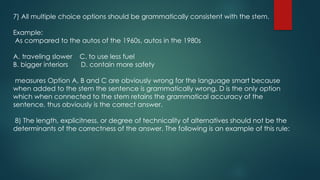
7) All multiple choice options should be grammatically consistent with the stem.
Example:
As compared to the autos of the 1960s, autos in the 1980s
A. traveling slower C. to use less fuel
B. bigger interiors D. contain more safety
measures Option A, B and C are obviously wrong for the language smart because
when added to the stem the sentence is grammatically wrong. D is the only option
which when connected to the stem retains the grammatical accuracy of the
sentence, thus obviously is the correct answer.
8) The length, explicitness, or degree of technicality of alternatives should not be the
determinants of the correctness of the answer. The following is an example of this rule:
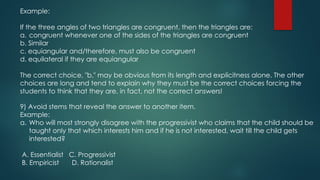
Example:
If the three angles of two triangles are congruent, then the triangles are:
a. congruent whenever one of the sides of the triangles are congruent
b. Similar
c. equiangular and/therefore, must also be congruent
d. equilateral if they are equiangular
The correct choice, "b," may be obvious from its length and explicitness alone. The other
choices are long and tend to explain why they must be the correct choices forcing the
students to think that they are, in fact, not the correct answers!
9) Avoid stems that reveal the answer to another item.
Example:
a. Who will most strongly disagree with the progressivist who claims that the child should be
taught only that which interests him and if he is not interested, wait till the child gets
interested?
A. Essentialist C. Progressivist
B. Empiricist D. Rationalist
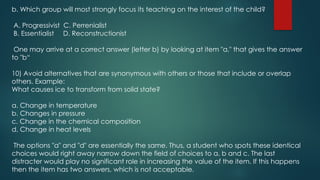
b. Which group will most strongly focus its teaching on the interest of the child?
A. Progressivist C. Perrenialist
B. Essentialist D. Reconstructionist
One may arrive at a correct answer (letter b) by looking at item "a," that gives the answer
to "b“
10) Avoid alternatives that are synonymous with others or those that include or overlap
others. Example:
What causes ice to transform from solid state?
a. Change in temperature
b. Changes in pressure
c. Change in the chemical composition
d. Change in heat levels
The options "a" and "d" are essentially the same. Thus, a student who spots these identical
choices would right away narrow down the field of choices to a, b and c. The last
distracter would play no significant role in increasing the value of the item. If this happens
then the item has two answers, which is not acceptable.
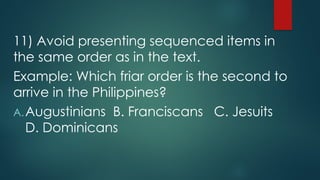
11) Avoid presenting sequenced items in
the same order as in the text.
Example: Which friar order is the second to
arrive in the Philippines?
A.Augustinians B. Franciscans C. Jesuits
D. Dominicans
12) Avoid use of assumed qualifiers that many
examinees may not be aware of. Qualifiers are
words that alter a statement. Words like always,
often, never, most, good and bad. In a multiple
choice test, qualifiers can make an option on a test
be a correct option or an incorrect option.
Example: Which statement is correct?
A. It often rains in Tarlac.
B. It never rains in Tarlac.
C. It always rains in Tarlac.
D. Most rains in Region 3 happen in Tarlac.
13) Avoid use of unnecessary words or phrases which are not relevant to the
problem at hand (unless such discriminating ability is the primary intent of the
evaluation).
The item's value is particularly damaged if the unnecessary material is designed to
distract or mislead. Such items test the student's reading comprehension rather
than knowledge of the subject matter.
Example:
The side opposite the thirty degree angle in a right triangle is equal to half the
length of the hypotenuse. If the sine of a 30-degree is 0.5 and its hypotenuse is 5,
what is the length of the side opposite the 30-degree angle?
a. 2.5
b. 3.5
c. 5.5
d. 1.5
The sine of a 30-degree angle is really quite unnecessary since the first sentence
already gives the method for finding the length of the side opposite the thirty-degree
angle. This is a case of a teacher who wants to make sure that no student in his class
gets the wrong answer!
14) Avoid use of non-relevant sources of difficulty such as requiring a complex
calculation when only knowledge of a principle is being tested Noted in the previous
example, knowledge of the sine of the 30-degree angle would have led some
students to use the sine formula for calculation even if a simpler approach would
have sufficed.
15) Pack the question in the stem. Here is an example of a question which has no
question. Avoid it by all means.
Example:
The Roman Empire
a. had no central government
b. had no definite territory
c. had no heroes
d. had no common religion
16) Use the "None of the above" option only when the keyed answer is totally
correct. When choice of the "best" response is intended, "none of the above"
is not appropriate, since the implication has already been made that the
correct response may be partially inaccurate.
17) Note that use of "all of the above" may allow credit for partial knowledge.
In a multiple option item. (allowing only one option choice) if a student only
knew that two (2) options were correct, he could then deduce the
correctness of "all of the above." This assumes you are allowed only one
correct choice.
18) Better still use "none of the above" and "all of the above" sparingly but
best not to use them at all.
19) Having compound response choices may purposefully increase difficulty
of an item. The difficulty in a multiple choice item may be controlled by
varying the homogeneity or degree of similarity of responses. The more
homogeneous, the more difficult the item because they all look like the
correct answer.
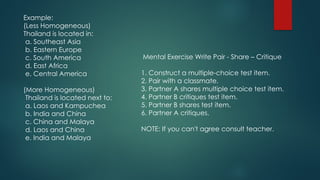
Example:
(Less Homogeneous)
Thailand is located in:
a. Southeast Asia
b. Eastern Europe
c. South America
d. East Africa
e. Central America
(More Homogeneous)
Thailand is located next to:
a. Laos and Kampuchea
b. India and China
c. China and Malaya
d. Laos and China
e. India and Malaya
Mental Exercise Write Pair - Share – Critique
1. Construct a multiple-choice test item.
2. Pair with a classmate.
3. Partner A shares multiple choice test item.
4. Partner B critiques test item.
5. Partner B shares test item.
6. Partner A critiques.
NOTE: If you can't agree consult teacher.
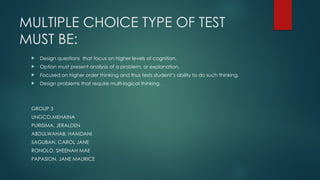
MULTIPLE CHOICE TYPE OF TEST
MUST BE:
 Design questions that focus on higher levels of cognition.
 Option must present analysis of a problem, or explanation.
 Focused on higher order thinking and thus tests student’s ability to do such thinking.
 Design problems that require multi-logical thinking.
GROUP 3
UNGCO,MEHAINA
PURISIMA, JERALDEN
ABDULWAHAB, HAMDANI
SAGUBAN, CAROL JANE
RONOLO, SHEENAH MAE
PAPASION, JANE MAURICE

MULTIPLE-CHOICE.pptx bshahshhdhsjehehejd

  • 1.
  • 2.
    Learning outcomes  Constructa table of specification  Construct paper-and-pencil tests in accordance with the guidelines in test construction.
  • 3.
    5.3.2 Multiple ChoiceTests The multiple choice type of test offers the student with more than two (2) options per item to choose from. Each item in a multiple choice test consists of two parts: (a) the stem and (b) the options. In the set of options, there is a "correct" or "best" option while all the others are considered "distracters." The distracters are chosen in such a way that they are attractive to those who do not know the answer or who are guessing but at the same time, have no appeal to those who actually know the answer. It is this feature of multiple choice type tests that allows the teacher to test higher order thinking skills even if the options are clearly stated. As in true- false items, there are certain rules of thumb to be followed in constructing multiple choice tests.
  • 4.
    Guidelines for ConstructingMultiple Choice Items 1) Do not use unfamiliar words, terms and phrases. The ability of the item to discriminate or its level of difficulty should stem from the subject matter rather than from the wording of the question. Example: What would be the system reliability of a computer system whose slave and peripherals are connected in parallel circuits and each one has a known time to failure probability of 0.05? A student completely unfamiliar with the terms "slave" and "peripherals "may not be able to answer correctly even if he knew the subject matter of reliability.
  • 5.
    2) Do notuse modifiers that are vague and whose meanings can differ from one person to the next such as: much, often, usually, etc. Example: Much of the process of photosynthesis takes place in the: a. bark b. leaf c. stem The qualifier "much" is vague and could have been replaced by more specific qualifiers like: -90% of the photosynthetic process" or some similar phrase be more precise. Be quantitative.
  • 6.
    3) Avoid complexor awkward word arrangements. Also, avoid use of negatives in the stem as this may add unnecessary comprehension difficulties Example: (Poor) As President of the Republic of the Philippines, Corazon Cojuangco Aquino would stand next to which President of the Philippine Republic subsequent to the 1986 EDSA Revolution? (Better) Who was the President of the Philippines after Corazon C. Aquino? 4. Do not use negatives or double negatives since such statements tend to be confusing. It is best to use simpler sentences rather than sentences that would require expertise in grammatical construction.
  • 7.
    Example: (Poor) Which ofthe following will not cause inflation in the Philippine economy? (Better) Which of the following will cause inflation in the Philippine economy? Poor: What does the statement "Development patterns acquired during the formative years are NOT Unchangeable" imply? A. B. C. D. Better: What does the statement "Development patterns acquired during the formative years are changeable" imply? A. B. C. D.
  • 8.
    5) Each itemstem should be as short as possible; otherwise you risk testing more for reading and comprehension skills. 6) Distracters should be equally plausible and attractive. Example: The short story: May Day's Eve, was written by which Filipino author? a. Jose Garcia Villa b. Nick Joaquin c. Genoveva Edrosa Matute d. Robert Frost e. Edgar Allan Poe If distracters had all been Filipino authors, the value of the item would be greatly increased. In this particular instance, only the first three carry the burden of the entire item since the last two can be essentially disregarded by the students.
  • 9.
    7) All multiplechoice options should be grammatically consistent with the stem. Example: As compared to the autos of the 1960s, autos in the 1980s A. traveling slower C. to use less fuel B. bigger interiors D. contain more safety measures Option A, B and C are obviously wrong for the language smart because when added to the stem the sentence is grammatically wrong. D is the only option which when connected to the stem retains the grammatical accuracy of the sentence, thus obviously is the correct answer. 8) The length, explicitness, or degree of technicality of alternatives should not be the determinants of the correctness of the answer. The following is an example of this rule:
  • 10.
    Example: If the threeangles of two triangles are congruent, then the triangles are: a. congruent whenever one of the sides of the triangles are congruent b. Similar c. equiangular and/therefore, must also be congruent d. equilateral if they are equiangular The correct choice, "b," may be obvious from its length and explicitness alone. The other choices are long and tend to explain why they must be the correct choices forcing the students to think that they are, in fact, not the correct answers! 9) Avoid stems that reveal the answer to another item. Example: a. Who will most strongly disagree with the progressivist who claims that the child should be taught only that which interests him and if he is not interested, wait till the child gets interested? A. Essentialist C. Progressivist B. Empiricist D. Rationalist
  • 11.
    b. Which groupwill most strongly focus its teaching on the interest of the child? A. Progressivist C. Perrenialist B. Essentialist D. Reconstructionist One may arrive at a correct answer (letter b) by looking at item "a," that gives the answer to "b“ 10) Avoid alternatives that are synonymous with others or those that include or overlap others. Example: What causes ice to transform from solid state? a. Change in temperature b. Changes in pressure c. Change in the chemical composition d. Change in heat levels The options "a" and "d" are essentially the same. Thus, a student who spots these identical choices would right away narrow down the field of choices to a, b and c. The last distracter would play no significant role in increasing the value of the item. If this happens then the item has two answers, which is not acceptable.
  • 12.
    11) Avoid presentingsequenced items in the same order as in the text. Example: Which friar order is the second to arrive in the Philippines? A.Augustinians B. Franciscans C. Jesuits D. Dominicans
  • 13.
    12) Avoid useof assumed qualifiers that many examinees may not be aware of. Qualifiers are words that alter a statement. Words like always, often, never, most, good and bad. In a multiple choice test, qualifiers can make an option on a test be a correct option or an incorrect option. Example: Which statement is correct? A. It often rains in Tarlac. B. It never rains in Tarlac. C. It always rains in Tarlac. D. Most rains in Region 3 happen in Tarlac.
  • 14.
    13) Avoid useof unnecessary words or phrases which are not relevant to the problem at hand (unless such discriminating ability is the primary intent of the evaluation). The item's value is particularly damaged if the unnecessary material is designed to distract or mislead. Such items test the student's reading comprehension rather than knowledge of the subject matter. Example: The side opposite the thirty degree angle in a right triangle is equal to half the length of the hypotenuse. If the sine of a 30-degree is 0.5 and its hypotenuse is 5, what is the length of the side opposite the 30-degree angle? a. 2.5 b. 3.5 c. 5.5 d. 1.5
  • 15.
    The sine ofa 30-degree angle is really quite unnecessary since the first sentence already gives the method for finding the length of the side opposite the thirty-degree angle. This is a case of a teacher who wants to make sure that no student in his class gets the wrong answer! 14) Avoid use of non-relevant sources of difficulty such as requiring a complex calculation when only knowledge of a principle is being tested Noted in the previous example, knowledge of the sine of the 30-degree angle would have led some students to use the sine formula for calculation even if a simpler approach would have sufficed. 15) Pack the question in the stem. Here is an example of a question which has no question. Avoid it by all means. Example: The Roman Empire a. had no central government b. had no definite territory c. had no heroes d. had no common religion
  • 16.
    16) Use the"None of the above" option only when the keyed answer is totally correct. When choice of the "best" response is intended, "none of the above" is not appropriate, since the implication has already been made that the correct response may be partially inaccurate. 17) Note that use of "all of the above" may allow credit for partial knowledge. In a multiple option item. (allowing only one option choice) if a student only knew that two (2) options were correct, he could then deduce the correctness of "all of the above." This assumes you are allowed only one correct choice. 18) Better still use "none of the above" and "all of the above" sparingly but best not to use them at all. 19) Having compound response choices may purposefully increase difficulty of an item. The difficulty in a multiple choice item may be controlled by varying the homogeneity or degree of similarity of responses. The more homogeneous, the more difficult the item because they all look like the correct answer.
  • 17.
    Example: (Less Homogeneous) Thailand islocated in: a. Southeast Asia b. Eastern Europe c. South America d. East Africa e. Central America (More Homogeneous) Thailand is located next to: a. Laos and Kampuchea b. India and China c. China and Malaya d. Laos and China e. India and Malaya Mental Exercise Write Pair - Share – Critique 1. Construct a multiple-choice test item. 2. Pair with a classmate. 3. Partner A shares multiple choice test item. 4. Partner B critiques test item. 5. Partner B shares test item. 6. Partner A critiques. NOTE: If you can't agree consult teacher.
  • 18.
    MULTIPLE CHOICE TYPEOF TEST MUST BE:  Design questions that focus on higher levels of cognition.  Option must present analysis of a problem, or explanation.  Focused on higher order thinking and thus tests student’s ability to do such thinking.  Design problems that require multi-logical thinking. GROUP 3 UNGCO,MEHAINA PURISIMA, JERALDEN ABDULWAHAB, HAMDANI SAGUBAN, CAROL JANE RONOLO, SHEENAH MAE PAPASION, JANE MAURICE