Presented  by Angela Maiers Fostering Literacy Independence
Teaching With Purpose How is what I am having children do today creating powerful readers, writers, and thinkers for tomorrow?
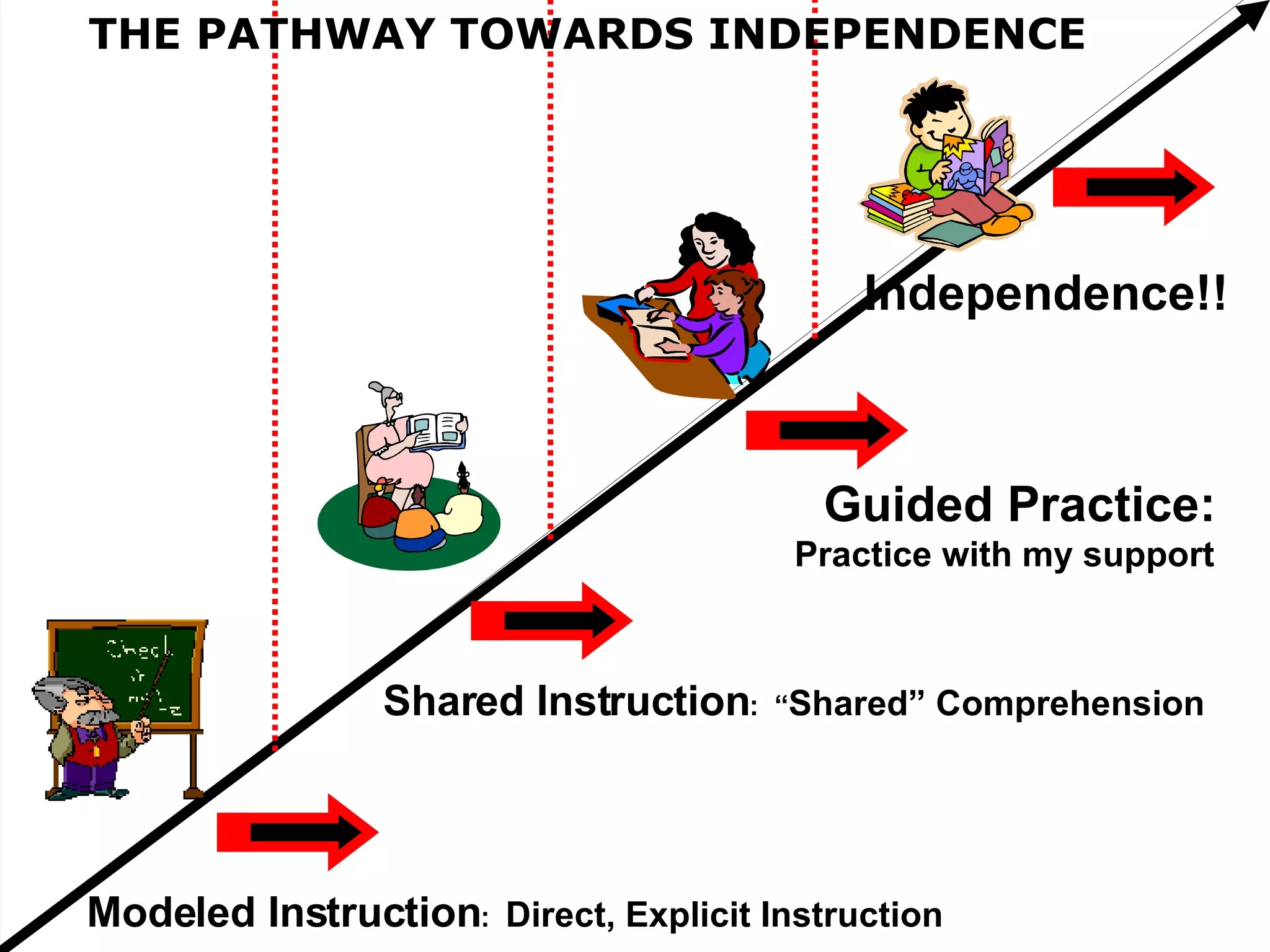
Modeled Instruction :  Direct, Explicit Instruction Shared Instruction :  “ Shared” Comprehension Guided Practice: Practice with my support Independence!!   THE PATHWAY TOWARDS INDEPENDENCE
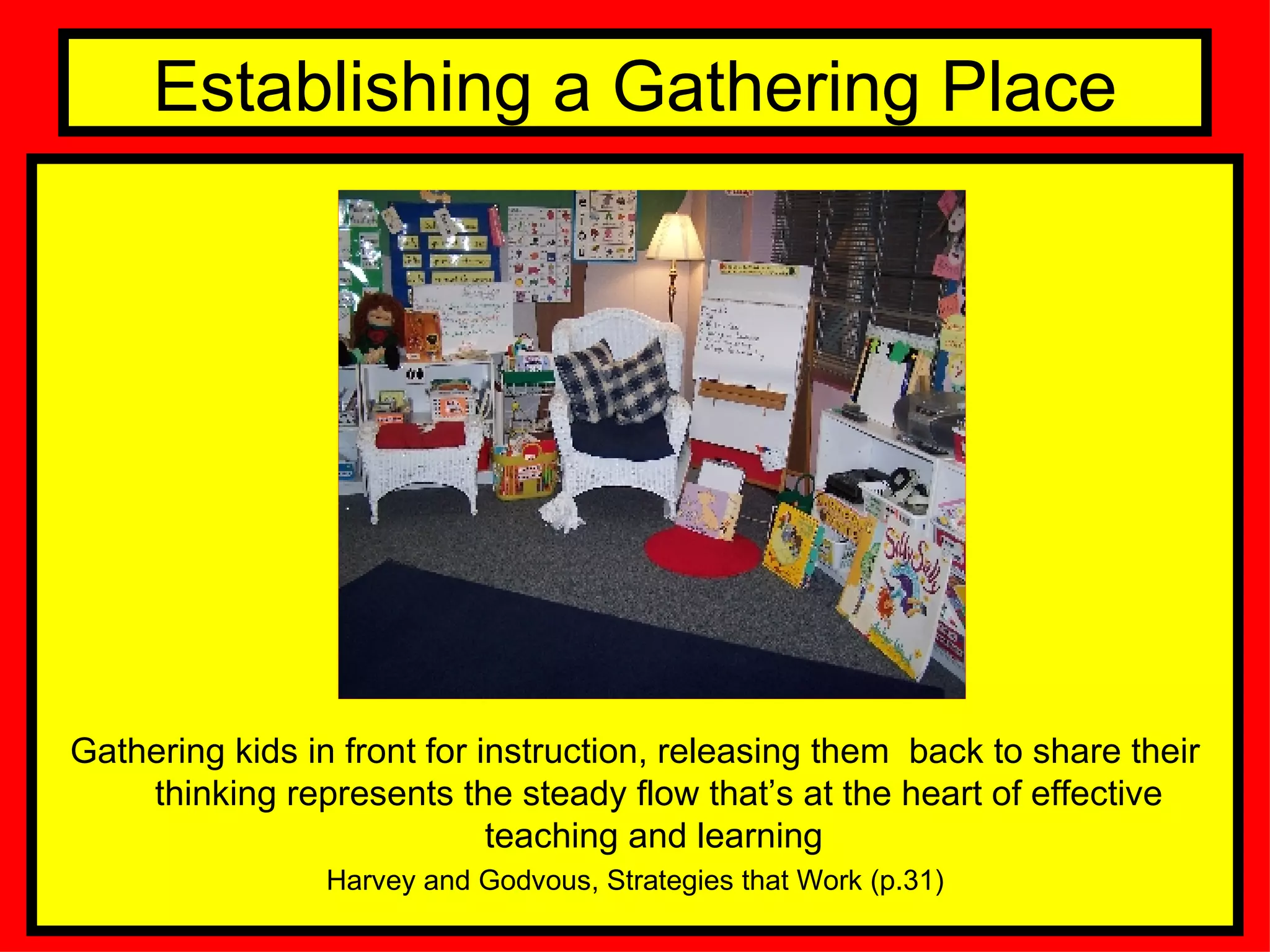
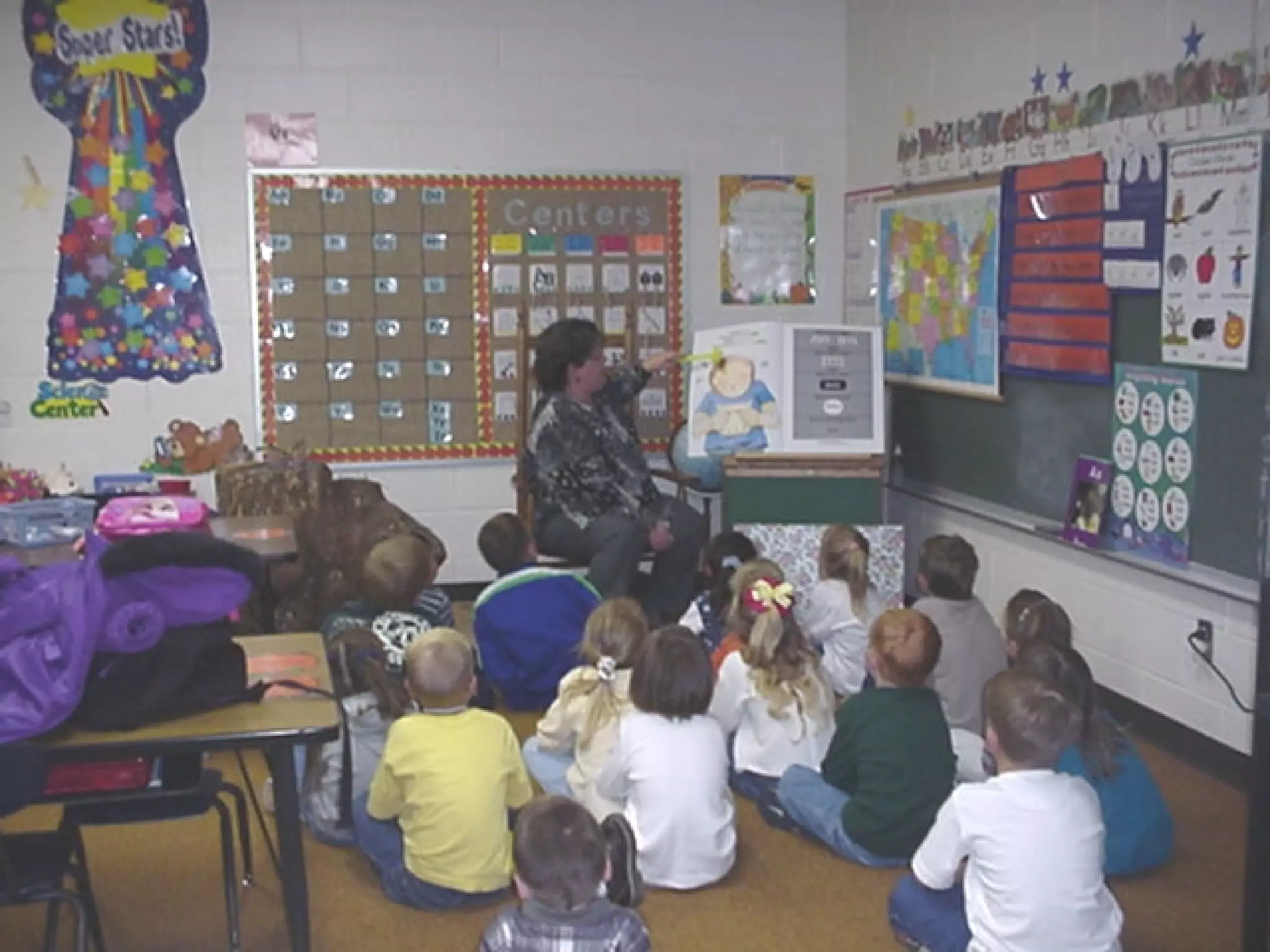
Establishing a Gathering Place Gathering kids in front for instruction, releasing them  back to share their thinking represents the steady flow that’s at the heart of effective teaching and learning  Harvey and Godvous, Strategies that Work (p.31)
 
 
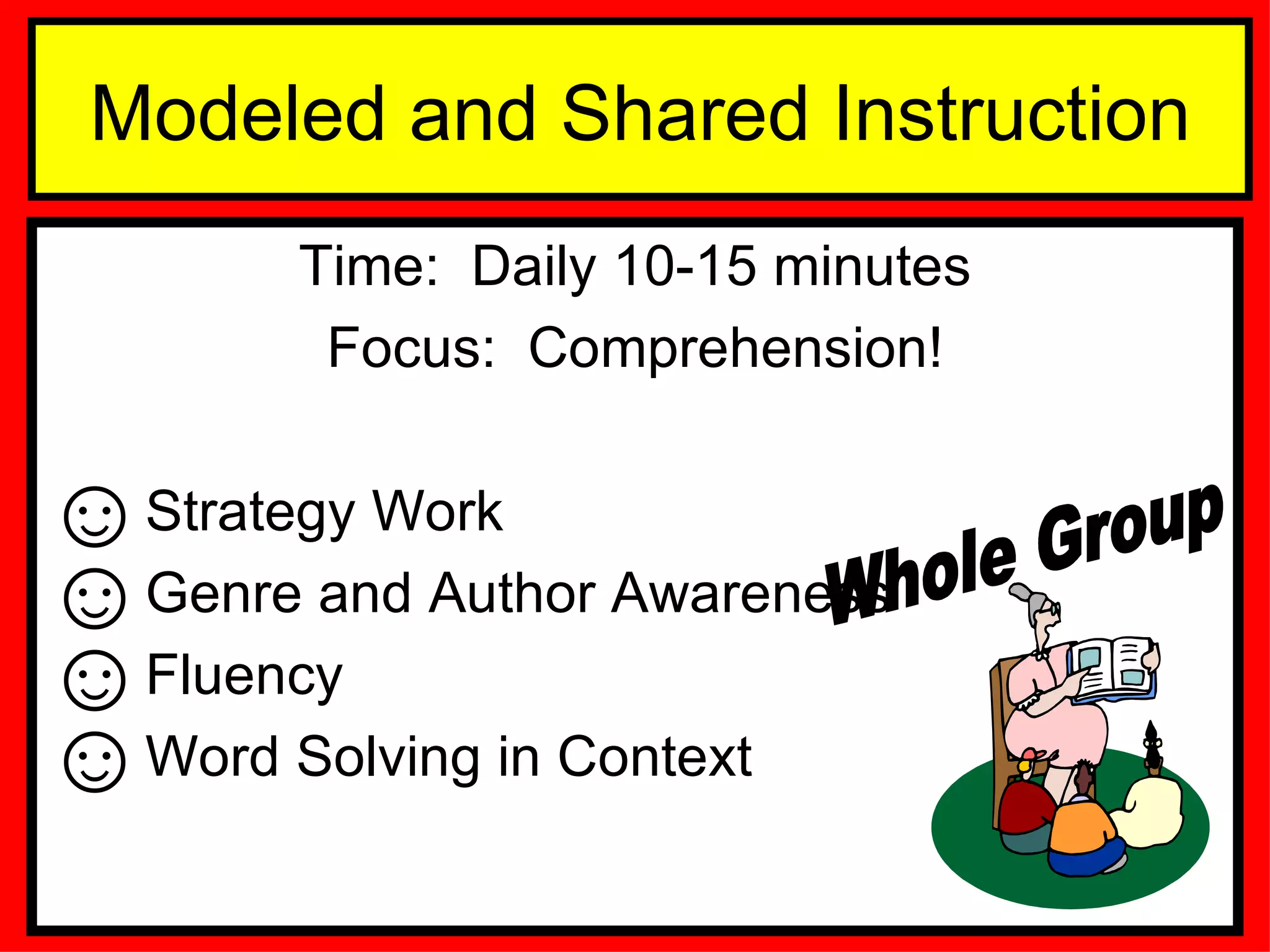
Modeled and Shared Instruction Time:  Daily 10-15 minutes Focus:  Comprehension! Strategy Work Genre and Author Awareness Fluency Word Solving in Context Whole Group
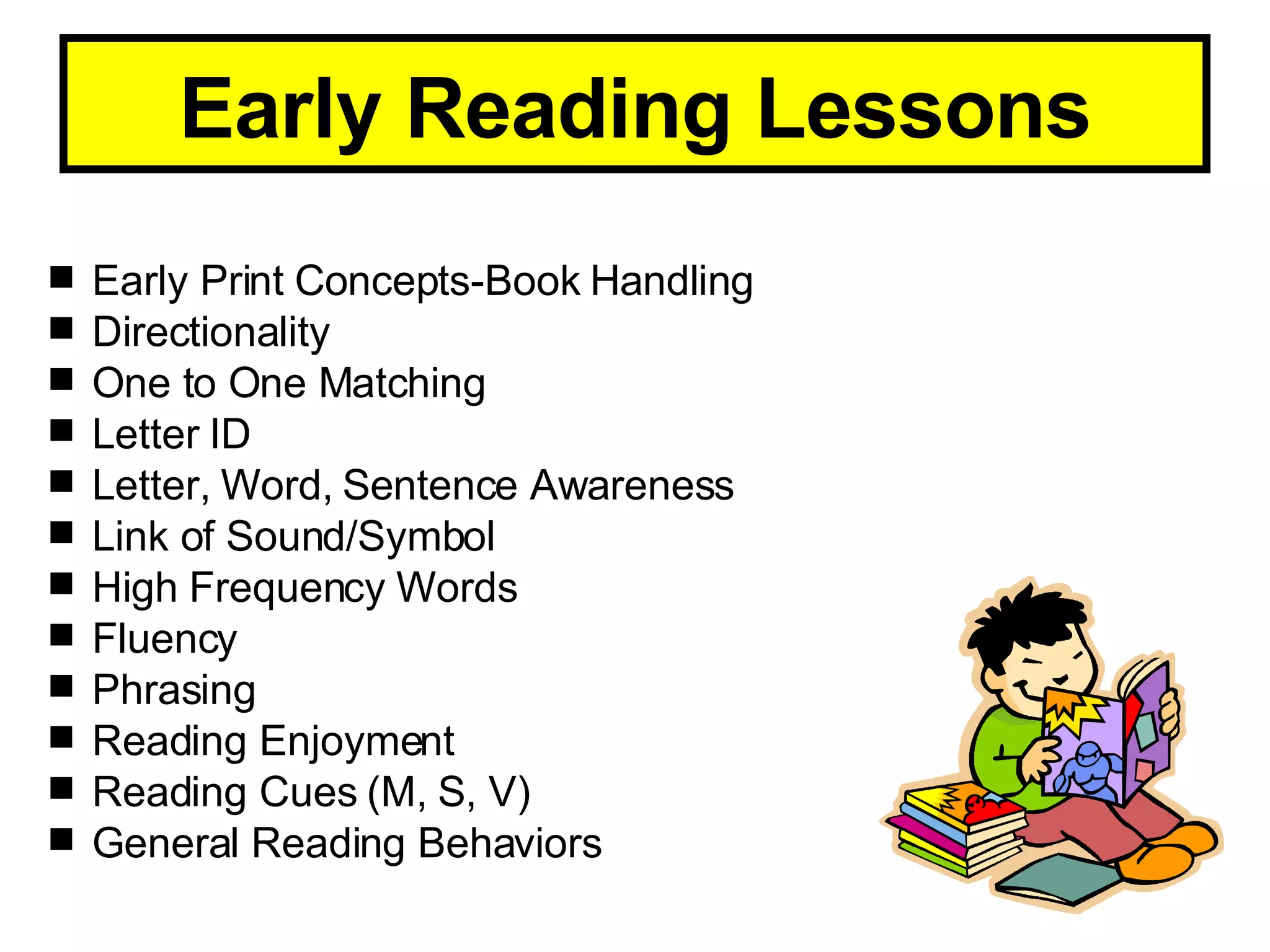
Early Reading Lessons Early Print Concepts-Book Handling Directionality One to One Matching Letter ID Letter, Word, Sentence Awareness Link of Sound/Symbol High Frequency Words Fluency Phrasing Reading Enjoyment Reading Cues (M, S, V) General Reading Behaviors
Large Group Makeover Materials Friday Thursday Wednesday Tuesday Monday
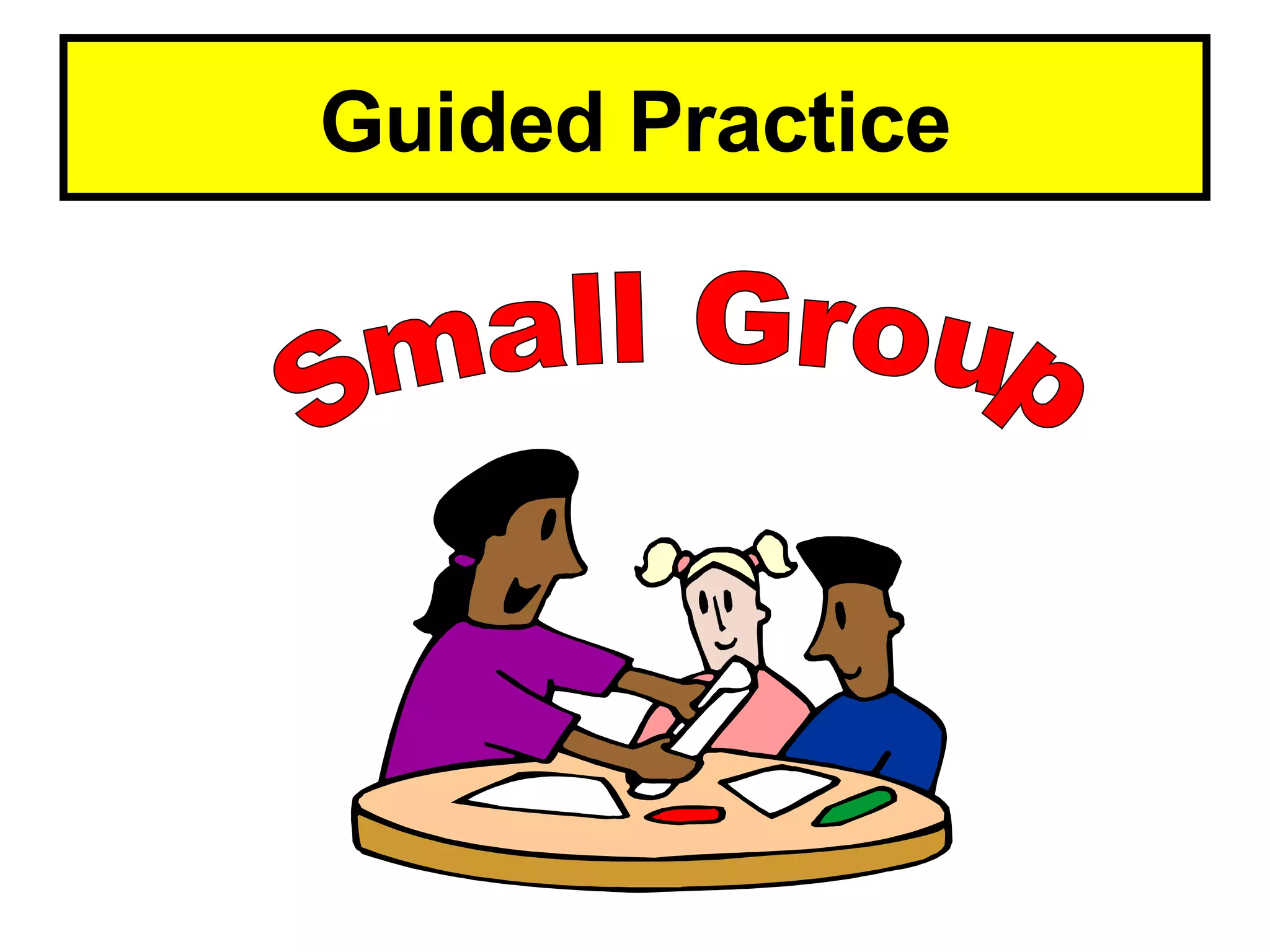
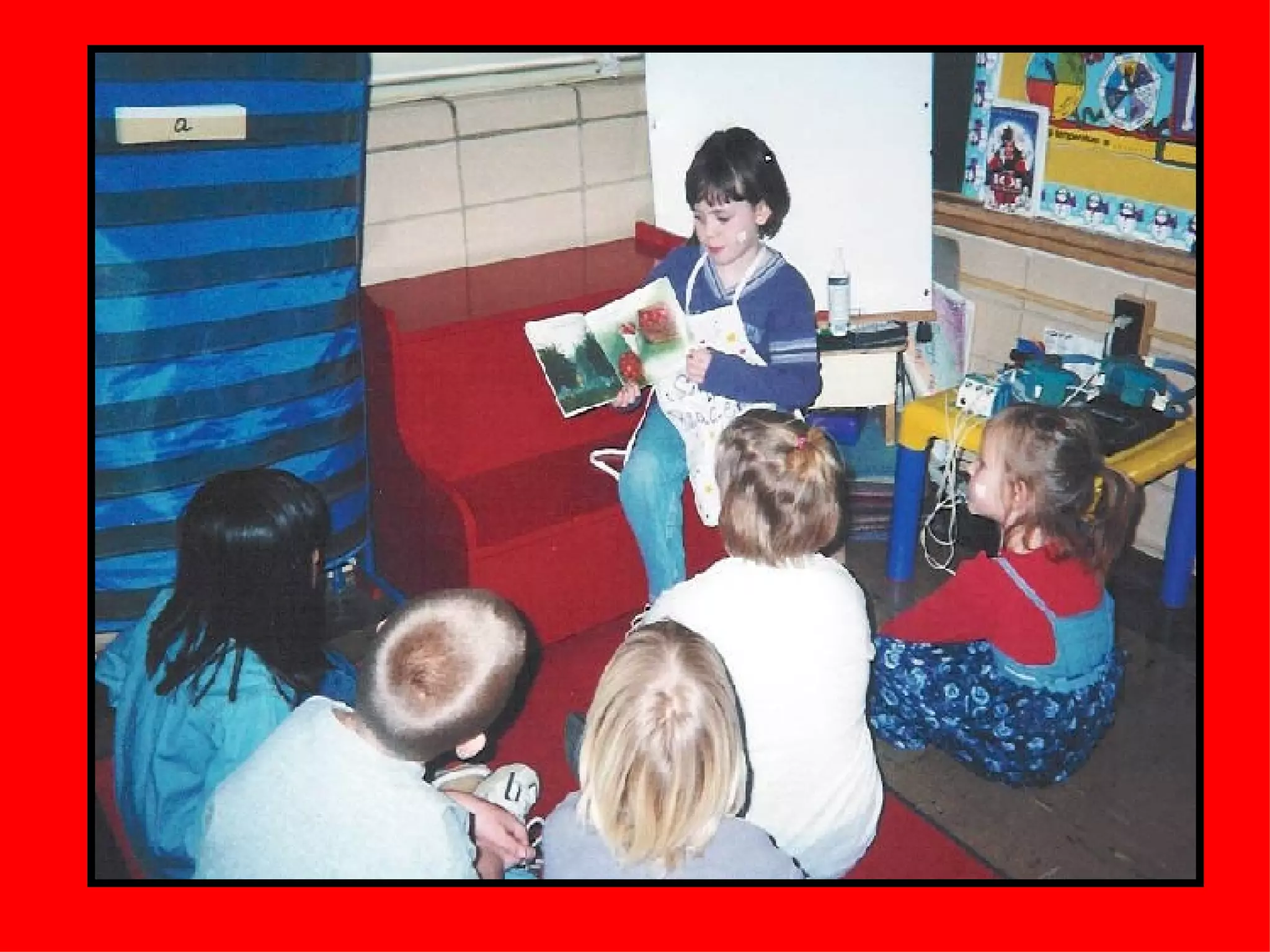
Guided Practice Small Group
 
Independent Reading Reading Practice
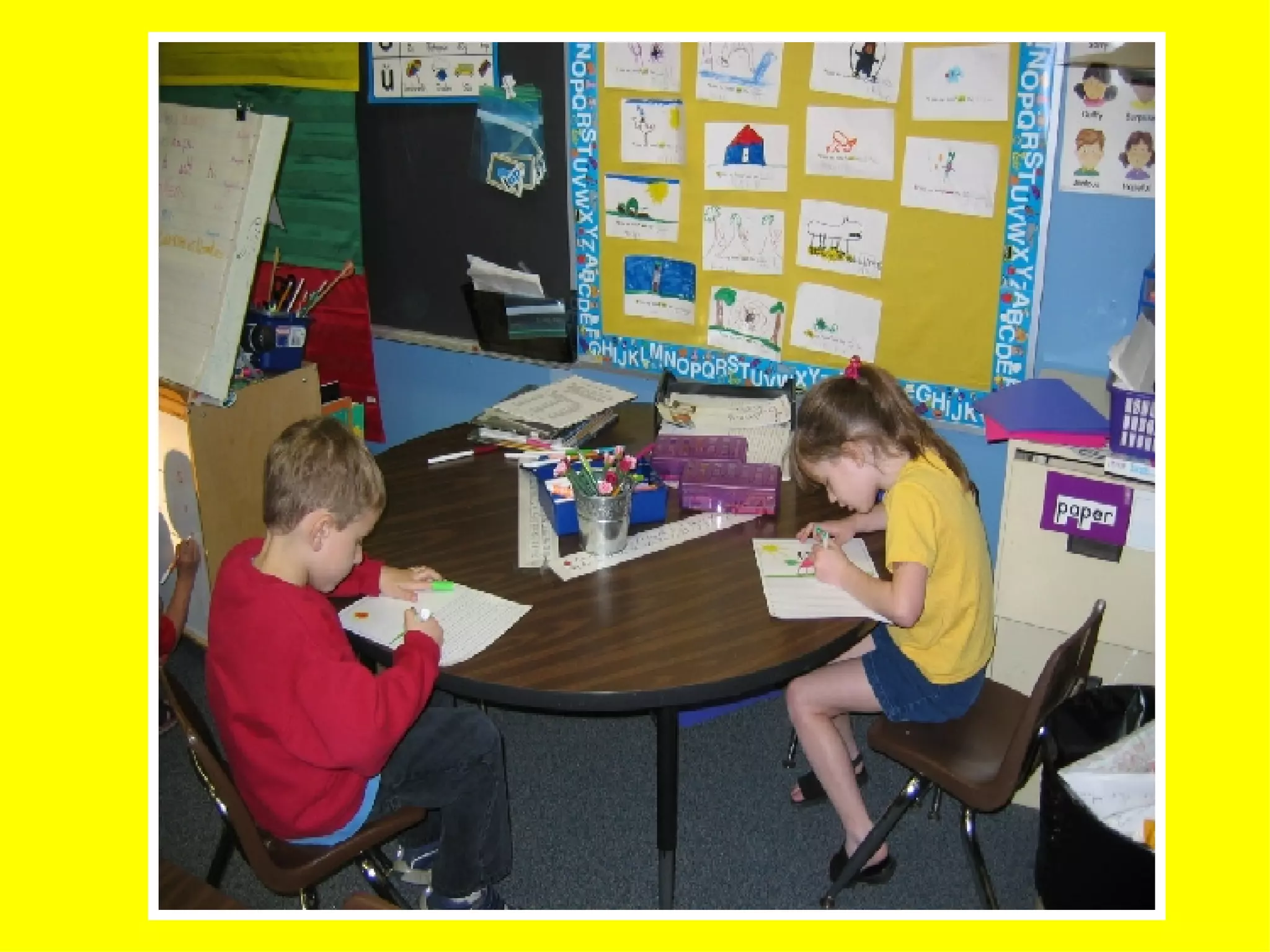
Specific Time  10-15 min DAILY Independent Level Real Reading CONFERENCE!!! Anytime Any Amount Any Book Any Behavior No Conference Independent Reading DEAR TIME/SSR
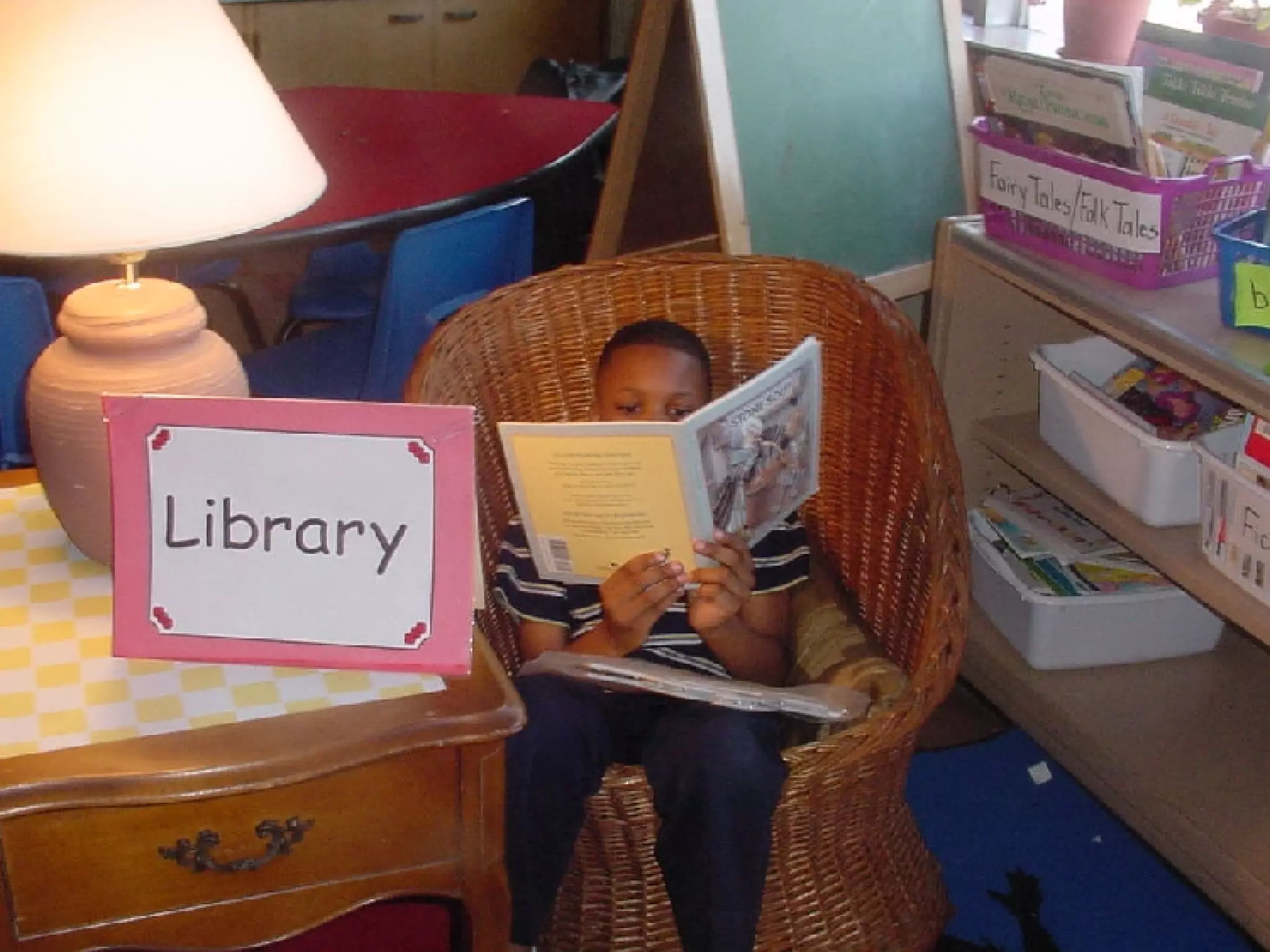
Free Choice Reading Reading Center
Three Ways to Read to Self Read and talk about the pictures Read the Words 3.  Retell a book you know


It is not enough to be busy, so are the ants.  The question is: What are we busy about? Henry David Thoreau Independent Practice
Independent Practice What do we need them to get good at?
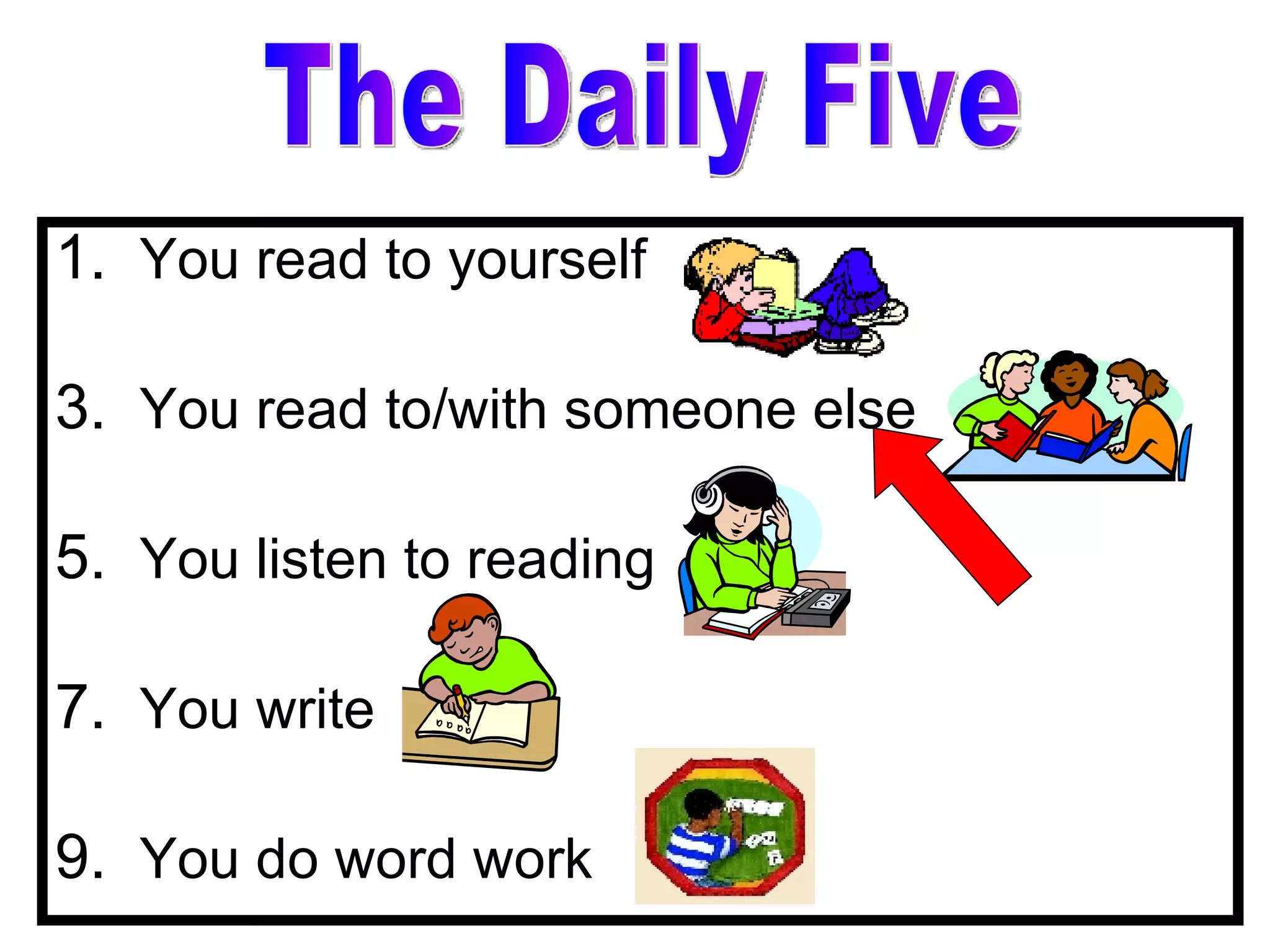
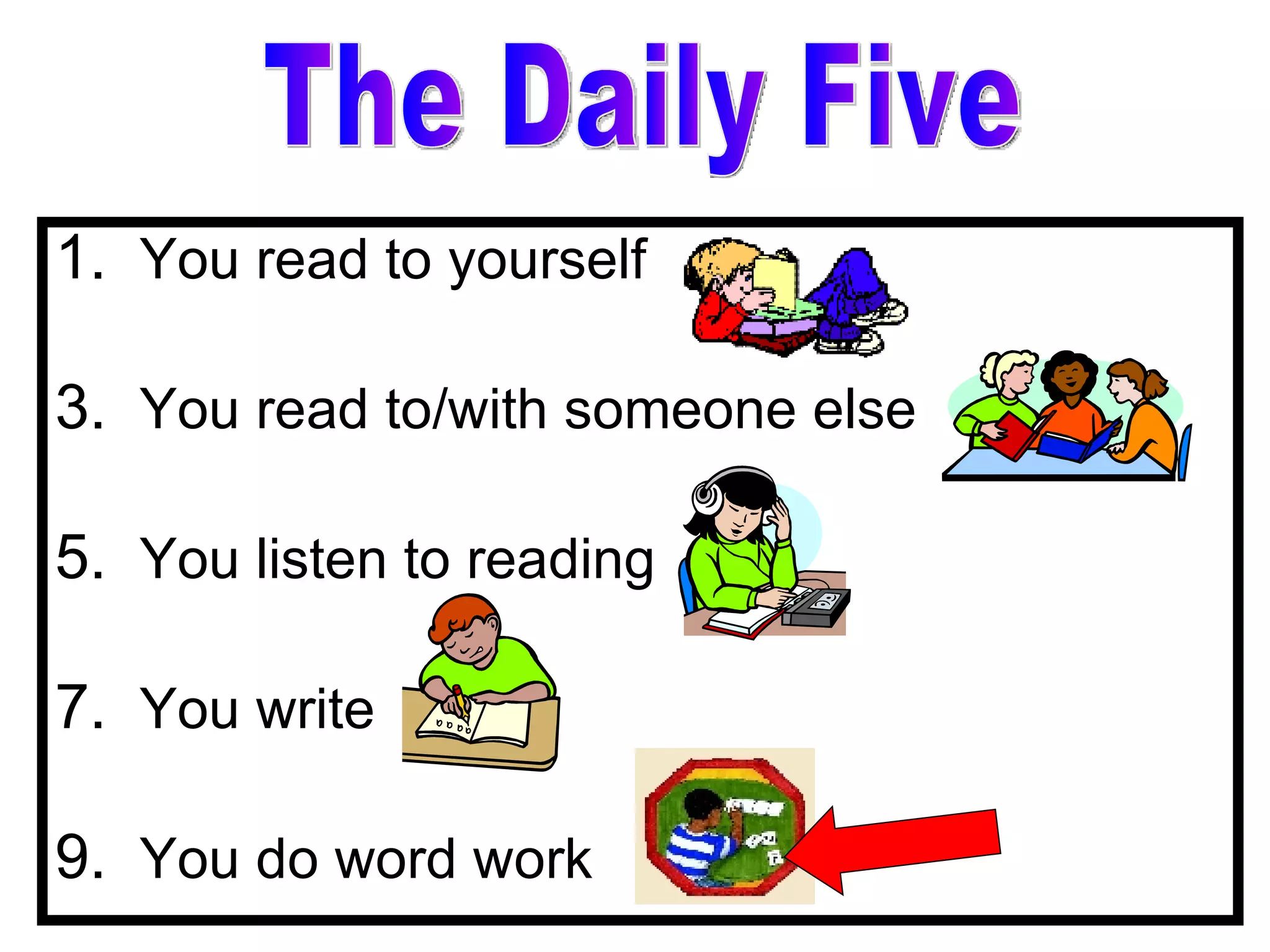
You read to yourself You read to/with someone else You listen to reading You write You do word work The Daily Five
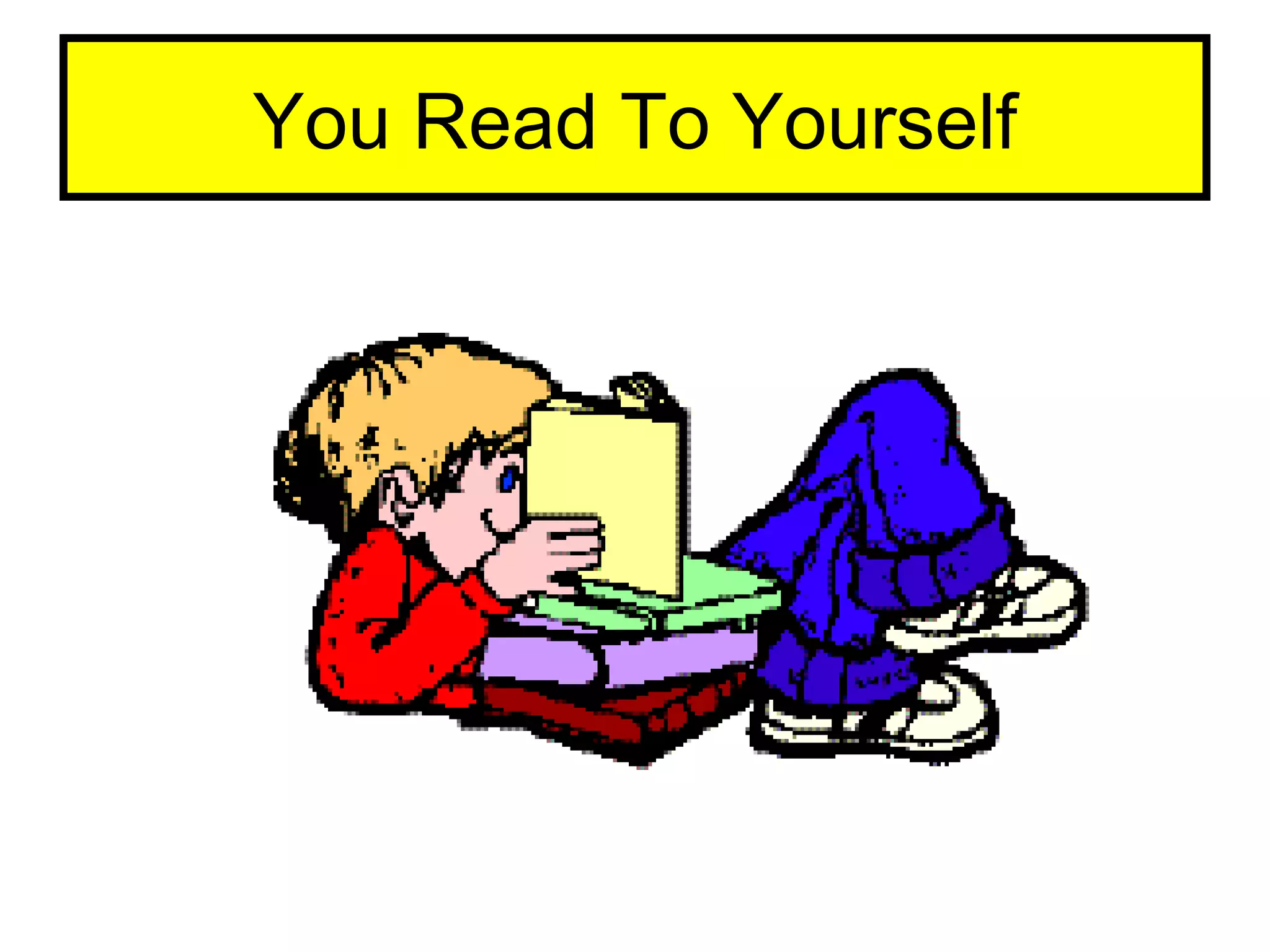
You Read To Yourself
 
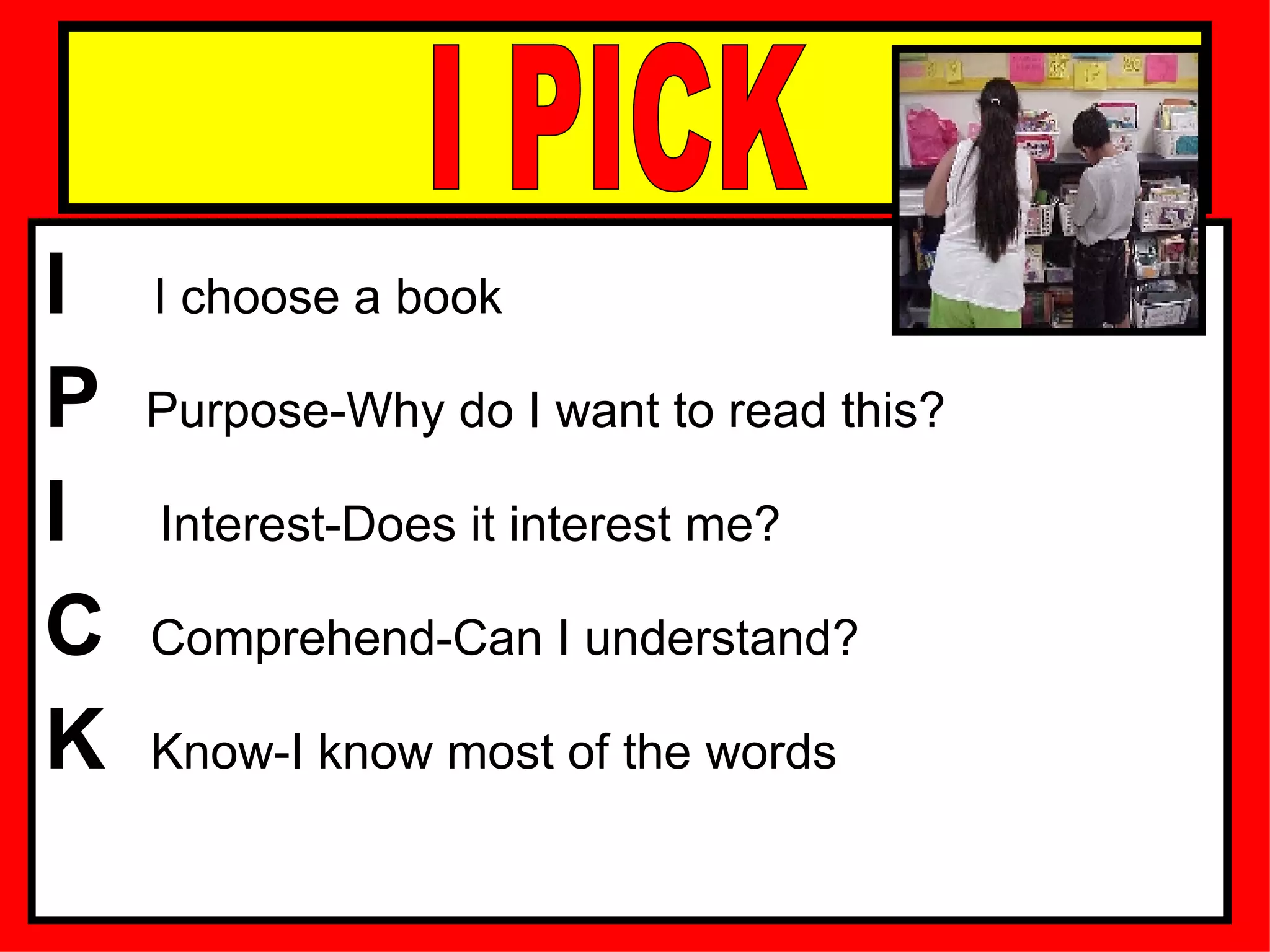
I  I choose a book P  Purpose-Why do I want to read this? I  Interest-Does it interest me? C  Comprehend-Can I understand? K  Know-I know most of the words I PICK
The Shoe Lesson (adapted from The Daily Five:  p.31)
 
 
You read to yourself You read to/with someone else You listen to reading You write You do word work The Daily Five
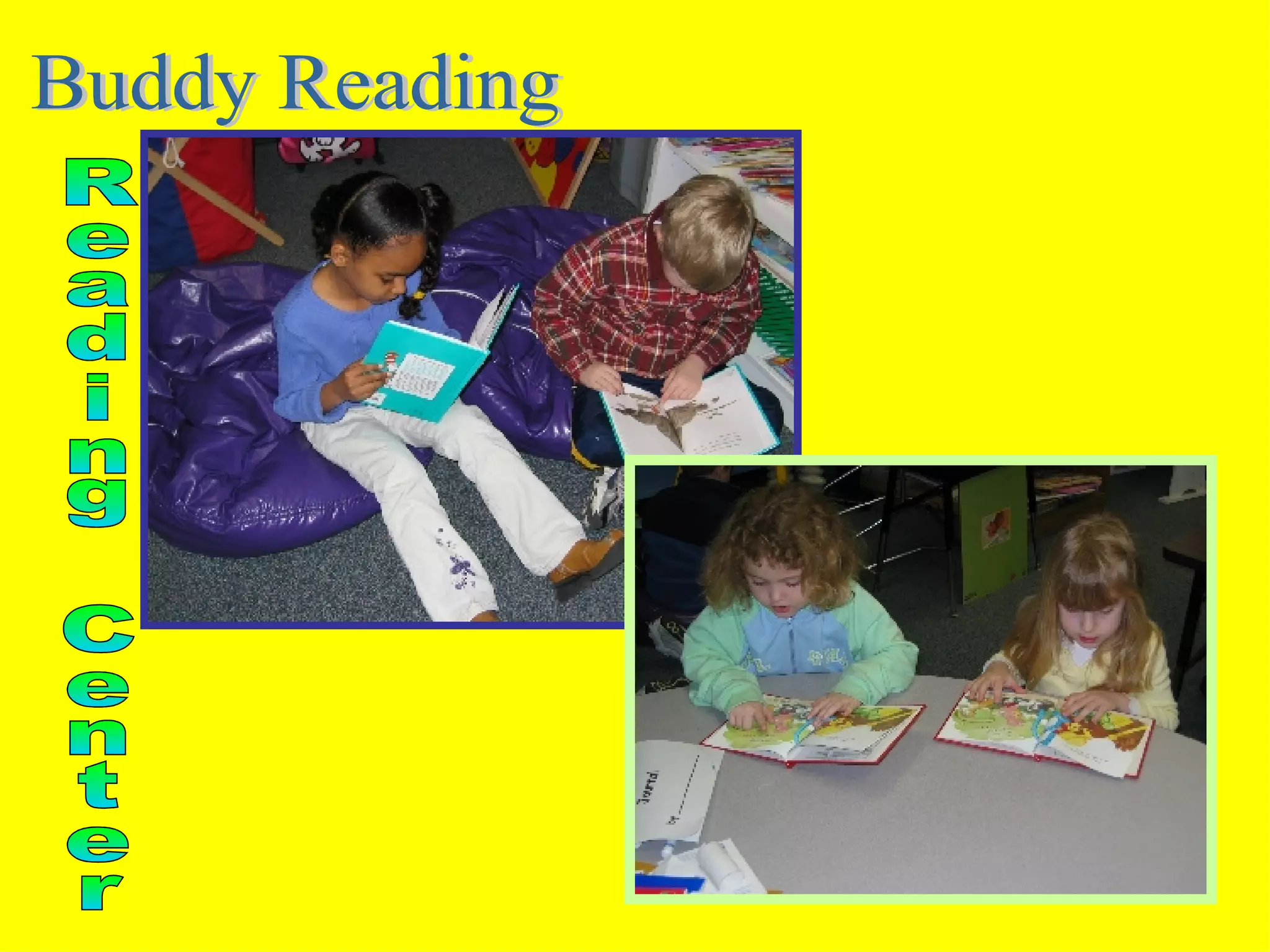
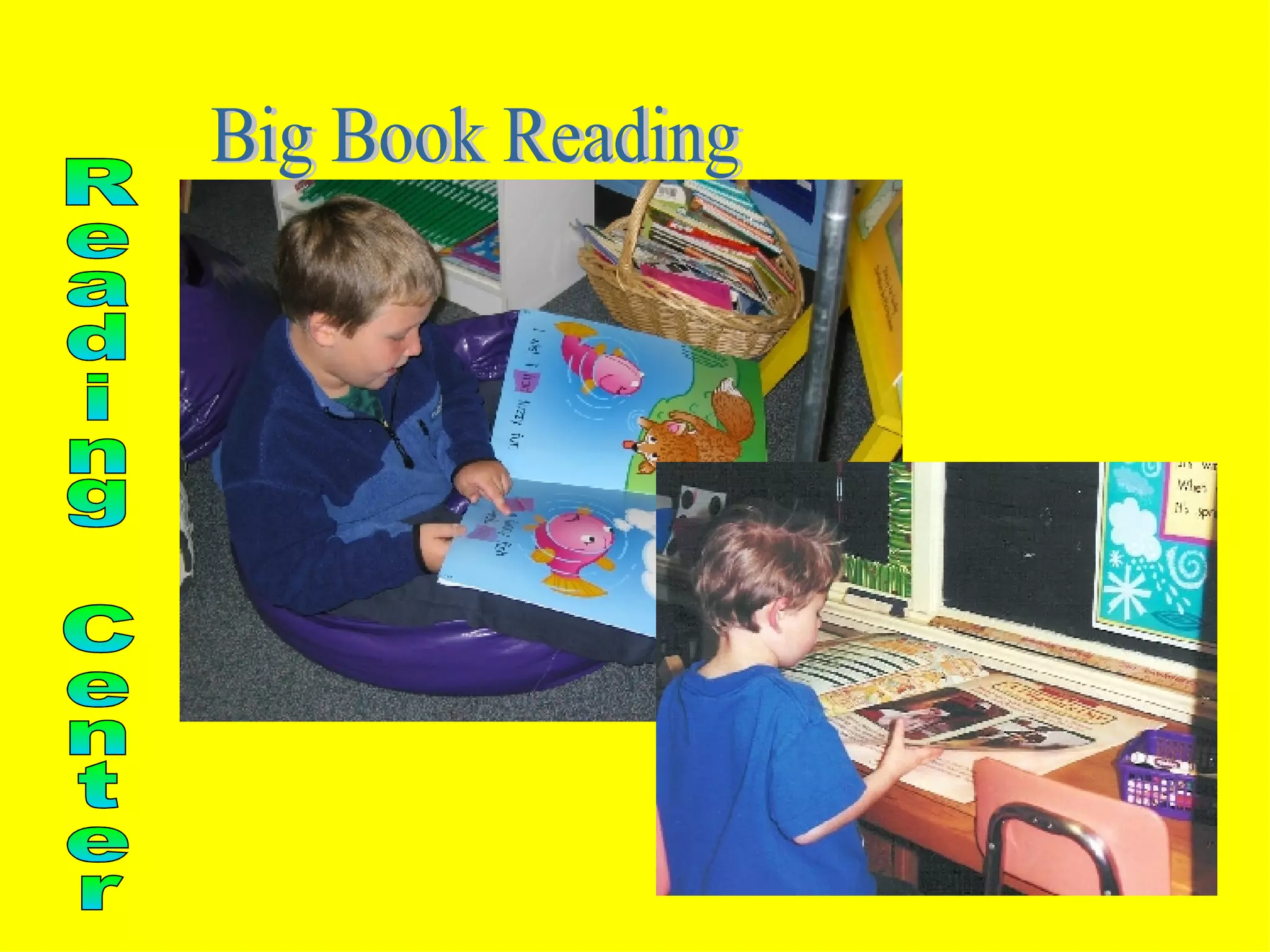
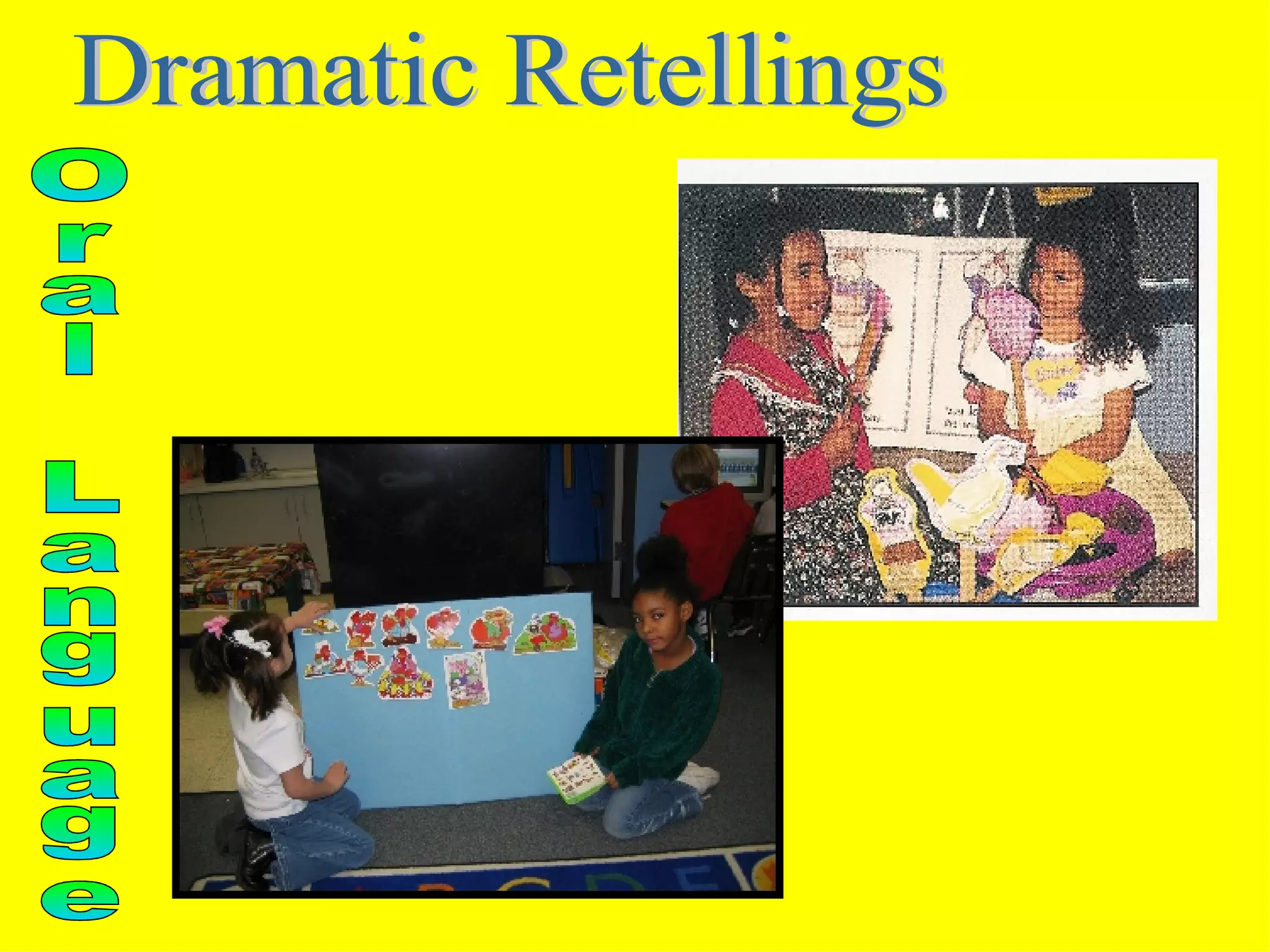
Read and Talk to Someone Buddy Reading Big Book Reading:  “Say Something” Dramatic Retelling Story Sequencing Read the Room
Buddy Reading Reading Center
Big Book Reading Reading Center
Dramatic Retellings Oral Language
Oral Language Story Sequencing
Read the Room Reading Center
You read to yourself You read to/with someone else You listen to reading You write You do word work The Daily Five
 
 
Listen and Read You could… Listen and Visualize/Sketch Listen and Retell Listen and Write Listen with a Partner-”Say Something” Listen and Respond Listen and Act Out Listen and Re-listen
Materials for Listening  Books on Tape (Fiction and Nonfiction) Poems on Tape Songs/Chants on Tape Guest Speakers Authors Reading Surprise Voices Individual Headphones Response Materials
You read to yourself You read to/with someone else You listen to reading You write You do word work The Daily Five


You read to yourself You read to/with someone else You listen to reading You write You do word work The Daily Five
Word Work for Grades K-2 Learning the Letters Learning the Words  Phonological Awareness TOGETHER:   These lead to an understanding of the alphabetic principle (  the relationship between the letters and the sounds)
ENVIRONMENT MATTERS!!!
Learning the Letters The letter name The letter formation (physical movement) The sound the letter represents The sound the letter represents when it is located in a word with other letters The features of a letter that make it different from every other letter The direction that the letter must be turned in order to preserve the name(b,d,m,n,) Some letters are doubled in words Some letters appear often together There are different types of letters(cap,lc, cons, vowel)
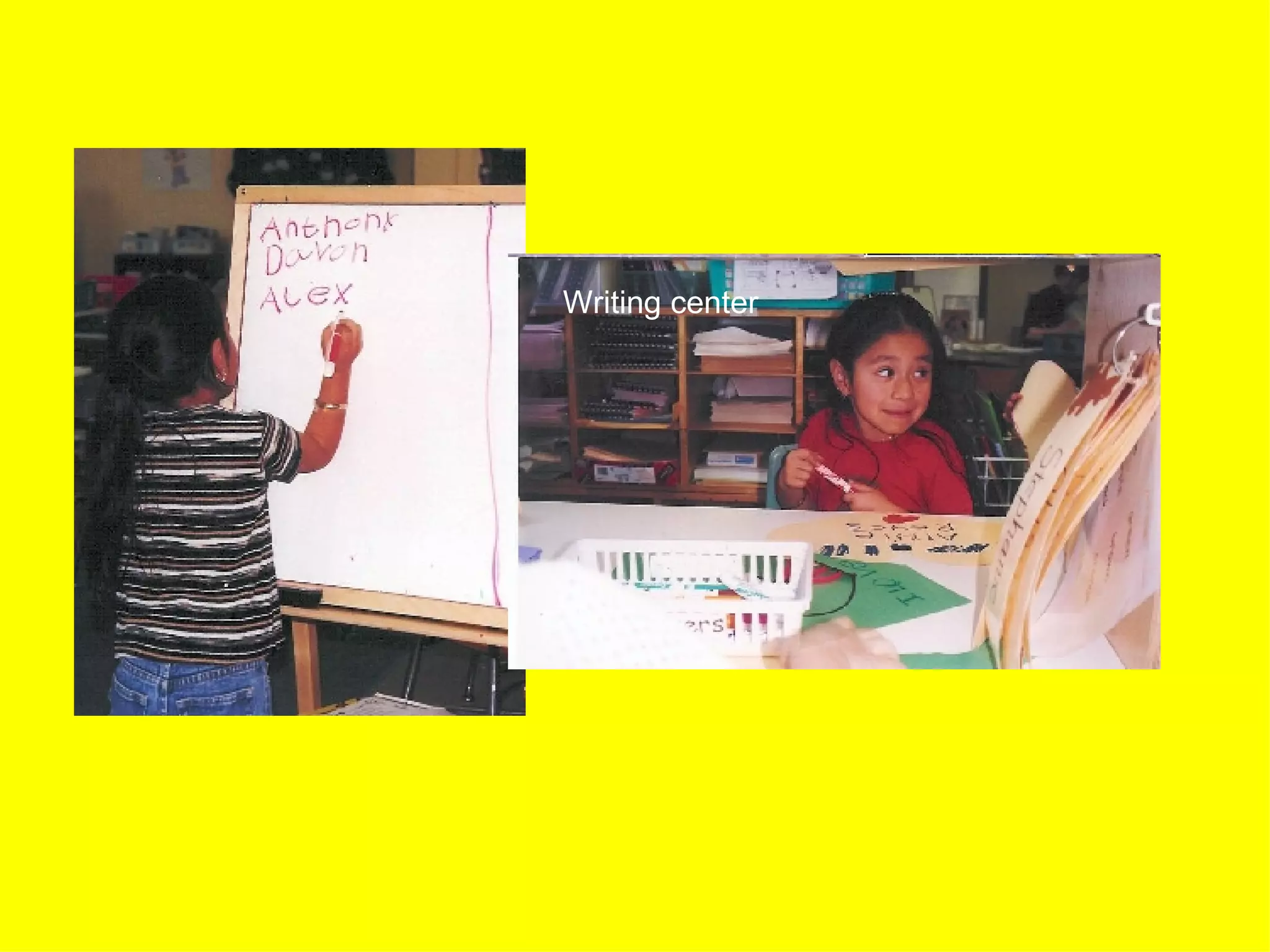
Writing center
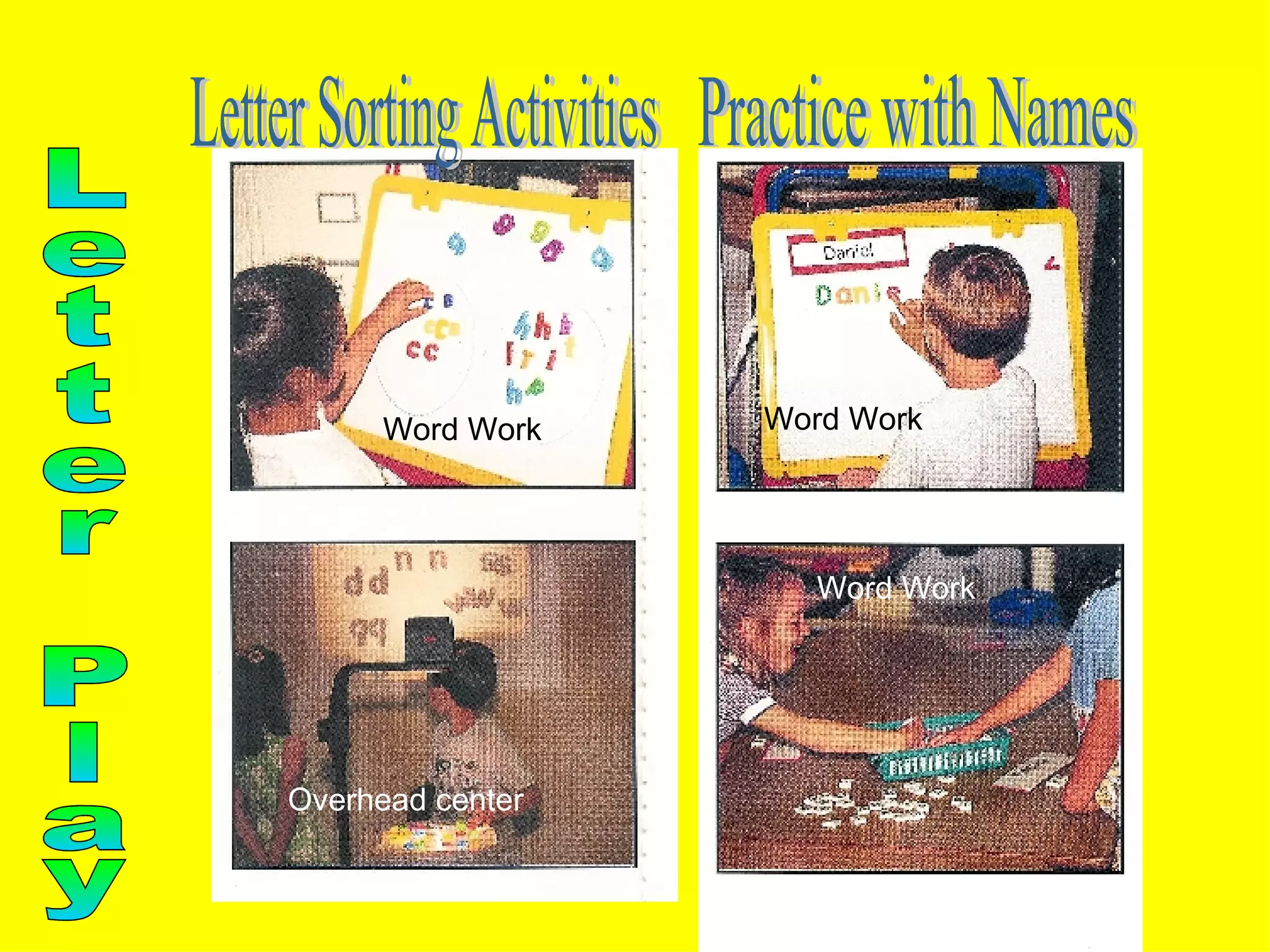
Letter Sorting Activities Letter Play Practice with Names Overhead center Word Work Word Work Word Work
Letter Play Letter Formation Alphabet Sequence Word work
Letter Play ABC Books and ABC Collage Word work
Learning the Words
Where To Begin?  NAMES They are most personal. Children should learn their own names Names of everyone else in the class. Label cubbyholes. Use name cards. NAME CHART!
Understanding Around Names Include: My name is a word A word is a sequence of letters that go together The letters in a word progress in a certain direction Words have meanings Words are written the same way every time Words are defined by white space ion either side Other words start/end like my name I can say a word and connect sounds to it Words can be put together to make a message Words have different meanings when put together with other words
Name Chart A arron Grayson  Matt Rodney A lex  Gabriel  Marcus  Rebecca A ndy  Rachel Cameron  Isabelle  Octvious  Steven Christi  Ike  Santana  Deb  Kathryn  Peter  William Dee  Kaitlyn  Pam  Erin  Lindsey  Yvette  Eric
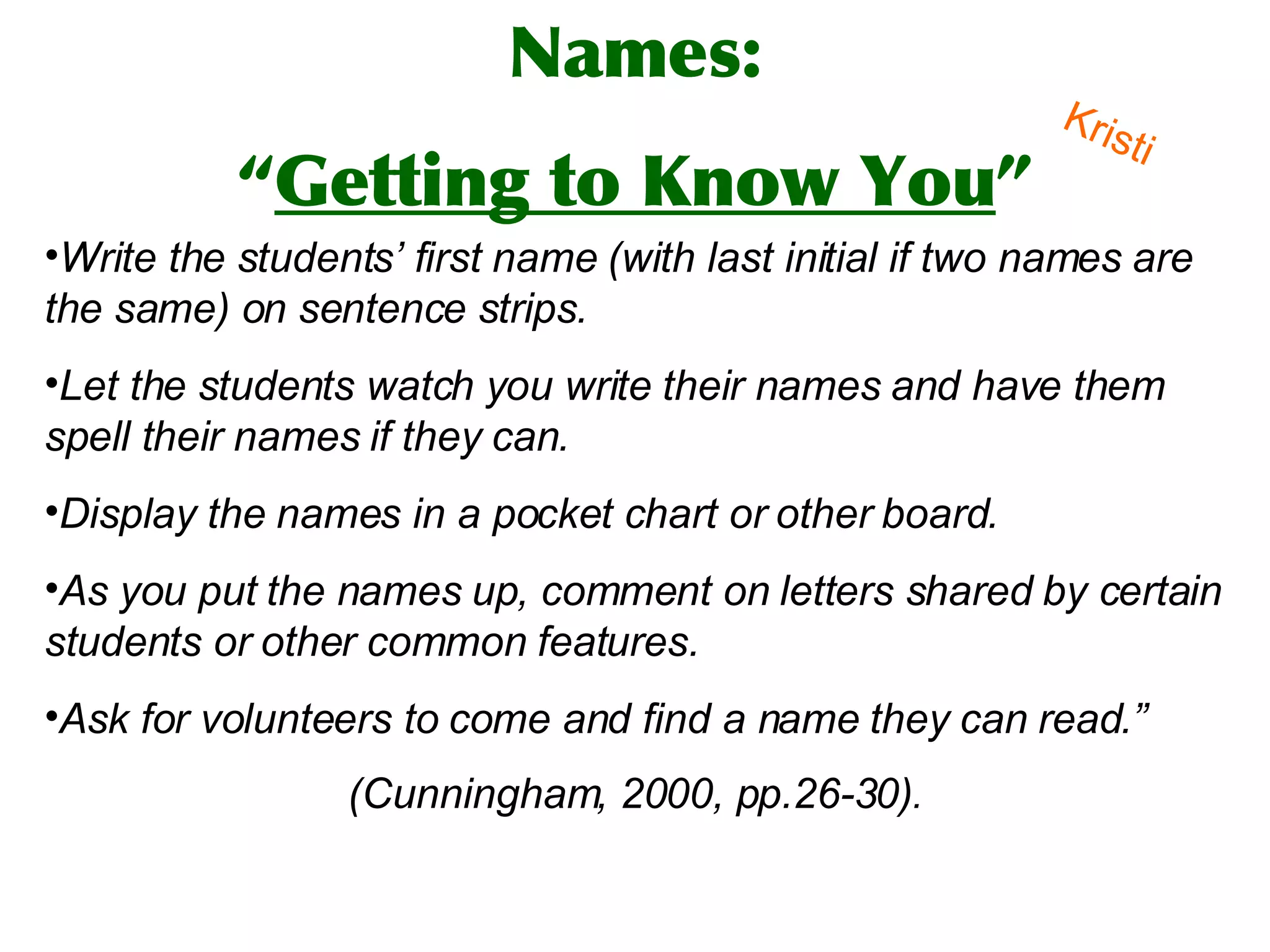
Write the students’ first name (with last initial if two names are the same) on sentence strips.  Let the students watch you write their names and have them spell their names if they can.  Display the names in a pocket chart or other board.  As you put the names up, comment on letters shared by certain students or other common features.  Ask for volunteers to come and find a name they can read.”  (Cunningham, 2000, pp.26-30) .   Names: “ Getting to Know You ” Kristi
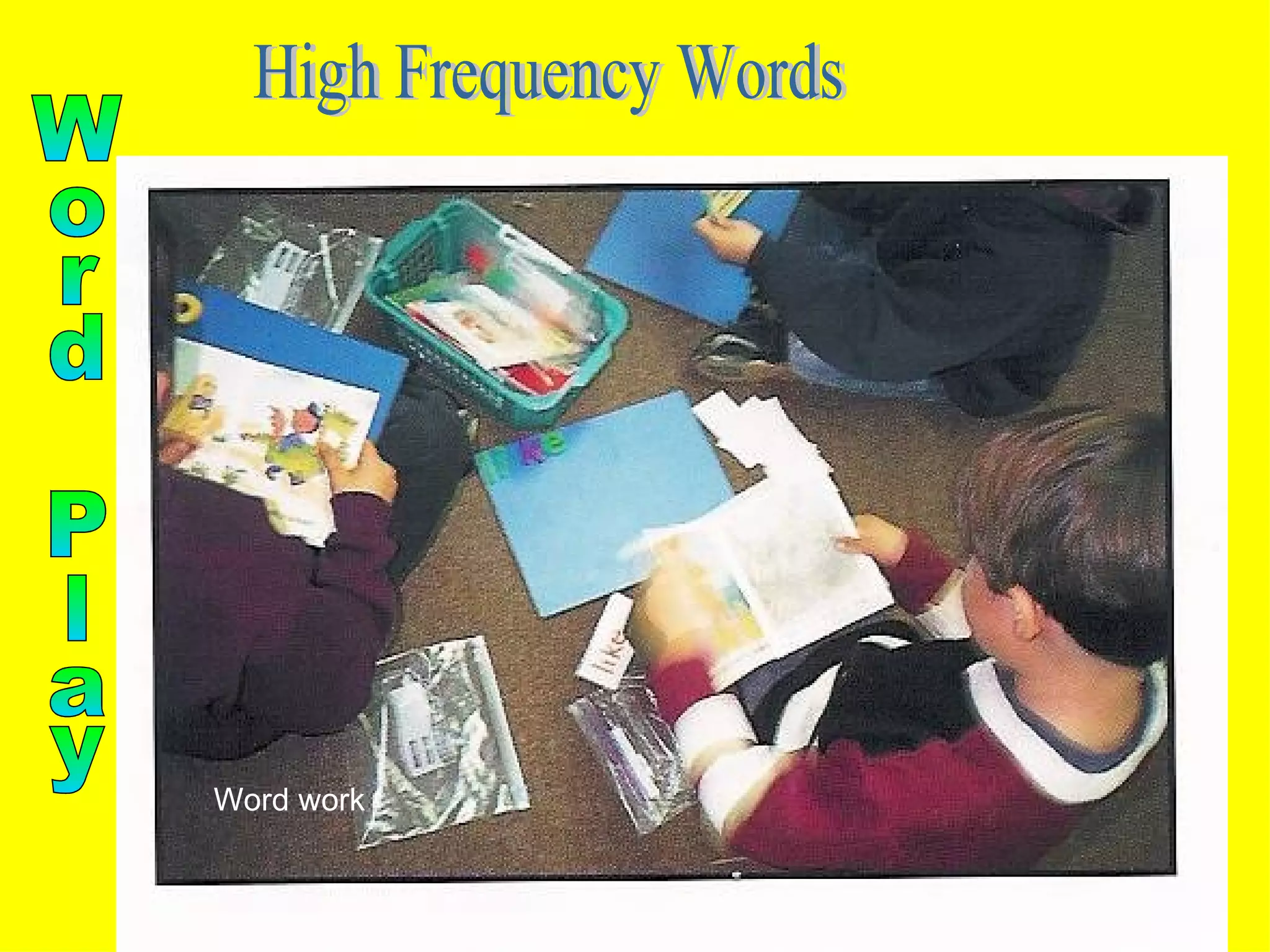
High Frequency Words Word Play Word work
Search and Tally Word Play Big book center
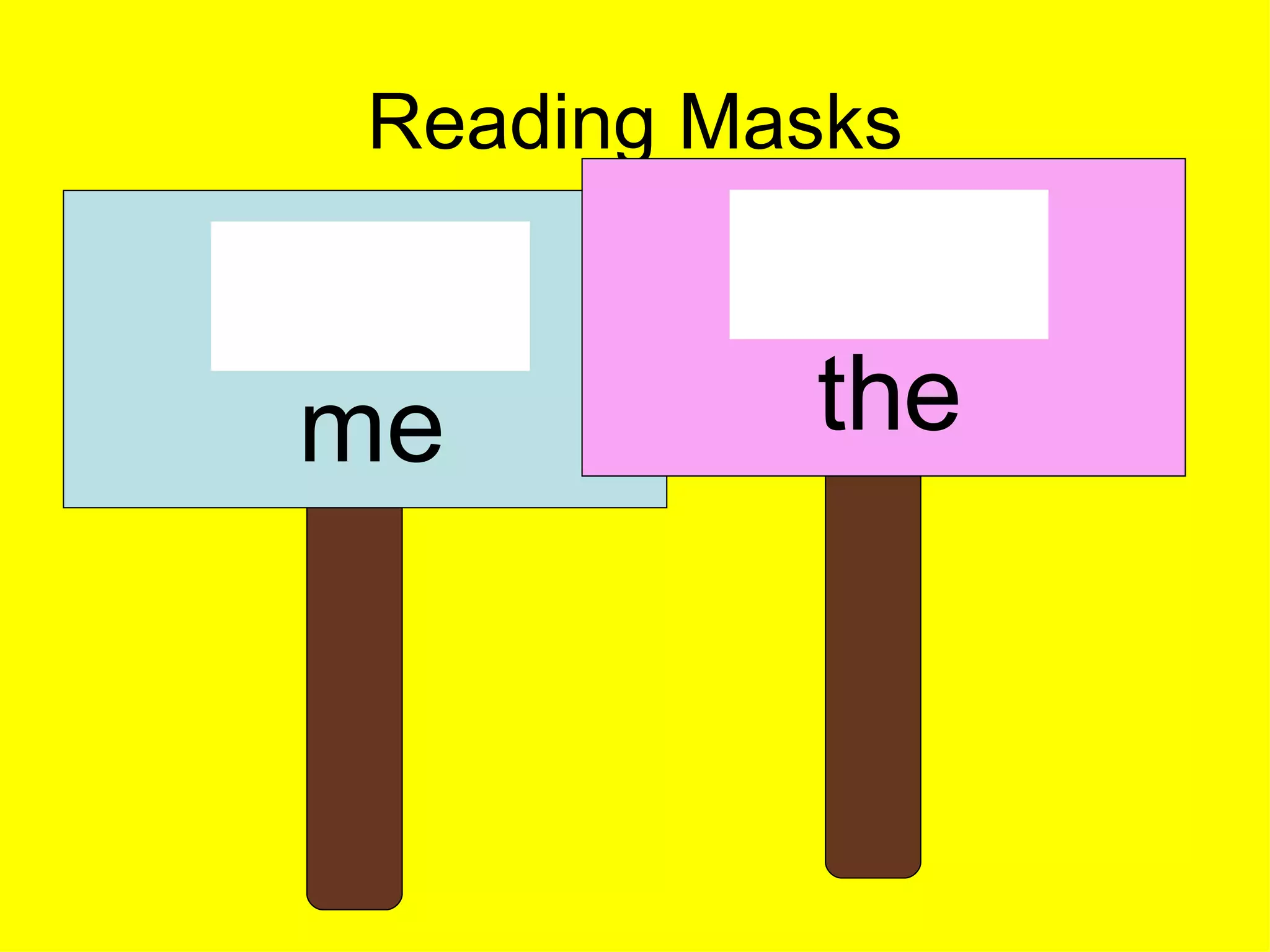
Reading Masks me the
Word Play Room Hunt
Word Hunts Students look for other words that follow patterns they are studying Provide newspaper for hunts Other sources include trade books, big books and environmental print They may record hunts in their word study notebooks
Sentence Book Match Sentence Play
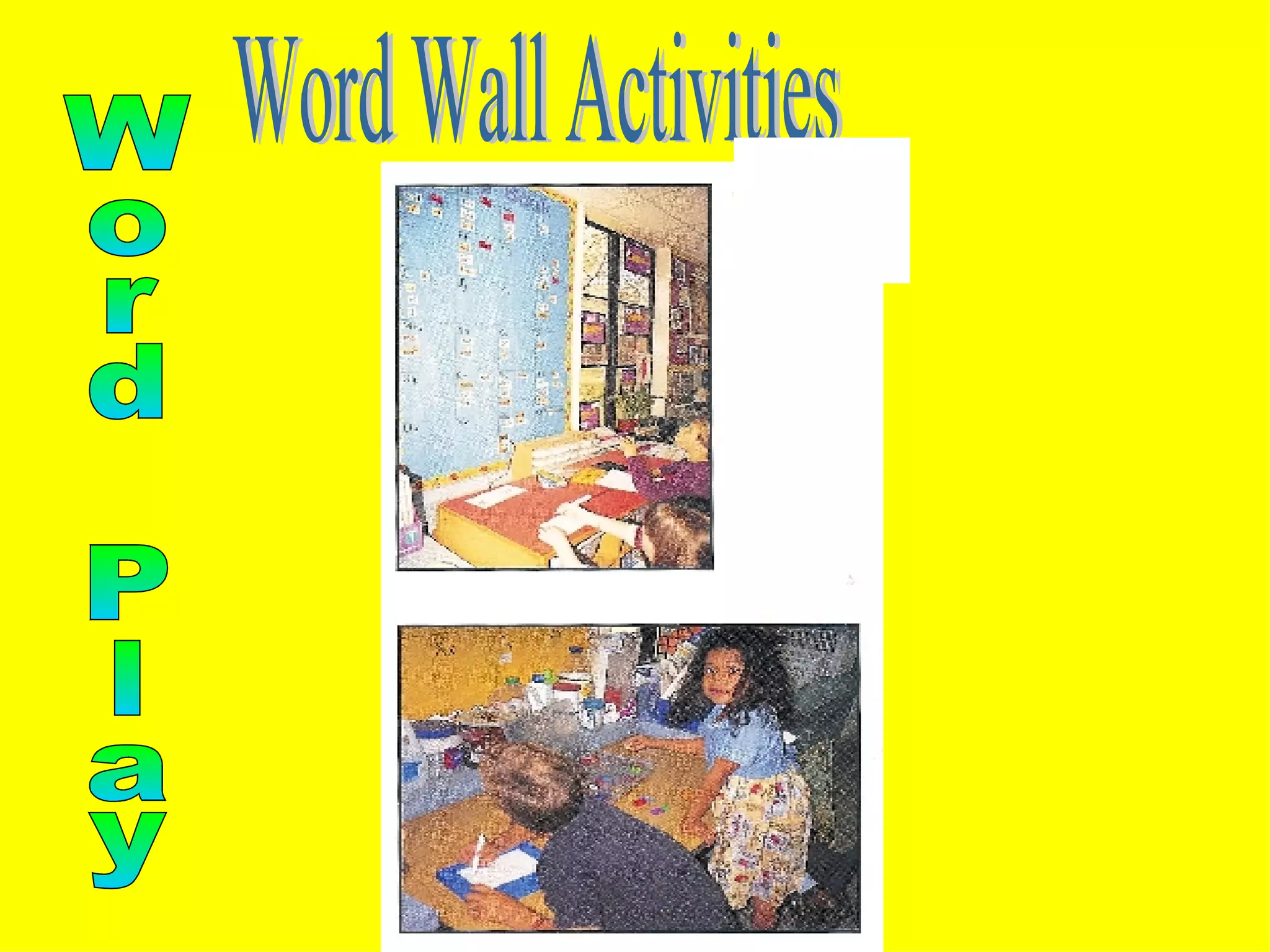
Word Play Word Wall Activities
Critical Attributes of a Word Wall In a position that is easy to see from anywhere in the  room Words printed in large easy to read letters Contains high-frequency and commonly misspelled words (content words and vocabulary should be somewhere else) Cut the shape of the word
A always about around
Ways to Make Your Word Wall Stand Out Use black bulletin board paper for the background Write the words on blank, white index cards with bold colors (Mr. Sketch or other bright markers) Put your alphabet letters in yellow or another bright color so they will stand out
Word Play Alphabetical Words
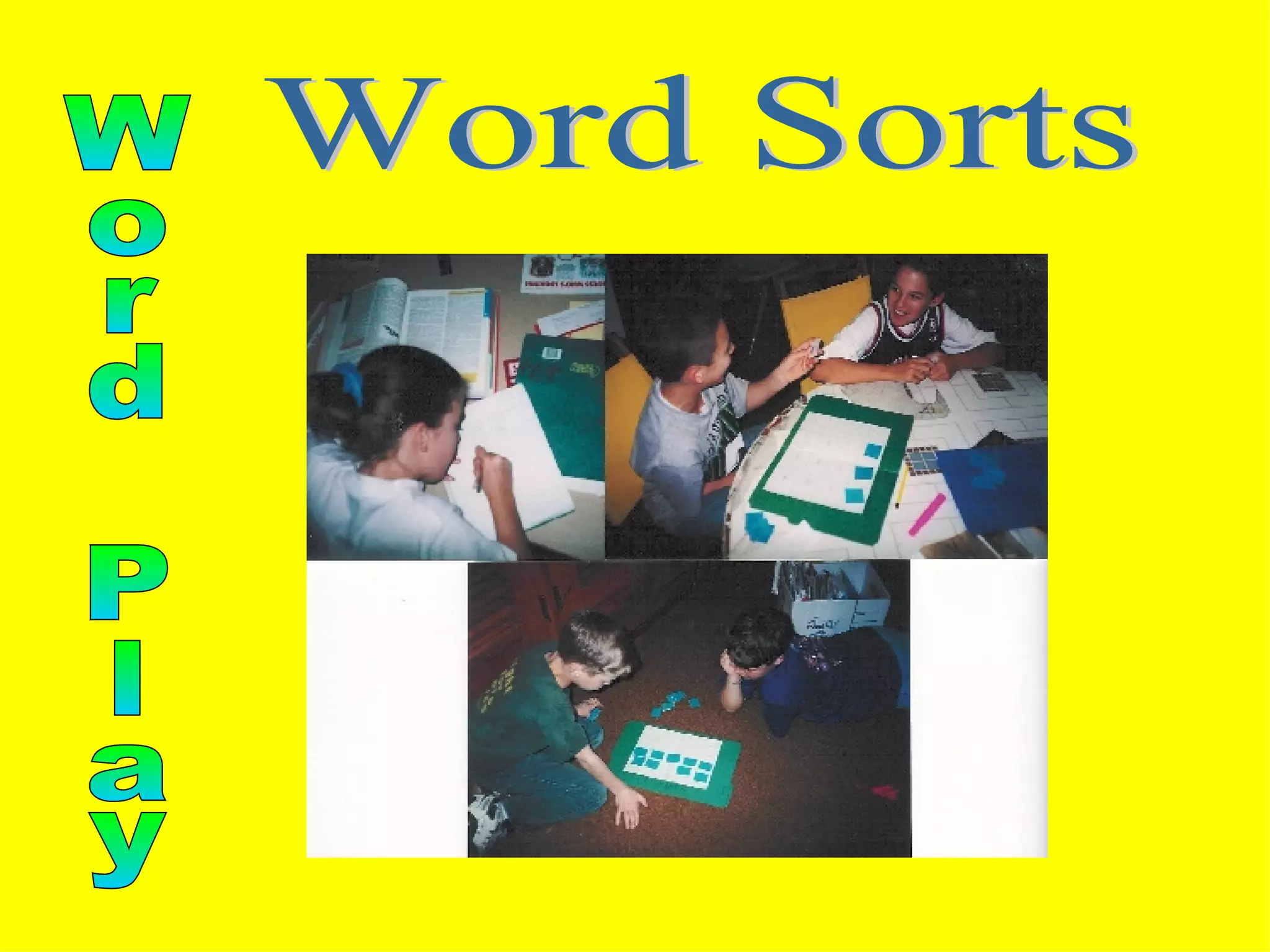
Word Play Word Sorts
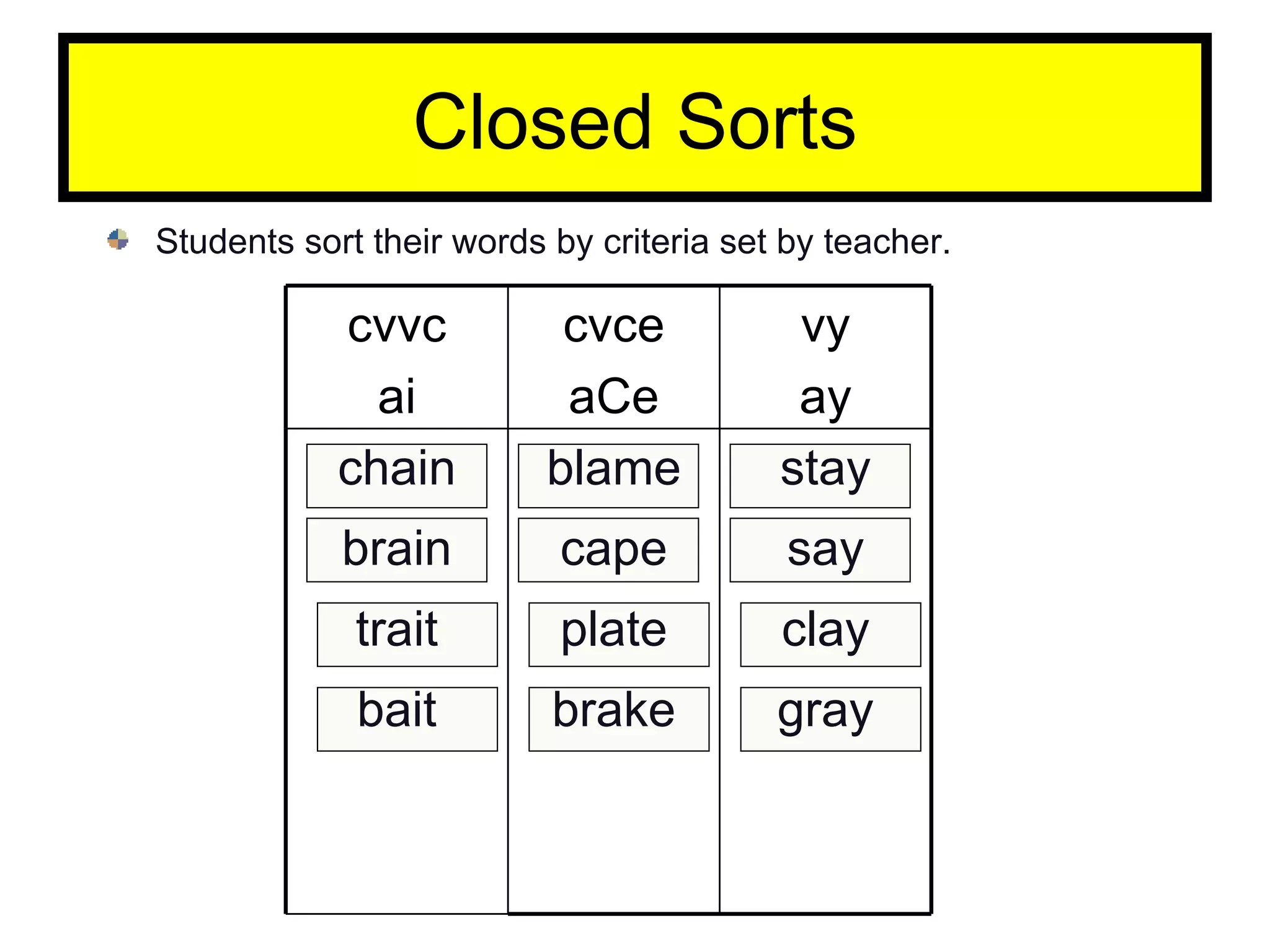
Closed Sorts Students sort their words by criteria set by teacher. gray brake bait clay plate trait say cape brain stay blame chain vy ay cvce aCe cvvc ai
Open Sorts Students work alone or in partners to sort their word cards into new categories.  Collected words from word banks can be used for this sort as well flake safe brain brake flake trait plate plate gray clay cake stay blame bake blends making a cake
Blind Sorts Blind sorts students are in pairs or small groups one students calls words that are hidden from other students other student(s) spells the word and places in the proper category according to pattern
Speed Sorts Speed sorts students sort word cards as quickly as possible may work in partners, small group or alone have timers available for those who like to time themselves this activity builds automaticity in recognizing word patterns
Other Activities Alphabet strips for alphabetizing words bingo boards where students look at a picture card and cover their boards  (blends, short vowels, long vowels, number of syllables, etc.) word building with cards that have onsets on one card and rimes on another
Materials for Word Work Name charts Alphabet charts Magnet Letters-different sizes, shapes, style Individual Letter Books Magna Doodle ABC stickers and pictures Pipe cleaners, wick sticks to form letters Letter and word tiles ABC Games and Songs Letter and word stamps Letter and Word Cards/pictures for sorting Word Games-Scrabble, Bongo White boards Magnetic Letters Wikki Sticks Clay Sandpaper Letter stamps Colored Markers
FOSTERING INDEPENDENCE WITH THE DAILY FIVE

  • 1.
    Presented byAngela Maiers Fostering Literacy Independence
  • 2.
    Teaching With PurposeHow is what I am having children do today creating powerful readers, writers, and thinkers for tomorrow?
  • 3.
    Modeled Instruction : Direct, Explicit Instruction Shared Instruction : “ Shared” Comprehension Guided Practice: Practice with my support Independence!! THE PATHWAY TOWARDS INDEPENDENCE
  • 4.
    Establishing a GatheringPlace Gathering kids in front for instruction, releasing them back to share their thinking represents the steady flow that’s at the heart of effective teaching and learning Harvey and Godvous, Strategies that Work (p.31)
  • 5.
  • 6.
  • 7.
    Modeled and SharedInstruction Time: Daily 10-15 minutes Focus: Comprehension! Strategy Work Genre and Author Awareness Fluency Word Solving in Context Whole Group
  • 8.
    Early Reading LessonsEarly Print Concepts-Book Handling Directionality One to One Matching Letter ID Letter, Word, Sentence Awareness Link of Sound/Symbol High Frequency Words Fluency Phrasing Reading Enjoyment Reading Cues (M, S, V) General Reading Behaviors
  • 9.
    Large Group MakeoverMaterials Friday Thursday Wednesday Tuesday Monday
  • 10.
  • 11.
  • 12.
  • 13.
    Specific Time 10-15 min DAILY Independent Level Real Reading CONFERENCE!!! Anytime Any Amount Any Book Any Behavior No Conference Independent Reading DEAR TIME/SSR
  • 14.
    Free Choice ReadingReading Center
  • 15.
    Three Ways toRead to Self Read and talk about the pictures Read the Words 3. Retell a book you know
  • 16.
  • 17.
  • 18.
  • 19.
  • 20.
    It is notenough to be busy, so are the ants. The question is: What are we busy about? Henry David Thoreau Independent Practice
  • 21.
    Independent Practice Whatdo we need them to get good at?
  • 22.
    You read toyourself You read to/with someone else You listen to reading You write You do word work The Daily Five
  • 23.
    You Read ToYourself
  • 24.
  • 25.
    I Ichoose a book P Purpose-Why do I want to read this? I Interest-Does it interest me? C Comprehend-Can I understand? K Know-I know most of the words I PICK
  • 26.
    The Shoe Lesson(adapted from The Daily Five: p.31)
  • 27.
  • 28.
  • 29.
    You read toyourself You read to/with someone else You listen to reading You write You do word work The Daily Five
  • 30.
    Read and Talkto Someone Buddy Reading Big Book Reading: “Say Something” Dramatic Retelling Story Sequencing Read the Room
  • 31.
  • 32.
    Big Book ReadingReading Center
  • 33.
  • 34.
  • 35.
    Read the RoomReading Center
  • 36.
    You read toyourself You read to/with someone else You listen to reading You write You do word work The Daily Five
  • 37.
  • 38.
  • 39.
    Listen and ReadYou could… Listen and Visualize/Sketch Listen and Retell Listen and Write Listen with a Partner-”Say Something” Listen and Respond Listen and Act Out Listen and Re-listen
  • 40.
    Materials for Listening Books on Tape (Fiction and Nonfiction) Poems on Tape Songs/Chants on Tape Guest Speakers Authors Reading Surprise Voices Individual Headphones Response Materials
  • 41.
    You read toyourself You read to/with someone else You listen to reading You write You do word work The Daily Five
  • 42.
  • 43.
  • 44.
  • 45.
    You read toyourself You read to/with someone else You listen to reading You write You do word work The Daily Five
  • 46.
    Word Work forGrades K-2 Learning the Letters Learning the Words Phonological Awareness TOGETHER: These lead to an understanding of the alphabetic principle ( the relationship between the letters and the sounds)
  • 47.
  • 48.
    Learning the LettersThe letter name The letter formation (physical movement) The sound the letter represents The sound the letter represents when it is located in a word with other letters The features of a letter that make it different from every other letter The direction that the letter must be turned in order to preserve the name(b,d,m,n,) Some letters are doubled in words Some letters appear often together There are different types of letters(cap,lc, cons, vowel)
  • 49.
  • 50.
    Letter Sorting ActivitiesLetter Play Practice with Names Overhead center Word Work Word Work Word Work
  • 51.
    Letter Play LetterFormation Alphabet Sequence Word work
  • 52.
    Letter Play ABCBooks and ABC Collage Word work
  • 53.
  • 54.
    Where To Begin? NAMES They are most personal. Children should learn their own names Names of everyone else in the class. Label cubbyholes. Use name cards. NAME CHART!
  • 55.
    Understanding Around NamesInclude: My name is a word A word is a sequence of letters that go together The letters in a word progress in a certain direction Words have meanings Words are written the same way every time Words are defined by white space ion either side Other words start/end like my name I can say a word and connect sounds to it Words can be put together to make a message Words have different meanings when put together with other words
  • 56.
    Name Chart Aarron Grayson Matt Rodney A lex Gabriel Marcus Rebecca A ndy Rachel Cameron Isabelle Octvious Steven Christi Ike Santana Deb Kathryn Peter William Dee Kaitlyn Pam Erin Lindsey Yvette Eric
  • 57.
    Write the students’first name (with last initial if two names are the same) on sentence strips. Let the students watch you write their names and have them spell their names if they can. Display the names in a pocket chart or other board. As you put the names up, comment on letters shared by certain students or other common features. Ask for volunteers to come and find a name they can read.” (Cunningham, 2000, pp.26-30) . Names: “ Getting to Know You ” Kristi
  • 58.
    High Frequency WordsWord Play Word work
  • 59.
    Search and TallyWord Play Big book center
  • 60.
  • 61.
  • 62.
    Word Hunts Studentslook for other words that follow patterns they are studying Provide newspaper for hunts Other sources include trade books, big books and environmental print They may record hunts in their word study notebooks
  • 63.
    Sentence Book MatchSentence Play
  • 64.
    Word Play WordWall Activities
  • 65.
    Critical Attributes ofa Word Wall In a position that is easy to see from anywhere in the room Words printed in large easy to read letters Contains high-frequency and commonly misspelled words (content words and vocabulary should be somewhere else) Cut the shape of the word
  • 66.
  • 67.
    Ways to MakeYour Word Wall Stand Out Use black bulletin board paper for the background Write the words on blank, white index cards with bold colors (Mr. Sketch or other bright markers) Put your alphabet letters in yellow or another bright color so they will stand out
  • 68.
  • 69.
  • 70.
    Closed Sorts Studentssort their words by criteria set by teacher. gray brake bait clay plate trait say cape brain stay blame chain vy ay cvce aCe cvvc ai
  • 71.
    Open Sorts Studentswork alone or in partners to sort their word cards into new categories. Collected words from word banks can be used for this sort as well flake safe brain brake flake trait plate plate gray clay cake stay blame bake blends making a cake
  • 72.
    Blind Sorts Blindsorts students are in pairs or small groups one students calls words that are hidden from other students other student(s) spells the word and places in the proper category according to pattern
  • 73.
    Speed Sorts Speedsorts students sort word cards as quickly as possible may work in partners, small group or alone have timers available for those who like to time themselves this activity builds automaticity in recognizing word patterns
  • 74.
    Other Activities Alphabetstrips for alphabetizing words bingo boards where students look at a picture card and cover their boards (blends, short vowels, long vowels, number of syllables, etc.) word building with cards that have onsets on one card and rimes on another
  • 75.
    Materials for WordWork Name charts Alphabet charts Magnet Letters-different sizes, shapes, style Individual Letter Books Magna Doodle ABC stickers and pictures Pipe cleaners, wick sticks to form letters Letter and word tiles ABC Games and Songs Letter and word stamps Letter and Word Cards/pictures for sorting Word Games-Scrabble, Bongo White boards Magnetic Letters Wikki Sticks Clay Sandpaper Letter stamps Colored Markers