Protocols and Standards
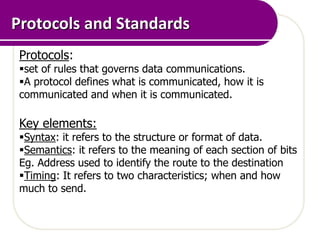
 Protocols:
 set of rules that governs data communications.
 A protocol defines what is communicated, how it is
 communicated and when it is communicated.

 Key elements:
 Syntax: it refers to the structure or format of data.
 Semantics: it refers to the meaning of each section of bits
 Eg. Address used to identify the route to the destination
 Timing: It refers to two characteristics; when and how
 much to send.
Standards

Standards:
• Provide guidelines to manufacturers.
Types of Standards:
• de facto [by fact]-Not approved by an organization but
  spreaded widely for use.
• de jure [by law]-Approved by an organization.
Standard organizations

• International Organization for Standardization (ISO)
• International Telecommunication Union-
  Telecommunication Standards (ITU-T)
• American National Standards Institute (ANSI)
• Institute of Electrical and Electronics Engineers
  (IEEE)
• Electronic Industries Association (EIA)
• International Engineering Task Force (IETF)
Standard organizations(contd.,)
• Internet Standards
   • Thoroughly tested specification
   • Strict procedure and must be followed.
• Internet draft
   • Working document with no official status
   • 6-month life time.
Transmission medium

 Transmission medium:
 • physical path between transmitter and receiver.
 • Carry the information from source to destination
Types of Transmission medium

2 Types of transmission medium are:
  • Guided media(wired) :
   provide a service from one device to another
   waves are guided along a physical path
   Eg., twisted pair, coaxial cable and optical fiber
  • Unguided media(wireless):
   Transport electromagnetic waves without Physical
    medium
   Eg., Radio waves, Microwave and Infra red
Guided media-Coaxial cable
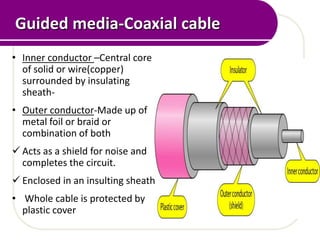
• Inner conductor –Central core
  of solid or wire(copper)
  surrounded by insulating
  sheath-
• Outer conductor-Made up of
  metal foil or braid or
  combination of both
 Acts as a shield for noise and
  completes the circuit.
 Enclosed in an insulting sheath
• Whole cable is protected by
  plastic cover
Coaxial cable standards

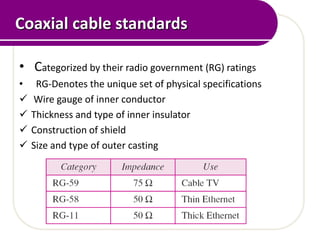
• Categorized by their radio government (RG) ratings
•    RG-Denotes the unique set of physical specifications
   Wire gauge of inner conductor
   Thickness and type of inner insulator
   Construction of shield
   Size and type of outer casting
Coaxial cable connectors

•   For connecting coaxial cables to devices
•   Commonly used connector-BNC(Bayone-Neill-Concelman)
•   Three types of connectors are:
    BNC connector
    BNC T Connector
    BNC terminator
Types

•  BNC connector-Connect the end of the cable to the devices.
  Eg.TV set
• BNC T Connector-To branch out to a connection to a
  computer or other device. Eg. Ethernet networks.
• BNC Terminator-Used at the end of the cable to prevent the
  reflection of signal.
Performance
•   Attenuation is higher
• Higher bandwidth
• Signal weakens rapidly and requires frequent use of
  repeaters.
Applications

 • Used in Analog telephone networks-Carry 10,000 voice
   signals.
 • In digital telephone networks-Carry digital data upto
   600Mbps.
 • Cable TV networks.
 • Traditional Ethernet LANs
 • Used in thin and thick Ethernet.
  10Base-2(Thin Ethernet)-Uses RG-58
  10BAse5(Thick Ethernet-Uses RG-11
Fibre optic cable

•   Fiber-optic cable transmit signals in the form of light.
• Made up of Glass or Plastic
• Optical fibre uses reflection to guide light through a channel
• Glass or Plastic core is surrounded by Cladding(Dense Glass or
  Plastic)
Bending of light rays
•  I-Angle the ray makes with the line perpendicular to the
  interface between 2 substances
• If the angle of incidence I is less than the critical angle, the ray
  refracts and moves closer to the surface.
• If the angle of incidence is equal to the critical angle, the light
  bends along the interface.
• If the angle is greater than the critical angle, the ray reflects
  and travels again in the denser substance.
Propagation modes
Types of Multimode
Multimode step-index fiber
• Density of the core remains constant from the center to the edges.
• Beam of light moves in a straight line -Reaches the interface of the
core and the cladding.
• Light beam changes the direction at the interface between the core
and cladding
•Step index -suddenness of this change, which contributes to the
distortion of the signal

Multimode graded-index fiber
• Core Density decreases with distance from the center
• Results in carving of light beams.
Multimode fibres
Single mode fibre

 • Uses step index fibre
 • Carries light pulses along single path

  Fibre types
Cable Composition
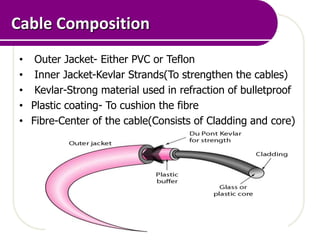
• Outer Jacket- Either PVC or Teflon
• Inner Jacket-Kevlar Strands(To strengthen the cables)
• Kevlar-Strong material used in refraction of bulletproof
• Plastic coating- To cushion the fibre
• Fibre-Center of the cable(Consists of Cladding and core)
Fibre optic cable connectors
• Three types of connectors:
 SC connector(Subscriber channel)-Uses push/pull
  locking system. Eg. Cable TV
 ST connector(Straight-Tip)-Used for connecting cables to
  Networking devices. More reliable than SC
 MT-RJ connector-Same as coaxial cable connector.
Performance

•   Attenuation is flatter than coaxial cable
• Need fewer repeaters.
Applications

• Often found in backbone networks
• cost-effective.
• With wavelength-division multiplexing (WDM), we can
transfer data at a rate of 1600 Gbps.
Advantages and Disadvantages

Advantages:
 Higher bandwidth.
 Less signal attenuation.
 Immunity to electromagnetic interference.
 Resistance to corrosive materials.
 Light weight.
 Greater immunity to tapping.
Disadvantages:
 Installation and maintenance
 Unidirectional light propagation
 Cost.

Protocol

  • 1.
    Protocols and Standards Protocols: set of rules that governs data communications. A protocol defines what is communicated, how it is communicated and when it is communicated. Key elements: Syntax: it refers to the structure or format of data. Semantics: it refers to the meaning of each section of bits Eg. Address used to identify the route to the destination Timing: It refers to two characteristics; when and how much to send.
  • 2.
    Standards Standards: • Provide guidelinesto manufacturers. Types of Standards: • de facto [by fact]-Not approved by an organization but spreaded widely for use. • de jure [by law]-Approved by an organization.
  • 3.
    Standard organizations • InternationalOrganization for Standardization (ISO) • International Telecommunication Union- Telecommunication Standards (ITU-T) • American National Standards Institute (ANSI) • Institute of Electrical and Electronics Engineers (IEEE) • Electronic Industries Association (EIA) • International Engineering Task Force (IETF)
  • 4.
    Standard organizations(contd.,) • InternetStandards • Thoroughly tested specification • Strict procedure and must be followed. • Internet draft • Working document with no official status • 6-month life time.
  • 5.
    Transmission medium Transmissionmedium: • physical path between transmitter and receiver. • Carry the information from source to destination
  • 6.
  • 7.
    Types of Transmissionmedium 2 Types of transmission medium are: • Guided media(wired) :  provide a service from one device to another  waves are guided along a physical path  Eg., twisted pair, coaxial cable and optical fiber • Unguided media(wireless):  Transport electromagnetic waves without Physical medium  Eg., Radio waves, Microwave and Infra red
  • 8.
    Guided media-Coaxial cable •Inner conductor –Central core of solid or wire(copper) surrounded by insulating sheath- • Outer conductor-Made up of metal foil or braid or combination of both  Acts as a shield for noise and completes the circuit.  Enclosed in an insulting sheath • Whole cable is protected by plastic cover
  • 9.
    Coaxial cable standards •Categorized by their radio government (RG) ratings • RG-Denotes the unique set of physical specifications  Wire gauge of inner conductor  Thickness and type of inner insulator  Construction of shield  Size and type of outer casting
  • 10.
    Coaxial cable connectors • For connecting coaxial cables to devices • Commonly used connector-BNC(Bayone-Neill-Concelman) • Three types of connectors are:  BNC connector  BNC T Connector  BNC terminator
  • 11.
    Types • BNCconnector-Connect the end of the cable to the devices. Eg.TV set • BNC T Connector-To branch out to a connection to a computer or other device. Eg. Ethernet networks. • BNC Terminator-Used at the end of the cable to prevent the reflection of signal.
  • 12.
    Performance • Attenuation is higher • Higher bandwidth • Signal weakens rapidly and requires frequent use of repeaters.
  • 13.
    Applications • Usedin Analog telephone networks-Carry 10,000 voice signals. • In digital telephone networks-Carry digital data upto 600Mbps. • Cable TV networks. • Traditional Ethernet LANs • Used in thin and thick Ethernet.  10Base-2(Thin Ethernet)-Uses RG-58  10BAse5(Thick Ethernet-Uses RG-11
  • 14.
    Fibre optic cable • Fiber-optic cable transmit signals in the form of light. • Made up of Glass or Plastic • Optical fibre uses reflection to guide light through a channel • Glass or Plastic core is surrounded by Cladding(Dense Glass or Plastic)
  • 15.
    Bending of lightrays • I-Angle the ray makes with the line perpendicular to the interface between 2 substances • If the angle of incidence I is less than the critical angle, the ray refracts and moves closer to the surface. • If the angle of incidence is equal to the critical angle, the light bends along the interface. • If the angle is greater than the critical angle, the ray reflects and travels again in the denser substance.
  • 16.
  • 17.
    Types of Multimode Multimodestep-index fiber • Density of the core remains constant from the center to the edges. • Beam of light moves in a straight line -Reaches the interface of the core and the cladding. • Light beam changes the direction at the interface between the core and cladding •Step index -suddenness of this change, which contributes to the distortion of the signal Multimode graded-index fiber • Core Density decreases with distance from the center • Results in carving of light beams.
  • 18.
  • 19.
    Single mode fibre • Uses step index fibre • Carries light pulses along single path  Fibre types
  • 20.
    Cable Composition • OuterJacket- Either PVC or Teflon • Inner Jacket-Kevlar Strands(To strengthen the cables) • Kevlar-Strong material used in refraction of bulletproof • Plastic coating- To cushion the fibre • Fibre-Center of the cable(Consists of Cladding and core)
  • 21.
    Fibre optic cableconnectors • Three types of connectors:  SC connector(Subscriber channel)-Uses push/pull locking system. Eg. Cable TV  ST connector(Straight-Tip)-Used for connecting cables to Networking devices. More reliable than SC  MT-RJ connector-Same as coaxial cable connector.
  • 22.
    Performance • Attenuation is flatter than coaxial cable • Need fewer repeaters.
  • 23.
    Applications • Often foundin backbone networks • cost-effective. • With wavelength-division multiplexing (WDM), we can transfer data at a rate of 1600 Gbps.
  • 24.
    Advantages and Disadvantages Advantages: Higher bandwidth.  Less signal attenuation.  Immunity to electromagnetic interference.  Resistance to corrosive materials.  Light weight.  Greater immunity to tapping. Disadvantages:  Installation and maintenance  Unidirectional light propagation  Cost.