TABLE OF CONTENTS
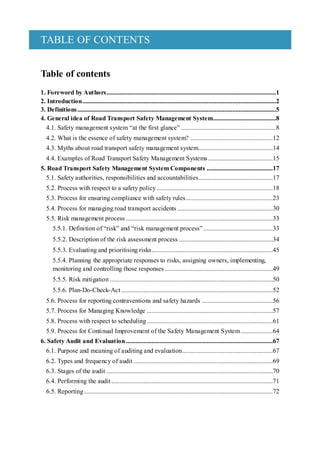
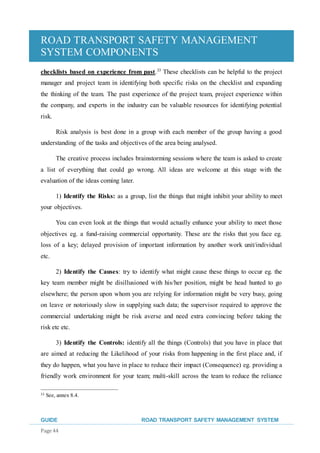
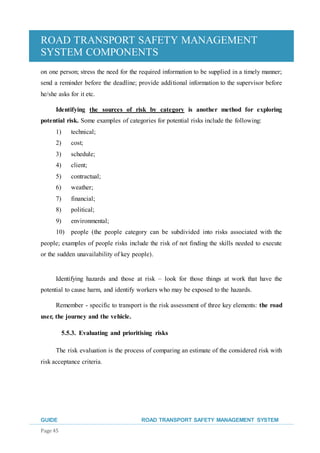
Table of contents
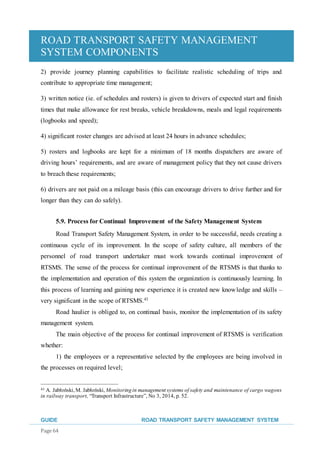
1. Foreword by Authors.........................................................................................................1
2. Introduction........................................................................................................................2
3. Definitions...........................................................................................................................5
4. General idea of Road Transport Safety Management System.......................................8
4.1. Safety management system “at the first glance” ...........................................................8
4.2. What is the essence of safety management system? ...................................................12
4.3. Myths about road transport safety management system..............................................14
4.4. Examples of Road Transport Safety Management Systems ........................................15
5. Road Transport Safety Management System Components .........................................17
5.1. Safety authorities, responsibilities and accountabilities..............................................17
5.2. Process with respect to a safety policy........................................................................18
5.3. Process for ensuring compliance with safety rules......................................................23
5.4. Process for managing road transport accidents ...........................................................30
5.5. Risk management process ...........................................................................................33
5.5.1. Definition of “risk” and “risk management process” ...........................................33
5.5.2. Description of the risk assessment process ..........................................................34
5.5.3. Evaluating and prioritising risks...........................................................................45
5.5.4. Planning the appropriate responses to risks, assigning owners, implementing,
monitoring and controlling those responses...................................................................49
5.5.5. Risk mitigation .....................................................................................................50
5.5.6. Plan-Do-Check-Act..............................................................................................52
5.6. Process for reporting contraventions and safety hazards ............................................56
5.7. Process for Managing Knowledge ..............................................................................57
5.8. Process with respect to scheduling..............................................................................61
5.9. Process for Continual Improvement of the Safety Management System....................64
6. Safety Audit and Evaluation...........................................................................................67
6.1. Purpose and meaning of auditing and evaluation........................................................67
6.2. Types and frequency of audit ......................................................................................69
6.3. Stages of the audit .......................................................................................................70
6.4. Performing the audit....................................................................................................71
6.5. Reporting.....................................................................................................................72
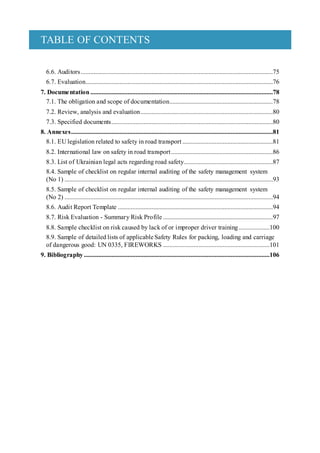
TABLE OF CONTENTS
6.6. Auditors.......................................................................................................................75
6.7. Evaluation....................................................................................................................76
7. Documentation .................................................................................................................78
7.1. The obligation and scope of documentation................................................................78
7.2. Review, analysis and evaluation..................................................................................80
7.3. Specified documents....................................................................................................80
8. Annexes.............................................................................................................................81
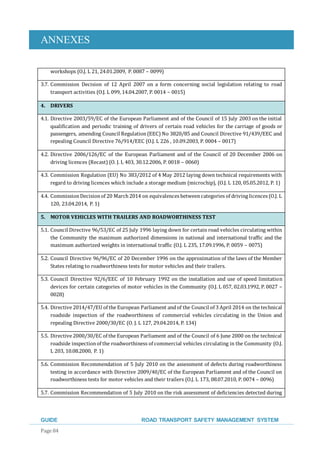
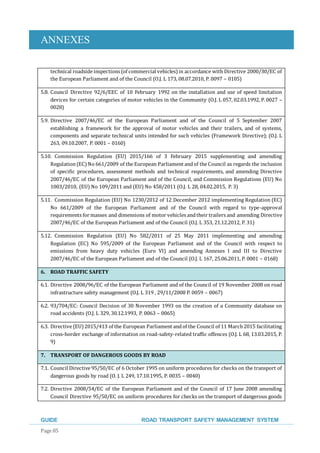
8.1. EU legislation related to safety in road transport ........................................................81
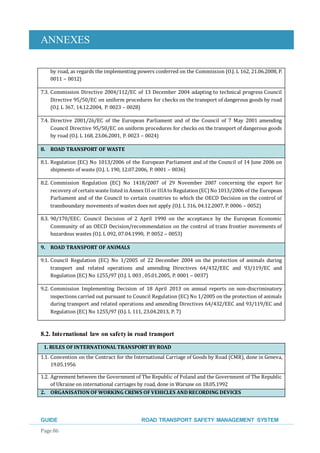
8.2. International law on safety in road transport...............................................................86
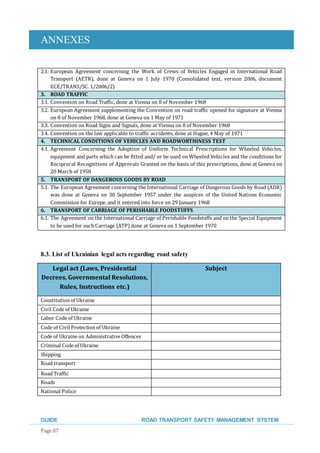
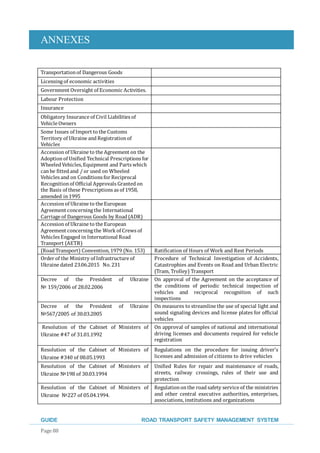
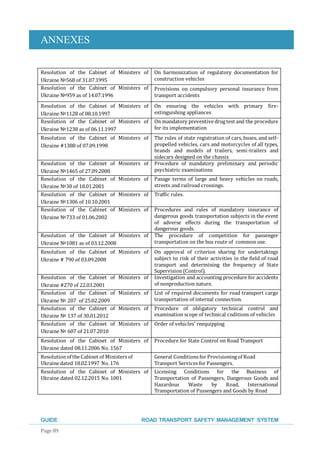
8.3. List of Ukrainian legal acts regarding road safety.......................................................87
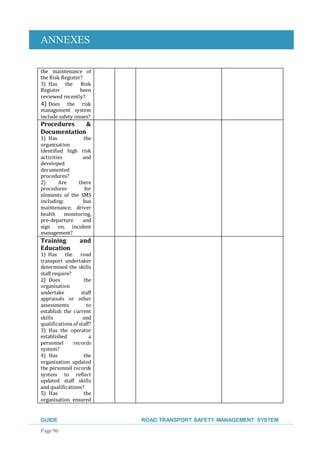
8.4. Sample of checklist on regular internal auditing of the safety management system
(No 1) .................................................................................................................................93
8.5. Sample of checklist on regular internal auditing of the safety management system
(No 2) .................................................................................................................................94
8.6. Audit Report Template ................................................................................................94
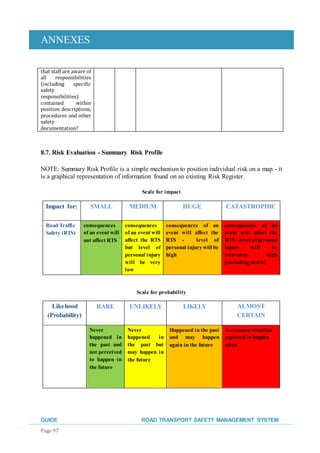
8.7. Risk Evaluation - Summary Risk Profile ....................................................................97
8.8. Sample checklist on risk caused by lack of or improper driver training ...................100
8.9. Sample of detailed lists of applicable Safety Rules for packing, loading and carriage
of dangerous good: UN 0335, FIREWORKS ..................................................................101
9. Bibliography ...................................................................................................................106
FOREWORD BY AUTHORS
GUIDE ROAD TRANSPORT SAFETY MANAGEMENT SYSTEM
Page 1
1. Foreword by Authors
This Guide has been elaborated within the European Union Twinning Project
“Support to the Ministry of Infrastructure of Ukraine in Strengthening of Safety Standards of
Commercial Road Transport (number UA/14/ENP/TR/43) by the group of Polish experts.
There were few professional study visits, organized for detailed discussions of several
strategies and options in Kyiv, Ukraine, regarding the Safety Management Systems (SMS) in
road transport.
The Experts would like to emphasize significant engagement and involvement of
Ukrainian Authorities (the Ministry of Infrastructure Representatives) in specifying and
formulating detailed amendments and requirements of the Beneficiary. It was very helpful in
the work of the Experts and allowed to prepare and propose options in this Guide fully
accepted by the Beneficiary – as fulfilling its all expectations in the area of SMS in road
transport. Based on full and open cooperation and collaboration with the Beneficiary the
Experts are looking forward for implementation of the Guide concept which will serve the
main goal – improvement of the road safety in Ukraine.
INTRODUCTION
GUIDE ROAD TRANSPORT SAFETY MANAGEMENT SYSTEM
Page 2
2. Introduction
Improving road safety is a global concern and increasingly becoming a top priority for
societies. Approximately 1.25 million people die each year as a result of road traffic crashes,
according to the World Health Organization's Global status report on road safety 2015,
despite improvements in road safety. The Sustainable Development Goals, adopted by the
United Nations General Assembly, include a target of 50% reduction in road traffic deaths
and injuries by 2020.1
Road transport undertakings are an essential area, which have got the significant
influence on improving road safety.
It must be underlined that there are worked out a variety of organizational,
technological and transport systems management standards, but mostly in maritime and then
rail and air sectors. However the road transport generates the greatest social costs, including
the costs of road accidents, the costs of environmental impacts and the congestion costs. One
1 World Health Organization, Global Status Report on Road Safety. Summary, 2015, p. 1. Full report is
available at: http://www.who.int/violence_injury_prevention/road_safety_status/2015/en/.
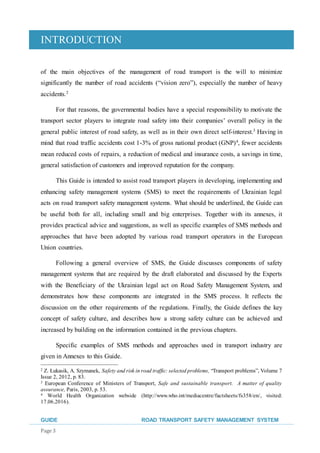
Improving global road safety according to the United Nations
„Noting that road traffic injuries are a major public health and development
problem that has a broadrange of social and economic consequences which,if
unaddressed,may affect the sustainable development of countries and hinder
progress towards the Millennium Development Goals.”
(General Assembly,Sixty-eighth session, 2014)
INTRODUCTION
GUIDE ROAD TRANSPORT SAFETY MANAGEMENT SYSTEM
Page 3
of the main objectives of the management of road transport is the will to minimize
significantly the number of road accidents (“vision zero”), especially the number of heavy
accidents.2
For that reasons, the governmental bodies have a special responsibility to motivate the
transport sector players to integrate road safety into their companies’ overall policy in the
general public interest of road safety, as well as in their own direct self-interest.3
Having in
mind that road traffic accidents cost 1-3% of gross national product (GNP)4
, fewer accidents
mean reduced costs of repairs, a reduction of medical and insurance costs, a savings in time,
general satisfaction of customers and improved reputation for the company.
This Guide is intended to assist road transport players in developing, implementing and
enhancing safety management systems (SMS) to meet the requirements of Ukrainian legal
acts on road transport safety management systems. What should be underlined, the Guide can
be useful both for all, including small and big enterprises. Together with its annexes, it
provides practical advice and suggestions, as well as specific examples of SMS methods and
approaches that have been adopted by various road transport operators in the European
Union countries.
Following a general overview of SMS, the Guide discusses components of safety
management systems that are required by the draft elaborated and discussed by the Experts
with the Beneficiary of the Ukrainian legal act on Road Safety Management System, and
demonstrates how these components are integrated in the SMS process. It reflects the
discussion on the other requirements of the regulations. Finally, the Guide defines the key
concept of safety culture, and describes how a strong safety culture can be achieved and
increased by building on the information contained in the previous chapters.
Specific examples of SMS methods and approaches used in transport industry are
given in Annexes to this Guide.
2 Z. Łukasik, A. Szymanek, Safety and risk in road traffic: selected problems, “Transport problems”, Volume 7
Issue 2, 2012, p. 83.
3 European Conference of Ministers of Transport, Safe and sustainable transport. A matter of quality
assurance, Paris, 2003, p. 53.
4 World Health Organization webside (http://www.who.int/mediacentre/factsheets/fs358/en/, visited:
17.06.2016).
INTRODUCTION
GUIDE ROAD TRANSPORT SAFETY MANAGEMENT SYSTEM
Page 4
Main objectives
Addressees
The purpose of this guide, inter alia, is to:
promote a common understanding of, and approach to, SMS in road transport
companies in Ukraine
establish organizational practices that should be followed by road transport operators,
drivers and other interested parties
provide knowledge bases for conducting RTSMS, especially risk assessments and
evaluating risk management options related to road safety
set the doctrinal bases for and organizational safety culture through consistent
application and training on RTSMS principles and practices
educate and inform road transport stakeholders in application of RTSMS.
The principal receivers of this guide are:
road transport operators
transport planners
fleet managers
occupational health and safety inspectors
human resources managers
road safety managers
drivers
other personnel of the road transport operators (for instance, road transport
managers)
cooperators and customers of road transport operators
control bodies in the scope of road transport and other enforcement bodies
auditors
certification bodies.
DEFINITIONS
GUIDE ROAD TRANSPORT SAFETY MANAGEMENT SYSTEM
Page 5
3. Definitions
Term Definition
Actors all parties which are, directly or through
contractual arrangements, involved in the
application of this regulation
audit systematic, independent and documented process
(3.27) for obtaining audit evidence (3.4) and
evaluating it objectively to determine the extent to
which the audit criteria (3.3) are fulfilled
(according to DSTU/ISO)5
Interfaces all points of interaction during a system or
subsystem life cycle, including operation and
maintenance where different actors of the road
transport sector will work together in order to
manage the risks
hazard a condition that could lead to an accident
hazard identification the process of finding, listing and characterising
hazards
hazard record the document in which identified hazards, their
related measures, their origin and reference to the
organisation, which has to manage them are
recorded and referenced
Risk the frequency of occurrence of accidents and
incidents resulting in harm (caused by
a hazard) and the degree of severity of that harm6
5 An audit can be an internal audit (first party) or an external audit (second party or third party), and it can be a
combined audit (combining two or more disciplines). “Audit evidence" and "audit criteria" are defined in ISO
19011.
6 Note, an effect is a deviation from the expected — positive or negative. Uncertainty is the state, even partial,
of deficiencyof informationrelatedto, understanding or knowledge of, an event, its consequence or likelihood.
Risk is often characterized by reference to potential events (as defined in ISO Guide 73:2009, 3.5.1.3) and
DEFINITIONS
GUIDE ROAD TRANSPORT SAFETY MANAGEMENT SYSTEM
Page 6
risk analysis systematic use of all available information to
identify hazards and to estimate the risk
risk assessment the overall process comprising a risk analysis and a
risk evaluation
risk management the systematic application of management policies,
procedures and practices to the tasks of analysing,
evaluating and controlling risks
risk evaluation a procedure based on the risk analysis to determine
whether an acceptable level of risk has been
achieved
road haulier an economic entity that has a license to conduct
economic activity on services rendering of
transportation of passengers and (or) cargoes by
road7
safety freedom from unacceptable risk of harm
safety management
system
a structured and documented system of
interconnected and interacting elements of a road
haulier, an economic entity maintaining vehicles in
terms of traffic safety management in order to
establish policy, objectives and respective
processes of these objectives’ attainment8
consequences (as defined in ISO Guide 73:2009, 3.6.1.3), or a combination of these. In this International
Standard, RTS-related risk refers to crashes (events) and death and serious injuries (consequences). Risk is
oftenexpressedinterms of acombinationof the consequences of anevent (including changes in circumstances)
and the associated likelihood (as defined in ISO Guide 73:2009, 3.6.1.1) of occurrence.
7 According to the draft Law “On Amendments to Some Legislative Acts in the Field of Road Transport to
Harmonize them with EU legislation” road haulier means the entity that holds the vehicles shall develop,
implement, support and improve Road Traffic Safety Management System within enterprise in accordance to
the requirements of the Provisions on Road Traffic Safety Management System of Wheeled Vehicles,
methodological recommendations onits development and implementation, international and national standards.
8 According to the draft Law “On Amendments to Some Legislative Acts in the Field of Road Transport to
Harmonize them with EU legislation” (article 34-36) Road Traffic Safety Management System of Wheeled
Vehicles is establishedto prevent accidents, reduce the heaviness of their consequences andto minimize related
economic losses. Provisions on Road Traffic Safety Management System of Wheeled Vehicles and
methodological recommendations on its development and implementation are approved by central public
authority that ensures formation of state policy in the transport field with the concurrence of the Ministry of
Internal Affairs.
DEFINITIONS
GUIDE ROAD TRANSPORT SAFETY MANAGEMENT SYSTEM
Page 7
safety measures a set of actions either reducing the frequency of
occurrence of a hazard or mitigating its
consequences in order to achieve and/or maintain
an acceptable level of risk
safety requirements the safety characteristics (qualitative or
quantitative) of a system and its operation
(including operational rules) and maintenance
necessary in order to meet legal or company safety
targets
safety rules all rules containing road transport safety
requirements established by applicable legal acts,
as well as regulatory and technical documentation,
the fulfillment of which ensures safety of road
transport
GENERAL IDEA OF ROAD TRANSPORT SAFETY
MANAGEMENT SYSTEM
GUIDE ROAD TRANSPORT SAFETY MANAGEMENT SYSTEM
Page 8
4. General idea of Road Transport Safety Management
System
4.1. Safetymanagement system “at the first glance”
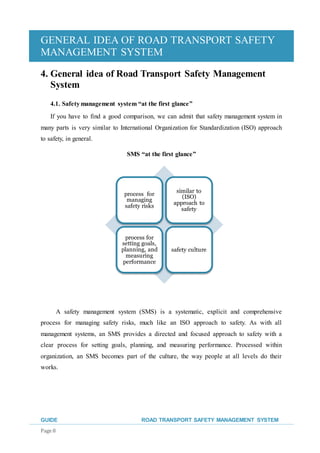
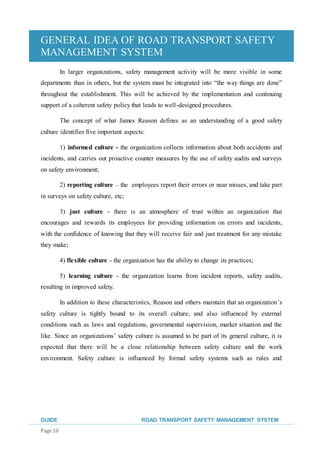
If you have to find a good comparison, we can admit that safety management system in
many parts is very similar to International Organization for Standardization (ISO) approach
to safety, in general.
SMS “at the first glance”
A safety management system (SMS) is a systematic, explicit and comprehensive
process for managing safety risks, much like an ISO approach to safety. As with all
management systems, an SMS provides a directed and focused approach to safety with a
clear process for setting goals, planning, and measuring performance. Processed within
organization, an SMS becomes part of the culture, the way people at all levels do their
works.
process for
managing
safety risks
similar to
(ISO)
approach to
safety
process for
setting goals,
planning, and
measuring
performance
safety culture
GENERAL IDEA OF ROAD TRANSPORT SAFETY
MANAGEMENT SYSTEM
GUIDE ROAD TRANSPORT SAFETY MANAGEMENT SYSTEM
Page 9
The organizational structures and activities that achieve an efficient safety management
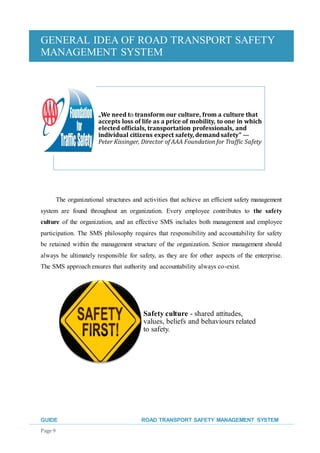
system are found throughout an organization. Every employee contributes to the safety
culture of the organization, and an effective SMS includes both management and employee
participation. The SMS philosophy requires that responsibility and accountability for safety
be retained within the management structure of the organization. Senior management should
always be ultimately responsible for safety, as they are for other aspects of the enterprise.
The SMS approach ensures that authority and accountability always co-exist.
„We need to transform our culture, from a culture that
accepts loss of life as a price of mobility, to one in which
elected officials, transportation professionals, and
individual citizens expect safety, demand safety” —
Peter Kissinger, Director of AAA Foundation for Traffic Safety
Safety culture - shared attitudes,
values, beliefs and behaviours related
to safety.
GENERAL IDEA OF ROAD TRANSPORT SAFETY
MANAGEMENT SYSTEM
GUIDE ROAD TRANSPORT SAFETY MANAGEMENT SYSTEM
Page 10
In larger organizations, safety management activity will be more visible in some
departments than in others, but the system must be integrated into “the way things are done”
throughout the establishment. This will be achieved by the implementation and continuing
support of a coherent safety policy that leads to well-designed procedures.
The concept of what James Reason defines as an understanding of a good safety
culture identifies five important aspects:
1) informed culture - the organization collects information about both accidents and
incidents, and carries out proactive counter measures by the use of safety audits and surveys
on safety environment;
2) reporting culture – the employees report their errors or near misses, and take part
in surveys on safety culture, etc;
3) just culture - there is an atmosphere of trust within an organization that
encourages and rewards its employees for providing information on errors and incidents,
with the confidence of knowing that they will receive fair and just treatment for any mistake
they make;
4) flexible culture - the organization has the ability to change its practices;
5) learning culture - the organization learns from incident reports, safety audits,
resulting in improved safety.
In addition to these characteristics, Reason and others maintain that an organization’s
safety culture is tightly bound to its overall culture, and also influenced by external
conditions such as laws and regulations, governmental supervision, market situation and the
like. Since an organizations’ safety culture is assumed to be part of its general culture, it is
expected that there will be a close relationship between safety culture and the work
environment. Safety culture is influenced by formal safety systems such as rules and
GENERAL IDEA OF ROAD TRANSPORT SAFETY
MANAGEMENT SYSTEM
GUIDE ROAD TRANSPORT SAFETY MANAGEMENT SYSTEM
Page 11
procedures within an organization. Additionally, the safety culture effects on the attitude and
behaviour of employees towards safety, which is reflected in their safety records.9
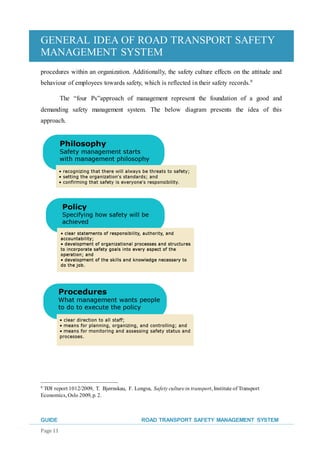
The “four Ps”approach of management represent the foundation of a good and
demanding safety management system. The below diagram presents the idea of this
approach.
9 TØI report 1012/2009, T. Bjørnskau, F. Longva, Safety culturein transport, Institute of Transport
Economics, Oslo 2009, p. 2.
GENERAL IDEA OF ROAD TRANSPORT SAFETY
MANAGEMENT SYSTEM
GUIDE ROAD TRANSPORT SAFETY MANAGEMENT SYSTEM
Page 12
4.2. What is the essence of safetymanagement system?
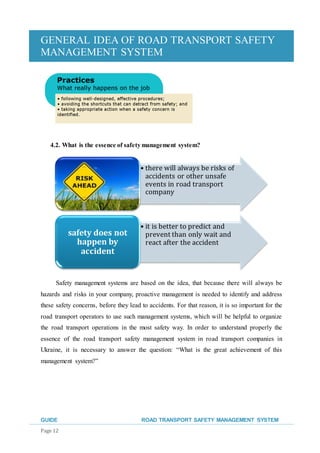
Safety management systems are based on the idea, that because there will always be
hazards and risks in your company, proactive management is needed to identify and address
these safety concerns, before they lead to accidents. For that reason, it is so important for the
road transport operators to use such management systems, which will be helpful to organize
the road transport operations in the most safety way. In order to understand properly the
essence of the road transport safety management system in road transport companies in
Ukraine, it is necessary to answer the question: “What is the great achievement of this
management system?”
• there will always be risks of
accidents or other unsafe
events in road transport
company
• it is better to predict and
prevent than only wait and
react after the accident
safety does not
happen by
accident
GENERAL IDEA OF ROAD TRANSPORT SAFETY
MANAGEMENT SYSTEM
GUIDE ROAD TRANSPORT SAFETY MANAGEMENT SYSTEM
Page 13
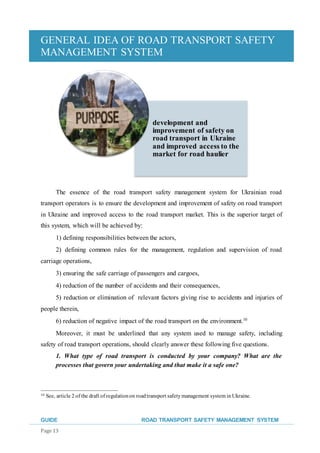
The essence of the road transport safety management system for Ukrainian road
transport operators is to ensure the development and improvement of safety on road transport
in Ukraine and improved access to the road transport market. This is the superior target of
this system, which will be achieved by:
1) defining responsibilities between the actors,
2) defining common rules for the management, regulation and supervision of road
carriage operations,
3) ensuring the safe carriage of passengers and cargoes,
4) reduction of the number of accidents and their consequences,
5) reduction or elimination of relevant factors giving rise to accidents and injuries of
people therein,
6) reduction of negative impact of the road transport on the environment.10
Moreover, it must be underlined that any system used to manage safety, including
safety of road transport operations, should clearly answer these following five questions.
1. What type of road transport is conducted by your company? What are the
processes that govern your undertaking and that make it a safe one?
10 See, article 2 of the draft of regulationon roadtransport safetymanagement system in Ukraine.
development and
improvement of safety on
road transport in Ukraine
and improved access to the
market for road haulier
GENERAL IDEA OF ROAD TRANSPORT SAFETY
MANAGEMENT SYSTEM
GUIDE ROAD TRANSPORT SAFETY MANAGEMENT SYSTEM
Page 14
2. What could go wrong? What are the safety issues or concerns, the hazards, and
the incidents or accidents that happened or could happen?
3. How bad is it? What are the causes, the sources, the probabilities and the
severities of those negative events?
4. What can be done about it? What corrective actions, controls or moderation
measures can be developed and implemented?
5. How effective are corrective actions? Has the situation been resolved?
4.3. Myths about road transport safetymanagement system
Safety Management System in road transport should not be comprehended as:
a) “de-regulation” - the Ukrainian legislation on road transport safety management do
not eliminate existing regulatory requirements and all legal provisions, which have
got the influence on safety of road carriages, both passengers and cargo; reasonably,
the legislation on road transport SMS act as an umbrella requirement, enabling road
transport undertakers to better meet the existing requirements of the rules, regulations
and standards;
b) “self-regulation” - the road transport SMS regulations will came into effect under
the Provision on Road Traffic Safety Management System. As such, Ukrainian
supervision authorities have the mandate to monitor compliance with the regulations
as it does with any legislated requirement. While the regulations put the responsibility
on the road transport companies to proactively demonstrate their management of
safety, the public services oversee compliance with the regulations.
c) “eliminating inspections” - inspections are an important component of the
enforcement of road transport legislation, and they continue to be used as part of the
assessment of SMS in road transport undertakings, or as a separate inaccuracy
activity.
d) “eliminating corrective action” - companies are required to comply with the road
transport SMS regulations as with all regulatory obligations. This includes the
GENERAL IDEA OF ROAD TRANSPORT SAFETY
MANAGEMENT SYSTEM
GUIDE ROAD TRANSPORT SAFETY MANAGEMENT SYSTEM
Page 15
requirement for road transport to take corrective actions for any safety concerns and
incidents of non-compliance identified by the regulator.
4.4. Examples of Road Transport Safety Management Systems
EXAMPLES OF ROAD TRANSPORT SAFETY MANAGEMENT SYSTEMS
1) The management of occupational road risk (MORR) is a key topic in road
safety, with broad agreement in the literature that injuries and deaths sustained from work-
related driving represent a substantial public health problem, as well as being a priority for
occupational health.
A risk management cycle within MORR has been proposed to manage work-related
road safety by the Royal Society for the Prevention of Accidents (RoSPA). The cycle is
suggested to incorporate continuous improvement for occupational road risk. An initial status
review is undertaken to develop an understanding of the current performance and collision
risk associated with the organisation. Recommendations are developed through this
consultation period to reduce the number of collisions and associated costs for the
organisation. A management system approach considers a proactive rather than reactive
approach to managing risks.
2) ISO Standard 39001:2012 on Road Traffic Safety Management System - is an
international standard designed to help vehicle fleet operators and others such as national
governments adopt a structured and holistic approach to managing the risk of death and
serious injury from road traffic. ISO 39001 „specifies requirements to enable an
organization, that interacts with the road traffic system, to reduce death and serious injuries
related to road traffic crashes which it can influence” ( ISO 39001 - 1 scope).
It contains a list of road traffic safety factors, which every company must analyse in
order to assess risks, before coming up with targets and deciding on action plans. The road
traffic safety factors include the areas of safe: roads, road users, safe drivers and emergency
planning.
The guiding principles according to ISO 39001:2012 are:
minimizing high risk,
GENERAL IDEA OF ROAD TRANSPORT SAFETY
MANAGEMENT SYSTEM
GUIDE ROAD TRANSPORT SAFETY MANAGEMENT SYSTEM
Page 16
minimizing numbers of risks,
minimizing serious consequences,
adhering to statutory requirements and customer requirements.
Regarding the size of the road transport undertaking, ISO 39001 is the universal
standard. It means that number of vehicles own by the entity or number of drivers should not
have the crucial influence on the safety management according to the general rules set in ISO
39001. This standard is also applicable to public and private organizations, interacting with
road traffic.
DSTU ISO 39001:2015 “Road Traffic Safety Management Systems”. Requirements
and Guideline for Use (ISO 39001:2012, IDT), approved by the Order of SC “UkrNDNC” of
the Ministry of Economic Development and Trade of Ukraine. Standard entered into force on
01.01.2016. Road Traffic Safety Management System is based on the ISO 39001 standard.
ROAD TRANSPORT SAFETY MANAGEMENT
SYSTEM COMPONENTS
GUIDE ROAD TRANSPORT SAFETY MANAGEMENT SYSTEM
Page 17
5. Road Transport Safety Management System
Components
5.1. Safetyauthorities, responsibilities and accountabilities
Effective safety management systems in road transport companies are possible to
achieve only under the supervision of state institutions. Road safety is the shared
responsibility of diverse disciplines and stakeholders. Activity of the road transport
undertakers should be coordinated by all possible bodies of extends. Additionally, Road
Transport Safety Management System, according to the necessity of integration of safety
management systems of different modes of transport, might be recognized as a part of
completed integrated transport safety management system of transport. For that reason,
organizational structure of authorities responsible for supervision and enforcement of road
transport safety management system in companies might consist of the following elements:
1) coordinative – one institution on state level which coordinates activities of all
other institutions in road transport safety management system;
2) essential – some state Ukrainian service for transport safety responsible for
inspections, instructed and coordinated by the Minister. Such inspection authority
might develop and implement a Supervision Strategy and plan outlining how it
targets its activities and sets its priorities for supervision;
3) cooperative - numerous institutions outside the road transport with basic and
supportive roles, for example: Police, National Fire Guard, institutions of crisis
management, institutions of medical care, research institutions;
4) operative - controlled and authorised by safety authorities; carriers, forwarders,
senders, receivers, undertakers conducting road carriages on their own purposes,
producers of road transport vehicles.
ROAD TRANSPORT SAFETY MANAGEMENT
SYSTEM COMPONENTS
GUIDE ROAD TRANSPORT SAFETY MANAGEMENT SYSTEM
Page 18
5.2. Process with respect to a safetypolicy
Written Road Transport Safety Policy is a necessary element of road traffic safety
management system. It should in particular:
- demonstrate top management commitment to promoting road transport safety,
including importance of complying with all safety rules and other requirements;
- introduce the strategic objective of implementing road traffic safety management
system;
- set the measurable, realistically achievable road traffic safety performance targets;
- be communicated to all employees and to other stakeholders (e.g., customers,
contractors, the public);
- be annually reviewed and revised;
- be approved at the highest possible level within the company.
Commitment is demonstrated visibly, when top management communicates clearly that
road transport safety matters are an important company requirement and allocates necessary
resources to related safety issues. There is a strong correlation between companies with low
number of road traffic crashes and companies whose top management is seen to be
concerned with road transport safety and communicates this concern to employees and other
stakeholders. That is why Road Transport Safety Policy should demonstrate an overall top
management commitment to promoting road transport safety, so far as is reasonably
practicable. Policy statement should highlight the importance of complying with safety rules
and give a clear and motivating message that road traffic crashes are avoidable.
Road Transport Safety Policy should also introduce the strategic objective of
implementing road traffic safety management system, which is reducing the risk of road
traffic crashes resulting in death, serious injury or damage to the environment. While the
ultimate objective is to eliminate road traffic crashes, it is very important and useful to set the
road traffic safety performance targets against which continual progress toward the ultimate
strategic objective can be measured. Road traffic safety performance target shall be relevant
with the activities of company, operational and business requirements, and the views of
employees, contractors, and customers. Road traffic safety performance target shall be also
measurable, meaningful and realistically achievable. In most cases, performance targets
ROAD TRANSPORT SAFETY MANAGEMENT
SYSTEM COMPONENTS
GUIDE ROAD TRANSPORT SAFETY MANAGEMENT SYSTEM
Page 19
would refer to the safety elements for: drivers, transport units, transport operation or
contractors.
Road Transport Safety Policy should be publicly available for all employees and other
stakeholders in clear to be understood language and format. Carrier must ensure that any
changes to the Safety Policy are communicated in the proper manner.
Road Transport Safety Policy should be annually reviewed and revised, taking into
consideration in particular the increase or decrease in:
- the number of road traffic crashes involving company vehicles;
- the number of road traffic incidents involving company vehicles, that could lead to a
road traffic crashes;
- the number of legal penalties imposed for the infringements, which relates to road
transport safety matters;
- financial costs associated with vehicle use (the costs of repairs, maintenance and
insurance).
Road Transport Safety Policy should be approved at the highest possible level within
the company and can be linked with other documents, for example lists setting out safety
roles, responsibilities and relationships of employees who manage, perform or verify work
affecting road transport safety.
Status review questionnaire for ensuring compliance
with respect to a Safety Policy
1) Does the Road haulier Safety Policy function in the company as separate descriptive
document?
2) Is the safety policy document appropriate to the type and extent of activity of Road
haulier?
3) Is the Safety Policy documentation approved and signed by the highest possible level
within the company?
ROAD TRANSPORT SAFETY MANAGEMENT
SYSTEM COMPONENTS
GUIDE ROAD TRANSPORT SAFETY MANAGEMENT SYSTEM
Page 20
4) Is the Safety Policy document communicated and made available to all staff?
5) Is there the document that confirms that safety policy is reviewed annually?
SAMPLE OF SAFETY POLICY FOR DANGEROUS GOODS TRANSPORT
COMPANY
Driving related incidents are the single largest cause of road traffic crashes
among…(organization name)…and top management accepts it has a responsibility to
manage the risk encountered by its employees when they use the road as part of their duties
for the organization.
The..(organization name)…will take all steps to ensure complying with all safety rules and
other requirements and will do all it can to meet strategic objective, which is reducing the
risk of road traffic crashes resulting in death, serious injury or damage to the environment.
We believe that this can be achieved by establishing measurable and realistically achievable
road traffic safety targets for Company’s: DRIVERS, TRANSPORT UNITS, JOURNEYS
AND CONTRACTORS.
The …(organisation name)… will ensures that:
ALL COMPANY’S DRIVERS:
do not operate a vehicle unless they are fit and appropriately rested;
do not operate a vehicle while under the influence of alcohol, drugs or any other
substance or medicationthat could impair their ability to safely operate the vehicle;
use safe driving speed, also considering traffic and weather conditions;
use seatbelts at all times the vehicle is in motion;
holds, can read and understand writing instructions as an aid during an accident
ROAD TRANSPORT SAFETY MANAGEMENT
SYSTEM COMPONENTS
GUIDE ROAD TRANSPORT SAFETY MANAGEMENT SYSTEM
Page 21
emergency situation that may occur or arise during carriage of dangerous goods;
holds the appropriate class of license for the vehicles, ADR TRAINING
CERTIFICATE and are familiar with laws and regulations concerning driving
safety rules;
wear high-visibility clothing when working directly outside or adjacent to moving
vehicles;
do not accept passengers in transport units carrying dangerous goods;
received additional training based on risk assessment for carriage of high
consequence dangerous goods;
reports to a manager of any accident emergency situation that may occur or arise
during carriage of dangerous goods.
ALL COMPANY’S VEHICLES OR TANKS:
are safely secured withinthe weight limits specified by the vehicle manufacturer or
within the national legal limit if more restrictive;
have valid ADR certificate of approval and deadline for the next test for tanks has
not expired;
are selected for the carriage of dangerous goods, taking into account type and
equipment, including devices to facilitate securing and handling of the dangerous
goods;
are in a roadworthy condition and are regularly assessed as part of a planned
maintenance program;
ROAD TRANSPORT SAFETY MANAGEMENT
SYSTEM COMPONENTS
GUIDE ROAD TRANSPORT SAFETY MANAGEMENT SYSTEM
Page 22
are routinely checked and inspected(the pre-start checks are carried out before the
journey begins);
are equipped withVehicle Monitoring System when carrying high consequence
dangerous goods;
are equipped with seat belts for each occupant.
ALL COMPANY’S JOURNEYS:
are clearly defined and mapped taking into consideration safety rules and risk
location on regular routes;
are monitored by appropriate means of communication between journey manager
and driver;
are monitored by Vehicle Monitoring System when carrying high consequence
dangerous goods.
ALL COMPANY’S CONTRACTORS:
hand over for carriage only consignments which conform to the requirements of
ADR;
have in place Dangerous Goods Safety Advisor, who is responsible for monitoring
compliance with all requirements governing the carriage of dangerous goods;
have in place competent employees, which use only packagings approved for and
suited to the carriage and comply with the special requirements concerning
marking and labelling of the packages and loading and handling of dangerous
goods.
ROAD TRANSPORT SAFETY MANAGEMENT
SYSTEM COMPONENTS
GUIDE ROAD TRANSPORT SAFETY MANAGEMENT SYSTEM
Page 23
Safety roles, responsibilities and relationships of all organizational units and all classes of
employees who manage road transport operations are defined in document “Process for
Managing Knowledge”.
Safety Policy will be reviewed and revised annually to reflect changing conditions and all
relevant for safety information.
Safety Policy will be communicated to all persons working for and on behalf of the
organization.
This document was approved by Accountable Executive of ..(organization name)… in
October 2015.
5.3. Process for ensuring compliance with safetyrules
Safety Rules means all rules containing road transport safety requirements, established
by applicable legal acts, as well as regulatory and technical documentation, the fulfillment of
which ensures safety of road transport. This term can cover both national, international or
European Union Legislation, as well as the national standards (for instance, ISO 39001:2012
–National Standard of Ukraine (DSTU) “Road Traffic Safety Management (RTS)
Requirements and Guidelines for Use”).
Compliance with safety rules is not an option. Road haulier must identify and
understand the applicable safety rules and must implement a system of controls to achieve
compliance with them.
The helpful list of EU legislation related to road transport is presented in Annexes
(item 8.1) and the list of international law on road safety is enclosed as annex 8.2
The annex 8.3 encloses the list of Ukrainian relevant legislation.
SMS should contain Process for Ensuring Compliance with legal provisions relating to road
transport safety to:
- identify, gather and list relevant Safety Rules;
- reviewing and updating the list of Safety Rules;
- ensuring compliance with these Safety Rules;
ROAD TRANSPORT SAFETY MANAGEMENT
SYSTEM COMPONENTS
GUIDE ROAD TRANSPORT SAFETY MANAGEMENT SYSTEM
Page 24
- verifying compliance with Safety Rules, reporting the results of such evaluations and
making recommendations.
Status Review Questionnaire for Ensuring Compliance with Safety Rules.
1. Is there the document describing the list of safety rules consistent with type and
extent of activity of Road haulier?
2. Is there the appropriate procedure of updating relevant safety rules to reflect changes
made to them?
3. Is there the appropriate procedure of monitoring compliance with relevant safety
rules?
4. Is there the appropriate procedure of taking actions when infringement of relevant
safety rule is identified?
SAMPLE OF LISTS OF APPLICABLE SAFETY RULES FROM BEST PRACTICE
GUIDELINES FOR SAFE (UN)LOADING OF ROAD FREIGHT VEHICLES OF THE
EUROPEAN CHEMICAL INDUSTRY COUNCIL
The legislation is divided into different parts:
1) health and safety,
2) process safety,
3) environment,
4) transport.
1.1. Risks
Risk Assessment (Art. 6 § 2)
Optimise work/workers environment (Art. 6 § 3)
Health and safety coordination (Art. 6 § 4)
1.2. First aid, fire- fighting, evacuation, serious and imminent danger
ROAD TRANSPORT SAFETY MANAGEMENT
SYSTEM COMPONENTS
GUIDE ROAD TRANSPORT SAFETY MANAGEMENT SYSTEM
Page 25
First aid organisation (Art. 8 § 1 & 2)
Information and instructions (Art 8 § 3 & 4)
Incidents & accidents
Information and reporting system (Art. 9)
1.3. Worker information
Own workers and/or their representatives (Art. 10 § 1)
Employers from outside undertakings (Art. 10 § 2)
1.4. Training & specific instructions
Own workers (Art. 12 § 1)
Workers from outside undertakings (Art. 12 § 2)
2.1. Fire Safety
Fire safety Directive
ATEX Explosive Atmospheres Atex 118a; Dir_1999_92
2.2. Equipment requirements
Safety in Pressure Vessels EN 13445 (97/23/EC)
Machine directive 2006/42/EC
CE marking 93/68/EC
Design of Installations different standards
3.1. Emissions to air, soil and water
ROAD TRANSPORT SAFETY MANAGEMENT
SYSTEM COMPONENTS
GUIDE ROAD TRANSPORT SAFETY MANAGEMENT SYSTEM
Page 26
Directive 2010/75/EC (Integrated pollution prevention control - IPPC)
Directive 2008/50/EC (Air Pollution)
National Air Emission legislation
Proposal for a Soil Framework Directive (COM(2006) 231)
National Soil pollution legislation
Water Framework Directive 2000/60/EC
National Water pollution legislation
3.2. Waste Control
2008 EU Waste Framework Directive
National Legislation on Waste Control
3.3. Noise Control
Environmental Noise Directive 2002/49/EC
National Legislation on Noise Control
4.1. General transport legislation
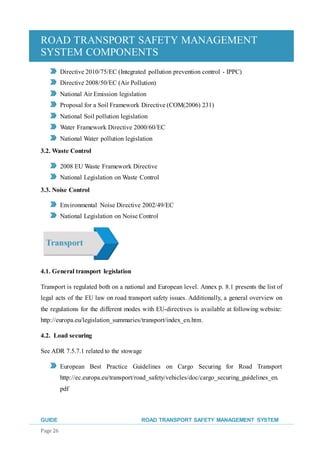
Transport is regulated both on a national and European level. Annex p. 8.1 presents the list of
legal acts of the EU law on road transport safety issues. Additionally, a general overview on
the regulations for the different modes with EU-directives is available at following website:
http://europa.eu/legislation_summaries/transport/index_en.htm.
4.2. Load securing
See ADR 7.5.7.1 related to the stowage
European Best Practice Guidelines on Cargo Securing for Road Transport
http://ec.europa.eu/transport/road_safety/vehicles/doc/cargo_securing_guidelines_en.
pdf
ROAD TRANSPORT SAFETY MANAGEMENT
SYSTEM COMPONENTS
GUIDE ROAD TRANSPORT SAFETY MANAGEMENT SYSTEM
Page 27
The requirements of paragraph 7.5.7.1 of ADR are deemed to be complied with if the
cargo is secured in accordance with standard EN 12195-1:2010
4.3. For class 2 receptacles:
Load securing of class 2 receptacles – IGC Doc 52/06/E
http://www.mobilit.fgov.be/data/route/adr/Doc_52_06_E.pdf
4.4. European Agreement concerning the International Carriage of Dangerous Goods
by Road. Responsibilities of the parties involved:
See ADR 1.4 : Safety obligations of the participants
Packing and Tank requirements
Part 4: Packing and tank provisions – use.
Part 6: Requirements for the construction and testing of packagings, intermediate
bulk container (IBCs), large packagings, tanks and bulk containers.
Provisions concerning the conditions of (…) unloading and handling.
See, ADR chapter 7.
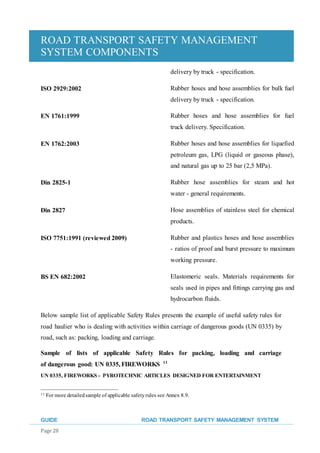
Standards - many standards are applicable to (un)loading operations. Below a non-
comprehensive list is given:
Standard Description
EN 12115:2011 Rubber and thermoplastics hoses and hose
assemblies for liquid or gaseous chemicals.
Specification (British standard).
ISO/DIS 5772 Rubber and plastic hoses and hose assemblies
for measured fuel dispensing systems -
specification 40.00 ISO/TC 45/SC 1
ISO 5772:1998 Rubber hoses and hose assemblies for
measured fuel dispensing - specification
ISO/DIS 2929 Rubber hoses and hose assemblies for bulk fuel
ROAD TRANSPORT SAFETY MANAGEMENT
SYSTEM COMPONENTS
GUIDE ROAD TRANSPORT SAFETY MANAGEMENT SYSTEM
Page 28
delivery by truck - specification.
ISO 2929:2002 Rubber hoses and hose assemblies for bulk fuel
delivery by truck - specification.
EN 1761:1999 Rubber hoses and hose assemblies for fuel
truck delivery. Specification.
EN 1762:2003 Rubber hoses and hose assemblies for liquefied
petroleum gas, LPG (liquid or gaseous phase),
and natural gas up to 25 bar (2,5 MPa).
Din 2825-1 Rubber hose assemblies for steam and hot
water - general requirements.
Din 2827 Hose assemblies of stainless steel for chemical
products.
ISO 7751:1991 (reviewed 2009) Rubber and plastics hoses and hose assemblies
- ratios of proof and burst pressure to maximum
working pressure.
BS EN 682:2002 Elastomeric seals. Materials requirements for
seals used in pipes and fittings carrying gas and
hydrocarbon fluids.
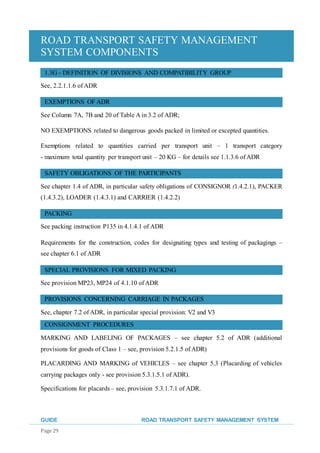
Below sample list of applicable Safety Rules presents the example of useful safety rules for
road haulier who is dealing with activities within carriage of dangerous goods (UN 0335) by
road, such as: packing, loading and carriage.
Sample of lists of applicable Safety Rules for packing, loading and carriage
of dangerous good: UN 0335, FIREWORKS 11
UN 0335, FIREWORKS - PYROTECHNIC ARTICLES DESIGNED FOR ENTERTAINMENT
11 For more detailedsample of applicable safetyrules see Annex 8.9.
ROAD TRANSPORT SAFETY MANAGEMENT
SYSTEM COMPONENTS
GUIDE ROAD TRANSPORT SAFETY MANAGEMENT SYSTEM
Page 29
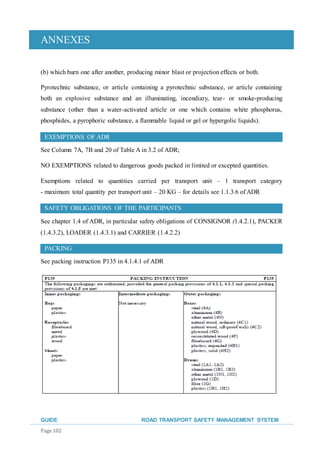
1.3G - DEFINITION OF DIVISIONS AND COMPATIBILITY GROUP
See, 2.2.1.1.6 of ADR
EXEMPTIONS OF ADR
See Column 7A, 7B and 20 of Table A in 3.2 of ADR;
NO EXEMPTIONS related to dangerous goods packed in limited or excepted quantities.
Exemptions related to quantities carried per transport unit – 1 transport category
- maximum total quantity per transport unit – 20 KG – for details see 1.1.3.6 of ADR
SAFETY OBLIGATIONS OF THE PARTICIPANTS
See chapter 1.4 of ADR, in particular safety obligations of CONSIGNOR (1.4.2.1), PACKER
(1.4.3.2), LOADER (1.4.3.1) and CARRIER (1.4.2.2)
PACKING
See packing instruction P135 in 4.1.4.1 of ADR
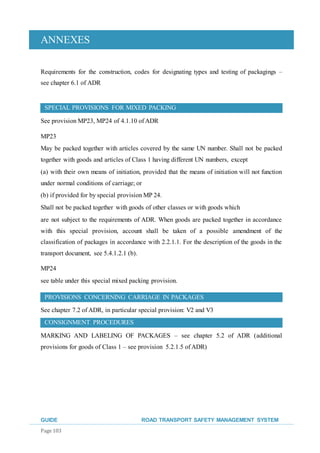
Requirements for the construction, codes for designating types and testing of packagings –
see chapter 6.1 of ADR
SPECIAL PROVISIONS FOR MIXED PACKING
See provision MP23, MP24 of 4.1.10 of ADR
PROVISIONS CONCERNING CARRIAGE IN PACKAGES
See, chapter 7.2 of ADR, in particular special provision: V2 and V3
CONSIGNMENT PROCEDURES
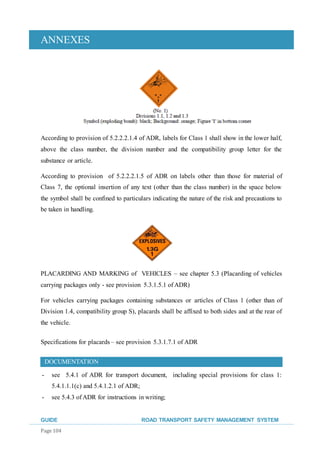
MARKING AND LABELING OF PACKAGES – see chapter 5.2 of ADR (additional
provisions for goods of Class 1 – see, provision 5.2.1.5 of ADR)
PLACARDING AND MARKING of VEHICLES – see chapter 5.3 (Placarding of vehicles
carrying packages only - see provision 5.3.1.5.1 of ADR).
Specifications for placards – see, provision 5.3.1.7.1 of ADR.
ROAD TRANSPORT SAFETY MANAGEMENT
SYSTEM COMPONENTS
GUIDE ROAD TRANSPORT SAFETY MANAGEMENT SYSTEM
Page 30
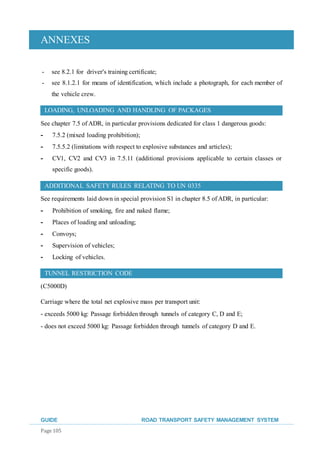
DOCUMENTATION
- see, 5.4.1 of ADR for transport document, including special provisions for class 1:
5.4.1.1.1(c) and 5.4.1.2.1 of ADR;
- see, 5.4.3 of ADR for instructions in writing;
- see, 8.2.1 for driver's training certificate;
- see, 8.1.2.1 for means of identification, which include a photograph, for each member of
the vehicle crew.
LOADING, UNLOADING AND HANDLING OF PACKAGES
See, chapter 7.5 of ADR, in particular provisions dedicated for class 1 dangerous goods:
- 7.5.2 (mixed loading prohibition);
- 7.5.5.2 (limitations with respect to explosive substances and articles);
- CV1, CV2 and CV3 in 7.5.11 (additional provisions applicable to certain classes or
specific goods).
ADDITIONAL SAFETY RULES RELATING TO UN 0335
See requirements laid down in special provision S1 in chapter 8.5 of ADR, in particular:
- prohibition of smoking, fire and naked flame;
- places of loading and unloading;
- convoys;
- supervision of vehicles;
- locking of vehicles.
TUNNEL RESTRICTION CODE
(C5000D)
5.4. Process for managing road transport accidents
Process for Managing Road Transport Accidents is a very important tool for dealing
with the accidents that may occur during the transport activities and also for identifying
opportunities for safety preventive measures, in the result of accident investigation.
ROAD TRANSPORT SAFETY MANAGEMENT
SYSTEM COMPONENTS
GUIDE ROAD TRANSPORT SAFETY MANAGEMENT SYSTEM
Page 31
While the ultimate objective of implementing road traffic safety management system is
reducing the risk of road traffic accidents, it is also very important to set procedures to
minimize their effects. It has to be underlined, that in the case of some transport operations,
providing the writing instructions as an aid during an accident emergency situation, is a legal
requirement. An example of this could be provision of 5.4.3 of ADR Agreement concerning
the international carriage of dangerous goods by road, which provides actions in the event of
an accident or emergency. According to this provision, in the event of an accident or
emergency, the members of the vehicle crew shall take the following actions where safe and
practicable to do:
apply the braking system, stop the engine and isolate the battery by activating the
master switch where available;
avoid sources of ignition, in particular, do not smoke or switch on any electrical
equipment;
inform the appropriate emergency services, giving as much information about the
incident or accident and substances involved as possible;
put on the warning vest and place the self-standing warning signs as appropriate;
keep the transport documents readily available for responders on arrival;
do not walk into or touch spilled substances and avoid inhalation of fumes, smoke,
dusts and vapours by staying up wind;
where appropriate and safe to do so, use the fire extinguishers to put out small/initial
fires in tyres, brakes and engine compartments;
fires in load compartments shall not be tackled by members of the vehicle crew;
where appropriate and safe to do so, use on-board equipment to prevent leakages into
the aquatic environment or the sewage system and to contain spillages;
move away from the vicinity of the accident or emergency, advise other persons to
move away and follow the advice of the emergency services;
remove any contaminated clothing and used contaminated protective equipment and
dispose of it safely.
ROAD TRANSPORT SAFETY MANAGEMENT
SYSTEM COMPONENTS
GUIDE ROAD TRANSPORT SAFETY MANAGEMENT SYSTEM
Page 32
It is also important to notice, that reporting of certain accidents (deaths, serious injuries)
to the relevant enforcing authorities is a legal requirement in each of the European Union
countries. However, incidents which do not result in deaths or serious injuries (so-called
‘near-misses’) are more frequent and it is very important to establish the procedure for
internal reporting also near-hits or other infringements, which could jeopardize road safety.
For that reason, it is very essential to introduce for relevant employees duty for reporting, not
only accidents (crashes), but also near-hits or other dangerous occurrences, including those
that do not result in any injury. The road haulier shall communicate to its employees the
procedure for reporting road transport accidents and incidents. Model form for such report
(e.g. site protocol) shall be appropriate to the scope of activities of the road transport
company. Usually it will contain:
date and location of occurrence;
particular weather conditions;
description of occurrence (eg. leaving the road, collision, technical fault);
cause of occurrence (if clearly known);
consequences of occurrence (eg. details of involved and/or injured person).
Summarizing, safety management system should contain, available for all employees,
procedure to ensure that accidents and incidents (near misses and other dangerous
occurrences) are:
internally reported to the road hauliers’ s management,
externally reported, as required by relevant legislation, to national enforcing
authorities.
Apart from accidents and incidents reporting procedure, road transport operator must
include, in its safety management system, a procedure for investigation of causes and
circumstances of a road transport accident. Accident investigation provides the Road haulier
with a review of the performance of risk assessment process and other related processes of
the safety management system. Therefore, not only the immediate causes, but also
underlying causes are to be systematically investigated and documented. It is very important
ROAD TRANSPORT SAFETY MANAGEMENT
SYSTEM COMPONENTS
GUIDE ROAD TRANSPORT SAFETY MANAGEMENT SYSTEM
Page 33
to establish accountability during its investigation and ensure that the staff appointed for
investigation is competent and duly trained for the scope of investigation to be carried out.
Relevant information relating to the accident investigation and their causes shall be
used to learn and, where required, adopt preventive measures. Progress in implementing
preventive measures will need to be monitored, and will not be deemed to have been
completed until their effectiveness has been demonstrated.
Status review questionnaire for ensuring compliance with respect to process for
Managing Road Transport Accidents
1. Is there the document describing the appropriate procedure of reporting a road
transport accident and incident to the management? Is there an evidence that
company is complying with above procedure?
2. Is there the document describing the appropriate procedure of investigation and
documenting a road transport accident? Is there an evidence that company is
complying with above procedure?
3. Is there the document describing the appropriate procedure of using information
relating to the investigation and causes of accident and reports of incidents for
implement preventive actions? Is there an evidence that company is complying with
above procedure?
5.5. Risk management process
5.5.1. Definition of “risk” and “risk management process”
The term “risk” is multi-discipline word and its definition depends on scope of activity
performed. The risk is generally seen as a composition of a hazard, which could occur at a
given frequency and cause a given severity of the consequences of the occurrence.12
According to the Oxford Dictionary, a noun “risk” is “a situation involving exposure to
danger.”13
According to ISO 31000 (2009) a risk is „an effect of uncertainty on objectives”,
12 European Railway Agency - Safety Unit, Workshop on Risk Evaluation and Assessment in the context of
Inland Transport of Dangerous Goods, Background discussion document, 8-9 October 2013, p. 1.
13 See, http://www.oxforddictionaries.com/definition/english/risk, visited on 27.06.2016.
ROAD TRANSPORT SAFETY MANAGEMENT
SYSTEM COMPONENTS
GUIDE ROAD TRANSPORT SAFETY MANAGEMENT SYSTEM
Page 34
where “uncertainties include events, which may or may not happen, and uncertainties caused
by ambiguity or a lack of information.”14
This definition of risk contains both negative and
positive impacts on objectives. Some definitions of risk are more complex, such as: “risk a
characteristic of a situation or action, where in two or more outcomes are possible, the
particular outcome that will occur is unknown, and at least one of the possibilities is
undesired.”15
In the scope of road safety the concept of risk is described as a tool to quantify the
level of road safety relative to the amount of exposure, as opposed to the absolute level of
safety as measured by the absolute number of accidents or casualties. The literature
differentiates between various kinds of risk such as personal risk, societal risk, individual
risk, group risk, etc.16
Risk management process includes risk assessment and a mitigation strategy for
those risks. Risk assessment includes both the identification of potential risk and the
evaluation of the potential impact of the risk. Risk management is a systematic application of
management policies, procedures and practices to the tasks of analysing, evaluating and
controlling risks.
A risk mitigation plan is designed to eliminate or minimize the impact of the risk
events - occurrences that have a negative impact. Identifying risk is both a creative and a
disciplined process.
5.5.2. Description of the risk assessment process17
5.5.2.1. The purpose of risk assessment process and examples of methods
The task of risk management is to ensure that an organization makes cost-effective use
of risk management process that includes a series of well-defined steps. The aim is to
14 ISO Guide 73:2002.
15 European Agency for Safetyand Healthat Work, Managingrisks to driversin roadtransport, Luxembourgh
2011.
16 A.S. Hakker, L. Braimaister, The uses of exposureandrisk in road safety studies, SWOV Institute for Road
Safety Research, The Netherlands, Leidschendam 2001, p. 8.
17 Order of the Ministry of Infrastructure Provision on Road Traffic Safety Management System art 16
ROAD TRANSPORT SAFETY MANAGEMENT
SYSTEM COMPONENTS
GUIDE ROAD TRANSPORT SAFETY MANAGEMENT SYSTEM
Page 35
improve internal control and support better decision-making trough a good understanding of
individual risks and the whole risk exposure that exists at a certain period.
The risk assessments in the field of the road transport need to integrate some of the
following different aspects:
• traffic level and composition of the traffic,
• possible accident scenarios,
• potential causes and consequences,
• frequency of accident scenarios,
• probability/frequency of dangerous goods substance involvement,
• hazards related to the substance involvement and to the volume transported,
• possible impacts to humans, transport infrastructure and natural environment.
The risk assessment process is the overall iterative process that comprises:
1) the system definition;
2) the risk analysis including the hazard identification;
3) the risk evaluation.
The system of definition shall address at least the following issues:
1) system objective (intended purpose);
2) system functions and elements, where relevant (including human, technical and
operational elements);
3) system boundary including other interacting systems;
4) physical (interacting systems) and functional (functional input and output)
interfaces;
5) system environment;
6) existing safety measures and, after the necessary relevant iterations, definition of the
safety requirements identified by the risk assessment process;
7) assumptions that determine the limits for the risk assessment.
Additionally, the risk assessment shall:
ROAD TRANSPORT SAFETY MANAGEMENT
SYSTEM COMPONENTS
GUIDE ROAD TRANSPORT SAFETY MANAGEMENT SYSTEM
Page 36
describe the circumstances that activated the requirement to conduct the risk
assessment;
identify and describe the risks associated with those circumstances;
identify the factors taken into account in the risk assessment, including the
persons who may be affected and whether property or the environment is
affected;
indicate, for each risk, the likelihood that the risk will occur and the severity of
its consequences;
identify the risks that require remedial action;
identify the remedial action for each of those risks.
When identifying the risks that require remedial action and the remedial action to be
implemented, a road haulier must consult with the employees who are affected by any of
those risks or a representative selected by the employees.
The road haulier must also communicate the risks identified as requiring remedial
action, and the remedial action to be implemented, to the employees who are affected by any
of the circumstances referred.
Additionally, a road haulier must include, in its safety management system,
1) a procedure for identifying the risks that require remedial action, taking into
account, for each risk, the likelihood that the risk will occur and the severity of its
consequences;
2) a plan for the consultation referred; and
3) a method for evaluating the level of risk, taking into account the likelihood that a
risk will occur and the severity of its consequences.
The most commonly known methodologies of risk assessment system are M_o_R and
ERM.
1) Management of Risk (M_o_R) – “a route map for risk management, bringing
together principles, an approach, a set of interrelated processes, and pointers to more detailed
ROAD TRANSPORT SAFETY MANAGEMENT
SYSTEM COMPONENTS
GUIDE ROAD TRANSPORT SAFETY MANAGEMENT SYSTEM
Page 37
sources of advice on risk management techniques and specialisms.”18
Principles are essential
for the development and maintenance of good risk management practice. They are informed
by corporate governance principles and the international standard for risk management, ISO
31000:2009. MoR is based on four core concepts: principles, approach, process and
embedding and reviewing. Principles need to be adapted and adopted to suit each individual
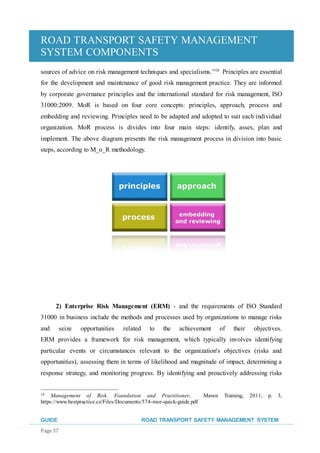
organization. MoR process is divides into four main steps: identify, asses, plan and
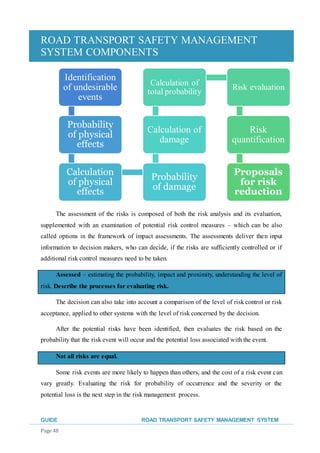
implement. The above diagram presents the risk management process in division into basic
steps, according to M_o_R methodology.
2) Enterprise Risk Management (ERM) - and the requirements of ISO Standard
31000 in business include the methods and processes used by organizations to manage risks
and seize opportunities related to the achievement of their objectives.
ERM provides a framework for risk management, which typically involves identifying
particular events or circumstances relevant to the organization's objectives (risks and
opportunities), assessing them in terms of likelihood and magnitude of impact, determining a
response strategy, and monitoring progress. By identifying and proactively addressing risks
18 Management of Risk. Foundation and Practitioner, Maven Training, 2011, p. 3,
https://www.bestpractice.cz/Files/Documents/574-mor-quick-guide.pdf
ROAD TRANSPORT SAFETY MANAGEMENT
SYSTEM COMPONENTS
GUIDE ROAD TRANSPORT SAFETY MANAGEMENT SYSTEM
Page 38
and opportunities, road transport undertakings are able to business enterprises protect and
create value for their stakeholders, including owners, employees, especially drivers and road
transport managers, customers, regulators, and society overall.
ERM can also be described as a risk-based approach to managing an enterprise,
integrating concepts of internal control, the Sarbanes–Oxley Act, as well as and strategic
planning. ERM is evolving to address the needs of various stakeholders, who want to
understand the broad spectrum of risks facing complex organizations to ensure they are
appropriately managed.
5.5.2.2. Risk management areas
The potential risk management areas cover:
1) Business continuity management (BCM) – is a holistic management process that
identifies potential threats to an organization and the impacts to the business operations that
those threats, if realized, might cause, and which provides a framework for building
organizational resilience with the capability for an effective response that safeguards the
interests of its key stakeholders, reputation, brand and value-creating activities.19
In other words, BCM is an organization-wide discipline and a complete set of
processes that provides identification of potential impacts which threaten an organization. It
provides a “know-how” for an effective response that safeguards the interests of its major
interested parties and reputation.
2) Incident and crisis management – an incident is an event that has the capacity to
lead to loss of, or a disruption to, an organization’s operations, services or functions, which,
if not managed; it can escalate into an emergency, crisis or disaster. For instance, a crisis is
an occurrence and/or perception than threatens the operations, staff, shareholder value,
stakeholders, brand, reputation, trust, strategic or business goals of organizations.20
3) Health and safety management – is a process on preventing people from being
harmed by work or becoming ill, by taking the right precautions and providing a satisfactory
19 Business Continuity Institute, Good Practice Guidelines, 2010.
20 R. Murray-Webster, Management of Risk: guidance for practitioners, Stationery Office, London 2010, p.
127.
ROAD TRANSPORT SAFETY MANAGEMENT
SYSTEM COMPONENTS
GUIDE ROAD TRANSPORT SAFETY MANAGEMENT SYSTEM
Page 39
working environment.21
Health and safety legislation and working conditions of drivers have
got important meaning in the field of safety management system in road transport
undertakings. In order to avoid accidents from happening and occupational diseases to occur,
EU wide minimum requirements for health and safety protection at the workplace have been
adopted.22
4) Security risk management – is the specific culture, processes and structures that
are directed towards maximising the benefits of security in support of business objectives;
assets, such as: personnel, information and organization’s physical, are essential for the day-
to-day operation of an organization, and for that reason need to be protected against harm.23
5) Financial risk management – is the practice by which an organization improves
the manner in which it takes financial risk. The financial approach of risk management
covers the monitoring of financial risk-taking activities, upholding relevant financial and
operational policies and procedures through appropriate controls, and the production and
distribution of financial risk-related reports.24
6) Environmental risk management - is a process leading to problems that are caused
by pollutants in the environment, and it is evaluate predicting whether there may be a risk of
dangerous effects on the environment caused by a chemical substance. It is the analysis of
risks resulting from technology that threaten ecosystems, animals and people. It includes
human health risk assessments, ecological or eco-toxicological risk assessments, and specific
industrial applications of risk assessment that examine end-points in people, biota or
ecosystems.25
An environmental risk appears only if there is an exposition to a hazard, and one, or
more than one, outcomes associated to the exposition.
21 BritishStandards InstitutionBS OHSAS 18001:2007, p. 1.
22 The Council Directive 89/391/EEC of 12 June 1989 on the introduction of measures to encourage
improvements in the safety and health of workers at work (OJ L 183, 29/06/1989 p. 0001–0008), called as
“framework Directive 89/391/EEC”is essential, as it aims at ensuring a higher degree of protection of workers
through the implementation of preventive measures to guard against accidents at work and occupational
diseases, and through the information, consultation, balanced participation and training of workers and their
representatives. This frameworkdirective applies as well as to the roadtransport sector, both public and private.
23 See also, ISO Standard 27001 - Informationsecuritymanagement.
24 R. Murray-Webster, Management of Risk (…), op. cit., p. 128.
25 EEA, 1998.
ROAD TRANSPORT SAFETY MANAGEMENT
SYSTEM COMPONENTS
GUIDE ROAD TRANSPORT SAFETY MANAGEMENT SYSTEM
Page 40
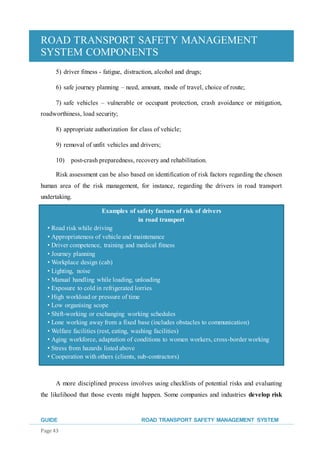
Indeed, ERA depends, at least, on four sub-systems:
− ecological risk assessment;
− health risk assessment;
− industrial risk assessment leading to facilities at strategic and planning level;
− industrial risk assessment leading to supply chain and system utilities, such as
transportation, at strategic, planning, operational or real time level.
7) Reputational risk management – reputation is one of the most important assets of
most organizations and, accordingly, reputational risk is one of the main concerns for risk
managers. Given the reputation is ultimately concerned with how an organization is
perceived by its stakeholders, good communication is an essential element of building and
the protecting an organization’s reputation. A condition of “good repute” is one of the key
requirements for the access to the road transport market in European Union. According to
regulation (EC) No 1071/2009 of the European Parliament and of the Council of 21 October
2009 establishing common rules concerning the conditions to be complied with to pursue the
occupation of road transport operator and repealing Council Directive 96/26/EC26
, the good
repute of transport managers is conditional on their not having been convicted of a serious
criminal offence or not having incurred a penalty, for a serious infringement, in particular, of
EU rules relating to road transport.
8) Contract risk management – is the process of systematically and efficiently
managing contract creation, execution and analysis for maximising operational and financial
performance and minimising risk.27
5.5.2.3. Formal techniques of risk management
FORMAL TECHNIQUES
With regard to the formal techniques, performed in the scope of risk management
process by the road transport undertakers, the most frequently used methods are:
hazard and operability studies (HAZOP);
26 O.J. L 300, 04.11.2009, p. 51.
27 Aberdeen Group Buying Goods and Services, A professional guide to contracting including model
conditions, A. D. Allwright and R. W. Oliver. Revised by E S Singleton & K R Burnett, 1997.
ROAD TRANSPORT SAFETY MANAGEMENT
SYSTEM COMPONENTS
GUIDE ROAD TRANSPORT SAFETY MANAGEMENT SYSTEM
Page 41
quantitative risk assessment (QRA);
probabilistic risk assessment (PRA).
HAZOP, which is the acronym for HAZard OPerability studies, is a technique that
must be performed by a group of experts, who know in detail the system that they intent to
analyze. This is a very expensive process, both in terms of hours worked and number of
skills involved. This technique requires a deep knowledge of the plant because the experts
have to examine any possible failure or rupture, using a variety of keywords that drive this
analysis.28
QRA is the acronym for Quantitative Risk Assessment and it is a strictly mathematical
technique that numerically determines the absolute frequency of "accidents". These
methodologies give quantitative estimates of risks, given the parameters defining them. They
are used mostly in the financial sector, the chemical process industry, as well as in road
transport sector. For instance, the following techniques of risk assessment are classified as
Quantitative Risk Assessment: fault tree analysis (FTA), probit statistical analysis, in-process
energy modeling, event probabilities, risk or cost trade-off.29
PRA stands for Probabilistic Risk Assessment and is a technique obtained by linking
the probability of individual events, such as failures or distraction of certain element of the
system and poorly functioning whole safety system. The probabilistic risk assessment (or
analysis/ probabilistic assessment of safety) is indeed a complex and systematic methodology
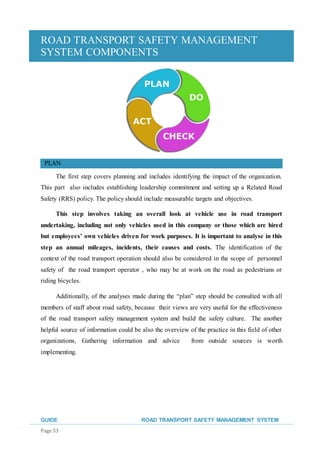
for assessing the risk associated with complex technological devices (such as aircraft or
power plants)30
. The PRA is a well-established technology, based on estimation of criteria
used to determine the frequencies and probabilities of different events modelled. The cause
of an event is an accident. In a PRA model, the parameters are estimated, on the bases of data
used to evaluate each of the parameters, and the doubts in estimation can be quantified using
28 A. M. Tomasoni, Models andmethods of risk assessment and control in dangerous goods transportation
(DGT) systems, usinginnovative informationand communication technologies, EcoleNationale Sup´erieure des
Mines de Paris;Universit`adegli studi di ´ Genova - Italie, 2010, NNT : 2010ENMP1703 , pastel-00006223, p.
30.
29 Ibidem, p. 32.
30 H. Kumamoto, E. J. Henley, ProbabilisticRisk Assessment and Management for Engineers and Scientists.
SECOND EDITION. IEEE PRESS, New York, 1996.
ROAD TRANSPORT SAFETY MANAGEMENT
SYSTEM COMPONENTS
GUIDE ROAD TRANSPORT SAFETY MANAGEMENT SYSTEM
Page 42
methods and sources of information, that describe the response of systems and operators to
accident initiating events. In this context, performance and reliability are enhanced by
monitoring equipment performance and evaluation of equipment trends.31
Risk identification – the achievement of objectives within the context and then
describing them, is a common understanding.
Identify the major elements in managing project risk.
First of all, it must be underlined, that in road transport the situation without any risk is
impossible; there is no absolute safety and it is not possible to eliminate all risks.
In view of the indication, technics on risk assessment and risk evaluation are so helpful
and necessary in risk management process and finally in road safety management system.
Risk assessment methodology is generally used as an input to decisions related to the
monitoring and management of risks. In principle, the methods used for assessing the risks
relating to the road transport are the same as those for assessing other type of risks.
According to the risk area (safety, finance, environment, legal, etc.) the risk analysis
methods use different parameters allowing the characterization of the risk, qualitatively,
quantitatively or in comparison with the existing standards, rules or systems. Risk
management methodologies in different domains need to take account of critical measures of
this domain.32
For that reason, it is very essential to indicate the criteria and factors for the
risk in road transport activity. For instance, according to ISO 39001:2012, the road transport
operator should consider the relevance of the 10 intermediate safety performance factors:
1) road design and safe speed, especially, separation, roadsides, and intersections;
2) use of appropriate roads, depending on vehicle type, user, type of cargo and
equipment;
3) use of safe driving speed, considering vehicle type, traffic and weather conditions;
4) use of personal safety equipment, for instance: restraints, helmets, lights;
31 Atwood et al., 2003.
32 A. Waring, A. Ian Glendon, Managing Risk, London1998, p. 166.
ROAD TRANSPORT SAFETY MANAGEMENT
SYSTEM COMPONENTS
GUIDE ROAD TRANSPORT SAFETY MANAGEMENT SYSTEM
Page 43
5) driver fitness - fatigue, distraction, alcohol and drugs;
6) safe journey planning – need, amount, mode of travel, choice of route;
7) safe vehicles – vulnerable or occupant protection, crash avoidance or mitigation,
roadworthiness, load security;
8) appropriate authorization for class of vehicle;
9) removal of unfit vehicles and drivers;
10) post-crash preparedness, recovery and rehabilitation.
Risk assessment can be also based on identification of risk factors regarding the chosen
human area of the risk management, for instance, regarding the drivers in road transport
undertaking.
A more disciplined process involves using checklists of potential risks and evaluating
the likelihood that those events might happen. Some companies and industries develop risk
Examples of safety factors of risk of drivers
in road transport
• Road risk while driving
• Appropriateness of vehicle and maintenance
• Driver competence, training and medical fitness
• Journey planning
• Workplace design (cab)
• Lighting, noise
• Manual handling while loading, unloading
• Exposure to cold in refrigerated lorries
• High workload or pressure of time
• Low organising scope
• Shift-working or exchanging working schedules
• Lone working away from a fixed base (includes obstacles to communication)
• Welfare facilities (rest, eating, washing facilities)
• Aging workforce, adaptation of conditions to women workers, cross-border working
• Stress from hazards listed above
• Cooperation with others (clients, sub-contractors)
ROAD TRANSPORT SAFETY MANAGEMENT
SYSTEM COMPONENTS
GUIDE ROAD TRANSPORT SAFETY MANAGEMENT SYSTEM
Page 44
checklists based on experience from past.33
These checklists can be helpful to the project
manager and project team in identifying both specific risks on the checklist and expanding
the thinking of the team. The past experience of the project team, project experience within
the company, and experts in the industry can be valuable resources for identifying potential
risk.
Risk analysis is best done in a group with each member of the group having a good
understanding of the tasks and objectives of the area being analysed.
The creative process includes brainstorming sessions where the team is asked to create
a list of everything that could go wrong. All ideas are welcome at this stage with the
evaluation of the ideas coming later.
1) Identify the Risks: as a group, list the things that might inhibit your ability to meet
your objectives.
You can even look at the things that would actually enhance your ability to meet those
objectives eg. a fund-raising commercial opportunity. These are the risks that you face eg.
loss of a key; delayed provision of important information by another work unit/individual
etc.
2) Identify the Causes: try to identify what might cause these things to occur eg. the
key team member might be disillusioned with his/her position, might be head hunted to go
elsewhere; the person upon whom you are relying for information might be very busy, going
on leave or notoriously slow in supplying such data; the supervisor required to approve the
commercial undertaking might be risk averse and need extra convincing before taking the
risk etc etc.
3) Identify the Controls: identify all the things (Controls) that you have in place that
are aimed at reducing the Likelihood of your risks from happening in the first place and, if
they do happen, what you have in place to reduce their impact (Consequence) eg. providing a
friendly work environment for your team; multi-skill across the team to reduce the reliance
33 See, annex 8.4.
ROAD TRANSPORT SAFETY MANAGEMENT
SYSTEM COMPONENTS
GUIDE ROAD TRANSPORT SAFETY MANAGEMENT SYSTEM
Page 45
on one person; stress the need for the required information to be supplied in a timely manner;
send a reminder before the deadline; provide additional information to the supervisor before
he/she asks for it etc.
Identifying the sources of risk by category is another method for exploring
potential risk. Some examples of categories for potential risks include the following:
1) technical;
2) cost;
3) schedule;
4) client;
5) contractual;
6) weather;
7) financial;
8) political;
9) environmental;
10) people (the people category can be subdivided into risks associated with the
people; examples of people risks include the risk of not finding the skills needed to execute
or the sudden unavailability of key people).
Identifying hazards and those at risk – look for those things at work that have the
potential to cause harm, and identify workers who may be exposed to the hazards.
Remember - specific to transport is the risk assessment of three key elements: the road
user, the journey and the vehicle.
5.5.3. Evaluating and prioritising risks
The risk evaluation is the process of comparing an estimate of the considered risk with
risk acceptance criteria.
ROAD TRANSPORT SAFETY MANAGEMENT
SYSTEM COMPONENTS
GUIDE ROAD TRANSPORT SAFETY MANAGEMENT SYSTEM
Page 46
1) The first step - risk awareness evaluation - must be performed in all cases. There
is no requirement to document or file the results, if the resulting risks are determined to be
insignificant. However, it must be underlined that some actions may affect others and the
road transport company should ensure that all other affected stakeholders are consulted prior
to initiation or implementation.
Within this stage it is very important to collect information on the considered risk and
to try to develop an evaluation which can be used to test different options for controlling the
risks and to provide inputs to a decision making process.
In general the following categories of options are examined for controlling the risks:
to accept the risk as it is,
to prevent/avoid the hazards,
to reduce the frequencies,
to report the risk in another location,
to transfer the risk to someone else,
to mitigate the consequences.
2) The second step - risk assessment evaluation - formal and written; must be
performed whenever a proposed project or change to a policy, procedure or work practice has
the potential for a significant positive or negative impact on safety performance. A risk
assessment evaluation must be performed, whenever a safety concern is identified through
analysis of safety data or other means, or a project or new or revised policy, procedure or
work practice is being considered, that could potentially affect the safety of employees of
road transport undertaker and its operation, the public, or the environment. This component
of risk management must be performed as soon as practicable after identification of the
safety concern and prior to initiation of the project and implementation of the change.
ROAD TRANSPORT SAFETY MANAGEMENT
SYSTEM COMPONENTS
GUIDE ROAD TRANSPORT SAFETY MANAGEMENT SYSTEM
Page 47
3) The third step - risk analysis evaluation must be performed if the potential risks
are more complex or critical than the second step risk assessment evaluation is designed to
accommodate. A third step risk analysis evaluation is likely to be required especially for
major or very complex corporate projects and initiatives, and will likely involve the
professional services of risk specialists or outside consultants and the use of sophisticated
analytical risk models and tools.
When any step of risk evaluation indicates that a project, current work practice or new
or revised policy, procedure or work practice, may result in unacceptable risks or may
degrade our existing safety performance, mitigating actions to eliminate or reduce those risks
to an acceptable level must be identified and implemented.
The next general phase of risk management, the assessment of risk, is used to evaluate
the risks of new or revised company procedures, policies, practices or projects, which have
the potential of affecting safety. It is a formal risk assessment protocol, which may use a
frequency and severity matrix (similar to the examples given in the Annexes to this guide,
see 8.6) or other specific and formal risk assessment tools for which protocols for their use
are available. Both quantitative (statistical) and qualitative techniques may be used.
The general approach of the quantitative risk analysis is presented in the below
diagram.
ROAD TRANSPORT SAFETY MANAGEMENT
SYSTEM COMPONENTS
GUIDE ROAD TRANSPORT SAFETY MANAGEMENT SYSTEM
Page 48
The assessment of the risks is composed of both the risk analysis and its evaluation,
supplemented with an examination of potential risk control measures – which can be also
called options in the framework of impact assessments. The assessments deliver then input
information to decision makers, who can decide, if the risks are sufficiently controlled or if
additional risk control measures need to be taken.
Assessed – estimating the probability, impact and proximity, understanding the level of
risk. Describe the processes for evaluating risk.
The decision can also take into account a comparison of the level of risk control or risk
acceptance, applied to other systems with the level of risk concerned by the decision.
After the potential risks have been identified, then evaluates the risk based on the
probability that the risk event will occur and the potential loss associated with the event.
Not all risks are equal.
Some risk events are more likely to happen than others, and the cost of a risk event can
vary greatly. Evaluating the risk for probability of occurrence and the severity or the
potential loss is the next step in the risk management process.
ROAD TRANSPORT SAFETY MANAGEMENT
SYSTEM COMPONENTS
GUIDE ROAD TRANSPORT SAFETY MANAGEMENT SYSTEM
Page 49
Establish your Likelihood and Consequence Descriptors, remembering that these
depend upon the context of your analysis ie. If your analysis relates to your work unit, any
financial loss or loss of a key staff member, for example,
Establish your Risk Rating Descriptors: ie. what is meant by a Low, Moderate, High
or Extreme Risk needs to be decided upon ahead of time. Because these are more generic in
terminology though, you might find that the Company's Strategic Risk Rating Descriptors
are applicable.
Having criteria to determine high impact risks can help narrow the focus on a few
critical risks that require mitigation.
For example, suppose high-impact risks are those that could increase the project costs
by 5% of the conceptual budget or 2% of the detailed budget. Only a few potential risk
events met these criteria. These are the critical few potential risk events that the project
management team should focus on when developing a project risk mitigation or management
plan.
Risk evaluation is about developing an understanding of which potential risks
have the greatest possibility of occurring and can have the greatest negative impact on
the company. These become the critical few.
Evaluating and prioritising risks – estimating the existing risks (the severity and
probability of possible harm) and prioritising them in order of importance.
For transport this may include identifying fatigue for long distance or high
mileage/km/drivers.
5.5.4. Planning the appropriate responses to risks, assigning owners,
implementing, monitoring and controlling those responses
Any risk that is rated as High or Extreme should have additional controls applied to it
in order to reduce it to an acceptable level. What the appropriate additional controls might
be, whether they can be afforded, what priority might be placed on them, is something for
ROAD TRANSPORT SAFETY MANAGEMENT
SYSTEM COMPONENTS
GUIDE ROAD TRANSPORT SAFETY MANAGEMENT SYSTEM
Page 50
the group to determine in consultation with the head of the work unit who, ideally, should be
a member of the group doing the analysis in the first place.
If there are still some risks that are rated as High or Extreme, make a decision - a
decision has to be made as to whether the activity will go ahead. There will be occasions
when the risks are higher than preferred, but there may be nothing more that can be done to
mitigate that risk.
Monitoring the circumstances and regular review is an essential element for a
successful risk management program.
5.5.5. Risk mitigation
After the risk has been identified and evaluated, road haulier develops a risk mitigation
plan, which is a plan to reduce the impact of an unexpected event.
You can mitigates risks in the following ways:
1) risk avoidance;
2) risk sharing;
3) risk reduction;
4) risk transfer.
Each of these mitigation techniques can be an effective tool in reducing individual
risks and the risk profile.
The risk mitigation plan captures the risk mitigation approach for each identified risk
event and the actions will take to reduce or eliminate the risk.
Risk avoidance usually involves developing an alternative strategy that has a higher
probability of success but usually at a higher cost associated with accomplishing a task. A
common risk avoidance technique is to use proven and existing technologies rather
than adopt new techniques, even though the new techniques may show promise of
better performance or lower costs.
Risk sharing involves partnering with others to share responsibility for the risk
activities. Many organizations that work on international projects will reduce political, legal,
ROAD TRANSPORT SAFETY MANAGEMENT
SYSTEM COMPONENTS
GUIDE ROAD TRANSPORT SAFETY MANAGEMENT SYSTEM
Page 51
labor, and others risk types associated with international projects by developing a joint
venture with a company located in that country. Partnering with another company to
share the risk associated with a portion of the project is advantageous when the other
company has expertise and experience the project team does not have. If the risk event
does occur, then the partnering company absorbs some or all of the negative impact of the
event.
Risk reduction is an investment of funds to reduce the risk on a project. On
international projects, companies will often purchase the guarantee of a currency rate to
reduce the risk associated with fluctuations in the currency exchange rate. A road haulier
may hire an expert to review the technical plans or the cost estimate on a project to
increase the confidence in that plan and reduce risk. Assigning highly skilled project
personnel to manage the high-risk activities is another risk reduction method. Experts
managing a high-risk activity can often predict problems and find solutions that prevent the
activities from having a negative impact. Some companies reduce risk by forbidding key
executives or technology experts to ride on the same airplane.
Risk transfer is a risk reduction method that shifts the risk from the company to another
party. The purchase of insurance on certain items is a risk transfer method. The risk is
transferred from the project to the insurance company. The purchase of insurance is
usually in areas outside the control of the project team. Weather, political unrest, and labor
strikes are examples of events that can significantly impact the project and that are outside
the control of the project team.
Deciding on preventive action – identifying the appropriate measures to eliminate or
control the risks.
For transport this may include undertaking a journey planning exercise resulting
in planning rest stops.
For transport this may include implementing a different driving and resting
regime.
ROAD TRANSPORT SAFETY MANAGEMENT
SYSTEM COMPONENTS
GUIDE ROAD TRANSPORT SAFETY MANAGEMENT SYSTEM
Page 52
Monitoring and reviewing - the assessment should be reviewed at regular intervals to
ensure that it remains up to date.
For transport this may include looking at the outcome of the changed journey
times and impact and add still additional changes.
There are two basic elements of monitoring process within RTSMS:
1) active monitoring - monitoring before the accident or other negative events; it is
based on regular inspection and checking to ensure that the safety standards are being
implemented and management controls are working properly; performing such model of
the monitoring activity the road transport operator is able to know if his organization is
achieving the objectives and standards set and if they are effective;
2) reactive monitoring - monitoring activities are performed after the accident or
other negative event for road safety; it involves learning from mistakes and incidents,
whether they have resulted in injuries and property damage or near misses.34
5.5.6. Plan-Do-Check-Act
Methodology presented in International Standard 39001 on Road Traffic Safety
Management System is based on the “Plan-Do-Check-Act” approach (PDCA). It is an
iterative four-step management method, used in business for the control and continuous
improvement of processes and products; it is also known as the Deming circle, cycle or
wheel. The PDCA is a cyclical methodology, involving several steps and requires strong
leadership and commitment from top management. MORR (RoSPA) is also based on ‘plan-
do-check-act’ management principles.
34 European Transport Safety Council, PreventingRoadAccidentsand Injuries forthe Safety of Employees.
Project Handbook, Brussels 2012, p. 22.
ROAD TRANSPORT SAFETY MANAGEMENT
SYSTEM COMPONENTS
GUIDE ROAD TRANSPORT SAFETY MANAGEMENT SYSTEM
Page 53
PLAN
The first step covers planning and includes identifying the impact of the organization.
This part also includes establishing leadership commitment and setting up a Related Road
Safety (RRS) policy. The policy should include measurable targets and objectives.
This step involves taking an overall look at vehicle use in road transport
undertaking, including not only vehicles used in this company or those which are hired
but employees’ own vehicles driven for work purposes. It is important to analyse in this
step an annual mileages, incidents, their causes and costs. The identification of the
context of the road transport operation should also be considered in the scope of personnel
safety of the road transport operator , who may be at work on the road as pedestrians or
riding bicycles.
Additionally, of the analyses made during the “plan” step should be consulted with all
members of staff about road safety, because their views are very useful for the effectiveness
of the road transport safety management system and build the safety culture. The another
helpful source of information could be also the overview of the practice in this field of other
organizations, Gathering information and advice from outside sources is worth
implementing.
ROAD TRANSPORT SAFETY MANAGEMENT
SYSTEM COMPONENTS
GUIDE ROAD TRANSPORT SAFETY MANAGEMENT SYSTEM
Page 54
DO
The next step “do” covers implementing the system which relies on coordination,
budget, competent human resources, awareness raising including internal and external
communication.
Consider drivers’ attitudes and their driving competence on recruitment and as
necessary thereafter. You can assess drivers while driving or by using online tools. Ask
them about their crash histories and penalty points.35
Consider investing in extra driver training, for example, for those covering the greatest
mileages or with greater development needs such as young drivers
Ensure drivers and their supervisors always consider safety before driving, for example
by planning journeys which follow the safest routes, wherever possible avoiding
congestion, crash sites and night and adverse weather driving. If a journey is excessively
long, staff may need to travel the night before. Or they may need to stay overnight rather
than driving straight home after working away. Plan stops of at least 15 minutes every two
hours.36
Make it clear that staff must not speed. Don’t set impossible schedules and
deadlines.
Emphasize that staff must be fit to drive.
Ensure vehicles are right for the job and that drivers are familiar with any new vehicles
they are asked to drive.
Insist that vehicles are properly maintained and serviced regularly.
Make sure all staff who drive know what they should do in an emergency.
35 Managing Occupational Road Risk Advice for small and medium sized organizations, ROSPA, p. 3.
36 Ibidem.
ROAD TRANSPORT SAFETY MANAGEMENT
SYSTEM COMPONENTS
GUIDE ROAD TRANSPORT SAFETY MANAGEMENT SYSTEM
Page 55
CHECK
Monitoring is under “check” and should ensure regular analysis and evaluation of
performance against the set objectives and targets. Routine, systematic monitoring should be
part of the day-to-day operation of the organisation. This should include compliance checks
which are carried out on a regular basis to test how well safety rules and standards are being
implemented and adhered to by staff.
Compliance checks might include:
• checking documentation including licences, driver training records, fitness to drive
records, driving and working or rest hours;
• random checks on the road to check compliance with rules such as seatbelt wearing,
mobile phone usage, speeding;
• checking that employees have actually read and understood all of the key policies,
procedures, guidance in driver handbooks.37
ACT
“Act” is improving the management system on a continual basis.
37 European Transport Safety Council, Preventing Road Accidents and Injuries for the Safety of Employees,
Project Handbook, p. 24.
• licenses to see that drivers are entitled to
drive the class or type of vehicle to be driven.Check
• all accidents while driving for work are
reported and investigated.Ensure
• drivers to do daily and weekly vehicle safety
checks
Require
ROAD TRANSPORT SAFETY MANAGEMENT
SYSTEM COMPONENTS
GUIDE ROAD TRANSPORT SAFETY MANAGEMENT SYSTEM
Page 56
Make time and space to review progress periodically.
See to it that any lessons to be learnt from experience are shared and fed back to
promote safer driving.
Develop a simple action plan with targets for further improvement.
Recognise, celebrate and reward safe driving achievements.
5.6. Process for reporting contraventions and safetyhazards
The risk management involves the important steps of learning from experience and
reporting on performance. Risk reporting provides information on historical losses and
trends. All hazards related to road transport should be identified, documented and risk
assessed. Those risk register should be written. It should be viewed as a risk action plan,
which includes current actions that are planned.
A road haulier shall include a procedure for enabling its employees to report an
infringement of the legal provisions on road transport safety. The road haulier shall include a
policy for protecting its employees from reprisals for reporting an infringement or safety
hazard.38
The hazards information gained from the risk evaluation should be documented and
incorporated into the management system, which should demonstrate that:
- all hazards have been identified;
- the likehood and probability of an accident have been assessed;
- controls to mitigate risks are in place.
- corrective action to incidents is in place.
The road haulier shall develop the procedure and the policy in collaboration with its
employees or a representative selected by its employees.
38 Article 15 of draft of the regulation Road Transport Safety Management System
ROAD TRANSPORT SAFETY MANAGEMENT
SYSTEM COMPONENTS
GUIDE ROAD TRANSPORT SAFETY MANAGEMENT SYSTEM
Page 57
Record should be kept in order to demonstrate the extend of compliance with its road
transport policy and to document the extent to which planned objectives and performance
criteria have been met, including:
- reports of inspections, audits, reviews and follow-up actions,
- investigation of incidents or accidents and follow-up actions,
- maintenance reports,
- training records, and
- security incidents.39
We can say about four steps for hazard identification process:
1) reporting hazards, events or safety concerns;
2) collecting and storing the data;
3) analyzing reports;
4) distributing the information.40
5.7. Process for Managing Knowledge
PROCESS FOR MANAGING KNOWLEDGE
Successful handling of transport safety matters is a line responsibility, requiring
specific allocation of responsibilities to competent and qualified employees with appropriate
authority to carry out their responsibilities. This should be reflected in the organizational
structure by development and implementation of process for Managing Knowledge.
A road transport company must establish a list setting out:
1) the duties that are essential to the safety of road transport operations;
39 Land transportation safety recommended practice OGP Report No. 365 (Issue 2), p. 16.
40 Safety Management System Training, ACAC, p. 58.
ROAD TRANSPORT SAFETY MANAGEMENT
SYSTEM COMPONENTS
GUIDE ROAD TRANSPORT SAFETY MANAGEMENT SYSTEM
Page 58
2) the positions in the road transport company that have responsibility for the performance of
each of those duties;
3) the skills, qualifications, experience and resources required to perform each of those duties
safely.
The list setting out positions in the road transport company and relevant duties shall be
documented and communicated for all interested parties in clear to be understood language
and format, with the aid of organizational diagrams where appropriate This documentation
can be linked with the road transport company Safety Policy.
Implementation of process for Managing Knowledge must include methods for
periodic verifying that an employee, who performs any of the duties connected to the safety
of road transport operations, has the competence (skills, qualifications, experience) and
resources required to perform each of those duties safely.
SAMPLE OF SAFETY ROLES, RESPONSIBILITIES AND RELATIONSHIPS OF
EMPLOYEES WHO MANAGE, PERFORM OR VERIFY WORK AFFECTING ROAD
TRANSPORT SAFETY.
Drivers
Drivers should take every care to protect themselves and others by following the
policies and the rules of safety management system of the ..(organization name)…
They should in particular:
carry out vehicle pre-start checks before the journey begins;
do not drive a defective vehicle;
immediately report any vehicle defects to their manager;
immediately report any crashes, near-hits or other infringement which could
jeopardize the safety to their manager, including those that do not result in injury
immediately report to their manager if their driver license has been suspended or
cancelled;
immediately report any legal penalties imposed for the infringements, which
relates to road transport safety maters to a manager;
ROAD TRANSPORT SAFETY MANAGEMENT
SYSTEM COMPONENTS
GUIDE ROAD TRANSPORT SAFETY MANAGEMENT SYSTEM
Page 59
be aware of what action needs to be taken in the event of accident or emergency;
participate in and implement the knowledge and skills gained from the driver
training provided;
inform their manager of any health problems or personal circumstances, which
could make driving hazardous;
allow sufficient time for planning the route and ensure that they are fit and
appropriately rested;
stop when tired even if continuation of driving complies with the social provisions
of driving times;
ensure that managers are aware of delays on routes so that journey times can be
extended to take account of the circumstances;
do not drive while under the influence of alcohol, drugs or any other substance or
medication that could impair their ability to safely operate the vehicle;
have their eyes tested regularly and ensure that any necessary corrective eyewear is
worn;
comply with the ban on mobile phone use while driving;
comply with the smoking ban when carrying dangerous goods;
drive within speed limits and to the speed which can be less than the limit
depending on dictated conditions;
comply with traffic legislation when driving;
wear high-visibility clothing when working directly outside or adjacent to moving
vehicles;
follow advice on route planning supplied by their manager;
use seatbelts at all times the vehicle is in motion;
do not accept passengers in transport units carrying dangerous goods;
do not accept passengers in other transport units unless authorized by the
company;
ascertain visually that the loads have no defects or leakages;
verify if the vehicles are not overloaded.
ROAD TRANSPORT SAFETY MANAGEMENT
SYSTEM COMPONENTS
GUIDE ROAD TRANSPORT SAFETY MANAGEMENT SYSTEM
Page 60
The effectiveness of Managing Knowledge Process is verified during internal audits.
This process should be also analysed in the field of Risk Management. Sample checklist on
risk caused by lack of or improper driver training is presented in annex 8.8
Transport Managers
Transport Managers have a responsibility to demonstrate their commitment to
managing all aspects of operational safety. They must ensure that transport activities are
carried out effectively with minimum risk to the employee, to the load and to other road
users. Transport managers must ensure that the employees involved in transport safety issues
are aware of safety rules relating to their individual roles and responsibilities and set up
procedures for verifying appropriate skills and qualifications of employees.
They should in particular:
ensure that the driver holds the appropriate class of valid legal license for the
vehicles;
ensure that driver health, eyesight and fitness to drive;
ensure that the driver receive any necessary initial driving (induction) training,
together with ongoing training based on risk assessment;
tests the driver´s knowledge of the safety rules of the road;
ensure that the training needs of their drivers are met;
ensure that drivers carry out vehicle pre-start checks;
ensure that all drivers are fully aware of what action they need to take in the event
of accident or emergency;
ensure that drivers have sufficient time for journeys and do not feel pressured into
completing them faster by speeding or taking risks;
provide advice on route planning and circulate information on hazards reported on
regular routes;
monitor and, if necessary, restrict total hours driven to ensure that drivers do not
suffer from fatigue;
ensure drivers understand the need for using seatbelts at all times and the ban on
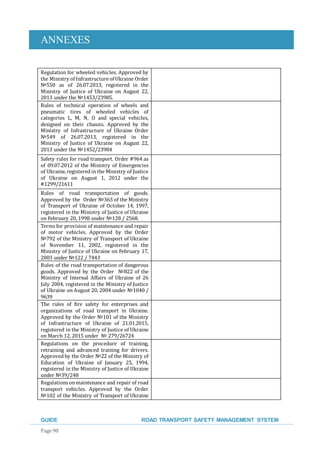
mobile phone use while driving;
ROAD TRANSPORT SAFETY MANAGEMENT
SYSTEM COMPONENTS
GUIDE ROAD TRANSPORT SAFETY MANAGEMENT SYSTEM
Page 61
in bad weather conditions make every effort to reduce journeys to a minimum;
set up procedures to ensure that all vehicles are in a roadworthy condition
according to safety rules and manufacturers’ recommendations;
collectingand collatingstatistics on crashes, near-hits or other infringement which
could jeopardize the safety and their causes.
5.8. Process with respect to scheduling
Transport time schedules must comply with the legal provisions on drivers’ hours,
breaks and rest periods.
A road transport company must apply the principles of fatigue science when
scheduling the work of the employees, including the principles:41
1) that human fatigue is governed by physiology;
2) that human alertness is affected by 24-hourly rhythms;
3) that human performance degrades in relation to hours of wakefulness and accumulated
sleep debt;
4) that humans have baseline minimum physiological sleep needs.
The road transport company must include, in its safety management system, a method
for applying the principles of fatigue science when scheduling the work of an employee who
is required to work according to a schedule.
Optimising Schedules:
- a policy that journey planning for safety should allow sufficient time to enable drivers to
take account of reasonably foreseeable weather and road traffic conditions and to comply
with speed limits;
- reducing night driving;
41 Order of the Ministry of Infrastructure ProvisiononRoad Traffic Safety Management System
ROAD TRANSPORT SAFETY MANAGEMENT
SYSTEM COMPONENTS
GUIDE ROAD TRANSPORT SAFETY MANAGEMENT SYSTEM
Page 62
- avoiding high risk hours;
- avoiding driving at times of day when falling asleep at the wheel is more likely.
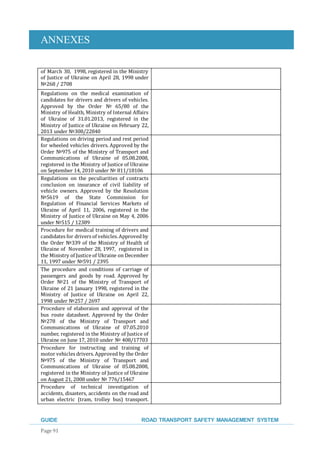
Some principles for managing fatigue42
:
1) plan schedules to maximise sleep and rest when drivers are most needed and when they
are most effective;
2) in trip planning, make allowances for delays have at least one day off work a week to
prevent fatigue building up compensate for the lack of night sleep on a regular basis, with
breaks that allow for at least two consecutive nights’ sleep;
3) compensate for a shorter sleep opportunity one day by providing a longer rest the next
day;
4) balance a long shift one day with a longer rest at the end of the day and a shorter shift the
next day;
5) regardless of any balancing of shifts, you should not continually compromise the seven
hours’ minimum sleep per day;
6) use short breaks, naps and, to a lesser degree, food, water and exercise as short-term
energisers;
7) remember that personal awareness is no substitute for proper rest and work patterns;
8) remember that schedules should take into account daily life (such as eating, family
commitments, and driving to and from home).
Fatigue is different for every person, and depends on a range of factors. This makes it
impossible to develop hard and fast rules for when a driver becomes fatigued.
However, factors that can lead to fatigue include:
1) long periods of time awake;
42 Employers’guide to health and safetyin roadtransport 2007 RoadTransport Forum NZ
ROAD TRANSPORT SAFETY MANAGEMENT
SYSTEM COMPONENTS
GUIDE ROAD TRANSPORT SAFETY MANAGEMENT SYSTEM
Page 63
2) an inadequate amount or quality of sleep;
3) inadequate rest breaks;
4) disruptions to normal patterns of sleep/work;
5) mentally/physically demanding work;
6) environmental stresses (such as heat, noise and vibration);
7) recent work history (rosters, hours, shifts);
8) personal factors (age, experience, health, sleep, lifestyle);
9) trip characteristics (length, breaks, time of day, driving conditions, queuing).
A significant step in managing fatigue is giving drivers the ability to identify whether they
feel they are becoming fatigued. It may be appropriate to provide driver training so that they
know how to recognise when they become tired. Signs of fatigue include:
1) forgetfulness;
2) being fixated;
3) poor decision-making;
4) slowed reaction times;
5) lethargy;
6) reduced vigilance;
7) moodiness;
8) not communicating well;
9) nodding off.
Recommendations to Employers:
1) create a safety culture: management should ensure work practices that do not pressurize
staff to speed;
ROAD TRANSPORT SAFETY MANAGEMENT
SYSTEM COMPONENTS
GUIDE ROAD TRANSPORT SAFETY MANAGEMENT SYSTEM
Page 64
2) provide journey planning capabilities to facilitate realistic scheduling of trips and
contribute to appropriate time management;
3) written notice (ie. of schedules and rosters) is given to drivers of expected start and finish
times that make allowance for rest breaks, vehicle breakdowns, meals and legal requirements
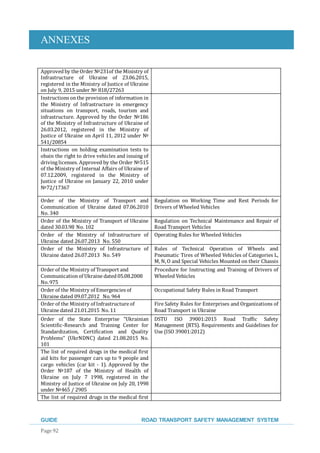
(logbooks and speed);
4) significant roster changes are advised at least 24 hours in advance schedules;
5) rosters and logbooks are kept for a minimum of 18 months dispatchers are aware of
driving hours’ requirements, and are aware of management policy that they not cause drivers
to breach these requirements;
6) drivers are not paid on a mileage basis (this can encourage drivers to drive further and for
longer than they can do safely).
5.9. Process for Continual Improvement of the Safety Management System
Road Transport Safety Management System, in order to be successful, needs creating a
continuous cycle of its improvement. In the scope of safety culture, all members of the
personnel of road transport undertaker must work towards continual improvement of
RTSMS. The sense of the process for continual improvement of the RTSMS is that thanks to
the implementation and operation of this system the organization is continuously learning. In
this process of learning and gaining new experience it is created new knowledge and skills –
very significant in the scope of RTSMS.43
Road haulier is obliged to, on continual basis, monitor the implementation of its safety
management system.
The main objective of the process for continual improvement of RTSMS is verification
whether:
1) the employees or a representative selected by the employees are being involved in
the processes on required level;
43 A. Jabłoński, M. Jabłoński, Monitoringin management systems of safety and maintenance of cargo wagons
in railway transport, “Transport Infrastructure”, No 3, 2014, p. 52.
ROAD TRANSPORT SAFETY MANAGEMENT
SYSTEM COMPONENTS
GUIDE ROAD TRANSPORT SAFETY MANAGEMENT SYSTEM
Page 65
2) the targets established by the road haulier are being achieved;
3) the procedures required under the RTSMS, and whether the safety policy and the
methods and plans are being implemented.
In other words, the process of continual improvement of RTSMS ensures that the
management system is effective. It means that the procedures adopted are efficient, improved
knowledge would have helped to reach better decisions and lessons can be learned for future
assessments and controls, as well as good communication on risk issues.
Monitoring shall include, if applicable,inquiring into:
1) the cause of any deficiencies in the implementation of the road haulier’s safety
management system and any actions being taken to remedy those deficiencies; and
2) the reasons why the targets are not being achieved.
In other words, the top management of the road transport undertaker should carry out a
comprehensive review,at least annually, that should:
• ensure compliance with standards;
• assess suitability and effectiveness of standards;
• ensure the adequacy of risk controls;
• update inadequate procedures from new information, including an updated review of
risks;
• monitor achievement of targets and objectives;
• identify possible trends and issues, as well as improvements required;
• rewardimproved performance and achievement of significant milestones;
• discuss audit results.44
The road haulier shall prepare an annual report setting out the conclusions of its
monitoring activities. This annual report regarding the process of continual improvement of
RTSMS may contain the above mentioned elements.
Evidence for the annual report should be collected from different sources, for instance:
analysis of documentation, interviews with the staff (especially drivers), technical inspection
of vehicles and generally, compliance checks.
44 European Transport Safety Council, Preventing Road Accidents and Injuries for the Safety of Employees,
Project Handbook, p. 24.
ROAD TRANSPORT SAFETY MANAGEMENT
SYSTEM COMPONENTS
GUIDE ROAD TRANSPORT SAFETY MANAGEMENT SYSTEM
Page 66
The process of continual improvement of RTSMS is based on monitoring and review
activities.
Routine, systematic monitoring should include compliance checks which are carried
out on a regular basis to test how well safety rules and standards are being implemented and
observed by staff.
Review processes should be linked into the general operation of the organisation and to
external influences. Road transport carrier should carry out an annual review of audit
findings and their close out and assess the need for changes to the requirements for managing
road transport safety.
continual
improvement
documentation
interviews with staff
technical
inspections
NOTE
Employer should set up clear proceduresand lines
of responsibilityfor carrying out the
monitoring/datacollectionin each of the areas
identified
inputs
output
annual
report
SAFETY AUDIT AND EVALUATION
GUIDE ROAD TRANSPORT SAFETY MANAGEMENT SYSTEM
Page 67
6. Safety Audit and Evaluation
6.1. Purpose and meaning of auditing and evaluation
Even the finest designed road safety management system and high level of safety
culture of the staff of road transport operator do not ensure the success of this safety
management system. There is no doubt that all kind of management systems need to be
reviewed to assess their effectiveness. With that in mind, it should be underlined that the key
to the success of RTSMS are safety audits and evaluations of this system. Safety audits and
evaluations of the RTSMS are vital mechanisms for ensuring that all of the organizational
elements, functions and procedures in the RTSMS are working properly. Moreover, internal
audits and evaluations are one of the key feedback steps for identifying required changes to
the RTSMS.
The main purpose of the safety auditing, as the element of RTSMS, is to evaluate the
extent to which:
1) requirements related to each process have been implemented; and
2) safety policy referred to and the procedures, plans and methods developed by the
road haulier are effective in improving the level of safety of its road transport operations.45
The term “audit” is derived from a Latin word "audire" - "to hear"; because in ancient
times auditors listened to the oral reports of responsible officials (stewards) to owners or
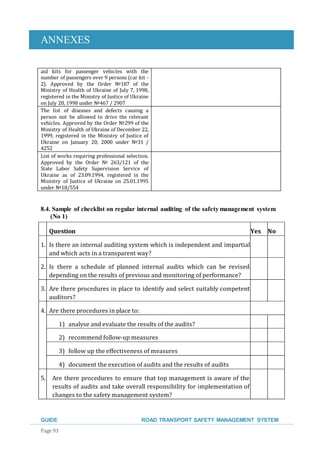
45 See, the draft of the regulationon road traffic safetymanagement system (article19).
SAFETY AUDIT AND EVALUATION
GUIDE ROAD TRANSPORT SAFETY MANAGEMENT SYSTEM
Page 68
those having authority, and confirmed the accuracy of the reports.46
During the medieval
times when manual book-keeping was prevalent, auditors in Britain used to hear the accounts
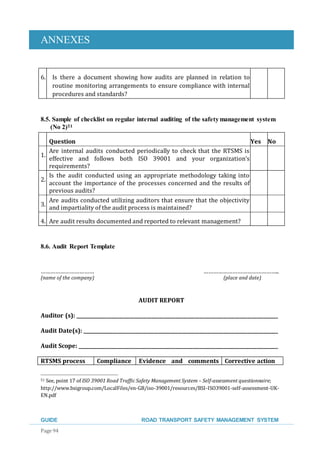
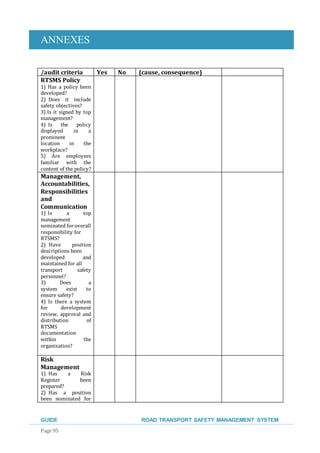
read out for them and checked that the organisation's personnel were not careless or
fraudulent.47
Nowadays an audit is a method used to establish facts and information, including
statistical information, to verify compliance with certain criteria. According to ISO Standard
39001:2012 on Road Traffic Safety, an audit is a „systematic, independent and documented
process for obtaining audit evidence and evaluating it objectively to determine the extent to
which the audit criteria are fulfilled.” The term “internal audit” is defined as “audit
conducted by, or on behalf of, the organisation itself for management review and other
internal processes, and may form the basis for an organisation’s self-declaration of
conformity” (ISO Standard 19011).
When considering the road transport safety management, an audit is a methodical,
planned review of safety management system to confirm that it is working well and to
recognize elements which must be improved. The audit do not ensures only that there are
written policies and procedures, but even more importantly, and that staff and top
management know and understand of these procedures, as well as apply them in practice.
Gap analysis online tools, which have been developed recently, could be very helpful and
used within this process.48
The audit includes an evaluation of the design and effectiveness of the process safety
management system and a field inspection of the safety conditions and practices to verify
that the road transport undertaker introduced the system, which is objectively effective. The
enclosed checklist concerning effectiveness of internal audit process within RTSMS can be
helpful to check if this key element of safety management system in road transport company
is conducted properly (see, annex 8.4 and 8.5).
46 S. K. Basu, Auditing: Principles and Techniques, Delhi 2006, p. 2
47 D. Matthews, History of Auditing. The changing audit processfrom the 19thcenturytill date. Routledge-
Taylor & Francis Group, p. 6.
48www.fleetsafetybenchmarking.net and http://www.roadsafetyatwork.ca/
SAFETY AUDIT AND EVALUATION
GUIDE ROAD TRANSPORT SAFETY MANAGEMENT SYSTEM
Page 69
Safety audits generally cover three areas, showed in the following diagram.
6.2. Types and frequency of audit
There are two basic types of audits: external and internal. For the successful road
transport safety management system the internal audits should play a greater role. According
to ISO 39001:2012 internal audits are the crucial method and tool for continual improvement
of road traffic safety management system. The above mentioned ISO standard requires
performing periodic audits at least once a year or as a consequence of change in situation of
the undertaker. Pursuant to provision of the draft of regulation on road safety management
system, a road haulier shall conduct an audit of its safety management system every two
years.
However, the road transport operator should remember that, notwithstanding those
standard or legal provisions, audit frequency should be determined by the degree of risk and
the results of previous audits and inspections. For instance, if the road transport inspectors
notice the few cases of serious infringements related to social rules of drivers or usage of
tachograph per year, the road transport operator should decide to conduct the internal audit in
every case of such infringement and more frequent than one audit per year.
reviewof
documentation
interviews with
staff and
management
inspection of
work activities
SAFETY AUDIT AND EVALUATION
GUIDE ROAD TRANSPORT SAFETY MANAGEMENT SYSTEM
Page 70
Despite these two above mentioned basic types of the audit (external and internal)
many other types of audits might be applied to a particular road transport undertaker. A
typical audit program should include all specified types of audits. For instance, we can
enumerate baseline audit, scheduled audit (compliance and continuous improvement) or
routine inspections and spot audits focusing on specific issues.
6.3. Stages of the audit
In order to ensure that the audit will be conducted in an effective and efficient way,
every internal audit must be properly planned.
The product of the planning process of the internal audit in road transport company
should be a document called “An audit plan”, which generally identify who, when, and what
the audit will cover. In other words, the outcome of the planning an audit is a written plan,
setting forth the overall audit strategy and the nature, extent and timing of the auditing
activities. Why it is so important not to miss the planning stage and preparing the audit plan?
This stage helps the auditor obtain sufficient appropriate evidence and the audit plan is the
detailed guideline to be followed when conducting an audit. The elements of the audit plan
should cover the answers on the following questions:
What are the audit objectives?
What is the scope of the audit?
When will the audit(s) occur and how long?
Who will conduct the audit (names and surnames of auditors)?
How will the audit be done?
The road haulier shall include, in its safety management system, an audit plan that:
1) defines the scope of each audit;
2) indicates the evaluation criteria to be applied;
3) specifies the method to be used in conducting each evaluation; and
4) sets out the schedule for evaluating each process.
SAFETY AUDIT AND EVALUATION
GUIDE ROAD TRANSPORT SAFETY MANAGEMENT SYSTEM
Page 71
It should be pointed out that the audit plan is not synonymous with audit program,
which is also written document but with the wider scope. The audit program is a kind of
strategy for whole audit process within RTSMS. The essential elements of an audit program
include planning, staffing, conducting the audit, evaluating hazards and deficiencies and
taking corrective action, performing a follow-up and actions taken.
6.4. Performing the audit
An effective safety audit process includes a review of the relevant documentation and
process of RTSMS, inspection of the technical conditions of the vehicles and other staff, and
interviews with all levels of road transport safety management personnel and other
personnel, especially drivers, as well as interviews with contractors and sub-contractors. An
audit is an evidence gathering process. Audit evidence is used to evaluate how well audit
criteria related to the delivery of safety management system are being met. Audits must be
objective, impartial, and independent, and the audit process must be both systematic and
documented.49
Operating the audit procedure and checklist developed in the preplanning stage, the
audit team can systematically analyze compliance with the provisions of the standard and
any other corporate policies that are relevant for RTSMS. For example, the audit team will
review all aspects of the training program for drivers as part of the overall audit of RTSMS.
The team will review the written training program for adequacy of content, frequency of
training, effectiveness of training in terms of its goals and objectives as well as to how it fits
into meeting the standard's requirements. Through interviews, the team can determine
employees' knowledge and awareness of the safety procedures, duties, rules, and emergency
response assignments. During the inspection, the auditors can observe actual practices such
as safety policies, procedures, and work authorization practices. This approach enables the
auditors to identify deficiencies and determine where corrective actions or improvements are
necessary.
49 http://www.praxiom.com/iso-definition.htm
SAFETY AUDIT AND EVALUATION
GUIDE ROAD TRANSPORT SAFETY MANAGEMENT SYSTEM
Page 72
To summarize, auditors performing safety audits of RTSMS should use as the audit
criteria, first of all: a safety policies and procedures of the road transport operator, including
vehicle inspection procedures, disaster response plans and incident report policies. Safety
audits analyze all documentation related to policies and procedures, as well as combing
through previously filed incident reports to ensure that policies and procedures are actually
being carried out. In other words, safety audits compare safety plans to actual accidents and
identified hazards to determine how effective a safety policy actually is in practice.
Examples of the key documents and information that the auditors should use to gain a
good understanding include:
acts and related legislation or regulations,
policies, procedures and standards manuals and directives,
results of previous audits or evaluations,
protocol of road checks and checks at the premise, performed by the road
transport inspectors or other control officers,
organization charts,
job descriptions and delegation instruments,
lists of key personnel,
process and system maps or flowcharts,
operational and financial data and reports,
planning and performance reports,
management meeting reports or minutes,
management control frameworks,
risk-based audit frameworks,
risk assessments,
management studies or reports.
6.5. Reporting
The safety audits and evaluation process should be recorded and well documented. The
documentation confirming the audit should cover especially all elements of RTSMS, which
SAFETY AUDIT AND EVALUATION
GUIDE ROAD TRANSPORT SAFETY MANAGEMENT SYSTEM
Page 73
require corrective action as well as where the RTSMS works properly. This provides a record
of the audit procedures and findings and serves as a baseline of operation data for future
audits. It will assist in determining changes or trends in future audits.
The final product of the reporting stage of the safety audit is the safety audit report.
The auditor indicates in this document all of these areas of RTSMS, where the audit finding
was identified (see, the attached “Audit Report Template” as annex 8.6.).
A road haulier shall prepare an audit report that includes the findings of the audit. The
executive (a member of top management) must sign the audit report to attest to his or her
acceptance of the report.
It is advisable that the audit finding contains of five elements, called: ”5Cs”, such as:
condition (what is the specific problem, identified during the safety audit?), criteria (what is
the safety standard, which was not complied with?), cause (for what reason the specific
problem occurred?), consequence (what is the risk or negative outcome because of the
finding?), corrective action (what should management do about the finding? What have they
agreed to do, by when and who will be responsible for?).
The following diagram presents the structure of the above proposed audit finding.
Audit
finding
condition
criteria
cause
consequence
corrective
action
SAFETY AUDIT AND EVALUATION
GUIDE ROAD TRANSPORT SAFETY MANAGEMENT SYSTEM
Page 74
Corrective action is one of the element of audit report and one of most important parts
of the audit process. It covers identifying deficiencies, planning, following-up and
documenting the corrections. The corrective action process normally begins with a
management review of the audit findings. The purpose of this review is to determine what
actions are appropriate, and to establish priorities, timetables, resource allocations and
requirements, and responsibilities. In some cases, corrective action may involve a simple
change in procedures or a minor maintenance effort to remedy the problem. Management of
change procedures need to be used, as appropriate, even for a apparently insignificant
change. Many of the deficiencies can be acted on promptly, while some may require analysis
and more detailed review of actual procedures and practices. There may be instances where
no action is necessary; this is a valid response to an audit finding. All actions taken,
including an explanation when no action is taken on a finding, need to be documented in
audit report.
Draft of the regulation on road safety management system states, that a road haulier
shall prepare an action plan, setting out the action to be taken to address each finding in the
audit report that it identifies as a deficiency in its safety management system. The action plan
should be signed by the executive to acknowledge that he or she approves it (see, article 19,
paragraph 5 and sic of the draft of the regulation).
The top management of the road transport undertaker must be informed on the safety
audit results, because the top management should guarantee that each audit finding is
addressed, the corrective action to be taken is noted, and the responsible audit person or team
is properly documented. To control the corrective action process, the road transport operator
should consider the use of a tracking system. This tracking system might include periodic
status reports shared with affected levels of management, specific reports such as completion
of an business study, and a final implementation report to provide closure for audit findings
that have been through management of change, if appropriate, and then shared with affected
employees and management. This type of tracking system provides the operator with the
status of the corrective action. It also provides the documentation required to verify that
appropriate corrective actions were taken on deficiencies identified in the audit.
SAFETY AUDIT AND EVALUATION
GUIDE ROAD TRANSPORT SAFETY MANAGEMENT SYSTEM
Page 75
6.6. Auditors
The selection of effective auditor or auditors is essential to the success of the safety
auditing process. Auditors should be chosen for their experience, knowledge, and training
and should be familiar with the processes and auditing techniques, practices, and procedures.
It is advisable to prove the suitable knowledge and skills by the certificate of the specialized
notified training organization.
Audits can be conducted by a “team” (for instance, a group of staff or managers) or
particular elements of the system can be conducted by different managers or staff. Larger
road transport operators may consider engaging an external safety consultant to conduct the
audit. The audit should be conducted or led by a person knowledgeable in audit techniques
who is impartial towards the facility or area being audited. In other words, auditors must be
competent and experienced in the issues they are assessing and also skilled and adequately
prepared and trained to perform audit activity.
The golden rule of internal audits, regarding the staff performed these activities, is
requirement that the audit should be objective and independent. Audits should be carried out
in an impartial, independent and transparent way: auditors should be independent from the
organisational unit being audited and conflict of interest between the assessing and the
assessed party should be avoided.
SAFETY AUDIT AND EVALUATION
GUIDE ROAD TRANSPORT SAFETY MANAGEMENT SYSTEM
Page 76
6.7. Evaluation
An audit is a kind of the evaluation of a road transport safety management system for
the purpose of determining its validity and authenticity, as well as to verify adherence to a set
of pre-defined processes. However, an evaluation is the determination of quality and
effectiveness of implemented road transport safety management system; it judges the
efficiency of the system.
For that reason, the road transport safety management system should also contain
periodic evaluations of it to ensure the continued suitability, adequacy and effectiveness of
the policy, annual safety targets, procedures and other components of the system, taking into
account changing circumstances and the results of compliance evaluations, risk assessments,
accident or incident investigations, safety performance analyses and audits. It is also very
important to ensure the proper feedback gathered from employees and other relevant
stakeholders, as well as consideration and approval of evaluation reports and the resulting
recommendations by top management.
NOTE: audit can not be performed by managament
or by person (s) responsible for the audited area
audit should
be
independent
& objective
SAFETY AUDIT AND EVALUATION
GUIDE ROAD TRANSPORT SAFETY MANAGEMENT SYSTEM
Page 77
A road haulier shall preserve a record of the factors taken into account in, and the
results of, inter alia: each evaluation conducted under the provisions of this regulation. This
record must include the date on which the evaluation was undertaken.
Regarding the RTSMS and its main objective, the most important process concerning
the evaluation, is the evaluation of defined risk. The most useful for the RTSMS rules related
to evaluation of risk are as follows:
risk of serious accidents is the same danger for road safety than in other countries;
“daily risks” should not increase significantly as a result of human participation in road
traffic;
road transport investments should be followed by tests whether there are alternatives in
order to get the same transport effect with lower risk;
means to improve road safety should be invested where they bring the best results;
for the evaluation of risk in repetitive situations it is necessary to use professional
experience;
professional standards - their weight is considered in each procedure of risk acceptance;
in-depth principle: the principle according to which no safety mean is perfect and
therefore requires the application of several protective measures (barriers, layers).50
50 Z. Łukasik, A. Szymanek, Safety and risk (…), op. cit., p. 90.
DOCUMENTATION
GUIDE ROAD TRANSPORT SAFETY MANAGEMENT SYSTEM
Page 78
7. Documentation
7.1. The obligation and scope of documentation
Road Safety Management System is a system proven by the specified documentation. It
is understandable that not every activity shall be recorded and documented within RTSMS.
The obligation of documentation covers only the main elements of safety management
system, such as:
1) programmes of road safety improvement of the road transport undertaker, describing
quantitative and qualitative targets of the organisation for the maintenance of the required
level of safety and the way of communication information described in programmes to the
employees;
2) a safety policy approved by the organisation’s chief executive and communicated to
all staff;
3) plans for reaching targets described in programmes of road safety improvement and
or the achievement of the objectives adopted in the improvement of safety and the fulfilment
of the conditions laid down in the legal acts relating to the road transport safety;
4) procedures and methods for carrying out risk evaluation and implementing risk
control measures whenever a change of the operating conditions or new material imposes
new risks on the infrastructure or on operations;
5) provision of programmes for managing knowledge of staff and systems to ensure that
the staff’s competence is maintained and tasks carried out accordingly;
6) arrangements for the provision of sufficient information within the organisation and,
where appropriate, between organisations operating on the same infrastructure;
7) procedures for reporting and documenting all the accidents and incidents to ensure
that all were reported and investigated in order to identify and implement preventive actions;
8) provisions for recurrent internal auditing of the safety management system;
DOCUMENTATION
GUIDE ROAD TRANSPORT SAFETY MANAGEMENT SYSTEM
Page 79
9) other provision of plans for action and alerts and information in case of emergency.
These basic elements of safety management system, including procedures, plans and
methods on processes, shall be proved by the documentation, with description of liability in
organizational structures of road haulier.
The documentation of road transport safety management system should indicate first of
all:
1) the way of supervision by the management of road haulier on the safety management
system at every stage of management;
2) the level of participation of the employees and representatives of the management at every
level;
3) the way of assurance of the continuous development of safety management system.
A road haulier shall store and preserve the records of the documentation for five years
after the day on which they are created.
documentation
on RTSMS
description &
evidenceof
supervisionon
RTSMS
description &
evidenceof staff
engagementin
RTSMS
description &
evidence of
developmentof
RTSMS
DOCUMENTATION
GUIDE ROAD TRANSPORT SAFETY MANAGEMENT SYSTEM
Page 80
7.2. Review, analysis and evaluation
One of the obligation of road transport undertaker within road transport safety
management system is to preserve a record of the factors taken into account in, and the
results of, especially:
1) the annual review of its safety policy;
2) each analysis conducted in the scope of road transport safety management system;
3) each evaluation conducted in the scope of road transport safety management system.
This record must include the date on which the review, analysis or evaluation was
undertaken, as well as name and surname of the person, who made it and his or her signature.
Additionally, for each case in which a road haulier consults, communicates or
collaborates with employees or a representative selected by employees, the road transport
operator prepare a record of the date and subject matter of the consultation, communication
or collaboration and the manner in which it was carried out.
7.3. Specified documents
A road haulier shall preserve the following records:
1) the documentation relating to the risk assessment process;
2) the written description of each initiative to be implemented in order to achieve each target
and a written explanation of how the initiative will contribute to achieving that target;
3) the annual report setting out the conclusions of monitoring activities;
4) the audit plan;
5) the signed audit report;
6) the approved action plan setting out the action to be taken to address each finding in the
audit report that it identifies as a deficiency in its safety management system.
ANNEXES
GUIDE ROAD TRANSPORT SAFETY MANAGEMENT SYSTEM
Page 81
8. Annexes
8.1. EU legislation related to safety in road transport
1. ACCESS TO THE MARKET
1.1. Regulation (EC) No 1071/2009 of the European Parliament and of the Council of 21 October 2009
establishing common rules concerning the conditions to be complied with to pursue the occupation
of road transport operator and repealing Council Directive 96/26/EC (O.J. L 300 , 14.11.2009 P. 0051
– 0071)
1.2. Regulation(EC)No 1072/2009 of the European Parliament andof the Council of 21 October 2009 on
common rules for access to the international road haulage market (O.J. L 300 , 14.11.2009 P. 0072 –
0087)
1.3. Regulation(EC)No 1073/2009 of the European Parliament andof the Council of 21 October 2009 on
common rules for access to the international market for coach and bus services, and amending
Regulation (EC) No 561/2006 (O.J. L 300 , 14.11.2009 P. 0088 – 0105)
1.4. Commission Implementing Regulation (EU) 2016/480 of 1 April 2016 establishing common rules
concerning the interconnection of national electronic registers on road transport undertakings and
repealing Regulation (EU) No 1213/2010 (O.J. L 87, 02.04.2016, P. 4)
1.5. Commission Regulation (EU) 2016/403 of 18 March 2016 supplementing Regulation (EC) No
1071/2009 of the EuropeanParliament and of the Council with regardto the classification of serious
infringements of the Union rules, which may lead to the loss of good repute by the road transport
operator, and amending Annex III to Directive 2006/22/EC of the European Parliament and of the
Council (O.J. L 74, 19.3.2016, P. 8)
1.6. Commission Regulation (EU) No 1213/2010 of 16 December 2010 establishing common rules
concerning the interconnectionof national electronicregisters on road transport undertakings (O.J. L
335, 18.12.2010, P. 0021 – 0029)
1.7. Commission Decision of 17 December 2009 on minimum requirements for the data to be entered in
the national electronic register of road transport undertakings (O.J. L 339, 22.12.2009, P. 0036 –
0039)
1.8. Commission Regulation (EU) No 612/2012 of 9 July 2012 amending Annexes II and III to Regulation
(EC)No 1072/2009 of the European Parliament andof the Council oncommonrules for access to the
international road haulage market (O.J. L 178, 10.07.2012, P. 5)
1.9. Commission Regulation (EU) No 361/2014 of 9 April 2014 laying down detailed rules for the
application of Regulation (EC) No 1073/2009 as regards documents for the international carriage of
passengers by coach and bus and repealing Commission Regulation (EC) No 2121/98 (O.J. L 107,
10.04.2014, P. 39)
ANNEXES
GUIDE ROAD TRANSPORT SAFETY MANAGEMENT SYSTEM
Page 82
1.10. Decision No 357/2009/EC of the European Parliament and of the Council of 22 April 2009 on a
procedure for prior examination and consultation in respect of certain laws, regulations and
administrative provisions concerning transport proposed in Member States (O.J. L 109, 30.04.2009 P.
0037 – 0039)
1.11. Commission Regulation (EC) No 792/94 of 8 April 1994 laying down detailed rules for the
applicationof Council Regulation (EEC) No 3118/93 to road haulage operators on own account (O. J.
L 092, 09.04.1994, P. 0013 – 0013)
1.12. Council Regulation (EEC) No 56/83 of 16 December 1982 concerning the implementation of the
Agreement on the international carriage of passengers by roadby means of occasional coach and bus
services (ASOR), (O. J. L 010, 13.01.1983, P. 0001 – 0003)
1.13. 87/286/EEC: Council Decision of 26 May 1987 on the application between the Community and
Switzerland of the provisions laid down in Sections II and III of the Agreement on the International
Carriage of Passengers by Road by means of Occasional Coach and Bus Services (ASOR), (O.J. L 143,
03.06.1987, P. 0032 – 0032)
1.14. Directive 2006/1/EC of the European Parliament and of the Council of 18 January 2006 on the
use of vehicles hired without drivers for the carriage of goods by road (codified version) Text with
EEA relevance (O.J. L 033, 04.02.2006, P. 0082 – 0085)
1.15. Council Regulation (EEC) No 3626/84 of 19 December 1984 amending Regulation No 11
concerning the abolition of discrimination in transport rates and conditions, in implementation of
Article 79 (3) of the Treaty establishing the European Economic Community (O.J. L 335, 22.12.1984,
P. 0004 – 0004)
1.16. Council Regulation (EEC) No 3916/90 of 21 December 1990 on measures to be taken in the
event of a crisis inthe market in the carriage of goods by road (O.J. L 375, 31.12.1990, P. 0010 – 0011)
1.17. Regulation (EC) No 2888/2000 of the European Parliament and of the Council of 18 December
2000 on the distribution of permits for heavy goods vehicles travelling in Switzerland (O.J. L 336,
30.12.2000, P. 0009 – 0013)
1.18. Commission Regulation (EC) No 3298/94 of 21 December 1994 laying down detailed measures
concerning the system of Rights of Transit (Ecopoints) for heavy goods vehicles transiting through
Austria,established by Article 11 of Protocolno 9 to the Act of Accession of Norway, Austria, Finland
and Sweden (O. J. L 341, 30.12.1994, P. 0020 – 0036)
2. ORGANISATION OF WORKING TIMEIN RESPECT OF ROAD TRANSPORT ACTIVITIES AND
SOCIAL LEGISLATIONOF DRIVERS
2.1. Directive 2002/15/EC of the European Parliament and of the Council of 11 March 2002 on the
organisation of working time of persons performing mobile road transport activities.
2.2. Directive 2006/22/EC of the European Parliament and of the Council of 15 March 2006 on minimum
conditions for the implementation of Council Regulations (EEC) No 3820/85 and (EEC) No 3821/85
ANNEXES
GUIDE ROAD TRANSPORT SAFETY MANAGEMENT SYSTEM
Page 83
concerning social legislation relating to road transport activities and repealing Council Directive
88/599/EEC (Text with EEA relevance) - Declarations (O.J. L 102, 11.04.2006, P. 0035 – 0044)
2.3. Commission Regulation (EU) 2016/403 of 18 March 2016 supplementing Regulation (EC) No
1071/2009 of the EuropeanParliament and of the Council with regardto the classification of serious
infringements of the Union rules, which may lead to the loss of good repute by the road transport
operator, and amending Annex III to Directive 2006/22/EC of the European Parliament and of the
Council (O.J. L 74, 19.3.2016, P. 8)
2.4. Regulation (EC) No 561/2006 of the European Parliament and of the Council of 15 March 2006 on
the harmonisation of certain social legislation relating to road transport and amending Council
Regulations (EEC) No 3821/85 and (EC) No 2135/98 and repealing Council Regulation (EEC) No
3820/85.
2.5. Commission Decision of 22 September 2008 drawing up the standard reporting form referred to in
Article 17 of Regulation (EC) No 561/2006 of the European Parliament and of the Council (notified
under document C(2008) 5123), (O.J. L 289 , 05/11/2009 P. 0009 – 0015)
2.6. 93/172/EEC: Commission Decision of 22 February 1993 drawing up the standard reporting form
provided for in Article 6 of Council Directive 88/599/EEC concerning road transport (O.J. L 72,
25.03.1993, P. 30 – 32)
3. RECORDING DEVICES
3.1. Regulation (EU) no 165/2014 of the European Parliament and of the Council of 4 February 2014 on
tachographs in road transport, repealing Council Regulation (EEC) No 3821/85 on recording
equipment in road transport and amending Regulation (EC) No 561/2006 of the European
Parliament and of the Council on the harmonisation of certain social legislation relating to road
transport (O.J. L 60, 28.2.2014, P. 0001-0033)
3.2. Commission Implementing Regulation (EU) 2016/799 of 18 March 2016 implementing Regulation
(EU) No 165/2014 of the European Parliament and of the Council laying down the requirements for
the construction,testing,installation,operationand repair of tachographs and their components (O.J.
L 139, 26.5.2016, P. 1)
3.3. CommissionImplementing Regulation(EU)2016/68 of 21 January 2016 oncommon procedures and
specifications necessary for the interconnection of electronic registers of driver cards (O.J. L 15,
22.1.2016, P. 51)
3.4. CommissionRecommendationof 13 January 2010 on the secure exchange of electronic data between
Member States to check the uniqueness of driver cards that they issue (O.J. L 9 , 14.01.2010, P. 0010 –
0013)
3.5. Commission Regulation (EU) No 581/2010 of 1 July 2010 on the maximum periods for the
downloading of relevant data from vehicle units and from driver cards (O.J. L 168 , 02/07/2010 P.
0016 – 0016)
3.6. Commission Recommendation of 23 January 2009 on guidelines for best enforcement practice
concerning checks of recording equipment to be carried out at roadside checks and by authorised
ANNEXES
GUIDE ROAD TRANSPORT SAFETY MANAGEMENT SYSTEM
Page 84
workshops (O.J. L 21, 24.01.2009, P. 0087 – 0099)
3.7. Commission Decision of 12 April 2007 on a form concerning social legislation relating to road
transport activities (O.J. L 099, 14.04.2007, P. 0014 – 0015)
4. DRIVERS
4.1. Directive 2003/59/EC of the European Parliament and of the Council of 15 July 2003 on the initial
qualification and periodic training of drivers of certain road vehicles for the carriage of goods or
passengers, amending Council Regulation(EEC) No 3820/85 and Council Directive 91/439/EEC and
repealing Council Directive 76/914/EEC (O.J. L 226 , 10.09.2003, P. 0004 – 0017)
4.2. Directive 2006/126/EC of the European Parliament and of the Council of 20 December 2006 on
driving licences (Recast) (O. J. L 403, 30.12.2006, P. 0018 – 0060)
4.3. Commission Regulation (EU) No 383/2012 of 4 May 2012 laying down technical requirements with
regard to driving licences which include a storage medium (microchip), (O.J. L 120, 05.05.2012, P. 1)
4.4. CommissionDecisionof 20 March 2014 on equivalences betweencategories of driving licences (O.J. L
120, 23.04.2014, P. 1)
5. MOTOR VEHICLES WITH TRAILERS AND ROADWORTHINESS TEST
5.1. Council Directive 96/53/EC of 25 July 1996 laying down for certain road vehicles circulating within
the Community the maximum authorized dimensions in national and international traffic and the
maximum authorized weights in international traffic (O.J. L 235, 17.09.1996, P. 0059 – 0075)
5.2. Council Directive 96/96/EC of 20 December 1996 on the approximation of the laws of the Member
States relating to roadworthiness tests for motor vehicles and their trailers.
5.3. Council Directive 92/6/EEC of 10 February 1992 on the installation and use of speed limitation
devices for certain categories of motor vehicles in the Community (O.J. L 057, 02.03.1992, P. 0027 –
0028)
5.4. Directive 2014/47/EU of the European Parliament and of the Council of 3 April 2014 on the technical
roadside inspection of the roadworthiness of commercial vehicles circulating in the Union and
repealing Directive 2000/30/EC (O. J. L 127, 29.04.2014, P. 134)
5.5. Directive 2000/30/EC of the European Parliament and of the Council of 6 June 2000 on the technical
roadside inspectionof the roadworthiness of commercial vehicles circulating in the Community (O.J.
L 203, 10.08.2000, P. 1)
5.6. Commission Recommendation of 5 July 2010 on the assessment of defects during roadworthiness
testing in accordance with Directive 2009/40/EC of the European Parliament and of the Council on
roadworthiness tests for motor vehicles and their trailers (O.J. L 173, 08.07.2010, P. 0074 – 0096)
5.7. Commission Recommendation of 5 July 2010 on the risk assessment of deficiencies detected during
ANNEXES
GUIDE ROAD TRANSPORT SAFETY MANAGEMENT SYSTEM
Page 85
technical roadside inspections (of commercial vehicles)in accordance with Directive 2000/30/EC of
the European Parliament and of the Council (O.J. L 173, 08.07.2010, P. 0097 – 0105)
5.8. Council Directive 92/6/EEC of 10 February 1992 on the installation and use of speed limitation
devices for certain categories of motor vehicles in the Community (O.J. L 057, 02.03.1992, P. 0027 –
0028)
5.9. Directive 2007/46/EC of the European Parliament and of the Council of 5 September 2007
establishing a framework for the approval of motor vehicles and their trailers, and of systems,
components and separate technical units intended for such vehicles (Framework Directive); (O.J. L
263, 09.10.2007, P. 0001 – 0160)
5.10. Commission Regulation (EU) 2015/166 of 3 February 2015 supplementing and amending
Regulation(EC)No 661/2009 of the European Parliament andof the Council as regards the inclusion
of specific procedures, assessment methods and technical requirements, and amending Directive
2007/46/EC of the European Parliament and of the Council, and Commission Regulations (EU) No
1003/2010, (EU) No 109/2011 and (EU) No 458/2011 (O.J. L 28, 04.02.2015, P. 3)
5.11. Commission Regulation (EU) No 1230/2012 of 12 December 2012 implementing Regulation (EC)
No 661/2009 of the European Parliament and of the Council with regard to type-approval
requirements for masses and dimensions of motor vehicles andtheir trailers and amending Directive
2007/46/EC of the European Parliament and of the Council (O.J. L 353, 21.12.2012, P. 31)
5.12. Commission Regulation (EU) No 582/2011 of 25 May 2011 implementing and amending
Regulation (EC) No 595/2009 of the European Parliament and of the Council with respect to
emissions from heavy duty vehicles (Euro VI) and amending Annexes I and III to Directive
2007/46/EC of the European Parliament and of the Council (O.J. L 167, 25.06.2011, P. 0001 – 0168)
6. ROAD TRAFFIC SAFETY
6.1. Directive 2008/96/EC of the European Parliament and of the Council of 19 November 2008 on road
infrastructure safety management (O.J. L 319 , 29/11/2008 P. 0059 – 0067)
6.2. 93/704/EC: Council Decision of 30 November 1993 on the creation of a Community database on
road accidents (O.J. L 329, 30.12.1993, P. 0063 – 0065)
6.3. Directive (EU)2015/413 of the European Parliament andof the Council of 11 March 2015 facilitating
cross-border exchange of information on road-safety-related traffic offences (O.J. L 68, 13.03.2015, P.
9)
7. TRANSPORT OF DANGEROUS GOODS BY ROAD
7.1. Council Directive 95/50/EC of 6 October 1995 on uniform procedures for checks on the transport of
dangerous goods by road (O. J. L 249, 17.10.1995, P. 0035 – 0040)
7.2. Directive 2008/54/EC of the European Parliament and of the Council of 17 June 2008 amending
Council Directive 95/50/EC on uniform procedures for checks on the transport of dangerous goods
ANNEXES
GUIDE ROAD TRANSPORT SAFETY MANAGEMENT SYSTEM
Page 86
by road, as regards the implementing powers conferred on the Commission (O.J. L 162, 21.06.2008, P.
0011 – 0012)
7.3. Commission Directive 2004/112/EC of 13 December 2004 adapting to technical progress Council
Directive 95/50/EC on uniform procedures for checks on the transport of dangerous goods by road
(O.J. L 367, 14.12.2004, P. 0023 – 0028)
7.4. Directive 2001/26/EC of the European Parliament and of the Council of 7 May 2001 amending
Council Directive 95/50/EC on uniform procedures for checks on the transport of dangerous goods
by road (O.J. L 168, 23.06.2001, P. 0023 – 0024)
8. ROAD TRANSPORT OF WASTE
8.1. Regulation (EC) No 1013/2006 of the European Parliament and of the Council of 14 June 2006 on
shipments of waste (O.J. L 190, 12.07.2006, P. 0001 – 0036)
8.2. Commission Regulation (EC) No 1418/2007 of 29 November 2007 concerning the export for
recovery of certainwaste listedinAnnex III or IIIAto Regulation(EC)No 1013/2006 of the European
Parliament and of the Council to certain countries to which the OECD Decision on the control of
transboundary movements of wastes does not apply (O.J. L 316, 04.12.2007, P. 0006 – 0052)
8.3. 90/170/EEC: Council Decision of 2 April 1990 on the acceptance by the European Economic
Community of an OECD Decision/recommendation on the control of trans frontier movements of
hazardous wastes (O.J. L 092, 07.04.1990, P. 0052 – 0053)
9. ROAD TRANSPORT OF ANIMALS
9.1. Council Regulation (EC) No 1/2005 of 22 December 2004 on the protection of animals during
transport and related operations and amending Directives 64/432/EEC and 93/119/EC and
Regulation (EC) No 1255/97 (O.J. L 003 , 05.01.2005, P. 0001 – 0037)
9.2. Commission Implementing Decision of 18 April 2013 on annual reports on non-discriminatory
inspections carried out pursuant to Council Regulation (EC) No 1/2005 on the protection of animals
during transport and related operations and amending Directives 64/432/EEC and 93/119/EC and
Regulation (EC) No 1255/97 (O.J. L 111, 23.04.2013, P. 7)
8.2. International law on safetyin road transport
1. RULES OF INTERNATIONAL TRANSPORT BY ROAD
1.1. Convention on the Contract for the International Carriage of Goods by Road (CMR), done in Geneva,
19.05.1956
1.2. Agreement between the Government of The Republic of Poland and the Government of The Republic
of Ukraine on international carriages by road, done in Warsaw on 18.05.1992
2. ORGANISATION OF WORKING CREWS OF VEHICLES ANDRECORDING DEVICES
ANNEXES
GUIDE ROAD TRANSPORT SAFETY MANAGEMENT SYSTEM
Page 87
2.1. European Agreement concerning the Work of Crews of Vehicles Engaged in International Road
Transport (AETR), done at Geneva on 1 July 1970 (Consolidated text, version 2006, document
ECE/TRANS/SC. 1/2006/2)
3. ROAD TRAFFIC
3.1. Convention on Road Traffic, done at Vienna on 8 of November 1968
3.2. European Agreement supplementing the Convention on road traffic opened for signature at Vienna
on 8 of November 1968, done at Geneva on 1 May of 1971
3.3. Convention on Road Signs and Signals, done at Vienna on 8 of November 1968
3.4. Convention on the law applicable to traffic accidents, done at Hague, 4 May of 1971
4. TECHNICAL CONDITIONS OF VEHICLES AND ROADWORTHINESS TEST
4.1. Agreement Concerning the Adoption of Uniform Technical Prescriptions for Wheeled Vehicles,
equipment and parts which can be fitted and/ or be used on Wheeled Vehicles and the conditions for
Reciprocal Recognitions of Approvals Granted on the basis of this prescriptions, done at Geneva on
20 March of 1958
5. TRANSPORT OF DANGEROUS GOODS BY ROAD
5.1. The European Agreement concerning the International Carriage of Dangerous Goods by Road (ADR)
was done at Geneva on 30 September 1957 under the auspices of the United Nations Economic
Commission for Europe, and it entered into force on 29 January 1968
6. TRANSPORT OF CARRIAGE OF PERISHABLE FOODSTUFFS
6.1. The Agreement on the International Carriage of Perishable Foodstuffs and on the Special Equipment
to be used for such Carriage (ATP) done at Geneva on 1 September 1970
8.3. List of Ukrainian legal acts regarding road safety
Legal act (Laws, Presidential
Decrees, Governmental Resolutions,
Rules, Instructions etc.)
Subject
Constitutionof Ukraine
Civil Code of Ukraine
Labor Code of Ukraine
Code of Civil Protectionof Ukraine
Code of Ukraine on Administrative Offences
Criminal Code of Ukraine
Shipping
Roadtransport
RoadTraffic
Roads
National Police
ANNEXES
GUIDE ROAD TRANSPORT SAFETY MANAGEMENT SYSTEM
Page 88
Transportationof Dangerous Goods
Licensing of economic activities
Government Oversight of Economic Activities.
Labour Protection
Insurance
Obligatory Insurance of Civil Liabilities of
Vehicle Owners
Some Issues of Import to the Customs
Territory of Ukraine andRegistrationof
Vehicles
Accessionof Ukraine to the Agreement on the
Adoptionof Unified Technical Prescriptions for
WheeledVehicles,Equipment and Parts which
canbe fittedand / or used on Wheeled
Vehicles and on Conditions for Reciprocal
Recognitionof Official Approvals Grantedon
the Basis of these Prescriptions as of 1958,
amended in1995
Accessionof Ukraine to the European
Agreement concerning the International
Carriage of Dangerous Goods by Road(ADR)
Accessionof Ukraine to the European
Agreement concerning the Work of Crews of
Vehicles Engaged in International Road
Transport (AETR)
(RoadTransport) Convention,1979 (No. 153) Ratification of Hours of Work and Rest Periods
Order of the Ministry of Infrastructure of
Ukraine dated 23.06.2015 No.231
Procedure of Technical Investigation of Accidents,
Catastrophies and Events on Road and Urban Electric
(Tram, Trolley) Transport
Decree of the President of Ukraine
№ 159/2006 of 28.02.2006
On approval of the Agreement on the acceptance of
the conditions of periodic technical inspection of
vehicles and reciprocal recognition of such
inspections
Decree of the President of Ukraine
№567/2005 of 30.03.2005
On measures to streamline the use of special light and
sound signaling devices and license plates for official
vehicles
Resolution of the Cabinet of Ministers of
Ukraine #47 of 31.01.1992
On approval of samples of national and international
driving licenses and documents required for vehicle
registration
Resolution of the Cabinet of Ministers of
Ukraine #340 of 08.05.1993
Regulations on the procedure for issuing driver's
licenses and admission of citizens to drive vehicles
Resolution of the Cabinet of Ministers of
Ukraine №198 of 30.03.1994
Unified Rules for repair and maintenance of roads,
streets, railway crossings, rules of their use and
protection
Resolution of the Cabinet of Ministers of
Ukraine №227 of 05.04.1994.
Regulationonthe road safety service of the ministries
and other central executive authorities, enterprises,
associations, institutions and organizations
ANNEXES
GUIDE ROAD TRANSPORT SAFETY MANAGEMENT SYSTEM
Page 89
Resolution of the Cabinet of Ministers of
Ukraine №568 of 31.07.1995
On harmonization of regulatory documentation for
construction vehicles
Resolution of the Cabinet of Ministers of
Ukraine №959 as of 14.07.1996
Provisions on compulsory personal insurance from
transport accidents
Resolution of the Cabinet of Ministers of
Ukraine №1128 of 08.10.1997
On ensuring the vehicles with primary fire-
extinguishing appliances
Resolution of the Cabinet of Ministers of
Ukraine №1238 as of 06.11.1997
On mandatory preventive drug test and the procedure
for its implementation
Resolution of the Cabinet of Ministers of
Ukraine #1388 of 07.09.1998
The rules of state registration of cars, buses, and self-
propelled vehicles, cars and motorcycles of all types,
brands and models of trailers, semi-trailers and
sidecars designed on the chassis
Resolution of the Cabinet of Ministers of
Ukraine №1465 of 27.09.2000
Procedure of mandatory preliminary and periodic
psychiatric examinations
Resolution of the Cabinet of Ministers of
Ukraine №30 of 18.01.2001
Pasage terms of large and heavy vehicles on roads,
streets and railroad crossings.
Resolution of the Cabinet of Ministers of
Ukraine №1306 of 10.10.2001
Traffic rules.
Resolution of the Cabinet of Ministers of
Ukraine №733 of 01.06.2002
Procedures and rules of mandatory insurance of
dangerous goods transportation subjects in the event
of adverse effects during the transportation of
dangerous goods.
Resolution of the Cabinet of Ministers of
Ukraine №1081 as of 03.12.2008
The procedure of competition for passenger
transportation on the bus route of common use.
Resolution of the Cabinet of Ministers of
Ukraine # 790 of 03.09.2008
On approval of criterion sharing for undertakings
subject to risk of their activities in the field of road
transport and determining the frequency of State
Supervision (Control).
Resolution of the Cabinet of Ministers of
Ukraine #270 of 22.03.2001
Investigation and accounting procedure for accidents
of nonproduction nature.
Resolution of the Cabinet of Ministers of
Ukraine № 207 of 25.02.2009
List of required documents for road transport cargo
transportation of internal connection.
Resolution of the Cabinet of Ministers of
Ukraine № 137 of 30.01.2012
Procedure of obligatory technical control and
examination scope of technical cnditions of vehicles
Resolution of the Cabinet of Ministers of
Ukraine № 607 of 21.07.2010
Order of vehicles’ reequipping
Resolution of the Cabinet of Ministers of
Ukraine dated 08.11.2006 No. 1567
Procedure for State Control on Road Transport
Resolutionof the Cabinet of Ministers of
Ukraine dated 18.02.1997 No. 176
General Conditions for Provisioning of Road
Transport Services for Passengers.
Resolution of the Cabinet of Ministers of
Ukraine dated 02.12.2015 No. 1001
Licensing Conditions for the Business of
Transportation of Passengers, Dangerous Goods and
Hazardous Waste by Road, International
Transportation of Passengers and Goods by Road
ANNEXES
GUIDE ROAD TRANSPORT SAFETY MANAGEMENT SYSTEM
Page 90
Regulation for wheeled vehicles. Approved by
the Ministry of Infrastructure of Ukraine Order
№550 as of 26.07.2013, registered in the
Ministry of Justice of Ukraine on August 22,
2013 under the №1453/23985.
Rules of technical operation of wheels and
pneumatic tires of wheeled vehicles of
categories L, M, N, O and special vehicles,
designed on their chassis. Approved by the
Ministry of Infrastructure of Ukraine Order
№549 of 26.07.2013, registered in the
Ministry of Justice of Ukraine on August 22,
2013 under the №1452/23984
Safety rules for road transport. Order #964 as
of 09.07.2012 of the Ministry of Emergencies
of Ukraine,registeredin the Ministry of Justice
of Ukraine on August 1, 2012 under the
#1299/21611
Rules of road transportation of goods.
Approved by the Order №363 of the Ministry
of Transport of Ukraine of October 14, 1997,
registered in the Ministry of Justice of Ukraine
on February 20, 1998 under №128 / 2568.
Terms for provision of maintenance and repair
of motor vehicles. Approved by the Order
№792 of the Ministry of Transport of Ukraine
of November 11, 2002, registered in the
Ministry of Justice of Ukraine on February 17,
2003 under №122 / 7443
Rules of the road transportation of dangerous
goods. Approved by the Order №822 of the
Ministry of Internal Affairs of Ukraine of 26
July 2004, registered in the Ministry of Justice
of Ukraine on August 20, 2004 under №1040 /
9639
The rules of fire safety for enterprises and
organizations of road transport in Ukraine.
Approved by the Order №101 of the Ministry
of Infrastructure of Ukraine of 21.01.2015,
registered in the Ministry of Justice of Ukraine
on March 12, 2015 under № 279/26724
Regulations on the procedure of training,
retraining and advanced training for drivers.
Approvedby the Order №22 of the Ministry of
Education of Ukraine of January 25, 1994,
registered in the Ministry of Justice of Ukraine
under №39/248
Regulations onmaintenance and repair of road
transport vehicles. Approved by the Order
№102 of the Ministry of Transport of Ukraine
ANNEXES
GUIDE ROAD TRANSPORT SAFETY MANAGEMENT SYSTEM
Page 91
of March 30, 1998, registered in the Ministry
of Justice of Ukraine on April 28, 1998 under
№268 / 2708
Regulations on the medical examination of
candidates for drivers and drivers of vehicles.
Approved by the Order № 65/80 of the
Ministry of Health, Ministry of Internal Affairs
of Ukraine of 31.01.2013, registered in the
Ministry of Justice of Ukraine on February 22,
2013 under №308/22840
Regulations on driving period and rest period
for wheeled vehicles drivers. Approved by the
Order №975 of the Ministry of Transport and
Communications of Ukraine of 05.08.2008,
registered in the Ministry of Justice of Ukraine
on September 14, 2010 under № 811/18106
Regulations on the peculiarities of contracts
conclusion on insurance of civil liability of
vehicle owners. Approved by the Resolution
№5619 of the State Commission for
Regulation of Financial Services Markets of
Ukraine of April 11, 2006, registered in the
Ministry of Justice of Ukraine on May 4, 2006
under №515 / 12389
Procedure for medical training of drivers and
candidates for drivers of vehicles.Approvedby
the Order №339 of the Ministry of Health of
Ukraine of November 28, 1997, registered in
the Ministry of Justice of Ukraine on December
11, 1997 under №591 / 2395
The procedure and conditions of carriage of
passengers and goods by road. Approved by
Order №21 of the Ministry of Transport of
Ukraine of 21 January 1998, registered in the
Ministry of Justice of Ukraine on April 22,
1998 under №257 / 2697
Procedure of elaboraion and approval of the
bus route datasheet. Approved by the Order
№278 of the Ministry of Transport and
Communications of Ukraine of 07.05.2010
number, registered in the Ministry of Justice of
Ukraine on June 17, 2010 under № 408/17703
Procedure for instructing and training of
motor vehicles drivers.Approved by the Order
№975 of the Ministry of Transport and
Communications of Ukraine of 05.08.2008,
registered in the Ministry of Justice of Ukraine
on August 21, 2008 under № 776/15467
Procedure of technical investigation of
accidents, disasters, accidents on the road and
urban electric (tram, trolley bus) transport.
ANNEXES
GUIDE ROAD TRANSPORT SAFETY MANAGEMENT SYSTEM
Page 92
Approvedby the Order №231of the Ministry of
Infrastructure of Ukraine of 23.06.2015,
registered in the Ministry of Justice of Ukraine
on July 9, 2015 under № 818/27263
Instructions onthe provision of information in
the Ministry of Infrastructure in emergency
situations on transport, roads, tourism and
infrastructure. Approved by the Order №186
of the Ministry of Infrastructure of Ukraine of
26.03.2012, registered in the Ministry of
Justice of Ukraine on April 11, 2012 under №
541/20854
Instructions on holding examination tests to
obain the right to drive vehicles and issuing of
driving licenses. Approved by the Order №515
of the Ministry of Internal Affairs of Ukraine of
07.12.2009, registered in the Ministry of
Justice of Ukraine on January 22, 2010 under
№72/17367
Order of the Ministry of Transport and
Communication of Ukraine dated 07.06.2010
No. 340
Regulation on Working Time and Rest Periods for
Drivers of Wheeled Vehicles
Order of the Ministry of Transport of Ukraine
dated 30.03.98 No. 102
Regulation on Technical Maintenance and Repair of
Road Transport Vehicles
Order of the Ministry of Infrastructure of
Ukraine dated 26.07.2013 No. 550
Operating Rules for Wheeled Vehicles
Order of the Ministry of Infrastructure of
Ukraine dated 26.07.2013 No. 549
Rules of Technical Operation of Wheels and
Pneumatic Tires of Wheeled Vehicles of Categories L,
M, N,O and Special Vehicles Mounted on their Chassis
Order of the Ministry of Transport and
Communicationof Ukraine dated05.08.2008
No.975
Procedure for Instructing and Training of Drivers of
Wheeled Vehicles
Order of the Ministry of Emergencies of
Ukraine dated 09.07.2012 No.964
Occupational Safety Rules in Road Transport
Order of the Ministry of Infrastructure of
Ukraine dated 21.01.2015 No.11
Fire Safety Rules for Enterprises and Organizations of
Road Transport in Ukraine
Order of the State Enterprise “Ukrainian
Scientific-Research and Training Center for
Standardization, Certification and Quality
Problems” (UkrNDNC) dated 21.08.2015 No.
101
DSTU ISO 39001:2015 Road Traffic Safety
Management (RTS). Requirements and Guidelines for
Use (ISO 39001:2012)
The list of required drugs in the medical first
aid kits for passenger cars up to 9 people and
cargo vehicles (car kit - 1). Approved by the
Order №187 of the Ministry of Health of
Ukraine on July 7 1998, registered in the
Ministry of Justice of Ukraine on July 20, 1998
under №465 / 2905
The list of required drugs in the medical first
ANNEXES
GUIDE ROAD TRANSPORT SAFETY MANAGEMENT SYSTEM
Page 93
aid kits for passenger vehicles with the
number of passengers over 9 persons (car kit -
2). Approved by the Order №187 of the
Ministry of Health of Ukraine of July 7, 1998,
registered in the Ministry of Justice of Ukraine
on July 20, 1998 under №467 / 2907
The list of diseases and defects causing a
person not be allowed to drive the relevant
vehicles. Approved by the Order №299 of the
Ministry of Health of Ukraine of December 22,
1999, registered in the Ministry of Justice of
Ukraine on January 20, 2000 under №31 /
4252
List of works requiring professional selection.
Approved by the Order № 263/121 of the
State Labor Safety Supervision Service of
Ukraine as of 23.09.1994, registered in the
Ministry of Justice of Ukraine on 25.01.1995
under №18/554
8.4. Sample of checklist on regular internal auditing of the safetymanagement system
(No 1)
Question Yes No
1. Is there an internal auditing system which is independent and impartial
and which acts in a transparent way?
2. Is there a schedule of planned internal audits which can be revised
depending on the results of previous and monitoring of performance?
3. Are there procedures in place to identify and select suitably competent
auditors?
4. Are there procedures in place to:
1) analyse and evaluate the results of the audits?
2) recommend follow-up measures
3) follow up the effectiveness of measures
4) document the execution of audits and the results of audits
5. Are there procedures to ensure that top management is aware of the
results of audits and take overall responsibility for implementation of
changes to the safety management system?
ANNEXES
GUIDE ROAD TRANSPORT SAFETY MANAGEMENT SYSTEM
Page 94
6. Is there a document showing how audits are planned in relation to
routine monitoring arrangements to ensure compliance with internal
procedures and standards?
8.5. Sample of checklist on regular internal auditing of the safetymanagement system
(No 2)51
Question Yes No
1.
Are internal audits conducted periodically to check that the RTSMS is
effective and follows both ISO 39001 and your organization’s
requirements?
2.
Is the audit conducted using an appropriate methodology taking into
account the importance of the processes concerned and the results of
previous audits?
3.
Are audits conducted utilizing auditors that ensure that the objectivity
and impartiality of the audit process is maintained?
4. Are audit results documented and reported to relevant management?
8.6. Audit Report Template
…………………………… ………………………………………..
(name of the company) (place and date)
AUDIT REPORT
Auditor (s): _____________________________________________________________________________________
Audit Date(s): __________________________________________________________________________________
Audit Scope: ____________________________________________________________________________________
RTSMS process Compliance Evidence and comments Corrective action
51 See, point 17 of ISO 39001 Road Traffic Safety Management System – Self-assessment questionnaire;
http://www.bsigroup.com/LocalFiles/en-GB/iso-39001/resources/BSI-ISO39001-self-assessment-UK-
EN.pdf
ANNEXES
GUIDE ROAD TRANSPORT SAFETY MANAGEMENT SYSTEM
Page 95
/audit criteria Yes No (cause, consequence)
RTSMS Policy
1) Has a policy been
developed?
2) Does it include
safety objectives?
3) Is it signed by top
management?
4) Is the policy
displayed in a
prominent
location in the
workplace?
5) Are employees
familiar with the
content of the policy?
Management,
Accountabilities,
Responsibilities
and
Communication
1) Is a top
management
nominated for overall
responsibility for
RTSMS?
2) Have position
descriptions been
developed and
maintained for all
transport safety
personnel?
3) Does a
system exist to
ensure safety?
4) Is there a system
for development
review, approval and
distribution of
RTSMS
documentation
within the
organization?
Risk
Management
1) Has a Risk
Register been
prepared?
2) Has a position
been nominated for
ANNEXES
GUIDE ROAD TRANSPORT SAFETY MANAGEMENT SYSTEM
Page 96
the maintenance of
the Risk Register?
3) Has the Risk
Register been
reviewed recently?
4) Does the risk
management system
include safety issues?
Procedures &
Documentation
1) Has the
organisation
identified high risk
activities and
developed
documented
procedures?
2) Are there
procedures for
elements of the SMS
including: bus
maintenance, driver
health monitoring,
pre-departure and
sign on, incident
management?
Training and
Education
1) Has the road
transport undertaker
determined the skills
staff require?
2) Does the
organisation
undertake staff
appraisals or other
assessments to
establish the current
skills and
qualifications of staff?
3) Has the operator
established a
personnel records
system?
4) Has the
organisation updated
the personnel records
system to reflect
updated staff skills
and qualifications?
5) Has the
organisation ensured
ANNEXES
GUIDE ROAD TRANSPORT SAFETY MANAGEMENT SYSTEM
Page 97
that staff are aware of
all responsibilities
(including specific
safety
responsibilities)
contained within
position descriptions,
procedures and other
safety
documentation?
8.7. Risk Evaluation - Summary Risk Profile
NOTE: Summary Risk Profile is a simple mechanism to position individual risk on a map - it
is a graphical representation of information found on an existing Risk Register.
Scale for impact
Impact for: SMALL MEDIUM HUGE CATASTROPHIC
Road Traffic
Safety (RTS)
consequences
of an event will
not affect RTS
consequences
of an event will
affect the RTS
but level of
personal injury
will be very
low
consequences of an
event will affect the
RTS - level of
personal injurywill be
high
consequences of an
event will affect the
RTS - level ofpersonal
injury will be
extremely high
(including death)
Scale for probability
Likehood
(Probability)
RARE UNLIKELY LIKELY ALMOST
CERTAIN
Never
happened in
the past and
not perceived
to happen in
the future
Never
happened in
the past but
may happen in
the future
Happened in the past
and may happen
again in the future
A commonsituation
expectedto happen
often
ANNEXES
GUIDE ROAD TRANSPORT SAFETY MANAGEMENT SYSTEM
Page 98
Scale for impact and probability
Summary RiskProfile illustratedall keyrisks as one picture, so that transport managers cangainan
overall impressionofthe total exposure to risk.
Examples of 5 risks existinginRiskRegister
1. Leakage of UN 1202 from a tank (cause of risk identification: it happened once in the past, that tank
have not been closedproperlyafter filing, but because of degree of filling this does not result in leakage of UN
1202);
2. No instructions in writing conforming to the ADR during the road accident (cause of risk
identification: drivers do not take with them the ADR instruction. There are no ADR Instructions also in the
vehicle cabs. Drivers may not know how to proceed in the emergency situation that may occur or arise during
carriage);
15
4
3
2
ANNEXES
GUIDE ROAD TRANSPORT SAFETY MANAGEMENT SYSTEM
Page 99
3. Vehicle not equipped with the fire extinguishers (cause of risk identification: in 2014
Ukrtransbezbeka imposed 6 penalties for carriage of UN 1202 in the tank-vehicle not equipped with the fire
extinguishers or equipped with not appropriate fire extinguishers - empty or under pressure);
4. Carriage of UN 1202 in to inappropriate tank,, (cause of risk identification: vehicles are not
routinelychecked and inspected. Lack of internal monitoringsystem leadto expiration of deadline for the next
test for tanks);
5. Carriage ofdangerous goods without orange-colouredplatemarking (cause of risk identification:
consignor reported to Carrier top management, that very often after loading, vehicles were leaving without the
required marking - orange-coloured plates).
Risktolerancethresholdshows the overall level ofriskthat the organizationis preparedto tolerate.
Unacceptable risks: 1, 2, 3, 4, 5.
Riskreaction - reducing the probability ofoccurrence:
1. Leakage of UN 1202 from a tank (risk reaction: to reduce the probability of risk, Carrier and Filler
Company concludedan agreement on the pre-start checks, which shall be carriedout after filingthe tank (driver
and competent employees of Filler Company );
2. No instructions in writing conforming to the ADR during the road accident (risk reaction: to
reduce the probability of risk, Carrier introduced additional monitoring system for instructions in writing and
the system of disciplinary penalties for drivers neglecting their duties);
3. Vehicle not equipped with the fire extinguishers ( risk reaction: to reduce the probability of risk,
Carrier introduced a cyclical system of assessing the suitability and exchange of not appropriate fire
extinguishers);
15
4
3
2
ANNEXES
GUIDE ROAD TRANSPORT SAFETY MANAGEMENT SYSTEM
Page 100
4. Carriage of UN 1202 in to inappropriate tank (risk reaction: to reduce the probability of risk, UA
TRANS hired a new employee, which is required for checking the technical condition of tanks, including
deadline for the next test);
5. Carriage ofdangerous goods without orange-coloured plate marking (risk reaction: to reduce the
probability of risk Carrier introduces new system of fixing vehicle marking, orange-coloured plate are fixedly
attached to the vehicle).
Acceptable risks: 1, 2, 3, 4, 5.
8.8. Sample checklist on risk caused by lack of or improper driver training
No Question Yes No
1. Do you assess the training needs of your drivers?
2. Do you provide induction training for drivers – for example,
to get them used to the vehicle, explain the dangers of driving
when tired or using mobile phones, or taking alcohol or
drugs?
3. Can existing employees who drive on company business do
so legally and safely?
4. Does the job description set out the level of skill and
experience needed for a driver to safely carry out their role?
5. What checks are in place to make sure that these levels are
met, for instance do you check if a driver holds a Certificate of
Professional Competence (CPC)?
6. When providing training, do you give priority to those most
at risk – for example, young or inexperienced drivers, and
those with high yearly mileage or poor accident history?
7. Is training carried out in-house to the industry’s best codes of
15 432
ANNEXES
GUIDE ROAD TRANSPORT SAFETY MANAGEMENT SYSTEM
Page 101
practice with well-experienced qualified instructors who are
able to provide training at all levels?
8. Do drivers undergo periodic refresher training as required
under the CPC, for instance that drivers undergo 35 hours
training taken 1 day per year over 5 years?
9. Have you set aside money for refresher training?
10. Are drivers given defensive driver training? A driver’s
standard of driving will vary over time and would need to be
refreshed.
11. Do drivers know how to use antilock brakes (ABS) in an
emergency situation?
12. Are drivers trained in safe loading and unloading procedures
and made aware of the height of their vehicle (both loaded
and empty)?
13. Are drivers able to carry out vehicle safety checks?
14. Do you insist on drivers using the vehicle’s safety equipment
– for example, wearing the seat belts provided?
15. Do drivers drive with a vehicle’s daytime running lights
switched on so they are more visible?
16. Do drivers know what precautions to take to protect their
own safety if their vehicle breaks down?
17. How do you make sure that drivers maintain a safe standard
of driving?
18. Have drivers aged over 40 had their eyesight examined in the
past two years?
8.9. Sample of detailed lists of applicable Safety Rules for packing, loading and carriage
of dangerous good: UN 0335, FIREWORKS
UN 0335, FIREWORKS - PYROTECHNIC ARTICLES DESIGNED FOR
ENTERTAINMENT
1.3G - DEFINITION OF DIVISIONS AND COMPATIBILITY GROUP
2.2.1.1.6 of ADR
Substances and articles which have a fire hazard and either a minor blast hazard or a minor
projection hazard or both, but not a mass explosion hazard:
(a) combustion of which gives rise to considerable radiant heat; or
ANNEXES
GUIDE ROAD TRANSPORT SAFETY MANAGEMENT SYSTEM
Page 102
(b) which burn one after another, producing minor blast or projection effects or both.
Pyrotechnic substance, or article containing a pyrotechnic substance, or article containing
both an explosive substance and an illuminating, incendiary, tear- or smoke-producing
substance (other than a water-activated article or one which contains white phosphorus,
phosphides, a pyrophoric substance, a flammable liquid or gel or hypergolic liquids).
EXEMPTIONS OF ADR
See Column 7A, 7B and 20 of Table A in 3.2 of ADR;
NO EXEMPTIONS related to dangerous goods packed in limited or excepted quantities.
Exemptions related to quantities carried per transport unit – 1 transport category
- maximum total quantity per transport unit – 20 KG – for details see 1.1.3.6 of ADR
SAFETY OBLIGATIONS OF THE PARTICIPANTS
See chapter 1.4 of ADR, in particular safety obligations of CONSIGNOR (1.4.2.1), PACKER
(1.4.3.2), LOADER (1.4.3.1) and CARRIER (1.4.2.2)
PACKING
See packing instruction P135 in 4.1.4.1 of ADR
ANNEXES
GUIDE ROAD TRANSPORT SAFETY MANAGEMENT SYSTEM
Page 103
Requirements for the construction, codes for designating types and testing of packagings –
see chapter 6.1 of ADR
SPECIAL PROVISIONS FOR MIXED PACKING
See provision MP23, MP24 of 4.1.10 of ADR
MP23
May be packed together with articles covered by the same UN number. Shall not be packed
together with goods and articles of Class 1 having different UN numbers, except
(a) with their own means of initiation, provided that the means of initiation will not function
under normal conditions of carriage; or
(b) if provided for by special provision MP 24.
Shall not be packed together with goods of other classes or with goods which
are not subject to the requirements of ADR. When goods are packed together in accordance
with this special provision, account shall be taken of a possible amendment of the
classification of packages in accordance with 2.2.1.1. For the description of the goods in the
transport document, see 5.4.1.2.1 (b).
MP24
see table under this special mixed packing provision.
PROVISIONS CONCERNING CARRIAGE IN PACKAGES
See chapter 7.2 of ADR, in particular special provision: V2 and V3
CONSIGNMENT PROCEDURES
MARKING AND LABELING OF PACKAGES – see chapter 5.2 of ADR (additional
provisions for goods of Class 1 – see provision 5.2.1.5 of ADR)
ANNEXES
GUIDE ROAD TRANSPORT SAFETY MANAGEMENT SYSTEM
Page 104
According to provision of 5.2.2.2.1.4 of ADR, labels for Class 1 shall show in the lower half,
above the class number, the division number and the compatibility group letter for the
substance or article.
According to provision of 5.2.2.2.1.5 of ADR on labels other than those for material of
Class 7, the optional insertion of any text (other than the class number) in the space below
the symbol shall be confined to particulars indicating the nature of the risk and precautions to
be taken in handling.
PLACARDING AND MARKING of VEHICLES – see chapter 5.3 (Placarding of vehicles
carrying packages only - see provision 5.3.1.5.1 of ADR)
For vehicles carrying packages containing substances or articles of Class 1 (other than of
Division 1.4, compatibility group S), placards shall be affixed to both sides and at the rear of
the vehicle.
Specifications for placards – see provision 5.3.1.7.1 of ADR
DOCUMENTATION
- see 5.4.1 of ADR for transport document, including special provisions for class 1:
5.4.1.1.1(c) and 5.4.1.2.1 of ADR;
- see 5.4.3 of ADR for instructions in writing;
ANNEXES
GUIDE ROAD TRANSPORT SAFETY MANAGEMENT SYSTEM
Page 105
- see 8.2.1 for driver's training certificate;
- see 8.1.2.1 for means of identification, which include a photograph, for each member of
the vehicle crew.
LOADING, UNLOADING AND HANDLING OF PACKAGES
See chapter 7.5 of ADR, in particular provisions dedicated for class 1 dangerous goods:
- 7.5.2 (mixed loading prohibition);
- 7.5.5.2 (limitations with respect to explosive substances and articles);
- CV1, CV2 and CV3 in 7.5.11 (additional provisions applicable to certain classes or
specific goods).
ADDITIONAL SAFETY RULES RELATING TO UN 0335
See requirements laid down in special provision S1 in chapter 8.5 of ADR, in particular:
- Prohibition of smoking, fire and naked flame;
- Places of loading and unloading;
- Convoys;
- Supervision of vehicles;
- Locking of vehicles.
TUNNEL RESTRICTION CODE
(C5000D)
Carriage where the total net explosive mass per transport unit:
- exceeds 5000 kg: Passage forbidden through tunnels of category C, D and E;
- does not exceed 5000 kg: Passage forbidden through tunnels of category D and E.
BIBLIOGRAPHY
GUIDE ROAD TRANSPORT SAFETY MANAGEMENT SYSTEM
Page 106
9. Bibliography
1) Basu S.K., Auditing: Principles and Techniques, Delhi 2006
2) Business Continuity Institute, Good Practice Guidelines, 2010
3) European Conference of Ministers of Transport, Safe and sustainable transport.
A matter of quality assurance, Paris, 2003
4) European Agency for Safety and Health at Work, Managing risks to drivers in
road transport, Luxembourg 2011
5) European Railway Agency - Safety Unit, Workshop on Risk Evaluation and
Assessment in the context of Inland Transport of Dangerous Goods, Background
discussion document, 8-9 October 2013
6) European Transport Safety Council, Preventing Road Accidents and Injuries for
the Safety of Employees, Project Handbook
7) Hakker A.S., Braimaister L., The uses of exposure and risk in road safety studies,
SWOV Institute for Road Safety Research, The Netherlands, Leidschendam 2001
8) Jabłoński A., Jabłoński M., Monitoring in management systems of safety and
maintenance of cargo wagons in railway transport, “Transport Infrastructure”,
No 3, 2014, p. 52.
9) Kumamoto H., Henley E.J., Probabilistic Risk Assessment and Management for
Engineers and Scientists. SECOND EDITION. IEEE PRESS, New York, 1996
10) Land transportation safety recommended practice OGP Report No. 365 (Issue 2),
p. 16.
11) Łukasik Z., Szymanek A., Safety and risk in road traffic: selected problems,
“Transport problems”, Volume 7 Issue 2, 2012.
12) Matthews D., History of Auditing. The changing audit process from the 19th
century till date. Routledge-Taylor & Francis Group
13) Safety Management System Training, ACAC, p. 58.
14) Tomasoni A. M., Models and methods of risk assessment and control in dangerous
goods transportation (DGT) systems, using innovative information and
BIBLIOGRAPHY
GUIDE ROAD TRANSPORT SAFETY MANAGEMENT SYSTEM
Page 107
communication technologies, Ecole Nationale Sup´erieure des Mines de Paris;
Universit`a degli studi di ´ Genova - Italie, 2010, NNT : 2010ENMP1703 , pastel-
00006223
15) Waring A., Glendon A.I., Managing Risk, London 1998, p. 166.
16) WHO, http://www.who.int/mediacentre/factsheets/fs358/en/, visited:
17.06.2016

Guide "Road transport safety management systems"

  • 2.
    TABLE OF CONTENTS Tableof contents 1. Foreword by Authors.........................................................................................................1 2. Introduction........................................................................................................................2 3. Definitions...........................................................................................................................5 4. General idea of Road Transport Safety Management System.......................................8 4.1. Safety management system “at the first glance” ...........................................................8 4.2. What is the essence of safety management system? ...................................................12 4.3. Myths about road transport safety management system..............................................14 4.4. Examples of Road Transport Safety Management Systems ........................................15 5. Road Transport Safety Management System Components .........................................17 5.1. Safety authorities, responsibilities and accountabilities..............................................17 5.2. Process with respect to a safety policy........................................................................18 5.3. Process for ensuring compliance with safety rules......................................................23 5.4. Process for managing road transport accidents ...........................................................30 5.5. Risk management process ...........................................................................................33 5.5.1. Definition of “risk” and “risk management process” ...........................................33 5.5.2. Description of the risk assessment process ..........................................................34 5.5.3. Evaluating and prioritising risks...........................................................................45 5.5.4. Planning the appropriate responses to risks, assigning owners, implementing, monitoring and controlling those responses...................................................................49 5.5.5. Risk mitigation .....................................................................................................50 5.5.6. Plan-Do-Check-Act..............................................................................................52 5.6. Process for reporting contraventions and safety hazards ............................................56 5.7. Process for Managing Knowledge ..............................................................................57 5.8. Process with respect to scheduling..............................................................................61 5.9. Process for Continual Improvement of the Safety Management System....................64 6. Safety Audit and Evaluation...........................................................................................67 6.1. Purpose and meaning of auditing and evaluation........................................................67 6.2. Types and frequency of audit ......................................................................................69 6.3. Stages of the audit .......................................................................................................70 6.4. Performing the audit....................................................................................................71 6.5. Reporting.....................................................................................................................72
  • 3.
    TABLE OF CONTENTS 6.6.Auditors.......................................................................................................................75 6.7. Evaluation....................................................................................................................76 7. Documentation .................................................................................................................78 7.1. The obligation and scope of documentation................................................................78 7.2. Review, analysis and evaluation..................................................................................80 7.3. Specified documents....................................................................................................80 8. Annexes.............................................................................................................................81 8.1. EU legislation related to safety in road transport ........................................................81 8.2. International law on safety in road transport...............................................................86 8.3. List of Ukrainian legal acts regarding road safety.......................................................87 8.4. Sample of checklist on regular internal auditing of the safety management system (No 1) .................................................................................................................................93 8.5. Sample of checklist on regular internal auditing of the safety management system (No 2) .................................................................................................................................94 8.6. Audit Report Template ................................................................................................94 8.7. Risk Evaluation - Summary Risk Profile ....................................................................97 8.8. Sample checklist on risk caused by lack of or improper driver training ...................100 8.9. Sample of detailed lists of applicable Safety Rules for packing, loading and carriage of dangerous good: UN 0335, FIREWORKS ..................................................................101 9. Bibliography ...................................................................................................................106
  • 4.
    FOREWORD BY AUTHORS GUIDEROAD TRANSPORT SAFETY MANAGEMENT SYSTEM Page 1 1. Foreword by Authors This Guide has been elaborated within the European Union Twinning Project “Support to the Ministry of Infrastructure of Ukraine in Strengthening of Safety Standards of Commercial Road Transport (number UA/14/ENP/TR/43) by the group of Polish experts. There were few professional study visits, organized for detailed discussions of several strategies and options in Kyiv, Ukraine, regarding the Safety Management Systems (SMS) in road transport. The Experts would like to emphasize significant engagement and involvement of Ukrainian Authorities (the Ministry of Infrastructure Representatives) in specifying and formulating detailed amendments and requirements of the Beneficiary. It was very helpful in the work of the Experts and allowed to prepare and propose options in this Guide fully accepted by the Beneficiary – as fulfilling its all expectations in the area of SMS in road transport. Based on full and open cooperation and collaboration with the Beneficiary the Experts are looking forward for implementation of the Guide concept which will serve the main goal – improvement of the road safety in Ukraine.
  • 5.
    INTRODUCTION GUIDE ROAD TRANSPORTSAFETY MANAGEMENT SYSTEM Page 2 2. Introduction Improving road safety is a global concern and increasingly becoming a top priority for societies. Approximately 1.25 million people die each year as a result of road traffic crashes, according to the World Health Organization's Global status report on road safety 2015, despite improvements in road safety. The Sustainable Development Goals, adopted by the United Nations General Assembly, include a target of 50% reduction in road traffic deaths and injuries by 2020.1 Road transport undertakings are an essential area, which have got the significant influence on improving road safety. It must be underlined that there are worked out a variety of organizational, technological and transport systems management standards, but mostly in maritime and then rail and air sectors. However the road transport generates the greatest social costs, including the costs of road accidents, the costs of environmental impacts and the congestion costs. One 1 World Health Organization, Global Status Report on Road Safety. Summary, 2015, p. 1. Full report is available at: http://www.who.int/violence_injury_prevention/road_safety_status/2015/en/. Improving global road safety according to the United Nations „Noting that road traffic injuries are a major public health and development problem that has a broadrange of social and economic consequences which,if unaddressed,may affect the sustainable development of countries and hinder progress towards the Millennium Development Goals.” (General Assembly,Sixty-eighth session, 2014)
  • 6.
    INTRODUCTION GUIDE ROAD TRANSPORTSAFETY MANAGEMENT SYSTEM Page 3 of the main objectives of the management of road transport is the will to minimize significantly the number of road accidents (“vision zero”), especially the number of heavy accidents.2 For that reasons, the governmental bodies have a special responsibility to motivate the transport sector players to integrate road safety into their companies’ overall policy in the general public interest of road safety, as well as in their own direct self-interest.3 Having in mind that road traffic accidents cost 1-3% of gross national product (GNP)4 , fewer accidents mean reduced costs of repairs, a reduction of medical and insurance costs, a savings in time, general satisfaction of customers and improved reputation for the company. This Guide is intended to assist road transport players in developing, implementing and enhancing safety management systems (SMS) to meet the requirements of Ukrainian legal acts on road transport safety management systems. What should be underlined, the Guide can be useful both for all, including small and big enterprises. Together with its annexes, it provides practical advice and suggestions, as well as specific examples of SMS methods and approaches that have been adopted by various road transport operators in the European Union countries. Following a general overview of SMS, the Guide discusses components of safety management systems that are required by the draft elaborated and discussed by the Experts with the Beneficiary of the Ukrainian legal act on Road Safety Management System, and demonstrates how these components are integrated in the SMS process. It reflects the discussion on the other requirements of the regulations. Finally, the Guide defines the key concept of safety culture, and describes how a strong safety culture can be achieved and increased by building on the information contained in the previous chapters. Specific examples of SMS methods and approaches used in transport industry are given in Annexes to this Guide. 2 Z. Łukasik, A. Szymanek, Safety and risk in road traffic: selected problems, “Transport problems”, Volume 7 Issue 2, 2012, p. 83. 3 European Conference of Ministers of Transport, Safe and sustainable transport. A matter of quality assurance, Paris, 2003, p. 53. 4 World Health Organization webside (http://www.who.int/mediacentre/factsheets/fs358/en/, visited: 17.06.2016).
  • 7.
    INTRODUCTION GUIDE ROAD TRANSPORTSAFETY MANAGEMENT SYSTEM Page 4 Main objectives Addressees The purpose of this guide, inter alia, is to: promote a common understanding of, and approach to, SMS in road transport companies in Ukraine establish organizational practices that should be followed by road transport operators, drivers and other interested parties provide knowledge bases for conducting RTSMS, especially risk assessments and evaluating risk management options related to road safety set the doctrinal bases for and organizational safety culture through consistent application and training on RTSMS principles and practices educate and inform road transport stakeholders in application of RTSMS. The principal receivers of this guide are: road transport operators transport planners fleet managers occupational health and safety inspectors human resources managers road safety managers drivers other personnel of the road transport operators (for instance, road transport managers) cooperators and customers of road transport operators control bodies in the scope of road transport and other enforcement bodies auditors certification bodies.
  • 8.
    DEFINITIONS GUIDE ROAD TRANSPORTSAFETY MANAGEMENT SYSTEM Page 5 3. Definitions Term Definition Actors all parties which are, directly or through contractual arrangements, involved in the application of this regulation audit systematic, independent and documented process (3.27) for obtaining audit evidence (3.4) and evaluating it objectively to determine the extent to which the audit criteria (3.3) are fulfilled (according to DSTU/ISO)5 Interfaces all points of interaction during a system or subsystem life cycle, including operation and maintenance where different actors of the road transport sector will work together in order to manage the risks hazard a condition that could lead to an accident hazard identification the process of finding, listing and characterising hazards hazard record the document in which identified hazards, their related measures, their origin and reference to the organisation, which has to manage them are recorded and referenced Risk the frequency of occurrence of accidents and incidents resulting in harm (caused by a hazard) and the degree of severity of that harm6 5 An audit can be an internal audit (first party) or an external audit (second party or third party), and it can be a combined audit (combining two or more disciplines). “Audit evidence" and "audit criteria" are defined in ISO 19011. 6 Note, an effect is a deviation from the expected — positive or negative. Uncertainty is the state, even partial, of deficiencyof informationrelatedto, understanding or knowledge of, an event, its consequence or likelihood. Risk is often characterized by reference to potential events (as defined in ISO Guide 73:2009, 3.5.1.3) and
  • 9.
    DEFINITIONS GUIDE ROAD TRANSPORTSAFETY MANAGEMENT SYSTEM Page 6 risk analysis systematic use of all available information to identify hazards and to estimate the risk risk assessment the overall process comprising a risk analysis and a risk evaluation risk management the systematic application of management policies, procedures and practices to the tasks of analysing, evaluating and controlling risks risk evaluation a procedure based on the risk analysis to determine whether an acceptable level of risk has been achieved road haulier an economic entity that has a license to conduct economic activity on services rendering of transportation of passengers and (or) cargoes by road7 safety freedom from unacceptable risk of harm safety management system a structured and documented system of interconnected and interacting elements of a road haulier, an economic entity maintaining vehicles in terms of traffic safety management in order to establish policy, objectives and respective processes of these objectives’ attainment8 consequences (as defined in ISO Guide 73:2009, 3.6.1.3), or a combination of these. In this International Standard, RTS-related risk refers to crashes (events) and death and serious injuries (consequences). Risk is oftenexpressedinterms of acombinationof the consequences of anevent (including changes in circumstances) and the associated likelihood (as defined in ISO Guide 73:2009, 3.6.1.1) of occurrence. 7 According to the draft Law “On Amendments to Some Legislative Acts in the Field of Road Transport to Harmonize them with EU legislation” road haulier means the entity that holds the vehicles shall develop, implement, support and improve Road Traffic Safety Management System within enterprise in accordance to the requirements of the Provisions on Road Traffic Safety Management System of Wheeled Vehicles, methodological recommendations onits development and implementation, international and national standards. 8 According to the draft Law “On Amendments to Some Legislative Acts in the Field of Road Transport to Harmonize them with EU legislation” (article 34-36) Road Traffic Safety Management System of Wheeled Vehicles is establishedto prevent accidents, reduce the heaviness of their consequences andto minimize related economic losses. Provisions on Road Traffic Safety Management System of Wheeled Vehicles and methodological recommendations on its development and implementation are approved by central public authority that ensures formation of state policy in the transport field with the concurrence of the Ministry of Internal Affairs.
  • 10.
    DEFINITIONS GUIDE ROAD TRANSPORTSAFETY MANAGEMENT SYSTEM Page 7 safety measures a set of actions either reducing the frequency of occurrence of a hazard or mitigating its consequences in order to achieve and/or maintain an acceptable level of risk safety requirements the safety characteristics (qualitative or quantitative) of a system and its operation (including operational rules) and maintenance necessary in order to meet legal or company safety targets safety rules all rules containing road transport safety requirements established by applicable legal acts, as well as regulatory and technical documentation, the fulfillment of which ensures safety of road transport
  • 11.
    GENERAL IDEA OFROAD TRANSPORT SAFETY MANAGEMENT SYSTEM GUIDE ROAD TRANSPORT SAFETY MANAGEMENT SYSTEM Page 8 4. General idea of Road Transport Safety Management System 4.1. Safetymanagement system “at the first glance” If you have to find a good comparison, we can admit that safety management system in many parts is very similar to International Organization for Standardization (ISO) approach to safety, in general. SMS “at the first glance” A safety management system (SMS) is a systematic, explicit and comprehensive process for managing safety risks, much like an ISO approach to safety. As with all management systems, an SMS provides a directed and focused approach to safety with a clear process for setting goals, planning, and measuring performance. Processed within organization, an SMS becomes part of the culture, the way people at all levels do their works. process for managing safety risks similar to (ISO) approach to safety process for setting goals, planning, and measuring performance safety culture
  • 12.
    GENERAL IDEA OFROAD TRANSPORT SAFETY MANAGEMENT SYSTEM GUIDE ROAD TRANSPORT SAFETY MANAGEMENT SYSTEM Page 9 The organizational structures and activities that achieve an efficient safety management system are found throughout an organization. Every employee contributes to the safety culture of the organization, and an effective SMS includes both management and employee participation. The SMS philosophy requires that responsibility and accountability for safety be retained within the management structure of the organization. Senior management should always be ultimately responsible for safety, as they are for other aspects of the enterprise. The SMS approach ensures that authority and accountability always co-exist. „We need to transform our culture, from a culture that accepts loss of life as a price of mobility, to one in which elected officials, transportation professionals, and individual citizens expect safety, demand safety” — Peter Kissinger, Director of AAA Foundation for Traffic Safety Safety culture - shared attitudes, values, beliefs and behaviours related to safety.
  • 13.
    GENERAL IDEA OFROAD TRANSPORT SAFETY MANAGEMENT SYSTEM GUIDE ROAD TRANSPORT SAFETY MANAGEMENT SYSTEM Page 10 In larger organizations, safety management activity will be more visible in some departments than in others, but the system must be integrated into “the way things are done” throughout the establishment. This will be achieved by the implementation and continuing support of a coherent safety policy that leads to well-designed procedures. The concept of what James Reason defines as an understanding of a good safety culture identifies five important aspects: 1) informed culture - the organization collects information about both accidents and incidents, and carries out proactive counter measures by the use of safety audits and surveys on safety environment; 2) reporting culture – the employees report their errors or near misses, and take part in surveys on safety culture, etc; 3) just culture - there is an atmosphere of trust within an organization that encourages and rewards its employees for providing information on errors and incidents, with the confidence of knowing that they will receive fair and just treatment for any mistake they make; 4) flexible culture - the organization has the ability to change its practices; 5) learning culture - the organization learns from incident reports, safety audits, resulting in improved safety. In addition to these characteristics, Reason and others maintain that an organization’s safety culture is tightly bound to its overall culture, and also influenced by external conditions such as laws and regulations, governmental supervision, market situation and the like. Since an organizations’ safety culture is assumed to be part of its general culture, it is expected that there will be a close relationship between safety culture and the work environment. Safety culture is influenced by formal safety systems such as rules and
  • 14.
    GENERAL IDEA OFROAD TRANSPORT SAFETY MANAGEMENT SYSTEM GUIDE ROAD TRANSPORT SAFETY MANAGEMENT SYSTEM Page 11 procedures within an organization. Additionally, the safety culture effects on the attitude and behaviour of employees towards safety, which is reflected in their safety records.9 The “four Ps”approach of management represent the foundation of a good and demanding safety management system. The below diagram presents the idea of this approach. 9 TØI report 1012/2009, T. Bjørnskau, F. Longva, Safety culturein transport, Institute of Transport Economics, Oslo 2009, p. 2.
  • 15.
    GENERAL IDEA OFROAD TRANSPORT SAFETY MANAGEMENT SYSTEM GUIDE ROAD TRANSPORT SAFETY MANAGEMENT SYSTEM Page 12 4.2. What is the essence of safetymanagement system? Safety management systems are based on the idea, that because there will always be hazards and risks in your company, proactive management is needed to identify and address these safety concerns, before they lead to accidents. For that reason, it is so important for the road transport operators to use such management systems, which will be helpful to organize the road transport operations in the most safety way. In order to understand properly the essence of the road transport safety management system in road transport companies in Ukraine, it is necessary to answer the question: “What is the great achievement of this management system?” • there will always be risks of accidents or other unsafe events in road transport company • it is better to predict and prevent than only wait and react after the accident safety does not happen by accident
  • 16.
    GENERAL IDEA OFROAD TRANSPORT SAFETY MANAGEMENT SYSTEM GUIDE ROAD TRANSPORT SAFETY MANAGEMENT SYSTEM Page 13 The essence of the road transport safety management system for Ukrainian road transport operators is to ensure the development and improvement of safety on road transport in Ukraine and improved access to the road transport market. This is the superior target of this system, which will be achieved by: 1) defining responsibilities between the actors, 2) defining common rules for the management, regulation and supervision of road carriage operations, 3) ensuring the safe carriage of passengers and cargoes, 4) reduction of the number of accidents and their consequences, 5) reduction or elimination of relevant factors giving rise to accidents and injuries of people therein, 6) reduction of negative impact of the road transport on the environment.10 Moreover, it must be underlined that any system used to manage safety, including safety of road transport operations, should clearly answer these following five questions. 1. What type of road transport is conducted by your company? What are the processes that govern your undertaking and that make it a safe one? 10 See, article 2 of the draft of regulationon roadtransport safetymanagement system in Ukraine. development and improvement of safety on road transport in Ukraine and improved access to the market for road haulier
  • 17.
    GENERAL IDEA OFROAD TRANSPORT SAFETY MANAGEMENT SYSTEM GUIDE ROAD TRANSPORT SAFETY MANAGEMENT SYSTEM Page 14 2. What could go wrong? What are the safety issues or concerns, the hazards, and the incidents or accidents that happened or could happen? 3. How bad is it? What are the causes, the sources, the probabilities and the severities of those negative events? 4. What can be done about it? What corrective actions, controls or moderation measures can be developed and implemented? 5. How effective are corrective actions? Has the situation been resolved? 4.3. Myths about road transport safetymanagement system Safety Management System in road transport should not be comprehended as: a) “de-regulation” - the Ukrainian legislation on road transport safety management do not eliminate existing regulatory requirements and all legal provisions, which have got the influence on safety of road carriages, both passengers and cargo; reasonably, the legislation on road transport SMS act as an umbrella requirement, enabling road transport undertakers to better meet the existing requirements of the rules, regulations and standards; b) “self-regulation” - the road transport SMS regulations will came into effect under the Provision on Road Traffic Safety Management System. As such, Ukrainian supervision authorities have the mandate to monitor compliance with the regulations as it does with any legislated requirement. While the regulations put the responsibility on the road transport companies to proactively demonstrate their management of safety, the public services oversee compliance with the regulations. c) “eliminating inspections” - inspections are an important component of the enforcement of road transport legislation, and they continue to be used as part of the assessment of SMS in road transport undertakings, or as a separate inaccuracy activity. d) “eliminating corrective action” - companies are required to comply with the road transport SMS regulations as with all regulatory obligations. This includes the
  • 18.
    GENERAL IDEA OFROAD TRANSPORT SAFETY MANAGEMENT SYSTEM GUIDE ROAD TRANSPORT SAFETY MANAGEMENT SYSTEM Page 15 requirement for road transport to take corrective actions for any safety concerns and incidents of non-compliance identified by the regulator. 4.4. Examples of Road Transport Safety Management Systems EXAMPLES OF ROAD TRANSPORT SAFETY MANAGEMENT SYSTEMS 1) The management of occupational road risk (MORR) is a key topic in road safety, with broad agreement in the literature that injuries and deaths sustained from work- related driving represent a substantial public health problem, as well as being a priority for occupational health. A risk management cycle within MORR has been proposed to manage work-related road safety by the Royal Society for the Prevention of Accidents (RoSPA). The cycle is suggested to incorporate continuous improvement for occupational road risk. An initial status review is undertaken to develop an understanding of the current performance and collision risk associated with the organisation. Recommendations are developed through this consultation period to reduce the number of collisions and associated costs for the organisation. A management system approach considers a proactive rather than reactive approach to managing risks. 2) ISO Standard 39001:2012 on Road Traffic Safety Management System - is an international standard designed to help vehicle fleet operators and others such as national governments adopt a structured and holistic approach to managing the risk of death and serious injury from road traffic. ISO 39001 „specifies requirements to enable an organization, that interacts with the road traffic system, to reduce death and serious injuries related to road traffic crashes which it can influence” ( ISO 39001 - 1 scope). It contains a list of road traffic safety factors, which every company must analyse in order to assess risks, before coming up with targets and deciding on action plans. The road traffic safety factors include the areas of safe: roads, road users, safe drivers and emergency planning. The guiding principles according to ISO 39001:2012 are: minimizing high risk,
  • 19.
    GENERAL IDEA OFROAD TRANSPORT SAFETY MANAGEMENT SYSTEM GUIDE ROAD TRANSPORT SAFETY MANAGEMENT SYSTEM Page 16 minimizing numbers of risks, minimizing serious consequences, adhering to statutory requirements and customer requirements. Regarding the size of the road transport undertaking, ISO 39001 is the universal standard. It means that number of vehicles own by the entity or number of drivers should not have the crucial influence on the safety management according to the general rules set in ISO 39001. This standard is also applicable to public and private organizations, interacting with road traffic. DSTU ISO 39001:2015 “Road Traffic Safety Management Systems”. Requirements and Guideline for Use (ISO 39001:2012, IDT), approved by the Order of SC “UkrNDNC” of the Ministry of Economic Development and Trade of Ukraine. Standard entered into force on 01.01.2016. Road Traffic Safety Management System is based on the ISO 39001 standard.
  • 20.
    ROAD TRANSPORT SAFETYMANAGEMENT SYSTEM COMPONENTS GUIDE ROAD TRANSPORT SAFETY MANAGEMENT SYSTEM Page 17 5. Road Transport Safety Management System Components 5.1. Safetyauthorities, responsibilities and accountabilities Effective safety management systems in road transport companies are possible to achieve only under the supervision of state institutions. Road safety is the shared responsibility of diverse disciplines and stakeholders. Activity of the road transport undertakers should be coordinated by all possible bodies of extends. Additionally, Road Transport Safety Management System, according to the necessity of integration of safety management systems of different modes of transport, might be recognized as a part of completed integrated transport safety management system of transport. For that reason, organizational structure of authorities responsible for supervision and enforcement of road transport safety management system in companies might consist of the following elements: 1) coordinative – one institution on state level which coordinates activities of all other institutions in road transport safety management system; 2) essential – some state Ukrainian service for transport safety responsible for inspections, instructed and coordinated by the Minister. Such inspection authority might develop and implement a Supervision Strategy and plan outlining how it targets its activities and sets its priorities for supervision; 3) cooperative - numerous institutions outside the road transport with basic and supportive roles, for example: Police, National Fire Guard, institutions of crisis management, institutions of medical care, research institutions; 4) operative - controlled and authorised by safety authorities; carriers, forwarders, senders, receivers, undertakers conducting road carriages on their own purposes, producers of road transport vehicles.
  • 21.
    ROAD TRANSPORT SAFETYMANAGEMENT SYSTEM COMPONENTS GUIDE ROAD TRANSPORT SAFETY MANAGEMENT SYSTEM Page 18 5.2. Process with respect to a safetypolicy Written Road Transport Safety Policy is a necessary element of road traffic safety management system. It should in particular: - demonstrate top management commitment to promoting road transport safety, including importance of complying with all safety rules and other requirements; - introduce the strategic objective of implementing road traffic safety management system; - set the measurable, realistically achievable road traffic safety performance targets; - be communicated to all employees and to other stakeholders (e.g., customers, contractors, the public); - be annually reviewed and revised; - be approved at the highest possible level within the company. Commitment is demonstrated visibly, when top management communicates clearly that road transport safety matters are an important company requirement and allocates necessary resources to related safety issues. There is a strong correlation between companies with low number of road traffic crashes and companies whose top management is seen to be concerned with road transport safety and communicates this concern to employees and other stakeholders. That is why Road Transport Safety Policy should demonstrate an overall top management commitment to promoting road transport safety, so far as is reasonably practicable. Policy statement should highlight the importance of complying with safety rules and give a clear and motivating message that road traffic crashes are avoidable. Road Transport Safety Policy should also introduce the strategic objective of implementing road traffic safety management system, which is reducing the risk of road traffic crashes resulting in death, serious injury or damage to the environment. While the ultimate objective is to eliminate road traffic crashes, it is very important and useful to set the road traffic safety performance targets against which continual progress toward the ultimate strategic objective can be measured. Road traffic safety performance target shall be relevant with the activities of company, operational and business requirements, and the views of employees, contractors, and customers. Road traffic safety performance target shall be also measurable, meaningful and realistically achievable. In most cases, performance targets
  • 22.
    ROAD TRANSPORT SAFETYMANAGEMENT SYSTEM COMPONENTS GUIDE ROAD TRANSPORT SAFETY MANAGEMENT SYSTEM Page 19 would refer to the safety elements for: drivers, transport units, transport operation or contractors. Road Transport Safety Policy should be publicly available for all employees and other stakeholders in clear to be understood language and format. Carrier must ensure that any changes to the Safety Policy are communicated in the proper manner. Road Transport Safety Policy should be annually reviewed and revised, taking into consideration in particular the increase or decrease in: - the number of road traffic crashes involving company vehicles; - the number of road traffic incidents involving company vehicles, that could lead to a road traffic crashes; - the number of legal penalties imposed for the infringements, which relates to road transport safety matters; - financial costs associated with vehicle use (the costs of repairs, maintenance and insurance). Road Transport Safety Policy should be approved at the highest possible level within the company and can be linked with other documents, for example lists setting out safety roles, responsibilities and relationships of employees who manage, perform or verify work affecting road transport safety. Status review questionnaire for ensuring compliance with respect to a Safety Policy 1) Does the Road haulier Safety Policy function in the company as separate descriptive document? 2) Is the safety policy document appropriate to the type and extent of activity of Road haulier? 3) Is the Safety Policy documentation approved and signed by the highest possible level within the company?
  • 23.
    ROAD TRANSPORT SAFETYMANAGEMENT SYSTEM COMPONENTS GUIDE ROAD TRANSPORT SAFETY MANAGEMENT SYSTEM Page 20 4) Is the Safety Policy document communicated and made available to all staff? 5) Is there the document that confirms that safety policy is reviewed annually? SAMPLE OF SAFETY POLICY FOR DANGEROUS GOODS TRANSPORT COMPANY Driving related incidents are the single largest cause of road traffic crashes among…(organization name)…and top management accepts it has a responsibility to manage the risk encountered by its employees when they use the road as part of their duties for the organization. The..(organization name)…will take all steps to ensure complying with all safety rules and other requirements and will do all it can to meet strategic objective, which is reducing the risk of road traffic crashes resulting in death, serious injury or damage to the environment. We believe that this can be achieved by establishing measurable and realistically achievable road traffic safety targets for Company’s: DRIVERS, TRANSPORT UNITS, JOURNEYS AND CONTRACTORS. The …(organisation name)… will ensures that: ALL COMPANY’S DRIVERS: do not operate a vehicle unless they are fit and appropriately rested; do not operate a vehicle while under the influence of alcohol, drugs or any other substance or medicationthat could impair their ability to safely operate the vehicle; use safe driving speed, also considering traffic and weather conditions; use seatbelts at all times the vehicle is in motion; holds, can read and understand writing instructions as an aid during an accident
  • 24.
    ROAD TRANSPORT SAFETYMANAGEMENT SYSTEM COMPONENTS GUIDE ROAD TRANSPORT SAFETY MANAGEMENT SYSTEM Page 21 emergency situation that may occur or arise during carriage of dangerous goods; holds the appropriate class of license for the vehicles, ADR TRAINING CERTIFICATE and are familiar with laws and regulations concerning driving safety rules; wear high-visibility clothing when working directly outside or adjacent to moving vehicles; do not accept passengers in transport units carrying dangerous goods; received additional training based on risk assessment for carriage of high consequence dangerous goods; reports to a manager of any accident emergency situation that may occur or arise during carriage of dangerous goods. ALL COMPANY’S VEHICLES OR TANKS: are safely secured withinthe weight limits specified by the vehicle manufacturer or within the national legal limit if more restrictive; have valid ADR certificate of approval and deadline for the next test for tanks has not expired; are selected for the carriage of dangerous goods, taking into account type and equipment, including devices to facilitate securing and handling of the dangerous goods; are in a roadworthy condition and are regularly assessed as part of a planned maintenance program;
  • 25.
    ROAD TRANSPORT SAFETYMANAGEMENT SYSTEM COMPONENTS GUIDE ROAD TRANSPORT SAFETY MANAGEMENT SYSTEM Page 22 are routinely checked and inspected(the pre-start checks are carried out before the journey begins); are equipped withVehicle Monitoring System when carrying high consequence dangerous goods; are equipped with seat belts for each occupant. ALL COMPANY’S JOURNEYS: are clearly defined and mapped taking into consideration safety rules and risk location on regular routes; are monitored by appropriate means of communication between journey manager and driver; are monitored by Vehicle Monitoring System when carrying high consequence dangerous goods. ALL COMPANY’S CONTRACTORS: hand over for carriage only consignments which conform to the requirements of ADR; have in place Dangerous Goods Safety Advisor, who is responsible for monitoring compliance with all requirements governing the carriage of dangerous goods; have in place competent employees, which use only packagings approved for and suited to the carriage and comply with the special requirements concerning marking and labelling of the packages and loading and handling of dangerous goods.
  • 26.
    ROAD TRANSPORT SAFETYMANAGEMENT SYSTEM COMPONENTS GUIDE ROAD TRANSPORT SAFETY MANAGEMENT SYSTEM Page 23 Safety roles, responsibilities and relationships of all organizational units and all classes of employees who manage road transport operations are defined in document “Process for Managing Knowledge”. Safety Policy will be reviewed and revised annually to reflect changing conditions and all relevant for safety information. Safety Policy will be communicated to all persons working for and on behalf of the organization. This document was approved by Accountable Executive of ..(organization name)… in October 2015. 5.3. Process for ensuring compliance with safetyrules Safety Rules means all rules containing road transport safety requirements, established by applicable legal acts, as well as regulatory and technical documentation, the fulfillment of which ensures safety of road transport. This term can cover both national, international or European Union Legislation, as well as the national standards (for instance, ISO 39001:2012 –National Standard of Ukraine (DSTU) “Road Traffic Safety Management (RTS) Requirements and Guidelines for Use”). Compliance with safety rules is not an option. Road haulier must identify and understand the applicable safety rules and must implement a system of controls to achieve compliance with them. The helpful list of EU legislation related to road transport is presented in Annexes (item 8.1) and the list of international law on road safety is enclosed as annex 8.2 The annex 8.3 encloses the list of Ukrainian relevant legislation. SMS should contain Process for Ensuring Compliance with legal provisions relating to road transport safety to: - identify, gather and list relevant Safety Rules; - reviewing and updating the list of Safety Rules; - ensuring compliance with these Safety Rules;
  • 27.
    ROAD TRANSPORT SAFETYMANAGEMENT SYSTEM COMPONENTS GUIDE ROAD TRANSPORT SAFETY MANAGEMENT SYSTEM Page 24 - verifying compliance with Safety Rules, reporting the results of such evaluations and making recommendations. Status Review Questionnaire for Ensuring Compliance with Safety Rules. 1. Is there the document describing the list of safety rules consistent with type and extent of activity of Road haulier? 2. Is there the appropriate procedure of updating relevant safety rules to reflect changes made to them? 3. Is there the appropriate procedure of monitoring compliance with relevant safety rules? 4. Is there the appropriate procedure of taking actions when infringement of relevant safety rule is identified? SAMPLE OF LISTS OF APPLICABLE SAFETY RULES FROM BEST PRACTICE GUIDELINES FOR SAFE (UN)LOADING OF ROAD FREIGHT VEHICLES OF THE EUROPEAN CHEMICAL INDUSTRY COUNCIL The legislation is divided into different parts: 1) health and safety, 2) process safety, 3) environment, 4) transport. 1.1. Risks Risk Assessment (Art. 6 § 2) Optimise work/workers environment (Art. 6 § 3) Health and safety coordination (Art. 6 § 4) 1.2. First aid, fire- fighting, evacuation, serious and imminent danger
  • 28.
    ROAD TRANSPORT SAFETYMANAGEMENT SYSTEM COMPONENTS GUIDE ROAD TRANSPORT SAFETY MANAGEMENT SYSTEM Page 25 First aid organisation (Art. 8 § 1 & 2) Information and instructions (Art 8 § 3 & 4) Incidents & accidents Information and reporting system (Art. 9) 1.3. Worker information Own workers and/or their representatives (Art. 10 § 1) Employers from outside undertakings (Art. 10 § 2) 1.4. Training & specific instructions Own workers (Art. 12 § 1) Workers from outside undertakings (Art. 12 § 2) 2.1. Fire Safety Fire safety Directive ATEX Explosive Atmospheres Atex 118a; Dir_1999_92 2.2. Equipment requirements Safety in Pressure Vessels EN 13445 (97/23/EC) Machine directive 2006/42/EC CE marking 93/68/EC Design of Installations different standards 3.1. Emissions to air, soil and water
  • 29.
    ROAD TRANSPORT SAFETYMANAGEMENT SYSTEM COMPONENTS GUIDE ROAD TRANSPORT SAFETY MANAGEMENT SYSTEM Page 26 Directive 2010/75/EC (Integrated pollution prevention control - IPPC) Directive 2008/50/EC (Air Pollution) National Air Emission legislation Proposal for a Soil Framework Directive (COM(2006) 231) National Soil pollution legislation Water Framework Directive 2000/60/EC National Water pollution legislation 3.2. Waste Control 2008 EU Waste Framework Directive National Legislation on Waste Control 3.3. Noise Control Environmental Noise Directive 2002/49/EC National Legislation on Noise Control 4.1. General transport legislation Transport is regulated both on a national and European level. Annex p. 8.1 presents the list of legal acts of the EU law on road transport safety issues. Additionally, a general overview on the regulations for the different modes with EU-directives is available at following website: http://europa.eu/legislation_summaries/transport/index_en.htm. 4.2. Load securing See ADR 7.5.7.1 related to the stowage European Best Practice Guidelines on Cargo Securing for Road Transport http://ec.europa.eu/transport/road_safety/vehicles/doc/cargo_securing_guidelines_en. pdf
  • 30.
    ROAD TRANSPORT SAFETYMANAGEMENT SYSTEM COMPONENTS GUIDE ROAD TRANSPORT SAFETY MANAGEMENT SYSTEM Page 27 The requirements of paragraph 7.5.7.1 of ADR are deemed to be complied with if the cargo is secured in accordance with standard EN 12195-1:2010 4.3. For class 2 receptacles: Load securing of class 2 receptacles – IGC Doc 52/06/E http://www.mobilit.fgov.be/data/route/adr/Doc_52_06_E.pdf 4.4. European Agreement concerning the International Carriage of Dangerous Goods by Road. Responsibilities of the parties involved: See ADR 1.4 : Safety obligations of the participants Packing and Tank requirements Part 4: Packing and tank provisions – use. Part 6: Requirements for the construction and testing of packagings, intermediate bulk container (IBCs), large packagings, tanks and bulk containers. Provisions concerning the conditions of (…) unloading and handling. See, ADR chapter 7. Standards - many standards are applicable to (un)loading operations. Below a non- comprehensive list is given: Standard Description EN 12115:2011 Rubber and thermoplastics hoses and hose assemblies for liquid or gaseous chemicals. Specification (British standard). ISO/DIS 5772 Rubber and plastic hoses and hose assemblies for measured fuel dispensing systems - specification 40.00 ISO/TC 45/SC 1 ISO 5772:1998 Rubber hoses and hose assemblies for measured fuel dispensing - specification ISO/DIS 2929 Rubber hoses and hose assemblies for bulk fuel
  • 31.
    ROAD TRANSPORT SAFETYMANAGEMENT SYSTEM COMPONENTS GUIDE ROAD TRANSPORT SAFETY MANAGEMENT SYSTEM Page 28 delivery by truck - specification. ISO 2929:2002 Rubber hoses and hose assemblies for bulk fuel delivery by truck - specification. EN 1761:1999 Rubber hoses and hose assemblies for fuel truck delivery. Specification. EN 1762:2003 Rubber hoses and hose assemblies for liquefied petroleum gas, LPG (liquid or gaseous phase), and natural gas up to 25 bar (2,5 MPa). Din 2825-1 Rubber hose assemblies for steam and hot water - general requirements. Din 2827 Hose assemblies of stainless steel for chemical products. ISO 7751:1991 (reviewed 2009) Rubber and plastics hoses and hose assemblies - ratios of proof and burst pressure to maximum working pressure. BS EN 682:2002 Elastomeric seals. Materials requirements for seals used in pipes and fittings carrying gas and hydrocarbon fluids. Below sample list of applicable Safety Rules presents the example of useful safety rules for road haulier who is dealing with activities within carriage of dangerous goods (UN 0335) by road, such as: packing, loading and carriage. Sample of lists of applicable Safety Rules for packing, loading and carriage of dangerous good: UN 0335, FIREWORKS 11 UN 0335, FIREWORKS - PYROTECHNIC ARTICLES DESIGNED FOR ENTERTAINMENT 11 For more detailedsample of applicable safetyrules see Annex 8.9.
  • 32.
    ROAD TRANSPORT SAFETYMANAGEMENT SYSTEM COMPONENTS GUIDE ROAD TRANSPORT SAFETY MANAGEMENT SYSTEM Page 29 1.3G - DEFINITION OF DIVISIONS AND COMPATIBILITY GROUP See, 2.2.1.1.6 of ADR EXEMPTIONS OF ADR See Column 7A, 7B and 20 of Table A in 3.2 of ADR; NO EXEMPTIONS related to dangerous goods packed in limited or excepted quantities. Exemptions related to quantities carried per transport unit – 1 transport category - maximum total quantity per transport unit – 20 KG – for details see 1.1.3.6 of ADR SAFETY OBLIGATIONS OF THE PARTICIPANTS See chapter 1.4 of ADR, in particular safety obligations of CONSIGNOR (1.4.2.1), PACKER (1.4.3.2), LOADER (1.4.3.1) and CARRIER (1.4.2.2) PACKING See packing instruction P135 in 4.1.4.1 of ADR Requirements for the construction, codes for designating types and testing of packagings – see chapter 6.1 of ADR SPECIAL PROVISIONS FOR MIXED PACKING See provision MP23, MP24 of 4.1.10 of ADR PROVISIONS CONCERNING CARRIAGE IN PACKAGES See, chapter 7.2 of ADR, in particular special provision: V2 and V3 CONSIGNMENT PROCEDURES MARKING AND LABELING OF PACKAGES – see chapter 5.2 of ADR (additional provisions for goods of Class 1 – see, provision 5.2.1.5 of ADR) PLACARDING AND MARKING of VEHICLES – see chapter 5.3 (Placarding of vehicles carrying packages only - see provision 5.3.1.5.1 of ADR). Specifications for placards – see, provision 5.3.1.7.1 of ADR.
  • 33.
    ROAD TRANSPORT SAFETYMANAGEMENT SYSTEM COMPONENTS GUIDE ROAD TRANSPORT SAFETY MANAGEMENT SYSTEM Page 30 DOCUMENTATION - see, 5.4.1 of ADR for transport document, including special provisions for class 1: 5.4.1.1.1(c) and 5.4.1.2.1 of ADR; - see, 5.4.3 of ADR for instructions in writing; - see, 8.2.1 for driver's training certificate; - see, 8.1.2.1 for means of identification, which include a photograph, for each member of the vehicle crew. LOADING, UNLOADING AND HANDLING OF PACKAGES See, chapter 7.5 of ADR, in particular provisions dedicated for class 1 dangerous goods: - 7.5.2 (mixed loading prohibition); - 7.5.5.2 (limitations with respect to explosive substances and articles); - CV1, CV2 and CV3 in 7.5.11 (additional provisions applicable to certain classes or specific goods). ADDITIONAL SAFETY RULES RELATING TO UN 0335 See requirements laid down in special provision S1 in chapter 8.5 of ADR, in particular: - prohibition of smoking, fire and naked flame; - places of loading and unloading; - convoys; - supervision of vehicles; - locking of vehicles. TUNNEL RESTRICTION CODE (C5000D) 5.4. Process for managing road transport accidents Process for Managing Road Transport Accidents is a very important tool for dealing with the accidents that may occur during the transport activities and also for identifying opportunities for safety preventive measures, in the result of accident investigation.
  • 34.
    ROAD TRANSPORT SAFETYMANAGEMENT SYSTEM COMPONENTS GUIDE ROAD TRANSPORT SAFETY MANAGEMENT SYSTEM Page 31 While the ultimate objective of implementing road traffic safety management system is reducing the risk of road traffic accidents, it is also very important to set procedures to minimize their effects. It has to be underlined, that in the case of some transport operations, providing the writing instructions as an aid during an accident emergency situation, is a legal requirement. An example of this could be provision of 5.4.3 of ADR Agreement concerning the international carriage of dangerous goods by road, which provides actions in the event of an accident or emergency. According to this provision, in the event of an accident or emergency, the members of the vehicle crew shall take the following actions where safe and practicable to do: apply the braking system, stop the engine and isolate the battery by activating the master switch where available; avoid sources of ignition, in particular, do not smoke or switch on any electrical equipment; inform the appropriate emergency services, giving as much information about the incident or accident and substances involved as possible; put on the warning vest and place the self-standing warning signs as appropriate; keep the transport documents readily available for responders on arrival; do not walk into or touch spilled substances and avoid inhalation of fumes, smoke, dusts and vapours by staying up wind; where appropriate and safe to do so, use the fire extinguishers to put out small/initial fires in tyres, brakes and engine compartments; fires in load compartments shall not be tackled by members of the vehicle crew; where appropriate and safe to do so, use on-board equipment to prevent leakages into the aquatic environment or the sewage system and to contain spillages; move away from the vicinity of the accident or emergency, advise other persons to move away and follow the advice of the emergency services; remove any contaminated clothing and used contaminated protective equipment and dispose of it safely.
  • 35.
    ROAD TRANSPORT SAFETYMANAGEMENT SYSTEM COMPONENTS GUIDE ROAD TRANSPORT SAFETY MANAGEMENT SYSTEM Page 32 It is also important to notice, that reporting of certain accidents (deaths, serious injuries) to the relevant enforcing authorities is a legal requirement in each of the European Union countries. However, incidents which do not result in deaths or serious injuries (so-called ‘near-misses’) are more frequent and it is very important to establish the procedure for internal reporting also near-hits or other infringements, which could jeopardize road safety. For that reason, it is very essential to introduce for relevant employees duty for reporting, not only accidents (crashes), but also near-hits or other dangerous occurrences, including those that do not result in any injury. The road haulier shall communicate to its employees the procedure for reporting road transport accidents and incidents. Model form for such report (e.g. site protocol) shall be appropriate to the scope of activities of the road transport company. Usually it will contain: date and location of occurrence; particular weather conditions; description of occurrence (eg. leaving the road, collision, technical fault); cause of occurrence (if clearly known); consequences of occurrence (eg. details of involved and/or injured person). Summarizing, safety management system should contain, available for all employees, procedure to ensure that accidents and incidents (near misses and other dangerous occurrences) are: internally reported to the road hauliers’ s management, externally reported, as required by relevant legislation, to national enforcing authorities. Apart from accidents and incidents reporting procedure, road transport operator must include, in its safety management system, a procedure for investigation of causes and circumstances of a road transport accident. Accident investigation provides the Road haulier with a review of the performance of risk assessment process and other related processes of the safety management system. Therefore, not only the immediate causes, but also underlying causes are to be systematically investigated and documented. It is very important
  • 36.
    ROAD TRANSPORT SAFETYMANAGEMENT SYSTEM COMPONENTS GUIDE ROAD TRANSPORT SAFETY MANAGEMENT SYSTEM Page 33 to establish accountability during its investigation and ensure that the staff appointed for investigation is competent and duly trained for the scope of investigation to be carried out. Relevant information relating to the accident investigation and their causes shall be used to learn and, where required, adopt preventive measures. Progress in implementing preventive measures will need to be monitored, and will not be deemed to have been completed until their effectiveness has been demonstrated. Status review questionnaire for ensuring compliance with respect to process for Managing Road Transport Accidents 1. Is there the document describing the appropriate procedure of reporting a road transport accident and incident to the management? Is there an evidence that company is complying with above procedure? 2. Is there the document describing the appropriate procedure of investigation and documenting a road transport accident? Is there an evidence that company is complying with above procedure? 3. Is there the document describing the appropriate procedure of using information relating to the investigation and causes of accident and reports of incidents for implement preventive actions? Is there an evidence that company is complying with above procedure? 5.5. Risk management process 5.5.1. Definition of “risk” and “risk management process” The term “risk” is multi-discipline word and its definition depends on scope of activity performed. The risk is generally seen as a composition of a hazard, which could occur at a given frequency and cause a given severity of the consequences of the occurrence.12 According to the Oxford Dictionary, a noun “risk” is “a situation involving exposure to danger.”13 According to ISO 31000 (2009) a risk is „an effect of uncertainty on objectives”, 12 European Railway Agency - Safety Unit, Workshop on Risk Evaluation and Assessment in the context of Inland Transport of Dangerous Goods, Background discussion document, 8-9 October 2013, p. 1. 13 See, http://www.oxforddictionaries.com/definition/english/risk, visited on 27.06.2016.
  • 37.
    ROAD TRANSPORT SAFETYMANAGEMENT SYSTEM COMPONENTS GUIDE ROAD TRANSPORT SAFETY MANAGEMENT SYSTEM Page 34 where “uncertainties include events, which may or may not happen, and uncertainties caused by ambiguity or a lack of information.”14 This definition of risk contains both negative and positive impacts on objectives. Some definitions of risk are more complex, such as: “risk a characteristic of a situation or action, where in two or more outcomes are possible, the particular outcome that will occur is unknown, and at least one of the possibilities is undesired.”15 In the scope of road safety the concept of risk is described as a tool to quantify the level of road safety relative to the amount of exposure, as opposed to the absolute level of safety as measured by the absolute number of accidents or casualties. The literature differentiates between various kinds of risk such as personal risk, societal risk, individual risk, group risk, etc.16 Risk management process includes risk assessment and a mitigation strategy for those risks. Risk assessment includes both the identification of potential risk and the evaluation of the potential impact of the risk. Risk management is a systematic application of management policies, procedures and practices to the tasks of analysing, evaluating and controlling risks. A risk mitigation plan is designed to eliminate or minimize the impact of the risk events - occurrences that have a negative impact. Identifying risk is both a creative and a disciplined process. 5.5.2. Description of the risk assessment process17 5.5.2.1. The purpose of risk assessment process and examples of methods The task of risk management is to ensure that an organization makes cost-effective use of risk management process that includes a series of well-defined steps. The aim is to 14 ISO Guide 73:2002. 15 European Agency for Safetyand Healthat Work, Managingrisks to driversin roadtransport, Luxembourgh 2011. 16 A.S. Hakker, L. Braimaister, The uses of exposureandrisk in road safety studies, SWOV Institute for Road Safety Research, The Netherlands, Leidschendam 2001, p. 8. 17 Order of the Ministry of Infrastructure Provision on Road Traffic Safety Management System art 16
  • 38.
    ROAD TRANSPORT SAFETYMANAGEMENT SYSTEM COMPONENTS GUIDE ROAD TRANSPORT SAFETY MANAGEMENT SYSTEM Page 35 improve internal control and support better decision-making trough a good understanding of individual risks and the whole risk exposure that exists at a certain period. The risk assessments in the field of the road transport need to integrate some of the following different aspects: • traffic level and composition of the traffic, • possible accident scenarios, • potential causes and consequences, • frequency of accident scenarios, • probability/frequency of dangerous goods substance involvement, • hazards related to the substance involvement and to the volume transported, • possible impacts to humans, transport infrastructure and natural environment. The risk assessment process is the overall iterative process that comprises: 1) the system definition; 2) the risk analysis including the hazard identification; 3) the risk evaluation. The system of definition shall address at least the following issues: 1) system objective (intended purpose); 2) system functions and elements, where relevant (including human, technical and operational elements); 3) system boundary including other interacting systems; 4) physical (interacting systems) and functional (functional input and output) interfaces; 5) system environment; 6) existing safety measures and, after the necessary relevant iterations, definition of the safety requirements identified by the risk assessment process; 7) assumptions that determine the limits for the risk assessment. Additionally, the risk assessment shall:
  • 39.
    ROAD TRANSPORT SAFETYMANAGEMENT SYSTEM COMPONENTS GUIDE ROAD TRANSPORT SAFETY MANAGEMENT SYSTEM Page 36 describe the circumstances that activated the requirement to conduct the risk assessment; identify and describe the risks associated with those circumstances; identify the factors taken into account in the risk assessment, including the persons who may be affected and whether property or the environment is affected; indicate, for each risk, the likelihood that the risk will occur and the severity of its consequences; identify the risks that require remedial action; identify the remedial action for each of those risks. When identifying the risks that require remedial action and the remedial action to be implemented, a road haulier must consult with the employees who are affected by any of those risks or a representative selected by the employees. The road haulier must also communicate the risks identified as requiring remedial action, and the remedial action to be implemented, to the employees who are affected by any of the circumstances referred. Additionally, a road haulier must include, in its safety management system, 1) a procedure for identifying the risks that require remedial action, taking into account, for each risk, the likelihood that the risk will occur and the severity of its consequences; 2) a plan for the consultation referred; and 3) a method for evaluating the level of risk, taking into account the likelihood that a risk will occur and the severity of its consequences. The most commonly known methodologies of risk assessment system are M_o_R and ERM. 1) Management of Risk (M_o_R) – “a route map for risk management, bringing together principles, an approach, a set of interrelated processes, and pointers to more detailed
  • 40.
    ROAD TRANSPORT SAFETYMANAGEMENT SYSTEM COMPONENTS GUIDE ROAD TRANSPORT SAFETY MANAGEMENT SYSTEM Page 37 sources of advice on risk management techniques and specialisms.”18 Principles are essential for the development and maintenance of good risk management practice. They are informed by corporate governance principles and the international standard for risk management, ISO 31000:2009. MoR is based on four core concepts: principles, approach, process and embedding and reviewing. Principles need to be adapted and adopted to suit each individual organization. MoR process is divides into four main steps: identify, asses, plan and implement. The above diagram presents the risk management process in division into basic steps, according to M_o_R methodology. 2) Enterprise Risk Management (ERM) - and the requirements of ISO Standard 31000 in business include the methods and processes used by organizations to manage risks and seize opportunities related to the achievement of their objectives. ERM provides a framework for risk management, which typically involves identifying particular events or circumstances relevant to the organization's objectives (risks and opportunities), assessing them in terms of likelihood and magnitude of impact, determining a response strategy, and monitoring progress. By identifying and proactively addressing risks 18 Management of Risk. Foundation and Practitioner, Maven Training, 2011, p. 3, https://www.bestpractice.cz/Files/Documents/574-mor-quick-guide.pdf
  • 41.
    ROAD TRANSPORT SAFETYMANAGEMENT SYSTEM COMPONENTS GUIDE ROAD TRANSPORT SAFETY MANAGEMENT SYSTEM Page 38 and opportunities, road transport undertakings are able to business enterprises protect and create value for their stakeholders, including owners, employees, especially drivers and road transport managers, customers, regulators, and society overall. ERM can also be described as a risk-based approach to managing an enterprise, integrating concepts of internal control, the Sarbanes–Oxley Act, as well as and strategic planning. ERM is evolving to address the needs of various stakeholders, who want to understand the broad spectrum of risks facing complex organizations to ensure they are appropriately managed. 5.5.2.2. Risk management areas The potential risk management areas cover: 1) Business continuity management (BCM) – is a holistic management process that identifies potential threats to an organization and the impacts to the business operations that those threats, if realized, might cause, and which provides a framework for building organizational resilience with the capability for an effective response that safeguards the interests of its key stakeholders, reputation, brand and value-creating activities.19 In other words, BCM is an organization-wide discipline and a complete set of processes that provides identification of potential impacts which threaten an organization. It provides a “know-how” for an effective response that safeguards the interests of its major interested parties and reputation. 2) Incident and crisis management – an incident is an event that has the capacity to lead to loss of, or a disruption to, an organization’s operations, services or functions, which, if not managed; it can escalate into an emergency, crisis or disaster. For instance, a crisis is an occurrence and/or perception than threatens the operations, staff, shareholder value, stakeholders, brand, reputation, trust, strategic or business goals of organizations.20 3) Health and safety management – is a process on preventing people from being harmed by work or becoming ill, by taking the right precautions and providing a satisfactory 19 Business Continuity Institute, Good Practice Guidelines, 2010. 20 R. Murray-Webster, Management of Risk: guidance for practitioners, Stationery Office, London 2010, p. 127.
  • 42.
    ROAD TRANSPORT SAFETYMANAGEMENT SYSTEM COMPONENTS GUIDE ROAD TRANSPORT SAFETY MANAGEMENT SYSTEM Page 39 working environment.21 Health and safety legislation and working conditions of drivers have got important meaning in the field of safety management system in road transport undertakings. In order to avoid accidents from happening and occupational diseases to occur, EU wide minimum requirements for health and safety protection at the workplace have been adopted.22 4) Security risk management – is the specific culture, processes and structures that are directed towards maximising the benefits of security in support of business objectives; assets, such as: personnel, information and organization’s physical, are essential for the day- to-day operation of an organization, and for that reason need to be protected against harm.23 5) Financial risk management – is the practice by which an organization improves the manner in which it takes financial risk. The financial approach of risk management covers the monitoring of financial risk-taking activities, upholding relevant financial and operational policies and procedures through appropriate controls, and the production and distribution of financial risk-related reports.24 6) Environmental risk management - is a process leading to problems that are caused by pollutants in the environment, and it is evaluate predicting whether there may be a risk of dangerous effects on the environment caused by a chemical substance. It is the analysis of risks resulting from technology that threaten ecosystems, animals and people. It includes human health risk assessments, ecological or eco-toxicological risk assessments, and specific industrial applications of risk assessment that examine end-points in people, biota or ecosystems.25 An environmental risk appears only if there is an exposition to a hazard, and one, or more than one, outcomes associated to the exposition. 21 BritishStandards InstitutionBS OHSAS 18001:2007, p. 1. 22 The Council Directive 89/391/EEC of 12 June 1989 on the introduction of measures to encourage improvements in the safety and health of workers at work (OJ L 183, 29/06/1989 p. 0001–0008), called as “framework Directive 89/391/EEC”is essential, as it aims at ensuring a higher degree of protection of workers through the implementation of preventive measures to guard against accidents at work and occupational diseases, and through the information, consultation, balanced participation and training of workers and their representatives. This frameworkdirective applies as well as to the roadtransport sector, both public and private. 23 See also, ISO Standard 27001 - Informationsecuritymanagement. 24 R. Murray-Webster, Management of Risk (…), op. cit., p. 128. 25 EEA, 1998.
  • 43.
    ROAD TRANSPORT SAFETYMANAGEMENT SYSTEM COMPONENTS GUIDE ROAD TRANSPORT SAFETY MANAGEMENT SYSTEM Page 40 Indeed, ERA depends, at least, on four sub-systems: − ecological risk assessment; − health risk assessment; − industrial risk assessment leading to facilities at strategic and planning level; − industrial risk assessment leading to supply chain and system utilities, such as transportation, at strategic, planning, operational or real time level. 7) Reputational risk management – reputation is one of the most important assets of most organizations and, accordingly, reputational risk is one of the main concerns for risk managers. Given the reputation is ultimately concerned with how an organization is perceived by its stakeholders, good communication is an essential element of building and the protecting an organization’s reputation. A condition of “good repute” is one of the key requirements for the access to the road transport market in European Union. According to regulation (EC) No 1071/2009 of the European Parliament and of the Council of 21 October 2009 establishing common rules concerning the conditions to be complied with to pursue the occupation of road transport operator and repealing Council Directive 96/26/EC26 , the good repute of transport managers is conditional on their not having been convicted of a serious criminal offence or not having incurred a penalty, for a serious infringement, in particular, of EU rules relating to road transport. 8) Contract risk management – is the process of systematically and efficiently managing contract creation, execution and analysis for maximising operational and financial performance and minimising risk.27 5.5.2.3. Formal techniques of risk management FORMAL TECHNIQUES With regard to the formal techniques, performed in the scope of risk management process by the road transport undertakers, the most frequently used methods are: hazard and operability studies (HAZOP); 26 O.J. L 300, 04.11.2009, p. 51. 27 Aberdeen Group Buying Goods and Services, A professional guide to contracting including model conditions, A. D. Allwright and R. W. Oliver. Revised by E S Singleton & K R Burnett, 1997.
  • 44.
    ROAD TRANSPORT SAFETYMANAGEMENT SYSTEM COMPONENTS GUIDE ROAD TRANSPORT SAFETY MANAGEMENT SYSTEM Page 41 quantitative risk assessment (QRA); probabilistic risk assessment (PRA). HAZOP, which is the acronym for HAZard OPerability studies, is a technique that must be performed by a group of experts, who know in detail the system that they intent to analyze. This is a very expensive process, both in terms of hours worked and number of skills involved. This technique requires a deep knowledge of the plant because the experts have to examine any possible failure or rupture, using a variety of keywords that drive this analysis.28 QRA is the acronym for Quantitative Risk Assessment and it is a strictly mathematical technique that numerically determines the absolute frequency of "accidents". These methodologies give quantitative estimates of risks, given the parameters defining them. They are used mostly in the financial sector, the chemical process industry, as well as in road transport sector. For instance, the following techniques of risk assessment are classified as Quantitative Risk Assessment: fault tree analysis (FTA), probit statistical analysis, in-process energy modeling, event probabilities, risk or cost trade-off.29 PRA stands for Probabilistic Risk Assessment and is a technique obtained by linking the probability of individual events, such as failures or distraction of certain element of the system and poorly functioning whole safety system. The probabilistic risk assessment (or analysis/ probabilistic assessment of safety) is indeed a complex and systematic methodology for assessing the risk associated with complex technological devices (such as aircraft or power plants)30 . The PRA is a well-established technology, based on estimation of criteria used to determine the frequencies and probabilities of different events modelled. The cause of an event is an accident. In a PRA model, the parameters are estimated, on the bases of data used to evaluate each of the parameters, and the doubts in estimation can be quantified using 28 A. M. Tomasoni, Models andmethods of risk assessment and control in dangerous goods transportation (DGT) systems, usinginnovative informationand communication technologies, EcoleNationale Sup´erieure des Mines de Paris;Universit`adegli studi di ´ Genova - Italie, 2010, NNT : 2010ENMP1703 , pastel-00006223, p. 30. 29 Ibidem, p. 32. 30 H. Kumamoto, E. J. Henley, ProbabilisticRisk Assessment and Management for Engineers and Scientists. SECOND EDITION. IEEE PRESS, New York, 1996.
  • 45.
    ROAD TRANSPORT SAFETYMANAGEMENT SYSTEM COMPONENTS GUIDE ROAD TRANSPORT SAFETY MANAGEMENT SYSTEM Page 42 methods and sources of information, that describe the response of systems and operators to accident initiating events. In this context, performance and reliability are enhanced by monitoring equipment performance and evaluation of equipment trends.31 Risk identification – the achievement of objectives within the context and then describing them, is a common understanding. Identify the major elements in managing project risk. First of all, it must be underlined, that in road transport the situation without any risk is impossible; there is no absolute safety and it is not possible to eliminate all risks. In view of the indication, technics on risk assessment and risk evaluation are so helpful and necessary in risk management process and finally in road safety management system. Risk assessment methodology is generally used as an input to decisions related to the monitoring and management of risks. In principle, the methods used for assessing the risks relating to the road transport are the same as those for assessing other type of risks. According to the risk area (safety, finance, environment, legal, etc.) the risk analysis methods use different parameters allowing the characterization of the risk, qualitatively, quantitatively or in comparison with the existing standards, rules or systems. Risk management methodologies in different domains need to take account of critical measures of this domain.32 For that reason, it is very essential to indicate the criteria and factors for the risk in road transport activity. For instance, according to ISO 39001:2012, the road transport operator should consider the relevance of the 10 intermediate safety performance factors: 1) road design and safe speed, especially, separation, roadsides, and intersections; 2) use of appropriate roads, depending on vehicle type, user, type of cargo and equipment; 3) use of safe driving speed, considering vehicle type, traffic and weather conditions; 4) use of personal safety equipment, for instance: restraints, helmets, lights; 31 Atwood et al., 2003. 32 A. Waring, A. Ian Glendon, Managing Risk, London1998, p. 166.
  • 46.
    ROAD TRANSPORT SAFETYMANAGEMENT SYSTEM COMPONENTS GUIDE ROAD TRANSPORT SAFETY MANAGEMENT SYSTEM Page 43 5) driver fitness - fatigue, distraction, alcohol and drugs; 6) safe journey planning – need, amount, mode of travel, choice of route; 7) safe vehicles – vulnerable or occupant protection, crash avoidance or mitigation, roadworthiness, load security; 8) appropriate authorization for class of vehicle; 9) removal of unfit vehicles and drivers; 10) post-crash preparedness, recovery and rehabilitation. Risk assessment can be also based on identification of risk factors regarding the chosen human area of the risk management, for instance, regarding the drivers in road transport undertaking. A more disciplined process involves using checklists of potential risks and evaluating the likelihood that those events might happen. Some companies and industries develop risk Examples of safety factors of risk of drivers in road transport • Road risk while driving • Appropriateness of vehicle and maintenance • Driver competence, training and medical fitness • Journey planning • Workplace design (cab) • Lighting, noise • Manual handling while loading, unloading • Exposure to cold in refrigerated lorries • High workload or pressure of time • Low organising scope • Shift-working or exchanging working schedules • Lone working away from a fixed base (includes obstacles to communication) • Welfare facilities (rest, eating, washing facilities) • Aging workforce, adaptation of conditions to women workers, cross-border working • Stress from hazards listed above • Cooperation with others (clients, sub-contractors)
  • 47.
    ROAD TRANSPORT SAFETYMANAGEMENT SYSTEM COMPONENTS GUIDE ROAD TRANSPORT SAFETY MANAGEMENT SYSTEM Page 44 checklists based on experience from past.33 These checklists can be helpful to the project manager and project team in identifying both specific risks on the checklist and expanding the thinking of the team. The past experience of the project team, project experience within the company, and experts in the industry can be valuable resources for identifying potential risk. Risk analysis is best done in a group with each member of the group having a good understanding of the tasks and objectives of the area being analysed. The creative process includes brainstorming sessions where the team is asked to create a list of everything that could go wrong. All ideas are welcome at this stage with the evaluation of the ideas coming later. 1) Identify the Risks: as a group, list the things that might inhibit your ability to meet your objectives. You can even look at the things that would actually enhance your ability to meet those objectives eg. a fund-raising commercial opportunity. These are the risks that you face eg. loss of a key; delayed provision of important information by another work unit/individual etc. 2) Identify the Causes: try to identify what might cause these things to occur eg. the key team member might be disillusioned with his/her position, might be head hunted to go elsewhere; the person upon whom you are relying for information might be very busy, going on leave or notoriously slow in supplying such data; the supervisor required to approve the commercial undertaking might be risk averse and need extra convincing before taking the risk etc etc. 3) Identify the Controls: identify all the things (Controls) that you have in place that are aimed at reducing the Likelihood of your risks from happening in the first place and, if they do happen, what you have in place to reduce their impact (Consequence) eg. providing a friendly work environment for your team; multi-skill across the team to reduce the reliance 33 See, annex 8.4.
  • 48.
    ROAD TRANSPORT SAFETYMANAGEMENT SYSTEM COMPONENTS GUIDE ROAD TRANSPORT SAFETY MANAGEMENT SYSTEM Page 45 on one person; stress the need for the required information to be supplied in a timely manner; send a reminder before the deadline; provide additional information to the supervisor before he/she asks for it etc. Identifying the sources of risk by category is another method for exploring potential risk. Some examples of categories for potential risks include the following: 1) technical; 2) cost; 3) schedule; 4) client; 5) contractual; 6) weather; 7) financial; 8) political; 9) environmental; 10) people (the people category can be subdivided into risks associated with the people; examples of people risks include the risk of not finding the skills needed to execute or the sudden unavailability of key people). Identifying hazards and those at risk – look for those things at work that have the potential to cause harm, and identify workers who may be exposed to the hazards. Remember - specific to transport is the risk assessment of three key elements: the road user, the journey and the vehicle. 5.5.3. Evaluating and prioritising risks The risk evaluation is the process of comparing an estimate of the considered risk with risk acceptance criteria.
  • 49.
    ROAD TRANSPORT SAFETYMANAGEMENT SYSTEM COMPONENTS GUIDE ROAD TRANSPORT SAFETY MANAGEMENT SYSTEM Page 46 1) The first step - risk awareness evaluation - must be performed in all cases. There is no requirement to document or file the results, if the resulting risks are determined to be insignificant. However, it must be underlined that some actions may affect others and the road transport company should ensure that all other affected stakeholders are consulted prior to initiation or implementation. Within this stage it is very important to collect information on the considered risk and to try to develop an evaluation which can be used to test different options for controlling the risks and to provide inputs to a decision making process. In general the following categories of options are examined for controlling the risks: to accept the risk as it is, to prevent/avoid the hazards, to reduce the frequencies, to report the risk in another location, to transfer the risk to someone else, to mitigate the consequences. 2) The second step - risk assessment evaluation - formal and written; must be performed whenever a proposed project or change to a policy, procedure or work practice has the potential for a significant positive or negative impact on safety performance. A risk assessment evaluation must be performed, whenever a safety concern is identified through analysis of safety data or other means, or a project or new or revised policy, procedure or work practice is being considered, that could potentially affect the safety of employees of road transport undertaker and its operation, the public, or the environment. This component of risk management must be performed as soon as practicable after identification of the safety concern and prior to initiation of the project and implementation of the change.
  • 50.
    ROAD TRANSPORT SAFETYMANAGEMENT SYSTEM COMPONENTS GUIDE ROAD TRANSPORT SAFETY MANAGEMENT SYSTEM Page 47 3) The third step - risk analysis evaluation must be performed if the potential risks are more complex or critical than the second step risk assessment evaluation is designed to accommodate. A third step risk analysis evaluation is likely to be required especially for major or very complex corporate projects and initiatives, and will likely involve the professional services of risk specialists or outside consultants and the use of sophisticated analytical risk models and tools. When any step of risk evaluation indicates that a project, current work practice or new or revised policy, procedure or work practice, may result in unacceptable risks or may degrade our existing safety performance, mitigating actions to eliminate or reduce those risks to an acceptable level must be identified and implemented. The next general phase of risk management, the assessment of risk, is used to evaluate the risks of new or revised company procedures, policies, practices or projects, which have the potential of affecting safety. It is a formal risk assessment protocol, which may use a frequency and severity matrix (similar to the examples given in the Annexes to this guide, see 8.6) or other specific and formal risk assessment tools for which protocols for their use are available. Both quantitative (statistical) and qualitative techniques may be used. The general approach of the quantitative risk analysis is presented in the below diagram.
  • 51.
    ROAD TRANSPORT SAFETYMANAGEMENT SYSTEM COMPONENTS GUIDE ROAD TRANSPORT SAFETY MANAGEMENT SYSTEM Page 48 The assessment of the risks is composed of both the risk analysis and its evaluation, supplemented with an examination of potential risk control measures – which can be also called options in the framework of impact assessments. The assessments deliver then input information to decision makers, who can decide, if the risks are sufficiently controlled or if additional risk control measures need to be taken. Assessed – estimating the probability, impact and proximity, understanding the level of risk. Describe the processes for evaluating risk. The decision can also take into account a comparison of the level of risk control or risk acceptance, applied to other systems with the level of risk concerned by the decision. After the potential risks have been identified, then evaluates the risk based on the probability that the risk event will occur and the potential loss associated with the event. Not all risks are equal. Some risk events are more likely to happen than others, and the cost of a risk event can vary greatly. Evaluating the risk for probability of occurrence and the severity or the potential loss is the next step in the risk management process.
  • 52.
    ROAD TRANSPORT SAFETYMANAGEMENT SYSTEM COMPONENTS GUIDE ROAD TRANSPORT SAFETY MANAGEMENT SYSTEM Page 49 Establish your Likelihood and Consequence Descriptors, remembering that these depend upon the context of your analysis ie. If your analysis relates to your work unit, any financial loss or loss of a key staff member, for example, Establish your Risk Rating Descriptors: ie. what is meant by a Low, Moderate, High or Extreme Risk needs to be decided upon ahead of time. Because these are more generic in terminology though, you might find that the Company's Strategic Risk Rating Descriptors are applicable. Having criteria to determine high impact risks can help narrow the focus on a few critical risks that require mitigation. For example, suppose high-impact risks are those that could increase the project costs by 5% of the conceptual budget or 2% of the detailed budget. Only a few potential risk events met these criteria. These are the critical few potential risk events that the project management team should focus on when developing a project risk mitigation or management plan. Risk evaluation is about developing an understanding of which potential risks have the greatest possibility of occurring and can have the greatest negative impact on the company. These become the critical few. Evaluating and prioritising risks – estimating the existing risks (the severity and probability of possible harm) and prioritising them in order of importance. For transport this may include identifying fatigue for long distance or high mileage/km/drivers. 5.5.4. Planning the appropriate responses to risks, assigning owners, implementing, monitoring and controlling those responses Any risk that is rated as High or Extreme should have additional controls applied to it in order to reduce it to an acceptable level. What the appropriate additional controls might be, whether they can be afforded, what priority might be placed on them, is something for
  • 53.
    ROAD TRANSPORT SAFETYMANAGEMENT SYSTEM COMPONENTS GUIDE ROAD TRANSPORT SAFETY MANAGEMENT SYSTEM Page 50 the group to determine in consultation with the head of the work unit who, ideally, should be a member of the group doing the analysis in the first place. If there are still some risks that are rated as High or Extreme, make a decision - a decision has to be made as to whether the activity will go ahead. There will be occasions when the risks are higher than preferred, but there may be nothing more that can be done to mitigate that risk. Monitoring the circumstances and regular review is an essential element for a successful risk management program. 5.5.5. Risk mitigation After the risk has been identified and evaluated, road haulier develops a risk mitigation plan, which is a plan to reduce the impact of an unexpected event. You can mitigates risks in the following ways: 1) risk avoidance; 2) risk sharing; 3) risk reduction; 4) risk transfer. Each of these mitigation techniques can be an effective tool in reducing individual risks and the risk profile. The risk mitigation plan captures the risk mitigation approach for each identified risk event and the actions will take to reduce or eliminate the risk. Risk avoidance usually involves developing an alternative strategy that has a higher probability of success but usually at a higher cost associated with accomplishing a task. A common risk avoidance technique is to use proven and existing technologies rather than adopt new techniques, even though the new techniques may show promise of better performance or lower costs. Risk sharing involves partnering with others to share responsibility for the risk activities. Many organizations that work on international projects will reduce political, legal,
  • 54.
    ROAD TRANSPORT SAFETYMANAGEMENT SYSTEM COMPONENTS GUIDE ROAD TRANSPORT SAFETY MANAGEMENT SYSTEM Page 51 labor, and others risk types associated with international projects by developing a joint venture with a company located in that country. Partnering with another company to share the risk associated with a portion of the project is advantageous when the other company has expertise and experience the project team does not have. If the risk event does occur, then the partnering company absorbs some or all of the negative impact of the event. Risk reduction is an investment of funds to reduce the risk on a project. On international projects, companies will often purchase the guarantee of a currency rate to reduce the risk associated with fluctuations in the currency exchange rate. A road haulier may hire an expert to review the technical plans or the cost estimate on a project to increase the confidence in that plan and reduce risk. Assigning highly skilled project personnel to manage the high-risk activities is another risk reduction method. Experts managing a high-risk activity can often predict problems and find solutions that prevent the activities from having a negative impact. Some companies reduce risk by forbidding key executives or technology experts to ride on the same airplane. Risk transfer is a risk reduction method that shifts the risk from the company to another party. The purchase of insurance on certain items is a risk transfer method. The risk is transferred from the project to the insurance company. The purchase of insurance is usually in areas outside the control of the project team. Weather, political unrest, and labor strikes are examples of events that can significantly impact the project and that are outside the control of the project team. Deciding on preventive action – identifying the appropriate measures to eliminate or control the risks. For transport this may include undertaking a journey planning exercise resulting in planning rest stops. For transport this may include implementing a different driving and resting regime.
  • 55.
    ROAD TRANSPORT SAFETYMANAGEMENT SYSTEM COMPONENTS GUIDE ROAD TRANSPORT SAFETY MANAGEMENT SYSTEM Page 52 Monitoring and reviewing - the assessment should be reviewed at regular intervals to ensure that it remains up to date. For transport this may include looking at the outcome of the changed journey times and impact and add still additional changes. There are two basic elements of monitoring process within RTSMS: 1) active monitoring - monitoring before the accident or other negative events; it is based on regular inspection and checking to ensure that the safety standards are being implemented and management controls are working properly; performing such model of the monitoring activity the road transport operator is able to know if his organization is achieving the objectives and standards set and if they are effective; 2) reactive monitoring - monitoring activities are performed after the accident or other negative event for road safety; it involves learning from mistakes and incidents, whether they have resulted in injuries and property damage or near misses.34 5.5.6. Plan-Do-Check-Act Methodology presented in International Standard 39001 on Road Traffic Safety Management System is based on the “Plan-Do-Check-Act” approach (PDCA). It is an iterative four-step management method, used in business for the control and continuous improvement of processes and products; it is also known as the Deming circle, cycle or wheel. The PDCA is a cyclical methodology, involving several steps and requires strong leadership and commitment from top management. MORR (RoSPA) is also based on ‘plan- do-check-act’ management principles. 34 European Transport Safety Council, PreventingRoadAccidentsand Injuries forthe Safety of Employees. Project Handbook, Brussels 2012, p. 22.
  • 56.
    ROAD TRANSPORT SAFETYMANAGEMENT SYSTEM COMPONENTS GUIDE ROAD TRANSPORT SAFETY MANAGEMENT SYSTEM Page 53 PLAN The first step covers planning and includes identifying the impact of the organization. This part also includes establishing leadership commitment and setting up a Related Road Safety (RRS) policy. The policy should include measurable targets and objectives. This step involves taking an overall look at vehicle use in road transport undertaking, including not only vehicles used in this company or those which are hired but employees’ own vehicles driven for work purposes. It is important to analyse in this step an annual mileages, incidents, their causes and costs. The identification of the context of the road transport operation should also be considered in the scope of personnel safety of the road transport operator , who may be at work on the road as pedestrians or riding bicycles. Additionally, of the analyses made during the “plan” step should be consulted with all members of staff about road safety, because their views are very useful for the effectiveness of the road transport safety management system and build the safety culture. The another helpful source of information could be also the overview of the practice in this field of other organizations, Gathering information and advice from outside sources is worth implementing.
  • 57.
    ROAD TRANSPORT SAFETYMANAGEMENT SYSTEM COMPONENTS GUIDE ROAD TRANSPORT SAFETY MANAGEMENT SYSTEM Page 54 DO The next step “do” covers implementing the system which relies on coordination, budget, competent human resources, awareness raising including internal and external communication. Consider drivers’ attitudes and their driving competence on recruitment and as necessary thereafter. You can assess drivers while driving or by using online tools. Ask them about their crash histories and penalty points.35 Consider investing in extra driver training, for example, for those covering the greatest mileages or with greater development needs such as young drivers Ensure drivers and their supervisors always consider safety before driving, for example by planning journeys which follow the safest routes, wherever possible avoiding congestion, crash sites and night and adverse weather driving. If a journey is excessively long, staff may need to travel the night before. Or they may need to stay overnight rather than driving straight home after working away. Plan stops of at least 15 minutes every two hours.36 Make it clear that staff must not speed. Don’t set impossible schedules and deadlines. Emphasize that staff must be fit to drive. Ensure vehicles are right for the job and that drivers are familiar with any new vehicles they are asked to drive. Insist that vehicles are properly maintained and serviced regularly. Make sure all staff who drive know what they should do in an emergency. 35 Managing Occupational Road Risk Advice for small and medium sized organizations, ROSPA, p. 3. 36 Ibidem.
  • 58.
    ROAD TRANSPORT SAFETYMANAGEMENT SYSTEM COMPONENTS GUIDE ROAD TRANSPORT SAFETY MANAGEMENT SYSTEM Page 55 CHECK Monitoring is under “check” and should ensure regular analysis and evaluation of performance against the set objectives and targets. Routine, systematic monitoring should be part of the day-to-day operation of the organisation. This should include compliance checks which are carried out on a regular basis to test how well safety rules and standards are being implemented and adhered to by staff. Compliance checks might include: • checking documentation including licences, driver training records, fitness to drive records, driving and working or rest hours; • random checks on the road to check compliance with rules such as seatbelt wearing, mobile phone usage, speeding; • checking that employees have actually read and understood all of the key policies, procedures, guidance in driver handbooks.37 ACT “Act” is improving the management system on a continual basis. 37 European Transport Safety Council, Preventing Road Accidents and Injuries for the Safety of Employees, Project Handbook, p. 24. • licenses to see that drivers are entitled to drive the class or type of vehicle to be driven.Check • all accidents while driving for work are reported and investigated.Ensure • drivers to do daily and weekly vehicle safety checks Require
  • 59.
    ROAD TRANSPORT SAFETYMANAGEMENT SYSTEM COMPONENTS GUIDE ROAD TRANSPORT SAFETY MANAGEMENT SYSTEM Page 56 Make time and space to review progress periodically. See to it that any lessons to be learnt from experience are shared and fed back to promote safer driving. Develop a simple action plan with targets for further improvement. Recognise, celebrate and reward safe driving achievements. 5.6. Process for reporting contraventions and safetyhazards The risk management involves the important steps of learning from experience and reporting on performance. Risk reporting provides information on historical losses and trends. All hazards related to road transport should be identified, documented and risk assessed. Those risk register should be written. It should be viewed as a risk action plan, which includes current actions that are planned. A road haulier shall include a procedure for enabling its employees to report an infringement of the legal provisions on road transport safety. The road haulier shall include a policy for protecting its employees from reprisals for reporting an infringement or safety hazard.38 The hazards information gained from the risk evaluation should be documented and incorporated into the management system, which should demonstrate that: - all hazards have been identified; - the likehood and probability of an accident have been assessed; - controls to mitigate risks are in place. - corrective action to incidents is in place. The road haulier shall develop the procedure and the policy in collaboration with its employees or a representative selected by its employees. 38 Article 15 of draft of the regulation Road Transport Safety Management System
  • 60.
    ROAD TRANSPORT SAFETYMANAGEMENT SYSTEM COMPONENTS GUIDE ROAD TRANSPORT SAFETY MANAGEMENT SYSTEM Page 57 Record should be kept in order to demonstrate the extend of compliance with its road transport policy and to document the extent to which planned objectives and performance criteria have been met, including: - reports of inspections, audits, reviews and follow-up actions, - investigation of incidents or accidents and follow-up actions, - maintenance reports, - training records, and - security incidents.39 We can say about four steps for hazard identification process: 1) reporting hazards, events or safety concerns; 2) collecting and storing the data; 3) analyzing reports; 4) distributing the information.40 5.7. Process for Managing Knowledge PROCESS FOR MANAGING KNOWLEDGE Successful handling of transport safety matters is a line responsibility, requiring specific allocation of responsibilities to competent and qualified employees with appropriate authority to carry out their responsibilities. This should be reflected in the organizational structure by development and implementation of process for Managing Knowledge. A road transport company must establish a list setting out: 1) the duties that are essential to the safety of road transport operations; 39 Land transportation safety recommended practice OGP Report No. 365 (Issue 2), p. 16. 40 Safety Management System Training, ACAC, p. 58.
  • 61.
    ROAD TRANSPORT SAFETYMANAGEMENT SYSTEM COMPONENTS GUIDE ROAD TRANSPORT SAFETY MANAGEMENT SYSTEM Page 58 2) the positions in the road transport company that have responsibility for the performance of each of those duties; 3) the skills, qualifications, experience and resources required to perform each of those duties safely. The list setting out positions in the road transport company and relevant duties shall be documented and communicated for all interested parties in clear to be understood language and format, with the aid of organizational diagrams where appropriate This documentation can be linked with the road transport company Safety Policy. Implementation of process for Managing Knowledge must include methods for periodic verifying that an employee, who performs any of the duties connected to the safety of road transport operations, has the competence (skills, qualifications, experience) and resources required to perform each of those duties safely. SAMPLE OF SAFETY ROLES, RESPONSIBILITIES AND RELATIONSHIPS OF EMPLOYEES WHO MANAGE, PERFORM OR VERIFY WORK AFFECTING ROAD TRANSPORT SAFETY. Drivers Drivers should take every care to protect themselves and others by following the policies and the rules of safety management system of the ..(organization name)… They should in particular: carry out vehicle pre-start checks before the journey begins; do not drive a defective vehicle; immediately report any vehicle defects to their manager; immediately report any crashes, near-hits or other infringement which could jeopardize the safety to their manager, including those that do not result in injury immediately report to their manager if their driver license has been suspended or cancelled; immediately report any legal penalties imposed for the infringements, which relates to road transport safety maters to a manager;
  • 62.
    ROAD TRANSPORT SAFETYMANAGEMENT SYSTEM COMPONENTS GUIDE ROAD TRANSPORT SAFETY MANAGEMENT SYSTEM Page 59 be aware of what action needs to be taken in the event of accident or emergency; participate in and implement the knowledge and skills gained from the driver training provided; inform their manager of any health problems or personal circumstances, which could make driving hazardous; allow sufficient time for planning the route and ensure that they are fit and appropriately rested; stop when tired even if continuation of driving complies with the social provisions of driving times; ensure that managers are aware of delays on routes so that journey times can be extended to take account of the circumstances; do not drive while under the influence of alcohol, drugs or any other substance or medication that could impair their ability to safely operate the vehicle; have their eyes tested regularly and ensure that any necessary corrective eyewear is worn; comply with the ban on mobile phone use while driving; comply with the smoking ban when carrying dangerous goods; drive within speed limits and to the speed which can be less than the limit depending on dictated conditions; comply with traffic legislation when driving; wear high-visibility clothing when working directly outside or adjacent to moving vehicles; follow advice on route planning supplied by their manager; use seatbelts at all times the vehicle is in motion; do not accept passengers in transport units carrying dangerous goods; do not accept passengers in other transport units unless authorized by the company; ascertain visually that the loads have no defects or leakages; verify if the vehicles are not overloaded.
  • 63.
    ROAD TRANSPORT SAFETYMANAGEMENT SYSTEM COMPONENTS GUIDE ROAD TRANSPORT SAFETY MANAGEMENT SYSTEM Page 60 The effectiveness of Managing Knowledge Process is verified during internal audits. This process should be also analysed in the field of Risk Management. Sample checklist on risk caused by lack of or improper driver training is presented in annex 8.8 Transport Managers Transport Managers have a responsibility to demonstrate their commitment to managing all aspects of operational safety. They must ensure that transport activities are carried out effectively with minimum risk to the employee, to the load and to other road users. Transport managers must ensure that the employees involved in transport safety issues are aware of safety rules relating to their individual roles and responsibilities and set up procedures for verifying appropriate skills and qualifications of employees. They should in particular: ensure that the driver holds the appropriate class of valid legal license for the vehicles; ensure that driver health, eyesight and fitness to drive; ensure that the driver receive any necessary initial driving (induction) training, together with ongoing training based on risk assessment; tests the driver´s knowledge of the safety rules of the road; ensure that the training needs of their drivers are met; ensure that drivers carry out vehicle pre-start checks; ensure that all drivers are fully aware of what action they need to take in the event of accident or emergency; ensure that drivers have sufficient time for journeys and do not feel pressured into completing them faster by speeding or taking risks; provide advice on route planning and circulate information on hazards reported on regular routes; monitor and, if necessary, restrict total hours driven to ensure that drivers do not suffer from fatigue; ensure drivers understand the need for using seatbelts at all times and the ban on mobile phone use while driving;
  • 64.
    ROAD TRANSPORT SAFETYMANAGEMENT SYSTEM COMPONENTS GUIDE ROAD TRANSPORT SAFETY MANAGEMENT SYSTEM Page 61 in bad weather conditions make every effort to reduce journeys to a minimum; set up procedures to ensure that all vehicles are in a roadworthy condition according to safety rules and manufacturers’ recommendations; collectingand collatingstatistics on crashes, near-hits or other infringement which could jeopardize the safety and their causes. 5.8. Process with respect to scheduling Transport time schedules must comply with the legal provisions on drivers’ hours, breaks and rest periods. A road transport company must apply the principles of fatigue science when scheduling the work of the employees, including the principles:41 1) that human fatigue is governed by physiology; 2) that human alertness is affected by 24-hourly rhythms; 3) that human performance degrades in relation to hours of wakefulness and accumulated sleep debt; 4) that humans have baseline minimum physiological sleep needs. The road transport company must include, in its safety management system, a method for applying the principles of fatigue science when scheduling the work of an employee who is required to work according to a schedule. Optimising Schedules: - a policy that journey planning for safety should allow sufficient time to enable drivers to take account of reasonably foreseeable weather and road traffic conditions and to comply with speed limits; - reducing night driving; 41 Order of the Ministry of Infrastructure ProvisiononRoad Traffic Safety Management System
  • 65.
    ROAD TRANSPORT SAFETYMANAGEMENT SYSTEM COMPONENTS GUIDE ROAD TRANSPORT SAFETY MANAGEMENT SYSTEM Page 62 - avoiding high risk hours; - avoiding driving at times of day when falling asleep at the wheel is more likely. Some principles for managing fatigue42 : 1) plan schedules to maximise sleep and rest when drivers are most needed and when they are most effective; 2) in trip planning, make allowances for delays have at least one day off work a week to prevent fatigue building up compensate for the lack of night sleep on a regular basis, with breaks that allow for at least two consecutive nights’ sleep; 3) compensate for a shorter sleep opportunity one day by providing a longer rest the next day; 4) balance a long shift one day with a longer rest at the end of the day and a shorter shift the next day; 5) regardless of any balancing of shifts, you should not continually compromise the seven hours’ minimum sleep per day; 6) use short breaks, naps and, to a lesser degree, food, water and exercise as short-term energisers; 7) remember that personal awareness is no substitute for proper rest and work patterns; 8) remember that schedules should take into account daily life (such as eating, family commitments, and driving to and from home). Fatigue is different for every person, and depends on a range of factors. This makes it impossible to develop hard and fast rules for when a driver becomes fatigued. However, factors that can lead to fatigue include: 1) long periods of time awake; 42 Employers’guide to health and safetyin roadtransport 2007 RoadTransport Forum NZ
  • 66.
    ROAD TRANSPORT SAFETYMANAGEMENT SYSTEM COMPONENTS GUIDE ROAD TRANSPORT SAFETY MANAGEMENT SYSTEM Page 63 2) an inadequate amount or quality of sleep; 3) inadequate rest breaks; 4) disruptions to normal patterns of sleep/work; 5) mentally/physically demanding work; 6) environmental stresses (such as heat, noise and vibration); 7) recent work history (rosters, hours, shifts); 8) personal factors (age, experience, health, sleep, lifestyle); 9) trip characteristics (length, breaks, time of day, driving conditions, queuing). A significant step in managing fatigue is giving drivers the ability to identify whether they feel they are becoming fatigued. It may be appropriate to provide driver training so that they know how to recognise when they become tired. Signs of fatigue include: 1) forgetfulness; 2) being fixated; 3) poor decision-making; 4) slowed reaction times; 5) lethargy; 6) reduced vigilance; 7) moodiness; 8) not communicating well; 9) nodding off. Recommendations to Employers: 1) create a safety culture: management should ensure work practices that do not pressurize staff to speed;
  • 67.
    ROAD TRANSPORT SAFETYMANAGEMENT SYSTEM COMPONENTS GUIDE ROAD TRANSPORT SAFETY MANAGEMENT SYSTEM Page 64 2) provide journey planning capabilities to facilitate realistic scheduling of trips and contribute to appropriate time management; 3) written notice (ie. of schedules and rosters) is given to drivers of expected start and finish times that make allowance for rest breaks, vehicle breakdowns, meals and legal requirements (logbooks and speed); 4) significant roster changes are advised at least 24 hours in advance schedules; 5) rosters and logbooks are kept for a minimum of 18 months dispatchers are aware of driving hours’ requirements, and are aware of management policy that they not cause drivers to breach these requirements; 6) drivers are not paid on a mileage basis (this can encourage drivers to drive further and for longer than they can do safely). 5.9. Process for Continual Improvement of the Safety Management System Road Transport Safety Management System, in order to be successful, needs creating a continuous cycle of its improvement. In the scope of safety culture, all members of the personnel of road transport undertaker must work towards continual improvement of RTSMS. The sense of the process for continual improvement of the RTSMS is that thanks to the implementation and operation of this system the organization is continuously learning. In this process of learning and gaining new experience it is created new knowledge and skills – very significant in the scope of RTSMS.43 Road haulier is obliged to, on continual basis, monitor the implementation of its safety management system. The main objective of the process for continual improvement of RTSMS is verification whether: 1) the employees or a representative selected by the employees are being involved in the processes on required level; 43 A. Jabłoński, M. Jabłoński, Monitoringin management systems of safety and maintenance of cargo wagons in railway transport, “Transport Infrastructure”, No 3, 2014, p. 52.
  • 68.
    ROAD TRANSPORT SAFETYMANAGEMENT SYSTEM COMPONENTS GUIDE ROAD TRANSPORT SAFETY MANAGEMENT SYSTEM Page 65 2) the targets established by the road haulier are being achieved; 3) the procedures required under the RTSMS, and whether the safety policy and the methods and plans are being implemented. In other words, the process of continual improvement of RTSMS ensures that the management system is effective. It means that the procedures adopted are efficient, improved knowledge would have helped to reach better decisions and lessons can be learned for future assessments and controls, as well as good communication on risk issues. Monitoring shall include, if applicable,inquiring into: 1) the cause of any deficiencies in the implementation of the road haulier’s safety management system and any actions being taken to remedy those deficiencies; and 2) the reasons why the targets are not being achieved. In other words, the top management of the road transport undertaker should carry out a comprehensive review,at least annually, that should: • ensure compliance with standards; • assess suitability and effectiveness of standards; • ensure the adequacy of risk controls; • update inadequate procedures from new information, including an updated review of risks; • monitor achievement of targets and objectives; • identify possible trends and issues, as well as improvements required; • rewardimproved performance and achievement of significant milestones; • discuss audit results.44 The road haulier shall prepare an annual report setting out the conclusions of its monitoring activities. This annual report regarding the process of continual improvement of RTSMS may contain the above mentioned elements. Evidence for the annual report should be collected from different sources, for instance: analysis of documentation, interviews with the staff (especially drivers), technical inspection of vehicles and generally, compliance checks. 44 European Transport Safety Council, Preventing Road Accidents and Injuries for the Safety of Employees, Project Handbook, p. 24.
  • 69.
    ROAD TRANSPORT SAFETYMANAGEMENT SYSTEM COMPONENTS GUIDE ROAD TRANSPORT SAFETY MANAGEMENT SYSTEM Page 66 The process of continual improvement of RTSMS is based on monitoring and review activities. Routine, systematic monitoring should include compliance checks which are carried out on a regular basis to test how well safety rules and standards are being implemented and observed by staff. Review processes should be linked into the general operation of the organisation and to external influences. Road transport carrier should carry out an annual review of audit findings and their close out and assess the need for changes to the requirements for managing road transport safety. continual improvement documentation interviews with staff technical inspections NOTE Employer should set up clear proceduresand lines of responsibilityfor carrying out the monitoring/datacollectionin each of the areas identified inputs output annual report
  • 70.
    SAFETY AUDIT ANDEVALUATION GUIDE ROAD TRANSPORT SAFETY MANAGEMENT SYSTEM Page 67 6. Safety Audit and Evaluation 6.1. Purpose and meaning of auditing and evaluation Even the finest designed road safety management system and high level of safety culture of the staff of road transport operator do not ensure the success of this safety management system. There is no doubt that all kind of management systems need to be reviewed to assess their effectiveness. With that in mind, it should be underlined that the key to the success of RTSMS are safety audits and evaluations of this system. Safety audits and evaluations of the RTSMS are vital mechanisms for ensuring that all of the organizational elements, functions and procedures in the RTSMS are working properly. Moreover, internal audits and evaluations are one of the key feedback steps for identifying required changes to the RTSMS. The main purpose of the safety auditing, as the element of RTSMS, is to evaluate the extent to which: 1) requirements related to each process have been implemented; and 2) safety policy referred to and the procedures, plans and methods developed by the road haulier are effective in improving the level of safety of its road transport operations.45 The term “audit” is derived from a Latin word "audire" - "to hear"; because in ancient times auditors listened to the oral reports of responsible officials (stewards) to owners or 45 See, the draft of the regulationon road traffic safetymanagement system (article19).
  • 71.
    SAFETY AUDIT ANDEVALUATION GUIDE ROAD TRANSPORT SAFETY MANAGEMENT SYSTEM Page 68 those having authority, and confirmed the accuracy of the reports.46 During the medieval times when manual book-keeping was prevalent, auditors in Britain used to hear the accounts read out for them and checked that the organisation's personnel were not careless or fraudulent.47 Nowadays an audit is a method used to establish facts and information, including statistical information, to verify compliance with certain criteria. According to ISO Standard 39001:2012 on Road Traffic Safety, an audit is a „systematic, independent and documented process for obtaining audit evidence and evaluating it objectively to determine the extent to which the audit criteria are fulfilled.” The term “internal audit” is defined as “audit conducted by, or on behalf of, the organisation itself for management review and other internal processes, and may form the basis for an organisation’s self-declaration of conformity” (ISO Standard 19011). When considering the road transport safety management, an audit is a methodical, planned review of safety management system to confirm that it is working well and to recognize elements which must be improved. The audit do not ensures only that there are written policies and procedures, but even more importantly, and that staff and top management know and understand of these procedures, as well as apply them in practice. Gap analysis online tools, which have been developed recently, could be very helpful and used within this process.48 The audit includes an evaluation of the design and effectiveness of the process safety management system and a field inspection of the safety conditions and practices to verify that the road transport undertaker introduced the system, which is objectively effective. The enclosed checklist concerning effectiveness of internal audit process within RTSMS can be helpful to check if this key element of safety management system in road transport company is conducted properly (see, annex 8.4 and 8.5). 46 S. K. Basu, Auditing: Principles and Techniques, Delhi 2006, p. 2 47 D. Matthews, History of Auditing. The changing audit processfrom the 19thcenturytill date. Routledge- Taylor & Francis Group, p. 6. 48www.fleetsafetybenchmarking.net and http://www.roadsafetyatwork.ca/
  • 72.
    SAFETY AUDIT ANDEVALUATION GUIDE ROAD TRANSPORT SAFETY MANAGEMENT SYSTEM Page 69 Safety audits generally cover three areas, showed in the following diagram. 6.2. Types and frequency of audit There are two basic types of audits: external and internal. For the successful road transport safety management system the internal audits should play a greater role. According to ISO 39001:2012 internal audits are the crucial method and tool for continual improvement of road traffic safety management system. The above mentioned ISO standard requires performing periodic audits at least once a year or as a consequence of change in situation of the undertaker. Pursuant to provision of the draft of regulation on road safety management system, a road haulier shall conduct an audit of its safety management system every two years. However, the road transport operator should remember that, notwithstanding those standard or legal provisions, audit frequency should be determined by the degree of risk and the results of previous audits and inspections. For instance, if the road transport inspectors notice the few cases of serious infringements related to social rules of drivers or usage of tachograph per year, the road transport operator should decide to conduct the internal audit in every case of such infringement and more frequent than one audit per year. reviewof documentation interviews with staff and management inspection of work activities
  • 73.
    SAFETY AUDIT ANDEVALUATION GUIDE ROAD TRANSPORT SAFETY MANAGEMENT SYSTEM Page 70 Despite these two above mentioned basic types of the audit (external and internal) many other types of audits might be applied to a particular road transport undertaker. A typical audit program should include all specified types of audits. For instance, we can enumerate baseline audit, scheduled audit (compliance and continuous improvement) or routine inspections and spot audits focusing on specific issues. 6.3. Stages of the audit In order to ensure that the audit will be conducted in an effective and efficient way, every internal audit must be properly planned. The product of the planning process of the internal audit in road transport company should be a document called “An audit plan”, which generally identify who, when, and what the audit will cover. In other words, the outcome of the planning an audit is a written plan, setting forth the overall audit strategy and the nature, extent and timing of the auditing activities. Why it is so important not to miss the planning stage and preparing the audit plan? This stage helps the auditor obtain sufficient appropriate evidence and the audit plan is the detailed guideline to be followed when conducting an audit. The elements of the audit plan should cover the answers on the following questions: What are the audit objectives? What is the scope of the audit? When will the audit(s) occur and how long? Who will conduct the audit (names and surnames of auditors)? How will the audit be done? The road haulier shall include, in its safety management system, an audit plan that: 1) defines the scope of each audit; 2) indicates the evaluation criteria to be applied; 3) specifies the method to be used in conducting each evaluation; and 4) sets out the schedule for evaluating each process.
  • 74.
    SAFETY AUDIT ANDEVALUATION GUIDE ROAD TRANSPORT SAFETY MANAGEMENT SYSTEM Page 71 It should be pointed out that the audit plan is not synonymous with audit program, which is also written document but with the wider scope. The audit program is a kind of strategy for whole audit process within RTSMS. The essential elements of an audit program include planning, staffing, conducting the audit, evaluating hazards and deficiencies and taking corrective action, performing a follow-up and actions taken. 6.4. Performing the audit An effective safety audit process includes a review of the relevant documentation and process of RTSMS, inspection of the technical conditions of the vehicles and other staff, and interviews with all levels of road transport safety management personnel and other personnel, especially drivers, as well as interviews with contractors and sub-contractors. An audit is an evidence gathering process. Audit evidence is used to evaluate how well audit criteria related to the delivery of safety management system are being met. Audits must be objective, impartial, and independent, and the audit process must be both systematic and documented.49 Operating the audit procedure and checklist developed in the preplanning stage, the audit team can systematically analyze compliance with the provisions of the standard and any other corporate policies that are relevant for RTSMS. For example, the audit team will review all aspects of the training program for drivers as part of the overall audit of RTSMS. The team will review the written training program for adequacy of content, frequency of training, effectiveness of training in terms of its goals and objectives as well as to how it fits into meeting the standard's requirements. Through interviews, the team can determine employees' knowledge and awareness of the safety procedures, duties, rules, and emergency response assignments. During the inspection, the auditors can observe actual practices such as safety policies, procedures, and work authorization practices. This approach enables the auditors to identify deficiencies and determine where corrective actions or improvements are necessary. 49 http://www.praxiom.com/iso-definition.htm
  • 75.
    SAFETY AUDIT ANDEVALUATION GUIDE ROAD TRANSPORT SAFETY MANAGEMENT SYSTEM Page 72 To summarize, auditors performing safety audits of RTSMS should use as the audit criteria, first of all: a safety policies and procedures of the road transport operator, including vehicle inspection procedures, disaster response plans and incident report policies. Safety audits analyze all documentation related to policies and procedures, as well as combing through previously filed incident reports to ensure that policies and procedures are actually being carried out. In other words, safety audits compare safety plans to actual accidents and identified hazards to determine how effective a safety policy actually is in practice. Examples of the key documents and information that the auditors should use to gain a good understanding include: acts and related legislation or regulations, policies, procedures and standards manuals and directives, results of previous audits or evaluations, protocol of road checks and checks at the premise, performed by the road transport inspectors or other control officers, organization charts, job descriptions and delegation instruments, lists of key personnel, process and system maps or flowcharts, operational and financial data and reports, planning and performance reports, management meeting reports or minutes, management control frameworks, risk-based audit frameworks, risk assessments, management studies or reports. 6.5. Reporting The safety audits and evaluation process should be recorded and well documented. The documentation confirming the audit should cover especially all elements of RTSMS, which
  • 76.
    SAFETY AUDIT ANDEVALUATION GUIDE ROAD TRANSPORT SAFETY MANAGEMENT SYSTEM Page 73 require corrective action as well as where the RTSMS works properly. This provides a record of the audit procedures and findings and serves as a baseline of operation data for future audits. It will assist in determining changes or trends in future audits. The final product of the reporting stage of the safety audit is the safety audit report. The auditor indicates in this document all of these areas of RTSMS, where the audit finding was identified (see, the attached “Audit Report Template” as annex 8.6.). A road haulier shall prepare an audit report that includes the findings of the audit. The executive (a member of top management) must sign the audit report to attest to his or her acceptance of the report. It is advisable that the audit finding contains of five elements, called: ”5Cs”, such as: condition (what is the specific problem, identified during the safety audit?), criteria (what is the safety standard, which was not complied with?), cause (for what reason the specific problem occurred?), consequence (what is the risk or negative outcome because of the finding?), corrective action (what should management do about the finding? What have they agreed to do, by when and who will be responsible for?). The following diagram presents the structure of the above proposed audit finding. Audit finding condition criteria cause consequence corrective action
  • 77.
    SAFETY AUDIT ANDEVALUATION GUIDE ROAD TRANSPORT SAFETY MANAGEMENT SYSTEM Page 74 Corrective action is one of the element of audit report and one of most important parts of the audit process. It covers identifying deficiencies, planning, following-up and documenting the corrections. The corrective action process normally begins with a management review of the audit findings. The purpose of this review is to determine what actions are appropriate, and to establish priorities, timetables, resource allocations and requirements, and responsibilities. In some cases, corrective action may involve a simple change in procedures or a minor maintenance effort to remedy the problem. Management of change procedures need to be used, as appropriate, even for a apparently insignificant change. Many of the deficiencies can be acted on promptly, while some may require analysis and more detailed review of actual procedures and practices. There may be instances where no action is necessary; this is a valid response to an audit finding. All actions taken, including an explanation when no action is taken on a finding, need to be documented in audit report. Draft of the regulation on road safety management system states, that a road haulier shall prepare an action plan, setting out the action to be taken to address each finding in the audit report that it identifies as a deficiency in its safety management system. The action plan should be signed by the executive to acknowledge that he or she approves it (see, article 19, paragraph 5 and sic of the draft of the regulation). The top management of the road transport undertaker must be informed on the safety audit results, because the top management should guarantee that each audit finding is addressed, the corrective action to be taken is noted, and the responsible audit person or team is properly documented. To control the corrective action process, the road transport operator should consider the use of a tracking system. This tracking system might include periodic status reports shared with affected levels of management, specific reports such as completion of an business study, and a final implementation report to provide closure for audit findings that have been through management of change, if appropriate, and then shared with affected employees and management. This type of tracking system provides the operator with the status of the corrective action. It also provides the documentation required to verify that appropriate corrective actions were taken on deficiencies identified in the audit.
  • 78.
    SAFETY AUDIT ANDEVALUATION GUIDE ROAD TRANSPORT SAFETY MANAGEMENT SYSTEM Page 75 6.6. Auditors The selection of effective auditor or auditors is essential to the success of the safety auditing process. Auditors should be chosen for their experience, knowledge, and training and should be familiar with the processes and auditing techniques, practices, and procedures. It is advisable to prove the suitable knowledge and skills by the certificate of the specialized notified training organization. Audits can be conducted by a “team” (for instance, a group of staff or managers) or particular elements of the system can be conducted by different managers or staff. Larger road transport operators may consider engaging an external safety consultant to conduct the audit. The audit should be conducted or led by a person knowledgeable in audit techniques who is impartial towards the facility or area being audited. In other words, auditors must be competent and experienced in the issues they are assessing and also skilled and adequately prepared and trained to perform audit activity. The golden rule of internal audits, regarding the staff performed these activities, is requirement that the audit should be objective and independent. Audits should be carried out in an impartial, independent and transparent way: auditors should be independent from the organisational unit being audited and conflict of interest between the assessing and the assessed party should be avoided.
  • 79.
    SAFETY AUDIT ANDEVALUATION GUIDE ROAD TRANSPORT SAFETY MANAGEMENT SYSTEM Page 76 6.7. Evaluation An audit is a kind of the evaluation of a road transport safety management system for the purpose of determining its validity and authenticity, as well as to verify adherence to a set of pre-defined processes. However, an evaluation is the determination of quality and effectiveness of implemented road transport safety management system; it judges the efficiency of the system. For that reason, the road transport safety management system should also contain periodic evaluations of it to ensure the continued suitability, adequacy and effectiveness of the policy, annual safety targets, procedures and other components of the system, taking into account changing circumstances and the results of compliance evaluations, risk assessments, accident or incident investigations, safety performance analyses and audits. It is also very important to ensure the proper feedback gathered from employees and other relevant stakeholders, as well as consideration and approval of evaluation reports and the resulting recommendations by top management. NOTE: audit can not be performed by managament or by person (s) responsible for the audited area audit should be independent & objective
  • 80.
    SAFETY AUDIT ANDEVALUATION GUIDE ROAD TRANSPORT SAFETY MANAGEMENT SYSTEM Page 77 A road haulier shall preserve a record of the factors taken into account in, and the results of, inter alia: each evaluation conducted under the provisions of this regulation. This record must include the date on which the evaluation was undertaken. Regarding the RTSMS and its main objective, the most important process concerning the evaluation, is the evaluation of defined risk. The most useful for the RTSMS rules related to evaluation of risk are as follows: risk of serious accidents is the same danger for road safety than in other countries; “daily risks” should not increase significantly as a result of human participation in road traffic; road transport investments should be followed by tests whether there are alternatives in order to get the same transport effect with lower risk; means to improve road safety should be invested where they bring the best results; for the evaluation of risk in repetitive situations it is necessary to use professional experience; professional standards - their weight is considered in each procedure of risk acceptance; in-depth principle: the principle according to which no safety mean is perfect and therefore requires the application of several protective measures (barriers, layers).50 50 Z. Łukasik, A. Szymanek, Safety and risk (…), op. cit., p. 90.
  • 81.
    DOCUMENTATION GUIDE ROAD TRANSPORTSAFETY MANAGEMENT SYSTEM Page 78 7. Documentation 7.1. The obligation and scope of documentation Road Safety Management System is a system proven by the specified documentation. It is understandable that not every activity shall be recorded and documented within RTSMS. The obligation of documentation covers only the main elements of safety management system, such as: 1) programmes of road safety improvement of the road transport undertaker, describing quantitative and qualitative targets of the organisation for the maintenance of the required level of safety and the way of communication information described in programmes to the employees; 2) a safety policy approved by the organisation’s chief executive and communicated to all staff; 3) plans for reaching targets described in programmes of road safety improvement and or the achievement of the objectives adopted in the improvement of safety and the fulfilment of the conditions laid down in the legal acts relating to the road transport safety; 4) procedures and methods for carrying out risk evaluation and implementing risk control measures whenever a change of the operating conditions or new material imposes new risks on the infrastructure or on operations; 5) provision of programmes for managing knowledge of staff and systems to ensure that the staff’s competence is maintained and tasks carried out accordingly; 6) arrangements for the provision of sufficient information within the organisation and, where appropriate, between organisations operating on the same infrastructure; 7) procedures for reporting and documenting all the accidents and incidents to ensure that all were reported and investigated in order to identify and implement preventive actions; 8) provisions for recurrent internal auditing of the safety management system;
  • 82.
    DOCUMENTATION GUIDE ROAD TRANSPORTSAFETY MANAGEMENT SYSTEM Page 79 9) other provision of plans for action and alerts and information in case of emergency. These basic elements of safety management system, including procedures, plans and methods on processes, shall be proved by the documentation, with description of liability in organizational structures of road haulier. The documentation of road transport safety management system should indicate first of all: 1) the way of supervision by the management of road haulier on the safety management system at every stage of management; 2) the level of participation of the employees and representatives of the management at every level; 3) the way of assurance of the continuous development of safety management system. A road haulier shall store and preserve the records of the documentation for five years after the day on which they are created. documentation on RTSMS description & evidenceof supervisionon RTSMS description & evidenceof staff engagementin RTSMS description & evidence of developmentof RTSMS
  • 83.
    DOCUMENTATION GUIDE ROAD TRANSPORTSAFETY MANAGEMENT SYSTEM Page 80 7.2. Review, analysis and evaluation One of the obligation of road transport undertaker within road transport safety management system is to preserve a record of the factors taken into account in, and the results of, especially: 1) the annual review of its safety policy; 2) each analysis conducted in the scope of road transport safety management system; 3) each evaluation conducted in the scope of road transport safety management system. This record must include the date on which the review, analysis or evaluation was undertaken, as well as name and surname of the person, who made it and his or her signature. Additionally, for each case in which a road haulier consults, communicates or collaborates with employees or a representative selected by employees, the road transport operator prepare a record of the date and subject matter of the consultation, communication or collaboration and the manner in which it was carried out. 7.3. Specified documents A road haulier shall preserve the following records: 1) the documentation relating to the risk assessment process; 2) the written description of each initiative to be implemented in order to achieve each target and a written explanation of how the initiative will contribute to achieving that target; 3) the annual report setting out the conclusions of monitoring activities; 4) the audit plan; 5) the signed audit report; 6) the approved action plan setting out the action to be taken to address each finding in the audit report that it identifies as a deficiency in its safety management system.
  • 84.
    ANNEXES GUIDE ROAD TRANSPORTSAFETY MANAGEMENT SYSTEM Page 81 8. Annexes 8.1. EU legislation related to safety in road transport 1. ACCESS TO THE MARKET 1.1. Regulation (EC) No 1071/2009 of the European Parliament and of the Council of 21 October 2009 establishing common rules concerning the conditions to be complied with to pursue the occupation of road transport operator and repealing Council Directive 96/26/EC (O.J. L 300 , 14.11.2009 P. 0051 – 0071) 1.2. Regulation(EC)No 1072/2009 of the European Parliament andof the Council of 21 October 2009 on common rules for access to the international road haulage market (O.J. L 300 , 14.11.2009 P. 0072 – 0087) 1.3. Regulation(EC)No 1073/2009 of the European Parliament andof the Council of 21 October 2009 on common rules for access to the international market for coach and bus services, and amending Regulation (EC) No 561/2006 (O.J. L 300 , 14.11.2009 P. 0088 – 0105) 1.4. Commission Implementing Regulation (EU) 2016/480 of 1 April 2016 establishing common rules concerning the interconnection of national electronic registers on road transport undertakings and repealing Regulation (EU) No 1213/2010 (O.J. L 87, 02.04.2016, P. 4) 1.5. Commission Regulation (EU) 2016/403 of 18 March 2016 supplementing Regulation (EC) No 1071/2009 of the EuropeanParliament and of the Council with regardto the classification of serious infringements of the Union rules, which may lead to the loss of good repute by the road transport operator, and amending Annex III to Directive 2006/22/EC of the European Parliament and of the Council (O.J. L 74, 19.3.2016, P. 8) 1.6. Commission Regulation (EU) No 1213/2010 of 16 December 2010 establishing common rules concerning the interconnectionof national electronicregisters on road transport undertakings (O.J. L 335, 18.12.2010, P. 0021 – 0029) 1.7. Commission Decision of 17 December 2009 on minimum requirements for the data to be entered in the national electronic register of road transport undertakings (O.J. L 339, 22.12.2009, P. 0036 – 0039) 1.8. Commission Regulation (EU) No 612/2012 of 9 July 2012 amending Annexes II and III to Regulation (EC)No 1072/2009 of the European Parliament andof the Council oncommonrules for access to the international road haulage market (O.J. L 178, 10.07.2012, P. 5) 1.9. Commission Regulation (EU) No 361/2014 of 9 April 2014 laying down detailed rules for the application of Regulation (EC) No 1073/2009 as regards documents for the international carriage of passengers by coach and bus and repealing Commission Regulation (EC) No 2121/98 (O.J. L 107, 10.04.2014, P. 39)
  • 85.
    ANNEXES GUIDE ROAD TRANSPORTSAFETY MANAGEMENT SYSTEM Page 82 1.10. Decision No 357/2009/EC of the European Parliament and of the Council of 22 April 2009 on a procedure for prior examination and consultation in respect of certain laws, regulations and administrative provisions concerning transport proposed in Member States (O.J. L 109, 30.04.2009 P. 0037 – 0039) 1.11. Commission Regulation (EC) No 792/94 of 8 April 1994 laying down detailed rules for the applicationof Council Regulation (EEC) No 3118/93 to road haulage operators on own account (O. J. L 092, 09.04.1994, P. 0013 – 0013) 1.12. Council Regulation (EEC) No 56/83 of 16 December 1982 concerning the implementation of the Agreement on the international carriage of passengers by roadby means of occasional coach and bus services (ASOR), (O. J. L 010, 13.01.1983, P. 0001 – 0003) 1.13. 87/286/EEC: Council Decision of 26 May 1987 on the application between the Community and Switzerland of the provisions laid down in Sections II and III of the Agreement on the International Carriage of Passengers by Road by means of Occasional Coach and Bus Services (ASOR), (O.J. L 143, 03.06.1987, P. 0032 – 0032) 1.14. Directive 2006/1/EC of the European Parliament and of the Council of 18 January 2006 on the use of vehicles hired without drivers for the carriage of goods by road (codified version) Text with EEA relevance (O.J. L 033, 04.02.2006, P. 0082 – 0085) 1.15. Council Regulation (EEC) No 3626/84 of 19 December 1984 amending Regulation No 11 concerning the abolition of discrimination in transport rates and conditions, in implementation of Article 79 (3) of the Treaty establishing the European Economic Community (O.J. L 335, 22.12.1984, P. 0004 – 0004) 1.16. Council Regulation (EEC) No 3916/90 of 21 December 1990 on measures to be taken in the event of a crisis inthe market in the carriage of goods by road (O.J. L 375, 31.12.1990, P. 0010 – 0011) 1.17. Regulation (EC) No 2888/2000 of the European Parliament and of the Council of 18 December 2000 on the distribution of permits for heavy goods vehicles travelling in Switzerland (O.J. L 336, 30.12.2000, P. 0009 – 0013) 1.18. Commission Regulation (EC) No 3298/94 of 21 December 1994 laying down detailed measures concerning the system of Rights of Transit (Ecopoints) for heavy goods vehicles transiting through Austria,established by Article 11 of Protocolno 9 to the Act of Accession of Norway, Austria, Finland and Sweden (O. J. L 341, 30.12.1994, P. 0020 – 0036) 2. ORGANISATION OF WORKING TIMEIN RESPECT OF ROAD TRANSPORT ACTIVITIES AND SOCIAL LEGISLATIONOF DRIVERS 2.1. Directive 2002/15/EC of the European Parliament and of the Council of 11 March 2002 on the organisation of working time of persons performing mobile road transport activities. 2.2. Directive 2006/22/EC of the European Parliament and of the Council of 15 March 2006 on minimum conditions for the implementation of Council Regulations (EEC) No 3820/85 and (EEC) No 3821/85
  • 86.
    ANNEXES GUIDE ROAD TRANSPORTSAFETY MANAGEMENT SYSTEM Page 83 concerning social legislation relating to road transport activities and repealing Council Directive 88/599/EEC (Text with EEA relevance) - Declarations (O.J. L 102, 11.04.2006, P. 0035 – 0044) 2.3. Commission Regulation (EU) 2016/403 of 18 March 2016 supplementing Regulation (EC) No 1071/2009 of the EuropeanParliament and of the Council with regardto the classification of serious infringements of the Union rules, which may lead to the loss of good repute by the road transport operator, and amending Annex III to Directive 2006/22/EC of the European Parliament and of the Council (O.J. L 74, 19.3.2016, P. 8) 2.4. Regulation (EC) No 561/2006 of the European Parliament and of the Council of 15 March 2006 on the harmonisation of certain social legislation relating to road transport and amending Council Regulations (EEC) No 3821/85 and (EC) No 2135/98 and repealing Council Regulation (EEC) No 3820/85. 2.5. Commission Decision of 22 September 2008 drawing up the standard reporting form referred to in Article 17 of Regulation (EC) No 561/2006 of the European Parliament and of the Council (notified under document C(2008) 5123), (O.J. L 289 , 05/11/2009 P. 0009 – 0015) 2.6. 93/172/EEC: Commission Decision of 22 February 1993 drawing up the standard reporting form provided for in Article 6 of Council Directive 88/599/EEC concerning road transport (O.J. L 72, 25.03.1993, P. 30 – 32) 3. RECORDING DEVICES 3.1. Regulation (EU) no 165/2014 of the European Parliament and of the Council of 4 February 2014 on tachographs in road transport, repealing Council Regulation (EEC) No 3821/85 on recording equipment in road transport and amending Regulation (EC) No 561/2006 of the European Parliament and of the Council on the harmonisation of certain social legislation relating to road transport (O.J. L 60, 28.2.2014, P. 0001-0033) 3.2. Commission Implementing Regulation (EU) 2016/799 of 18 March 2016 implementing Regulation (EU) No 165/2014 of the European Parliament and of the Council laying down the requirements for the construction,testing,installation,operationand repair of tachographs and their components (O.J. L 139, 26.5.2016, P. 1) 3.3. CommissionImplementing Regulation(EU)2016/68 of 21 January 2016 oncommon procedures and specifications necessary for the interconnection of electronic registers of driver cards (O.J. L 15, 22.1.2016, P. 51) 3.4. CommissionRecommendationof 13 January 2010 on the secure exchange of electronic data between Member States to check the uniqueness of driver cards that they issue (O.J. L 9 , 14.01.2010, P. 0010 – 0013) 3.5. Commission Regulation (EU) No 581/2010 of 1 July 2010 on the maximum periods for the downloading of relevant data from vehicle units and from driver cards (O.J. L 168 , 02/07/2010 P. 0016 – 0016) 3.6. Commission Recommendation of 23 January 2009 on guidelines for best enforcement practice concerning checks of recording equipment to be carried out at roadside checks and by authorised
  • 87.
    ANNEXES GUIDE ROAD TRANSPORTSAFETY MANAGEMENT SYSTEM Page 84 workshops (O.J. L 21, 24.01.2009, P. 0087 – 0099) 3.7. Commission Decision of 12 April 2007 on a form concerning social legislation relating to road transport activities (O.J. L 099, 14.04.2007, P. 0014 – 0015) 4. DRIVERS 4.1. Directive 2003/59/EC of the European Parliament and of the Council of 15 July 2003 on the initial qualification and periodic training of drivers of certain road vehicles for the carriage of goods or passengers, amending Council Regulation(EEC) No 3820/85 and Council Directive 91/439/EEC and repealing Council Directive 76/914/EEC (O.J. L 226 , 10.09.2003, P. 0004 – 0017) 4.2. Directive 2006/126/EC of the European Parliament and of the Council of 20 December 2006 on driving licences (Recast) (O. J. L 403, 30.12.2006, P. 0018 – 0060) 4.3. Commission Regulation (EU) No 383/2012 of 4 May 2012 laying down technical requirements with regard to driving licences which include a storage medium (microchip), (O.J. L 120, 05.05.2012, P. 1) 4.4. CommissionDecisionof 20 March 2014 on equivalences betweencategories of driving licences (O.J. L 120, 23.04.2014, P. 1) 5. MOTOR VEHICLES WITH TRAILERS AND ROADWORTHINESS TEST 5.1. Council Directive 96/53/EC of 25 July 1996 laying down for certain road vehicles circulating within the Community the maximum authorized dimensions in national and international traffic and the maximum authorized weights in international traffic (O.J. L 235, 17.09.1996, P. 0059 – 0075) 5.2. Council Directive 96/96/EC of 20 December 1996 on the approximation of the laws of the Member States relating to roadworthiness tests for motor vehicles and their trailers. 5.3. Council Directive 92/6/EEC of 10 February 1992 on the installation and use of speed limitation devices for certain categories of motor vehicles in the Community (O.J. L 057, 02.03.1992, P. 0027 – 0028) 5.4. Directive 2014/47/EU of the European Parliament and of the Council of 3 April 2014 on the technical roadside inspection of the roadworthiness of commercial vehicles circulating in the Union and repealing Directive 2000/30/EC (O. J. L 127, 29.04.2014, P. 134) 5.5. Directive 2000/30/EC of the European Parliament and of the Council of 6 June 2000 on the technical roadside inspectionof the roadworthiness of commercial vehicles circulating in the Community (O.J. L 203, 10.08.2000, P. 1) 5.6. Commission Recommendation of 5 July 2010 on the assessment of defects during roadworthiness testing in accordance with Directive 2009/40/EC of the European Parliament and of the Council on roadworthiness tests for motor vehicles and their trailers (O.J. L 173, 08.07.2010, P. 0074 – 0096) 5.7. Commission Recommendation of 5 July 2010 on the risk assessment of deficiencies detected during
  • 88.
    ANNEXES GUIDE ROAD TRANSPORTSAFETY MANAGEMENT SYSTEM Page 85 technical roadside inspections (of commercial vehicles)in accordance with Directive 2000/30/EC of the European Parliament and of the Council (O.J. L 173, 08.07.2010, P. 0097 – 0105) 5.8. Council Directive 92/6/EEC of 10 February 1992 on the installation and use of speed limitation devices for certain categories of motor vehicles in the Community (O.J. L 057, 02.03.1992, P. 0027 – 0028) 5.9. Directive 2007/46/EC of the European Parliament and of the Council of 5 September 2007 establishing a framework for the approval of motor vehicles and their trailers, and of systems, components and separate technical units intended for such vehicles (Framework Directive); (O.J. L 263, 09.10.2007, P. 0001 – 0160) 5.10. Commission Regulation (EU) 2015/166 of 3 February 2015 supplementing and amending Regulation(EC)No 661/2009 of the European Parliament andof the Council as regards the inclusion of specific procedures, assessment methods and technical requirements, and amending Directive 2007/46/EC of the European Parliament and of the Council, and Commission Regulations (EU) No 1003/2010, (EU) No 109/2011 and (EU) No 458/2011 (O.J. L 28, 04.02.2015, P. 3) 5.11. Commission Regulation (EU) No 1230/2012 of 12 December 2012 implementing Regulation (EC) No 661/2009 of the European Parliament and of the Council with regard to type-approval requirements for masses and dimensions of motor vehicles andtheir trailers and amending Directive 2007/46/EC of the European Parliament and of the Council (O.J. L 353, 21.12.2012, P. 31) 5.12. Commission Regulation (EU) No 582/2011 of 25 May 2011 implementing and amending Regulation (EC) No 595/2009 of the European Parliament and of the Council with respect to emissions from heavy duty vehicles (Euro VI) and amending Annexes I and III to Directive 2007/46/EC of the European Parliament and of the Council (O.J. L 167, 25.06.2011, P. 0001 – 0168) 6. ROAD TRAFFIC SAFETY 6.1. Directive 2008/96/EC of the European Parliament and of the Council of 19 November 2008 on road infrastructure safety management (O.J. L 319 , 29/11/2008 P. 0059 – 0067) 6.2. 93/704/EC: Council Decision of 30 November 1993 on the creation of a Community database on road accidents (O.J. L 329, 30.12.1993, P. 0063 – 0065) 6.3. Directive (EU)2015/413 of the European Parliament andof the Council of 11 March 2015 facilitating cross-border exchange of information on road-safety-related traffic offences (O.J. L 68, 13.03.2015, P. 9) 7. TRANSPORT OF DANGEROUS GOODS BY ROAD 7.1. Council Directive 95/50/EC of 6 October 1995 on uniform procedures for checks on the transport of dangerous goods by road (O. J. L 249, 17.10.1995, P. 0035 – 0040) 7.2. Directive 2008/54/EC of the European Parliament and of the Council of 17 June 2008 amending Council Directive 95/50/EC on uniform procedures for checks on the transport of dangerous goods
  • 89.
    ANNEXES GUIDE ROAD TRANSPORTSAFETY MANAGEMENT SYSTEM Page 86 by road, as regards the implementing powers conferred on the Commission (O.J. L 162, 21.06.2008, P. 0011 – 0012) 7.3. Commission Directive 2004/112/EC of 13 December 2004 adapting to technical progress Council Directive 95/50/EC on uniform procedures for checks on the transport of dangerous goods by road (O.J. L 367, 14.12.2004, P. 0023 – 0028) 7.4. Directive 2001/26/EC of the European Parliament and of the Council of 7 May 2001 amending Council Directive 95/50/EC on uniform procedures for checks on the transport of dangerous goods by road (O.J. L 168, 23.06.2001, P. 0023 – 0024) 8. ROAD TRANSPORT OF WASTE 8.1. Regulation (EC) No 1013/2006 of the European Parliament and of the Council of 14 June 2006 on shipments of waste (O.J. L 190, 12.07.2006, P. 0001 – 0036) 8.2. Commission Regulation (EC) No 1418/2007 of 29 November 2007 concerning the export for recovery of certainwaste listedinAnnex III or IIIAto Regulation(EC)No 1013/2006 of the European Parliament and of the Council to certain countries to which the OECD Decision on the control of transboundary movements of wastes does not apply (O.J. L 316, 04.12.2007, P. 0006 – 0052) 8.3. 90/170/EEC: Council Decision of 2 April 1990 on the acceptance by the European Economic Community of an OECD Decision/recommendation on the control of trans frontier movements of hazardous wastes (O.J. L 092, 07.04.1990, P. 0052 – 0053) 9. ROAD TRANSPORT OF ANIMALS 9.1. Council Regulation (EC) No 1/2005 of 22 December 2004 on the protection of animals during transport and related operations and amending Directives 64/432/EEC and 93/119/EC and Regulation (EC) No 1255/97 (O.J. L 003 , 05.01.2005, P. 0001 – 0037) 9.2. Commission Implementing Decision of 18 April 2013 on annual reports on non-discriminatory inspections carried out pursuant to Council Regulation (EC) No 1/2005 on the protection of animals during transport and related operations and amending Directives 64/432/EEC and 93/119/EC and Regulation (EC) No 1255/97 (O.J. L 111, 23.04.2013, P. 7) 8.2. International law on safetyin road transport 1. RULES OF INTERNATIONAL TRANSPORT BY ROAD 1.1. Convention on the Contract for the International Carriage of Goods by Road (CMR), done in Geneva, 19.05.1956 1.2. Agreement between the Government of The Republic of Poland and the Government of The Republic of Ukraine on international carriages by road, done in Warsaw on 18.05.1992 2. ORGANISATION OF WORKING CREWS OF VEHICLES ANDRECORDING DEVICES
  • 90.
    ANNEXES GUIDE ROAD TRANSPORTSAFETY MANAGEMENT SYSTEM Page 87 2.1. European Agreement concerning the Work of Crews of Vehicles Engaged in International Road Transport (AETR), done at Geneva on 1 July 1970 (Consolidated text, version 2006, document ECE/TRANS/SC. 1/2006/2) 3. ROAD TRAFFIC 3.1. Convention on Road Traffic, done at Vienna on 8 of November 1968 3.2. European Agreement supplementing the Convention on road traffic opened for signature at Vienna on 8 of November 1968, done at Geneva on 1 May of 1971 3.3. Convention on Road Signs and Signals, done at Vienna on 8 of November 1968 3.4. Convention on the law applicable to traffic accidents, done at Hague, 4 May of 1971 4. TECHNICAL CONDITIONS OF VEHICLES AND ROADWORTHINESS TEST 4.1. Agreement Concerning the Adoption of Uniform Technical Prescriptions for Wheeled Vehicles, equipment and parts which can be fitted and/ or be used on Wheeled Vehicles and the conditions for Reciprocal Recognitions of Approvals Granted on the basis of this prescriptions, done at Geneva on 20 March of 1958 5. TRANSPORT OF DANGEROUS GOODS BY ROAD 5.1. The European Agreement concerning the International Carriage of Dangerous Goods by Road (ADR) was done at Geneva on 30 September 1957 under the auspices of the United Nations Economic Commission for Europe, and it entered into force on 29 January 1968 6. TRANSPORT OF CARRIAGE OF PERISHABLE FOODSTUFFS 6.1. The Agreement on the International Carriage of Perishable Foodstuffs and on the Special Equipment to be used for such Carriage (ATP) done at Geneva on 1 September 1970 8.3. List of Ukrainian legal acts regarding road safety Legal act (Laws, Presidential Decrees, Governmental Resolutions, Rules, Instructions etc.) Subject Constitutionof Ukraine Civil Code of Ukraine Labor Code of Ukraine Code of Civil Protectionof Ukraine Code of Ukraine on Administrative Offences Criminal Code of Ukraine Shipping Roadtransport RoadTraffic Roads National Police
  • 91.
    ANNEXES GUIDE ROAD TRANSPORTSAFETY MANAGEMENT SYSTEM Page 88 Transportationof Dangerous Goods Licensing of economic activities Government Oversight of Economic Activities. Labour Protection Insurance Obligatory Insurance of Civil Liabilities of Vehicle Owners Some Issues of Import to the Customs Territory of Ukraine andRegistrationof Vehicles Accessionof Ukraine to the Agreement on the Adoptionof Unified Technical Prescriptions for WheeledVehicles,Equipment and Parts which canbe fittedand / or used on Wheeled Vehicles and on Conditions for Reciprocal Recognitionof Official Approvals Grantedon the Basis of these Prescriptions as of 1958, amended in1995 Accessionof Ukraine to the European Agreement concerning the International Carriage of Dangerous Goods by Road(ADR) Accessionof Ukraine to the European Agreement concerning the Work of Crews of Vehicles Engaged in International Road Transport (AETR) (RoadTransport) Convention,1979 (No. 153) Ratification of Hours of Work and Rest Periods Order of the Ministry of Infrastructure of Ukraine dated 23.06.2015 No.231 Procedure of Technical Investigation of Accidents, Catastrophies and Events on Road and Urban Electric (Tram, Trolley) Transport Decree of the President of Ukraine № 159/2006 of 28.02.2006 On approval of the Agreement on the acceptance of the conditions of periodic technical inspection of vehicles and reciprocal recognition of such inspections Decree of the President of Ukraine №567/2005 of 30.03.2005 On measures to streamline the use of special light and sound signaling devices and license plates for official vehicles Resolution of the Cabinet of Ministers of Ukraine #47 of 31.01.1992 On approval of samples of national and international driving licenses and documents required for vehicle registration Resolution of the Cabinet of Ministers of Ukraine #340 of 08.05.1993 Regulations on the procedure for issuing driver's licenses and admission of citizens to drive vehicles Resolution of the Cabinet of Ministers of Ukraine №198 of 30.03.1994 Unified Rules for repair and maintenance of roads, streets, railway crossings, rules of their use and protection Resolution of the Cabinet of Ministers of Ukraine №227 of 05.04.1994. Regulationonthe road safety service of the ministries and other central executive authorities, enterprises, associations, institutions and organizations
  • 92.
    ANNEXES GUIDE ROAD TRANSPORTSAFETY MANAGEMENT SYSTEM Page 89 Resolution of the Cabinet of Ministers of Ukraine №568 of 31.07.1995 On harmonization of regulatory documentation for construction vehicles Resolution of the Cabinet of Ministers of Ukraine №959 as of 14.07.1996 Provisions on compulsory personal insurance from transport accidents Resolution of the Cabinet of Ministers of Ukraine №1128 of 08.10.1997 On ensuring the vehicles with primary fire- extinguishing appliances Resolution of the Cabinet of Ministers of Ukraine №1238 as of 06.11.1997 On mandatory preventive drug test and the procedure for its implementation Resolution of the Cabinet of Ministers of Ukraine #1388 of 07.09.1998 The rules of state registration of cars, buses, and self- propelled vehicles, cars and motorcycles of all types, brands and models of trailers, semi-trailers and sidecars designed on the chassis Resolution of the Cabinet of Ministers of Ukraine №1465 of 27.09.2000 Procedure of mandatory preliminary and periodic psychiatric examinations Resolution of the Cabinet of Ministers of Ukraine №30 of 18.01.2001 Pasage terms of large and heavy vehicles on roads, streets and railroad crossings. Resolution of the Cabinet of Ministers of Ukraine №1306 of 10.10.2001 Traffic rules. Resolution of the Cabinet of Ministers of Ukraine №733 of 01.06.2002 Procedures and rules of mandatory insurance of dangerous goods transportation subjects in the event of adverse effects during the transportation of dangerous goods. Resolution of the Cabinet of Ministers of Ukraine №1081 as of 03.12.2008 The procedure of competition for passenger transportation on the bus route of common use. Resolution of the Cabinet of Ministers of Ukraine # 790 of 03.09.2008 On approval of criterion sharing for undertakings subject to risk of their activities in the field of road transport and determining the frequency of State Supervision (Control). Resolution of the Cabinet of Ministers of Ukraine #270 of 22.03.2001 Investigation and accounting procedure for accidents of nonproduction nature. Resolution of the Cabinet of Ministers of Ukraine № 207 of 25.02.2009 List of required documents for road transport cargo transportation of internal connection. Resolution of the Cabinet of Ministers of Ukraine № 137 of 30.01.2012 Procedure of obligatory technical control and examination scope of technical cnditions of vehicles Resolution of the Cabinet of Ministers of Ukraine № 607 of 21.07.2010 Order of vehicles’ reequipping Resolution of the Cabinet of Ministers of Ukraine dated 08.11.2006 No. 1567 Procedure for State Control on Road Transport Resolutionof the Cabinet of Ministers of Ukraine dated 18.02.1997 No. 176 General Conditions for Provisioning of Road Transport Services for Passengers. Resolution of the Cabinet of Ministers of Ukraine dated 02.12.2015 No. 1001 Licensing Conditions for the Business of Transportation of Passengers, Dangerous Goods and Hazardous Waste by Road, International Transportation of Passengers and Goods by Road
  • 93.
    ANNEXES GUIDE ROAD TRANSPORTSAFETY MANAGEMENT SYSTEM Page 90 Regulation for wheeled vehicles. Approved by the Ministry of Infrastructure of Ukraine Order №550 as of 26.07.2013, registered in the Ministry of Justice of Ukraine on August 22, 2013 under the №1453/23985. Rules of technical operation of wheels and pneumatic tires of wheeled vehicles of categories L, M, N, O and special vehicles, designed on their chassis. Approved by the Ministry of Infrastructure of Ukraine Order №549 of 26.07.2013, registered in the Ministry of Justice of Ukraine on August 22, 2013 under the №1452/23984 Safety rules for road transport. Order #964 as of 09.07.2012 of the Ministry of Emergencies of Ukraine,registeredin the Ministry of Justice of Ukraine on August 1, 2012 under the #1299/21611 Rules of road transportation of goods. Approved by the Order №363 of the Ministry of Transport of Ukraine of October 14, 1997, registered in the Ministry of Justice of Ukraine on February 20, 1998 under №128 / 2568. Terms for provision of maintenance and repair of motor vehicles. Approved by the Order №792 of the Ministry of Transport of Ukraine of November 11, 2002, registered in the Ministry of Justice of Ukraine on February 17, 2003 under №122 / 7443 Rules of the road transportation of dangerous goods. Approved by the Order №822 of the Ministry of Internal Affairs of Ukraine of 26 July 2004, registered in the Ministry of Justice of Ukraine on August 20, 2004 under №1040 / 9639 The rules of fire safety for enterprises and organizations of road transport in Ukraine. Approved by the Order №101 of the Ministry of Infrastructure of Ukraine of 21.01.2015, registered in the Ministry of Justice of Ukraine on March 12, 2015 under № 279/26724 Regulations on the procedure of training, retraining and advanced training for drivers. Approvedby the Order №22 of the Ministry of Education of Ukraine of January 25, 1994, registered in the Ministry of Justice of Ukraine under №39/248 Regulations onmaintenance and repair of road transport vehicles. Approved by the Order №102 of the Ministry of Transport of Ukraine
  • 94.
    ANNEXES GUIDE ROAD TRANSPORTSAFETY MANAGEMENT SYSTEM Page 91 of March 30, 1998, registered in the Ministry of Justice of Ukraine on April 28, 1998 under №268 / 2708 Regulations on the medical examination of candidates for drivers and drivers of vehicles. Approved by the Order № 65/80 of the Ministry of Health, Ministry of Internal Affairs of Ukraine of 31.01.2013, registered in the Ministry of Justice of Ukraine on February 22, 2013 under №308/22840 Regulations on driving period and rest period for wheeled vehicles drivers. Approved by the Order №975 of the Ministry of Transport and Communications of Ukraine of 05.08.2008, registered in the Ministry of Justice of Ukraine on September 14, 2010 under № 811/18106 Regulations on the peculiarities of contracts conclusion on insurance of civil liability of vehicle owners. Approved by the Resolution №5619 of the State Commission for Regulation of Financial Services Markets of Ukraine of April 11, 2006, registered in the Ministry of Justice of Ukraine on May 4, 2006 under №515 / 12389 Procedure for medical training of drivers and candidates for drivers of vehicles.Approvedby the Order №339 of the Ministry of Health of Ukraine of November 28, 1997, registered in the Ministry of Justice of Ukraine on December 11, 1997 under №591 / 2395 The procedure and conditions of carriage of passengers and goods by road. Approved by Order №21 of the Ministry of Transport of Ukraine of 21 January 1998, registered in the Ministry of Justice of Ukraine on April 22, 1998 under №257 / 2697 Procedure of elaboraion and approval of the bus route datasheet. Approved by the Order №278 of the Ministry of Transport and Communications of Ukraine of 07.05.2010 number, registered in the Ministry of Justice of Ukraine on June 17, 2010 under № 408/17703 Procedure for instructing and training of motor vehicles drivers.Approved by the Order №975 of the Ministry of Transport and Communications of Ukraine of 05.08.2008, registered in the Ministry of Justice of Ukraine on August 21, 2008 under № 776/15467 Procedure of technical investigation of accidents, disasters, accidents on the road and urban electric (tram, trolley bus) transport.
  • 95.
    ANNEXES GUIDE ROAD TRANSPORTSAFETY MANAGEMENT SYSTEM Page 92 Approvedby the Order №231of the Ministry of Infrastructure of Ukraine of 23.06.2015, registered in the Ministry of Justice of Ukraine on July 9, 2015 under № 818/27263 Instructions onthe provision of information in the Ministry of Infrastructure in emergency situations on transport, roads, tourism and infrastructure. Approved by the Order №186 of the Ministry of Infrastructure of Ukraine of 26.03.2012, registered in the Ministry of Justice of Ukraine on April 11, 2012 under № 541/20854 Instructions on holding examination tests to obain the right to drive vehicles and issuing of driving licenses. Approved by the Order №515 of the Ministry of Internal Affairs of Ukraine of 07.12.2009, registered in the Ministry of Justice of Ukraine on January 22, 2010 under №72/17367 Order of the Ministry of Transport and Communication of Ukraine dated 07.06.2010 No. 340 Regulation on Working Time and Rest Periods for Drivers of Wheeled Vehicles Order of the Ministry of Transport of Ukraine dated 30.03.98 No. 102 Regulation on Technical Maintenance and Repair of Road Transport Vehicles Order of the Ministry of Infrastructure of Ukraine dated 26.07.2013 No. 550 Operating Rules for Wheeled Vehicles Order of the Ministry of Infrastructure of Ukraine dated 26.07.2013 No. 549 Rules of Technical Operation of Wheels and Pneumatic Tires of Wheeled Vehicles of Categories L, M, N,O and Special Vehicles Mounted on their Chassis Order of the Ministry of Transport and Communicationof Ukraine dated05.08.2008 No.975 Procedure for Instructing and Training of Drivers of Wheeled Vehicles Order of the Ministry of Emergencies of Ukraine dated 09.07.2012 No.964 Occupational Safety Rules in Road Transport Order of the Ministry of Infrastructure of Ukraine dated 21.01.2015 No.11 Fire Safety Rules for Enterprises and Organizations of Road Transport in Ukraine Order of the State Enterprise “Ukrainian Scientific-Research and Training Center for Standardization, Certification and Quality Problems” (UkrNDNC) dated 21.08.2015 No. 101 DSTU ISO 39001:2015 Road Traffic Safety Management (RTS). Requirements and Guidelines for Use (ISO 39001:2012) The list of required drugs in the medical first aid kits for passenger cars up to 9 people and cargo vehicles (car kit - 1). Approved by the Order №187 of the Ministry of Health of Ukraine on July 7 1998, registered in the Ministry of Justice of Ukraine on July 20, 1998 under №465 / 2905 The list of required drugs in the medical first
  • 96.
    ANNEXES GUIDE ROAD TRANSPORTSAFETY MANAGEMENT SYSTEM Page 93 aid kits for passenger vehicles with the number of passengers over 9 persons (car kit - 2). Approved by the Order №187 of the Ministry of Health of Ukraine of July 7, 1998, registered in the Ministry of Justice of Ukraine on July 20, 1998 under №467 / 2907 The list of diseases and defects causing a person not be allowed to drive the relevant vehicles. Approved by the Order №299 of the Ministry of Health of Ukraine of December 22, 1999, registered in the Ministry of Justice of Ukraine on January 20, 2000 under №31 / 4252 List of works requiring professional selection. Approved by the Order № 263/121 of the State Labor Safety Supervision Service of Ukraine as of 23.09.1994, registered in the Ministry of Justice of Ukraine on 25.01.1995 under №18/554 8.4. Sample of checklist on regular internal auditing of the safetymanagement system (No 1) Question Yes No 1. Is there an internal auditing system which is independent and impartial and which acts in a transparent way? 2. Is there a schedule of planned internal audits which can be revised depending on the results of previous and monitoring of performance? 3. Are there procedures in place to identify and select suitably competent auditors? 4. Are there procedures in place to: 1) analyse and evaluate the results of the audits? 2) recommend follow-up measures 3) follow up the effectiveness of measures 4) document the execution of audits and the results of audits 5. Are there procedures to ensure that top management is aware of the results of audits and take overall responsibility for implementation of changes to the safety management system?
  • 97.
    ANNEXES GUIDE ROAD TRANSPORTSAFETY MANAGEMENT SYSTEM Page 94 6. Is there a document showing how audits are planned in relation to routine monitoring arrangements to ensure compliance with internal procedures and standards? 8.5. Sample of checklist on regular internal auditing of the safetymanagement system (No 2)51 Question Yes No 1. Are internal audits conducted periodically to check that the RTSMS is effective and follows both ISO 39001 and your organization’s requirements? 2. Is the audit conducted using an appropriate methodology taking into account the importance of the processes concerned and the results of previous audits? 3. Are audits conducted utilizing auditors that ensure that the objectivity and impartiality of the audit process is maintained? 4. Are audit results documented and reported to relevant management? 8.6. Audit Report Template …………………………… ……………………………………….. (name of the company) (place and date) AUDIT REPORT Auditor (s): _____________________________________________________________________________________ Audit Date(s): __________________________________________________________________________________ Audit Scope: ____________________________________________________________________________________ RTSMS process Compliance Evidence and comments Corrective action 51 See, point 17 of ISO 39001 Road Traffic Safety Management System – Self-assessment questionnaire; http://www.bsigroup.com/LocalFiles/en-GB/iso-39001/resources/BSI-ISO39001-self-assessment-UK- EN.pdf
  • 98.
    ANNEXES GUIDE ROAD TRANSPORTSAFETY MANAGEMENT SYSTEM Page 95 /audit criteria Yes No (cause, consequence) RTSMS Policy 1) Has a policy been developed? 2) Does it include safety objectives? 3) Is it signed by top management? 4) Is the policy displayed in a prominent location in the workplace? 5) Are employees familiar with the content of the policy? Management, Accountabilities, Responsibilities and Communication 1) Is a top management nominated for overall responsibility for RTSMS? 2) Have position descriptions been developed and maintained for all transport safety personnel? 3) Does a system exist to ensure safety? 4) Is there a system for development review, approval and distribution of RTSMS documentation within the organization? Risk Management 1) Has a Risk Register been prepared? 2) Has a position been nominated for
  • 99.
    ANNEXES GUIDE ROAD TRANSPORTSAFETY MANAGEMENT SYSTEM Page 96 the maintenance of the Risk Register? 3) Has the Risk Register been reviewed recently? 4) Does the risk management system include safety issues? Procedures & Documentation 1) Has the organisation identified high risk activities and developed documented procedures? 2) Are there procedures for elements of the SMS including: bus maintenance, driver health monitoring, pre-departure and sign on, incident management? Training and Education 1) Has the road transport undertaker determined the skills staff require? 2) Does the organisation undertake staff appraisals or other assessments to establish the current skills and qualifications of staff? 3) Has the operator established a personnel records system? 4) Has the organisation updated the personnel records system to reflect updated staff skills and qualifications? 5) Has the organisation ensured
  • 100.
    ANNEXES GUIDE ROAD TRANSPORTSAFETY MANAGEMENT SYSTEM Page 97 that staff are aware of all responsibilities (including specific safety responsibilities) contained within position descriptions, procedures and other safety documentation? 8.7. Risk Evaluation - Summary Risk Profile NOTE: Summary Risk Profile is a simple mechanism to position individual risk on a map - it is a graphical representation of information found on an existing Risk Register. Scale for impact Impact for: SMALL MEDIUM HUGE CATASTROPHIC Road Traffic Safety (RTS) consequences of an event will not affect RTS consequences of an event will affect the RTS but level of personal injury will be very low consequences of an event will affect the RTS - level of personal injurywill be high consequences of an event will affect the RTS - level ofpersonal injury will be extremely high (including death) Scale for probability Likehood (Probability) RARE UNLIKELY LIKELY ALMOST CERTAIN Never happened in the past and not perceived to happen in the future Never happened in the past but may happen in the future Happened in the past and may happen again in the future A commonsituation expectedto happen often
  • 101.
    ANNEXES GUIDE ROAD TRANSPORTSAFETY MANAGEMENT SYSTEM Page 98 Scale for impact and probability Summary RiskProfile illustratedall keyrisks as one picture, so that transport managers cangainan overall impressionofthe total exposure to risk. Examples of 5 risks existinginRiskRegister 1. Leakage of UN 1202 from a tank (cause of risk identification: it happened once in the past, that tank have not been closedproperlyafter filing, but because of degree of filling this does not result in leakage of UN 1202); 2. No instructions in writing conforming to the ADR during the road accident (cause of risk identification: drivers do not take with them the ADR instruction. There are no ADR Instructions also in the vehicle cabs. Drivers may not know how to proceed in the emergency situation that may occur or arise during carriage); 15 4 3 2
  • 102.
    ANNEXES GUIDE ROAD TRANSPORTSAFETY MANAGEMENT SYSTEM Page 99 3. Vehicle not equipped with the fire extinguishers (cause of risk identification: in 2014 Ukrtransbezbeka imposed 6 penalties for carriage of UN 1202 in the tank-vehicle not equipped with the fire extinguishers or equipped with not appropriate fire extinguishers - empty or under pressure); 4. Carriage of UN 1202 in to inappropriate tank,, (cause of risk identification: vehicles are not routinelychecked and inspected. Lack of internal monitoringsystem leadto expiration of deadline for the next test for tanks); 5. Carriage ofdangerous goods without orange-colouredplatemarking (cause of risk identification: consignor reported to Carrier top management, that very often after loading, vehicles were leaving without the required marking - orange-coloured plates). Risktolerancethresholdshows the overall level ofriskthat the organizationis preparedto tolerate. Unacceptable risks: 1, 2, 3, 4, 5. Riskreaction - reducing the probability ofoccurrence: 1. Leakage of UN 1202 from a tank (risk reaction: to reduce the probability of risk, Carrier and Filler Company concludedan agreement on the pre-start checks, which shall be carriedout after filingthe tank (driver and competent employees of Filler Company ); 2. No instructions in writing conforming to the ADR during the road accident (risk reaction: to reduce the probability of risk, Carrier introduced additional monitoring system for instructions in writing and the system of disciplinary penalties for drivers neglecting their duties); 3. Vehicle not equipped with the fire extinguishers ( risk reaction: to reduce the probability of risk, Carrier introduced a cyclical system of assessing the suitability and exchange of not appropriate fire extinguishers); 15 4 3 2
  • 103.
    ANNEXES GUIDE ROAD TRANSPORTSAFETY MANAGEMENT SYSTEM Page 100 4. Carriage of UN 1202 in to inappropriate tank (risk reaction: to reduce the probability of risk, UA TRANS hired a new employee, which is required for checking the technical condition of tanks, including deadline for the next test); 5. Carriage ofdangerous goods without orange-coloured plate marking (risk reaction: to reduce the probability of risk Carrier introduces new system of fixing vehicle marking, orange-coloured plate are fixedly attached to the vehicle). Acceptable risks: 1, 2, 3, 4, 5. 8.8. Sample checklist on risk caused by lack of or improper driver training No Question Yes No 1. Do you assess the training needs of your drivers? 2. Do you provide induction training for drivers – for example, to get them used to the vehicle, explain the dangers of driving when tired or using mobile phones, or taking alcohol or drugs? 3. Can existing employees who drive on company business do so legally and safely? 4. Does the job description set out the level of skill and experience needed for a driver to safely carry out their role? 5. What checks are in place to make sure that these levels are met, for instance do you check if a driver holds a Certificate of Professional Competence (CPC)? 6. When providing training, do you give priority to those most at risk – for example, young or inexperienced drivers, and those with high yearly mileage or poor accident history? 7. Is training carried out in-house to the industry’s best codes of 15 432
  • 104.
    ANNEXES GUIDE ROAD TRANSPORTSAFETY MANAGEMENT SYSTEM Page 101 practice with well-experienced qualified instructors who are able to provide training at all levels? 8. Do drivers undergo periodic refresher training as required under the CPC, for instance that drivers undergo 35 hours training taken 1 day per year over 5 years? 9. Have you set aside money for refresher training? 10. Are drivers given defensive driver training? A driver’s standard of driving will vary over time and would need to be refreshed. 11. Do drivers know how to use antilock brakes (ABS) in an emergency situation? 12. Are drivers trained in safe loading and unloading procedures and made aware of the height of their vehicle (both loaded and empty)? 13. Are drivers able to carry out vehicle safety checks? 14. Do you insist on drivers using the vehicle’s safety equipment – for example, wearing the seat belts provided? 15. Do drivers drive with a vehicle’s daytime running lights switched on so they are more visible? 16. Do drivers know what precautions to take to protect their own safety if their vehicle breaks down? 17. How do you make sure that drivers maintain a safe standard of driving? 18. Have drivers aged over 40 had their eyesight examined in the past two years? 8.9. Sample of detailed lists of applicable Safety Rules for packing, loading and carriage of dangerous good: UN 0335, FIREWORKS UN 0335, FIREWORKS - PYROTECHNIC ARTICLES DESIGNED FOR ENTERTAINMENT 1.3G - DEFINITION OF DIVISIONS AND COMPATIBILITY GROUP 2.2.1.1.6 of ADR Substances and articles which have a fire hazard and either a minor blast hazard or a minor projection hazard or both, but not a mass explosion hazard: (a) combustion of which gives rise to considerable radiant heat; or
  • 105.
    ANNEXES GUIDE ROAD TRANSPORTSAFETY MANAGEMENT SYSTEM Page 102 (b) which burn one after another, producing minor blast or projection effects or both. Pyrotechnic substance, or article containing a pyrotechnic substance, or article containing both an explosive substance and an illuminating, incendiary, tear- or smoke-producing substance (other than a water-activated article or one which contains white phosphorus, phosphides, a pyrophoric substance, a flammable liquid or gel or hypergolic liquids). EXEMPTIONS OF ADR See Column 7A, 7B and 20 of Table A in 3.2 of ADR; NO EXEMPTIONS related to dangerous goods packed in limited or excepted quantities. Exemptions related to quantities carried per transport unit – 1 transport category - maximum total quantity per transport unit – 20 KG – for details see 1.1.3.6 of ADR SAFETY OBLIGATIONS OF THE PARTICIPANTS See chapter 1.4 of ADR, in particular safety obligations of CONSIGNOR (1.4.2.1), PACKER (1.4.3.2), LOADER (1.4.3.1) and CARRIER (1.4.2.2) PACKING See packing instruction P135 in 4.1.4.1 of ADR
  • 106.
    ANNEXES GUIDE ROAD TRANSPORTSAFETY MANAGEMENT SYSTEM Page 103 Requirements for the construction, codes for designating types and testing of packagings – see chapter 6.1 of ADR SPECIAL PROVISIONS FOR MIXED PACKING See provision MP23, MP24 of 4.1.10 of ADR MP23 May be packed together with articles covered by the same UN number. Shall not be packed together with goods and articles of Class 1 having different UN numbers, except (a) with their own means of initiation, provided that the means of initiation will not function under normal conditions of carriage; or (b) if provided for by special provision MP 24. Shall not be packed together with goods of other classes or with goods which are not subject to the requirements of ADR. When goods are packed together in accordance with this special provision, account shall be taken of a possible amendment of the classification of packages in accordance with 2.2.1.1. For the description of the goods in the transport document, see 5.4.1.2.1 (b). MP24 see table under this special mixed packing provision. PROVISIONS CONCERNING CARRIAGE IN PACKAGES See chapter 7.2 of ADR, in particular special provision: V2 and V3 CONSIGNMENT PROCEDURES MARKING AND LABELING OF PACKAGES – see chapter 5.2 of ADR (additional provisions for goods of Class 1 – see provision 5.2.1.5 of ADR)
  • 107.
    ANNEXES GUIDE ROAD TRANSPORTSAFETY MANAGEMENT SYSTEM Page 104 According to provision of 5.2.2.2.1.4 of ADR, labels for Class 1 shall show in the lower half, above the class number, the division number and the compatibility group letter for the substance or article. According to provision of 5.2.2.2.1.5 of ADR on labels other than those for material of Class 7, the optional insertion of any text (other than the class number) in the space below the symbol shall be confined to particulars indicating the nature of the risk and precautions to be taken in handling. PLACARDING AND MARKING of VEHICLES – see chapter 5.3 (Placarding of vehicles carrying packages only - see provision 5.3.1.5.1 of ADR) For vehicles carrying packages containing substances or articles of Class 1 (other than of Division 1.4, compatibility group S), placards shall be affixed to both sides and at the rear of the vehicle. Specifications for placards – see provision 5.3.1.7.1 of ADR DOCUMENTATION - see 5.4.1 of ADR for transport document, including special provisions for class 1: 5.4.1.1.1(c) and 5.4.1.2.1 of ADR; - see 5.4.3 of ADR for instructions in writing;
  • 108.
    ANNEXES GUIDE ROAD TRANSPORTSAFETY MANAGEMENT SYSTEM Page 105 - see 8.2.1 for driver's training certificate; - see 8.1.2.1 for means of identification, which include a photograph, for each member of the vehicle crew. LOADING, UNLOADING AND HANDLING OF PACKAGES See chapter 7.5 of ADR, in particular provisions dedicated for class 1 dangerous goods: - 7.5.2 (mixed loading prohibition); - 7.5.5.2 (limitations with respect to explosive substances and articles); - CV1, CV2 and CV3 in 7.5.11 (additional provisions applicable to certain classes or specific goods). ADDITIONAL SAFETY RULES RELATING TO UN 0335 See requirements laid down in special provision S1 in chapter 8.5 of ADR, in particular: - Prohibition of smoking, fire and naked flame; - Places of loading and unloading; - Convoys; - Supervision of vehicles; - Locking of vehicles. TUNNEL RESTRICTION CODE (C5000D) Carriage where the total net explosive mass per transport unit: - exceeds 5000 kg: Passage forbidden through tunnels of category C, D and E; - does not exceed 5000 kg: Passage forbidden through tunnels of category D and E.
  • 109.
    BIBLIOGRAPHY GUIDE ROAD TRANSPORTSAFETY MANAGEMENT SYSTEM Page 106 9. Bibliography 1) Basu S.K., Auditing: Principles and Techniques, Delhi 2006 2) Business Continuity Institute, Good Practice Guidelines, 2010 3) European Conference of Ministers of Transport, Safe and sustainable transport. A matter of quality assurance, Paris, 2003 4) European Agency for Safety and Health at Work, Managing risks to drivers in road transport, Luxembourg 2011 5) European Railway Agency - Safety Unit, Workshop on Risk Evaluation and Assessment in the context of Inland Transport of Dangerous Goods, Background discussion document, 8-9 October 2013 6) European Transport Safety Council, Preventing Road Accidents and Injuries for the Safety of Employees, Project Handbook 7) Hakker A.S., Braimaister L., The uses of exposure and risk in road safety studies, SWOV Institute for Road Safety Research, The Netherlands, Leidschendam 2001 8) Jabłoński A., Jabłoński M., Monitoring in management systems of safety and maintenance of cargo wagons in railway transport, “Transport Infrastructure”, No 3, 2014, p. 52. 9) Kumamoto H., Henley E.J., Probabilistic Risk Assessment and Management for Engineers and Scientists. SECOND EDITION. IEEE PRESS, New York, 1996 10) Land transportation safety recommended practice OGP Report No. 365 (Issue 2), p. 16. 11) Łukasik Z., Szymanek A., Safety and risk in road traffic: selected problems, “Transport problems”, Volume 7 Issue 2, 2012. 12) Matthews D., History of Auditing. The changing audit process from the 19th century till date. Routledge-Taylor & Francis Group 13) Safety Management System Training, ACAC, p. 58. 14) Tomasoni A. M., Models and methods of risk assessment and control in dangerous goods transportation (DGT) systems, using innovative information and
  • 110.
    BIBLIOGRAPHY GUIDE ROAD TRANSPORTSAFETY MANAGEMENT SYSTEM Page 107 communication technologies, Ecole Nationale Sup´erieure des Mines de Paris; Universit`a degli studi di ´ Genova - Italie, 2010, NNT : 2010ENMP1703 , pastel- 00006223 15) Waring A., Glendon A.I., Managing Risk, London 1998, p. 166. 16) WHO, http://www.who.int/mediacentre/factsheets/fs358/en/, visited: 17.06.2016