Limitations and Difficulties of Wireless
              Technologies
• Wireless is convenient and less expensive
• Limitations includes: political and technical
  difficulties which inhibit wireless technologies
• Lack of an industry-wide standard
• Device limitations
   – E.g., small LCD on a mobile telephone can only displaying
     a few lines of text
   – E.g., browsers of most mobile wireless devices use wireless
     markup language (WML) instead of HTML


                          Engr. Sana Mukhtar
Wireless Technologies
   Cellular wireless.
   Wireless local loop.
   Wireless local area networks.
       Mesh networks.
   Satellites.
   Multi-hop wireless.


                         Engr. Sana Mukhtar
Cellular Concept: Motivation
   Early mobile radio systems:
       Large coverage with single, high-powered
        transmitter.
       But, no frequency re-use due to interference.
   With limited spectrum allocation, capacity (in
    terms of number of users) is limited.


                          Engr. Sana Mukhtar
Some Cellular Terminology
   Mobile.
   Base station.
   Mobile Switching Center (MSC).
   Handoff.
   Cell.


                     Engr. Sana Mukhtar
Cellular Fundamentals
   System-level idea, no major technological changes.
      Many low-power transmitters instead of single, high

       power one (large cell).
      Service area divided into small cells covered by each

       low power transmitter.
      Each transmitter (base station) allocated a portion of

       the spectrum.
      Nearby BSs assigned different channel groups to

       minimize interference.
      Scalability: as more users subscribe, more BSs can be

       added using lower transmission power): mini-cells.

                           Engr. Sana Mukhtar
Frequency Reuse
                                           E
          B

   G
                                   C


          A                                    G


  F                                    D


          E                                    F


              Engr. Sana Mukhtar
Handoff/Handover

   Mobile hosts can change cells while
    communicating.
   Hand-off occurs when a mobile host starts
    communicating via a new base station.
   Handoff decision made based on signal
    strength.


                     Engr. Sana Mukhtar
Handoff Strategies: Network-initiated

   Used in 1G.
   Based solely on measurements of received
    signals from MH.
   Each BS monitors signal strengths of
    mobiles with calls in progress.
   MSC decides if handoff necessary.


                    Engr. Sana Mukhtar
Cellular Networks: Evolution
   Evidence of the wireless success!
       Since 1996, number of new mobile phone
        subscribers exceeded number of new fixed
        phone subscribers!
   1st Generation (1G): analog technology
       FDMA.
       Analog FM.


                       Engr. Sana Mukhtar
Second Generation (2G)
• Second generation 2G cellular telecom networks were
  commercially launched on the GSM standard in Finland in 1991
• radio signals on 2G networks are digital
• But…both systems use digital signaling to connect the radio
  towers
• Three primary benefits of 2G networks over their predecessors
  were:
   – phone conversations were digitally encrypted
   – significantly more efficient on the spectrum allowing for far
     greater mobile phone penetration levels
   – 2G introduced data services for mobile, starting with SMS text
• 2G has been superseded by newer technologies such as 2.5G,
  2.75G, 3G, and 4G


                        Engr. Sana Mukhtar
Second Generation (2G) ….
   Most of today’s cellular networks use 2G
    standards.
   Early 90s.
   Digital technology.
       Digital modulation.
       TDMA and CDMA based on the type of multiplexing techniques.
       Lighter, smaller devices with longer battery life.
       Better reception and channel utilization.


                                Engr. Sana Mukhtar
Example 2G Standards
   TDMA standards:
       Global System Mobile (GSM).
          
              Europe, Asia, Australia, South America.
       Interim Standard 13 (IS-136 or NDSC).
          
              North and South America and Australia.
       Pacific Digital Cellular (PDC).
             Similar to IS-136.
             Japan.
   CDMA standard
       Interim Standard 95 (IS-95)
       North and South America, Korea, Japan, China, Australia.


                                    Engr. Sana Mukhtar
2G Evolution
   Shift from voice to data.
   New wireless devices: pagers, PDAs.
   New services: Web access, e-mail, instant
    messaging, etc.
   New “data-centric” standards.
       “Retrofit” 2G to support higher data throughput.
       2.5G standards supports GPRS.MMS, WWW.
       Moved from 56 Kbs to 115Kbs
       Support higher data rates for Web browsing (e.g., WAP), e-mail, m-
        commerce, etc.


                                 Engr. Sana Mukhtar
3G Wireless Networks
   Multi-megabit Internet access, VoIP,
    ubiquitous “always-on” access.
   Single mobile device for everything
    (integrated service approach).
   New, world-wide standard.
       International Mobile Telephone 2000 (IMT
        2000)


                       Engr. Sana Mukhtar
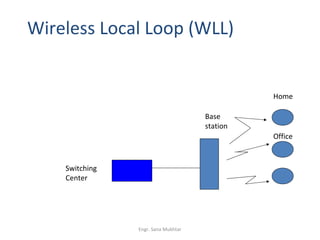
Wireless Local Loop (WLL)


                                               Home

                                     Base
                                     station
                                               Office


    Switching
    Center


                Engr. Sana Mukhtar
WLL
   Wireless “last mile”.
       Between central office and homes and businesses close-by.
   Fixed wireless service.
   Developing countries, remote areas.
   Broadband access.
   Microwave or millimeter radio frequencies.
       Directional antennas.
       Allow for very high data rate signals (tens or hundreds Mbs).
       But need LOS: no obstacles!


                                  Engr. Sana Mukhtar
Wireless Local Area Networks
   Local area connectivity using wireless
    communication.
   IEEE 802.11 WLAN standard.
   Multitude of commercially available devices:
    WaveLan, Aironet, etc.
   Wireless LAN may be used for
       Last hop to a wireless host.
       Wireless connectivity between hosts on the LAN.


                                 Engr. Sana Mukhtar
Satellite Communications
   Satellite-based antenna(e) in stable orbit above
    earth.
   Two or more (earth) stations communicate via
    one or more satellites serving as relay(s) in space.
   Uplink: earth->satellite.
   Downlink: satellite->earth.
   Transponder: satellite electronics converting
    uplink signal to downlink.


                        Engr. Sana Mukhtar
Satellite Communications


              SAT


          ground stations


              Engr. Sana Mukhtar
Orbits
   Shape: circular, elliptical.
   Plane: equatorial, polar.
   Altitude: geostationary (GEO), medium
    earth (MEO), low earth (LEO).


                    Engr. Sana Mukhtar
GEO Satellites
   Most common type.
   Orbit at 35,863 Km above earth and rotates
    in equatorial plane.
   Many GEO satellites up there!


                    Engr. Sana Mukhtar
Time-Domain Concepts
• Analog signal - signal intensity varies in a smooth fashion
  over time
   – No breaks or discontinuities in the signal
• Digital signal - signal intensity maintains a constant level for
  some period of time and then changes to another constant
  level
• Peak amplitude (A) - maximum value or strength of the signal
  over time; typically measured in volts
• Frequency (f )
   – Rate, in cycles per second, or Hertz (Hz) at which the signal repeats
• Periodic signal - analog or digital signal pattern that repeats
  over time
   –   s(t +T ) = s(t )  -¥< t < +¥
       • where T is the period of the signal

                            Engr. Sana Mukhtar
Time-Domain Concepts
• Period (T ) - amount of time it takes for one repetition
  of the signal
   – T = 1/f
• Phase (φ) - measure of the relative position in time
  within a single period of a signal
• Wavelength (λ) - distance occupied by a single cycle
  of the signal
   – Or, the distance between two points of corresponding phase
     of two consecutive cycles


                          Engr. Sana Mukhtar

Lecture 1 wireless

  • 1.
    Limitations and Difficultiesof Wireless Technologies • Wireless is convenient and less expensive • Limitations includes: political and technical difficulties which inhibit wireless technologies • Lack of an industry-wide standard • Device limitations – E.g., small LCD on a mobile telephone can only displaying a few lines of text – E.g., browsers of most mobile wireless devices use wireless markup language (WML) instead of HTML Engr. Sana Mukhtar
  • 2.
    Wireless Technologies  Cellular wireless.  Wireless local loop.  Wireless local area networks.  Mesh networks.  Satellites.  Multi-hop wireless. Engr. Sana Mukhtar
  • 3.
    Cellular Concept: Motivation  Early mobile radio systems:  Large coverage with single, high-powered transmitter.  But, no frequency re-use due to interference.  With limited spectrum allocation, capacity (in terms of number of users) is limited. Engr. Sana Mukhtar
  • 4.
    Some Cellular Terminology  Mobile.  Base station.  Mobile Switching Center (MSC).  Handoff.  Cell. Engr. Sana Mukhtar
  • 5.
    Cellular Fundamentals  System-level idea, no major technological changes.  Many low-power transmitters instead of single, high power one (large cell).  Service area divided into small cells covered by each low power transmitter.  Each transmitter (base station) allocated a portion of the spectrum.  Nearby BSs assigned different channel groups to minimize interference.  Scalability: as more users subscribe, more BSs can be added using lower transmission power): mini-cells. Engr. Sana Mukhtar
  • 6.
    Frequency Reuse E B G C A G F D E F Engr. Sana Mukhtar
  • 7.
    Handoff/Handover  Mobile hosts can change cells while communicating.  Hand-off occurs when a mobile host starts communicating via a new base station.  Handoff decision made based on signal strength. Engr. Sana Mukhtar
  • 8.
    Handoff Strategies: Network-initiated  Used in 1G.  Based solely on measurements of received signals from MH.  Each BS monitors signal strengths of mobiles with calls in progress.  MSC decides if handoff necessary. Engr. Sana Mukhtar
  • 9.
    Cellular Networks: Evolution  Evidence of the wireless success!  Since 1996, number of new mobile phone subscribers exceeded number of new fixed phone subscribers!  1st Generation (1G): analog technology  FDMA.  Analog FM. Engr. Sana Mukhtar
  • 10.
    Second Generation (2G) •Second generation 2G cellular telecom networks were commercially launched on the GSM standard in Finland in 1991 • radio signals on 2G networks are digital • But…both systems use digital signaling to connect the radio towers • Three primary benefits of 2G networks over their predecessors were: – phone conversations were digitally encrypted – significantly more efficient on the spectrum allowing for far greater mobile phone penetration levels – 2G introduced data services for mobile, starting with SMS text • 2G has been superseded by newer technologies such as 2.5G, 2.75G, 3G, and 4G Engr. Sana Mukhtar
  • 11.
    Second Generation (2G)….  Most of today’s cellular networks use 2G standards.  Early 90s.  Digital technology.  Digital modulation.  TDMA and CDMA based on the type of multiplexing techniques.  Lighter, smaller devices with longer battery life.  Better reception and channel utilization. Engr. Sana Mukhtar
  • 12.
    Example 2G Standards  TDMA standards:  Global System Mobile (GSM).  Europe, Asia, Australia, South America.  Interim Standard 13 (IS-136 or NDSC).  North and South America and Australia.  Pacific Digital Cellular (PDC).  Similar to IS-136.  Japan.  CDMA standard  Interim Standard 95 (IS-95)  North and South America, Korea, Japan, China, Australia. Engr. Sana Mukhtar
  • 13.
    2G Evolution  Shift from voice to data.  New wireless devices: pagers, PDAs.  New services: Web access, e-mail, instant messaging, etc.  New “data-centric” standards.  “Retrofit” 2G to support higher data throughput.  2.5G standards supports GPRS.MMS, WWW.  Moved from 56 Kbs to 115Kbs  Support higher data rates for Web browsing (e.g., WAP), e-mail, m- commerce, etc. Engr. Sana Mukhtar
  • 14.
    3G Wireless Networks  Multi-megabit Internet access, VoIP, ubiquitous “always-on” access.  Single mobile device for everything (integrated service approach).  New, world-wide standard.  International Mobile Telephone 2000 (IMT 2000) Engr. Sana Mukhtar
  • 15.
    Wireless Local Loop(WLL) Home Base station Office Switching Center Engr. Sana Mukhtar
  • 16.
    WLL  Wireless “last mile”.  Between central office and homes and businesses close-by.  Fixed wireless service.  Developing countries, remote areas.  Broadband access.  Microwave or millimeter radio frequencies.  Directional antennas.  Allow for very high data rate signals (tens or hundreds Mbs).  But need LOS: no obstacles! Engr. Sana Mukhtar
  • 17.
    Wireless Local AreaNetworks  Local area connectivity using wireless communication.  IEEE 802.11 WLAN standard.  Multitude of commercially available devices: WaveLan, Aironet, etc.  Wireless LAN may be used for  Last hop to a wireless host.  Wireless connectivity between hosts on the LAN. Engr. Sana Mukhtar
  • 18.
    Satellite Communications  Satellite-based antenna(e) in stable orbit above earth.  Two or more (earth) stations communicate via one or more satellites serving as relay(s) in space.  Uplink: earth->satellite.  Downlink: satellite->earth.  Transponder: satellite electronics converting uplink signal to downlink. Engr. Sana Mukhtar
  • 19.
    Satellite Communications SAT ground stations Engr. Sana Mukhtar
  • 20.
    Orbits  Shape: circular, elliptical.  Plane: equatorial, polar.  Altitude: geostationary (GEO), medium earth (MEO), low earth (LEO). Engr. Sana Mukhtar
  • 21.
    GEO Satellites  Most common type.  Orbit at 35,863 Km above earth and rotates in equatorial plane.  Many GEO satellites up there! Engr. Sana Mukhtar
  • 22.
    Time-Domain Concepts • Analogsignal - signal intensity varies in a smooth fashion over time – No breaks or discontinuities in the signal • Digital signal - signal intensity maintains a constant level for some period of time and then changes to another constant level • Peak amplitude (A) - maximum value or strength of the signal over time; typically measured in volts • Frequency (f ) – Rate, in cycles per second, or Hertz (Hz) at which the signal repeats • Periodic signal - analog or digital signal pattern that repeats over time – s(t +T ) = s(t ) -¥< t < +¥ • where T is the period of the signal Engr. Sana Mukhtar
  • 23.
    Time-Domain Concepts • Period(T ) - amount of time it takes for one repetition of the signal – T = 1/f • Phase (φ) - measure of the relative position in time within a single period of a signal • Wavelength (λ) - distance occupied by a single cycle of the signal – Or, the distance between two points of corresponding phase of two consecutive cycles Engr. Sana Mukhtar