Fundamental Analysis
• Macroeconomics Analysis
• Industry Analysis
• Equity Valuation Model
(Dividend Discount Model- DDM)
• Financial Statement Analysis
Macroeconomics Analysis
• Global Economy Analysis
– affects export, price competition and profits
– exchange rate: purchasing power and earnings
• Domestic Economy
– The ability to forecast the macroeconomy can translate
into great investment performance
– outperform other analysts to earn extra profits
Many variables can affect economy
–Gross Domestic Product (GDP):
measures the economy’s total output of goods and services
– Employment rate:
measures the extent that the economy is operating at full capacity
– Inflation
measures the general level of prices increase Phillip’s curve
– Interest Rate
high interest rate reduces PV of cashflows, thus stock values
– Budget Deficit
large deficit means more borrowing, which
implies higher interest rate.
– Sentiment
Business Cycles
• business cycles: pattern of recession and recovery
• peak: the end of expansion and start of recession
• trough: the bottom of the recession
• stock returns are decreasing when at peak and
increasing at trough
• cyclical industries: do well in expansionary periods but
poorly in recession, e.g., durable goods such as automobile
and wash machines
• defensive industries: little sensitive to business cycles,
such food
Industry Analysis
• Select a good industry to invest. It is difficult for
a firm to do well in a troubled industry
• Standard Industry Classification (SIC) code
• Value line Investment Survey - reports 1700 firms in
90 industries
• Two factors that determine the sensitivity of a
firm’s earnings to business conditions:
business risk,
financial risk
Business risk
• Sales sensitivity to business condition
some industries are robust (food) while others are
not (movie)
• operating leverage: the division between fixed and
variable costs.
– firms with greater amounts of variable cost relative to the
fixed cost are subject less to business fluctuations, thus
profits are more stable
Financial Risk
• the degree in using financial leverage (the amount
of interest payment)
• leverage firm is more sensitive to business cycles
Industry cycles
Start-up Build-up Maturity Decline
Start-up: increasing growth
Build-up/consolidation: stabilized growth
maturity: slower growth
Decline: shrinking growth
Equity Valuation Model
• Dividend Discount Model (DDM)
V0= (D1+P1)/(1+k)
= D1/(1+k) + D2/(1+k)2
...+ Dn/(1+k)n
• constant growth assumption
V0 = D1/(1+k) + D1(1+g)/(1+k)2
+D1(1+g)2
/(1+k)3
+ ...
= D1/(k-g)
or k = expected return
= D1/P0 + g
Multistage Growth Model
• Growth profile may not be constant such as:
Expected Growth
Time
g1
g2
n
V=D0(1+g1)/(1+k)+...+D0(1+g1)n
/(1+k)n
+ D0(1+g1)n
(1+g2)/(1+k)n+1
+ ... and so on
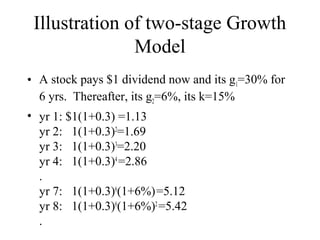
Illustration of two-stage Growth
Model
• A stock pays $1 dividend now and its g1=30% for
6 yrs. Thereafter, its g2=6%, its k=15%
• yr 1: $1(1+0.3) =1.13
yr 2: 1(1+0.3)2
=1.69
yr 3: 1(1+0.3)3
=2.20
yr 4: 1(1+0.3)4
=2.86
.
yr 7: 1(1+0.3)6
(1+6%)=5.12
yr 8: 1(1+0.3)6
(1+6%)2
=5.42
.
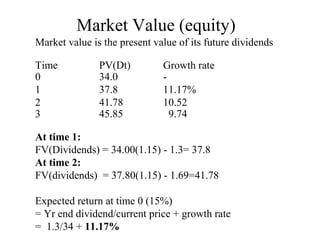
Market Value (equity)
Market value is the present value of its future dividends
Time PV(Dt) Growth rate
0 34.0 -
1 37.8 11.17%
2 41.78 10.52
3 45.85 9.74
At time 1:
FV(Dividends) = 34.00(1.15) - 1.3= 37.8
At time 2:
FV(dividends) = 37.80(1.15) - 1.69=41.78
Expected return at time 0 (15%)
= Yr end dividend/current price + growth rate
= 1.3/34 + 11.17%
P/E Ratio Behaviors
• Price = No growth value/share
P0 = E1/k + PVGO
or
• P0/E1= [1+ PVGO]/k
E1/k
Time
P/E
average
Pitfalls in P/E Analysis
• Denomination of P/E ratio is the accounting
earnings (arbitrary rules or historical cost
will distort the earnings figures)
• Earning should be based on economic
earnings (i.e., net of economic deprecation)
• Earnings are future figures vs P/E ratio
(which uses past accounting earnings)
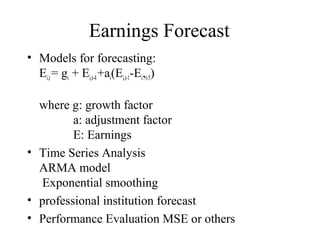
Earnings Forecast
• Models for forecasting:
Ei,t= gi + Ei,t-4+ai(Ei,t-1-Ei,t-5)
where g: growth factor
a: adjustment factor
E: Earnings
• Time Series Analysis
ARMA model
Exponential smoothing
• professional institution forecast
• Performance Evaluation MSE or others
Financial Statement Analysis
• Preparation of Source/Use Fund Statement
• Ratio Analysis
– Performance Analysis
– Du Pont Analysis
Use/source of Fund Statement
• Sources Uses
C. Paper $ 5.8 Cash $ 0.4
A/P 17.8 A/R 16.2
Div/P 1.4 Inv 34.8
S/T debt 4.6 Prep. Ex 0.4
S/T Lease 3.8 Lease 82.8
L/T Debt 20.6 Others 3.6
L/T Lease 25.0 Tax 1.0
C/S 3.2
P/I Cap 0.6
NI 54.4 Div. 46.6
Depreciation 48.6
Total 185.8 185.8
Analysis of Use/Source
• Sales growth=3.5%
• Uses- major component
A/R =8.72%; Inventory = 18.73%; Lease = 44.6%
Dividend = 25.1%
• Sources
A/P = 9.5%; L/T debt = 11.1%; L/T lease = 13.4%
Operation profits = 55.4%
(NI+depreciation)
• Why issue shares?
• S/T-/LT capital increases so much?
Ratio Analysis
• Assets Sales Profit
• Liquidity Ratio
• Risk Ratio
• Du Pond Analysis
ROE=Net Income(NI)/Equity (E)
= NI Pretax Prof EBIT Sale TA
P.Prof EBIT Sales TA E
TB IB GPM TAT EM
Pretax profit =EBIT - Interest
TB = Tax burden
IB = interest burden

Ddm

  • 1.
    Fundamental Analysis • MacroeconomicsAnalysis • Industry Analysis • Equity Valuation Model (Dividend Discount Model- DDM) • Financial Statement Analysis
  • 2.
    Macroeconomics Analysis • GlobalEconomy Analysis – affects export, price competition and profits – exchange rate: purchasing power and earnings • Domestic Economy – The ability to forecast the macroeconomy can translate into great investment performance – outperform other analysts to earn extra profits Many variables can affect economy
  • 3.
    –Gross Domestic Product(GDP): measures the economy’s total output of goods and services – Employment rate: measures the extent that the economy is operating at full capacity – Inflation measures the general level of prices increase Phillip’s curve – Interest Rate high interest rate reduces PV of cashflows, thus stock values – Budget Deficit large deficit means more borrowing, which implies higher interest rate. – Sentiment
  • 4.
    Business Cycles • businesscycles: pattern of recession and recovery • peak: the end of expansion and start of recession • trough: the bottom of the recession • stock returns are decreasing when at peak and increasing at trough • cyclical industries: do well in expansionary periods but poorly in recession, e.g., durable goods such as automobile and wash machines • defensive industries: little sensitive to business cycles, such food
  • 5.
    Industry Analysis • Selecta good industry to invest. It is difficult for a firm to do well in a troubled industry • Standard Industry Classification (SIC) code • Value line Investment Survey - reports 1700 firms in 90 industries • Two factors that determine the sensitivity of a firm’s earnings to business conditions: business risk, financial risk
  • 6.
    Business risk • Salessensitivity to business condition some industries are robust (food) while others are not (movie) • operating leverage: the division between fixed and variable costs. – firms with greater amounts of variable cost relative to the fixed cost are subject less to business fluctuations, thus profits are more stable Financial Risk • the degree in using financial leverage (the amount of interest payment) • leverage firm is more sensitive to business cycles
  • 7.
    Industry cycles Start-up Build-upMaturity Decline Start-up: increasing growth Build-up/consolidation: stabilized growth maturity: slower growth Decline: shrinking growth
  • 8.
    Equity Valuation Model •Dividend Discount Model (DDM) V0= (D1+P1)/(1+k) = D1/(1+k) + D2/(1+k)2 ...+ Dn/(1+k)n • constant growth assumption V0 = D1/(1+k) + D1(1+g)/(1+k)2 +D1(1+g)2 /(1+k)3 + ... = D1/(k-g) or k = expected return = D1/P0 + g
  • 9.
    Multistage Growth Model •Growth profile may not be constant such as: Expected Growth Time g1 g2 n V=D0(1+g1)/(1+k)+...+D0(1+g1)n /(1+k)n + D0(1+g1)n (1+g2)/(1+k)n+1 + ... and so on
  • 10.
    Illustration of two-stageGrowth Model • A stock pays $1 dividend now and its g1=30% for 6 yrs. Thereafter, its g2=6%, its k=15% • yr 1: $1(1+0.3) =1.13 yr 2: 1(1+0.3)2 =1.69 yr 3: 1(1+0.3)3 =2.20 yr 4: 1(1+0.3)4 =2.86 . yr 7: 1(1+0.3)6 (1+6%)=5.12 yr 8: 1(1+0.3)6 (1+6%)2 =5.42 .
  • 11.
    Market Value (equity) Marketvalue is the present value of its future dividends Time PV(Dt) Growth rate 0 34.0 - 1 37.8 11.17% 2 41.78 10.52 3 45.85 9.74 At time 1: FV(Dividends) = 34.00(1.15) - 1.3= 37.8 At time 2: FV(dividends) = 37.80(1.15) - 1.69=41.78 Expected return at time 0 (15%) = Yr end dividend/current price + growth rate = 1.3/34 + 11.17%
  • 12.
    P/E Ratio Behaviors •Price = No growth value/share P0 = E1/k + PVGO or • P0/E1= [1+ PVGO]/k E1/k Time P/E average
  • 13.
    Pitfalls in P/EAnalysis • Denomination of P/E ratio is the accounting earnings (arbitrary rules or historical cost will distort the earnings figures) • Earning should be based on economic earnings (i.e., net of economic deprecation) • Earnings are future figures vs P/E ratio (which uses past accounting earnings)
  • 14.
    Earnings Forecast • Modelsfor forecasting: Ei,t= gi + Ei,t-4+ai(Ei,t-1-Ei,t-5) where g: growth factor a: adjustment factor E: Earnings • Time Series Analysis ARMA model Exponential smoothing • professional institution forecast • Performance Evaluation MSE or others
  • 15.
    Financial Statement Analysis •Preparation of Source/Use Fund Statement • Ratio Analysis – Performance Analysis – Du Pont Analysis
  • 16.
    Use/source of FundStatement • Sources Uses C. Paper $ 5.8 Cash $ 0.4 A/P 17.8 A/R 16.2 Div/P 1.4 Inv 34.8 S/T debt 4.6 Prep. Ex 0.4 S/T Lease 3.8 Lease 82.8 L/T Debt 20.6 Others 3.6 L/T Lease 25.0 Tax 1.0 C/S 3.2 P/I Cap 0.6 NI 54.4 Div. 46.6 Depreciation 48.6 Total 185.8 185.8
  • 17.
    Analysis of Use/Source •Sales growth=3.5% • Uses- major component A/R =8.72%; Inventory = 18.73%; Lease = 44.6% Dividend = 25.1% • Sources A/P = 9.5%; L/T debt = 11.1%; L/T lease = 13.4% Operation profits = 55.4% (NI+depreciation) • Why issue shares? • S/T-/LT capital increases so much?
  • 18.
    Ratio Analysis • AssetsSales Profit • Liquidity Ratio • Risk Ratio • Du Pond Analysis ROE=Net Income(NI)/Equity (E) = NI Pretax Prof EBIT Sale TA P.Prof EBIT Sales TA E TB IB GPM TAT EM Pretax profit =EBIT - Interest TB = Tax burden IB = interest burden