Mindset: The Psychology of
Learning and Achievement
Mindset: The Psychology
of Success
of Success
Agenda
Agenda
 Two mindsets
Two mindsets
 Motivational framework supporting
Motivational framework supporting
mindsets
mindsets
 Praise
Praise
 The brain
The brain
 Lasting change
Lasting change
 Summary
Summary
Two mindsets
Two mindsets
Are people born smart?
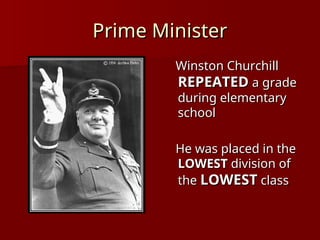
Prime Minister
Prime Minister
Winston Churchill
Winston Churchill
REPEATED
REPEATED a grade
a grade
during elementary
during elementary
school
school
He was placed in the
LOWEST
LOWEST division of
division of
the
the LOWEST
LOWEST class
class
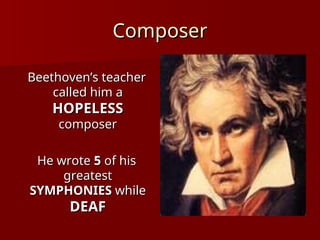
Composer
Composer
Beethoven’s teacher
Beethoven’s teacher
called him a
called him a
HOPELESS
HOPELESS
composer
composer
He wrote
He wrote 5
5 of his
of his
greatest
greatest
SYMPHONIES
SYMPHONIES while
while
DEAF
DEAF
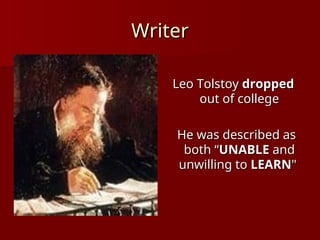
Writer
Writer
Leo Tolstoy
Leo Tolstoy dropped
dropped
out of college
out of college
He was described as
He was described as
both “
both “UNABLE
UNABLE and
and
unwilling to
unwilling to LEARN
LEARN"
"
Role models
Role models
…
….
.Einstein's
Einstein's teacher said that he was
teacher said that he was
‘academically subnormal
‘academically subnormal’
’
…
….
.Michael Jordan's
Michael Jordan's coach said that he
coach said that he
wasn’t more talented than other people
wasn’t more talented than other people…
…
…
…..
..Walt Disney
Walt Disney was told that he lacked
was told that he lacked
‘creative imagination’
‘
‘People are made, not
People are made, not
born’
born’
The ‘growth mindset’
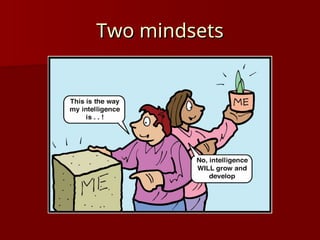
Two mindsets
Two mindsets
Mindset
Mindset
 Related to your belief about ability
Related to your belief about ability
 Creates a whole mental world for
Creates a whole mental world for
you
you to live in
to live in
 Fixed
Fixed mindset – ability cannot
mindset – ability cannot
change
change
 Growth
Growth mindset – ability can
mindset – ability can
change
change (grow)
(grow)
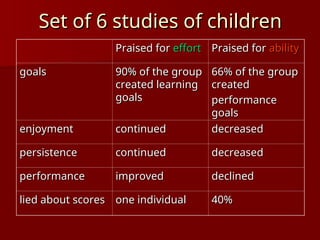
Set of 6 studies of children
Praised for
Praised for effort
effort Praised for
Praised for ability
ability
goals
goals 90% of the group
90% of the group
created learning
created learning
goals
goals
66% of the group
66% of the group
created
created
performance
performance
goals
goals
enjoyment
enjoyment continued
continued decreased
decreased
persistence
persistence continued
continued decreased
decreased
performance
performance improved
improved declined
declined
lied about scores
lied about scores one individual
one individual 40%
40%
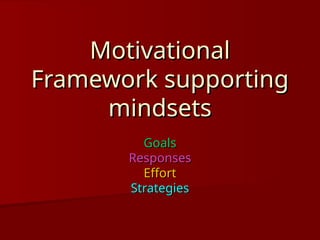
Motivational
Motivational
Framework supporting
mindsets
mindsets
Goals
Goals
Responses
Responses
Effort
Effort
Strategies
Strategies
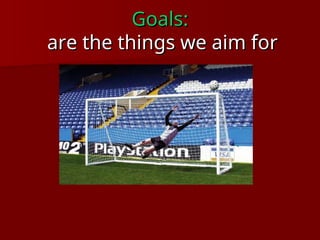
Goals:
Goals:
are the things we aim for
Goals:
Goals: performance
performance
 Those with a
Those with a FIXED MINDSET
FIXED MINDSET tend to create
tend to create
PERFORMANCE
PERFORMANCE goals.
goals.
 They believe that a person’s
They believe that a person’s POTENTIAL
POTENTIAL can
can
be
be MEASURED
MEASURED.
. They aim to receive validation
They aim to receive validation
from others.
from others.
 Receiving low marks mean that they are not
Receiving low marks mean that they are not
smart.
smart.
 Both success and failure cause
Both success and failure cause ANXIETY.
ANXIETY.
Goals:
Goals: learning
learning
 Those with a growth mindset tend to create
Those with a growth mindset tend to create
LEARNING
LEARNING goals.
goals.
 The goal is
The goal is MASTERY
MASTERY and
and COMPETENCE.
COMPETENCE.
 Scores and marks reflect how people are doing
Scores and marks reflect how people are doing
NOW
NOW and do not measure a person’s potential.
and do not measure a person’s potential.
 Creating goals for learning has shown to
Creating goals for learning has shown to
INCREASE PERFORMANCE
INCREASE PERFORMANCE and enjoyment and
and enjoyment and
decrease negative emotion.
Responses:
Responses:
are how we react to events
Response:
Response: helpless
helpless
When faced with failure or challenge, people with a
FIXED mindset:
FIXED mindset:
 do not pay attention to learning information
do not pay attention to learning information
 get depressed, become
get depressed, become de-energised
de-energised and lose self-
and lose self-
esteem
esteem
 denigrate their intelligence: ‘I am stupid’, they’ll
denigrate their intelligence: ‘I am stupid’, they’ll
think
think
 under-represent past successes and over-represent
under-represent past successes and over-represent
failures (pessimism)
 explain the cause of events as something stable
explain the cause of events as something stable
about them.
about them.
Response:
Response: mastery
mastery
 Pay attention to learning information, and so
Pay attention to learning information, and so
do better on future tests.
 Focus on what they are learning, rather than
Focus on what they are learning, rather than
focusing on how they feel.
 Try out new ways of doing things.
Try out new ways of doing things.
 Use self-motivating statements such as ‘ the
Use self-motivating statements such as ‘ the
harder it gets the harder I try’.
 When faced with tests which are impossible
When faced with tests which are impossible
to pass they will factor in other reasons and
not blame their intellect i.e. this test was
beyond my ability for now.
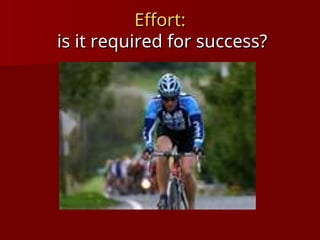
Effort:
Effort:
is it required for success?
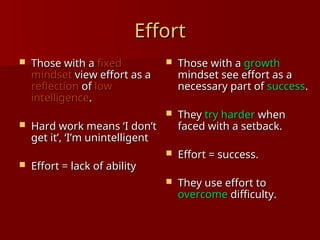
Effort
Effort
 Those with a
Those with a fixed
fixed
mindset
mindset view effort as a
view effort as a
reflection
reflection of
of low
low
intelligence
intelligence.
.
 Hard work means ‘I don’t
Hard work means ‘I don’t
get it’, ‘I’m unintelligent
 Effort = lack of ability
Effort = lack of ability
 Those with a
Those with a growth
growth
mindset see effort as a
necessary part of
necessary part of success
success.
.
 They
They try harder
try harder when
when
faced with a setback.
 Effort = success.
Effort = success.
 They use effort to
They use effort to
overcome
overcome difficulty.
difficulty.
Effort
Effort
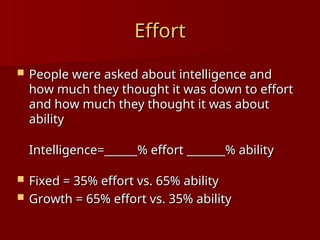
 People were asked about intelligence and
People were asked about intelligence and
how much they thought it was down to effort
and how much they thought it was about
ability
ability
Intelligence=______% effort _______% ability
 Fixed = 35% effort vs. 65% ability
Fixed = 35% effort vs. 65% ability
 Growth = 65% effort vs. 35% ability
Growth = 65% effort vs. 35% ability
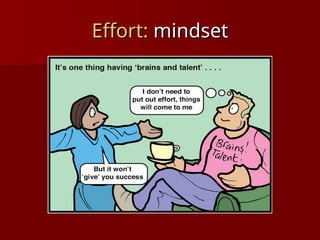
Effort:
Effort: mindset
mindset
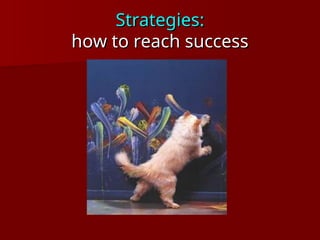
Strategies:
Strategies:
how to reach success
Strategies:
Strategies: growth mindset
growth mindset
 People adopting a growth mindset tend to
People adopting a growth mindset tend to
generate other, and new, ways to do things.
 If one route doesn’t work they will try others.
If one route doesn’t work they will try others.
 They will think ‘outside of the box’ to solve
They will think ‘outside of the box’ to solve
problems because they believe that they
‘can’.
‘can’.
Strategies:
Strategies: fixed mindset
fixed mindset
 Carol Dweck has found that students with a
Carol Dweck has found that students with a
fixed mindset keep using the wrong strategy
when faced with a problem.
 Then they disengage from the problem.
Then they disengage from the problem.
 Finally, they give up.
Finally, they give up.
Praise
Praise
 People are very sensitive to the messages
People are very sensitive to the messages
they receive about themselves.
 The way we interact with young people can
The way we interact with young people can
foster either a growth or a fixed mindset.
 Praise for effort v. praise for ability.
Praise for effort v. praise for ability.
Praise:
Praise: ability
ability
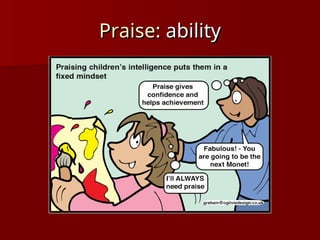
Praising for ability (e.g. talent or
intelligence)
intelligence)
 Can change a young person’s mindset from
Can change a young person’s mindset from
growth to fixed.
growth to fixed.
 Encourages young people to create
Encourages young people to create
performance goals
performance goals and display a
and display a helpless
helpless
response
response when faced with challenges.
when faced with challenges.
 Encourages young people to
Encourages young people to lie
lie about scores.
about scores.
 Undermines
Undermines motivation and willingness to
motivation and willingness to
take risks.
take risks.
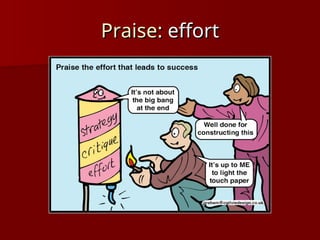
Praise:
Praise: effort
effort
Praise for effort
Praise for effort
 Encourages people to adopt a growth
Encourages people to adopt a growth
mindset.
mindset.
 Encourages people to create learning
Encourages people to create learning
goals
goals and display a mastery response
and display a mastery response
when faced
when faced with setback.
with setback.
 Increases motivation and success.
Increases motivation and success.
Praise is not a villain
Good feedback is important
 Constructive criticism is necessary if we want
Constructive criticism is necessary if we want
people to develop and learn.
 Praise is not a villain – praising for the effort
Praise is not a villain – praising for the effort
and the process will help the person become
more motivated and ultimately more resilient.
Frontal
Lobe
Parietal
Lobe
Occipital
Lobe
Temporal
Lobe
Frontal
Lobe
Parietal
Lobe
Occipital
Lobe
Temporal
Lobe
The body in the brain
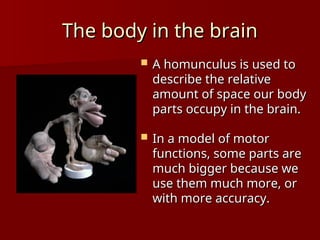
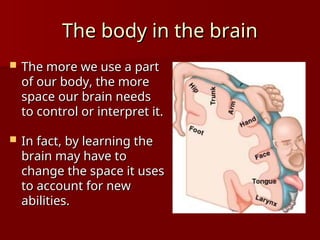
 A homunculus is used to
A homunculus is used to
describe the relative
amount of space our body
parts occupy in the brain.
 In a model of motor
In a model of motor
functions, some parts are
much bigger because we
use them much more, or
with more accuracy.
with more accuracy.
 The more we use a part
The more we use a part
of our body, the more
space our brain needs
to control or interpret it.
 In fact, by learning the
In fact, by learning the
brain may have to
brain may have to
change the space it uses
to account for new
to account for new
abilities.
abilities.
The body in the brain
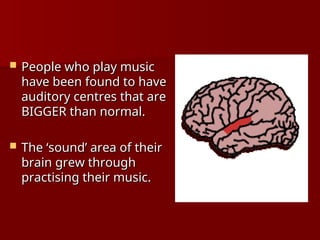
 People who play music
People who play music
have been found to have
auditory centres that are
BIGGER than normal.
BIGGER than normal.
 The ‘sound’ area of their
The ‘sound’ area of their
brain grew through
brain grew through
practising their music.
Evidence from neuroscience
 Rats in a rich environment have heavier
Rats in a rich environment have heavier
brains, by 10%, than those in a boring
environment.
environment.
 Taxi drivers have bigger areas which deal with
Taxi drivers have bigger areas which deal with
3D space – the hippocampus - than non-taxi
drivers.
drivers.
 Musicians have a larger auditory cortex.
Musicians have a larger auditory cortex.
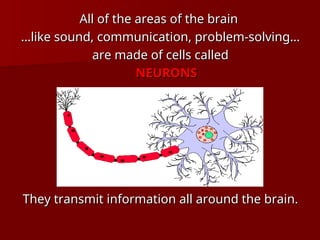
All of the areas of the brain
…
…like sound, communication, problem-solving…
like sound, communication, problem-solving…
are made of cells called
NEURONS
NEURONS
They transmit information all around the brain.
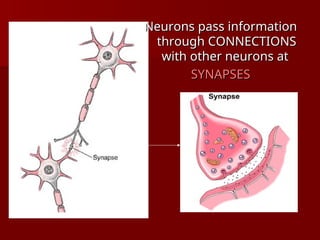
Neurons pass information
through CONNECTIONS
through CONNECTIONS
with other neurons at
SYNAPSES
SYNAPSES
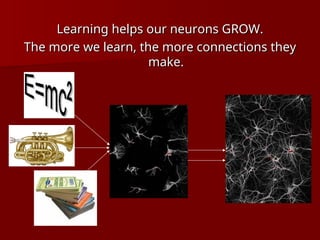
Learning helps our neurons GROW.
The more we learn, the more connections they
make.
make.
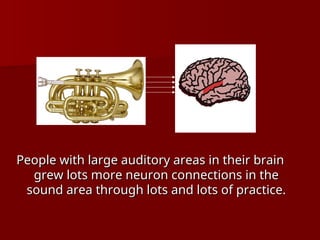
People with large auditory areas in their brain
grew lots more neuron connections in the
sound area through lots and lots of practice.
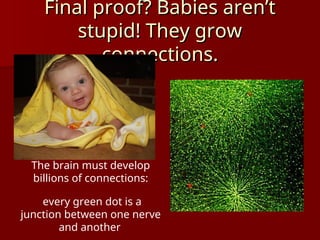
Final proof? Babies aren’t
stupid! They grow
stupid! They grow
connections.
connections.
The brain must develop
billions of connections:
every green dot is a
junction between one nerve
and another
Lasting change
Lasting change
 Dweck suggests that we need to present young
Dweck suggests that we need to present young
people with information on the brain and its
huge potential. Including how the brain learns.
 Praise for strategies, effort and processes rather
Praise for strategies, effort and processes rather
than for intelligence or ability.
 Positive stories provide people with role models
Positive stories provide people with role models
of those individuals who have succeeded
because of a growth mindset.
 Writing about your growth mindset experiences,
Writing about your growth mindset experiences,
in order to convince others, will deepen your
own growth mindset.
own growth mindset.
Summary
Summary
 A growth mindset helps people to be
A growth mindset helps people to be
motivated and to succeed.
 A growth mindset can be learnt.
A growth mindset can be learnt.
 We can foster a growth mindset in others by
We can foster a growth mindset in others by
the type of feedback we give and by teaching
them about the brain’s huge potential.
 Role models give people evidence of the
Role models give people evidence of the
growth mindset in action.
The Centre would like to thank the
Scottish Government for their
support in helping to produce this
resource.
resource.

mindset_presentation_for_teaching_adults (1).ppt

  • 1.
    Mindset: The Psychologyof Mindset: The Psychology of Learning and Achievement Learning and Achievement
  • 2.
    Mindset: The Psychology Mindset:The Psychology of Success of Success
  • 3.
    Agenda Agenda  Two mindsets Twomindsets  Motivational framework supporting Motivational framework supporting mindsets mindsets  Praise Praise  The brain The brain  Lasting change Lasting change  Summary Summary
  • 4.
  • 5.
    Are people bornsmart? Are people born smart?
  • 6.
    Prime Minister Prime Minister WinstonChurchill Winston Churchill REPEATED REPEATED a grade a grade during elementary during elementary school school He was placed in the He was placed in the LOWEST LOWEST division of division of the the LOWEST LOWEST class class
  • 7.
    Composer Composer Beethoven’s teacher Beethoven’s teacher calledhim a called him a HOPELESS HOPELESS composer composer He wrote He wrote 5 5 of his of his greatest greatest SYMPHONIES SYMPHONIES while while DEAF DEAF
  • 8.
    Writer Writer Leo Tolstoy Leo Tolstoydropped dropped out of college out of college He was described as He was described as both “ both “UNABLE UNABLE and and unwilling to unwilling to LEARN LEARN" "
  • 9.
    Role models Role models … …. .Einstein's Einstein'steacher said that he was teacher said that he was ‘academically subnormal ‘academically subnormal’ ’ … …. .Michael Jordan's Michael Jordan's coach said that he coach said that he wasn’t more talented than other people wasn’t more talented than other people… … … ….. ..Walt Disney Walt Disney was told that he lacked was told that he lacked ‘creative imagination’ ‘creative imagination’
  • 10.
    ‘ ‘People are made,not People are made, not born’ born’ The ‘growth mindset’ The ‘growth mindset’
  • 11.
  • 12.
    Mindset Mindset  Related toyour belief about ability Related to your belief about ability  Creates a whole mental world for Creates a whole mental world for you you to live in to live in  Fixed Fixed mindset – ability cannot mindset – ability cannot change change  Growth Growth mindset – ability can mindset – ability can change change (grow) (grow)
  • 13.
    Set of 6studies of children Set of 6 studies of children Praised for Praised for effort effort Praised for Praised for ability ability goals goals 90% of the group 90% of the group created learning created learning goals goals 66% of the group 66% of the group created created performance performance goals goals enjoyment enjoyment continued continued decreased decreased persistence persistence continued continued decreased decreased performance performance improved improved declined declined lied about scores lied about scores one individual one individual 40% 40%
  • 14.
  • 15.
    Goals: Goals: are the thingswe aim for are the things we aim for
  • 16.
    Goals: Goals: performance performance  Thosewith a Those with a FIXED MINDSET FIXED MINDSET tend to create tend to create PERFORMANCE PERFORMANCE goals. goals.  They believe that a person’s They believe that a person’s POTENTIAL POTENTIAL can can be be MEASURED MEASURED. . They aim to receive validation They aim to receive validation from others. from others.  Receiving low marks mean that they are not Receiving low marks mean that they are not smart. smart.  Both success and failure cause Both success and failure cause ANXIETY. ANXIETY.
  • 17.
    Goals: Goals: learning learning  Thosewith a growth mindset tend to create Those with a growth mindset tend to create LEARNING LEARNING goals. goals.  The goal is The goal is MASTERY MASTERY and and COMPETENCE. COMPETENCE.  Scores and marks reflect how people are doing Scores and marks reflect how people are doing NOW NOW and do not measure a person’s potential. and do not measure a person’s potential.  Creating goals for learning has shown to Creating goals for learning has shown to INCREASE PERFORMANCE INCREASE PERFORMANCE and enjoyment and and enjoyment and decrease negative emotion. decrease negative emotion.
  • 18.
    Responses: Responses: are how wereact to events are how we react to events
  • 19.
    Response: Response: helpless helpless When facedwith failure or challenge, people with a When faced with failure or challenge, people with a FIXED mindset: FIXED mindset:  do not pay attention to learning information do not pay attention to learning information  get depressed, become get depressed, become de-energised de-energised and lose self- and lose self- esteem esteem  denigrate their intelligence: ‘I am stupid’, they’ll denigrate their intelligence: ‘I am stupid’, they’ll think think  under-represent past successes and over-represent under-represent past successes and over-represent failures (pessimism) failures (pessimism)  explain the cause of events as something stable explain the cause of events as something stable about them. about them.
  • 20.
    Response: Response: mastery mastery  Payattention to learning information, and so Pay attention to learning information, and so do better on future tests. do better on future tests.  Focus on what they are learning, rather than Focus on what they are learning, rather than focusing on how they feel. focusing on how they feel.  Try out new ways of doing things. Try out new ways of doing things.  Use self-motivating statements such as ‘ the Use self-motivating statements such as ‘ the harder it gets the harder I try’. harder it gets the harder I try’.  When faced with tests which are impossible When faced with tests which are impossible to pass they will factor in other reasons and to pass they will factor in other reasons and not blame their intellect i.e. this test was not blame their intellect i.e. this test was beyond my ability for now. beyond my ability for now.
  • 21.
    Effort: Effort: is it requiredfor success? is it required for success?
  • 22.
    Effort Effort  Those witha Those with a fixed fixed mindset mindset view effort as a view effort as a reflection reflection of of low low intelligence intelligence. .  Hard work means ‘I don’t Hard work means ‘I don’t get it’, ‘I’m unintelligent get it’, ‘I’m unintelligent  Effort = lack of ability Effort = lack of ability  Those with a Those with a growth growth mindset see effort as a mindset see effort as a necessary part of necessary part of success success. .  They They try harder try harder when when faced with a setback. faced with a setback.  Effort = success. Effort = success.  They use effort to They use effort to overcome overcome difficulty. difficulty.
  • 23.
    Effort Effort  People wereasked about intelligence and People were asked about intelligence and how much they thought it was down to effort how much they thought it was down to effort and how much they thought it was about and how much they thought it was about ability ability Intelligence=______% effort _______% ability Intelligence=______% effort _______% ability  Fixed = 35% effort vs. 65% ability Fixed = 35% effort vs. 65% ability  Growth = 65% effort vs. 35% ability Growth = 65% effort vs. 35% ability
  • 24.
  • 25.
    Strategies: Strategies: how to reachsuccess how to reach success
  • 26.
    Strategies: Strategies: growth mindset growthmindset  People adopting a growth mindset tend to People adopting a growth mindset tend to generate other, and new, ways to do things. generate other, and new, ways to do things.  If one route doesn’t work they will try others. If one route doesn’t work they will try others.  They will think ‘outside of the box’ to solve They will think ‘outside of the box’ to solve problems because they believe that they problems because they believe that they ‘can’. ‘can’.
  • 27.
    Strategies: Strategies: fixed mindset fixedmindset  Carol Dweck has found that students with a Carol Dweck has found that students with a fixed mindset keep using the wrong strategy fixed mindset keep using the wrong strategy when faced with a problem. when faced with a problem.  Then they disengage from the problem. Then they disengage from the problem.  Finally, they give up. Finally, they give up.
  • 28.
    Praise Praise  People arevery sensitive to the messages People are very sensitive to the messages they receive about themselves. they receive about themselves.  The way we interact with young people can The way we interact with young people can foster either a growth or a fixed mindset. foster either a growth or a fixed mindset.  Praise for effort v. praise for ability. Praise for effort v. praise for ability.
  • 29.
  • 30.
    Praising for ability(e.g. talent or Praising for ability (e.g. talent or intelligence) intelligence)  Can change a young person’s mindset from Can change a young person’s mindset from growth to fixed. growth to fixed.  Encourages young people to create Encourages young people to create performance goals performance goals and display a and display a helpless helpless response response when faced with challenges. when faced with challenges.  Encourages young people to Encourages young people to lie lie about scores. about scores.  Undermines Undermines motivation and willingness to motivation and willingness to take risks. take risks.
  • 31.
  • 32.
    Praise for effort Praisefor effort  Encourages people to adopt a growth Encourages people to adopt a growth mindset. mindset.  Encourages people to create learning Encourages people to create learning goals goals and display a mastery response and display a mastery response when faced when faced with setback. with setback.  Increases motivation and success. Increases motivation and success.
  • 33.
    Praise is nota villain Praise is not a villain
  • 34.
    Good feedback isimportant Good feedback is important  Constructive criticism is necessary if we want Constructive criticism is necessary if we want people to develop and learn. people to develop and learn.  Praise is not a villain – praising for the effort Praise is not a villain – praising for the effort and the process will help the person become and the process will help the person become more motivated and ultimately more resilient. more motivated and ultimately more resilient.
  • 35.
  • 36.
  • 37.
    The body inthe brain The body in the brain  A homunculus is used to A homunculus is used to describe the relative describe the relative amount of space our body amount of space our body parts occupy in the brain. parts occupy in the brain.  In a model of motor In a model of motor functions, some parts are functions, some parts are much bigger because we much bigger because we use them much more, or use them much more, or with more accuracy. with more accuracy.
  • 38.
     The morewe use a part The more we use a part of our body, the more of our body, the more space our brain needs space our brain needs to control or interpret it. to control or interpret it.  In fact, by learning the In fact, by learning the brain may have to brain may have to change the space it uses change the space it uses to account for new to account for new abilities. abilities. The body in the brain The body in the brain
  • 39.
     People whoplay music People who play music have been found to have have been found to have auditory centres that are auditory centres that are BIGGER than normal. BIGGER than normal.  The ‘sound’ area of their The ‘sound’ area of their brain grew through brain grew through practising their music. practising their music.
  • 40.
    Evidence from neuroscience Evidencefrom neuroscience  Rats in a rich environment have heavier Rats in a rich environment have heavier brains, by 10%, than those in a boring brains, by 10%, than those in a boring environment. environment.  Taxi drivers have bigger areas which deal with Taxi drivers have bigger areas which deal with 3D space – the hippocampus - than non-taxi 3D space – the hippocampus - than non-taxi drivers. drivers.  Musicians have a larger auditory cortex. Musicians have a larger auditory cortex.
  • 41.
    All of theareas of the brain All of the areas of the brain … …like sound, communication, problem-solving… like sound, communication, problem-solving… are made of cells called are made of cells called NEURONS NEURONS They transmit information all around the brain. They transmit information all around the brain.
  • 42.
    Neurons pass information Neuronspass information through CONNECTIONS through CONNECTIONS with other neurons at with other neurons at SYNAPSES SYNAPSES
  • 43.
    Learning helps ourneurons GROW. Learning helps our neurons GROW. The more we learn, the more connections they The more we learn, the more connections they make. make.
  • 44.
    People with largeauditory areas in their brain People with large auditory areas in their brain grew lots more neuron connections in the grew lots more neuron connections in the sound area through lots and lots of practice. sound area through lots and lots of practice.
  • 45.
    Final proof? Babiesaren’t Final proof? Babies aren’t stupid! They grow stupid! They grow connections. connections. The brain must develop billions of connections: every green dot is a junction between one nerve and another
  • 46.
    Lasting change Lasting change Dweck suggests that we need to present young Dweck suggests that we need to present young people with information on the brain and its people with information on the brain and its huge potential. Including how the brain learns. huge potential. Including how the brain learns.  Praise for strategies, effort and processes rather Praise for strategies, effort and processes rather than for intelligence or ability. than for intelligence or ability.  Positive stories provide people with role models Positive stories provide people with role models of those individuals who have succeeded of those individuals who have succeeded because of a growth mindset. because of a growth mindset.  Writing about your growth mindset experiences, Writing about your growth mindset experiences, in order to convince others, will deepen your in order to convince others, will deepen your own growth mindset. own growth mindset.
  • 47.
    Summary Summary  A growthmindset helps people to be A growth mindset helps people to be motivated and to succeed. motivated and to succeed.  A growth mindset can be learnt. A growth mindset can be learnt.  We can foster a growth mindset in others by We can foster a growth mindset in others by the type of feedback we give and by teaching the type of feedback we give and by teaching them about the brain’s huge potential. them about the brain’s huge potential.  Role models give people evidence of the Role models give people evidence of the growth mindset in action. growth mindset in action.
  • 48.
    The Centre wouldlike to thank the The Centre would like to thank the Scottish Government for their Scottish Government for their support in helping to produce this support in helping to produce this resource. resource.