Group Work That
Works!!
Dr.Ray Hibbins, GBS, Dept
of HTLSM
Dr. Peter Woods GBS, Dept
of Management
Presentation Overview
Introduction
Why group work?
The characteristics of effective groups
Case Study 1
Case Study 2
Case Study 3
Where to from here?


                                          2
Introduction
Productive diversity in business organisations
Universities and culturally and linguistically diverse
  students.
Diverse project groups as the nexus of cultural and
  language interaction and learning.
Case studies as stimuli for discussion about the
  central issues involved


                                                         3
Introduction
• Case studies-the background, the issues, and
  suggested strategies used in attempting to solve
  the issues/problems
• Resolved issues
• Unresolved issues
• Raising more questions and inviting your
  comments


                                                     4
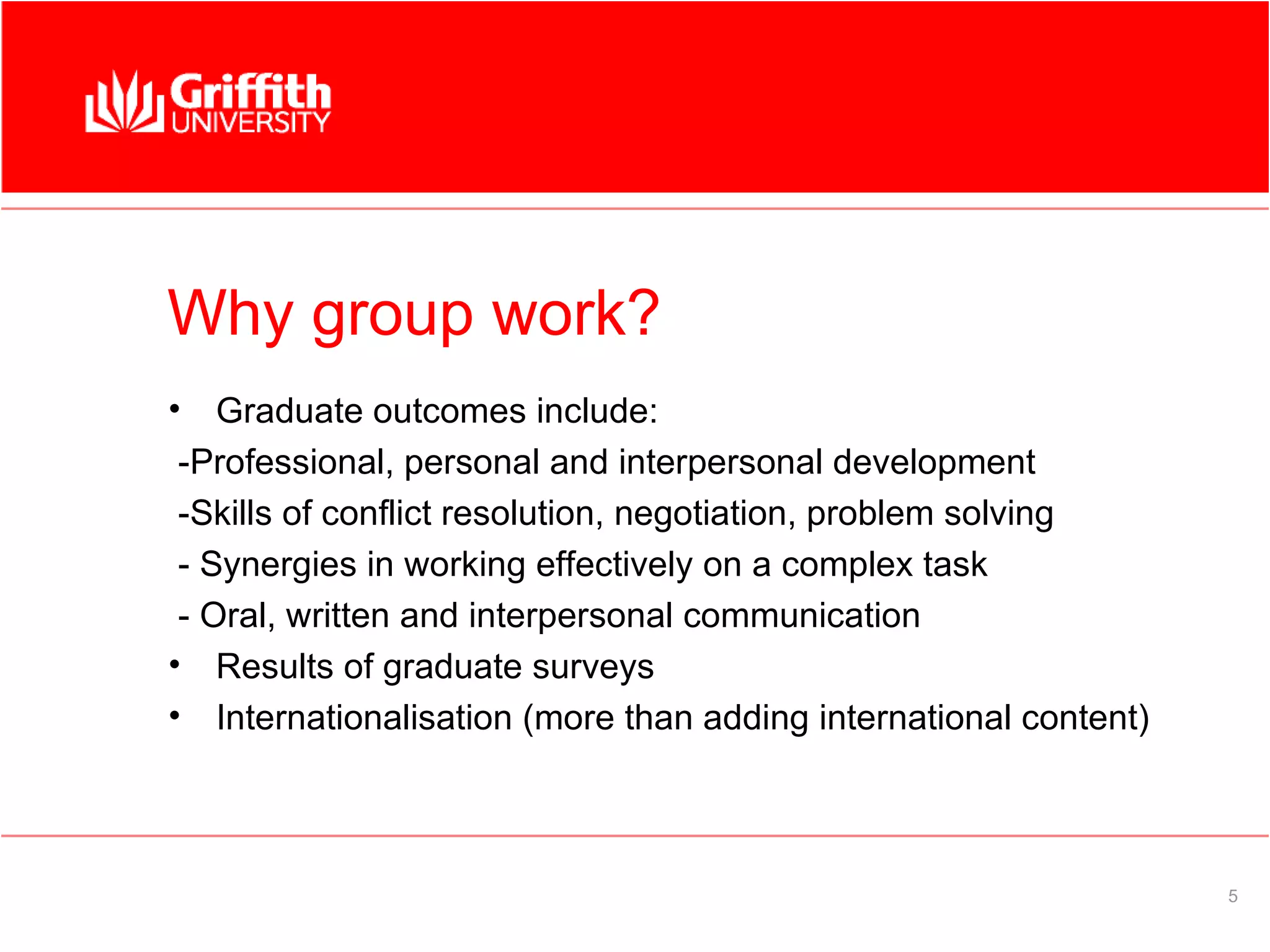
Why group work?
•   Graduate outcomes include:
 -Professional, personal and interpersonal development
 -Skills of conflict resolution, negotiation, problem solving
 - Synergies in working effectively on a complex task
 - Oral, written and interpersonal communication
• Results of graduate surveys
• Internationalisation (more than adding international content)


                                                                  5
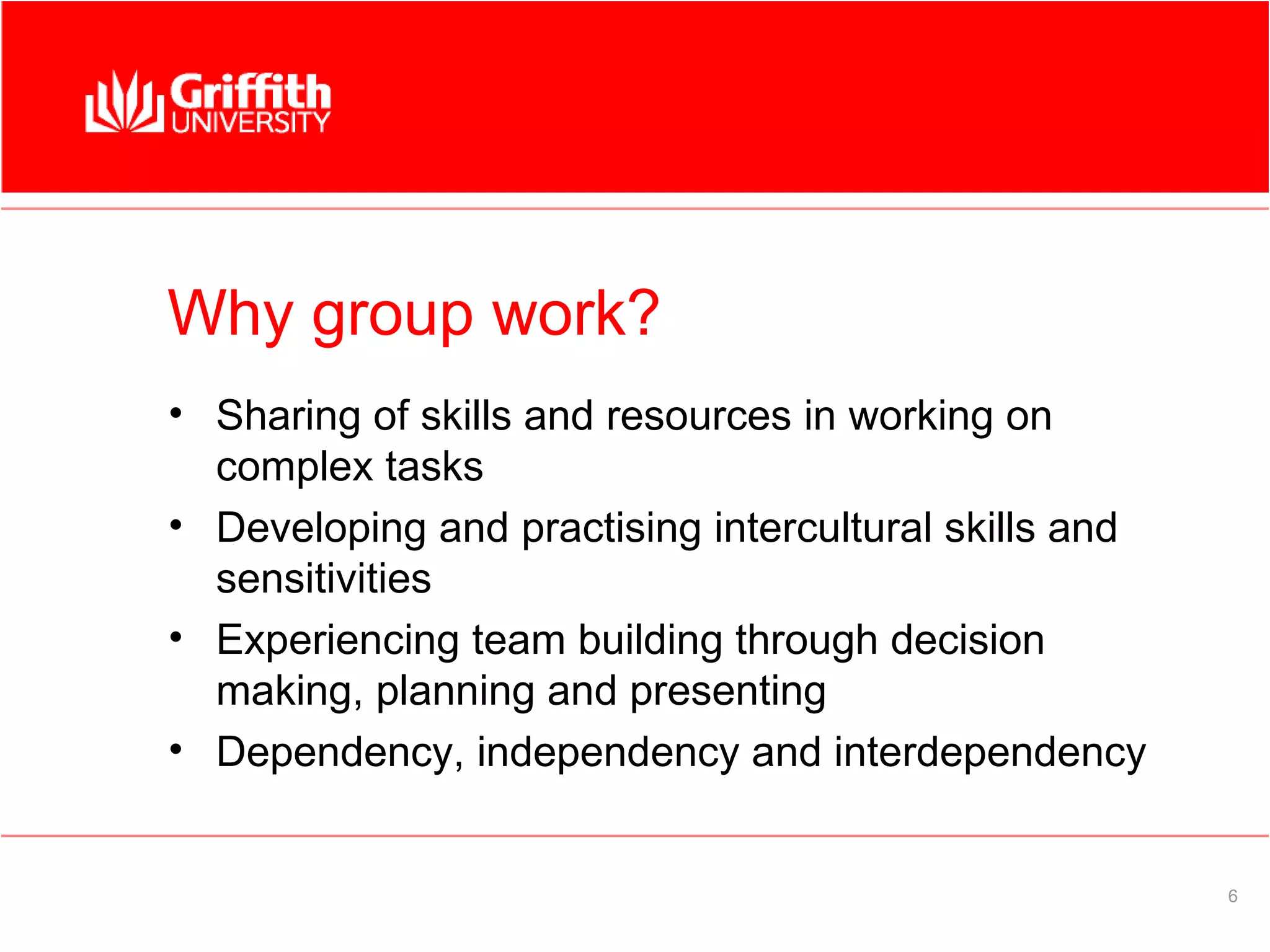
Why group work?
• Sharing of skills and resources in working on
  complex tasks
• Developing and practising intercultural skills and
  sensitivities
• Experiencing team building through decision
  making, planning and presenting
• Dependency, independency and interdependency


                                                       6
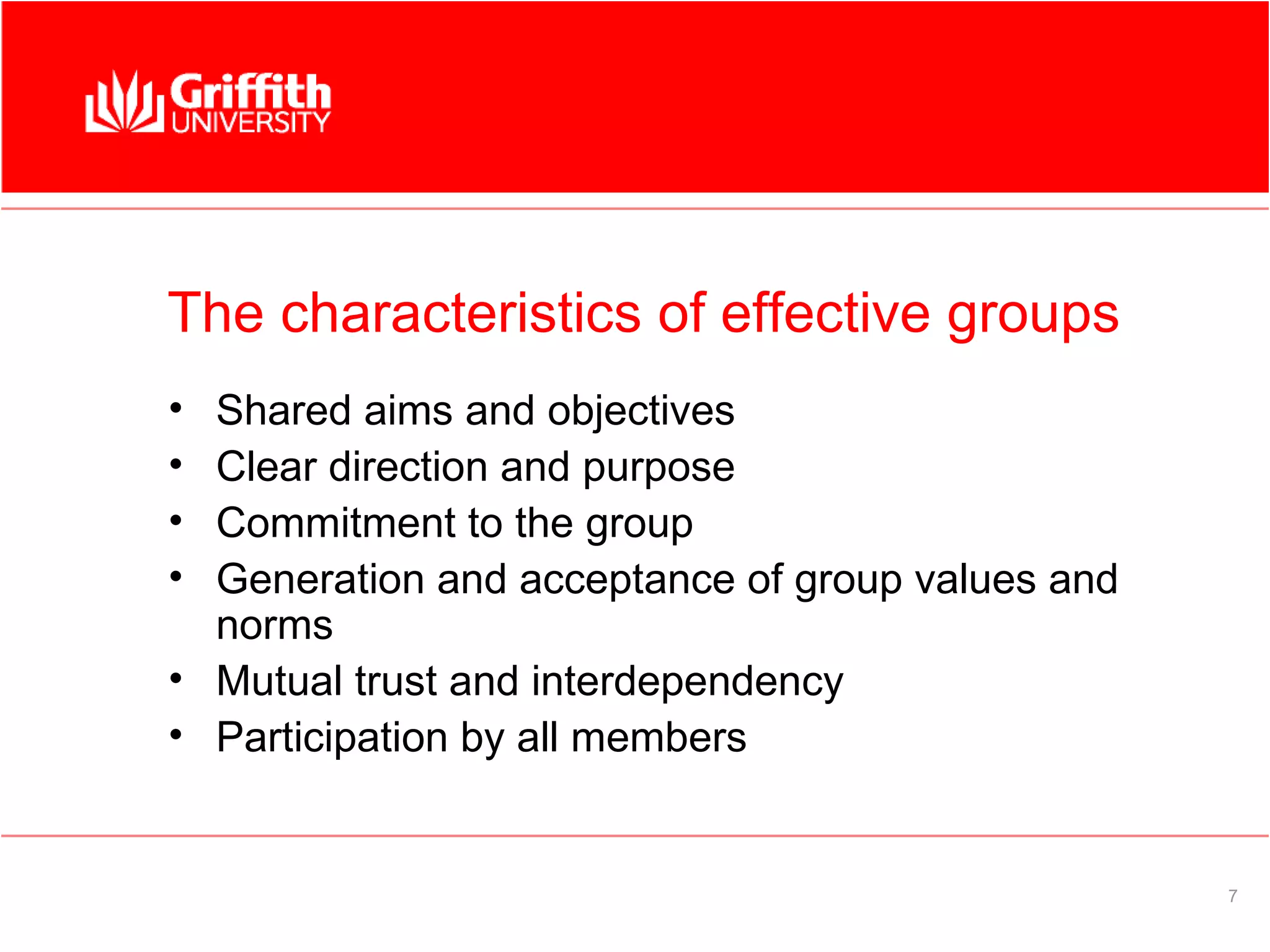
The characteristics of effective groups
• Shared aims and objectives
• Clear direction and purpose
• Commitment to the group
• Generation and acceptance of group values and
  norms
• Mutual trust and interdependency
• Participation by all members


                                                  7
Characteristics of effective groups
•   Shared responsibility for group outcomes
•   Effective decision-making processes
•   Flow of information and open communication
•   Expression of feelings and disagreements
•   Resolution of conflicts by members themselves
•   A climate that does not stifle individuality
•   A balanced approach to individual and group needs.
    (adapted from Fowler, Gudmundsson & Whicker,2006:8-9)


                                                            8
Case Study One – The Problem
• A third year course in International Human
  Resource Management – 2 hour fortnightly
  tutorials
• Low participation of international students
  (particularly from Confucian oriented cultural
  backgrounds) in discussion based tutorials
• Limited interaction between local and international
  students in tutorial discussions
• The unrealised dream of productive diversity

                                                        9
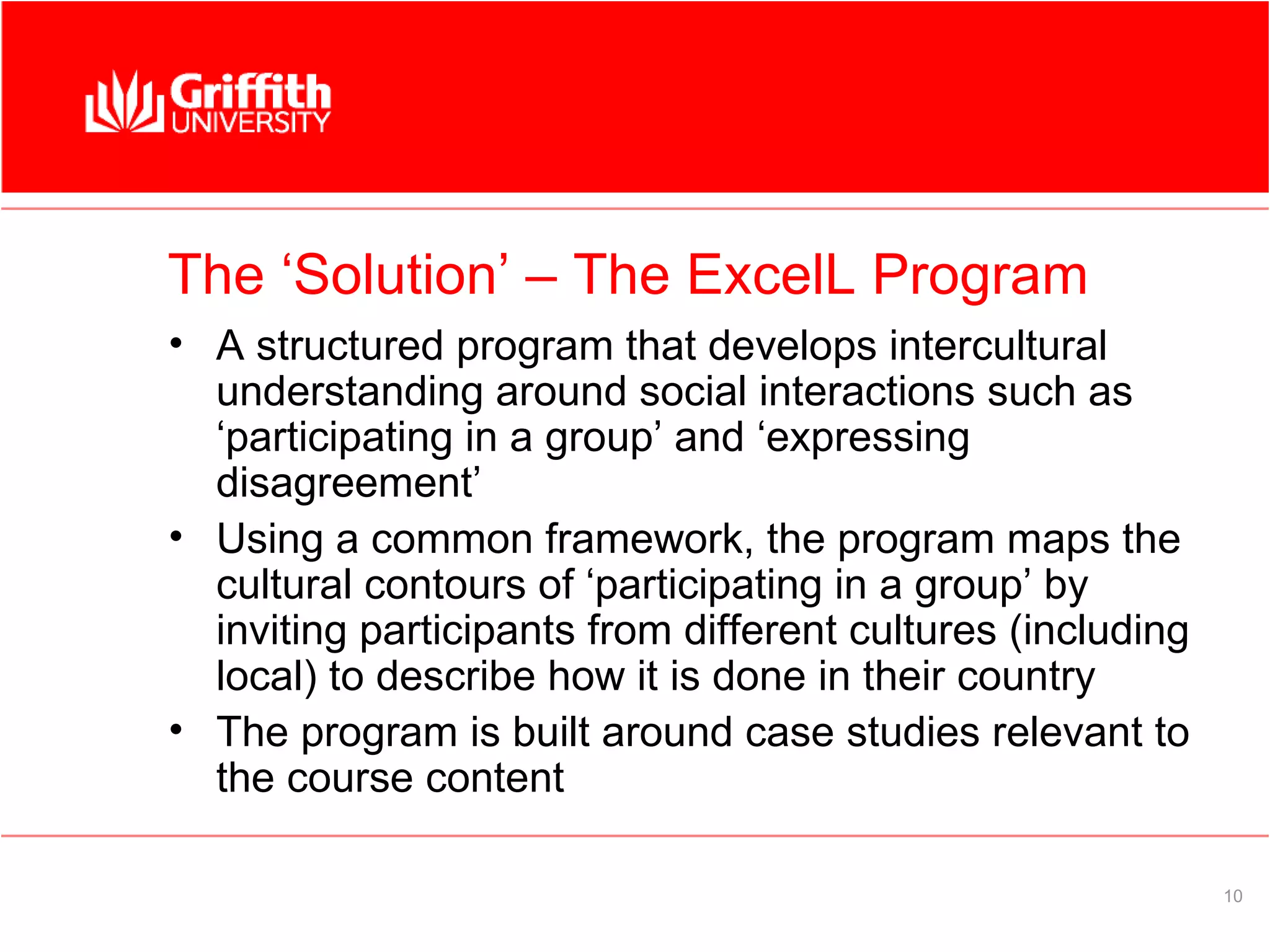
The ‘Solution’ – The ExcelL Program
• A structured program that develops intercultural
  understanding around social interactions such as
  ‘participating in a group’ and ‘expressing
  disagreement’
• Using a common framework, the program maps the
  cultural contours of ‘participating in a group’ by
  inviting participants from different cultures (including
  local) to describe how it is done in their country
• The program is built around case studies relevant to
  the course content

                                                             10
Case Study 1 (ExcelL)
•   Issues
         - spending time on process
         - are students ready for group work?
         - Can/will international students take initiative? What is a good
              leader?
         - Roles and timelines
         - Using international student resources
         - Diversity in the classroom and student expectations
         - Language differences and multiple meaning
              construction
         - Fears of racism, discrimination, prejudice and stereotyping
         - How do I agree/ disagree? Give feedback?


                                                                             11
Case Study Two – The Problem
• A third year management course where students
  operate in project groups in tutorials and to complete
  an assessment task (a company analysis)
• On a different individual assessment task (journal
  article analysis), groups of international students
  hand in assignments that show a common
  misunderstanding of the task, leading to very poor
  marks
• The students appeal against their marks, claiming
  that their whole group had a wrong understanding of
  the assessment task (groupthink)
                                                           12
Solution in Process – Myth Busting
• Related problem – QIBT and other international
  students believe they don’t need orientation and they
  don’t need to attend classes in the first week – bust the
  myth through feedback!
• Realisation of my own myth that first year at GU
  effectively covers assessment skills
• Provide a structured presentation on how to complete
  assessment items – make the presentation available on
  the course website
• Short assessment skill presentations during lecture time
  in second and third year classes
                                                              13
Case Study 2 (Group Think)
•   Issues
         - If one goes down then they must all go
         down! Having a problem without knowing you do.
         - Making expectations clear and establishing a
    contract but the problems of poor student       attendance at
    orientation, early lectures and       tutorials
         - Breaking down diasporic groups. Homogeneity versus
         heterogeneity


                                                                    14
Case Study Three – The Problem
• Unequal contribution in project group based
  assessment
• Third year strategic management course analysing
  a company case study
• Progressive attempts - 1) Signed group contract 2)
  Group research, individually written 3) Marks for
  group contribution (deducted when a problem is
  apparent) 4) Groups marks based on group
  meeting report (schedule, tasks, performance
  evaluation)

                                                       15
Technology to the Rescue – Solution in
progress
    • Solution by Dr. Paul Bates – aviation courses
    • Group members must submit their contribution to
      the assignment to a secure section of the course
      website by a particular date (at least one week
      prior to the assignment due date)
    • Marker has access to these sections of the site
    • Contributions can be marked on their quality and
      timeliness


                                                         16
Case Study 3 (Technology to the
Rescue)
•   Issues
         - Academic quality of students and group performance
         - Down with groups, they never work!
         - Equal contribution of all group members
         - Skill development and student numbers
         - I cant work in groups, I work best alone
         - Student attitudes and skilled ‘freeloading’
         - You never know whose work it is
         - The whole is the sum of the parts


                                                                17
Where to from here?
•   Is group work worthwhile?
•   Language issues in groups
•   Do groups change over the period of a semester?
•   Forming, norming, storming and adjourning.
•   The excitement of the journey
•   Q and A


                                                      18

Group Work That Works

  • 1.
    Group Work That Works!! Dr.RayHibbins, GBS, Dept of HTLSM Dr. Peter Woods GBS, Dept of Management
  • 2.
    Presentation Overview Introduction Why groupwork? The characteristics of effective groups Case Study 1 Case Study 2 Case Study 3 Where to from here? 2
  • 3.
    Introduction Productive diversity inbusiness organisations Universities and culturally and linguistically diverse students. Diverse project groups as the nexus of cultural and language interaction and learning. Case studies as stimuli for discussion about the central issues involved 3
  • 4.
    Introduction • Case studies-thebackground, the issues, and suggested strategies used in attempting to solve the issues/problems • Resolved issues • Unresolved issues • Raising more questions and inviting your comments 4
  • 5.
    Why group work? • Graduate outcomes include: -Professional, personal and interpersonal development -Skills of conflict resolution, negotiation, problem solving - Synergies in working effectively on a complex task - Oral, written and interpersonal communication • Results of graduate surveys • Internationalisation (more than adding international content) 5
  • 6.
    Why group work? •Sharing of skills and resources in working on complex tasks • Developing and practising intercultural skills and sensitivities • Experiencing team building through decision making, planning and presenting • Dependency, independency and interdependency 6
  • 7.
    The characteristics ofeffective groups • Shared aims and objectives • Clear direction and purpose • Commitment to the group • Generation and acceptance of group values and norms • Mutual trust and interdependency • Participation by all members 7
  • 8.
    Characteristics of effectivegroups • Shared responsibility for group outcomes • Effective decision-making processes • Flow of information and open communication • Expression of feelings and disagreements • Resolution of conflicts by members themselves • A climate that does not stifle individuality • A balanced approach to individual and group needs. (adapted from Fowler, Gudmundsson & Whicker,2006:8-9) 8
  • 9.
    Case Study One– The Problem • A third year course in International Human Resource Management – 2 hour fortnightly tutorials • Low participation of international students (particularly from Confucian oriented cultural backgrounds) in discussion based tutorials • Limited interaction between local and international students in tutorial discussions • The unrealised dream of productive diversity 9
  • 10.
    The ‘Solution’ –The ExcelL Program • A structured program that develops intercultural understanding around social interactions such as ‘participating in a group’ and ‘expressing disagreement’ • Using a common framework, the program maps the cultural contours of ‘participating in a group’ by inviting participants from different cultures (including local) to describe how it is done in their country • The program is built around case studies relevant to the course content 10
  • 11.
    Case Study 1(ExcelL) • Issues - spending time on process - are students ready for group work? - Can/will international students take initiative? What is a good leader? - Roles and timelines - Using international student resources - Diversity in the classroom and student expectations - Language differences and multiple meaning construction - Fears of racism, discrimination, prejudice and stereotyping - How do I agree/ disagree? Give feedback? 11
  • 12.
    Case Study Two– The Problem • A third year management course where students operate in project groups in tutorials and to complete an assessment task (a company analysis) • On a different individual assessment task (journal article analysis), groups of international students hand in assignments that show a common misunderstanding of the task, leading to very poor marks • The students appeal against their marks, claiming that their whole group had a wrong understanding of the assessment task (groupthink) 12
  • 13.
    Solution in Process– Myth Busting • Related problem – QIBT and other international students believe they don’t need orientation and they don’t need to attend classes in the first week – bust the myth through feedback! • Realisation of my own myth that first year at GU effectively covers assessment skills • Provide a structured presentation on how to complete assessment items – make the presentation available on the course website • Short assessment skill presentations during lecture time in second and third year classes 13
  • 14.
    Case Study 2(Group Think) • Issues - If one goes down then they must all go down! Having a problem without knowing you do. - Making expectations clear and establishing a contract but the problems of poor student attendance at orientation, early lectures and tutorials - Breaking down diasporic groups. Homogeneity versus heterogeneity 14
  • 15.
    Case Study Three– The Problem • Unequal contribution in project group based assessment • Third year strategic management course analysing a company case study • Progressive attempts - 1) Signed group contract 2) Group research, individually written 3) Marks for group contribution (deducted when a problem is apparent) 4) Groups marks based on group meeting report (schedule, tasks, performance evaluation) 15
  • 16.
    Technology to theRescue – Solution in progress • Solution by Dr. Paul Bates – aviation courses • Group members must submit their contribution to the assignment to a secure section of the course website by a particular date (at least one week prior to the assignment due date) • Marker has access to these sections of the site • Contributions can be marked on their quality and timeliness 16
  • 17.
    Case Study 3(Technology to the Rescue) • Issues - Academic quality of students and group performance - Down with groups, they never work! - Equal contribution of all group members - Skill development and student numbers - I cant work in groups, I work best alone - Student attitudes and skilled ‘freeloading’ - You never know whose work it is - The whole is the sum of the parts 17
  • 18.
    Where to fromhere? • Is group work worthwhile? • Language issues in groups • Do groups change over the period of a semester? • Forming, norming, storming and adjourning. • The excitement of the journey • Q and A 18