Essays With Benefits
Undergraduate
Collaborative Writing
Peter Levrai & Averil Bolster
Friday 7th April, BALEAP 2017 Bristol
Why Hedgehogs?
• There are a range of attitudes to collaborative
writing.
• “I’d rather vomit up a live hedgehog” (Strauss,
2001)
• Concerns about
• Fairness
• Uneven workload / freeloading
• Scheduling
Why Group Essays?
• Group writing is widespread in universities (Scotland, 2016)
• Group writing has added benefits e.g. teamwork & critical
thinking (Shin, 2015)
• Group writing leads to better quality essays than individual
writing (Wigglesworth & Storch, 2009; Shehadeh, 2011)
• Results in better task fulfilment, grammatical accuracy and
complexity (Storch, 2005; Mulligan & Garofalo, 2011)
• Results in better grades (Mulligan & Garofalo, 2011; Berry,
2007)
• Group-work helps with employability (Wigglesworth &
Storch, 2009)
The Teaching Context
• University of Macau (English Medium Instruction
Institution)
• 1st Year undergraduate students
• B1 & up (CEFR)
• Novice writers
• Preparation for first academic essay
• The aim of the course is to help students develop
“the language and associated practices that people
need in order to undertake study or work in English
medium higher education” (Gillett, 2015, para. 1).
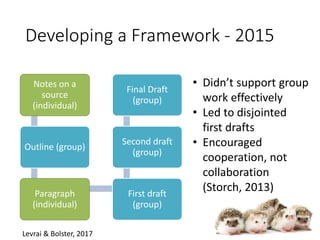
Developing a Framework - 2015
Notes on a
source
(individual)
Outline (group)
Paragraph
(individual)
First draft
(group)
Second draft
(group)
Final Draft
(group)
• Didn’t support group
work effectively
• Led to disjointed
first drafts
• Encouraged
cooperation, not
collaboration
(Storch, 2013)
Levrai & Bolster, 2017
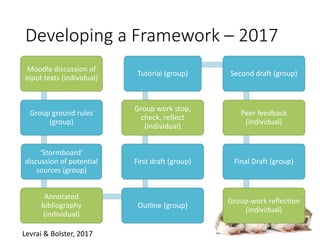
Developing a Framework – 2017
Moodle discussion of
input texts (individual)
Group ground rules
(group)
‘Stormboard’
discussion of potential
sources (group)
Annotated
bibliography
(individual)
Outline (group)
First draft (group)
Group work stop,
check, reflect
(individual)
Tutorial (group) Second draft (group)
Peer feedback
(individual)
Final Draft (group)
Group-work reflection
(individual)
Levrai & Bolster, 2017
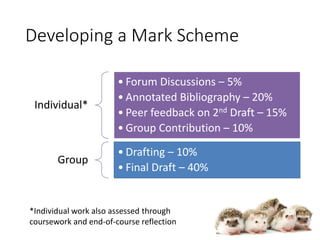
Developing a Mark Scheme
*Individual work also assessed through
coursework and end-of-course reflection
Individual*
• Forum Discussions – 5%
• Annotated Bibliography – 20%
• Peer feedback on 2nd Draft – 15%
• Group Contribution – 10%
Group
• Drafting – 10%
• Final Draft – 40%
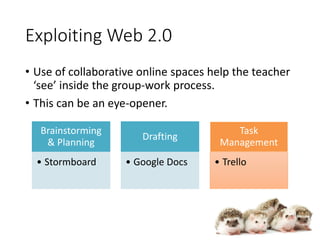
Exploiting Web 2.0
• Use of collaborative online spaces help the teacher
‘see’ inside the group-work process.
• This can be an eye-opener.
Brainstorming
& Planning
• Stormboard
Drafting
• Google Docs
Task
Management
• Trello
Student Perceptions
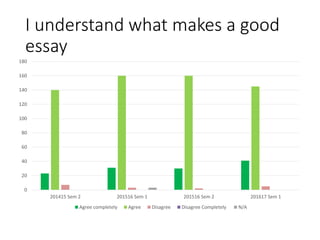
I understand what makes a good
essay
0
20
40
60
80
100
120
140
160
180
201415 Sem 2 201516 Sem 1 201516 Sem 2 201617 Sem 1
Agree completely Agree Disagree Disagree Completely N/A
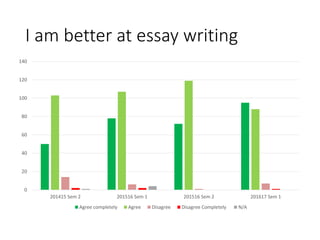
I am better at essay writing
0
20
40
60
80
100
120
140
201415 Sem 2 201516 Sem 1 201516 Sem 2 201617 Sem 1
Agree completely Agree Disagree Disagree Completely N/A
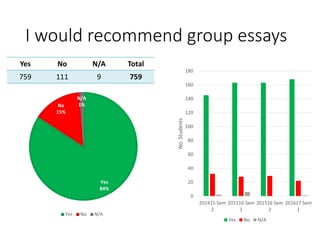
I would recommend group essays
0
20
40
60
80
100
120
140
160
180
201415 Sem
2
201516 Sem
1
201516 Sem
2
201617 Sem
1
No.Students
Yes No N/A
Yes
84%
No
15%
N/A
1%
Yes No N/A
Yes No N/A Total
759 111 9 759
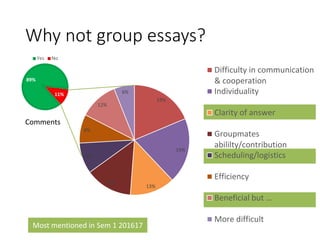
Why not group essays?
19%
19%
13%
14%
9%
8%
12%
6%
Difficulty in communication
& cooperation
Individuality
Clarity of answer
Groupmates
abililty/contribution
Scheduling/logistics
Efficiency
Beneficial but …
More difficult
89%
11%
Yes No
Most mentioned in Sem 1 201617
Comments
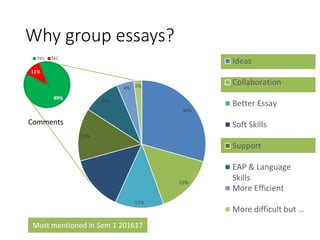
Why group essays?
89%
11%
Yes No
30%
15%
12%
14%
13%
10%
4% 2%
Ideas
Collaboration
Better Essay
Soft Skills
Support
EAP & Language
Skills
More Efficient
More difficult but …
Most mentioned in Sem 1 201617
Comments
Teacher Perceptions
• Anecdotal – level meetings and informal
discussions
• Initially - interest, doubt, resistance
• Learning curve first year
• Generally positive attitude to group essays
(surprising themselves)
Conclusions
• Group essays can not be approached in the
same way as individual essays.
• Less marking but more monitoring.
• With teacher support, collaborative essay
assignments can be very successful.
• Collaborative essays develop more than just
essay writing skills.
• Needs more research.
Group Essays In Context
• Session 13H
• Sunday April 9th
• 12:00-12:30
• Sustainable Development
Goals for a Sustainable EAP
Course
References
Berry, E. (2007). Group work and assessment—benefit or burden?. The Law Teacher, 41(1), 19-36.
Gillett, A. (2015). What is EAP? Retrieved from http://www.uefap.com/bgnd/whatfram. htm
Levrai, P. & Bolster, A. (2017). ‘Undergraduate collaborative essays: constructive not a cop-out’, IATEFL 2016
Birmingham Conference Selections. IATEFL
Li, M., & Campbell, J. (2008). Asian students’ perceptions of group work and group assignments in a New Zealand
tertiary institution. Intercultural Education, 19(3), 203-216.
Mulligan, C., & Garofalo, R. (2011). A collaborative writing approach: Methodology and student assessment. The
Language Teacher, 35(3), 5-10.
Scotland, J. (2016). How the experience of assessed collaborative writing impacts on undergraduate students’
perceptions of assessed group work. Assessment & Evaluation in Higher Education, 41(1), 15-34.
Shehadeh, A. (2011). Effects and student perceptions of collaborative writing in L2. Journal of Second Language
Writing, 20(4), 286-305.
Shin, M. (2015). Collaborative learning. English Teaching Professional, 97, 11-13.
Storch, N. (2013). Collaborative writing in L2 classrooms (Vol. 31). Multilingual matters.
Storch, N. (2005). Collaborative writing: Product, process, and students’ reflections. Journal of second language
writing, 14(3), 153-173.
Strauss, P. (2001). I'd rather vomit up a live hedgehog‘ - L2 students and group assessment in mainstream
university programs. Prospect-Adelaide-, 16(2), 55-66.
Wigglesworth, G., & Storch, N. (2009). Pair versus individual writing: Effects on fluency, complexity and
accuracy. Language Testing 26.3: 445-466.
Thank You
peterlevrai@gmail.com
averilbolster@gmail.com
http://developeap.weebly.com
Slides available at
https://www.slideshare.net
/PeterLevrai/

Baleap 2017 - essays with benefits

  • 1.
    Essays With Benefits Undergraduate CollaborativeWriting Peter Levrai & Averil Bolster Friday 7th April, BALEAP 2017 Bristol
  • 2.
    Why Hedgehogs? • Thereare a range of attitudes to collaborative writing. • “I’d rather vomit up a live hedgehog” (Strauss, 2001) • Concerns about • Fairness • Uneven workload / freeloading • Scheduling
  • 3.
    Why Group Essays? •Group writing is widespread in universities (Scotland, 2016) • Group writing has added benefits e.g. teamwork & critical thinking (Shin, 2015) • Group writing leads to better quality essays than individual writing (Wigglesworth & Storch, 2009; Shehadeh, 2011) • Results in better task fulfilment, grammatical accuracy and complexity (Storch, 2005; Mulligan & Garofalo, 2011) • Results in better grades (Mulligan & Garofalo, 2011; Berry, 2007) • Group-work helps with employability (Wigglesworth & Storch, 2009)
  • 4.
    The Teaching Context •University of Macau (English Medium Instruction Institution) • 1st Year undergraduate students • B1 & up (CEFR) • Novice writers • Preparation for first academic essay • The aim of the course is to help students develop “the language and associated practices that people need in order to undertake study or work in English medium higher education” (Gillett, 2015, para. 1).
  • 5.
    Developing a Framework- 2015 Notes on a source (individual) Outline (group) Paragraph (individual) First draft (group) Second draft (group) Final Draft (group) • Didn’t support group work effectively • Led to disjointed first drafts • Encouraged cooperation, not collaboration (Storch, 2013) Levrai & Bolster, 2017
  • 6.
    Developing a Framework– 2017 Moodle discussion of input texts (individual) Group ground rules (group) ‘Stormboard’ discussion of potential sources (group) Annotated bibliography (individual) Outline (group) First draft (group) Group work stop, check, reflect (individual) Tutorial (group) Second draft (group) Peer feedback (individual) Final Draft (group) Group-work reflection (individual) Levrai & Bolster, 2017
  • 7.
    Developing a MarkScheme *Individual work also assessed through coursework and end-of-course reflection Individual* • Forum Discussions – 5% • Annotated Bibliography – 20% • Peer feedback on 2nd Draft – 15% • Group Contribution – 10% Group • Drafting – 10% • Final Draft – 40%
  • 8.
    Exploiting Web 2.0 •Use of collaborative online spaces help the teacher ‘see’ inside the group-work process. • This can be an eye-opener. Brainstorming & Planning • Stormboard Drafting • Google Docs Task Management • Trello
  • 9.
  • 10.
    I understand whatmakes a good essay 0 20 40 60 80 100 120 140 160 180 201415 Sem 2 201516 Sem 1 201516 Sem 2 201617 Sem 1 Agree completely Agree Disagree Disagree Completely N/A
  • 11.
    I am betterat essay writing 0 20 40 60 80 100 120 140 201415 Sem 2 201516 Sem 1 201516 Sem 2 201617 Sem 1 Agree completely Agree Disagree Disagree Completely N/A
  • 12.
    I would recommendgroup essays 0 20 40 60 80 100 120 140 160 180 201415 Sem 2 201516 Sem 1 201516 Sem 2 201617 Sem 1 No.Students Yes No N/A Yes 84% No 15% N/A 1% Yes No N/A Yes No N/A Total 759 111 9 759
  • 13.
    Why not groupessays? 19% 19% 13% 14% 9% 8% 12% 6% Difficulty in communication & cooperation Individuality Clarity of answer Groupmates abililty/contribution Scheduling/logistics Efficiency Beneficial but … More difficult 89% 11% Yes No Most mentioned in Sem 1 201617 Comments
  • 14.
    Why group essays? 89% 11% YesNo 30% 15% 12% 14% 13% 10% 4% 2% Ideas Collaboration Better Essay Soft Skills Support EAP & Language Skills More Efficient More difficult but … Most mentioned in Sem 1 201617 Comments
  • 15.
    Teacher Perceptions • Anecdotal– level meetings and informal discussions • Initially - interest, doubt, resistance • Learning curve first year • Generally positive attitude to group essays (surprising themselves)
  • 16.
    Conclusions • Group essayscan not be approached in the same way as individual essays. • Less marking but more monitoring. • With teacher support, collaborative essay assignments can be very successful. • Collaborative essays develop more than just essay writing skills. • Needs more research.
  • 17.
    Group Essays InContext • Session 13H • Sunday April 9th • 12:00-12:30 • Sustainable Development Goals for a Sustainable EAP Course
  • 18.
    References Berry, E. (2007).Group work and assessment—benefit or burden?. The Law Teacher, 41(1), 19-36. Gillett, A. (2015). What is EAP? Retrieved from http://www.uefap.com/bgnd/whatfram. htm Levrai, P. & Bolster, A. (2017). ‘Undergraduate collaborative essays: constructive not a cop-out’, IATEFL 2016 Birmingham Conference Selections. IATEFL Li, M., & Campbell, J. (2008). Asian students’ perceptions of group work and group assignments in a New Zealand tertiary institution. Intercultural Education, 19(3), 203-216. Mulligan, C., & Garofalo, R. (2011). A collaborative writing approach: Methodology and student assessment. The Language Teacher, 35(3), 5-10. Scotland, J. (2016). How the experience of assessed collaborative writing impacts on undergraduate students’ perceptions of assessed group work. Assessment & Evaluation in Higher Education, 41(1), 15-34. Shehadeh, A. (2011). Effects and student perceptions of collaborative writing in L2. Journal of Second Language Writing, 20(4), 286-305. Shin, M. (2015). Collaborative learning. English Teaching Professional, 97, 11-13. Storch, N. (2013). Collaborative writing in L2 classrooms (Vol. 31). Multilingual matters. Storch, N. (2005). Collaborative writing: Product, process, and students’ reflections. Journal of second language writing, 14(3), 153-173. Strauss, P. (2001). I'd rather vomit up a live hedgehog‘ - L2 students and group assessment in mainstream university programs. Prospect-Adelaide-, 16(2), 55-66. Wigglesworth, G., & Storch, N. (2009). Pair versus individual writing: Effects on fluency, complexity and accuracy. Language Testing 26.3: 445-466.
  • 19.