Winter 2010 COM101

Group Project Overview
“Learning in Teams”

 A team of students had four members called
 Everybody, Somebody, Anybody, and Nobody.
 There was an important job to be done.
 Everybody was sure that Somebody would do it.
 Anybody could have done it, but Nobody did it.
 Somebody got angry about that because it was
 Everybody’s job. Everybody thought Anybody
 could do it but Nobody realized that Everybody
 wouldn’t do it. It ended up that Everybody
 blamed Somebody when Nobody did what
 Anybody could have done.
                                      (Graham Gibbs)
Groups for Final Project

• Please write your Group Name, Group
  Members’ Names, & Case Study you chose on
  the colored paper
5 Ways to Wreck a Group
• List 5 behaviors or actions that can undermine
  group work
  – Example: One member “forgets” to complete
    assignments
  – Roundtable Instructions:
          • One piece of paper and pen per group
          • First student writes one response and says it out loud
          • First student passes paper to the left, second student
            writes response…
          • Continues around group until time elapses
          • Students may “pass” at any time
          • Group stops when time is called
  (Cooperative Learning, Millis, B.J., 1999; Group Dynamics 101; Allen, D., 2002; Working in Groups, Duch, B., 2000)
Developing Ground Rules
• Use the worksheet provided to develop Ground
  Rules for your group. Your ground rules must:
   – be agreed upon by all members of your group.
   – clearly state expectations for group members' behavior.
   – discuss consequences for certain behaviors when
     expectations are not met.
   – address absences as well as issues related to students
     who do not contribute equally.
• These ground rules will be used during the semester
  to assure that you have the most worthwhile
  learning experience possible.
• Be prepared to share your list with the class.
Examples of Ground Rules
 Arrive to class on time
 Come to class prepared
 Share information with group members
 Respect the views, values, and ideas of group
  members


                                 (Group Dynamics 101; Allen,
  D., 2002)
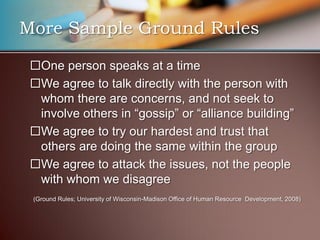
More Sample Ground Rules

 One person speaks at a time
 We agree to talk directly with the person with
  whom there are concerns, and not seek to
  involve others in “gossip” or “alliance building”
 We agree to try our hardest and trust that
  others are doing the same within the group
 We agree to attack the issues, not the people
  with whom we disagree
 (Ground Rules; University of Wisconsin-Madison Office of Human Resource Development, 2008)
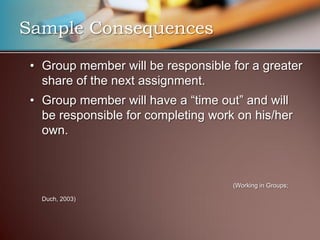
Sample Consequences

 • Group member will be responsible for a greater
   share of the next assignment.
 • Group member will have a “time out” and will
   be responsible for completing work on his/her
   own.


                                     (Working in Groups;

   Duch, 2003)
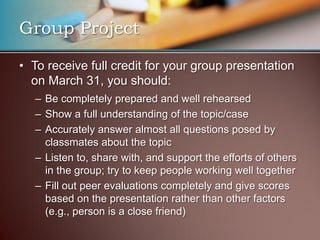
Group Project

• To receive full credit for your group presentation
  on March 31, you should:
   – Be completely prepared and well rehearsed
   – Show a full understanding of the topic/case
   – Accurately answer almost all questions posed by
     classmates about the topic
   – Listen to, share with, and support the efforts of others
     in the group; try to keep people working well together
   – Fill out peer evaluations completely and give scores
     based on the presentation rather than other factors
     (e.g., person is a close friend)
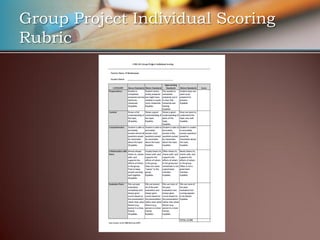
Group Project Individual Scoring
Rubric
Group Project
• To receive full credit from your group members,
  you should:
  – Bring needed materials to class and always be ready
    to work
  – Consistently stay focused on the task and what needs
    to be done; be very self-directed
  – Routinely use time well throughout the project to
    ensure things get done on time
  – Always listen to, share with, and support the efforts of
    others; try to keep people working well together
  – Routinely monitor the effectiveness of the group, and
    make suggestions to make it more effective
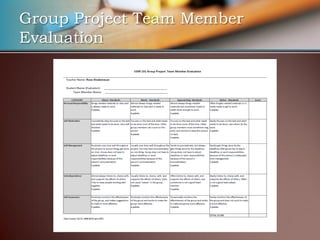
Group Project Team Member
Evaluation
• Consider the success strategies in the text when
  investigating solutions. Be sure to include these
  in your presentation!
• What are some of the strategies we’ve already
  covered?
Some possibilities for your
      presentation
You Tube
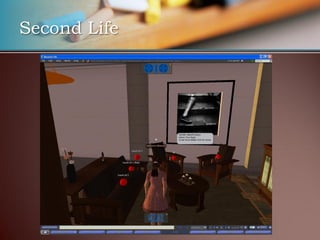
Second Life
Second Life
Student Technology Center

• Begin scheduling your appointments now with
  the Student Technology Center (248-370-4832
  or stc@oakland.edu).
• They can assist you with:
  • PowerPoint
  • YouTube
  • SecondLife
Questions?

10732 week four wi2010 group project

  • 1.
    Winter 2010 COM101 GroupProject Overview
  • 2.
    “Learning in Teams” A team of students had four members called Everybody, Somebody, Anybody, and Nobody. There was an important job to be done. Everybody was sure that Somebody would do it. Anybody could have done it, but Nobody did it. Somebody got angry about that because it was Everybody’s job. Everybody thought Anybody could do it but Nobody realized that Everybody wouldn’t do it. It ended up that Everybody blamed Somebody when Nobody did what Anybody could have done. (Graham Gibbs)
  • 3.
    Groups for FinalProject • Please write your Group Name, Group Members’ Names, & Case Study you chose on the colored paper
  • 4.
    5 Ways toWreck a Group • List 5 behaviors or actions that can undermine group work – Example: One member “forgets” to complete assignments – Roundtable Instructions: • One piece of paper and pen per group • First student writes one response and says it out loud • First student passes paper to the left, second student writes response… • Continues around group until time elapses • Students may “pass” at any time • Group stops when time is called (Cooperative Learning, Millis, B.J., 1999; Group Dynamics 101; Allen, D., 2002; Working in Groups, Duch, B., 2000)
  • 5.
    Developing Ground Rules •Use the worksheet provided to develop Ground Rules for your group. Your ground rules must: – be agreed upon by all members of your group. – clearly state expectations for group members' behavior. – discuss consequences for certain behaviors when expectations are not met. – address absences as well as issues related to students who do not contribute equally. • These ground rules will be used during the semester to assure that you have the most worthwhile learning experience possible. • Be prepared to share your list with the class.
  • 6.
    Examples of GroundRules Arrive to class on time Come to class prepared Share information with group members Respect the views, values, and ideas of group members (Group Dynamics 101; Allen, D., 2002)
  • 7.
    More Sample GroundRules One person speaks at a time We agree to talk directly with the person with whom there are concerns, and not seek to involve others in “gossip” or “alliance building” We agree to try our hardest and trust that others are doing the same within the group We agree to attack the issues, not the people with whom we disagree (Ground Rules; University of Wisconsin-Madison Office of Human Resource Development, 2008)
  • 8.
    Sample Consequences •Group member will be responsible for a greater share of the next assignment. • Group member will have a “time out” and will be responsible for completing work on his/her own. (Working in Groups; Duch, 2003)
  • 9.
    Group Project • Toreceive full credit for your group presentation on March 31, you should: – Be completely prepared and well rehearsed – Show a full understanding of the topic/case – Accurately answer almost all questions posed by classmates about the topic – Listen to, share with, and support the efforts of others in the group; try to keep people working well together – Fill out peer evaluations completely and give scores based on the presentation rather than other factors (e.g., person is a close friend)
  • 10.
  • 11.
    Group Project • Toreceive full credit from your group members, you should: – Bring needed materials to class and always be ready to work – Consistently stay focused on the task and what needs to be done; be very self-directed – Routinely use time well throughout the project to ensure things get done on time – Always listen to, share with, and support the efforts of others; try to keep people working well together – Routinely monitor the effectiveness of the group, and make suggestions to make it more effective
  • 12.
    Group Project TeamMember Evaluation
  • 13.
    • Consider thesuccess strategies in the text when investigating solutions. Be sure to include these in your presentation! • What are some of the strategies we’ve already covered?
  • 14.
    Some possibilities foryour presentation
  • 15.
  • 16.
  • 17.
  • 18.
    Student Technology Center •Begin scheduling your appointments now with the Student Technology Center (248-370-4832 or stc@oakland.edu). • They can assist you with: • PowerPoint • YouTube • SecondLife
  • 19.