ShopAll Return Module

       Group 2 (H49)
   Akanksha Singh (525772)
    Gaurav Paliwal (525705)
    Nikhil Trivedi (525746)
   Pragyan Acharya (525867)
    Pranjal Mishra (525850)
     Ratika Malik (525695)
    Suman Kumar (525818)
Index

1. Introduction to Business Intelligence
2. Informatica
3. ShopAll Scenario
4. Slowing Changing Dimension – 0/1/2/3
5. Business Objects
6. Test Cases
7. Report
8. Lessons Learnt
9. Business Value of Reports
10. Miscellaneous
What is Business Intelligence ?


 A Brief history of Business Intelligence
What is Business Intelligence ?

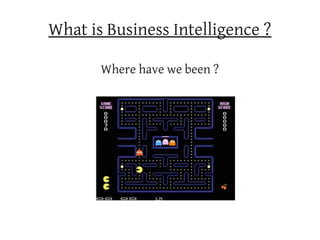
       Where have we been ?
What is Business Intelligence ?

        Where are we now ?
What is Business Intelligence ?

       Where are we going ?
What is Business Intelligence ?

       Why Should we care ?
According to Wikipedia
What is Business Intelligence ?


Business intelligence (BI) mainly refers to computer-
based techniques used in identifying, extracting,and
analyzing business data, such as sales revenue by
products and/or departments, or by associated costs
and incomes. BI technologies provide historical,
current and predictive views of business operations.
What is Business Intelligence ?


     But that BI is still hard to understand ?

Is what that what it took to make business intelligent ?
What is Business Intelligence ?


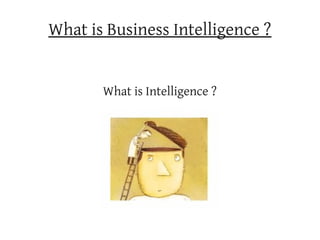
       What is Intelligence ?
What is Business Intelligence ?


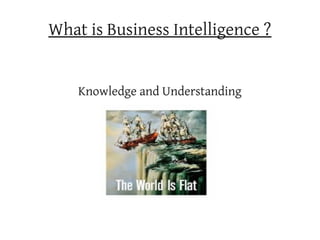
    Knowledge and Understanding
What is Business Intelligence ?

       Meaning and Context
What is Business Intelligence ?

            Foresight
What is Business Intelligence ?

      Solve complex problems
What is Business Intelligence ?

        To make decisions.
What is Business Intelligence ?

    We make decision every time ?
What is Business Intelligence ?

         Sometimes good.
What is Business Intelligence ?


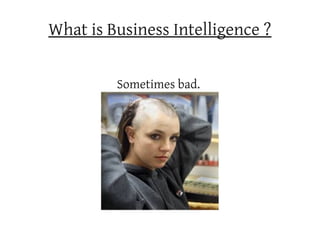
         Sometimes bad.
What is Business Intelligence ?


       Intelligence = Decision
What is Business Intelligence ?

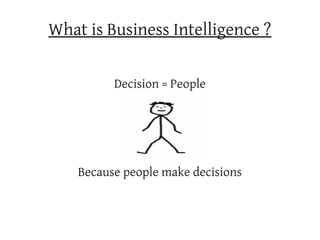
          Decision = People


    Because people make decisions
What is Business Intelligence ?


     What makes good decision ?

       Valuable information.
What is Business Intelligence ?


     Intelligence + Information
                  =
            Good Decision
What is Business Intelligence ?


    Information provide answers
What is Business Intelligence ?


Information is distributed in various places.
What is Business Intelligence ?


You need to aggregate Information from various
                   sources.
What is Business Intelligence ?


      Solution is Informatica.
What is Business Intelligence ?


Decisions are made by Information Analysis.
What is Business Intelligence ?


But BI is about usability as business people don't have
     time and they need time line based analysis.
What is Business Intelligence ?

          To turn data
What is Business Intelligence ?

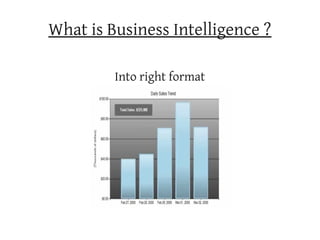
         Into right format
What is Business Intelligence ?


  What you need is Business Objects.
What is Business Intelligence ?

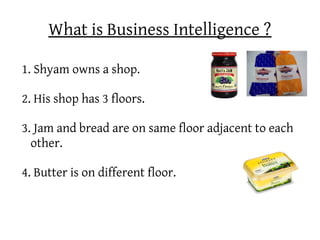
1. Shyam owns a shop.

2. His shop has 3 floors.

3. Jam and bread are on same floor adjacent to each
  other.

4. Butter is on different floor.
What is Business Intelligence ?


5. He gives all his sales data to the abc organization.


            Sales Data → Raw Information
What is Business Intelligence ?
6. abc organization observed that 25% of the people
 who bought bread also bought jam.


7. But 50% of the people who bought bread also
 bought butter.
What is Business Intelligence ?

8. Prediction can be made that bread and butter
 combination is more likely purchased compared to
 the bread and jam combination.

 He then exchanged the butter with the jam
 location.
What is Business Intelligence ?

9. This is called Business Intelligence.

10. And the outcome is Happy Customers and Better
 revenues.
What is Business Intelligence ?

BI helps in the following processes :
  1. Decision support system
  2. Future trends analysis
  3. Business patterns
  etc.
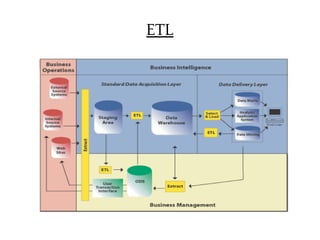
ETL Process

1. ETL stands for Extraction – Transformation –
Loading.
ETL

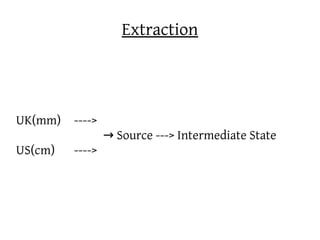
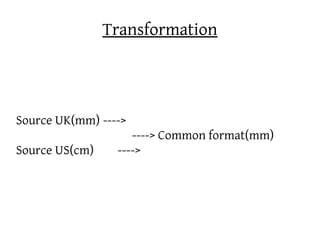
1. Data is taken from different sources, lets say US and
UK.

2. In US database the shoe size is in mm size, In UK
database it is in cm size.

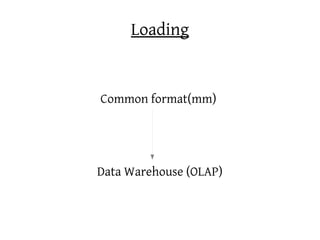
3. We need both of them in common format, so that
we can use it for future predictions
Extraction


UK(mm)   ---->
                 → Source ---> Intermediate State
US(cm)   ---->
Transformation


Source UK(mm) ---->
                    ----> Common format(mm)
Source US(cm)    ---->
Type of Transformation

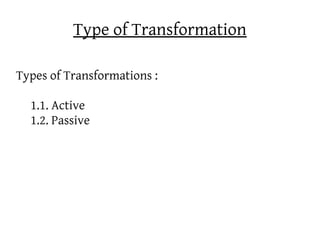
Types of Transformations :

  1.1. Active
  1.2. Passive
Loading


Common format(mm)


Data Warehouse (OLAP)
ETL
Tools for ETL

  Informatica
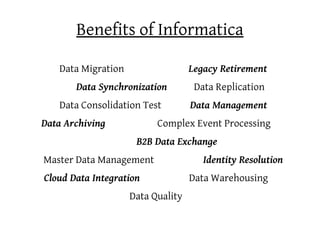
Benefits of Informatica

   Data Migration                  Legacy Retirement
       Data Synchronization         Data Replication
   Data Consolidation Test         Data Management
Data Archiving            Complex Event Processing
                     B2B Data Exchange
Master Data Management                Identity Resolution
Cloud Data Integration             Data Warehousing
                    Data Quality
ShopAll Example


http://gauravpaliwal.com/LiveExamples/CustomerIndex.html
ShopAll Scenario


Populating Data Warehouse
Preserving history for trends analysis


1. Methods :

  1.1.   Slowly Changing Dimensions 0
  1.2.   Slowly Changing Dimensions 1
  1.3.   Slowly Changing Dimensions 2
  1.4.   Slowly Changing Dimensions 3
Slowly Changing Dimensions 0

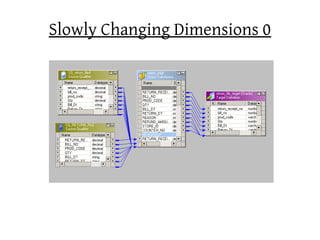
The Type 0 method is a passive approach to managing
dimension value changes, in which no action is taken.
Values remain as they were at the time of the
dimension record was first entered.
Slowly Changing Dimensions 0


           Example
Slowly Changing Dimensions 0
Slowly Changing Dimensions 1

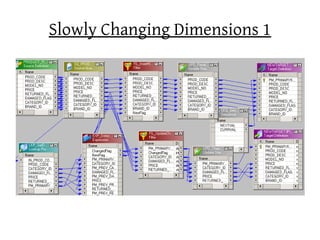
The Type 1 methodology overwrites old data with
new data, and therefore does not track historical data
at all. This is most appropriate when correcting
certain types of data errors, such as the spelling of a
name.
Slowly Changing Dimensions 1


           Example
Slowly Changing Dimensions 1
Slowly Changing Dimensions 2


The Type 2 method tracks historical data by creating
multiple records for a given natural key in the
dimensional tables with separate surrogate key
and/or different version numbers. With Type 2, we
have unlimited history preservation as a new
record is inserted each time a change is made.
Slowly Changing Dimensions 2


           Example
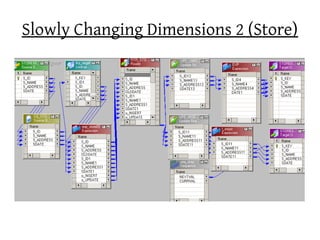
Slowly Changing Dimensions 2 (Store)
Slowly Changing Dimensions 3

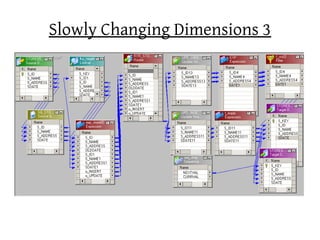
The Type 3 method tracks changes using separate
columns. Whereas Type 2 had unlimited history
preservation, Type 3 has limited history preservation,
as it's limited to the number of columns designated
for storing historical data.
Slowly Changing Dimensions 3


           Example
Slowly Changing Dimensions 3
ShopAll Scenario

1. ETL process for populating following tables :

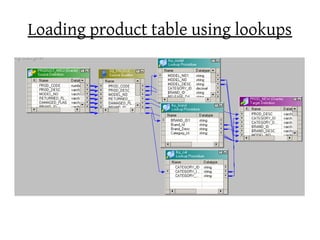
  1.1. Loading product table using lookup.
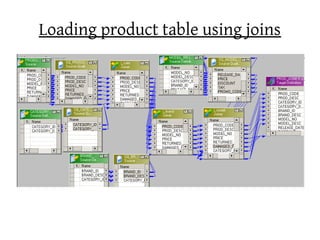
  1.2. Loading product table using joins.
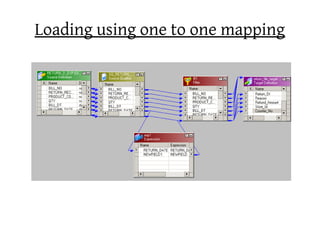
  1.3. Return fact table loading using one to
  one mapping.
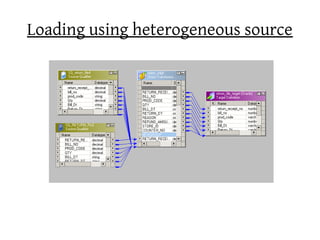
  1.4. Return fact table loading using
     heterogeneous source.
Loading product table using lookups
Loading product table using joins
Loading using one to one mapping
Loading using heterogeneous source
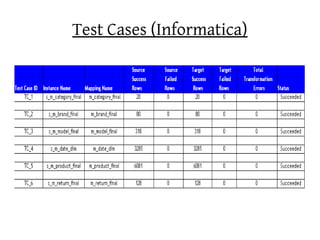
Test Cases (Informatica)
Reports Generation


Reports Generation for fast analyzing of data
Reports Generation


 We use Business Object
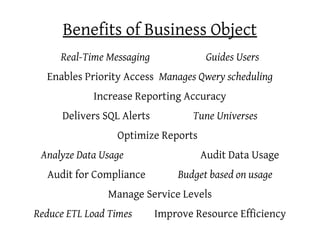
Benefits of Business Object
     Real-Time Messaging              Guides Users
  Enables Priority Access Manages Qwery scheduling
            Increase Reporting Accuracy
      Delivers SQL Alerts          Tune Universes
                 Optimize Reports
 Analyze Data Usage                  Audit Data Usage
  Audit for Compliance          Budget based on usage
               Manage Service Levels
Reduce ETL Load Times       Improve Resource Efficiency
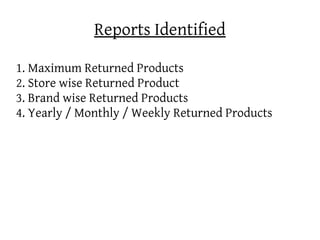
Reports Identified

1. Maximum Returned Products
2. Store wise Returned Product
3. Brand wise Returned Products
4. Yearly / Monthly / Weekly Returned Products
Test Cases (BO)


http://gauravpaliwal.com/maptestcase.html
Reports Analyzed


                                    BO Reports :
  http://inhydqcybipm01:8080/businessobjects/enterprise115/desktoplaunch/InfoView/logon/logon.do


      Interactive Dashboard (Business Values):
http://gauravpaliwal.com/FusionCharts_Evaluation/Code/jquery/creatingcharts/
Problem Faced and Lesson Learnt


Problem : Session Related Error (Informatica)

  Solution : Logout all sessions and follow
           naming convention

Group Presentation on Bussiness Intelligence