Business Intelligence
          O.A.Balasubramaniam
Data Growth

• Corporate data is undoubtedly one of the
  most critical assets of any company
• Data is growing by 100% Every year
• Data generated in the 3 years is equivalent to
  previous 30 years..
How we are going to
 Manage with this?
What is
Information?
Information is
an Organisational Asset
                    Information
Information
should be used
as a tool
for strategic advantage
Data
vs
Information
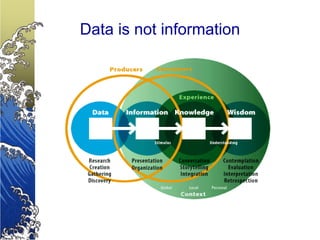
Data is not information
Data vs Information
Data
  •    A “given,” or fact; a number, a statement, or a
       picture
  •    Represents something in the real world
  •    The raw materials in the production
Information
  •    Data that have meaning within a context
  •    Data in relationships
  •    Data after manipulation
CURRENT STATUS OF DATA


                        What do
                        I do???

                          How do I increase
                             sales????

                            How do I make my
                             product better???


Mountains of Data       Business Users
DATA – WHAT DO WE DO ??????


Organizations have LOTS of Data

Data is not in a form that is useful to Decision-Makers

    Not easy to Review

    Not Informative nor Insightful
THE PROBLEM


                                  How do I retain
                                  customers?

                                  How do I increase
                      GAP            sales????

                                    How do I make my
                                    product better???


Mountains of Data                     Business People
                    The Problem
WHERE DO THESE DATA COME FROM ?


                Sales   Procure-   Operations   Finance
                        ment


 Reporting
  Layer


Transaction
  Layer         CRM       SCM         MRP       Finance


              SILOS OF DATA BY FUNCTIONAL AREA
WHERE DO THESE DATA COME FROM ?


              Sales   Sales       Sales       Sales


Reporting
 Layer


Transaction
  Layer

              Div 2   Region: B   Region: A    Div 1


     SILOS OF DATA WITHIN ORGANIZATIONS
Common Pain Points ...
•   Data everywhere, information no where
•   Different users have different needs
    •   Excel versus PDF
    •   Pull versus push
    •   On demand – on schedule
    •   Your format – my format

•   Takes too long – wasted resources/efforts
•   Security
•   “Why I just can’t get it to you when you want it”


                                                        14
Data Manipulation
  Example: customer survey

• Reading through data collected from a
 customer survey with questions in various
 categories would be time-consuming and
 not very helpful.

• When manipulated, the surveys may
 provide useful information.
The existing Reporting system..
•   You’re battling to answer basic questions about your business

•   You spend more time collecting data than analyzing it

•   You’re drowning in reports

•   You have problems with the quality of the information you use

•   You’re forced to make decisions with insufficient facts and
    information

•   You are having problems to combine data across different
    systems and platforms

•   You’re frustrated with the complexities of OLAP and one
    dimensional view in Excel
Information & Management levels

                  High level reports


                    Executive Information

                        Decision Support


                       Queries and Report


                       Transaction Data
Types of Information Systems

• Transaction Processing Systems (TPS)
• Management Information Systems (MIS)
• Decision Support Systems (DSS)
• Executive Information System (EIS)
• Business Intelligence (BI)
Transaction Processing Systems (TPS)

•   Designed to Staff and day-to-day transactions
•   Automate handling of data about business activities
    (transactions)
•   Mostly transactions Eg.
     •   Entering Purchase orders
     •   Making sales invoices
     •   Entering production data
Management Information Systems (MIS)..

•   Designed for the Managers
•   Converts raw data from transaction processing
    system into meaningful form
•   Mostly reports and charts Eg.
     •   Value of Pending orders till date
     •   Sales made for the month of June
     •   Profit for the quarter
Decision Support Systems (DSS)

•   Designed to help decision makers
•   Provides interactive environment for decision
    making
•   What if Analysis and Extrapolations Eg.
     •   Value of sales in the month of March 2007 compared to
         March 2006
     •   Reduction in sales value due to Price reduction
Executive Information System (EIS)

•   Designed to the Top Management – Directors,
    CEOs
•   Graphs and High level Drill down Data
•   Key business and Industry area Eg.
     •   Profit on Cleaning machines for Second Quarter
         compared to First Quarter
     •   Sales forecast for the next 5 years
     •   Achieving 50% sales through exports
Business
Intelligence
Business Intelligence


It will Lead Business into the Future
The general categories of BI tools

•   Spreadsheets
•   Reporting and querying software
    •   tools that extract, sort, summarize, and present selected data
•   OLAP
•   Digital Dashboards
•   Data mining
•   Decision engineering
•   Process mining
•   Business performance management
•   Local information systems
Evolution from Static Report to BI…
    High
                                                 2002
                                                           Action – Business Intelligence


                                     1996           Advice – Data Mining


      User
Interaction                                 Analysis – Online Analytical Processing
                         1992
                                   Investigation – Executive Information Systems


               1985           Aggregation – Management Information Systems


    Low               Reporting – General Reports


              Low
                                   Analytical Features               High
Evolution from Static Report to BI…


                                      BI Tools
                                      Digital Dashboards


                      Visual Charts


 Plain Text Reports
WHAT IS BUSINESS INTELLIGENCE (BI) !


Business Intelligence Is The Processes,
Technologies, And Tools That Help Us Change
Data Into Information, Information Into
Knowledge And Knowledge Into Plans That
Guide Organization

Technologies    For    Gathering,  Storing,
Analyzing And Providing Access To Data To
Help Enterprise Users Make Better Business
Decisions
What is Business Intelligence?
•   Business Intelligence (BI) is about getting
     • the right information,
     • to the right decision makers,
     • at the right time.
•   BI is an enterprise Software

•   BI leads to:
     • Fact-based decision making
     • “single version of the truth”
•   BI includes reporting, analysis and decision
    making.
WHAT IS BUSINESS INTELLIGENCE
             IN SUMMARY
Data Analytics & Business Intelligence provide the Right
Information at the Right Time in the Right Way for more
profitable decision-making.


Data Analytics with BI forms an Enterprise-wide platform
for querying, analysis and Reporting to make better
decisions.


 Advanced BI solutions provide interactive analysis by
integrating departments and Functions into one holistic view.
Technologies Supporting BI

•   Database systems and database integration
•   Data warehousing, data stores and data marts
•   Enterprise resource planning (ERP) systems
•   Query and report writing technologies
•   Data mining and analytics tools
•   Decision support systems
•   Customer Relation Management software
•   Product Lifecycle Management (PLM) systems
Business Intelligence

Improving organizations by
providing business insights
to all employees leading to
• Better
• Faster
• More relevant decisions

 Advanced Analytics
 Self Service Reporting
 End-User Analysis
 Business Performance Management
Why BI?
               The Five Questions


        • What happened?              Past
        • What is happening?
        • Why did it happen?          Present
        • What will happen?
        • What do I want to happen?   Future


                                       Misc
Data   ERP    CRM     SCM      3Pty    Data
Why BI?
Make more informed business decisions
•   Competitive and location analysis
•   Customer behavior analysis
•   Targeted marketing and sales strategies
•   Business scenarios and forecasting
•   Business service management
•   Business planning and operation optimization
•   Financial management and compliance
WHO USES BI

There are many different users who can
benefit from business intelligence

 Executives
 Business Decision Makers
 Information Workers
 Line Workers
 Analysts
Business Intelligence thro Excel
Digital Dashboard

A dashboard is a tool used for
collecting and reporting key
performance indicators in a quick
summary format.
Digital Dashboard…

 A digital dashboard provides a
consolidated view of information
from multiple sources in a single
web browser screen.
Dashboard of Marketing Campaign
Winter Olympic Games
BUSINESS PERFORMANCE MANAGEMENT


                  Source: Abeerdeen Research –Best in Class Trends for Business Planning
Key Performance Indicator (KPI)

 Key Performance Indicator (KPI) is a measure of
 performance of
     - an Organisation
     - a Department
     - an Individual


Such measures are commonly used
to help an organization define and
   evaluate how successful it is,
   typically in terms of making
  progress towards its long-term
       organizational goals
KPI’s As Dash Board Elements

Manufacturing KPIs

•   Production Capacity Trends
•   Projected Inventory Surplus
•   Days on Hand
•   Production Shortage as percentage (%) of Demand
•   Inventory Turns
•   Production Cycle
•   Equipment Utilization percentage (%)
KPI’s As Dash Board Elements…

    Financial KPIs
•   Inventory level at a given time
•   Collections made during the day
•   Days in Accounts Receivable
•   Net Collection Percentage
•   Percent of A/R over 90 days
•   Profit before Tax
BI as a Balance Score Card
BI’ Help in a Manufacturing Industry


Increase the value of customer relationships

Respond quickly to changing markets and company sensitivities

Accelerate new product time-to-market

Reduce inventory investment

Improve planning, scheduling, and the procurement schedule

Maintain and develop quality assurance

Select and apply world-class technologies
Data for BI

                          LAN/WAN
                                                  Branches


                                         Server


                                                   Internet/ Intranet
                      Data Acquisition
                         Programs
Operational Systems
(Systems of Record)
General purpose of BI
•   Single Source of the Truth

•   Increased Reporting Accuracy

•   Spots Opportunity and Risks business-wide

•   Conduct “what-if” analysis

•   Tracks Past, Present and Future Business Scenarios

•   Faster Deployment Time, Easy to use and meant for
    executives for decision-making
Depth of Business Intelligence


                    Normal Reports


                     BI Reports
BI Vendors in The Market
No.   Business Intelligence Tool        Vendor
1.    Oracle Enterprise BI Server       Oracle
2.    SAP Business Objects Enterprise   SAP
3.    SAP NetWeaver BI                  SAP
4.    SAS Enterprise BI Server          SAS Institute
5.    Microsoft BI platform*            Microsoft
6.    IBM Cognos Series 8               IBM
7.    Board Mgt Intelligence Toolkit    Board International
 8.   BizzScore Suite                   EFM Software
 9.   WebFocus                          Information Builders
10.   QlikView                          QlikTech
11.   Microstrategy                     Microstrategy
12.   Oracle Hyperion System            Oracle
13.   Actuate                           Actuate
Thank You…

Business intelligence

  • 1.
    Business Intelligence O.A.Balasubramaniam
  • 2.
    Data Growth • Corporatedata is undoubtedly one of the most critical assets of any company • Data is growing by 100% Every year • Data generated in the 3 years is equivalent to previous 30 years..
  • 3.
    How we aregoing to Manage with this?
  • 4.
  • 5.
    Information is an OrganisationalAsset Information Information should be used as a tool for strategic advantage
  • 6.
  • 7.
    Data is notinformation
  • 8.
    Data vs Information Data • A “given,” or fact; a number, a statement, or a picture • Represents something in the real world • The raw materials in the production Information • Data that have meaning within a context • Data in relationships • Data after manipulation
  • 9.
    CURRENT STATUS OFDATA What do I do??? How do I increase sales???? How do I make my product better??? Mountains of Data Business Users
  • 10.
    DATA – WHATDO WE DO ?????? Organizations have LOTS of Data Data is not in a form that is useful to Decision-Makers Not easy to Review Not Informative nor Insightful
  • 11.
    THE PROBLEM How do I retain customers? How do I increase GAP sales???? How do I make my product better??? Mountains of Data Business People The Problem
  • 12.
    WHERE DO THESEDATA COME FROM ? Sales Procure- Operations Finance ment Reporting Layer Transaction Layer CRM SCM MRP Finance SILOS OF DATA BY FUNCTIONAL AREA
  • 13.
    WHERE DO THESEDATA COME FROM ? Sales Sales Sales Sales Reporting Layer Transaction Layer Div 2 Region: B Region: A Div 1 SILOS OF DATA WITHIN ORGANIZATIONS
  • 14.
    Common Pain Points... • Data everywhere, information no where • Different users have different needs • Excel versus PDF • Pull versus push • On demand – on schedule • Your format – my format • Takes too long – wasted resources/efforts • Security • “Why I just can’t get it to you when you want it” 14
  • 15.
    Data Manipulation Example: customer survey • Reading through data collected from a customer survey with questions in various categories would be time-consuming and not very helpful. • When manipulated, the surveys may provide useful information.
  • 16.
    The existing Reportingsystem.. • You’re battling to answer basic questions about your business • You spend more time collecting data than analyzing it • You’re drowning in reports • You have problems with the quality of the information you use • You’re forced to make decisions with insufficient facts and information • You are having problems to combine data across different systems and platforms • You’re frustrated with the complexities of OLAP and one dimensional view in Excel
  • 17.
  • 18.
    Information & Managementlevels High level reports Executive Information Decision Support Queries and Report Transaction Data
  • 19.
    Types of InformationSystems • Transaction Processing Systems (TPS) • Management Information Systems (MIS) • Decision Support Systems (DSS) • Executive Information System (EIS) • Business Intelligence (BI)
  • 20.
    Transaction Processing Systems(TPS) • Designed to Staff and day-to-day transactions • Automate handling of data about business activities (transactions) • Mostly transactions Eg. • Entering Purchase orders • Making sales invoices • Entering production data
  • 21.
    Management Information Systems(MIS).. • Designed for the Managers • Converts raw data from transaction processing system into meaningful form • Mostly reports and charts Eg. • Value of Pending orders till date • Sales made for the month of June • Profit for the quarter
  • 22.
    Decision Support Systems(DSS) • Designed to help decision makers • Provides interactive environment for decision making • What if Analysis and Extrapolations Eg. • Value of sales in the month of March 2007 compared to March 2006 • Reduction in sales value due to Price reduction
  • 23.
    Executive Information System(EIS) • Designed to the Top Management – Directors, CEOs • Graphs and High level Drill down Data • Key business and Industry area Eg. • Profit on Cleaning machines for Second Quarter compared to First Quarter • Sales forecast for the next 5 years • Achieving 50% sales through exports
  • 24.
  • 25.
    Business Intelligence It willLead Business into the Future
  • 26.
    The general categoriesof BI tools • Spreadsheets • Reporting and querying software • tools that extract, sort, summarize, and present selected data • OLAP • Digital Dashboards • Data mining • Decision engineering • Process mining • Business performance management • Local information systems
  • 27.
    Evolution from StaticReport to BI… High 2002 Action – Business Intelligence 1996 Advice – Data Mining User Interaction Analysis – Online Analytical Processing 1992 Investigation – Executive Information Systems 1985 Aggregation – Management Information Systems Low Reporting – General Reports Low Analytical Features High
  • 28.
    Evolution from StaticReport to BI… BI Tools Digital Dashboards Visual Charts Plain Text Reports
  • 29.
    WHAT IS BUSINESSINTELLIGENCE (BI) ! Business Intelligence Is The Processes, Technologies, And Tools That Help Us Change Data Into Information, Information Into Knowledge And Knowledge Into Plans That Guide Organization Technologies For Gathering, Storing, Analyzing And Providing Access To Data To Help Enterprise Users Make Better Business Decisions
  • 30.
    What is BusinessIntelligence? • Business Intelligence (BI) is about getting • the right information, • to the right decision makers, • at the right time. • BI is an enterprise Software • BI leads to: • Fact-based decision making • “single version of the truth” • BI includes reporting, analysis and decision making.
  • 31.
    WHAT IS BUSINESSINTELLIGENCE IN SUMMARY Data Analytics & Business Intelligence provide the Right Information at the Right Time in the Right Way for more profitable decision-making. Data Analytics with BI forms an Enterprise-wide platform for querying, analysis and Reporting to make better decisions. Advanced BI solutions provide interactive analysis by integrating departments and Functions into one holistic view.
  • 32.
    Technologies Supporting BI • Database systems and database integration • Data warehousing, data stores and data marts • Enterprise resource planning (ERP) systems • Query and report writing technologies • Data mining and analytics tools • Decision support systems • Customer Relation Management software • Product Lifecycle Management (PLM) systems
  • 33.
    Business Intelligence Improving organizationsby providing business insights to all employees leading to • Better • Faster • More relevant decisions Advanced Analytics Self Service Reporting End-User Analysis Business Performance Management
  • 34.
    Why BI? The Five Questions • What happened? Past • What is happening? • Why did it happen? Present • What will happen? • What do I want to happen? Future Misc Data ERP CRM SCM 3Pty Data
  • 35.
    Why BI? Make moreinformed business decisions • Competitive and location analysis • Customer behavior analysis • Targeted marketing and sales strategies • Business scenarios and forecasting • Business service management • Business planning and operation optimization • Financial management and compliance
  • 36.
    WHO USES BI Thereare many different users who can benefit from business intelligence  Executives  Business Decision Makers  Information Workers  Line Workers  Analysts
  • 41.
  • 42.
  • 43.
    Digital Dashboard A dashboardis a tool used for collecting and reporting key performance indicators in a quick summary format.
  • 44.
    Digital Dashboard… Adigital dashboard provides a consolidated view of information from multiple sources in a single web browser screen.
  • 46.
  • 48.
  • 50.
    BUSINESS PERFORMANCE MANAGEMENT Source: Abeerdeen Research –Best in Class Trends for Business Planning
  • 51.
    Key Performance Indicator(KPI) Key Performance Indicator (KPI) is a measure of performance of - an Organisation - a Department - an Individual Such measures are commonly used to help an organization define and evaluate how successful it is, typically in terms of making progress towards its long-term organizational goals
  • 52.
    KPI’s As DashBoard Elements Manufacturing KPIs • Production Capacity Trends • Projected Inventory Surplus • Days on Hand • Production Shortage as percentage (%) of Demand • Inventory Turns • Production Cycle • Equipment Utilization percentage (%)
  • 53.
    KPI’s As DashBoard Elements… Financial KPIs • Inventory level at a given time • Collections made during the day • Days in Accounts Receivable • Net Collection Percentage • Percent of A/R over 90 days • Profit before Tax
  • 55.
    BI as aBalance Score Card
  • 56.
    BI’ Help ina Manufacturing Industry Increase the value of customer relationships Respond quickly to changing markets and company sensitivities Accelerate new product time-to-market Reduce inventory investment Improve planning, scheduling, and the procurement schedule Maintain and develop quality assurance Select and apply world-class technologies
  • 57.
    Data for BI LAN/WAN Branches Server Internet/ Intranet Data Acquisition Programs Operational Systems (Systems of Record)
  • 58.
    General purpose ofBI • Single Source of the Truth • Increased Reporting Accuracy • Spots Opportunity and Risks business-wide • Conduct “what-if” analysis • Tracks Past, Present and Future Business Scenarios • Faster Deployment Time, Easy to use and meant for executives for decision-making
  • 59.
    Depth of BusinessIntelligence Normal Reports BI Reports
  • 60.
    BI Vendors inThe Market No. Business Intelligence Tool Vendor 1. Oracle Enterprise BI Server Oracle 2. SAP Business Objects Enterprise SAP 3. SAP NetWeaver BI SAP 4. SAS Enterprise BI Server SAS Institute 5. Microsoft BI platform* Microsoft 6. IBM Cognos Series 8 IBM 7. Board Mgt Intelligence Toolkit Board International 8. BizzScore Suite EFM Software 9. WebFocus Information Builders 10. QlikView QlikTech 11. Microstrategy Microstrategy 12. Oracle Hyperion System Oracle 13. Actuate Actuate
  • 61.