GROUP ,TEAM & DECISION
MAKING BY… RAGHAV SIR
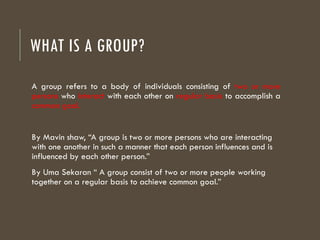
WHAT IS A GROUP?
A group refers to a body of individuals consisting of two or more
persons who interact with each other on regular basis to accomplish a
common goal.
By Mavin shaw, “A group is two or more persons who are interacting
with one another in such a manner that each person influences and is
influenced by each other person.”
By Uma Sekaran “ A group consist of two or more people working
together on a regular basis to achieve common goal.”
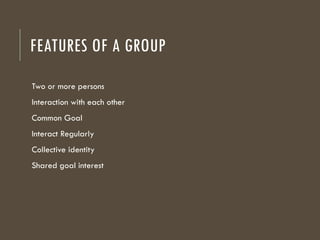
FEATURES OF A GROUP
Two or more persons
Interaction with each other
Common Goal
Interact Regularly
Collective identity
Shared goal interest
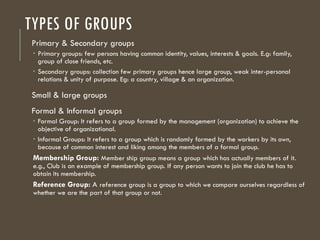
TYPES OF GROUPS
Primary & Secondary groups
 Primary groups: few persons having common identity, values, interests & goals. E.g: family,
group of close friends, etc.
 Secondary groups: collection few primary groups hence large group, weak inter-personal
relations & unity of purpose. Eg: a country, village & an organization.
Small & large groups
Formal & Informal groups
 Formal Group: It refers to a group formed by the management (organization) to achieve the
objective of organizational.
 Informal Groups: It refers to a group which is randomly formed by the workers by its own,
because of common interest and liking among the members of a formal group.
Membership Group: Member ship group means a group which has actually members of it.
e.g., Club is an example of membership group. If any person wants to join the club he has to
obtain its membership.
Reference Group: A reference group is a group to which we compare ourselves regardless of
whether we are the part of that group or not.
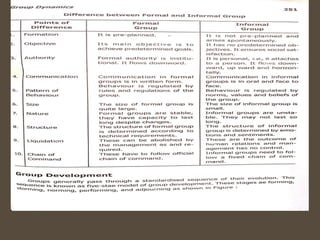
FORMAL & INFORMAL GROUPS
CHARACTERISTICS OF FORMAL GROUPS
Organization structure is defined by top management
Based on division of labor & efficiency in operations.
They are based on the division of work
Authority & responsibility are fixed to each member.
Coordination among members & their control is governed by set rules,
regulations etc.
CHARACTERISTICS OF INFORMAL GROUPS
Small size
More frequent interactions
Free flow of communication
Social control over members through norms developed informally.
Informal groups goal often conflict with organizational goals.
There are no written rules & regulations, instead are governed by the
group norms.
Members can be a member of other groups as well.
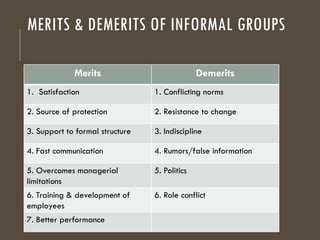
MERITS & DEMERITS OF INFORMAL GROUPS
Merits Demerits
1. Satisfaction 1. Conflicting norms
2. Source of protection 2. Resistance to change
3. Support to formal structure 3. Indiscipline
4. Fast communication 4. Rumors/false information
5. Overcomes managerial
limitations
5. Politics
6. Training & development of
employees
6. Role conflict
7. Better performance
REASONS FOR FORMATION OF GROUPS
Companionship & Sense of belongingness
Identity
Information(fast communication)
Security
Esteem
Power
Common cultural values
Generation of new ideas
Personality Development
Increase in Efficiency
GROUP DYNAMICS
It refers to the forces operating or present in the group and which
influence the behavior of the members of the group.
These forces are:
 Group Composition
 Group Leadership
 Group Norms
 Group Cohesiveness
 Group Status
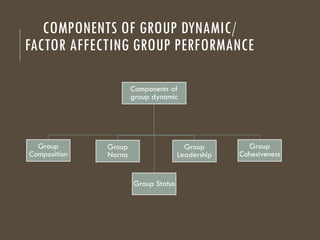
COMPONENTS OF GROUP DYNAMIC/
FACTOR AFFECTING GROUP PERFORMANCE
Components of
group dynamic
Group
Composition
Group
Norms
Group Status
Group
Leadership
Group
Cohesiveness
CONT’D…
Group composition
 Group composition refers to the extent to which group members are alike (common).
 The member of group are either homogeneous of heterogeneous.
Homogeneous Group: In the homogeneous group the members have similar qualities.
these similar qualities may be:
I. Demographic : Caste, Gender, Education, Experience, Age, Income, Culture etc.
II. Personality
III. Abilities
IV. Opinion
Heterogeneous Group: In heterogeneous group the members have different qualities.
Consequently, there is a lack of cohesiveness among them.
CONT’D…
Group Norms: Norms are those standards (rules/principles) which
guide the behavior of the members of the group.
Group Leadership: Leadership refers to the quality of a person to
control the behavior of group members. Every group has a leader. The
style of the working of the leader has an affect on the behavior of
the group members.
Group Status: Group status refers to the position or rank of a person
in a group. There are two types of group status.
1. Formal Status: These are the post or position given by the organization. Such as:
General manager, C.E.O., Sales Manager, Finance manager etc.
2. Informal Status: In an organization along with formal status one may get
informational status as well. Accepting somebody as the leader is an example of
informal status.
CONT’D…
Group Cohesiveness: It refers to the similarity of attitude,
behavior and performance of the group members.
It is an indicator of the unity of the members of the group.
According to Stephen P Robbins, “ Group cohesiveness is the
degree to which members are attached and attracted to each
other and are motivated to stay in group.
FACTORS INFLUENCING GROUP
COHESIVENESS
Group size
 Small groups are more cohesive
Composition of the group
 More cohesive if members are of same age, education, income, interests &
values(homogeneous)
Location of members
 More cohesiveness among people who work closely.
Group goals & performance
 Clear, acceptable & attainable goals encourages cohesiveness
Outside pressure/competition
 Members unite in case of external pressure
CONT’D…
Status
 Group having high status tends to be more cohesive
Group structure
 Well structured group with clear roles & responsibilities enhances cohesiveness
Group atmosphere
 Informal, friendly atmosphere encourages cohesiveness
Leadership
 Friendly, competent & democratic leader increases cohesiveness
Social rewards
 Groups in which members are socially satisfied and achieve their goals become more
cohesive.
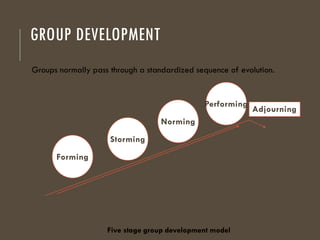
GROUP DEVELOPMENT
Groups normally pass through a standardized sequence of evolution.
Performing
Adjourning
Norming
Storming
Forming
Five stage group development model
THEORIES (ASSIGNMENT)
Propinquity theory
Homans interaction theory
Balance theory
Exchange theory
GROUP DECISION MAKING
Decision is the process of selecting best alternatives.
Every member can contribute to their effectiveness in taking decision
for a problem.
FEATURES
Minimum two decision makers.
Greater number of alternatives
Active interaction
Participation of group members.
Based on rational thinking
Decision can be both positive and negative.
ADVANTAGES
Greater knowledge base
Greater no. of alternatives.
Effective implementation/understanding of decisions.
Personal biasness is eliminated
Participative decisions
Democratic
DISADVANTAGES
Time consuming
Interpersonal conflicts
Group goals Vs organizational goals
Dominance
DECISION MAKING PROCESS
Defining the problem
Analysis of problem
Alternative course of action
Evaluation of alternatives
Experience
Experimentation
Taking decision & following up
TECHNIQUES FOR GROUP DECISION
MAKING
Brainstorming
 Five to ten people
 Generate ideas and written on blackboard
 Leader defines and explains the problems
 Focus on idea generation than on idea evaluation.
Delphi technique
 A group of experts are asked their opinions on a particular problem or situation
 Experts are unknown to each other & are physically separated.
 Experts are chosen on the basis of the problem.
 A coordinator collects, analyze & refine the opinions through the experts..
CONT’D…
Nominal technique
 Similar to brainstorming but more structured
 Each person is physically present but give ideas in writing only.
 A coordinator manages the whole process.
 All ideas are written on a board & ranking of solutions are done
 Highest ranking solution is selected.
Dialectic decision method
 Used to eliminate wrong choice of alternative
 Evaluate assumptions, pros & cons of each alternative.
 After evaluation we select one or combination of all or a new alternative.
CONT’D…
Fishbowling
 Members sit in a circle with a chair at the centre
 One member sits on the central chair at a time
 That member give his views on the problem & proposes a solution
 Other members ask questions to this member
 All member have to sit on that central chair one by one.
TEAM
A small number of people with complementary skills, committed to a
common performance goal, purpose and are mutually accountable.
 Small number of people.
 Complementary skills(technical, decision making & interpersonal)
 Common purpose & performance goals.
 Common approach
 Mutual accountability.
DON’T FORGET TO CONSIDER
YOUR REFERENCE BOOK…..
PPTs are just a revision tool.

Group & Group Dynamics.pdf

  • 1.
    GROUP ,TEAM &DECISION MAKING BY… RAGHAV SIR
  • 2.
    WHAT IS AGROUP? A group refers to a body of individuals consisting of two or more persons who interact with each other on regular basis to accomplish a common goal. By Mavin shaw, “A group is two or more persons who are interacting with one another in such a manner that each person influences and is influenced by each other person.” By Uma Sekaran “ A group consist of two or more people working together on a regular basis to achieve common goal.”
  • 3.
    FEATURES OF AGROUP Two or more persons Interaction with each other Common Goal Interact Regularly Collective identity Shared goal interest
  • 4.
    TYPES OF GROUPS Primary& Secondary groups  Primary groups: few persons having common identity, values, interests & goals. E.g: family, group of close friends, etc.  Secondary groups: collection few primary groups hence large group, weak inter-personal relations & unity of purpose. Eg: a country, village & an organization. Small & large groups Formal & Informal groups  Formal Group: It refers to a group formed by the management (organization) to achieve the objective of organizational.  Informal Groups: It refers to a group which is randomly formed by the workers by its own, because of common interest and liking among the members of a formal group. Membership Group: Member ship group means a group which has actually members of it. e.g., Club is an example of membership group. If any person wants to join the club he has to obtain its membership. Reference Group: A reference group is a group to which we compare ourselves regardless of whether we are the part of that group or not.
  • 5.
  • 6.
    CHARACTERISTICS OF FORMALGROUPS Organization structure is defined by top management Based on division of labor & efficiency in operations. They are based on the division of work Authority & responsibility are fixed to each member. Coordination among members & their control is governed by set rules, regulations etc.
  • 7.
    CHARACTERISTICS OF INFORMALGROUPS Small size More frequent interactions Free flow of communication Social control over members through norms developed informally. Informal groups goal often conflict with organizational goals. There are no written rules & regulations, instead are governed by the group norms. Members can be a member of other groups as well.
  • 8.
    MERITS & DEMERITSOF INFORMAL GROUPS Merits Demerits 1. Satisfaction 1. Conflicting norms 2. Source of protection 2. Resistance to change 3. Support to formal structure 3. Indiscipline 4. Fast communication 4. Rumors/false information 5. Overcomes managerial limitations 5. Politics 6. Training & development of employees 6. Role conflict 7. Better performance
  • 9.
    REASONS FOR FORMATIONOF GROUPS Companionship & Sense of belongingness Identity Information(fast communication) Security Esteem Power Common cultural values Generation of new ideas Personality Development Increase in Efficiency
  • 10.
    GROUP DYNAMICS It refersto the forces operating or present in the group and which influence the behavior of the members of the group. These forces are:  Group Composition  Group Leadership  Group Norms  Group Cohesiveness  Group Status
  • 11.
    COMPONENTS OF GROUPDYNAMIC/ FACTOR AFFECTING GROUP PERFORMANCE Components of group dynamic Group Composition Group Norms Group Status Group Leadership Group Cohesiveness
  • 12.
    CONT’D… Group composition  Groupcomposition refers to the extent to which group members are alike (common).  The member of group are either homogeneous of heterogeneous. Homogeneous Group: In the homogeneous group the members have similar qualities. these similar qualities may be: I. Demographic : Caste, Gender, Education, Experience, Age, Income, Culture etc. II. Personality III. Abilities IV. Opinion Heterogeneous Group: In heterogeneous group the members have different qualities. Consequently, there is a lack of cohesiveness among them.
  • 13.
    CONT’D… Group Norms: Normsare those standards (rules/principles) which guide the behavior of the members of the group. Group Leadership: Leadership refers to the quality of a person to control the behavior of group members. Every group has a leader. The style of the working of the leader has an affect on the behavior of the group members. Group Status: Group status refers to the position or rank of a person in a group. There are two types of group status. 1. Formal Status: These are the post or position given by the organization. Such as: General manager, C.E.O., Sales Manager, Finance manager etc. 2. Informal Status: In an organization along with formal status one may get informational status as well. Accepting somebody as the leader is an example of informal status.
  • 14.
    CONT’D… Group Cohesiveness: Itrefers to the similarity of attitude, behavior and performance of the group members. It is an indicator of the unity of the members of the group. According to Stephen P Robbins, “ Group cohesiveness is the degree to which members are attached and attracted to each other and are motivated to stay in group.
  • 15.
    FACTORS INFLUENCING GROUP COHESIVENESS Groupsize  Small groups are more cohesive Composition of the group  More cohesive if members are of same age, education, income, interests & values(homogeneous) Location of members  More cohesiveness among people who work closely. Group goals & performance  Clear, acceptable & attainable goals encourages cohesiveness Outside pressure/competition  Members unite in case of external pressure
  • 16.
    CONT’D… Status  Group havinghigh status tends to be more cohesive Group structure  Well structured group with clear roles & responsibilities enhances cohesiveness Group atmosphere  Informal, friendly atmosphere encourages cohesiveness Leadership  Friendly, competent & democratic leader increases cohesiveness Social rewards  Groups in which members are socially satisfied and achieve their goals become more cohesive.
  • 17.
    GROUP DEVELOPMENT Groups normallypass through a standardized sequence of evolution. Performing Adjourning Norming Storming Forming Five stage group development model
  • 18.
    THEORIES (ASSIGNMENT) Propinquity theory Homansinteraction theory Balance theory Exchange theory
  • 19.
    GROUP DECISION MAKING Decisionis the process of selecting best alternatives. Every member can contribute to their effectiveness in taking decision for a problem.
  • 20.
    FEATURES Minimum two decisionmakers. Greater number of alternatives Active interaction Participation of group members. Based on rational thinking Decision can be both positive and negative.
  • 21.
    ADVANTAGES Greater knowledge base Greaterno. of alternatives. Effective implementation/understanding of decisions. Personal biasness is eliminated Participative decisions Democratic
  • 22.
    DISADVANTAGES Time consuming Interpersonal conflicts Groupgoals Vs organizational goals Dominance
  • 23.
    DECISION MAKING PROCESS Definingthe problem Analysis of problem Alternative course of action Evaluation of alternatives Experience Experimentation Taking decision & following up
  • 24.
    TECHNIQUES FOR GROUPDECISION MAKING Brainstorming  Five to ten people  Generate ideas and written on blackboard  Leader defines and explains the problems  Focus on idea generation than on idea evaluation. Delphi technique  A group of experts are asked their opinions on a particular problem or situation  Experts are unknown to each other & are physically separated.  Experts are chosen on the basis of the problem.  A coordinator collects, analyze & refine the opinions through the experts..
  • 25.
    CONT’D… Nominal technique  Similarto brainstorming but more structured  Each person is physically present but give ideas in writing only.  A coordinator manages the whole process.  All ideas are written on a board & ranking of solutions are done  Highest ranking solution is selected. Dialectic decision method  Used to eliminate wrong choice of alternative  Evaluate assumptions, pros & cons of each alternative.  After evaluation we select one or combination of all or a new alternative.
  • 26.
    CONT’D… Fishbowling  Members sitin a circle with a chair at the centre  One member sits on the central chair at a time  That member give his views on the problem & proposes a solution  Other members ask questions to this member  All member have to sit on that central chair one by one.
  • 27.
    TEAM A small numberof people with complementary skills, committed to a common performance goal, purpose and are mutually accountable.  Small number of people.  Complementary skills(technical, decision making & interpersonal)  Common purpose & performance goals.  Common approach  Mutual accountability.
  • 28.
    DON’T FORGET TOCONSIDER YOUR REFERENCE BOOK….. PPTs are just a revision tool.