Malarkodi S
Assistant Professor
AIIMS, Rishikesh
Plagiarism
Contents
1
 Introduction
 Definition of Plagiarism
 Avoiding plagiarism
 Tools used for text based plagiarism
 Disadvantages of the plagiarism detection
technology
 Conclusion
11/18/2022 Malarkodi S 2
Introduction
o Plagiarism: The representation of another’s work as
one’s own.
o It is serious problem for academics now a days.
o In computing courses, students often plagiarize
various assignments.
o Usually they may copy it from their friends or web.
o Manual comparison is rather impractical or difficult
too.
literary theft
11/18/2022 Malarkodi S 3
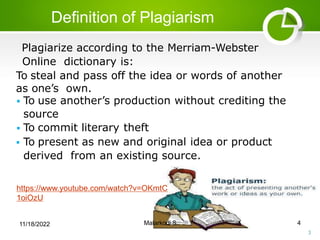
Definition of Plagiarism
3
Plagiarize according to the Merriam-Webster
Online dictionary is:
To steal and pass off the idea or words of another
as one’s own.
 To use another’s production without crediting the
source
 To commit literary theft
 To present as new and original idea or product
derived from an existing source.
https://www.youtube.com/watch?v=OKmtC
1oiOzU
11/18/2022 Malarkodi S 4
What is Plagiarism:
4
Malarkodi S
 Turning in someone else’s work as your own.
 Copying words or ideas from someone else
without giving credit.
 Failing to put a quotation in quotation marks
 Giving incorrect information about the source
of a quotation.
 Changing words but copying sentence structure.
 Copying so many words or ideas from a source
that it makes up the majority of your work,
even though by credit.
11/18/2022 5
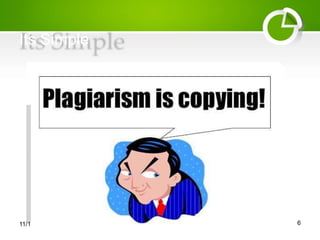
Its Simple
11/18/2022 Malarkodi S 6
Plagiarism
The Internet has made it easier for
students to plagiarize.
WHAT DOES PLAGIARISM LOOK
LIKE?
▶Copying someone’s work
Citing a source improperly
▶ Failure to cite a source
▶ Creation of false sources
▶ Turning in
another
person’s work as
your own
Types Plagiarism
5
Malarkodi S
Steals the property of somebody else and claims
it to be his own.
Somebody unknowingly cites a phrase or
copies words without acknowledging the
author of the material.
11/18/2022
Avoiding plagiarism
7
Malarkodi S
Two methods :
 Plagiarism prevention
 Plagiarism detection
11/18/2022
Plagiarism Prevention
8
Malarkodi S
 Collaborative effort for recognize and counter
plagiarism at every level.
 Educate authors about the appropriate use of
intellectual material.
 Minimize the possibility of submission of
plagiarized content.
 Plagiarism prevention is difficult to achieve &
also take a long time.
11/18/2022
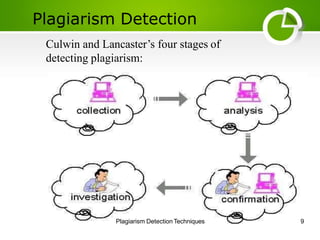
Plagiarism Detection
Culwin and Lancaster’s four stages of
detecting plagiarism:
9
Plagiarism Detection Techniques
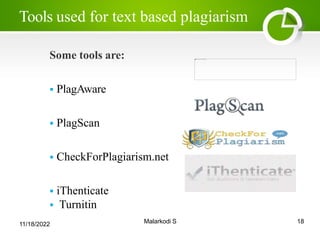
Tools used for text based plagiarism
18
Malarkodi S
Some tools are:
 PlagAware
 PlagScan
 CheckForPlagiarism.net
 iThenticate
 Turnitin
11/18/2022
What is an acceptable percentage of
plagiarism?
• However, contrary to popular belief, plagiarism checkers do
not detect plagiarism, but similarities.
• Properly cited quotes,
• In-text citations or your reference list, and
• Commonly used phrases that are obviously not considered
plagiarism.
Because of this, you can generally follow these guidelines:
o A score higher than 10% is troublesome.
o A score between 5% and 10% it is not bad per se.
o A score around 5% is reasonable.
11/18/2022 Malarkodi S 14
Examples of penalty for plagiarism:
o In 2002, Prof. David Monash, rector of Monash
University(Australia), was caught citing some
paragraphs without sources in his books published
in 1970s. He then resigned to maintain his
institution’s reputation.
o In 2004, Prof. Sultan, professor of Immunology of
Harvard University, was accused of plagiarizing from
four papers. Consequently, he was banned from
reviewing papers for3years
11/18/2022 Malarkodi S 15
Conclusion
Plagiarism Detection Techniques 39
 Plagiarism is rampant now. With most of
the data available to us in digital format
the venues for plagiarism is opening up.
 To avoid this kind of cheating and to
acknowledge the originality of the author
new detection techniques are to be created.
 To protect the intellectual property source
code new techniques are to be developed
and implemented.
11/18/2022 Malarkodi S 16
References
 http://www.ijirae.com/volumes/vol1/issue7/AUCS10085.
06.pdf
 http://dspace.cusat.ac.in/jspui/bitstream/123456789/3618/
1/PDT.pdf
 http://elearningindustry.com/top-10-free-plagiarism-
detection-tools-for-teachers
 http://www.plagiarism.org/plagiarism-101/what-is-
plagiarism/
 http://www.cs.uu.nl/research/techreps/repo/CS2010/2010-
015.Pdf
 https://en.wikipedia.org/wiki/Category:Plagiarism_detecto
rs
Plagiarism Detection Techniques 39
11/18/2022 Malarkodi S 17
Plagiarism Detection T
echniques 10
?
11/18/2022 Malarkodi S 18
10
Plagiarism DetectionTechniques
11/18/2022 Malarkodi S 19

Plagiarism oct 2021.pptx

  • 1.
  • 2.
    Contents 1  Introduction  Definitionof Plagiarism  Avoiding plagiarism  Tools used for text based plagiarism  Disadvantages of the plagiarism detection technology  Conclusion 11/18/2022 Malarkodi S 2
  • 3.
    Introduction o Plagiarism: Therepresentation of another’s work as one’s own. o It is serious problem for academics now a days. o In computing courses, students often plagiarize various assignments. o Usually they may copy it from their friends or web. o Manual comparison is rather impractical or difficult too. literary theft 11/18/2022 Malarkodi S 3
  • 4.
    Definition of Plagiarism 3 Plagiarizeaccording to the Merriam-Webster Online dictionary is: To steal and pass off the idea or words of another as one’s own.  To use another’s production without crediting the source  To commit literary theft  To present as new and original idea or product derived from an existing source. https://www.youtube.com/watch?v=OKmtC 1oiOzU 11/18/2022 Malarkodi S 4
  • 5.
    What is Plagiarism: 4 MalarkodiS  Turning in someone else’s work as your own.  Copying words or ideas from someone else without giving credit.  Failing to put a quotation in quotation marks  Giving incorrect information about the source of a quotation.  Changing words but copying sentence structure.  Copying so many words or ideas from a source that it makes up the majority of your work, even though by credit. 11/18/2022 5
  • 6.
  • 7.
    Plagiarism The Internet hasmade it easier for students to plagiarize.
  • 8.
    WHAT DOES PLAGIARISMLOOK LIKE? ▶Copying someone’s work Citing a source improperly ▶ Failure to cite a source ▶ Creation of false sources ▶ Turning in another person’s work as your own
  • 9.
    Types Plagiarism 5 Malarkodi S Stealsthe property of somebody else and claims it to be his own. Somebody unknowingly cites a phrase or copies words without acknowledging the author of the material. 11/18/2022
  • 10.
    Avoiding plagiarism 7 Malarkodi S Twomethods :  Plagiarism prevention  Plagiarism detection 11/18/2022
  • 11.
    Plagiarism Prevention 8 Malarkodi S Collaborative effort for recognize and counter plagiarism at every level.  Educate authors about the appropriate use of intellectual material.  Minimize the possibility of submission of plagiarized content.  Plagiarism prevention is difficult to achieve & also take a long time. 11/18/2022
  • 12.
    Plagiarism Detection Culwin andLancaster’s four stages of detecting plagiarism: 9 Plagiarism Detection Techniques
  • 13.
    Tools used fortext based plagiarism 18 Malarkodi S Some tools are:  PlagAware  PlagScan  CheckForPlagiarism.net  iThenticate  Turnitin 11/18/2022
  • 14.
    What is anacceptable percentage of plagiarism? • However, contrary to popular belief, plagiarism checkers do not detect plagiarism, but similarities. • Properly cited quotes, • In-text citations or your reference list, and • Commonly used phrases that are obviously not considered plagiarism. Because of this, you can generally follow these guidelines: o A score higher than 10% is troublesome. o A score between 5% and 10% it is not bad per se. o A score around 5% is reasonable. 11/18/2022 Malarkodi S 14
  • 15.
    Examples of penaltyfor plagiarism: o In 2002, Prof. David Monash, rector of Monash University(Australia), was caught citing some paragraphs without sources in his books published in 1970s. He then resigned to maintain his institution’s reputation. o In 2004, Prof. Sultan, professor of Immunology of Harvard University, was accused of plagiarizing from four papers. Consequently, he was banned from reviewing papers for3years 11/18/2022 Malarkodi S 15
  • 16.
    Conclusion Plagiarism Detection Techniques39  Plagiarism is rampant now. With most of the data available to us in digital format the venues for plagiarism is opening up.  To avoid this kind of cheating and to acknowledge the originality of the author new detection techniques are to be created.  To protect the intellectual property source code new techniques are to be developed and implemented. 11/18/2022 Malarkodi S 16
  • 17.
    References  http://www.ijirae.com/volumes/vol1/issue7/AUCS10085. 06.pdf  http://dspace.cusat.ac.in/jspui/bitstream/123456789/3618/ 1/PDT.pdf http://elearningindustry.com/top-10-free-plagiarism- detection-tools-for-teachers  http://www.plagiarism.org/plagiarism-101/what-is- plagiarism/  http://www.cs.uu.nl/research/techreps/repo/CS2010/2010- 015.Pdf  https://en.wikipedia.org/wiki/Category:Plagiarism_detecto rs Plagiarism Detection Techniques 39 11/18/2022 Malarkodi S 17
  • 18.
    Plagiarism Detection T echniques10 ? 11/18/2022 Malarkodi S 18
  • 19.