Chapter 8
THE IMPACT OF
INFORMATION
TECHNOLOGY ON
PRODUCTIVITY AND
QUALITY OF LIFE
THE IMPACT OF IT ON
THE STANDARD OF
LIVING AND WORKER
PRODUCTIVITY
IT Investment and Productivity
Productivity is defined as the amount of output
produced per unit of input, and it is measured in
many different ways.
Telework
Telework (also known as telecommuting) is a work
arrangement in which an employee works away
from the office—at home, at a client’s office, in a
hotel—literally, anywhere.
ADVANTAGES DISADVANTAGES
People with disabilities who otherwise find
public transportation and office
accommodations a barrier to work may now
be able to join the workforce.
Some employees are unable to be
productive workers away from the office.
Teleworkers avoid long, stressful commutes
and gain time for additional work or
personal activities.
Teleworkers may suffer from isolation and
may not really feel “part of the team.”
Telework can reduce the need for
employees to take time off to stay home to
care for a sick family member.
Workers who are out of sight also tend to be
out of mind. The contributions of
teleworkers may not be fully recognized
and credited.
Teleworkers have an opportunity to
experience an improved work/family
balance.
Teleworkers must guard against working
too many hours per day because work is
always there.
Telework reduces ad hoc work requests and
disruptions from fellow workers.
The cost of the necessary equipment and
communication services can be
considerable if the organization does not
cover these.
TABLE 8-2 Advantages/disadvantages of teleworking for employees.
TABLE 8-3 Advantages/disadvantages of teleworking for organizations.
ADVANTAGES DISADVANTAGES
As more employees telework, there is less
need for office and parking space; this can
lead to lower costs.
Allowing teleworkers to access organizational
data and systems from remote sites creates
potential security issues.
Allowing employees to telework can improve
morale and reduce turnover.
Informal, spontaneous meetings become more
difficult if not impossible.
Telework allows for the continuity of business
operations in the event of a local or national
disaster and supports national pandemic-
preparedness planning.
Managers may have a harder time monitoring
the quality and quantity of the work performed
by teleworkers, wondering, for instance, if
they really “put in a full day.”
The opportunity to telework can be seen as an
additional perk that can help in recruiting.
Increased planning is required by managers to
accommodate and include teleworkers.
There may be an actual gain in worker
productivity.
There are additional costs associated with
providing equipment, services, and support for
people who work away from the office.
Telework can decrease an organization’s
carbon footprint by reducing daily commuting.
Telework increases the potential for lost or
stolen equipment.
The Digital Divide
digital divide is a term used to describe the gulf between those
who do and those who don’t have access to modern information
and communications technology, such as cell phones,
smartphones, personal computers, and the Internet.
E-Rate Program
 The Education Rate (E-Rate) program
 Low-Cost Computers
 One Laptop per Child (OLPC)
 Classmateþ
 Raspberry Pi
THE IMPACT OF IT ON
HEALTHCARE COSTS
Electronic Health Records
An electronic health record (EHR) is a computer-readable
record of health-related information on an individual. An EHR
can include patient demographics, medical history, family
history, immunization records, laboratory data, health problems,
progress notes, medications, vital signs, and radiology reports.
The Health Information Technology for Economic and Clinical
Health Act (HITECH Act)
Use of Mobile and Wireless
Technology in the Healthcare
Industry
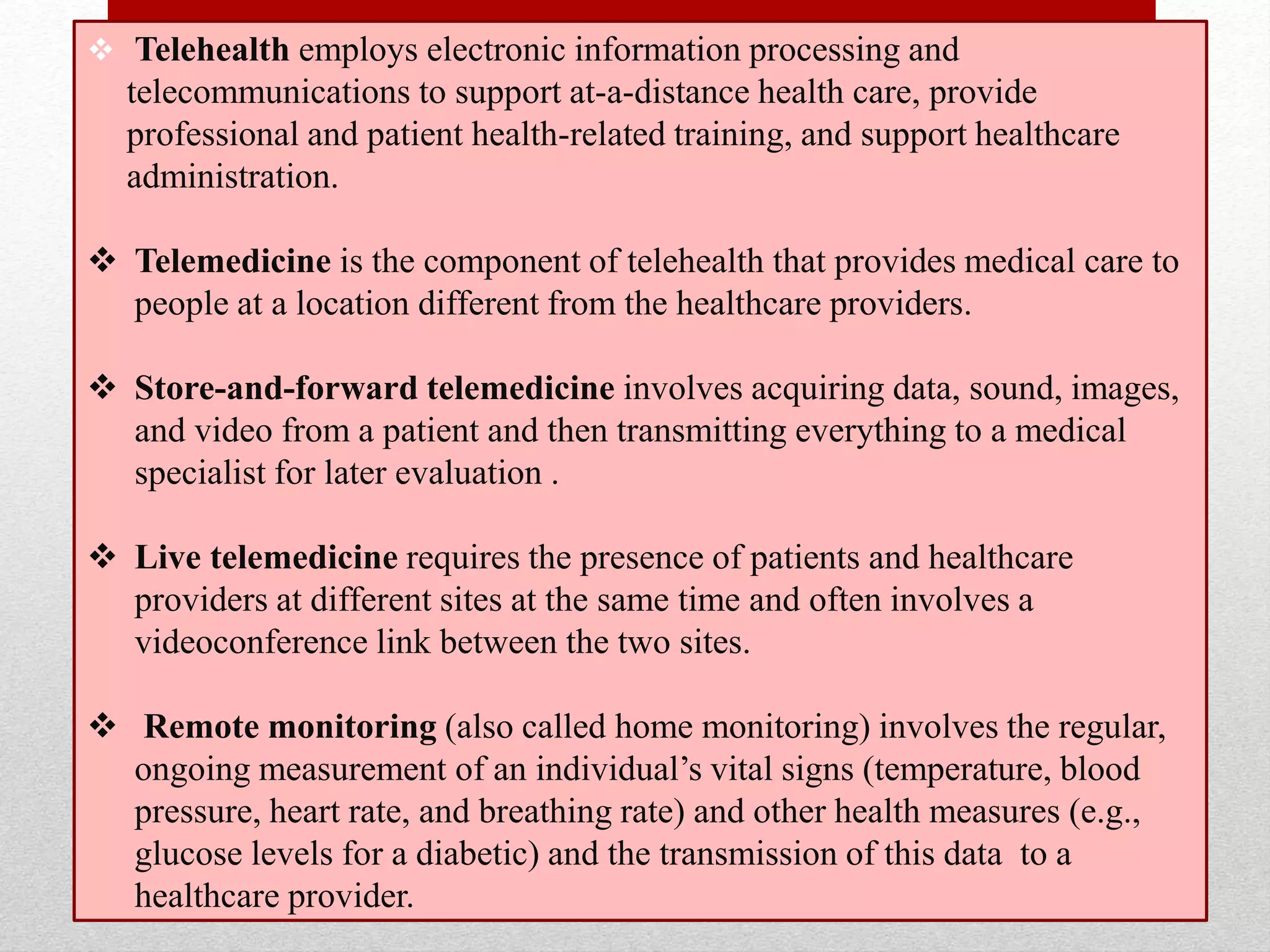
 Telehealth employs electronic information processing and
telecommunications to support at-a-distance health care, provide
professional and patient health-related training, and support healthcare
administration.
 Telemedicine is the component of telehealth that provides medical care to
people at a location different from the healthcare providers.
 Store-and-forward telemedicine involves acquiring data, sound, images,
and video from a patient and then transmitting everything to a medical
specialist for later evaluation .
 Live telemedicine requires the presence of patients and healthcare
providers at different sites at the same time and often involves a
videoconference link between the two sites.
 Remote monitoring (also called home monitoring) involves the regular,
ongoing measurement of an individual’s vital signs (temperature, blood
pressure, heart rate, and breathing rate) and other health measures (e.g.,
glucose levels for a diabetic) and the transmission of this data to a
healthcare provider.
Medical Information Web Sites for Laypeople
Healthy people as well as those who suffer from illness need
reliable information on a wide range of medical topics to learn
more about healthcare services and to take more responsibility
for their health. Clearly, laypeople cannot become as informed as
trained medical practitioners, but a tremendous amount of
healthcare information is available via the Web. These sites have
a critical responsibility to publish current, reliable, and objective
information.
CHAPTER 9
SOCIAL
NETWORKING
WHAT IS A SOCIAL
NETWORKING WEBSITE?
A social networking Web site
creates an online community of
Internet users that enables members
to break down the barriers of time,
distance, and cultural differences.
BUSINESS APPLICATIONS OF
ONLINE SOCIAL NETWORKING
Social network advertising
involves the use of social networks
to communicate and promote the
benefits of products and services.
SOCIAL NETWORK ADVERTISING
STRATEGIES
 Direct Advertising
 Advertising Using an Individual’s
Network of Friends
 Indirect Advertising Through
Groups
 Company-Owned Social
Networking Web Site
 Viral Marketing
The Use of Social Networks in
the Hiring Process
The Use of Social Media to
Improve Customer Service
Social Shopping Web Sites
SOCIAL NETWORKING
ETHICAL ISSUES
 Cyberbullying is the harassment, torment,
humiliation, or threatening of one minor by another
minor or group of minors via the Internet or cell
phone.
 Cyberstalking is threatening behavior or unwanted
advances directed at an adult using the Internet or
other forms of online and electronic communications;
it is the adult version of cyberbullying.
 Encounters with Sexual
Predators
 Uploading of
Inappropriate Material
ONLINE VIRTUAL WORLDS
An online virtual world is a shared
multimedia, computer-generated
environment in which users,
represented by avatars, can act,
communicate, create, retain
ownership of what they create, and
exchange assets, including currency,
with each other.
One type of online virtual world, a
massively multiplayer online game
(MMOG), is a multiplayer video game
capable of supporting hundreds and even
thousands of concurrent players.
Massive multiplayer online role-playing
games (MMORPG) is a subcategory of
MMOG that provides a huge online world
in which players take on the role of a
character and control that character’s action.
Crime in Virtual Worlds
It seems the freedom and anonymity afforded
avatars in a virtual world encourages some
individuals to unleash their darker side. Thus,
virtual worlds raise many interesting questions
regarding what is a criminal act and whether law
enforcement—real or virtual— should get
involved in acts that occur in virtual worlds.
Some virtual activities are clear violations of real
world law and need to be reported to law
enforcement authorities
Educational and Business Uses of
Virtual Worlds
Virtual online worlds are also being used
for education and business purposes. The
New Media Consortium (NMC) is an
international consortium of hundreds of
colleges, universities, museums, and
research centers exploring the use of new
media and technologies to improve
teaching, learning, and creative
expression.
THE
END

Group 4 ite 10

  • 1.
    Chapter 8 THE IMPACTOF INFORMATION TECHNOLOGY ON PRODUCTIVITY AND QUALITY OF LIFE
  • 2.
    THE IMPACT OFIT ON THE STANDARD OF LIVING AND WORKER PRODUCTIVITY
  • 3.
    IT Investment andProductivity Productivity is defined as the amount of output produced per unit of input, and it is measured in many different ways. Telework Telework (also known as telecommuting) is a work arrangement in which an employee works away from the office—at home, at a client’s office, in a hotel—literally, anywhere.
  • 4.
    ADVANTAGES DISADVANTAGES People withdisabilities who otherwise find public transportation and office accommodations a barrier to work may now be able to join the workforce. Some employees are unable to be productive workers away from the office. Teleworkers avoid long, stressful commutes and gain time for additional work or personal activities. Teleworkers may suffer from isolation and may not really feel “part of the team.” Telework can reduce the need for employees to take time off to stay home to care for a sick family member. Workers who are out of sight also tend to be out of mind. The contributions of teleworkers may not be fully recognized and credited. Teleworkers have an opportunity to experience an improved work/family balance. Teleworkers must guard against working too many hours per day because work is always there. Telework reduces ad hoc work requests and disruptions from fellow workers. The cost of the necessary equipment and communication services can be considerable if the organization does not cover these. TABLE 8-2 Advantages/disadvantages of teleworking for employees.
  • 5.
    TABLE 8-3 Advantages/disadvantagesof teleworking for organizations. ADVANTAGES DISADVANTAGES As more employees telework, there is less need for office and parking space; this can lead to lower costs. Allowing teleworkers to access organizational data and systems from remote sites creates potential security issues. Allowing employees to telework can improve morale and reduce turnover. Informal, spontaneous meetings become more difficult if not impossible. Telework allows for the continuity of business operations in the event of a local or national disaster and supports national pandemic- preparedness planning. Managers may have a harder time monitoring the quality and quantity of the work performed by teleworkers, wondering, for instance, if they really “put in a full day.” The opportunity to telework can be seen as an additional perk that can help in recruiting. Increased planning is required by managers to accommodate and include teleworkers. There may be an actual gain in worker productivity. There are additional costs associated with providing equipment, services, and support for people who work away from the office. Telework can decrease an organization’s carbon footprint by reducing daily commuting. Telework increases the potential for lost or stolen equipment.
  • 6.
    The Digital Divide digitaldivide is a term used to describe the gulf between those who do and those who don’t have access to modern information and communications technology, such as cell phones, smartphones, personal computers, and the Internet. E-Rate Program  The Education Rate (E-Rate) program  Low-Cost Computers  One Laptop per Child (OLPC)  Classmateþ  Raspberry Pi
  • 7.
    THE IMPACT OFIT ON HEALTHCARE COSTS Electronic Health Records An electronic health record (EHR) is a computer-readable record of health-related information on an individual. An EHR can include patient demographics, medical history, family history, immunization records, laboratory data, health problems, progress notes, medications, vital signs, and radiology reports.
  • 8.
    The Health InformationTechnology for Economic and Clinical Health Act (HITECH Act) Use of Mobile and Wireless Technology in the Healthcare Industry
  • 9.
     Telehealth employselectronic information processing and telecommunications to support at-a-distance health care, provide professional and patient health-related training, and support healthcare administration.  Telemedicine is the component of telehealth that provides medical care to people at a location different from the healthcare providers.  Store-and-forward telemedicine involves acquiring data, sound, images, and video from a patient and then transmitting everything to a medical specialist for later evaluation .  Live telemedicine requires the presence of patients and healthcare providers at different sites at the same time and often involves a videoconference link between the two sites.  Remote monitoring (also called home monitoring) involves the regular, ongoing measurement of an individual’s vital signs (temperature, blood pressure, heart rate, and breathing rate) and other health measures (e.g., glucose levels for a diabetic) and the transmission of this data to a healthcare provider.
  • 10.
    Medical Information WebSites for Laypeople Healthy people as well as those who suffer from illness need reliable information on a wide range of medical topics to learn more about healthcare services and to take more responsibility for their health. Clearly, laypeople cannot become as informed as trained medical practitioners, but a tremendous amount of healthcare information is available via the Web. These sites have a critical responsibility to publish current, reliable, and objective information.
  • 11.
  • 12.
    WHAT IS ASOCIAL NETWORKING WEBSITE? A social networking Web site creates an online community of Internet users that enables members to break down the barriers of time, distance, and cultural differences.
  • 13.
    BUSINESS APPLICATIONS OF ONLINESOCIAL NETWORKING Social network advertising involves the use of social networks to communicate and promote the benefits of products and services.
  • 14.
    SOCIAL NETWORK ADVERTISING STRATEGIES Direct Advertising  Advertising Using an Individual’s Network of Friends  Indirect Advertising Through Groups  Company-Owned Social Networking Web Site  Viral Marketing
  • 15.
    The Use ofSocial Networks in the Hiring Process The Use of Social Media to Improve Customer Service Social Shopping Web Sites
  • 16.
    SOCIAL NETWORKING ETHICAL ISSUES Cyberbullying is the harassment, torment, humiliation, or threatening of one minor by another minor or group of minors via the Internet or cell phone.  Cyberstalking is threatening behavior or unwanted advances directed at an adult using the Internet or other forms of online and electronic communications; it is the adult version of cyberbullying.
  • 17.
     Encounters withSexual Predators  Uploading of Inappropriate Material
  • 18.
    ONLINE VIRTUAL WORLDS Anonline virtual world is a shared multimedia, computer-generated environment in which users, represented by avatars, can act, communicate, create, retain ownership of what they create, and exchange assets, including currency, with each other.
  • 19.
    One type ofonline virtual world, a massively multiplayer online game (MMOG), is a multiplayer video game capable of supporting hundreds and even thousands of concurrent players. Massive multiplayer online role-playing games (MMORPG) is a subcategory of MMOG that provides a huge online world in which players take on the role of a character and control that character’s action.
  • 20.
    Crime in VirtualWorlds It seems the freedom and anonymity afforded avatars in a virtual world encourages some individuals to unleash their darker side. Thus, virtual worlds raise many interesting questions regarding what is a criminal act and whether law enforcement—real or virtual— should get involved in acts that occur in virtual worlds. Some virtual activities are clear violations of real world law and need to be reported to law enforcement authorities
  • 21.
    Educational and BusinessUses of Virtual Worlds Virtual online worlds are also being used for education and business purposes. The New Media Consortium (NMC) is an international consortium of hundreds of colleges, universities, museums, and research centers exploring the use of new media and technologies to improve teaching, learning, and creative expression.
  • 22.