Neighborhood Ground Water Network

               Ground Water
               Science
Oregon State Water Resources Department
in collaboration with
Oregon State University Sea Grant Extension
Ground Water Science   Presentation Outline

                         Ground Water Basics
                         Well Construction
                         Measuring Water Use
                         Ground Water Quality
                         Water Supply Problems
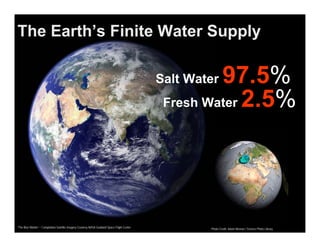
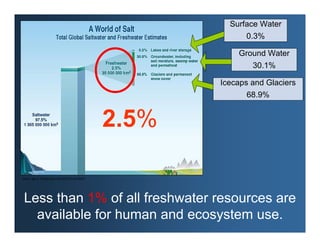
The Earth’s Finite Water Supply

                                                                                                       97.5%
                                                                                              Salt Water
                                                                                               Fresh Water 2.5%


“The Blue Marble” – Compilation Satellite Imagery Courtesy NASA Goddard Space Flight Center           Photo Credit: Adam Nieman / Science Photo Library
Surface Water
                                                               0.3%

                                                             Ground Water
                                                                 30.1%

                                                         Icecaps and Glaciers
                                                               68.9%


                                                  2.5%

Source: Igor A. Shiklomanov and UNESCO via UNEP


 Less than 1% of all freshwater resources are
   available for human and ecosystem use.
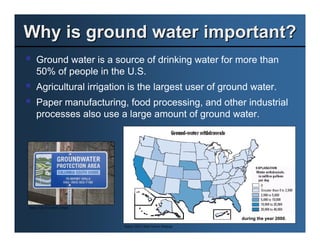
Why is ground water important?
     Ground water is a source of drinking water for more than
     50% of people in the U.S.
     Agricultural irrigation is the largest user of ground water.
     Paper manufacturing, food processing, and other industrial
     processes also use a large amount of ground water.


Source: City of Gresham, Oregon


                                                                        during the year 2000.
                                  Source: USGS, Water Science Webpage
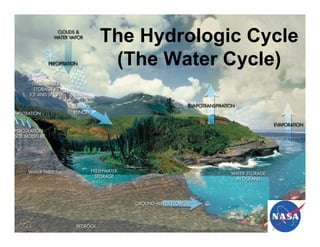
The Hydrologic Cycle
 (The Water Cycle)
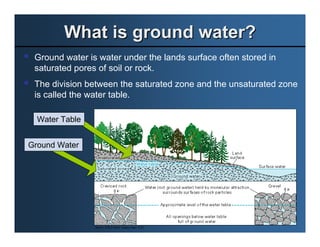
What is ground water?
 Ground water is water under the lands surface often stored in
 saturated pores of soil or rock.
 The division between the saturated zone and the unsaturated zone
 is called the water table.

  Water Table


Ground Water


                Source: USGS Water Supply Paper 2220
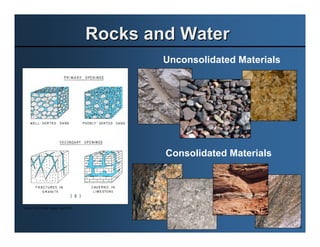
Rocks and Water
                                               Unconsolidated Materials


                                               Consolidated Materials


Source: USGS Water Supply Paper 2220
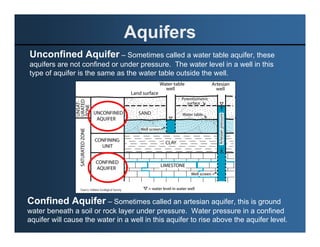
Aquifers
Unconfined Aquifer – Sometimes called a water table aquifer, these
aquifers are not confined or under pressure. The water level in a well in this
type of aquifer is the same as the water table outside the well.


                 Source: Indiana Geological Survey


Confined Aquifer – Sometimes called an artesian aquifer, this is ground
water beneath a soil or rock layer under pressure. Water pressure in a confined
aquifer will cause the water in a well in this aquifer to rise above the aquifer level.
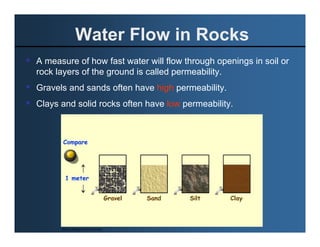
Water Flow in Rocks
A measure of how fast water will flow through openings in soil or
rock layers of the ground is called permeability.
Gravels and sands often have high permeability.
Clays and solid rocks often have low permeability.


      Source: Michigan Tech University.
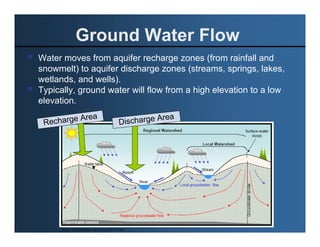
Ground Water Flow
Water moves from aquifer recharge zones (from rainfall and
snowmelt) to aquifer discharge zones (streams, springs, lakes,
wetlands, and wells).
Typically, ground water will flow from a high elevation to a low
elevation.
             ea                                                rea
 Re charge Ar                                    Discharge
                                                           A


      Source: Jenny Erickson, Sauk County UW-Extension
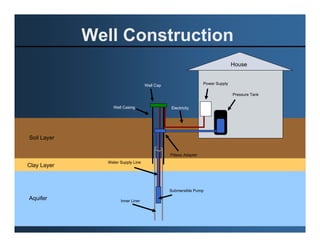
Well Construction
                                                                               House


                                   Well Cap                     Power Supply

                                                                               Pressure Tank


                 Well Casing                  Electricity


Soil Layer

                                              Pitless Adapter
               Water Supply Line
Clay Layer


                                              Submersible Pump
Aquifer              Inner Liner
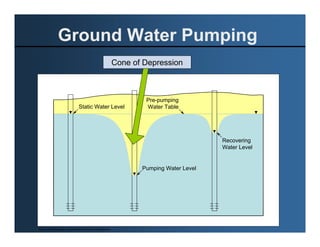
Ground Water Pumping
                                                          Cone of Depression


                                                                  Pre-pumping
                               Static Water Level                 Water Table


                                                                                       Recovering
                                                                                       Water Level


                                                                 Pumping Water Level


Source: Karl Wozniak, Oregon Water Resources Department
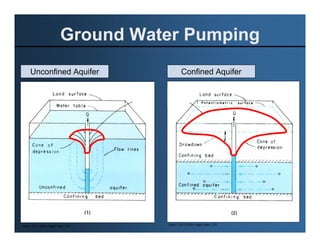
Ground Water Pumping
      Unconfined Aquifer                        Confined Aquifer


Source: USGS Water Supply Paper 2220   Source: USGS Water Supply Paper 2220
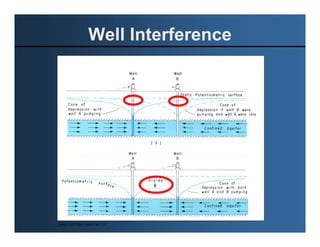
Well Interference


Source: USGS Water Supply Paper 2220
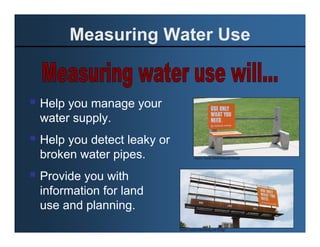
Measuring Water Use


Help you manage your
water supply.
Help you detect leaky or
broken water pipes.                   Source: Suckle Advertising and Design


Provide you with
information for land
use and planning.
                           Source: Suckle Advertising and Design
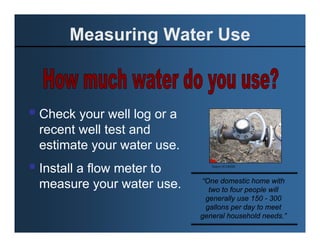
Measuring Water Use


Check your well log or a
recent well test and
estimate your water use.
Install a flow meter to       Source: HCCREMS


                           “One domestic home with
measure your water use.      two to four people will
                            generally use 150 - 300
                            gallons per day to meet
                           general household needs.”
Ground Water Quality
How often should I test?
The National Ground Water Association (NGWA) recommends testing your water
quality annually.


What should I test for?
Bacteria, Nitrates and other local contaminants (from landfills, industrial sites, or
dumping of household wastes) or arsenic and radon (depending on your location).


What should I do if there are
water quality problems?                             Drinking Water Program

Contact the Drinking Water Program at the
State of Oregon – Public Health Division in
the Department of Human Services or your                   503-731-4317
County Health Department.                          http://oregon.gov/DHS/ph/dwp/
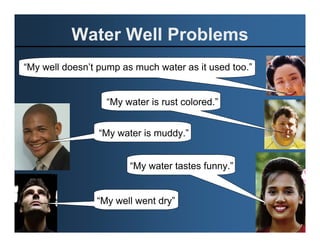
Water Well Problems
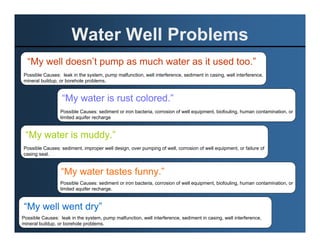
“My well doesn’t pump as much water as it used too.”


                  “My water is rust colored.”


                 “My water is muddy.”


                        “My water tastes funny.”


                “My well went dry”
Water Well Problems
  “My well doesn’t pump as much water as it used too.”
Possible Causes: leak in the system, pump malfunction, well interference, sediment in casing, well interference,
mineral buildup, or borehole problems.


                  “My water is rust colored.”
                 Possible Causes: sediment or iron bacteria, corrosion of well equipment, biofouling, human contamination, or
                 limited aquifer recharge


 “My water is muddy.”
Possible Causes: sediment, improper well design, over pumping of well, corrosion of well equipment, or failure of
casing seal.


                  “My water tastes funny.”
                 Possible Causes: sediment or iron bacteria, corrosion of well equipment, biofouling, human contamination, or
                 limited aquifer recharge.


“My well went dry”
Possible Causes: leak in the system, pump malfunction, well interference, sediment in casing, well interference,
mineral buildup, or borehole problems.
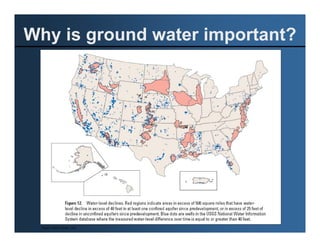
Why is ground water important?


  Source: USGS Circular 1323
Ground water is among the Nation’s most important natural
resources. It provides half our drinking water and is essential to the
vitality of agriculture and industry, as well as to the health of rivers,
wetlands, and estuaries throughout the country. Large-scale
development of ground-water resources with accompanying
declines in ground-water levels and other effects of pumping has
led to concerns about the future availability of ground water to meet
domestic, agricultural, industrial, and environmental needs…

Robert M. Hirsch,
Associate Director for Water, U.S. Geological Survey
Neighborhood Ground Water Network
   Abigail Brown – OSU Sea Grant Fellow
   Oregon Water Resources Department
   725 Summer Street NE, Suite A – Salem, OR 97301
   Phone: 503-986-0836 – Fax: 503-986-0902
   brownal@wrd.state.or.us   http://www.wrd.state.or.us

Groundwater Science Overview

  • 1.
    Neighborhood Ground WaterNetwork Ground Water Science Oregon State Water Resources Department in collaboration with Oregon State University Sea Grant Extension
  • 2.
    Ground Water Science Presentation Outline Ground Water Basics Well Construction Measuring Water Use Ground Water Quality Water Supply Problems
  • 3.
    The Earth’s FiniteWater Supply 97.5% Salt Water Fresh Water 2.5% “The Blue Marble” – Compilation Satellite Imagery Courtesy NASA Goddard Space Flight Center Photo Credit: Adam Nieman / Science Photo Library
  • 4.
    Surface Water 0.3% Ground Water 30.1% Icecaps and Glaciers 68.9% 2.5% Source: Igor A. Shiklomanov and UNESCO via UNEP Less than 1% of all freshwater resources are available for human and ecosystem use.
  • 5.
    Why is groundwater important? Ground water is a source of drinking water for more than 50% of people in the U.S. Agricultural irrigation is the largest user of ground water. Paper manufacturing, food processing, and other industrial processes also use a large amount of ground water. Source: City of Gresham, Oregon during the year 2000. Source: USGS, Water Science Webpage
  • 6.
    The Hydrologic Cycle (The Water Cycle)
  • 7.
    What is groundwater? Ground water is water under the lands surface often stored in saturated pores of soil or rock. The division between the saturated zone and the unsaturated zone is called the water table. Water Table Ground Water Source: USGS Water Supply Paper 2220
  • 8.
    Rocks and Water Unconsolidated Materials Consolidated Materials Source: USGS Water Supply Paper 2220
  • 9.
    Aquifers Unconfined Aquifer –Sometimes called a water table aquifer, these aquifers are not confined or under pressure. The water level in a well in this type of aquifer is the same as the water table outside the well. Source: Indiana Geological Survey Confined Aquifer – Sometimes called an artesian aquifer, this is ground water beneath a soil or rock layer under pressure. Water pressure in a confined aquifer will cause the water in a well in this aquifer to rise above the aquifer level.
  • 10.
    Water Flow inRocks A measure of how fast water will flow through openings in soil or rock layers of the ground is called permeability. Gravels and sands often have high permeability. Clays and solid rocks often have low permeability. Source: Michigan Tech University.
  • 11.
    Ground Water Flow Watermoves from aquifer recharge zones (from rainfall and snowmelt) to aquifer discharge zones (streams, springs, lakes, wetlands, and wells). Typically, ground water will flow from a high elevation to a low elevation. ea rea Re charge Ar Discharge A Source: Jenny Erickson, Sauk County UW-Extension
  • 12.
    Well Construction House Well Cap Power Supply Pressure Tank Well Casing Electricity Soil Layer Pitless Adapter Water Supply Line Clay Layer Submersible Pump Aquifer Inner Liner
  • 13.
    Ground Water Pumping Cone of Depression Pre-pumping Static Water Level Water Table Recovering Water Level Pumping Water Level Source: Karl Wozniak, Oregon Water Resources Department
  • 14.
    Ground Water Pumping Unconfined Aquifer Confined Aquifer Source: USGS Water Supply Paper 2220 Source: USGS Water Supply Paper 2220
  • 15.
    Well Interference Source: USGSWater Supply Paper 2220
  • 16.
    Measuring Water Use Helpyou manage your water supply. Help you detect leaky or broken water pipes. Source: Suckle Advertising and Design Provide you with information for land use and planning. Source: Suckle Advertising and Design
  • 17.
    Measuring Water Use Checkyour well log or a recent well test and estimate your water use. Install a flow meter to Source: HCCREMS “One domestic home with measure your water use. two to four people will generally use 150 - 300 gallons per day to meet general household needs.”
  • 18.
    Ground Water Quality Howoften should I test? The National Ground Water Association (NGWA) recommends testing your water quality annually. What should I test for? Bacteria, Nitrates and other local contaminants (from landfills, industrial sites, or dumping of household wastes) or arsenic and radon (depending on your location). What should I do if there are water quality problems? Drinking Water Program Contact the Drinking Water Program at the State of Oregon – Public Health Division in the Department of Human Services or your 503-731-4317 County Health Department. http://oregon.gov/DHS/ph/dwp/
  • 19.
    Water Well Problems “Mywell doesn’t pump as much water as it used too.” “My water is rust colored.” “My water is muddy.” “My water tastes funny.” “My well went dry”
  • 20.
    Water Well Problems “My well doesn’t pump as much water as it used too.” Possible Causes: leak in the system, pump malfunction, well interference, sediment in casing, well interference, mineral buildup, or borehole problems. “My water is rust colored.” Possible Causes: sediment or iron bacteria, corrosion of well equipment, biofouling, human contamination, or limited aquifer recharge “My water is muddy.” Possible Causes: sediment, improper well design, over pumping of well, corrosion of well equipment, or failure of casing seal. “My water tastes funny.” Possible Causes: sediment or iron bacteria, corrosion of well equipment, biofouling, human contamination, or limited aquifer recharge. “My well went dry” Possible Causes: leak in the system, pump malfunction, well interference, sediment in casing, well interference, mineral buildup, or borehole problems.
  • 21.
    Why is groundwater important? Source: USGS Circular 1323
  • 22.
    Ground water isamong the Nation’s most important natural resources. It provides half our drinking water and is essential to the vitality of agriculture and industry, as well as to the health of rivers, wetlands, and estuaries throughout the country. Large-scale development of ground-water resources with accompanying declines in ground-water levels and other effects of pumping has led to concerns about the future availability of ground water to meet domestic, agricultural, industrial, and environmental needs… Robert M. Hirsch, Associate Director for Water, U.S. Geological Survey
  • 23.
    Neighborhood Ground WaterNetwork Abigail Brown – OSU Sea Grant Fellow Oregon Water Resources Department 725 Summer Street NE, Suite A – Salem, OR 97301 Phone: 503-986-0836 – Fax: 503-986-0902 brownal@wrd.state.or.us http://www.wrd.state.or.us