Managing Water for Increased
Resiliency of Drained Agricultural
Landscapes
Jane Frankenberger
Agricultural & Biological Engineering
Purdue University, West Lafayette, Indiana
Purdue Iowa State Ohio State U. Minnesota
Jane Frankenberger
Eileen Kladivko
Laura Bowling
Bernie Engel
Linda Prokopy
Ben Reinhart
Matt Helmers
Lori Abendroth
USDA – ARS
Dan Jaynes
North Carolina
Mohamed
Youssef
South Dakota
Chris Hay
Larry Brown
Brent Sohngen
North Dakota
Xinhua Jia
Jeff Strock
U. Missouri
Kelly Nelson
Original Project Team
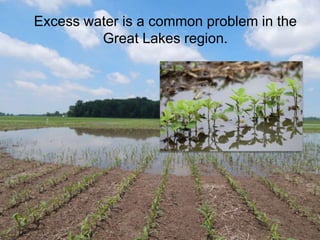
Excess water is a common problem in the
Great Lakes region.
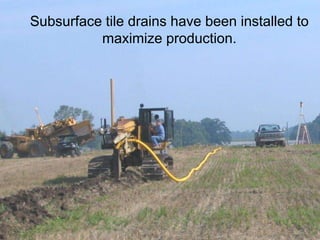
Subsurface tile drains have been installed to
maximize production.
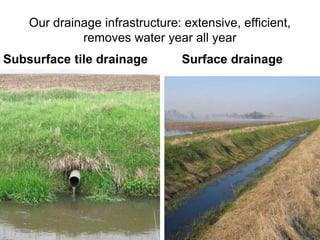
Our drainage infrastructure: extensive, efficient,
removes water year all year
Subsurface tile drainage Surface drainage
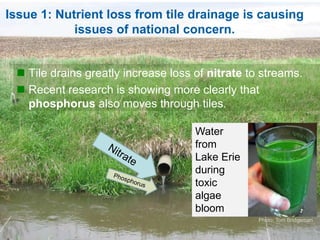
Issue 1: Nutrient loss from tile drainage is causing
issues of national concern.
 Tile drains greatly increase loss of nitrate to streams.
 Recent research is showing more clearly that
phosphorus also moves through tiles.
Water
from
Lake Erie
during
toxic
algae
bloom
Photo: Tom Bridgeman
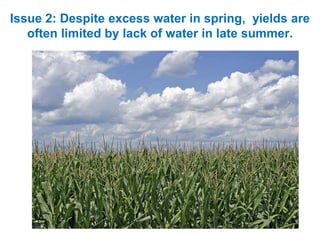
Issue 2: Despite excess water in spring, yields are
often limited by lack of water in late summer.
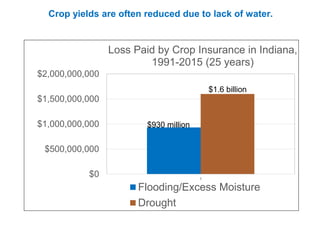
Crop yields are often reduced due to lack of water.
$0
$500,000,000
$1,000,000,000
$1,500,000,000
$2,000,000,000
1
Loss Paid by Crop Insurance in Indiana,
1991-2015 (25 years)
Flooding/Excess Moisture
Drought
$930 million
$1.6 billion
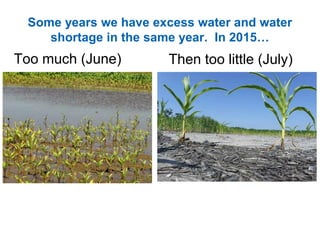
Some years we have excess water and water
shortage in the same year. In 2015…
Then too little (July)Too much (June)
Two issues; both are expected to be
become more severe due to future
extreme weather
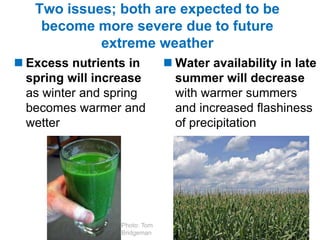
 Excess nutrients in
spring will increase
as winter and spring
becomes warmer and
wetter
 Water availability in late
summer will decrease
with warmer summers
and increased flashiness
of precipitation
Photo: Tom
Bridgeman
Storing drained water in the landscape
addresses both these issues.
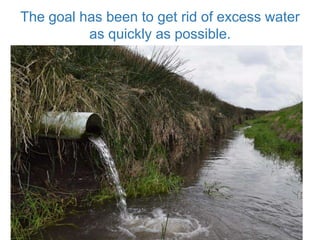
The goal has been to get rid of excess water
as quickly as possible.
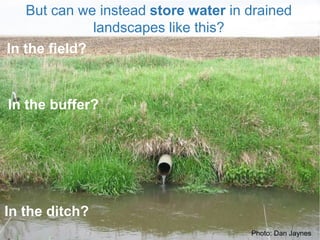
But can we instead store water in drained
landscapes like this?
Photo: Dan Jaynes
In the field?
In the buffer?
In the ditch?
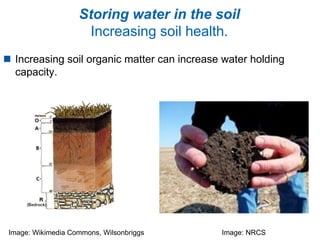
Storing water in the soil
Increasing soil health.
 Increasing soil organic matter can increase water holding
capacity.
Image: Wikimedia Commons, Wilsonbriggs Image: NRCS
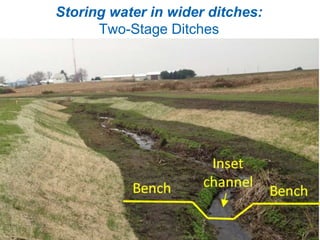
Storing water in wider ditches:
Two-Stage Ditches
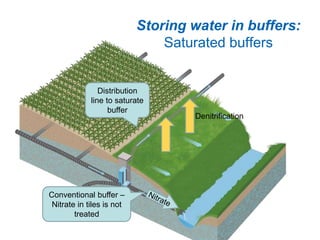
Storing water in buffers:
Saturated buffers
Distribution
line to saturate
buffer
Conventional buffer –
Nitrate in tiles is not
treated
Denitrification
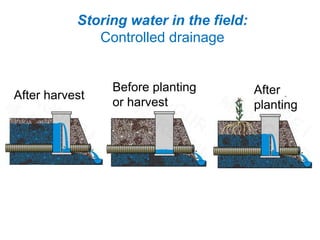
After harvest
Before planting
or harvest
After
planting
Storing water in the field:
Controlled drainage
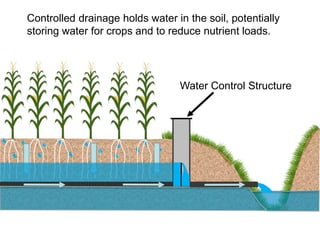
Water Control Structure
Controlled drainage holds water in the soil, potentially
storing water for crops and to reduce nutrient loads.
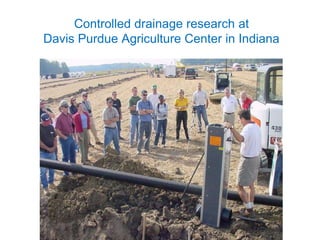
Controlled drainage research at
Davis Purdue Agriculture Center in Indiana
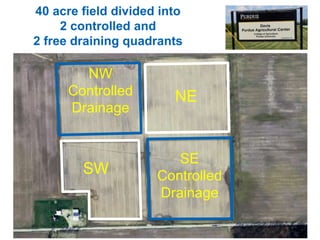
NW
Controlled
Drainage
NE
SW
SE
Controlled
Drainage
40 acre field divided into
2 controlled and
2 free draining quadrants
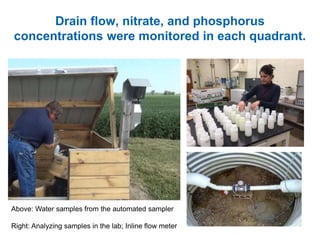
Drain flow, nitrate, and phosphorus
concentrations were monitored in each quadrant.
Above: Water samples from the automated sampler
Right: Analyzing samples in the lab; Inline flow meter
0
2
4
6
8
10
12
14
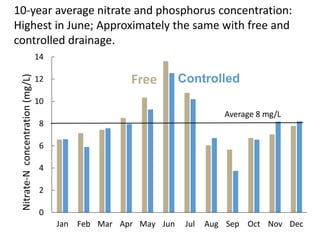
Jan Feb Mar Apr May Jun Jul Aug Sep Oct Nov Dec
Nitrate-Nconcentration(mg/L)
Average 8 mg/L
10-year average nitrate and phosphorus concentration:
Highest in June; Approximately the same with free and
controlled drainage.
Free Controlled
0
1
2
3
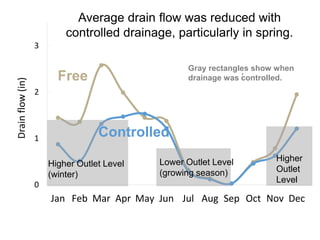
Jan Feb Mar Apr May Jun Jul Aug Sep Oct Nov Dec
Drainflow(in)
.
Controlled
Free
Average drain flow was reduced with
controlled drainage, particularly in spring.
Higher Outlet Level
(winter)
Lower Outlet Level
(growing season)
Higher
Outlet
Level
Gray rectangles show when
drainage was controlled.
0
10
20
30
40
50
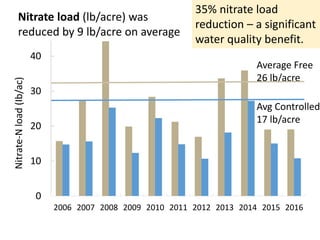
2006 2007 2008 2009 2010 2011 2012 2013 2014 2015 2016
Nitrate-Nload(Ib/ac)
Average Free
26 lb/acre
Avg Controlled
17 lb/acre
35% nitrate load
reduction – a significant
water quality benefit.
Nitrate load (lb/acre) was
reduced by 9 lb/acre on average
0.0
0.2
0.4
0.6
0.8
1.0
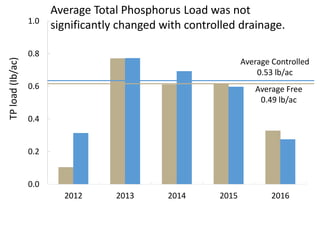
2012 2013 2014 2015 2016
TPload(Ib/ac)
Average Controlled
0.53 lb/ac
Average Free
0.49 lb/ac
Average Total Phosphorus Load was not
significantly changed with controlled drainage.
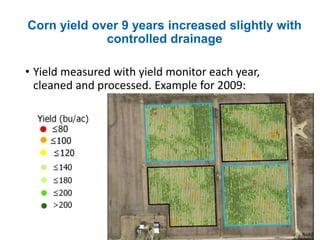
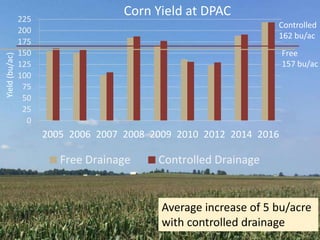
Corn yield over 9 years increased slightly with
controlled drainage
• Yield measured with yield monitor each year,
cleaned and processed. Example for 2009:
0
25
50
75
100
125
150
175
200
225
2005 2006 2007 2008 2009 2010 2012 2014 2016
Yield(bu/ac) Corn Yield at DPAC
Free Drainage Controlled Drainage
Controlled
162 bu/ac
Free
157 bu/ac
Average increase of 5 bu/acre
with controlled drainage
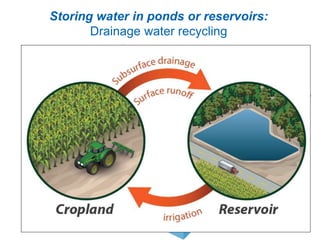
Storing water in ponds or reservoirs:
Drainage water recycling
Subirrigation
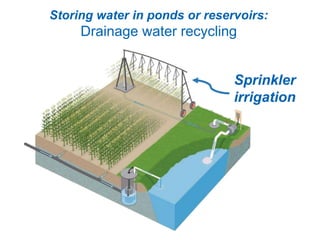
Sprinkler
irrigation
Storing water in ponds or reservoirs:
Drainage water recycling
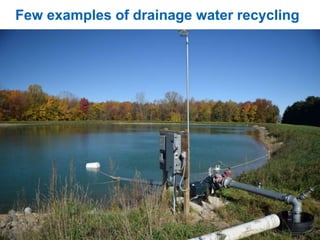
Few examples of drainage water recycling
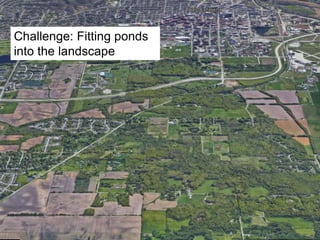
Challenge: Fitting ponds
into the landscape
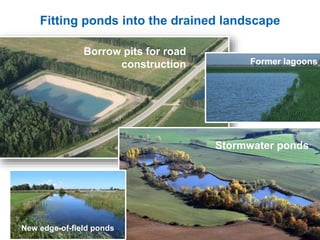
Fitting ponds into the drained landscape
Borrow pits for road
construction
Stormwater ponds
Former lagoons
New edge-of-field ponds
THIS MATERIAL IS BASED UPON WORK THAT IS SUPPORTED BY THE NATIONAL INSTITUTE OF FOOD AND AGRICULTURE, U.S.
DEPARTMENT OF AGRICULTURE, UNDER AWARD NUMBER 2015-68007-23193, “MANAGING WATER FOR INCREASED RESILIENCY OF
DRAINED AGRICULTURAL LANDSCAPES”, HTTP://TRANSFORMINGDRAINAGE.ORG. ANY OPINIONS, FINDINGS, CONCLUSIONS, OR
RECOMMENDATIONS EXPRESSED IN THIS PUBLICATION ARE THOSE OF THE AUTHOR(S) AND DO NOT NECESSARILY REFLECT THE
VIEW OF THE U.S. DEPARTMENT OF AGRICULTURE.
University of Missouri
MANAGING WATER FOR TOMORROW’S
AGRICULTURE
Managing Water for Increased
Resiliency of Drained
Agricultural Landscapes
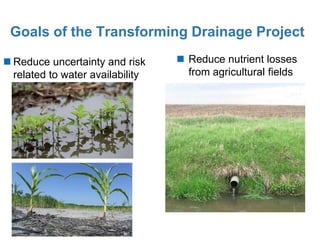
Goals of the Transforming Drainage Project
 Reduce uncertainty and risk
related to water availability
 Reduce nutrient losses
from agricultural fields
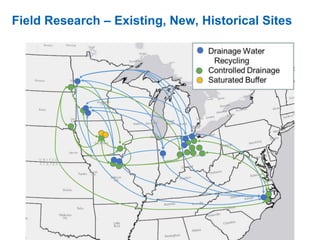
Field Research – Existing, New, Historical Sites
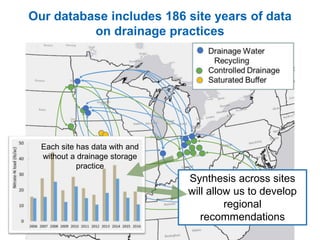
Synthesis across sites
will allow us to develop
regional
recommendations
Our database includes 186 site years of data
on drainage practices
Each site has data with and
without a drainage storage
practice
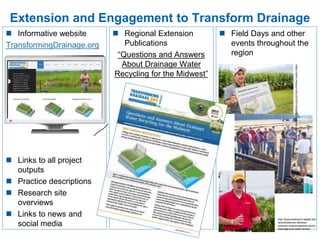
Extension and Engagement to Transform Drainage
 Informative website
TransformingDrainage.org
 Links to all project
outputs
 Practice descriptions
 Research site
overviews
 Links to news and
social media
 Regional Extension
Publications
“Questions and Answers
About Drainage Water
Recycling for the Midwest”
 Field Days and other
events throughout the
region
https://cafnr.missouri.edu/2016/01/keeping-nutrients-in-the-field/
http://www.extension.iastate.edu
/article/webinar-address-
common-misconceptions-about-
drainage-and-water-quality
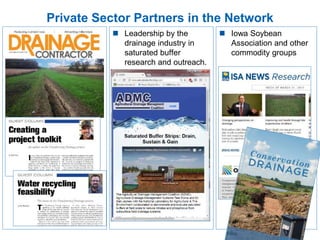
Private Sector Partners in the Network
a  Leadership by the
drainage industry in
saturated buffer
research and outreach.
 Iowa Soybean
Association and other
commodity groups
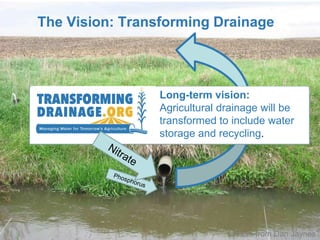
The Vision: Transforming Drainage
Photo from Dan Jaynes
Long-term vision:
Agricultural drainage will be
transformed to include water
storage and recycling.

Dr. Eileen Kladivko - Transforming Drainage Project

  • 1.
    Managing Water forIncreased Resiliency of Drained Agricultural Landscapes Jane Frankenberger Agricultural & Biological Engineering Purdue University, West Lafayette, Indiana Purdue Iowa State Ohio State U. Minnesota Jane Frankenberger Eileen Kladivko Laura Bowling Bernie Engel Linda Prokopy Ben Reinhart Matt Helmers Lori Abendroth USDA – ARS Dan Jaynes North Carolina Mohamed Youssef South Dakota Chris Hay Larry Brown Brent Sohngen North Dakota Xinhua Jia Jeff Strock U. Missouri Kelly Nelson Original Project Team
  • 2.
    Excess water isa common problem in the Great Lakes region.
  • 3.
    Subsurface tile drainshave been installed to maximize production.
  • 4.
    Our drainage infrastructure:extensive, efficient, removes water year all year Subsurface tile drainage Surface drainage
  • 5.
    Issue 1: Nutrientloss from tile drainage is causing issues of national concern.  Tile drains greatly increase loss of nitrate to streams.  Recent research is showing more clearly that phosphorus also moves through tiles. Water from Lake Erie during toxic algae bloom Photo: Tom Bridgeman
  • 6.
    Issue 2: Despiteexcess water in spring, yields are often limited by lack of water in late summer.
  • 7.
    Crop yields areoften reduced due to lack of water. $0 $500,000,000 $1,000,000,000 $1,500,000,000 $2,000,000,000 1 Loss Paid by Crop Insurance in Indiana, 1991-2015 (25 years) Flooding/Excess Moisture Drought $930 million $1.6 billion
  • 8.
    Some years wehave excess water and water shortage in the same year. In 2015… Then too little (July)Too much (June)
  • 9.
    Two issues; bothare expected to be become more severe due to future extreme weather  Excess nutrients in spring will increase as winter and spring becomes warmer and wetter  Water availability in late summer will decrease with warmer summers and increased flashiness of precipitation Photo: Tom Bridgeman
  • 10.
    Storing drained waterin the landscape addresses both these issues.
  • 11.
    The goal hasbeen to get rid of excess water as quickly as possible.
  • 12.
    But can weinstead store water in drained landscapes like this? Photo: Dan Jaynes In the field? In the buffer? In the ditch?
  • 13.
    Storing water inthe soil Increasing soil health.  Increasing soil organic matter can increase water holding capacity. Image: Wikimedia Commons, Wilsonbriggs Image: NRCS
  • 14.
    Storing water inwider ditches: Two-Stage Ditches
  • 15.
    Storing water inbuffers: Saturated buffers Distribution line to saturate buffer Conventional buffer – Nitrate in tiles is not treated Denitrification
  • 16.
    After harvest Before planting orharvest After planting Storing water in the field: Controlled drainage
  • 17.
    Water Control Structure Controlleddrainage holds water in the soil, potentially storing water for crops and to reduce nutrient loads.
  • 18.
    Controlled drainage researchat Davis Purdue Agriculture Center in Indiana
  • 19.
    NW Controlled Drainage NE SW SE Controlled Drainage 40 acre fielddivided into 2 controlled and 2 free draining quadrants
  • 20.
    Drain flow, nitrate,and phosphorus concentrations were monitored in each quadrant. Above: Water samples from the automated sampler Right: Analyzing samples in the lab; Inline flow meter
  • 21.
    0 2 4 6 8 10 12 14 Jan Feb MarApr May Jun Jul Aug Sep Oct Nov Dec Nitrate-Nconcentration(mg/L) Average 8 mg/L 10-year average nitrate and phosphorus concentration: Highest in June; Approximately the same with free and controlled drainage. Free Controlled
  • 22.
    0 1 2 3 Jan Feb MarApr May Jun Jul Aug Sep Oct Nov Dec Drainflow(in) . Controlled Free Average drain flow was reduced with controlled drainage, particularly in spring. Higher Outlet Level (winter) Lower Outlet Level (growing season) Higher Outlet Level Gray rectangles show when drainage was controlled.
  • 23.
    0 10 20 30 40 50 2006 2007 20082009 2010 2011 2012 2013 2014 2015 2016 Nitrate-Nload(Ib/ac) Average Free 26 lb/acre Avg Controlled 17 lb/acre 35% nitrate load reduction – a significant water quality benefit. Nitrate load (lb/acre) was reduced by 9 lb/acre on average
  • 24.
    0.0 0.2 0.4 0.6 0.8 1.0 2012 2013 20142015 2016 TPload(Ib/ac) Average Controlled 0.53 lb/ac Average Free 0.49 lb/ac Average Total Phosphorus Load was not significantly changed with controlled drainage.
  • 25.
    Corn yield over9 years increased slightly with controlled drainage • Yield measured with yield monitor each year, cleaned and processed. Example for 2009:
  • 26.
    0 25 50 75 100 125 150 175 200 225 2005 2006 20072008 2009 2010 2012 2014 2016 Yield(bu/ac) Corn Yield at DPAC Free Drainage Controlled Drainage Controlled 162 bu/ac Free 157 bu/ac Average increase of 5 bu/acre with controlled drainage
  • 27.
    Storing water inponds or reservoirs: Drainage water recycling Subirrigation
  • 28.
    Sprinkler irrigation Storing water inponds or reservoirs: Drainage water recycling
  • 29.
    Few examples ofdrainage water recycling
  • 30.
  • 31.
    Fitting ponds intothe drained landscape Borrow pits for road construction Stormwater ponds Former lagoons New edge-of-field ponds
  • 32.
    THIS MATERIAL ISBASED UPON WORK THAT IS SUPPORTED BY THE NATIONAL INSTITUTE OF FOOD AND AGRICULTURE, U.S. DEPARTMENT OF AGRICULTURE, UNDER AWARD NUMBER 2015-68007-23193, “MANAGING WATER FOR INCREASED RESILIENCY OF DRAINED AGRICULTURAL LANDSCAPES”, HTTP://TRANSFORMINGDRAINAGE.ORG. ANY OPINIONS, FINDINGS, CONCLUSIONS, OR RECOMMENDATIONS EXPRESSED IN THIS PUBLICATION ARE THOSE OF THE AUTHOR(S) AND DO NOT NECESSARILY REFLECT THE VIEW OF THE U.S. DEPARTMENT OF AGRICULTURE. University of Missouri MANAGING WATER FOR TOMORROW’S AGRICULTURE Managing Water for Increased Resiliency of Drained Agricultural Landscapes
  • 33.
    Goals of theTransforming Drainage Project  Reduce uncertainty and risk related to water availability  Reduce nutrient losses from agricultural fields
  • 34.
    Field Research –Existing, New, Historical Sites
  • 35.
    Synthesis across sites willallow us to develop regional recommendations Our database includes 186 site years of data on drainage practices Each site has data with and without a drainage storage practice
  • 36.
    Extension and Engagementto Transform Drainage  Informative website TransformingDrainage.org  Links to all project outputs  Practice descriptions  Research site overviews  Links to news and social media  Regional Extension Publications “Questions and Answers About Drainage Water Recycling for the Midwest”  Field Days and other events throughout the region https://cafnr.missouri.edu/2016/01/keeping-nutrients-in-the-field/ http://www.extension.iastate.edu /article/webinar-address- common-misconceptions-about- drainage-and-water-quality
  • 37.
    Private Sector Partnersin the Network a  Leadership by the drainage industry in saturated buffer research and outreach.  Iowa Soybean Association and other commodity groups
  • 38.
    The Vision: TransformingDrainage Photo from Dan Jaynes Long-term vision: Agricultural drainage will be transformed to include water storage and recycling.