PRESENTATION ON
SCHEMAS ANALYSIS
BY
SHAHID MEHMOOD
PhD SCHOLAR
UNIVERSITY OF OKARA
 Introduction
 History of Schemas Analysis
 Mental Models
 Kind of Schemas
 Methods of Studying Schemas
 Folk theories
OUTLINE
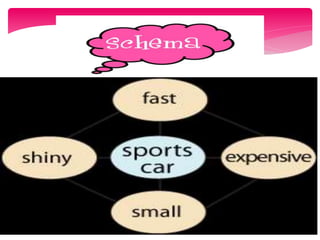
 A schema or schemas describes a pattern of thought
or behavior that organizes categories of information
and the relationships among them.
 A schema is a high-level conceptual structure or
framework that organizes prior experience and helps
us to interpret new situations.
Definition of Schema
 Piaget called the schema the basic building block of
intelligent behavior . A way of organizing knowledge.
Indeed, it is useful to think of schemas as “units” of
knowledge, each relating to one aspect of the world,
including objects, actions, and abstract concepts.
Conti…
 Schema analysis is based on the idea that people
must use cognitive simplifications to help make sense
of complex information.
 Schemas lead us to interpret the situation, for
example Mona Lisa’s smile is as evidence of her
perplexity of her desperation.
(Wodak 1992)
Introduction of Schema Analysis
Contemporary work on schemas was initiated F. Bartlett
( 1932 ), who was interested in the role that prior
knowledge played in the interpretation and memory for
stories. His work largely challenged the perspective of
behaviorism by emphasizing the role of internalized
representations in the control of behavior and thought.
Bartlett argued that meaning was integral to memory
and sought a different experimental technique.
History of Schema Analysis
 In one set of studies, participants were told a Native
American folktale that included a number of unfamiliar cultural
elements. On subsequent occasions, participants were brought
back to the lab and asked to retell the story. Over time,
participants’
account of the story drifted in systematic ways, including
the omission of information that did not make sense to them
and
the reinterpretation of certain facts in order to match their own
cultural backgrounds.
Conti…
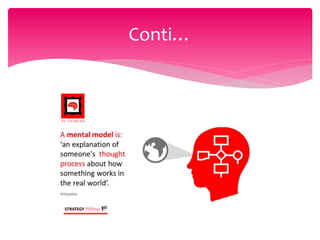
A mental model is an explanation of how something
works. It is a concept, framework, or worldview that
you carry around in your mind to help you interpret the
world and understand the relationship between things.
Mental models are deeply held beliefs about how the
world works.
Mental models
Conti…
 Bartlett sought a theory to explain the systematic
directions over time in retelling of stories. Bartlett
reasoned that our experience of this reality is far too
complex to deal with on an image by image. There
must be some underlying structures, some
simplifications that help us make sense of the
information to which we are exposed.
Conti…
 When we run into a new situation an object, a person,
or an interaction we compare it to the schemas we
have already stored in the memory.
Conti…
 A shortened form of a written word or phrase used in place of
the whole word or phrase.
 Schemas or scripts make it possible for culturally skilled people
to fill in the details of story.
Example:
 Alice had to go out to Los Angles last week and deals with this
client’s ego. Now think about all the information you need to
understand sentence . For example if you are in New York when
you hear this sentence than you know that Alice travelled by
plane, last week is less than 7 days ago & LA is 2753 miles from
NY that is much too far for Alice to drive or get train coming
back with in time and spending a lot of time and money on this
client.
Abbreviating
Followings are common types of Schemas
1. Universal Schema
2. Individual Schema
3. Cultural Schema
Kind of Schemas
Some schemas may be universal, reflecting the fact that
there are some experience that are common to all
humanity.
For example
Observed that all human beings experience the World
as a set of binary categories like male and female.
Universal Schema
Every human being grows up with a unique set of
experiences, some schemas are based on unique and
personal experience that each of us has on something.
A few examples of Individual-schemas are; exciting/
dull, quiet/ loud, healthy/ sickly etc.
Individual Schema
Somewhere between the universal and individual
schemas are cultural schemas. They are developed by
experience but are held by population.
For example, going out to a restaurant, this sentence
has four main components Entering, Ordering, Eating
and Exciting.
Each of these main components has more scripts for
example Existing schema has paying the bill, tipping and
leaving.
Cultural Schemas
There are three widely methods of studying schemas
1. Experiments
2. Interviewing
3. Analyzing Metaphors
Methods of Studying Schemas
In one experiment Rice (1980) made two version of Eskimo
stories. One version was the complete Eskimo version in
English. The other version was adapted to make it fit to the
American story schema. The participants in this experiment
read the story and than wrote it out from recall. They also
came back a week later and recalled the story again. Rice’s
work provides strong support to Bartlett’s earlier findings as
people add the American schema structure to the stories.
When the passage fit to American story schema people
agreed about which events they remembered.
Experiments
And people recalled more exactly from the
Americanized version of stories than from the Eskimo
versions.
Thus as Bartlett has found in his early work, people
distort stories in recall to fit their cultural expectations
about what stories ought to be like.
Conti…
 Naomi Quinn and her students collected and
transcribed interviews about marriage from 11 North
American couples. Some of the couples were recently
married; others had been married a long time. The
couples came from the different parts of the country
and represented different occupations, educational
levels, ethnic and religious groups. Each of 22 people
was interviewed separately for 15-16 hours and
interviews were transcribed.
Interviewing
Quinn analyzed this body of text to discover and
document the concepts underlying American marriage
and to show how these concepts are tied together.
A schema shared by people from different backgrounds
about what constitutes the success and failure in
marriage. She begins by looking at patterns of speech,
repetition of keywords, phrases, paying particular
attention to the informant’s metaphors and
commonalities in their reasoning about marriage.
Conti…
 A metaphor is a figure of speech that is used to make
a comparison between two things that aren't alike
but do have something in common. Unlike a simile,
where two things are compared directly using like or
as, a metaphor's comparison is more indirect by
stating something is something else.
Analyzing Metaphors
 Listen carefully to everybody speech as if some one says
“Debt can sink you” or “He is drowning in debt” the image
of person drowning not meant literally but the metaphor
works as a figure of speech (an image made with words).
 One way to get a list of metaphor is get a large amount of
text as Quinn did, on a particular topic and comb through
it. For many languages today, however, there are
compilations of metaphor and proverbs, short phrases or
sayings that encapsulate the cultural wisdom of people.
Those archival resources provides the opportunity for
schema analysis.
Conti…
 Folk theories or folk models are everyday theories
about how things work or why things exist. Why do
so few women go to physics? Why have American
automobile manufacturers lost ground to Japanese
and European manufacturers?
 To understand these theories we need to study, “
Cognition in the wild”.
Folk Theories
 Kempton (1987) interviewed 12 people in Michigan
about how they controlled heat in their homes during
the winter. He inferred from the interviews that
people were applying one of two possible theories,
the THERMOSTAT as Feedback theory or
THERMOSTAT as VALVE theory about heat control.
Conti…
Schemas analysis
Schemas analysis

Schemas analysis

  • 1.
    PRESENTATION ON SCHEMAS ANALYSIS BY SHAHIDMEHMOOD PhD SCHOLAR UNIVERSITY OF OKARA
  • 2.
     Introduction  Historyof Schemas Analysis  Mental Models  Kind of Schemas  Methods of Studying Schemas  Folk theories OUTLINE
  • 3.
     A schemaor schemas describes a pattern of thought or behavior that organizes categories of information and the relationships among them.  A schema is a high-level conceptual structure or framework that organizes prior experience and helps us to interpret new situations. Definition of Schema
  • 4.
     Piaget calledthe schema the basic building block of intelligent behavior . A way of organizing knowledge. Indeed, it is useful to think of schemas as “units” of knowledge, each relating to one aspect of the world, including objects, actions, and abstract concepts. Conti…
  • 6.
     Schema analysisis based on the idea that people must use cognitive simplifications to help make sense of complex information.  Schemas lead us to interpret the situation, for example Mona Lisa’s smile is as evidence of her perplexity of her desperation. (Wodak 1992) Introduction of Schema Analysis
  • 7.
    Contemporary work onschemas was initiated F. Bartlett ( 1932 ), who was interested in the role that prior knowledge played in the interpretation and memory for stories. His work largely challenged the perspective of behaviorism by emphasizing the role of internalized representations in the control of behavior and thought. Bartlett argued that meaning was integral to memory and sought a different experimental technique. History of Schema Analysis
  • 8.
     In oneset of studies, participants were told a Native American folktale that included a number of unfamiliar cultural elements. On subsequent occasions, participants were brought back to the lab and asked to retell the story. Over time, participants’ account of the story drifted in systematic ways, including the omission of information that did not make sense to them and the reinterpretation of certain facts in order to match their own cultural backgrounds. Conti…
  • 9.
    A mental modelis an explanation of how something works. It is a concept, framework, or worldview that you carry around in your mind to help you interpret the world and understand the relationship between things. Mental models are deeply held beliefs about how the world works. Mental models
  • 10.
  • 11.
     Bartlett soughta theory to explain the systematic directions over time in retelling of stories. Bartlett reasoned that our experience of this reality is far too complex to deal with on an image by image. There must be some underlying structures, some simplifications that help us make sense of the information to which we are exposed. Conti…
  • 12.
     When werun into a new situation an object, a person, or an interaction we compare it to the schemas we have already stored in the memory. Conti…
  • 13.
     A shortenedform of a written word or phrase used in place of the whole word or phrase.  Schemas or scripts make it possible for culturally skilled people to fill in the details of story. Example:  Alice had to go out to Los Angles last week and deals with this client’s ego. Now think about all the information you need to understand sentence . For example if you are in New York when you hear this sentence than you know that Alice travelled by plane, last week is less than 7 days ago & LA is 2753 miles from NY that is much too far for Alice to drive or get train coming back with in time and spending a lot of time and money on this client. Abbreviating
  • 14.
    Followings are commontypes of Schemas 1. Universal Schema 2. Individual Schema 3. Cultural Schema Kind of Schemas
  • 15.
    Some schemas maybe universal, reflecting the fact that there are some experience that are common to all humanity. For example Observed that all human beings experience the World as a set of binary categories like male and female. Universal Schema
  • 16.
    Every human beinggrows up with a unique set of experiences, some schemas are based on unique and personal experience that each of us has on something. A few examples of Individual-schemas are; exciting/ dull, quiet/ loud, healthy/ sickly etc. Individual Schema
  • 17.
    Somewhere between theuniversal and individual schemas are cultural schemas. They are developed by experience but are held by population. For example, going out to a restaurant, this sentence has four main components Entering, Ordering, Eating and Exciting. Each of these main components has more scripts for example Existing schema has paying the bill, tipping and leaving. Cultural Schemas
  • 18.
    There are threewidely methods of studying schemas 1. Experiments 2. Interviewing 3. Analyzing Metaphors Methods of Studying Schemas
  • 19.
    In one experimentRice (1980) made two version of Eskimo stories. One version was the complete Eskimo version in English. The other version was adapted to make it fit to the American story schema. The participants in this experiment read the story and than wrote it out from recall. They also came back a week later and recalled the story again. Rice’s work provides strong support to Bartlett’s earlier findings as people add the American schema structure to the stories. When the passage fit to American story schema people agreed about which events they remembered. Experiments
  • 20.
    And people recalledmore exactly from the Americanized version of stories than from the Eskimo versions. Thus as Bartlett has found in his early work, people distort stories in recall to fit their cultural expectations about what stories ought to be like. Conti…
  • 21.
     Naomi Quinnand her students collected and transcribed interviews about marriage from 11 North American couples. Some of the couples were recently married; others had been married a long time. The couples came from the different parts of the country and represented different occupations, educational levels, ethnic and religious groups. Each of 22 people was interviewed separately for 15-16 hours and interviews were transcribed. Interviewing
  • 22.
    Quinn analyzed thisbody of text to discover and document the concepts underlying American marriage and to show how these concepts are tied together. A schema shared by people from different backgrounds about what constitutes the success and failure in marriage. She begins by looking at patterns of speech, repetition of keywords, phrases, paying particular attention to the informant’s metaphors and commonalities in their reasoning about marriage. Conti…
  • 23.
     A metaphoris a figure of speech that is used to make a comparison between two things that aren't alike but do have something in common. Unlike a simile, where two things are compared directly using like or as, a metaphor's comparison is more indirect by stating something is something else. Analyzing Metaphors
  • 24.
     Listen carefullyto everybody speech as if some one says “Debt can sink you” or “He is drowning in debt” the image of person drowning not meant literally but the metaphor works as a figure of speech (an image made with words).  One way to get a list of metaphor is get a large amount of text as Quinn did, on a particular topic and comb through it. For many languages today, however, there are compilations of metaphor and proverbs, short phrases or sayings that encapsulate the cultural wisdom of people. Those archival resources provides the opportunity for schema analysis. Conti…
  • 25.
     Folk theoriesor folk models are everyday theories about how things work or why things exist. Why do so few women go to physics? Why have American automobile manufacturers lost ground to Japanese and European manufacturers?  To understand these theories we need to study, “ Cognition in the wild”. Folk Theories
  • 26.
     Kempton (1987)interviewed 12 people in Michigan about how they controlled heat in their homes during the winter. He inferred from the interviews that people were applying one of two possible theories, the THERMOSTAT as Feedback theory or THERMOSTAT as VALVE theory about heat control. Conti…