Qualitative Research
in Business &
Management
© Michael D. Myers
Chapter 9:
Grounded Theory
Introduction
• Grounded theory is a
research method that seeks
to develop theory that is
grounded in data
systematically gathered
and analyzed
• There is a continuous
interplay between data
collection and analysis
Written Record
Data Analysis Approach
Data Collection
Technique
Research Method
Philosophical
Assumptions
The purpose of grounded theory
Defining grounded theory
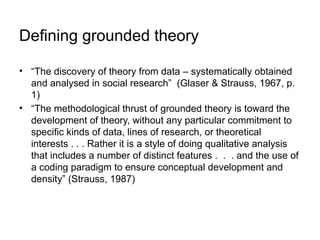
• “The discovery of theory from data – systematically obtained
and analysed in social research” (Glaser & Strauss, 1967, p.
1)
• “The methodological thrust of grounded theory is toward the
development of theory, without any particular commitment to
specific kinds of data, lines of research, or theoretical
interests . . . Rather it is a style of doing qualitative analysis
that includes a number of distinct features . . . and the use of
a coding paradigm to ensure conceptual development and
density” (Strauss, 1987)
Grounded theory and the literature
review
• As a general rule, grounded theory researchers should make
sure that they have no preconceived theoretical ideas before
starting the research
• Many people think that this means ignoring the literature
• But this is not so - the intention is to make sure that
researchers are not constrained by the literature when coding
• Researchers should make sure that they do not impose
concepts on the data – those concepts should emerge from
the data
Some approaches to grounded theory
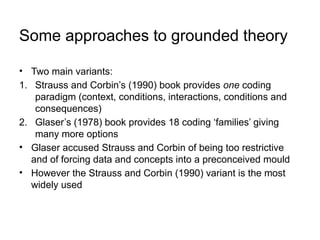
• Two main variants:
1. Strauss and Corbin’s (1990) book provides one coding
paradigm (context, conditions, interactions, conditions and
consequences)
2. Glaser’s (1978) book provides 18 coding ‘families’ giving
many more options
• Glaser accused Strauss and Corbin of being too restrictive
and of forcing data and concepts into a preconceived mould
• However the Strauss and Corbin (1990) variant is the most
widely used
How to do grounded theory
1. Open coding
• Summarizing some text by the use of a succinct code
• Constant comparison: constantly compare and contrast
qualitative data in the search for similarities and differences
2. Axial coding or selective coding
• Refine the conceptual constructs
3. Theoretical coding
• The formulation of a theory
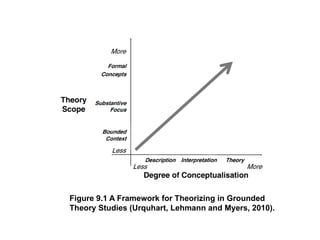
Figure 9.1 A Framework for Theorizing in Grounded
Theory Studies (Urquhart, Lehmann and Myers, 2010).
Critique of grounded theory
• Advantages:
• It has intuitive appeal for novice researchers, since it allows
them to become immersed in the data at a detailed level.
• It gets researchers analyzing the data early
• It encourages systematic, detailed analysis of the data and
provides a method for doing so
• It gives researchers ample evidence to back up their claims
• It encourages a constant interplay between data collection and
analysis
• It is especially useful for describing repeated processes e.g. the
communications processes between doctors and patients, or the
communications processes between information systems
analysts and users
Critique of grounded theory (2)
• Disadvantages:
• First time users can get overwhelmed at the coding level
• Open coding takes a long time
• It can be difficult to “scale up” to larger concepts or themes
• Because it is a detailed method, it can be difficult to see the
bigger picture
• Tends to produce lower level theories only
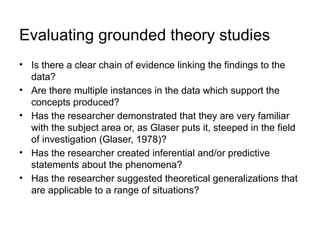
Evaluating grounded theory studies
• Is there a clear chain of evidence linking the findings to the
data?
• Are there multiple instances in the data which support the
concepts produced?
• Has the researcher demonstrated that they are very familiar
with the subject area or, as Glaser puts it, steeped in the field
of investigation (Glaser, 1978)?
• Has the researcher created inferential and/or predictive
statements about the phenomena?
• Has the researcher suggested theoretical generalizations that
are applicable to a range of situations?


Myers Chapter 9 qualitative research.pptx

  • 1.
    Qualitative Research in Business& Management © Michael D. Myers
  • 2.
  • 3.
    Introduction • Grounded theoryis a research method that seeks to develop theory that is grounded in data systematically gathered and analyzed • There is a continuous interplay between data collection and analysis Written Record Data Analysis Approach Data Collection Technique Research Method Philosophical Assumptions
  • 4.
    The purpose ofgrounded theory
  • 5.
    Defining grounded theory •“The discovery of theory from data – systematically obtained and analysed in social research” (Glaser & Strauss, 1967, p. 1) • “The methodological thrust of grounded theory is toward the development of theory, without any particular commitment to specific kinds of data, lines of research, or theoretical interests . . . Rather it is a style of doing qualitative analysis that includes a number of distinct features . . . and the use of a coding paradigm to ensure conceptual development and density” (Strauss, 1987)
  • 6.
    Grounded theory andthe literature review • As a general rule, grounded theory researchers should make sure that they have no preconceived theoretical ideas before starting the research • Many people think that this means ignoring the literature • But this is not so - the intention is to make sure that researchers are not constrained by the literature when coding • Researchers should make sure that they do not impose concepts on the data – those concepts should emerge from the data
  • 7.
    Some approaches togrounded theory • Two main variants: 1. Strauss and Corbin’s (1990) book provides one coding paradigm (context, conditions, interactions, conditions and consequences) 2. Glaser’s (1978) book provides 18 coding ‘families’ giving many more options • Glaser accused Strauss and Corbin of being too restrictive and of forcing data and concepts into a preconceived mould • However the Strauss and Corbin (1990) variant is the most widely used
  • 8.
    How to dogrounded theory 1. Open coding • Summarizing some text by the use of a succinct code • Constant comparison: constantly compare and contrast qualitative data in the search for similarities and differences 2. Axial coding or selective coding • Refine the conceptual constructs 3. Theoretical coding • The formulation of a theory
  • 9.
    Figure 9.1 AFramework for Theorizing in Grounded Theory Studies (Urquhart, Lehmann and Myers, 2010).
  • 10.
    Critique of groundedtheory • Advantages: • It has intuitive appeal for novice researchers, since it allows them to become immersed in the data at a detailed level. • It gets researchers analyzing the data early • It encourages systematic, detailed analysis of the data and provides a method for doing so • It gives researchers ample evidence to back up their claims • It encourages a constant interplay between data collection and analysis • It is especially useful for describing repeated processes e.g. the communications processes between doctors and patients, or the communications processes between information systems analysts and users
  • 11.
    Critique of groundedtheory (2) • Disadvantages: • First time users can get overwhelmed at the coding level • Open coding takes a long time • It can be difficult to “scale up” to larger concepts or themes • Because it is a detailed method, it can be difficult to see the bigger picture • Tends to produce lower level theories only
  • 12.
    Evaluating grounded theorystudies • Is there a clear chain of evidence linking the findings to the data? • Are there multiple instances in the data which support the concepts produced? • Has the researcher demonstrated that they are very familiar with the subject area or, as Glaser puts it, steeped in the field of investigation (Glaser, 1978)? • Has the researcher created inferential and/or predictive statements about the phenomena? • Has the researcher suggested theoretical generalizations that are applicable to a range of situations?