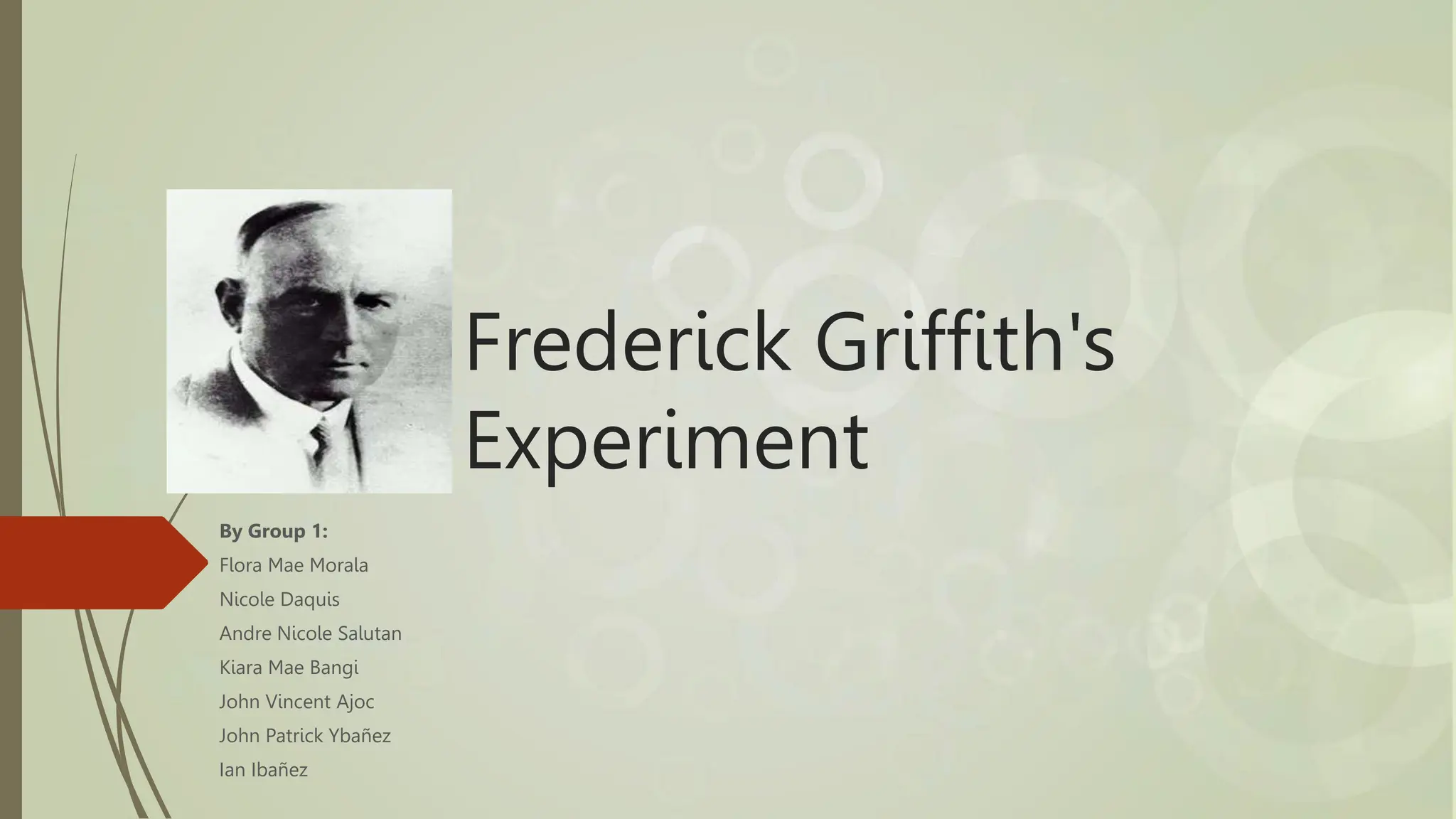
Frederick Griffith's
Experiment
By Group 1:
Flora Mae Morala
Nicole Daquis
Andre Nicole Salutan
Kiara Mae Bangi
John Vincent Ajoc
John Patrick Ybañez
Ian Ibañez
FREDERICK GRIFFITH
2
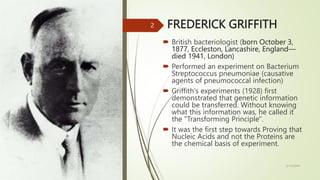
 British bacteriologist (born October 3,
1877, Eccleston, Lancashire, England—
died 1941, London)
 Performed an experiment on Bacterium
Streptococcus pneumoniae (causative
agents of pneumococcal infection)
 Griffith's experiments (1928) first
demonstrated that genetic information
could be transferred. Without knowing
what this information was, he called it
the "Transforming Principle".
 It was the first step towards Proving that
Nucleic Acids and not the Proteins are
the chemical basis of experiment.
3/14/2024
FREDERICK GRIFFITH
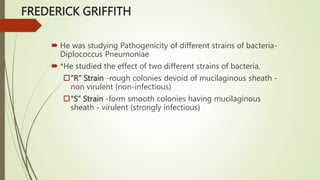
 He was studying Pathogenicity of different strains of bacteria-
Diplococcus Pneumoniae
 *He studied the effect of two different strains of bacteria.
“R” Strain -rough colonies devoid of mucilaginous sheath -
non virulent (non-infectious)
“S” Strain -form smooth colonies having mucilaginous
sheath - virulent (strongly infectious)
FREDERICK GRIFFITH
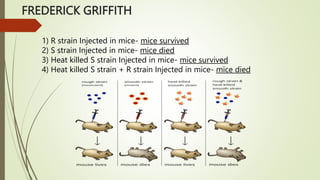
1) R strain Injected in mice- mice survived
2) S strain Injected in mice- mice died
3) Heat killed S strain Injected in mice- mice survived
4) Heat killed S strain + R strain Injected in mice- mice died
Griffith’s Conclusion
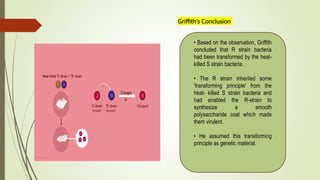
• Based on the observation, Griffith
concluded that R strain bacteria
had been transformed by the heat-
killed S strain bacteria.
• The R strain inherited some
'transforming principle' from the
heat- killed S strain bacteria and
had enabled the R-strain to
synthesize a smooth
polysaccharide coat which made
them virulent.
• He assumed this transforming
principle as genetic material.
DNA and Genetic material
 • Griffith's experiment was a turning point towards the
discovery of hereditary material.
 • However, it failed to explain the biochemistry of genetic
material.
 • Hence, a group of scientists, Oswald Avery, Colin MacLeod
and Maclyn McCarty continued the Griffith experiment in
search of biochemical nature of the hereditary material.
 • Their discovery revised the concept of protein as genetic
material to DNA.
Avery, MacLeod and McCarty's conclusion
 • They repeated Griffith’s Experiment on 1944
• They extracted and purified proteins, DNA, RNA
and other biomolecules from the heat-killed S strain
bacteria.
• They discovered that DNA is the genetic material
and it is alone responsible for the transformation of
the R strain bacteria.
Avery, MacLeod and McCarty's conclusion
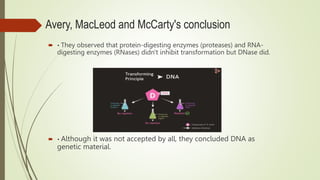
 • They observed that protein-digesting enzymes (proteases) and RNA-
digesting enzymes (RNases) didn't inhibit transformation but DNase did.
 • Although it was not accepted by all, they concluded DNA as
genetic material.
Frederick Griffith's Experiment.ppt GENx

Frederick Griffith's Experiment.ppt GENx

  • 1.
    Frederick Griffith's Experiment By Group1: Flora Mae Morala Nicole Daquis Andre Nicole Salutan Kiara Mae Bangi John Vincent Ajoc John Patrick Ybañez Ian Ibañez
  • 2.
    FREDERICK GRIFFITH 2  Britishbacteriologist (born October 3, 1877, Eccleston, Lancashire, England— died 1941, London)  Performed an experiment on Bacterium Streptococcus pneumoniae (causative agents of pneumococcal infection)  Griffith's experiments (1928) first demonstrated that genetic information could be transferred. Without knowing what this information was, he called it the "Transforming Principle".  It was the first step towards Proving that Nucleic Acids and not the Proteins are the chemical basis of experiment. 3/14/2024
  • 3.
    FREDERICK GRIFFITH  Hewas studying Pathogenicity of different strains of bacteria- Diplococcus Pneumoniae  *He studied the effect of two different strains of bacteria. “R” Strain -rough colonies devoid of mucilaginous sheath - non virulent (non-infectious) “S” Strain -form smooth colonies having mucilaginous sheath - virulent (strongly infectious)
  • 4.
    FREDERICK GRIFFITH 1) Rstrain Injected in mice- mice survived 2) S strain Injected in mice- mice died 3) Heat killed S strain Injected in mice- mice survived 4) Heat killed S strain + R strain Injected in mice- mice died
  • 5.
    Griffith’s Conclusion • Basedon the observation, Griffith concluded that R strain bacteria had been transformed by the heat- killed S strain bacteria. • The R strain inherited some 'transforming principle' from the heat- killed S strain bacteria and had enabled the R-strain to synthesize a smooth polysaccharide coat which made them virulent. • He assumed this transforming principle as genetic material.
  • 6.
    DNA and Geneticmaterial  • Griffith's experiment was a turning point towards the discovery of hereditary material.  • However, it failed to explain the biochemistry of genetic material.  • Hence, a group of scientists, Oswald Avery, Colin MacLeod and Maclyn McCarty continued the Griffith experiment in search of biochemical nature of the hereditary material.  • Their discovery revised the concept of protein as genetic material to DNA.
  • 7.
    Avery, MacLeod andMcCarty's conclusion  • They repeated Griffith’s Experiment on 1944 • They extracted and purified proteins, DNA, RNA and other biomolecules from the heat-killed S strain bacteria. • They discovered that DNA is the genetic material and it is alone responsible for the transformation of the R strain bacteria.
  • 8.
    Avery, MacLeod andMcCarty's conclusion  • They observed that protein-digesting enzymes (proteases) and RNA- digesting enzymes (RNases) didn't inhibit transformation but DNase did.  • Although it was not accepted by all, they concluded DNA as genetic material.