The Master of IEEE Projects
Copyright © 2016LeMenizInfotech. All rights reserved
LeMenizInfotech
36, 100 Feet Road, Natesan Nagar, Near Indira Gandhi Statue,
Pondicherry-605 005.
Call: 0413-4205444, +91 9566355386, 99625 88976.
Web :www.lemenizinfotech.com/ www.ieeemaster.com
Mail : projects@lemenizinfotech.com
Grid-Current-Feedback Active Damping
for LCL Resonance in Grid-Connected
Voltage-Source Converters
Introduction:
CL resonance has always been an important concern for LCL-
filtered voltage-source converters. A wide variety of resonance
damping techniques have thus been developed with the trend
generally favoring active damping techniques because of the
additional power losses experienced by passive damping techniques.
Active damping techniques can also be broadly divided into those
realized by cascading a digital filter with the current controller, and
those realized by feeding back the filter state variables. The former
represents a sensor-less technique realized by plugging in a digital
filter, which unfortunately, is sensitive to parameter uncertainties and
variations. It is, therefore, not as popular as the feedback of filter state
variables for damping purposes.
Existing system:
The state variables fed back, the filter capacitor current has been
widely chosen, and is usually realized with a proportional resistive
gain. The proportional resistive gain is, however, easily modified by
transport delays found in a digital system. The outcome is a negative
virtual resistance, which upon introduced, will add open-loop right-
half-plane (RHP) poles to the system. These open-loop poles will, in
turn, introduce a non-minimum-phase closed-loop behaviour to the
system. Such a non-minimum has behaviour has subsequently been
The Master of IEEE Projects
Copyright © 2016LeMenizInfotech. All rights reserved
LeMenizInfotech
36, 100 Feet Road, Natesan Nagar, Near Indira Gandhi Statue,
Pondicherry-605 005.
Call: 0413-4205444, +91 9566355386, 99625 88976.
Web :www.lemenizinfotech.com/ www.ieeemaster.com
Mail : projects@lemenizinfotech.com
resolved by replacing the usual proportional gain with a high-pass
filter (HPF) along the capacitor current feedback loop. The capacitor
current must, however, still be measured, which in practice, will
demand an additional sensor or a complex software-based observer
Disadvantages:
 Positive virtual resistance, is not implementable because of the
possible noise amplification.
 Lag to non-minimum-phase response of the system
Proposed system:
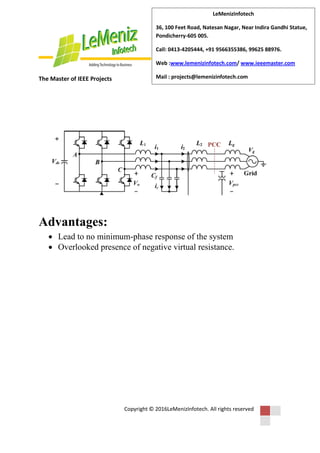
An impedance-based analysis in s-domain for generalizing
physical circuit property of grid current feedback active damping is
analysed. The analysis specifically demonstrates that the grid current
active damping is equivalent to the insertion of virtual impedance in
parallel with the grid-side inductance. In case of an HPF with a
negated output along the damping path, the virtual impedance can
further be notated as a series RL branch in parallel with a negative
inductance. The resistive part of the RL branch may become negative
when influenced by transport delays, which may then cause non-
minimum-phase response that can impair the overall system stability
and robustness. The non-minimum-phase problem can, however, be
minimized by the negative virtual inductance in parallel with the
series RL damper. This mitigation effect is not inherited by other
existing active damping techniques based on the feedback of the filter
capacitor current, and has presently not been discussed in the
literature. It is thus the intention of this paper to study the combined
negative resistive and inductive effects introduced by the grid current
active damping.
The Master of IEEE Projects
Copyright © 2016LeMenizInfotech. All rights reserved
LeMenizInfotech
36, 100 Feet Road, Natesan Nagar, Near Indira Gandhi Statue,
Pondicherry-605 005.
Call: 0413-4205444, +91 9566355386, 99625 88976.
Web :www.lemenizinfotech.com/ www.ieeemaster.com
Mail : projects@lemenizinfotech.com
Advantages:
 Lead to no minimum-phase response of the system
 Overlooked presence of negative virtual resistance.
The Master of IEEE Projects
Copyright © 2016LeMenizInfotech. All rights reserved
LeMenizInfotech
36, 100 Feet Road, Natesan Nagar, Near Indira Gandhi Statue,
Pondicherry-605 005.
Call: 0413-4205444, +91 9566355386, 99625 88976.
Web :www.lemenizinfotech.com/ www.ieeemaster.com
Mail : projects@lemenizinfotech.com
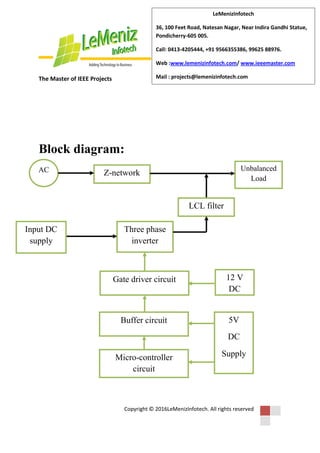
Block diagram:
AC Unbalanced
Load
Three phase
inverter
Input DC
supply
Gate driver circuit 12 V
DC
Buffer circuit
Micro-controller
circuit
5V
DC
Supply
LCL filter
Z-network

Grid current-feedback active damping for lcl resonance in grid-connected voltage-source converters

  • 1.
    The Master ofIEEE Projects Copyright © 2016LeMenizInfotech. All rights reserved LeMenizInfotech 36, 100 Feet Road, Natesan Nagar, Near Indira Gandhi Statue, Pondicherry-605 005. Call: 0413-4205444, +91 9566355386, 99625 88976. Web :www.lemenizinfotech.com/ www.ieeemaster.com Mail : projects@lemenizinfotech.com Grid-Current-Feedback Active Damping for LCL Resonance in Grid-Connected Voltage-Source Converters Introduction: CL resonance has always been an important concern for LCL- filtered voltage-source converters. A wide variety of resonance damping techniques have thus been developed with the trend generally favoring active damping techniques because of the additional power losses experienced by passive damping techniques. Active damping techniques can also be broadly divided into those realized by cascading a digital filter with the current controller, and those realized by feeding back the filter state variables. The former represents a sensor-less technique realized by plugging in a digital filter, which unfortunately, is sensitive to parameter uncertainties and variations. It is, therefore, not as popular as the feedback of filter state variables for damping purposes. Existing system: The state variables fed back, the filter capacitor current has been widely chosen, and is usually realized with a proportional resistive gain. The proportional resistive gain is, however, easily modified by transport delays found in a digital system. The outcome is a negative virtual resistance, which upon introduced, will add open-loop right- half-plane (RHP) poles to the system. These open-loop poles will, in turn, introduce a non-minimum-phase closed-loop behaviour to the system. Such a non-minimum has behaviour has subsequently been
  • 2.
    The Master ofIEEE Projects Copyright © 2016LeMenizInfotech. All rights reserved LeMenizInfotech 36, 100 Feet Road, Natesan Nagar, Near Indira Gandhi Statue, Pondicherry-605 005. Call: 0413-4205444, +91 9566355386, 99625 88976. Web :www.lemenizinfotech.com/ www.ieeemaster.com Mail : projects@lemenizinfotech.com resolved by replacing the usual proportional gain with a high-pass filter (HPF) along the capacitor current feedback loop. The capacitor current must, however, still be measured, which in practice, will demand an additional sensor or a complex software-based observer Disadvantages:  Positive virtual resistance, is not implementable because of the possible noise amplification.  Lag to non-minimum-phase response of the system Proposed system: An impedance-based analysis in s-domain for generalizing physical circuit property of grid current feedback active damping is analysed. The analysis specifically demonstrates that the grid current active damping is equivalent to the insertion of virtual impedance in parallel with the grid-side inductance. In case of an HPF with a negated output along the damping path, the virtual impedance can further be notated as a series RL branch in parallel with a negative inductance. The resistive part of the RL branch may become negative when influenced by transport delays, which may then cause non- minimum-phase response that can impair the overall system stability and robustness. The non-minimum-phase problem can, however, be minimized by the negative virtual inductance in parallel with the series RL damper. This mitigation effect is not inherited by other existing active damping techniques based on the feedback of the filter capacitor current, and has presently not been discussed in the literature. It is thus the intention of this paper to study the combined negative resistive and inductive effects introduced by the grid current active damping.
  • 3.
    The Master ofIEEE Projects Copyright © 2016LeMenizInfotech. All rights reserved LeMenizInfotech 36, 100 Feet Road, Natesan Nagar, Near Indira Gandhi Statue, Pondicherry-605 005. Call: 0413-4205444, +91 9566355386, 99625 88976. Web :www.lemenizinfotech.com/ www.ieeemaster.com Mail : projects@lemenizinfotech.com Advantages:  Lead to no minimum-phase response of the system  Overlooked presence of negative virtual resistance.
  • 4.
    The Master ofIEEE Projects Copyright © 2016LeMenizInfotech. All rights reserved LeMenizInfotech 36, 100 Feet Road, Natesan Nagar, Near Indira Gandhi Statue, Pondicherry-605 005. Call: 0413-4205444, +91 9566355386, 99625 88976. Web :www.lemenizinfotech.com/ www.ieeemaster.com Mail : projects@lemenizinfotech.com Block diagram: AC Unbalanced Load Three phase inverter Input DC supply Gate driver circuit 12 V DC Buffer circuit Micro-controller circuit 5V DC Supply LCL filter Z-network