URBAN REJNUVATION
CASE STUDY
BILBAO CITY
SUBMITTED BY – SHIVANGI (62)
INTRODUCTION
• Bilbao, in the heart of the Basque country, is the largest port on Spain’s long
Atlantic coast, hemmed in on three sides by steep slopes leading eastwards
to the Pyrenees, and in the north by the sea.
• The city grew as a fishing and trading centre near the mouth of the river
Nervión.
• Bilbao’s early development brought it the official status of city in 1300; and its
strategic location between the Atlantic and Spain, between Europe and the
Iberian Peninsula, made it into an international trading hub as well as
reinforcing its fierce independence.
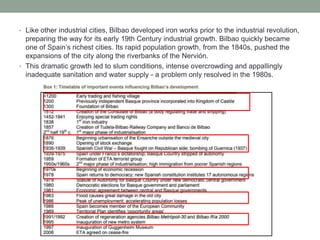
• Like other industrial cities, Bilbao developed iron works prior to the industrial revolution,
preparing the way for its early 19th Century industrial growth. Bilbao quickly became
one of Spain’s richest cities. Its rapid population growth, from the 1840s, pushed the
expansions of the city along the riverbanks of the Nervión.
• This dramatic growth led to slum conditions, intense overcrowding and appallingly
inadequate sanitation and water supply - a problem only resolved in the 1980s.
• Before, during and after the Civil War, Bilbao’s iron and steel industry continued to grow
– making Altos Hornos, the huge steel furnaces on the banks of the Nervión,
internationally famous.
• Bilbao was almost unique in a country that was increasingly behind the rest of Europe.
It had the workforce, skills, raw materials, infrastructure, production systems, and
international links to hold its own in a relatively backward country.
• In the 1950s and 1960s, Spain was still predominantly rural and had not yet developed
into the massive construction boom of the 1970s which results high level population
growth in and around the port areas and also major increase in industrial pollution and
environmental damage unmatched by other Western European cities.
• Bilbao had become a rich industrial hub, facing extreme inequality within, and
surrounded by poor Spanish regions.
• By the time a democratic government finally took over in 1978, the Basque Country
secured a uniquely favorable agreement with the central Spanish government. The
Basque Country pays a small annual quota to the Central Government to compensate for
its services provided in the Basque Country. As a relatively rich region in a relatively poor
country, this gave Bilbao and the Basque provinces a strong financial base on which to
grow.
• Four simultaneous crises in the 1980s provoked immediate and urgent action: -
1. The loss of industrial and manufacturing jobs;
2. The loss of population;
3. Extreme pollution of the main water systems and lack of modern sewage treatment;
4. The disastrous floods in the old city exposing extreme decay and deprivation.
• Spain’s admission as a full member of
the European Union in 1986 marked
a new turn for the Basque country.
• The Basque country was a
particularly strong beneficiary,
especially in the late 1980s and early
1990s because European regional
aid, structural funds, economic
investments.
• Bilbao was able to begin a serious restructuring of its troubled economy and a major clean-
up of its fond water systems, including for the first time in its industrial history:
1. a proper sewage treatment system;
2. new high-tech business parks;
3. significant urban renewal;
4. retraining and reskilling through the large and open-minded SME sector;
5. a commitment to the environment;
6. New transport infrastructure.
• Two bodies, structurally separate from the local, provincial and regional governments, were
set up by a partnership of both public and private organisations, in part funded by the
Basque and central governments with local representatives on their boards. Bilbao
Metropoli 50 and Bilbao Ría 2000.
• Bilbao Metropoli 30 became a form of think-tank, lobby organisation and catalyst for
investment for the city and its wider metropolitan area, with a population of 1 million and 22
separate municipalities. To this day, it brings together public and private sector partners to
develop and promote the changing image of Bilbao as a post-industrial, European city.
• Bilbao Ría 2000 was established as a much more interventionist and pro-active body,
owned half by the Spanish government, half by the Basque administration. Its core purpose
was to take ownership of disused industrial land and infrastructure in Bilbao and
neighbouring municipalities, and turn these into new productive spaces, using its
investment potential to clean them up, develop and sell them on.
THE NEW ERA.
‘Opportunity Areas’
The regeneration of designated ‘opportunity areas’ was carried
out by Bilbao Ría 2000, which invested a total of €560 million
between 1997 and 2006 (BR 2000, online). Initially, the
territorial plan identified four such ‘opportunity areas’
1. Abandodoibarra: Brownfield land formerly occupied by
harbour and railway infrastructure on the riverfront in
central locations. The project involved the creation of
Bilbao’s new urban heart with a focus on new investment.
2. Zorrozaure: A peninsula occupied by mixed – mostly
lower-value – harbour and industrial as well as some
residential buildings and activities. The project involved
restructuring uses and a planned future extension of
Abandoibarra.
3. Ametzola/Eskurtze: The area south of central Bilbao
dominated by dense residential developments. The
project involved overcoming the physical divides such as
deep railway cuttings.
4. Miribilla and Morro: Abandoned mining areas on the hilly
slopes south east of central Bilbao led to a project to
reclaim these areas through construction of new housing.
THE NEW ERA.
• The most visible, best known and most recognised new development was the
Abandoibarra area, where the Guggenheim Museum is located, in the reclaimed docks,
attracting nearly a million visitors every year since it opened in 1997.
• It held 744 events in 2013, let out at 92% capacity, with almost 500,00 people visiting
for major conferences, small seminars and workshops, concerts and shows.
Euskalduna Conference and Events Centre
• The conference center built in February 19,1999 and has generated a year-
round new industry in “business tourism” which the Guggenheim and other
attractions obviously encourage and support.
• These leading flagship projects were a major force in the much wider task of
image change, job transformation, urban renewal and innovative enterprise.
Alhondiga
• One of the most impressive but costly developments is the careful restoration and internal
rebuilding of the Alhondiga: an imposing former warehouse and wine store for the famous
Rioja wines, which used to be imported via Bilbao. Now preserved, it is a public amenity in the
city centre.
• The entire ground floor is an internal open space with giant ornate pillars every few yards
supporting the floors above, containing the super-modern “media-tec” public library, a
swimming pool and gym, a theatre, eight cinemas and several meeting venues.
• It attracts around 350,000 visitors a year, mainly local residents. There are 7000 swimmers
and gym users a day, 3000 daily library visitors ranging from children, to students, to elderly
people.
Social Programmes
• Barakaldo the largest working-class suburb received urban funding between 1994-1999
for the improvement of conditions in its most deprived neighbourhoods. the two most
striking social interventions were initiated by the City of Bilbao– Surbisa and Lan
Ekintza – were created specifically to tackle social problems resulting from the urban
crisis and structural change.
• Basque government and social housing offered by the City Council both go some way
to responding to the need of housing:
• ‘Protected housing’ in the Basque Country
• Local authority public housing
Transport Infrastructure
• Substantial investments were also made in the transport infrastructure of the Bilbao
metropolitan area following the aim to improve accessibility and connections for the city’s
residents and more widely, including internationally. Funding for transport projects came
almost entirely from the public sector -
THANKYOU

Urban rejnuvation case study

  • 1.
    URBAN REJNUVATION CASE STUDY BILBAOCITY SUBMITTED BY – SHIVANGI (62)
  • 2.
    INTRODUCTION • Bilbao, inthe heart of the Basque country, is the largest port on Spain’s long Atlantic coast, hemmed in on three sides by steep slopes leading eastwards to the Pyrenees, and in the north by the sea. • The city grew as a fishing and trading centre near the mouth of the river Nervión. • Bilbao’s early development brought it the official status of city in 1300; and its strategic location between the Atlantic and Spain, between Europe and the Iberian Peninsula, made it into an international trading hub as well as reinforcing its fierce independence.
  • 3.
    • Like otherindustrial cities, Bilbao developed iron works prior to the industrial revolution, preparing the way for its early 19th Century industrial growth. Bilbao quickly became one of Spain’s richest cities. Its rapid population growth, from the 1840s, pushed the expansions of the city along the riverbanks of the Nervión. • This dramatic growth led to slum conditions, intense overcrowding and appallingly inadequate sanitation and water supply - a problem only resolved in the 1980s.
  • 4.
    • Before, duringand after the Civil War, Bilbao’s iron and steel industry continued to grow – making Altos Hornos, the huge steel furnaces on the banks of the Nervión, internationally famous. • Bilbao was almost unique in a country that was increasingly behind the rest of Europe. It had the workforce, skills, raw materials, infrastructure, production systems, and international links to hold its own in a relatively backward country. • In the 1950s and 1960s, Spain was still predominantly rural and had not yet developed into the massive construction boom of the 1970s which results high level population growth in and around the port areas and also major increase in industrial pollution and environmental damage unmatched by other Western European cities. • Bilbao had become a rich industrial hub, facing extreme inequality within, and surrounded by poor Spanish regions.
  • 5.
    • By thetime a democratic government finally took over in 1978, the Basque Country secured a uniquely favorable agreement with the central Spanish government. The Basque Country pays a small annual quota to the Central Government to compensate for its services provided in the Basque Country. As a relatively rich region in a relatively poor country, this gave Bilbao and the Basque provinces a strong financial base on which to grow. • Four simultaneous crises in the 1980s provoked immediate and urgent action: - 1. The loss of industrial and manufacturing jobs; 2. The loss of population; 3. Extreme pollution of the main water systems and lack of modern sewage treatment; 4. The disastrous floods in the old city exposing extreme decay and deprivation. • Spain’s admission as a full member of the European Union in 1986 marked a new turn for the Basque country. • The Basque country was a particularly strong beneficiary, especially in the late 1980s and early 1990s because European regional aid, structural funds, economic investments.
  • 6.
    • Bilbao wasable to begin a serious restructuring of its troubled economy and a major clean- up of its fond water systems, including for the first time in its industrial history: 1. a proper sewage treatment system; 2. new high-tech business parks; 3. significant urban renewal; 4. retraining and reskilling through the large and open-minded SME sector; 5. a commitment to the environment; 6. New transport infrastructure. • Two bodies, structurally separate from the local, provincial and regional governments, were set up by a partnership of both public and private organisations, in part funded by the Basque and central governments with local representatives on their boards. Bilbao Metropoli 50 and Bilbao Ría 2000. • Bilbao Metropoli 30 became a form of think-tank, lobby organisation and catalyst for investment for the city and its wider metropolitan area, with a population of 1 million and 22 separate municipalities. To this day, it brings together public and private sector partners to develop and promote the changing image of Bilbao as a post-industrial, European city. • Bilbao Ría 2000 was established as a much more interventionist and pro-active body, owned half by the Spanish government, half by the Basque administration. Its core purpose was to take ownership of disused industrial land and infrastructure in Bilbao and neighbouring municipalities, and turn these into new productive spaces, using its investment potential to clean them up, develop and sell them on.
  • 7.
    THE NEW ERA. ‘OpportunityAreas’ The regeneration of designated ‘opportunity areas’ was carried out by Bilbao Ría 2000, which invested a total of €560 million between 1997 and 2006 (BR 2000, online). Initially, the territorial plan identified four such ‘opportunity areas’ 1. Abandodoibarra: Brownfield land formerly occupied by harbour and railway infrastructure on the riverfront in central locations. The project involved the creation of Bilbao’s new urban heart with a focus on new investment. 2. Zorrozaure: A peninsula occupied by mixed – mostly lower-value – harbour and industrial as well as some residential buildings and activities. The project involved restructuring uses and a planned future extension of Abandoibarra. 3. Ametzola/Eskurtze: The area south of central Bilbao dominated by dense residential developments. The project involved overcoming the physical divides such as deep railway cuttings. 4. Miribilla and Morro: Abandoned mining areas on the hilly slopes south east of central Bilbao led to a project to reclaim these areas through construction of new housing.
  • 8.
    THE NEW ERA. •The most visible, best known and most recognised new development was the Abandoibarra area, where the Guggenheim Museum is located, in the reclaimed docks, attracting nearly a million visitors every year since it opened in 1997. • It held 744 events in 2013, let out at 92% capacity, with almost 500,00 people visiting for major conferences, small seminars and workshops, concerts and shows.
  • 11.
    Euskalduna Conference andEvents Centre • The conference center built in February 19,1999 and has generated a year- round new industry in “business tourism” which the Guggenheim and other attractions obviously encourage and support. • These leading flagship projects were a major force in the much wider task of image change, job transformation, urban renewal and innovative enterprise.
  • 13.
    Alhondiga • One ofthe most impressive but costly developments is the careful restoration and internal rebuilding of the Alhondiga: an imposing former warehouse and wine store for the famous Rioja wines, which used to be imported via Bilbao. Now preserved, it is a public amenity in the city centre. • The entire ground floor is an internal open space with giant ornate pillars every few yards supporting the floors above, containing the super-modern “media-tec” public library, a swimming pool and gym, a theatre, eight cinemas and several meeting venues. • It attracts around 350,000 visitors a year, mainly local residents. There are 7000 swimmers and gym users a day, 3000 daily library visitors ranging from children, to students, to elderly people.
  • 14.
    Social Programmes • Barakaldothe largest working-class suburb received urban funding between 1994-1999 for the improvement of conditions in its most deprived neighbourhoods. the two most striking social interventions were initiated by the City of Bilbao– Surbisa and Lan Ekintza – were created specifically to tackle social problems resulting from the urban crisis and structural change. • Basque government and social housing offered by the City Council both go some way to responding to the need of housing: • ‘Protected housing’ in the Basque Country • Local authority public housing
  • 15.
    Transport Infrastructure • Substantialinvestments were also made in the transport infrastructure of the Bilbao metropolitan area following the aim to improve accessibility and connections for the city’s residents and more widely, including internationally. Funding for transport projects came almost entirely from the public sector -
  • 20.