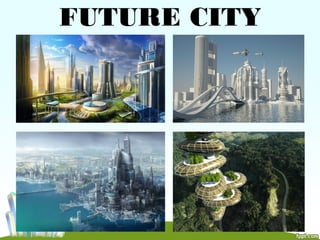
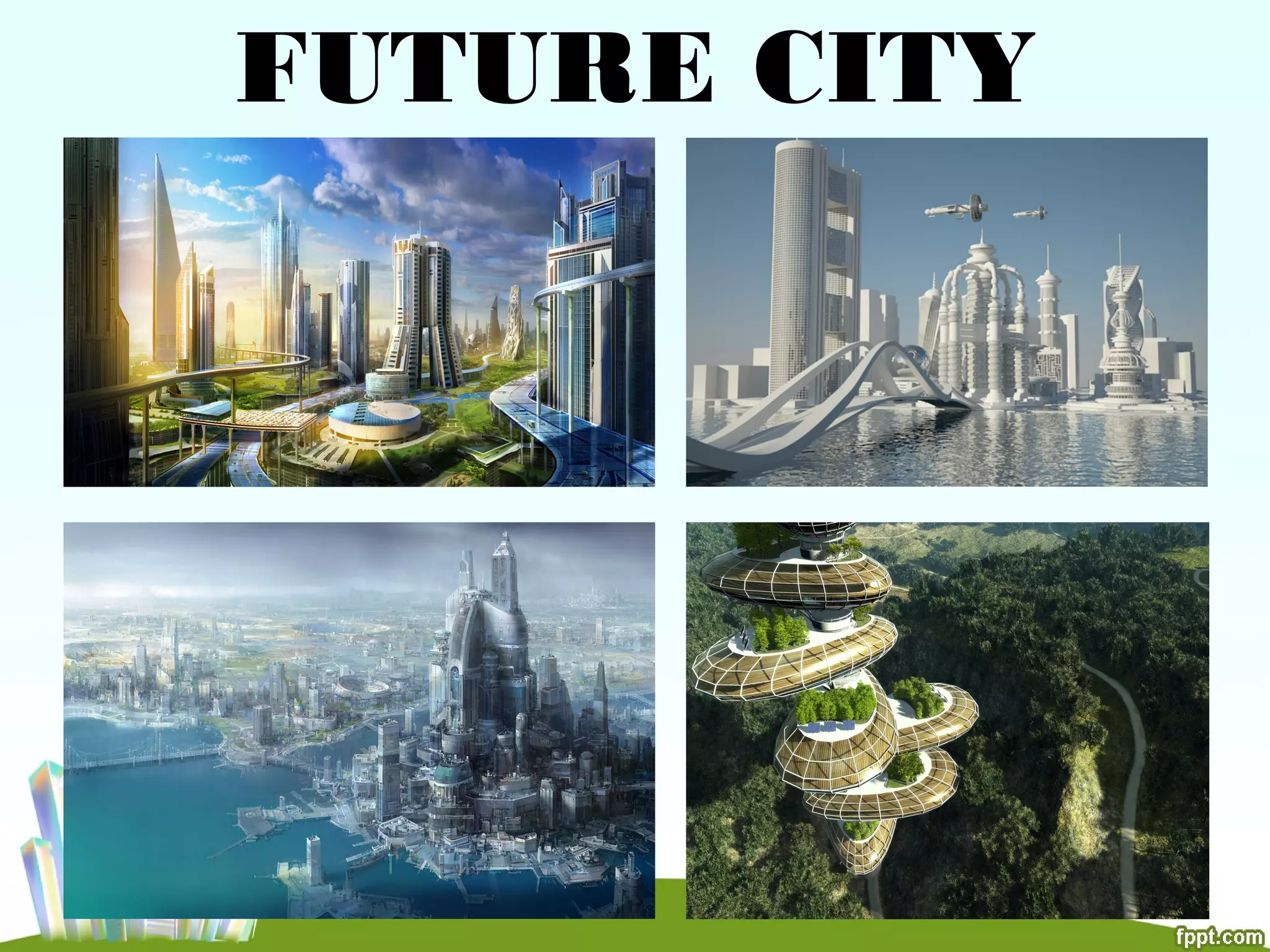
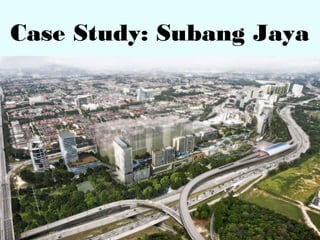
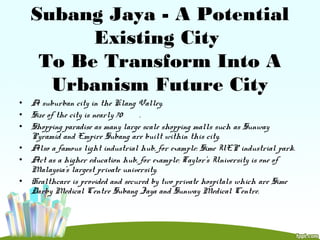
FUTURE CITY
Case Study: Subang Jaya
Subang Jaya - A Potential
Existing City
To Be Transform Into A
Urbanism Future City
• A suburban city in the Klang Valley.
• Size of the city is nearly 70 .
• Shopping paradise as many large scale shopping malls such as Sunway
Pyramid and Empire Subang are built within this city.
• Also a famous light industrial hub, for example: Sime UEP industrial park.
• Act as a higher education hub, for example: Taylor's University is one of
Malaysia's largest private university.
• Healthcare is provided and secured by two private hospitals which are Sime
Darby Medical Centre Subang Jaya and Sunway Medical Centre.
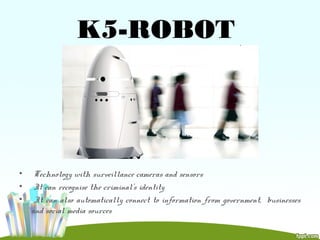
• Technology with surveillance cameras and sensors
• It can recognise the criminal’s identity
• It can also automatically connect to information from government, businesses
and social media sources
K5-ROBOT
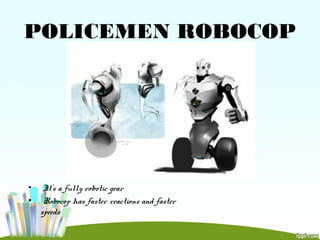
POLICEMEN ROBOCOP
• It’s a fully robotic gear
• Robocop has faster reactions and faster
speeds
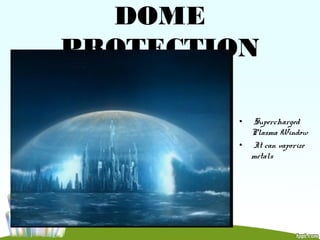
DOME
PROTECTION
• Supercharged
Plasma Window
• It can vaporize
metals
WATER AND WASTE
MANAGEMENT
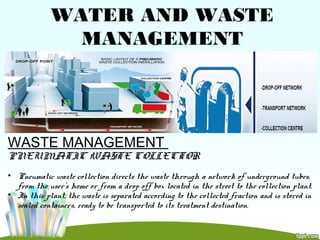
WASTE MANAGEMENT
PNEUMATIC WASTE COLLECTOR
• Pneumatic waste collection directs the waste through a network of underground tubes,
from the user’s home or from a drop off box located in the street to the collection plant.
• In this plant, the waste is separated according to the collected fraction and is stored in
sealed containers, ready to be transported to its treatment destination.
HOW IT
WORKS? Users of the pneumatic waste collection system deposit their refuse into waste inlets, located
aroundthe chosen operating area. Waste collection points are placed outdoors or indoors and are
accessible 24 hours a day. There is one waste inlet for each type of refuse (which will typically be
divided into mixed waste, organic waste and paper waste). The refuse is temporarily stored by the
waste inlets until the next emptying cycle.
 The refuse is then transported along the pipelines into containers at the waste station. When full,
the containers are sent away for further processing using, for example, the city’s existing
underground railway network.
 The system is remotely monitored and controlled by operators at the waste station. In addition, some
staff are needed to handle the system maintenance when required. No personnel are needed in the
actual collection and transport of waste from the collection point to the waste station.
 Typical application areas for pneumatic collection systems include large metropolitan and residential
areas, high-rise buildings, public spaces, healthcare facilities, and hotel and office complexes.
WASTE STATION
 Basically, the waste station is located as far as 2 km from the waste collection points. The entire
network can be monitored and controlled by the waste station operators. At least one container is
required for each waste type. It is also possible to connect the waste station to the existing public
transportation rail network.
WATER MANAGEMENT
GREY WATER
SYSTEM
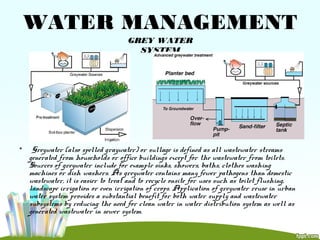
• Greywater (also spelled graywater) or sullage is defined as all wastewater streams
generated from households or office buildings except for the wastewater from toilets.
Sources of greywater include for example sinks, showers, baths, clothes washing
machines or dish washers. As greywater contains many fewer pathogens than domestic
wastewater, it is easier to treat and to recycle onsite for uses such as toilet flushing,
landscape irrigation or even irrigation of crops. Application of greywater reuse in urban
water system provides a substantial benefit for both water supply and wastewater
subsystems by reducing the need for clean water in water distribution system as well as
generated wastewater in sewer system.
HOW GREY WATER
SYSTEM WORKS ?
•Greywater is water from basins, baths and showers that is piped to a surge tank. The
greywater is held briefly in the tank before being discharged to an irrigation or treatment
system.
•The greywater can be diverted either by gravity or by using a pump.
•The surge tank can be any type of container that is suitable for holding (but not storing)
the initial surge of water. The surge tank must be emptied completely each time greywater is
dispersed to the irrigation or treatment system – greywater must not sit for extended periods
of time in the tank.
•A gravity system can only be used when there is sufficient fall from the
laundry/bathroom drain to the surge tank.
TOURISM AND
HOSPITALITY
First
impression
s
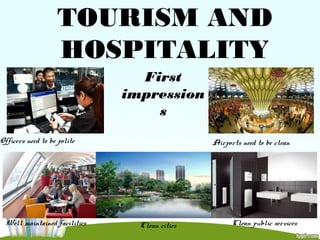
Officers need to be polite Airports need to be clean
Well maintained facilities Clean cities Clean public services
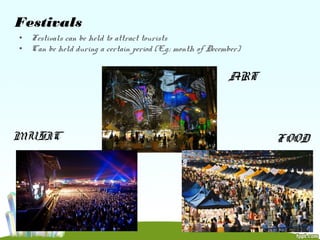
Festivals
• Festivals can be held to attract tourists
• Can be held during a certain period (E.g.: month of December)
ART
MUSIC FOOD
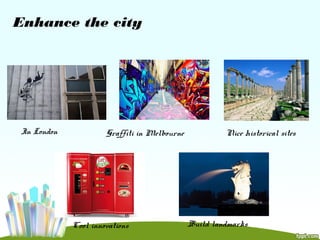
Enhance the city
In London Graffiti in Melbourne Nice historical sites
Cool innovations Build landmarks
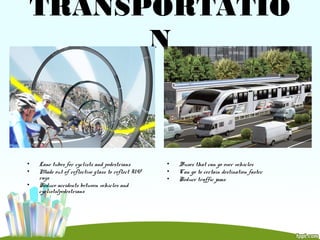
TRANSPORTATIO
N
• Lane tubes for cyclists and pedestrians
• Made out of reflective glass to reflect UV
rays
• Reduce accidents between vehicles and
cyclists/pedestrians
• Buses that can go over vehicles
• Can go to certain destination faster
• Reduce traffic jams
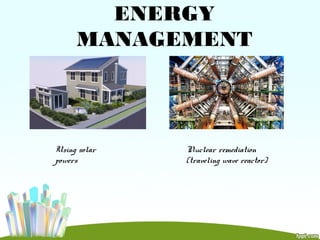
ENERGY
MANAGEMENT
Using solar
powers
Nuclear remediation
(traveling wave reactor)
DISASTER RELIEF
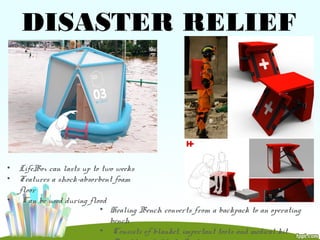
• LifeBox can lasts up to two weeks
• Features a shock-absorbent foam
floor
• Can be used during flood
• Healing Bench converts from a backpack to an operating
bench
• Consists of blanket, important tools and medical kit
What is Green
Building?
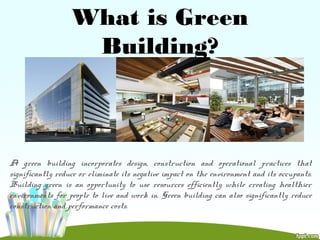
A green building incorporates design, construction and operational practices that
significantly reduce or eliminate its negative impact on the environment and its occupants.
Building green is an opportunity to use resources efficiently while creating healthier
environments for people to live and work in. Green building can also significantly reduce
construction and performance costs.
Why Build Green?
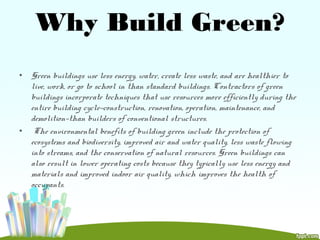
• Green buildings use less energy, water, create less waste, and are healthier to
live, work, or go to school in than standard buildings. Contractors of green
buildings incorporate techniques that use resources more efficiently during the
entire building cycle—construction, renovation, operation, maintenance, and
demolition—than builders of conventional structures.
• The environmental benefits of building green include the protection of
ecosystems and biodiversity, improved air and water quality, less waste flowing
into streams, and the conservation of natural resources. Green buildings can
also result in lower operating costs because they typically use less energy and
materials and improved indoor air quality, which improves the health of
occupants.
How to build Green?
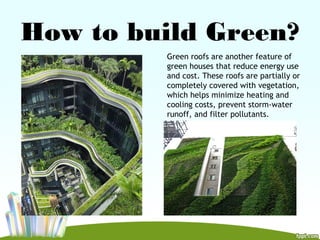
Green roofs are another feature of
green houses that reduce energy use
and cost. These roofs are partially or
completely covered with vegetation,
which helps minimize heating and
cooling costs, prevent storm-water
runoff, and filter pollutants.
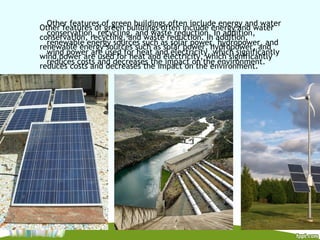
Other features of green buildings often include energy and water
conservation, recycling, and waste reduction. In addition,
renewable energy sources such as solar power, hydropower, and
wind power are used for heat and electricity, which significantly
reduces costs and decreases the impact on the environment.
Other features of green buildings often include energy and water
conservation, recycling, and waste reduction. In addition,
renewable energy sources such as solar power, hydropower, and
wind power are used for heat and electricity, which significantly
reduces costs and decreases the impact on the environment.
High-Tech City = Future
City
LOVE + High- Technology
= Future City
City without love is not a future city
that we want.
City without high- technology does not
fulfill the requirement to be a future
city.

English Assignment 2 (Oral Presentation)

  • 1.
  • 2.
  • 3.
    Subang Jaya -A Potential Existing City To Be Transform Into A Urbanism Future City • A suburban city in the Klang Valley. • Size of the city is nearly 70 . • Shopping paradise as many large scale shopping malls such as Sunway Pyramid and Empire Subang are built within this city. • Also a famous light industrial hub, for example: Sime UEP industrial park. • Act as a higher education hub, for example: Taylor's University is one of Malaysia's largest private university. • Healthcare is provided and secured by two private hospitals which are Sime Darby Medical Centre Subang Jaya and Sunway Medical Centre.
  • 4.
    • Technology withsurveillance cameras and sensors • It can recognise the criminal’s identity • It can also automatically connect to information from government, businesses and social media sources K5-ROBOT
  • 5.
    POLICEMEN ROBOCOP • It’sa fully robotic gear • Robocop has faster reactions and faster speeds
  • 6.
  • 7.
    WATER AND WASTE MANAGEMENT WASTEMANAGEMENT PNEUMATIC WASTE COLLECTOR • Pneumatic waste collection directs the waste through a network of underground tubes, from the user’s home or from a drop off box located in the street to the collection plant. • In this plant, the waste is separated according to the collected fraction and is stored in sealed containers, ready to be transported to its treatment destination.
  • 8.
    HOW IT WORKS? Usersof the pneumatic waste collection system deposit their refuse into waste inlets, located aroundthe chosen operating area. Waste collection points are placed outdoors or indoors and are accessible 24 hours a day. There is one waste inlet for each type of refuse (which will typically be divided into mixed waste, organic waste and paper waste). The refuse is temporarily stored by the waste inlets until the next emptying cycle.  The refuse is then transported along the pipelines into containers at the waste station. When full, the containers are sent away for further processing using, for example, the city’s existing underground railway network.  The system is remotely monitored and controlled by operators at the waste station. In addition, some staff are needed to handle the system maintenance when required. No personnel are needed in the actual collection and transport of waste from the collection point to the waste station.  Typical application areas for pneumatic collection systems include large metropolitan and residential areas, high-rise buildings, public spaces, healthcare facilities, and hotel and office complexes. WASTE STATION  Basically, the waste station is located as far as 2 km from the waste collection points. The entire network can be monitored and controlled by the waste station operators. At least one container is required for each waste type. It is also possible to connect the waste station to the existing public transportation rail network.
  • 9.
    WATER MANAGEMENT GREY WATER SYSTEM •Greywater (also spelled graywater) or sullage is defined as all wastewater streams generated from households or office buildings except for the wastewater from toilets. Sources of greywater include for example sinks, showers, baths, clothes washing machines or dish washers. As greywater contains many fewer pathogens than domestic wastewater, it is easier to treat and to recycle onsite for uses such as toilet flushing, landscape irrigation or even irrigation of crops. Application of greywater reuse in urban water system provides a substantial benefit for both water supply and wastewater subsystems by reducing the need for clean water in water distribution system as well as generated wastewater in sewer system.
  • 10.
    HOW GREY WATER SYSTEMWORKS ? •Greywater is water from basins, baths and showers that is piped to a surge tank. The greywater is held briefly in the tank before being discharged to an irrigation or treatment system. •The greywater can be diverted either by gravity or by using a pump. •The surge tank can be any type of container that is suitable for holding (but not storing) the initial surge of water. The surge tank must be emptied completely each time greywater is dispersed to the irrigation or treatment system – greywater must not sit for extended periods of time in the tank. •A gravity system can only be used when there is sufficient fall from the laundry/bathroom drain to the surge tank.
  • 11.
    TOURISM AND HOSPITALITY First impression s Officers needto be polite Airports need to be clean Well maintained facilities Clean cities Clean public services
  • 12.
    Festivals • Festivals canbe held to attract tourists • Can be held during a certain period (E.g.: month of December) ART MUSIC FOOD
  • 13.
    Enhance the city InLondon Graffiti in Melbourne Nice historical sites Cool innovations Build landmarks
  • 14.
    TRANSPORTATIO N • Lane tubesfor cyclists and pedestrians • Made out of reflective glass to reflect UV rays • Reduce accidents between vehicles and cyclists/pedestrians • Buses that can go over vehicles • Can go to certain destination faster • Reduce traffic jams
  • 15.
  • 16.
    DISASTER RELIEF • LifeBoxcan lasts up to two weeks • Features a shock-absorbent foam floor • Can be used during flood • Healing Bench converts from a backpack to an operating bench • Consists of blanket, important tools and medical kit
  • 17.
    What is Green Building? Agreen building incorporates design, construction and operational practices that significantly reduce or eliminate its negative impact on the environment and its occupants. Building green is an opportunity to use resources efficiently while creating healthier environments for people to live and work in. Green building can also significantly reduce construction and performance costs.
  • 18.
    Why Build Green? •Green buildings use less energy, water, create less waste, and are healthier to live, work, or go to school in than standard buildings. Contractors of green buildings incorporate techniques that use resources more efficiently during the entire building cycle—construction, renovation, operation, maintenance, and demolition—than builders of conventional structures. • The environmental benefits of building green include the protection of ecosystems and biodiversity, improved air and water quality, less waste flowing into streams, and the conservation of natural resources. Green buildings can also result in lower operating costs because they typically use less energy and materials and improved indoor air quality, which improves the health of occupants.
  • 19.
    How to buildGreen? Green roofs are another feature of green houses that reduce energy use and cost. These roofs are partially or completely covered with vegetation, which helps minimize heating and cooling costs, prevent storm-water runoff, and filter pollutants.
  • 20.
    Other features ofgreen buildings often include energy and water conservation, recycling, and waste reduction. In addition, renewable energy sources such as solar power, hydropower, and wind power are used for heat and electricity, which significantly reduces costs and decreases the impact on the environment. Other features of green buildings often include energy and water conservation, recycling, and waste reduction. In addition, renewable energy sources such as solar power, hydropower, and wind power are used for heat and electricity, which significantly reduces costs and decreases the impact on the environment.
  • 21.
    High-Tech City =Future City LOVE + High- Technology = Future City City without love is not a future city that we want. City without high- technology does not fulfill the requirement to be a future city.