
GREEN CHEMISTRY
PRESENTED BY:
FAZIL T S
15 ICM 20
1
Highlights of presentation
1
• introduction
2
• Green Chemistry and Sustainability
3
• 12 Principles of Green Chemistry
4
• Conclusions
2
GREEN CHEMISTRY
• Green chemistry, also called sustainable chemistry,
is an area of chemistry and chemical engineering
focused on the designing of products and processes
that minimize the use and generation of hazardous
substances.
• Green chemistry focuses on technological
approaches to preventing pollution and reducing
consumption of non-renewable resources.
3
Green Chemistry and
Sustainability
 Sustainability: Meeting the needs of the present
generation without compromising the needs of
future generations.
• Making chemicals safe for our health & environment,
• Using industrial processes that reduce or eliminate
hazardous chemicals, &
• Designing more efficient processes that minimize waste
4
12 Principles of Green Chemistry
• In 1998, Paul Anastas (who then
directed the Green Chemistry Program
at the US EPA) and John C. Warner
published a set of principles to guide the
practice of green chemistry
5
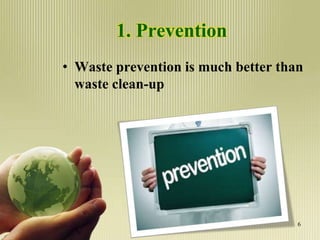
1. Prevention
• Waste prevention is much better than
waste clean-up
6
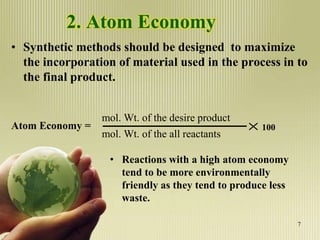
2. Atom Economy
• Synthetic methods should be designed to maximize
the incorporation of material used in the process in to
the final product.
Atom Economy =
mol. Wt. of the desire product
mol. Wt. of the all reactants
100
• Reactions with a high atom economy
tend to be more environmentally
friendly as they tend to produce less
waste.
7
3. Less Hazardous Chemical
Synthesis
• The use or generation of substances
that pose hazards to humans and the
environment should be avoided.
 Example: Firefighting foam that
contains hydrocarbon surfactants,
water, solvent, complex carbohydrates
and a corrosion inhibitor .
 Eliminated the use of fluorinated
surfactants.
8
4. Designing Safer Chemicals
• Chemical products should be as effective
as possible for their designated purpose
but with minimum toxicity.
 Example: In the manufacturing process of
Polystyrene, CFC’s which contribute to
the ozone depletion replaced by CO₂
9
5. Safer Solvents and Auxiliaries
• The use of auxiliary substances (e.g. solvents,
separation agents, etc.) should be made
unnecessary wherever possible and innocuous
when used.
( the major problem with many solvents is their volatility
that may damage environment and human health )
 Example : To avoid this many
reactions are carried out in safer green
solvents like ionic liquids, Supercritical
CO₂ fluid etc. which are non-volatile.
10
6. Design for Energy Efficiency
• Energy requirements should be
recognized for their environmental
and economic impacts and should be
minimized.
 Example: if the final product is impure it has to
be purified by distillation or recrystallization
these steps requires energy which is
uneconomical.
11
7. Use of Renewable Feedstocks
• Feedstock or raw material should be
renewable rather than depleting
wherever technically and economically
practicable.
 Example: Ethene from bioethanol,
which is used to make poly(ethene) and
methane gas are considered as
renewable starting materials.
12
8. Reduce Derivatives
• Unnecessary derivatization (blocking
group, protection/deprotection)
should be avoided whenever possible.
• Adopt selective and better alternative
synthetic sequences.
13
9. Catalysis
• Catalytic reagents (as selective as possible)
are superior to stoichiometric reagents.
 Example: Activate H₂O₂ for chlorine-free
wood pulp bleaching.
14
10. Design for Degradation
• Chemical products should be designed so
that at the end of their function they do not
persist in the environment and break down
into innocuous degradation products.
 Example: Bio degradable polymers
 Polypropylene carbonate (PPC) is a
common example for Bio degradable
polymers
15
11. Real-time Analysis for Pollution
Prevention
• successful practice of green chemistry
requires real-time, in-process monitoring
techniques coupled with process control.
16
 Example: when coal is burnt in industrial
boilers, SO₂ (a pollutant) is formed.
If the temperature of the boilers is too
high , a large amount of SO₂ generated
can be measured all the time.
Once it reaches an unacceptable level, an
alarming signal will be generated.
Then the temperature will be lowered
immediately
17
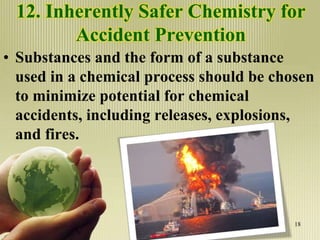
12. Inherently Safer Chemistry for
Accident Prevention
• Substances and the form of a substance
used in a chemical process should be chosen
to minimize potential for chemical
accidents, including releases, explosions,
and fires.
18
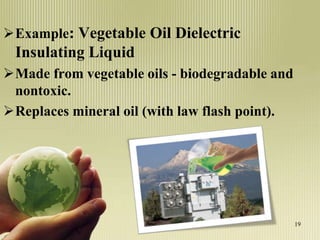
Example: Vegetable Oil Dielectric
Insulating Liquid
Made from vegetable oils - biodegradable and
nontoxic.
Replaces mineral oil (with law flash point).
19
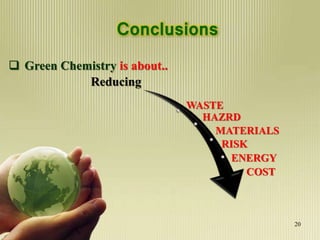
Conclusions
 Green Chemistry is about..
Reducing
WASTE
MATERIALS
HAZRD
RISK
ENERGY
COST
20
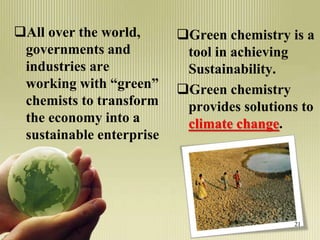
All over the world,
governments and
industries are
working with “green”
chemists to transform
the economy into a
sustainable enterprise
Green chemistry is a
tool in achieving
Sustainability.
Green chemistry
provides solutions to
climate change.
21
REFERANCE
 http://www.epa.gov/greenchemistry/
 http://www.epa.gov/greenchemistry/pubs/educat.html
 http://www.epa.gov/greenchemistry/
 http://www.epa.gov/greenchemistry/pubs/principles.html
 http://en.wikipedia.org/wiki/Green_chemistry
 http://portal.acs.org/portal/acs/corg/content?_nfpb=true&_pageLabel=PP_TRANSITIONMAIN&n
ode_id=830&use_sec=false&sec_url_var=region1&__uuid=76247a16-94d0-458e-9092-10de1c35f2c6
 http://books.google.com/books?id=ZMjkTMwO3NkC&dq=green+chemistry&printsec=frontcover
&source=bl&ots=ZdGD63CxOJ&sig=vM94PxekSEhIX3a9yFOPpDAOXGo&hl=en&ei=mD9RSqS
oDqDMjAfJg4mfBQ&sa=X&oi=book_result&ct=result&resnum=8
 http://books.google.com/books?id=ZMjkTMwO3NkC&dq=green+chemistry&printsec=frontcover
&source=bl&ots=ZdGD63CxOJ&sig=vM94PxekSEhIX3a9yFOPpDAOXGo&hl=en&ei=mD9RSqS
oDqDMjAfJg4mfBQ&sa=X&oi=book_result&ct=result&resnum=8
22
23

green chemistry

  • 1.
  • 2.
    Highlights of presentation 1 •introduction 2 • Green Chemistry and Sustainability 3 • 12 Principles of Green Chemistry 4 • Conclusions 2
  • 3.
    GREEN CHEMISTRY • Greenchemistry, also called sustainable chemistry, is an area of chemistry and chemical engineering focused on the designing of products and processes that minimize the use and generation of hazardous substances. • Green chemistry focuses on technological approaches to preventing pollution and reducing consumption of non-renewable resources. 3
  • 4.
    Green Chemistry and Sustainability Sustainability: Meeting the needs of the present generation without compromising the needs of future generations. • Making chemicals safe for our health & environment, • Using industrial processes that reduce or eliminate hazardous chemicals, & • Designing more efficient processes that minimize waste 4
  • 5.
    12 Principles ofGreen Chemistry • In 1998, Paul Anastas (who then directed the Green Chemistry Program at the US EPA) and John C. Warner published a set of principles to guide the practice of green chemistry 5
  • 6.
    1. Prevention • Wasteprevention is much better than waste clean-up 6
  • 7.
    2. Atom Economy •Synthetic methods should be designed to maximize the incorporation of material used in the process in to the final product. Atom Economy = mol. Wt. of the desire product mol. Wt. of the all reactants 100 • Reactions with a high atom economy tend to be more environmentally friendly as they tend to produce less waste. 7
  • 8.
    3. Less HazardousChemical Synthesis • The use or generation of substances that pose hazards to humans and the environment should be avoided.  Example: Firefighting foam that contains hydrocarbon surfactants, water, solvent, complex carbohydrates and a corrosion inhibitor .  Eliminated the use of fluorinated surfactants. 8
  • 9.
    4. Designing SaferChemicals • Chemical products should be as effective as possible for their designated purpose but with minimum toxicity.  Example: In the manufacturing process of Polystyrene, CFC’s which contribute to the ozone depletion replaced by CO₂ 9
  • 10.
    5. Safer Solventsand Auxiliaries • The use of auxiliary substances (e.g. solvents, separation agents, etc.) should be made unnecessary wherever possible and innocuous when used. ( the major problem with many solvents is their volatility that may damage environment and human health )  Example : To avoid this many reactions are carried out in safer green solvents like ionic liquids, Supercritical CO₂ fluid etc. which are non-volatile. 10
  • 11.
    6. Design forEnergy Efficiency • Energy requirements should be recognized for their environmental and economic impacts and should be minimized.  Example: if the final product is impure it has to be purified by distillation or recrystallization these steps requires energy which is uneconomical. 11
  • 12.
    7. Use ofRenewable Feedstocks • Feedstock or raw material should be renewable rather than depleting wherever technically and economically practicable.  Example: Ethene from bioethanol, which is used to make poly(ethene) and methane gas are considered as renewable starting materials. 12
  • 13.
    8. Reduce Derivatives •Unnecessary derivatization (blocking group, protection/deprotection) should be avoided whenever possible. • Adopt selective and better alternative synthetic sequences. 13
  • 14.
    9. Catalysis • Catalyticreagents (as selective as possible) are superior to stoichiometric reagents.  Example: Activate H₂O₂ for chlorine-free wood pulp bleaching. 14
  • 15.
    10. Design forDegradation • Chemical products should be designed so that at the end of their function they do not persist in the environment and break down into innocuous degradation products.  Example: Bio degradable polymers  Polypropylene carbonate (PPC) is a common example for Bio degradable polymers 15
  • 16.
    11. Real-time Analysisfor Pollution Prevention • successful practice of green chemistry requires real-time, in-process monitoring techniques coupled with process control. 16
  • 17.
     Example: whencoal is burnt in industrial boilers, SO₂ (a pollutant) is formed. If the temperature of the boilers is too high , a large amount of SO₂ generated can be measured all the time. Once it reaches an unacceptable level, an alarming signal will be generated. Then the temperature will be lowered immediately 17
  • 18.
    12. Inherently SaferChemistry for Accident Prevention • Substances and the form of a substance used in a chemical process should be chosen to minimize potential for chemical accidents, including releases, explosions, and fires. 18
  • 19.
    Example: Vegetable OilDielectric Insulating Liquid Made from vegetable oils - biodegradable and nontoxic. Replaces mineral oil (with law flash point). 19
  • 20.
    Conclusions  Green Chemistryis about.. Reducing WASTE MATERIALS HAZRD RISK ENERGY COST 20
  • 21.
    All over theworld, governments and industries are working with “green” chemists to transform the economy into a sustainable enterprise Green chemistry is a tool in achieving Sustainability. Green chemistry provides solutions to climate change. 21
  • 22.
    REFERANCE  http://www.epa.gov/greenchemistry/  http://www.epa.gov/greenchemistry/pubs/educat.html http://www.epa.gov/greenchemistry/  http://www.epa.gov/greenchemistry/pubs/principles.html  http://en.wikipedia.org/wiki/Green_chemistry  http://portal.acs.org/portal/acs/corg/content?_nfpb=true&_pageLabel=PP_TRANSITIONMAIN&n ode_id=830&use_sec=false&sec_url_var=region1&__uuid=76247a16-94d0-458e-9092-10de1c35f2c6  http://books.google.com/books?id=ZMjkTMwO3NkC&dq=green+chemistry&printsec=frontcover &source=bl&ots=ZdGD63CxOJ&sig=vM94PxekSEhIX3a9yFOPpDAOXGo&hl=en&ei=mD9RSqS oDqDMjAfJg4mfBQ&sa=X&oi=book_result&ct=result&resnum=8  http://books.google.com/books?id=ZMjkTMwO3NkC&dq=green+chemistry&printsec=frontcover &source=bl&ots=ZdGD63CxOJ&sig=vM94PxekSEhIX3a9yFOPpDAOXGo&hl=en&ei=mD9RSqS oDqDMjAfJg4mfBQ&sa=X&oi=book_result&ct=result&resnum=8 22
  • 23.