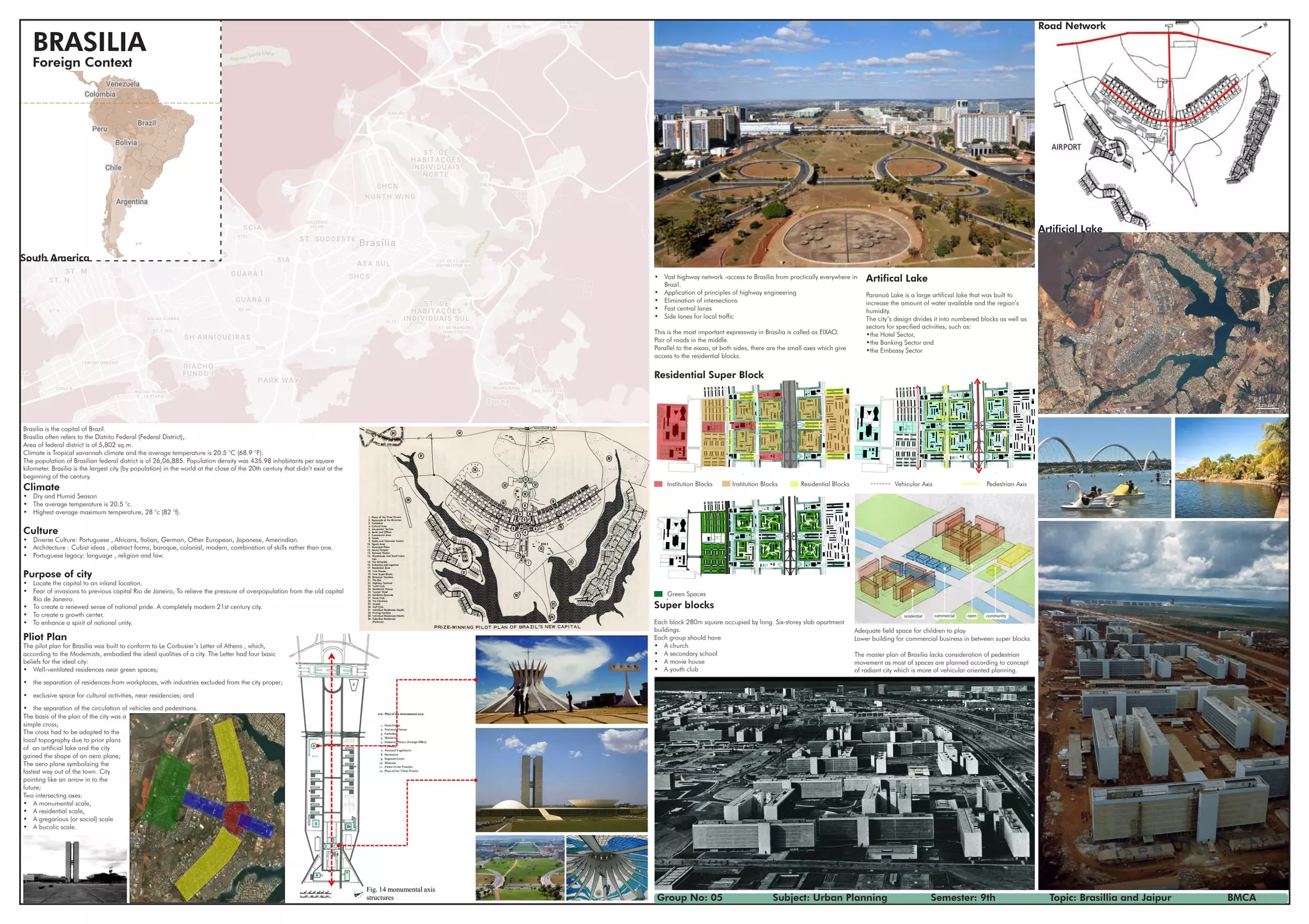
Brasilia is the capital of Brazil.
Brasília often refers to the Distrito Federal (Federal District),.
Area of federal district is of 5,802 sq.m.
Climate is Tropical savannah climate and the average temperature is 20.5 °C (68.9 °F).
The population of Brasilian federal district is of 26,06,885. Population density was 435.98 inhabitants per square
kilometer. Brasilia is the largest city (by population) in the world at the close of the 20th century that didn’t exist at the
beginning of the century.
Climate
•	 Dry and Humid Season
•	 The average temperature is 20.5 °c.
•	 Highest average maximum temperature, 28 °c (82 °f).
Culture
•	 Diverse Culture: Portuguese , Africans, Italian, German, Other European, Japanese, Amerindian.
•	 Architecture : Cubist ideas , abstract forms, baroque, colonial, modern, combination of skills rather than one.
•	 Portuguese legacy: language , religion and law.
Purpose of city
•	 Locate the capital to an inland location.
•	 Fear of invasions to previous capital Rio de Janeiro, To relieve the pressure of overpopulation from the old capital
Rio de Janeiro.
•	 To create a renewed sense of national pride. A completely modern 21st century city.
•	 To create a growth center.
•	 To enhance a spirit of national unity.
The basis of the plan of the city was a
simple cross;
The cross had to be adapted to the
local topography due to prior plans
of an artificial lake and the city
gained the shape of an aero plane;
The aero plane symbolizing the
fastest way out of the town. City
pointing like an arrow in to the
future;
Two intersecting axes:
•	 A monumental scale, 	
•	 A residential scale, 		
•	 A gregarious (or social) scale
•	 A bucolic scale.
Pliot Plan
The pilot plan for Brasília was built to conform to Le Corbusier’s Letter of Athens , which,
according to the Modernists, embodied the ideal qualities of a city. The Letter had four basic
beliefs for the ideal city:
•	 Well-ventilated residences near green spaces;
•	 the separation of residences from workplaces, with industries excluded from the city proper;
•	 exclusive space for cultural activities, near residencies; and
•	 the separation of the circulation of vehicles and pedestrians.
Artifical Lake
Paranoá Lake is a large artificial lake that was built to
increase the amount of water available and the region’s
humidity.
The city’s design divides it into numbered blocks as well as
sectors for specified activities, such as:
•the Hotel Sector,
•the Banking Sector and
•the Embassy Sector
•	 Vast highway network -access to Brasília from practically everywhere in
Brazil.
•	 Application of principles of highway engineering
•	 Elimination of intersections
•	 Fast central lanes
•	 Side lanes for local traffic
This is the most important expressway in Brasilia is called as EIXAO.
Pair of roads in the middle.
Parallel to the eixao, at both sides, there are the small axes which give
access to the residential blocks.
BRASILIA
Foreign Context
South America
Road Network
Artificial Lake
Residential Super Block
Super blocks
Each block 280m square occupied by long. Six-storey slab apartment
buildings.
Each group should have
•	 A church
•	 A secondary school
•	 A movie house
•	 A youth club
Adequate field space for children to play
Lower building for commercial business in between super blocks.
The master plan of Brasilia lacks consideration of pedestrian
movement as most of spaces are planned according to concept
of radiant city which is more of vehicular oriented planning.
Institution Blocks
Green Spaces
Institution Blocks Residential Blocks Vehicular Axis Pedestrian Axis
Group No: 05			 Subject: Urban Planning 			 Semester: 9th			 Topic: Brasillia and Jaipur			 BMCA
India
Group No: 05			 Subject: Urban Planning 			 Semester: 9th			 Topic: Brasillia and Jaipur			 BMCA
JAIPUR
Indian Context
Location: 26.92n, 75.82e
Altitude: 431 m above msl
Area: 484.64 km2
Population: 3,046,189
Density: 6300/km sq
Jaipur city is Rajasthan’s capital and largest city.It is situated
in the eastern border of Thar desert.It is 258 kms from Delhi
and 232 kms from Agra, it forms a golden triangle to attract
tourists.Jaipur is the capital and the largest city of the Indian
state of Rajasthan.It was founded on 18 November 1727 by
Maharaja Sawai Jai Singh 2, the city has been named after
him.Jaipur is also known as pink city and Paris of India.
Population:While, the current population of Jaipur is
estimated to be around 80 Lacs, its population, according
to census of 2011, was 66,26,178.Its population growth
rate over the decade 2001-2011 was 26.91%.Jaipur has a
sex ratio of 909 females for every 1000 males and a literacy
rate of 76.44%.The district has a population density of 598
inhabitants per square kilometer.
Climate: Jaipur has a semi-arid type of climate.
Temperatures vary in different seasons.  May and June are
the hottest months in Jaipur. Temperature reaches up to 40-
45oC in these months. Annual rainfall is concentrated in the
monsoon months between June (Last of June) and September.
Reasons to change his capital from amber to jaipur (1727)
Military reasons
•	 Defence
•	 A site at the South of Amber ensured greater distance from Delhi.
•	 the out skirting hill ranges (Nahargarh hills)
•	 shaped as a horseshoe would allow the new city to expand only in the
South.
•	 It was an open plain bounded on the northwest and east by hills.
Geographical Reasons
•	 The rocky terrain of Amber restricted expansion.
•	 Jaipur had the potentialities of developing into a city with adequate
drinking water due to the presence of a perennial stream nearby.
•	 good drainage system.
•	 Its rugged hills also ensured a constant supply a of building material.
Conceptual Planning
•	 It is a model of town planning the first planned city in India. It is
based on Hindu systems of town planning and followed the principles
prescribed in the Shilpa-shastra, an ancient Indian treatise on
architecture .according to this shastra the site should be divided into
grids or mandalas ranging from 2x 2 to 10 x 10.
•	 Planned according to the Prastara type of layout, which gives
prominence to the cardinal directions.
•	 Thus plan of jaipur is a grid of 3x3 with gridlines being the city’s main
streets.
•	 The central axis of the town was laid from East to West between the gates of the Sun(Suraj pol) and the
moon(Chandpol) .
•	 This was crossed by two roads at right angles dividing the town into nine almost square, almost equally sized blocks,
which were further sub divided by lanes and alleys all at right angles.
•	 By building the western boundary of the city right up to the hill’s southern apex, it provided a continuous line of defense.
•	 The mandala could not be complete in the NW due to the presence of the hills.
•	 On the other hand in the SE an extra square has been added that plugged the gap between the city and the eastern
hills.
•	 South of the main road were four almost equal rectangles. The rectangle opposite the palace has been broken up into
two equal and smaller rectangles by the Chaura Rasta.Thus altogether there are now five rectangles on the south of the
main road called Chowkris.
•	 On the North of the main road from West to East are the Purani Basti, the Palace and Ramchandraji.
•	 The principal bazaar leads from the western gate in the city wall, The Chandpole, passing in front of the Tripolia Gate,
to the eastern city gate, the Surajpole.
Planning of Walled City

Brasilia & Jaipur Sheets

  • 1.
    Brasilia is thecapital of Brazil. Brasília often refers to the Distrito Federal (Federal District),. Area of federal district is of 5,802 sq.m. Climate is Tropical savannah climate and the average temperature is 20.5 °C (68.9 °F). The population of Brasilian federal district is of 26,06,885. Population density was 435.98 inhabitants per square kilometer. Brasilia is the largest city (by population) in the world at the close of the 20th century that didn’t exist at the beginning of the century. Climate • Dry and Humid Season • The average temperature is 20.5 °c. • Highest average maximum temperature, 28 °c (82 °f). Culture • Diverse Culture: Portuguese , Africans, Italian, German, Other European, Japanese, Amerindian. • Architecture : Cubist ideas , abstract forms, baroque, colonial, modern, combination of skills rather than one. • Portuguese legacy: language , religion and law. Purpose of city • Locate the capital to an inland location. • Fear of invasions to previous capital Rio de Janeiro, To relieve the pressure of overpopulation from the old capital Rio de Janeiro. • To create a renewed sense of national pride. A completely modern 21st century city. • To create a growth center. • To enhance a spirit of national unity. The basis of the plan of the city was a simple cross; The cross had to be adapted to the local topography due to prior plans of an artificial lake and the city gained the shape of an aero plane; The aero plane symbolizing the fastest way out of the town. City pointing like an arrow in to the future; Two intersecting axes: • A monumental scale, • A residential scale, • A gregarious (or social) scale • A bucolic scale. Pliot Plan The pilot plan for Brasília was built to conform to Le Corbusier’s Letter of Athens , which, according to the Modernists, embodied the ideal qualities of a city. The Letter had four basic beliefs for the ideal city: • Well-ventilated residences near green spaces; • the separation of residences from workplaces, with industries excluded from the city proper; • exclusive space for cultural activities, near residencies; and • the separation of the circulation of vehicles and pedestrians. Artifical Lake Paranoá Lake is a large artificial lake that was built to increase the amount of water available and the region’s humidity. The city’s design divides it into numbered blocks as well as sectors for specified activities, such as: •the Hotel Sector, •the Banking Sector and •the Embassy Sector • Vast highway network -access to Brasília from practically everywhere in Brazil. • Application of principles of highway engineering • Elimination of intersections • Fast central lanes • Side lanes for local traffic This is the most important expressway in Brasilia is called as EIXAO. Pair of roads in the middle. Parallel to the eixao, at both sides, there are the small axes which give access to the residential blocks. BRASILIA Foreign Context South America Road Network Artificial Lake Residential Super Block Super blocks Each block 280m square occupied by long. Six-storey slab apartment buildings. Each group should have • A church • A secondary school • A movie house • A youth club Adequate field space for children to play Lower building for commercial business in between super blocks. The master plan of Brasilia lacks consideration of pedestrian movement as most of spaces are planned according to concept of radiant city which is more of vehicular oriented planning. Institution Blocks Green Spaces Institution Blocks Residential Blocks Vehicular Axis Pedestrian Axis Group No: 05 Subject: Urban Planning Semester: 9th Topic: Brasillia and Jaipur BMCA
  • 2.
    India Group No: 05 Subject: Urban Planning Semester: 9th Topic: Brasillia and Jaipur BMCA JAIPUR Indian Context Location: 26.92n, 75.82e Altitude: 431 m above msl Area: 484.64 km2 Population: 3,046,189 Density: 6300/km sq Jaipur city is Rajasthan’s capital and largest city.It is situated in the eastern border of Thar desert.It is 258 kms from Delhi and 232 kms from Agra, it forms a golden triangle to attract tourists.Jaipur is the capital and the largest city of the Indian state of Rajasthan.It was founded on 18 November 1727 by Maharaja Sawai Jai Singh 2, the city has been named after him.Jaipur is also known as pink city and Paris of India. Population:While, the current population of Jaipur is estimated to be around 80 Lacs, its population, according to census of 2011, was 66,26,178.Its population growth rate over the decade 2001-2011 was 26.91%.Jaipur has a sex ratio of 909 females for every 1000 males and a literacy rate of 76.44%.The district has a population density of 598 inhabitants per square kilometer. Climate: Jaipur has a semi-arid type of climate. Temperatures vary in different seasons.  May and June are the hottest months in Jaipur. Temperature reaches up to 40- 45oC in these months. Annual rainfall is concentrated in the monsoon months between June (Last of June) and September. Reasons to change his capital from amber to jaipur (1727) Military reasons • Defence • A site at the South of Amber ensured greater distance from Delhi. • the out skirting hill ranges (Nahargarh hills) • shaped as a horseshoe would allow the new city to expand only in the South. • It was an open plain bounded on the northwest and east by hills. Geographical Reasons • The rocky terrain of Amber restricted expansion. • Jaipur had the potentialities of developing into a city with adequate drinking water due to the presence of a perennial stream nearby. • good drainage system. • Its rugged hills also ensured a constant supply a of building material. Conceptual Planning • It is a model of town planning the first planned city in India. It is based on Hindu systems of town planning and followed the principles prescribed in the Shilpa-shastra, an ancient Indian treatise on architecture .according to this shastra the site should be divided into grids or mandalas ranging from 2x 2 to 10 x 10. • Planned according to the Prastara type of layout, which gives prominence to the cardinal directions. • Thus plan of jaipur is a grid of 3x3 with gridlines being the city’s main streets. • The central axis of the town was laid from East to West between the gates of the Sun(Suraj pol) and the moon(Chandpol) . • This was crossed by two roads at right angles dividing the town into nine almost square, almost equally sized blocks, which were further sub divided by lanes and alleys all at right angles. • By building the western boundary of the city right up to the hill’s southern apex, it provided a continuous line of defense. • The mandala could not be complete in the NW due to the presence of the hills. • On the other hand in the SE an extra square has been added that plugged the gap between the city and the eastern hills. • South of the main road were four almost equal rectangles. The rectangle opposite the palace has been broken up into two equal and smaller rectangles by the Chaura Rasta.Thus altogether there are now five rectangles on the south of the main road called Chowkris. • On the North of the main road from West to East are the Purani Basti, the Palace and Ramchandraji. • The principal bazaar leads from the western gate in the city wall, The Chandpole, passing in front of the Tripolia Gate, to the eastern city gate, the Surajpole. Planning of Walled City