vINTRODUCTION: -
Indigenous people refer as the original inhabitants of a particular place. As
you know that after 16th century many European countries explore the world
and started to settle down in different parts of the worlds.
These new countries become the colonies of the European countries. This
process of colonisation affected the life of natives. They were displaced.
In this lesson we will read about how the European settlers affect the native
peoples of America and Australia.
HISTORY (XI)-THEME 10
DISPLACING INDIGENOUS PEOPLES
(NOTES)
__________________________________________________________
CHEROKEE TRIBES NATIVE AMERICIANS
vSOURCES
Oral History of natives.
Historical and fiction works written by natives.
Galleries and Museums of native art.
vEUROPEAN IMPERIALISM
Imperialism refers a political system in which rich and powerful countries extend their power by gaining economic and
political control over the territories and people of poor countries.
Initially Spain and Portugal established their colonies in America.
But after 17th centuries France, Holland and England become powerful and established their colonies in America, Africa and
Asia
vEUROPEAN IMPERIALISM
Imperialism refers a political system in which rich and powerful countries extend their power by gaining
economic and political control over the territories and people of poor countries.
Initially Spain and Portugal established their colonies in America.
But after 17th centuries France, Holland and England become powerful and established their colonies in
America, Africa and Asia
NORTH AMERICA
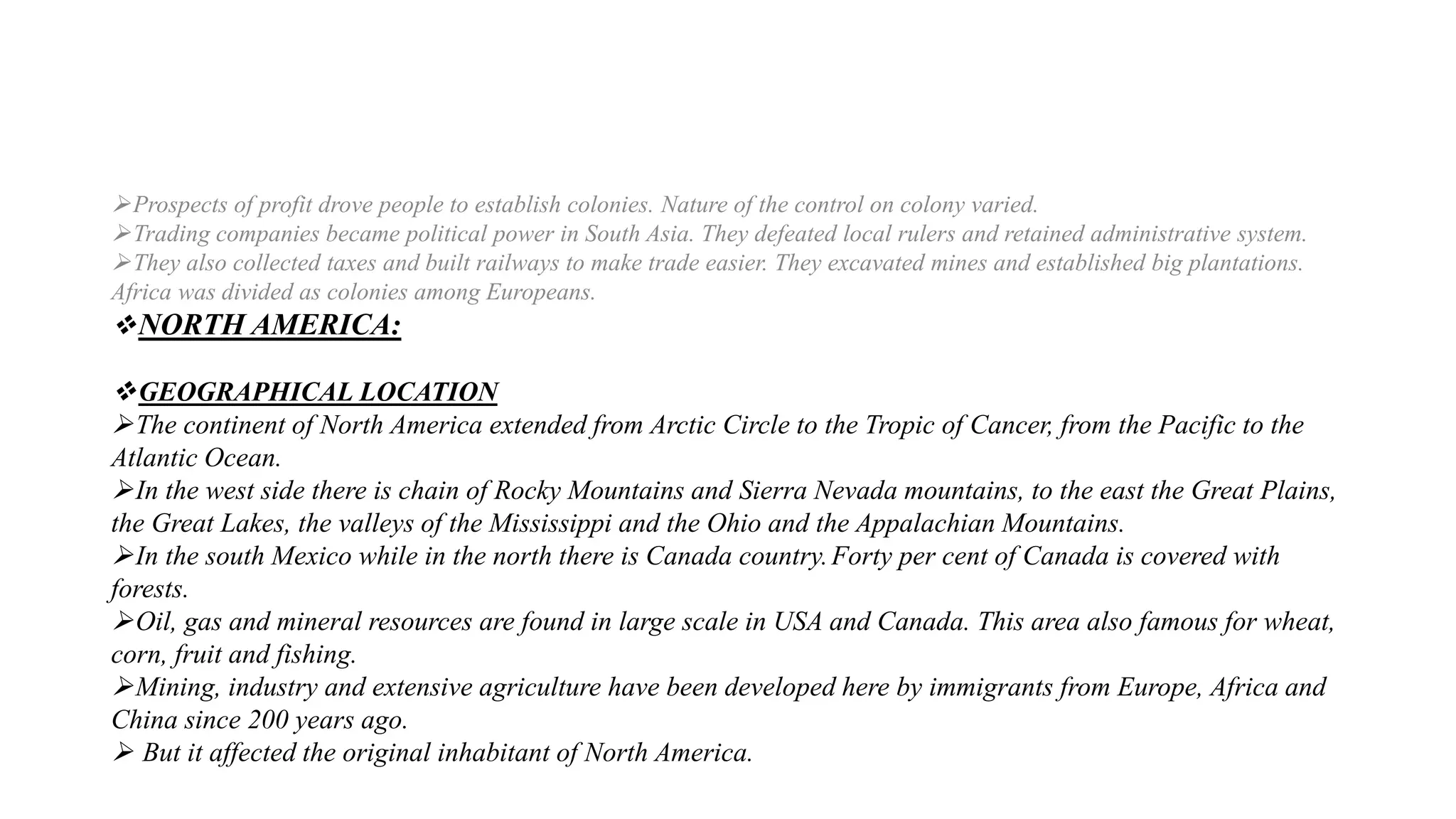
Prospects of profit drove people to establish
colonies. Nature of the control on colony
varied.
Trading companies became political power
in South Asia. They defeated local rulers and
retained administrative system.
They also collected taxes and built railways
to make trade easier. They excavated mines
and established big plantations. Africa was
divided as colonies among Europeans.
Prospects of profit drove people to establish colonies. Nature of the control on colony varied.
Trading companies became political power in South Asia. They defeated local rulers and retained administrative system.
They also collected taxes and built railways to make trade easier. They excavated mines and established big plantations.
Africa was divided as colonies among Europeans.
vNORTH AMERICA:
vGEOGRAPHICAL LOCATION
The continent of North America extended from Arctic Circle to the Tropic of Cancer, from the Pacific to the
Atlantic Ocean.
In the west side there is chain of Rocky Mountains and Sierra Nevada mountains, to the east the Great Plains,
the Great Lakes, the valleys of the Mississippi and the Ohio and the Appalachian Mountains.
In the south Mexico while in the north there is Canada country.Forty per cent of Canada is covered with
forests.
Oil, gas and mineral resources are found in large scale in USA and Canada. This area also famous for wheat,
corn, fruit and fishing.
Mining, industry and extensive agriculture have been developed here by immigrants from Europe, Africa and
China since 200 years ago.
 But it affected the original inhabitant of North America.
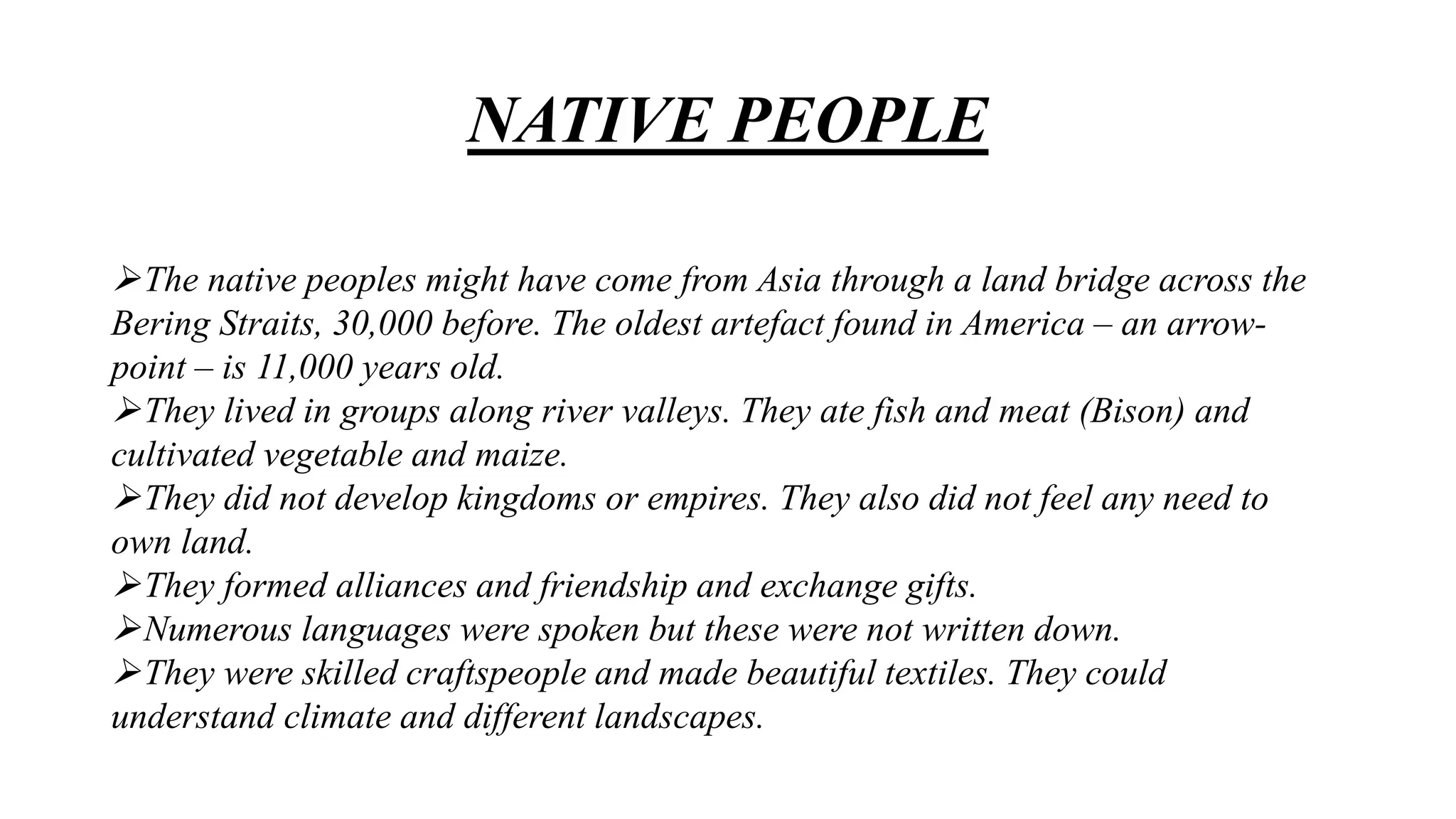
NATIVE PEOPLE
The native peoples might have come from Asia through a land bridge across the
Bering Straits, 30,000 before. The oldest artefact found in America – an arrow-
point – is 11,000 years old.
They lived in groups along river valleys. They ate fish and meat (Bison) and
cultivated vegetable and maize.
They did not develop kingdoms or empires. They also did not feel any need to
own land.
They formed alliances and friendship and exchange gifts.
Numerous languages were spoken but these were not written down.
They were skilled craftspeople and made beautiful textiles. They could
understand climate and different landscapes.
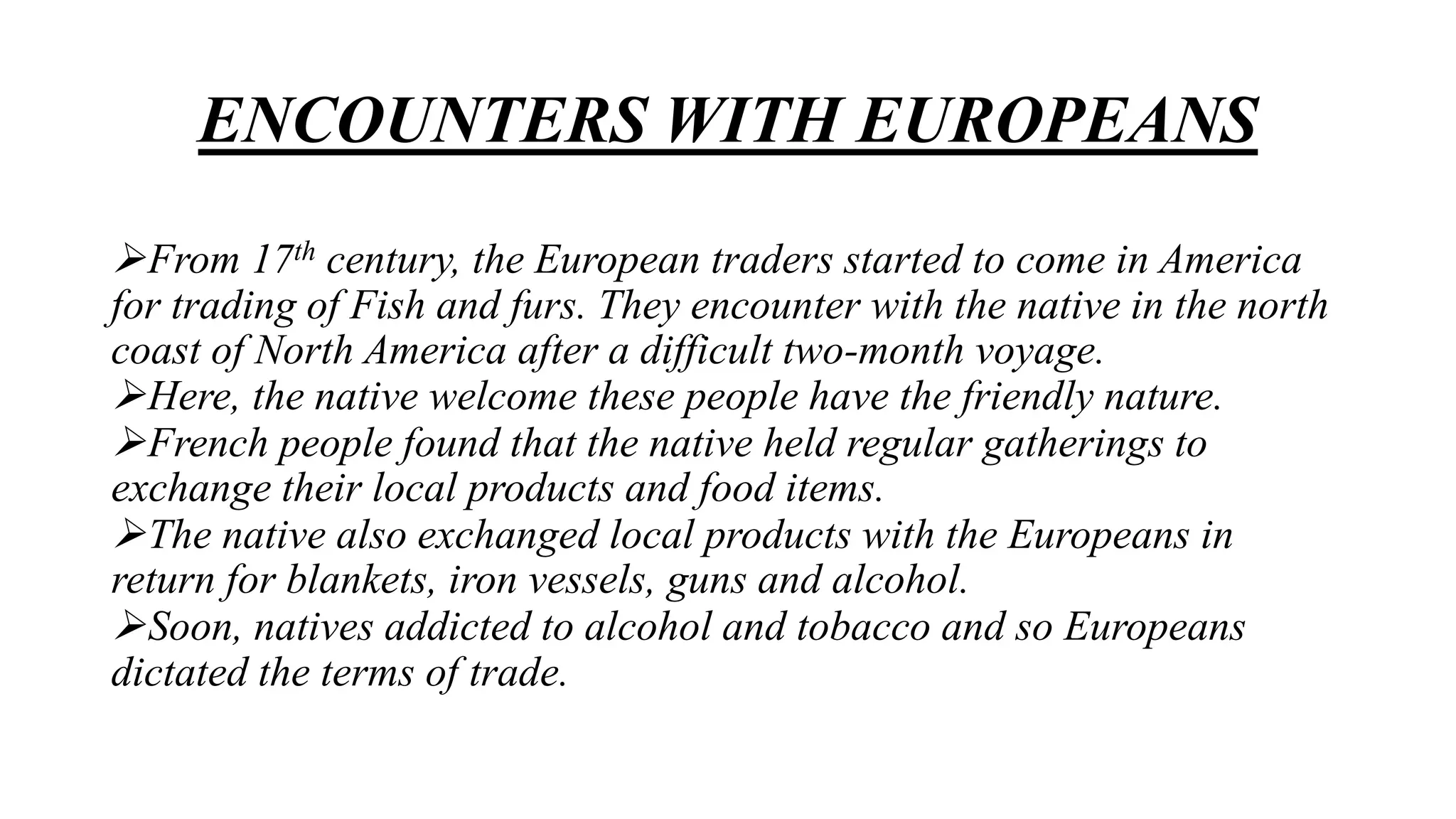
ENCOUNTERS WITH EUROPEANS
From 17th century, the European traders started to come in America
for trading of Fish and furs. They encounter with the native in the north
coast of North America after a difficult two-month voyage.
Here, the native welcome these people have the friendly nature.
French people found that the native held regular gatherings to
exchange their local products and food items.
The native also exchanged local products with the Europeans in
return for blankets, iron vessels, guns and alcohol.
Soon, natives addicted to alcohol and tobacco and so Europeans
dictated the terms of trade.
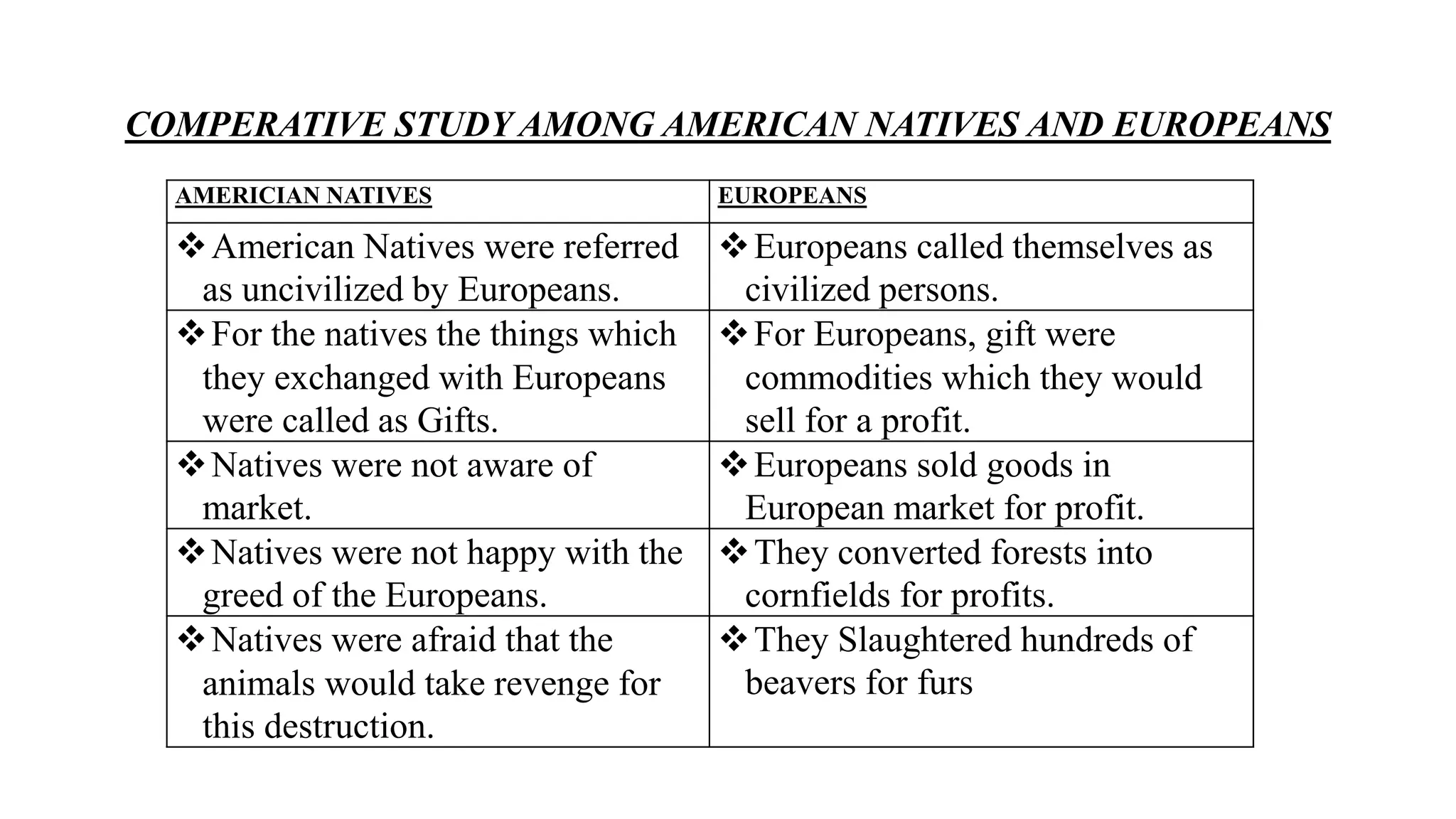
COMPERATIVE STUDY AMONG AMERICAN NATIVES AND EUROPEANS
AMERICIAN NATIVES EUROPEANS
vAmerican Natives were referred
as uncivilized by Europeans.
vEuropeans called themselves as
civilized persons.
vFor the natives the things which
they exchanged with Europeans
were called as Gifts.
vFor Europeans, gift were
commodities which they would
sell for a profit.
vNatives were not aware of
market.
vEuropeans sold goods in
European market for profit.
vNatives were not happy with the
greed of the Europeans.
vThey converted forests into
cornfields for profits.
vNatives were afraid that the
animals would take revenge for
this destruction.
vThey Slaughtered hundreds of
beavers for furs
EUROPEAN COME TO AMERICA
Initially the European traders came in America. But after that the
common people also come here in search of new opportunities because
of these reasons: -
People left Europe due to the religious riots occurred during that time.
Many younger sons could not inherit their fathers’property in Britain
and France therefore they come here in eager to own land in America.
Many people who lost their land to big farmers in many countries also
come here.
People also come here to get more profit by producing new crops
EXPENSION OF AMERICA
These new settlers occupied the vacant land and started to cut down
the forest to lay down farms.
Over the next hundred years they extended their control over more
territory by purchase or war to reach their present size.
Like Louisiana (1803) from France and Alaska (1867) from
Russia. Southern USA was won from Mexico in war.
SLAVERY SYSTEM
Europeans established many farms and plantation in large tracts of USA.
They faced the problem of shortage of labour, so they introduced the
slavery system. They purchase these slaves from Africa.
The northern states of the USA argued for ending slavery since they
condemned it as an inhuman practice.
Protests by anti-slavery groups led to a ban on slave trade. But the Africans
who were in the USA remained slaves as did their children.
In 1861-65, a civil war broke out in which the northern states won to
abolish slavery.
It was only in the 20th century that the African Americans won the battle of
civil liberties.
NATIVE PEOPLES OF NORTH AMERICA LOSE THEIR LAND
In the USA, the natives were forced to move by signing treaties or selling their lands.
They were cheated by taking more land or paying less. The natives were deprived of their land.
For example, Cherokee tribe in Georgia was governed by state laws but could not enjoy the rights of citizens.
The Judgment by the US Chief Justice, John Marshall said that the Cherokees were a distinct community, occupying its own
territory in which law of Georgia had no force.
Us President Andrew Jackson refused to accept the Chief Justice’s judgement. He ordered the US army to evict the
Cherokees from their land.
They were driven out to the Great American Desert. About 15,000 people were forced to move and over a quarter died
along the ‘Trail of Tears’.
Those who occupied the lands of the tribes called the natives as lazy, not skilled, not learning English or dressing properly.
They deserved to ‘die out’.
They were concentrated into small areas called ‘reservations’. There were a series of rebellions from1865 to 1890.The US
army crushed all these revolts.
THE GOLD RUSH AND THE GROWTH OF INDUSTRIES
Traces of gold led to ‘Gold Rush’in 1840s in California.
A lot of Europeans hurried to America in the hope of making a quick
fortune.
The Gold Rush led to the building of railway lines across the
continent.
In North America industries developed to manufacture railway
equipment.
In order to make large scale farming machinery produced.
Industrial development led to the growth of towns and factories.
By 1890 the USA emerged as a leading industrial power in the world.

DISPLACING INDIGENOUS PEOPLES.pptx

  • 1.
    vINTRODUCTION: - Indigenous peoplerefer as the original inhabitants of a particular place. As you know that after 16th century many European countries explore the world and started to settle down in different parts of the worlds. These new countries become the colonies of the European countries. This process of colonisation affected the life of natives. They were displaced. In this lesson we will read about how the European settlers affect the native peoples of America and Australia. HISTORY (XI)-THEME 10 DISPLACING INDIGENOUS PEOPLES (NOTES) __________________________________________________________
  • 2.
  • 3.
    vSOURCES Oral History ofnatives. Historical and fiction works written by natives. Galleries and Museums of native art. vEUROPEAN IMPERIALISM Imperialism refers a political system in which rich and powerful countries extend their power by gaining economic and political control over the territories and people of poor countries. Initially Spain and Portugal established their colonies in America. But after 17th centuries France, Holland and England become powerful and established their colonies in America, Africa and Asia vEUROPEAN IMPERIALISM Imperialism refers a political system in which rich and powerful countries extend their power by gaining economic and political control over the territories and people of poor countries. Initially Spain and Portugal established their colonies in America. But after 17th centuries France, Holland and England become powerful and established their colonies in America, Africa and Asia
  • 4.
    NORTH AMERICA Prospects ofprofit drove people to establish colonies. Nature of the control on colony varied. Trading companies became political power in South Asia. They defeated local rulers and retained administrative system. They also collected taxes and built railways to make trade easier. They excavated mines and established big plantations. Africa was divided as colonies among Europeans.
  • 5.
    Prospects of profitdrove people to establish colonies. Nature of the control on colony varied. Trading companies became political power in South Asia. They defeated local rulers and retained administrative system. They also collected taxes and built railways to make trade easier. They excavated mines and established big plantations. Africa was divided as colonies among Europeans. vNORTH AMERICA: vGEOGRAPHICAL LOCATION The continent of North America extended from Arctic Circle to the Tropic of Cancer, from the Pacific to the Atlantic Ocean. In the west side there is chain of Rocky Mountains and Sierra Nevada mountains, to the east the Great Plains, the Great Lakes, the valleys of the Mississippi and the Ohio and the Appalachian Mountains. In the south Mexico while in the north there is Canada country.Forty per cent of Canada is covered with forests. Oil, gas and mineral resources are found in large scale in USA and Canada. This area also famous for wheat, corn, fruit and fishing. Mining, industry and extensive agriculture have been developed here by immigrants from Europe, Africa and China since 200 years ago.  But it affected the original inhabitant of North America.
  • 6.
    NATIVE PEOPLE The nativepeoples might have come from Asia through a land bridge across the Bering Straits, 30,000 before. The oldest artefact found in America – an arrow- point – is 11,000 years old. They lived in groups along river valleys. They ate fish and meat (Bison) and cultivated vegetable and maize. They did not develop kingdoms or empires. They also did not feel any need to own land. They formed alliances and friendship and exchange gifts. Numerous languages were spoken but these were not written down. They were skilled craftspeople and made beautiful textiles. They could understand climate and different landscapes.
  • 7.
    ENCOUNTERS WITH EUROPEANS From17th century, the European traders started to come in America for trading of Fish and furs. They encounter with the native in the north coast of North America after a difficult two-month voyage. Here, the native welcome these people have the friendly nature. French people found that the native held regular gatherings to exchange their local products and food items. The native also exchanged local products with the Europeans in return for blankets, iron vessels, guns and alcohol. Soon, natives addicted to alcohol and tobacco and so Europeans dictated the terms of trade.
  • 8.
    COMPERATIVE STUDY AMONGAMERICAN NATIVES AND EUROPEANS AMERICIAN NATIVES EUROPEANS vAmerican Natives were referred as uncivilized by Europeans. vEuropeans called themselves as civilized persons. vFor the natives the things which they exchanged with Europeans were called as Gifts. vFor Europeans, gift were commodities which they would sell for a profit. vNatives were not aware of market. vEuropeans sold goods in European market for profit. vNatives were not happy with the greed of the Europeans. vThey converted forests into cornfields for profits. vNatives were afraid that the animals would take revenge for this destruction. vThey Slaughtered hundreds of beavers for furs
  • 9.
    EUROPEAN COME TOAMERICA Initially the European traders came in America. But after that the common people also come here in search of new opportunities because of these reasons: - People left Europe due to the religious riots occurred during that time. Many younger sons could not inherit their fathers’property in Britain and France therefore they come here in eager to own land in America. Many people who lost their land to big farmers in many countries also come here. People also come here to get more profit by producing new crops
  • 10.
    EXPENSION OF AMERICA Thesenew settlers occupied the vacant land and started to cut down the forest to lay down farms. Over the next hundred years they extended their control over more territory by purchase or war to reach their present size. Like Louisiana (1803) from France and Alaska (1867) from Russia. Southern USA was won from Mexico in war.
  • 11.
    SLAVERY SYSTEM Europeans establishedmany farms and plantation in large tracts of USA. They faced the problem of shortage of labour, so they introduced the slavery system. They purchase these slaves from Africa. The northern states of the USA argued for ending slavery since they condemned it as an inhuman practice. Protests by anti-slavery groups led to a ban on slave trade. But the Africans who were in the USA remained slaves as did their children. In 1861-65, a civil war broke out in which the northern states won to abolish slavery. It was only in the 20th century that the African Americans won the battle of civil liberties.
  • 12.
    NATIVE PEOPLES OFNORTH AMERICA LOSE THEIR LAND In the USA, the natives were forced to move by signing treaties or selling their lands. They were cheated by taking more land or paying less. The natives were deprived of their land. For example, Cherokee tribe in Georgia was governed by state laws but could not enjoy the rights of citizens. The Judgment by the US Chief Justice, John Marshall said that the Cherokees were a distinct community, occupying its own territory in which law of Georgia had no force. Us President Andrew Jackson refused to accept the Chief Justice’s judgement. He ordered the US army to evict the Cherokees from their land. They were driven out to the Great American Desert. About 15,000 people were forced to move and over a quarter died along the ‘Trail of Tears’. Those who occupied the lands of the tribes called the natives as lazy, not skilled, not learning English or dressing properly. They deserved to ‘die out’. They were concentrated into small areas called ‘reservations’. There were a series of rebellions from1865 to 1890.The US army crushed all these revolts.
  • 13.
    THE GOLD RUSHAND THE GROWTH OF INDUSTRIES Traces of gold led to ‘Gold Rush’in 1840s in California. A lot of Europeans hurried to America in the hope of making a quick fortune. The Gold Rush led to the building of railway lines across the continent. In North America industries developed to manufacture railway equipment. In order to make large scale farming machinery produced. Industrial development led to the growth of towns and factories. By 1890 the USA emerged as a leading industrial power in the world.