Getting Cattle Onto
Cover Crops
February 13th, 2018 – Adam Shea(Beef), Adam Bent(Cash Crop)
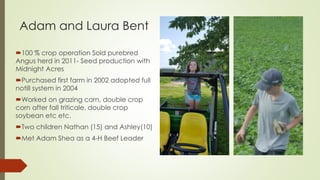
Adam and Laura Bent
100 % crop operation Sold purebred
Angus herd in 2011- Seed production with
Midnight Acres
Purchased first farm in 2002 adopted full
notill system in 2004
Worked on grazing corn, double crop
corn after fall triticale, double crop
soybean etc etc.
Two children Nathan (15) and Ashley(10)
Met Adam Shea as a 4-H Beef Leader
What is The Cash Cropper Looking
for???
What is The Cash
Cropper Looking for???
#1 Higher yield in overall cropping
system
#2 Reduce input costs for Fertilizer
and Herbicides
#3 Protect soil and water in a Long
Term Sustainable Manner
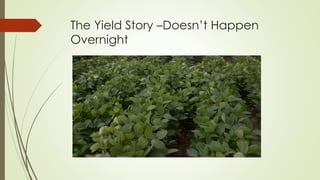
The Yield Story –Doesn’t Happen
Overnight
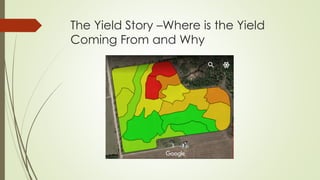
The Yield Story –Where is the Yield
Coming From and Why
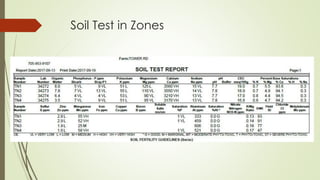
Soil Test in Zones
The Yield Story –Where is the Yield
Coming From and Why
The Good
The Bad
The Ugly
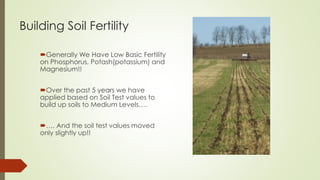
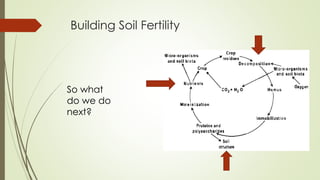
Building Soil Fertility
Generally We Have Low Basic Fertility
on Phosphorus, Potash(potassium) and
Magnesium!!
Over the past 5 years we have
applied based on Soil Test values to
build up soils to Medium Levels….
…. And the soil test values moved
only slightly up!!
Building Soil Fertility
So what
do we do
next?
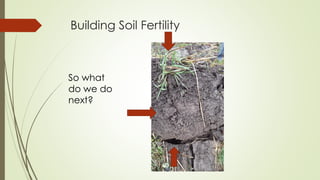
Building Soil Fertility
So what
do we do
next?
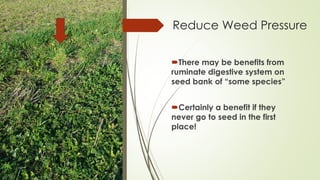
Reduce Weed Pressure
There may be benefits from
ruminate digestive system on
seed bank of “some species”
Certainly a benefit if they
never go to seed in the first
place!
Shealand Farms
 Cow-calf, sheep, and cash crop mixed farm
 Myself, my wife, mother, father, and uncle are all
involved. Marie and I focus on cow-calf beef and
sheep. 130 cows and 120 ewes, 2,000 acres
 We share equipment and labour.
 Our stored forage sources are mostly from Corn
Silage, some sort of ‘Oatledge’, and some dry
hay.
 We direct sell meat at 3 local farmer’s markets
and farm gate sales. 80% of our lamb, and 15% of
our beef production is sold through these
channels.
Why
grazing
cover
crops with
a cash
cropper?
Experience growing oats after winter wheat
and cut, baled, wrapped it for ‘oatledge’.
Limited land base on our own operation.
September to December weather is
generally good!
Swap stored feed costs for grazing costs or
reduce costs
What we did to
Adam’s field
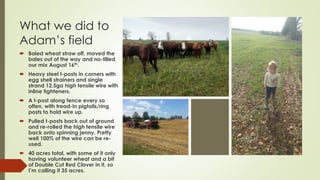
 Baled wheat straw off, moved the
bales out of the way and no-tilled
our mix August 16th.
 Heavy steel t-posts in corners with
egg shell strainers and single
strand 12.5ga high tensile wire with
inline tighteners.
 A t-post along fence every so
often, with tread-in pigtails/ring
posts to hold wire up.
 Pulled t-posts back out of ground
and re-rolled the high tensile wire
back onto spinning jenny. Pretty
well 100% of the wire can be re-
used.
 40 acres total, with some of it only
having volunteer wheat and a bit
of Double Cut Red Clover in it, so
I’m calling it 35 acres.
Grazing
Strategies
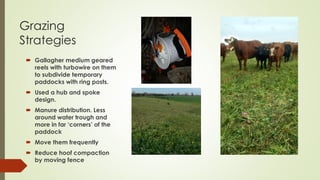
 Gallagher medium geared
reels with turbowire on them
to subdivide temporary
paddocks with ring posts.
 Used a hub and spoke
design.
 Manure distribution. Less
around water trough and
more in far ‘corners’ of the
paddock
 Move them frequently
 Reduce hoof compaction
by moving fence
Species Used
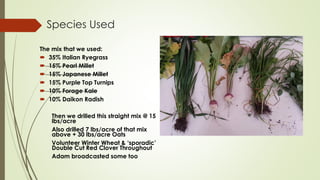
The mix that we used:
 35% Italian Ryegrass
 15% Pearl Millet
 15% Japanese Millet
 15% Purple Top Turnips
 10% Forage Kale
 10% Daikon Radish
Then we drilled this straight mix @ 15
lbs/acre
Also drilled 7 lbs/acre of that mix
above + 30 lbs/acre Oats
Volunteer Winter Wheat & ‘sporadic’
Double Cut Red Clover Throughout
Adam broadcasted some too
Costs of the cover crop seed
Here’s a mix that I would go with next year, and a rough
cost of each component:
 35 lbs Oats = $10.00/ac
 2 lbs Turnips = $7.00/ac
 2 lbs Radish = $4.50/ac
 3 lbs Berseem Clover = $9.00/ac (Cash cropper may
want to pull this out?)
 7 lbs Italian Ryegrass = $11.00/ac
= 50 lbs/acre, $41.50/acre
For grazing cover crops… keep it around $40/acre or
under?
Species Selection
All of these species diversify the mix, have different/complimentary
growing habits, and like cool weather.
 Oats –Awesome! Cheap, grow anywhere anytime, winterkills, simple!
 Turnips –Higher protein, digestibility, low fibre brassica, winterkills, 60-
70% bulb weight 30-40% leaf weight
 Daikon Radish –Penetrating tap root, low fibre brassica, winterkills
 Berseem/Crimson Clover – Pick a legume to put in the mix for some
Nitrogen fixation really for next crop, diversification of species. Need to
terminate.
 Italian (Annual) Ryegrass – species diversification(2nd grass), slightly
different root structure, highly digestible feed. –Most should winterkill,
but still need to terminate likely.
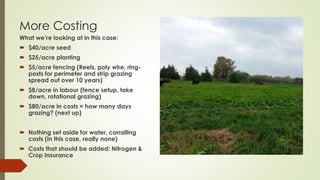
More Costing
What we’re looking at in this case:
 $40/acre seed
 $25/acre planting
 $5/acre fencing (Reels, poly wire, ring-
posts for perimeter and strip grazing
spread out over 10 years)
 $8/acre in labour (fence setup, take
down, rotational grazing)
 $80/acre in costs = how many days
grazing? (next up)
 Nothing set aside for water, corralling
costs (in this case, really none)
 Costs that should be added: Nitrogen &
Crop Insurance
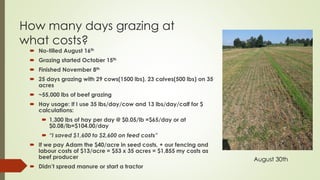
How many days grazing at
what costs?
 No-tilled August 16th
 Grazing started October 15th
 Finished November 8th
 25 days grazing with 29 cows(1500 lbs), 23 calves(500 lbs) on 35
acres
 ~55,000 lbs of beef grazing
 Hay usage: If I use 35 lbs/day/cow and 13 lbs/day/calf for $
calculations:
 1,300 lbs of hay per day @ $0.05/lb =$65/day or at
$0.08/lb=$104.00/day
 “I saved $1,600 to $2,600 on feed costs”
 If we pay Adam the $40/acre in seed costs, + our fencing and
labour costs of $13/acre = $53 x 35 acres = $1,855 my costs as
beef producer
 Didn’t spread manure or start a tractor
August 30th
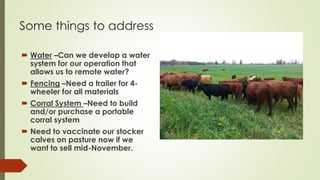
Some things to address
 Water –Can we develop a water
system for our operation that
allows us to remote water?
 Fencing –Need a trailer for 4-
wheeler for all materials
 Corral System –Need to build
and/or purchase a portable
corral system
 Need to vaccinate our stocker
calves on pasture now if we
want to sell mid-November.
Soapbox Slide
 On our operation, reducing the need to purchase feed, grow hay, or more
corn silage acres allows us to grow a cash crop on those acres, a
somewhat intangible that should help with our bottom line.
 Gets back to my point on ‘swapping’ stored feed costs for grazing costs,
might allow us to generate more profit somewhere else.
 Grazing corn stalks that have or have not been inter seeded with cover
crops. MASSIVE opportunity in Ontario for this.
 Put crop insurance on your frost seeded red clover, or grazing cover crop!
 As dad says –we talked and did this stuff decades ago. –Yes ‘we’ did, but
we need to actually implement them and work with these approaches on
our farm.
 I’ve certainly focused on making an economic case for exploring this
further, but if we collectively as farmers want to leave our soil in similar
shape than we inherited it from the previous generation then this is one of
the ways to help do it.
 Help prime the soil biology
 Help reduce soil erosion
 Improve soil structure
 Better prepare our soils for increased weather extremes
2018….
We still need Answers to the following:
1. Is Soil Compaction an issue in walk
ways?
2. Does Cattle Manure “spread” itself..
(Mycorrhizae etc)?
3. Is Weed Seed Predation Equal to or
Greater than Non – Grazed area?
General Observations
Definitely need to get another year under our
belts to calculate the net benefits
However I believe concept is great
Anything that conserves soil and protects water
and the environment at zero or minimal cost is
just the right thing to do!!
Some Final Thoughts & Questions
 Cash cropper has to be interested in gaining from the benefits of
Cover Crops to make this come together.
 Cash cropper is happy if some or all of cover crop seed is paid by
the beef producer?
 Beef producer is happy if they replace stored hay costs with grazing
cover crops? Sell extra feed stored or stockpile it? I think we will
see/show a ‘savings’ in costs.
 Calves gained well, and had a really nice looking condition to them
Thank you!
Contact Info
@FarmingForYou (Adam Shea)
shealandfarms@gmail.com
@Adam4Bent (Adam Bent)
Bentadam184@gmail.com
@Shea_8 (Marie)
www.shealandfarms.ca

12. Grazing Cover Crops - Adam Shea

  • 1.
    Getting Cattle Onto CoverCrops February 13th, 2018 – Adam Shea(Beef), Adam Bent(Cash Crop)
  • 2.
    Adam and LauraBent 100 % crop operation Sold purebred Angus herd in 2011- Seed production with Midnight Acres Purchased first farm in 2002 adopted full notill system in 2004 Worked on grazing corn, double crop corn after fall triticale, double crop soybean etc etc. Two children Nathan (15) and Ashley(10) Met Adam Shea as a 4-H Beef Leader
  • 3.
    What is TheCash Cropper Looking for???
  • 4.
    What is TheCash Cropper Looking for??? #1 Higher yield in overall cropping system #2 Reduce input costs for Fertilizer and Herbicides #3 Protect soil and water in a Long Term Sustainable Manner
  • 5.
    The Yield Story–Doesn’t Happen Overnight
  • 6.
    The Yield Story–Where is the Yield Coming From and Why
  • 7.
  • 8.
    The Yield Story–Where is the Yield Coming From and Why The Good The Bad The Ugly
  • 9.
    Building Soil Fertility GenerallyWe Have Low Basic Fertility on Phosphorus, Potash(potassium) and Magnesium!! Over the past 5 years we have applied based on Soil Test values to build up soils to Medium Levels…. …. And the soil test values moved only slightly up!!
  • 10.
    Building Soil Fertility Sowhat do we do next?
  • 11.
    Building Soil Fertility Sowhat do we do next?
  • 12.
    Reduce Weed Pressure Theremay be benefits from ruminate digestive system on seed bank of “some species” Certainly a benefit if they never go to seed in the first place!
  • 13.
    Shealand Farms  Cow-calf,sheep, and cash crop mixed farm  Myself, my wife, mother, father, and uncle are all involved. Marie and I focus on cow-calf beef and sheep. 130 cows and 120 ewes, 2,000 acres  We share equipment and labour.  Our stored forage sources are mostly from Corn Silage, some sort of ‘Oatledge’, and some dry hay.  We direct sell meat at 3 local farmer’s markets and farm gate sales. 80% of our lamb, and 15% of our beef production is sold through these channels.
  • 14.
    Why grazing cover crops with a cash cropper? Experiencegrowing oats after winter wheat and cut, baled, wrapped it for ‘oatledge’. Limited land base on our own operation. September to December weather is generally good! Swap stored feed costs for grazing costs or reduce costs
  • 15.
    What we didto Adam’s field  Baled wheat straw off, moved the bales out of the way and no-tilled our mix August 16th.  Heavy steel t-posts in corners with egg shell strainers and single strand 12.5ga high tensile wire with inline tighteners.  A t-post along fence every so often, with tread-in pigtails/ring posts to hold wire up.  Pulled t-posts back out of ground and re-rolled the high tensile wire back onto spinning jenny. Pretty well 100% of the wire can be re- used.  40 acres total, with some of it only having volunteer wheat and a bit of Double Cut Red Clover in it, so I’m calling it 35 acres.
  • 16.
    Grazing Strategies  Gallagher mediumgeared reels with turbowire on them to subdivide temporary paddocks with ring posts.  Used a hub and spoke design.  Manure distribution. Less around water trough and more in far ‘corners’ of the paddock  Move them frequently  Reduce hoof compaction by moving fence
  • 17.
    Species Used The mixthat we used:  35% Italian Ryegrass  15% Pearl Millet  15% Japanese Millet  15% Purple Top Turnips  10% Forage Kale  10% Daikon Radish Then we drilled this straight mix @ 15 lbs/acre Also drilled 7 lbs/acre of that mix above + 30 lbs/acre Oats Volunteer Winter Wheat & ‘sporadic’ Double Cut Red Clover Throughout Adam broadcasted some too
  • 18.
    Costs of thecover crop seed Here’s a mix that I would go with next year, and a rough cost of each component:  35 lbs Oats = $10.00/ac  2 lbs Turnips = $7.00/ac  2 lbs Radish = $4.50/ac  3 lbs Berseem Clover = $9.00/ac (Cash cropper may want to pull this out?)  7 lbs Italian Ryegrass = $11.00/ac = 50 lbs/acre, $41.50/acre For grazing cover crops… keep it around $40/acre or under?
  • 19.
    Species Selection All ofthese species diversify the mix, have different/complimentary growing habits, and like cool weather.  Oats –Awesome! Cheap, grow anywhere anytime, winterkills, simple!  Turnips –Higher protein, digestibility, low fibre brassica, winterkills, 60- 70% bulb weight 30-40% leaf weight  Daikon Radish –Penetrating tap root, low fibre brassica, winterkills  Berseem/Crimson Clover – Pick a legume to put in the mix for some Nitrogen fixation really for next crop, diversification of species. Need to terminate.  Italian (Annual) Ryegrass – species diversification(2nd grass), slightly different root structure, highly digestible feed. –Most should winterkill, but still need to terminate likely.
  • 20.
    More Costing What we’relooking at in this case:  $40/acre seed  $25/acre planting  $5/acre fencing (Reels, poly wire, ring- posts for perimeter and strip grazing spread out over 10 years)  $8/acre in labour (fence setup, take down, rotational grazing)  $80/acre in costs = how many days grazing? (next up)  Nothing set aside for water, corralling costs (in this case, really none)  Costs that should be added: Nitrogen & Crop Insurance
  • 21.
    How many daysgrazing at what costs?  No-tilled August 16th  Grazing started October 15th  Finished November 8th  25 days grazing with 29 cows(1500 lbs), 23 calves(500 lbs) on 35 acres  ~55,000 lbs of beef grazing  Hay usage: If I use 35 lbs/day/cow and 13 lbs/day/calf for $ calculations:  1,300 lbs of hay per day @ $0.05/lb =$65/day or at $0.08/lb=$104.00/day  “I saved $1,600 to $2,600 on feed costs”  If we pay Adam the $40/acre in seed costs, + our fencing and labour costs of $13/acre = $53 x 35 acres = $1,855 my costs as beef producer  Didn’t spread manure or start a tractor August 30th
  • 22.
    Some things toaddress  Water –Can we develop a water system for our operation that allows us to remote water?  Fencing –Need a trailer for 4- wheeler for all materials  Corral System –Need to build and/or purchase a portable corral system  Need to vaccinate our stocker calves on pasture now if we want to sell mid-November.
  • 23.
    Soapbox Slide  Onour operation, reducing the need to purchase feed, grow hay, or more corn silage acres allows us to grow a cash crop on those acres, a somewhat intangible that should help with our bottom line.  Gets back to my point on ‘swapping’ stored feed costs for grazing costs, might allow us to generate more profit somewhere else.  Grazing corn stalks that have or have not been inter seeded with cover crops. MASSIVE opportunity in Ontario for this.  Put crop insurance on your frost seeded red clover, or grazing cover crop!  As dad says –we talked and did this stuff decades ago. –Yes ‘we’ did, but we need to actually implement them and work with these approaches on our farm.  I’ve certainly focused on making an economic case for exploring this further, but if we collectively as farmers want to leave our soil in similar shape than we inherited it from the previous generation then this is one of the ways to help do it.  Help prime the soil biology  Help reduce soil erosion  Improve soil structure  Better prepare our soils for increased weather extremes
  • 24.
    2018…. We still needAnswers to the following: 1. Is Soil Compaction an issue in walk ways? 2. Does Cattle Manure “spread” itself.. (Mycorrhizae etc)? 3. Is Weed Seed Predation Equal to or Greater than Non – Grazed area?
  • 25.
    General Observations Definitely needto get another year under our belts to calculate the net benefits However I believe concept is great Anything that conserves soil and protects water and the environment at zero or minimal cost is just the right thing to do!!
  • 26.
    Some Final Thoughts& Questions  Cash cropper has to be interested in gaining from the benefits of Cover Crops to make this come together.  Cash cropper is happy if some or all of cover crop seed is paid by the beef producer?  Beef producer is happy if they replace stored hay costs with grazing cover crops? Sell extra feed stored or stockpile it? I think we will see/show a ‘savings’ in costs.  Calves gained well, and had a really nice looking condition to them
  • 27.
    Thank you! Contact Info @FarmingForYou(Adam Shea) shealandfarms@gmail.com @Adam4Bent (Adam Bent) Bentadam184@gmail.com @Shea_8 (Marie) www.shealandfarms.ca