Applications of CLTTask-Based/Cooperative Approach&Content Language Integrated Learning: A new dimension in Language LearningIgnacio Bravo  & Alberto Delano.
Task-based language learningFocuses on the use of authentic language and on asking students to do meaningful tasks using the target languageAllows for more meaningful communicationprovides for practical extra-linguistic skill buildingTask-based language learning is on outputstudents are only exposed to certain forms of language
Cooperative Language Learning.Collaborative foundations, maximizing group activities.-Centralized on the learner, constant feedback from peers.-Different types of groups according to specific language learning aspect.-Strong focus on interpersonal skills, interdependence .-Groups are to be selected by teacher according to student’s needsSource: http://www.slideshare.net/mgdpcastro/cooperative-language-learning-approach-presentation
Content Language Integrated Learning.Content through LanguageOrigins: New Conception of Language Learning for a New World-CLIL tackles the needs for massive and thorough language learning in a globalized world-CLIL also tackles the communicative needs of the Knowledge/Information era.
Origins: Historical Overview.CLIL arising from political needs: The Canadian Case
CLIL as a means to revolutionize education: The European Union’s caseCLIL as a concept adopted in 1994 by Marsh, Maljers and Hartiala to describe the method.
CLILTheoretical ConceptsCLIL is not-Content learning in another language.-Traditional language teaching disguised as content learning.The question is How to apply CLIL as for:Content LearningLanguage Learning.
Content Learning Aspects in CLILClassroom must be dialogical in nature and cooperative oriented.Cognitive approach is key: Learner should achieve lower and higher order thinking processes in the CLIL subjectFrom Memorizing and  UnderstandingTo Analyzing and Creating.
Language Learning AspectsForm and Meaning should be given equal priority and mutual complementation.Communicative approach but also strong  grammar focus.Or content and language integrated in a continuum.“Content must be manipulated by pedagogy if its potential for language learning is to be realized” Klapper, 1996: 70
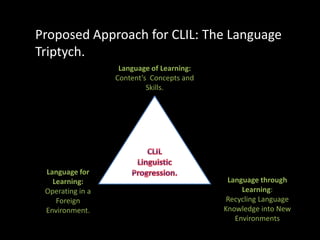
Proposed Approach for CLIL: The Language Triptych.Language of Learning: Content’s  Concepts and Skills.CLIL Linguistic Progression.Language for Learning: Operating in a Foreign Environment.Language through Learning:Recycling Language Knowledge into New Environments
Advantages of CLILAllows a much more “natural” and realistic way to approach language learning.
“Two birds with one stone” Learners achieve two areas of expertise under one subject.
Learners are prepared in a much more superior way into the globalized world. Learners acquires a much wider scope of analysis.CLILChallenges and restrictions:CulturalBreaking down myths: High proficiency can be achieved in Content and Language
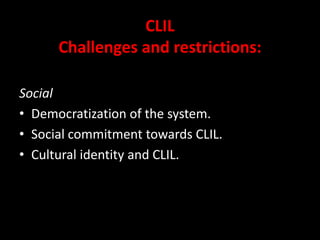
Which and how many subjects should be taught?CLILChallenges and restrictions:SocialDemocratization of the system.Social commitment towards CLIL.Cultural identity and CLIL.
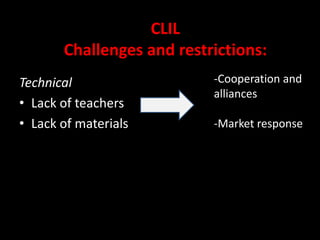
CLILChallenges and restrictions:-Cooperation and alliances-Market responseTechnicalLack of teachersLack of materials
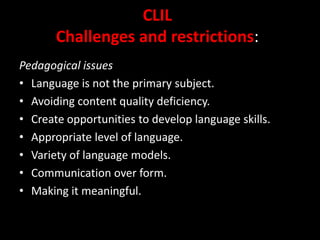
CLIL Challenges and restrictions:Pedagogical issuesLanguage is not the primary subject.Avoiding content quality deficiency.Create opportunities to develop language skills.Appropriate level of language.Variety of language models.Communication over form.Making it meaningful.
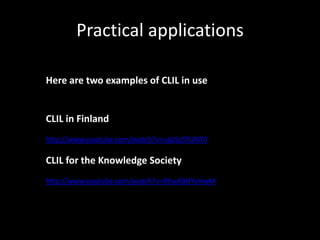
Practical applicationsHere are two examples of CLIL in useCLIL in Finlandhttp://www.youtube.com/watch?v=uAJSzSTUNT0CLIL for the Knowledge Societyhttp://www.youtube.com/watch?v=8YwABHYvHwM

Clil (2)

  • 1.
    Applications of CLTTask-Based/CooperativeApproach&Content Language Integrated Learning: A new dimension in Language LearningIgnacio Bravo & Alberto Delano.
  • 2.
    Task-based language learningFocuseson the use of authentic language and on asking students to do meaningful tasks using the target languageAllows for more meaningful communicationprovides for practical extra-linguistic skill buildingTask-based language learning is on outputstudents are only exposed to certain forms of language
  • 3.
    Cooperative Language Learning.Collaborativefoundations, maximizing group activities.-Centralized on the learner, constant feedback from peers.-Different types of groups according to specific language learning aspect.-Strong focus on interpersonal skills, interdependence .-Groups are to be selected by teacher according to student’s needsSource: http://www.slideshare.net/mgdpcastro/cooperative-language-learning-approach-presentation
  • 4.
    Content Language IntegratedLearning.Content through LanguageOrigins: New Conception of Language Learning for a New World-CLIL tackles the needs for massive and thorough language learning in a globalized world-CLIL also tackles the communicative needs of the Knowledge/Information era.
  • 5.
    Origins: Historical Overview.CLILarising from political needs: The Canadian Case
  • 6.
    CLIL as ameans to revolutionize education: The European Union’s caseCLIL as a concept adopted in 1994 by Marsh, Maljers and Hartiala to describe the method.
  • 7.
    CLILTheoretical ConceptsCLIL isnot-Content learning in another language.-Traditional language teaching disguised as content learning.The question is How to apply CLIL as for:Content LearningLanguage Learning.
  • 8.
    Content Learning Aspectsin CLILClassroom must be dialogical in nature and cooperative oriented.Cognitive approach is key: Learner should achieve lower and higher order thinking processes in the CLIL subjectFrom Memorizing and UnderstandingTo Analyzing and Creating.
  • 9.
    Language Learning AspectsFormand Meaning should be given equal priority and mutual complementation.Communicative approach but also strong grammar focus.Or content and language integrated in a continuum.“Content must be manipulated by pedagogy if its potential for language learning is to be realized” Klapper, 1996: 70
  • 10.
    Proposed Approach forCLIL: The Language Triptych.Language of Learning: Content’s Concepts and Skills.CLIL Linguistic Progression.Language for Learning: Operating in a Foreign Environment.Language through Learning:Recycling Language Knowledge into New Environments
  • 11.
    Advantages of CLILAllowsa much more “natural” and realistic way to approach language learning.
  • 12.
    “Two birds withone stone” Learners achieve two areas of expertise under one subject.
  • 13.
    Learners are preparedin a much more superior way into the globalized world. Learners acquires a much wider scope of analysis.CLILChallenges and restrictions:CulturalBreaking down myths: High proficiency can be achieved in Content and Language
  • 14.
    Which and howmany subjects should be taught?CLILChallenges and restrictions:SocialDemocratization of the system.Social commitment towards CLIL.Cultural identity and CLIL.
  • 15.
    CLILChallenges and restrictions:-Cooperationand alliances-Market responseTechnicalLack of teachersLack of materials
  • 16.
    CLIL Challenges andrestrictions:Pedagogical issuesLanguage is not the primary subject.Avoiding content quality deficiency.Create opportunities to develop language skills.Appropriate level of language.Variety of language models.Communication over form.Making it meaningful.
  • 17.
    Practical applicationsHere aretwo examples of CLIL in useCLIL in Finlandhttp://www.youtube.com/watch?v=uAJSzSTUNT0CLIL for the Knowledge Societyhttp://www.youtube.com/watch?v=8YwABHYvHwM