Gravity: A Force of Attraction
It all starts with an apple…
 One beautiful spring day in 1655, a man named
Isaac Newton was sitting under an apple tree in
his garden, enjoying a glass of tea.
 Suddenly, one of the apples fell and crashed on
his head.
Disclaimer: This last part has been fictionalized, most
believe that the apple did not actually hit Newton on the
head, but rather fell nearby and caught his attention.
A story about an apple
 That got Newton thinking (once the
bump had gone down of course).
 “Why did the apple fall towards the
Earth?”
 “Why did it not “shoot upwards''
when it came away from the
branch?”
 And, “why did I plant that stupid
apple tree anyway?!!''
A story about an apple
 Newton knew that
unbalanced forces are
necessary to move or
change the motion of
objects.
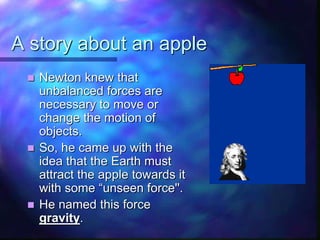
 So, he came up with the
idea that the Earth must
attract the apple towards it
with some “unseen force''.
 He named this force
gravity.
 Gravity is a force of attraction between
objects.
 The atoms of one object pull on the atoms of
another object.
 It's like the Earth pulling on you and keeping
you on the ground.
 That pull is gravity at work.
All matter is affected by gravity
 Definition of matter:
 Matter is anything that has mass and volume.
 Since all matter has mass, all matter is
affected by gravity.
 Gravity (aka: gravitational force) pulls
objects towards each other.
 It acts on anything with mass.
Ok, then why don’t we see objects
being pulled towards one another?
 This is because the mass of most objects is
too small to cause an attraction large enough
to cause the objects to move towards each
other.
 Even though gravity is “pulling” the pencil
you’re holding, its mass is so small that it’s
not really moving.
 There is, however, one object that is big
enough to cause a noticeable attraction…
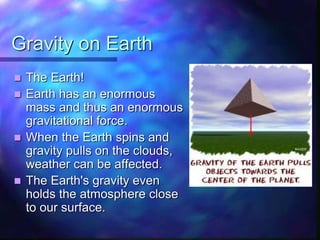
Gravity on Earth
 The Earth!
 Earth has an enormous
mass and thus an enormous
gravitational force.
 When the Earth spins and
gravity pulls on the clouds,
weather can be affected.
 The Earth's gravity even
holds the atmosphere close
to our surface.
The Law of Universal Gravitation
 Now that we know what gravity is, let’s
go back to Newton.
 He generalized his observation in
something called the Law of Universal
Gravitation.
 This law states: All objects in the
universe attract each other through
gravitational force.
The Law of Universal Gravitation
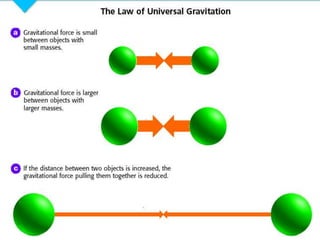
The size of the gravitational force
depends on two things:
1. Mass of the objects
2. Distance between the objects
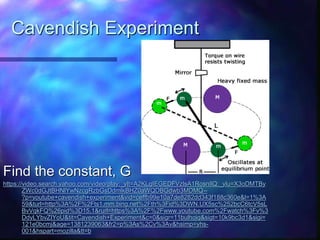
Cavendish Experiment
Find the constant, G
https://video.search.yahoo.com/video/play;_ylt=A2KLqIEGEDFVzlsA1RosnIlQ;_ylu=X3oDMTBy
ZWc0dGJtBHNlYwNzcgRzbGsDdmlkBHZ0aWQDBGdwb3MDMQ--
?p=youtube+cavendish+experiment&vid=ceffb99e10a7de8282dd343f188c360e&l=1%3A
59&turl=http%3A%2F%2Fts1.mm.bing.net%2Fth%3Fid%3DWN.UX5sc%252bcC6tcV5sL
BvVqkFQ%26pid%3D15.1&rurl=https%3A%2F%2Fwww.youtube.com%2Fwatch%3Fv%3
DdyLYbvZIYoU&tit=Cavendish+Experiment&c=0&sigr=11bulhojq&sigt=10k9bc3d1&sigi=
121e0bcmj&age=1381239063&fr2=p%3As%2Cv%3Av&hsimp=yhs-
001&hspart=mozilla&tt=b
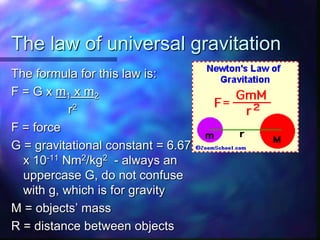
The law of universal gravitation
The formula for this law is:
F = G x m1 x m2
r2
F = force
G = gravitational constant = 6.673
x 10-11 Nm2/kg2 - always an
uppercase G, do not confuse
with g, which is for gravity
M = objects’ mass
R = distance between objects
The law of universal gravitation
Basically, there are two major parts to this law
that you need to know:
1. Gravitational force increases as mass
increases
2. Gravitational force decreases as
distance increases
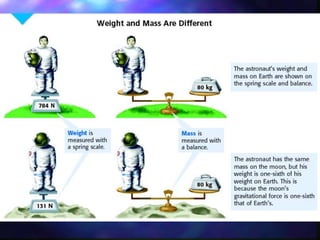
What is weight?
 Weight is a measure of the gravitational
force exerted on an object.
 Most of the time, when we’re talking about
weight, we’re referring to the Earth’s
gravitational force on an object.
 Since gravity is a force and weight is a
measure of gravity, weight is expressed in
newtons (N).
 On Earth, a 100 gram object would weigh 1 N.
What is mass?
 Mass is the amount of matter in an object.
 This does not change… ever!
 Whereas weight changes when gravity changes,
mass always remains the same.
 Remember, mass is measured with a balance,
where the mass of one object is compared to
another object.
 On Earth, mass and weight are both constant
since gravity is a constant force, which is why
they seem like the same thing to us.
Part 2
Gravity & Motion
Chapter 6.1
Actually, it all started with a
cannonball…
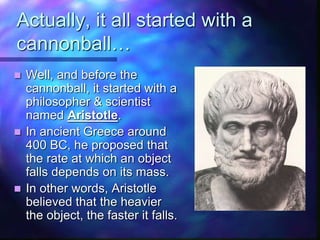
 Well, and before the
cannonball, it started with a
philosopher & scientist
named Aristotle.
 In ancient Greece around
400 BC, he proposed that
the rate at which an object
falls depends on its mass.
 In other words, Aristotle
believed that the heavier
the object, the faster it falls.
A story about a cannonball
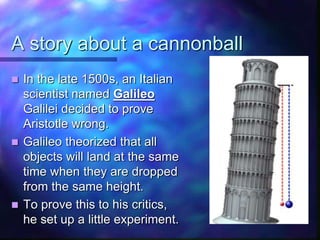
 In the late 1500s, an Italian
scientist named Galileo
Galilei decided to prove
Aristotle wrong.
 Galileo theorized that all
objects will land at the same
time when they are dropped
from the same height.
 To prove this to his critics,
he set up a little experiment.
A story about a cannonball
 Galileo carried a cannonball and a wooden ball up
the 300 steps of the Leaning Tower of Pisa.
 Dropping the two different balls at exactly the
same time, the crowd was amazed with what they
saw…
 The two balls, with extremely different masses,
landed at the exact same time!
Disclaimer: this story may or may not be true, but a similar
and well-documented experiment was performed by
Benedetti Giambattista in 1553.
A story about a cannonball
 Can we demonstrate this?
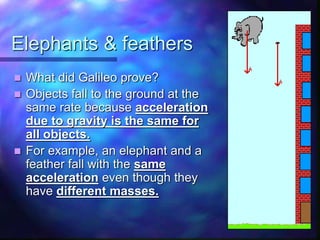
Elephants & feathers
 What did Galileo prove?
 Objects fall to the ground at the
same rate because acceleration
due to gravity is the same for
all objects.
 For example, an elephant and a
feather fall with the same
acceleration even though they
have different masses.
Gravity &
Acceleration
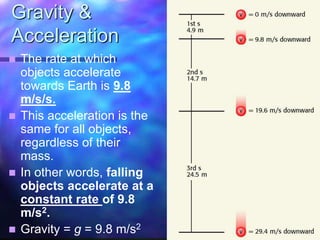
 The rate at which
objects accelerate
towards Earth is 9.8
m/s/s.
 This acceleration is the
same for all objects,
regardless of their
mass.
 In other words, falling
objects accelerate at a
constant rate of 9.8
m/s2.
 Gravity = g = 9.8 m/s2
Gravity &
Acceleration
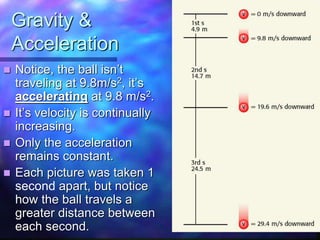
 Notice, the ball isn’t
traveling at 9.8m/s2, it’s
accelerating at 9.8 m/s2.
 It’s velocity is continually
increasing.
 Only the acceleration
remains constant.
 Each picture was taken 1
second apart, but notice
how the ball travels a
greater distance between
each second.
Air Resistance
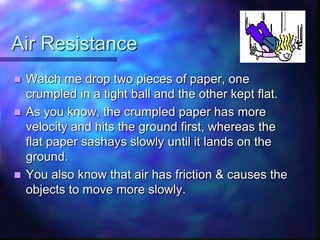
 Watch me drop two pieces of paper, one
crumpled in a tight ball and the other kept flat.
 As you know, the crumpled paper has more
velocity and hits the ground first, whereas the
flat paper sashays slowly until it lands on the
ground.
 You also know that air has friction & causes the
objects to move more slowly.
Air Resistance
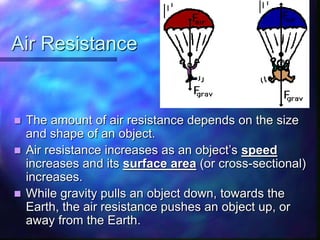
 The amount of air resistance depends on the size
and shape of an object.
 Air resistance increases as an object’s speed
increases and its surface area (or cross-sectional)
increases.
 While gravity pulls an object down, towards the
Earth, the air resistance pushes an object up, or
away from the Earth.
Free Fall
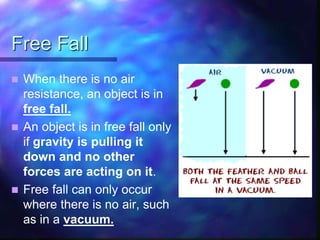
 When there is no air
resistance, an object is in
free fall.
 An object is in free fall only
if gravity is pulling it
down and no other
forces are acting on it.
 Free fall can only occur
where there is no air, such
as in a vacuum.
The role of gravity in orbit
 In space, there is very little gravity.
 This is because the distances between
you and other large objects are so vast,
the force is minimal.
 You would still have mass, and because
there is still a little bit of gravity, you
would still have some weight.
The role of gravity in orbit
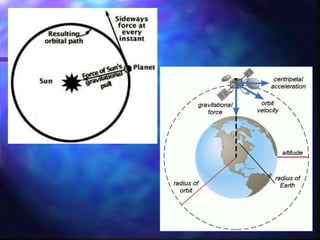
 We know that an object in orbit is traveling in a
circular or near-circular path around another
object.
 There are two forces that act on a spaceship in
orbit.
 First, gravity is pulling the spaceship back to
earth, so technically, the shuttle is in free fall.
 Second, the shuttle is being propelled forward and
is moving at a constant speed.
 As a result, the path of the orbit is a curved
combination of the two forces.
Some additional info:
Terminal Velocity
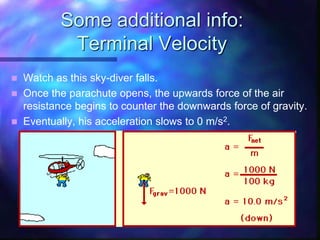
 Watch as this sky-diver falls.
 Once the parachute opens, the upwards force of the air
resistance begins to counter the downwards force of gravity.
 Eventually, his acceleration slows to 0 m/s2.
Terminal Velocity
 As an object falls, the air resistance is
continually increasing.
 Eventually, the force of the air resistance will
match the force of gravity pulling the object
down.
 When this happens, the overall force is 0 N
and the object stops accelerating.
 The object is now falling a constant velocity,
which is called the terminal velocity.

Gravity.ppt

  • 1.
    Gravity: A Forceof Attraction
  • 2.
    It all startswith an apple…  One beautiful spring day in 1655, a man named Isaac Newton was sitting under an apple tree in his garden, enjoying a glass of tea.  Suddenly, one of the apples fell and crashed on his head. Disclaimer: This last part has been fictionalized, most believe that the apple did not actually hit Newton on the head, but rather fell nearby and caught his attention.
  • 3.
    A story aboutan apple  That got Newton thinking (once the bump had gone down of course).  “Why did the apple fall towards the Earth?”  “Why did it not “shoot upwards'' when it came away from the branch?”  And, “why did I plant that stupid apple tree anyway?!!''
  • 4.
    A story aboutan apple  Newton knew that unbalanced forces are necessary to move or change the motion of objects.  So, he came up with the idea that the Earth must attract the apple towards it with some “unseen force''.  He named this force gravity.
  • 5.
     Gravity isa force of attraction between objects.  The atoms of one object pull on the atoms of another object.  It's like the Earth pulling on you and keeping you on the ground.  That pull is gravity at work.
  • 6.
    All matter isaffected by gravity  Definition of matter:  Matter is anything that has mass and volume.  Since all matter has mass, all matter is affected by gravity.  Gravity (aka: gravitational force) pulls objects towards each other.  It acts on anything with mass.
  • 7.
    Ok, then whydon’t we see objects being pulled towards one another?  This is because the mass of most objects is too small to cause an attraction large enough to cause the objects to move towards each other.  Even though gravity is “pulling” the pencil you’re holding, its mass is so small that it’s not really moving.  There is, however, one object that is big enough to cause a noticeable attraction…
  • 8.
    Gravity on Earth The Earth!  Earth has an enormous mass and thus an enormous gravitational force.  When the Earth spins and gravity pulls on the clouds, weather can be affected.  The Earth's gravity even holds the atmosphere close to our surface.
  • 9.
    The Law ofUniversal Gravitation  Now that we know what gravity is, let’s go back to Newton.  He generalized his observation in something called the Law of Universal Gravitation.  This law states: All objects in the universe attract each other through gravitational force.
  • 10.
    The Law ofUniversal Gravitation The size of the gravitational force depends on two things: 1. Mass of the objects 2. Distance between the objects
  • 11.
    Cavendish Experiment Find theconstant, G https://video.search.yahoo.com/video/play;_ylt=A2KLqIEGEDFVzlsA1RosnIlQ;_ylu=X3oDMTBy ZWc0dGJtBHNlYwNzcgRzbGsDdmlkBHZ0aWQDBGdwb3MDMQ-- ?p=youtube+cavendish+experiment&vid=ceffb99e10a7de8282dd343f188c360e&l=1%3A 59&turl=http%3A%2F%2Fts1.mm.bing.net%2Fth%3Fid%3DWN.UX5sc%252bcC6tcV5sL BvVqkFQ%26pid%3D15.1&rurl=https%3A%2F%2Fwww.youtube.com%2Fwatch%3Fv%3 DdyLYbvZIYoU&tit=Cavendish+Experiment&c=0&sigr=11bulhojq&sigt=10k9bc3d1&sigi= 121e0bcmj&age=1381239063&fr2=p%3As%2Cv%3Av&hsimp=yhs- 001&hspart=mozilla&tt=b
  • 12.
    The law ofuniversal gravitation The formula for this law is: F = G x m1 x m2 r2 F = force G = gravitational constant = 6.673 x 10⁻¹¹ Nm2/kg2 - always an uppercase G, do not confuse with g, which is for gravity M = objects’ mass R = distance between objects
  • 14.
    The law ofuniversal gravitation Basically, there are two major parts to this law that you need to know: 1. Gravitational force increases as mass increases 2. Gravitational force decreases as distance increases
  • 15.
    What is weight? Weight is a measure of the gravitational force exerted on an object.  Most of the time, when we’re talking about weight, we’re referring to the Earth’s gravitational force on an object.  Since gravity is a force and weight is a measure of gravity, weight is expressed in newtons (N).  On Earth, a 100 gram object would weigh 1 N.
  • 16.
    What is mass? Mass is the amount of matter in an object.  This does not change… ever!  Whereas weight changes when gravity changes, mass always remains the same.  Remember, mass is measured with a balance, where the mass of one object is compared to another object.  On Earth, mass and weight are both constant since gravity is a constant force, which is why they seem like the same thing to us.
  • 18.
    Part 2 Gravity &Motion Chapter 6.1
  • 19.
    Actually, it allstarted with a cannonball…  Well, and before the cannonball, it started with a philosopher & scientist named Aristotle.  In ancient Greece around 400 BC, he proposed that the rate at which an object falls depends on its mass.  In other words, Aristotle believed that the heavier the object, the faster it falls.
  • 20.
    A story abouta cannonball  In the late 1500s, an Italian scientist named Galileo Galilei decided to prove Aristotle wrong.  Galileo theorized that all objects will land at the same time when they are dropped from the same height.  To prove this to his critics, he set up a little experiment.
  • 21.
    A story abouta cannonball  Galileo carried a cannonball and a wooden ball up the 300 steps of the Leaning Tower of Pisa.  Dropping the two different balls at exactly the same time, the crowd was amazed with what they saw…  The two balls, with extremely different masses, landed at the exact same time! Disclaimer: this story may or may not be true, but a similar and well-documented experiment was performed by Benedetti Giambattista in 1553.
  • 22.
    A story abouta cannonball  Can we demonstrate this?
  • 23.
    Elephants & feathers What did Galileo prove?  Objects fall to the ground at the same rate because acceleration due to gravity is the same for all objects.  For example, an elephant and a feather fall with the same acceleration even though they have different masses.
  • 24.
    Gravity & Acceleration  Therate at which objects accelerate towards Earth is 9.8 m/s/s.  This acceleration is the same for all objects, regardless of their mass.  In other words, falling objects accelerate at a constant rate of 9.8 m/s2.  Gravity = g = 9.8 m/s2
  • 25.
    Gravity & Acceleration  Notice,the ball isn’t traveling at 9.8m/s2, it’s accelerating at 9.8 m/s2.  It’s velocity is continually increasing.  Only the acceleration remains constant.  Each picture was taken 1 second apart, but notice how the ball travels a greater distance between each second.
  • 26.
    Air Resistance  Watchme drop two pieces of paper, one crumpled in a tight ball and the other kept flat.  As you know, the crumpled paper has more velocity and hits the ground first, whereas the flat paper sashays slowly until it lands on the ground.  You also know that air has friction & causes the objects to move more slowly.
  • 27.
    Air Resistance  Theamount of air resistance depends on the size and shape of an object.  Air resistance increases as an object’s speed increases and its surface area (or cross-sectional) increases.  While gravity pulls an object down, towards the Earth, the air resistance pushes an object up, or away from the Earth.
  • 28.
    Free Fall  Whenthere is no air resistance, an object is in free fall.  An object is in free fall only if gravity is pulling it down and no other forces are acting on it.  Free fall can only occur where there is no air, such as in a vacuum.
  • 29.
    The role ofgravity in orbit  In space, there is very little gravity.  This is because the distances between you and other large objects are so vast, the force is minimal.  You would still have mass, and because there is still a little bit of gravity, you would still have some weight.
  • 30.
    The role ofgravity in orbit  We know that an object in orbit is traveling in a circular or near-circular path around another object.  There are two forces that act on a spaceship in orbit.  First, gravity is pulling the spaceship back to earth, so technically, the shuttle is in free fall.  Second, the shuttle is being propelled forward and is moving at a constant speed.  As a result, the path of the orbit is a curved combination of the two forces.
  • 32.
    Some additional info: TerminalVelocity  Watch as this sky-diver falls.  Once the parachute opens, the upwards force of the air resistance begins to counter the downwards force of gravity.  Eventually, his acceleration slows to 0 m/s2.
  • 33.
    Terminal Velocity  Asan object falls, the air resistance is continually increasing.  Eventually, the force of the air resistance will match the force of gravity pulling the object down.  When this happens, the overall force is 0 N and the object stops accelerating.  The object is now falling a constant velocity, which is called the terminal velocity.