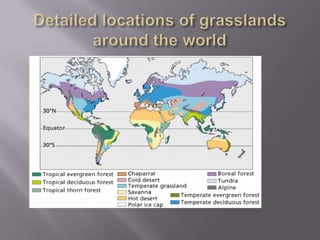
Their latitude range is 55 degrees North to 30
                 degrees South.
Grassland is an area where the annual rainfall is insufficient
to support a luxuriant growth of trees, but is still high
enough so that deserts are not formed.
Natural grasslands primarily occur in regions that receive
between 250 and 900 mm of rain per year, as compared
with deserts, which receive less than 250 mm (9.8 in)
and tropical rainforests, which receive more than 2,000 mm
(79 in). Grassland can exist naturally in areas with higher
rainfall when other factors prevent the growth of forests,
where minerals in the soil inhibit most plants from growing.
Average daily temperatures range between −20 and 30 °C.
Temperate grasslands have warm summers and cold
winters with rain or some snow.
There are two types of grasslands, namely the tropical and
the temperate.
Grasses are the main kind of plant in
grasslands.
There are not many trees in grasslands.
Some grasslands are hot all year round.
Some grassland areas have hot summers and
very cold winters.
Grasslands have different names in different
places (pampas for South America, prairies for
North America, savannahs for Africa, or
steppes for Asia).
There are two different kinds of grasslands:
tropical and temperate. Grasslands in the
southern hemisphere tend to get more
precipitation than those in the northern
hemisphere. Some grasses grow more than 7
feet (2 meters), and have roots extending
several feet into the soil.
Tropical grasslands are warm year round, but
usually have a dry and a rainy season. One
such tropical grassland, the African savanna, is
home to some of the world’s most recognizable
species, including elephants, giraffes, rhinos,
zebras, lions, hyenas, and warthogs.
Mainly between latitudes 5° and 15° north and
south of the Equator.
Tropical grasslands are those closest to the
equator. They are hot all year long.
Temperate grasslands, which average between
10 and 30 inches (25 and 75 centimeters) of rain
per year, have shorter grasses, sometimes just a
few millimeters. These areas have two seasons:
a growing season and a dormant season.
During the dormant season, no grass can grow
because it is too cold.
Temperate grasslands are those further from
the equator, with hot summers and harsh
winter.
Overxploitation of Resources:
  Overhunting
  Urbanization

Grasslands bernard

  • 5.
    Their latitude rangeis 55 degrees North to 30 degrees South.
  • 6.
    Grassland is anarea where the annual rainfall is insufficient to support a luxuriant growth of trees, but is still high enough so that deserts are not formed. Natural grasslands primarily occur in regions that receive between 250 and 900 mm of rain per year, as compared with deserts, which receive less than 250 mm (9.8 in) and tropical rainforests, which receive more than 2,000 mm (79 in). Grassland can exist naturally in areas with higher rainfall when other factors prevent the growth of forests, where minerals in the soil inhibit most plants from growing. Average daily temperatures range between −20 and 30 °C. Temperate grasslands have warm summers and cold winters with rain or some snow. There are two types of grasslands, namely the tropical and the temperate.
  • 7.
    Grasses are themain kind of plant in grasslands. There are not many trees in grasslands. Some grasslands are hot all year round. Some grassland areas have hot summers and very cold winters. Grasslands have different names in different places (pampas for South America, prairies for North America, savannahs for Africa, or steppes for Asia).
  • 8.
    There are twodifferent kinds of grasslands: tropical and temperate. Grasslands in the southern hemisphere tend to get more precipitation than those in the northern hemisphere. Some grasses grow more than 7 feet (2 meters), and have roots extending several feet into the soil.
  • 9.
    Tropical grasslands arewarm year round, but usually have a dry and a rainy season. One such tropical grassland, the African savanna, is home to some of the world’s most recognizable species, including elephants, giraffes, rhinos, zebras, lions, hyenas, and warthogs.
  • 10.
    Mainly between latitudes5° and 15° north and south of the Equator. Tropical grasslands are those closest to the equator. They are hot all year long.
  • 12.
    Temperate grasslands, whichaverage between 10 and 30 inches (25 and 75 centimeters) of rain per year, have shorter grasses, sometimes just a few millimeters. These areas have two seasons: a growing season and a dormant season. During the dormant season, no grass can grow because it is too cold.
  • 13.
    Temperate grasslands arethose further from the equator, with hot summers and harsh winter.
  • 15.
    Overxploitation of Resources: Overhunting Urbanization