GOAL 3: Bar Graphs, Line Graphs
& Picto-Graphs
Tables, charts and graphs are
convenient ways to clearly
show your data.
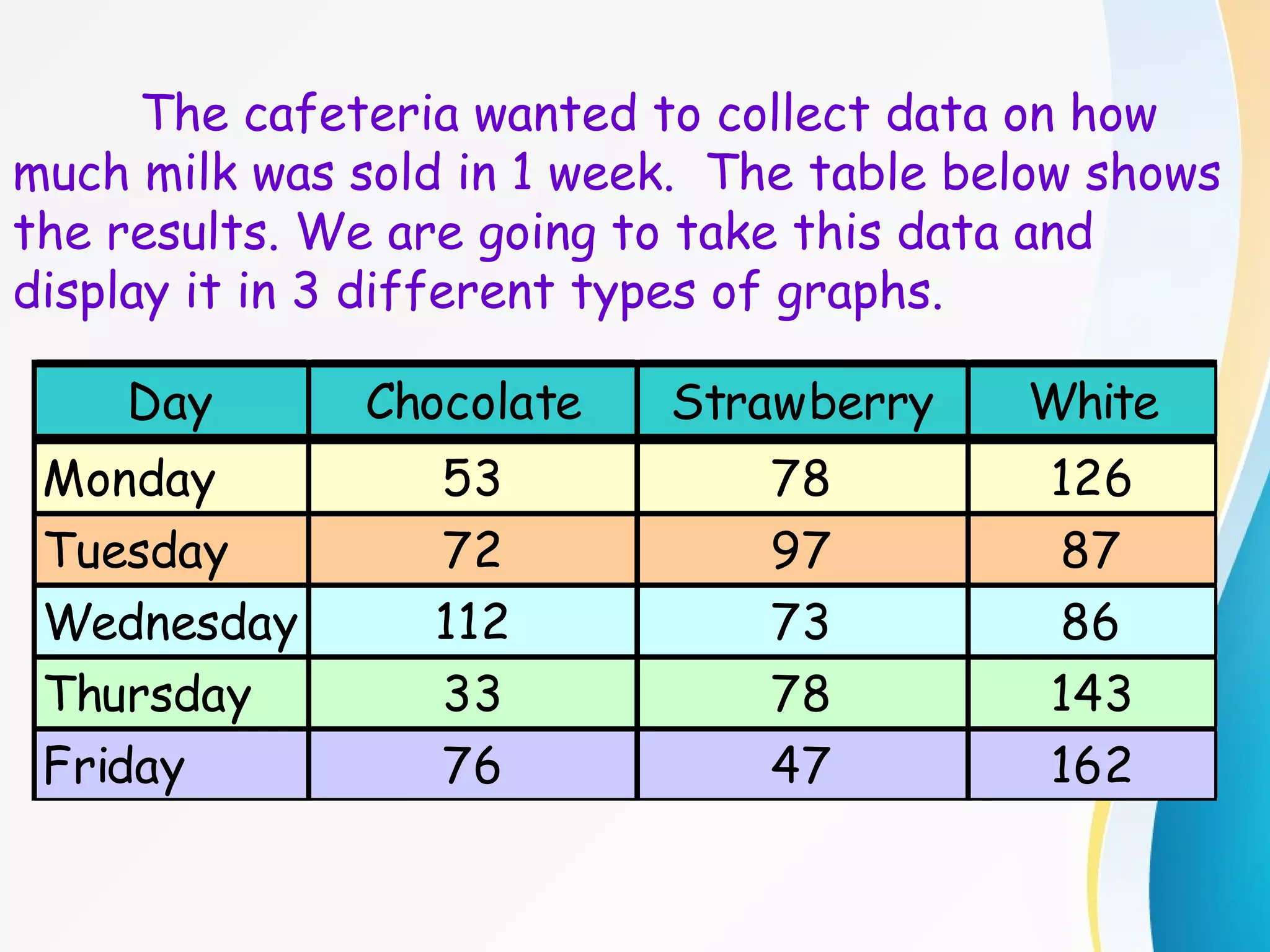
Day Chocolate Strawberry White
Monday 53 78 126
Tuesday 72 97 87
Wednesday 112 73 86
Thursday 33 78 143
Friday 76 47 162
The cafeteria wanted to collect data on how
much milk was sold in 1 week. The table below shows
the results. We are going to take this data and
display it in 3 different types of graphs.
Scale / Intervals
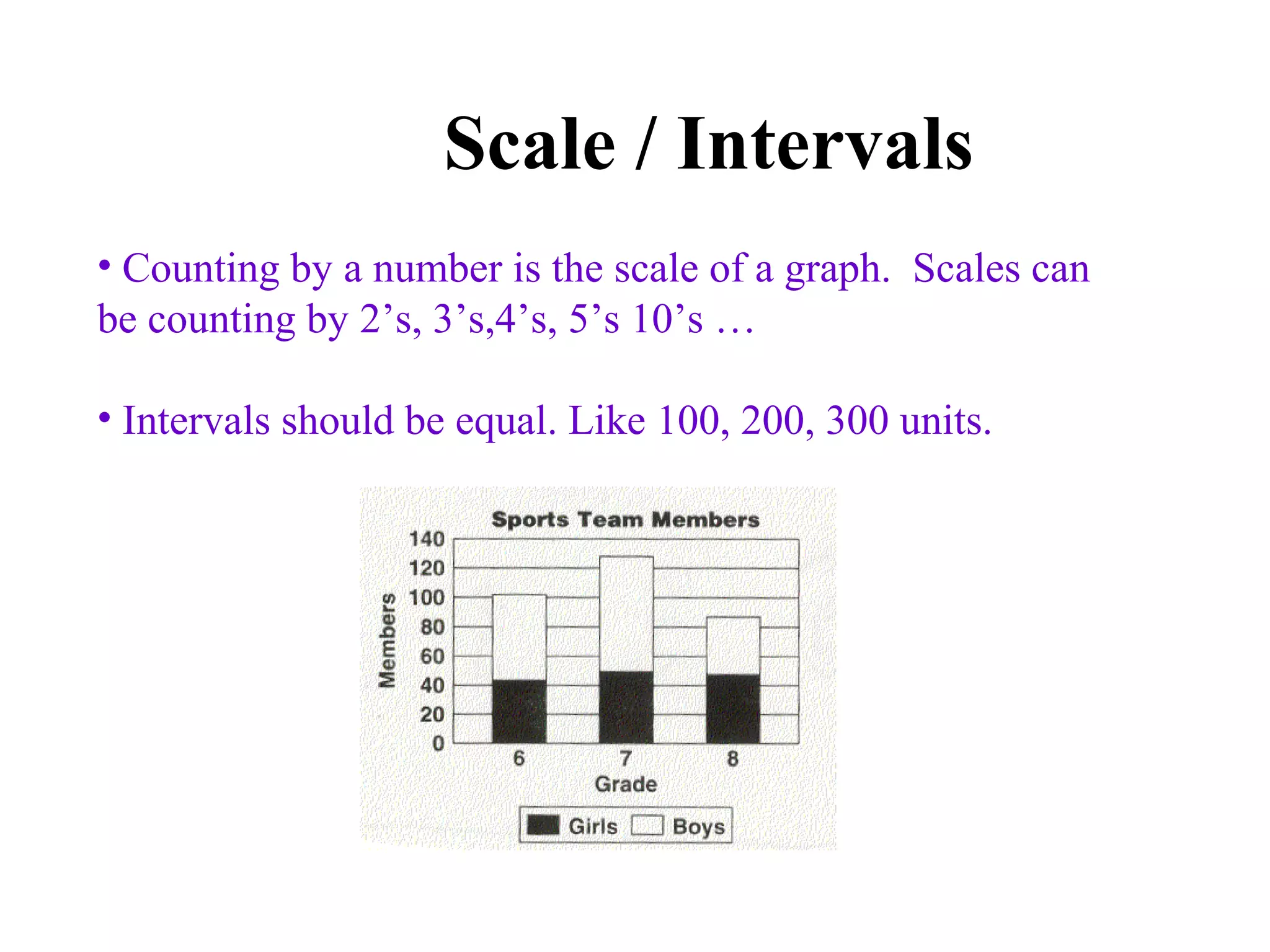
• Counting by a number is the scale of a graph. Scales can
be counting by 2’s, 3’s,4’s, 5’s 10’s …
• Intervals should be equal. Like 100, 200, 300 units.
Bar Graph
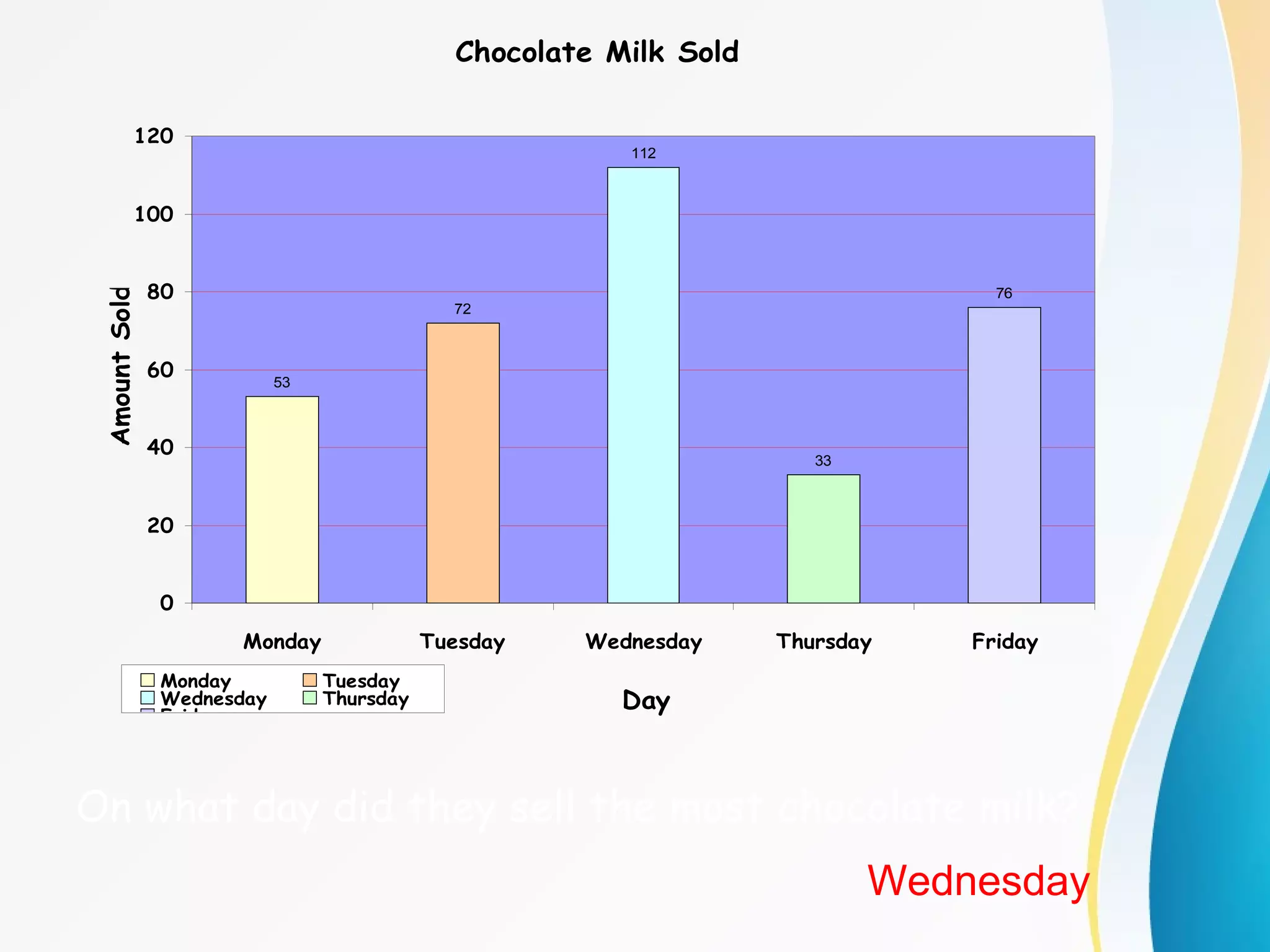
• A bar graph is used to show
relationships between groups.
• The two items being compared do
not need to affect each other.
• It's a fast way to show big
differences. Notice how easy it is
to read a bar graph.
Chocolate Milk Sold
53
72
112
33
76
0
20
40
60
80
100
120
Monday Tuesday Wednesday Thursday Friday
Day
AmountSold
Monday Tuesday
Wednesday Thursday
Friday
Line Graph
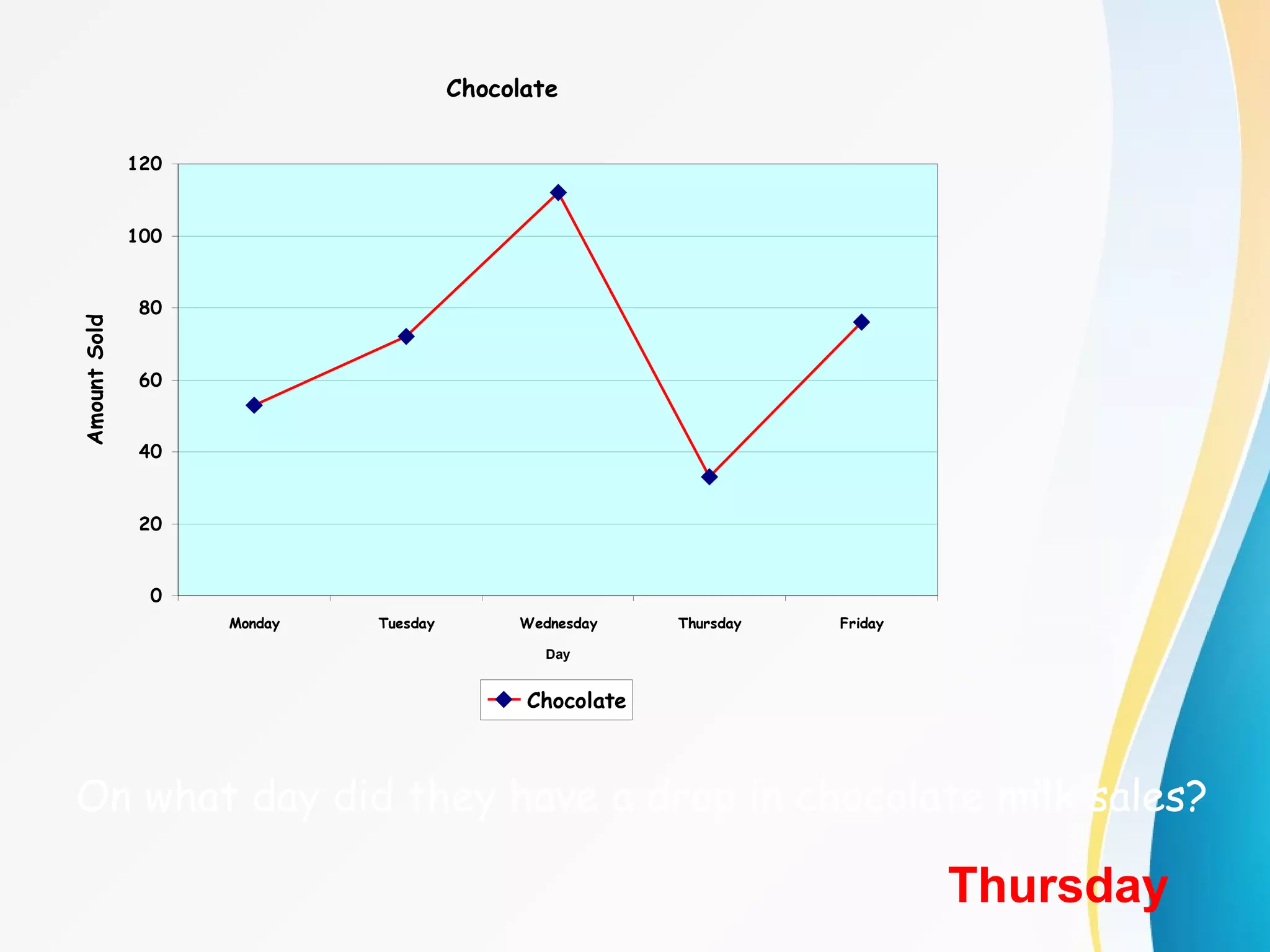
• A line graph is used to show continuing data; how one
thing is affected by another.
• It's clear to see how things are going by the rises and
falls a line graph shows.
Chocolate MIlk Sold
0
20
40
60
80
100
120
Monday Tuesday Wednesday Thursday Friday
Day
AmountSold
Chocolate
On what day did they sell the most chocolate milk?
Chocolate Milk Sold
53
72
112
33
76
0
20
40
60
80
100
120
Monday Tuesday Wednesday Thursday Friday
Day
AmountSold
Monday Tuesday
Wednesday Thursday
Friday
Wednesday
Chocolate
0
20
40
60
80
100
120
Monday Tuesday Wednesday Thursday Friday
Day
AmountSold
Chocolate
On what day did they have a drop in chocolate milk sales?
Thursday
Choosing the Right Graph
• Use a bar graph if you are not looking for
trends (or patterns) over time; and the
items (or categories) are not parts of a
whole.
• Use a line graph if you need to see how a
quantity has changed over time.  Line graphs
enable us to find trends (or patterns) over
time.
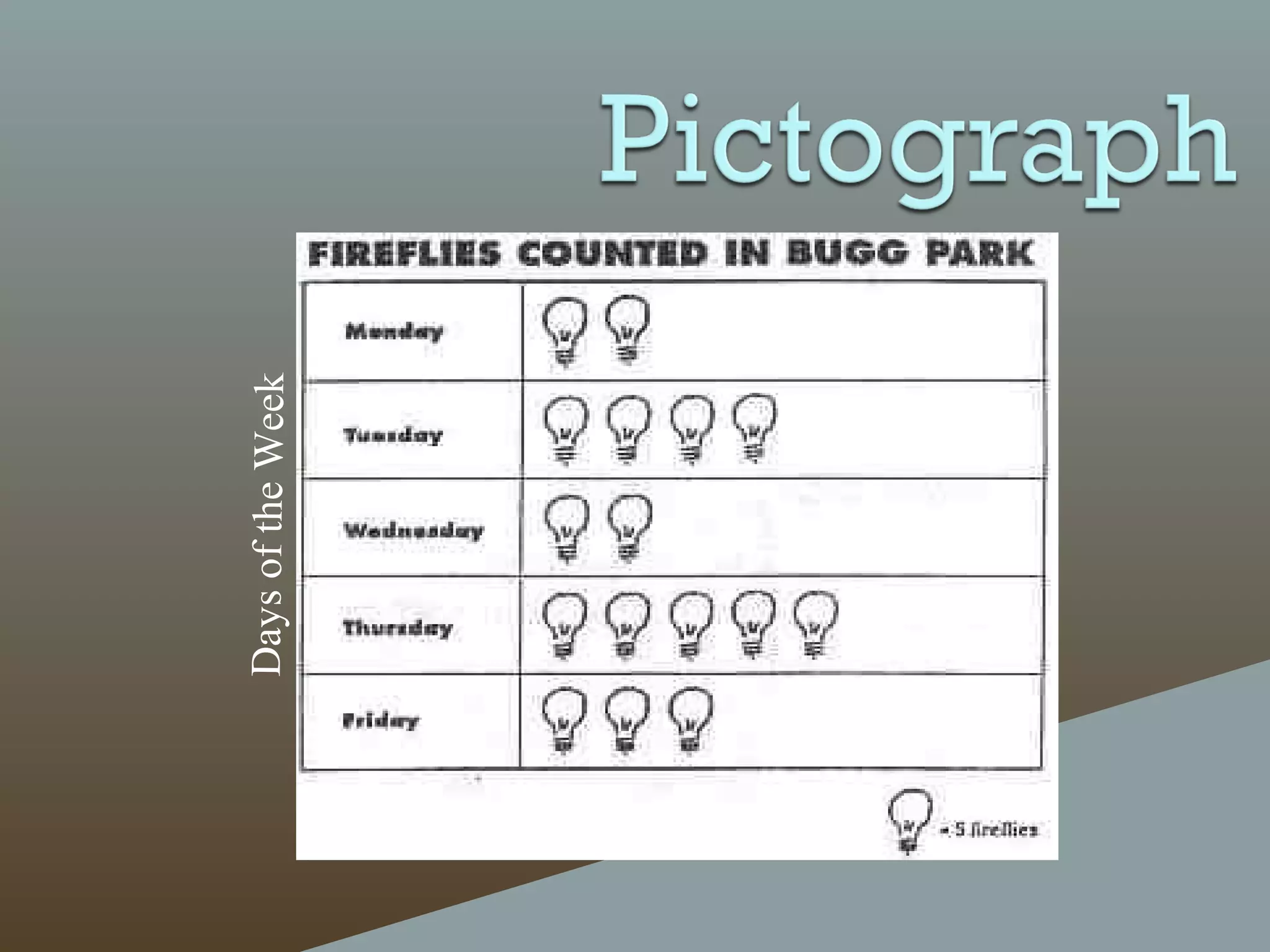
Fireflies
DaysoftheWeek
• All pictographs have a
title.
• Rows and columns
shape the
pictograph.
• Label each row and
column.
• Use pictures to show
the data.
• Each picture equals
a certain amount of
data.
• Pictographs need a
key.
Plant Growth
0
5
10
15
20
Week 1 Week 2 Week 3 Week 4
Weeks
Inches
Light
Dark
Amount of Rainfall
0
1
2
3
4
5
May June July August
Months
Inches
1999
2000
Bar Graph
• The purpose of a
bar graph is to
display and
compare data.
• Bar graphs use bars
to show the data.
• A bar graph must
include:
- a title
- labeled X and Y
axes
- equal intervals are
used on the Y axis
- the bars are evenly
spaced apart from
each other
• A line graph is used to
illustrate change over
time.
• Line graphs need:
- Title
- Labeled X and Y
axes
- Equal Intervals
- Data displayed by
points connected into
lines
Tables, charts and graphs are
convenient ways to clearly
show your data.

Graphs bar line & picto

  • 1.
    GOAL 3: BarGraphs, Line Graphs & Picto-Graphs Tables, charts and graphs are convenient ways to clearly show your data.
  • 2.
    Day Chocolate StrawberryWhite Monday 53 78 126 Tuesday 72 97 87 Wednesday 112 73 86 Thursday 33 78 143 Friday 76 47 162 The cafeteria wanted to collect data on how much milk was sold in 1 week. The table below shows the results. We are going to take this data and display it in 3 different types of graphs.
  • 3.
    Scale / Intervals •Counting by a number is the scale of a graph. Scales can be counting by 2’s, 3’s,4’s, 5’s 10’s … • Intervals should be equal. Like 100, 200, 300 units.
  • 4.
    Bar Graph • Abar graph is used to show relationships between groups. • The two items being compared do not need to affect each other. • It's a fast way to show big differences. Notice how easy it is to read a bar graph. Chocolate Milk Sold 53 72 112 33 76 0 20 40 60 80 100 120 Monday Tuesday Wednesday Thursday Friday Day AmountSold Monday Tuesday Wednesday Thursday Friday
  • 5.
    Line Graph • Aline graph is used to show continuing data; how one thing is affected by another. • It's clear to see how things are going by the rises and falls a line graph shows. Chocolate MIlk Sold 0 20 40 60 80 100 120 Monday Tuesday Wednesday Thursday Friday Day AmountSold Chocolate
  • 6.
    On what daydid they sell the most chocolate milk? Chocolate Milk Sold 53 72 112 33 76 0 20 40 60 80 100 120 Monday Tuesday Wednesday Thursday Friday Day AmountSold Monday Tuesday Wednesday Thursday Friday Wednesday
  • 7.
    Chocolate 0 20 40 60 80 100 120 Monday Tuesday WednesdayThursday Friday Day AmountSold Chocolate On what day did they have a drop in chocolate milk sales? Thursday
  • 8.
    Choosing the RightGraph • Use a bar graph if you are not looking for trends (or patterns) over time; and the items (or categories) are not parts of a whole. • Use a line graph if you need to see how a quantity has changed over time.  Line graphs enable us to find trends (or patterns) over time.
  • 9.
  • 10.
    • All pictographshave a title. • Rows and columns shape the pictograph. • Label each row and column. • Use pictures to show the data. • Each picture equals a certain amount of data. • Pictographs need a key.
  • 11.
    Plant Growth 0 5 10 15 20 Week 1Week 2 Week 3 Week 4 Weeks Inches Light Dark
  • 12.
    Amount of Rainfall 0 1 2 3 4 5 MayJune July August Months Inches 1999 2000
  • 13.
    Bar Graph • Thepurpose of a bar graph is to display and compare data. • Bar graphs use bars to show the data. • A bar graph must include: - a title - labeled X and Y axes - equal intervals are used on the Y axis - the bars are evenly spaced apart from each other
  • 14.
    • A linegraph is used to illustrate change over time. • Line graphs need: - Title - Labeled X and Y axes - Equal Intervals - Data displayed by points connected into lines
  • 15.
    Tables, charts andgraphs are convenient ways to clearly show your data.