MICROSOFT TEST MANAGER
2013
Why MTM?
• Test Tool
• Different test types
– Manual/scripted
– Exploratory
– Automated (CodedUI/Unit tests)
• Integration
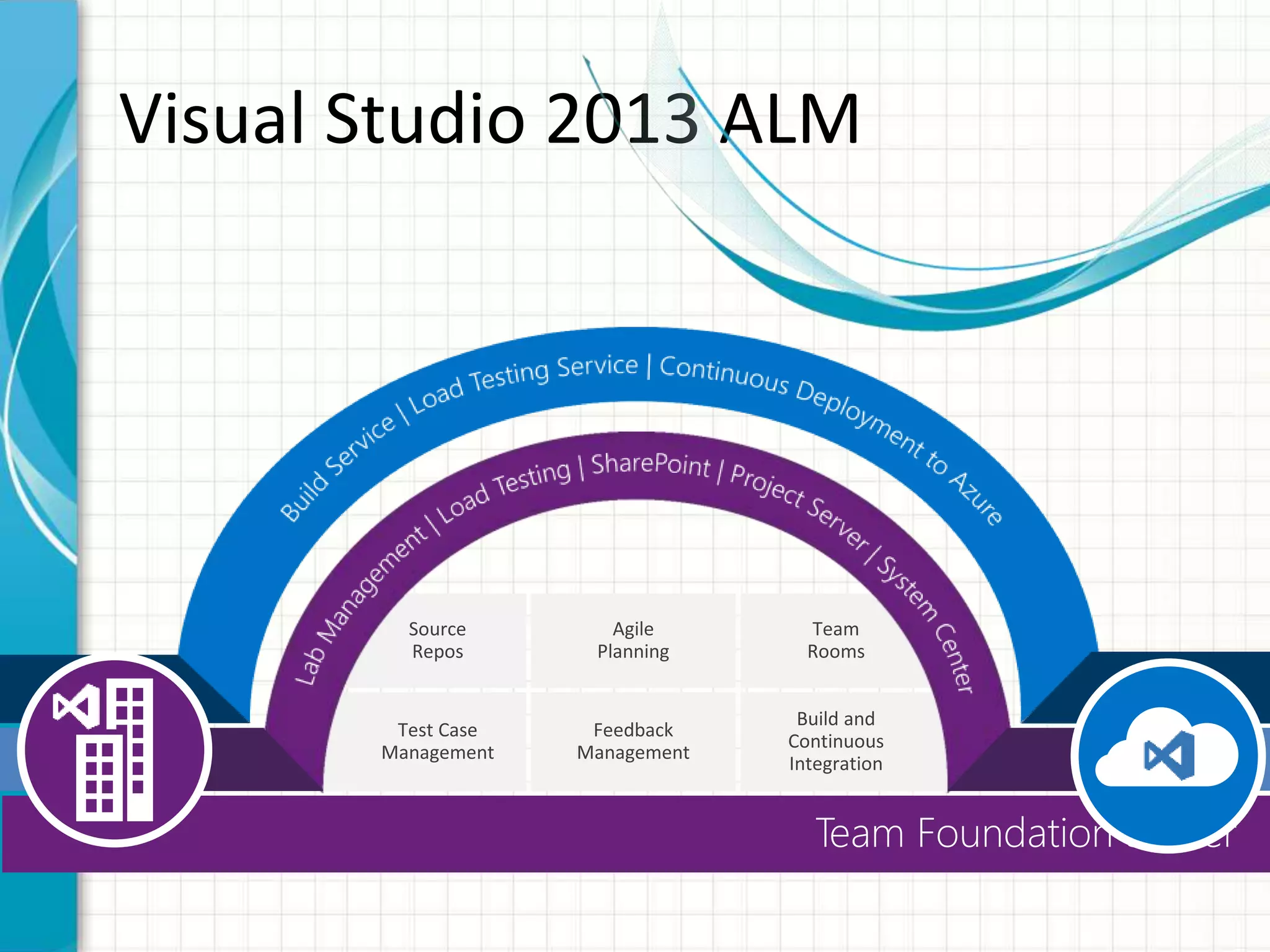
Visual Studio 2013 ALM
Resources
• Visual Studio 2013 Ultimate/Premium/Test
Professional
• TFS
• Visual Studio Online
• Brian Keller http://aka.ms/almvms
Agenda
Test Planning
Test Case
Management
Test Run
Exploratory
Testing
Lab
Management
Ready?
TEST
PLANNING
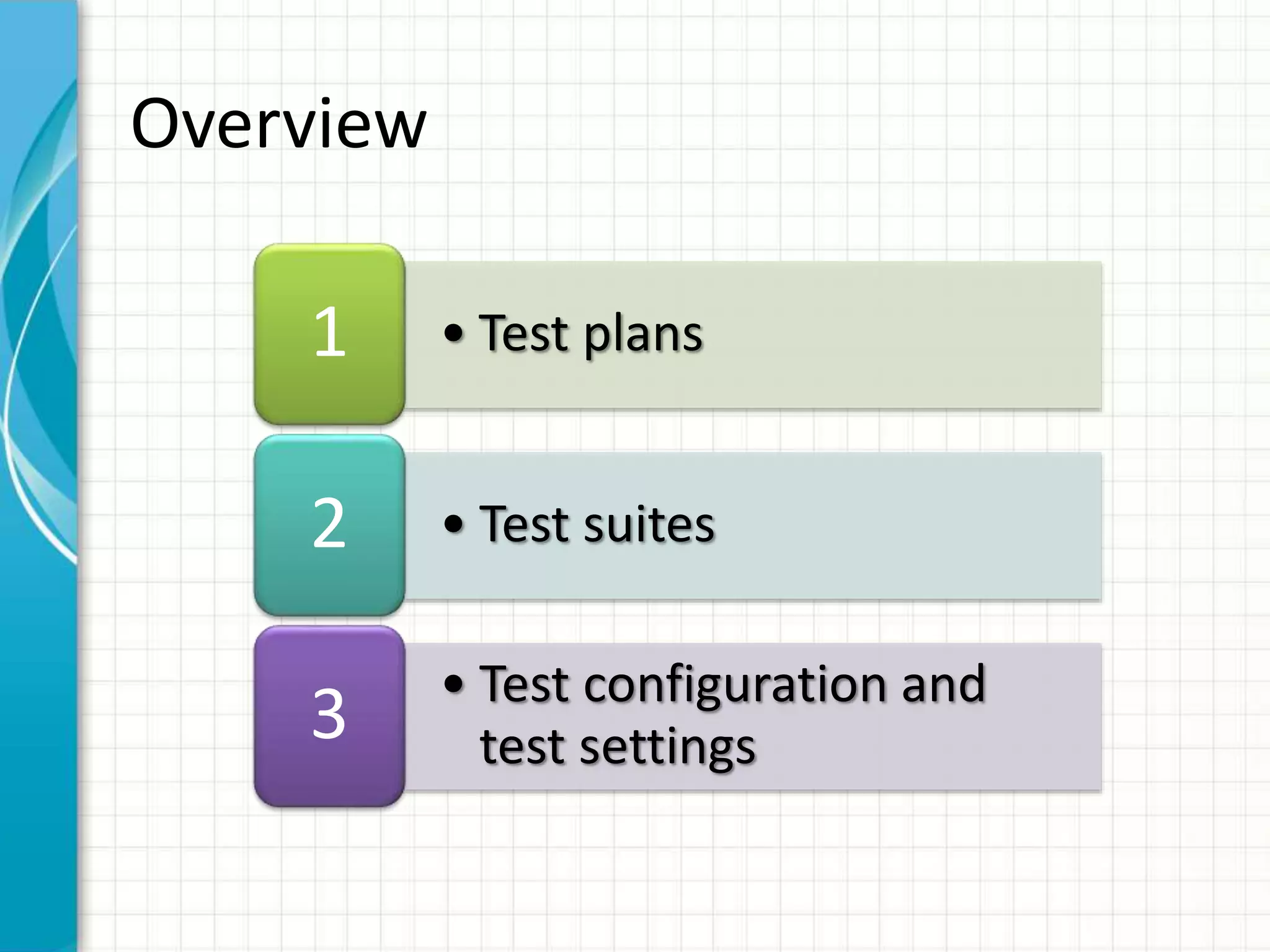
• Test plans1
• Test suites2
• Test configuration and
test settings3
Overview
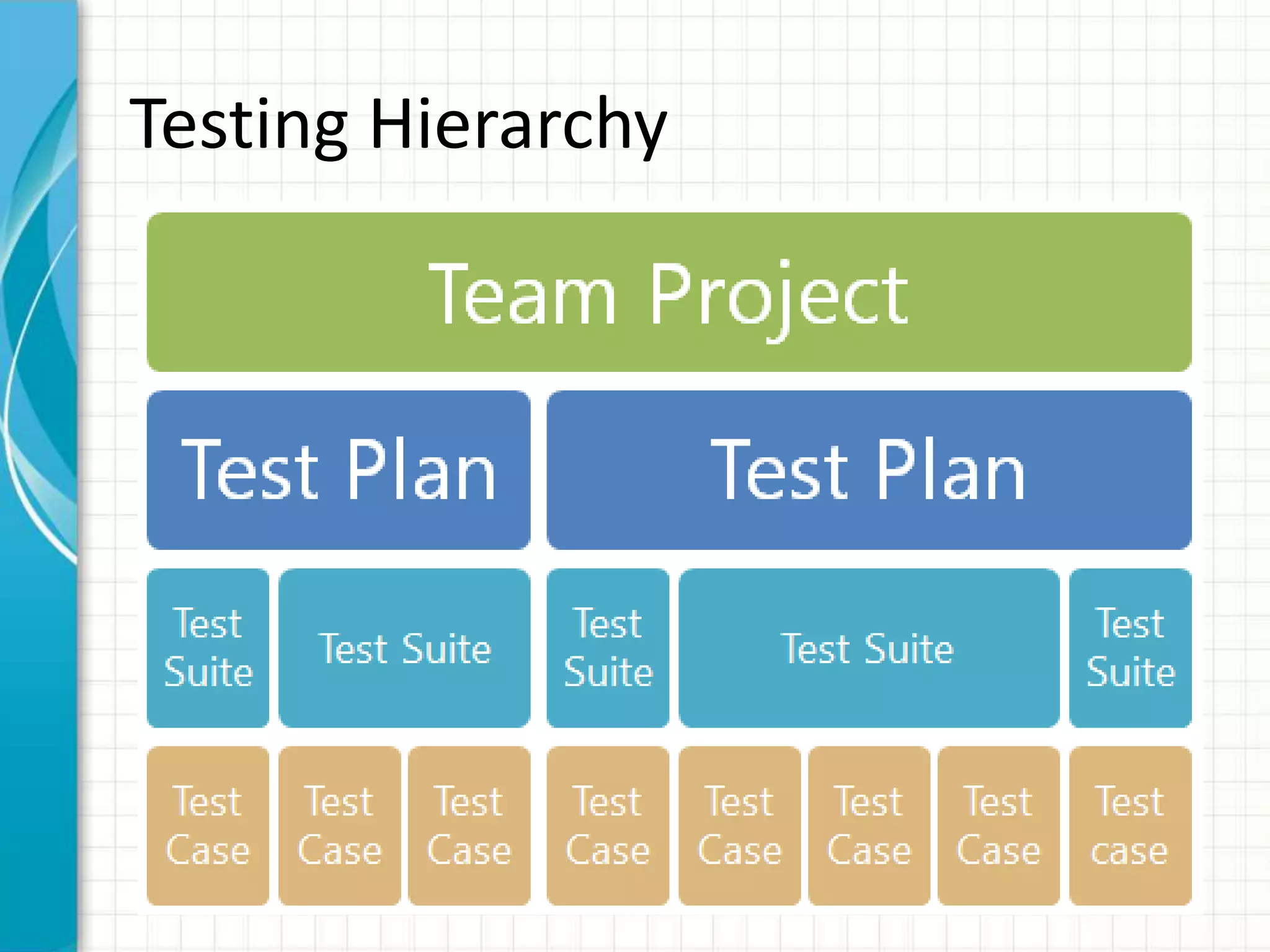
Testing Hierarchy
TEST PLAN
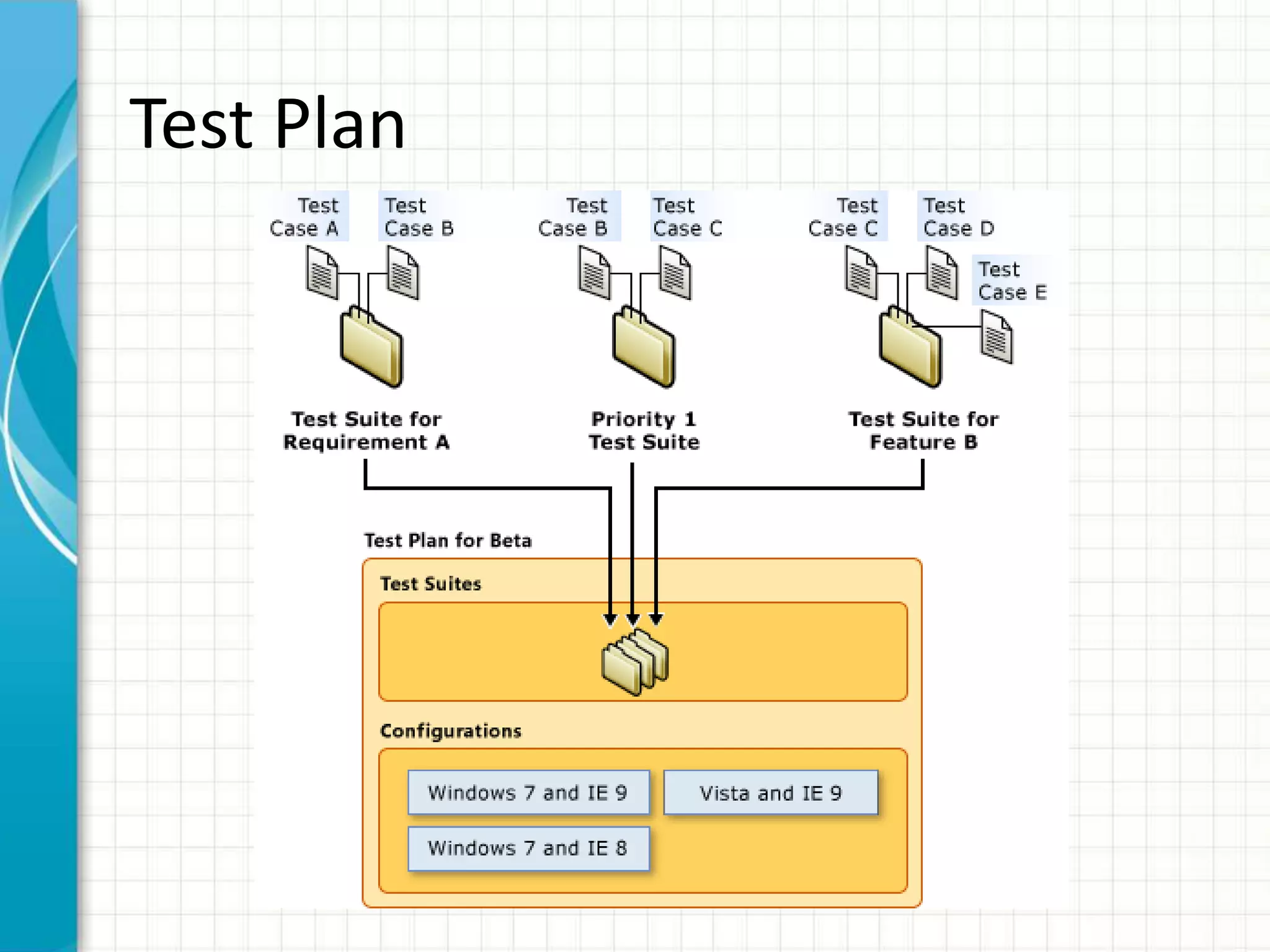
Test Plan
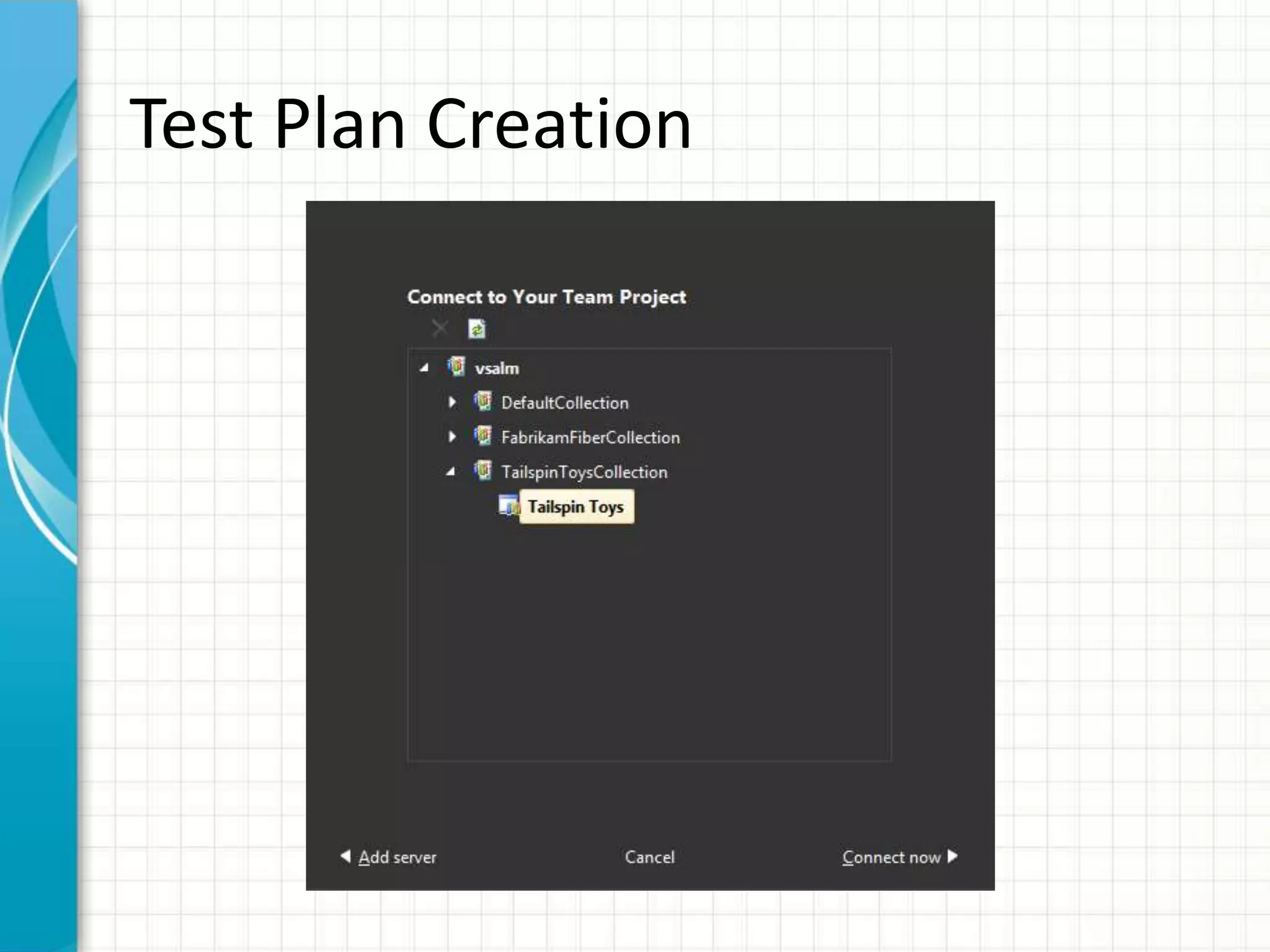
Test Plan Creation
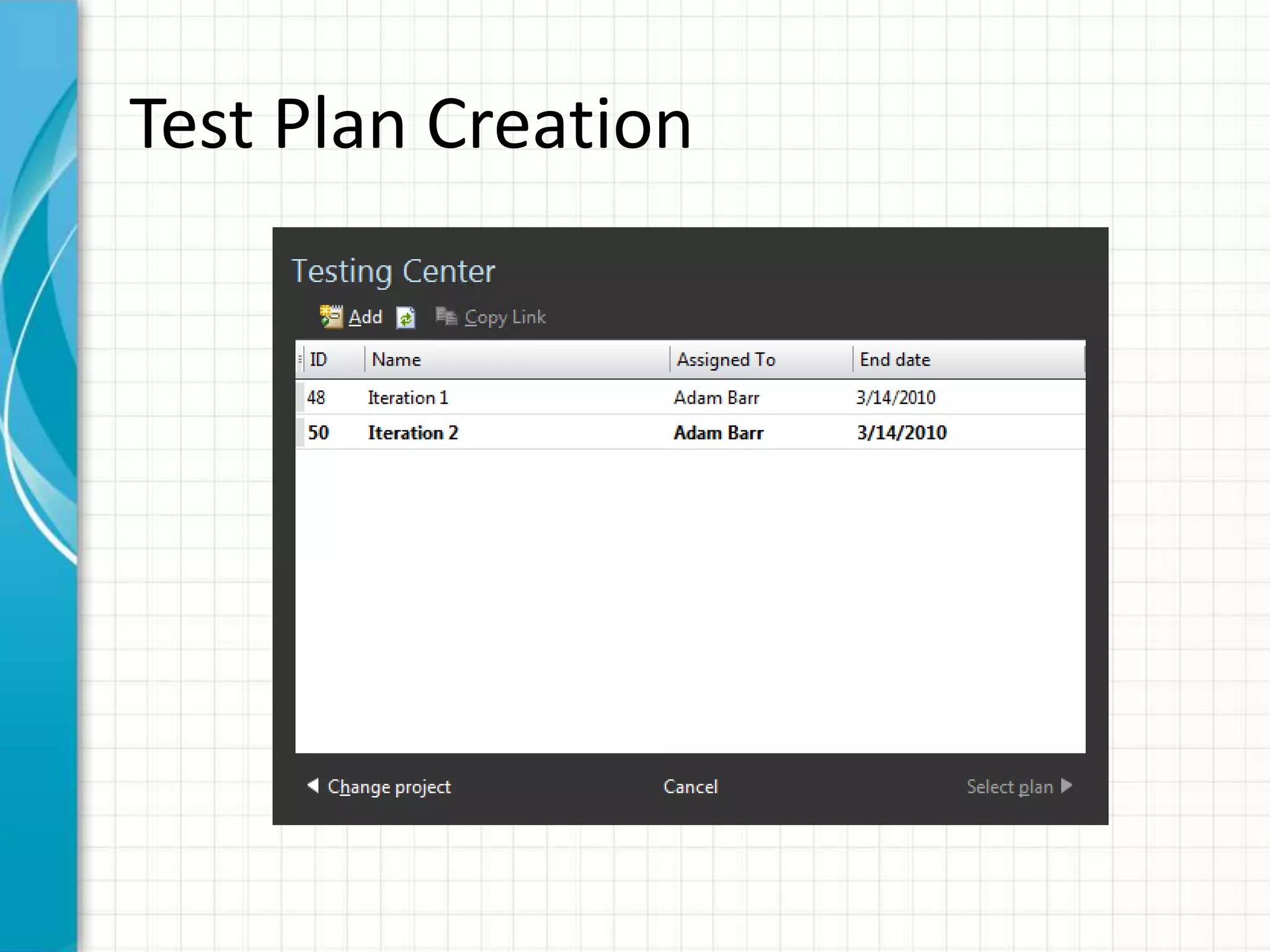
Test Plan Creation
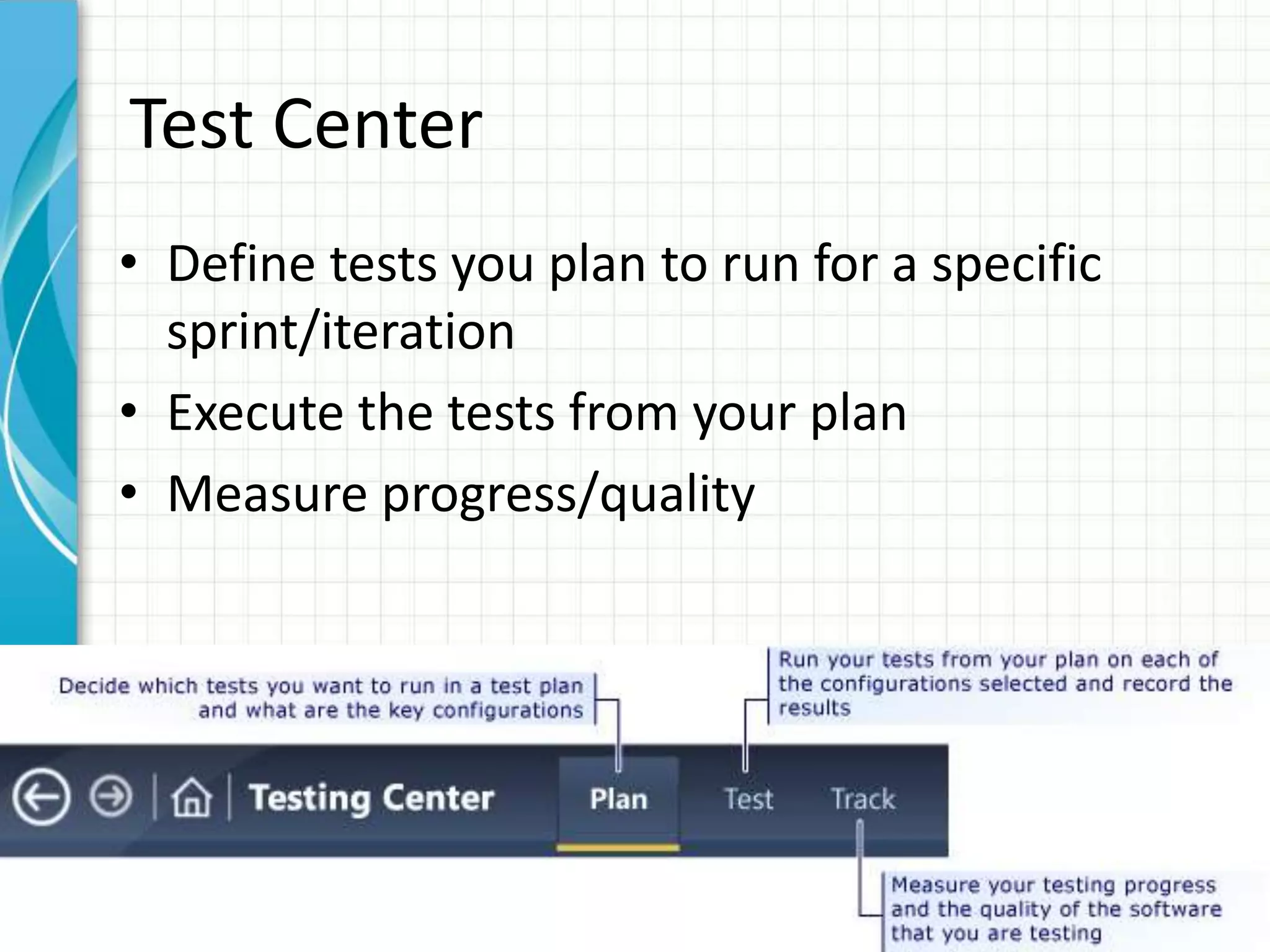
Test Center
• Define tests you plan to run for a specific
sprint/iteration
• Execute the tests from your plan
• Measure progress/quality
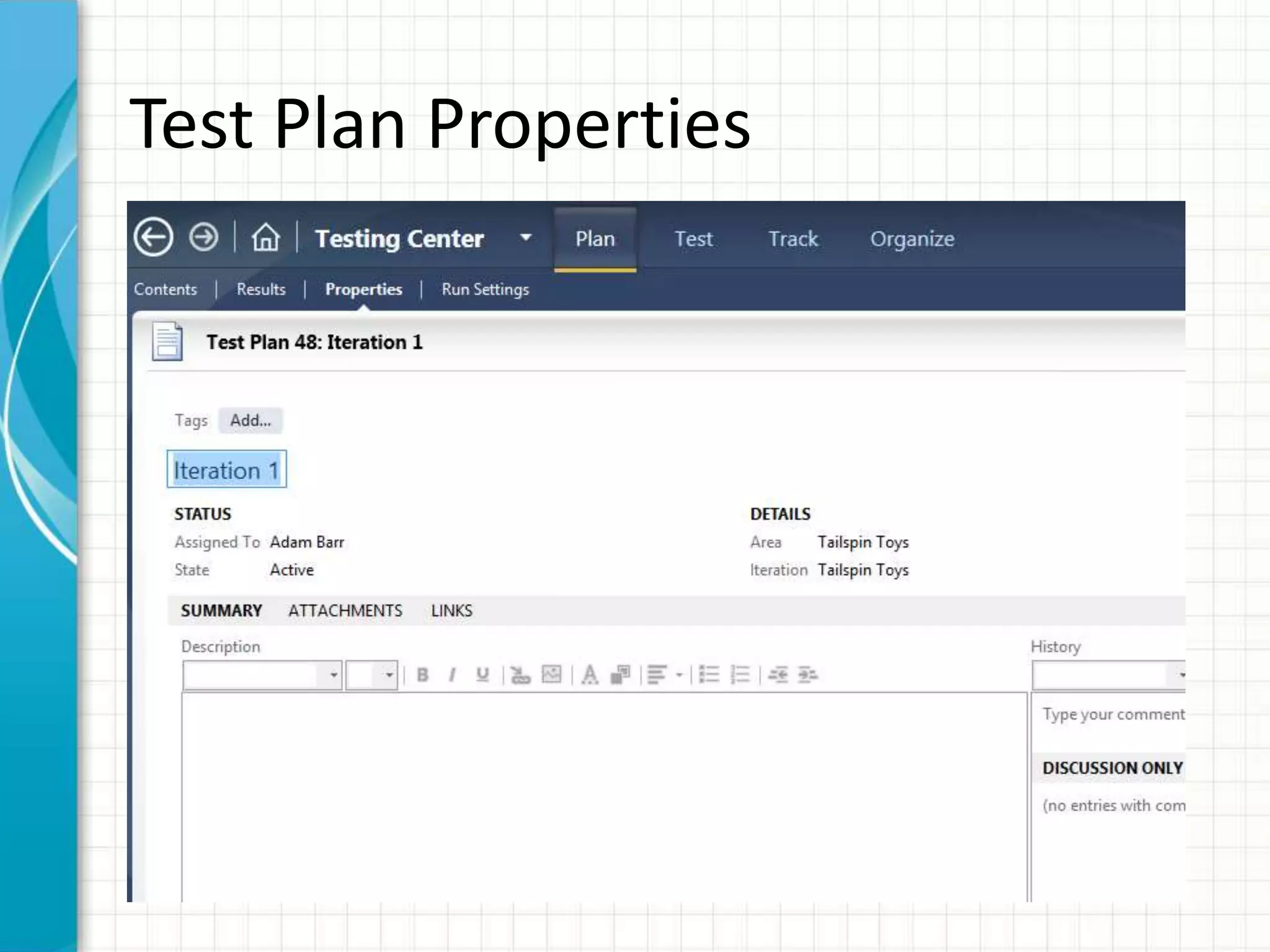
Test Plan Properties
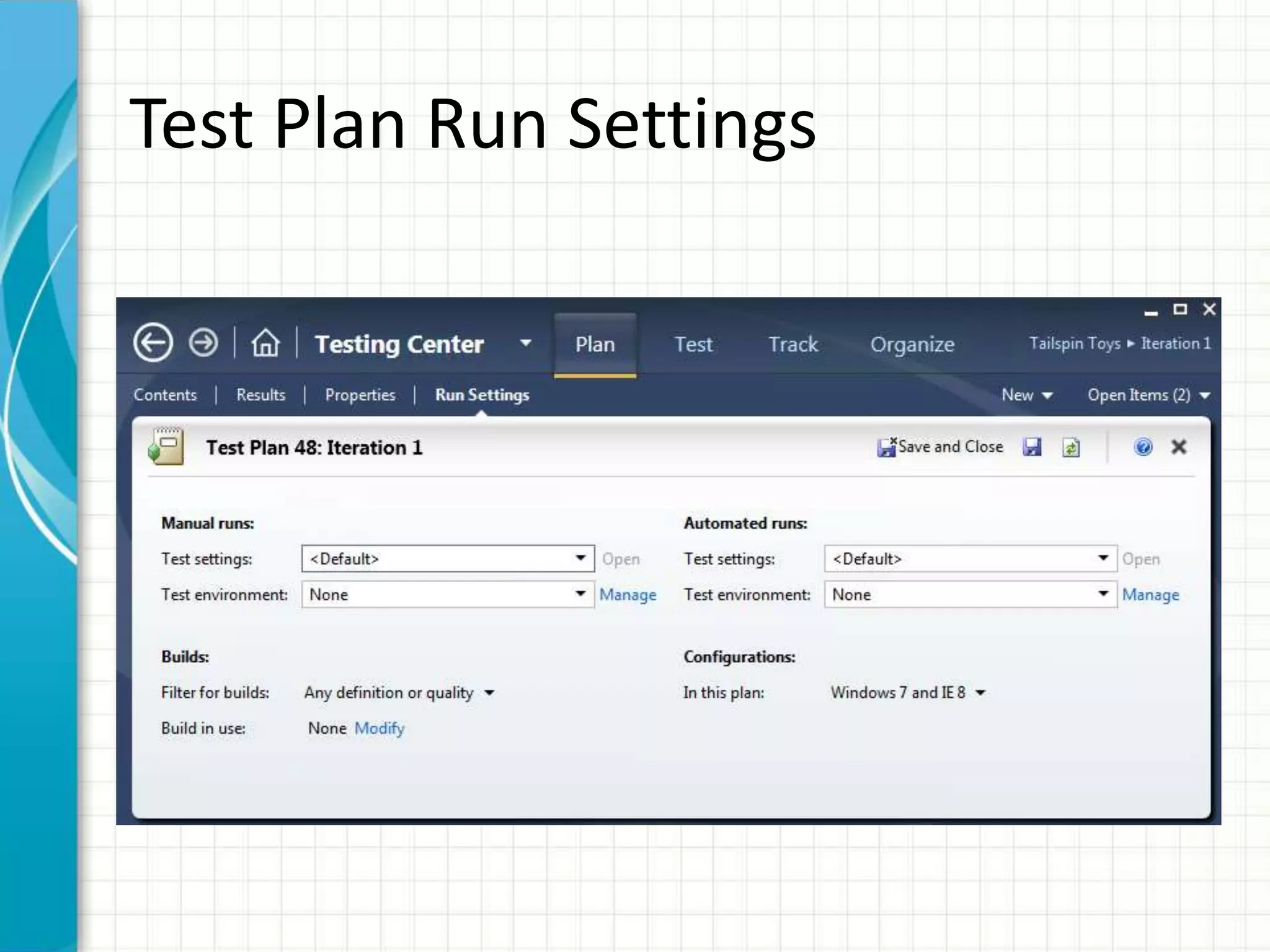
Test Plan Run Settings
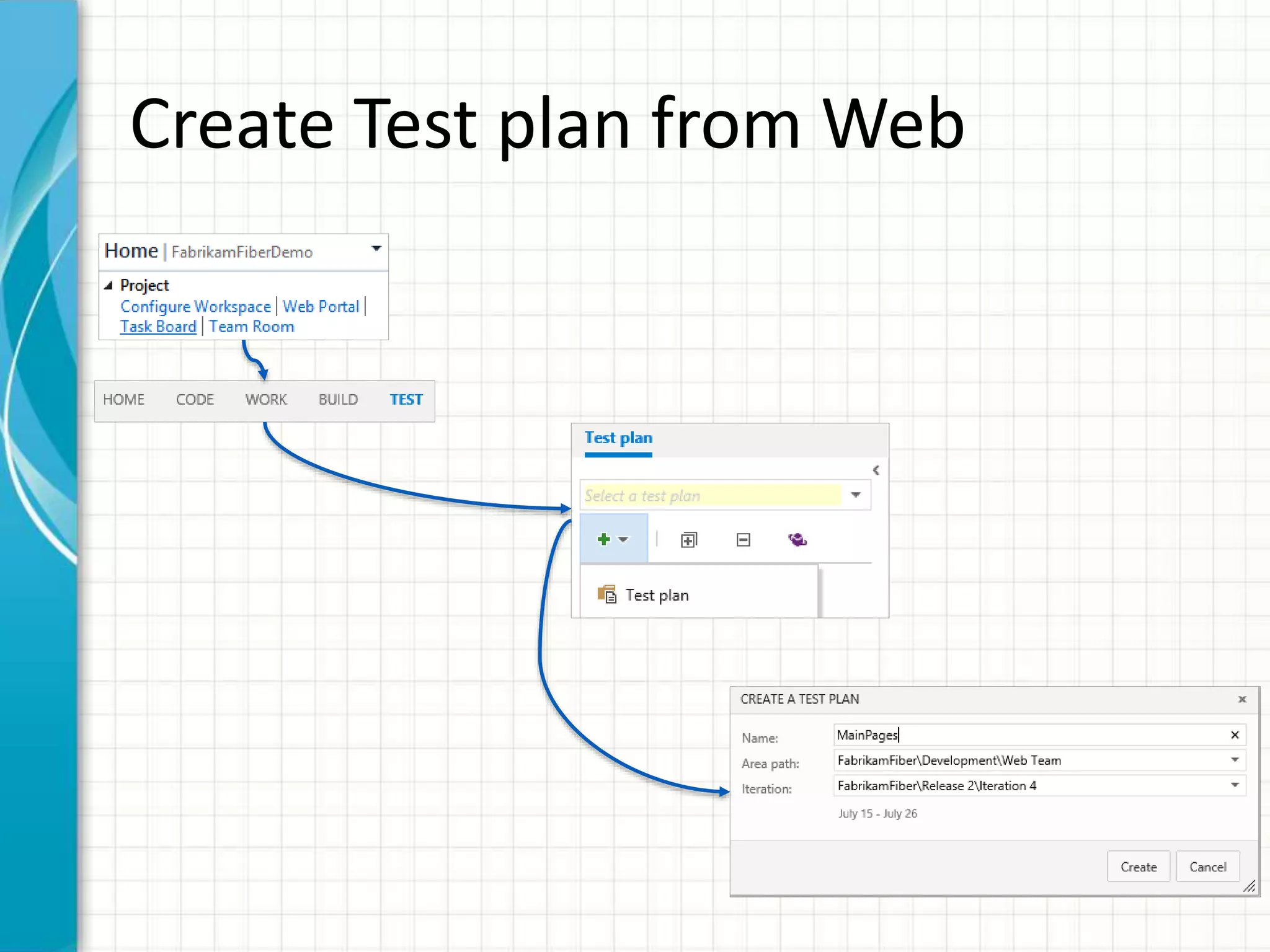
Create Test plan from Web
TEST PLAN - DEMO
TEST PLAN - SUITES
Test Suites Overview
• Test Suites
• Static Test Suites
• Query-based Test Suites
• Requirement-based Test Suites
• Copying Test Suites
• Cloning Test Suites
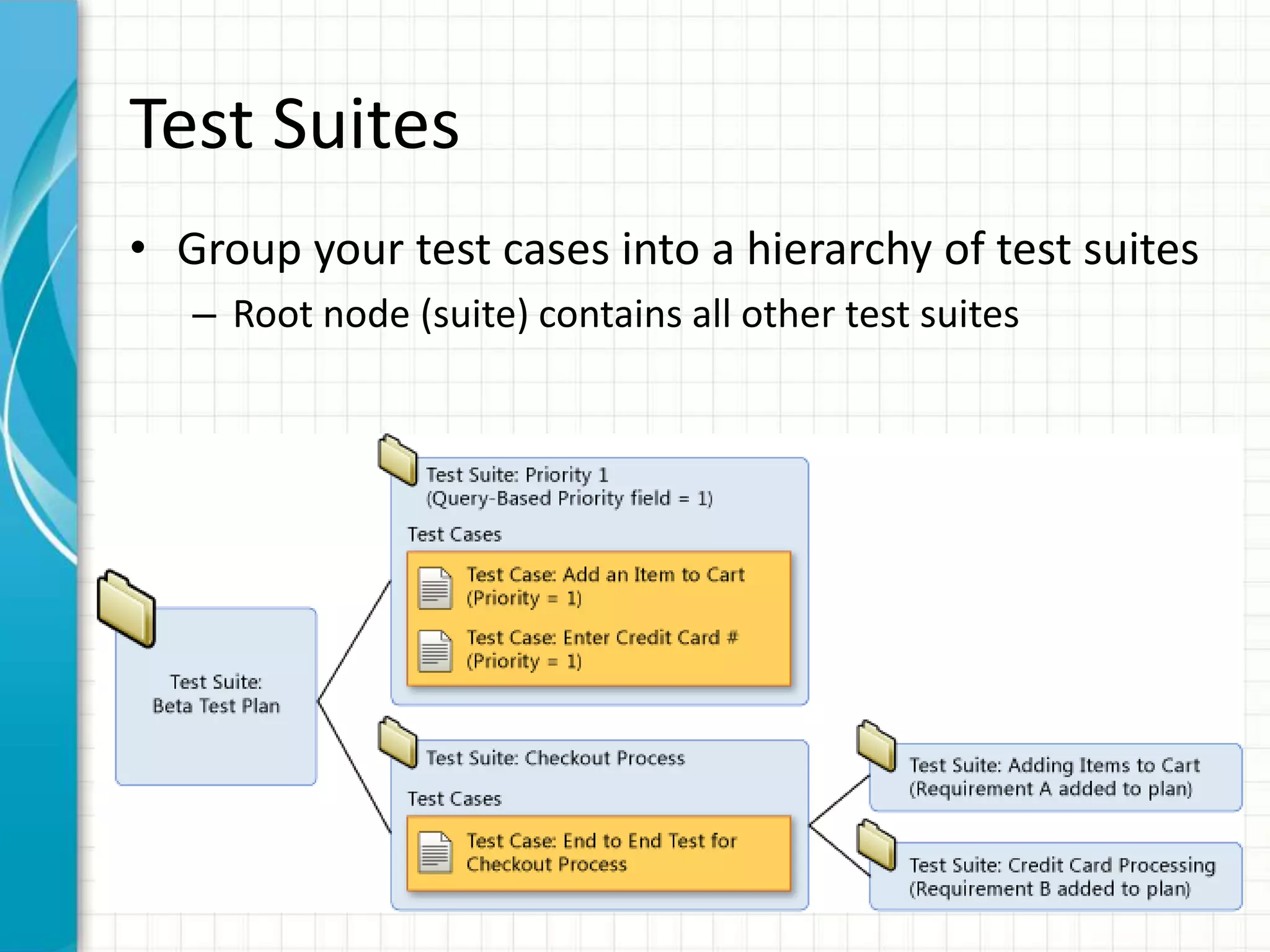
Test Suites
• Group your test cases into a hierarchy of test suites
– Root node (suite) contains all other test suites
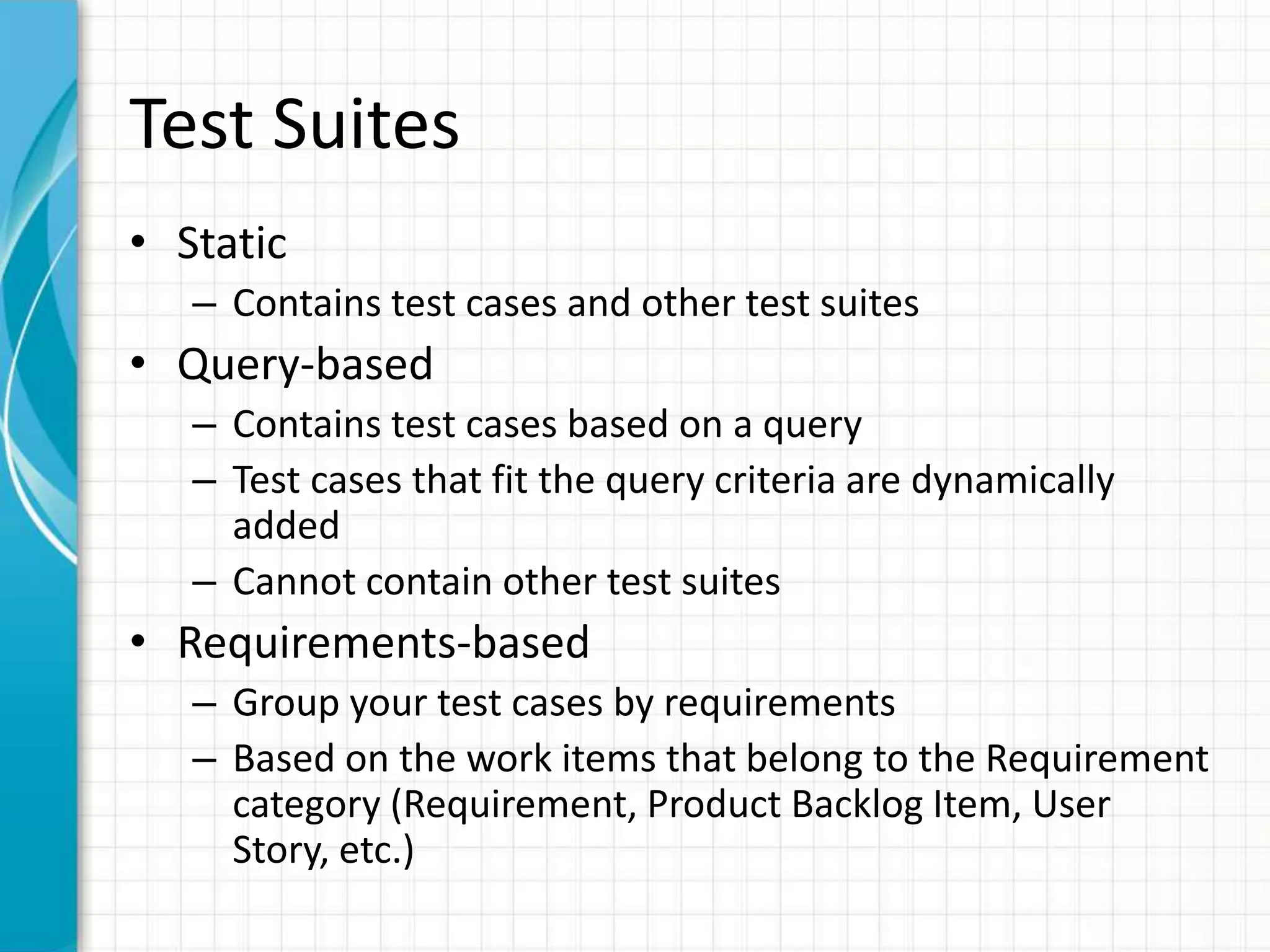
Test Suites
• Static
– Contains test cases and other test suites
• Query-based
– Contains test cases based on a query
– Test cases that fit the query criteria are dynamically
added
– Cannot contain other test suites
• Requirements-based
– Group your test cases by requirements
– Based on the work items that belong to the Requirement
category (Requirement, Product Backlog Item, User
Story, etc.)
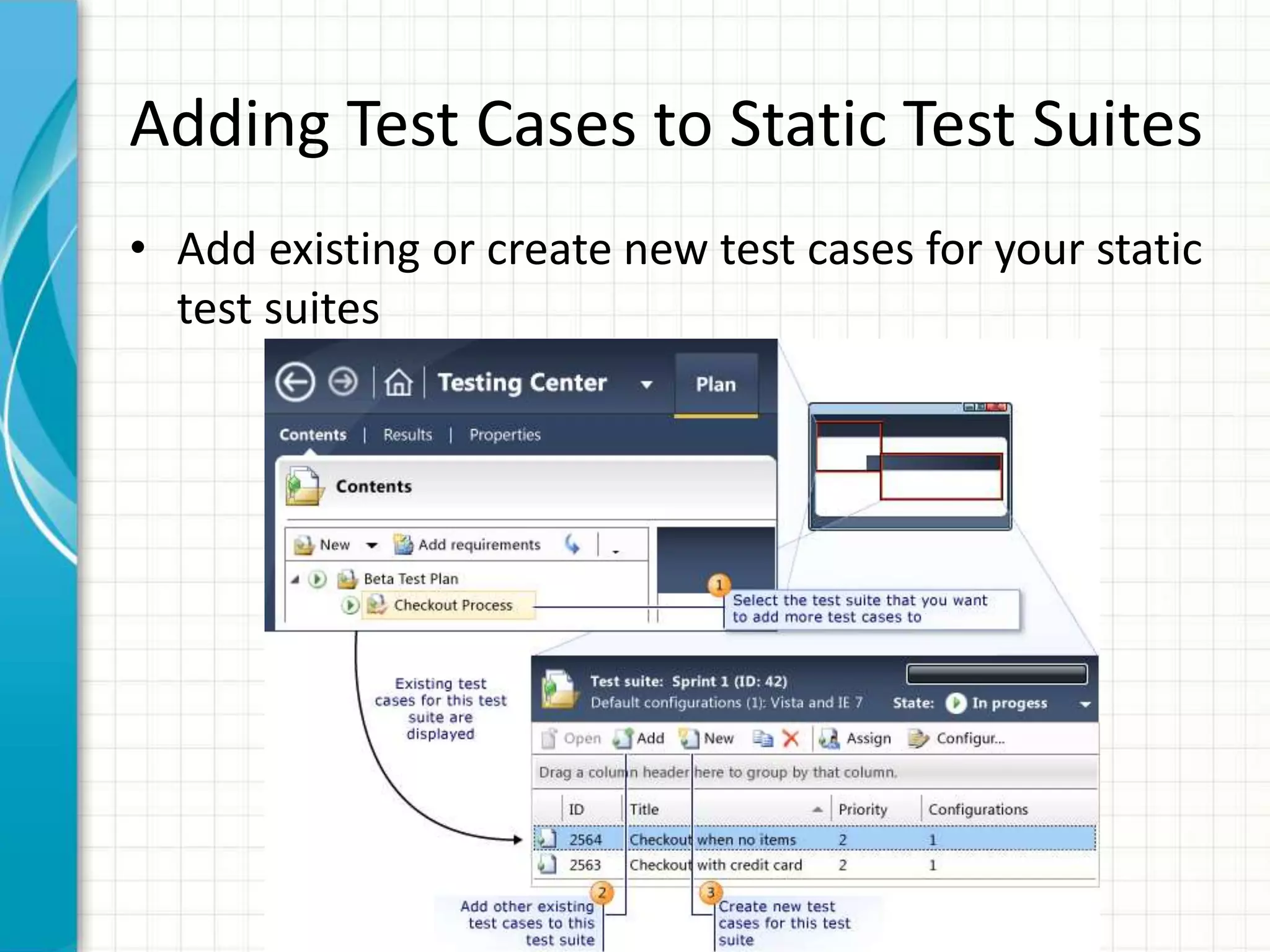
Adding Test Cases to Static Test Suites
• Add existing or create new test cases for your static
test suites
Query-Based Test Suites
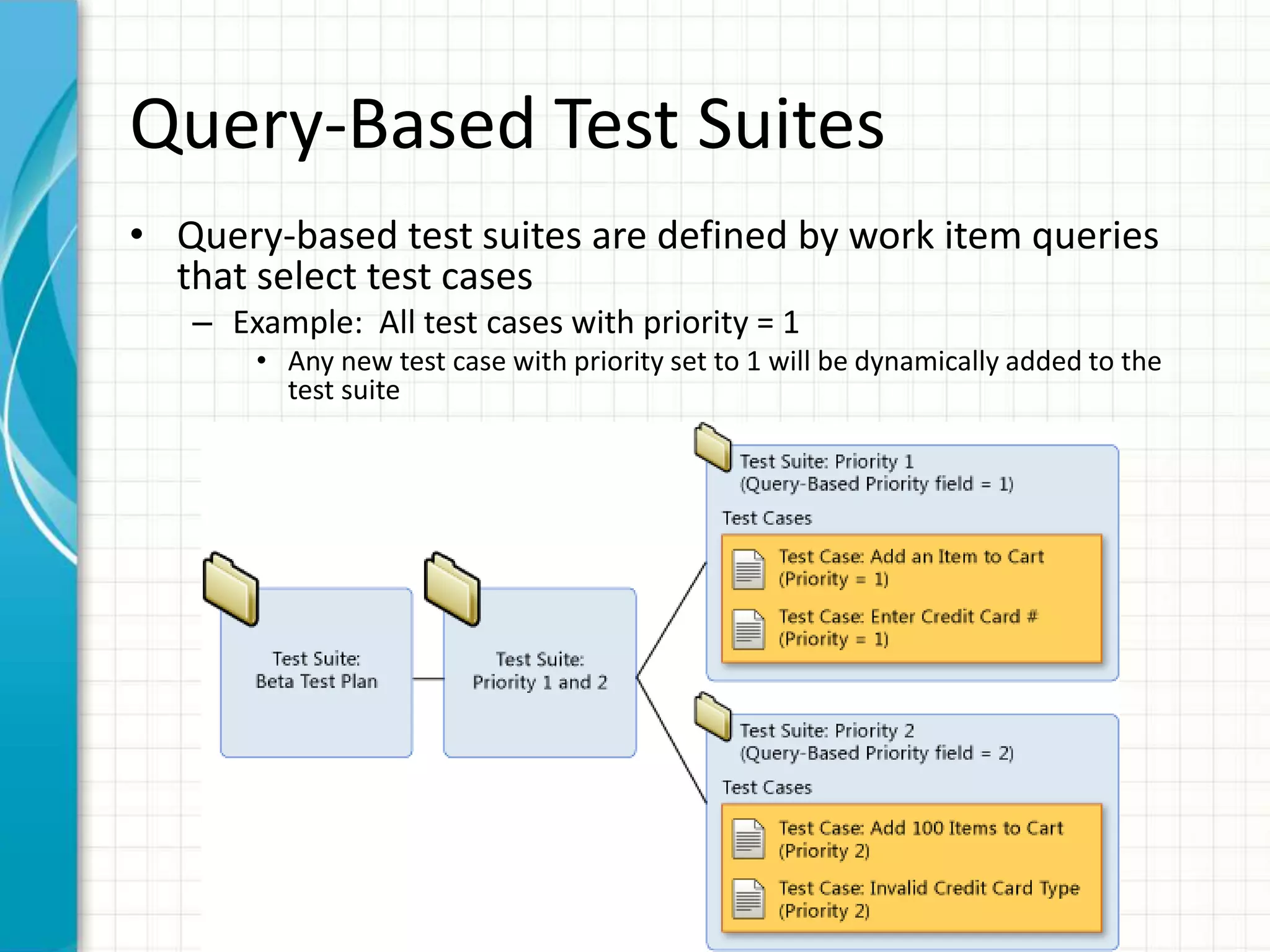
• Query-based test suites are defined by work item queries
that select test cases
– Example: All test cases with priority = 1
• Any new test case with priority set to 1 will be dynamically added to the
test suite
Requirement-Based Test Suites
• Add existing requirement (work item) to your test
plan to create test suite
• Each requirement has its own suite
• Test cases added are linked to requirements
• Helps to determine test coverage and completion
of your requirements
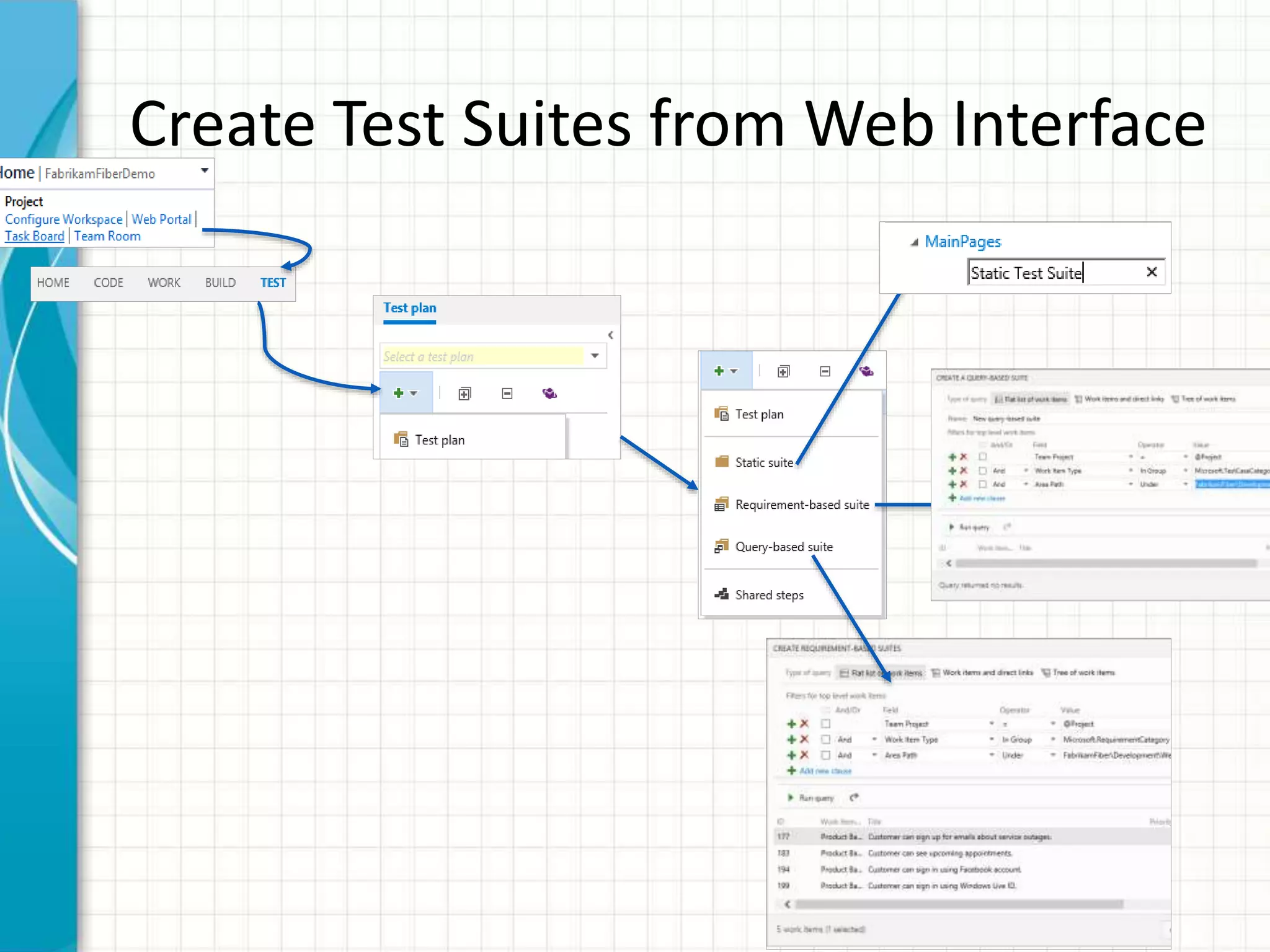
Create Test Suites from Web Interface
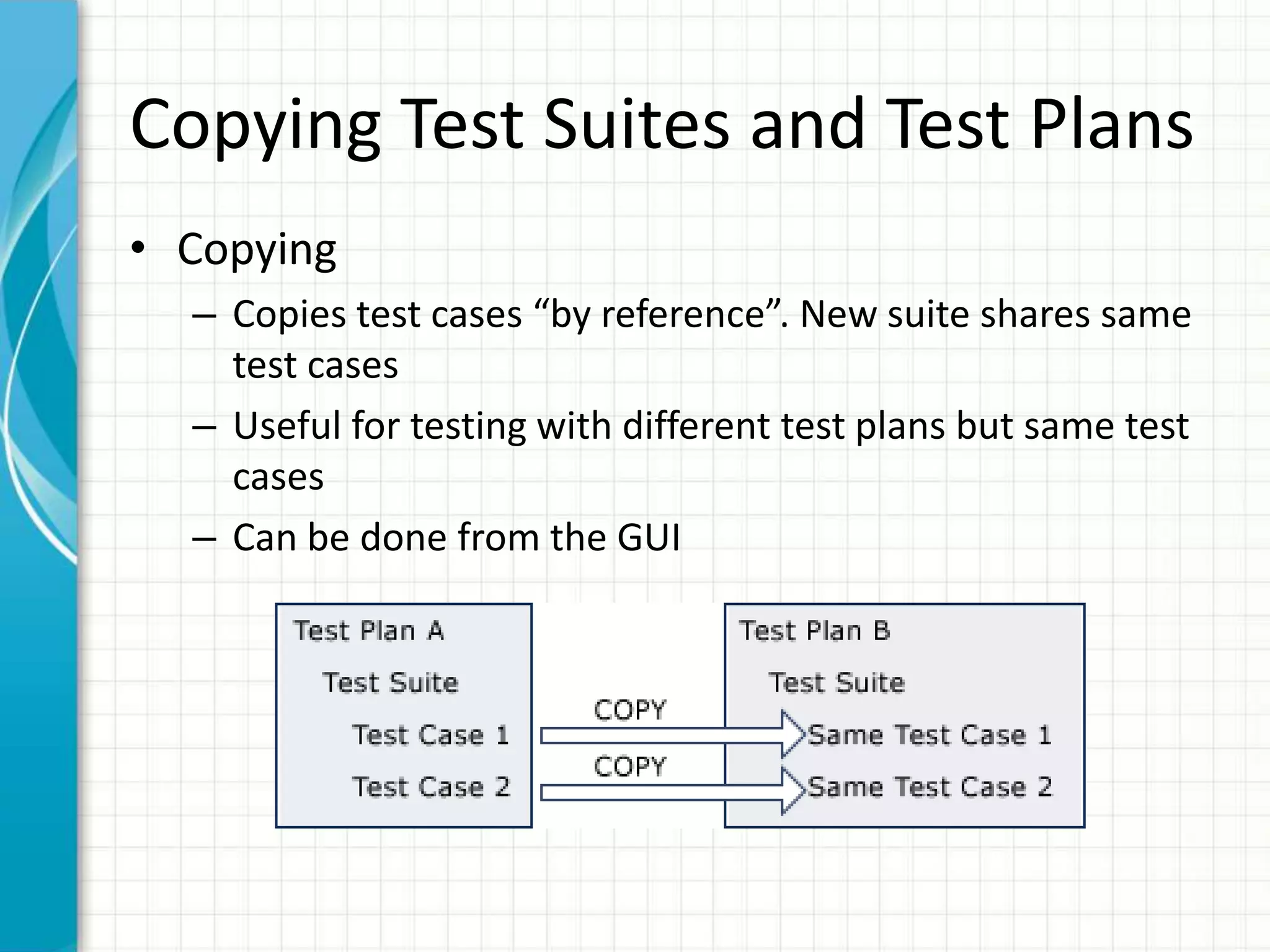
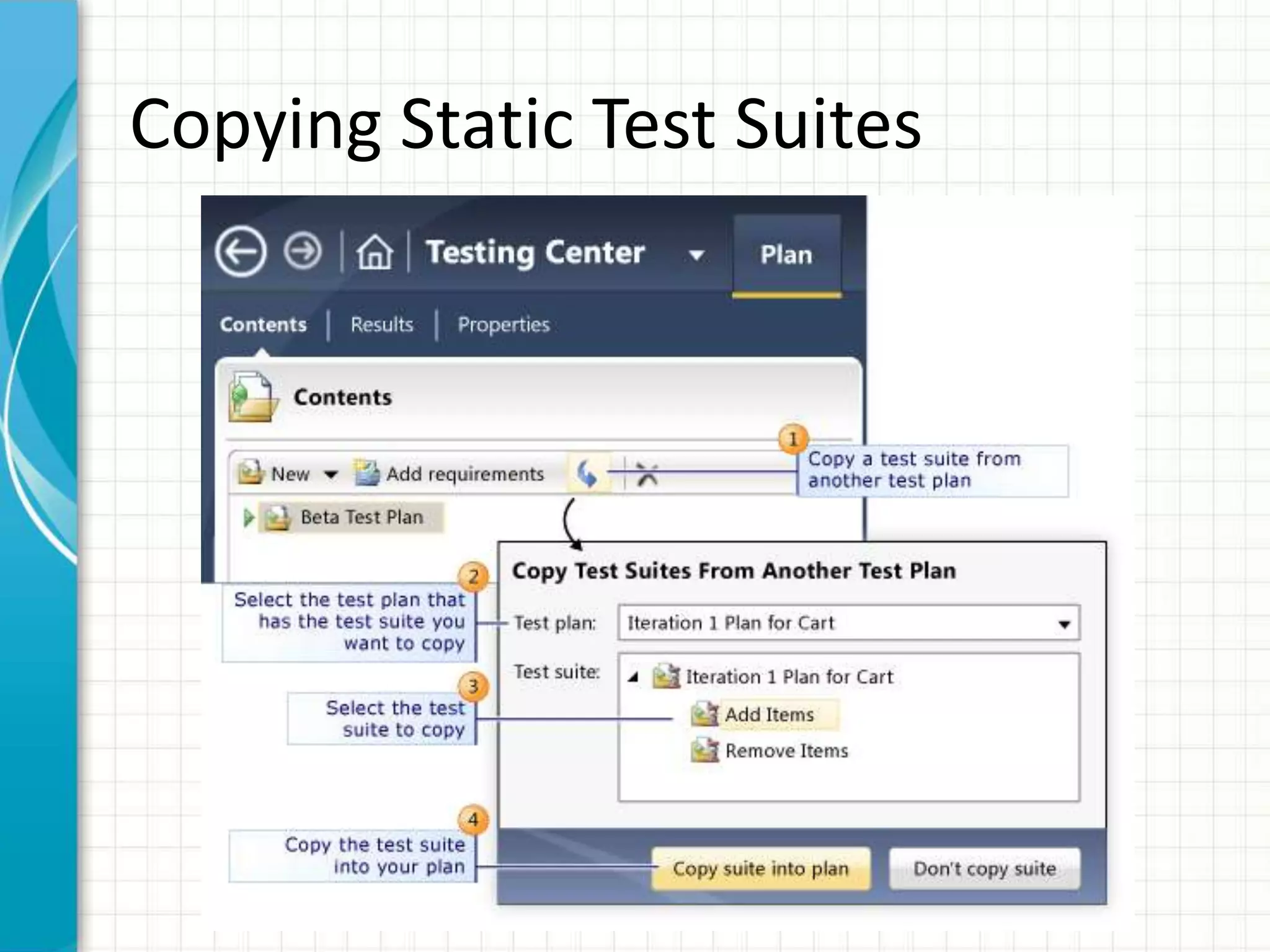
Copying Test Suites and Test Plans
• Copying
– Copies test cases “by reference”. New suite shares same
test cases
– Useful for testing with different test plans but same test
cases
– Can be done from the GUI
Copying Static Test Suites
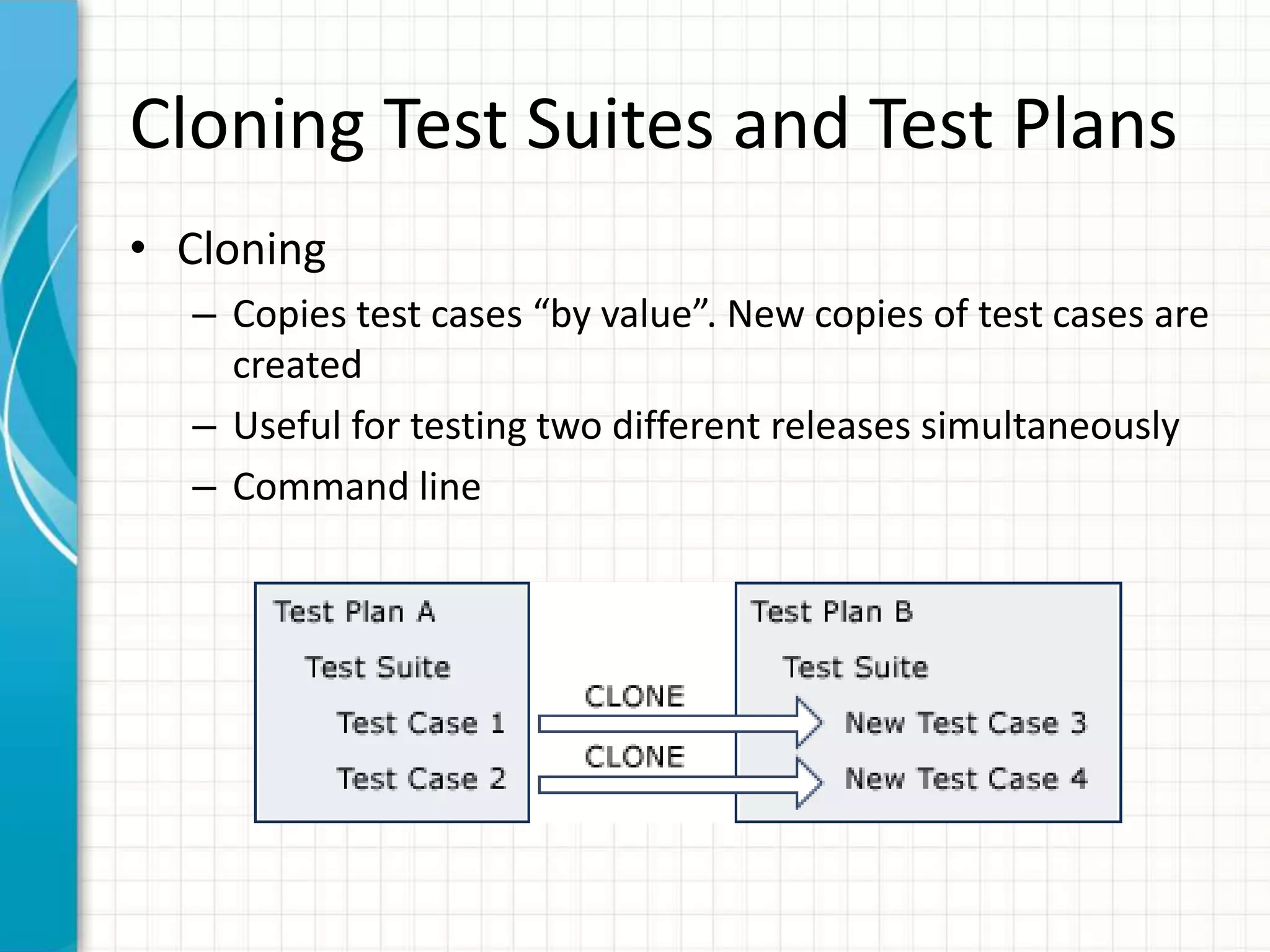
Cloning Test Suites and Test Plans
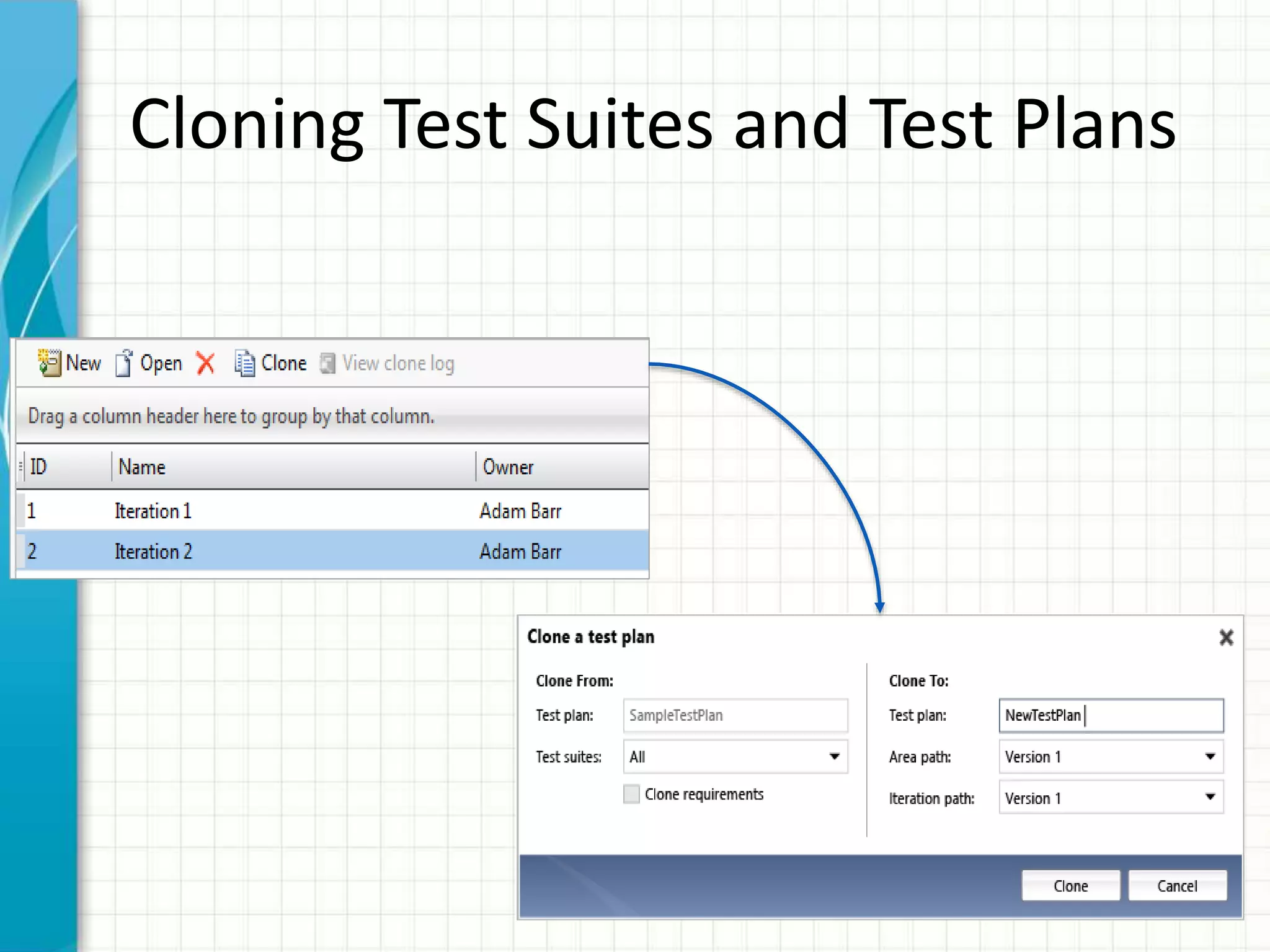
• Cloning
– Copies test cases “by value”. New copies of test cases are
created
– Useful for testing two different releases simultaneously
– Command line
Cloning Test Suites and Test Plans
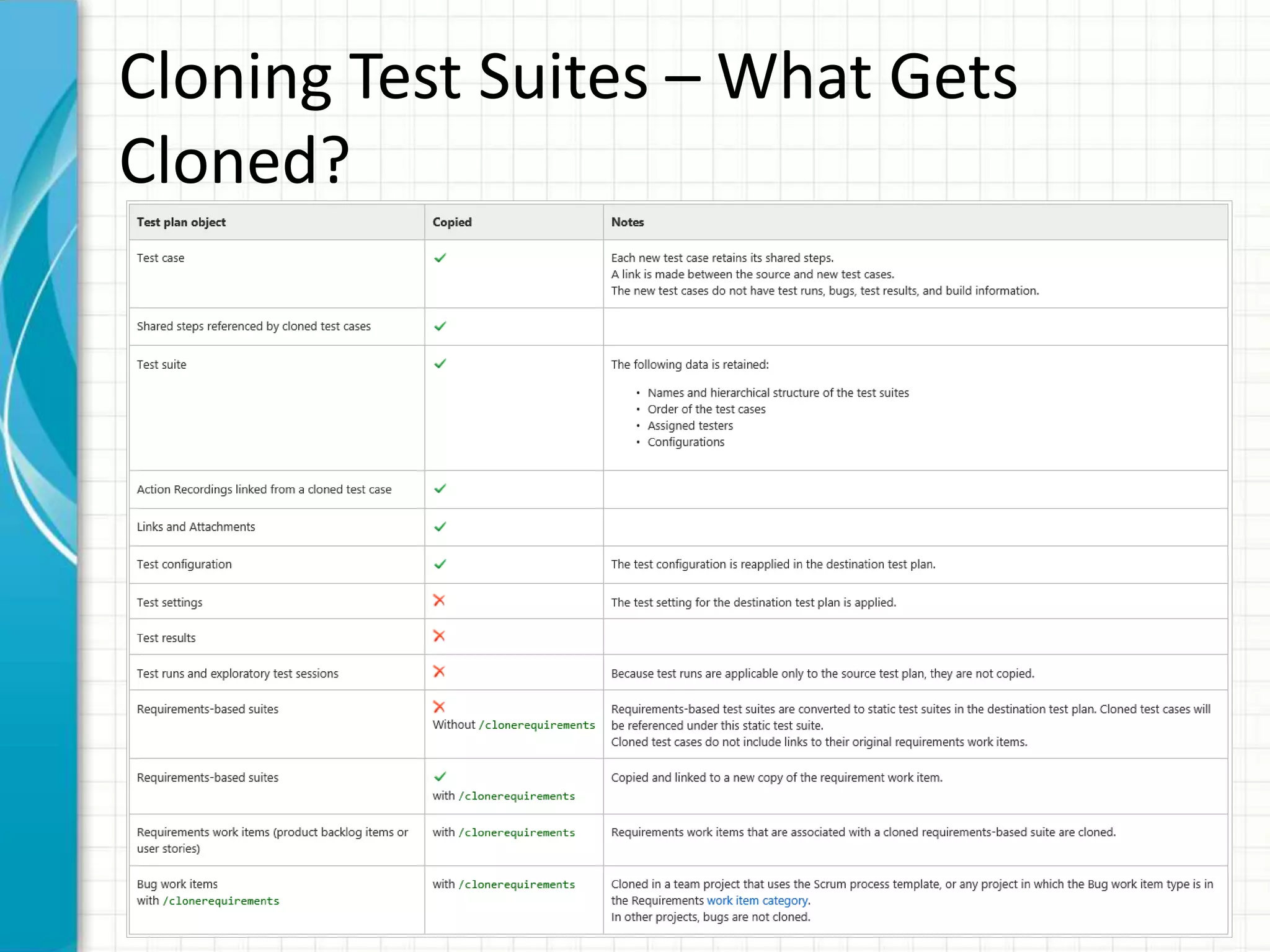
Cloning Test Suites – What Gets
Cloned?
TEST SUITES - DEMO
TEST CONFIGURATION
AND TEST SETTINGS
Test Configuration and Settings Overview
• Test Configurations
• Creating Test Configurations
• Defining Configuration Variables
• Selecting Test Configurations
• Test Settings
• Data Adapters
• How to Collect Data
Test Configurations
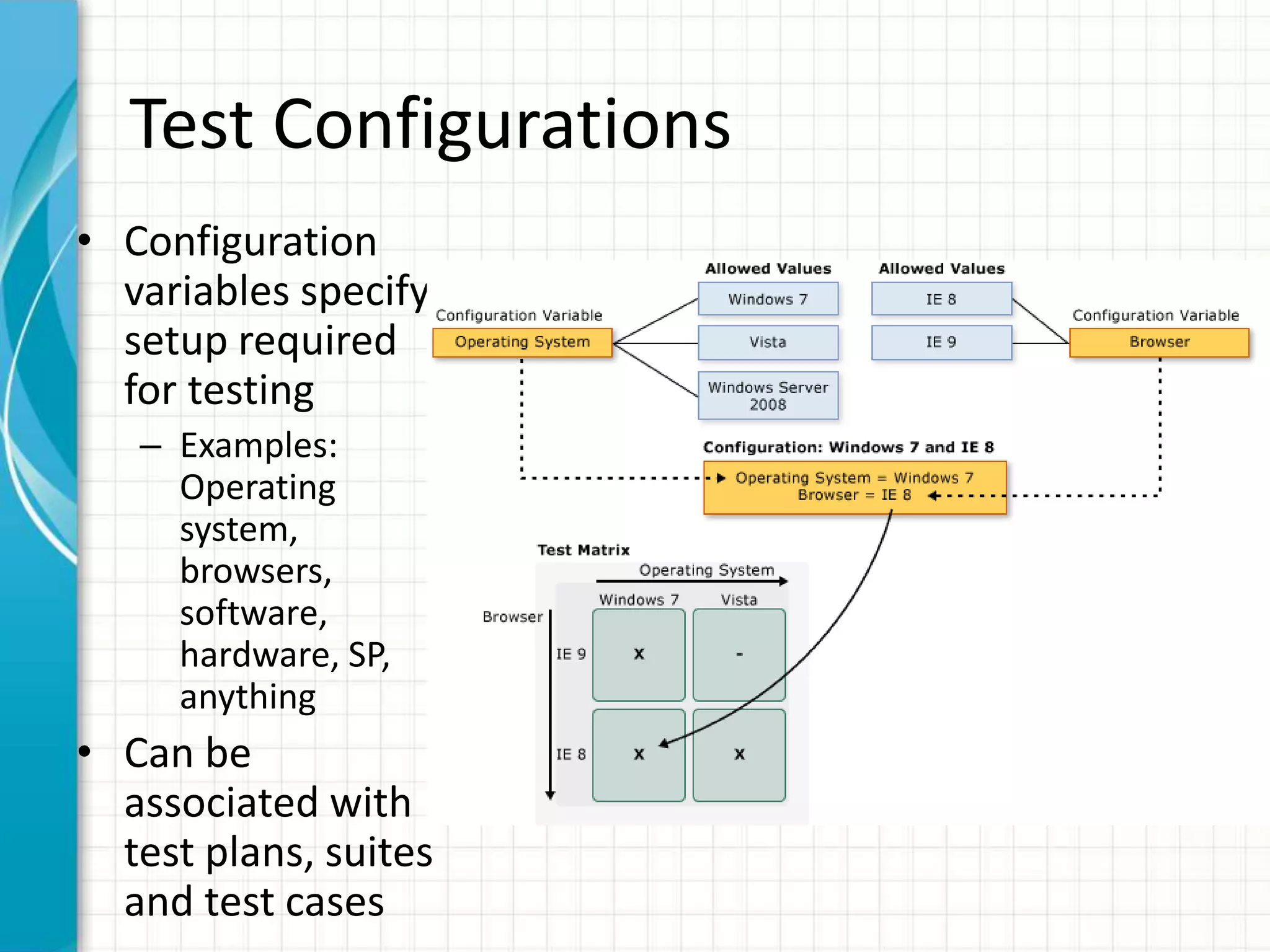
• Configuration
variables specify
setup required
for testing
– Examples:
Operating
system,
browsers,
software,
hardware, SP,
anything
• Can be
associated with
test plans, suites
and test cases
Create Test Configurations
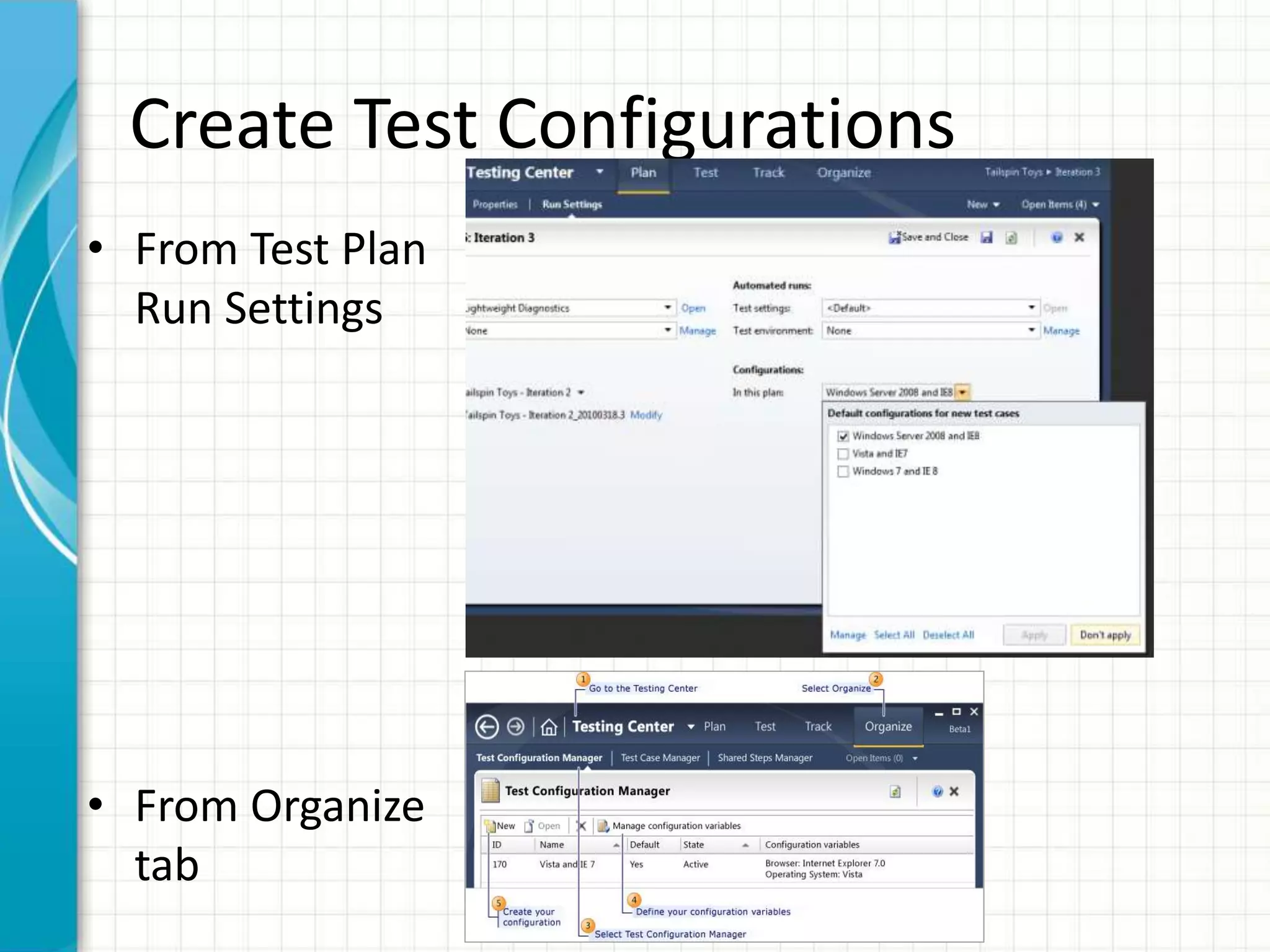
• From Test Plan
Run Settings
• From Organize
tab
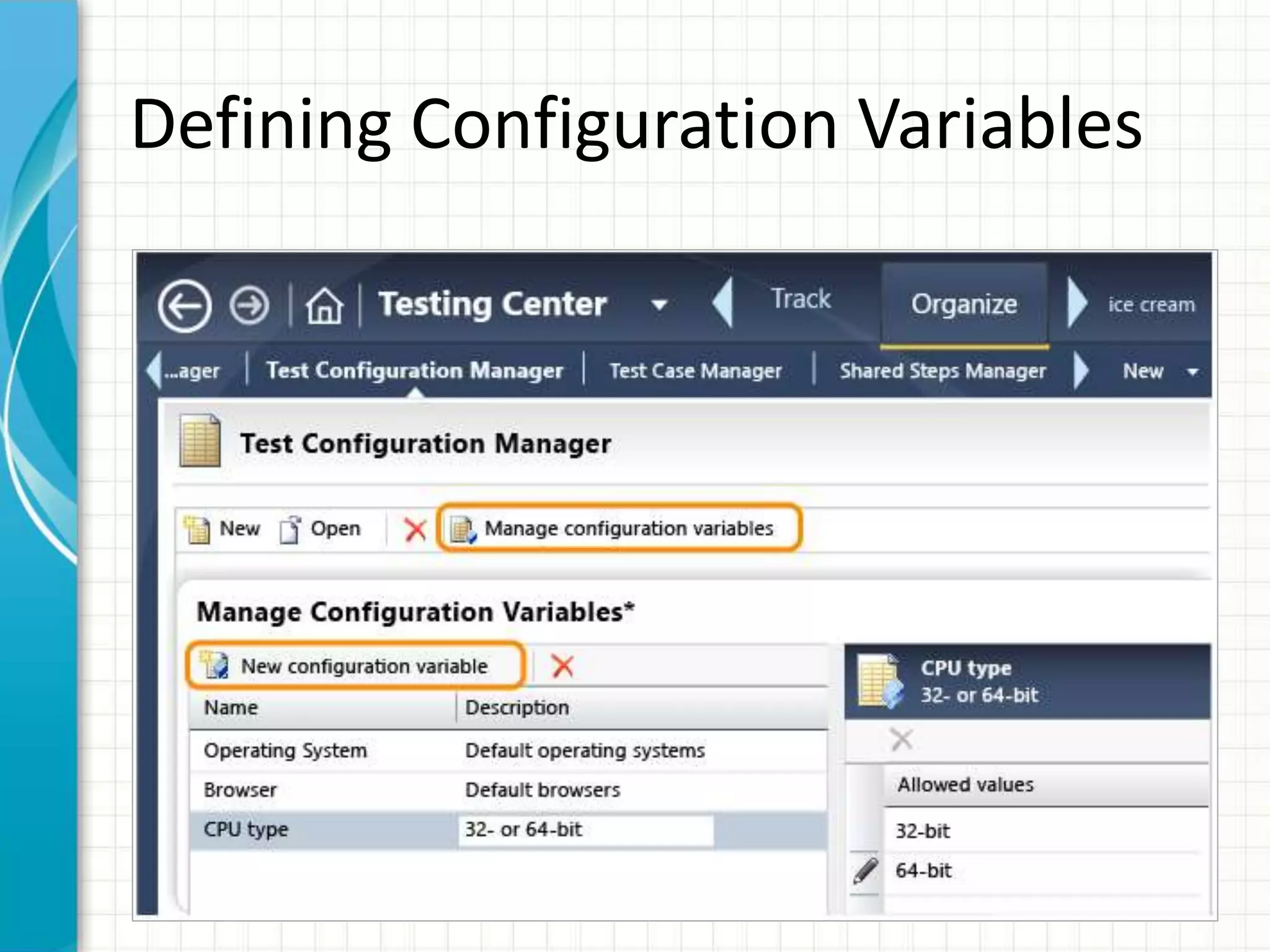
Defining Configuration Variables
Selecting Test Configurations
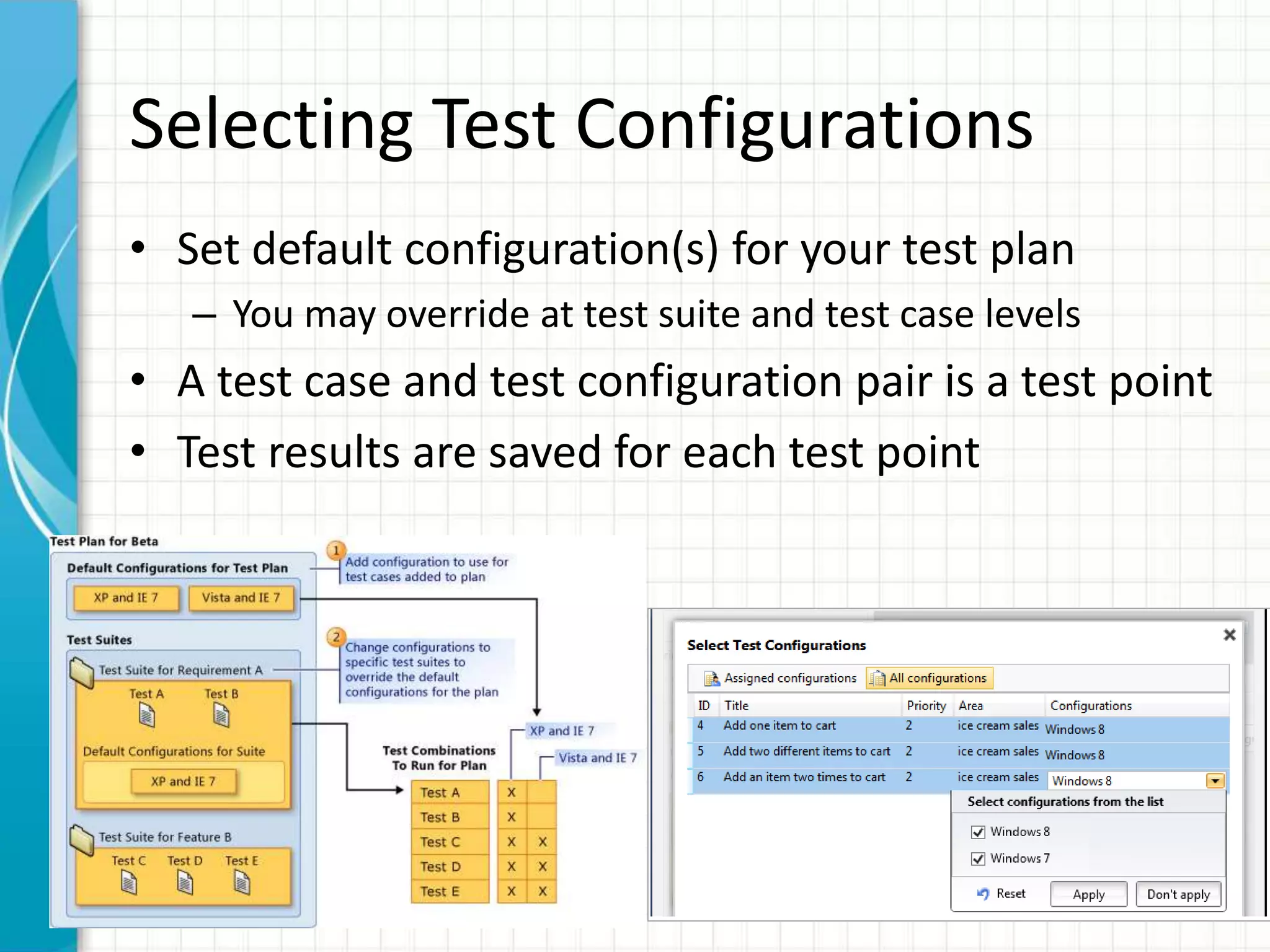
• Set default configuration(s) for your test plan
– You may override at test suite and test case levels
• A test case and test configuration pair is a test point
• Test results are saved for each test point
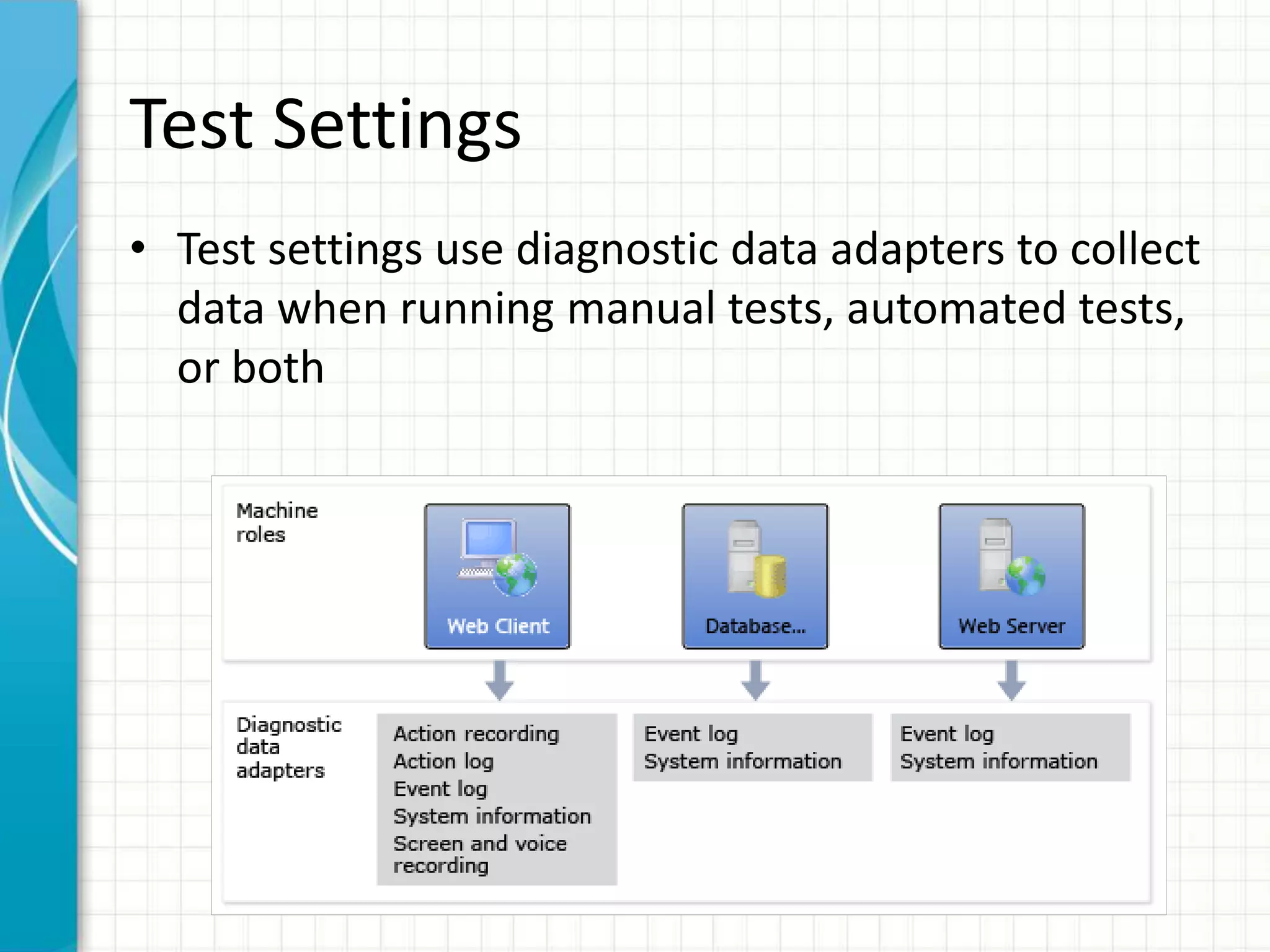
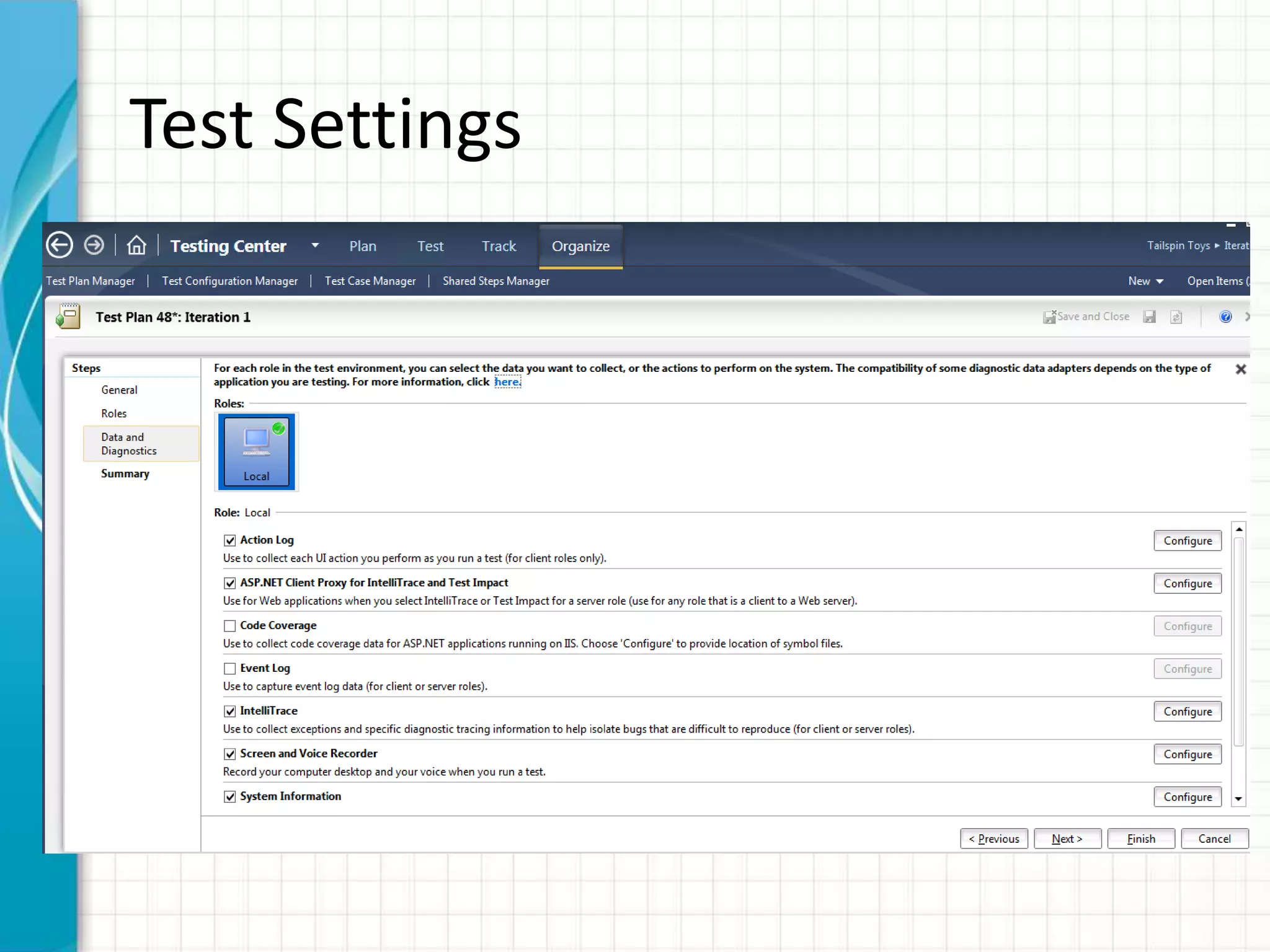
Test Settings
• Test settings use diagnostic data adapters to collect
data when running manual tests, automated tests,
or both
Test Settings
Test Reports
• View test run results in real time in MTM
• Use predefined test reports (Microsoft Excel, SQL
Server Reporting Services)
• Create your own reports (Microsoft Excel, SQL
Server Reporting Services)
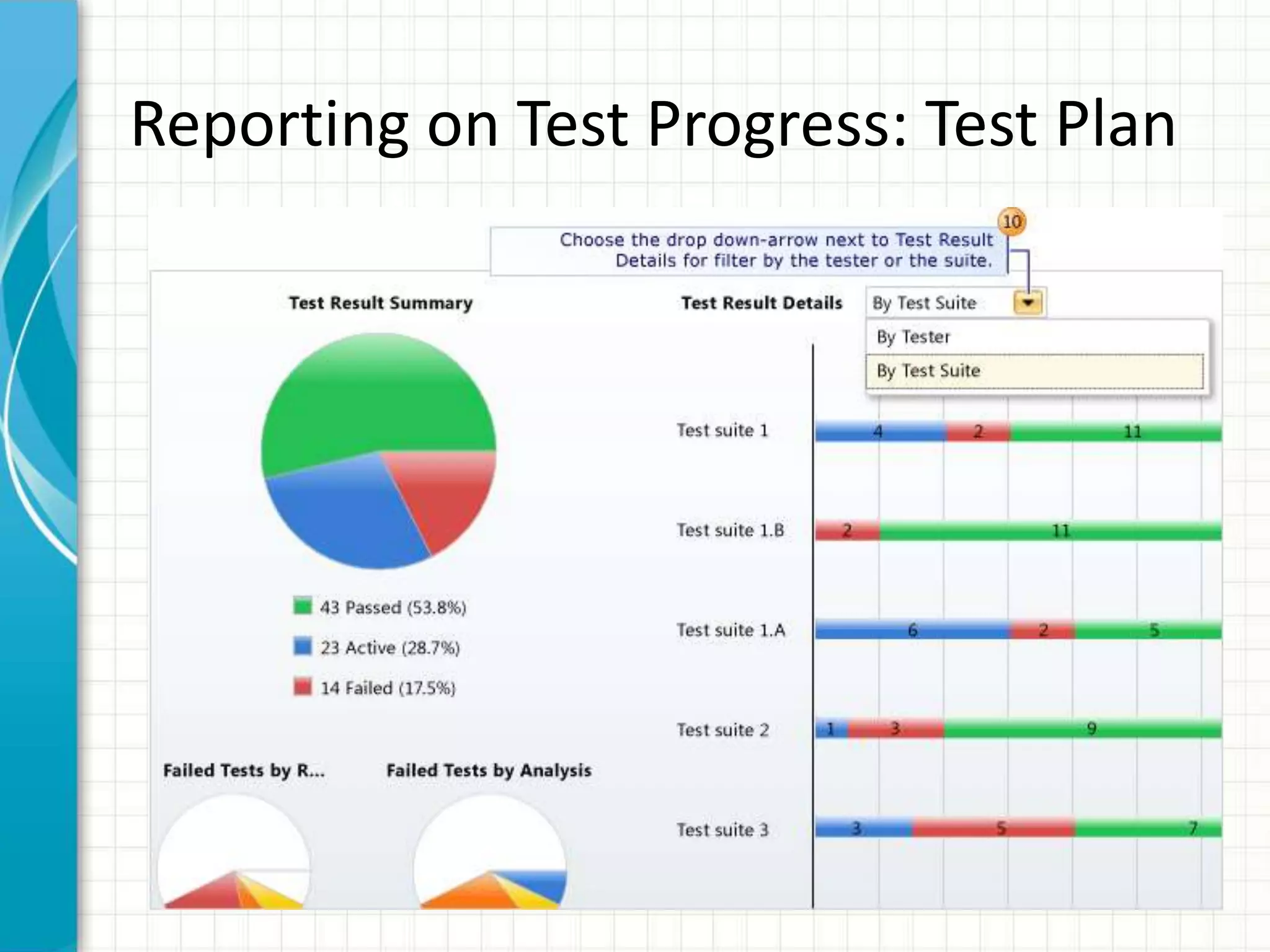
Reporting on Test Progress: Test Plan
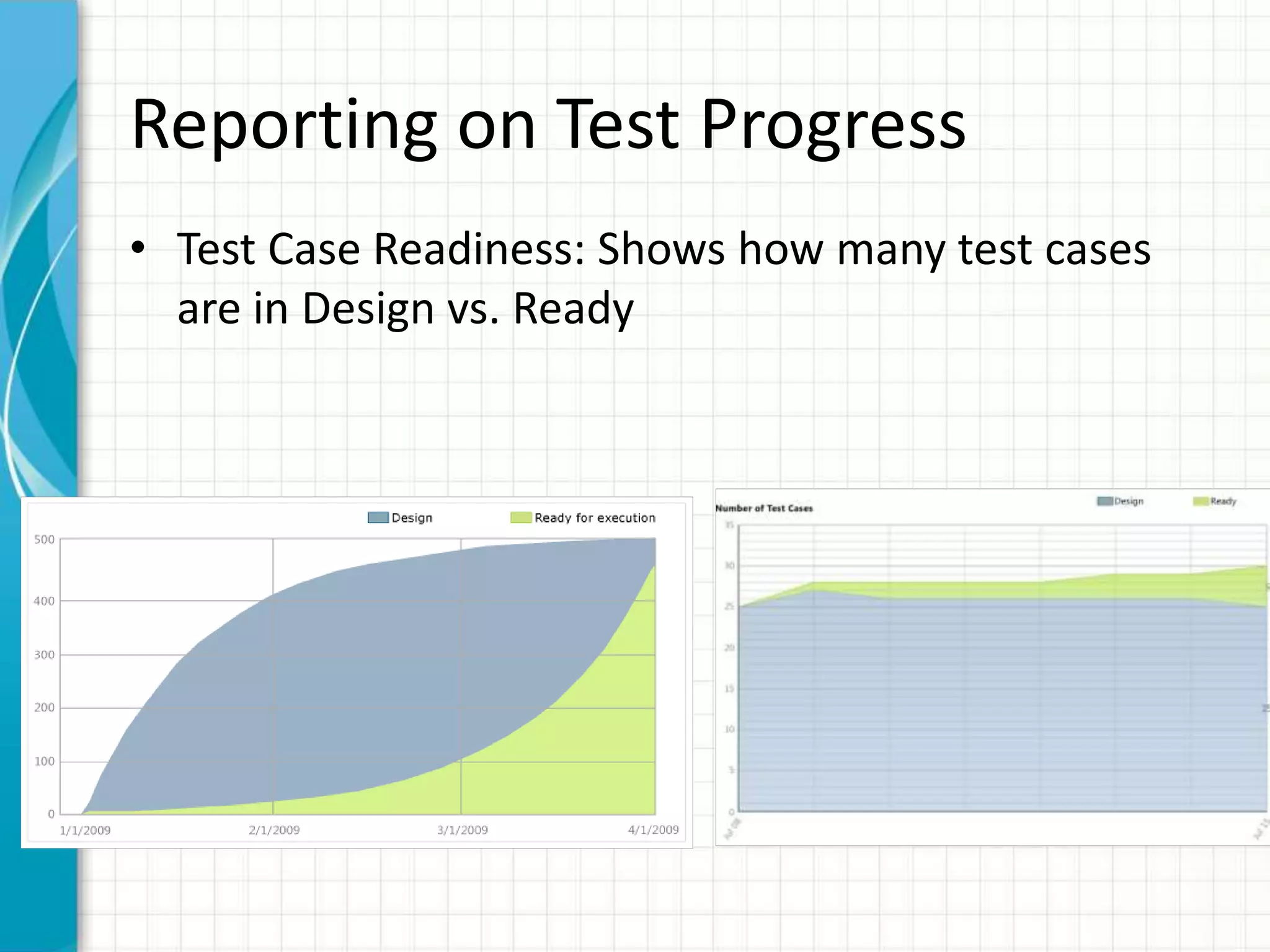
Reporting on Test Progress
• Test Case Readiness: Shows how many test cases
are in Design vs. Ready
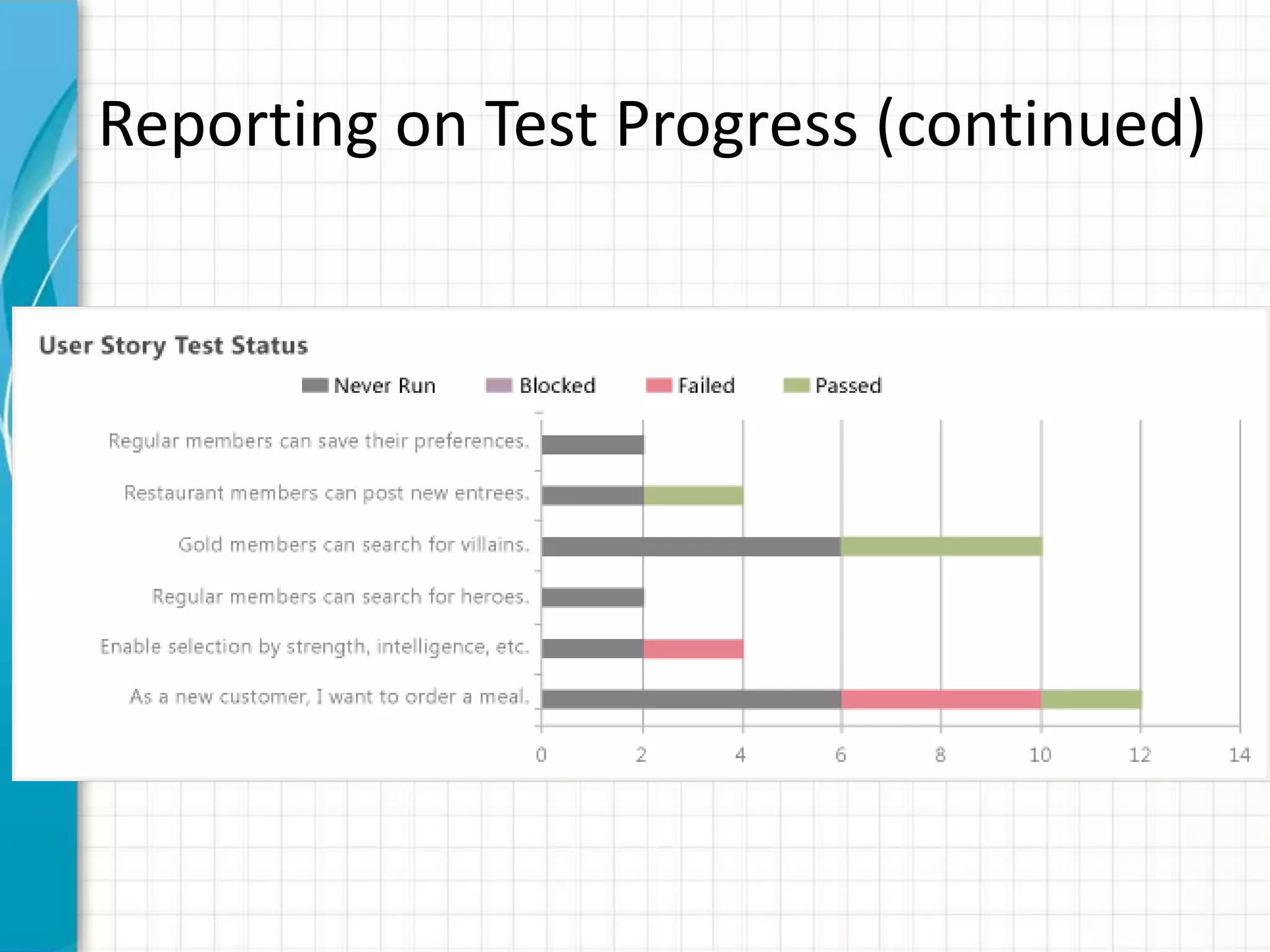
Reporting on Test Progress (continued)
• Test Plan Progress: Tracks how many tests have
been run and how many are failing
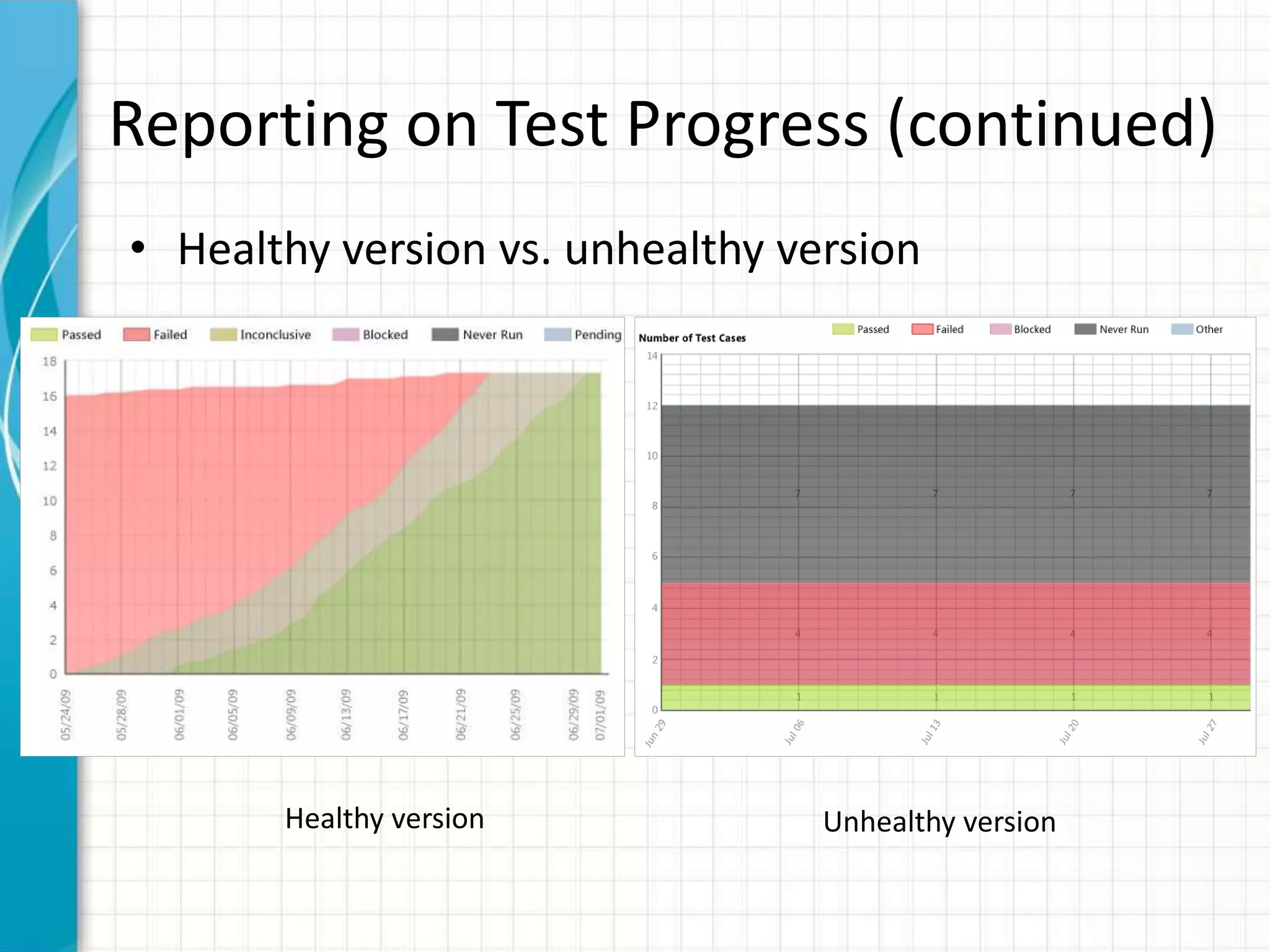
Reporting on Test Progress (continued)
• Healthy version vs. unhealthy version
Healthy version Unhealthy version
Reporting on Test Progress (continued)
TEST CONFIGURATION
AND SETTINGS - DEMO
TEST CASE
MANAGEMENT
• Manual Test Cases1
• Test Steps Parameters2
• Shared Steps3
Overview
MANUAL TEST CASES
Manual Test Cases
• Test cases are work items
• Test results are saved on each run
• Manual test cases contain test steps (test
script)
– May contain test steps with validation
– A tester indicates pass or fail at the test step level
• A test case can be assigned to a tester
Manual Test Cases (continued)
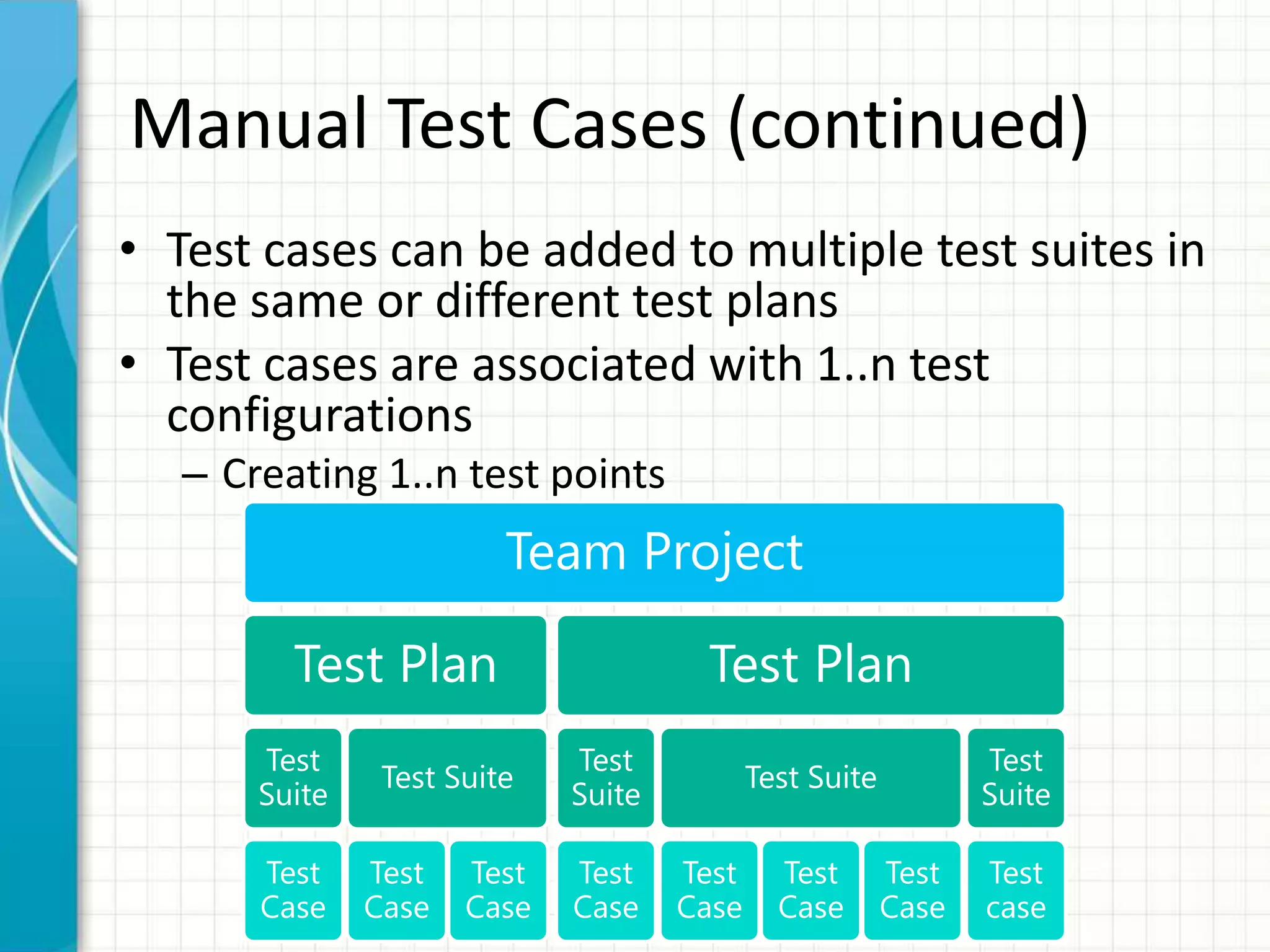
• Test cases can be added to multiple test suites in
the same or different test plans
• Test cases are associated with 1..n test
configurations
– Creating 1..n test points
Team Project
Test Plan
Test
Suite
Test
Case
Test Suite
Test
Case
Test
Case
Test Plan
Test
Suite
Test
Case
Test Suite
Test
Case
Test
Case
Test
Case
Test
Suite
Test
case
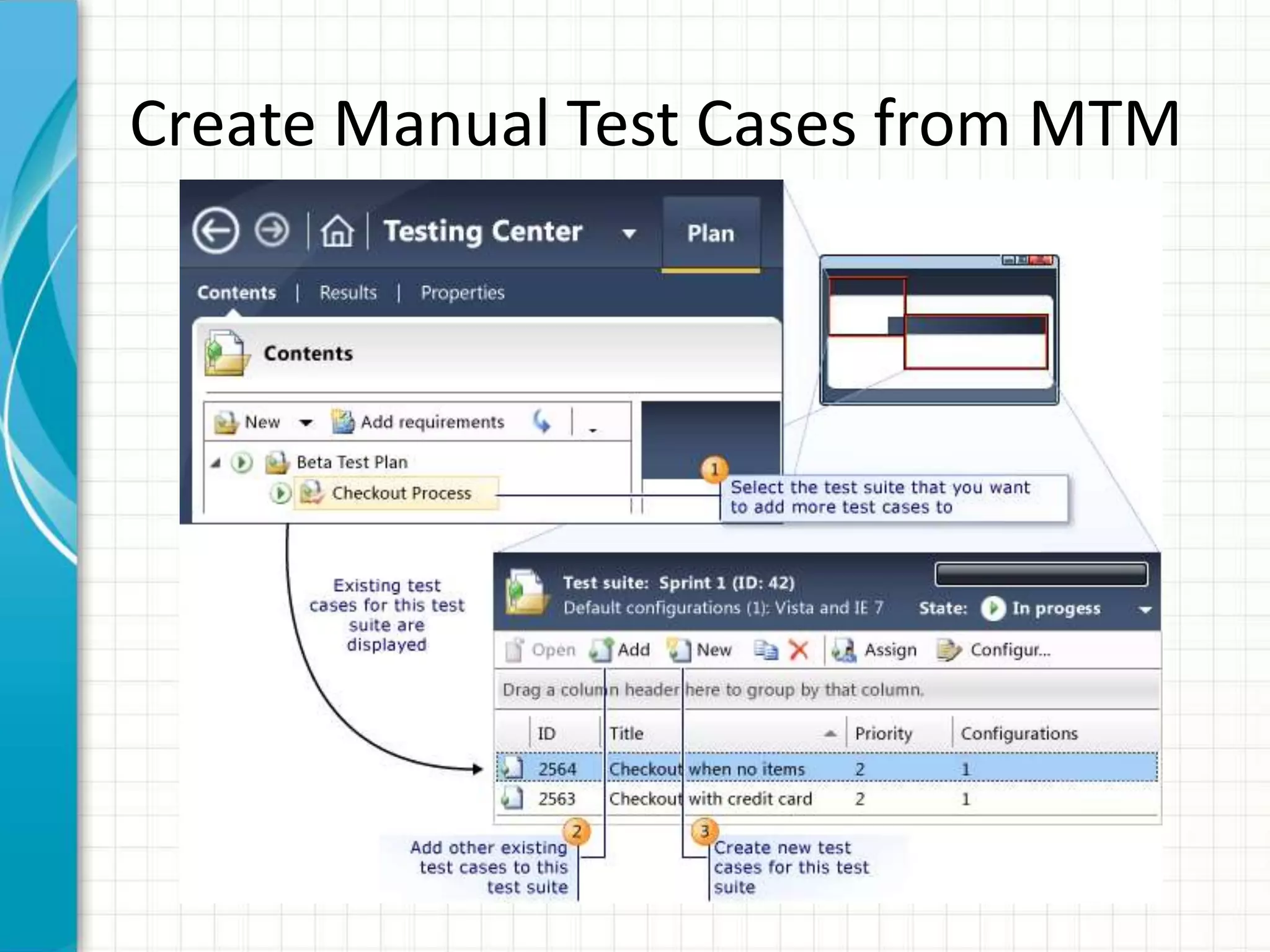
Create Manual Test Cases from MTM
(continued)
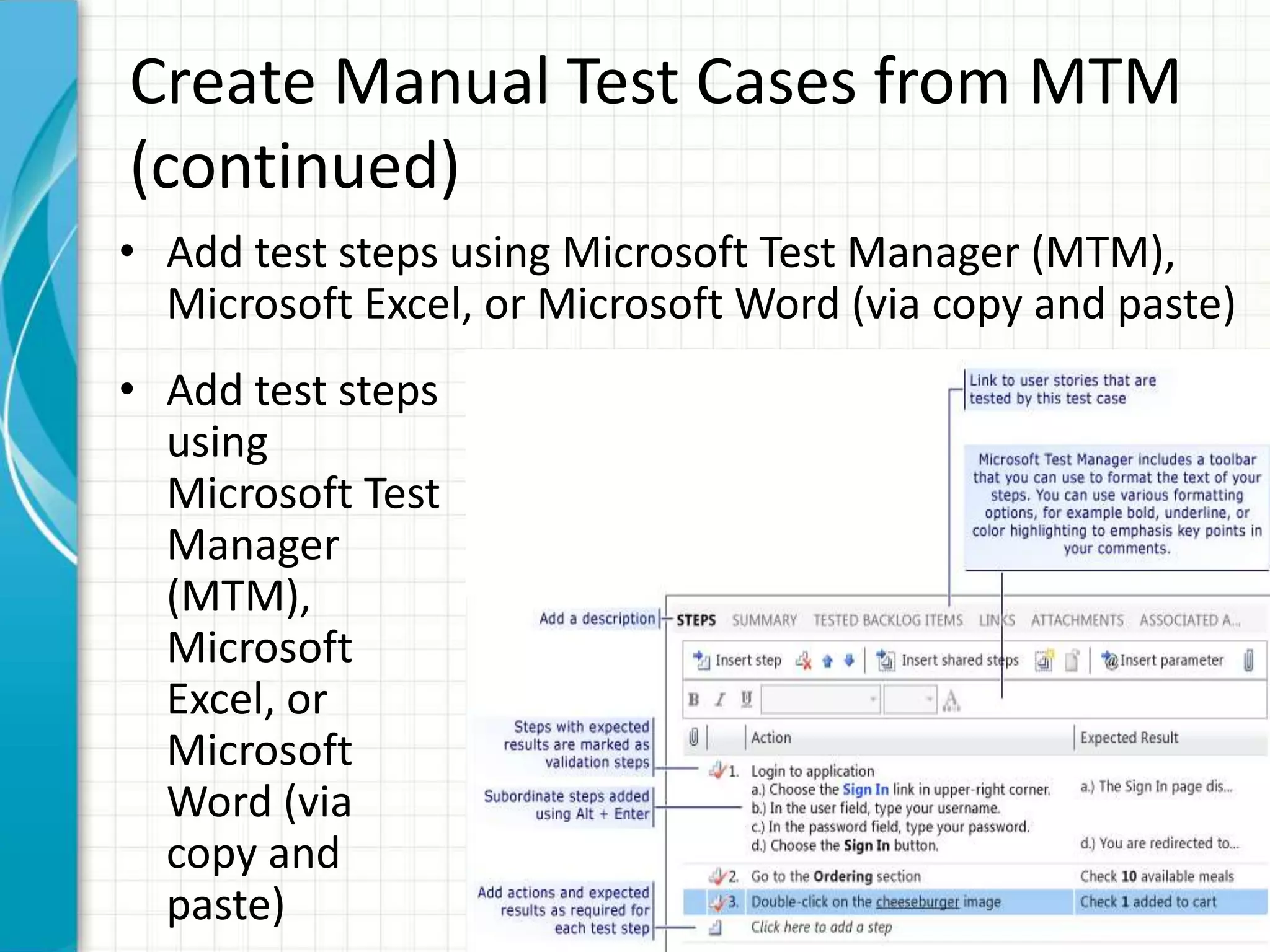
• Add test steps using Microsoft Test Manager (MTM),
Microsoft Excel, or Microsoft Word (via copy and paste)
• Add test steps
using
Microsoft Test
Manager
(MTM),
Microsoft
Excel, or
Microsoft
Word (via
copy and
paste)
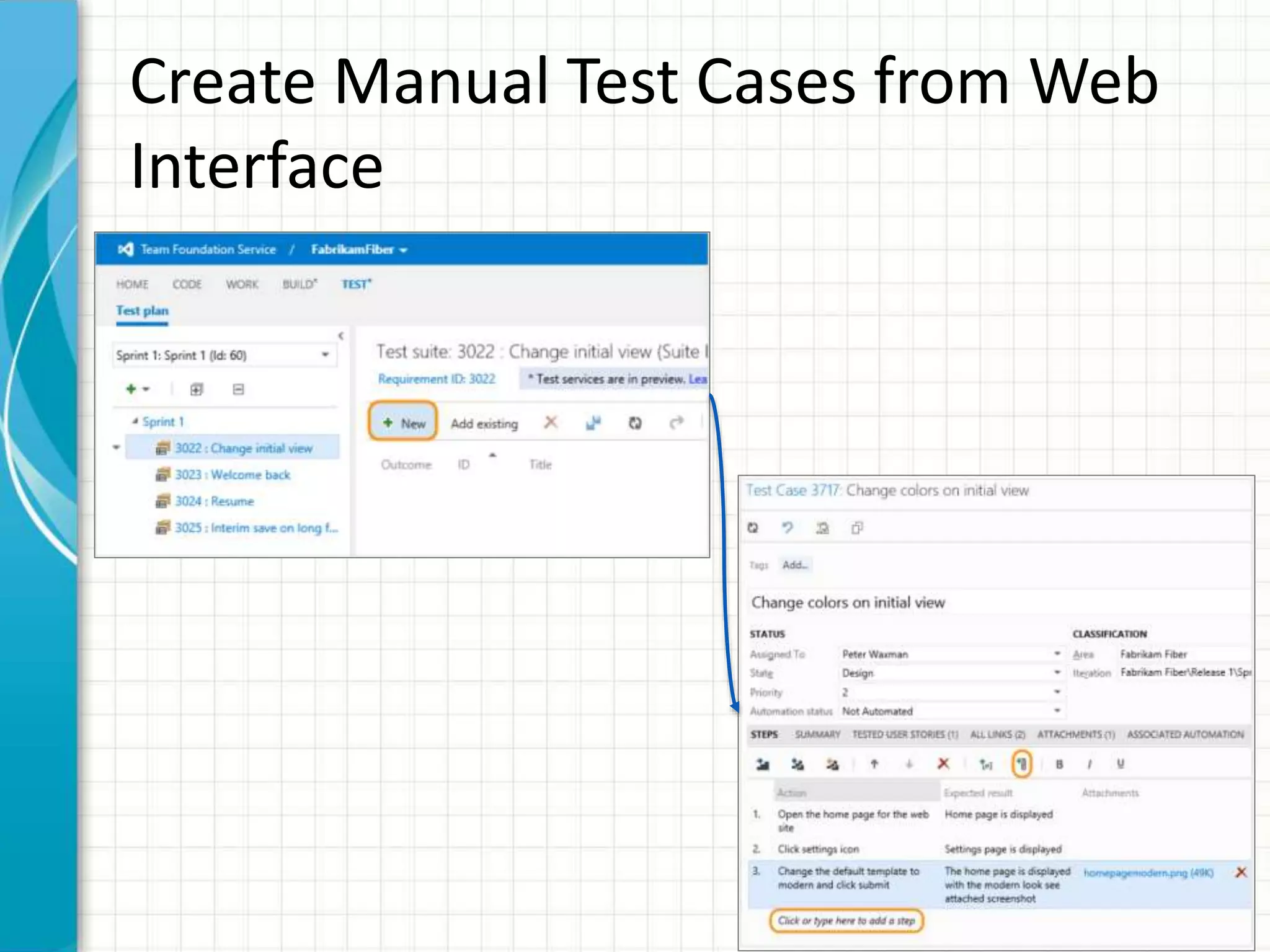
Create Manual Test Cases from Web
Interface
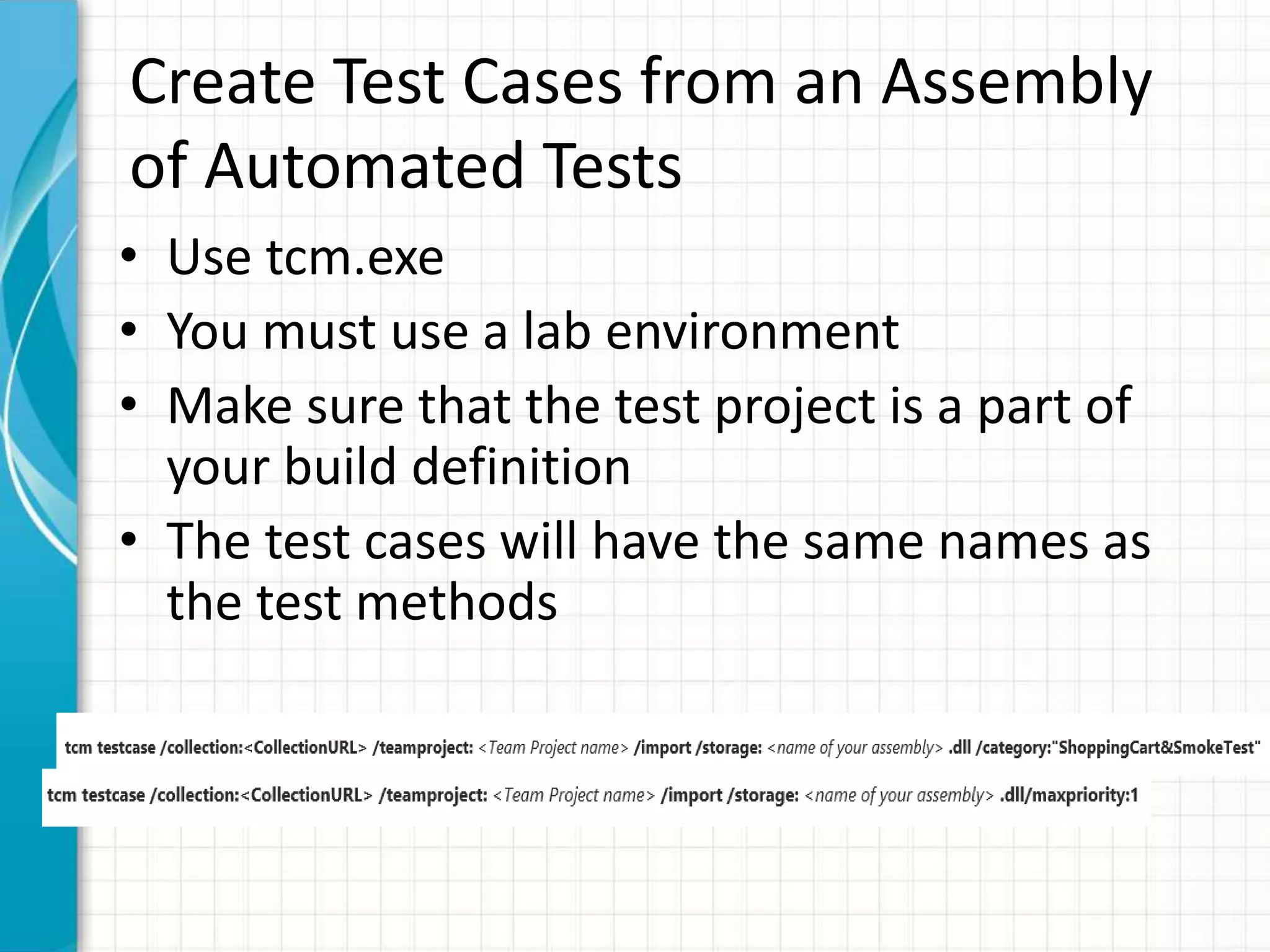
Create Test Cases from an Assembly
of Automated Tests
• Use tcm.exe
• You must use a lab environment
• Make sure that the test project is a part of
your build definition
• The test cases will have the same names as
the test methods
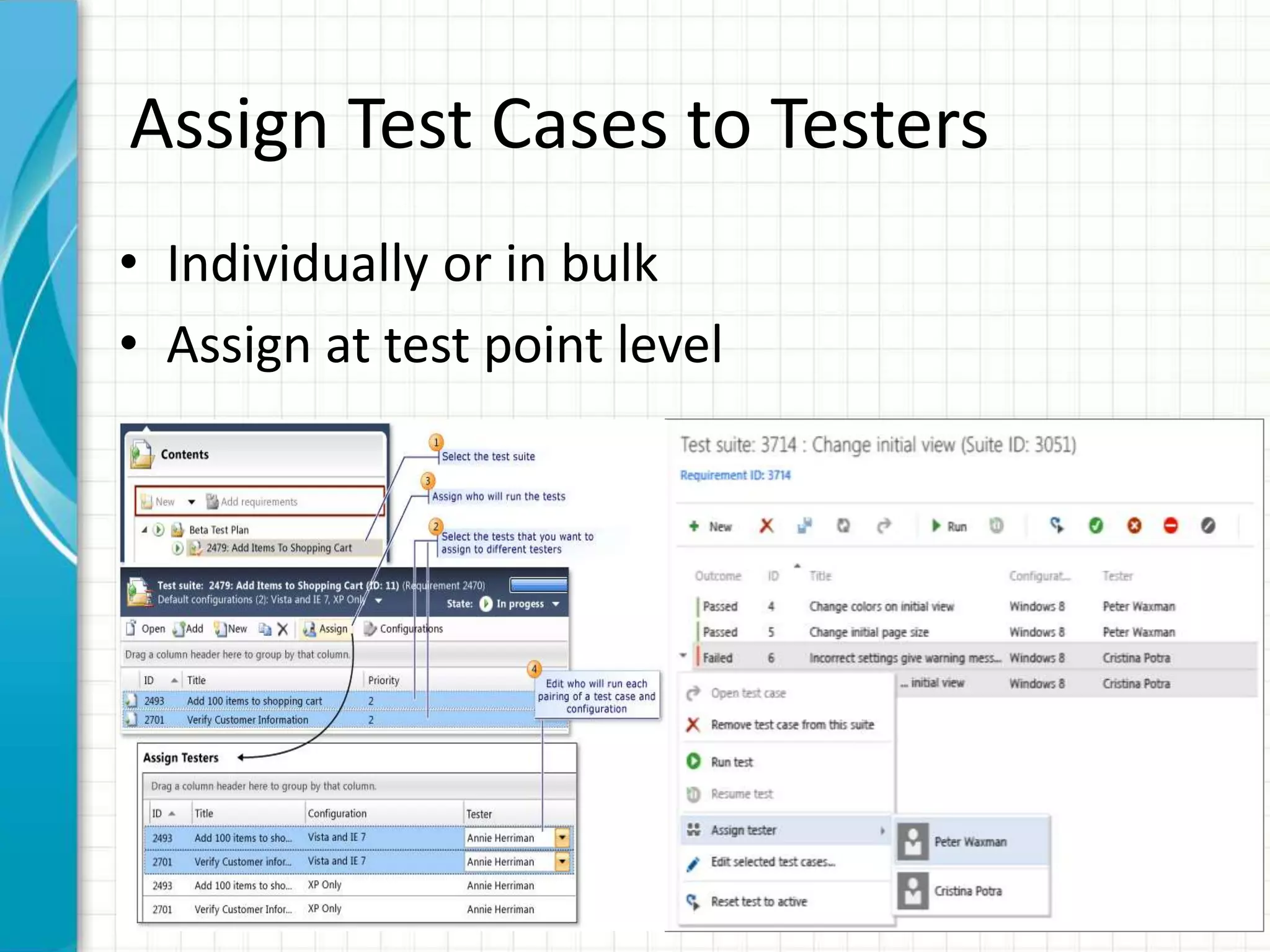
Assign Test Cases to Testers
• Individually or in bulk
• Assign at test point level
TEST STEPS
PARAMETERS
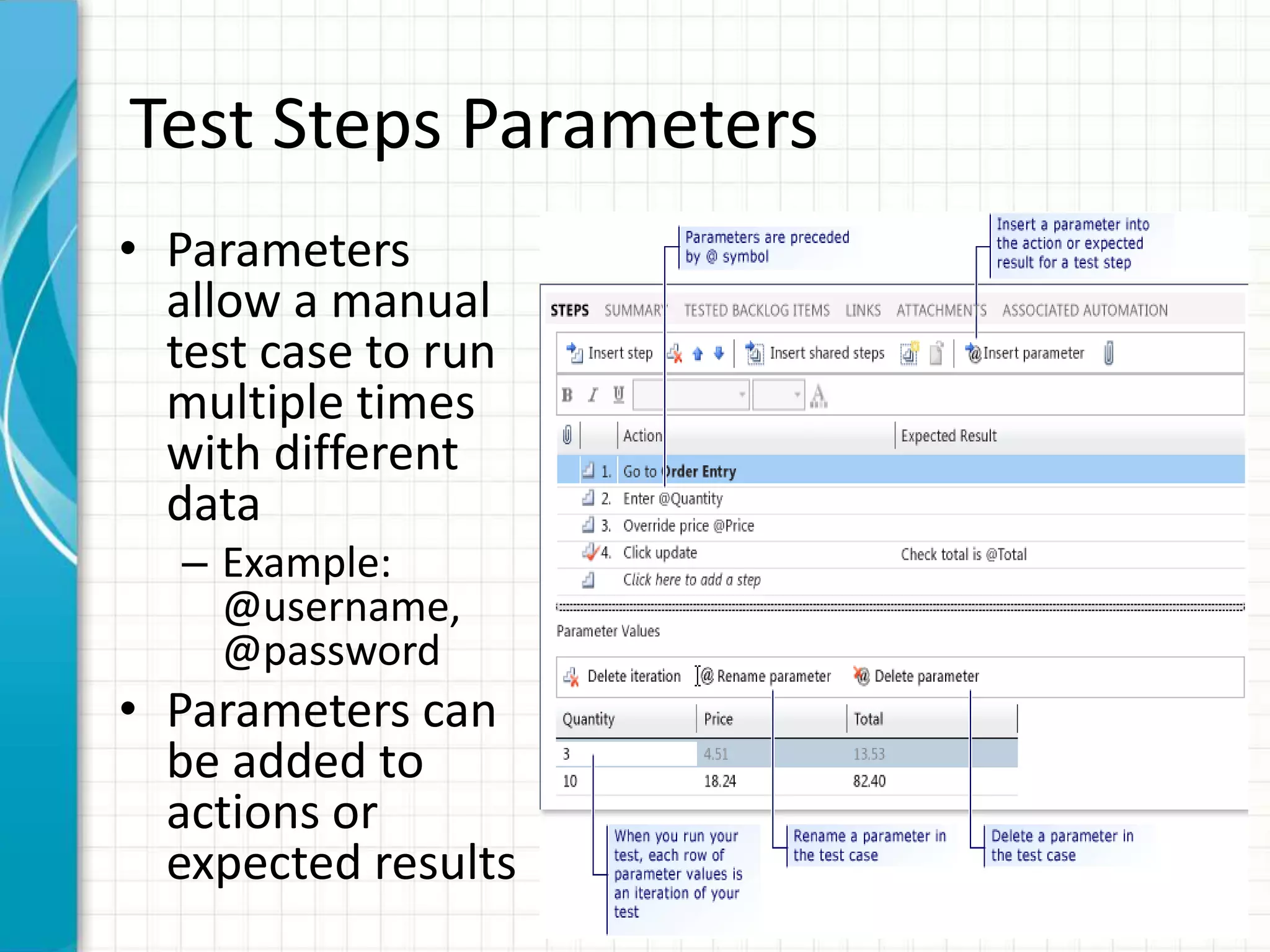
Test Steps Parameters
• Parameters
allow a manual
test case to run
multiple times
with different
data
– Example:
@username,
@password
• Parameters can
be added to
actions or
expected results
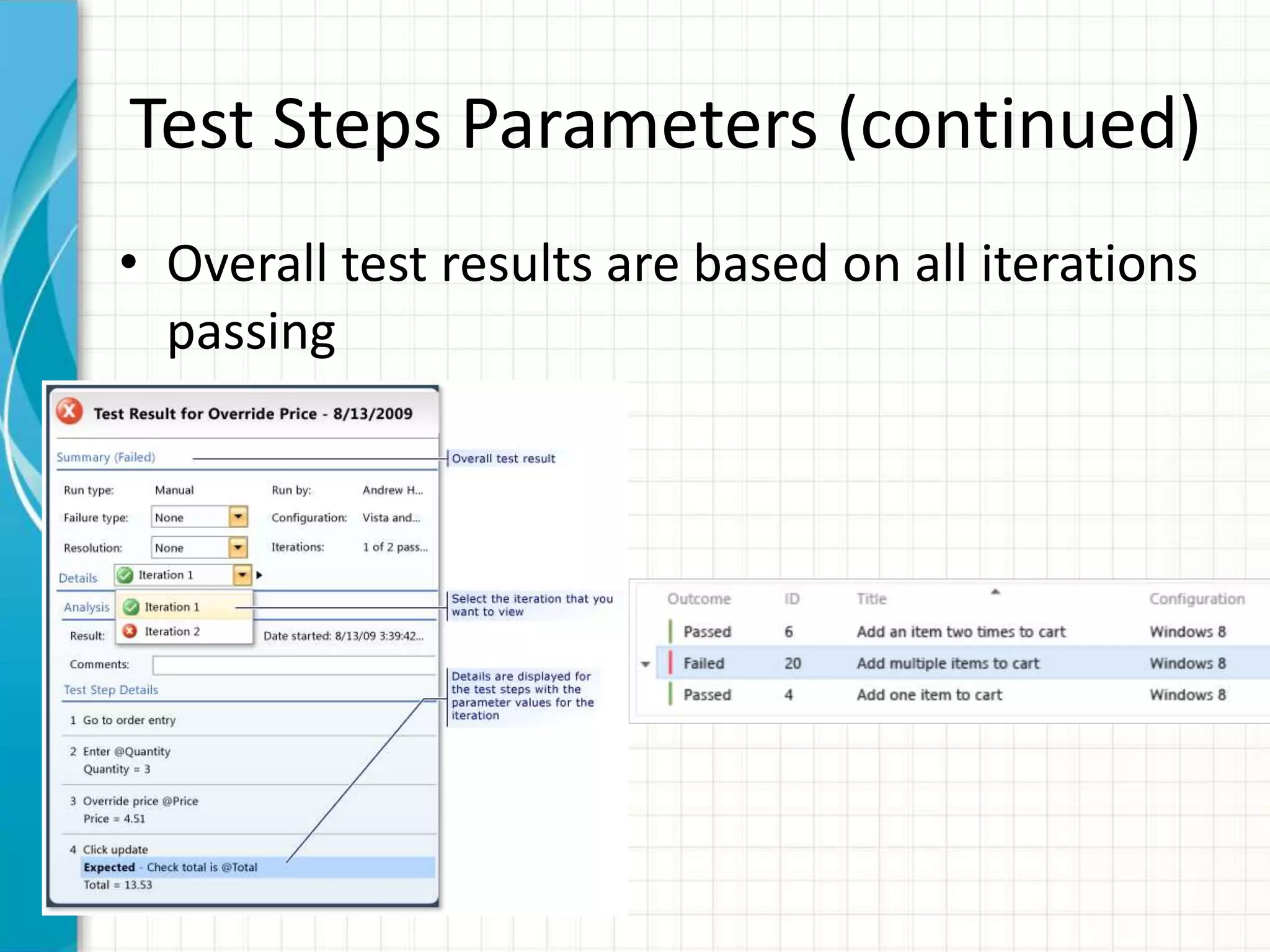
Test Steps Parameters (continued)
• Overall test results are based on all iterations
passing
SHARED STEPS
Shared Steps
• Used for repeated sequences of steps, such
as logging in, that occur in many test cases
• Avoiding having to enter these sequences
again and again, create shared steps
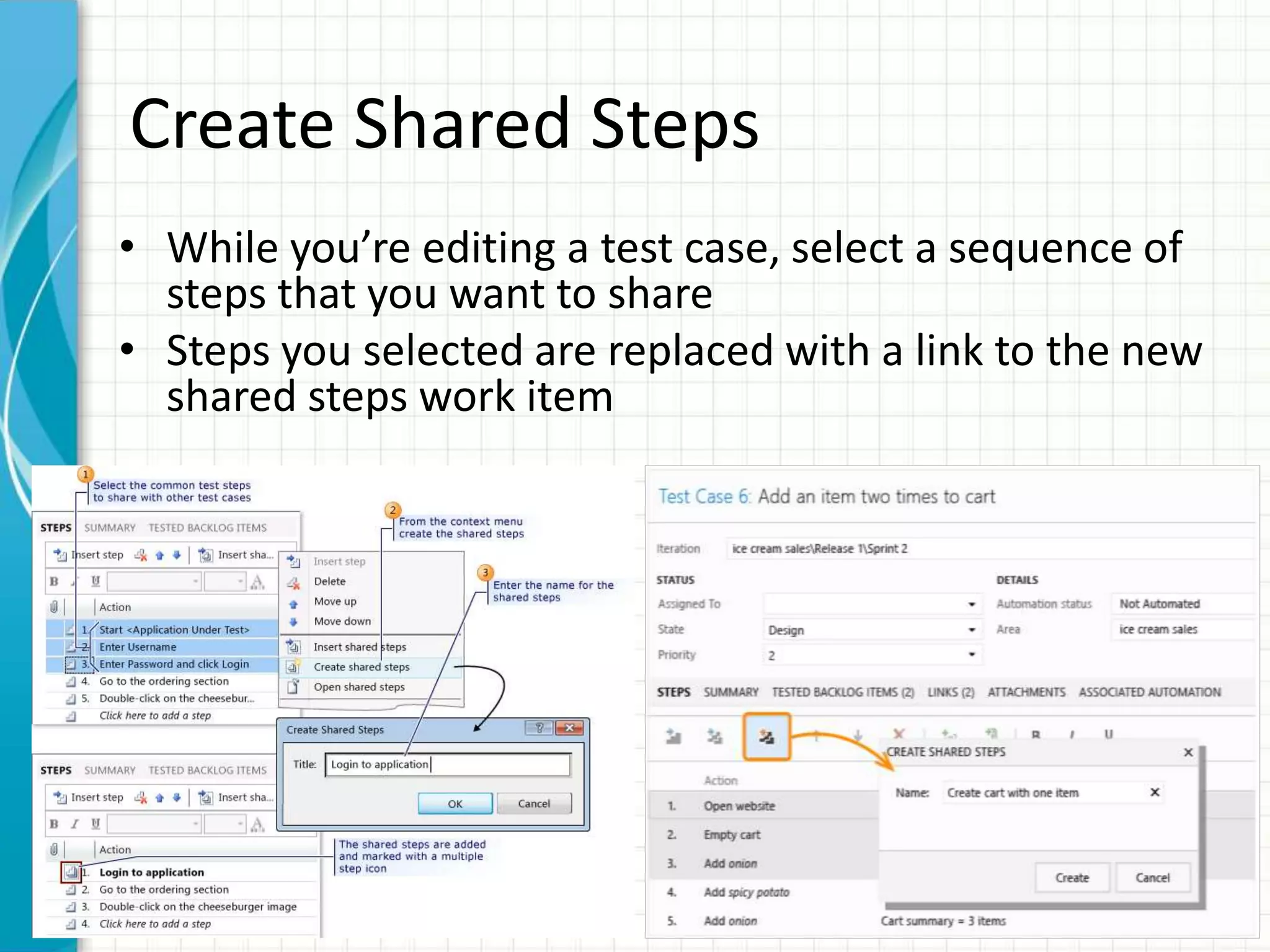
Create Shared Steps
• While you’re editing a test case, select a sequence of
steps that you want to share
• Steps you selected are replaced with a link to the new
shared steps work item
TEST CASE
MANAGEMENT - DEMO
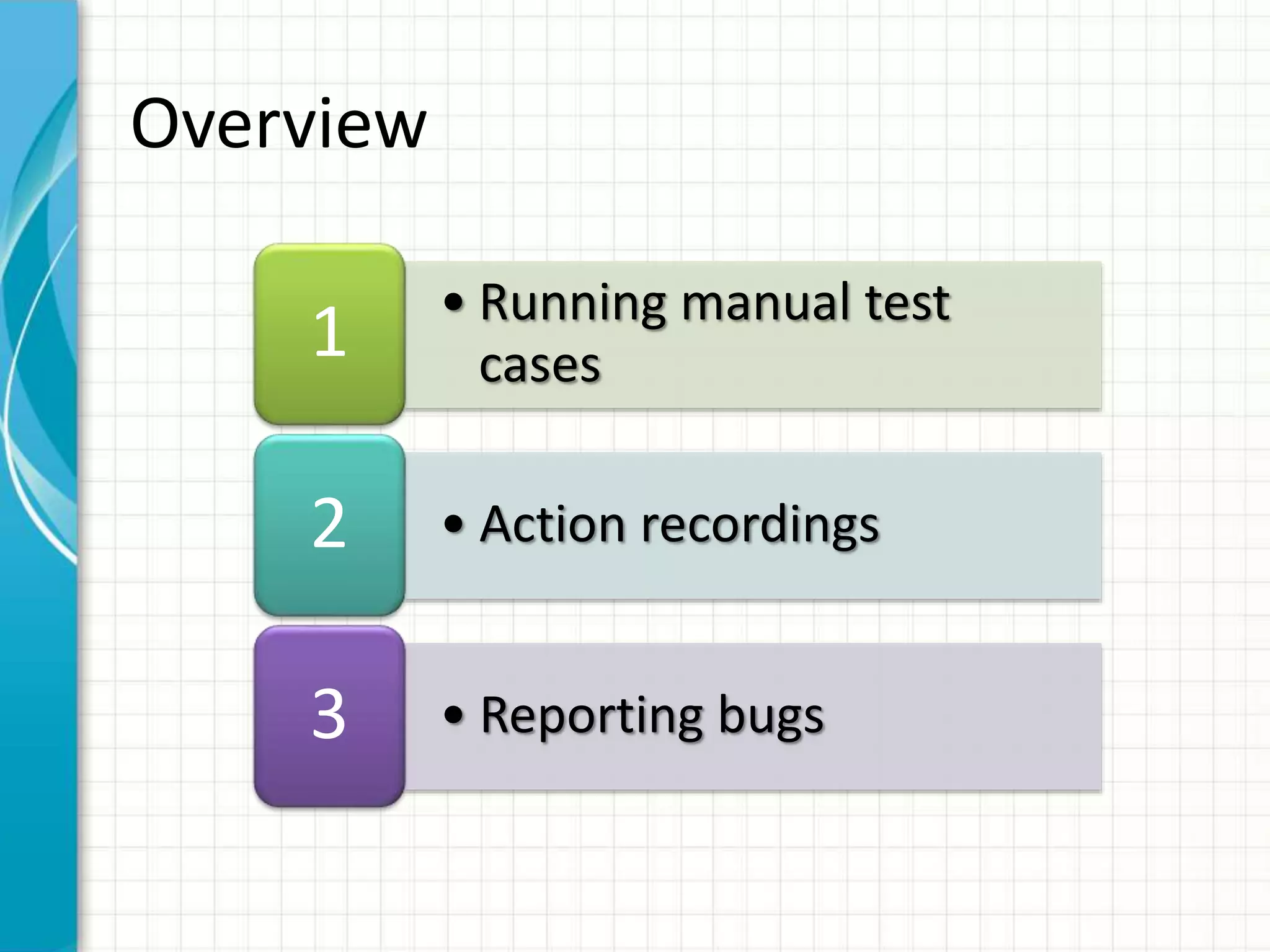
TEST RUN
• Running manual test
cases1
• Action recordings2
• Reporting bugs3
Overview
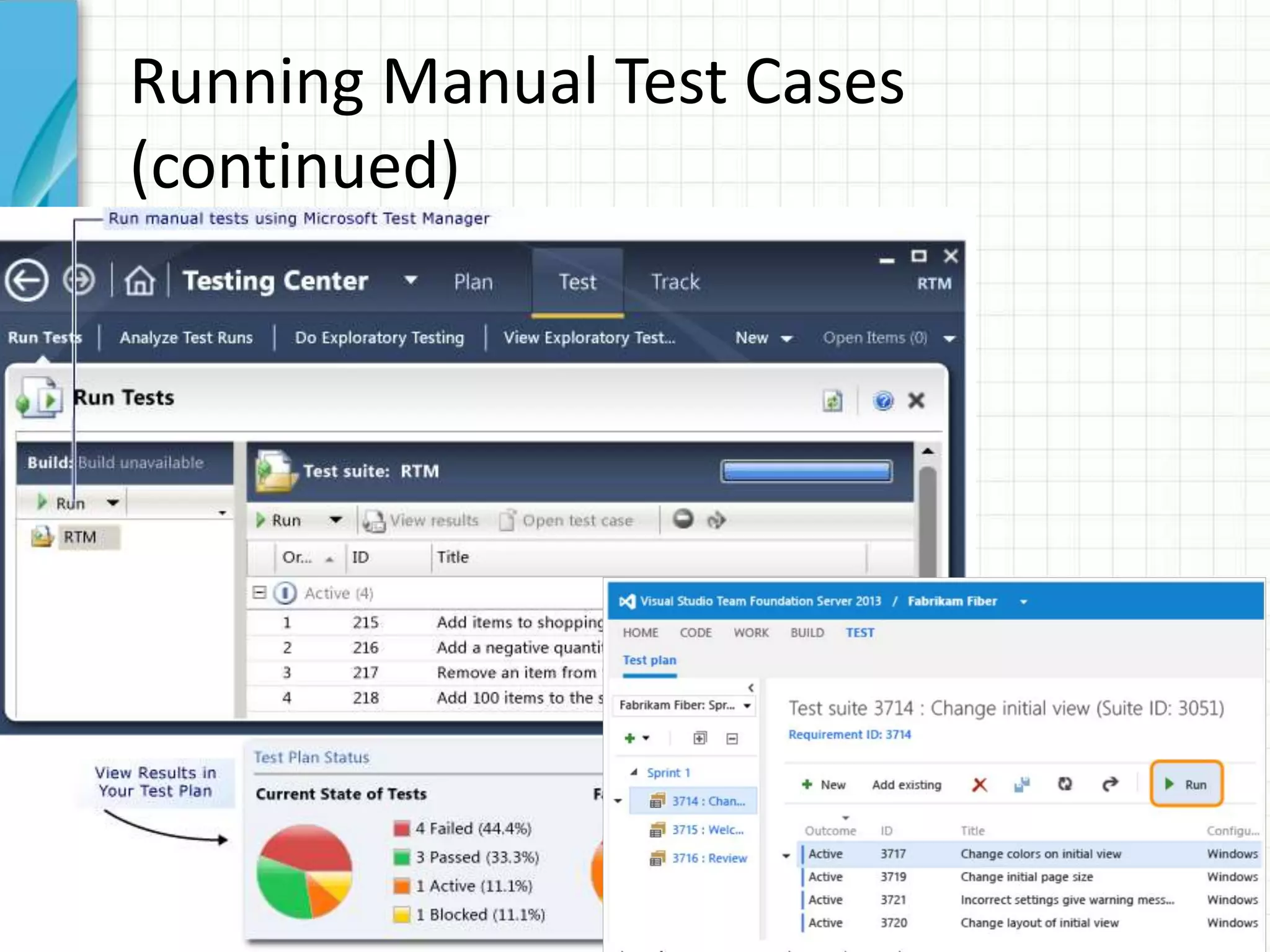
Running Manual Test Cases
• Run individual tests or entire suites
• A test result is recorded for each test run
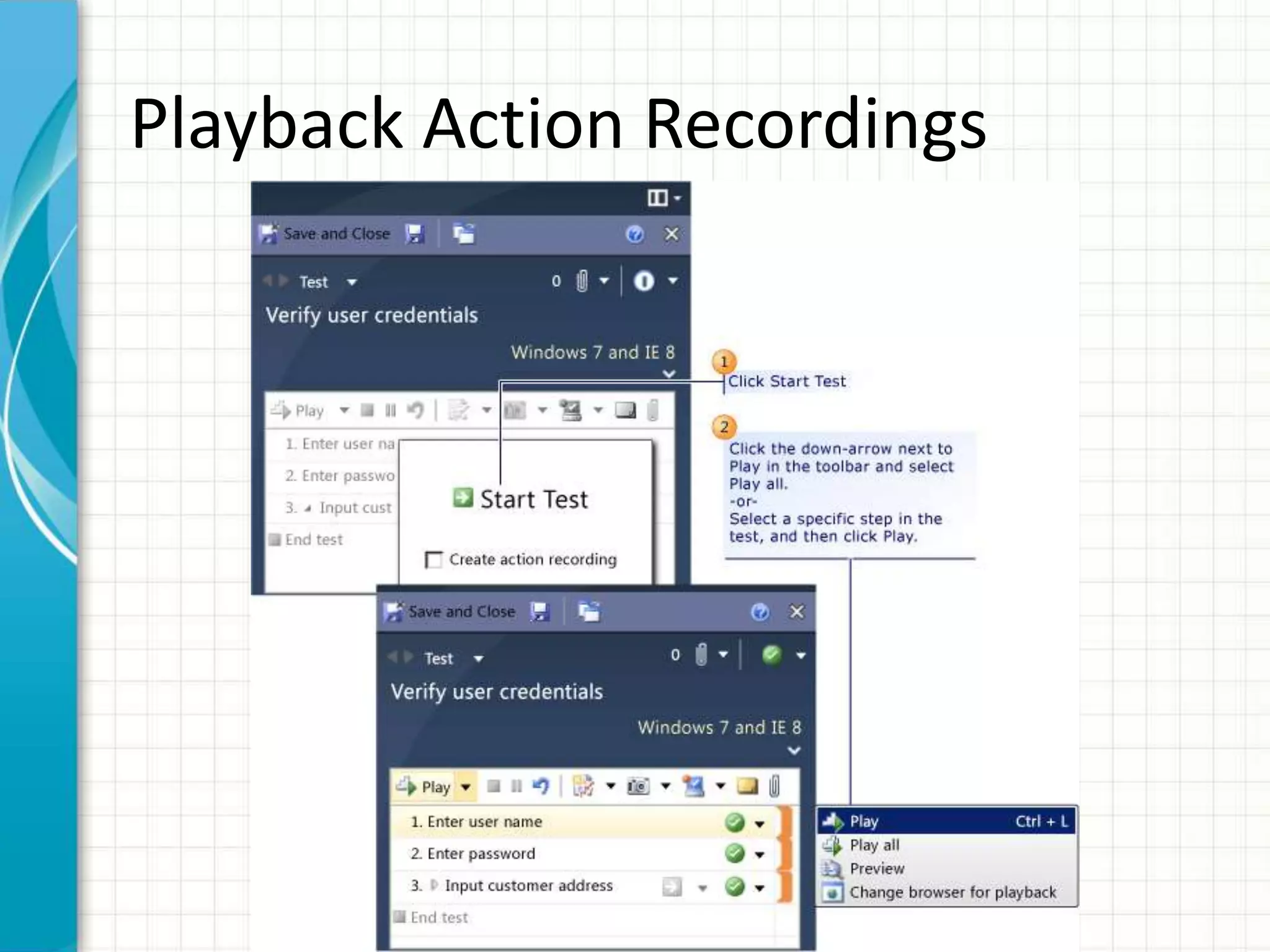
• Create action recordings
– Used for future runs
– Action recording can be used in CodedUI tests
• Submit new bugs or update existing bugs
directly
• Attach comments, indicate pass or fail, take
screenshots
• Test case management features also available in
Web Portal
Running Manual Test Cases
(continued)
Action Recordings
• Record a manual test (or shared steps) to
allow for a later run of certain parts of
manual tests
– Example: Login, entire smoke test
• Use it to help with:
– A test that you will want to run multiple times
– Different manual tests that contain common
steps via action recordings
– Verifying a bug fix
– Automate by importing it to a Coded UI Test
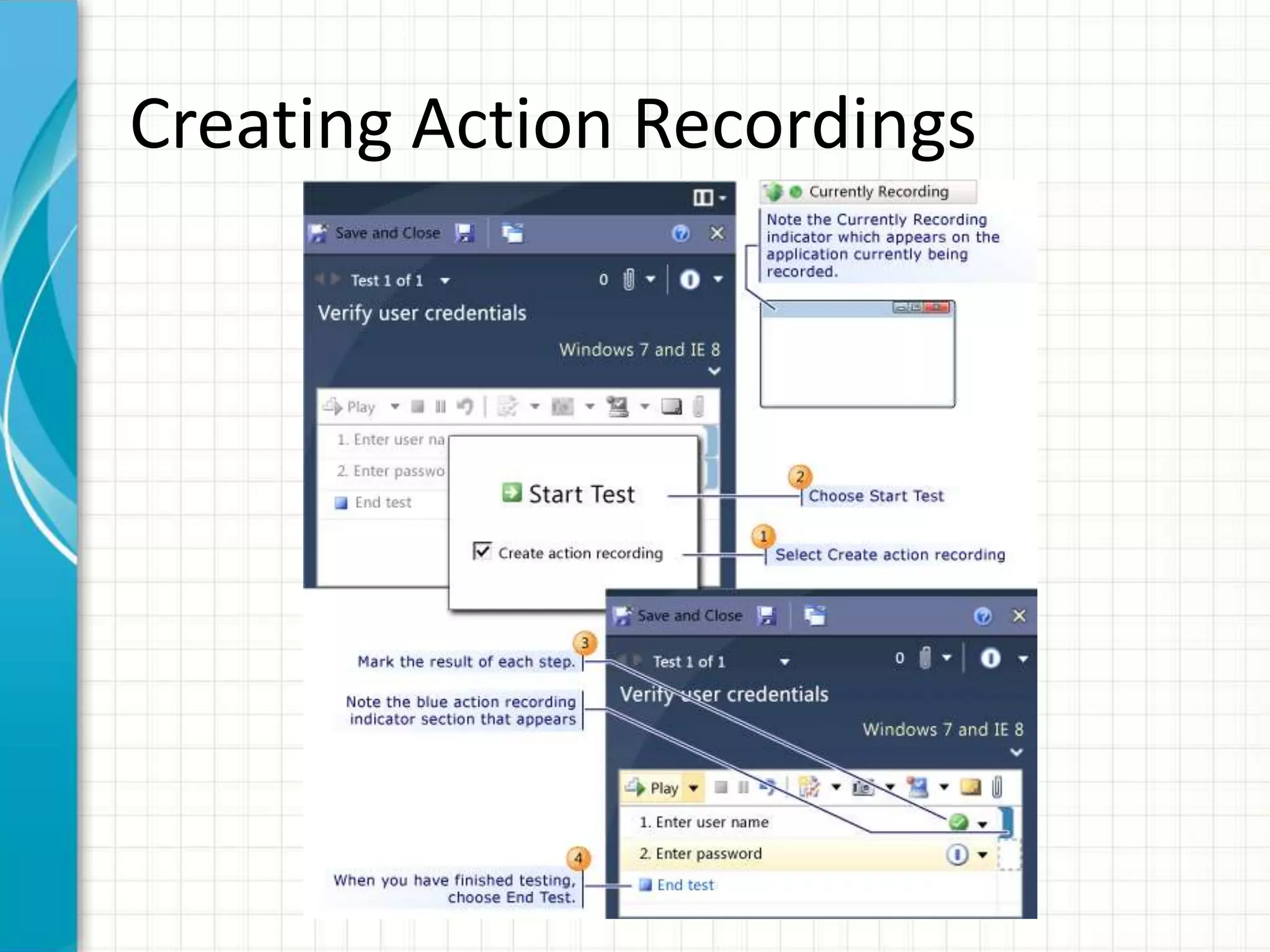
Creating Action Recordings
Playback Action Recordings
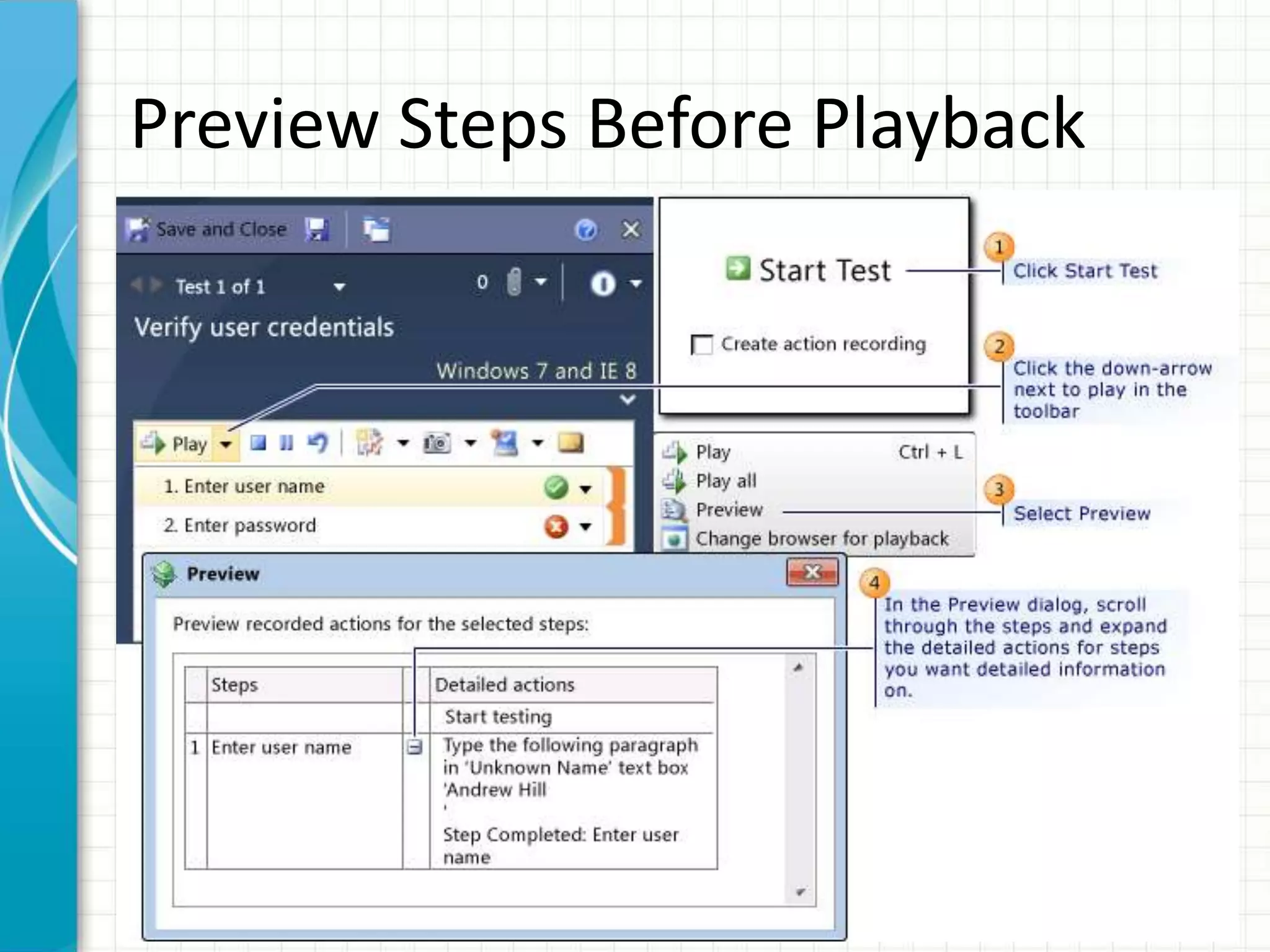
Preview Steps Before Playback
Submitting Bugs
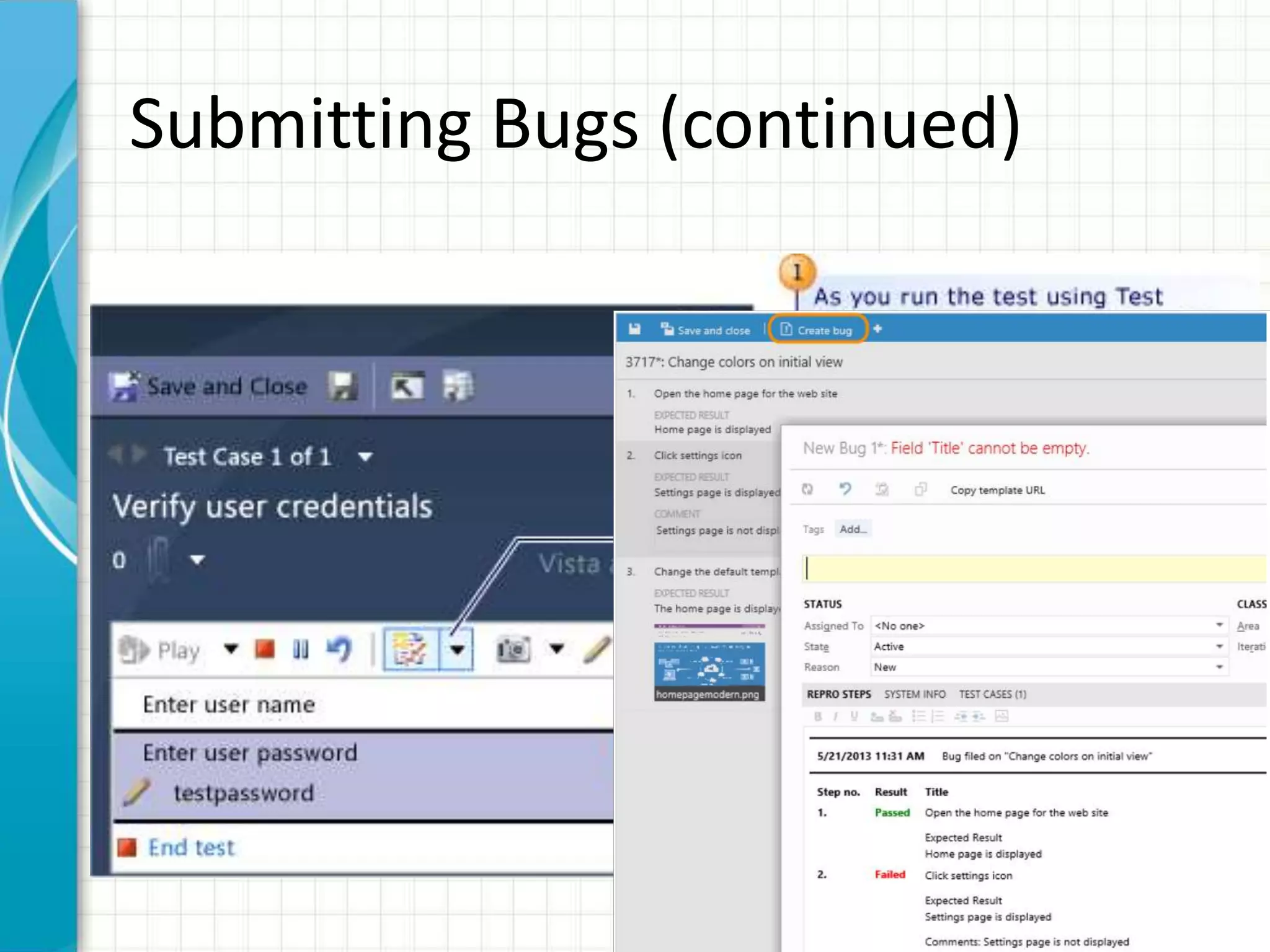
• Submit a bug from Test Runner
– Information automatically added about the test
environment, comments, screenshots, video
recording
• Submit a bug from Test Manager when you
view the manual test result
– No diagnostic data added via this route
Submitting Bugs (continued)
TEST RUN - DEMO
EXPLORATORY
TESTING
Exploratory Testing
• Test the application without a predefined test
script
• Record screenshots, comments, attach files,
video and audio narration
• Submit bugs you find while testing
– Includes rich diagnostic data collected through
testing
– Uses the recorded steps to create a manual test
case
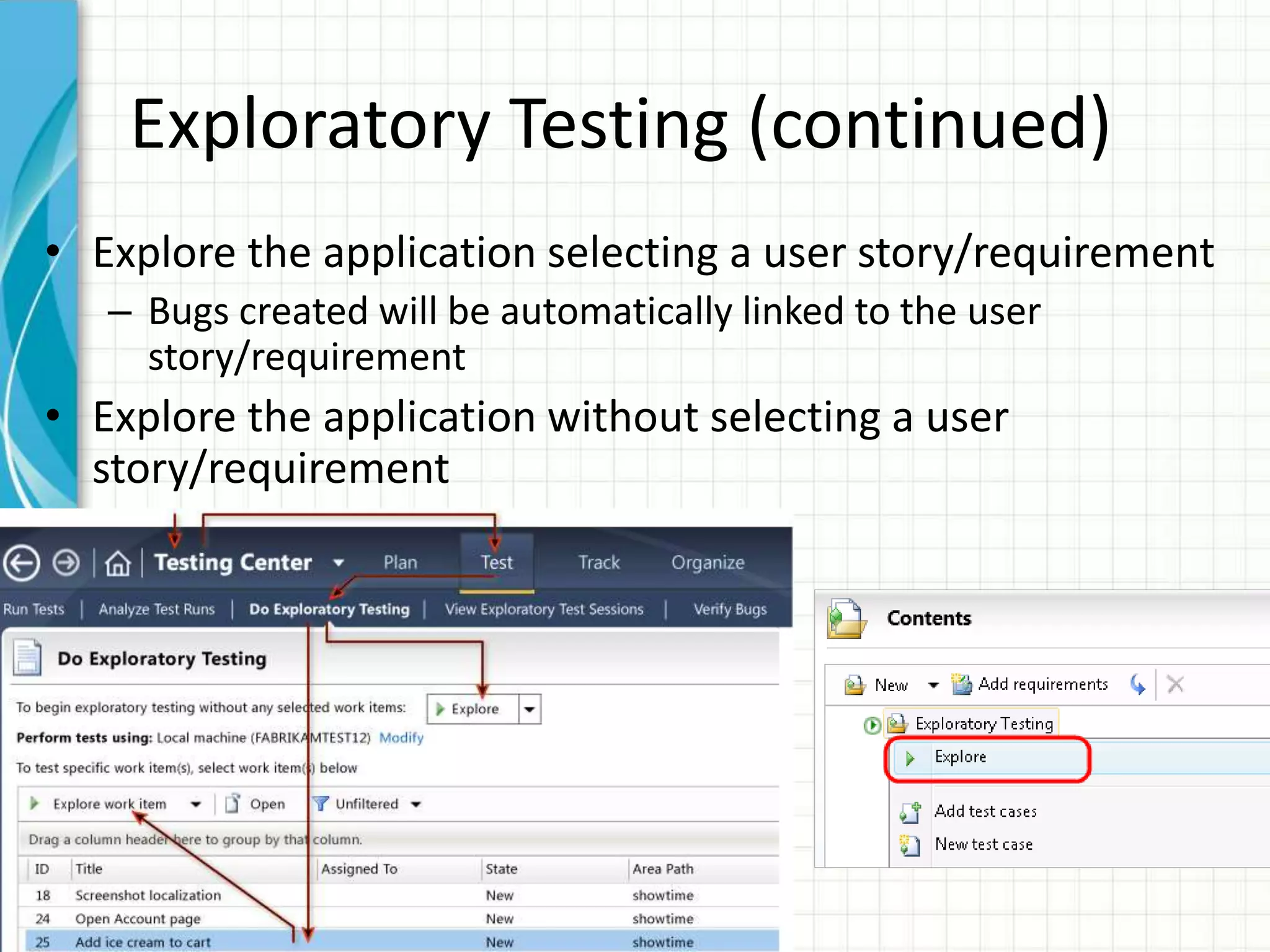
Exploratory Testing (continued)
• Explore the application selecting a user story/requirement
– Bugs created will be automatically linked to the user
story/requirement
• Explore the application without selecting a user
story/requirement
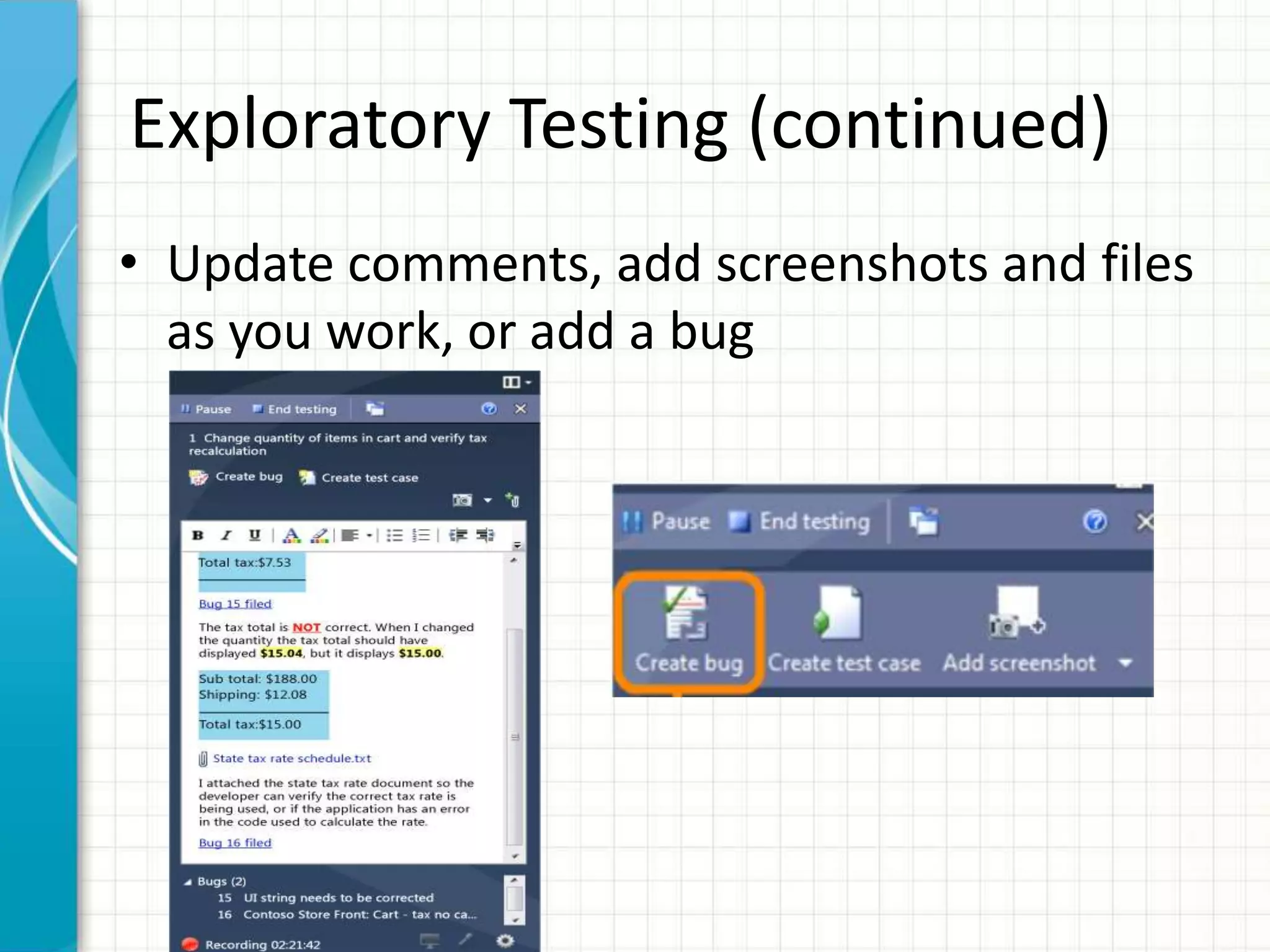
Exploratory Testing (continued)
• Update comments, add screenshots and files
as you work, or add a bug
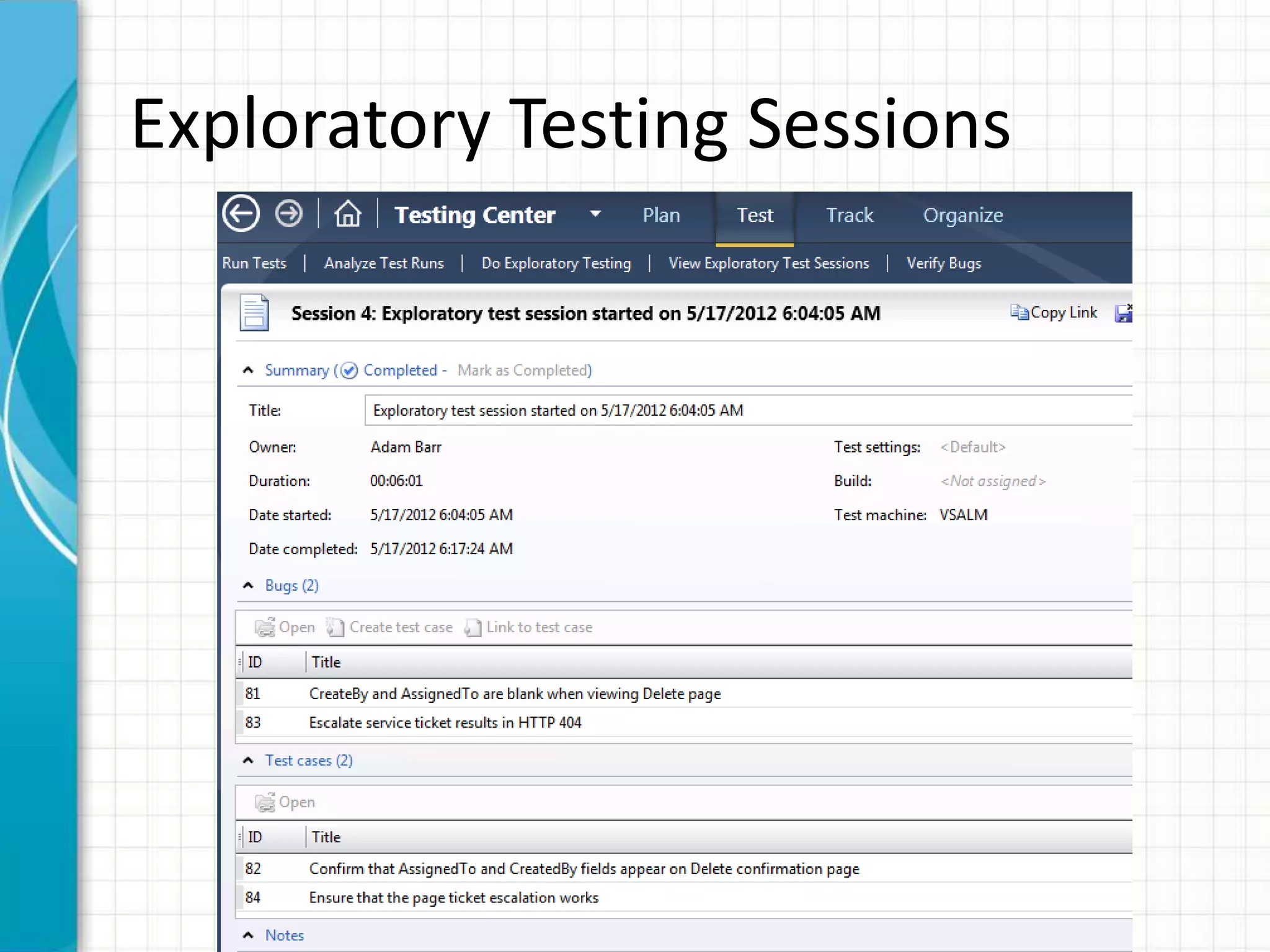
Exploratory Testing Sessions
EXPLORATORY TESTING
- DEMO
LAB
MANAGEMENT
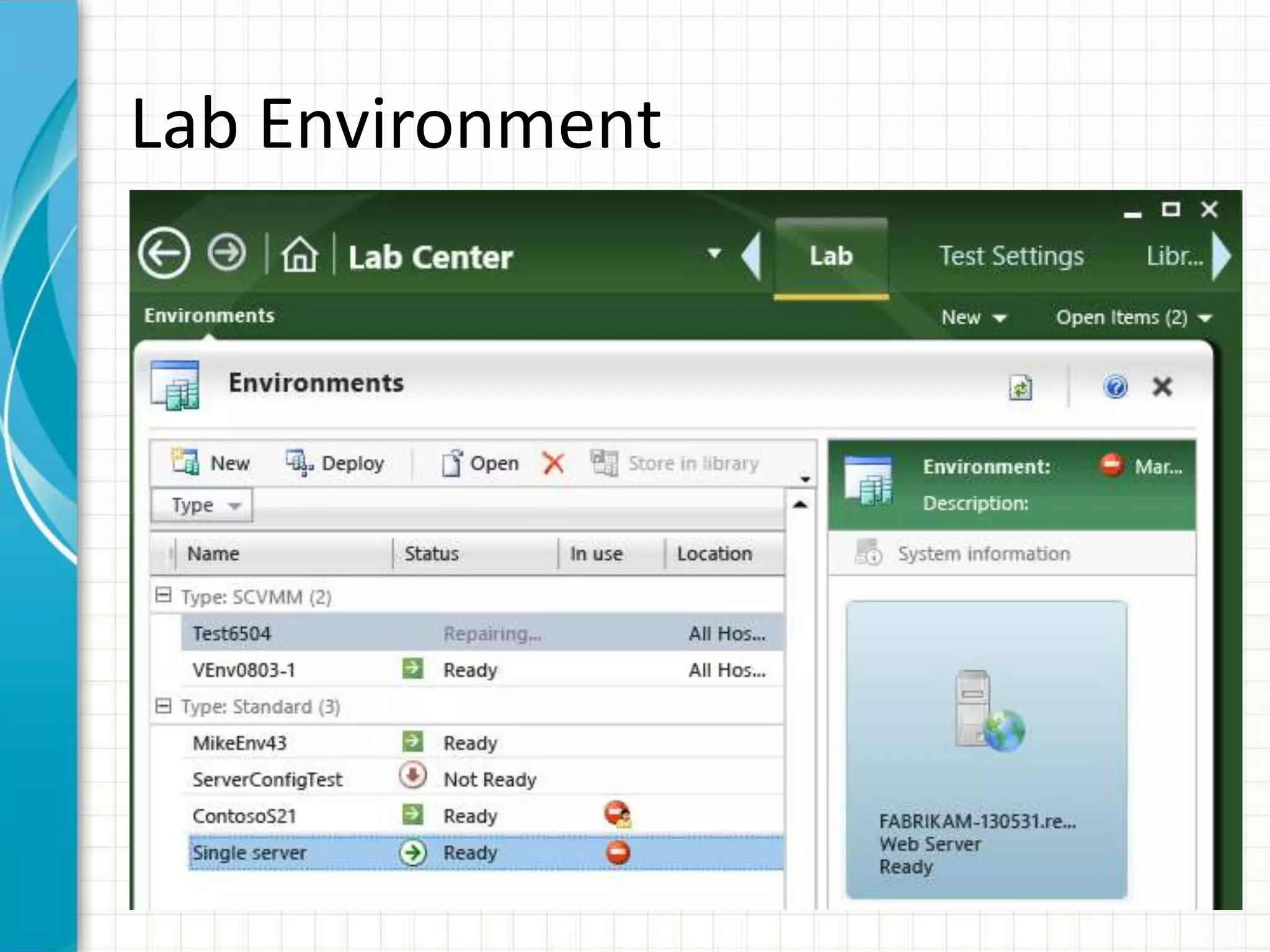
Lab Environment
• A group of computers that you manage as a
single entity
• Lets you collect diagnostic data from all the
machines in the lab while you’re performing
your tests. The data, such as event actions,
are attached to the test results and to any
bug that you create
• Automate the process of building, deploying,
and running automated tests on your lab
environment
Lab Environment
Standard Lab Environment
• Both physical computers and virtual
machines can be added to a standard
environment
• On each machine:
– Configure a user account and a password that
has administrative privileges. All the machines
must have the same username and password. It
doesn’t matter whether the account is a domain
or a local account
– Make sure that file sharing is enabled
Standard Lab Environment (continued)
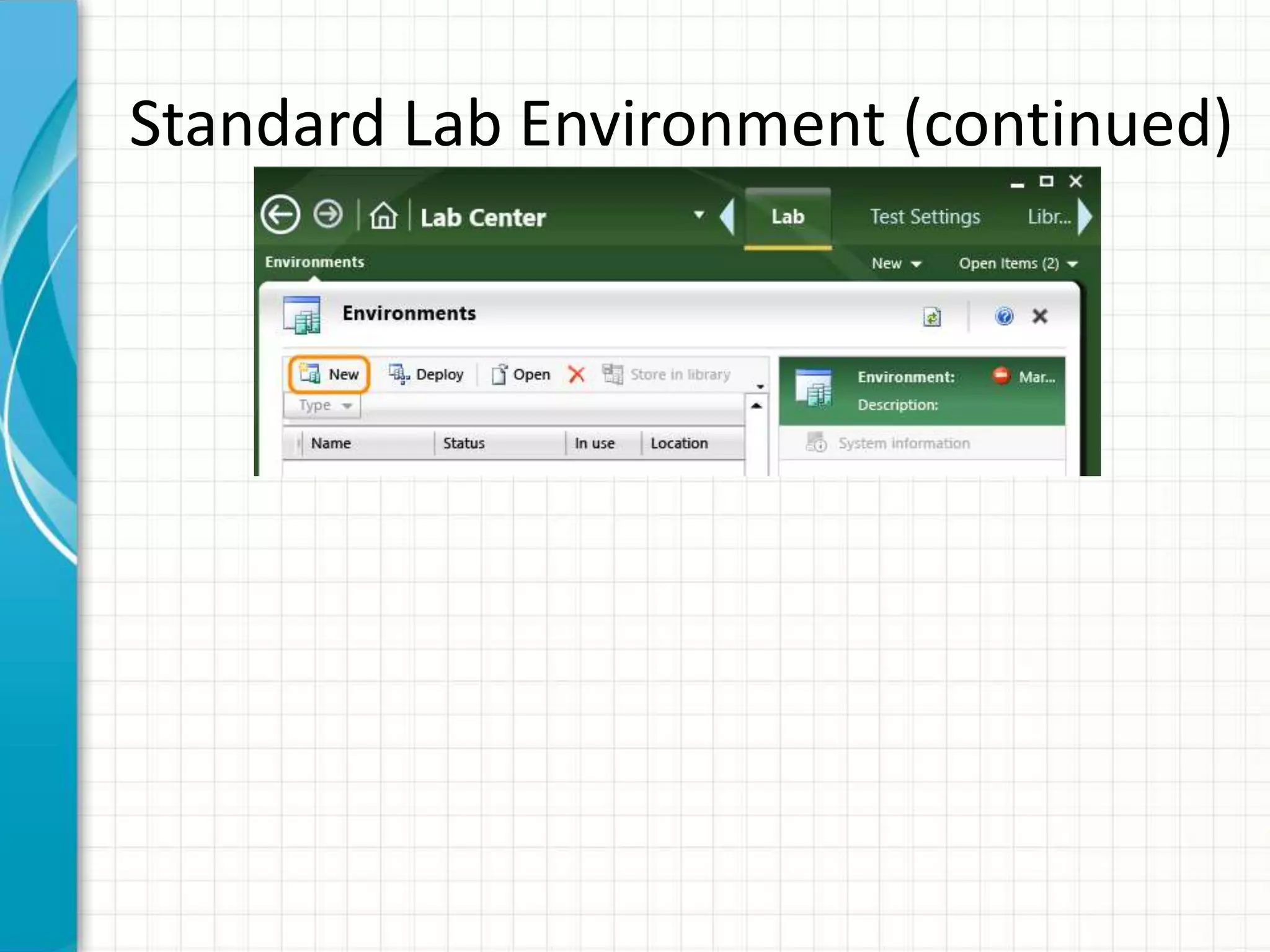
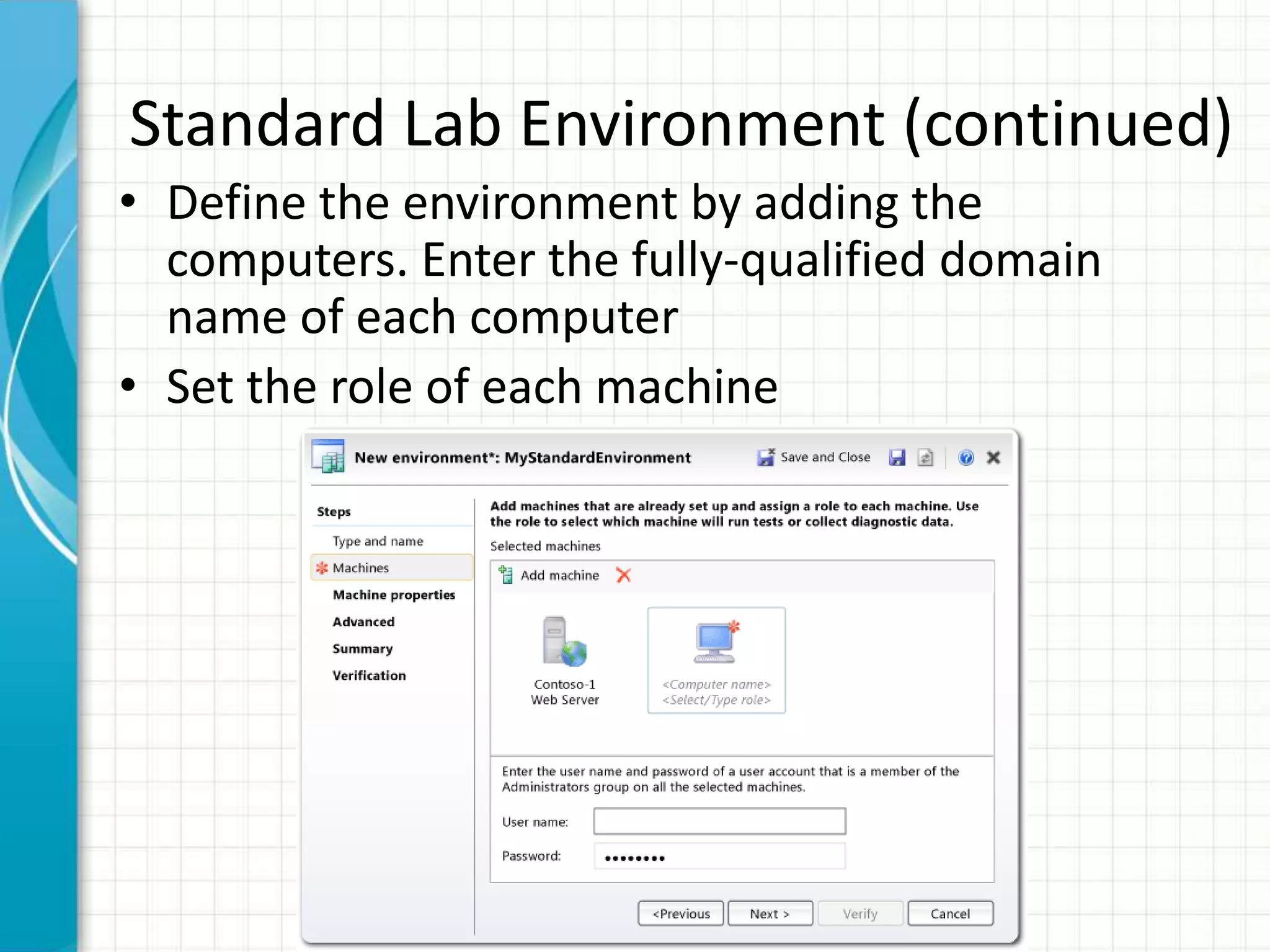
• Define the environment by adding the
computers. Enter the fully-qualified domain
name of each computer
• Set the role of each machine
Standard Lab Environment (continued)
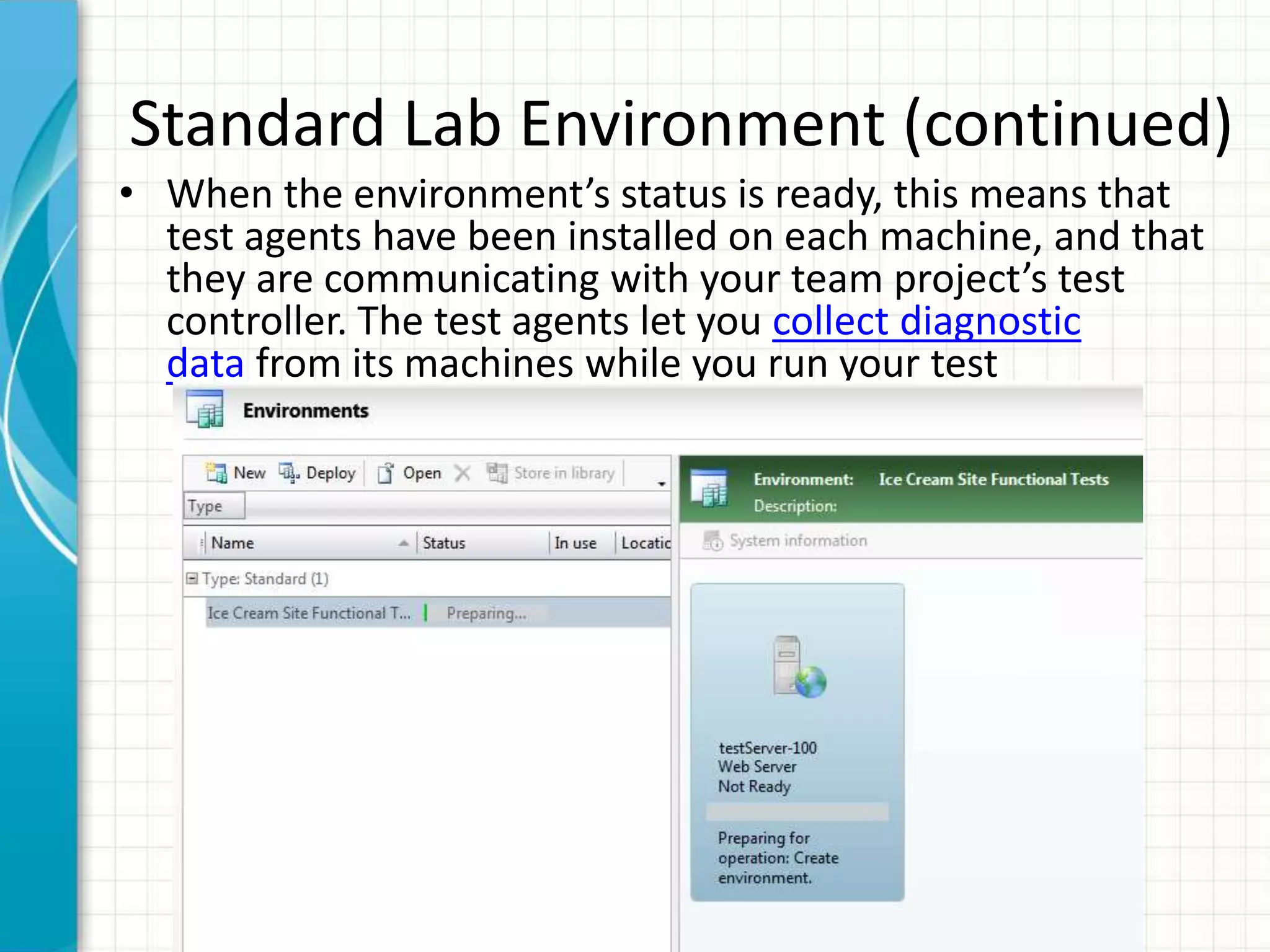
• When the environment’s status is ready, this means that
test agents have been installed on each machine, and that
they are communicating with your team project’s test
controller. The test agents let you collect diagnostic
data from its machines while you run your test
Use Standard Lab Environment
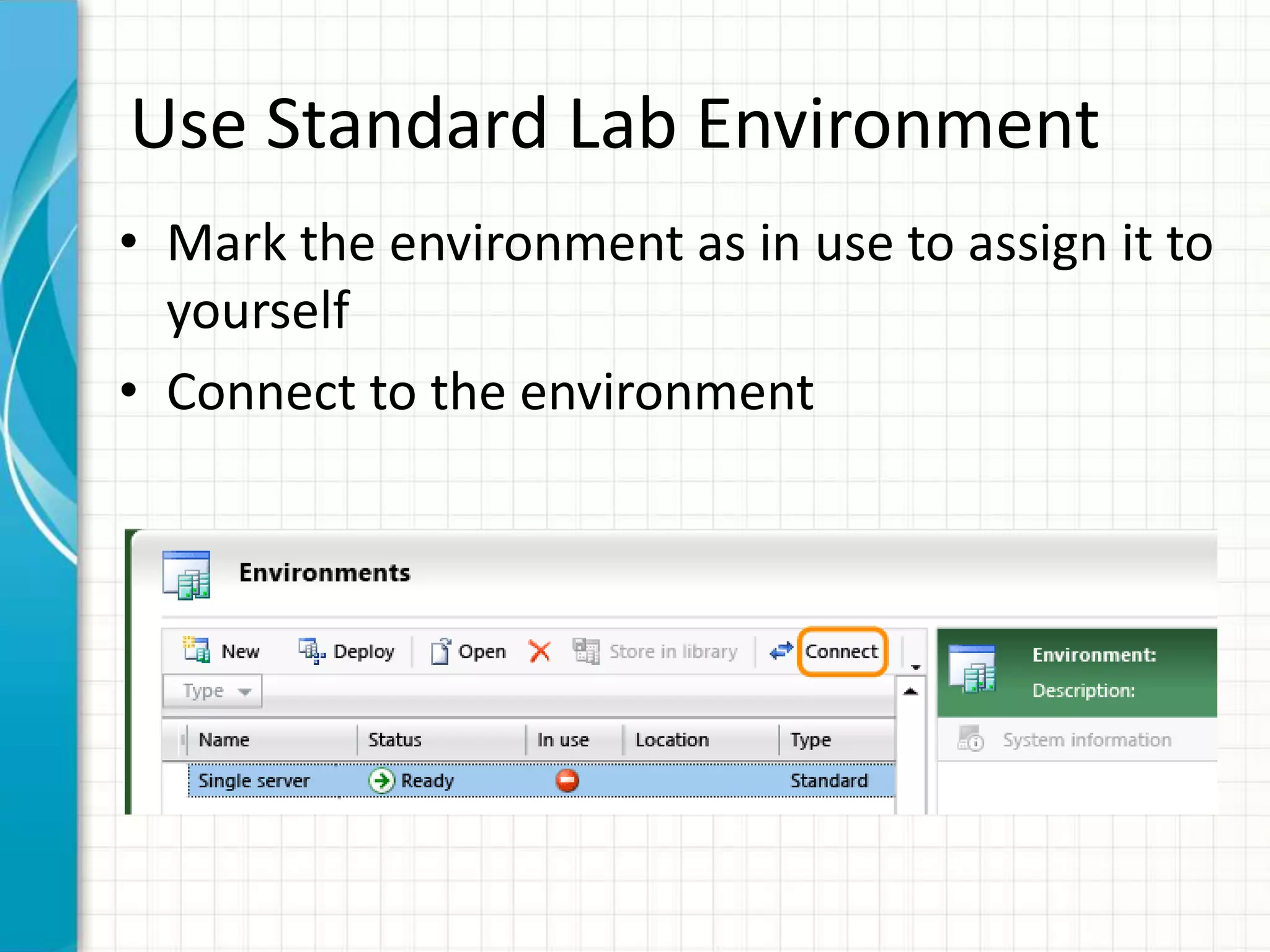
• Mark the environment as in use to assign it to
yourself
• Connect to the environment
Use Standard Lab Environment
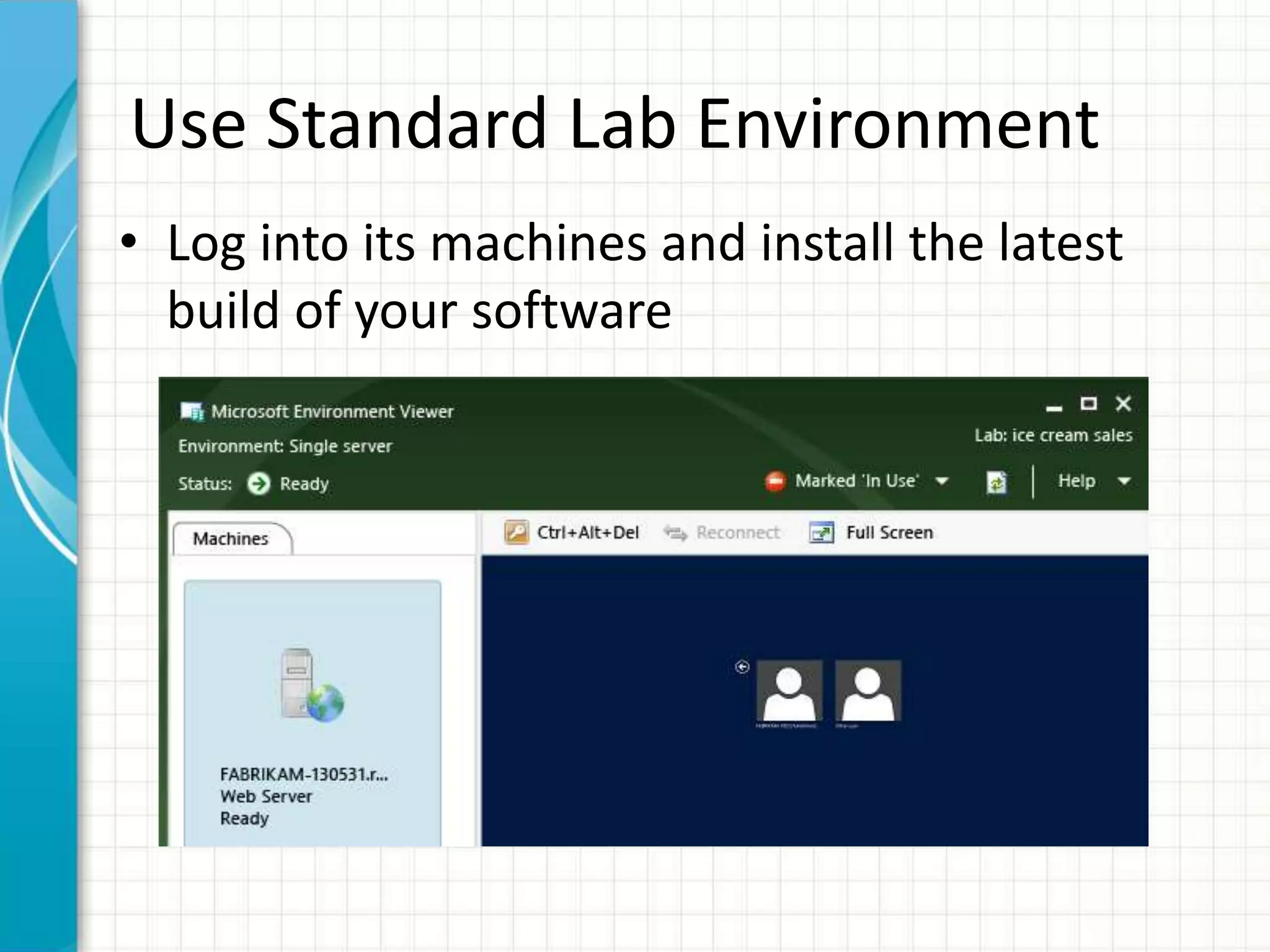
• Log into its machines and install the latest
build of your software
Use Standard Lab Environment
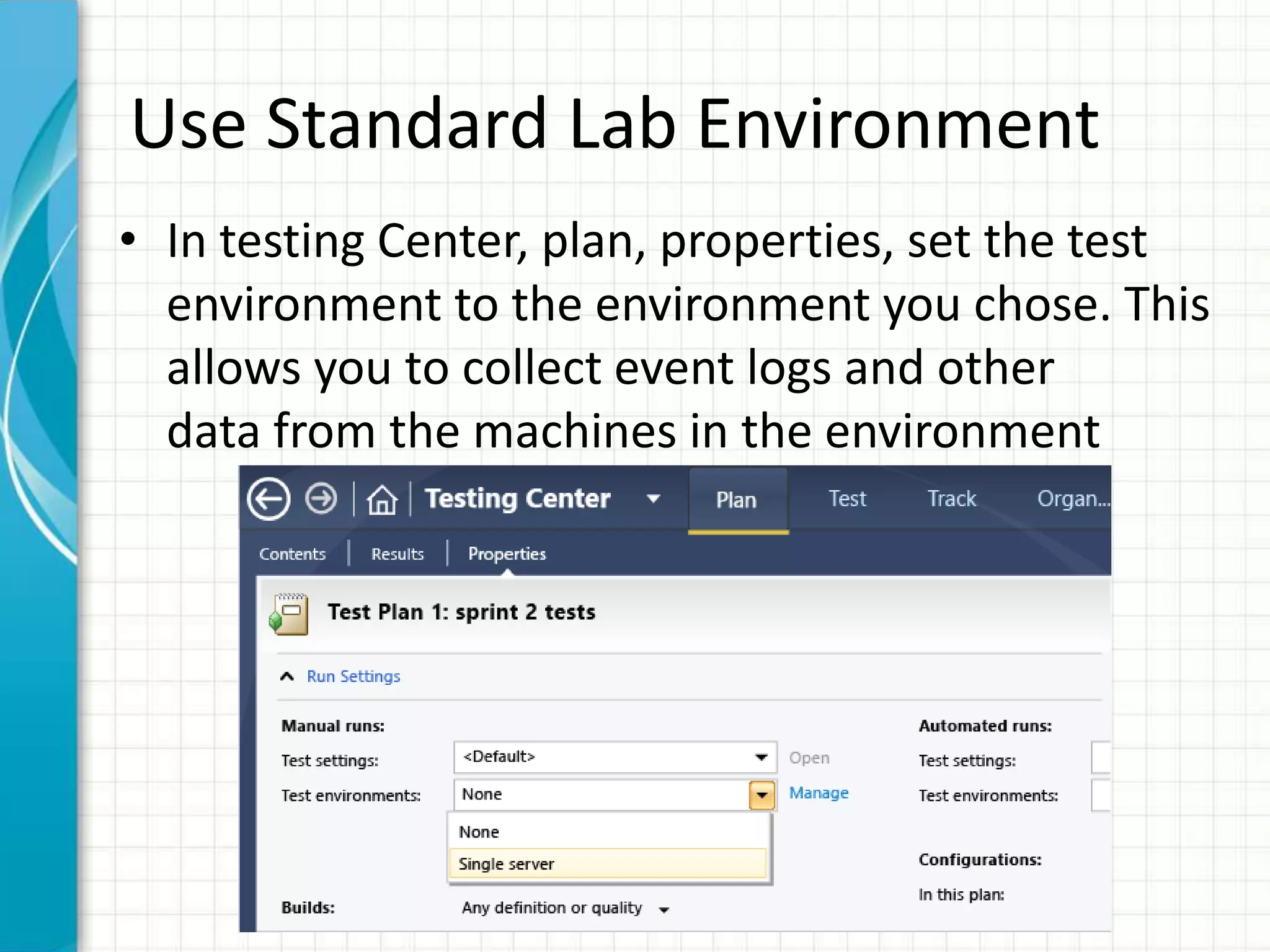
• In testing Center, plan, properties, set the test
environment to the environment you chose. This
allows you to collect event logs and other
data from the machines in the environment
Questions?
Thank you!
Raluca Suditu
raluca.suditu@gmail.com
http://ralucasuditu-softwaretesting.blogspot.ro/

Test Case Management with MTM 2013

  • 1.
  • 2.
    Why MTM? • TestTool • Different test types – Manual/scripted – Exploratory – Automated (CodedUI/Unit tests) • Integration
  • 3.
  • 4.
    Resources • Visual Studio2013 Ultimate/Premium/Test Professional • TFS • Visual Studio Online • Brian Keller http://aka.ms/almvms
  • 5.
  • 6.
  • 7.
  • 8.
  • 9.
  • 10.
  • 11.
  • 12.
  • 13.
    • Test plans1 •Test suites2 • Test configuration and test settings3 Overview
  • 14.
  • 15.
  • 16.
  • 17.
  • 18.
  • 19.
    Test Center • Definetests you plan to run for a specific sprint/iteration • Execute the tests from your plan • Measure progress/quality
  • 20.
  • 21.
    Test Plan RunSettings
  • 22.
  • 23.
  • 24.
  • 25.
    Test Suites Overview •Test Suites • Static Test Suites • Query-based Test Suites • Requirement-based Test Suites • Copying Test Suites • Cloning Test Suites
  • 26.
    Test Suites • Groupyour test cases into a hierarchy of test suites – Root node (suite) contains all other test suites
  • 27.
    Test Suites • Static –Contains test cases and other test suites • Query-based – Contains test cases based on a query – Test cases that fit the query criteria are dynamically added – Cannot contain other test suites • Requirements-based – Group your test cases by requirements – Based on the work items that belong to the Requirement category (Requirement, Product Backlog Item, User Story, etc.)
  • 28.
    Adding Test Casesto Static Test Suites • Add existing or create new test cases for your static test suites
  • 29.
    Query-Based Test Suites •Query-based test suites are defined by work item queries that select test cases – Example: All test cases with priority = 1 • Any new test case with priority set to 1 will be dynamically added to the test suite
  • 30.
    Requirement-Based Test Suites •Add existing requirement (work item) to your test plan to create test suite • Each requirement has its own suite • Test cases added are linked to requirements • Helps to determine test coverage and completion of your requirements
  • 31.
    Create Test Suitesfrom Web Interface
  • 32.
    Copying Test Suitesand Test Plans • Copying – Copies test cases “by reference”. New suite shares same test cases – Useful for testing with different test plans but same test cases – Can be done from the GUI
  • 33.
  • 34.
    Cloning Test Suitesand Test Plans • Cloning – Copies test cases “by value”. New copies of test cases are created – Useful for testing two different releases simultaneously – Command line
  • 35.
    Cloning Test Suitesand Test Plans
  • 36.
    Cloning Test Suites– What Gets Cloned?
  • 37.
  • 38.
  • 39.
    Test Configuration andSettings Overview • Test Configurations • Creating Test Configurations • Defining Configuration Variables • Selecting Test Configurations • Test Settings • Data Adapters • How to Collect Data
  • 40.
    Test Configurations • Configuration variablesspecify setup required for testing – Examples: Operating system, browsers, software, hardware, SP, anything • Can be associated with test plans, suites and test cases
  • 41.
    Create Test Configurations •From Test Plan Run Settings • From Organize tab
  • 42.
  • 43.
    Selecting Test Configurations •Set default configuration(s) for your test plan – You may override at test suite and test case levels • A test case and test configuration pair is a test point • Test results are saved for each test point
  • 44.
    Test Settings • Testsettings use diagnostic data adapters to collect data when running manual tests, automated tests, or both
  • 45.
  • 46.
    Test Reports • Viewtest run results in real time in MTM • Use predefined test reports (Microsoft Excel, SQL Server Reporting Services) • Create your own reports (Microsoft Excel, SQL Server Reporting Services)
  • 47.
    Reporting on TestProgress: Test Plan
  • 48.
    Reporting on TestProgress • Test Case Readiness: Shows how many test cases are in Design vs. Ready
  • 49.
    Reporting on TestProgress (continued) • Test Plan Progress: Tracks how many tests have been run and how many are failing
  • 50.
    Reporting on TestProgress (continued) • Healthy version vs. unhealthy version Healthy version Unhealthy version
  • 51.
    Reporting on TestProgress (continued)
  • 52.
  • 53.
  • 54.
    • Manual TestCases1 • Test Steps Parameters2 • Shared Steps3 Overview
  • 55.
  • 56.
    Manual Test Cases •Test cases are work items • Test results are saved on each run • Manual test cases contain test steps (test script) – May contain test steps with validation – A tester indicates pass or fail at the test step level • A test case can be assigned to a tester
  • 57.
    Manual Test Cases(continued) • Test cases can be added to multiple test suites in the same or different test plans • Test cases are associated with 1..n test configurations – Creating 1..n test points Team Project Test Plan Test Suite Test Case Test Suite Test Case Test Case Test Plan Test Suite Test Case Test Suite Test Case Test Case Test Case Test Suite Test case
  • 58.
    Create Manual TestCases from MTM
  • 59.
    Create Manual TestCases from MTM (continued) • Add test steps using Microsoft Test Manager (MTM), Microsoft Excel, or Microsoft Word (via copy and paste) • Add test steps using Microsoft Test Manager (MTM), Microsoft Excel, or Microsoft Word (via copy and paste)
  • 60.
    Create Manual TestCases from Web Interface
  • 61.
    Create Test Casesfrom an Assembly of Automated Tests • Use tcm.exe • You must use a lab environment • Make sure that the test project is a part of your build definition • The test cases will have the same names as the test methods
  • 62.
    Assign Test Casesto Testers • Individually or in bulk • Assign at test point level
  • 63.
  • 64.
    Test Steps Parameters •Parameters allow a manual test case to run multiple times with different data – Example: @username, @password • Parameters can be added to actions or expected results
  • 65.
    Test Steps Parameters(continued) • Overall test results are based on all iterations passing
  • 66.
  • 67.
    Shared Steps • Usedfor repeated sequences of steps, such as logging in, that occur in many test cases • Avoiding having to enter these sequences again and again, create shared steps
  • 68.
    Create Shared Steps •While you’re editing a test case, select a sequence of steps that you want to share • Steps you selected are replaced with a link to the new shared steps work item
  • 69.
  • 70.
  • 71.
    • Running manualtest cases1 • Action recordings2 • Reporting bugs3 Overview
  • 72.
    Running Manual TestCases • Run individual tests or entire suites • A test result is recorded for each test run • Create action recordings – Used for future runs – Action recording can be used in CodedUI tests • Submit new bugs or update existing bugs directly • Attach comments, indicate pass or fail, take screenshots • Test case management features also available in Web Portal
  • 73.
    Running Manual TestCases (continued)
  • 74.
    Action Recordings • Recorda manual test (or shared steps) to allow for a later run of certain parts of manual tests – Example: Login, entire smoke test • Use it to help with: – A test that you will want to run multiple times – Different manual tests that contain common steps via action recordings – Verifying a bug fix – Automate by importing it to a Coded UI Test
  • 75.
  • 76.
  • 77.
  • 78.
    Submitting Bugs • Submita bug from Test Runner – Information automatically added about the test environment, comments, screenshots, video recording • Submit a bug from Test Manager when you view the manual test result – No diagnostic data added via this route
  • 79.
  • 80.
  • 81.
  • 82.
    Exploratory Testing • Testthe application without a predefined test script • Record screenshots, comments, attach files, video and audio narration • Submit bugs you find while testing – Includes rich diagnostic data collected through testing – Uses the recorded steps to create a manual test case
  • 83.
    Exploratory Testing (continued) •Explore the application selecting a user story/requirement – Bugs created will be automatically linked to the user story/requirement • Explore the application without selecting a user story/requirement
  • 84.
    Exploratory Testing (continued) •Update comments, add screenshots and files as you work, or add a bug
  • 85.
  • 86.
  • 87.
  • 88.
    Lab Environment • Agroup of computers that you manage as a single entity • Lets you collect diagnostic data from all the machines in the lab while you’re performing your tests. The data, such as event actions, are attached to the test results and to any bug that you create • Automate the process of building, deploying, and running automated tests on your lab environment

  • 89.
  • 90.
    Standard Lab Environment •Both physical computers and virtual machines can be added to a standard environment • On each machine: – Configure a user account and a password that has administrative privileges. All the machines must have the same username and password. It doesn’t matter whether the account is a domain or a local account – Make sure that file sharing is enabled
  • 91.
  • 92.
    Standard Lab Environment(continued) • Define the environment by adding the computers. Enter the fully-qualified domain name of each computer • Set the role of each machine
  • 93.
    Standard Lab Environment(continued) • When the environment’s status is ready, this means that test agents have been installed on each machine, and that they are communicating with your team project’s test controller. The test agents let you collect diagnostic data from its machines while you run your test
  • 94.
    Use Standard LabEnvironment • Mark the environment as in use to assign it to yourself • Connect to the environment
  • 95.
    Use Standard LabEnvironment • Log into its machines and install the latest build of your software
  • 96.
    Use Standard LabEnvironment • In testing Center, plan, properties, set the test environment to the environment you chose. This allows you to collect event logs and other data from the machines in the environment
  • 97.
  • 98.