Unit 4 - Graphs
What is a graph?
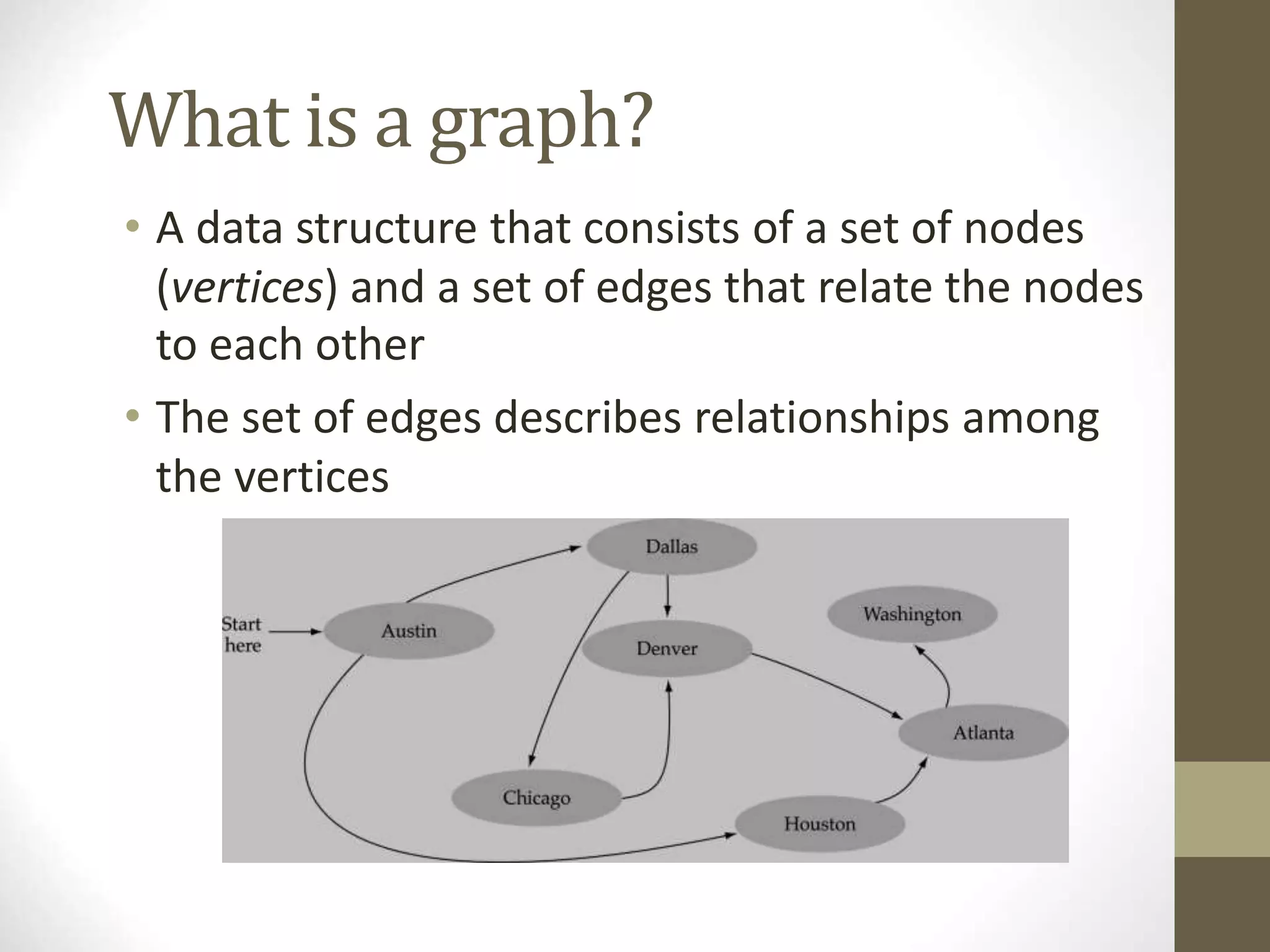
• A data structure that consists of a set of nodes
(vertices) and a set of edges that relate the nodes
to each other
• The set of edges describes relationships among
the vertices
Definition of graphs
• A graph G is defined as follows:
G=(V,E)
V(G): a finite, nonempty set of vertices
E(G): a set of edges (pairs of vertices)
Directed vs. undirected graphs
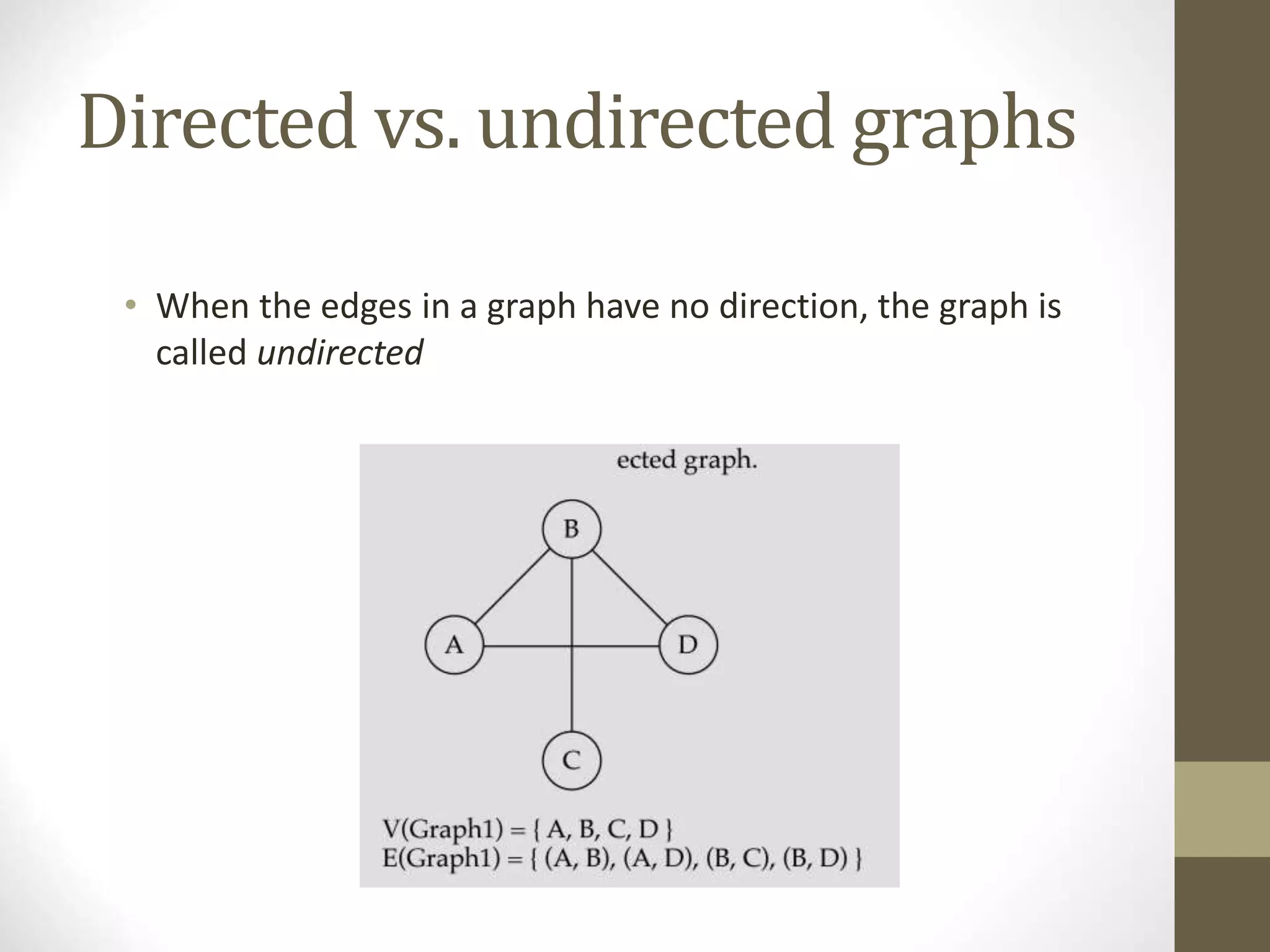
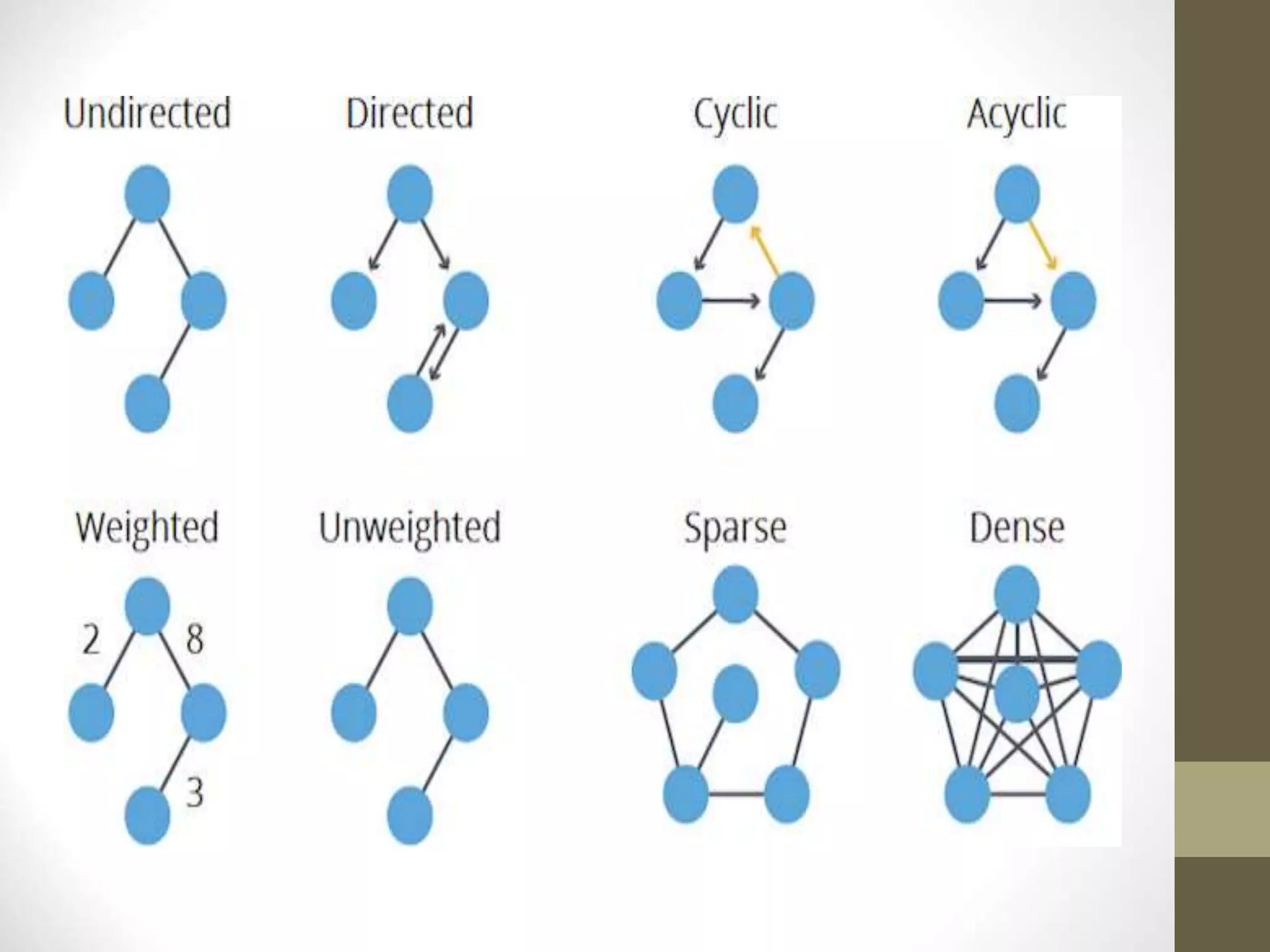
• When the edges in a graph have no direction, the graph is
called undirected
Directed vs. undirected graphs
(cont.)
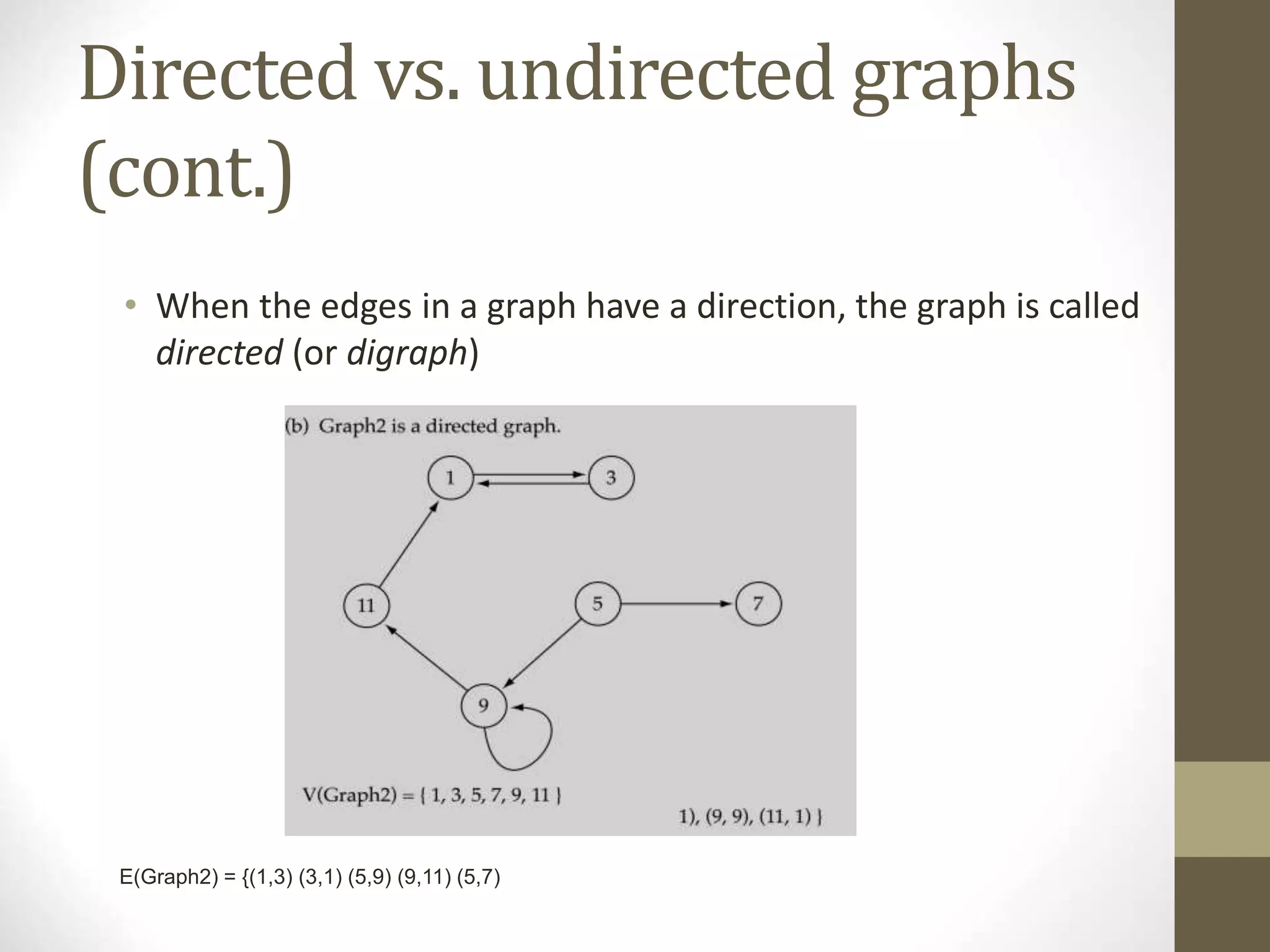
• When the edges in a graph have a direction, the graph is called
directed (or digraph)
E(Graph2) = {(1,3) (3,1) (5,9) (9,11) (5,7)
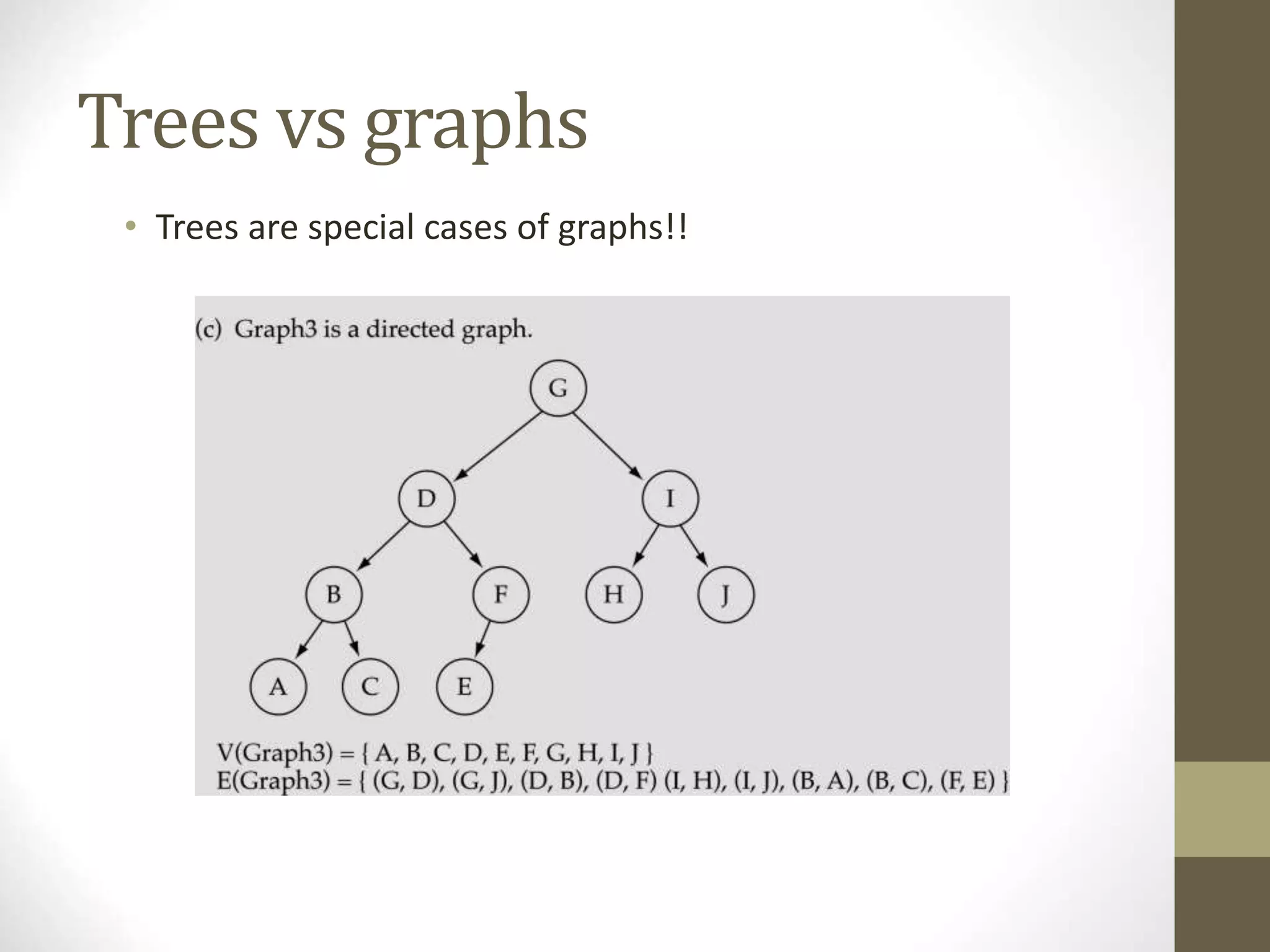
Trees vs graphs
• Trees are special cases of graphs!!
Graph terminology
• Adjacent nodes: two nodes are adjacent if they are connected
by an edge
• Path: a sequence of vertices that connect two nodes in a graph
• Complete graph: a graph in which every vertex is directly
connected to every other vertex
5
Graph terminology (cont.)
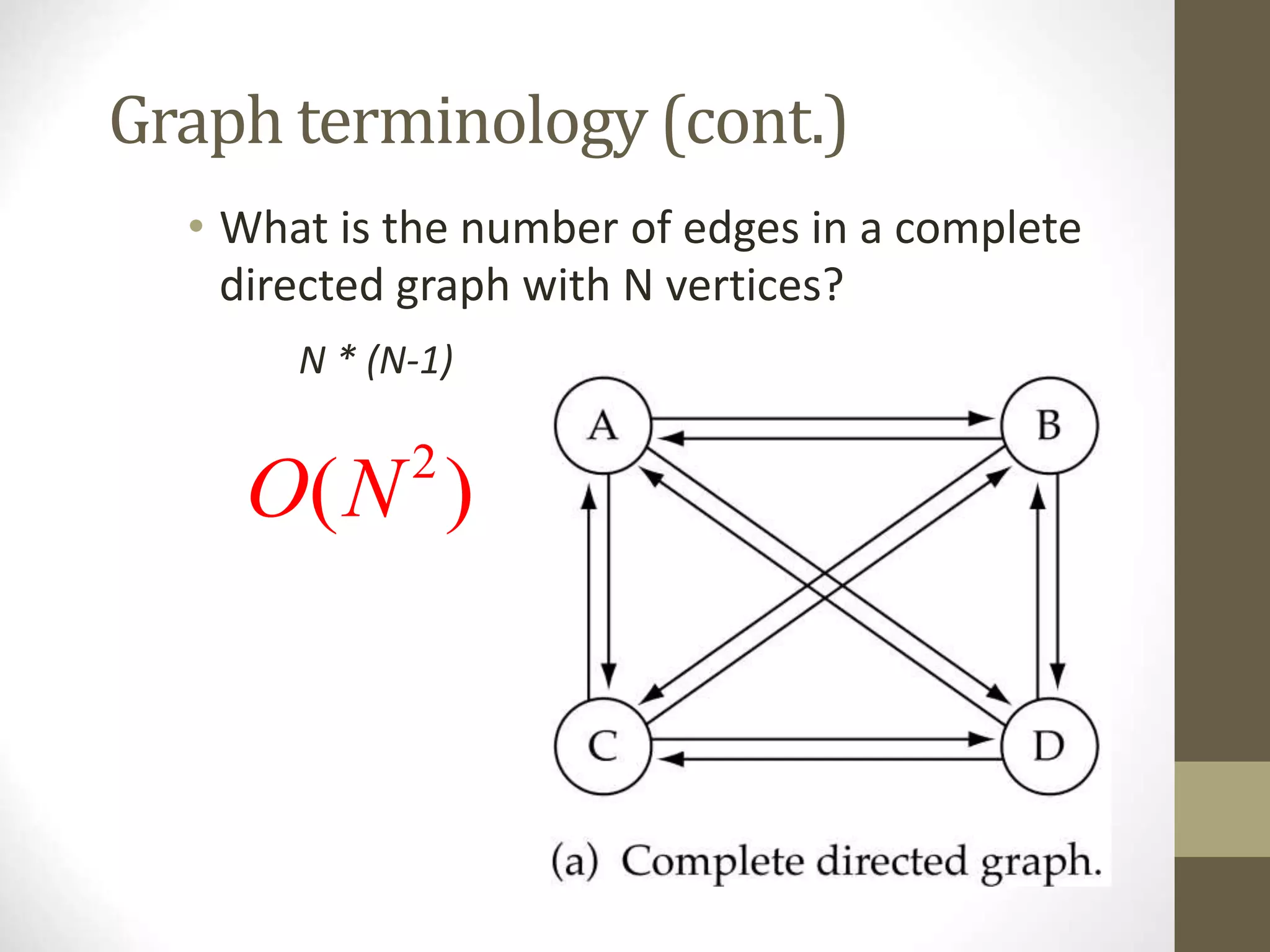
• What is the number of edges in a complete
directed graph with N vertices?
N * (N-1)
2
( )
O N
Graph terminology (cont.)
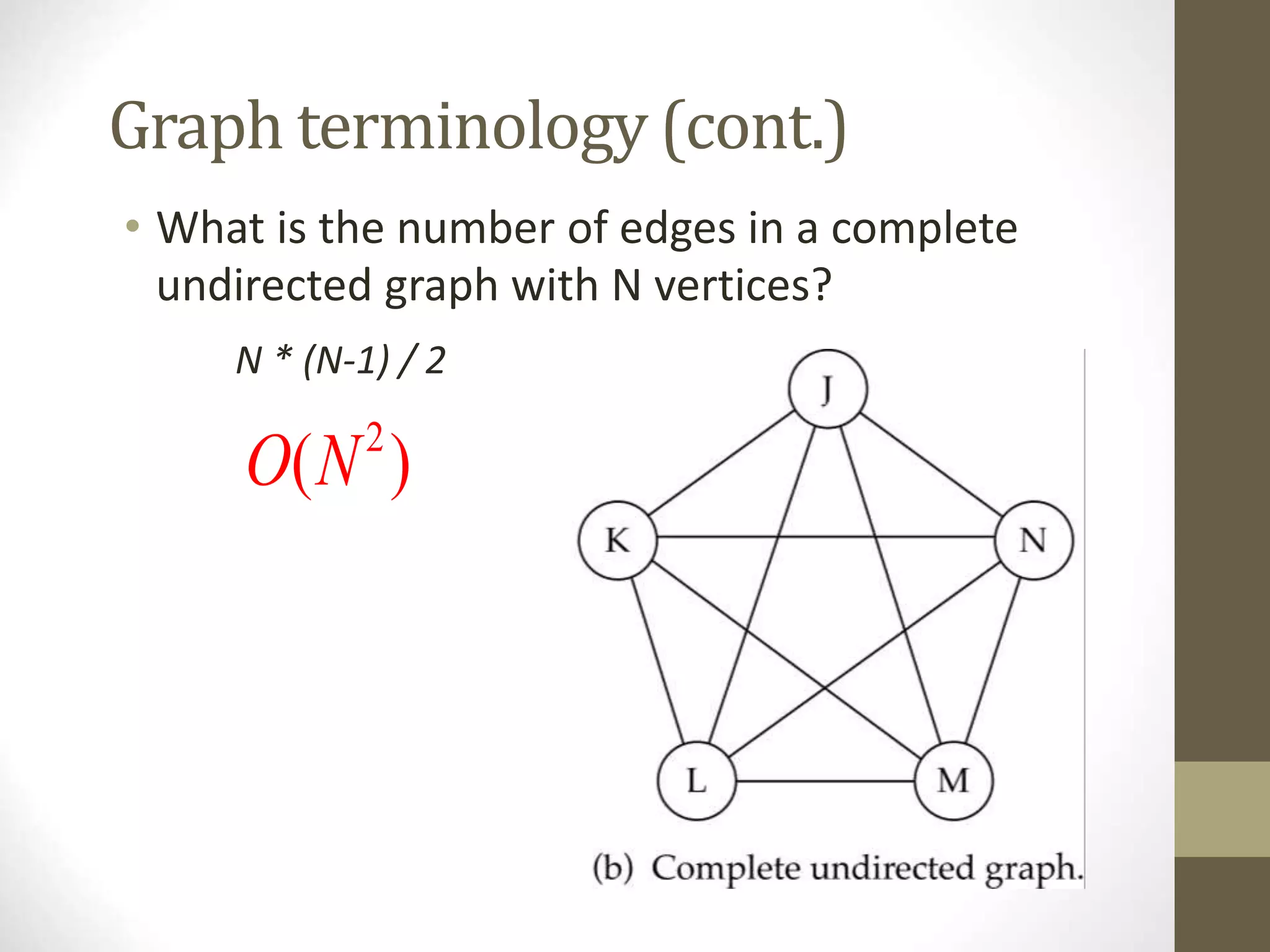
• What is the number of edges in a complete
undirected graph with N vertices?
N * (N-1) / 2
2
( )
O N
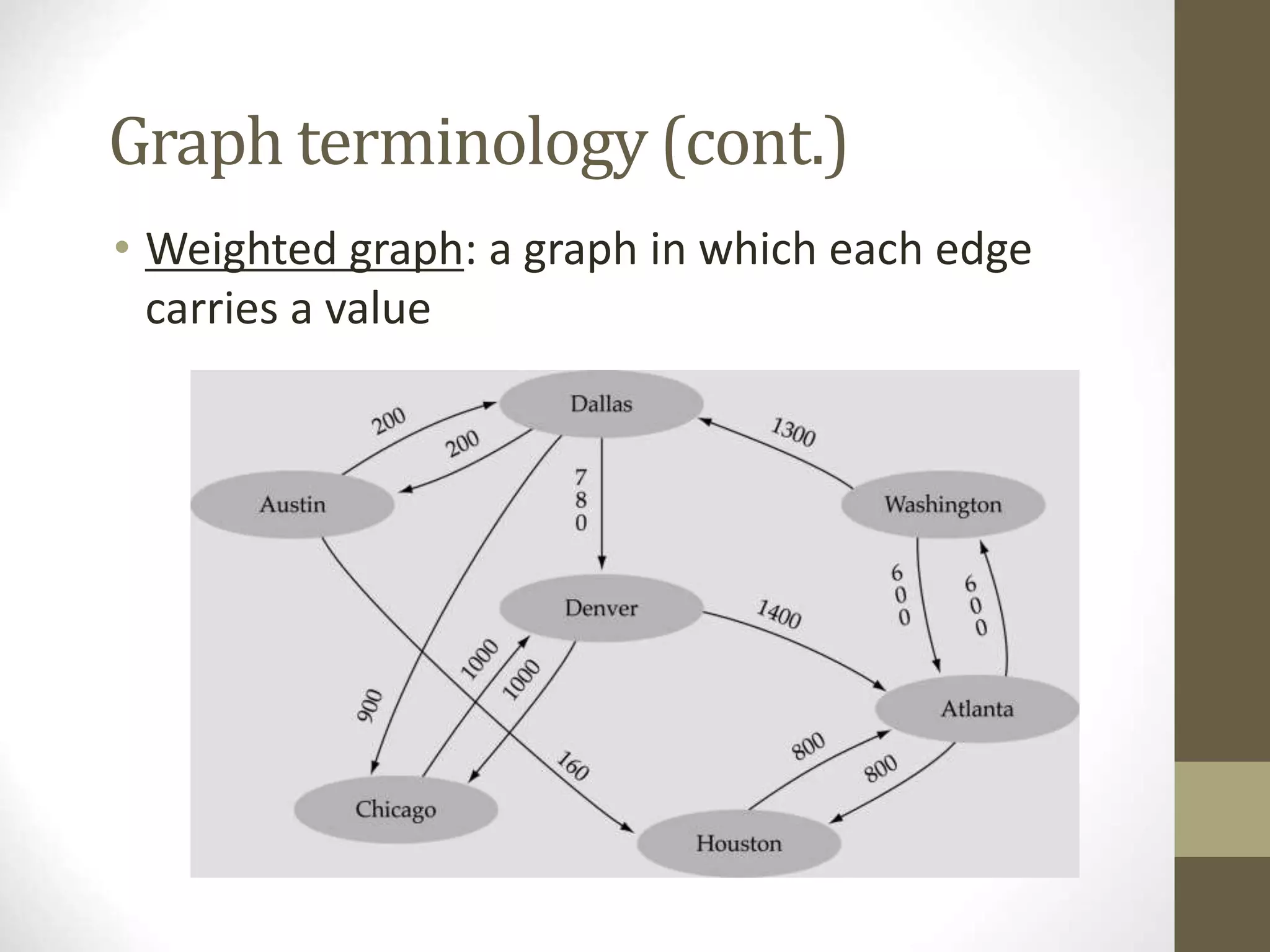
Graph terminology (cont.)
• Weighted graph: a graph in which each edge
carries a value
Graph implementation
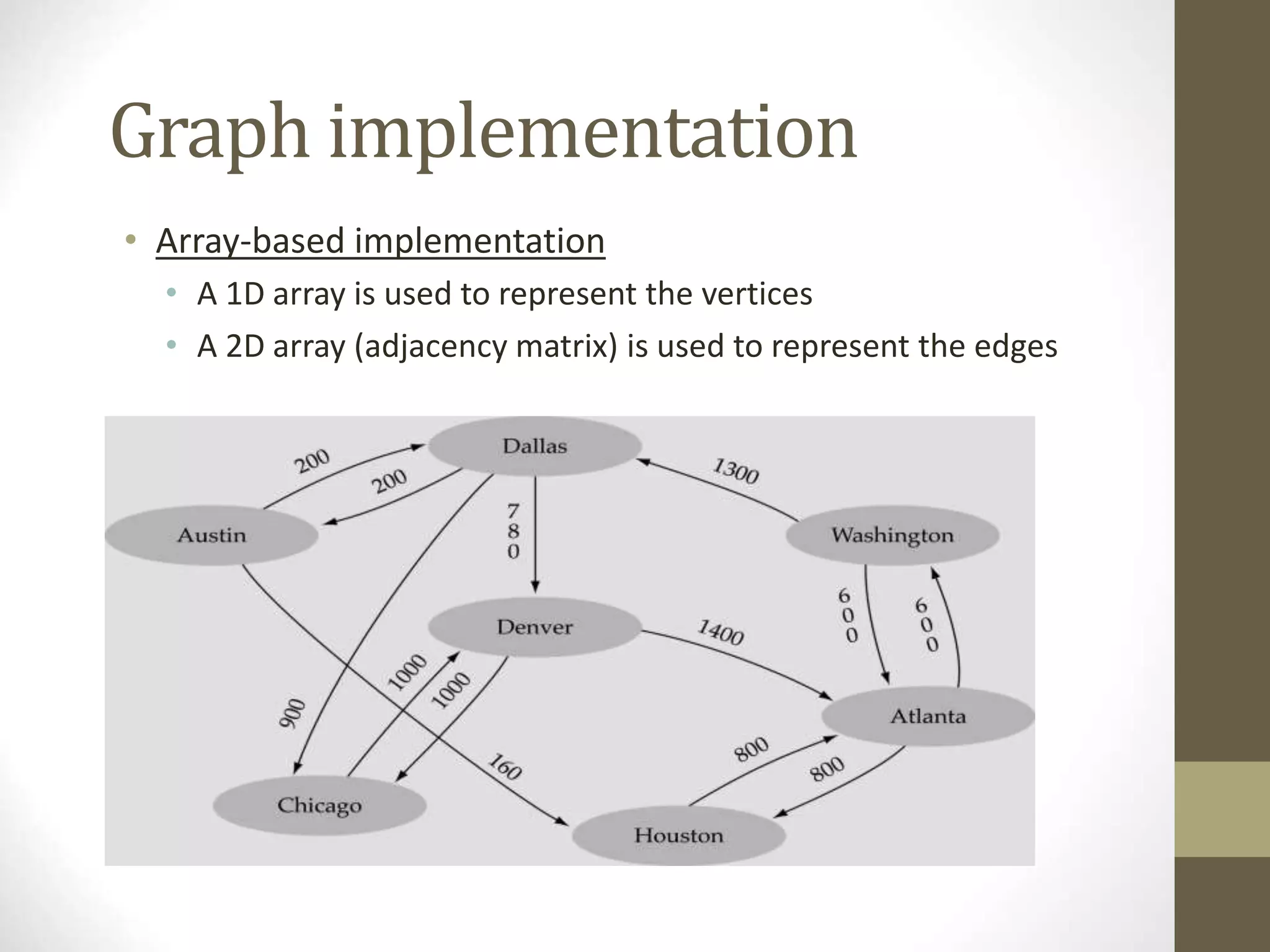
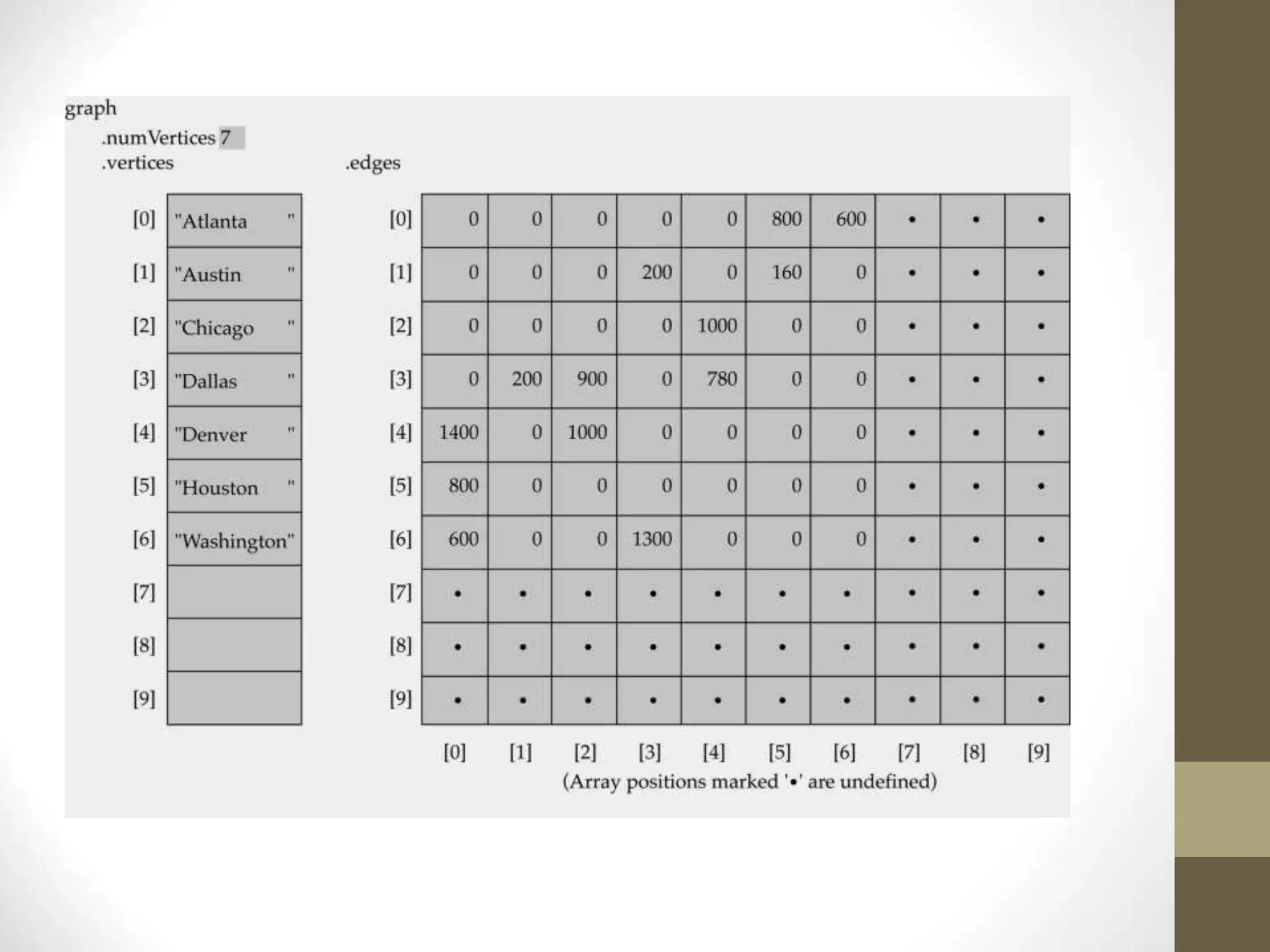
• Array-based implementation
• A 1D array is used to represent the vertices
• A 2D array (adjacency matrix) is used to represent the edges
Array-based implementation
Graph implementation (cont.)
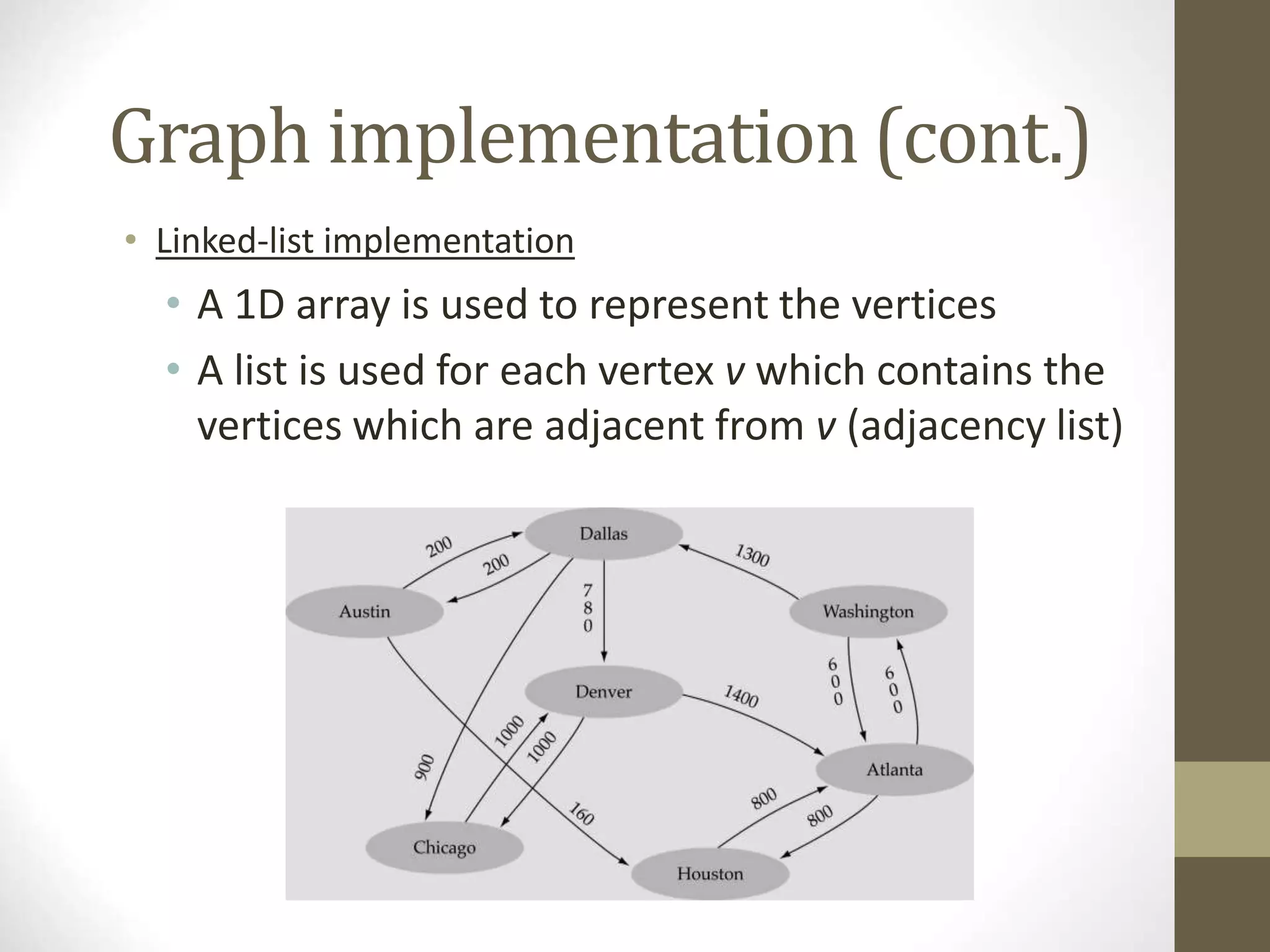
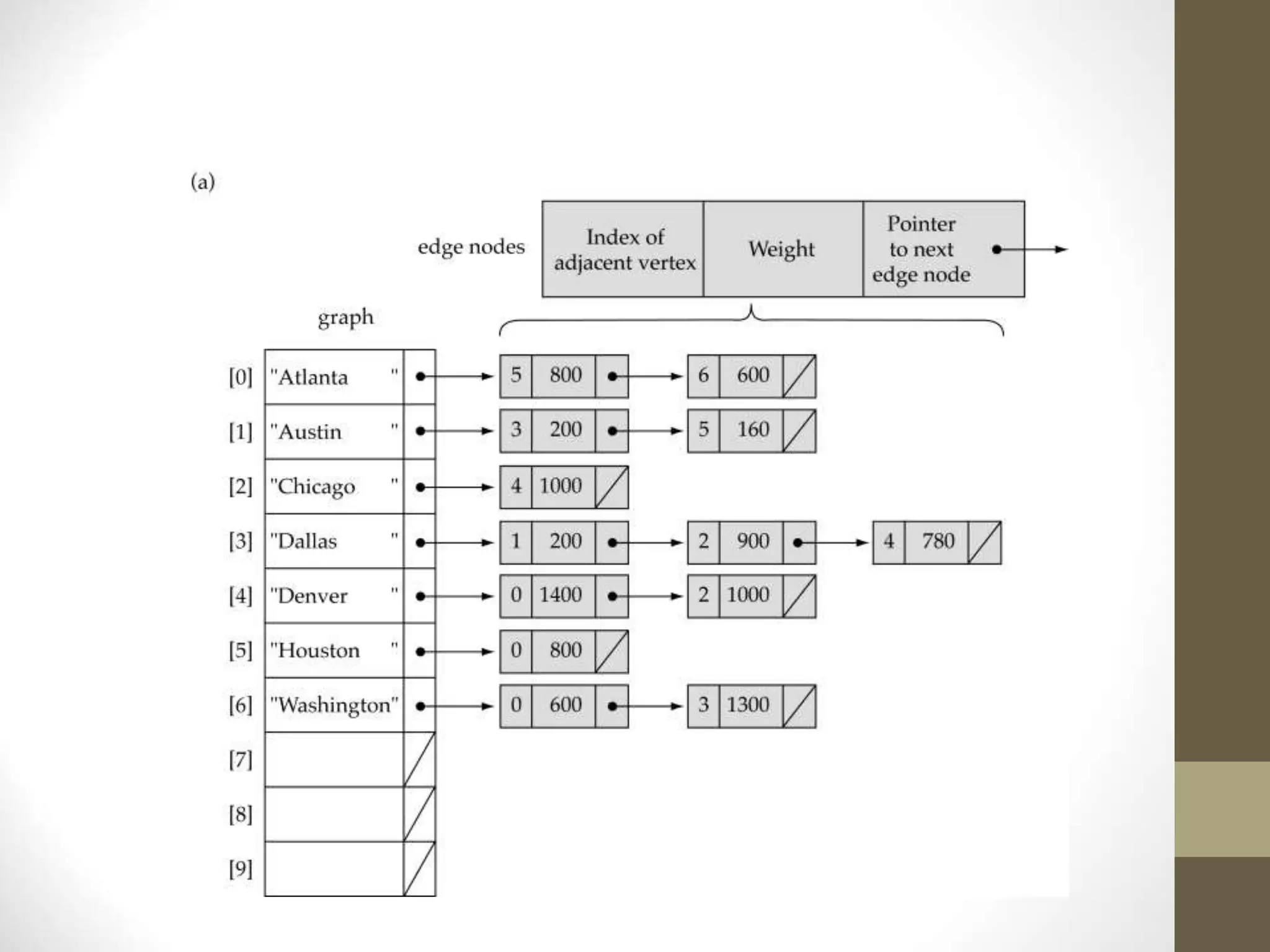
• Linked-list implementation
• A 1D array is used to represent the vertices
• A list is used for each vertex v which contains the
vertices which are adjacent from v (adjacency list)
Linked-list implementation
Adjacency matrix vs. adjacency list
representation
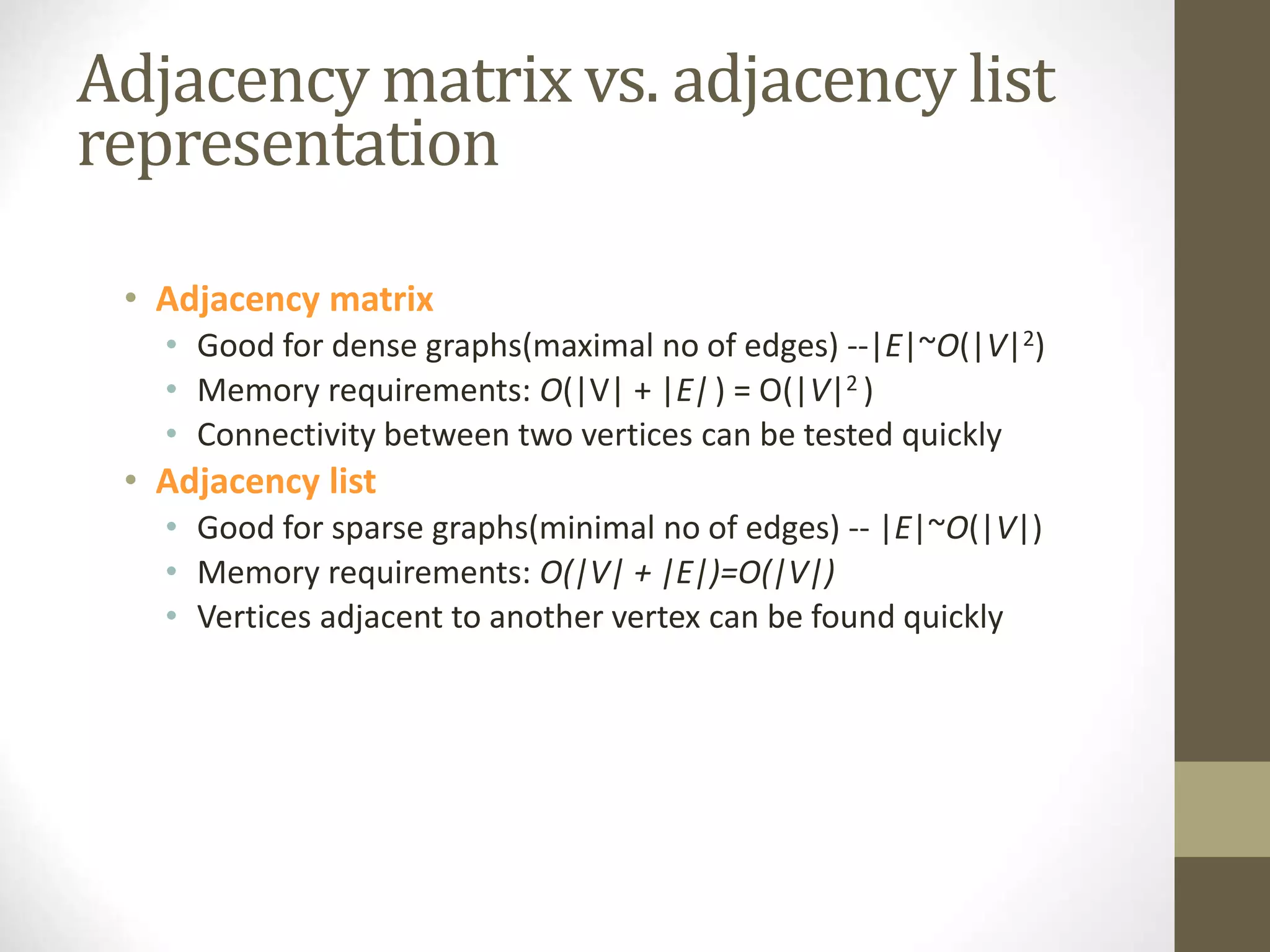
• Adjacency matrix
• Good for dense graphs(maximal no of edges) --|E|~O(|V|2)
• Memory requirements: O(|V| + |E|) = O(|V|2 )
• Connectivity between two vertices can be tested quickly
• Adjacency list
• Good for sparse graphs(minimal no of edges) -- |E|~O(|V|)
• Memory requirements: O(|V| + |E|)=O(|V|)
• Vertices adjacent to another vertex can be found quickly
Graph searching
• Problem: find a path between two nodes of the graph (e.g.,
Austin and Washington)
• Methods: Depth-First-Search (DFS) or Breadth-First-Search (BFS)
Depth-First-Search (DFS)
• What is the idea behind DFS?
• Travel as far as you can down a path
• Back up as little as possible when you reach a "dead end" (i.e.,
next vertex has been "marked" or there is no next vertex)
• DFS can be implemented efficiently using a stack
Rules to be followed for DFS
• Rule 1 − Visit the adjacent unvisited vertex. Mark it as visited.
Display it. Push it in a stack.
• Rule 2 − If no adjacent vertex is found, pop up a vertex from
the stack. (It will pop up all the vertices from the stack, which
do not have adjacent vertices.)
• Rule 3 − Repeat Rule 1 and Rule 2 until the stack is empty
• https://www.programiz.com/dsa/graph-dfs
Breadth-First-Searching (BFS)
• What is the idea behind BFS?
• Look at all possible paths at the same depth before you go at a
deeper level
• Back up as far as possible when you reach a "dead end" (i.e., next
vertex has been "marked" or there is no next vertex)
Breadth-First-Searching (BFS) (cont.)
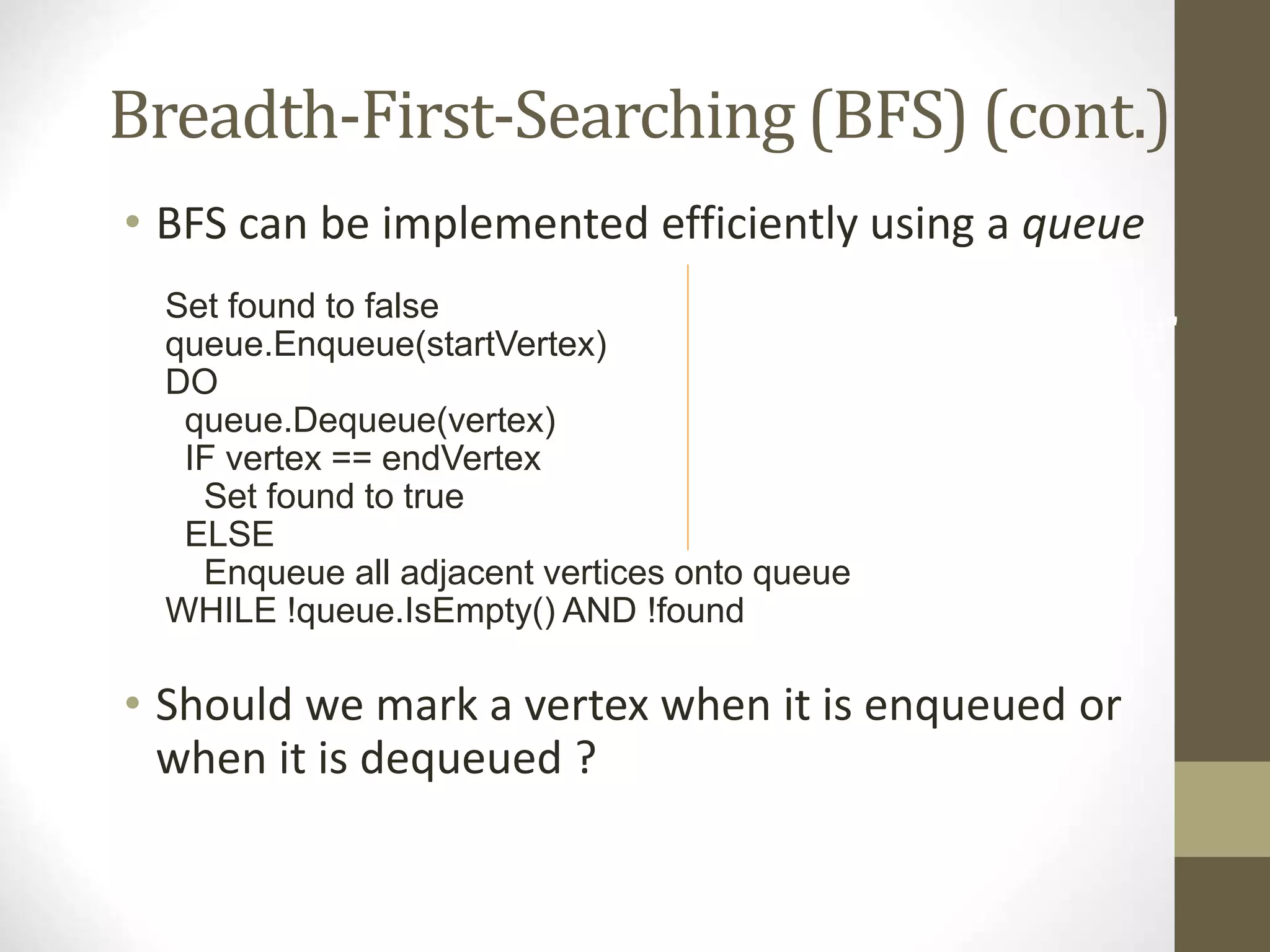
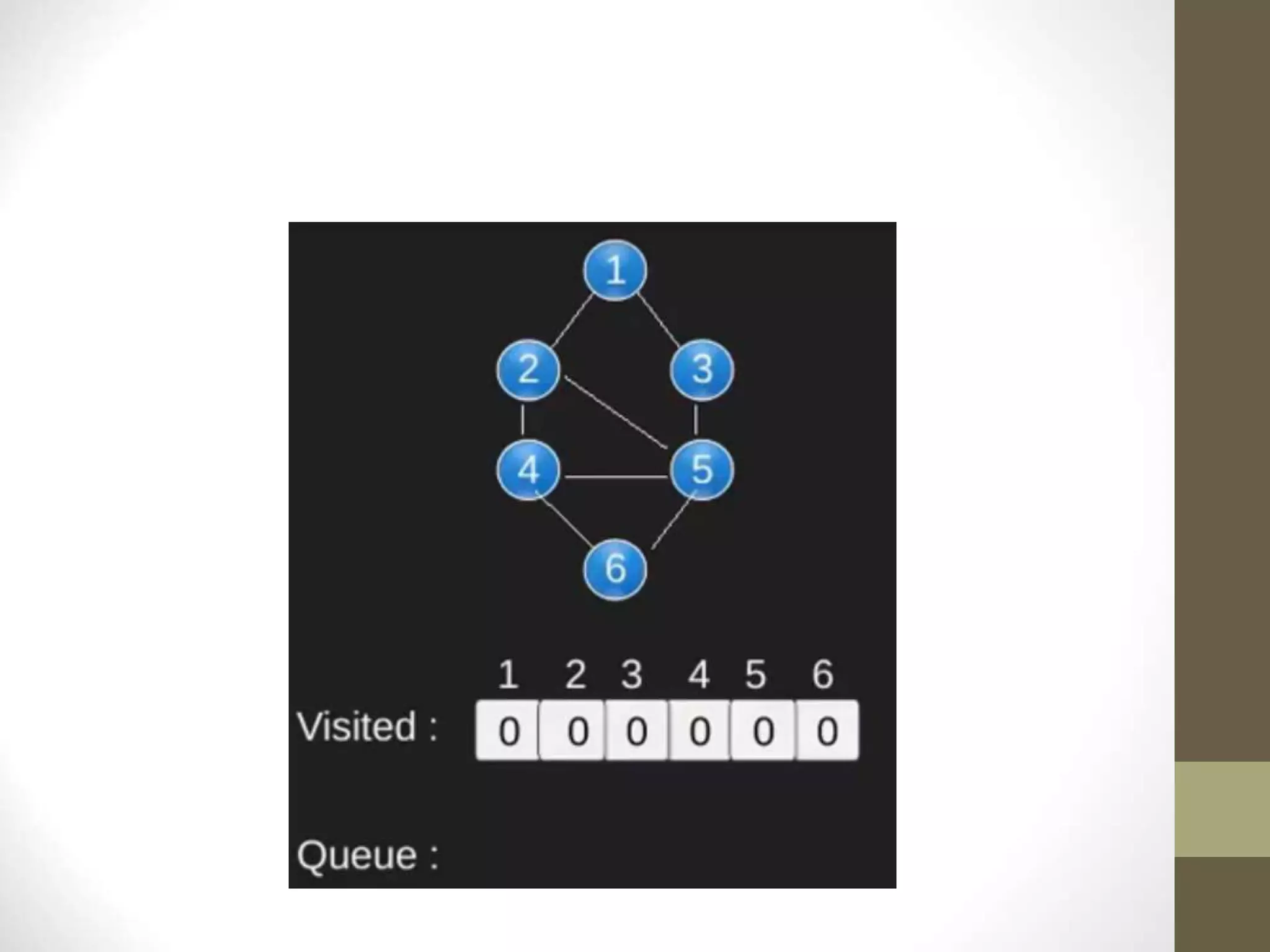
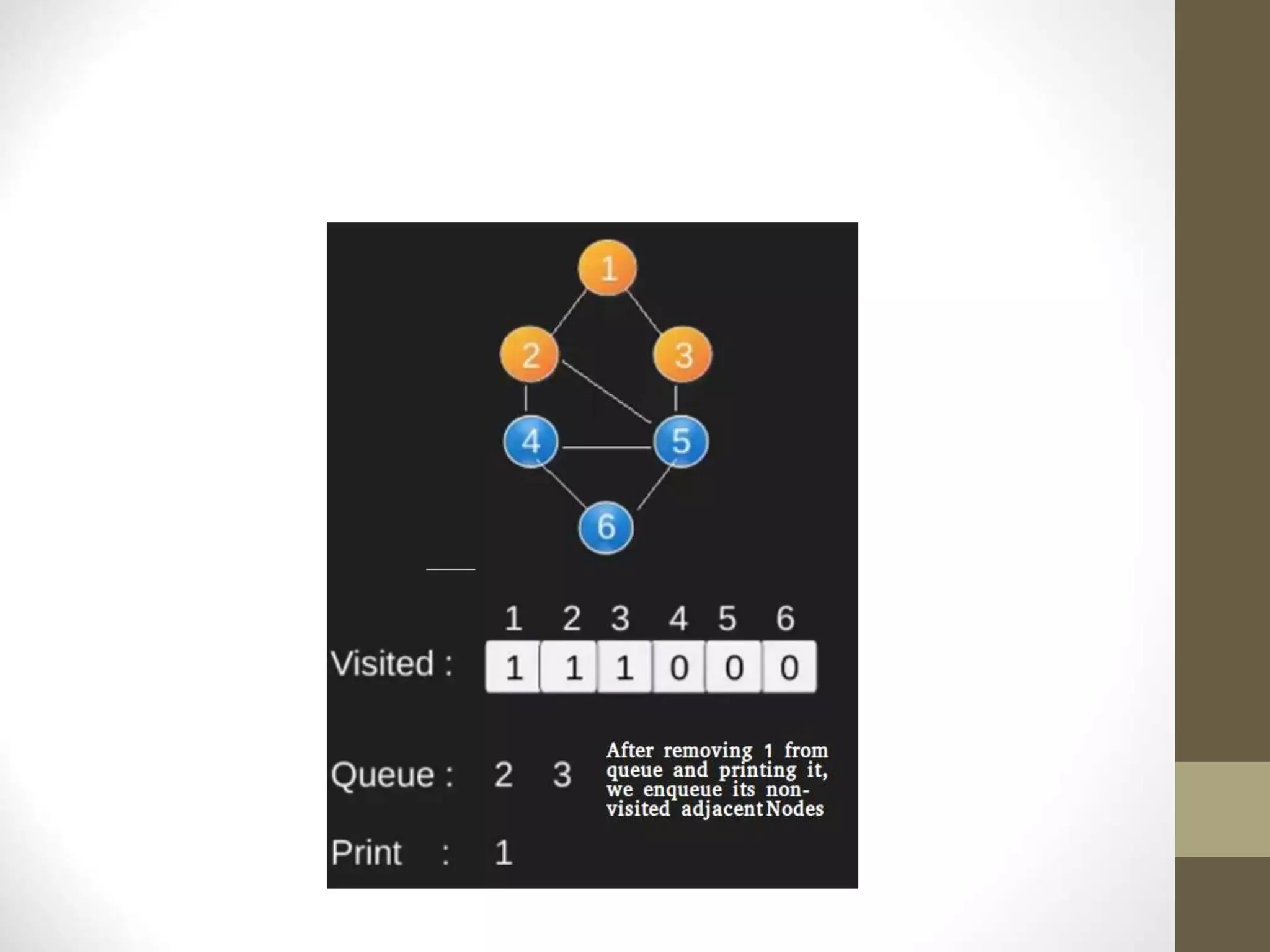
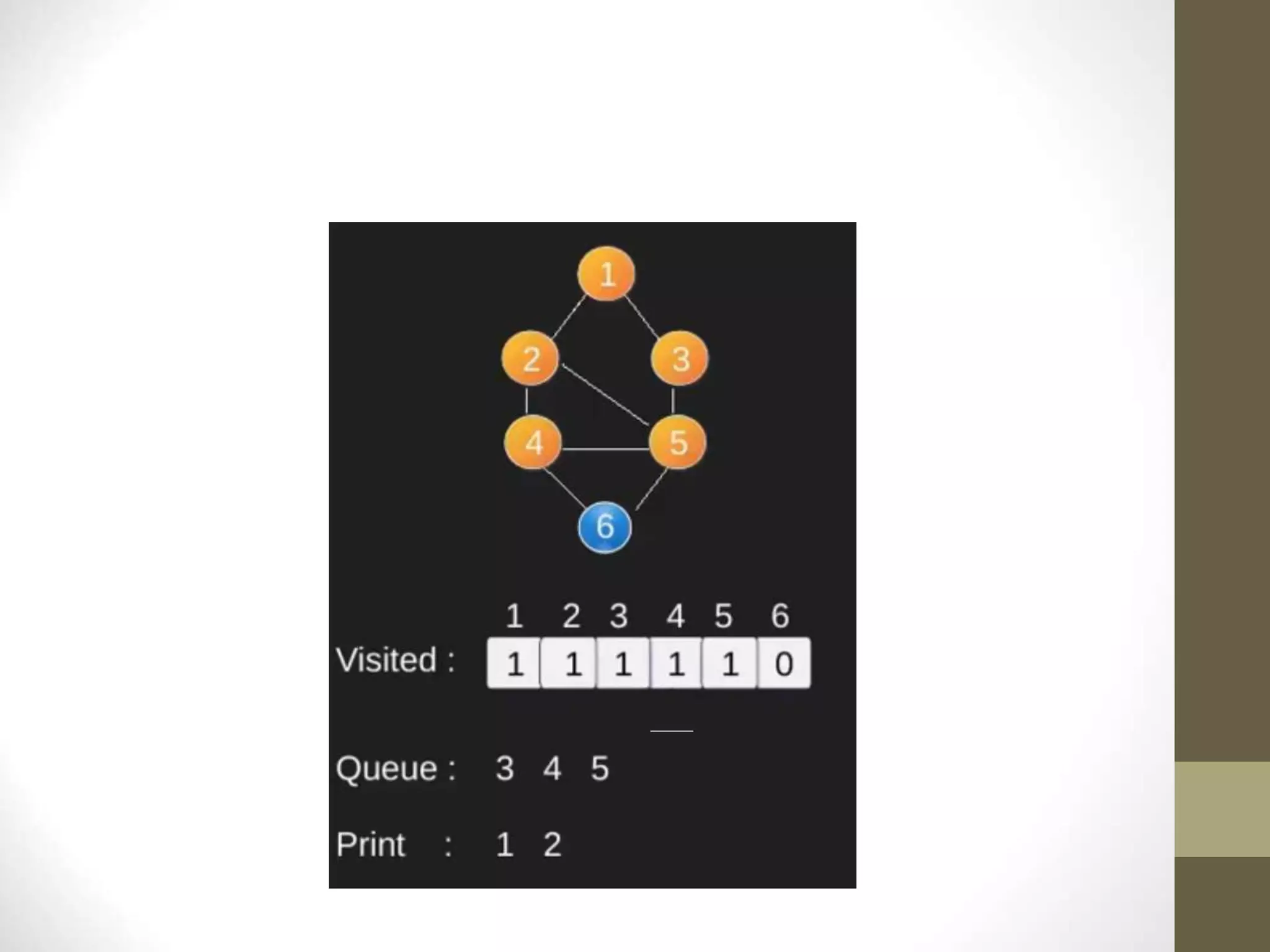
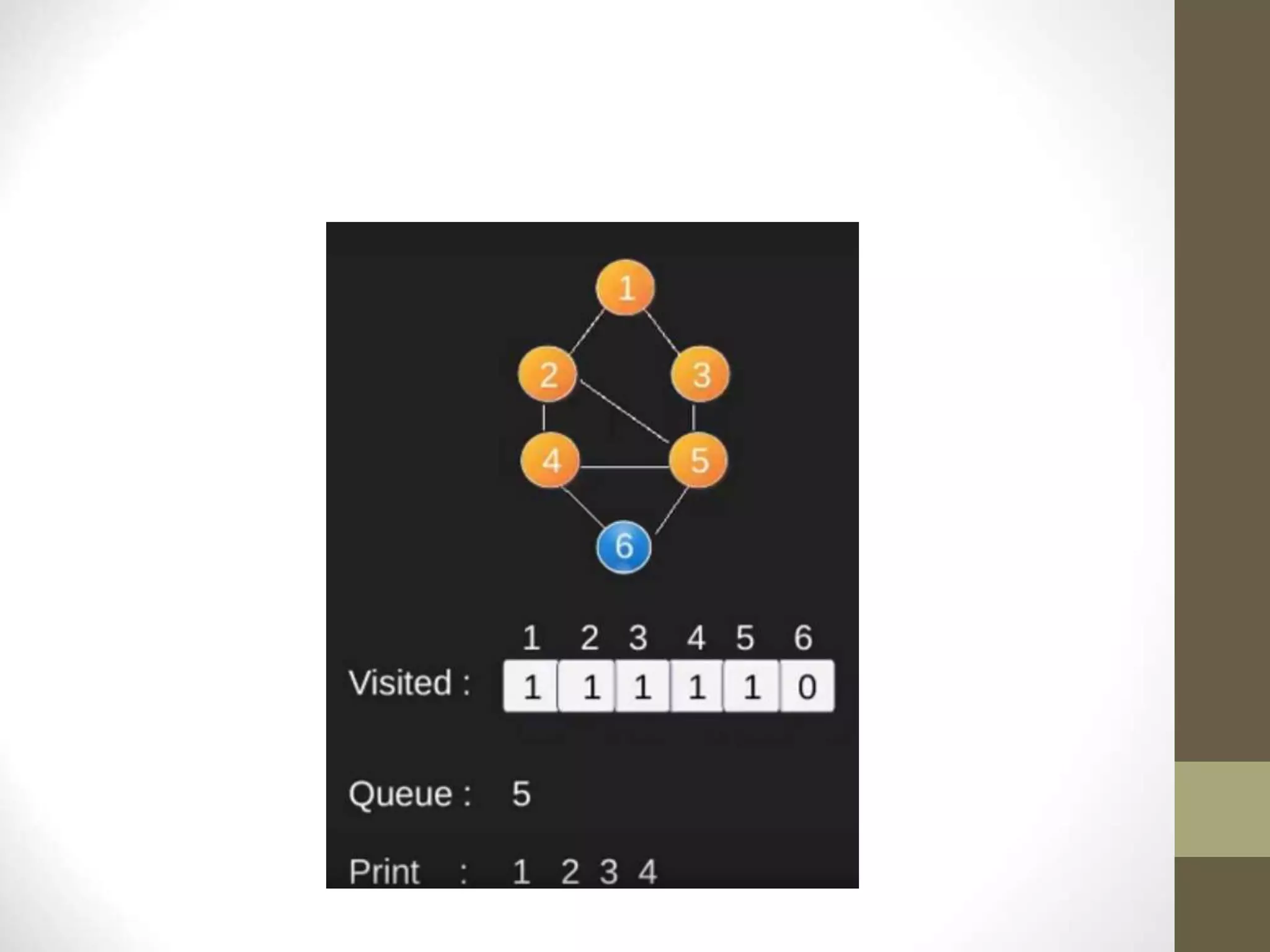
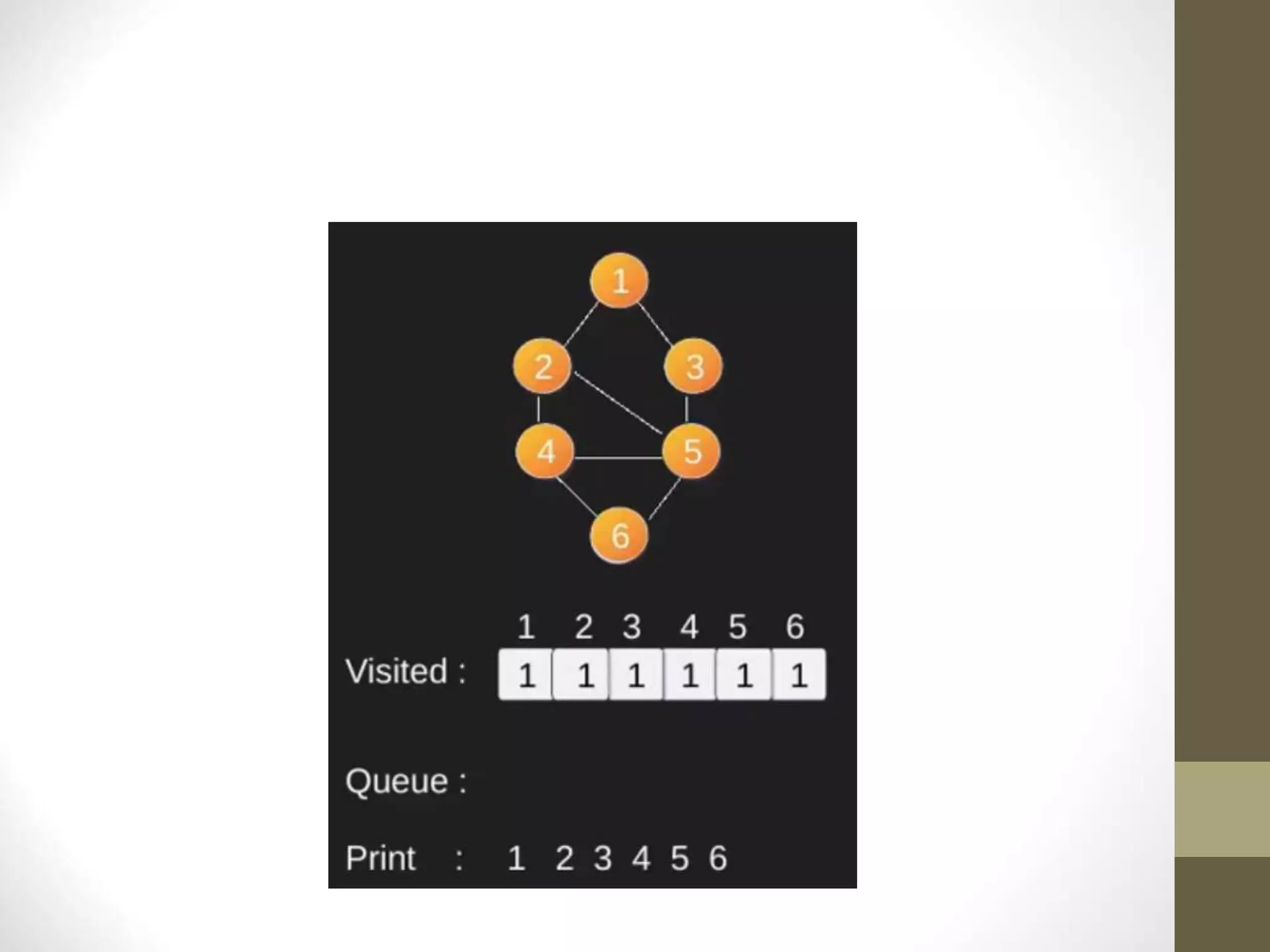
• BFS can be implemented efficiently using a queue
Set found to false
queue.Enqueue(startVertex)
DO
queue.Dequeue(vertex)
IF vertex == endVertex
Set found to true
ELSE
Enqueue all adjacent vertices onto queue
WHILE !queue.IsEmpty() AND !found
• Should we mark a vertex when it is enqueued or
when it is dequeued ?
IF(!found)
Write "Path does not exist"
Applications of Graph
• Google maps uses graphs for building transportation
systems
• graph is used to represent networks of communication, data
organization, computational devices etc.
• graphs are used to represent the flow of computation
Topological sort
• The topological sort algorithm takes a directed graph and
returns an array of the nodes where each node appears
before all the nodes it points to.
• The ordering of the nodes in the array is called a topological
ordering.
• Topological sorting for Directed Acyclic Graph (DAG) is a linear
ordering of vertices such that for every directed edge u v,
vertex u comes before v in the ordering.
• Topological Sorting for a graph is not possible if the graph is
not a DAG.
• https://www.gatevidyalay.com/topological-sort-topological-
sorting/
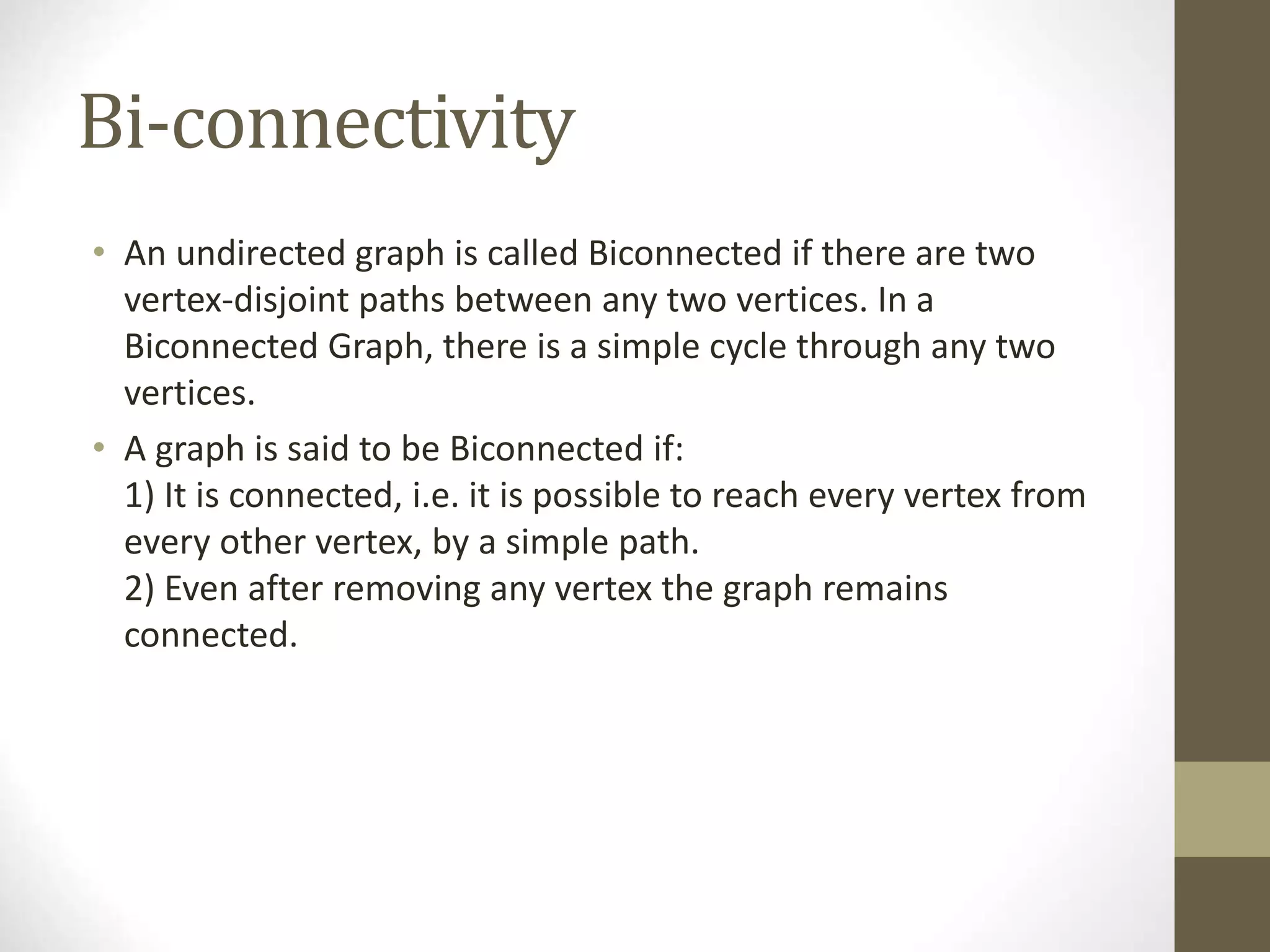
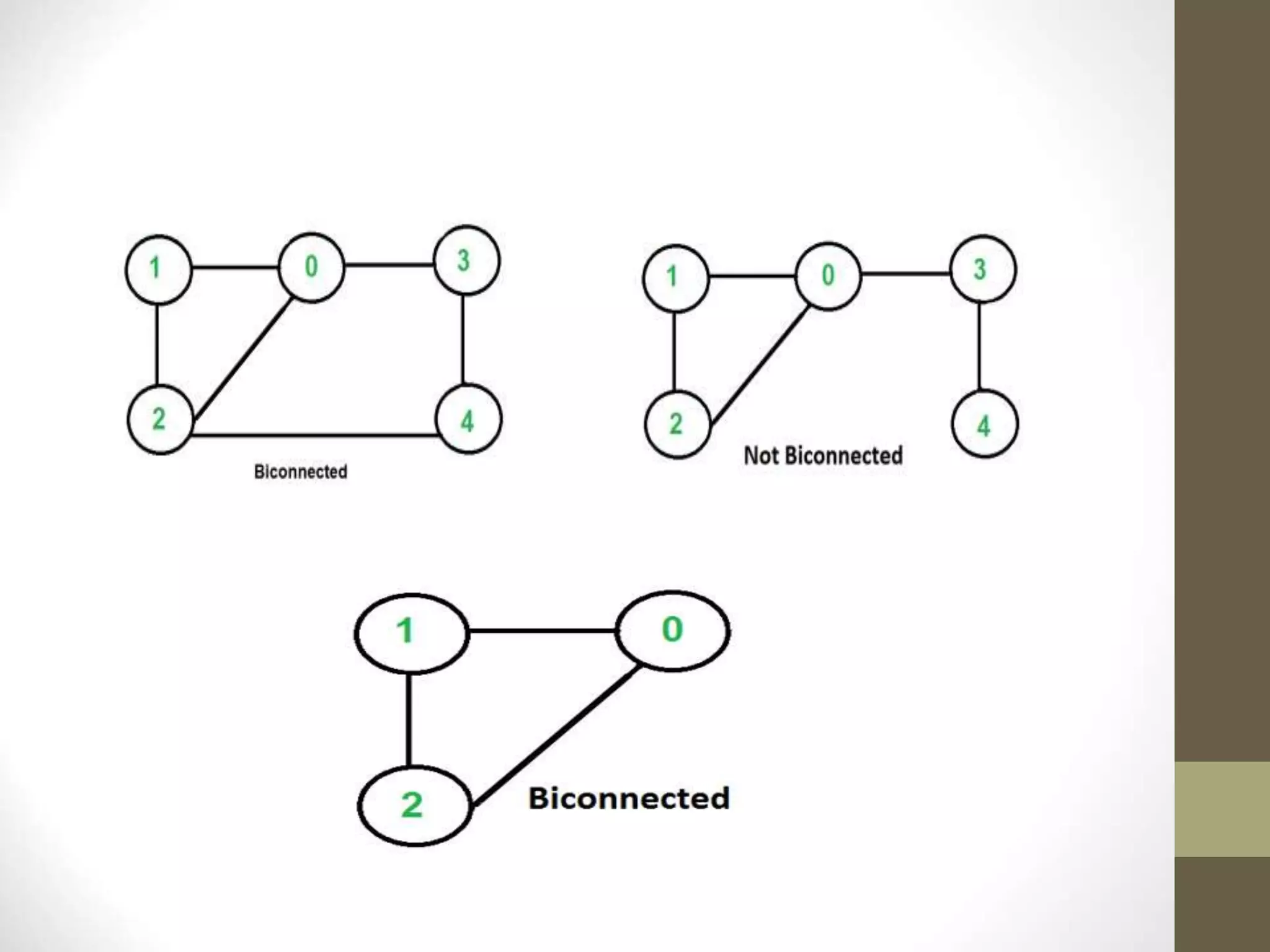
Bi-connectivity
• An undirected graph is called Biconnected if there are two
vertex-disjoint paths between any two vertices. In a
Biconnected Graph, there is a simple cycle through any two
vertices.
• A graph is said to be Biconnected if:
1) It is connected, i.e. it is possible to reach every vertex from
every other vertex, by a simple path.
2) Even after removing any vertex the graph remains
connected.
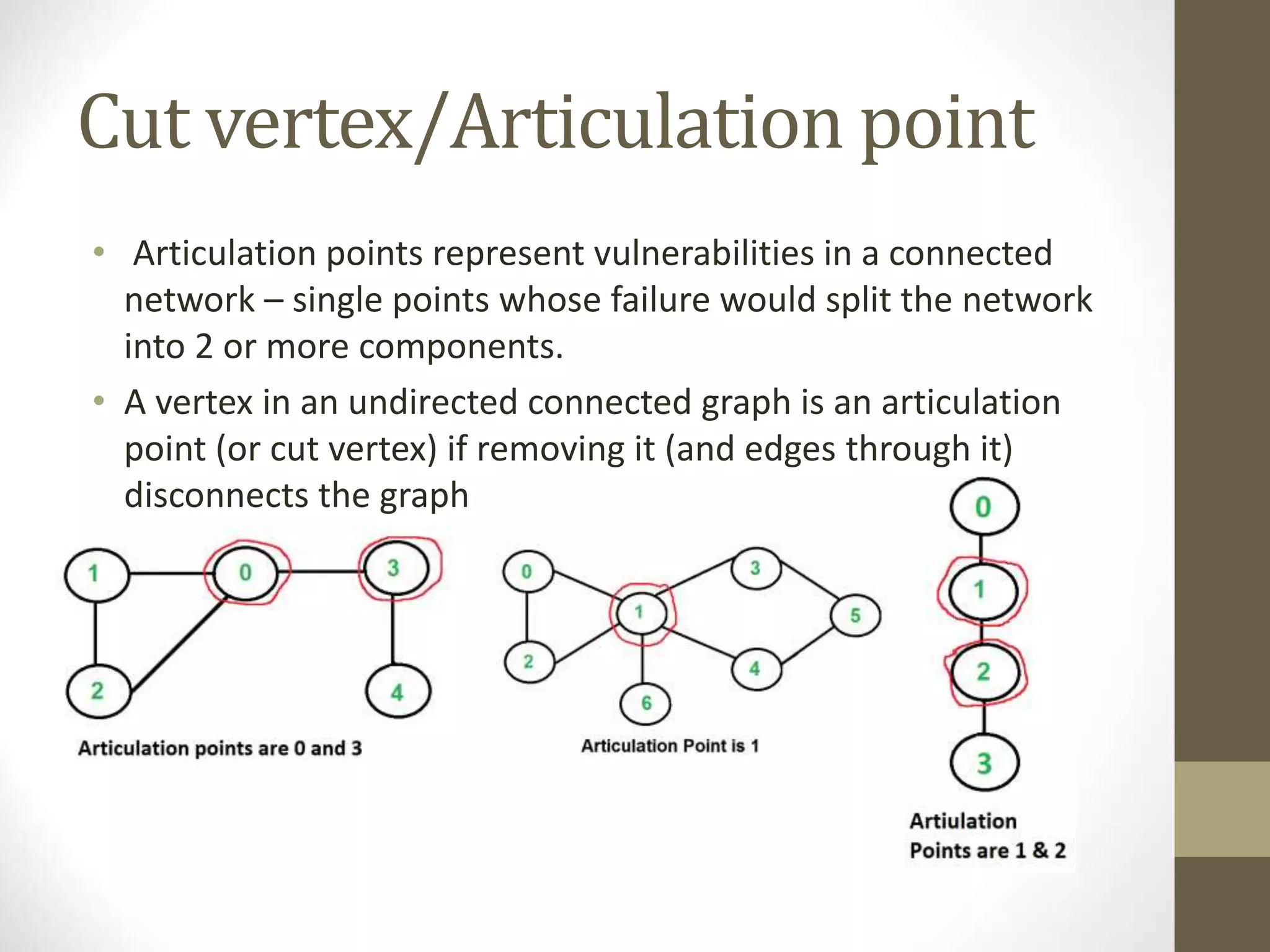
Cut vertex/Articulation point
• Articulation points represent vulnerabilities in a connected
network – single points whose failure would split the network
into 2 or more components.
• A vertex in an undirected connected graph is an articulation
point (or cut vertex) if removing it (and edges through it)
disconnects the graph
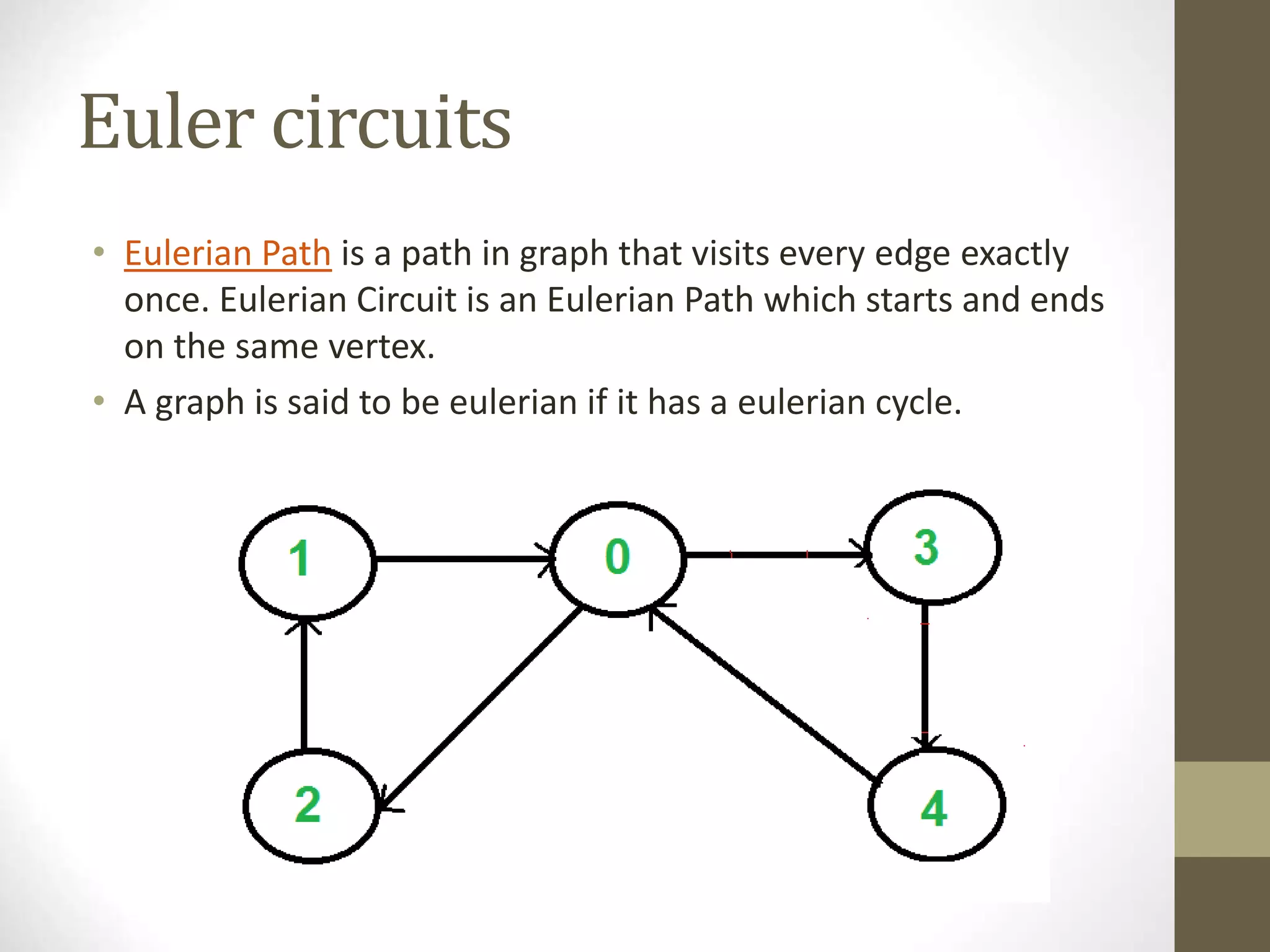
Euler circuits
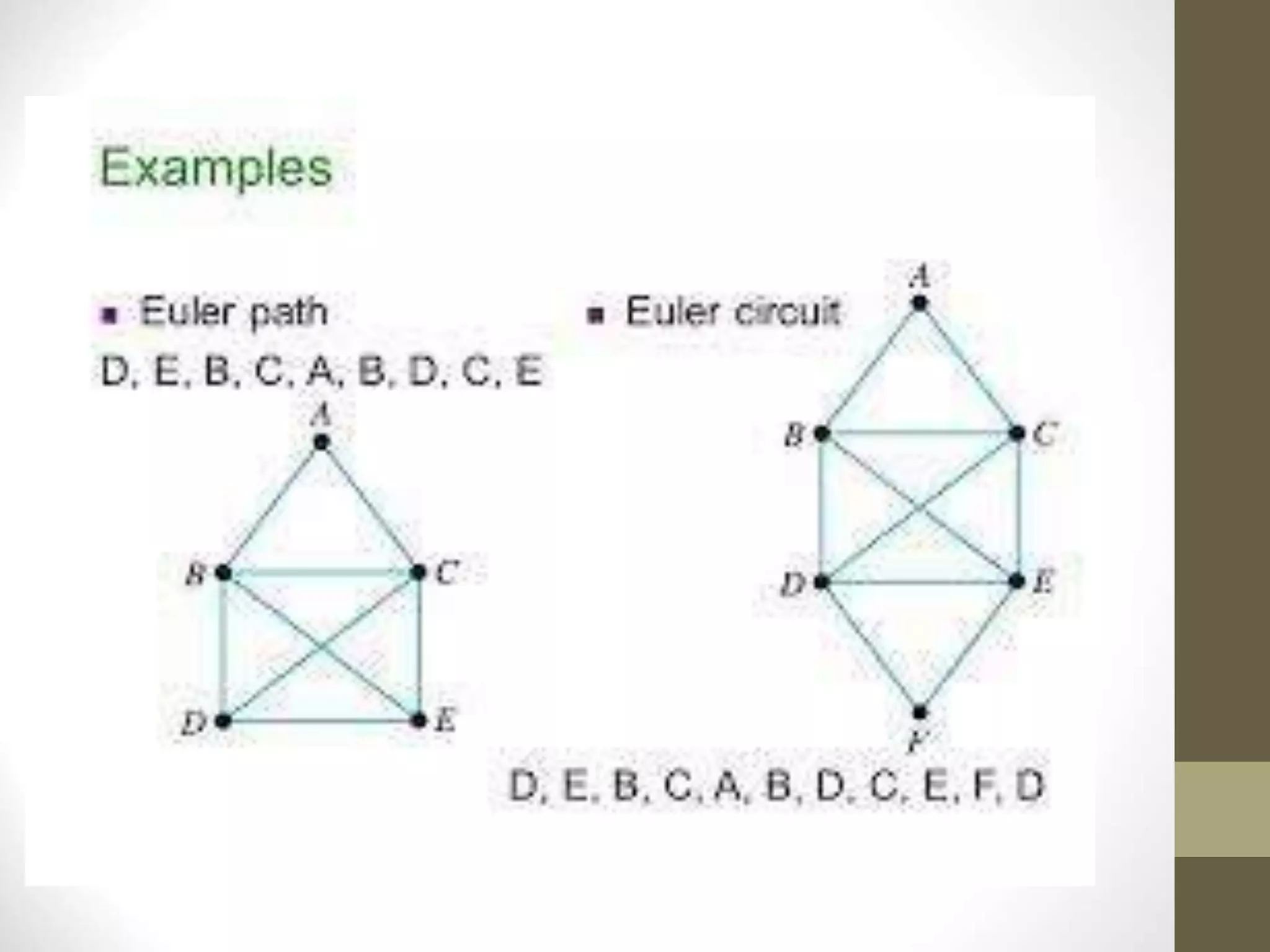
• Eulerian Path is a path in graph that visits every edge exactly
once. Eulerian Circuit is an Eulerian Path which starts and ends
on the same vertex.
• A graph is said to be eulerian if it has a eulerian cycle.
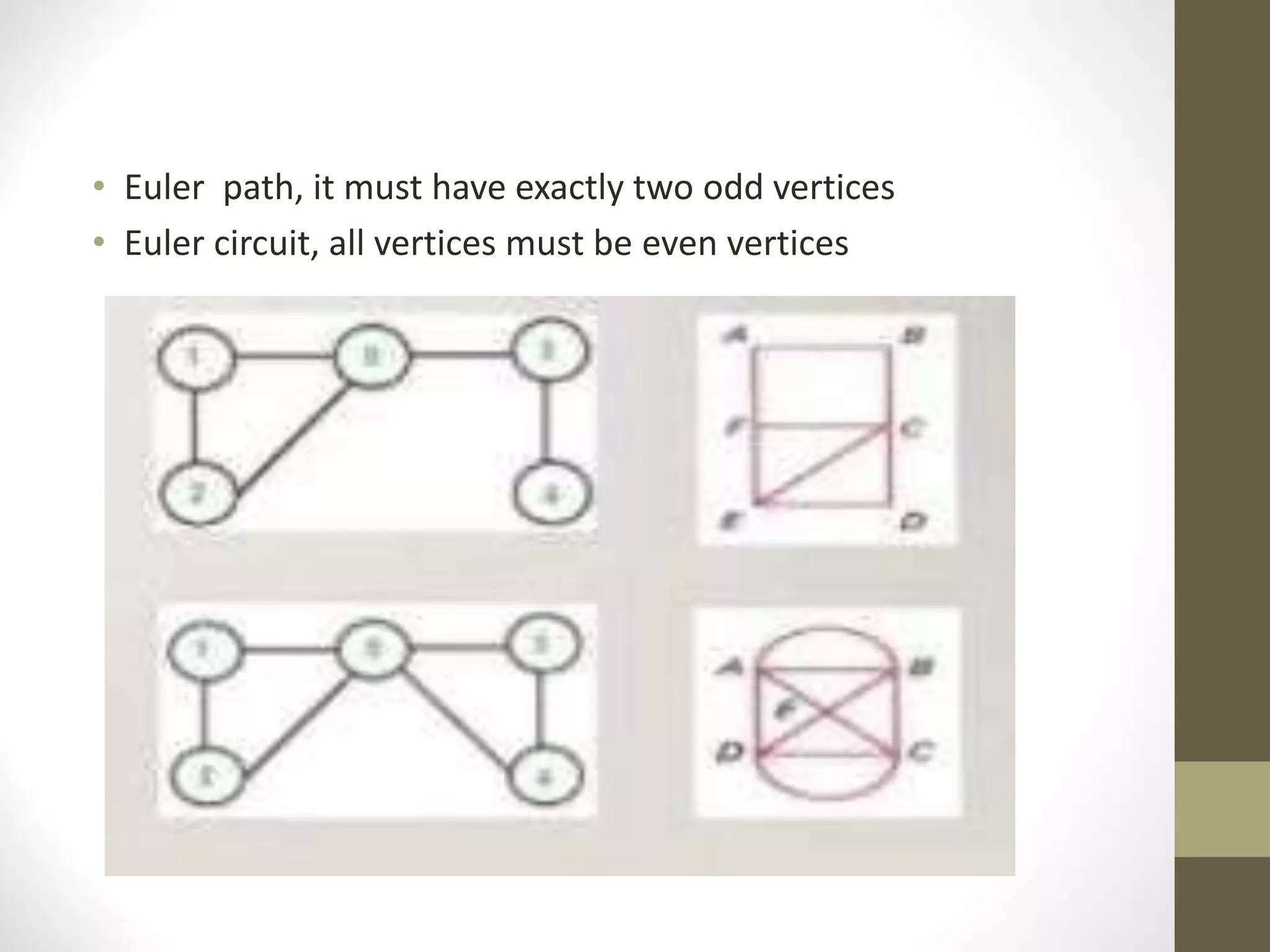
• Euler path, it must have exactly two odd vertices
• Euler circuit, all vertices must be even vertices
Minimum spanning tree
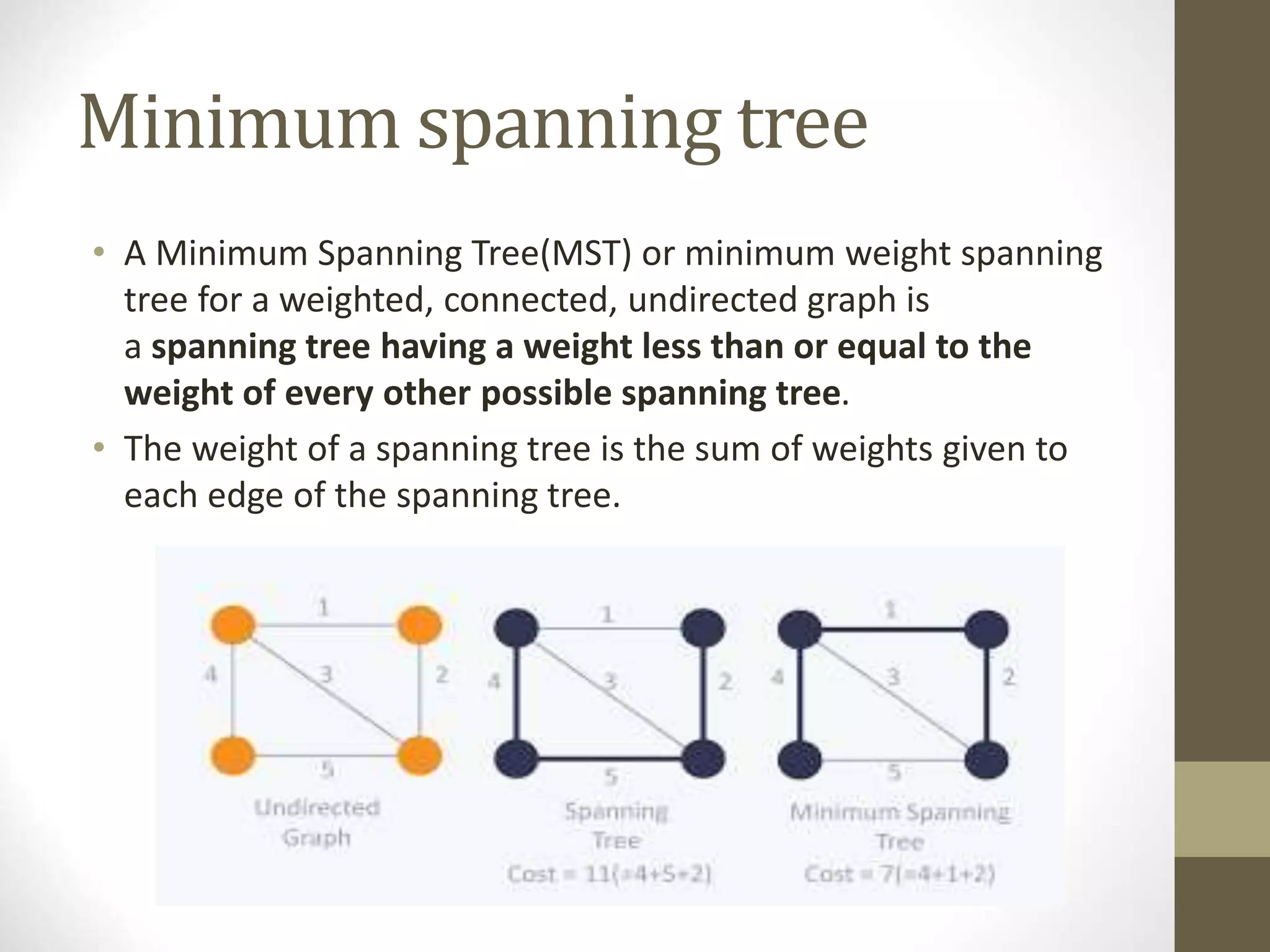
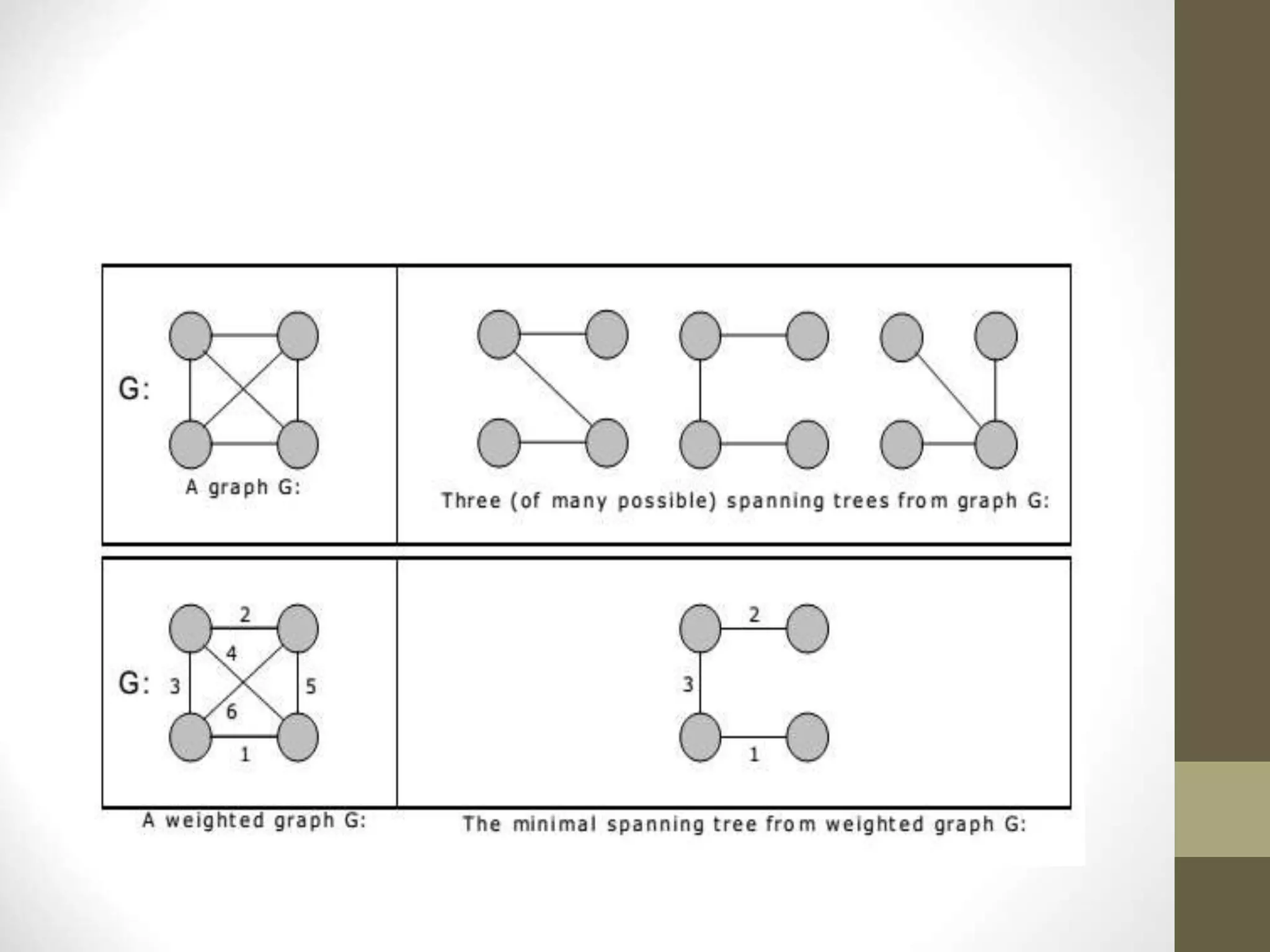
• A Minimum Spanning Tree(MST) or minimum weight spanning
tree for a weighted, connected, undirected graph is
a spanning tree having a weight less than or equal to the
weight of every other possible spanning tree.
• The weight of a spanning tree is the sum of weights given to
each edge of the spanning tree.
Prim’s Algorithm
• Prim's algorithm to find minimum cost spanning tree (as
Kruskal's algorithm) uses the greedy approach. Prim's
algorithm shares a similarity with the shortest path
first algorithms.
• https://www.tutorialspoint.com/data_structures_algorithms/
prims_spanning_tree_algorithm.htm
• https://www.youtube.com/watch?v=4ZlRH0eK-qQ
• https://www.geeksforgeeks.org/difference-between-prims-
and-kruskals-algorithm-for-mst/
Kruskal’s algorithm
• Kruskal's Algorithm is used to find the minimum spanning
tree for a connected weighted graph.
• The main target of the algorithm is to find the subset of edges
by using which, we can traverse every vertex of the graph.
• https://www.geeksforgeeks.org/kruskals-minimum-spanning-
tree-algorithm-greedy-algo-2/

Graphs

  • 1.
    Unit 4 -Graphs
  • 2.
    What is agraph? • A data structure that consists of a set of nodes (vertices) and a set of edges that relate the nodes to each other • The set of edges describes relationships among the vertices
  • 3.
    Definition of graphs •A graph G is defined as follows: G=(V,E) V(G): a finite, nonempty set of vertices E(G): a set of edges (pairs of vertices)
  • 4.
    Directed vs. undirectedgraphs • When the edges in a graph have no direction, the graph is called undirected
  • 5.
    Directed vs. undirectedgraphs (cont.) • When the edges in a graph have a direction, the graph is called directed (or digraph) E(Graph2) = {(1,3) (3,1) (5,9) (9,11) (5,7)
  • 6.
    Trees vs graphs •Trees are special cases of graphs!!
  • 7.
    Graph terminology • Adjacentnodes: two nodes are adjacent if they are connected by an edge • Path: a sequence of vertices that connect two nodes in a graph • Complete graph: a graph in which every vertex is directly connected to every other vertex 5
  • 9.
    Graph terminology (cont.) •What is the number of edges in a complete directed graph with N vertices? N * (N-1) 2 ( ) O N
  • 10.
    Graph terminology (cont.) •What is the number of edges in a complete undirected graph with N vertices? N * (N-1) / 2 2 ( ) O N
  • 11.
    Graph terminology (cont.) •Weighted graph: a graph in which each edge carries a value
  • 12.
    Graph implementation • Array-basedimplementation • A 1D array is used to represent the vertices • A 2D array (adjacency matrix) is used to represent the edges
  • 13.
  • 14.
    Graph implementation (cont.) •Linked-list implementation • A 1D array is used to represent the vertices • A list is used for each vertex v which contains the vertices which are adjacent from v (adjacency list)
  • 15.
  • 16.
    Adjacency matrix vs.adjacency list representation • Adjacency matrix • Good for dense graphs(maximal no of edges) --|E|~O(|V|2) • Memory requirements: O(|V| + |E|) = O(|V|2 ) • Connectivity between two vertices can be tested quickly • Adjacency list • Good for sparse graphs(minimal no of edges) -- |E|~O(|V|) • Memory requirements: O(|V| + |E|)=O(|V|) • Vertices adjacent to another vertex can be found quickly
  • 17.
    Graph searching • Problem:find a path between two nodes of the graph (e.g., Austin and Washington) • Methods: Depth-First-Search (DFS) or Breadth-First-Search (BFS)
  • 18.
    Depth-First-Search (DFS) • Whatis the idea behind DFS? • Travel as far as you can down a path • Back up as little as possible when you reach a "dead end" (i.e., next vertex has been "marked" or there is no next vertex) • DFS can be implemented efficiently using a stack
  • 19.
    Rules to befollowed for DFS • Rule 1 − Visit the adjacent unvisited vertex. Mark it as visited. Display it. Push it in a stack. • Rule 2 − If no adjacent vertex is found, pop up a vertex from the stack. (It will pop up all the vertices from the stack, which do not have adjacent vertices.) • Rule 3 − Repeat Rule 1 and Rule 2 until the stack is empty
  • 20.
  • 21.
    Breadth-First-Searching (BFS) • Whatis the idea behind BFS? • Look at all possible paths at the same depth before you go at a deeper level • Back up as far as possible when you reach a "dead end" (i.e., next vertex has been "marked" or there is no next vertex)
  • 22.
    Breadth-First-Searching (BFS) (cont.) •BFS can be implemented efficiently using a queue Set found to false queue.Enqueue(startVertex) DO queue.Dequeue(vertex) IF vertex == endVertex Set found to true ELSE Enqueue all adjacent vertices onto queue WHILE !queue.IsEmpty() AND !found • Should we mark a vertex when it is enqueued or when it is dequeued ? IF(!found) Write "Path does not exist"
  • 28.
    Applications of Graph •Google maps uses graphs for building transportation systems • graph is used to represent networks of communication, data organization, computational devices etc. • graphs are used to represent the flow of computation
  • 29.
    Topological sort • Thetopological sort algorithm takes a directed graph and returns an array of the nodes where each node appears before all the nodes it points to. • The ordering of the nodes in the array is called a topological ordering. • Topological sorting for Directed Acyclic Graph (DAG) is a linear ordering of vertices such that for every directed edge u v, vertex u comes before v in the ordering. • Topological Sorting for a graph is not possible if the graph is not a DAG. • https://www.gatevidyalay.com/topological-sort-topological- sorting/
  • 30.
    Bi-connectivity • An undirectedgraph is called Biconnected if there are two vertex-disjoint paths between any two vertices. In a Biconnected Graph, there is a simple cycle through any two vertices. • A graph is said to be Biconnected if: 1) It is connected, i.e. it is possible to reach every vertex from every other vertex, by a simple path. 2) Even after removing any vertex the graph remains connected.
  • 32.
    Cut vertex/Articulation point •Articulation points represent vulnerabilities in a connected network – single points whose failure would split the network into 2 or more components. • A vertex in an undirected connected graph is an articulation point (or cut vertex) if removing it (and edges through it) disconnects the graph
  • 33.
    Euler circuits • EulerianPath is a path in graph that visits every edge exactly once. Eulerian Circuit is an Eulerian Path which starts and ends on the same vertex. • A graph is said to be eulerian if it has a eulerian cycle.
  • 35.
    • Euler path,it must have exactly two odd vertices • Euler circuit, all vertices must be even vertices
  • 36.
    Minimum spanning tree •A Minimum Spanning Tree(MST) or minimum weight spanning tree for a weighted, connected, undirected graph is a spanning tree having a weight less than or equal to the weight of every other possible spanning tree. • The weight of a spanning tree is the sum of weights given to each edge of the spanning tree.
  • 38.
    Prim’s Algorithm • Prim'salgorithm to find minimum cost spanning tree (as Kruskal's algorithm) uses the greedy approach. Prim's algorithm shares a similarity with the shortest path first algorithms. • https://www.tutorialspoint.com/data_structures_algorithms/ prims_spanning_tree_algorithm.htm • https://www.youtube.com/watch?v=4ZlRH0eK-qQ • https://www.geeksforgeeks.org/difference-between-prims- and-kruskals-algorithm-for-mst/
  • 39.
    Kruskal’s algorithm • Kruskal'sAlgorithm is used to find the minimum spanning tree for a connected weighted graph. • The main target of the algorithm is to find the subset of edges by using which, we can traverse every vertex of the graph. • https://www.geeksforgeeks.org/kruskals-minimum-spanning- tree-algorithm-greedy-algo-2/