UNIT- II
Linear data structure
Stack ADT
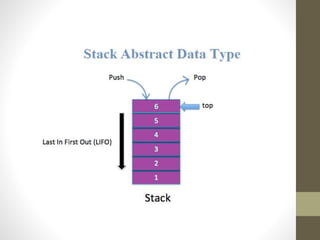
• Stack is a linear data structure in which the insertion and
deletion operations are performed at only one end. In a stack,
adding and removing of elements are performed at a single
position which is known as "top“
• In stack, the insertion and deletion operations are performed
based on LIFO (Last In First Out) principle or FILO(First In Last
Out).
Operations
• isFull()
• isEmpty()
• Push(x)
• Pop()
• Peek()
• Size()
• https://towardsdatascience.com/stack-
and-array-implementation-with-python-
and-nodejs-b8b260229e3a
Applications of stack
• used for expression evaluation.
• used to check parenthesis matching in an
expression.
• used for Conversion from one form of
expression to another.
• used for Memory Management.
• used in backtracking problems.
• https://www.youtube.com/watch?v=d_XvFOkQz
5k
Evaluating arithmetic
expressions
• Polish notation(Prefix) +AB
• Reverse polish notation(Postfix ) AB+
• Infix notation A+B
•A+B/*C-
•(A+B)/(C-D)
• +AB-C
•http://www.btechsmartclass.com/da
ta_structures/infix-to-postfix.html
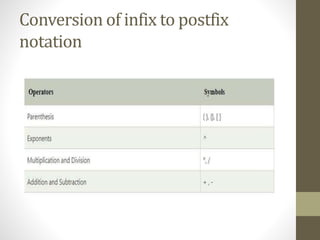
Conversion of infix to postfix
notation
Conversion of infix to postfix
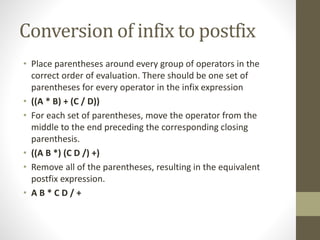
• Place parentheses around every group of operators in the
correct order of evaluation. There should be one set of
parentheses for every operator in the infix expression
• ((A * B) + (C / D))
• For each set of parentheses, move the operator from the
middle to the end preceding the corresponding closing
parenthesis.
• ((A B *) (C D /) +)
• Remove all of the parentheses, resulting in the equivalent
postfix expression.
• A B * C D / +
Evaluating arithmetic
expressions
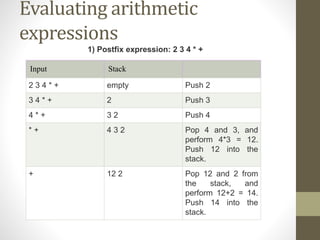
Input Stack
2 3 4 * + empty Push 2
3 4 * + 2 Push 3
4 * + 3 2 Push 4
* + 4 3 2 Pop 4 and 3, and
perform 4*3 = 12.
Push 12 into the
stack.
+ 12 2 Pop 12 and 2 from
the stack, and
perform 12+2 = 14.
Push 14 into the
stack.
1) Postfix expression: 2 3 4 * +
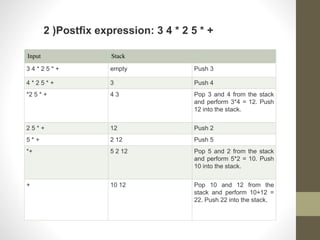
Input Stack
3 4 * 2 5 * + empty Push 3
4 * 2 5 * + 3 Push 4
*2 5 * + 4 3 Pop 3 and 4 from the stack
and perform 3*4 = 12. Push
12 into the stack.
2 5 * + 12 Push 2
5 * + 2 12 Push 5
*+ 5 2 12 Pop 5 and 2 from the stack
and perform 5*2 = 10. Push
10 into the stack.
+ 10 12 Pop 10 and 12 from the
stack and perform 10+12 =
22. Push 22 into the stack.
2 )Postfix expression: 3 4 * 2 5 * +
Queue ADT
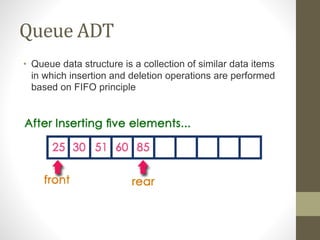
• Queue data structure is a collection of similar data items
in which insertion and deletion operations are performed
based on FIFO principle
Operations
1.enQueue(value) - (To insert an element into the queue)
2.deQueue() - (To delete an element from the queue)
3.display() - (To display the elements of the queue)
4.Queue() – creates a new empty queue
5.isEmpty()-returns a boolean value
6.Length()-returns the number of items currently in the
queue
https://www.geeksforgeeks.org/array-implementation-of-queue-
simple/
Circular queue
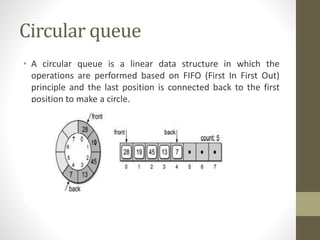
• A circular queue is a linear data structure in which the
operations are performed based on FIFO (First In First Out)
principle and the last position is connected back to the first
position to make a circle.
Priority queue
• Every item has a priority associated with it.
• An element with high priority is dequeued before an element
with low priority.
• If two elements have the same priority, they are served
according to their order in the queue.
Types:
1)Bounded priority queue - small limited range of p priorities
over the interval of integers [0 . . . P]
2)Unbounded priority queue - no limit on the range of integer
values
Doubly Ended queue(Deque)
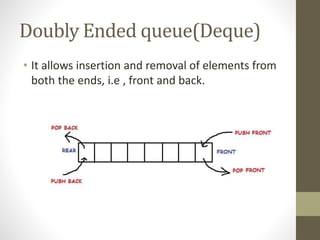
• It allows insertion and removal of elements from
both the ends, i.e , front and back.
Applications of Queue
• In operating systems like Semaphores,FCFS, Buffer for
devices
• CPU task scheduling
• In networks like mail queues, queues in routers/switches
Real time application
• call center phone system to hold the calls

Stack and queue

  • 1.
  • 2.
    Stack ADT • Stackis a linear data structure in which the insertion and deletion operations are performed at only one end. In a stack, adding and removing of elements are performed at a single position which is known as "top“ • In stack, the insertion and deletion operations are performed based on LIFO (Last In First Out) principle or FILO(First In Last Out).
  • 3.
    Operations • isFull() • isEmpty() •Push(x) • Pop() • Peek() • Size() • https://towardsdatascience.com/stack- and-array-implementation-with-python- and-nodejs-b8b260229e3a
  • 5.
    Applications of stack •used for expression evaluation. • used to check parenthesis matching in an expression. • used for Conversion from one form of expression to another. • used for Memory Management. • used in backtracking problems. • https://www.youtube.com/watch?v=d_XvFOkQz 5k
  • 6.
    Evaluating arithmetic expressions • Polishnotation(Prefix) +AB • Reverse polish notation(Postfix ) AB+ • Infix notation A+B •A+B/*C- •(A+B)/(C-D) • +AB-C •http://www.btechsmartclass.com/da ta_structures/infix-to-postfix.html
  • 7.
    Conversion of infixto postfix notation
  • 8.
    Conversion of infixto postfix • Place parentheses around every group of operators in the correct order of evaluation. There should be one set of parentheses for every operator in the infix expression • ((A * B) + (C / D)) • For each set of parentheses, move the operator from the middle to the end preceding the corresponding closing parenthesis. • ((A B *) (C D /) +) • Remove all of the parentheses, resulting in the equivalent postfix expression. • A B * C D / +
  • 9.
    Evaluating arithmetic expressions Input Stack 23 4 * + empty Push 2 3 4 * + 2 Push 3 4 * + 3 2 Push 4 * + 4 3 2 Pop 4 and 3, and perform 4*3 = 12. Push 12 into the stack. + 12 2 Pop 12 and 2 from the stack, and perform 12+2 = 14. Push 14 into the stack. 1) Postfix expression: 2 3 4 * +
  • 10.
    Input Stack 3 4* 2 5 * + empty Push 3 4 * 2 5 * + 3 Push 4 *2 5 * + 4 3 Pop 3 and 4 from the stack and perform 3*4 = 12. Push 12 into the stack. 2 5 * + 12 Push 2 5 * + 2 12 Push 5 *+ 5 2 12 Pop 5 and 2 from the stack and perform 5*2 = 10. Push 10 into the stack. + 10 12 Pop 10 and 12 from the stack and perform 10+12 = 22. Push 22 into the stack. 2 )Postfix expression: 3 4 * 2 5 * +
  • 11.
    Queue ADT • Queuedata structure is a collection of similar data items in which insertion and deletion operations are performed based on FIFO principle
  • 12.
    Operations 1.enQueue(value) - (Toinsert an element into the queue) 2.deQueue() - (To delete an element from the queue) 3.display() - (To display the elements of the queue) 4.Queue() – creates a new empty queue 5.isEmpty()-returns a boolean value 6.Length()-returns the number of items currently in the queue https://www.geeksforgeeks.org/array-implementation-of-queue- simple/
  • 13.
    Circular queue • Acircular queue is a linear data structure in which the operations are performed based on FIFO (First In First Out) principle and the last position is connected back to the first position to make a circle.
  • 14.
    Priority queue • Everyitem has a priority associated with it. • An element with high priority is dequeued before an element with low priority. • If two elements have the same priority, they are served according to their order in the queue. Types: 1)Bounded priority queue - small limited range of p priorities over the interval of integers [0 . . . P] 2)Unbounded priority queue - no limit on the range of integer values
  • 15.
    Doubly Ended queue(Deque) •It allows insertion and removal of elements from both the ends, i.e , front and back.
  • 16.
    Applications of Queue •In operating systems like Semaphores,FCFS, Buffer for devices • CPU task scheduling • In networks like mail queues, queues in routers/switches Real time application • call center phone system to hold the calls