GRAPHIC/ADVANCE
ORGANIZERS
by:
April Rose S. Figueras
A visual/pictorial way of constructing knowledge and
organizing information in facilitating learning and instruction.
Visual formats are appealing for many types of audiences and
can provoke interest for users than texts formats.
What is a graphic/advance organizer?
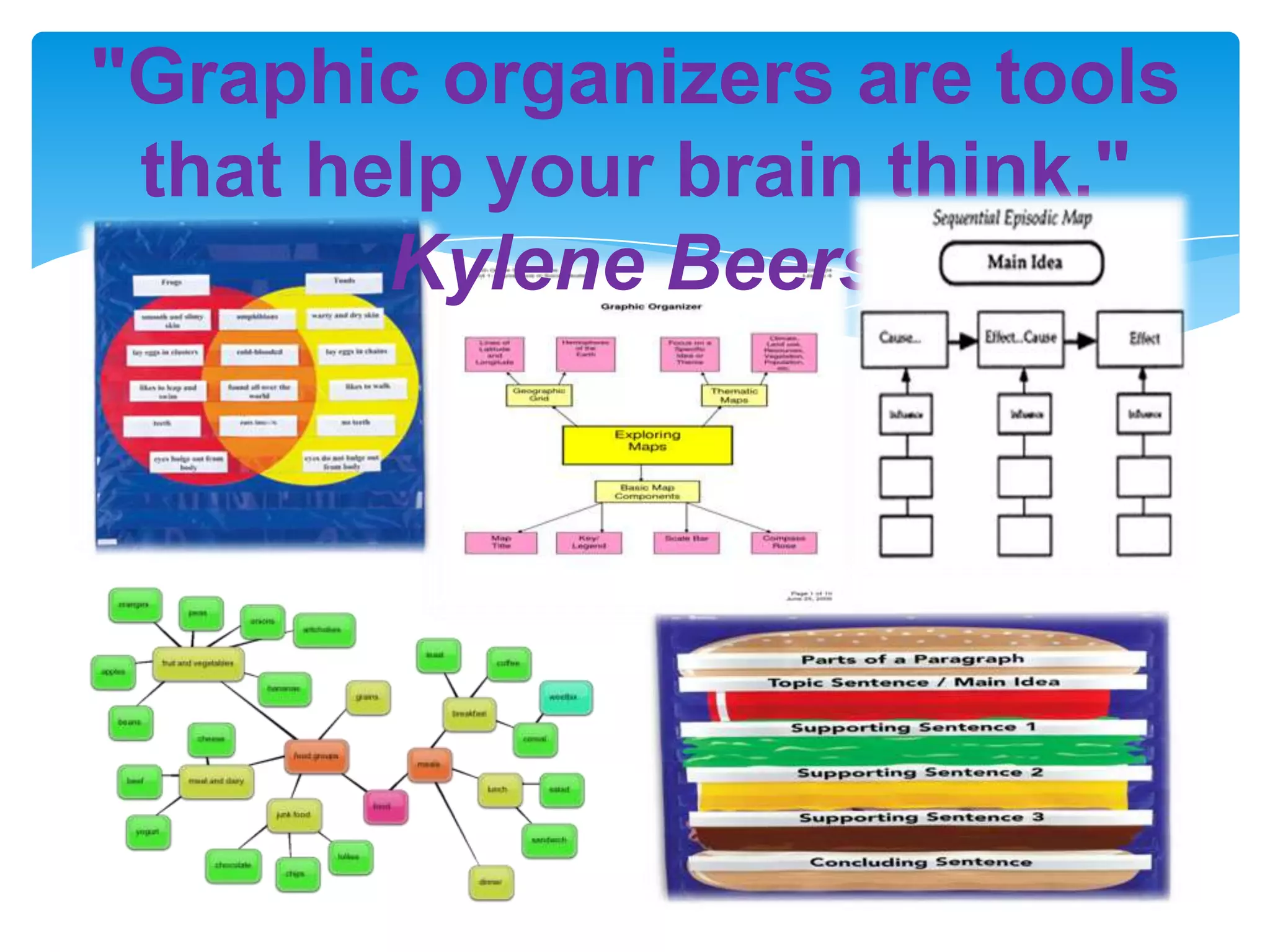
"Graphic organizers are tools
that help your brain think."
Kylene Beers
Ausubel’s Meaningful Verbal Learning/Subsumption
Learning Theory says that knowledge is hierarchically
organized – new information is meaningful to the
extent that it can be related (attached, andchored) to
what is already known.
Garner’s Theory of Mulitiple Intelligence posits that
students are better able to learn and internalize
information when more than one learning modality is
employed in an instructional strategy.
Related to the constructivist approach and concept
teaching
Less is more-depth is more.
Philosophies and Proponents:
Graphic/
Advance
organizers
Visual/pictorial
presentation of
concepts and
knowledge
Facilitates teaching and
learning processes
(based on researches)
Applicable to all level of
education and across
curriculum areas
Show positive outcomes
which go beyond
comprehension and
reading (based on
reaserch)
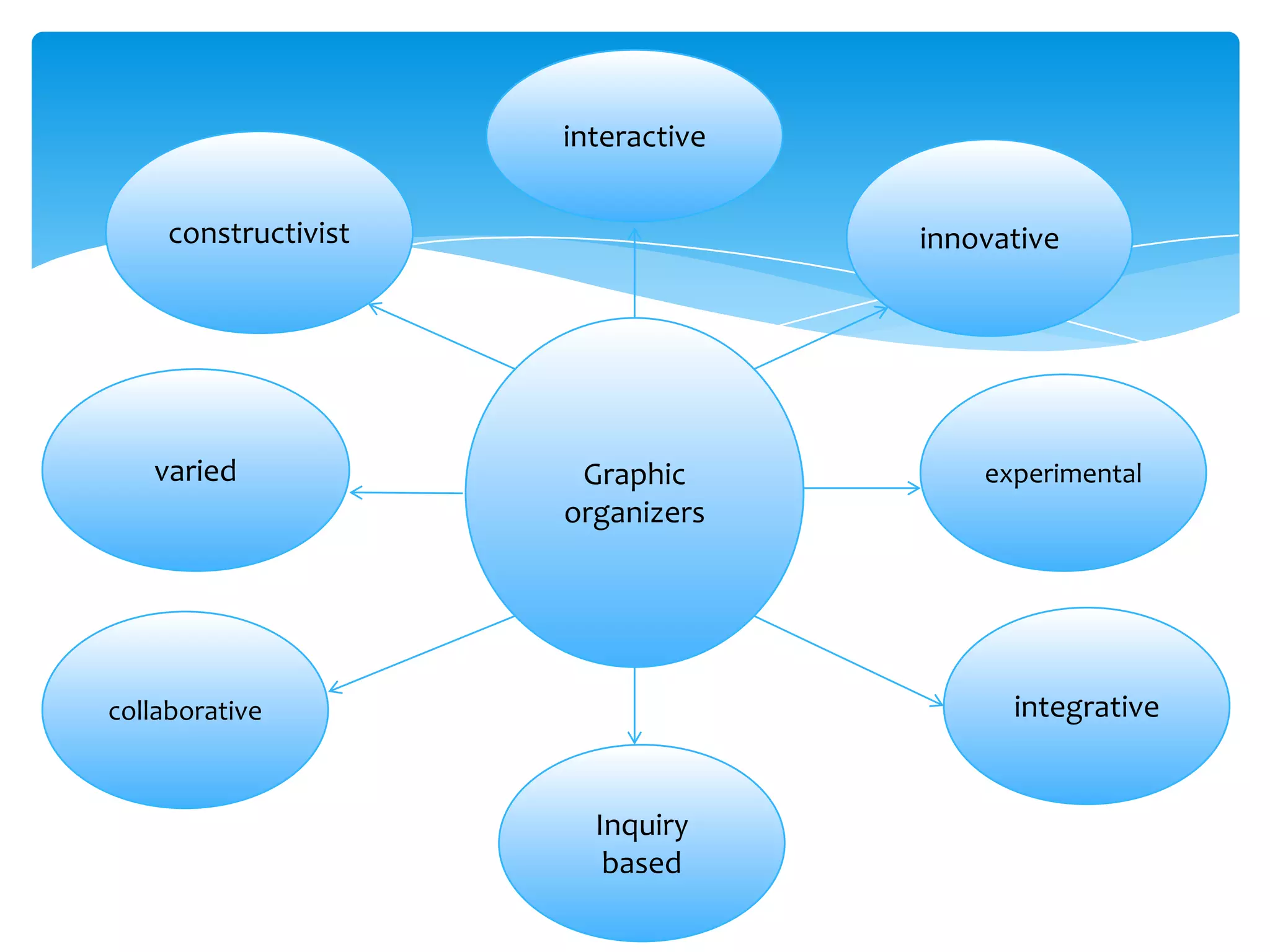
Graphic
organizers
constructivist
interactive
innovative
integrativecollaborative
Inquiry
based
varied experimental
Concept mapping – visual representation of the
relationship between ideas.
Webbing – students will see how their central
idea is linked to supporting details.
Mind mapping – visual representation of
hierarchical information.
Most common visual learning
strategies:
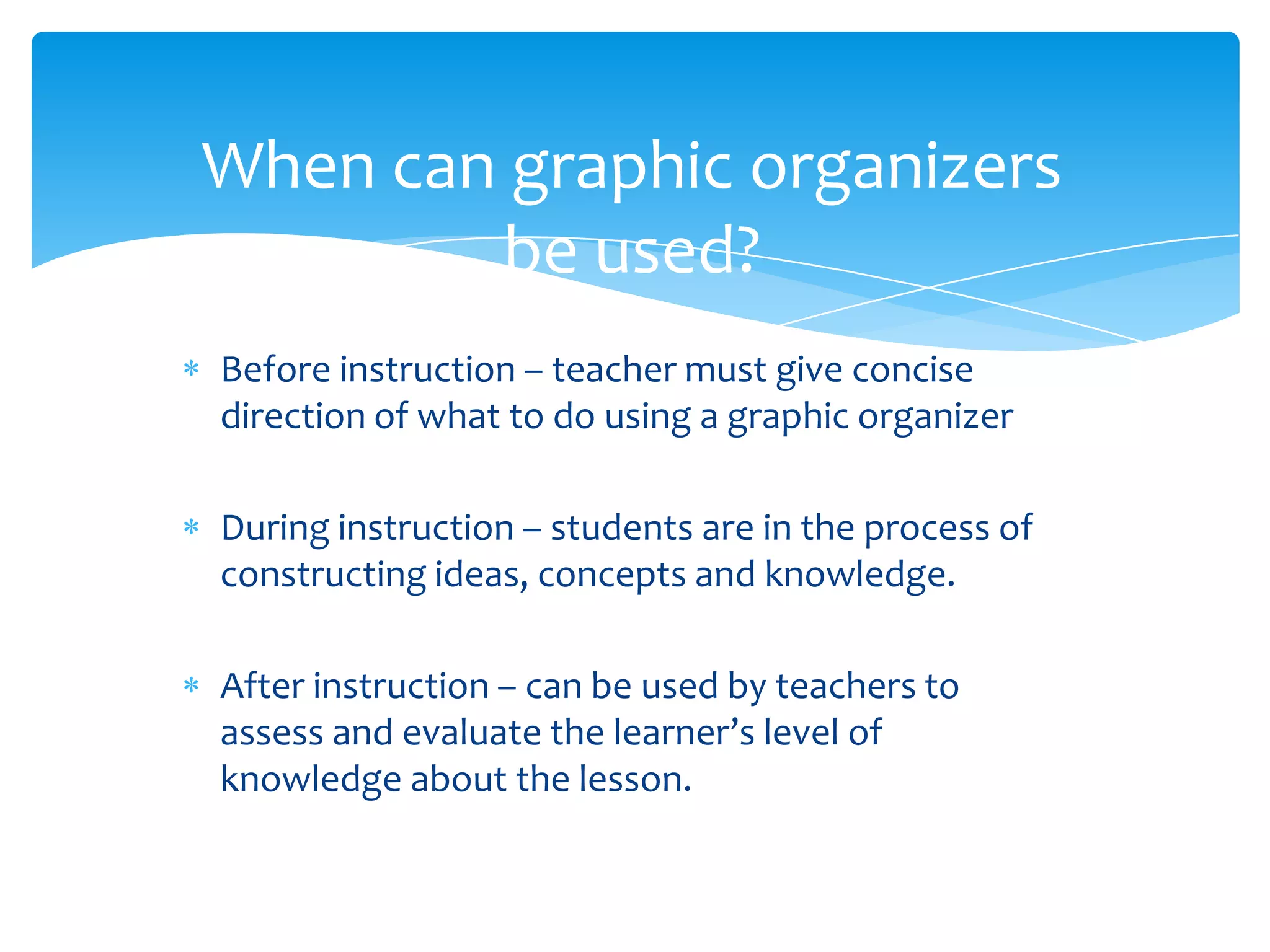
Before instruction – teacher must give concise
direction of what to do using a graphic organizer
During instruction – students are in the process of
constructing ideas, concepts and knowledge.
After instruction – can be used by teachers to
assess and evaluate the learner’s level of
knowledge about the lesson.
When can graphic organizers
be used?
Teacher does it – teacher constructs the graphic
organizer, provides students a copy, and uses it when
teaching the content.
Class does it – teacher and students co-construct
graphic organizers depicting important ideas as the
content is explored.
Groups do it – teams of students construct graphic
organizers via cooperative learning and the teacher
acts as a guide-on-the-side.
Individuals do it – students independently construct
graphic organizers.
Four Stages for Enabling Students to
Construct Graphic Organizers
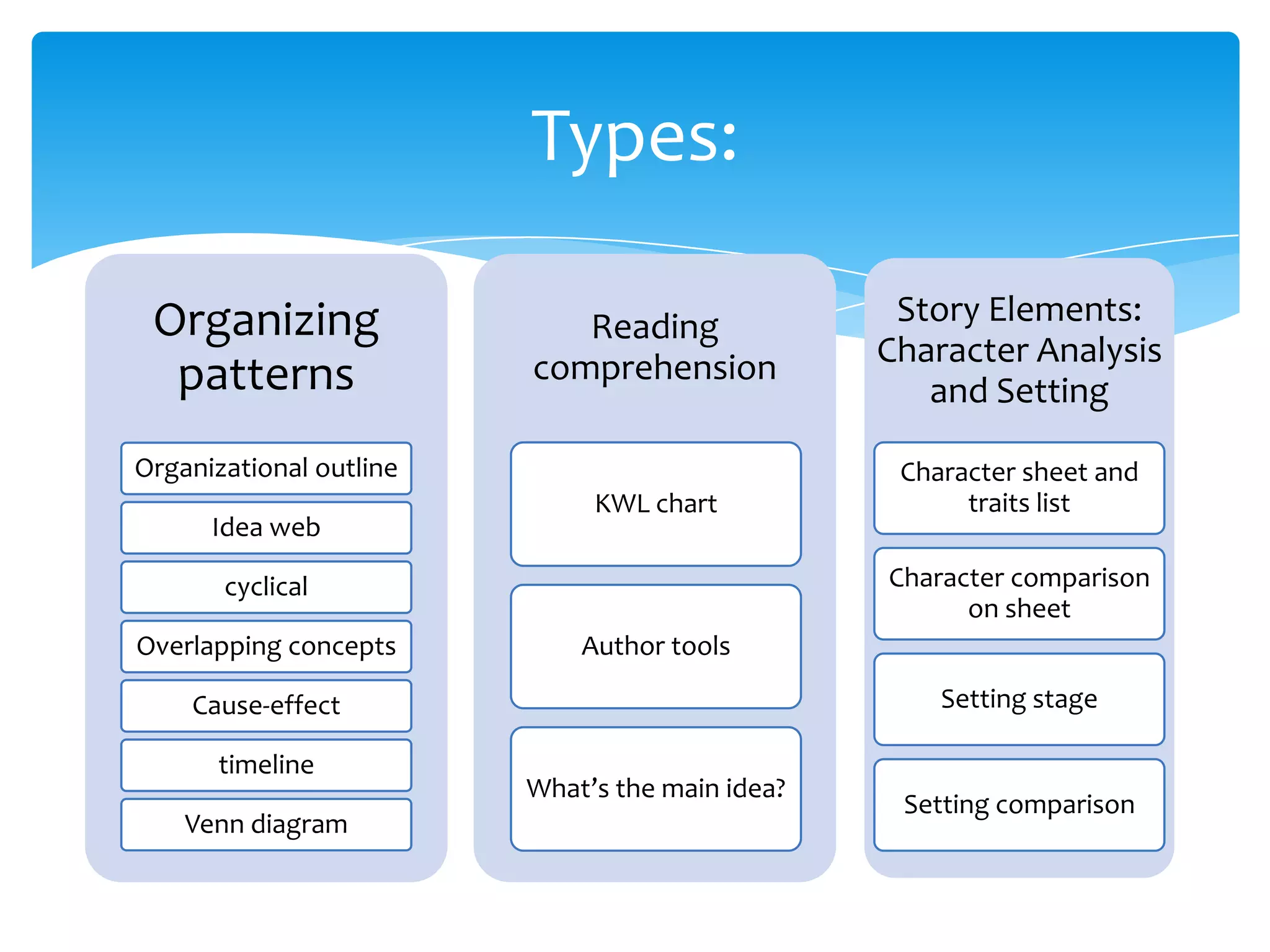
Organizing
patterns
Organizational outline
Idea web
cyclical
Overlapping concepts
Cause-effect
timeline
Venn diagram
Reading
comprehension
KWL chart
Author tools
What’s the main idea?
Story Elements:
Character Analysis
and Setting
Character sheet and
traits list
Character comparison
on sheet
Setting stage
Setting comparison
Types:
Advantages of graphic organizers to
teachers:
A quick
reference
when
presenting
lessons
Used to
structure
lesson notes
in a way that
make sense to
students
Helps in
assessing your
students
understanding
of what they
are reading
observe their
thinking
process on
what you read
as a class, as a
group, or
independently
Advantages of graphic organizers to
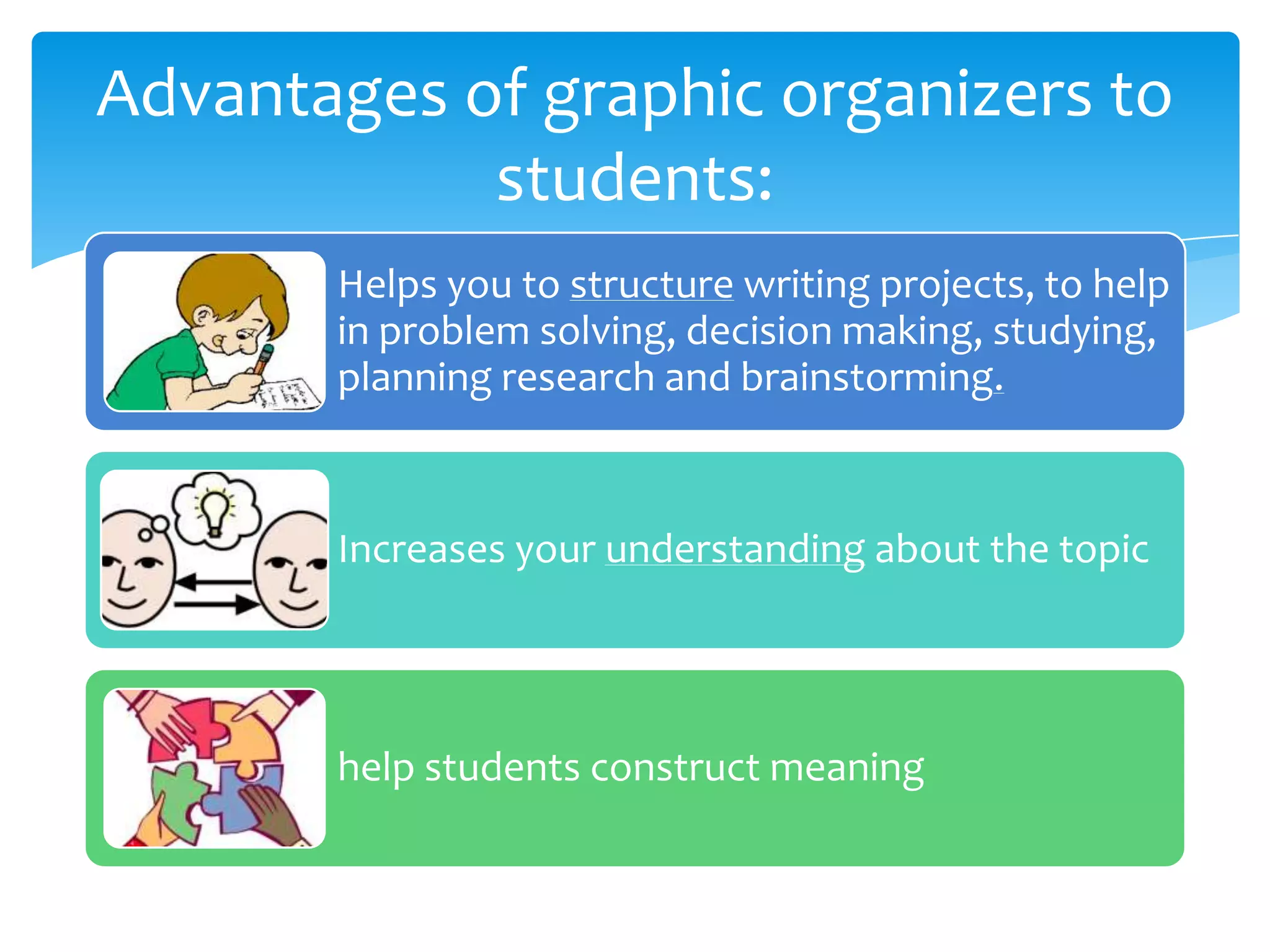
students:
Helps you to structure writing projects, to help
in problem solving, decision making, studying,
planning research and brainstorming.
Increases your understanding about the topic
help students construct meaning
grade level
point of implementation
instructional context
ease of implementation
Factors Influencing Effectiveness
have been applied across a range of curriculum
subject areas such as studied application,
science, social studies, language arts, and math
Operations such as mapping cause and effect,
note taking, comparing and contrasting concepts,
organizing problems and solutions, and relating
information to main ideas or themes can be
beneficial to many subject areas. The observed
benefits in these subject areas go beyond those
known to occur in reading comprehension
(Bulgren, Schumaker, & Deshler, 1988; Darch, Carnine, &
Kammenui, 1986; Herl, O'Neil, Chung, & Schacter, 1999;
Applications Across Curriculum
Areas
Without teacher instruction on how to use them,
graphic organizers may not be effective learning
tools (Carnes et al. 1987; Clements-Davis & Ley,
1991).
Graphic organizers can successfully improve
learning when there is a substantive instructional
context such as explicit instruction incorporating
teacher modeling (Boyle & Weishaar, 1997; Gardill
& Jitendra, 1999; Idol & Croll, 1987; Willerman &
Mac Harg, 1991) and independent practice with
feedback (Boyle & Weishaar, 1997; Gardill &
Jitendra, 1999; Idol & Croll, 1987), strategy
instruction (Anderson-Inman et al., 1996; Boyle &
Weishaar, 1997; Darch et al., 1986; Scanlon,
Instructional Context
can be successfully implemented at several phases of
the instructional cycle
Positive outcomes were reported with the use of
graphic organizers
Point of Implementation
Visualize the general concept and break it down into
manageable, specific ideas.
Analyze the correlation between two ideas or themes.
Structure their writing projects better and make the entire
process easier.
Communicate their ideas.
Visually represent their thinking process.
Explore all possible options by brainstorming.
Determine the validity, relevance, and correlation of evidence.
Enhance understanding when reading and writing.
Easily identify the main elements of a composition.
Evaluate cause and effect.
Compare and contrast ideas.
Implement problem solving skills
Enhance organizational skills
Expand their vocabulary.
Recognize sequences, hierarchies, and patterns.
Advantages to the Students:
When students use graphic organizers, the teacher
has a better understanding of the student’s level of
understanding. This makes it easy to offer
suggestions and point out areas of improvement.
Teachers can also use a completed advance organizer
as a quick reference when presenting the lesson. This
method provides a reminder of the lesson for the
students, as they review notes later.
Teachers can use advance organizers to structure
their lesson notes in a way that makes sense to the
students. This way the teacher knows how the
student’s notes should look, as well.
Advantages to the Teachers:
-End-
Thank you!

Graphic/Advance Organizers

  • 1.
  • 2.
    A visual/pictorial wayof constructing knowledge and organizing information in facilitating learning and instruction. Visual formats are appealing for many types of audiences and can provoke interest for users than texts formats. What is a graphic/advance organizer?
  • 3.
    "Graphic organizers aretools that help your brain think." Kylene Beers
  • 4.
    Ausubel’s Meaningful VerbalLearning/Subsumption Learning Theory says that knowledge is hierarchically organized – new information is meaningful to the extent that it can be related (attached, andchored) to what is already known. Garner’s Theory of Mulitiple Intelligence posits that students are better able to learn and internalize information when more than one learning modality is employed in an instructional strategy. Related to the constructivist approach and concept teaching Less is more-depth is more. Philosophies and Proponents:
  • 5.
    Graphic/ Advance organizers Visual/pictorial presentation of concepts and knowledge Facilitatesteaching and learning processes (based on researches) Applicable to all level of education and across curriculum areas Show positive outcomes which go beyond comprehension and reading (based on reaserch)
  • 6.
  • 7.
    Concept mapping –visual representation of the relationship between ideas. Webbing – students will see how their central idea is linked to supporting details. Mind mapping – visual representation of hierarchical information. Most common visual learning strategies:
  • 8.
    Before instruction –teacher must give concise direction of what to do using a graphic organizer During instruction – students are in the process of constructing ideas, concepts and knowledge. After instruction – can be used by teachers to assess and evaluate the learner’s level of knowledge about the lesson. When can graphic organizers be used?
  • 9.
    Teacher does it– teacher constructs the graphic organizer, provides students a copy, and uses it when teaching the content. Class does it – teacher and students co-construct graphic organizers depicting important ideas as the content is explored. Groups do it – teams of students construct graphic organizers via cooperative learning and the teacher acts as a guide-on-the-side. Individuals do it – students independently construct graphic organizers. Four Stages for Enabling Students to Construct Graphic Organizers
  • 10.
    Organizing patterns Organizational outline Idea web cyclical Overlappingconcepts Cause-effect timeline Venn diagram Reading comprehension KWL chart Author tools What’s the main idea? Story Elements: Character Analysis and Setting Character sheet and traits list Character comparison on sheet Setting stage Setting comparison Types:
  • 11.
    Advantages of graphicorganizers to teachers: A quick reference when presenting lessons Used to structure lesson notes in a way that make sense to students Helps in assessing your students understanding of what they are reading observe their thinking process on what you read as a class, as a group, or independently
  • 12.
    Advantages of graphicorganizers to students: Helps you to structure writing projects, to help in problem solving, decision making, studying, planning research and brainstorming. Increases your understanding about the topic help students construct meaning
  • 13.
    grade level point ofimplementation instructional context ease of implementation Factors Influencing Effectiveness
  • 14.
    have been appliedacross a range of curriculum subject areas such as studied application, science, social studies, language arts, and math Operations such as mapping cause and effect, note taking, comparing and contrasting concepts, organizing problems and solutions, and relating information to main ideas or themes can be beneficial to many subject areas. The observed benefits in these subject areas go beyond those known to occur in reading comprehension (Bulgren, Schumaker, & Deshler, 1988; Darch, Carnine, & Kammenui, 1986; Herl, O'Neil, Chung, & Schacter, 1999; Applications Across Curriculum Areas
  • 15.
    Without teacher instructionon how to use them, graphic organizers may not be effective learning tools (Carnes et al. 1987; Clements-Davis & Ley, 1991). Graphic organizers can successfully improve learning when there is a substantive instructional context such as explicit instruction incorporating teacher modeling (Boyle & Weishaar, 1997; Gardill & Jitendra, 1999; Idol & Croll, 1987; Willerman & Mac Harg, 1991) and independent practice with feedback (Boyle & Weishaar, 1997; Gardill & Jitendra, 1999; Idol & Croll, 1987), strategy instruction (Anderson-Inman et al., 1996; Boyle & Weishaar, 1997; Darch et al., 1986; Scanlon, Instructional Context
  • 16.
    can be successfullyimplemented at several phases of the instructional cycle Positive outcomes were reported with the use of graphic organizers Point of Implementation
  • 17.
    Visualize the generalconcept and break it down into manageable, specific ideas. Analyze the correlation between two ideas or themes. Structure their writing projects better and make the entire process easier. Communicate their ideas. Visually represent their thinking process. Explore all possible options by brainstorming. Determine the validity, relevance, and correlation of evidence. Enhance understanding when reading and writing. Easily identify the main elements of a composition. Evaluate cause and effect. Compare and contrast ideas. Implement problem solving skills Enhance organizational skills Expand their vocabulary. Recognize sequences, hierarchies, and patterns. Advantages to the Students:
  • 18.
    When students usegraphic organizers, the teacher has a better understanding of the student’s level of understanding. This makes it easy to offer suggestions and point out areas of improvement. Teachers can also use a completed advance organizer as a quick reference when presenting the lesson. This method provides a reminder of the lesson for the students, as they review notes later. Teachers can use advance organizers to structure their lesson notes in a way that makes sense to the students. This way the teacher knows how the student’s notes should look, as well. Advantages to the Teachers:
  • 19.

Editor's Notes

  • #6 Why Use Advanced Organizers?Advance organizers come in many forms. From the blank (or mostly blank) outline to the image map template. Teachers can use advance organizers to help students understand the process of the lesson. By knowing the flow of the lesson, students are better able to follow the thought process and concept development that the teacher is presenting. Students also see the progress of the lesson. They know, for example, if there are five key points, that the lesson is reaching its summation when the teacher discusses point five. The advance organizer allows students to better follow and organize the main points of a lesson, while it teaches them how to take good notes.