Graphic
Organizers
Jessica Vaught
Andy Wren
Graphic
Organizers:
Defined
"A visual and graphic display that
depicts the relationships between
facts, terms, and or ideas within a
learning task. Graphic organizers are
also sometimes referred to as
knowledge maps, concept maps, story
maps, cognitive organizers, advance
organizers, or concept diagrams."
Common Graphic
Organizers
Timelines
Flow Charts
Venn Diagrams
T-Charts
Guided Notes
Concept Maps
Clustering
Plot Diagrams
W’s Organizers
Storyboards
Uses of Common
Graphic Organizers
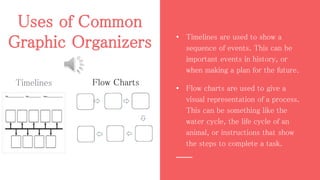
Timelines
• Timelines are used to show a
sequence of events. This can be
important events in history, or
when making a plan for the future.
• Flow charts are used to give a
visual representation of a process.
This can be something like the
water cycle, the life cycle of an
animal, or instructions that show
the steps to complete a task.
Flow Charts
Uses of Common
Graphic
Organizers (cont.)
Venn Diagrams
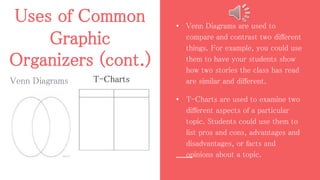
• Venn Diagrams are used to
compare and contrast two different
things. For example, you could use
them to have your students show
how two stories the class has read
are similar and different.
• T-Charts are used to examine two
different aspects of a particular
topic. Students could use them to
list pros and cons, advantages and
disadvantages, or facts and
opinions about a topic.
T-Charts
Uses of Common
Graphic
Organizers (cont.)
W’s Organizers
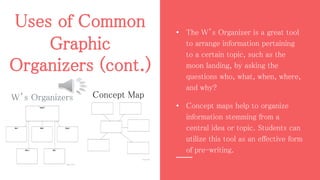
• The W’s Organizer is a great tool
to arrange information pertaining
to a certain topic, such as the
moon landing, by asking the
questions who, what, when, where,
and why?
• Concept maps help to organize
information stemming from a
central idea or topic. Students can
utilize this tool as an effective form
of pre-writing.
Concept Map
Uses of Common
Graphic
Organizers (cont.)
Clustering
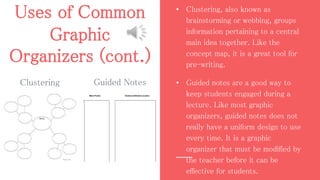
• Clustering, also known as
brainstorming or webbing, groups
information pertaining to a central
main idea together. Like the
concept map, it is a great tool for
pre-writing.
• Guided notes are a good way to
keep students engaged during a
lecture. Like most graphic
organizers, guided notes does not
really have a uniform design to use
every time. It is a graphic
organizer that must be modified by
the teacher before it can be
effective for students.
Guided Notes
Uses of Common
Graphic
Organizers (cont.)
Plot Diagrams
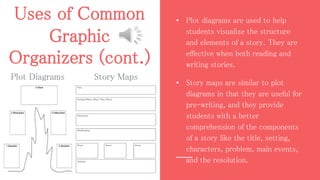
• Plot diagrams are used to help
students visualize the structure
and elements of a story. They are
effective when both reading and
writing stories.
• Story maps are similar to plot
diagrams in that they are useful for
pre-writing, and they provide
students with a better
comprehension of the components
of a story like the title, setting,
characters, problem, main events,
and the resolution.
Story Maps
Benefits of
Graphic
Organizers
• Graphic organizers provide an
easier way for students
comprehend important information.
• They lessen amount of information
students have to process.
• They help students learn skills to
become more efficient learners.
Learners Who
Benefit from
Graphic
Organizers
• Visual
• Tactile
• Analytical
• Special Needs
• ESL
• Gifted and Talented
However: ALL learners benefit from
graphic organizers! Assimilating
information leads to critical thinking
andthe presentation leads to better
content internalization.
Information
Processing
Theory
Breaking down information into main
ideas and creating visuals helps
students move material from short- to
long-term memory
Students process the information bit
by bit instead of all at once, giving
them time to build upon what they’ve
already learned.
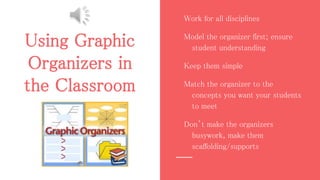
Using Graphic
Organizers in
the Classroom
Work for all disciplines
Model the organizer first; ensure
student understanding
Keep them simple
Match the organizer to the
concepts you want your students
to meet
Don’t make the organizers
busywork, make them
scaffolding/supports
Teacher
Resources
Listed to the right are links to
online resources where teachers
can access and create graphic
organizers to use in their own
classrooms.
Education Place
ThinkPort
Creately
UDL Tech
Teach-Nology
Work Cited
Baltimore County Public Schools. “Learning Styles.” BCPS, 2016,
https://www.bcps.org/offices/lis/models/tips/styles.html
Chapman, Sandy. “Graphic Organizers Enhance Student Comprehension.” Colorado
State University, 2016, http://teaching.colostate.edu/tips/tip.cfm?tipid=176
“Graphic Organizers.” Maryland Public Television, 2016, http://thinkport.org/graphic-
organizers.html
McKnight, Katherine, PhD. “Use Graphic Organizers for Effective Learning.” Teach
Hub, 2016, http://www.teachhub.com/teaching-graphic-organizers
Work Cited (continued)
Rini, Ellen. “Information Processing Theory: Chapter 8.” EDF 219, Ed Psych Text.
2016. Power Point Lecture.
“Tips and Tricks for Using Graphic Organizers.” Teaching History, n.d.,
http://teachinghistory.org/teaching-materials/ask-a-master-teacher/25149

EMS 300: Graphic Organizers

  • 1.
  • 2.
    Graphic Organizers: Defined "A visual andgraphic display that depicts the relationships between facts, terms, and or ideas within a learning task. Graphic organizers are also sometimes referred to as knowledge maps, concept maps, story maps, cognitive organizers, advance organizers, or concept diagrams."
  • 3.
    Common Graphic Organizers Timelines Flow Charts VennDiagrams T-Charts Guided Notes Concept Maps Clustering Plot Diagrams W’s Organizers Storyboards
  • 4.
    Uses of Common GraphicOrganizers Timelines • Timelines are used to show a sequence of events. This can be important events in history, or when making a plan for the future. • Flow charts are used to give a visual representation of a process. This can be something like the water cycle, the life cycle of an animal, or instructions that show the steps to complete a task. Flow Charts
  • 5.
    Uses of Common Graphic Organizers(cont.) Venn Diagrams • Venn Diagrams are used to compare and contrast two different things. For example, you could use them to have your students show how two stories the class has read are similar and different. • T-Charts are used to examine two different aspects of a particular topic. Students could use them to list pros and cons, advantages and disadvantages, or facts and opinions about a topic. T-Charts
  • 6.
    Uses of Common Graphic Organizers(cont.) W’s Organizers • The W’s Organizer is a great tool to arrange information pertaining to a certain topic, such as the moon landing, by asking the questions who, what, when, where, and why? • Concept maps help to organize information stemming from a central idea or topic. Students can utilize this tool as an effective form of pre-writing. Concept Map
  • 7.
    Uses of Common Graphic Organizers(cont.) Clustering • Clustering, also known as brainstorming or webbing, groups information pertaining to a central main idea together. Like the concept map, it is a great tool for pre-writing. • Guided notes are a good way to keep students engaged during a lecture. Like most graphic organizers, guided notes does not really have a uniform design to use every time. It is a graphic organizer that must be modified by the teacher before it can be effective for students. Guided Notes
  • 8.
    Uses of Common Graphic Organizers(cont.) Plot Diagrams • Plot diagrams are used to help students visualize the structure and elements of a story. They are effective when both reading and writing stories. • Story maps are similar to plot diagrams in that they are useful for pre-writing, and they provide students with a better comprehension of the components of a story like the title, setting, characters, problem, main events, and the resolution. Story Maps
  • 9.
    Benefits of Graphic Organizers • Graphicorganizers provide an easier way for students comprehend important information. • They lessen amount of information students have to process. • They help students learn skills to become more efficient learners.
  • 10.
    Learners Who Benefit from Graphic Organizers •Visual • Tactile • Analytical • Special Needs • ESL • Gifted and Talented However: ALL learners benefit from graphic organizers! Assimilating information leads to critical thinking andthe presentation leads to better content internalization.
  • 11.
    Information Processing Theory Breaking down informationinto main ideas and creating visuals helps students move material from short- to long-term memory Students process the information bit by bit instead of all at once, giving them time to build upon what they’ve already learned.
  • 12.
    Using Graphic Organizers in theClassroom Work for all disciplines Model the organizer first; ensure student understanding Keep them simple Match the organizer to the concepts you want your students to meet Don’t make the organizers busywork, make them scaffolding/supports
  • 13.
    Teacher Resources Listed to theright are links to online resources where teachers can access and create graphic organizers to use in their own classrooms. Education Place ThinkPort Creately UDL Tech Teach-Nology
  • 14.
    Work Cited Baltimore CountyPublic Schools. “Learning Styles.” BCPS, 2016, https://www.bcps.org/offices/lis/models/tips/styles.html Chapman, Sandy. “Graphic Organizers Enhance Student Comprehension.” Colorado State University, 2016, http://teaching.colostate.edu/tips/tip.cfm?tipid=176 “Graphic Organizers.” Maryland Public Television, 2016, http://thinkport.org/graphic- organizers.html McKnight, Katherine, PhD. “Use Graphic Organizers for Effective Learning.” Teach Hub, 2016, http://www.teachhub.com/teaching-graphic-organizers
  • 15.
    Work Cited (continued) Rini,Ellen. “Information Processing Theory: Chapter 8.” EDF 219, Ed Psych Text. 2016. Power Point Lecture. “Tips and Tricks for Using Graphic Organizers.” Teaching History, n.d., http://teachinghistory.org/teaching-materials/ask-a-master-teacher/25149