Graphic Organizers
Graphic Organizers
Graphic organizers are visual
displays of key content information
designed to benefit learners who
have difficulty organizing
information (Fisher & Schumaker,
1995).
Graphic Organizers
• Help students maintain the information over
time (Fountas & Pinnell, 2001, as cited in
Baxendrall, 2003).
• Connects content in a meaningful way to help
students gain a clearer understanding of the
material (Fountas & Pinnell, 2001, as cited in
Baxendrall, 2003).
Graphic Organizers
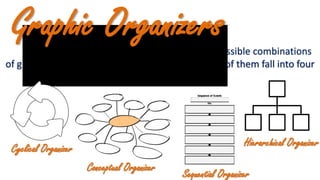
Although there are many variations and possible combinations
of graphic organizers used in the classrooms, most of them fall into four
basic categories namely:
Graphic Organizers
Sequential Organizer
Conceptual Organizer
Cyclical Organizer Hierarchical Organizer
Graphic Organizers
Graphic Organizers
Effectiveness and Advantages of
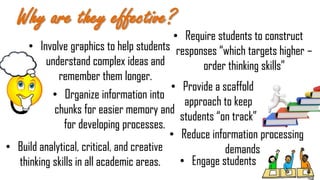
Why are they effective?
• Organize information into
chunks for easier memory and
for developing processes.
• Require students to construct
responses “which targets higher –
order thinking skills”
• Build analytical, critical, and creative
thinking skills in all academic areas.
• Provide a scaffold
approach to keep
students “on track”
• Reduce information processing
demands
• Engage students
• Involve graphics to help students
understand complex ideas and
remember them longer.
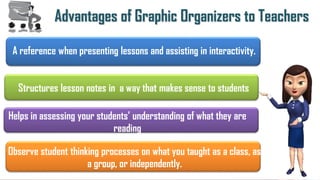
Advantages of Graphic Organizers to Teachers
A reference when presenting lessons and assisting in interactivity.
Structures lesson notes in a way that makes sense to students
Observe student thinking processes on what you taught as a class, as
a group, or independently.
Helps in assessing your students’ understanding of what they are
reading
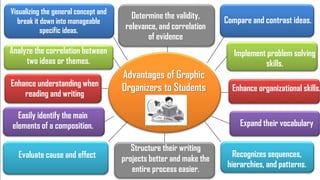
Advantages of Graphic
Organizers to Students
Increase your understanding
about the topic
Visualizing the general concept and
break it down into manageable
specific ideas.
Analyze the correlation between
two ideas or themes.
Determine the validity,
relevance, and correlation
of evidence
Easily identify the main
elements of a composition.
Evaluate cause and effect
Compare and contrast ideas.
Structure their writing
projects better and make the
entire process easier.
Recognizes sequences,
hierarchies, and patterns.
Implement problem solving
skills.
Enhance understanding when
reading and writing
Expand their vocabulary
Enhance organizational skills.
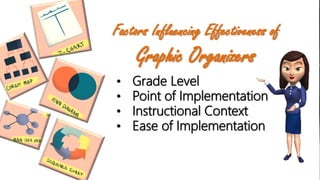
• Grade Level
• Point of Implementation
• Instructional Context
• Ease of Implementation
Factors Influencing Effectiveness of
Graphic Organizers
Learning Competencies that can
be taught with the use of
Graphic Organizers
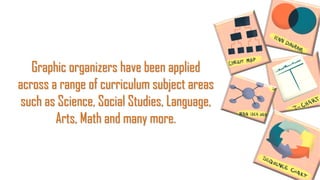
Graphic organizers have been applied
across a range of curriculum subject areas
such as Science, Social Studies, Language,
Arts, Math and many more.
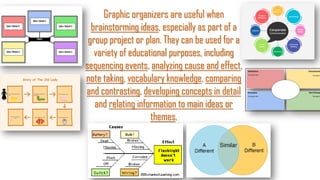
Graphic organizers are useful when
brainstorming ideas, especially as part of a
group project or plan. They can be used for a
variety of educational purposes, including
sequencing events, analyzing cause and effect,
note taking, vocabulary knowledge, comparing
and contrasting, developing concepts in detail
and relating information to main ideas or
themes.
Graphic Organizers
Instructional Procedures in Using
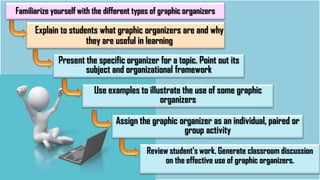
Familiarize yourself with the different types of graphic organizers
Present the specific organizer for a topic. Point out its
subject and organizational framework
Explain to students what graphic organizers are and why
they are useful in learning
Use examples to illustrate the use of some graphic
organizers
Assign the graphic organizer as an individual, paired or
group activity
Review student's work. Generate classroom discussion
on the effective use of graphic organizers.
• Graphic Organizers: Guiding Principles and Effective Practices Considerations Packet (2015) retrieved from
https://education.wm.edu/centers/ttac/documents/packets/graphicorganizers.pdf (November 7, 2020)
• Wise M. & Cooper C. (2019). Increasing the Value of Graphic Organizers. Retrieved from https://www.edutopia.org/article/increasing-
value-graphic-organizers#:~:text=Graphic%20organizers%20are%20a%20helpful,scaffold%20to%20support%20student%20learning.
(November 7, 2020)
• Nikolai A. (2008). Advantages & Disadvantages of a Graphic Organizer. Retrieved from https://www.theclassroom.com/use-cloze-
technique-middle-school-7799125.html. (November 7, 2020)
• Alber R. (2016). Using Graphic Organizers Correctly. Retrieved from https://www.edutopia.org/blog/using-graphic-organizers-
correctly-rebecca-alber. (November 7, 2020)
• Gonzalez J. (2017). The Greta and Powerful Graphic Organizers. Retrieved from https://www.cultofpedagogy.com/graphic-organizer/.
(November 7, 2020)
• Nicholas F. B. (2008). The Implementation and Effective Use of Graphic Organizers in the Classroom: Graphic Organizers to the Rescue.
Retreived From https://www.lynchburg.edu/wp-content/uploads/volume-5-2010-11/NicholasF-Implementation-Graphic-Organizers-
Classroom.pdf. (November 7, 2020).
References:

Graphic organizer

  • 1.
  • 2.
    Graphic Organizers Graphic organizersare visual displays of key content information designed to benefit learners who have difficulty organizing information (Fisher & Schumaker, 1995). Graphic Organizers
  • 3.
    • Help studentsmaintain the information over time (Fountas & Pinnell, 2001, as cited in Baxendrall, 2003). • Connects content in a meaningful way to help students gain a clearer understanding of the material (Fountas & Pinnell, 2001, as cited in Baxendrall, 2003). Graphic Organizers
  • 4.
    Although there aremany variations and possible combinations of graphic organizers used in the classrooms, most of them fall into four basic categories namely: Graphic Organizers Sequential Organizer Conceptual Organizer Cyclical Organizer Hierarchical Organizer
  • 5.
  • 6.
    Why are theyeffective? • Organize information into chunks for easier memory and for developing processes. • Require students to construct responses “which targets higher – order thinking skills” • Build analytical, critical, and creative thinking skills in all academic areas. • Provide a scaffold approach to keep students “on track” • Reduce information processing demands • Engage students • Involve graphics to help students understand complex ideas and remember them longer.
  • 7.
    Advantages of GraphicOrganizers to Teachers A reference when presenting lessons and assisting in interactivity. Structures lesson notes in a way that makes sense to students Observe student thinking processes on what you taught as a class, as a group, or independently. Helps in assessing your students’ understanding of what they are reading
  • 8.
    Advantages of Graphic Organizersto Students Increase your understanding about the topic Visualizing the general concept and break it down into manageable specific ideas. Analyze the correlation between two ideas or themes. Determine the validity, relevance, and correlation of evidence Easily identify the main elements of a composition. Evaluate cause and effect Compare and contrast ideas. Structure their writing projects better and make the entire process easier. Recognizes sequences, hierarchies, and patterns. Implement problem solving skills. Enhance understanding when reading and writing Expand their vocabulary Enhance organizational skills.
  • 9.
    • Grade Level •Point of Implementation • Instructional Context • Ease of Implementation Factors Influencing Effectiveness of Graphic Organizers
  • 10.
    Learning Competencies thatcan be taught with the use of Graphic Organizers
  • 11.
    Graphic organizers havebeen applied across a range of curriculum subject areas such as Science, Social Studies, Language, Arts, Math and many more.
  • 12.
    Graphic organizers areuseful when brainstorming ideas, especially as part of a group project or plan. They can be used for a variety of educational purposes, including sequencing events, analyzing cause and effect, note taking, vocabulary knowledge, comparing and contrasting, developing concepts in detail and relating information to main ideas or themes.
  • 13.
  • 14.
    Familiarize yourself withthe different types of graphic organizers Present the specific organizer for a topic. Point out its subject and organizational framework Explain to students what graphic organizers are and why they are useful in learning Use examples to illustrate the use of some graphic organizers Assign the graphic organizer as an individual, paired or group activity Review student's work. Generate classroom discussion on the effective use of graphic organizers.
  • 15.
    • Graphic Organizers:Guiding Principles and Effective Practices Considerations Packet (2015) retrieved from https://education.wm.edu/centers/ttac/documents/packets/graphicorganizers.pdf (November 7, 2020) • Wise M. & Cooper C. (2019). Increasing the Value of Graphic Organizers. Retrieved from https://www.edutopia.org/article/increasing- value-graphic-organizers#:~:text=Graphic%20organizers%20are%20a%20helpful,scaffold%20to%20support%20student%20learning. (November 7, 2020) • Nikolai A. (2008). Advantages & Disadvantages of a Graphic Organizer. Retrieved from https://www.theclassroom.com/use-cloze- technique-middle-school-7799125.html. (November 7, 2020) • Alber R. (2016). Using Graphic Organizers Correctly. Retrieved from https://www.edutopia.org/blog/using-graphic-organizers- correctly-rebecca-alber. (November 7, 2020) • Gonzalez J. (2017). The Greta and Powerful Graphic Organizers. Retrieved from https://www.cultofpedagogy.com/graphic-organizer/. (November 7, 2020) • Nicholas F. B. (2008). The Implementation and Effective Use of Graphic Organizers in the Classroom: Graphic Organizers to the Rescue. Retreived From https://www.lynchburg.edu/wp-content/uploads/volume-5-2010-11/NicholasF-Implementation-Graphic-Organizers- Classroom.pdf. (November 7, 2020). References: