1
Ergonomics
for the
"General Practitioner"
Cindy Burt, MS, OTR/L, CPE
Injury Prevention Program Manager
UCLA
2
Learning Objectives
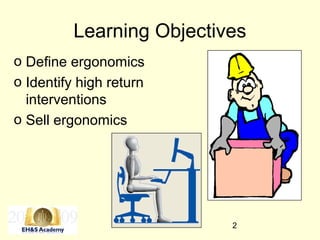
o Define ergonomics
o Identify high return
interventions
o Sell ergonomics
History of Ergonomics
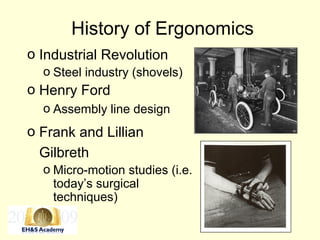
o Industrial Revolution
o Steel industry (shovels)
o Henry Ford
o Assembly line design
o Frank and Lillian
Gilbreth
o Micro-motion studies (i.e.
today’s surgical
techniques)
History of Ergonomics
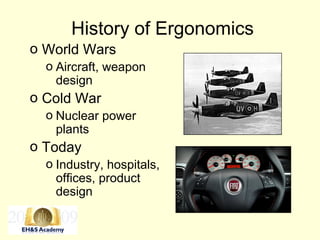
o World Wars
o Aircraft, weapon
design
o Cold War
o Nuclear power
plants
o Today
o Industry, hospitals,
offices, product
design
5
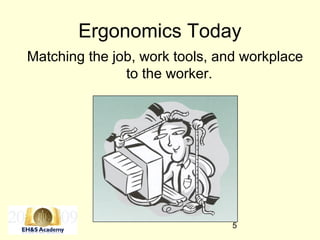
Ergonomics Today
Matching the job, work tools, and workplace
to the worker.
6
Ergonomics
Employee Concerns
– Comfort
– Fatigue
– Injuries
– Job satisfaction
• Decreased boredom
• Decreased stress
• Reasonable workloads
Employer Concerns
– Worker’s comp costs
– Productivity
– Errors
– Products
– Profit
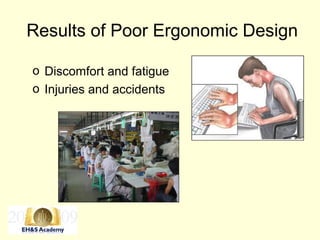
Results of Poor Ergonomic Design
o Discomfort and fatigue
o Injuries and accidents
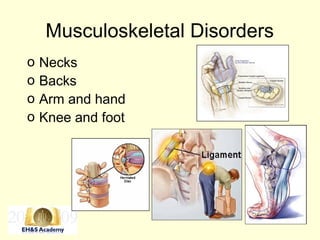
Musculoskeletal Disorders
o Necks
o Backs
o Arm and hand
o Knee and foot
9
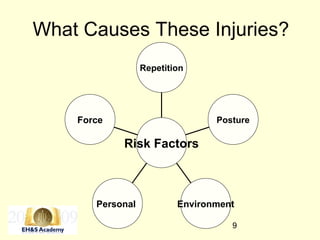
What Causes These Injuries?
Force
Personal Environment
Posture
Repetition
Risk Factors
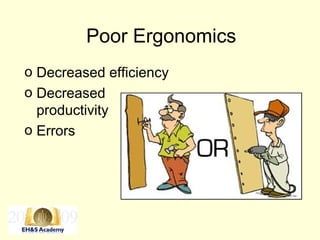
Poor Ergonomics
o Decreased efficiency
o Decreased
productivity
o Errors
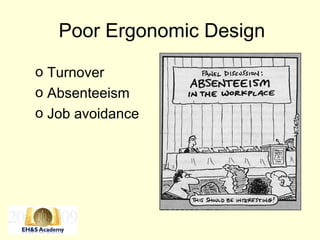
Poor Ergonomic Design
o Turnover
o Absenteeism
o Job avoidance
How Do I Get Started?
o Pick your fights
o Sell your service
13
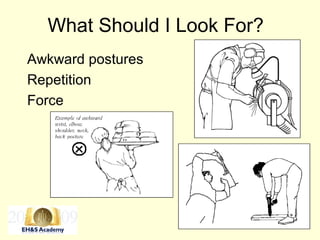
What Should I Look For?
Awkward postures
Repetition
Force
14
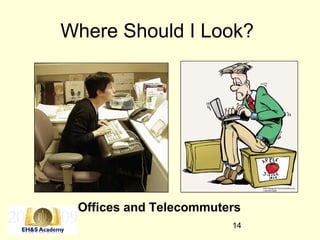
Where Should I Look?
Offices and Telecommuters
15
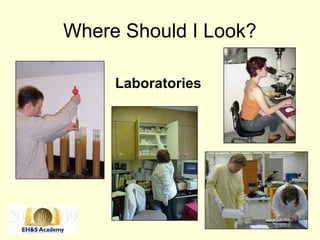
Where Should I Look?
Laboratories
16
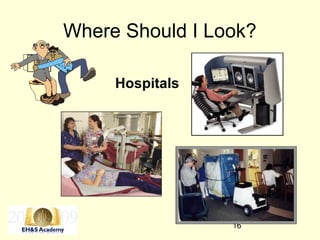
Where Should I Look?
Hospitals
17
Where Should I Look?
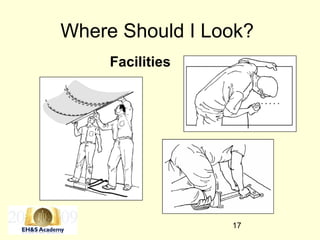
Facilities
18
Where Should I Look?
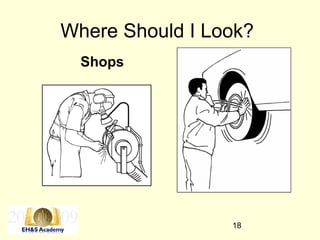
Shops
19
Where Should I Look?
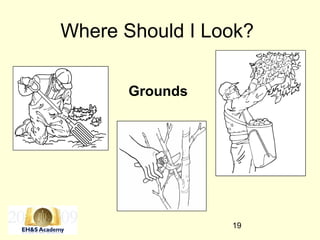
Grounds
20
Where Should I Look?
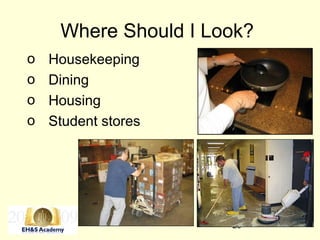
o Housekeeping
o Dining
o Housing
o Student stores
21
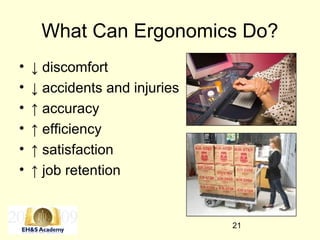
What Can Ergonomics Do?
• ↓ discomfort
• ↓ accidents and injuries
• ↑ accuracy
• ↑ efficiency
• ↑ satisfaction
• ↑ job retention
22
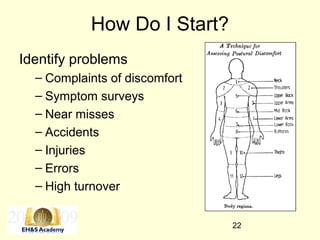
How Do I Start?
Identify problems
– Complaints of discomfort
– Symptom surveys
– Near misses
– Accidents
– Injuries
– Errors
– High turnover
23
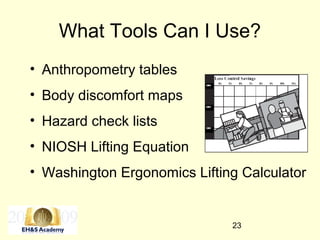
What Tools Can I Use?
• Anthropometry tables
• Body discomfort maps
• Hazard check lists
• NIOSH Lifting Equation
• Washington Ergonomics Lifting Calculator
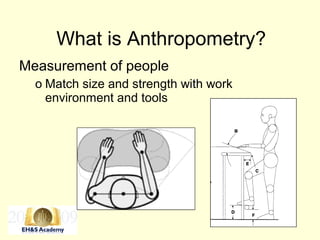
What is Anthropometry?
Measurement of people
o Match size and strength with work
environment and tools
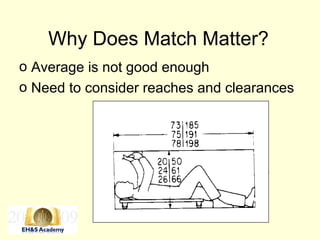
Why Does Match Matter?
o Average is not good enough
o Need to consider reaches and clearances
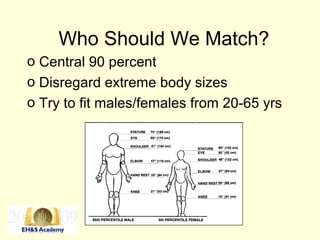
Who Should We Match?
o Central 90 percent
o Disregard extreme body sizes
o Try to fit males/females from 20-65 yrs
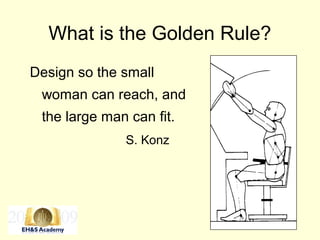
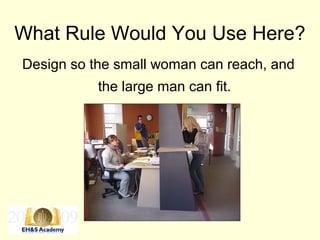
What is the Golden Rule?
Design so the small
woman can reach, and
the large man can fit.
S. Konz
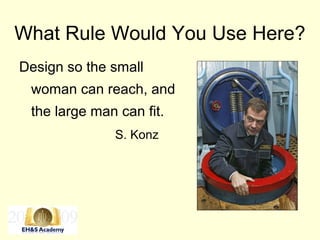
What Rule Would You Use Here?
Design so the small
woman can reach, and
the large man can fit.
S. Konz
What Rule Would You Use Here?
Design so the small woman can reach, and
the large man can fit.
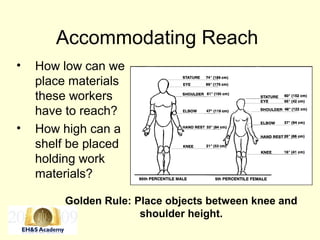
Accommodating Reach
• How low can we
place materials
these workers
have to reach?
• How high can a
shelf be placed
holding work
materials?
Golden Rule: Place objects between knee and
shoulder height.
31
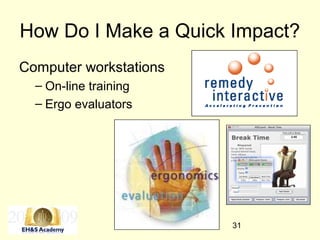
How Do I Make a Quick Impact?
Computer workstations
– On-line training
– Ergo evaluators
32
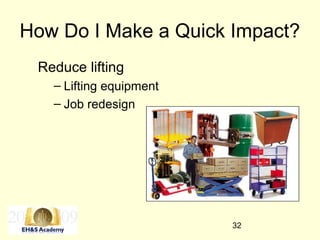
How Do I Make a Quick Impact?
Reduce lifting
– Lifting equipment
– Job redesign
33
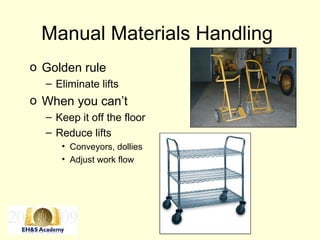
Manual Materials Handling
o Golden rule
– Eliminate lifts
o When you can’t
– Keep it off the floor
– Reduce lifts
• Conveyors, dollies
• Adjust work flow
34
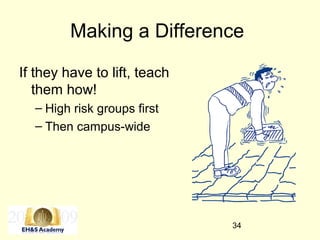
Making a Difference
If they have to lift, teach
them how!
– High risk groups first
– Then campus-wide
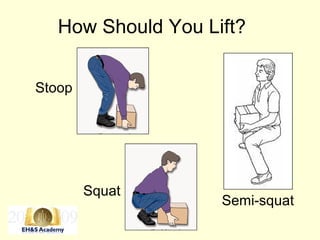
How Should You Lift?
Stoop
Squat
Semi-squat
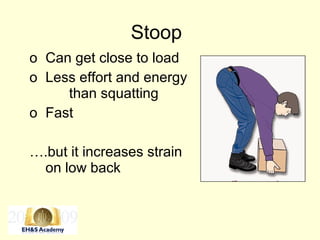
Stoop
o Can get close to load
o Less effort and energy
than squatting
o Fast
….but it increases strain
on low back
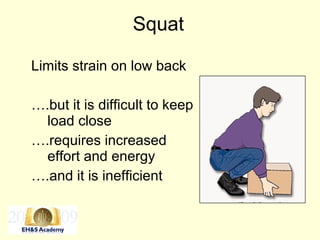
Squat
Limits strain on low back
….but it is difficult to keep
load close
….requires increased
effort and energy
….and it is inefficient
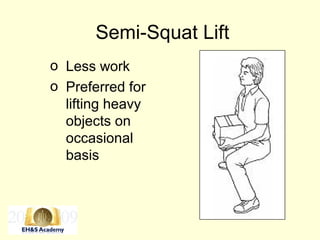
Semi-Squat Lift
o Less work
o Preferred for
lifting heavy
objects on
occasional
basis
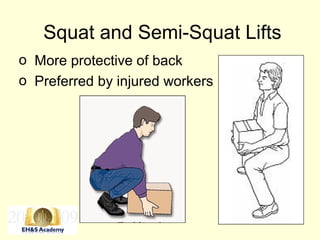
Squat and Semi-Squat Lifts
o More protective of back
o Preferred by injured workers
40
There are no “right” or
“correct” ways to sit, stand or
lift....
However, there are more
and less demanding ways!
41
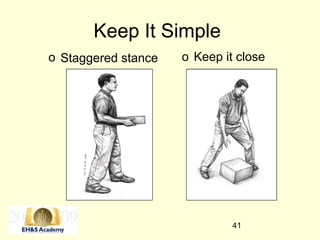
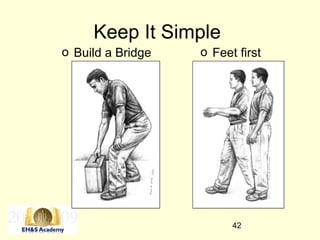
Keep It Simple
o Staggered stance o Keep it close
42
Keep It Simple
o Build a Bridge o Feet first
43
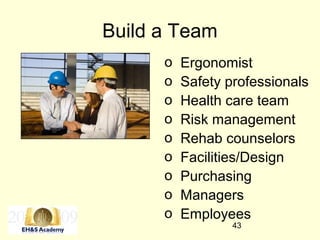
Build a Team
o Ergonomist
o Safety professionals
o Health care team
o Risk management
o Rehab counselors
o Facilities/Design
o Purchasing
o Managers
o Employees
44
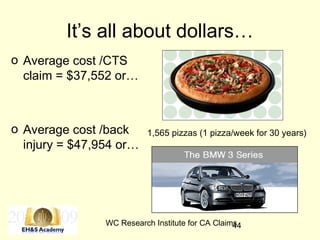
It’s all about dollars…
o Average cost /CTS
claim = $37,552 or…
o Average cost /back
injury = $47,954 or…
WC Research Institute for CA Claims
1,565 pizzas (1 pizza/week for 30 years)
45
Prove Your Value!
For every direct dollar spent
–OSHA estimates
»$3-7 indirect dollars spent
–Liberty Mutual estimates
»$2-5 indirect dollars spent
46
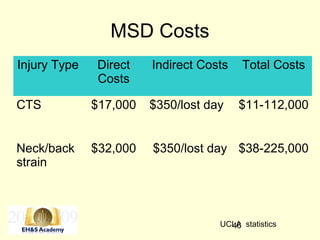
MSD Costs
Injury Type Direct
Costs
Indirect Costs Total Costs
CTS $17,000 $350/lost day $11-112,000
Neck/back
strain
$32,000 $350/lost day $38-225,000
UCLA statistics
47
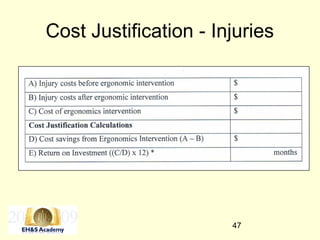
Cost Justification - Injuries
48
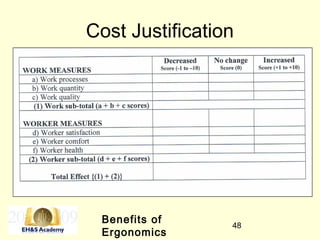
Cost Justification
Benefits of
Ergonomics
49
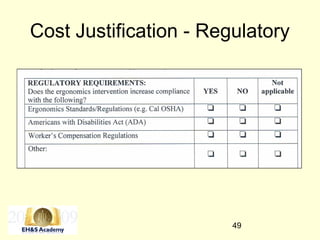
Cost Justification - Regulatory
50
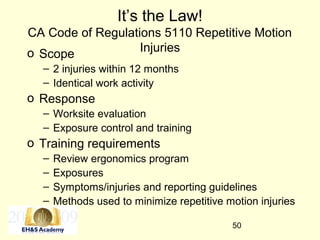
It’s the Law!
CA Code of Regulations 5110 Repetitive Motion
Injurieso Scope
– 2 injuries within 12 months
– Identical work activity
o Response
– Worksite evaluation
– Exposure control and training
o Training requirements
– Review ergonomics program
– Exposures
– Symptoms/injuries and reporting guidelines
– Methods used to minimize repetitive motion injuries
51
Useful References
o Fundamentals of Industrial Hygiene, 3rd
Edition. National Safety Council Pgs.
283-334
o Industrial Hygiene Engineering, 2nd
Edition. National Institute for Occupational
Safety and Health Pgs. 702-765
52
Useful References
o The Occupational Environmental – Its
Evaluation and Control, 2nd
Edition, AIHA,
Section 4, The Human Environment at
Work.
o Kodak’s Ergonomic Design for People at
Work, 2nd
Edition, Chengalur, Rodgers and
Bernard, 2004.
o Fitting the Task to the Human, 5th
Edition,
Kroemer & Grandjean, 1997.
53
Useful Internet Sites
www.ergonomics.ucla.edu
www.me.berkeley.edu/ergo/
www.uhs.berkeley.edu/facstaff/ergonomics/index.shtml
www.llnl.gov/ergo/welcome.html
www.busserv.ucsb.edu/irp/ergo/tsr.htm
ehs.ucsc.edu/safety/ergonomics.php
blink.ucsd.edu/Blink/External/Topics/Policy/0,1162,4008,
54
Useful Internet Sites
http://ergo.human.cornell.edu/
www.3m.com/cws/selfhelp/index.html
www.pc.ibm.com/ww/healthycomputing
www.dir.ca.gov/dosh/REU/REU_WhatsNew.html
www.osha.gov/SLTC/etools/computerworkstation
s/index.html
55
Useful Internet Sites
www.niehs.nih.gov/odhsb/ergoguid/home.htm
www.lni.wa.gov/Safety/Topics/Ergonomics/default.asp
www.ccohs.ca/oshanswers/ergonomics/
www.bcpe.org (Board of Certification in Professional
Ergonomics)
www.hfes.org (Human Factors Society)
56
Thank you!
Cindy Burt, MS, OTR/L, CPE
UCLA Injury Prevention Program Manager
501 Westwood Plaza 4th
Floor
Los Angeles, CA 90095-1605
burt@ehs.ucla.edu
www.ergonomics.ucla.edu
310-794-5329

Ergonomics

Editor's Notes

  • #2 <number> Intro How many people know something about ergonomics? Can they brainstorm words that relate to ergonomics? Neither industry nor research university settings are immune to ergo problems.
  • #3 <number> Goal of this program is to teach participants basic concepts of ergonomics so you can incorporate them into your health and safety agenda at your facility.
  • #4 <number>
  • #5 <number>
  • #6 <number>
  • #8 <number>
  • #9 <number> There are several commonly known musculoskeletal injuries that can be avoided with use of ergonomics. These are also known as cumulative trauma disorders and repetitive strain disorders
  • #10 There are several risk factors leading to MSDs.
  • #11 <number> The effects of the risk factors associated with the development of WMSDs (primarily force, posture and repetition) have been validated throughout history. Archaeological digs at an ancient Mayan toolmaking factory in Belize uncovered skeletal remains with distinct wear-and-tear damage to the wrist, elbow and shoulder joints of the dominant hand. These discoveries were indicative of long hours repeatedly hammering stones to make tools. Industrial hygiene issues and WMSDs were first identified as a significant cause of occupational disease/injury nearly 300 years ago by Bernardino Rammazzini, the father of occupational medicine. He identified that certain diseases were attributed to “irregular motions” and “unnatural postures” which over time lead to discomfort, pain or impaired function. Fortunately, the discomfort and pain “gradually develop” which means that time exists to stop the progression and reverse the process if we intervene early and proactively. In 1918, Alice Hamilton identified Raynaud’s disease (a numbness and whitening of the fingers) as a problem among men using airhammers to cut stone. She associated the disease to three cause: duration of force in holding the tool, vibration and cold. She also noted that the severity of the disease increased as the total exposure time increased. Despite the early connection between occupation and disease, it wasn’t until World War II that engineers began to design cockpits to fit the size of most pilots and match capabilities to vision and sound. Excerpted from Safety and Health, June 1995
  • #12 <number>
  • #13 <number> You can’t be everywhere and do everything, so invest your energy into the areas where there are high levels of injuries. It is crucial to have management support and involvement. You will always need to be actively “selling” your program.
  • #14 <number> Look for the high risk activities we have mentioned.
  • #15 <number> Ergonomic issues in offices are frequently related to visual and physical targets. Don’t forget to observe unusual things such as demonstrated above with the employee awkwardly using a stamp.
  • #16 <number> Laboratory workers notoriously work long hours in poorly designed facilities. Pipetting and microscope work involve all 3 risk factors.
  • #17 <number> Although lifting patients is the most common ergonomics problem in hospitals, there are other risks to consider.
  • #18 <number> These are problems that I have encountered while at UT Houston.
  • #19 <number> There are ergonomic problems in most areas with a high level of materials handling.
  • #20 <number> There are ergonomic problems in most areas with a high level of materials handling.
  • #21 <number> There are ergonomic problems in most areas with a high level of materials handling.
  • #22 <number> Ergonomics is more than making workers comfortable. Ergonomics can save money and increase worker safety.
  • #23 <number> Complaints of discomfort and symptom surveys are often the first sign of problems. Don’t forget to consider other safety issues as near misses, accidents and injuries. High turnover can often indicate a job that is dangerous or difficult to do. Errors and accuracy are also affected bu job design and performance expectations.
  • #24 <number> There are many tools ergonomists use to match workers with their work. Here are some samples. Some are included in your manual.
  • #25 <number> Anthropometrics is a tool you can use to set up work environments without having to measure everyone in your particular workforce. However, remember that there are several databases available. Select one that closely matches the your work force.
  • #26 <number> Design has to consider all issues including reaches and clearances.
  • #27 <number> You can’t realistically fit everyone. So try to set up work for the middle 90% of workers. Ask tall and short volunteer to get up in front of group and compare reaches.
  • #28 <number> Design has to consider all issues including reaches and clearances.
  • #29 <number> Design has to consider all issues including reaches and clearances.
  • #30 <number> Design has to consider all issues including reaches and clearances.
  • #31 <number> This slide demonstrates the ranges for placing objects when working. The tallest and smallest workers are at a distinct disadvantage.
  • #32 <number> Eliminating the risk is the best solution. Back injuries are expensive claims.
  • #33 <number> Eliminating the risk is the best solution. Back injuries are expensive claims.
  • #34 <number> Reduce lifting when it can’t be eliminated.
  • #35 <number> Training is one way to reduce risk. Try to do training frequently and take advantage of all opportunities, no matter how small.
  • #36 <number> Have everyone stand and take their pulse for 15 seconds and multiply it by 4. Write it down. Then have them lift using a squat technique for 20 repetitions and re-measure pulse. Have them write it down.
  • #37 <number> Advantages of different lifts.
  • #38 <number> Advantages of different lifts.
  • #39 <number> Advantages of different lifts.
  • #40 <number> Advantages of different lifts.
  • #42 <number> Training is one of the ways to reduce injuries, but keep it simple. Employees don’t know about ergo Back belts can be bad
  • #43 <number> Training is one of the ways to reduce injuries, but keep it simple.
  • #44 <number> An effective team is composed of many disciplines bringing a variety of expertise to solve ergonomic problems and improve the workplace. Latin:ergon – work and strength nomos – law or rule 1957 – North American scientist and engineers recognized the field as human factors. Before 1957 ergonomics were disregarded in military human machines.
  • #52 <number> Sections in books where info was obtained for presentation.
  • #53 <number> Sections in books where info was obtained for presentation.
  • #54 <number> Good ergonomics websites
  • #55 <number> Good ergonomics websites.
  • #56 <number> Good ergonomics websites.
  • #57 <number>