
OBSERVATION OF
SAFETY PRECAUTION
ER. MANI DAS
9866019982
9813622321
Use of Protective clothing and
Equipment
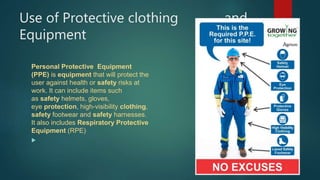
Personal Protective Equipment
(PPE) is equipment that will protect the
user against health or safety risks at
work. It can include items such
as safety helmets, gloves,
eye protection, high-visibility clothing,
safety footwear and safety harnesses.
It also includes Respiratory Protective
Equipment (RPE)

Demonstration of Safe Working Habits
Here we look at five safety measures every construction worker must
take.
 Double-Check Your Work Areas. ...
 Be Vigilant with Electricity and Equipment. ...
 Maintain Fencing and Prevent Fires. ...
 Protective Apparel and PPE. ...
 Keep First Aid Close. ...
 Final Thoughts.
Demonstration of Safe Working Habits
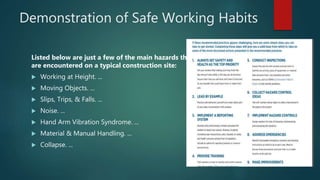
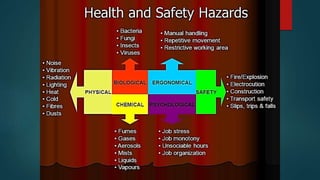
Listed below are just a few of the main hazards that
are encountered on a typical construction site:
 Working at Height. ...
 Moving Objects. ...
 Slips, Trips, & Falls. ...
 Noise. ...
 Hand Arm Vibration Syndrome. ...
 Material & Manual Handling. ...
 Collapse. ...
Demonstration of Safe Working Habits
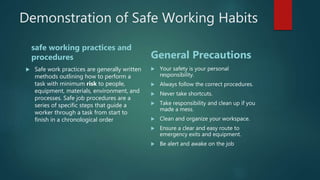
safe working practices and
procedures
 Safe work practices are generally written
methods outlining how to perform a
task with minimum risk to people,
equipment, materials, environment, and
processes. Safe job procedures are a
series of specific steps that guide a
worker through a task from start to
finish in a chronological order
General Precautions
 Your safety is your personal
responsibility.
 Always follow the correct procedures.
 Never take shortcuts.
 Take responsibility and clean up if you
made a mess.
 Clean and organize your workspace.
 Ensure a clear and easy route to
emergency exits and equipment.
 Be alert and awake on the job
Maintaining Tools and Equipment
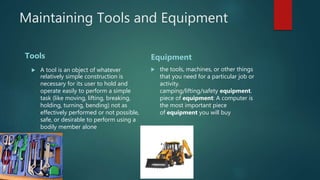
Tools
 A tool is an object of whatever
relatively simple construction is
necessary for its user to hold and
operate easily to perform a simple
task (like moving, lifting, breaking,
holding, turning, bending) not as
effectively performed or not possible,
safe, or desirable to perform using a
bodily member alone
Equipment
 the tools, machines, or other things
that you need for a particular job or
activity.
camping/lifting/safety equipment.
piece of equipment: A computer is
the most important piece
of equipment you will buy
Maintaining Tools and Equipment
Here are top tips for large machinery maintenance:
 Stay on top of large machinery operator training. ...
 Add and test lubricants frequently. ...
 Check for signs of wear. ...
 Keep large machinery clean, and maintain a clean
environment. ...
 Have a maintenance and repair schedule, and keep
good records.
 Stay on top of large machinery operator training. ...
 Add and test lubricants frequently. ...
 Check for signs of wear. ...
 Keep large machinery clean, and maintain a clean
environment. ...
 Have a maintenance and repair schedule, and keep
good records.
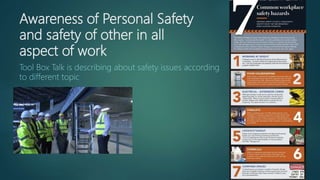
Awareness of Personal Safety and
safety of other in all aspect of work
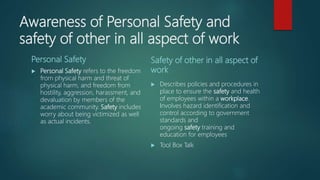
Personal Safety
 Personal Safety refers to the freedom
from physical harm and threat of
physical harm, and freedom from
hostility, aggression, harassment, and
devaluation by members of the
academic community. Safety includes
worry about being victimized as well
as actual incidents.
Safety of other in all aspect of
work
 Describes policies and procedures in
place to ensure the safety and health
of employees within a workplace.
Involves hazard identification and
control according to government
standards and
ongoing safety training and
education for employees
 Tool Box Talk
Awareness of Personal Safety
and safety of other in all
aspect of work
Tool Box Talk is describing about safety issues according
to different topic
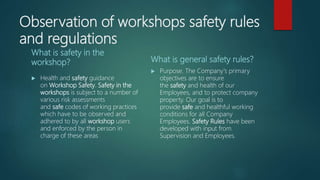
Observation of workshops safety rules
and regulations
What is safety in the
workshop?
 Health and safety guidance
on Workshop Safety. Safety in the
workshops is subject to a number of
various risk assessments
and safe codes of working practices
which have to be observed and
adhered to by all workshop users
and enforced by the person in
charge of these areas
What is general safety rules?
 Purpose. The Company's primary
objectives are to ensure
the safety and health of our
Employees, and to protect company
property. Our goal is to
provide safe and healthful working
conditions for all Company
Employees. Safety Rules have been
developed with input from
Supervision and Employees.
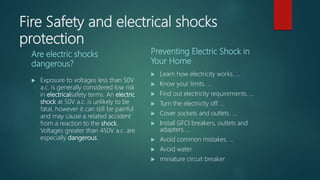
Fire Safety and electrical shocks
protection
Are electric shocks
dangerous?
 Exposure to voltages less than 50V
a.c. is generally considered low risk
in electricalsafety terms. An electric
shock at 50V a.c. is unlikely to be
fatal, however it can still be painful
and may cause a related accident
from a reaction to the shock.
Voltages greater than 450V a.c. are
especially dangerous.
Preventing Electric Shock in
Your Home
 Learn how electricity works. ...
 Know your limits. ...
 Find out electricity requirements. ...
 Turn the electricity off. ...
 Cover sockets and outlets. ...
 Install GFCI breakers, outlets and
adapters. ...
 Avoid common mistakes. ...
 Avoid water.
 miniature circuit breaker
Fire Hazard
Common Fire Hazards in the
Workplace
 Waste and combustible material
being stored on site. ...
 Flammable liquids and vapours. ...
 Dust build-up. ...
 Objects that generate heat. ...
 Faulty electrical equipment. ...
 Overloading power sockets. ...
 Smoking. ...
 Human error and negligence.
Top Tips for Fire Safety
 Install smoke alarms on every level of
your home, inside bedrooms and
outside sleeping areas.
 Test smoke alarms every month. ...
 Talk with all family members about a
fire escape plan and practice the plan
twice a year.
 If a fire occurs in your home, GET
OUT, STAY OUT and CALL FOR HELP.
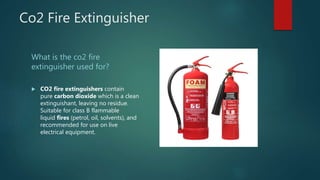
Co2 Fire Extinguisher
What is the co2 fire
extinguisher used for?
 CO2 fire extinguishers contain
pure carbon dioxide which is a clean
extinguishant, leaving no residue.
Suitable for class B flammable
liquid fires (petrol, oil, solvents), and
recommended for use on live
electrical equipment.
THANK YOU

Observation of safety precaution

  • 1.
    OBSERVATION OF SAFETY PRECAUTION ER.MANI DAS 9866019982 9813622321
  • 2.
    Use of Protectiveclothing and Equipment Personal Protective Equipment (PPE) is equipment that will protect the user against health or safety risks at work. It can include items such as safety helmets, gloves, eye protection, high-visibility clothing, safety footwear and safety harnesses. It also includes Respiratory Protective Equipment (RPE) 
  • 3.
    Demonstration of SafeWorking Habits Here we look at five safety measures every construction worker must take.  Double-Check Your Work Areas. ...  Be Vigilant with Electricity and Equipment. ...  Maintain Fencing and Prevent Fires. ...  Protective Apparel and PPE. ...  Keep First Aid Close. ...  Final Thoughts.
  • 4.
    Demonstration of SafeWorking Habits Listed below are just a few of the main hazards that are encountered on a typical construction site:  Working at Height. ...  Moving Objects. ...  Slips, Trips, & Falls. ...  Noise. ...  Hand Arm Vibration Syndrome. ...  Material & Manual Handling. ...  Collapse. ...
  • 5.
    Demonstration of SafeWorking Habits safe working practices and procedures  Safe work practices are generally written methods outlining how to perform a task with minimum risk to people, equipment, materials, environment, and processes. Safe job procedures are a series of specific steps that guide a worker through a task from start to finish in a chronological order General Precautions  Your safety is your personal responsibility.  Always follow the correct procedures.  Never take shortcuts.  Take responsibility and clean up if you made a mess.  Clean and organize your workspace.  Ensure a clear and easy route to emergency exits and equipment.  Be alert and awake on the job
  • 7.
    Maintaining Tools andEquipment Tools  A tool is an object of whatever relatively simple construction is necessary for its user to hold and operate easily to perform a simple task (like moving, lifting, breaking, holding, turning, bending) not as effectively performed or not possible, safe, or desirable to perform using a bodily member alone Equipment  the tools, machines, or other things that you need for a particular job or activity. camping/lifting/safety equipment. piece of equipment: A computer is the most important piece of equipment you will buy
  • 8.
    Maintaining Tools andEquipment Here are top tips for large machinery maintenance:  Stay on top of large machinery operator training. ...  Add and test lubricants frequently. ...  Check for signs of wear. ...  Keep large machinery clean, and maintain a clean environment. ...  Have a maintenance and repair schedule, and keep good records.  Stay on top of large machinery operator training. ...  Add and test lubricants frequently. ...  Check for signs of wear. ...  Keep large machinery clean, and maintain a clean environment. ...  Have a maintenance and repair schedule, and keep good records.
  • 9.
    Awareness of PersonalSafety and safety of other in all aspect of work Personal Safety  Personal Safety refers to the freedom from physical harm and threat of physical harm, and freedom from hostility, aggression, harassment, and devaluation by members of the academic community. Safety includes worry about being victimized as well as actual incidents. Safety of other in all aspect of work  Describes policies and procedures in place to ensure the safety and health of employees within a workplace. Involves hazard identification and control according to government standards and ongoing safety training and education for employees  Tool Box Talk
  • 10.
    Awareness of PersonalSafety and safety of other in all aspect of work Tool Box Talk is describing about safety issues according to different topic
  • 11.
    Observation of workshopssafety rules and regulations What is safety in the workshop?  Health and safety guidance on Workshop Safety. Safety in the workshops is subject to a number of various risk assessments and safe codes of working practices which have to be observed and adhered to by all workshop users and enforced by the person in charge of these areas What is general safety rules?  Purpose. The Company's primary objectives are to ensure the safety and health of our Employees, and to protect company property. Our goal is to provide safe and healthful working conditions for all Company Employees. Safety Rules have been developed with input from Supervision and Employees.
  • 12.
    Fire Safety andelectrical shocks protection Are electric shocks dangerous?  Exposure to voltages less than 50V a.c. is generally considered low risk in electricalsafety terms. An electric shock at 50V a.c. is unlikely to be fatal, however it can still be painful and may cause a related accident from a reaction to the shock. Voltages greater than 450V a.c. are especially dangerous. Preventing Electric Shock in Your Home  Learn how electricity works. ...  Know your limits. ...  Find out electricity requirements. ...  Turn the electricity off. ...  Cover sockets and outlets. ...  Install GFCI breakers, outlets and adapters. ...  Avoid common mistakes. ...  Avoid water.  miniature circuit breaker
  • 13.
    Fire Hazard Common FireHazards in the Workplace  Waste and combustible material being stored on site. ...  Flammable liquids and vapours. ...  Dust build-up. ...  Objects that generate heat. ...  Faulty electrical equipment. ...  Overloading power sockets. ...  Smoking. ...  Human error and negligence. Top Tips for Fire Safety  Install smoke alarms on every level of your home, inside bedrooms and outside sleeping areas.  Test smoke alarms every month. ...  Talk with all family members about a fire escape plan and practice the plan twice a year.  If a fire occurs in your home, GET OUT, STAY OUT and CALL FOR HELP.
  • 14.
    Co2 Fire Extinguisher Whatis the co2 fire extinguisher used for?  CO2 fire extinguishers contain pure carbon dioxide which is a clean extinguishant, leaving no residue. Suitable for class B flammable liquid fires (petrol, oil, solvents), and recommended for use on live electrical equipment.
  • 15.