OH&S
Induction training and
information
Induction Process
• Discussion and information on business practices,
operations and procedures.
• Discuss and explain policies and conditions of
employment.
• Provide information and training on safety procedures,
emergency evacuations, location of first aid kits, fire
escapes/equipment and tour of the workplace.
• Description of duty of care for both employer and
employee.
• The necessities of complying with the WHS Act.
• Explanation of duties and on the job training.
• Provide any equipment, uniforms, protective equipment,
access details.
• Answer any questions or re-explain any procedures.
Current Safety Procedures
• Testing and tagging of electrical equipment.
• Correct storage of chemicals and printing equipment.
All staff should have access to MSDS.
• Workplace floor must be clear and free of hazards.
• Appropriate personal protection equipment must be
worn when handling machinery and chemicals.
• Use correct manual handling procedures.
• Report any injuries, incidents or hazards as specified
within company policy.
• SOP & SWMS (standard operating procedures and safe
work method statement)
• There must be continual compliance to current
relevant workplace standards.
Equipment Safety Checks
• Inspect the machines and ensure nothing
is broken or missing.
• Electrical equipment is subject to a
testing and tagging procedure every 6
months.
• All protective gear must be accessible
and stored correctly.
• All employees must be made aware
where fire equipment and first aid kits
are located and they must be stocked and
operational. Signage will be and should
be required to indicate locations.
• Material Safety Data Sheets should be
readily available, revised and employees
should be familiar with any guidelines
before handling or using any hazardous
items.
• Cease operating immediately and isolate
any faulty electrical equipment.
Your Safety Representative
• Manager - Sam Horton
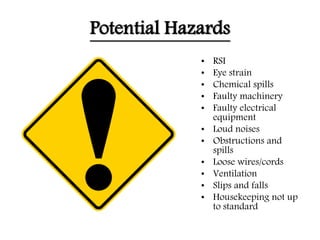
Potential Hazards
• RSI
• Eye strain
• Chemical spills
• Faulty machinery
• Faulty electrical
equipment
• Loud noises
• Obstructions and
spills
• Loose wires/cords
• Ventilation
• Slips and falls
• Housekeeping not up
to standard
Controlling Risks
• When using a computer, ensure you are taking regular
breaks. Get up and walk around, rest your eyes and avoid
staying focused on one task for an extended time.
• When using machinery complete all necessary checks,
ensure the correct personal protective equipment is being
utilised and correct chemical and manual handling
procedures are read and recognised.
• If in doubt, consult training and safety manuals or request
assistance from a manager or supervisor.
• Keep the workspace neat and tidy and return any
equipment and items to their correct place after use.
• Report any broken equipment or potential hazards
immediately.
Procedure for Reporting an Incident
• If there is an injury you must attend to the well-being of
the injured person first. If there is faulty
machinery/chemical spill it should be isolated if possible, if
not refer to next point.
• Next, you must find a supervisor/manager and report the
incident to them.
• You will need to fill out a report form within the time
frame designated in the procedures manual. In this report
you will need to fill out any witness, injuries sustained,
what medical assistance may have been needed, what the
circumstances before and around the incident were and
most importantly, time and date.
• You may be required to assist in an investigation or in
ensuring there is a procedure to minimise a repeat of the
incident.
Meetings, Inspections and
Consultations
• There will be regular staff meetings, during these any
OH&S issues will be raised, you will also be given the
opportunity to voice any concerns or ideas.
• In the event of a change in procedure or regulations
there will be a consultation and extra training if
needed.
• Inspections will be completed as required by a
manager or supervisor. If you have noticed a hazard
or there is an incident between inspections, another
will be arranged immediately as part of an incident
report or to fix the problem. Documentation will also
be provided to correctly report and notify.
Emergencies
• In the event of a fire proceed to the nearest evacuation or assembly
point. An appointed fire warden will direct you. Make sure any
visitors to the studio are guided to the assembly point and a
headcount or rollcall taken.
• In the event of an injury, ensure first aid is administered and if
serious, an ambulance called. Ensure there is a clear path for any
paramedics and if machinery or a chemical spill is involved clear
others from the immediate vicinity.
• If there is an assault or attempted robbery, do not try to fight. Give
them what they demand and contact police as soon as you are at no
risk. In the event of an assault, do not try to intervene. Contact the
authorities or security, if there is any in your building.
• Should a black out occur, make sure electrical equipment is
switched off and move to the nearest exit if possible. Signage
should still be illuminated, use this as a guide. It is also advisable to
know where any flash lights or protective equipment may be
stored for an occurrence like this.
Responsibilities
• Your employer has a responsibility to provide
a safe work space, protective equipment,
access to information, appropriate training
and on-going support.
• You as an employee have a responsibility to
follow set procedures, manuals, safety
guidelines, looking out for co-workers and
following instructions.
Hazard Signs
You will encounter various signs to warn of hazards and dangerous substances. Also to
identify what protective equipment is needed or where fire exits and equipment are
stored.
Further Resources
• http://www.worksafe.tas.gov.au/home
• http://www.workcover.tas.gov.au/
• http://www.safeworkaustralia.gov.au/sites/swa
/pages/default

Oh&s

  • 1.
  • 2.
    Induction Process • Discussionand information on business practices, operations and procedures. • Discuss and explain policies and conditions of employment. • Provide information and training on safety procedures, emergency evacuations, location of first aid kits, fire escapes/equipment and tour of the workplace. • Description of duty of care for both employer and employee. • The necessities of complying with the WHS Act. • Explanation of duties and on the job training. • Provide any equipment, uniforms, protective equipment, access details. • Answer any questions or re-explain any procedures.
  • 3.
    Current Safety Procedures •Testing and tagging of electrical equipment. • Correct storage of chemicals and printing equipment. All staff should have access to MSDS. • Workplace floor must be clear and free of hazards. • Appropriate personal protection equipment must be worn when handling machinery and chemicals. • Use correct manual handling procedures. • Report any injuries, incidents or hazards as specified within company policy. • SOP & SWMS (standard operating procedures and safe work method statement) • There must be continual compliance to current relevant workplace standards.
  • 4.
    Equipment Safety Checks •Inspect the machines and ensure nothing is broken or missing. • Electrical equipment is subject to a testing and tagging procedure every 6 months. • All protective gear must be accessible and stored correctly. • All employees must be made aware where fire equipment and first aid kits are located and they must be stocked and operational. Signage will be and should be required to indicate locations. • Material Safety Data Sheets should be readily available, revised and employees should be familiar with any guidelines before handling or using any hazardous items. • Cease operating immediately and isolate any faulty electrical equipment.
  • 5.
    Your Safety Representative •Manager - Sam Horton
  • 6.
    Potential Hazards • RSI •Eye strain • Chemical spills • Faulty machinery • Faulty electrical equipment • Loud noises • Obstructions and spills • Loose wires/cords • Ventilation • Slips and falls • Housekeeping not up to standard
  • 7.
    Controlling Risks • Whenusing a computer, ensure you are taking regular breaks. Get up and walk around, rest your eyes and avoid staying focused on one task for an extended time. • When using machinery complete all necessary checks, ensure the correct personal protective equipment is being utilised and correct chemical and manual handling procedures are read and recognised. • If in doubt, consult training and safety manuals or request assistance from a manager or supervisor. • Keep the workspace neat and tidy and return any equipment and items to their correct place after use. • Report any broken equipment or potential hazards immediately.
  • 8.
    Procedure for Reportingan Incident • If there is an injury you must attend to the well-being of the injured person first. If there is faulty machinery/chemical spill it should be isolated if possible, if not refer to next point. • Next, you must find a supervisor/manager and report the incident to them. • You will need to fill out a report form within the time frame designated in the procedures manual. In this report you will need to fill out any witness, injuries sustained, what medical assistance may have been needed, what the circumstances before and around the incident were and most importantly, time and date. • You may be required to assist in an investigation or in ensuring there is a procedure to minimise a repeat of the incident.
  • 9.
    Meetings, Inspections and Consultations •There will be regular staff meetings, during these any OH&S issues will be raised, you will also be given the opportunity to voice any concerns or ideas. • In the event of a change in procedure or regulations there will be a consultation and extra training if needed. • Inspections will be completed as required by a manager or supervisor. If you have noticed a hazard or there is an incident between inspections, another will be arranged immediately as part of an incident report or to fix the problem. Documentation will also be provided to correctly report and notify.
  • 10.
    Emergencies • In theevent of a fire proceed to the nearest evacuation or assembly point. An appointed fire warden will direct you. Make sure any visitors to the studio are guided to the assembly point and a headcount or rollcall taken. • In the event of an injury, ensure first aid is administered and if serious, an ambulance called. Ensure there is a clear path for any paramedics and if machinery or a chemical spill is involved clear others from the immediate vicinity. • If there is an assault or attempted robbery, do not try to fight. Give them what they demand and contact police as soon as you are at no risk. In the event of an assault, do not try to intervene. Contact the authorities or security, if there is any in your building. • Should a black out occur, make sure electrical equipment is switched off and move to the nearest exit if possible. Signage should still be illuminated, use this as a guide. It is also advisable to know where any flash lights or protective equipment may be stored for an occurrence like this.
  • 11.
    Responsibilities • Your employerhas a responsibility to provide a safe work space, protective equipment, access to information, appropriate training and on-going support. • You as an employee have a responsibility to follow set procedures, manuals, safety guidelines, looking out for co-workers and following instructions.
  • 12.
    Hazard Signs You willencounter various signs to warn of hazards and dangerous substances. Also to identify what protective equipment is needed or where fire exits and equipment are stored.
  • 13.
    Further Resources • http://www.worksafe.tas.gov.au/home •http://www.workcover.tas.gov.au/ • http://www.safeworkaustralia.gov.au/sites/swa /pages/default