UNIT-4
Graphs and
Graph Terminology
Graphs consist of
 points called vertices
 lines called edges
1. Edges connect two
vertices.
2. Edges only intersect
at vertices.
3. Edges joining a
vertex to itself are
called loops.
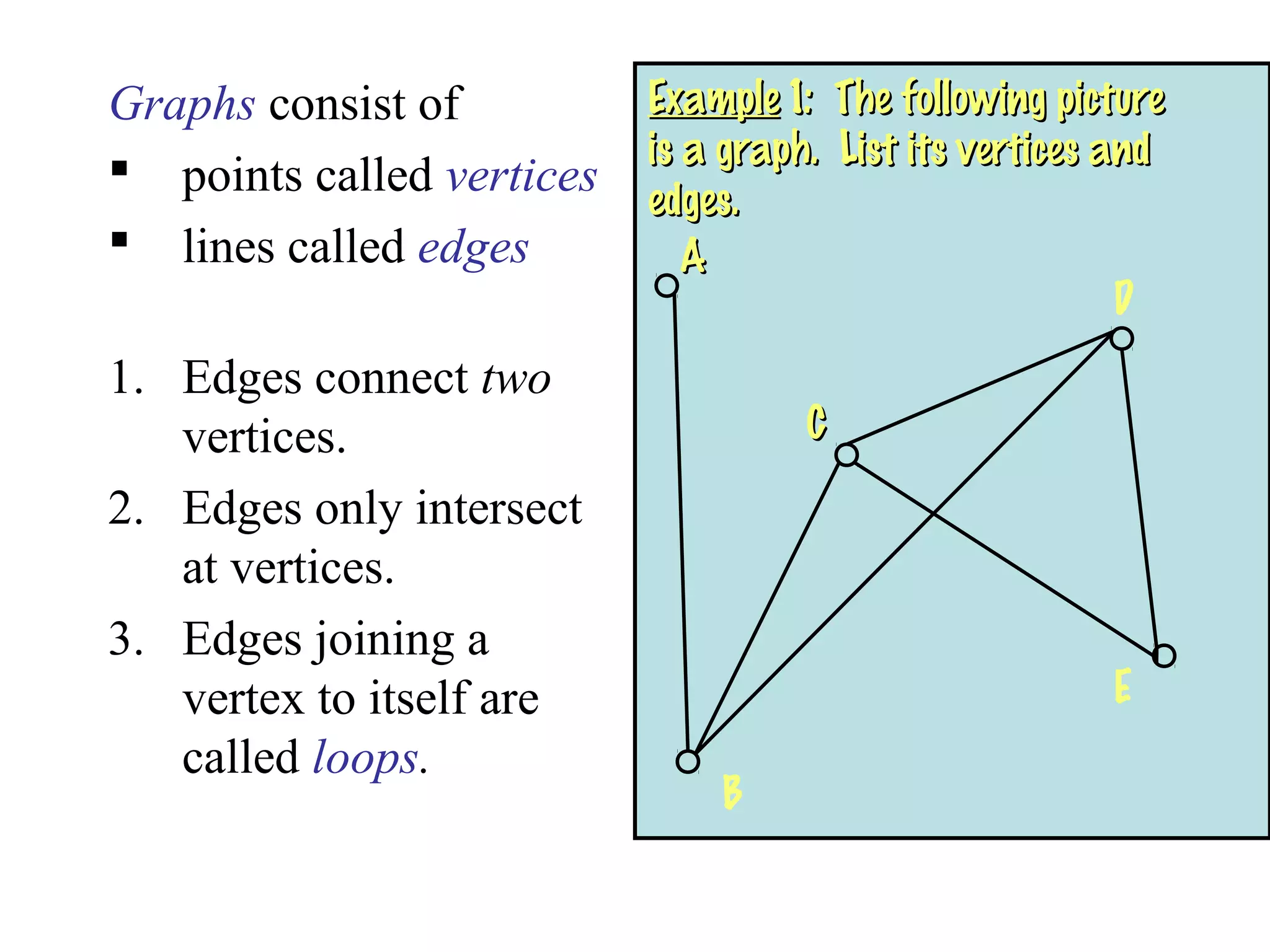
ExampleExample 1: The following picture1: The following picture
is a graph. List its vertices andis a graph. List its vertices and
edges.edges.
AA
B
CC
D
E
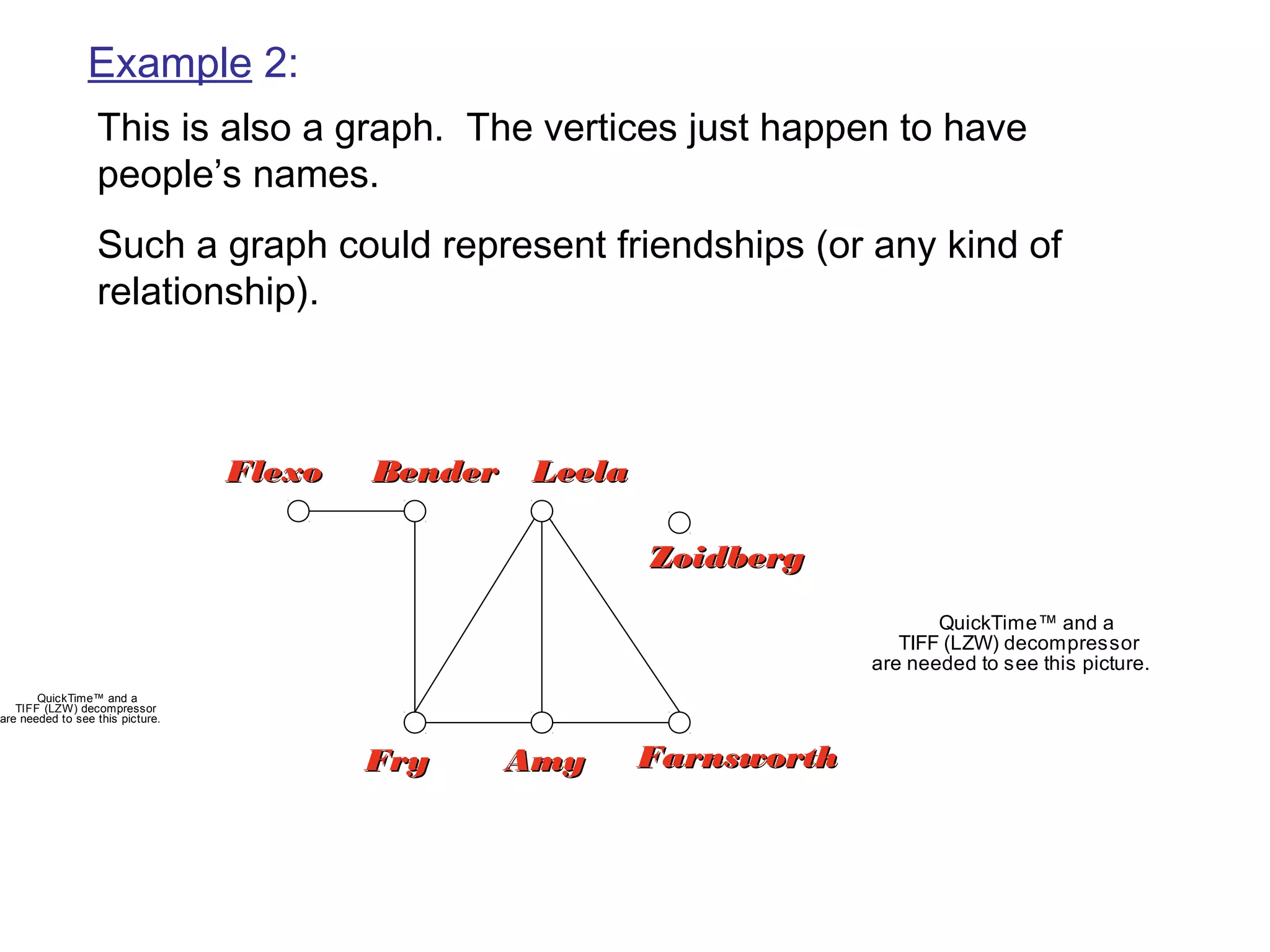
Example 2:
FlexoFlexo BenderBender LeelaLeela
FryFry AmyAmy
This is also a graph. The vertices just happen to have
people’s names.
Such a graph could represent friendships (or any kind of
relationship).
QuickTime™ and a
TIFF (LZW) decompressor
are needed to see this picture.
QuickTime™ and a
TIFF (LZW) decompressor
are needed to see this picture.
FarnsworthFarnsworth
ZoidbergZoidberg
FlexoFlexo
BenderBender
LeelaLeela FryFry
AmyAmy
FarnsworthFarnsworth
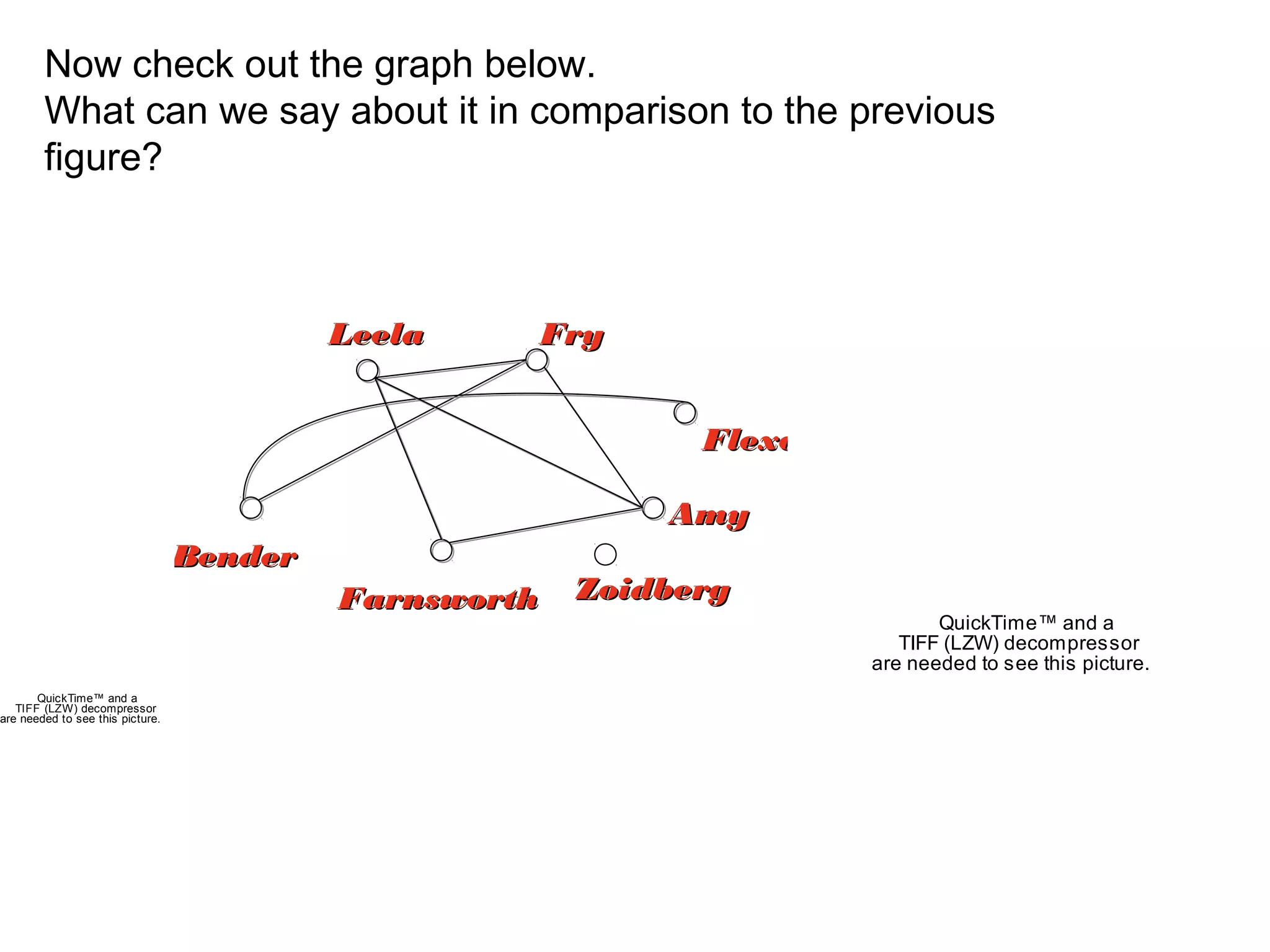
Now check out the graph below.
What can we say about it in comparison to the previous
figure?
QuickTime™ and a
TIFF (LZW) decompressor
are needed to see this picture.
QuickTime™ and a
TIFF (LZW) decompressor
are needed to see this picture.
ZoidbergZoidberg
• One graph may be drawn in (infinitely)
many ways, but it always provides us
with the same information.
• Graphs are a structure for describing
relationships between objects.
(The vertices denote the objects and the
edges represent the relationship.)
Moral of the Story
Graph TerminologyGraph Terminology
(ie - all the math-y jargon one could ask for)
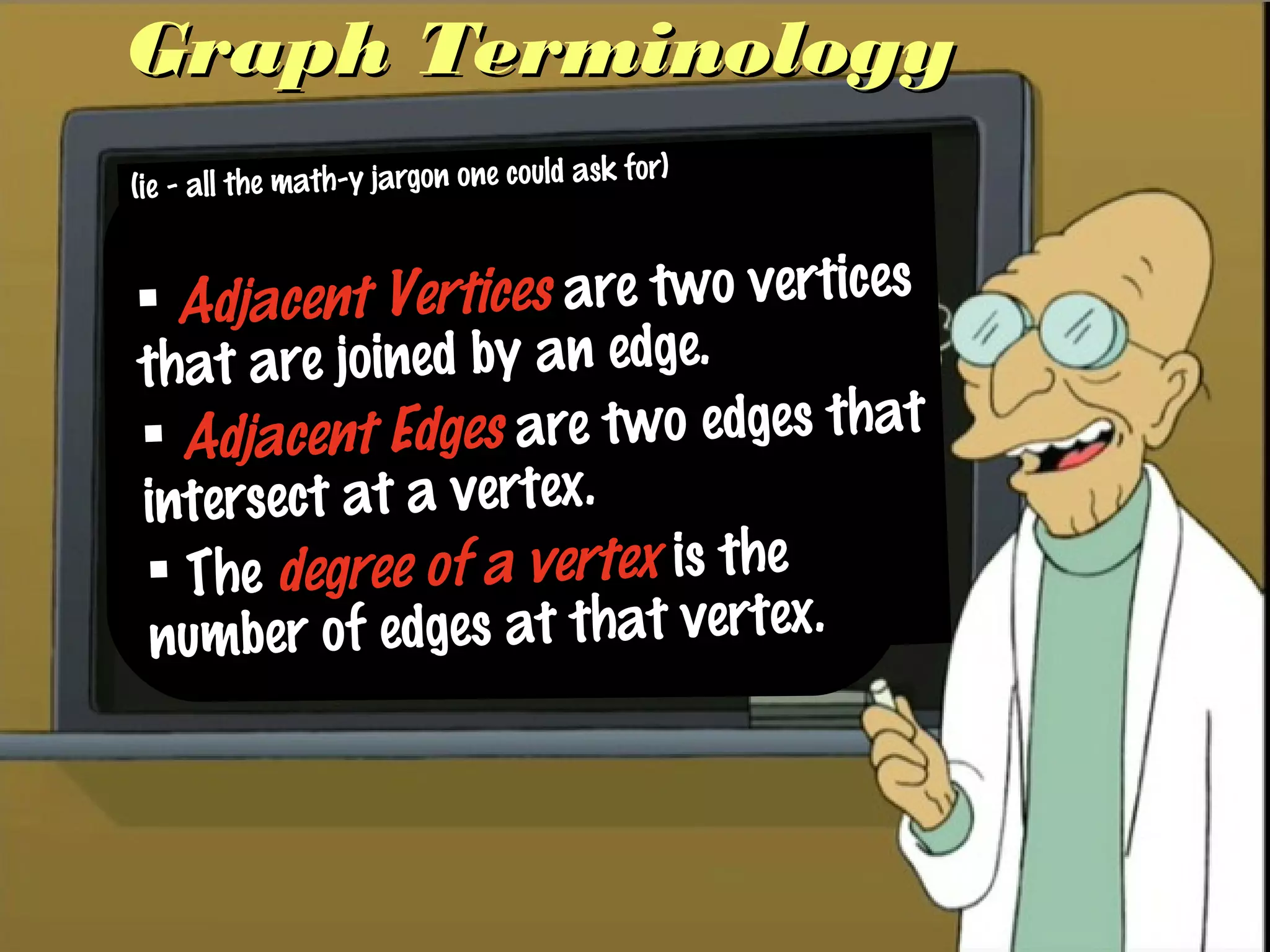
 Adjacent Vertices are two vertices
that are joined by an edge.
 Adjacent Edges are two edges that
intersect at a vertex.
 The degree of a vertex is the
number of edges at that vertex.
Graph TerminologyGraph Terminology
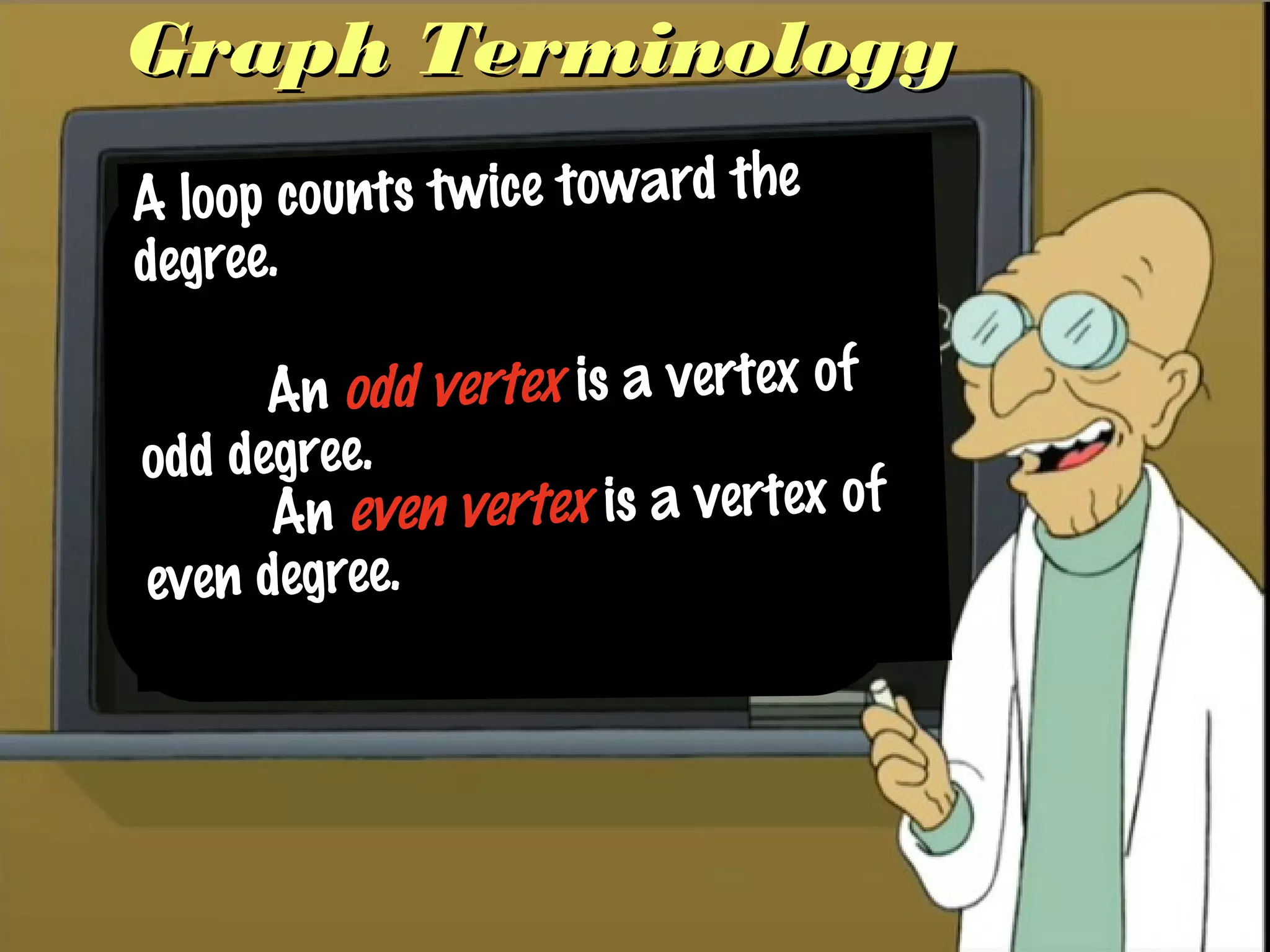
A loop counts twice toward the
degree.
An odd vertex is a vertex of
odd degree.
An even vertex is a vertex of
even degree.
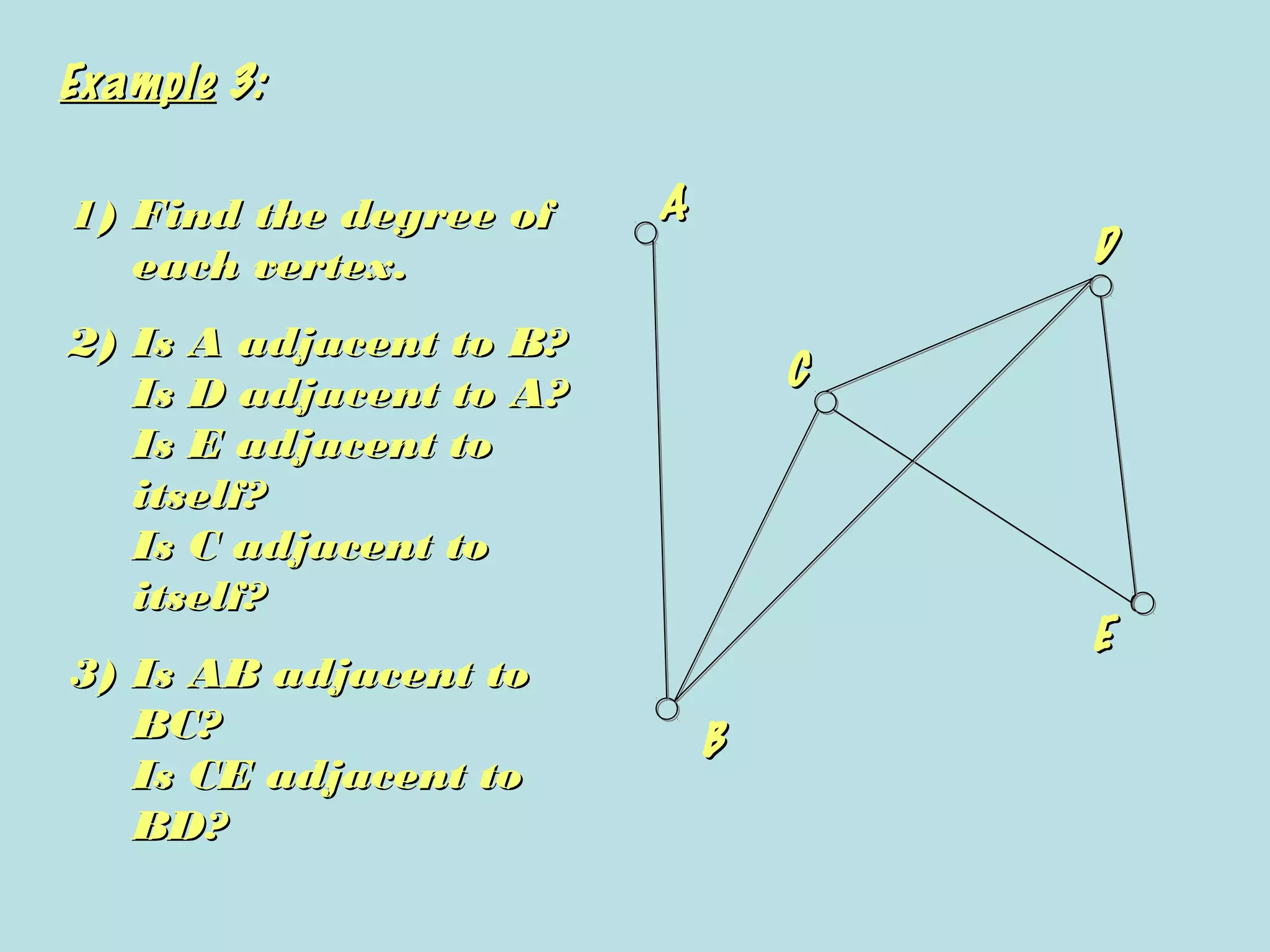
ExampleExample 3:3:
AA
BB
CC
DD
EE
1)1) Find the degree ofFind the degree of
each vertex.each vertex.
2)2) Is A adjacent to B?Is A adjacent to B?
Is D adjacent to A?Is D adjacent to A?
Is E adjacent toIs E adjacent to
itself?itself?
Is C adjacent toIs C adjacent to
itself?itself?
3)3) Is AB adjacent toIs AB adjacent to
BC?BC?
Is CE adjacent toIs CE adjacent to
BD?BD?
Graph TerminologyGraph Terminology
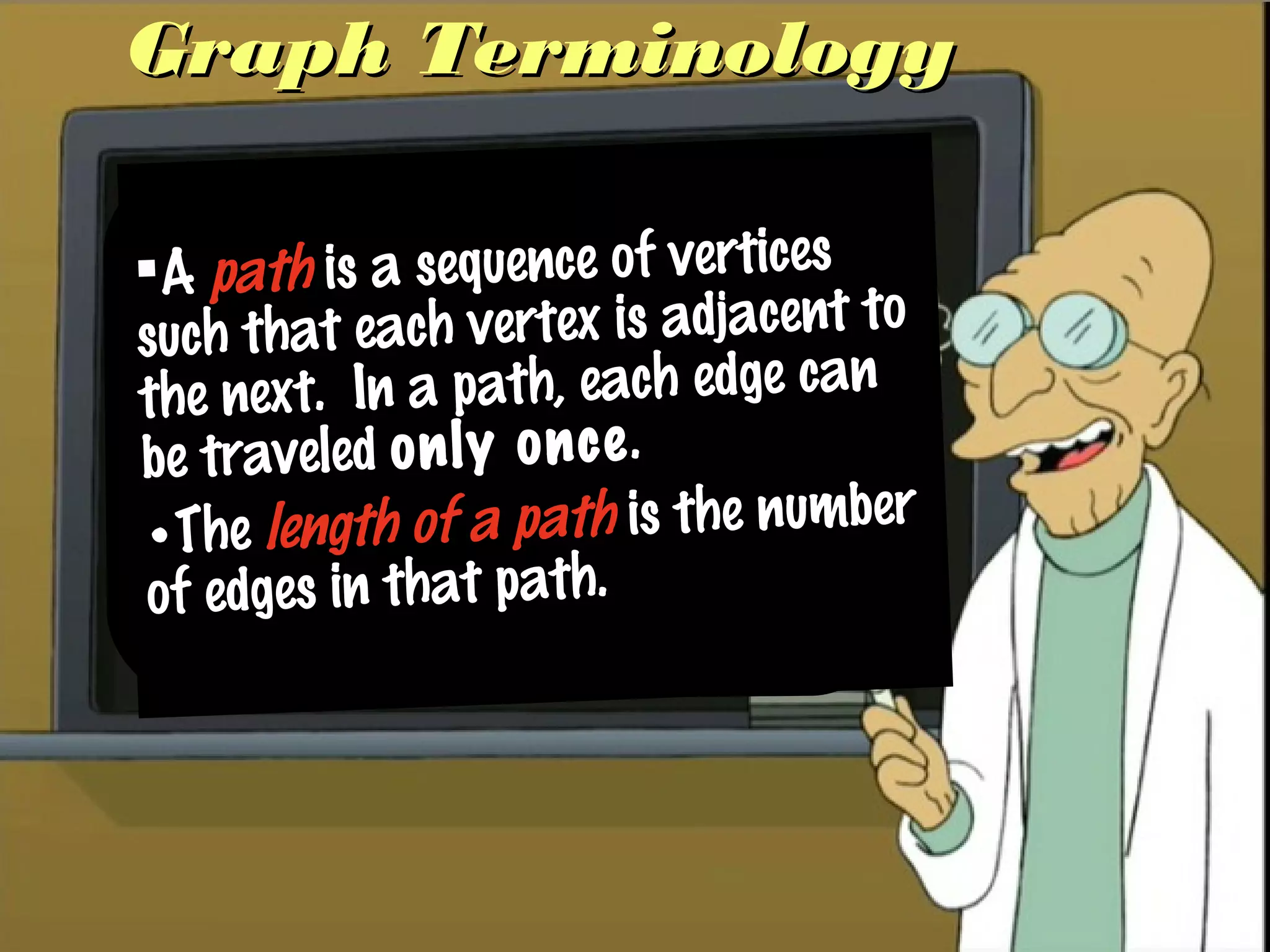
A path is a sequence of vertices
such that each vertex is adjacent to
the next. In a path, each edge can
be traveled only once.
•The length of a path is the number
of edges in that path.
Graph TerminologyGraph Terminology
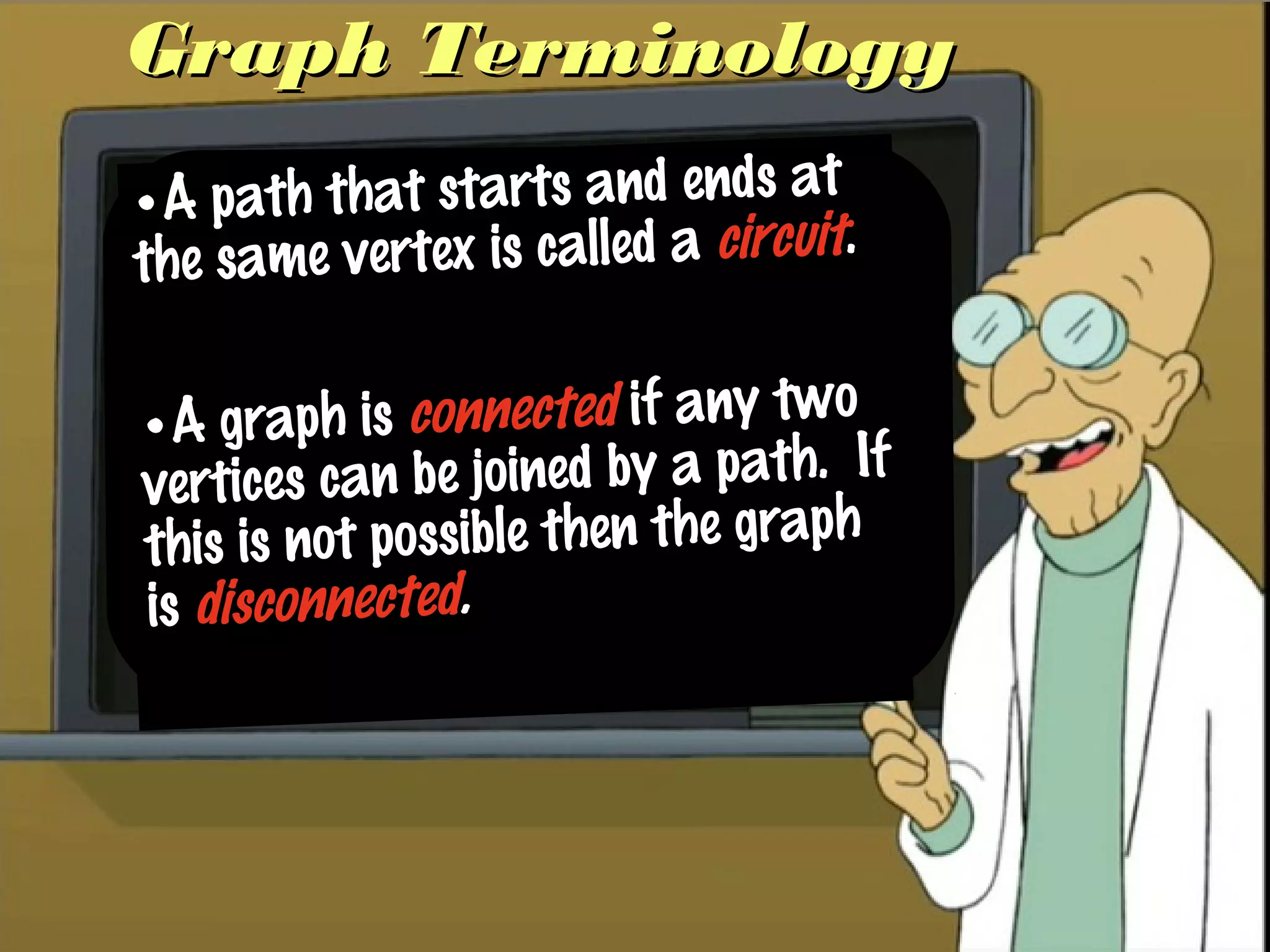
•A path that starts and ends at
the same vertex is called a circuit.
•A graph is connected if any two
vertices can be joined by a path. If
this is not possible then the graph
is disconnected.
Graph TerminologyGraph Terminology
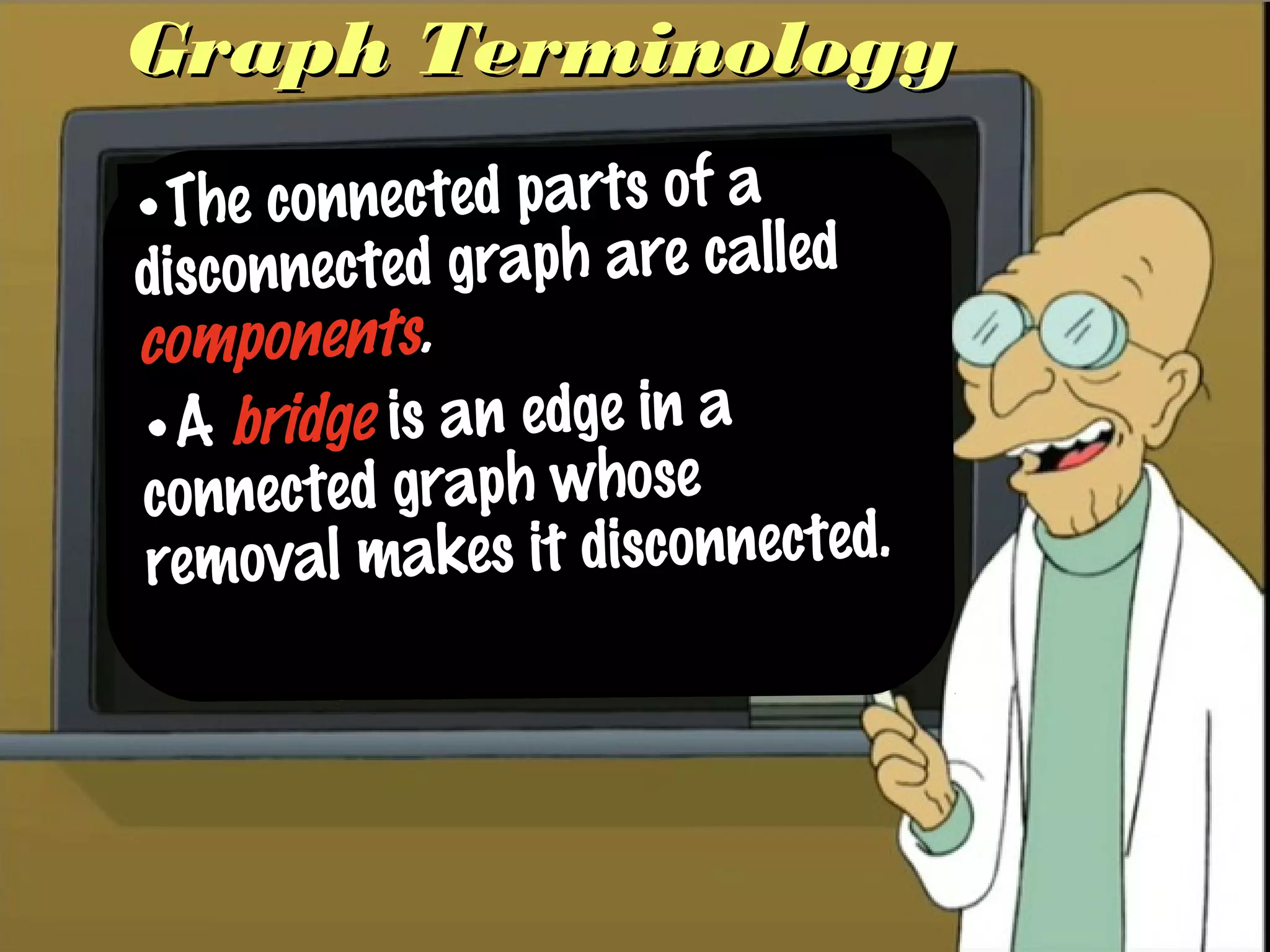
•The connected parts of a
disconnected graph are called
components.
•A bridge is an edge in a
connected graph whose
removal makes it disconnected.
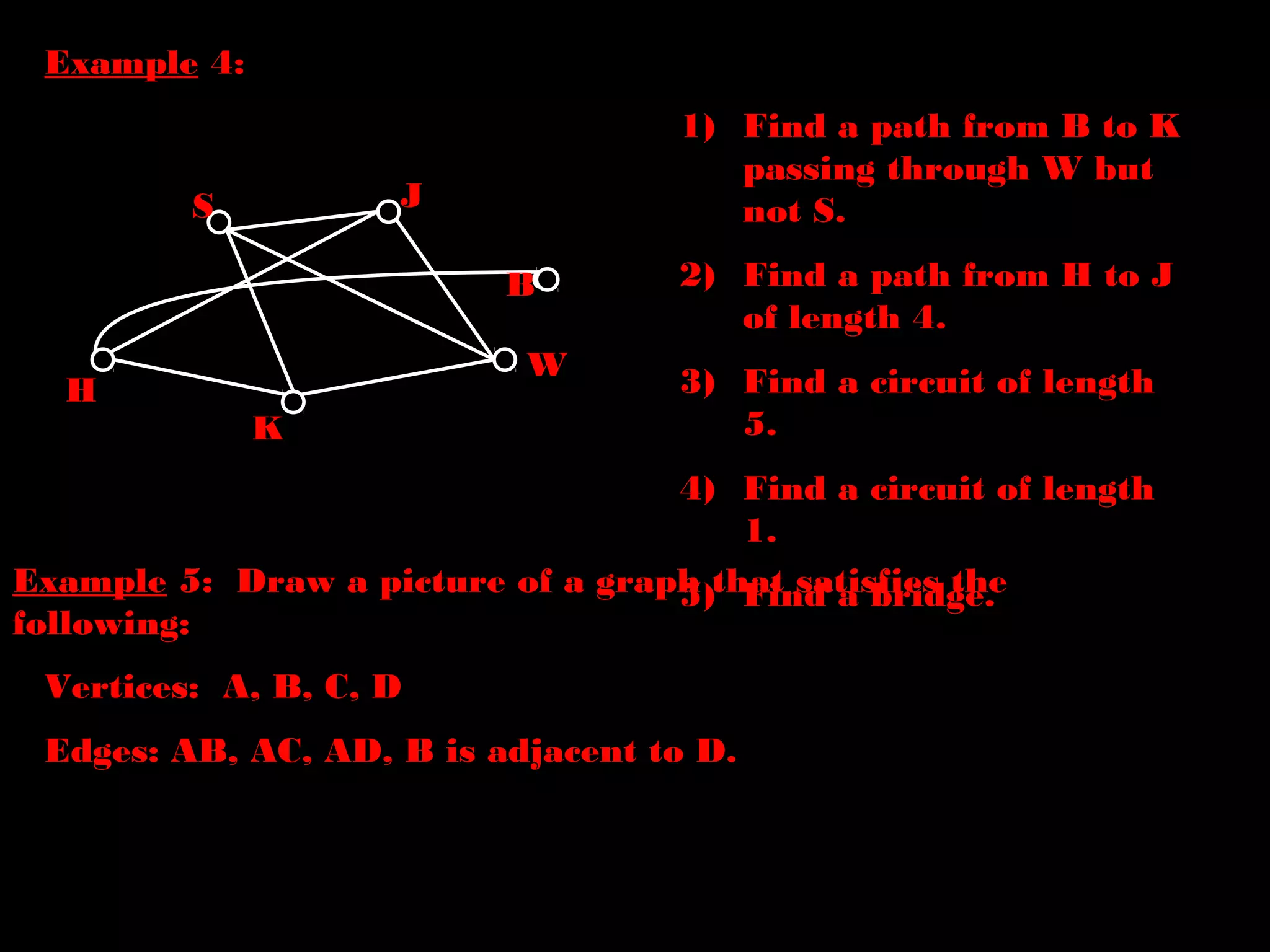
B
H
S J
W
K
Example 4:
1) Find a path from B to K
passing through W but
not S.
2) Find a path from H to J
of length 4.
3) Find a circuit of length
5.
4) Find a circuit of length
1.
5) Find a bridge.Example 5: Draw a picture of a graph that satisfies the
following:
Vertices: A, B, C, D
Edges: AB, AC, AD, B is adjacent to D.
Graph TerminologyGraph Terminology
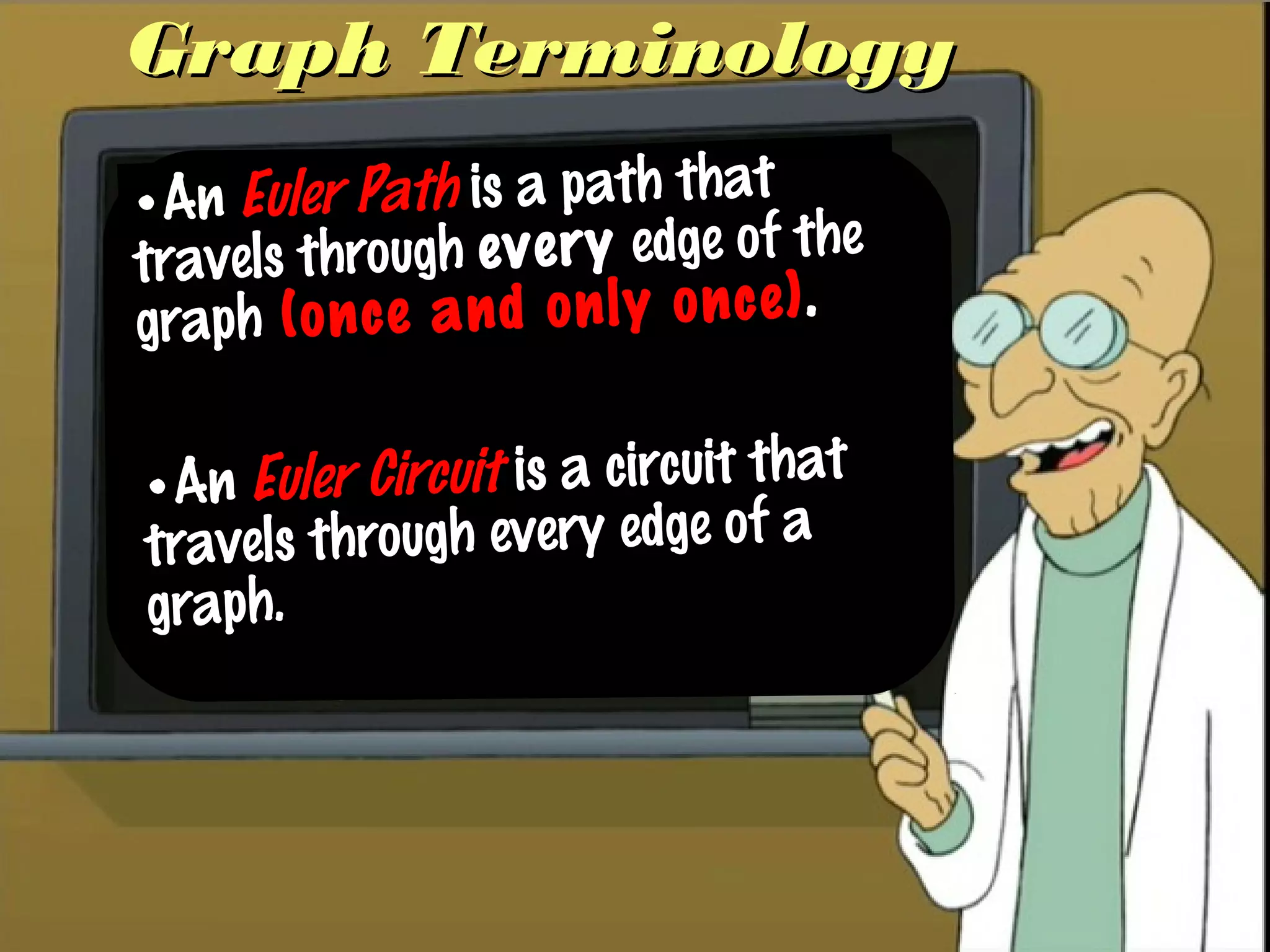
•An Euler Path is a path that
travels through every edge of the
graph (once and only once).
•An Euler Circuit is a circuit that
travels through every edge of a
graph.
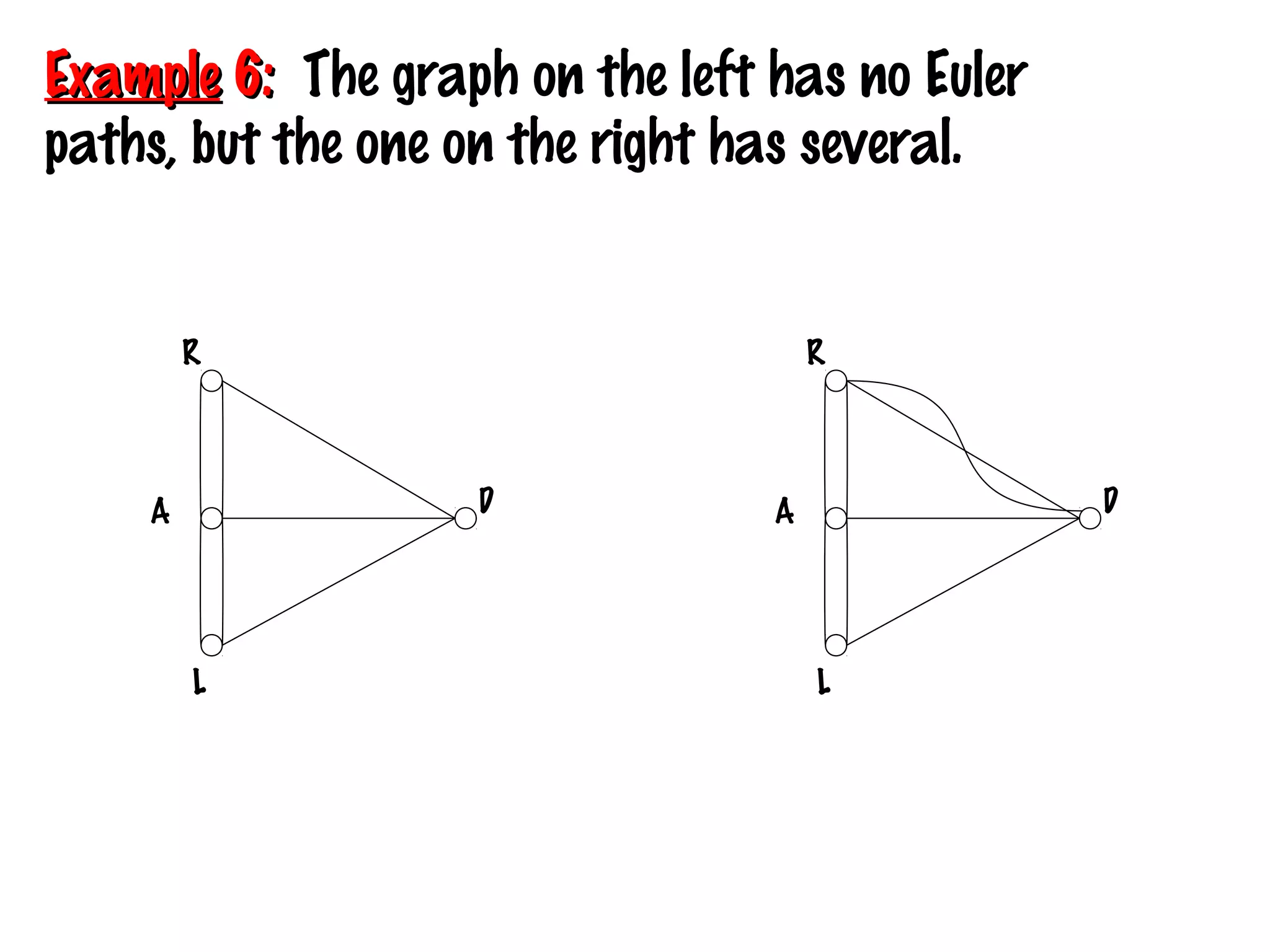
R
A
L
D
R
A
L
D
ExampleExample 6:6: The graph on the left has no Euler
paths, but the one on the right has several.
§5.4 - 5.5 Graph Models and
Euler’s Theorems
“Now I will have less
distraction.”
- Leonhard Euler
after losing sight
in his right eye.
Königsberg’s Bridges II
(The rare sequel that is not entirely gratuitous.)
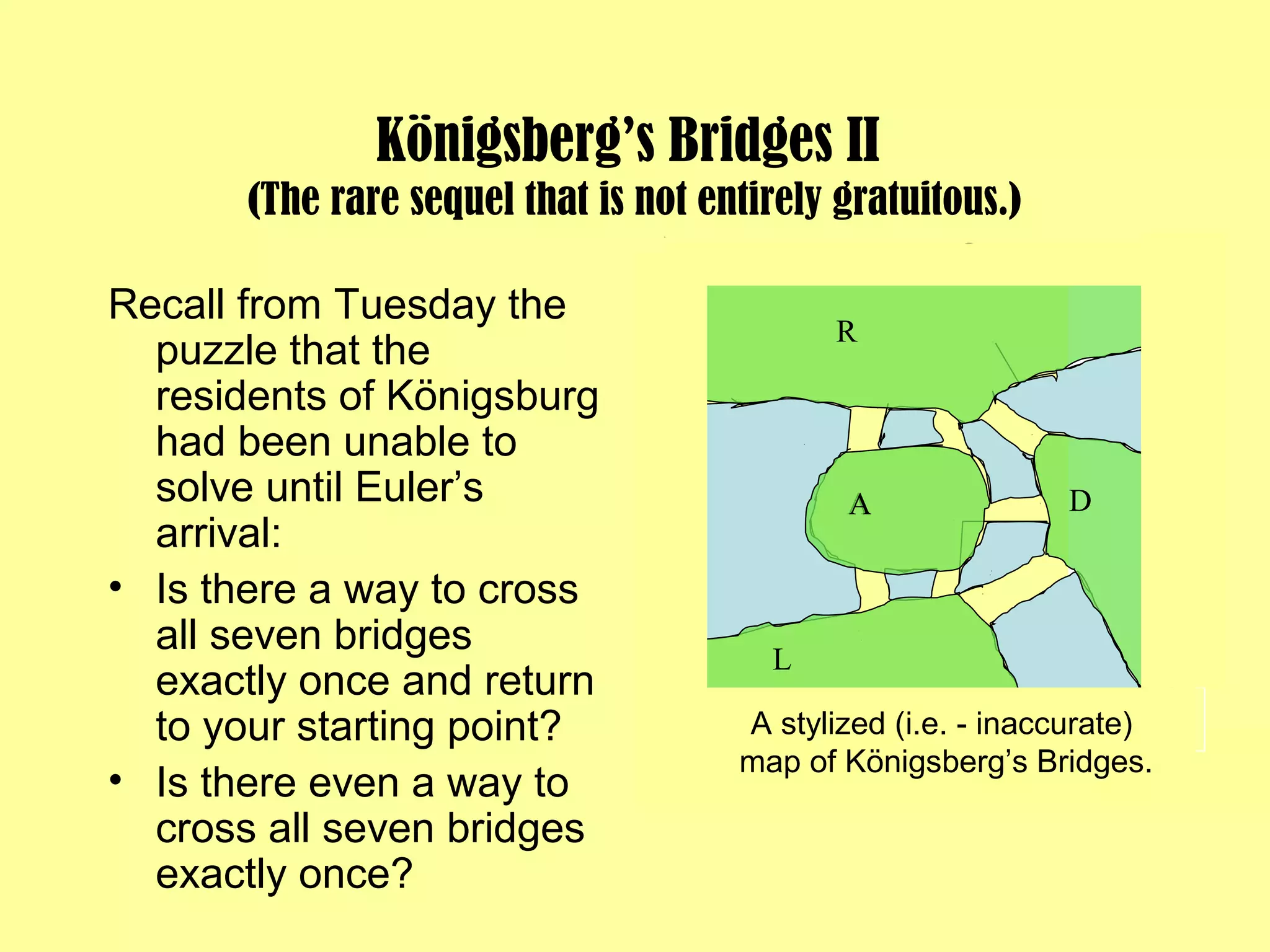
Recall from Tuesday the
puzzle that the
residents of Königsburg
had been unable to
solve until Euler’s
arrival:
• Is there a way to cross
all seven bridges
exactly once and return
to your starting point?
• Is there even a way to
cross all seven bridges
exactly once?
A
A stylized (i.e. - inaccurate)
map of Königsberg’s Bridges.
A
R
L
D
A
R
A
L
D
R
A
L
D
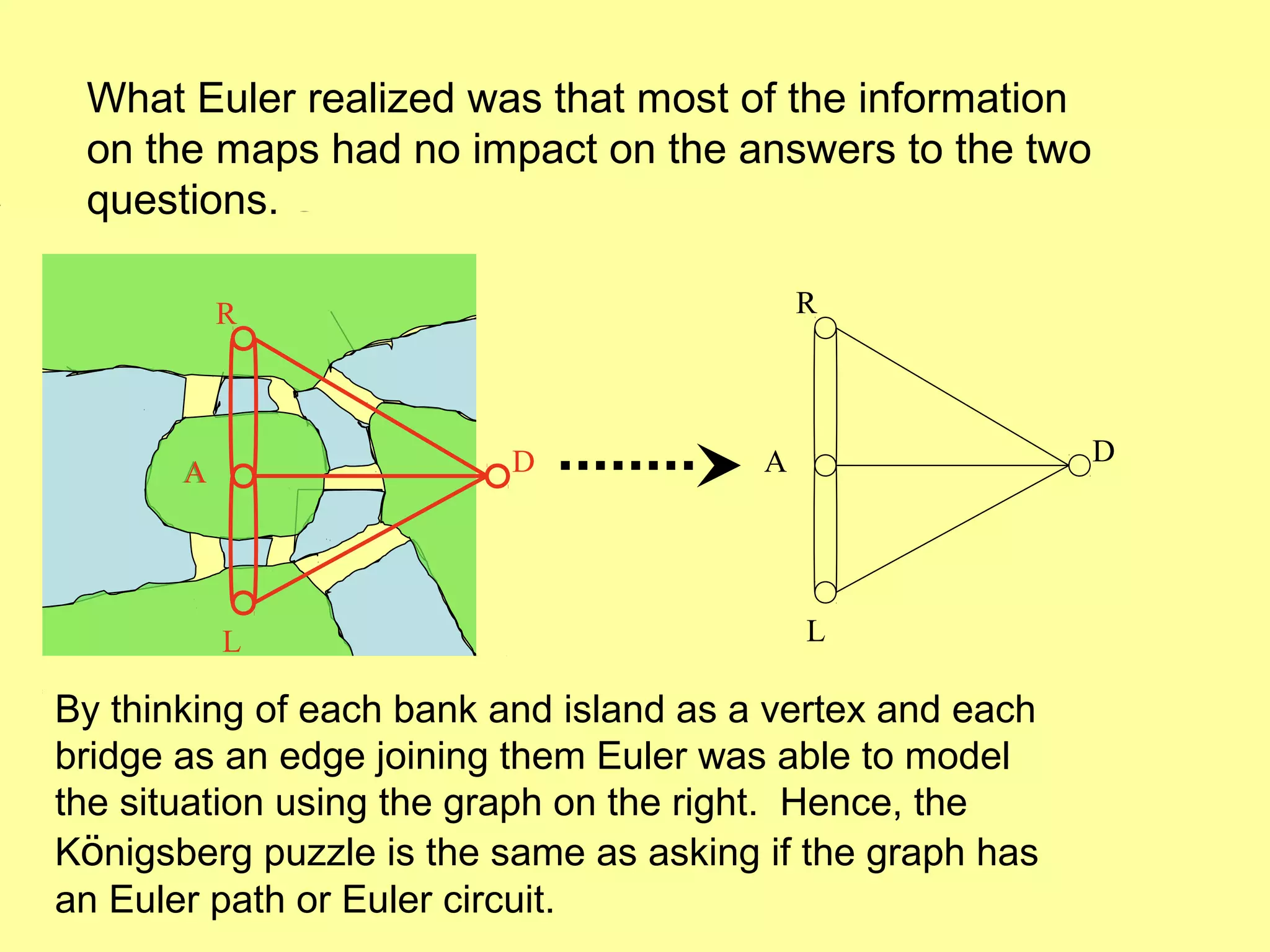
What Euler realized was that most of the information
on the maps had no impact on the answers to the two
questions.
By thinking of each bank and island as a vertex and each
bridge as an edge joining them Euler was able to model
the situation using the graph on the right. Hence, the
Königsberg puzzle is the same as asking if the graph has
an Euler path or Euler circuit.
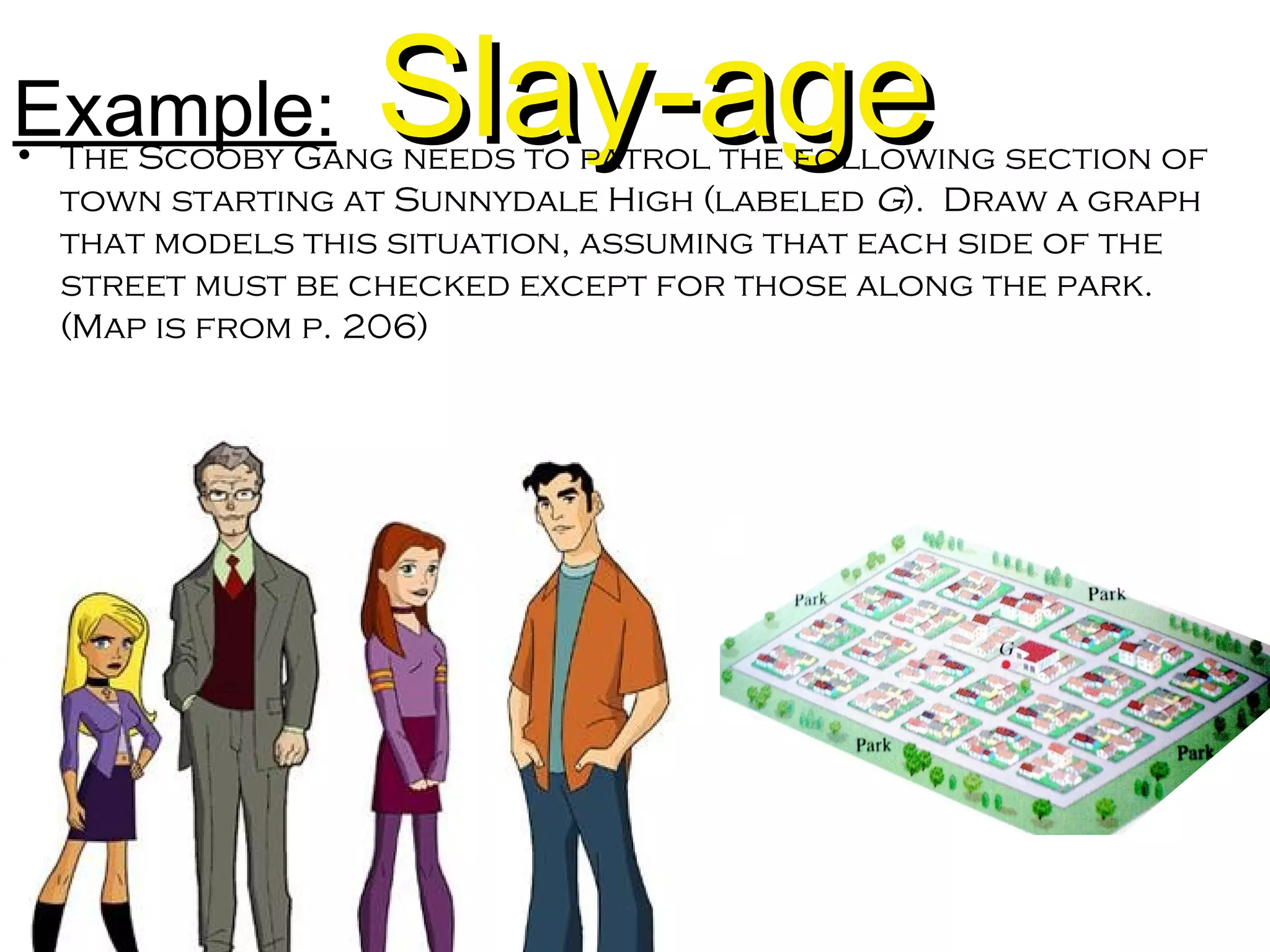
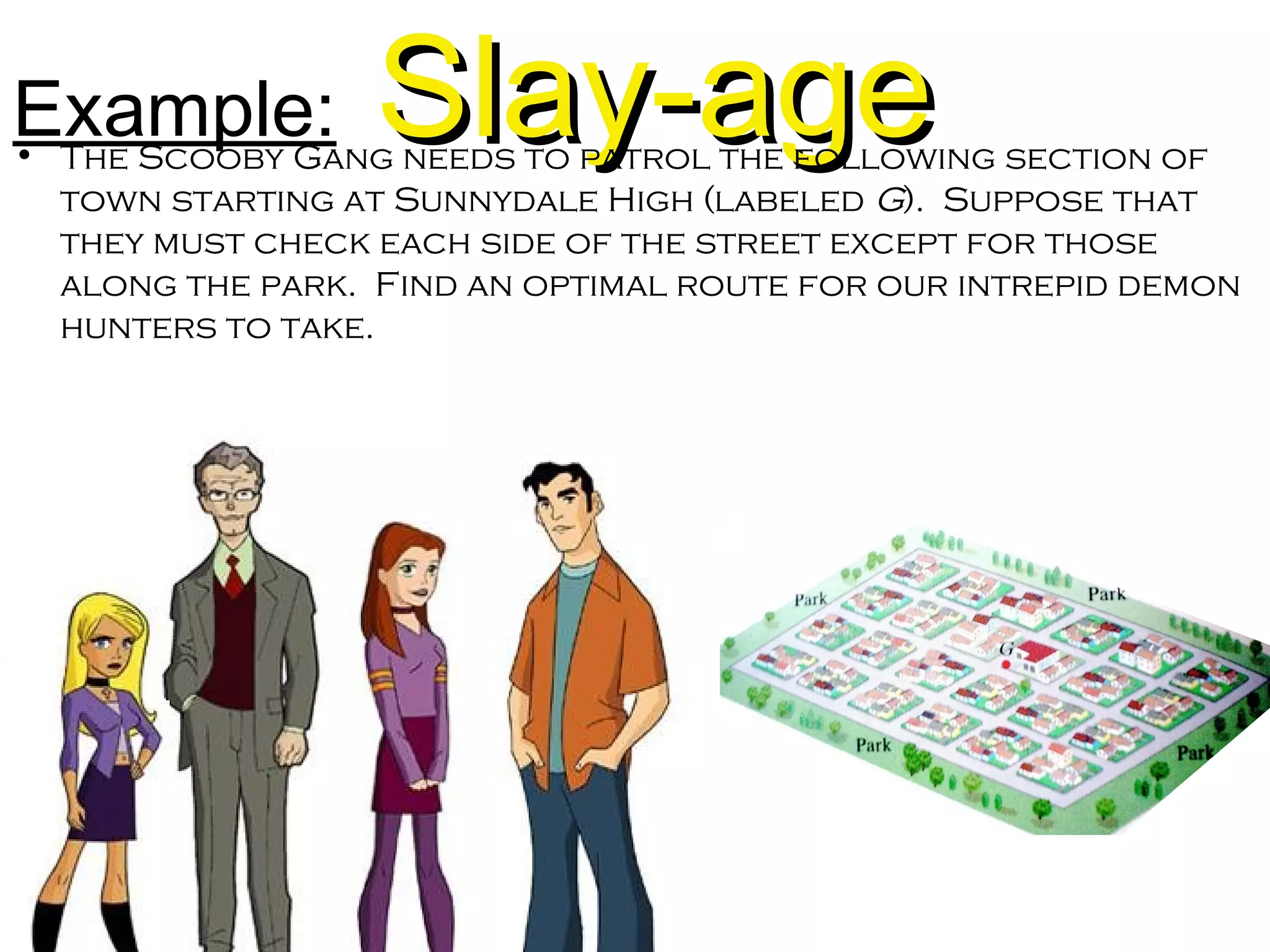
Example: Slay-ageSlay-age• The Scooby Gang needs to patrol the following section of
town starting at Sunnydale High (labeled G). Draw a graph
that models this situation, assuming that each side of the
street must be checked except for those along the park.
(Map is from p. 206)
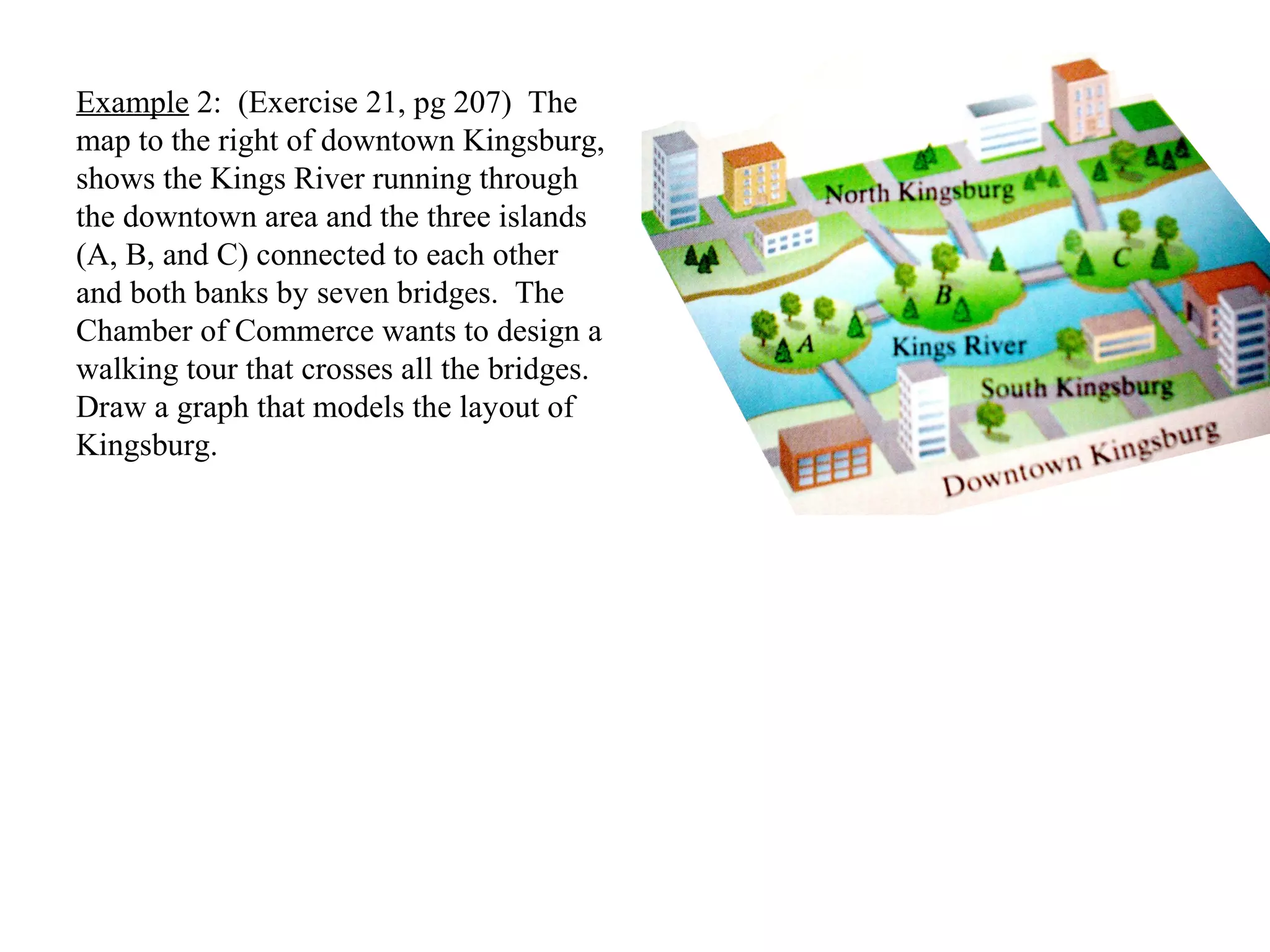
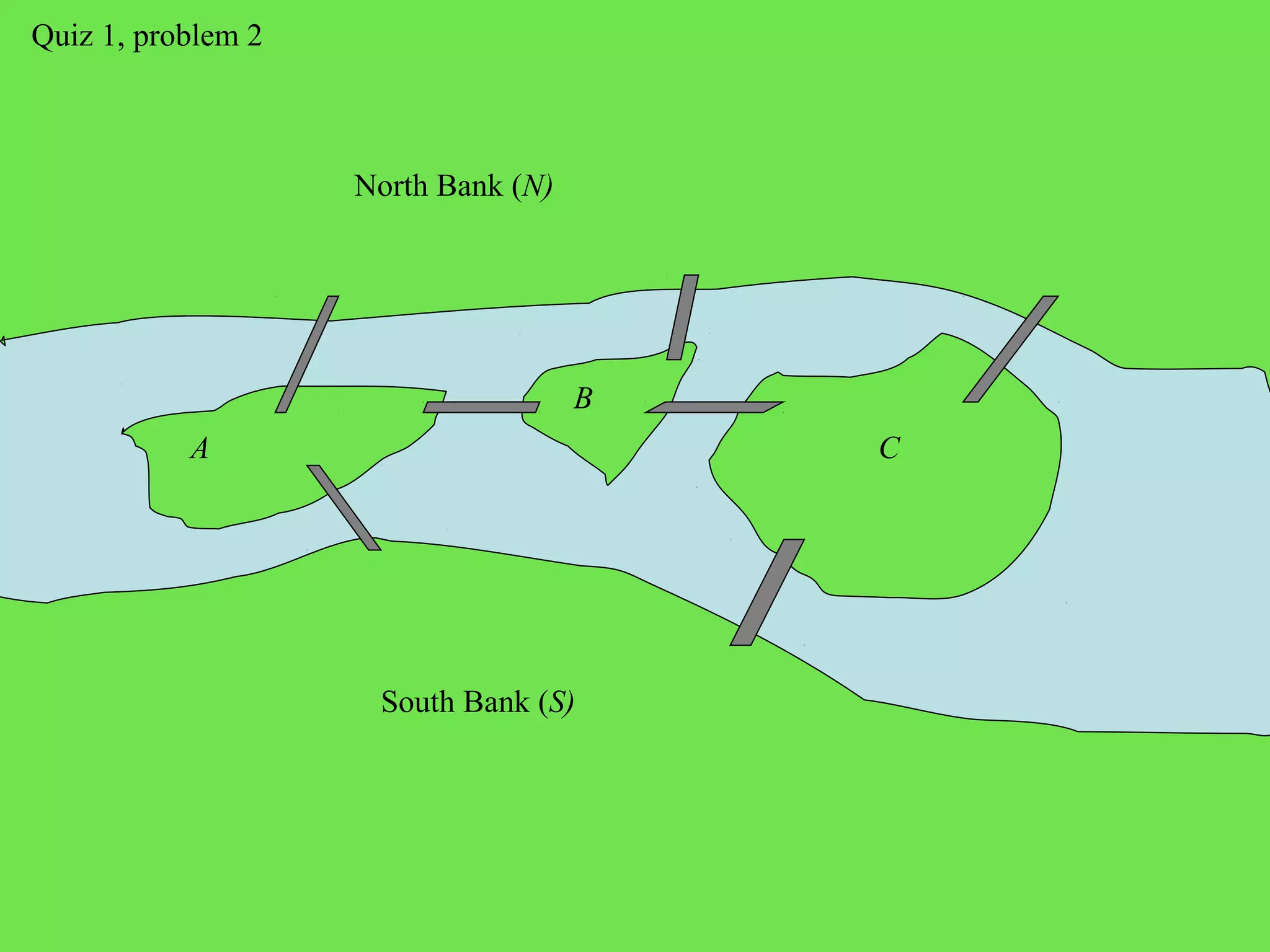
Example 2: (Exercise 21, pg 207) The
map to the right of downtown Kingsburg,
shows the Kings River running through
the downtown area and the three islands
(A, B, and C) connected to each other
and both banks by seven bridges. The
Chamber of Commerce wants to design a
walking tour that crosses all the bridges.
Draw a graph that models the layout of
Kingsburg.
Example 3:
The Kevin Bacon Game
(http://www.cs.virginia.edu/oracle/)
Euler’s Theorems
• Euler’s Theorem 1Euler’s Theorem 1
(a) If a graph has any odd vertices, then
it cannot have an Euler circuit.
(b) If a graph is connected and every
vertex is even, then it has at least one
Euler circuit.
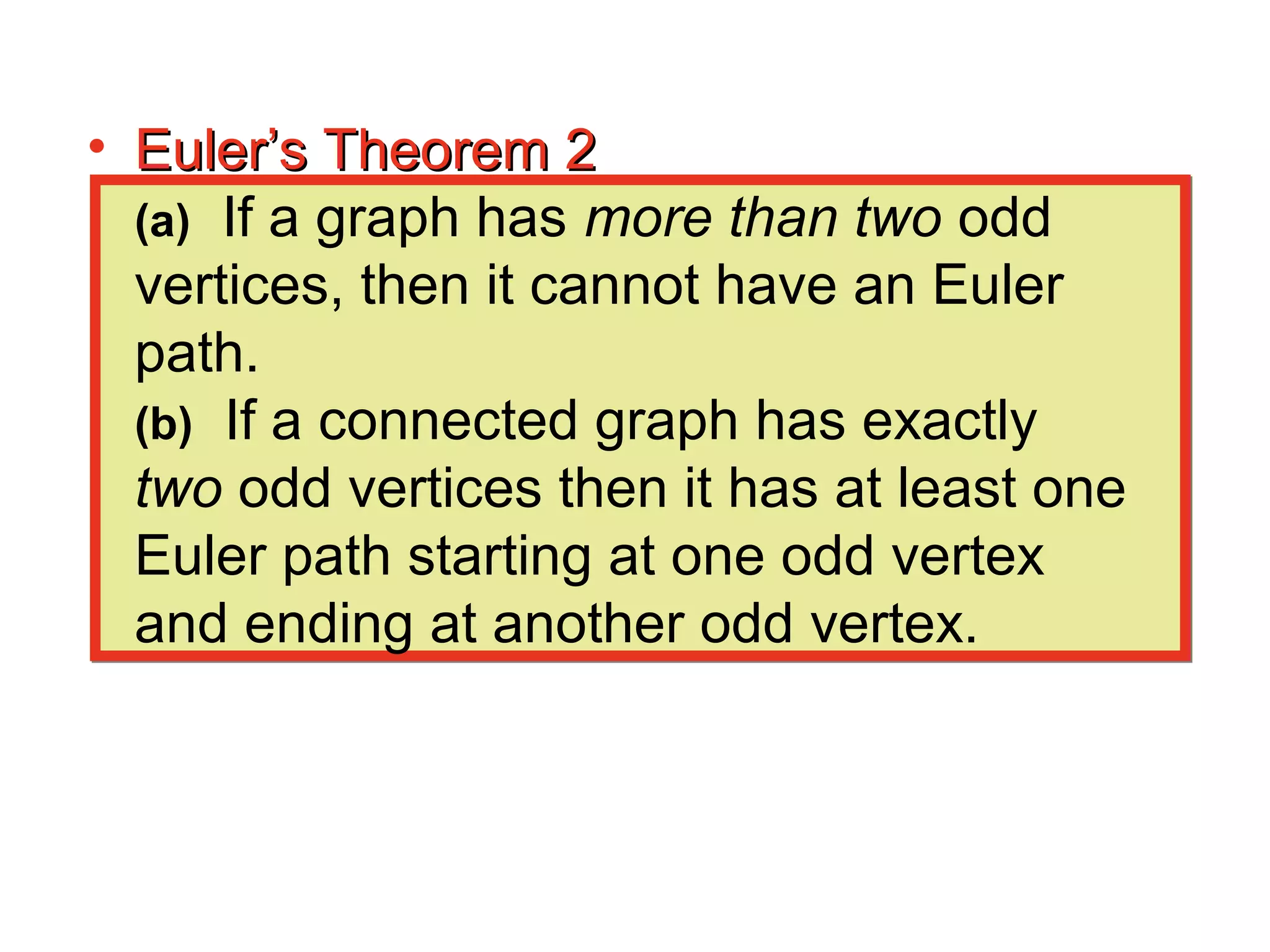
• Euler’s Theorem 2Euler’s Theorem 2
(a) If a graph has more than two odd
vertices, then it cannot have an Euler
path.
(b) If a connected graph has exactly
two odd vertices then it has at least one
Euler path starting at one odd vertex
and ending at another odd vertex.
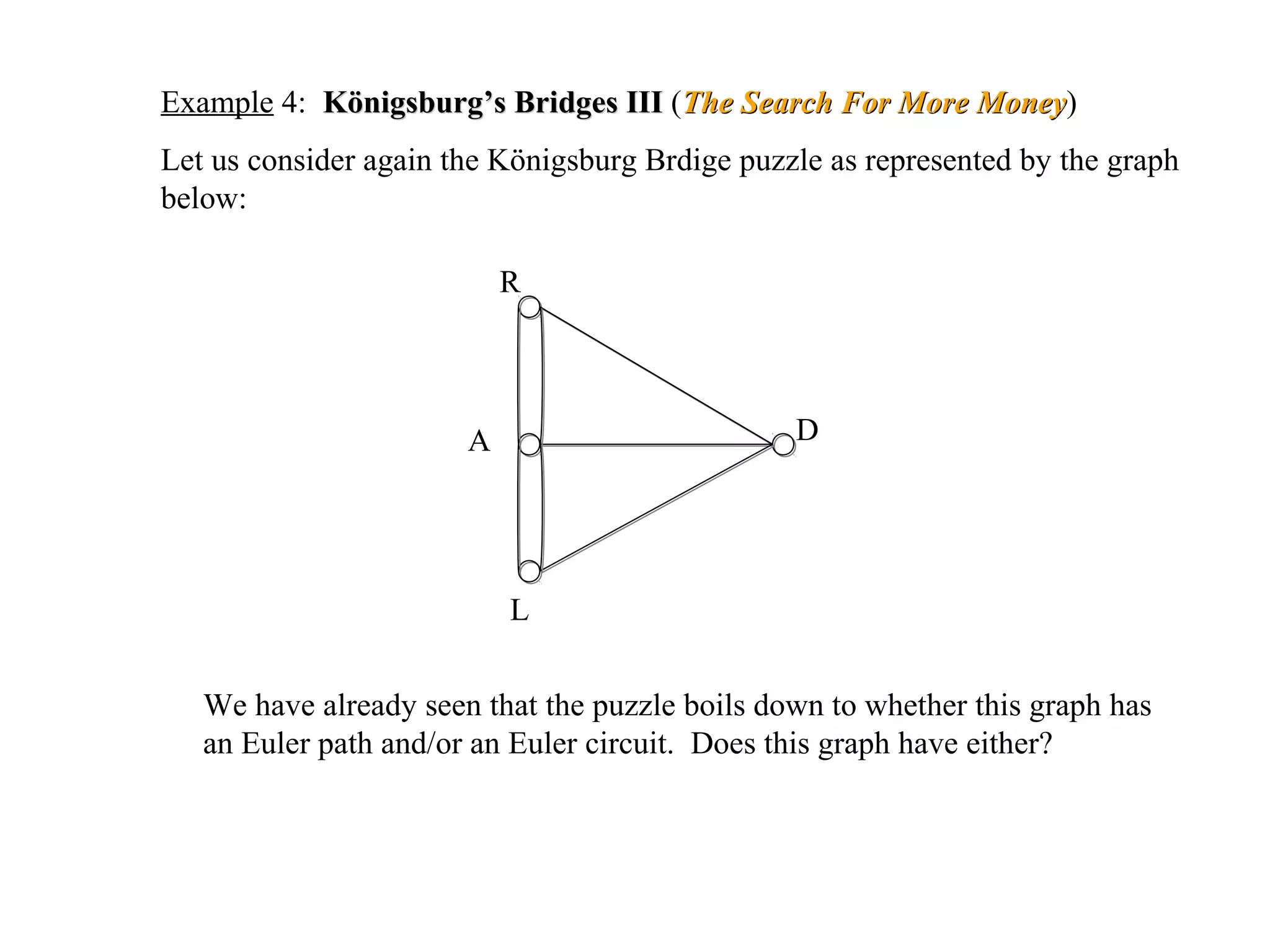
Example 4: Königsburg’s Bridges IIIKönigsburg’s Bridges III (The Search For More MoneyThe Search For More Money)
Let us consider again the Königsburg Brdige puzzle as represented by the graph
below:
R
A
L
D
We have already seen that the puzzle boils down to whether this graph has
an Euler path and/or an Euler circuit. Does this graph have either?
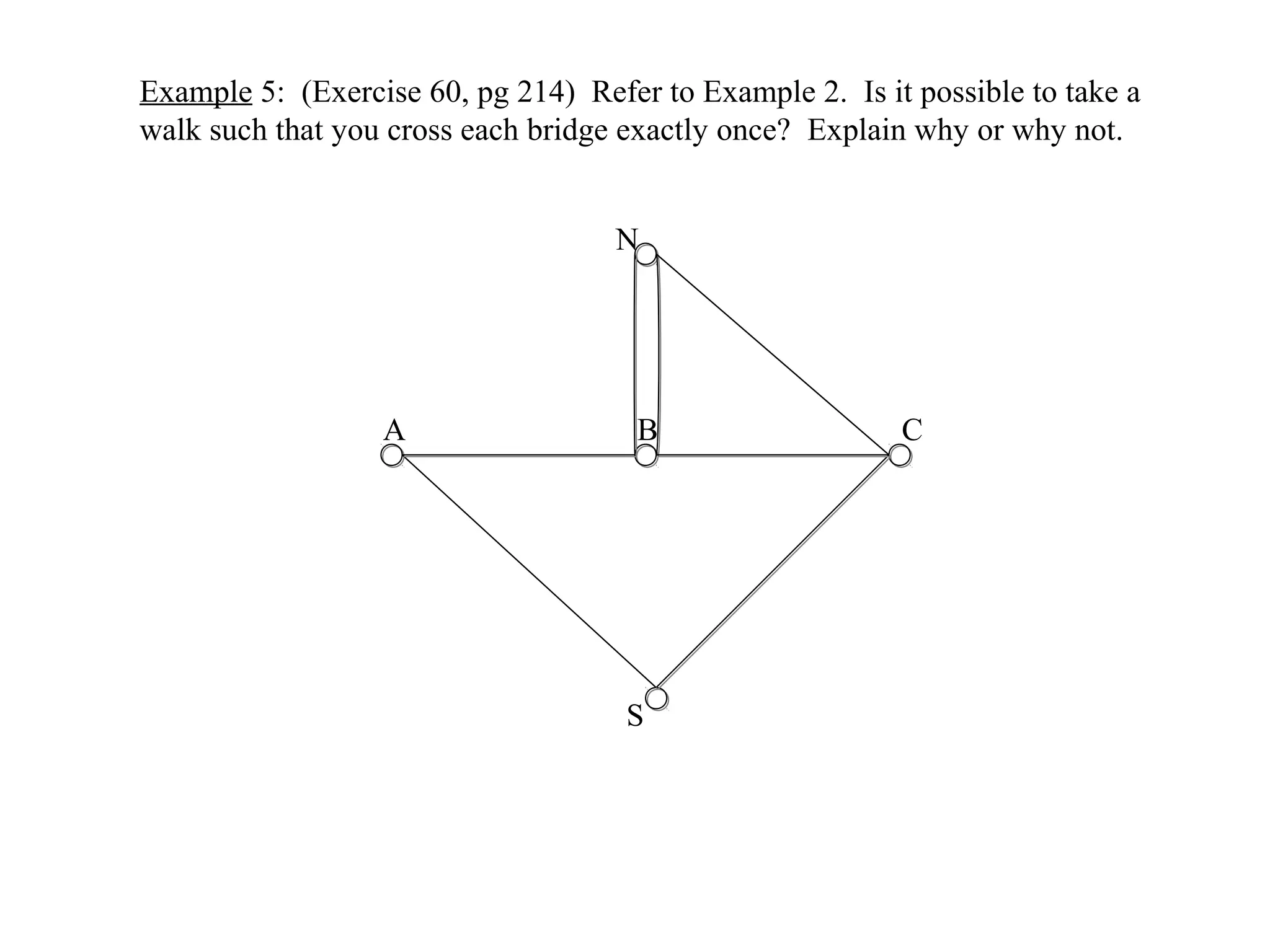
Example 5: (Exercise 60, pg 214) Refer to Example 2. Is it possible to take a
walk such that you cross each bridge exactly once? Explain why or why not.
N
A B C
S
ExampleExample 6: Unicursal Tracings6: Unicursal Tracings
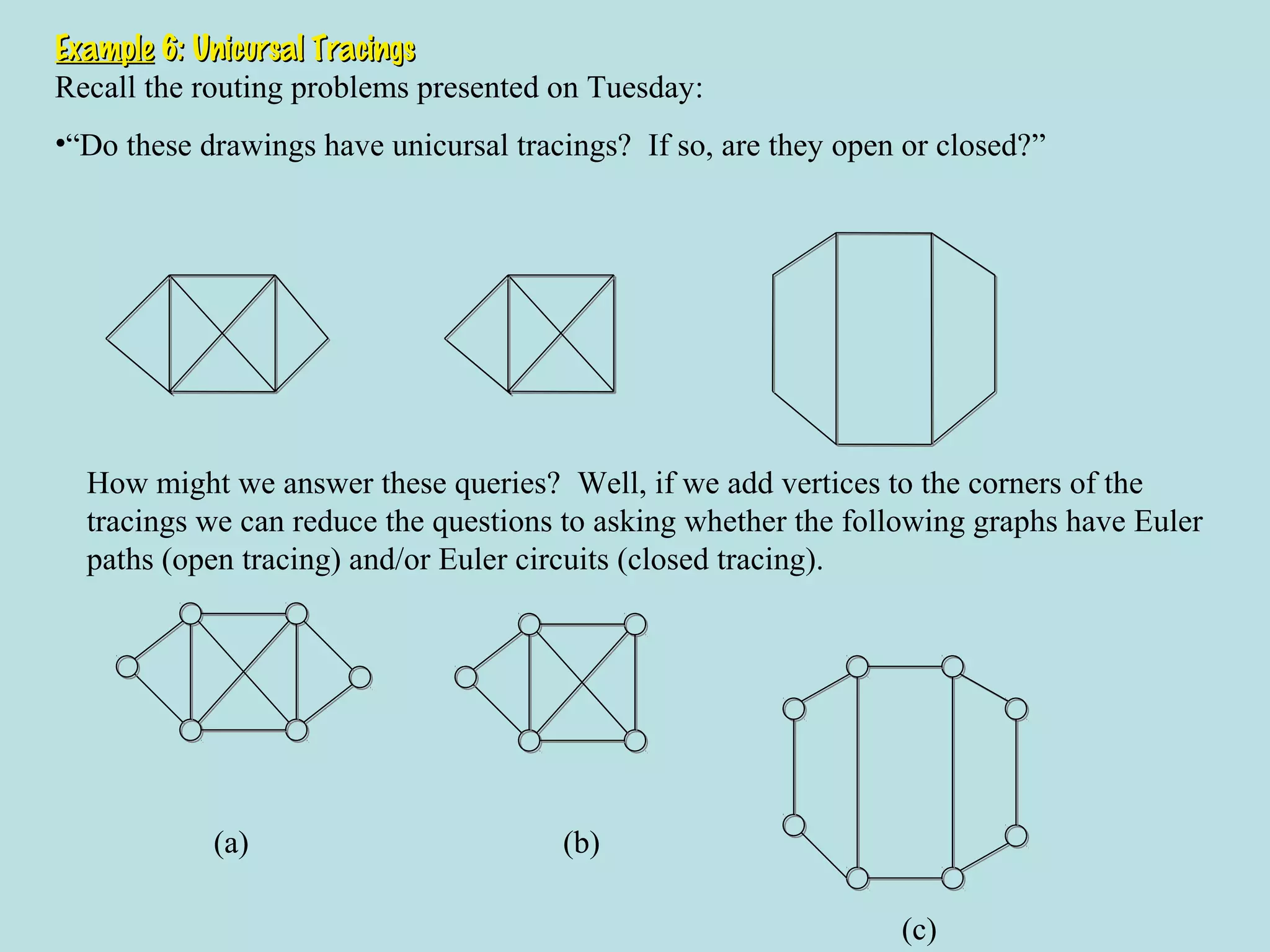
Recall the routing problems presented on Tuesday:
•“Do these drawings have unicursal tracings? If so, are they open or closed?”
(a) (b)
(c)
How might we answer these queries? Well, if we add vertices to the corners of the
tracings we can reduce the questions to asking whether the following graphs have Euler
paths (open tracing) and/or Euler circuits (closed tracing).
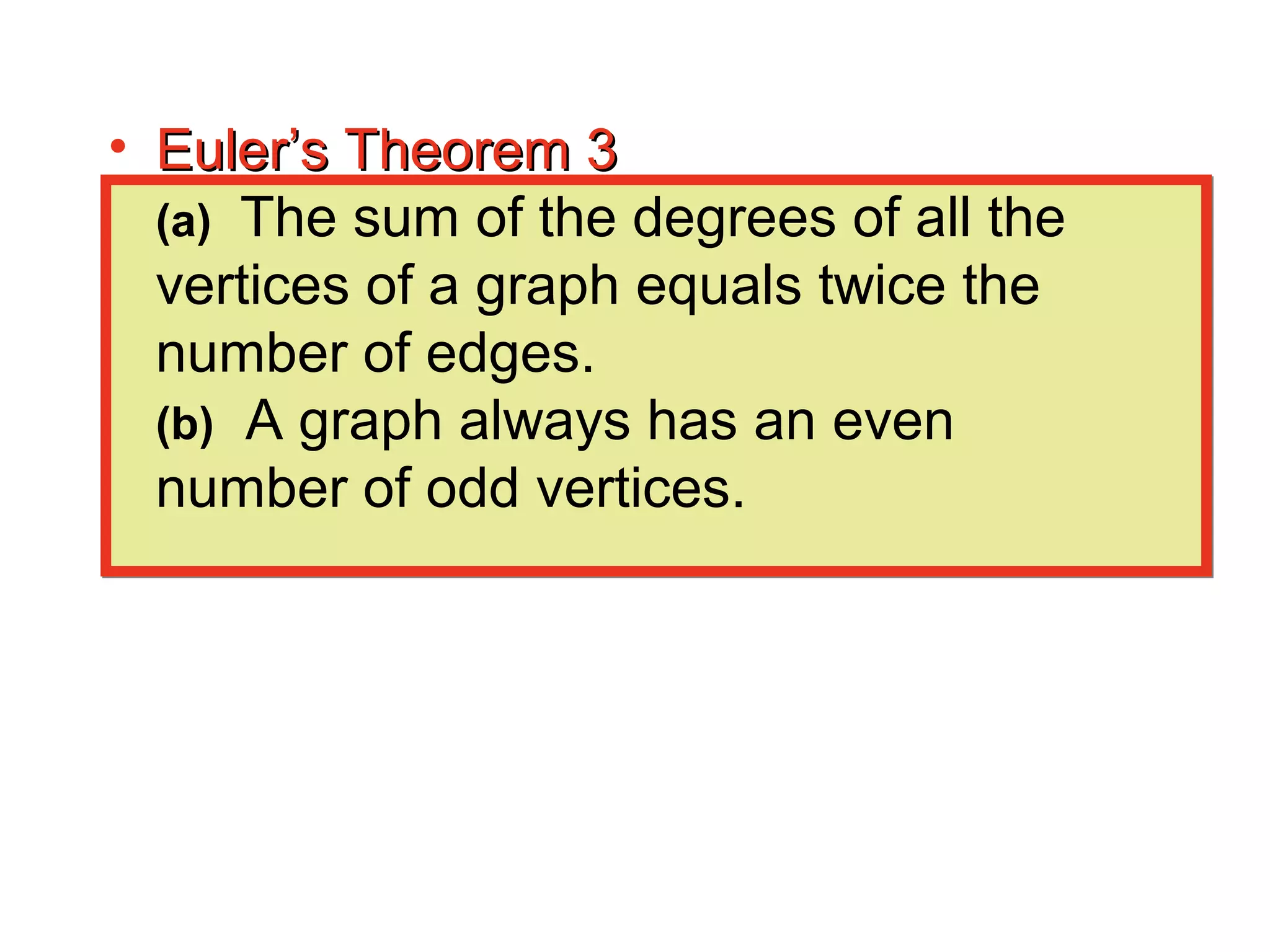
• Euler’s Theorem 3Euler’s Theorem 3
(a) The sum of the degrees of all the
vertices of a graph equals twice the
number of edges.
(b) A graph always has an even
number of odd vertices.
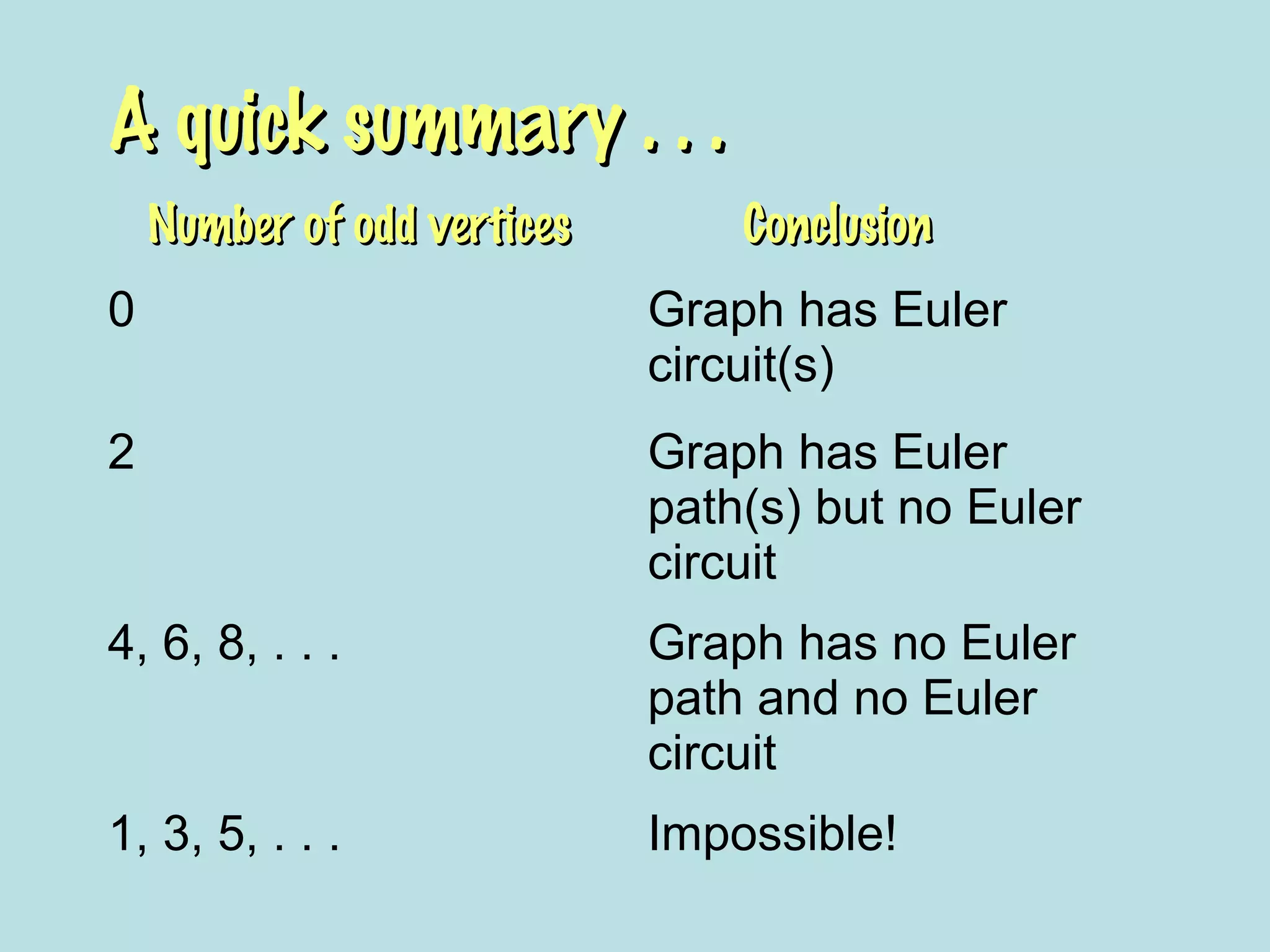
A quick summary . . .A quick summary . . .
Number of odd verticesNumber of odd vertices ConclusionConclusion
0 Graph has Euler
circuit(s)
2 Graph has Euler
path(s) but no Euler
circuit
4, 6, 8, . . . Graph has no Euler
path and no Euler
circuit
1, 3, 5, . . . Impossible!
§5.6 Fleury’s Algorithm
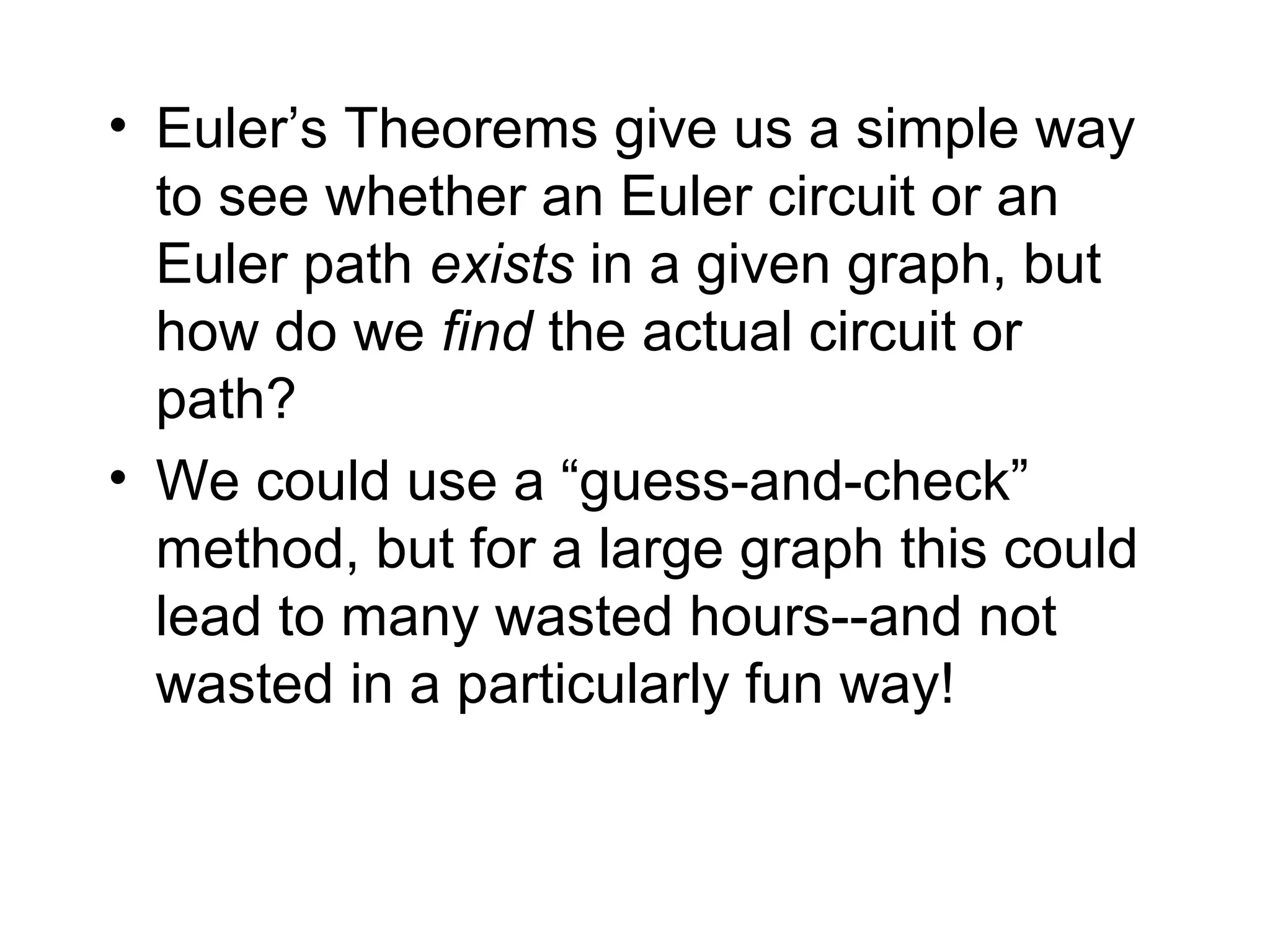
• Euler’s Theorems give us a simple way
to see whether an Euler circuit or an
Euler path exists in a given graph, but
how do we find the actual circuit or
path?
• We could use a “guess-and-check”
method, but for a large graph this could
lead to many wasted hours--and not
wasted in a particularly fun way!
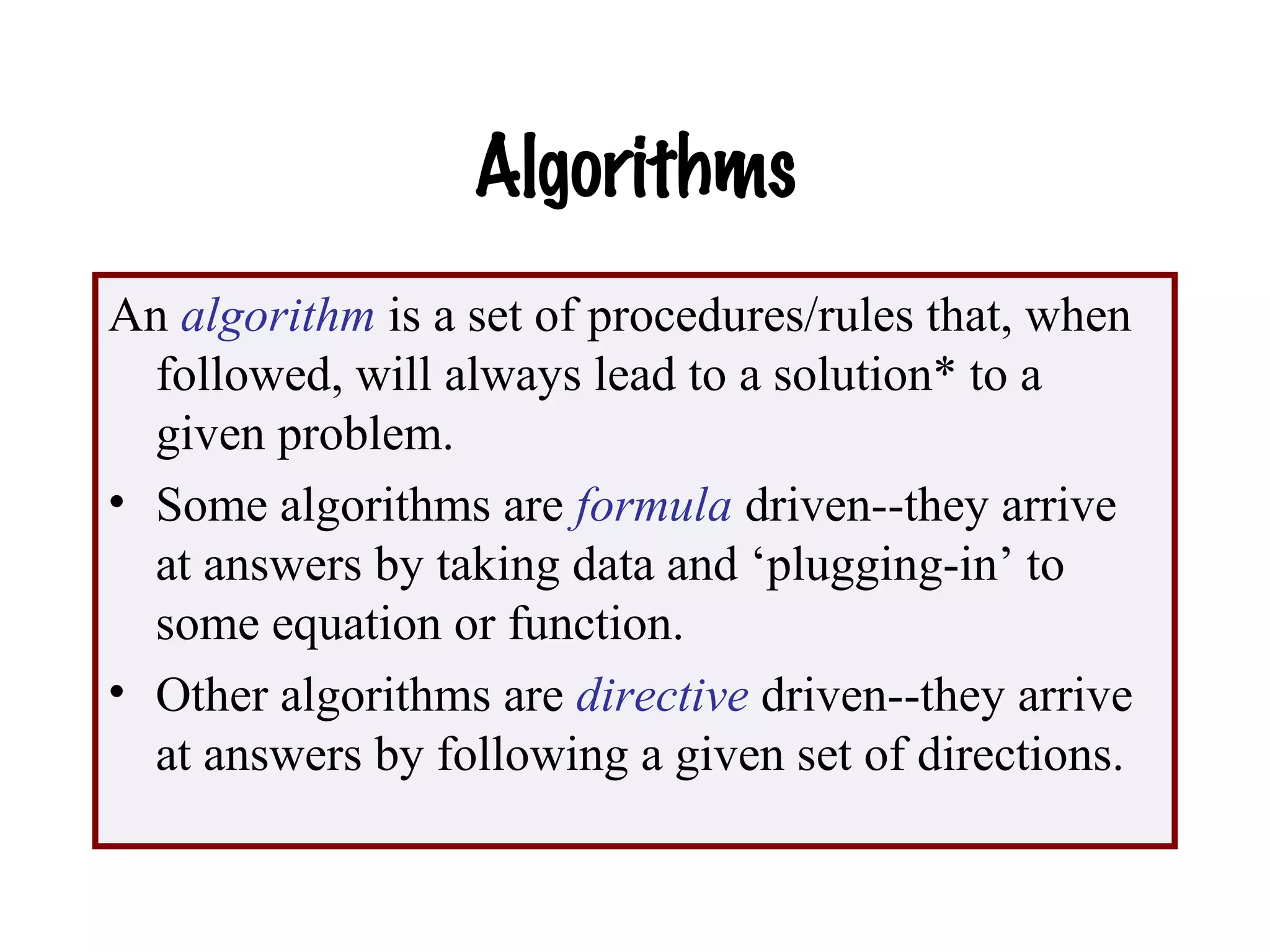
Algorithms
An algorithm is a set of procedures/rules that, when
followed, will always lead to a solution* to a
given problem.
• Some algorithms are formula driven--they arrive
at answers by taking data and ‘plugging-in’ to
some equation or function.
• Other algorithms are directive driven--they arrive
at answers by following a given set of directions.
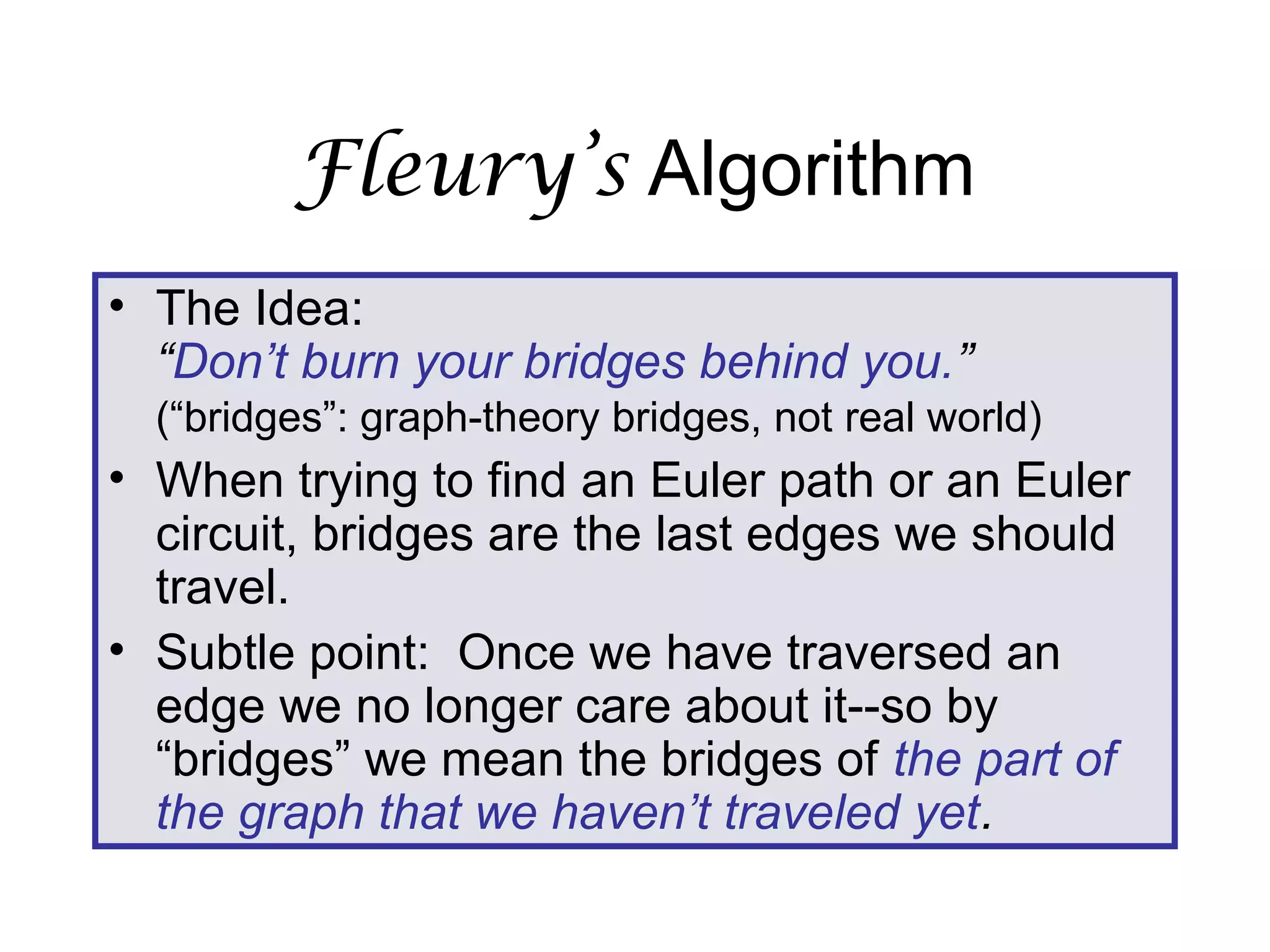
Fleury’s Algorithm
• The Idea:
“Don’t burn your bridges behind you.”
(“bridges”: graph-theory bridges, not real world)
• When trying to find an Euler path or an Euler
circuit, bridges are the last edges we should
travel.
• Subtle point: Once we have traversed an
edge we no longer care about it--so by
“bridges” we mean the bridges of the part of
the graph that we haven’t traveled yet.
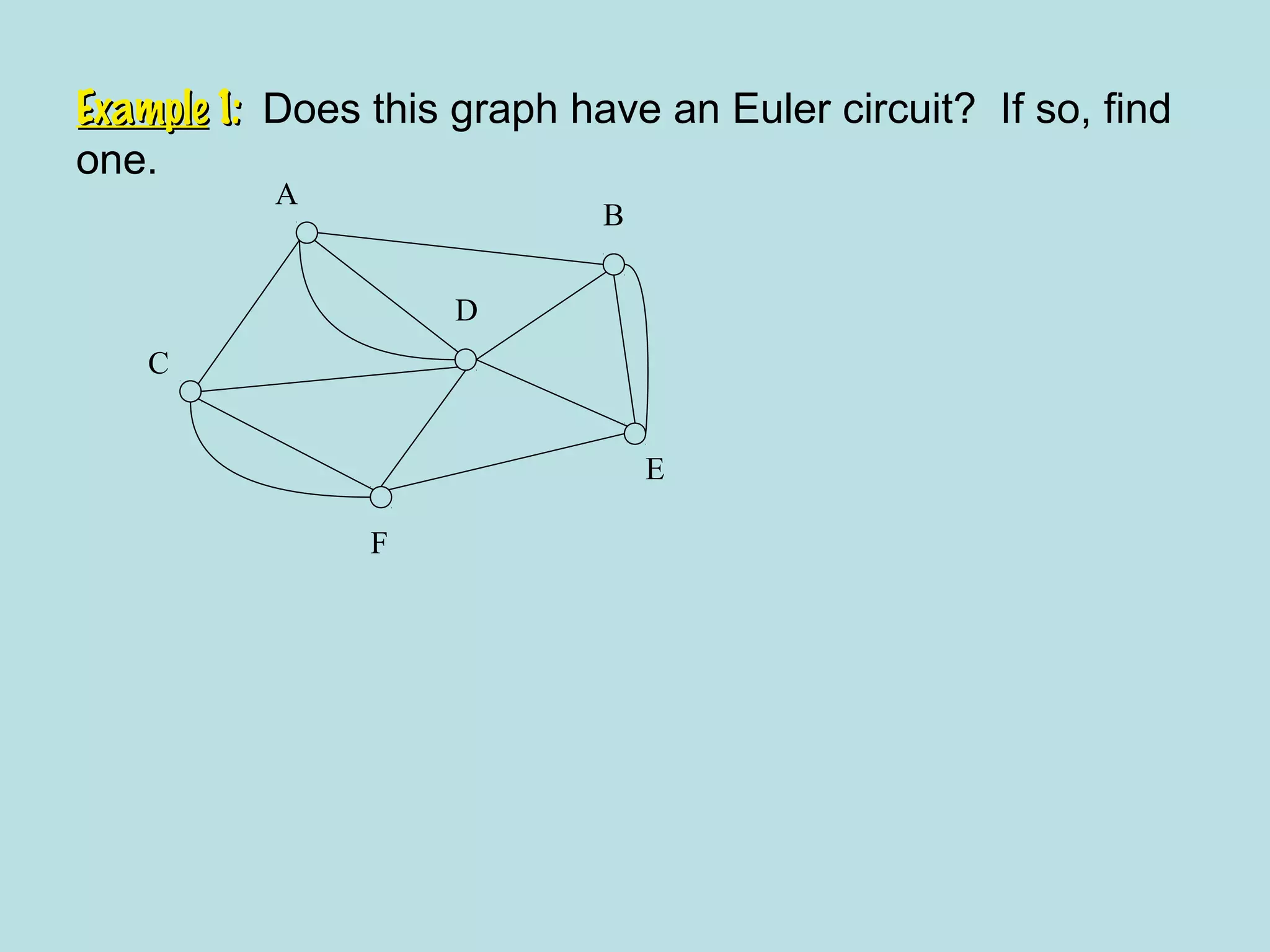
ExampleExample 1:1: Does this graph have an Euler circuit? If so, find
one.
A
B
C
D
E
F
Fleury’sFleury’s AlgorithmAlgorithm
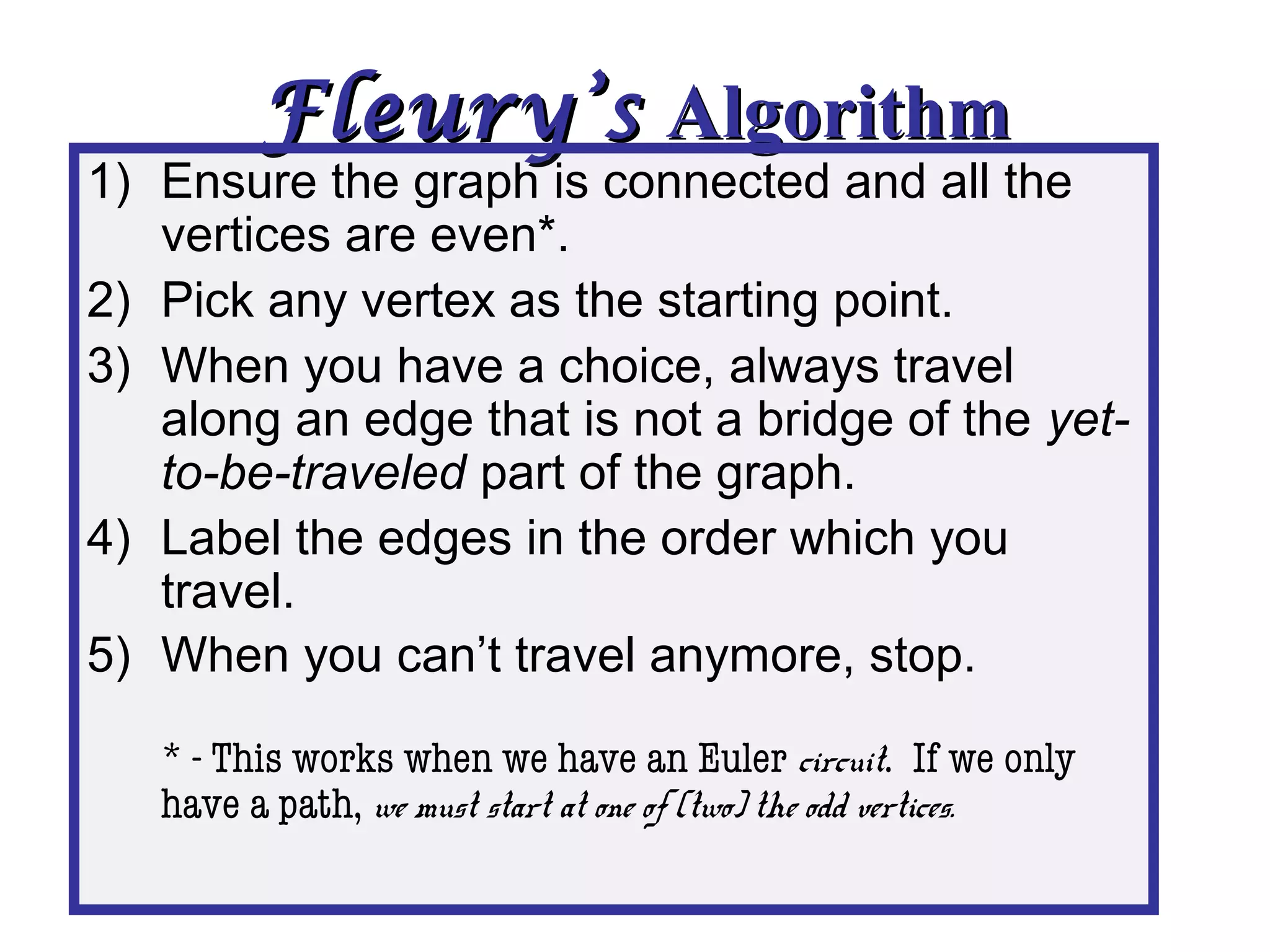
1) Ensure the graph is connected and all the
vertices are even*.
2) Pick any vertex as the starting point.
3) When you have a choice, always travel
along an edge that is not a bridge of the yet-
to-be-traveled part of the graph.
4) Label the edges in the order which you
travel.
5) When you can’t travel anymore, stop.
* - This works when we have an Euler circuit. If we only
have a path, we must start at one of (two) the odd vertices.
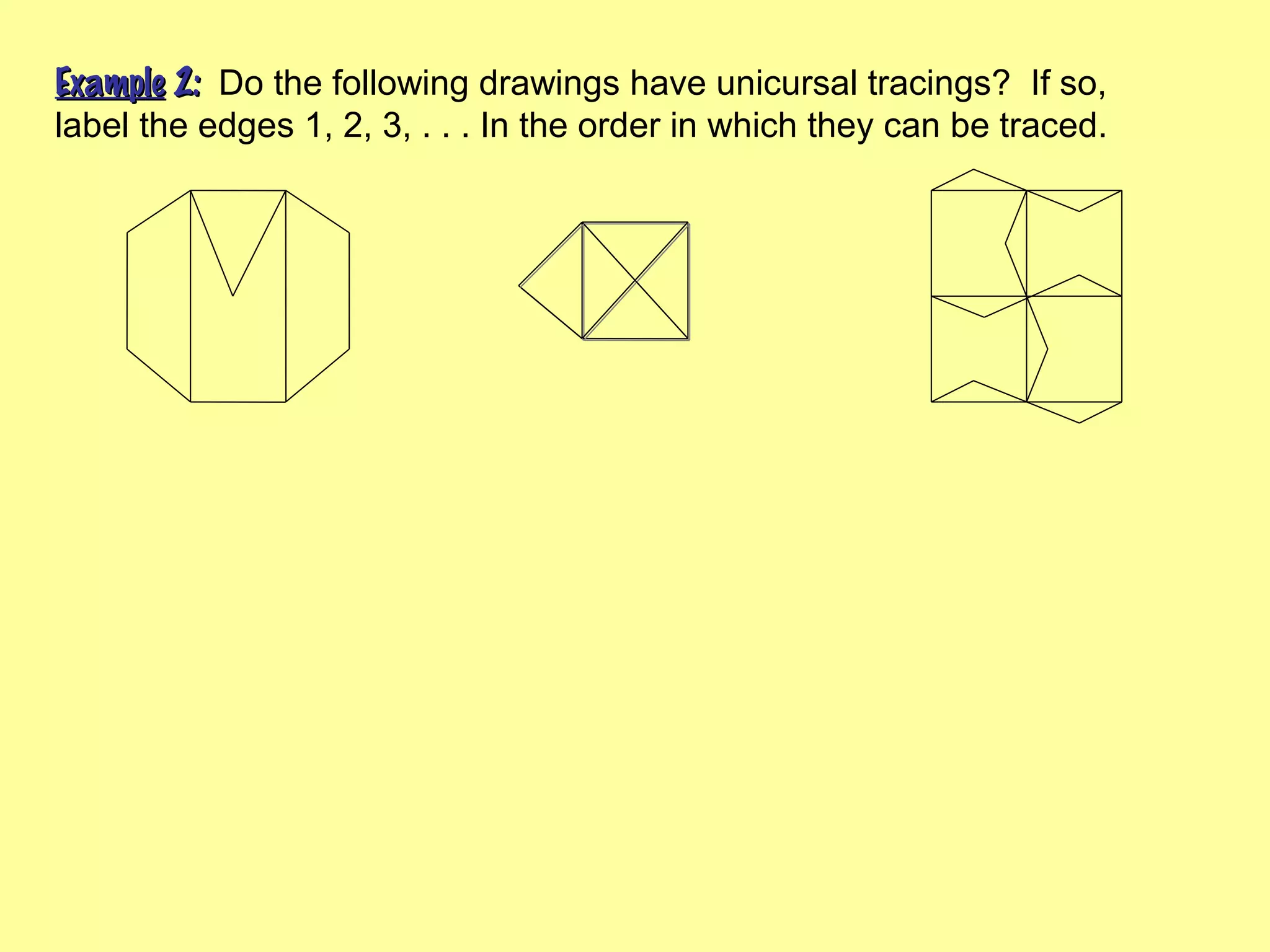
ExampleExample 2:2: Do the following drawings have unicursal tracings? If so,
label the edges 1, 2, 3, . . . In the order in which they can be traced.
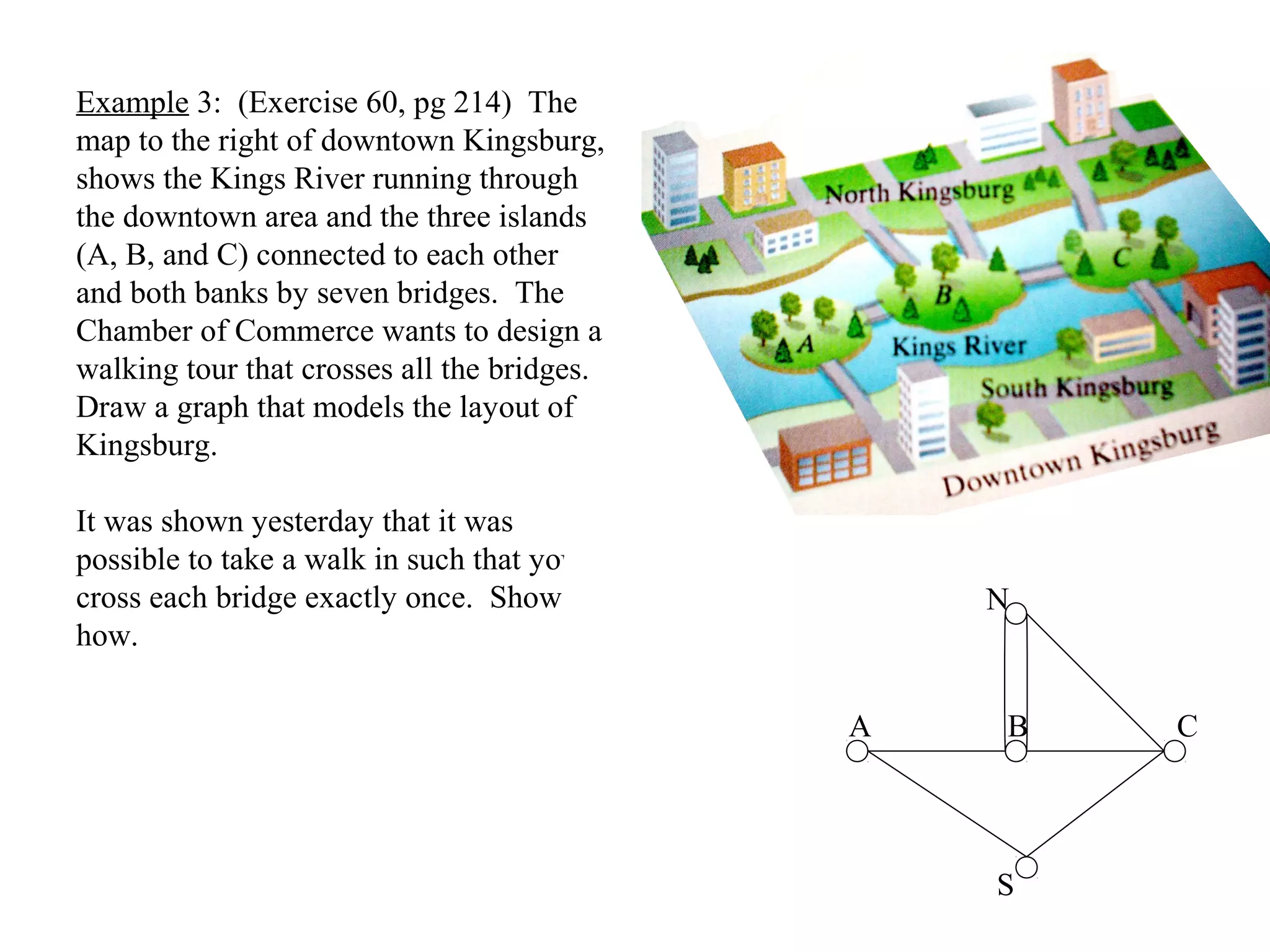
Example 3: (Exercise 60, pg 214) The
map to the right of downtown Kingsburg,
shows the Kings River running through
the downtown area and the three islands
(A, B, and C) connected to each other
and both banks by seven bridges. The
Chamber of Commerce wants to design a
walking tour that crosses all the bridges.
Draw a graph that models the layout of
Kingsburg.
It was shown yesterday that it was
possible to take a walk in such that you
cross each bridge exactly once. Show
how.
N
A B C
S
Example: Slay-ageSlay-age• The Scooby Gang needs to patrol the following section of
town starting at Sunnydale High (labeled G). Suppose that
they must check each side of the street except for those
along the park. Find an optimal route for our intrepid demon
hunters to take.
North Bank (N)
A
B
C
South Bank (S)
Quiz 1, problem 2
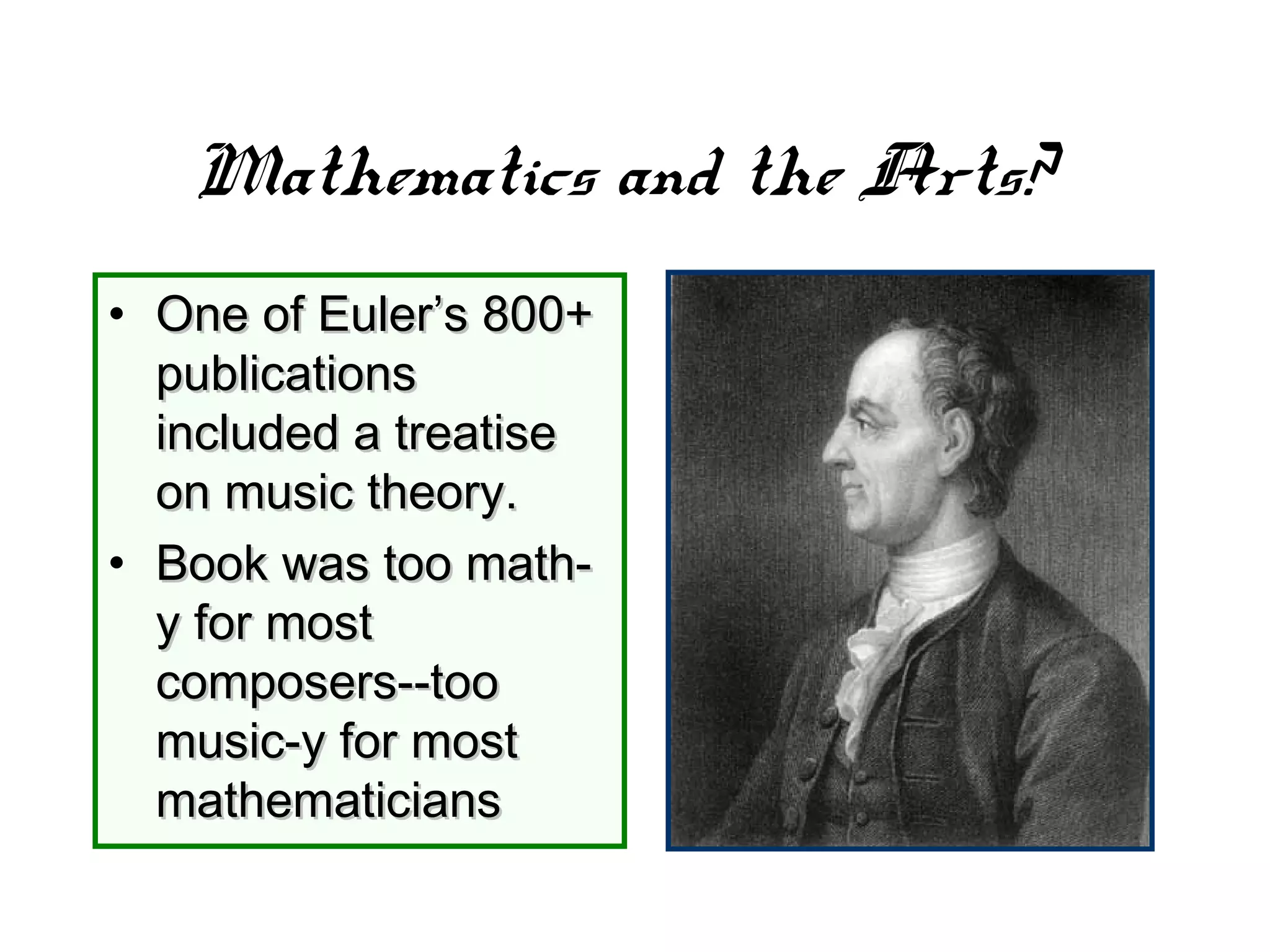
Mathematics and the Arts?
• One of Euler’s 800+One of Euler’s 800+
publicationspublications
included a treatiseincluded a treatise
on music theory.on music theory.
• Book was too math-Book was too math-
y for mosty for most
composers--toocomposers--too
music-y for mostmusic-y for most
mathematiciansmathematicians
Mathematics and the Arts?
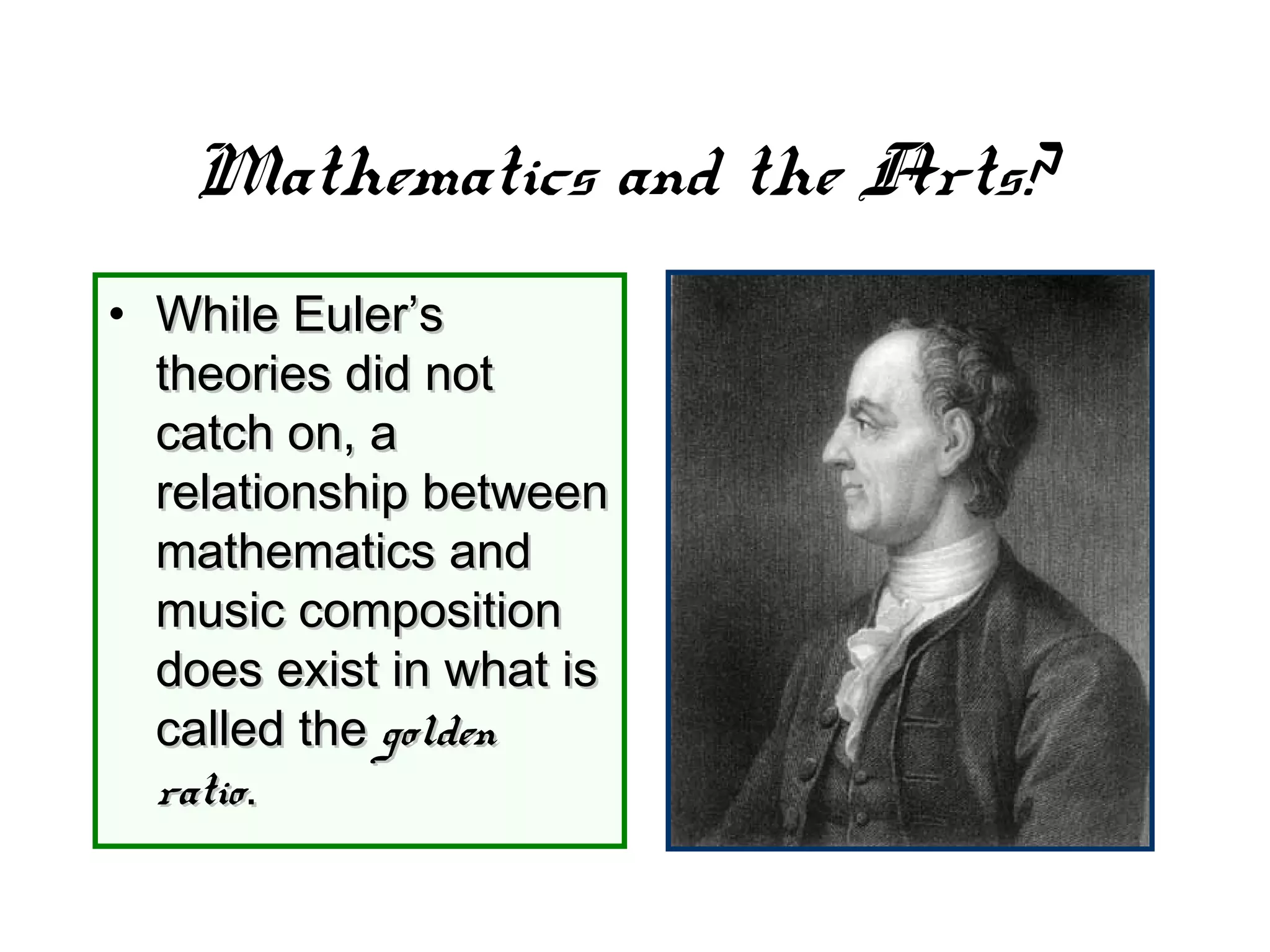
• While Euler’sWhile Euler’s
theories did nottheories did not
catch on, acatch on, a
relationship betweenrelationship between
mathematics andmathematics and
music compositionmusic composition
does exist in what isdoes exist in what is
called thecalled the goldengolden
ratioratio..
Fibonacci Numbers
• The Fibonacci Numbers are
those that comprise the
sequence:
1, 1, 2, 3, 5, 8, 13, 21, . . .
• The sequence can be
defined by:
F1=1, F2=1;
Fn=Fn-1+Fn-2
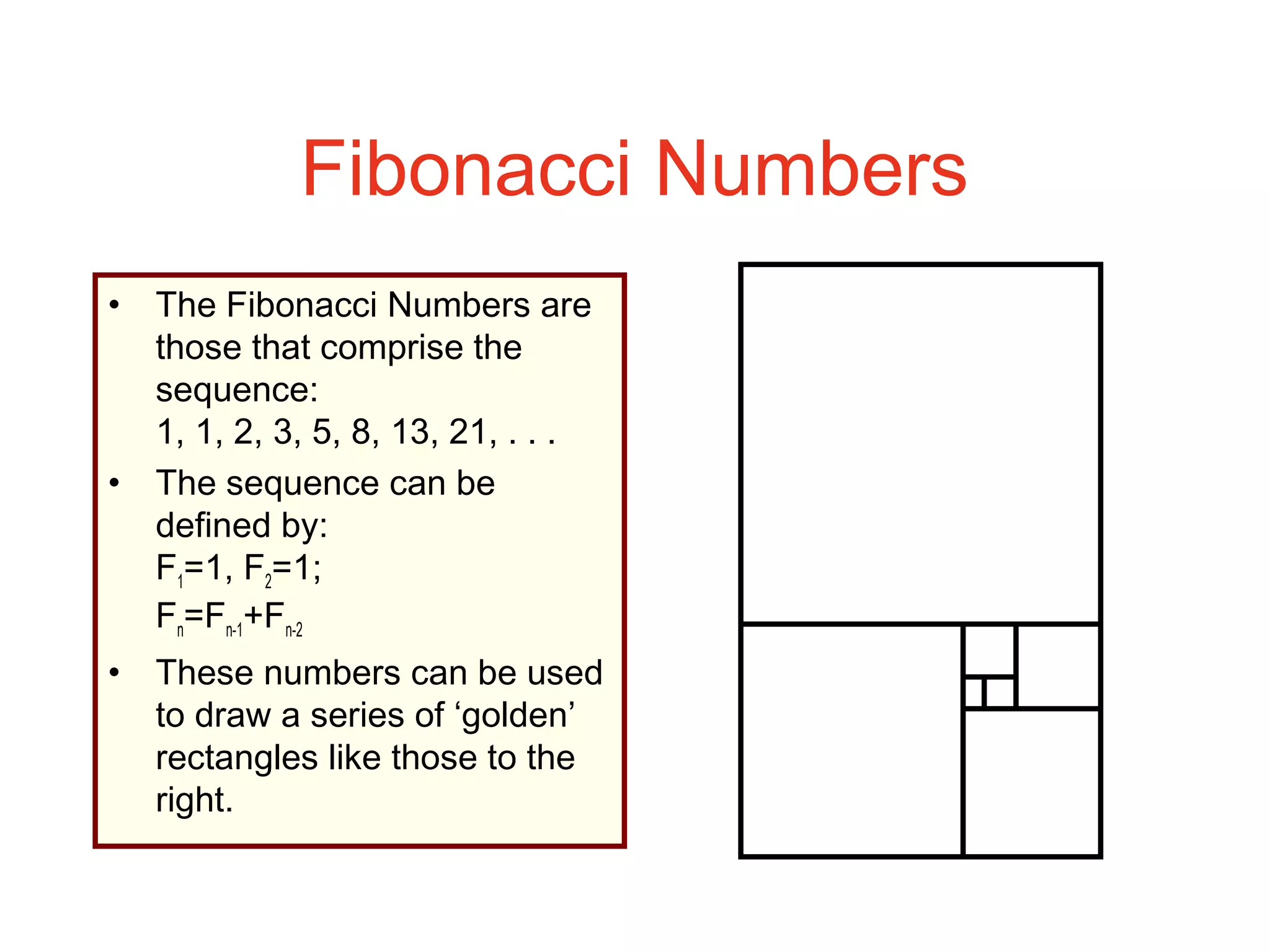
• These numbers can be used
to draw a series of ‘golden’
rectangles like those to the
right.
Fibonacci Numbers
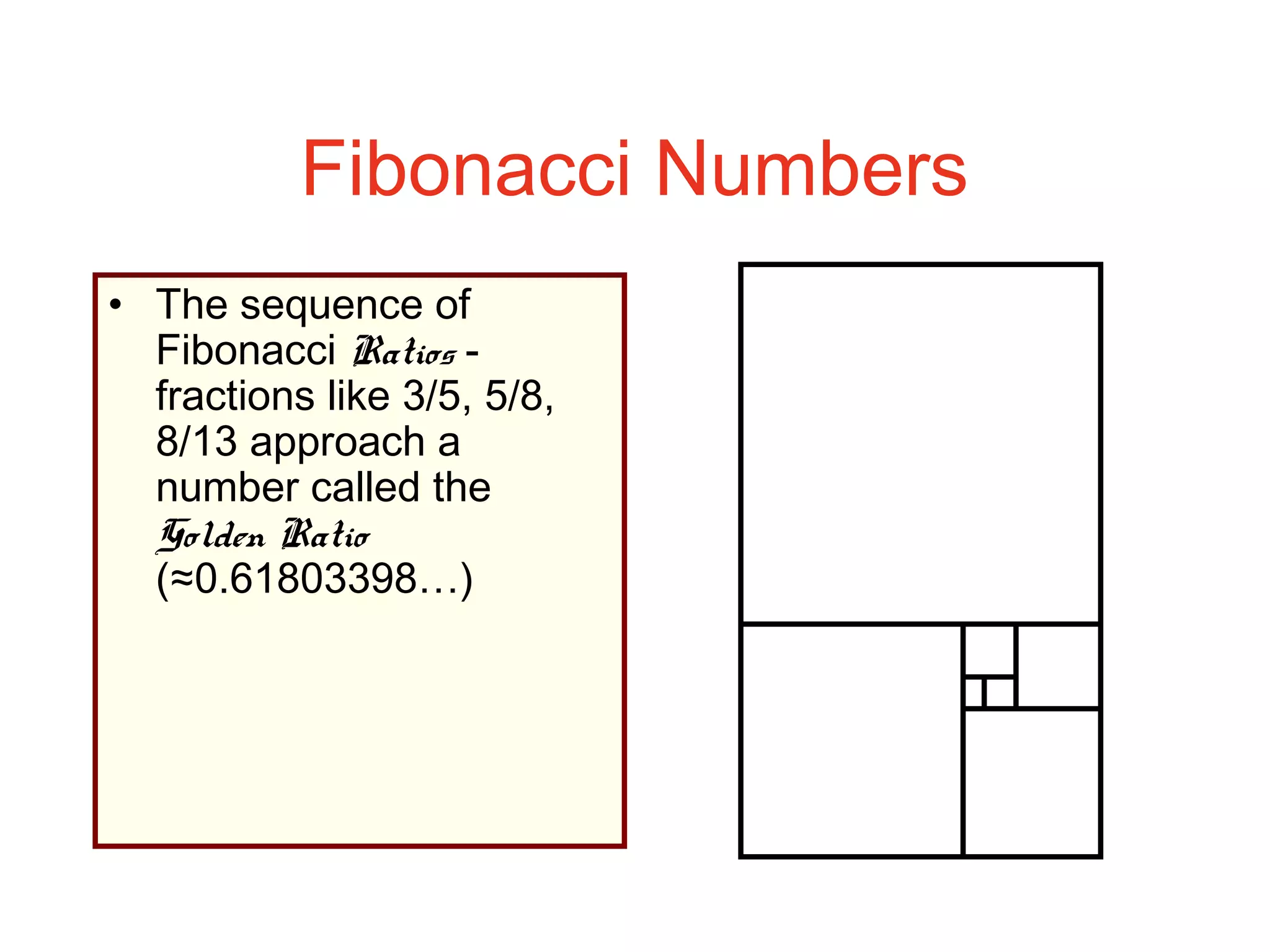
• The sequence of
Fibonacci Ratios -
fractions like 3/5, 5/8,
8/13 approach a
number called the
Golden Ratio
(≈0.61803398…)
The Golden Ratio
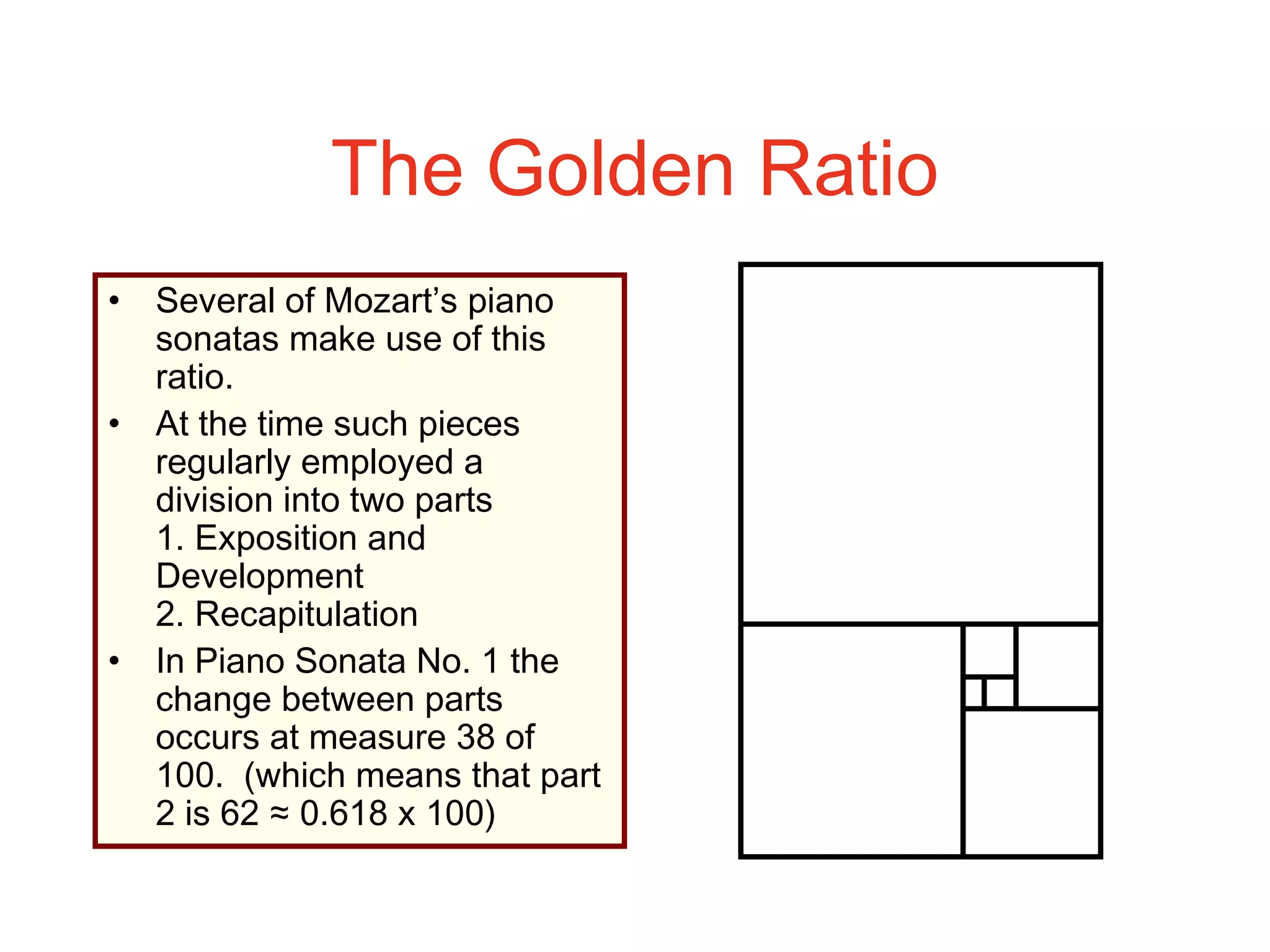
• Several of Mozart’s piano
sonatas make use of this
ratio.
• At the time such pieces
regularly employed a
division into two parts
1. Exposition and
Development
2. Recapitulation
• In Piano Sonata No. 1 the
change between parts
occurs at measure 38 of
100. (which means that part
2 is 62 ≈ 0.618 x 100)
The Golden Ratio
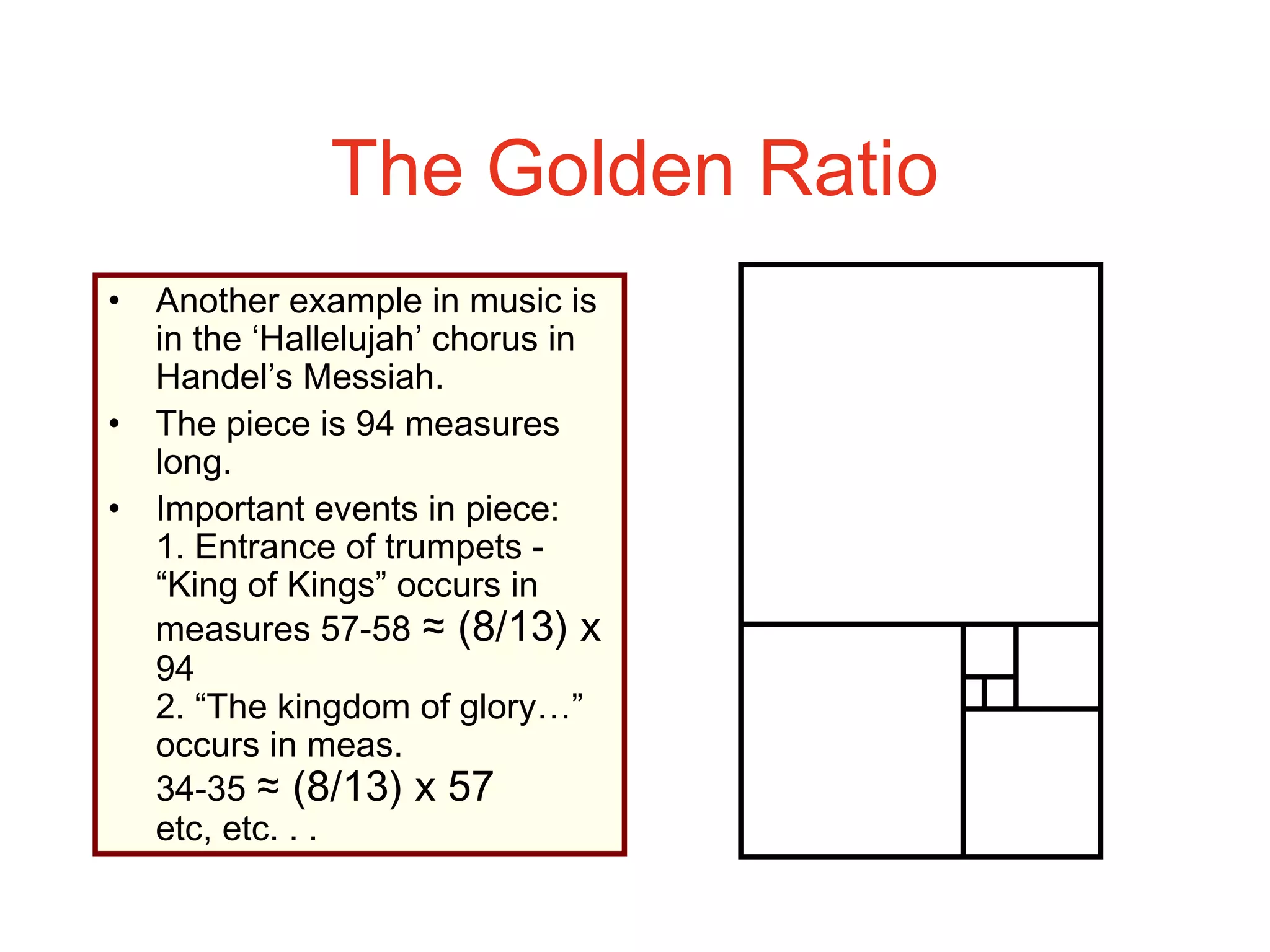
• Another example in music is
in the ‘Hallelujah’ chorus in
Handel’s Messiah.
• The piece is 94 measures
long.
• Important events in piece:
1. Entrance of trumpets -
“King of Kings” occurs in
measures 57-58 ≈ (8/13) x
94
2. “The kingdom of glory…”
occurs in meas.
34-35 ≈ (8/13) x 57
etc, etc. . .
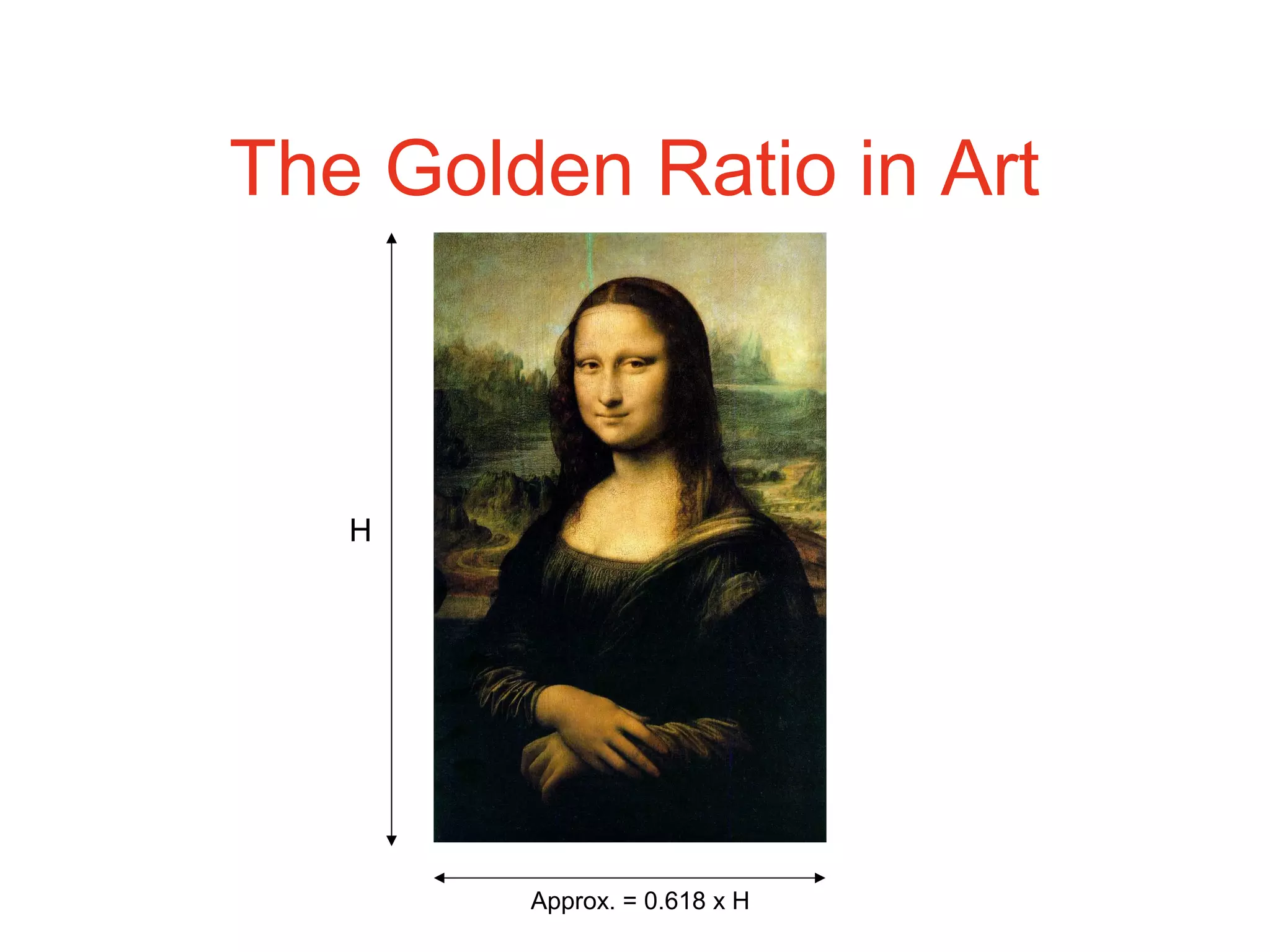
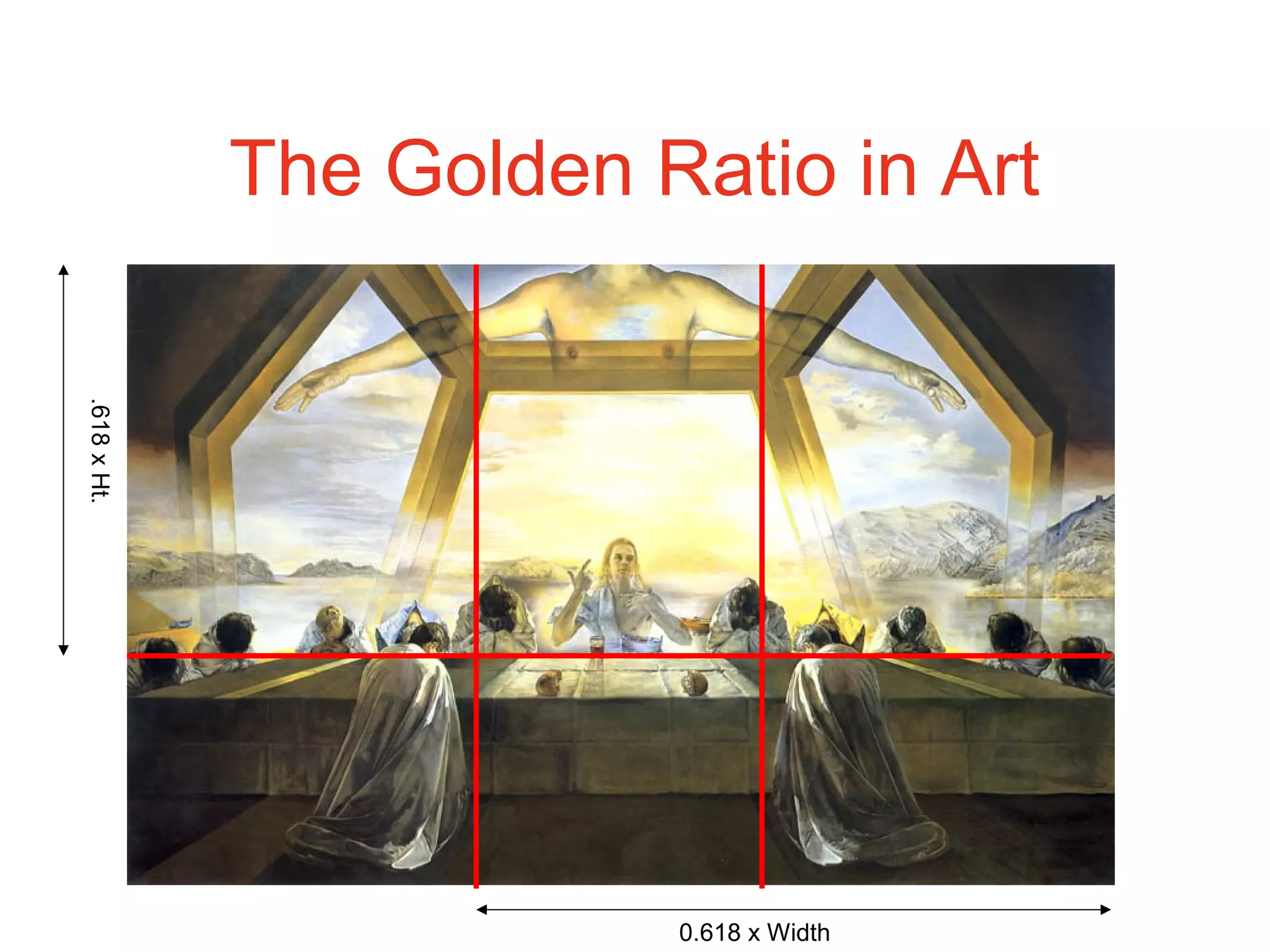
The Golden Ratio in Art
H
Approx. = 0.618 x H
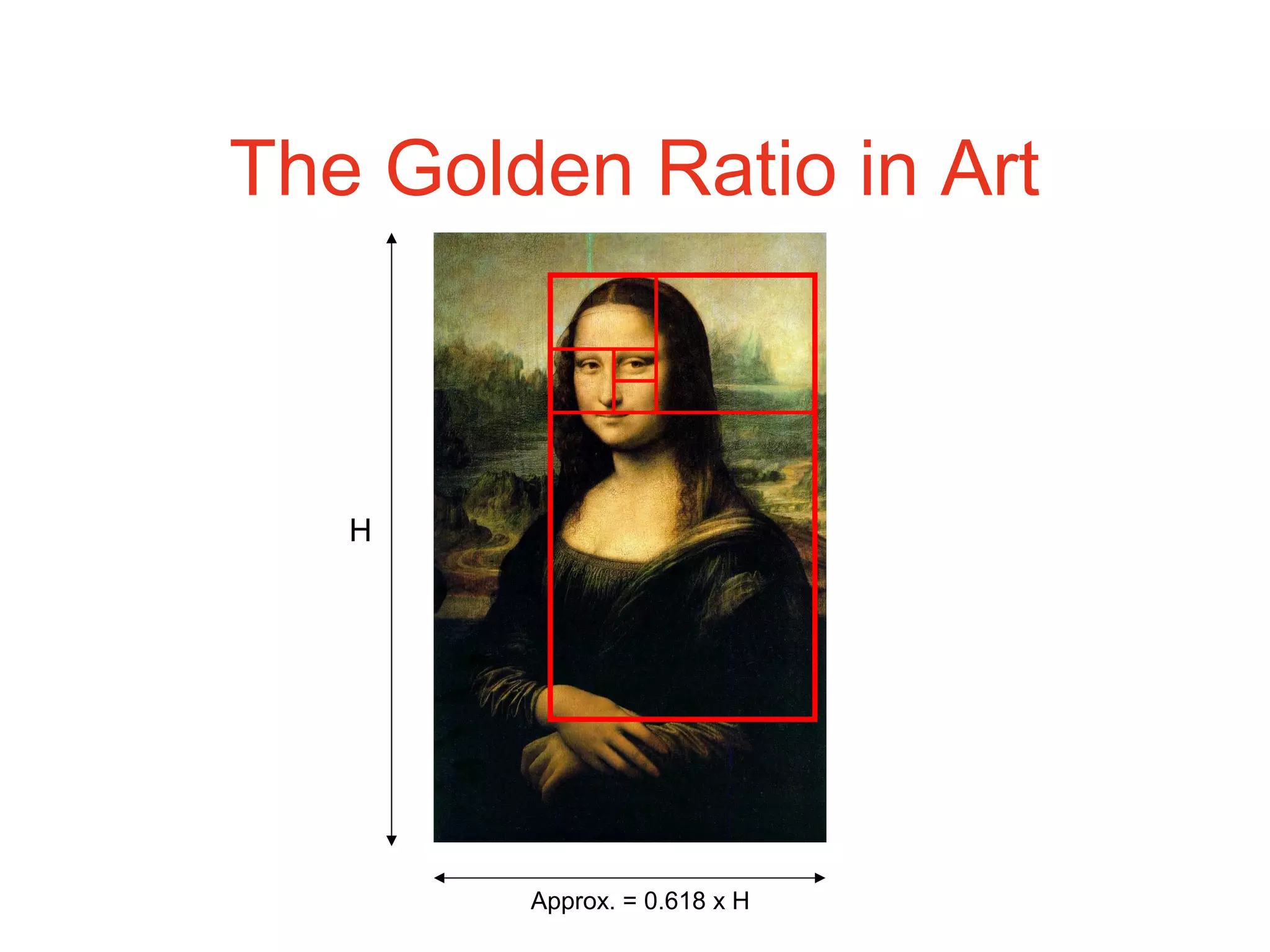
The Golden Ratio in Art
H
Approx. = 0.618 x H
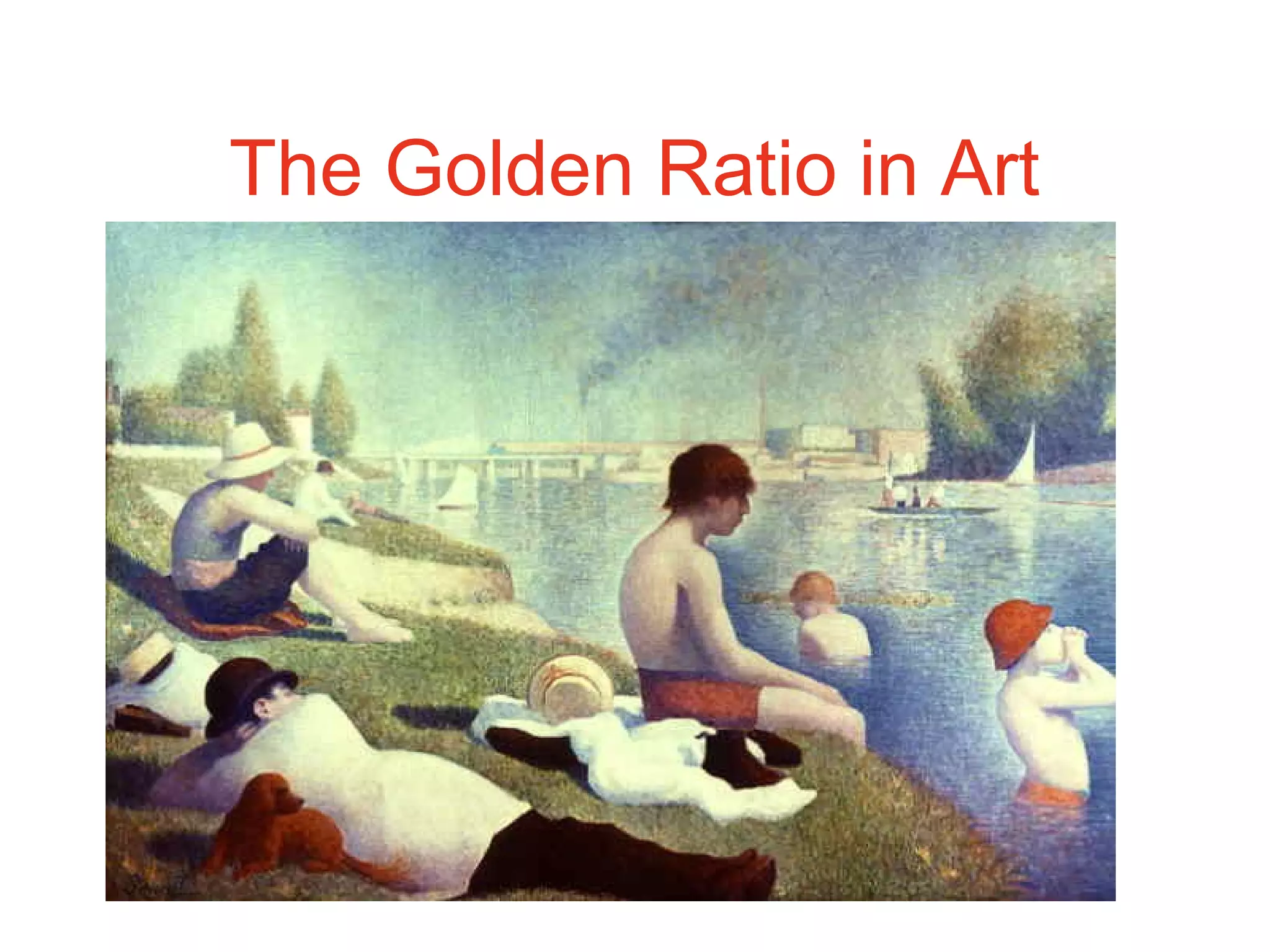
The Golden Ratio in Art
.618xHt.
0.618 x Width
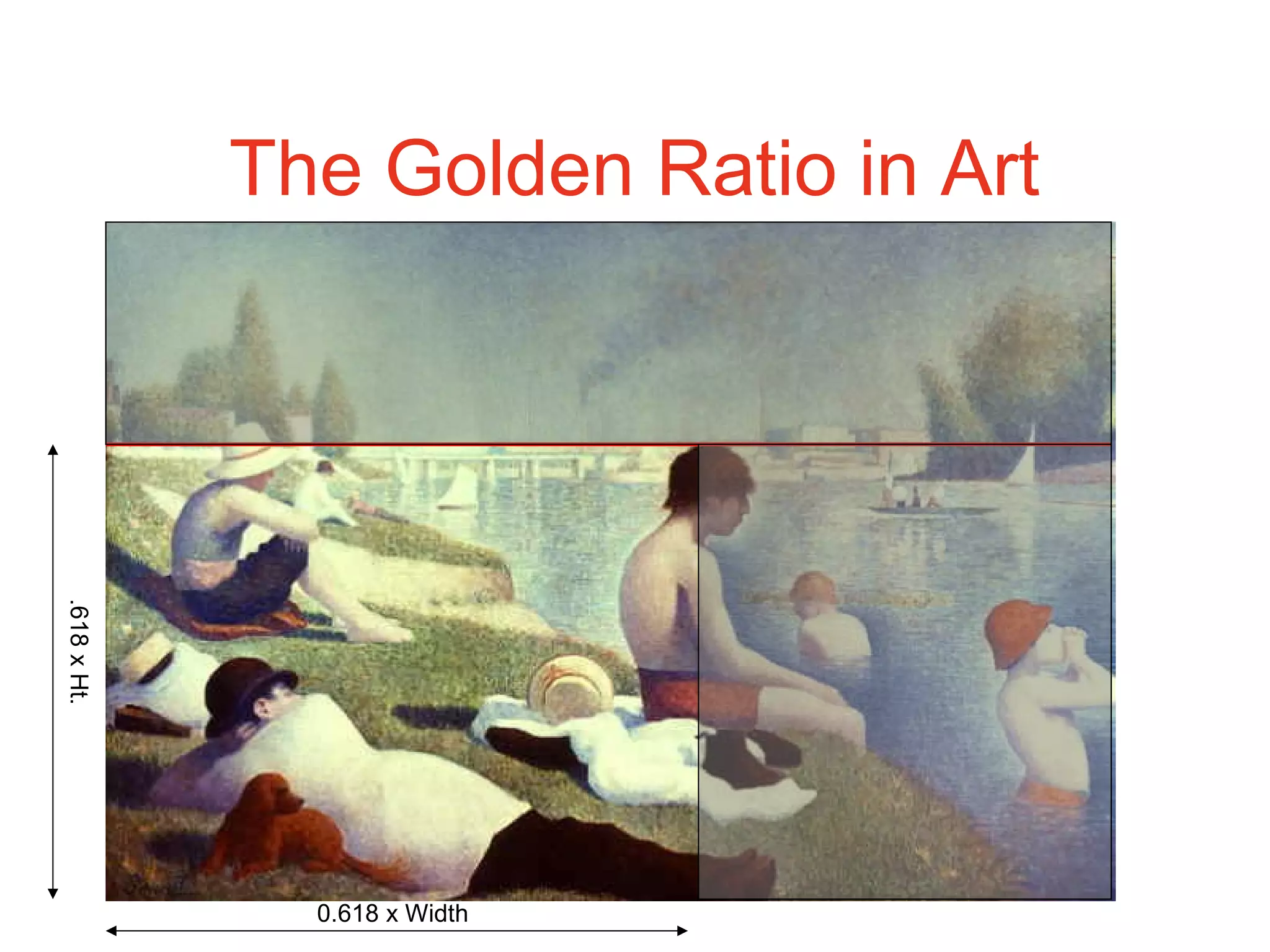
The Golden Ratio in Art
.618xHt.
0.618 x Width
Minimum Spanning Trees
Prim’s Algorithm
Kruskal’s Algorithm
Definition
• A Minimum Spanning Tree (MST) is a
subgraph of an undirected graph such that
the subgraph spans (includes) all nodes, is
connected, is acyclic, and has minimum
total edge weight
Algorithm Characteristics
• Both Prim’s and Kruskal’s Algorithms work
with undirected graphs
• Both work with weighted and unweighted
graphs but are more interesting when edges
are weighted
• Both are greedy algorithms that produce
optimal solutions
Prim’s Algorithm
• Similar to Dijkstra’s Algorithm except that
dv records edge weights, not path lengths
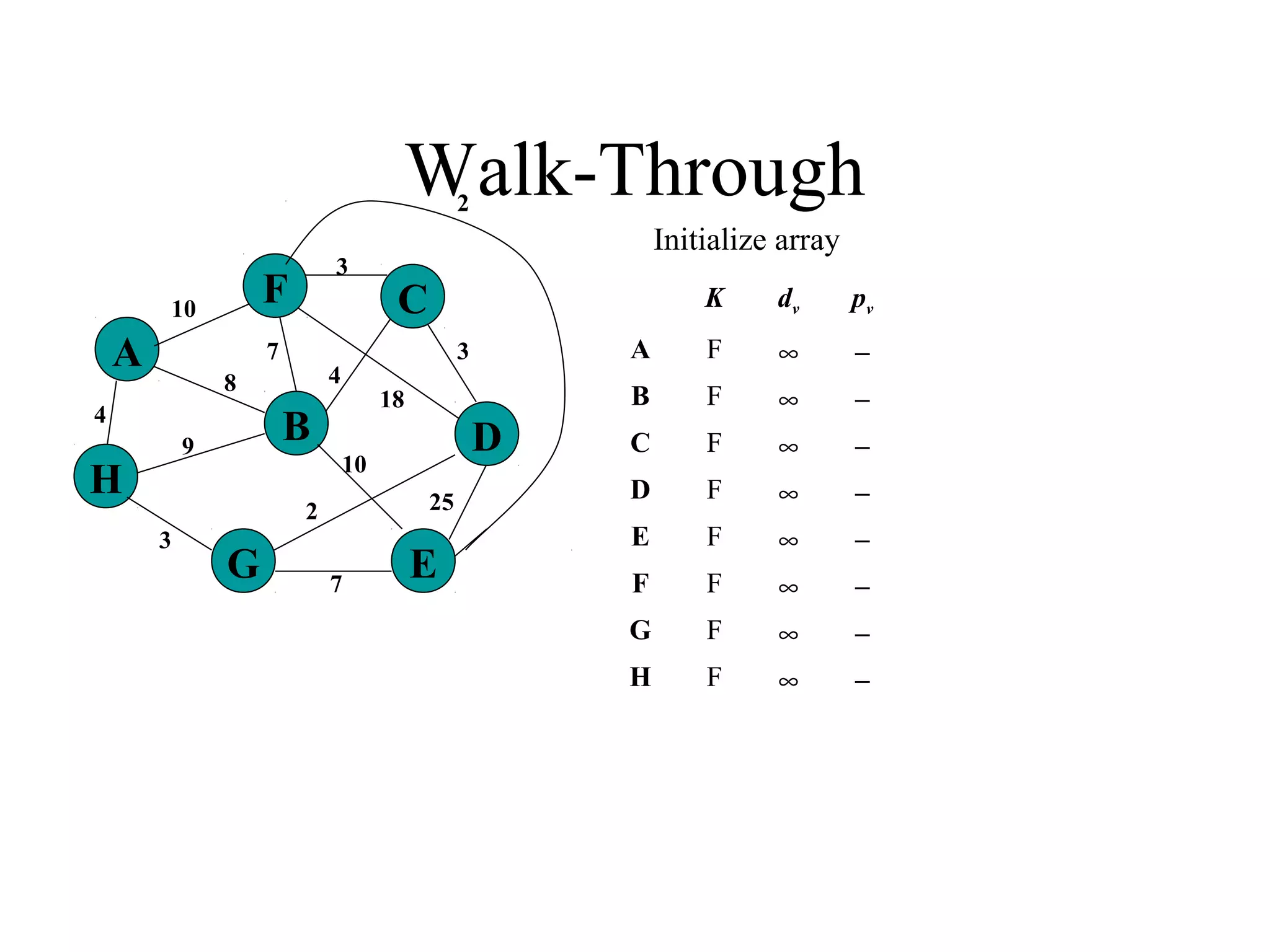
Walk-Through
Initialize array
K dv pv
A F ∞ −
B F ∞ −
C F ∞ −
D F ∞ −
E F ∞ −
F F ∞ −
G F ∞ −
H F ∞ −
4
25
A
H
B
F
E
D
C
G 7
2
10
18
3
4
3
7
8
9
3
10
2
4
25
A
H
B
F
E
D
C
G 7
2
10
18
3
4
3
7
8
9
3
10
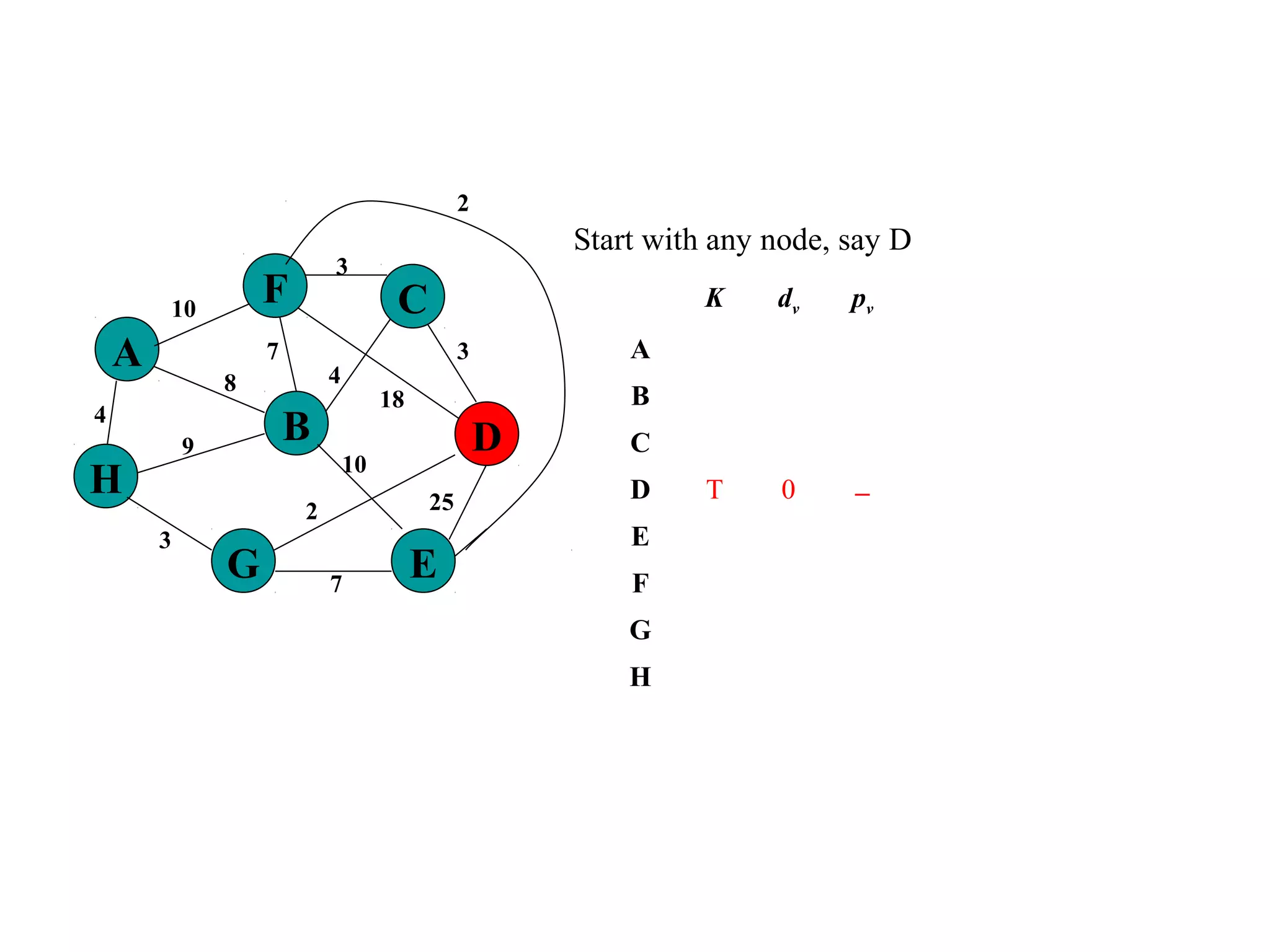
Start with any node, say D
K dv pv
A
B
C
D T 0 −
E
F
G
H
2
4
25
A
H
B
F
E
D
C
G 7
2
10
18
3
4
3
7
8
9
3
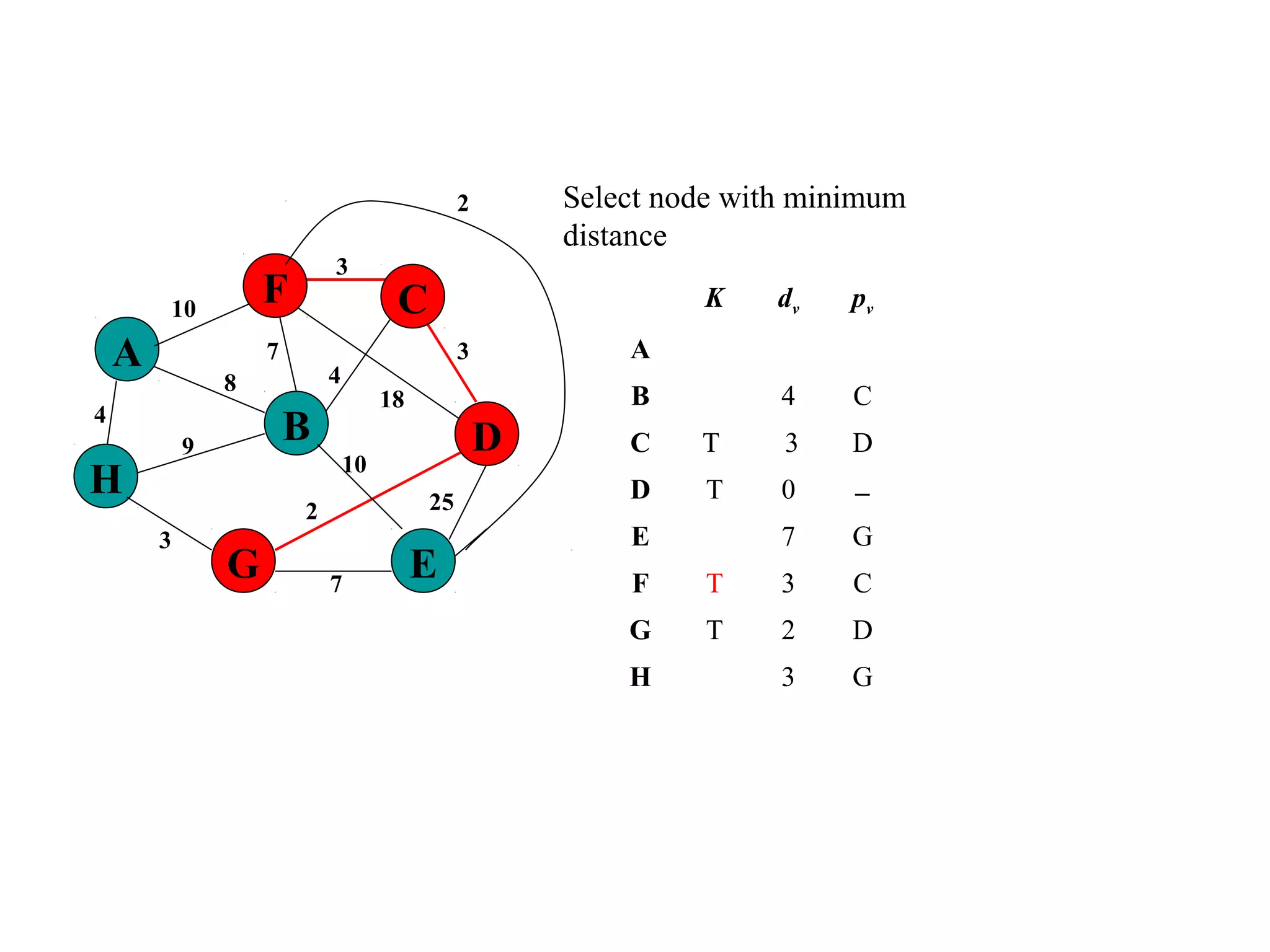
10
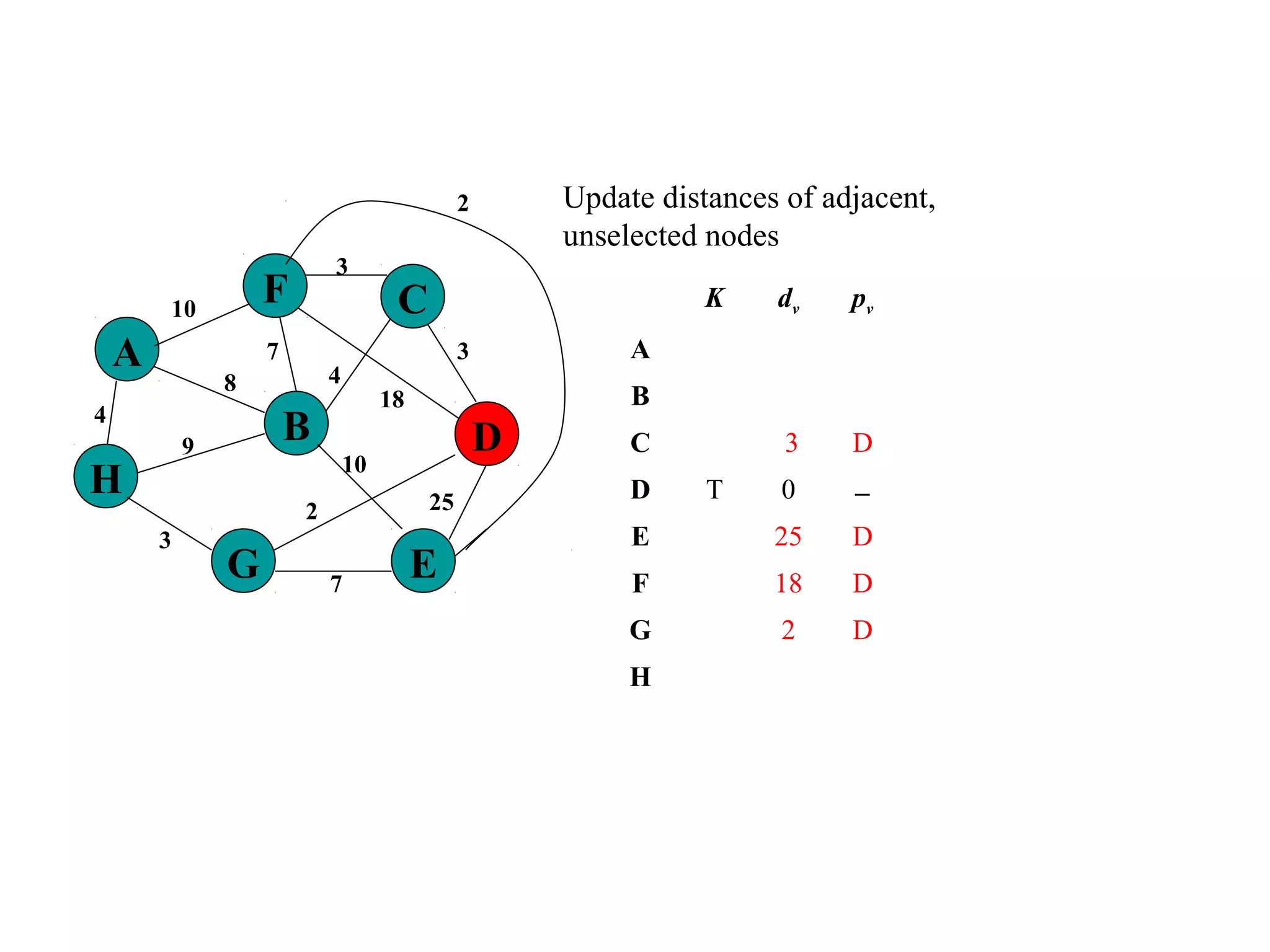
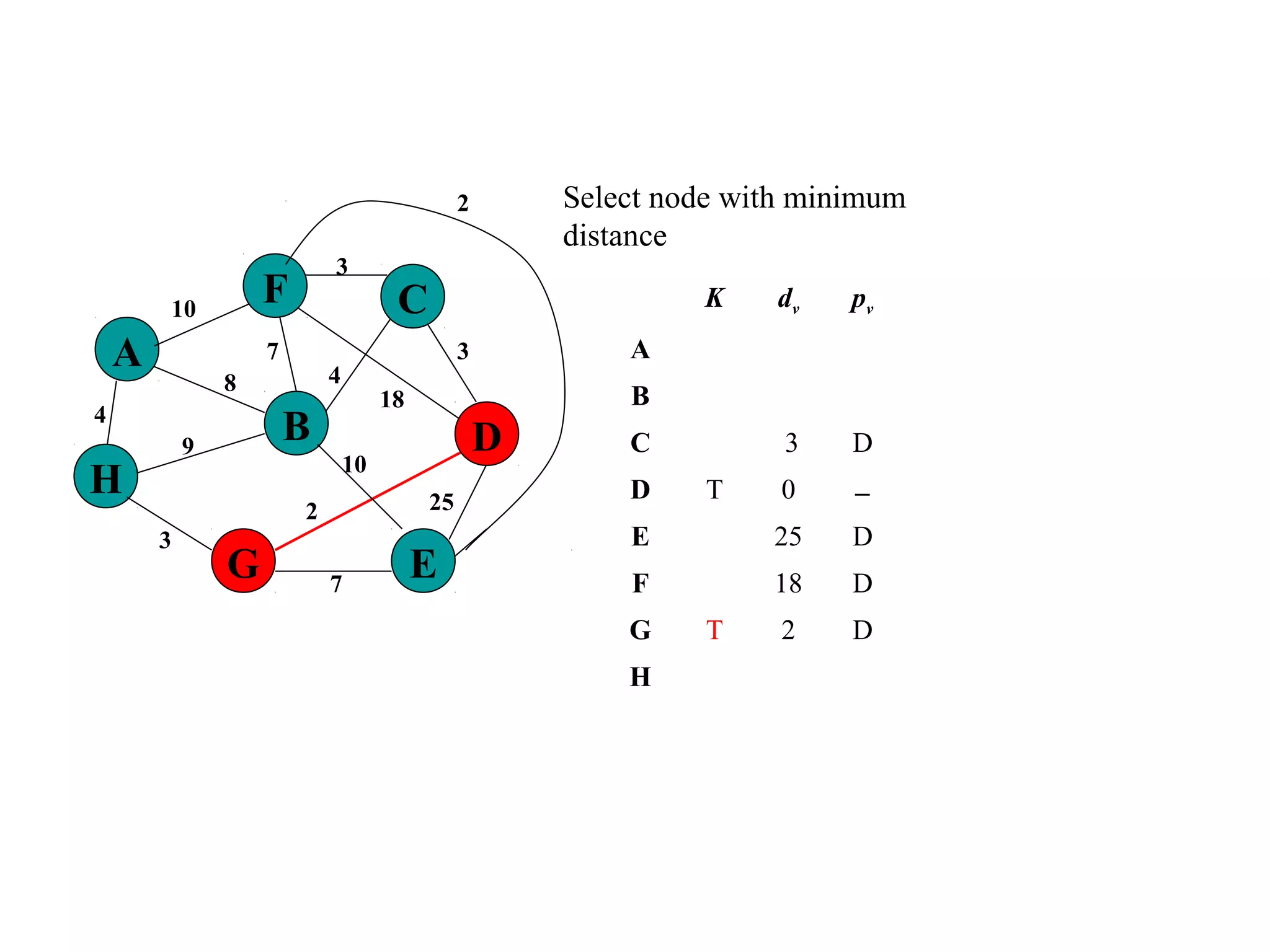
Update distances of adjacent,
unselected nodes
K dv pv
A
B
C 3 D
D T 0 −
E 25 D
F 18 D
G 2 D
H
2
4
25
A
H
B
F
E
D
C
G 7
2
10
18
3
4
3
7
8
9
3
10
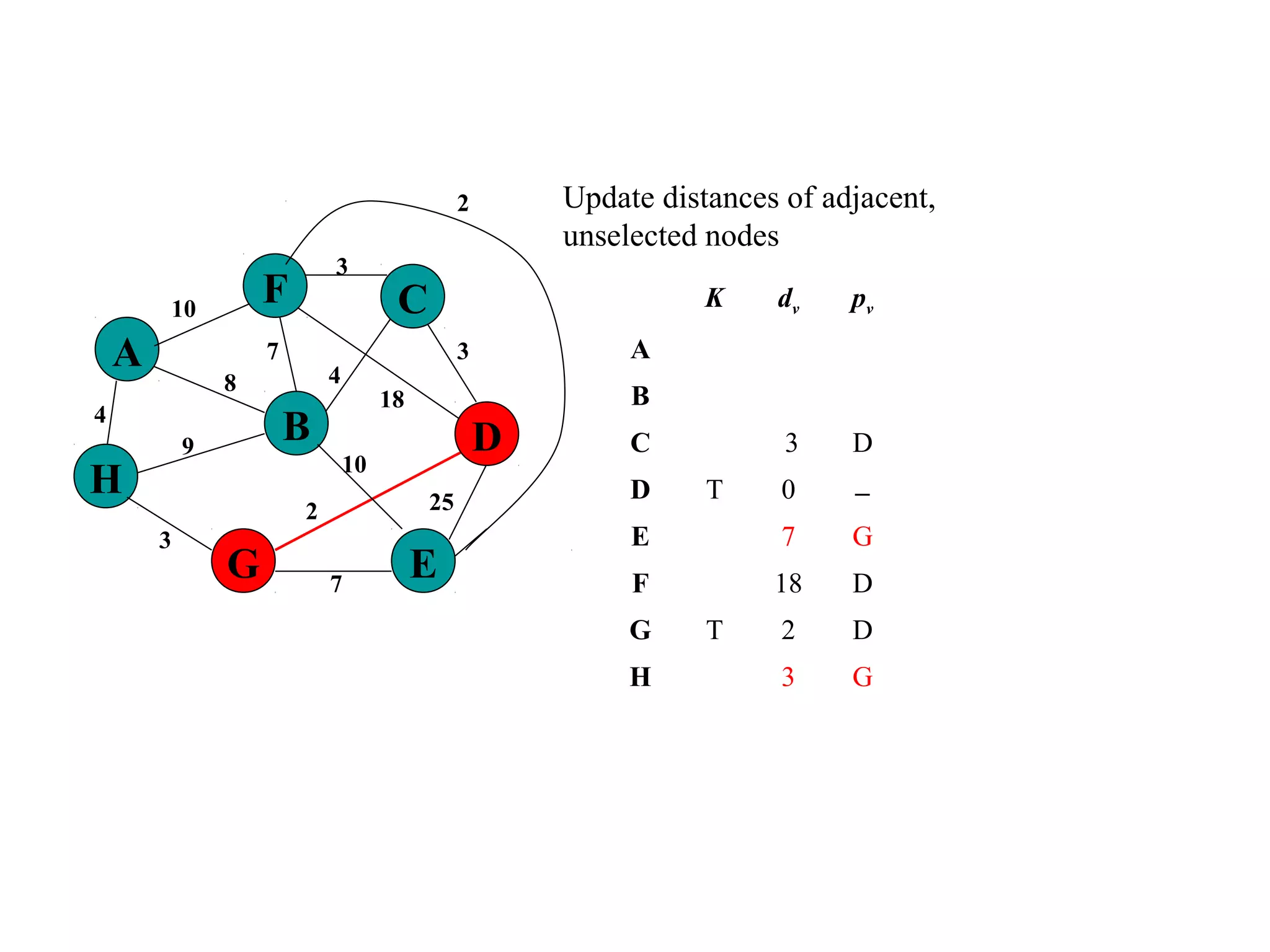
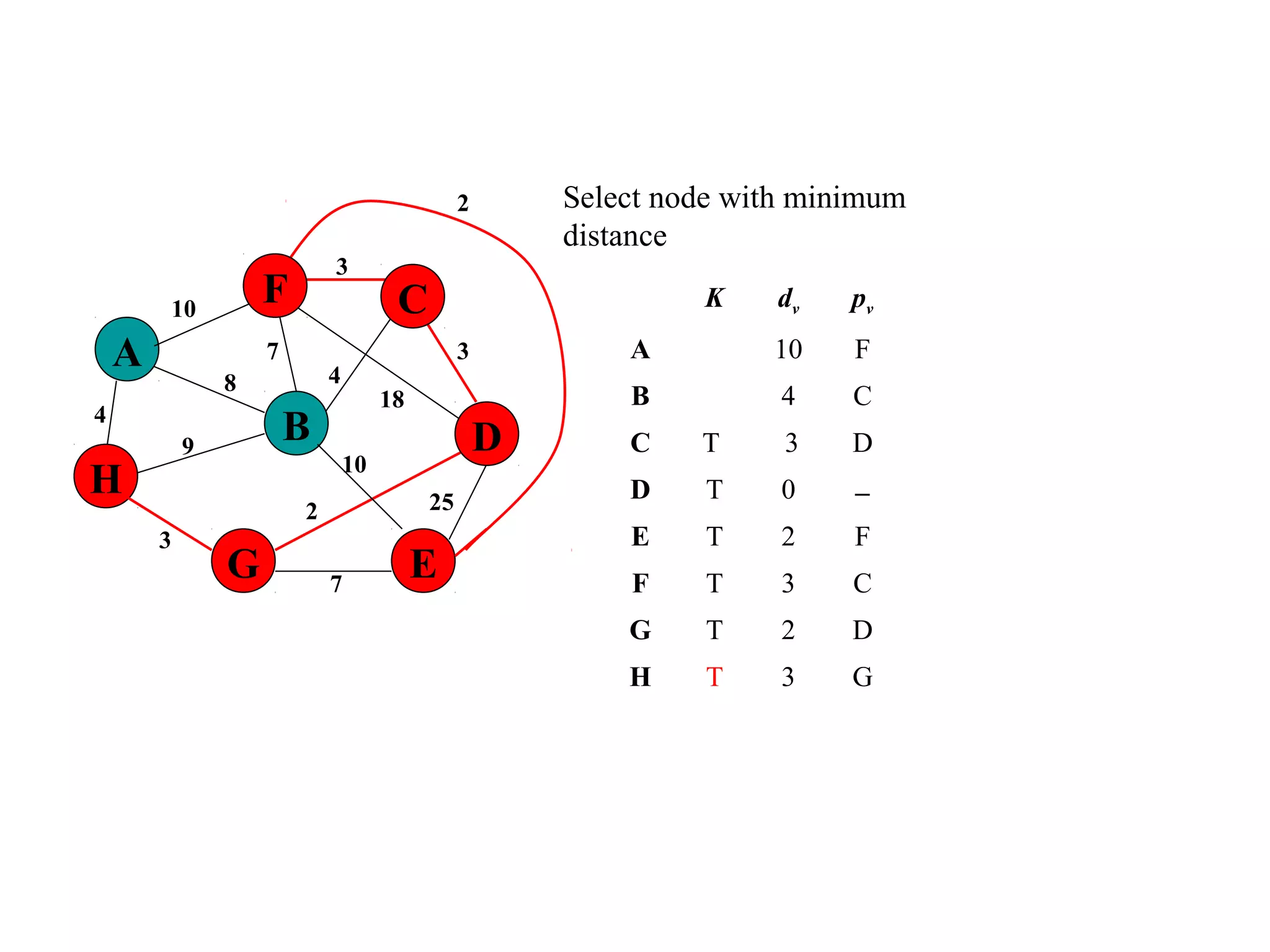
Select node with minimum
distance
K dv pv
A
B
C 3 D
D T 0 −
E 25 D
F 18 D
G T 2 D
H
2
4
25
A
H
B
F
E
D
C
G 7
2
10
18
3
4
3
7
8
9
3
10
Update distances of adjacent,
unselected nodes
K dv pv
A
B
C 3 D
D T 0 −
E 7 G
F 18 D
G T 2 D
H 3 G
2
4
25
A
H
B
F
E
D
C
G 7
2
10
18
3
4
3
7
8
9
3
10
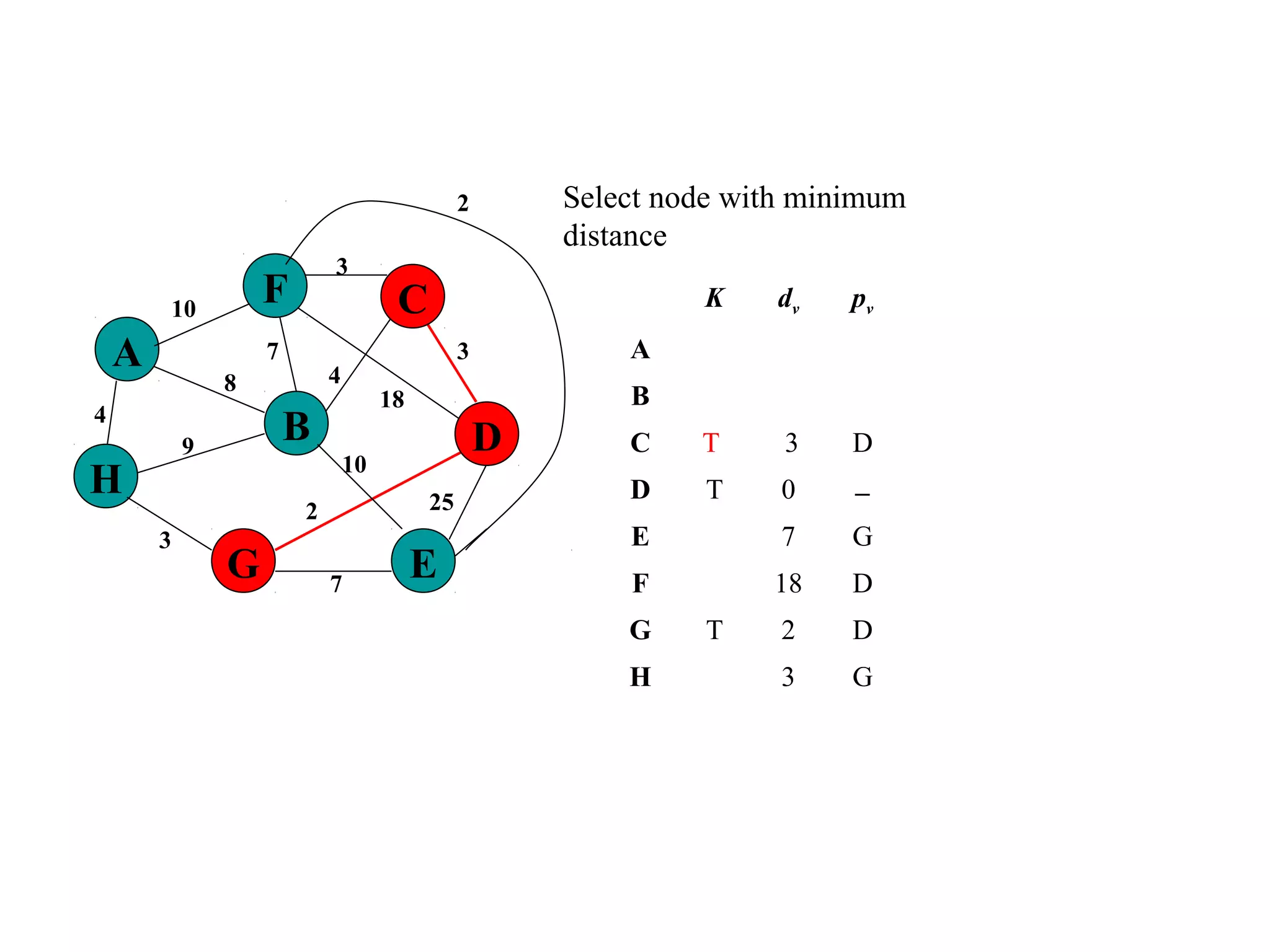
Select node with minimum
distance
K dv pv
A
B
C T 3 D
D T 0 −
E 7 G
F 18 D
G T 2 D
H 3 G
2
4
25
A
H
B
F
E
D
C
G 7
2
10
18
3
4
3
7
8
9
3
10
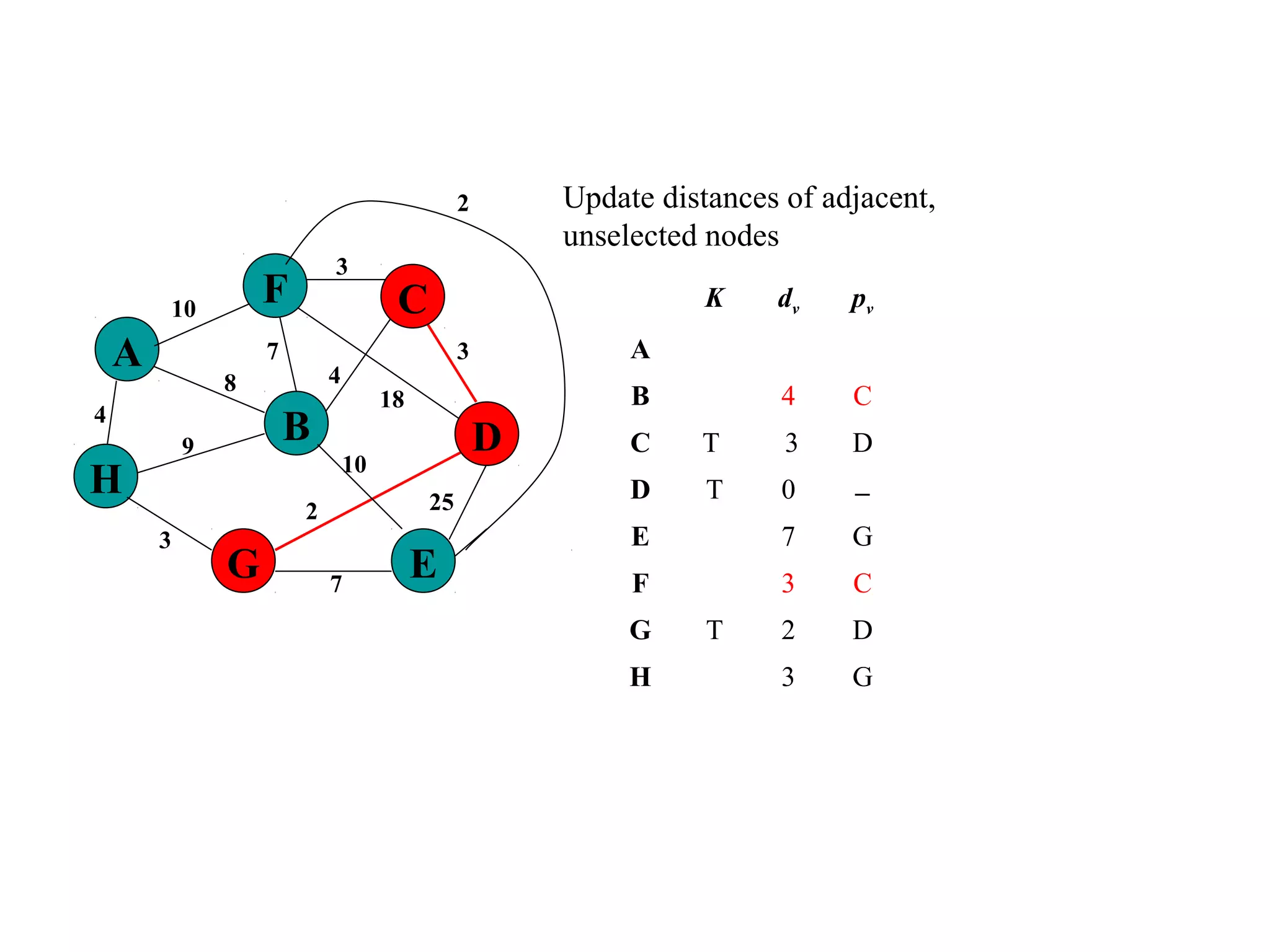
Update distances of adjacent,
unselected nodes
K dv pv
A
B 4 C
C T 3 D
D T 0 −
E 7 G
F 3 C
G T 2 D
H 3 G
2
4
25
A
H
B
F
E
D
C
G 7
2
10
18
3
4
3
7
8
9
3
10
Select node with minimum
distance
K dv pv
A
B 4 C
C T 3 D
D T 0 −
E 7 G
F T 3 C
G T 2 D
H 3 G
2
4
25
A
H
B
F
E
D
C
G 7
2
10
18
3
4
3
7
8
9
3
10
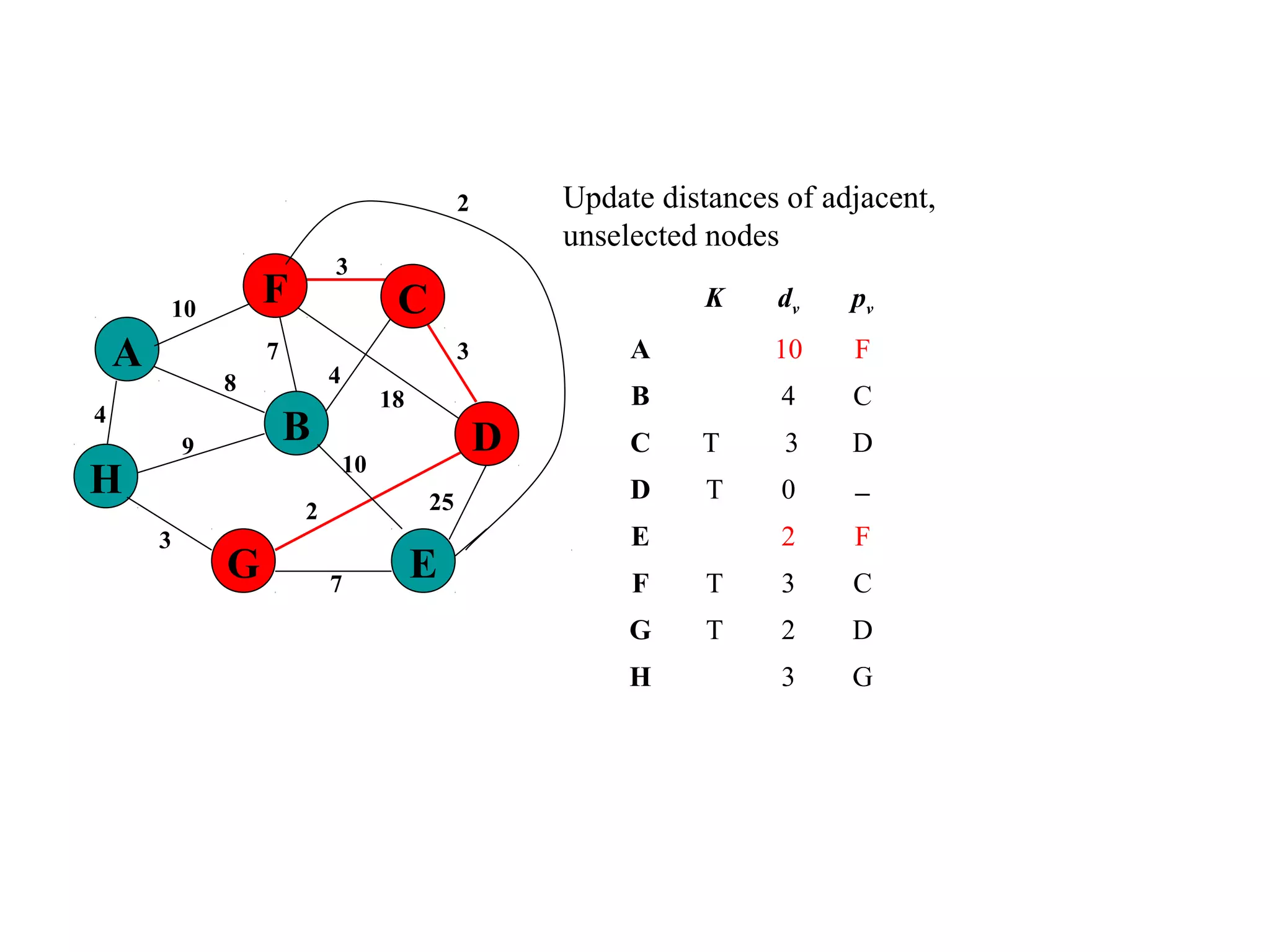
Update distances of adjacent,
unselected nodes
K dv pv
A 10 F
B 4 C
C T 3 D
D T 0 −
E 2 F
F T 3 C
G T 2 D
H 3 G
2
4
25
A
H
B
F
E
D
C
G 7
2
10
18
3
4
3
7
8
9
3
10
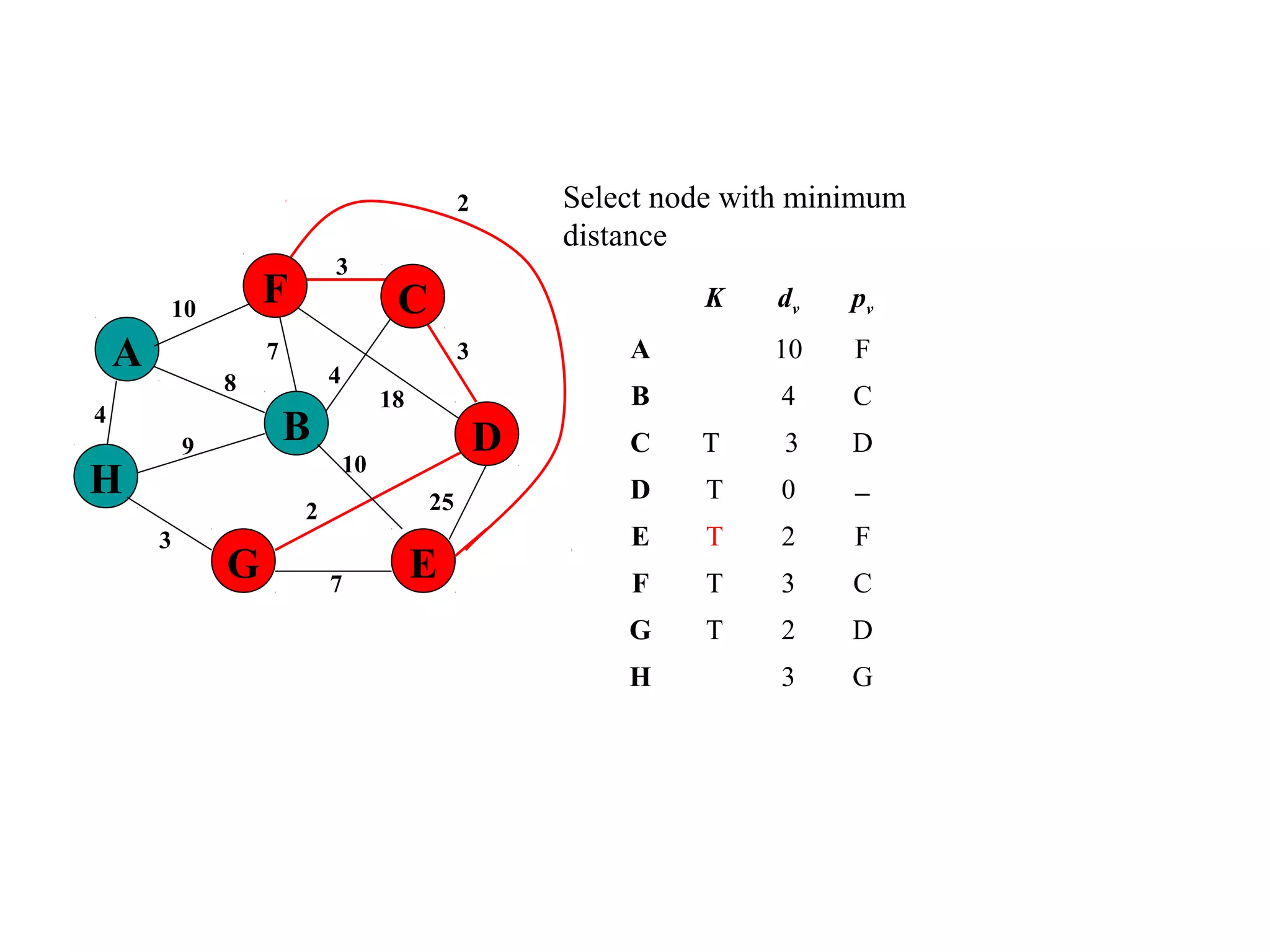
Select node with minimum
distance
K dv pv
A 10 F
B 4 C
C T 3 D
D T 0 −
E T 2 F
F T 3 C
G T 2 D
H 3 G
2
4
25
A
H
B
F
E
D
C
G 7
2
10
18
3
4
3
7
8
9
3
10
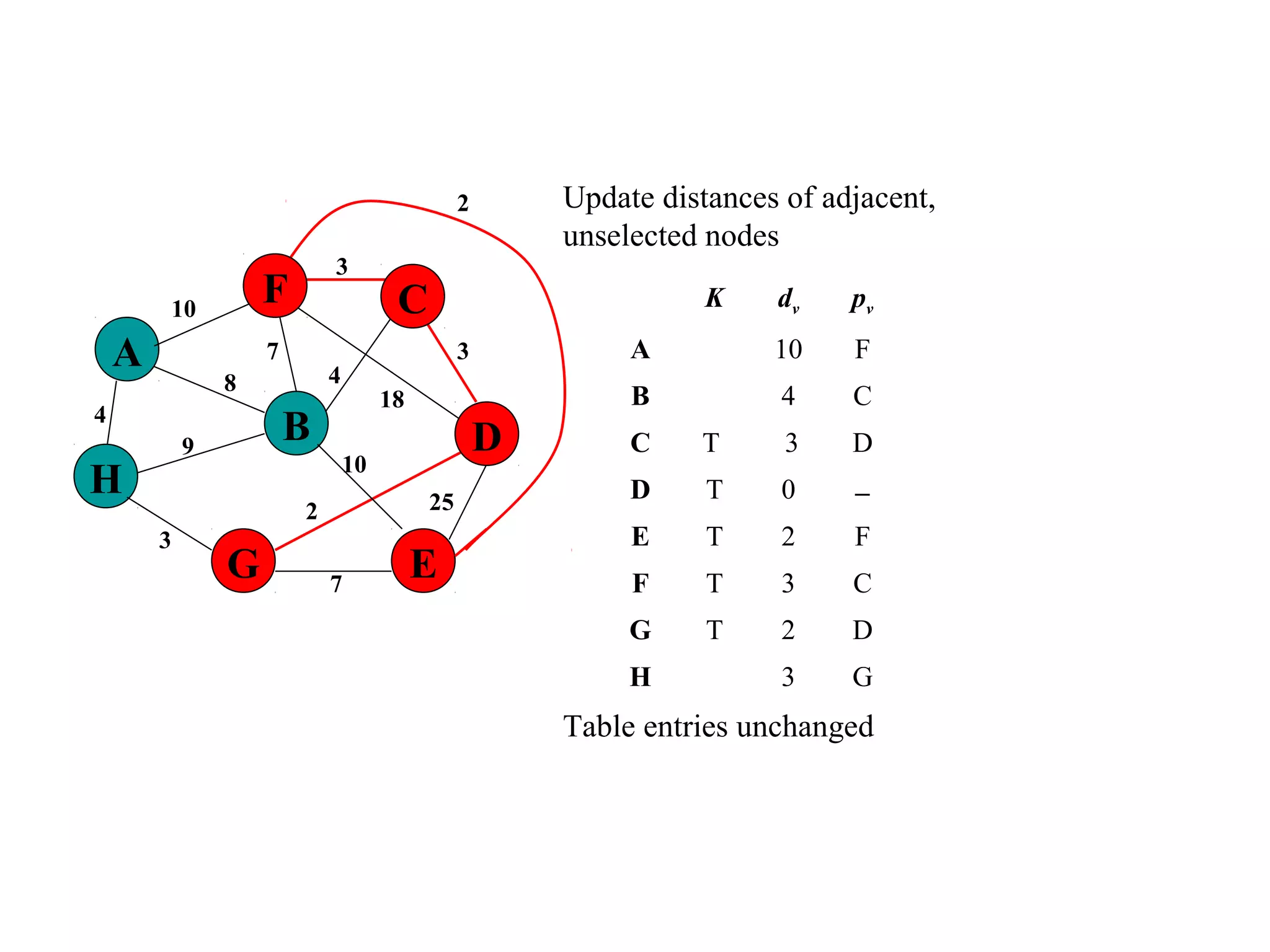
Update distances of adjacent,
unselected nodes
K dv pv
A 10 F
B 4 C
C T 3 D
D T 0 −
E T 2 F
F T 3 C
G T 2 D
H 3 G
2
Table entries unchanged
4
25
A
H
B
F
E
D
C
G 7
2
10
18
3
4
3
7
8
9
3
10
Select node with minimum
distance
K dv pv
A 10 F
B 4 C
C T 3 D
D T 0 −
E T 2 F
F T 3 C
G T 2 D
H T 3 G
2
4
25
A
H
B
F
E
D
C
G 7
2
10
18
3
4
3
7
8
9
3
10
Update distances of adjacent,
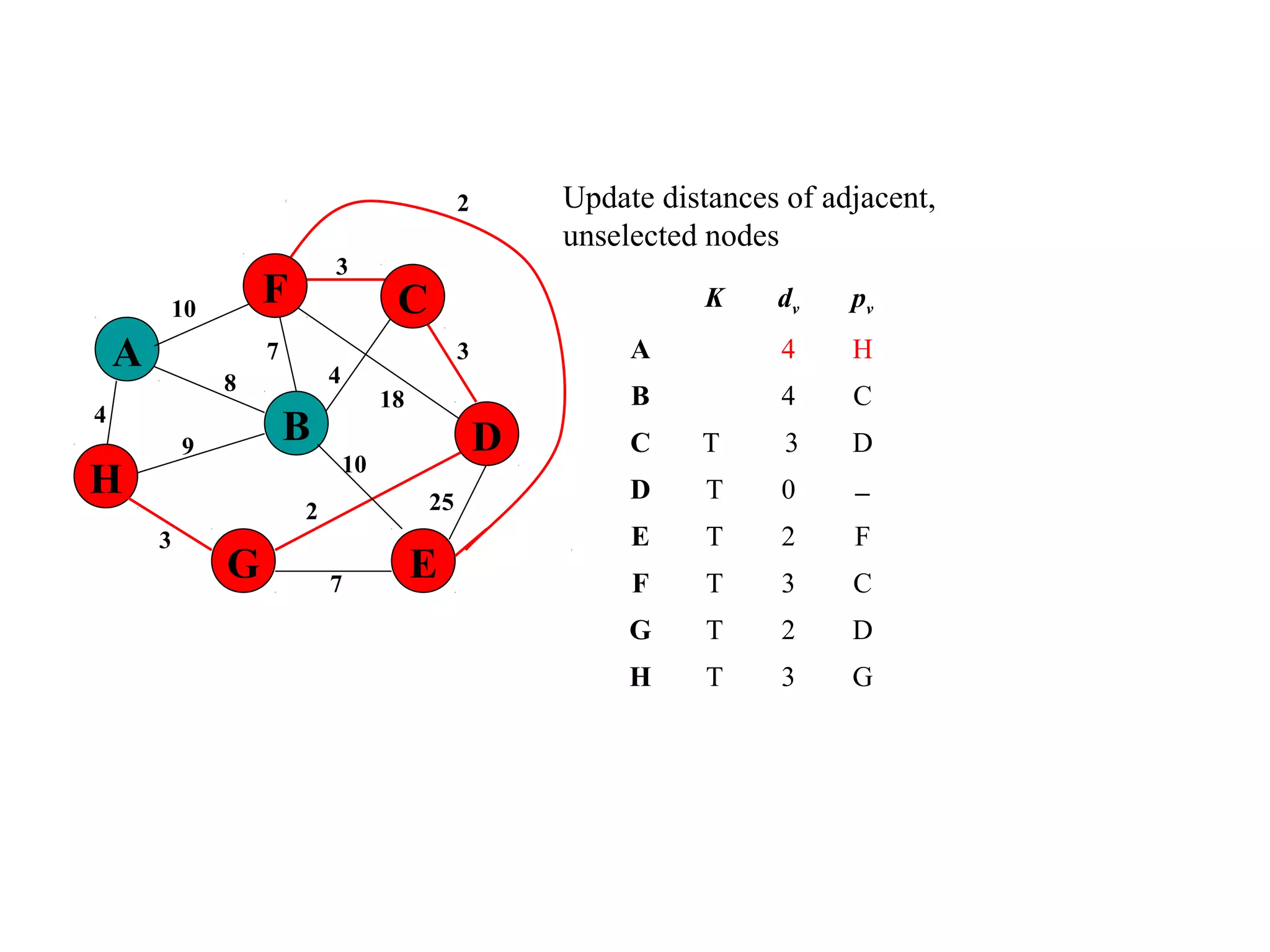
unselected nodes
K dv pv
A 4 H
B 4 C
C T 3 D
D T 0 −
E T 2 F
F T 3 C
G T 2 D
H T 3 G
2
4
25
A
H
B
F
E
D
C
G 7
2
10
18
3
4
3
7
8
9
3
10
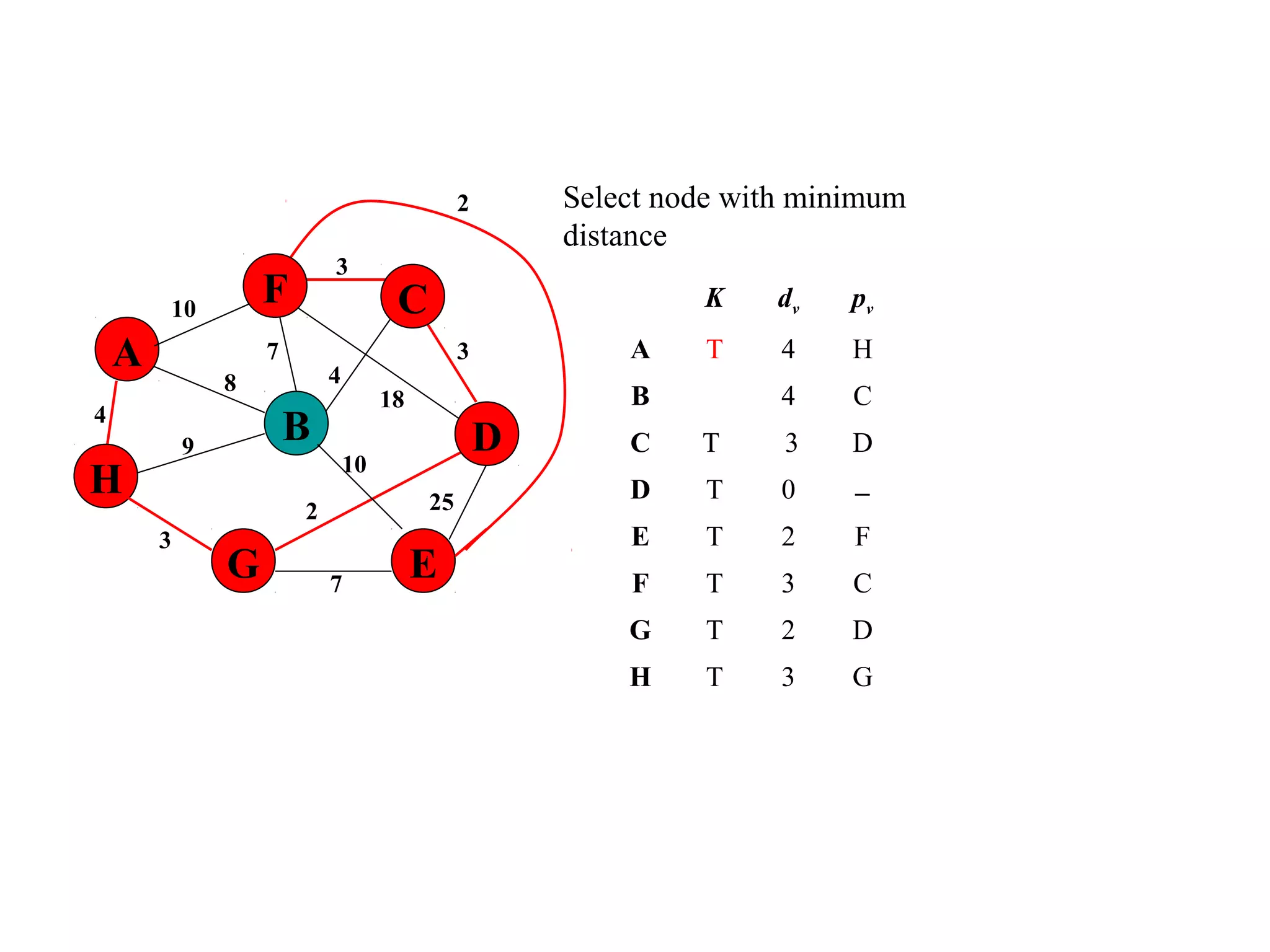
Select node with minimum
distance
K dv pv
A T 4 H
B 4 C
C T 3 D
D T 0 −
E T 2 F
F T 3 C
G T 2 D
H T 3 G
2
4
25
A
H
B
F
E
D
C
G 7
2
10
18
3
4
3
7
8
9
3
10
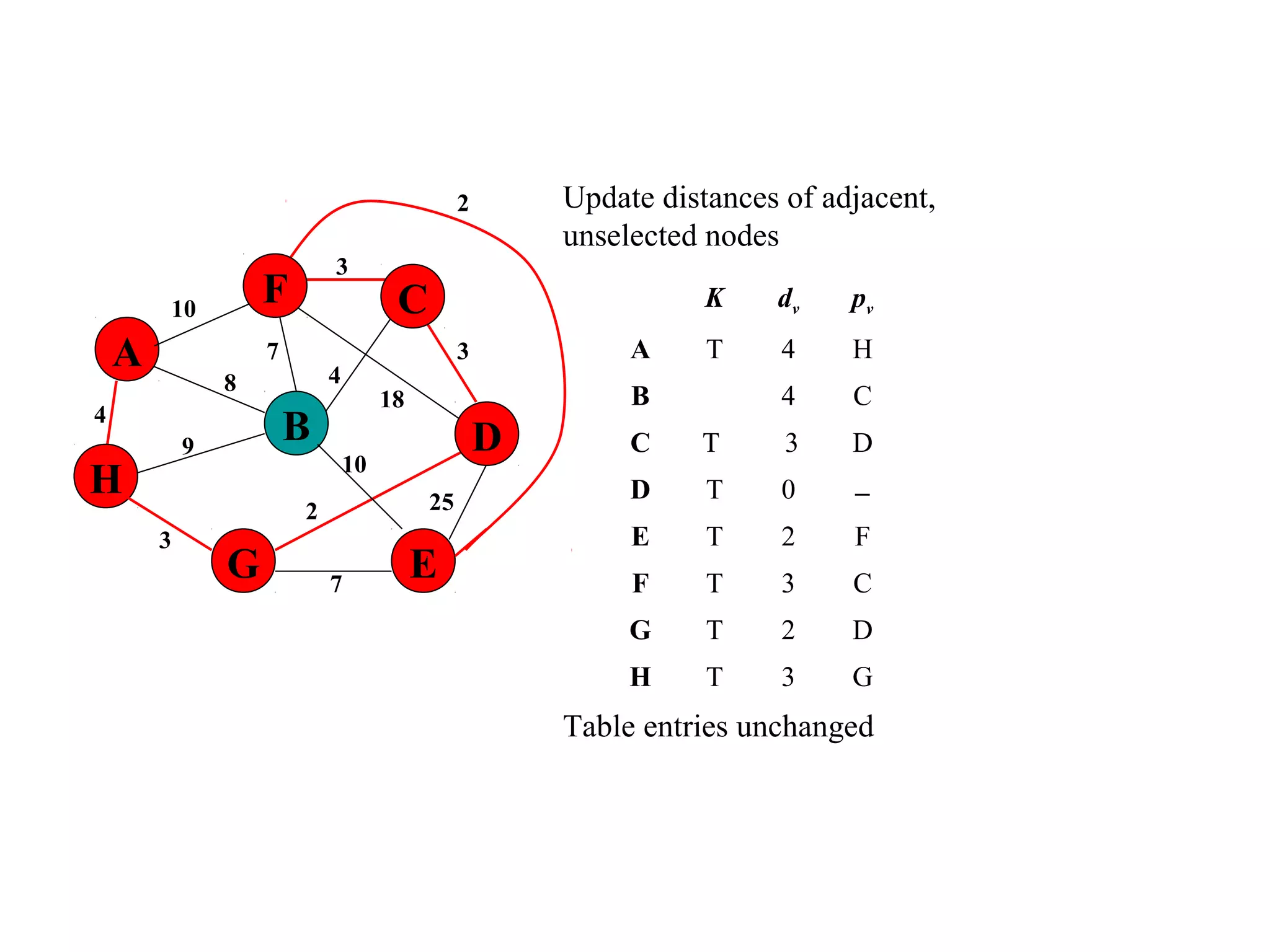
Update distances of adjacent,
unselected nodes
K dv pv
A T 4 H
B 4 C
C T 3 D
D T 0 −
E T 2 F
F T 3 C
G T 2 D
H T 3 G
2
Table entries unchanged
4
25
A
H
B
F
E
D
C
G 7
2
10
18
3
4
3
7
8
9
3
10
Select node with minimum
distance
K dv pv
A T 4 H
B T 4 C
C T 3 D
D T 0 −
E T 2 F
F T 3 C
G T 2 D
H T 3 G
2
4
A
H
B
F
E
D
C
G
2
3
4
3
3
Cost of Minimum Spanning
Tree = Σ dv = 21
K dv pv
A T 4 H
B T 4 C
C T 3 D
D T 0 −
E T 2 F
F T 3 C
G T 2 D
H T 3 G
2
Done
Kruskal’s Algorithm
Work with edges, rather than nodes
Two steps:
– Sort edges by increasing edge weight
– Select the first |V| – 1 edges that do not
generate a cycle
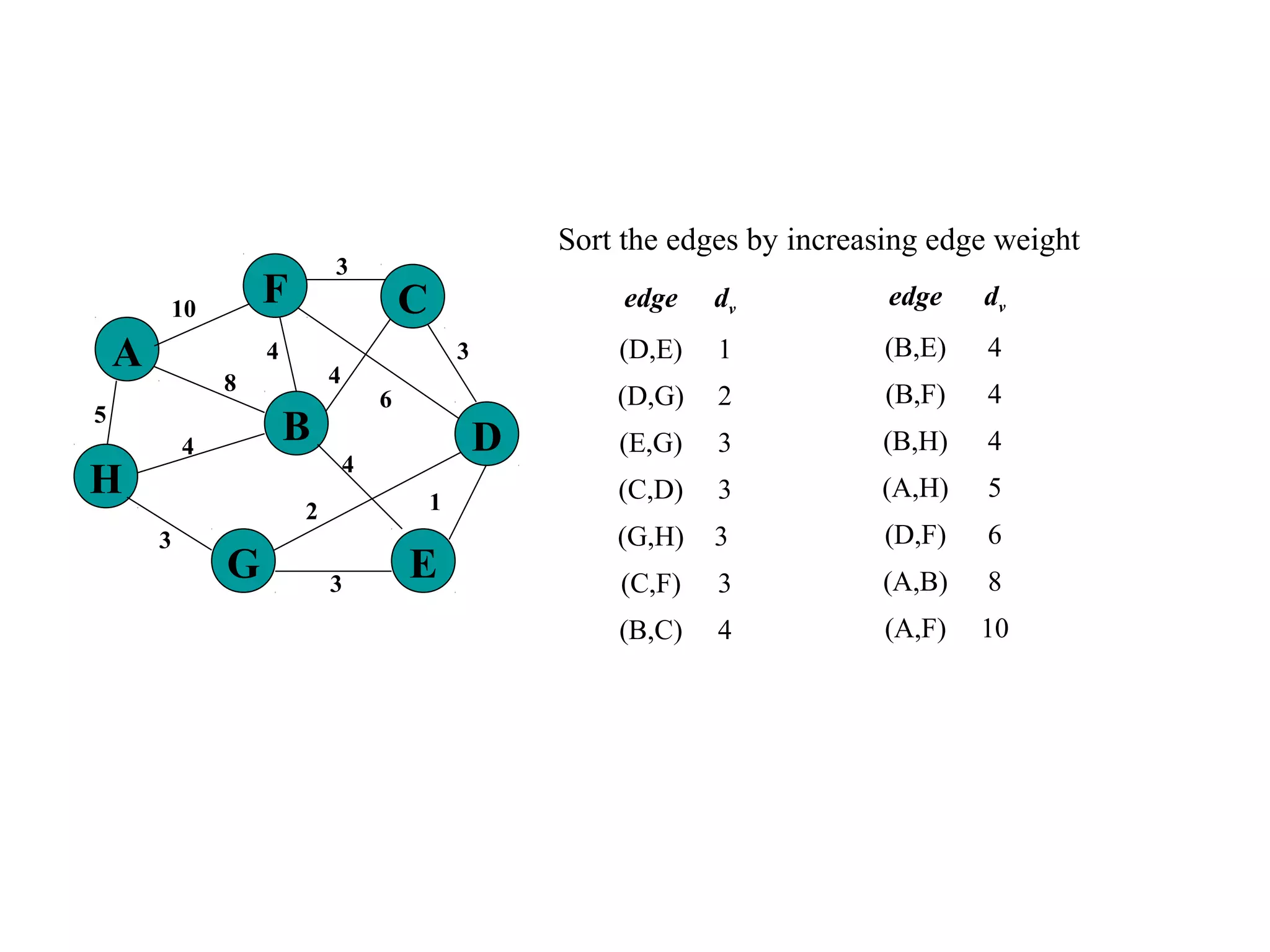
Walk-Through
Consider an undirected, weight graph
5
1
A
H
B
F
E
D
C
G 3
2
4
6
3
4
3
4
8
4
3
10
Sort the edges by increasing edge weight
edge dv
(D,E) 1
(D,G) 2
(E,G) 3
(C,D) 3
(G,H) 3
(C,F) 3
(B,C) 4
5
1
A
H
B
F
E
D
C
G 3
2
4
6
3
4
3
4
8
4
3
10 edge dv
(B,E) 4
(B,F) 4
(B,H) 4
(A,H) 5
(D,F) 6
(A,B) 8
(A,F) 10
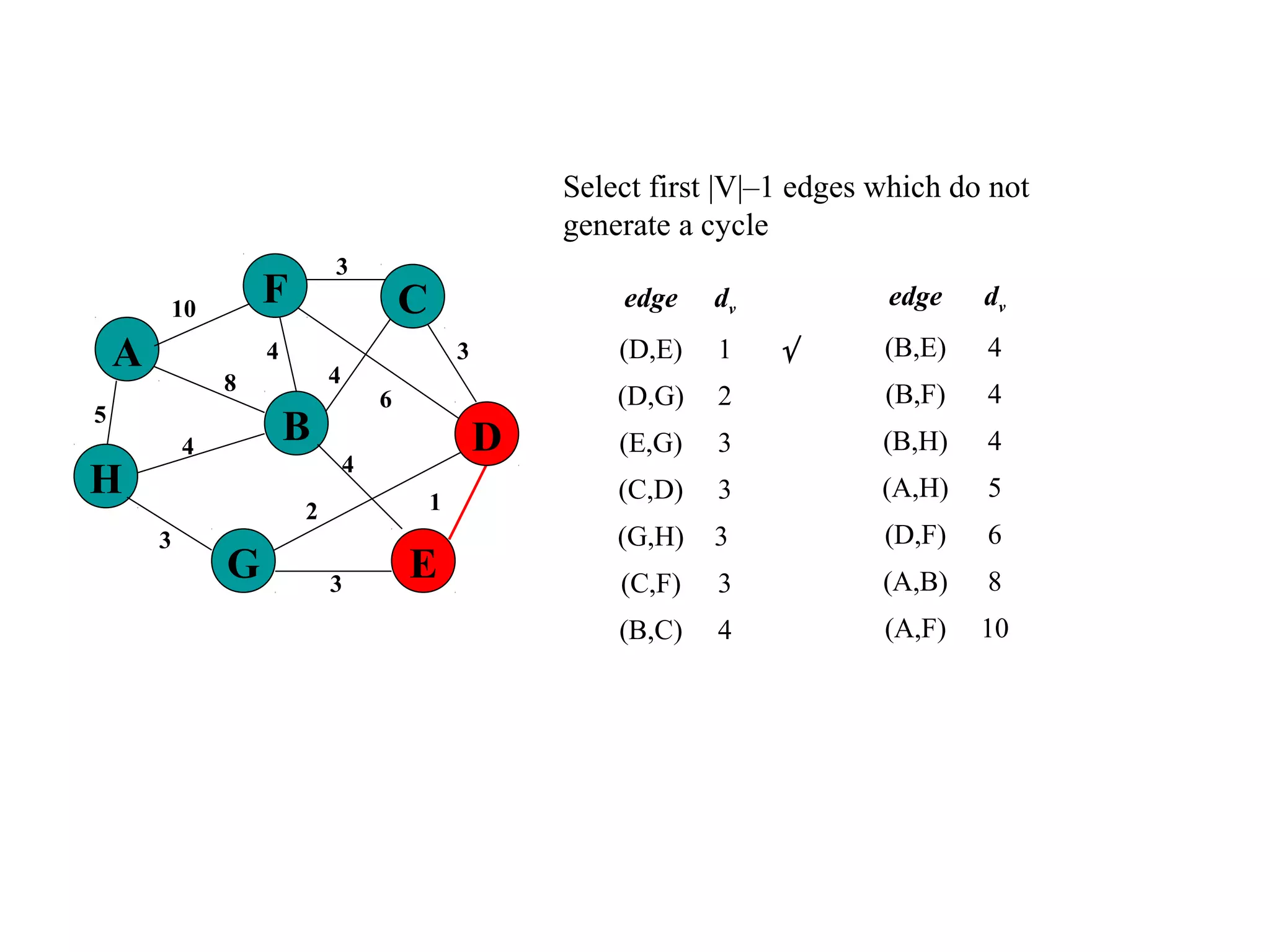
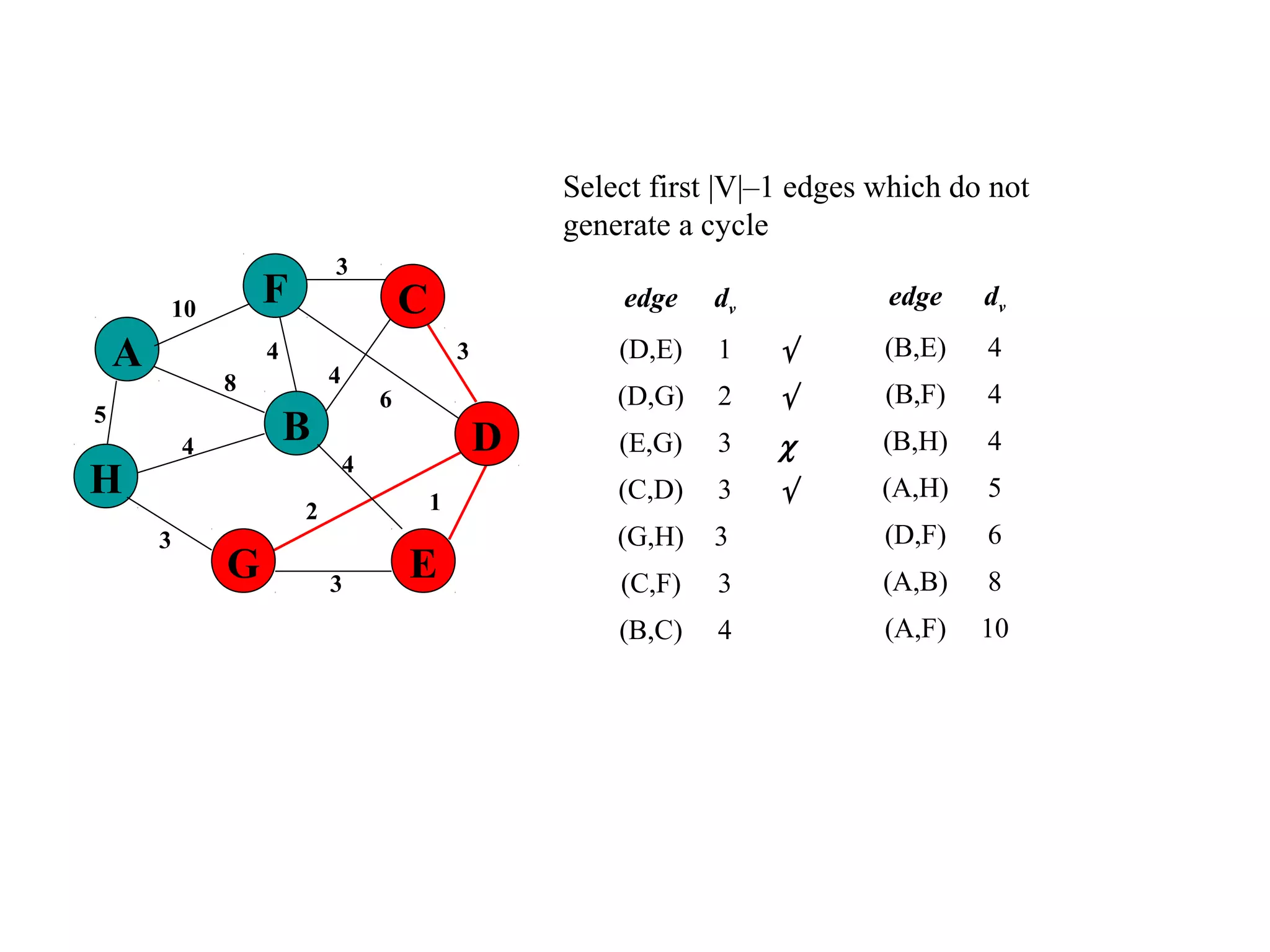
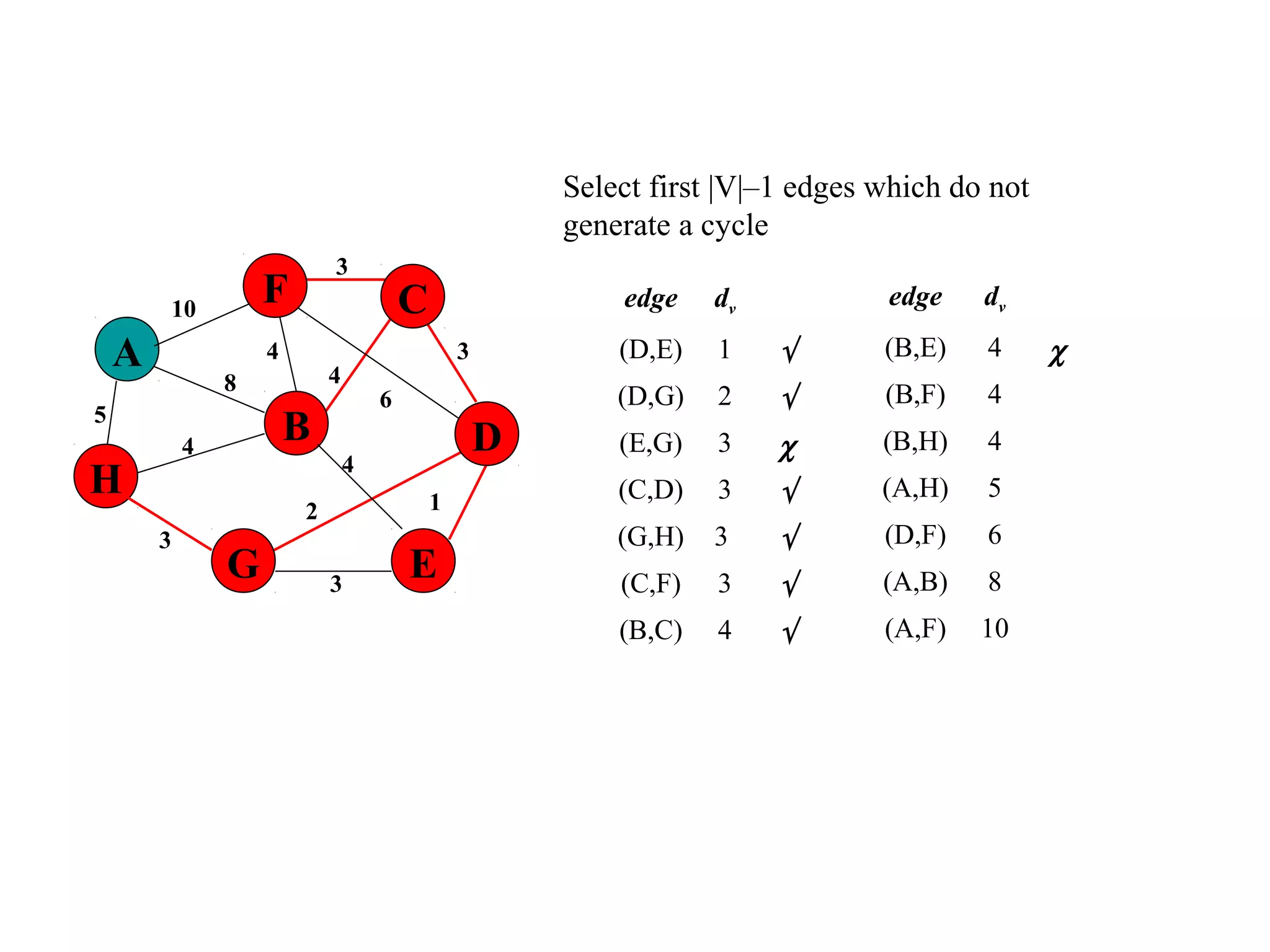
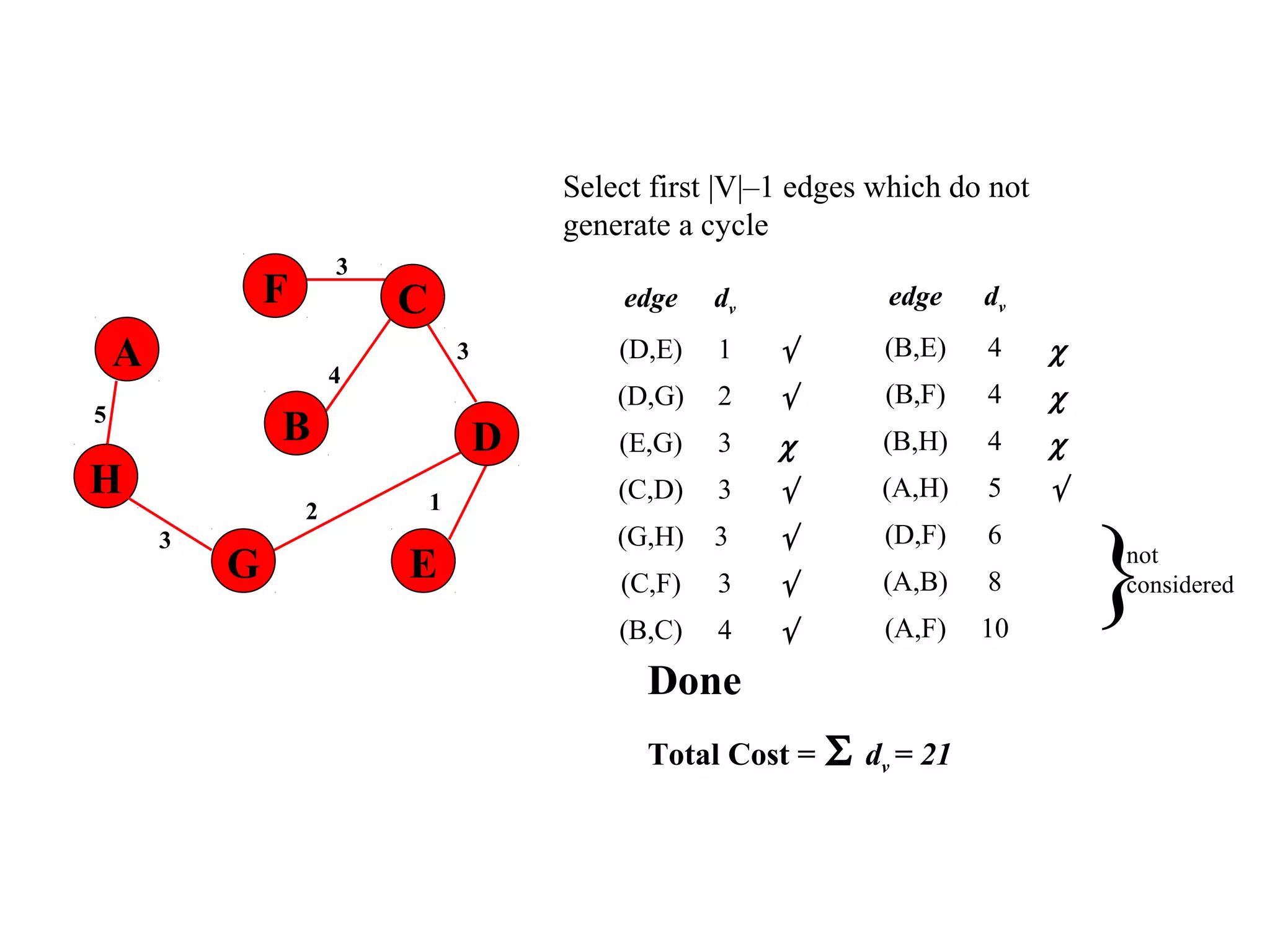
Select first |V|–1 edges which do not
generate a cycle
edge dv
(D,E) 1 √
(D,G) 2
(E,G) 3
(C,D) 3
(G,H) 3
(C,F) 3
(B,C) 4
5
1
A
H
B
F
E
D
C
G 3
2
4
6
3
4
3
4
8
4
3
10 edge dv
(B,E) 4
(B,F) 4
(B,H) 4
(A,H) 5
(D,F) 6
(A,B) 8
(A,F) 10
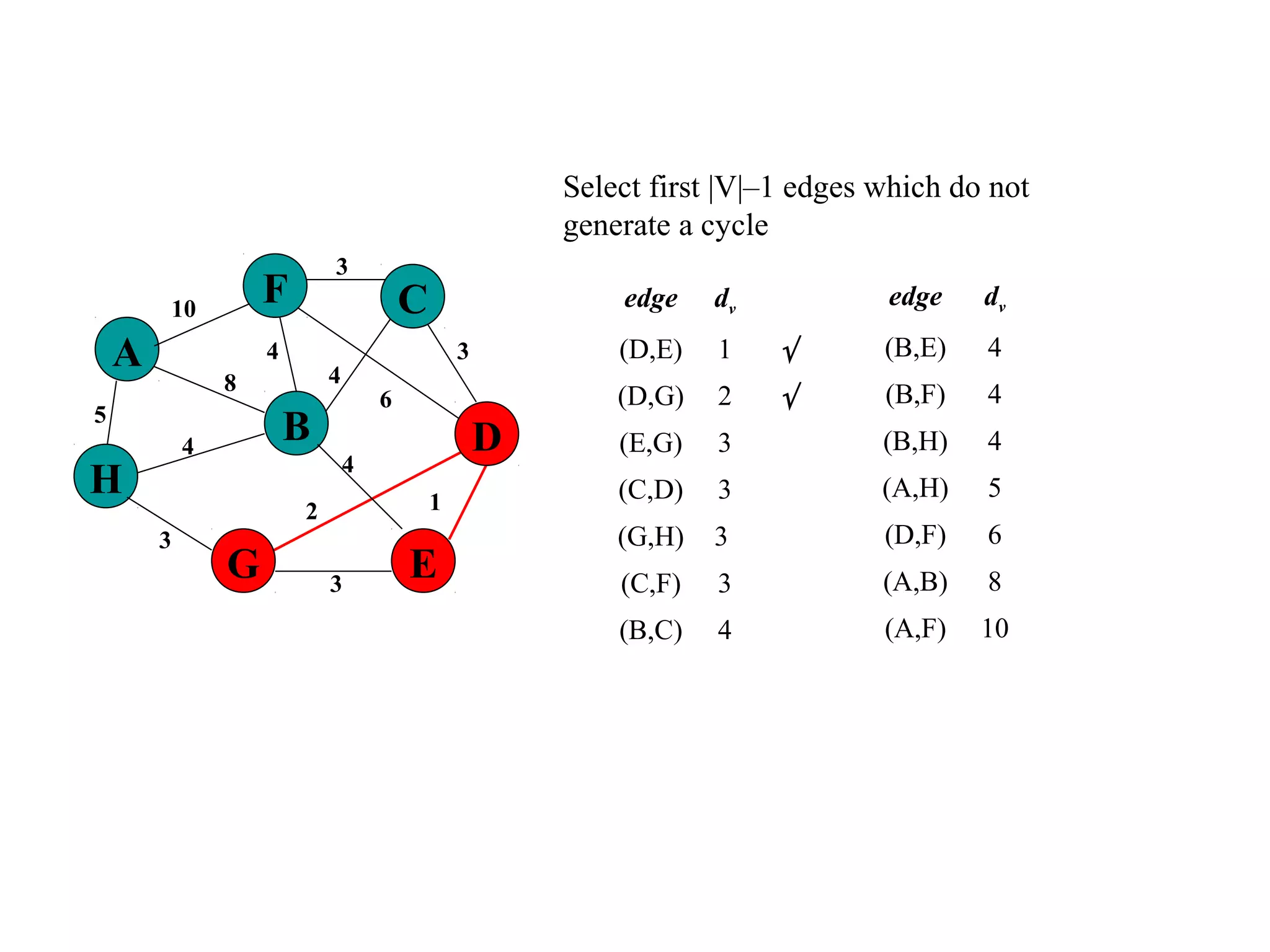
Select first |V|–1 edges which do not
generate a cycle
edge dv
(D,E) 1 √
(D,G) 2 √
(E,G) 3
(C,D) 3
(G,H) 3
(C,F) 3
(B,C) 4
5
1
A
H
B
F
E
D
C
G 3
2
4
6
3
4
3
4
8
4
3
10 edge dv
(B,E) 4
(B,F) 4
(B,H) 4
(A,H) 5
(D,F) 6
(A,B) 8
(A,F) 10
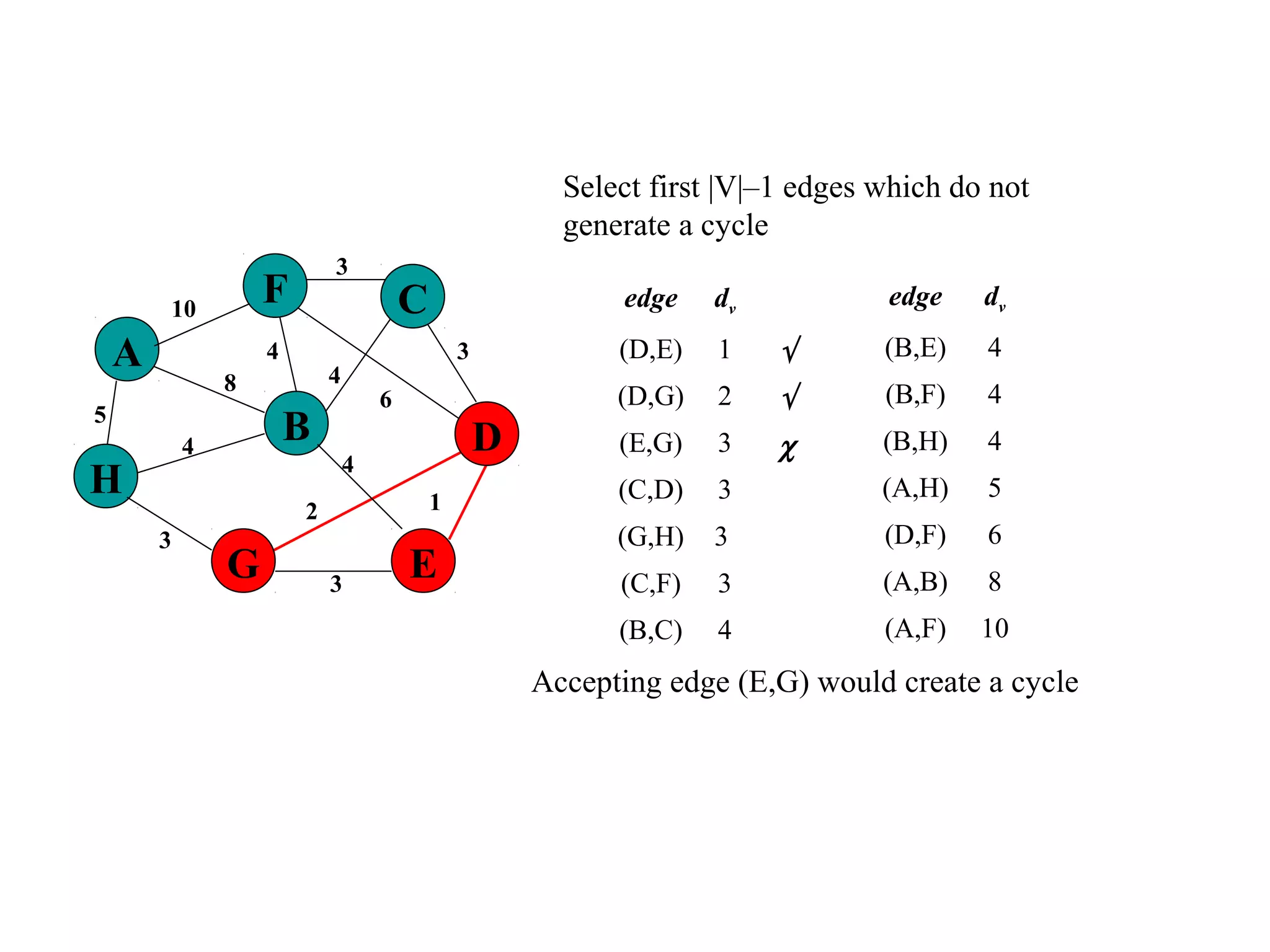
Select first |V|–1 edges which do not
generate a cycle
edge dv
(D,E) 1 √
(D,G) 2 √
(E,G) 3 χ
(C,D) 3
(G,H) 3
(C,F) 3
(B,C) 4
5
1
A
H
B
F
E
D
C
G 3
2
4
6
3
4
3
4
8
4
3
10 edge dv
(B,E) 4
(B,F) 4
(B,H) 4
(A,H) 5
(D,F) 6
(A,B) 8
(A,F) 10
Accepting edge (E,G) would create a cycle
Select first |V|–1 edges which do not
generate a cycle
edge dv
(D,E) 1 √
(D,G) 2 √
(E,G) 3 χ
(C,D) 3 √
(G,H) 3
(C,F) 3
(B,C) 4
5
1
A
H
B
F
E
D
C
G 3
2
4
6
3
4
3
4
8
4
3
10 edge dv
(B,E) 4
(B,F) 4
(B,H) 4
(A,H) 5
(D,F) 6
(A,B) 8
(A,F) 10
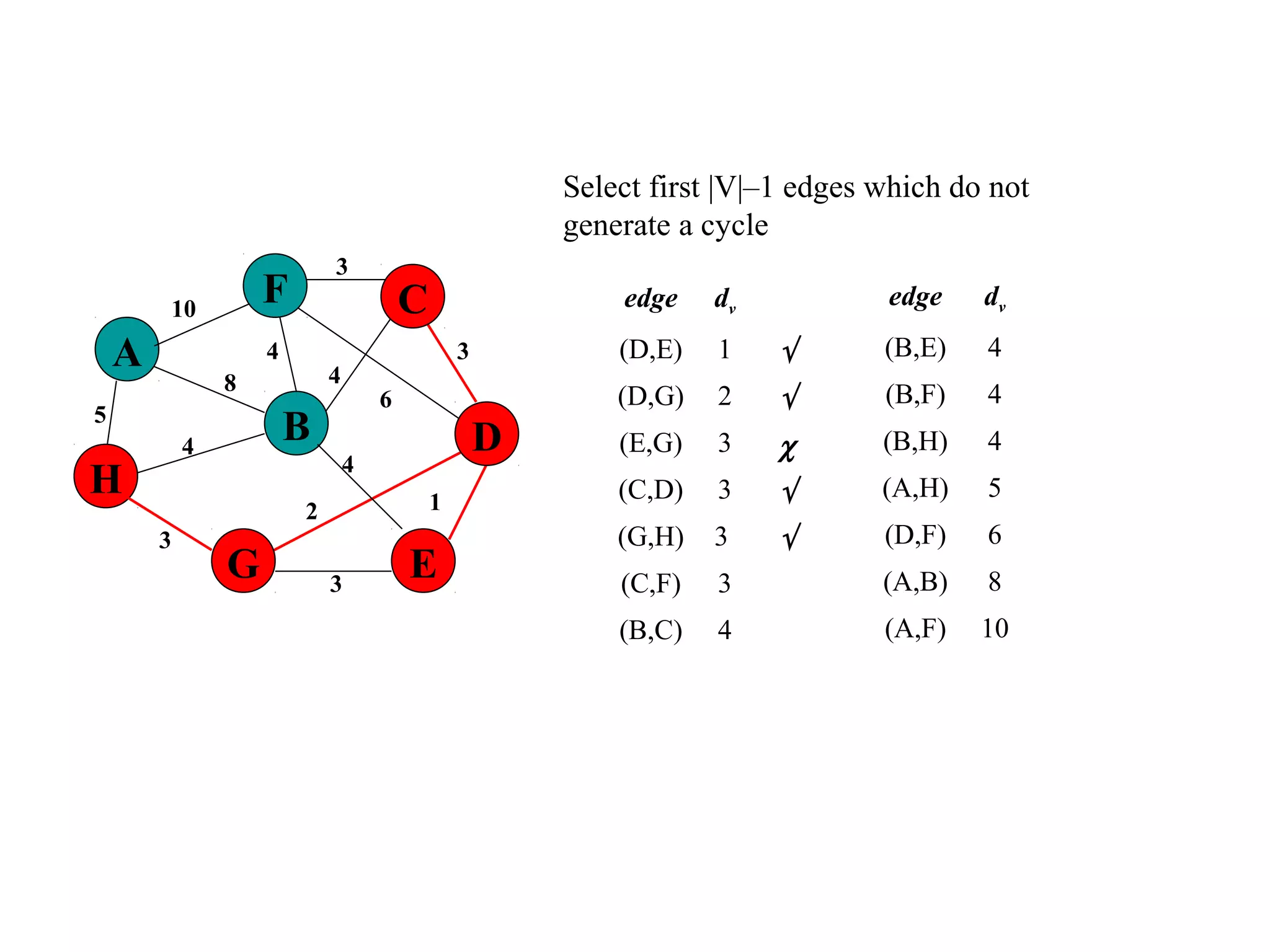
Select first |V|–1 edges which do not
generate a cycle
edge dv
(D,E) 1 √
(D,G) 2 √
(E,G) 3 χ
(C,D) 3 √
(G,H) 3 √
(C,F) 3
(B,C) 4
5
1
A
H
B
F
E
D
C
G 3
2
4
6
3
4
3
4
8
4
3
10 edge dv
(B,E) 4
(B,F) 4
(B,H) 4
(A,H) 5
(D,F) 6
(A,B) 8
(A,F) 10
Select first |V|–1 edges which do not
generate a cycle
edge dv
(D,E) 1 √
(D,G) 2 √
(E,G) 3 χ
(C,D) 3 √
(G,H) 3 √
(C,F) 3 √
(B,C) 4
5
1
A
H
B
F
E
D
C
G 3
2
4
6
3
4
3
4
8
4
3
10 edge dv
(B,E) 4
(B,F) 4
(B,H) 4
(A,H) 5
(D,F) 6
(A,B) 8
(A,F) 10
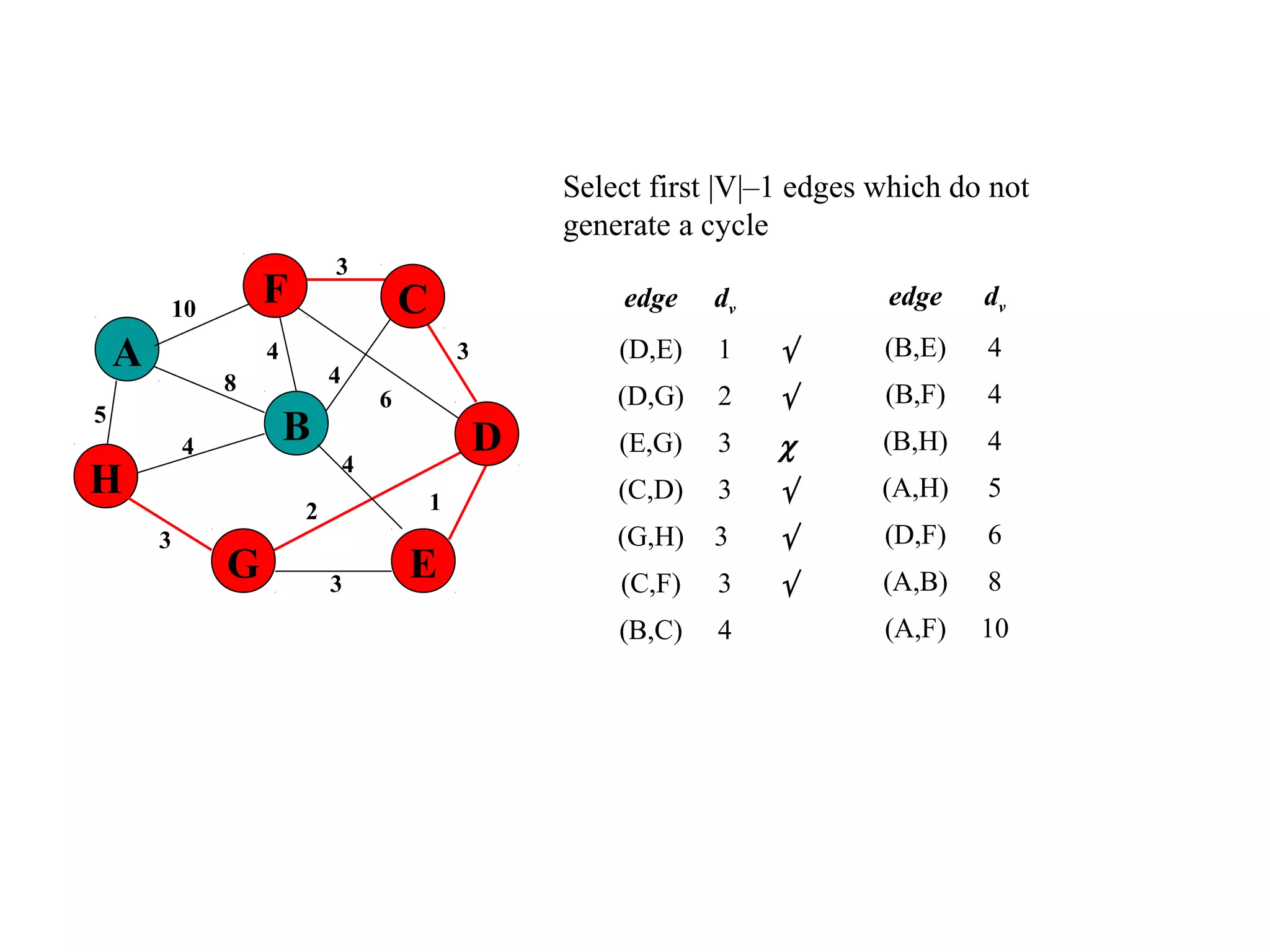
Select first |V|–1 edges which do not
generate a cycle
edge dv
(D,E) 1 √
(D,G) 2 √
(E,G) 3 χ
(C,D) 3 √
(G,H) 3 √
(C,F) 3 √
(B,C) 4 √
5
1
A
H
B
F
E
D
C
G 3
2
4
6
3
4
3
4
8
4
3
10 edge dv
(B,E) 4
(B,F) 4
(B,H) 4
(A,H) 5
(D,F) 6
(A,B) 8
(A,F) 10
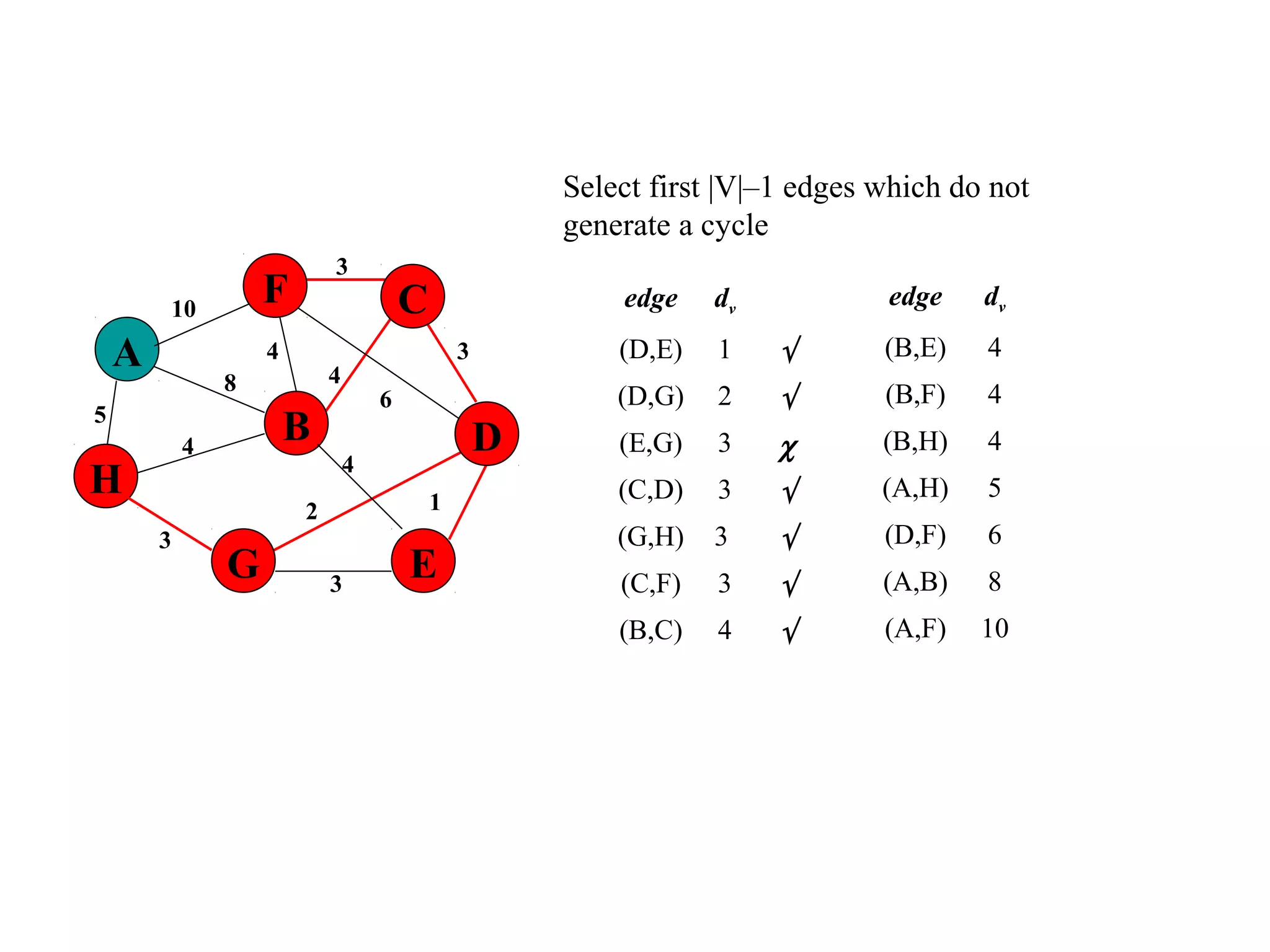
Select first |V|–1 edges which do not
generate a cycle
edge dv
(D,E) 1 √
(D,G) 2 √
(E,G) 3 χ
(C,D) 3 √
(G,H) 3 √
(C,F) 3 √
(B,C) 4 √
5
1
A
H
B
F
E
D
C
G 3
2
4
6
3
4
3
4
8
4
3
10 edge dv
(B,E) 4 χ
(B,F) 4
(B,H) 4
(A,H) 5
(D,F) 6
(A,B) 8
(A,F) 10
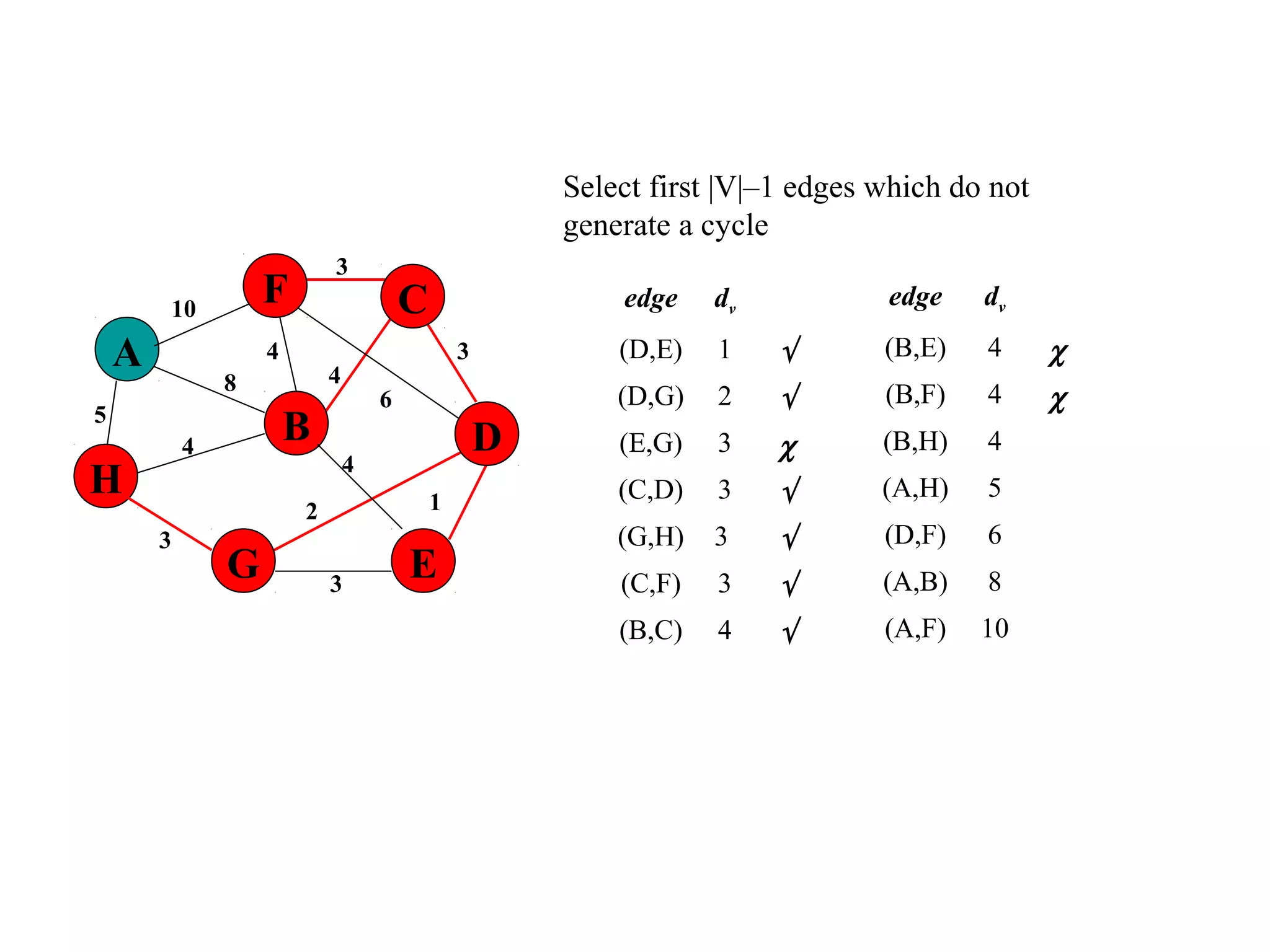
Select first |V|–1 edges which do not
generate a cycle
edge dv
(D,E) 1 √
(D,G) 2 √
(E,G) 3 χ
(C,D) 3 √
(G,H) 3 √
(C,F) 3 √
(B,C) 4 √
5
1
A
H
B
F
E
D
C
G 3
2
4
6
3
4
3
4
8
4
3
10 edge dv
(B,E) 4 χ
(B,F) 4 χ
(B,H) 4
(A,H) 5
(D,F) 6
(A,B) 8
(A,F) 10
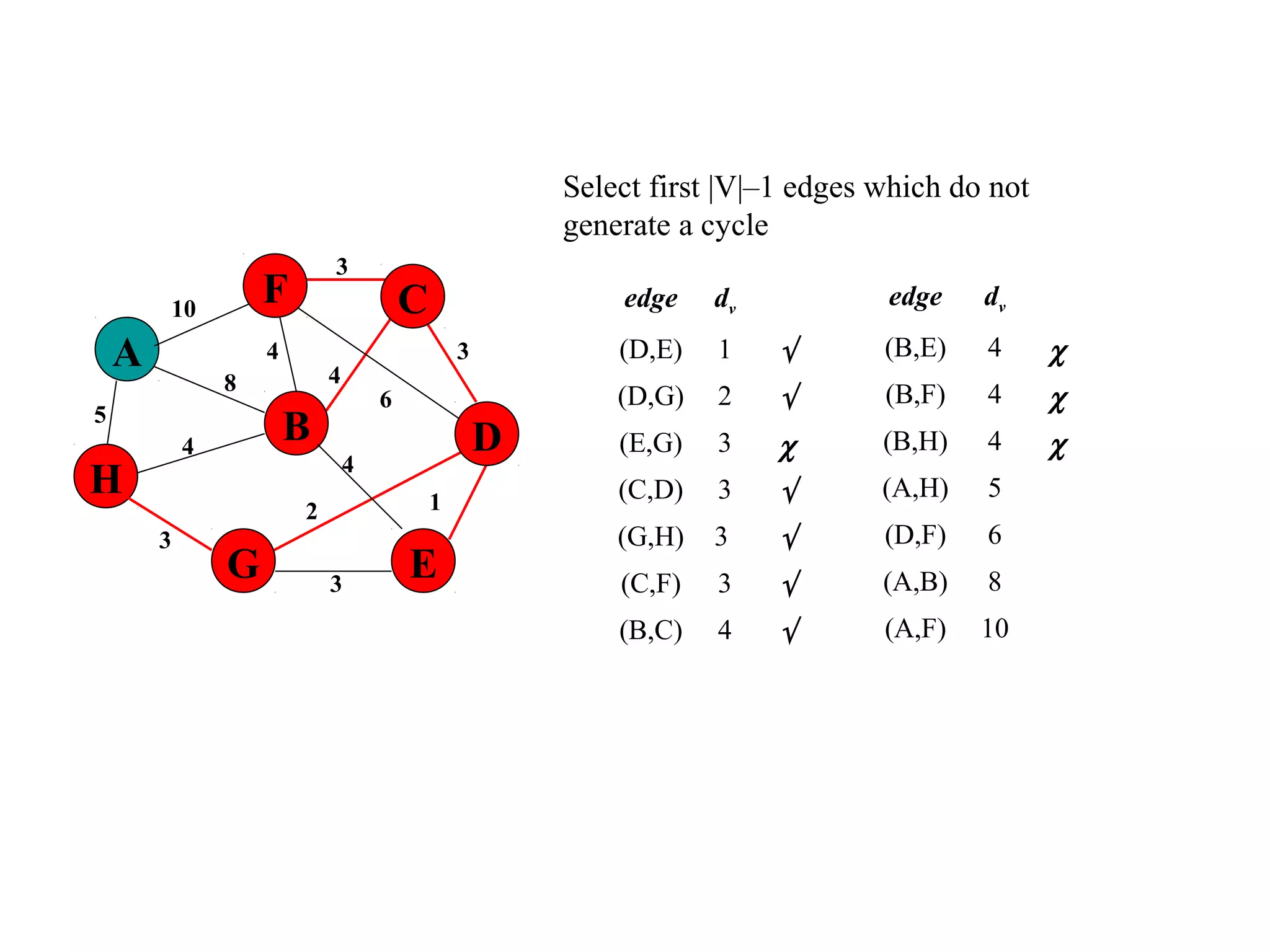
Select first |V|–1 edges which do not
generate a cycle
edge dv
(D,E) 1 √
(D,G) 2 √
(E,G) 3 χ
(C,D) 3 √
(G,H) 3 √
(C,F) 3 √
(B,C) 4 √
5
1
A
H
B
F
E
D
C
G 3
2
4
6
3
4
3
4
8
4
3
10 edge dv
(B,E) 4 χ
(B,F) 4 χ
(B,H) 4 χ
(A,H) 5
(D,F) 6
(A,B) 8
(A,F) 10
Select first |V|–1 edges which do not
generate a cycle
edge dv
(D,E) 1 √
(D,G) 2 √
(E,G) 3 χ
(C,D) 3 √
(G,H) 3 √
(C,F) 3 √
(B,C) 4 √
5
1
A
H
B
F
E
D
C
G 3
2
4
6
3
4
3
4
8
4
3
10 edge dv
(B,E) 4 χ
(B,F) 4 χ
(B,H) 4 χ
(A,H) 5 √
(D,F) 6
(A,B) 8
(A,F) 10
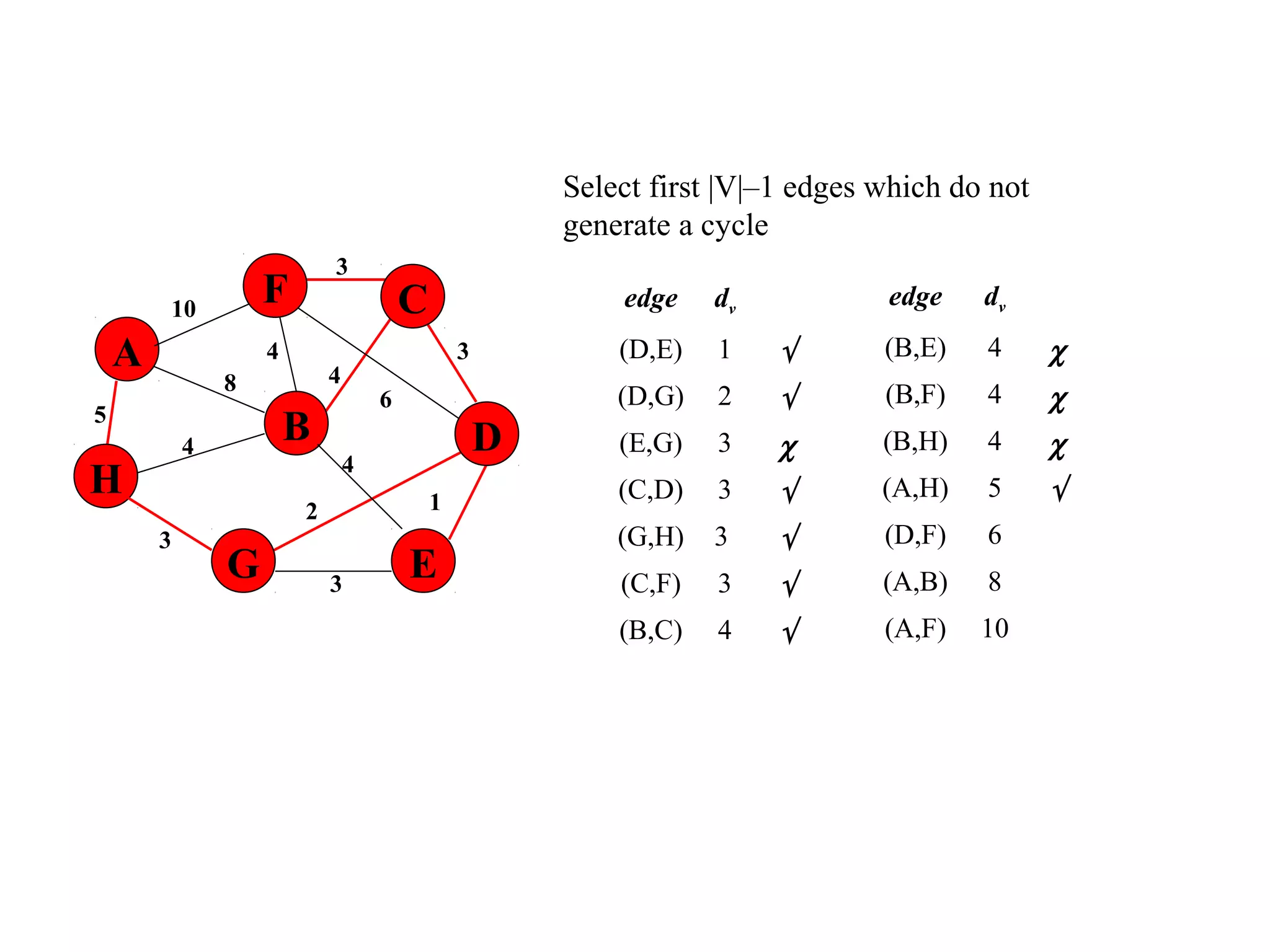
Select first |V|–1 edges which do not
generate a cycle
edge dv
(D,E) 1 √
(D,G) 2 √
(E,G) 3 χ
(C,D) 3 √
(G,H) 3 √
(C,F) 3 √
(B,C) 4 √
5
1
A
H
B
F
E
D
C
G
2
3
3
3
edge dv
(B,E) 4 χ
(B,F) 4 χ
(B,H) 4 χ
(A,H) 5 √
(D,F) 6
(A,B) 8
(A,F) 10
Done
Total Cost = Σ dv = 21
4
}not
considered

Graph theory

  • 1.
  • 2.
    Graphs consist of points called vertices  lines called edges 1. Edges connect two vertices. 2. Edges only intersect at vertices. 3. Edges joining a vertex to itself are called loops. ExampleExample 1: The following picture1: The following picture is a graph. List its vertices andis a graph. List its vertices and edges.edges. AA B CC D E
  • 3.
    Example 2: FlexoFlexo BenderBenderLeelaLeela FryFry AmyAmy This is also a graph. The vertices just happen to have people’s names. Such a graph could represent friendships (or any kind of relationship). QuickTime™ and a TIFF (LZW) decompressor are needed to see this picture. QuickTime™ and a TIFF (LZW) decompressor are needed to see this picture. FarnsworthFarnsworth ZoidbergZoidberg
  • 4.
    FlexoFlexo BenderBender LeelaLeela FryFry AmyAmy FarnsworthFarnsworth Now checkout the graph below. What can we say about it in comparison to the previous figure? QuickTime™ and a TIFF (LZW) decompressor are needed to see this picture. QuickTime™ and a TIFF (LZW) decompressor are needed to see this picture. ZoidbergZoidberg
  • 5.
    • One graphmay be drawn in (infinitely) many ways, but it always provides us with the same information. • Graphs are a structure for describing relationships between objects. (The vertices denote the objects and the edges represent the relationship.) Moral of the Story
  • 6.
  • 7.
    Graph TerminologyGraph Terminology (ie- all the math-y jargon one could ask for)  Adjacent Vertices are two vertices that are joined by an edge.  Adjacent Edges are two edges that intersect at a vertex.  The degree of a vertex is the number of edges at that vertex.
  • 8.
    Graph TerminologyGraph Terminology Aloop counts twice toward the degree. An odd vertex is a vertex of odd degree. An even vertex is a vertex of even degree.
  • 9.
    ExampleExample 3:3: AA BB CC DD EE 1)1) Findthe degree ofFind the degree of each vertex.each vertex. 2)2) Is A adjacent to B?Is A adjacent to B? Is D adjacent to A?Is D adjacent to A? Is E adjacent toIs E adjacent to itself?itself? Is C adjacent toIs C adjacent to itself?itself? 3)3) Is AB adjacent toIs AB adjacent to BC?BC? Is CE adjacent toIs CE adjacent to BD?BD?
  • 10.
    Graph TerminologyGraph Terminology Apath is a sequence of vertices such that each vertex is adjacent to the next. In a path, each edge can be traveled only once. •The length of a path is the number of edges in that path.
  • 11.
    Graph TerminologyGraph Terminology •Apath that starts and ends at the same vertex is called a circuit. •A graph is connected if any two vertices can be joined by a path. If this is not possible then the graph is disconnected.
  • 12.
    Graph TerminologyGraph Terminology •Theconnected parts of a disconnected graph are called components. •A bridge is an edge in a connected graph whose removal makes it disconnected.
  • 13.
    B H S J W K Example 4: 1)Find a path from B to K passing through W but not S. 2) Find a path from H to J of length 4. 3) Find a circuit of length 5. 4) Find a circuit of length 1. 5) Find a bridge.Example 5: Draw a picture of a graph that satisfies the following: Vertices: A, B, C, D Edges: AB, AC, AD, B is adjacent to D.
  • 14.
    Graph TerminologyGraph Terminology •AnEuler Path is a path that travels through every edge of the graph (once and only once). •An Euler Circuit is a circuit that travels through every edge of a graph.
  • 15.
    R A L D R A L D ExampleExample 6:6: Thegraph on the left has no Euler paths, but the one on the right has several.
  • 16.
    §5.4 - 5.5Graph Models and Euler’s Theorems “Now I will have less distraction.” - Leonhard Euler after losing sight in his right eye.
  • 17.
    Königsberg’s Bridges II (Therare sequel that is not entirely gratuitous.) Recall from Tuesday the puzzle that the residents of Königsburg had been unable to solve until Euler’s arrival: • Is there a way to cross all seven bridges exactly once and return to your starting point? • Is there even a way to cross all seven bridges exactly once? A A stylized (i.e. - inaccurate) map of Königsberg’s Bridges. A R L D
  • 18.
    A R A L D R A L D What Euler realizedwas that most of the information on the maps had no impact on the answers to the two questions. By thinking of each bank and island as a vertex and each bridge as an edge joining them Euler was able to model the situation using the graph on the right. Hence, the Königsberg puzzle is the same as asking if the graph has an Euler path or Euler circuit.
  • 19.
    Example: Slay-ageSlay-age• TheScooby Gang needs to patrol the following section of town starting at Sunnydale High (labeled G). Draw a graph that models this situation, assuming that each side of the street must be checked except for those along the park. (Map is from p. 206)
  • 20.
    Example 2: (Exercise21, pg 207) The map to the right of downtown Kingsburg, shows the Kings River running through the downtown area and the three islands (A, B, and C) connected to each other and both banks by seven bridges. The Chamber of Commerce wants to design a walking tour that crosses all the bridges. Draw a graph that models the layout of Kingsburg.
  • 21.
    Example 3: The KevinBacon Game (http://www.cs.virginia.edu/oracle/)
  • 22.
    Euler’s Theorems • Euler’sTheorem 1Euler’s Theorem 1 (a) If a graph has any odd vertices, then it cannot have an Euler circuit. (b) If a graph is connected and every vertex is even, then it has at least one Euler circuit.
  • 23.
    • Euler’s Theorem2Euler’s Theorem 2 (a) If a graph has more than two odd vertices, then it cannot have an Euler path. (b) If a connected graph has exactly two odd vertices then it has at least one Euler path starting at one odd vertex and ending at another odd vertex.
  • 24.
    Example 4: Königsburg’sBridges IIIKönigsburg’s Bridges III (The Search For More MoneyThe Search For More Money) Let us consider again the Königsburg Brdige puzzle as represented by the graph below: R A L D We have already seen that the puzzle boils down to whether this graph has an Euler path and/or an Euler circuit. Does this graph have either?
  • 25.
    Example 5: (Exercise60, pg 214) Refer to Example 2. Is it possible to take a walk such that you cross each bridge exactly once? Explain why or why not. N A B C S
  • 26.
    ExampleExample 6: UnicursalTracings6: Unicursal Tracings Recall the routing problems presented on Tuesday: •“Do these drawings have unicursal tracings? If so, are they open or closed?” (a) (b) (c) How might we answer these queries? Well, if we add vertices to the corners of the tracings we can reduce the questions to asking whether the following graphs have Euler paths (open tracing) and/or Euler circuits (closed tracing).
  • 27.
    • Euler’s Theorem3Euler’s Theorem 3 (a) The sum of the degrees of all the vertices of a graph equals twice the number of edges. (b) A graph always has an even number of odd vertices.
  • 28.
    A quick summary. . .A quick summary . . . Number of odd verticesNumber of odd vertices ConclusionConclusion 0 Graph has Euler circuit(s) 2 Graph has Euler path(s) but no Euler circuit 4, 6, 8, . . . Graph has no Euler path and no Euler circuit 1, 3, 5, . . . Impossible!
  • 29.
  • 30.
    • Euler’s Theoremsgive us a simple way to see whether an Euler circuit or an Euler path exists in a given graph, but how do we find the actual circuit or path? • We could use a “guess-and-check” method, but for a large graph this could lead to many wasted hours--and not wasted in a particularly fun way!
  • 31.
    Algorithms An algorithm isa set of procedures/rules that, when followed, will always lead to a solution* to a given problem. • Some algorithms are formula driven--they arrive at answers by taking data and ‘plugging-in’ to some equation or function. • Other algorithms are directive driven--they arrive at answers by following a given set of directions.
  • 32.
    Fleury’s Algorithm • TheIdea: “Don’t burn your bridges behind you.” (“bridges”: graph-theory bridges, not real world) • When trying to find an Euler path or an Euler circuit, bridges are the last edges we should travel. • Subtle point: Once we have traversed an edge we no longer care about it--so by “bridges” we mean the bridges of the part of the graph that we haven’t traveled yet.
  • 33.
    ExampleExample 1:1: Doesthis graph have an Euler circuit? If so, find one. A B C D E F
  • 34.
    Fleury’sFleury’s AlgorithmAlgorithm 1) Ensurethe graph is connected and all the vertices are even*. 2) Pick any vertex as the starting point. 3) When you have a choice, always travel along an edge that is not a bridge of the yet- to-be-traveled part of the graph. 4) Label the edges in the order which you travel. 5) When you can’t travel anymore, stop. * - This works when we have an Euler circuit. If we only have a path, we must start at one of (two) the odd vertices.
  • 35.
    ExampleExample 2:2: Dothe following drawings have unicursal tracings? If so, label the edges 1, 2, 3, . . . In the order in which they can be traced.
  • 36.
    Example 3: (Exercise60, pg 214) The map to the right of downtown Kingsburg, shows the Kings River running through the downtown area and the three islands (A, B, and C) connected to each other and both banks by seven bridges. The Chamber of Commerce wants to design a walking tour that crosses all the bridges. Draw a graph that models the layout of Kingsburg. It was shown yesterday that it was possible to take a walk in such that you cross each bridge exactly once. Show how. N A B C S
  • 37.
    Example: Slay-ageSlay-age• TheScooby Gang needs to patrol the following section of town starting at Sunnydale High (labeled G). Suppose that they must check each side of the street except for those along the park. Find an optimal route for our intrepid demon hunters to take.
  • 38.
    North Bank (N) A B C SouthBank (S) Quiz 1, problem 2
  • 39.
    Mathematics and theArts? • One of Euler’s 800+One of Euler’s 800+ publicationspublications included a treatiseincluded a treatise on music theory.on music theory. • Book was too math-Book was too math- y for mosty for most composers--toocomposers--too music-y for mostmusic-y for most mathematiciansmathematicians
  • 40.
    Mathematics and theArts? • While Euler’sWhile Euler’s theories did nottheories did not catch on, acatch on, a relationship betweenrelationship between mathematics andmathematics and music compositionmusic composition does exist in what isdoes exist in what is called thecalled the goldengolden ratioratio..
  • 41.
    Fibonacci Numbers • TheFibonacci Numbers are those that comprise the sequence: 1, 1, 2, 3, 5, 8, 13, 21, . . . • The sequence can be defined by: F1=1, F2=1; Fn=Fn-1+Fn-2 • These numbers can be used to draw a series of ‘golden’ rectangles like those to the right.
  • 42.
    Fibonacci Numbers • Thesequence of Fibonacci Ratios - fractions like 3/5, 5/8, 8/13 approach a number called the Golden Ratio (≈0.61803398…)
  • 43.
    The Golden Ratio •Several of Mozart’s piano sonatas make use of this ratio. • At the time such pieces regularly employed a division into two parts 1. Exposition and Development 2. Recapitulation • In Piano Sonata No. 1 the change between parts occurs at measure 38 of 100. (which means that part 2 is 62 ≈ 0.618 x 100)
  • 44.
    The Golden Ratio •Another example in music is in the ‘Hallelujah’ chorus in Handel’s Messiah. • The piece is 94 measures long. • Important events in piece: 1. Entrance of trumpets - “King of Kings” occurs in measures 57-58 ≈ (8/13) x 94 2. “The kingdom of glory…” occurs in meas. 34-35 ≈ (8/13) x 57 etc, etc. . .
  • 45.
    The Golden Ratioin Art H Approx. = 0.618 x H
  • 46.
    The Golden Ratioin Art H Approx. = 0.618 x H
  • 47.
  • 48.
    The Golden Ratioin Art .618xHt. 0.618 x Width
  • 49.
    The Golden Ratioin Art .618xHt. 0.618 x Width
  • 50.
    Minimum Spanning Trees Prim’sAlgorithm Kruskal’s Algorithm
  • 51.
    Definition • A MinimumSpanning Tree (MST) is a subgraph of an undirected graph such that the subgraph spans (includes) all nodes, is connected, is acyclic, and has minimum total edge weight
  • 52.
    Algorithm Characteristics • BothPrim’s and Kruskal’s Algorithms work with undirected graphs • Both work with weighted and unweighted graphs but are more interesting when edges are weighted • Both are greedy algorithms that produce optimal solutions
  • 53.
    Prim’s Algorithm • Similarto Dijkstra’s Algorithm except that dv records edge weights, not path lengths
  • 54.
    Walk-Through Initialize array K dvpv A F ∞ − B F ∞ − C F ∞ − D F ∞ − E F ∞ − F F ∞ − G F ∞ − H F ∞ − 4 25 A H B F E D C G 7 2 10 18 3 4 3 7 8 9 3 10 2
  • 55.
    4 25 A H B F E D C G 7 2 10 18 3 4 3 7 8 9 3 10 Start withany node, say D K dv pv A B C D T 0 − E F G H 2
  • 56.
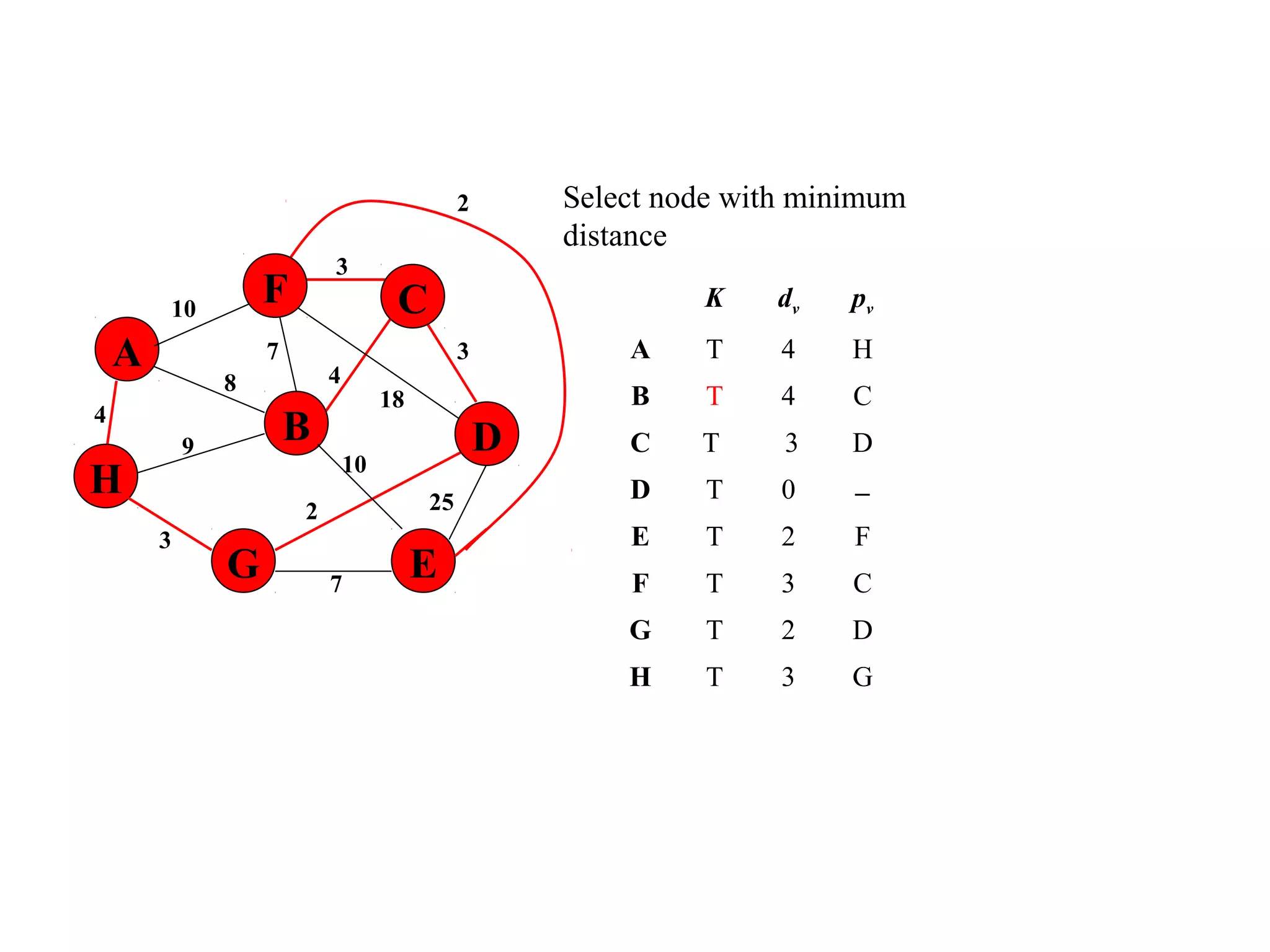
    4 25 A H B F E D C G 7 2 10 18 3 4 3 7 8 9 3 10 Update distancesof adjacent, unselected nodes K dv pv A B C 3 D D T 0 − E 25 D F 18 D G 2 D H 2
  • 57.
    4 25 A H B F E D C G 7 2 10 18 3 4 3 7 8 9 3 10 Select nodewith minimum distance K dv pv A B C 3 D D T 0 − E 25 D F 18 D G T 2 D H 2
  • 58.
    4 25 A H B F E D C G 7 2 10 18 3 4 3 7 8 9 3 10 Update distancesof adjacent, unselected nodes K dv pv A B C 3 D D T 0 − E 7 G F 18 D G T 2 D H 3 G 2
  • 59.
    4 25 A H B F E D C G 7 2 10 18 3 4 3 7 8 9 3 10 Select nodewith minimum distance K dv pv A B C T 3 D D T 0 − E 7 G F 18 D G T 2 D H 3 G 2
  • 60.
    4 25 A H B F E D C G 7 2 10 18 3 4 3 7 8 9 3 10 Update distancesof adjacent, unselected nodes K dv pv A B 4 C C T 3 D D T 0 − E 7 G F 3 C G T 2 D H 3 G 2
  • 61.
    4 25 A H B F E D C G 7 2 10 18 3 4 3 7 8 9 3 10 Select nodewith minimum distance K dv pv A B 4 C C T 3 D D T 0 − E 7 G F T 3 C G T 2 D H 3 G 2
  • 62.
    4 25 A H B F E D C G 7 2 10 18 3 4 3 7 8 9 3 10 Update distancesof adjacent, unselected nodes K dv pv A 10 F B 4 C C T 3 D D T 0 − E 2 F F T 3 C G T 2 D H 3 G 2
  • 63.
    4 25 A H B F E D C G 7 2 10 18 3 4 3 7 8 9 3 10 Select nodewith minimum distance K dv pv A 10 F B 4 C C T 3 D D T 0 − E T 2 F F T 3 C G T 2 D H 3 G 2
  • 64.
    4 25 A H B F E D C G 7 2 10 18 3 4 3 7 8 9 3 10 Update distancesof adjacent, unselected nodes K dv pv A 10 F B 4 C C T 3 D D T 0 − E T 2 F F T 3 C G T 2 D H 3 G 2 Table entries unchanged
  • 65.
    4 25 A H B F E D C G 7 2 10 18 3 4 3 7 8 9 3 10 Select nodewith minimum distance K dv pv A 10 F B 4 C C T 3 D D T 0 − E T 2 F F T 3 C G T 2 D H T 3 G 2
  • 66.
    4 25 A H B F E D C G 7 2 10 18 3 4 3 7 8 9 3 10 Update distancesof adjacent, unselected nodes K dv pv A 4 H B 4 C C T 3 D D T 0 − E T 2 F F T 3 C G T 2 D H T 3 G 2
  • 67.
    4 25 A H B F E D C G 7 2 10 18 3 4 3 7 8 9 3 10 Select nodewith minimum distance K dv pv A T 4 H B 4 C C T 3 D D T 0 − E T 2 F F T 3 C G T 2 D H T 3 G 2
  • 68.
    4 25 A H B F E D C G 7 2 10 18 3 4 3 7 8 9 3 10 Update distancesof adjacent, unselected nodes K dv pv A T 4 H B 4 C C T 3 D D T 0 − E T 2 F F T 3 C G T 2 D H T 3 G 2 Table entries unchanged
  • 69.
    4 25 A H B F E D C G 7 2 10 18 3 4 3 7 8 9 3 10 Select nodewith minimum distance K dv pv A T 4 H B T 4 C C T 3 D D T 0 − E T 2 F F T 3 C G T 2 D H T 3 G 2
  • 70.
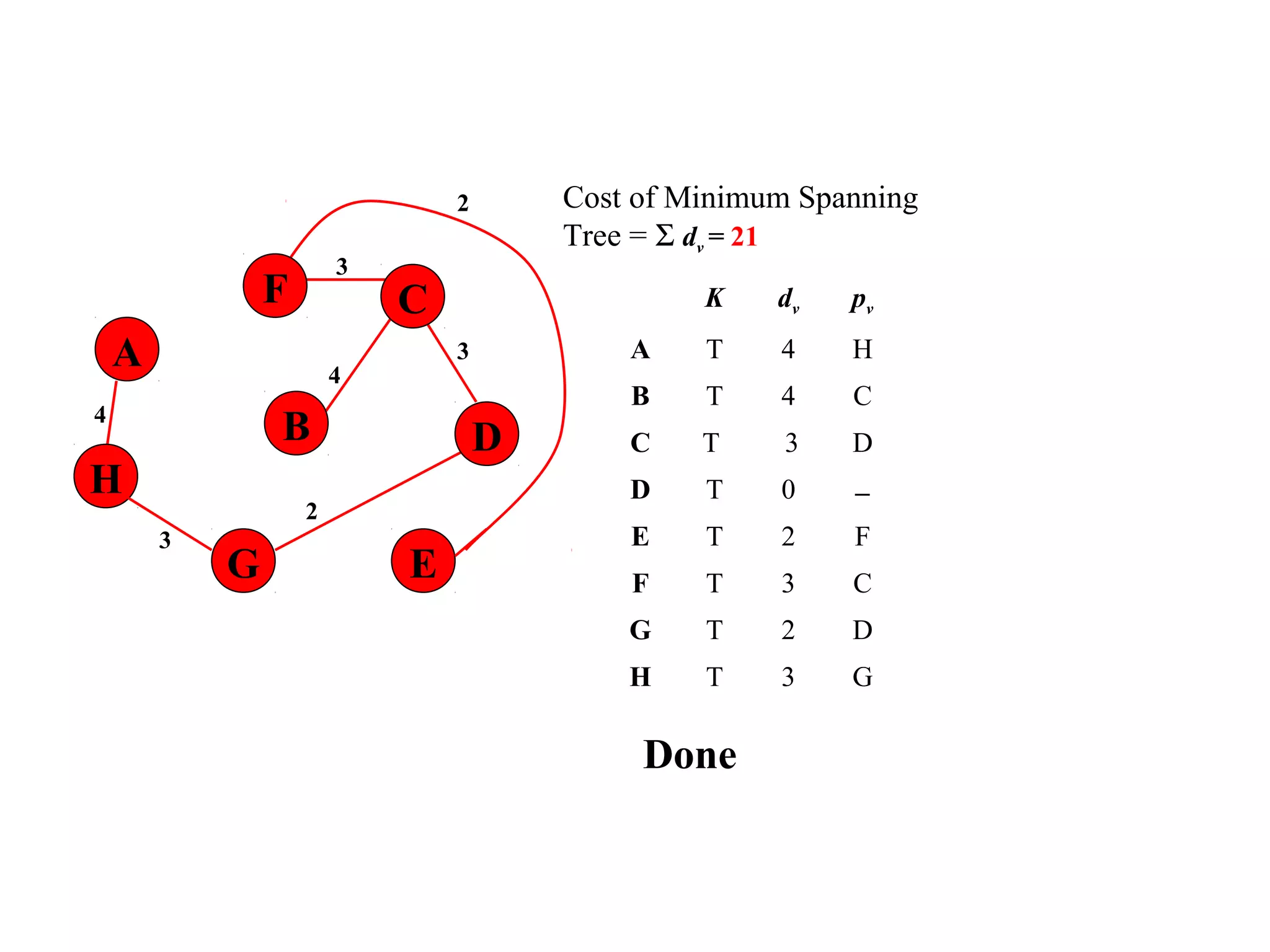
    4 A H B F E D C G 2 3 4 3 3 Cost of MinimumSpanning Tree = Σ dv = 21 K dv pv A T 4 H B T 4 C C T 3 D D T 0 − E T 2 F F T 3 C G T 2 D H T 3 G 2 Done
  • 71.
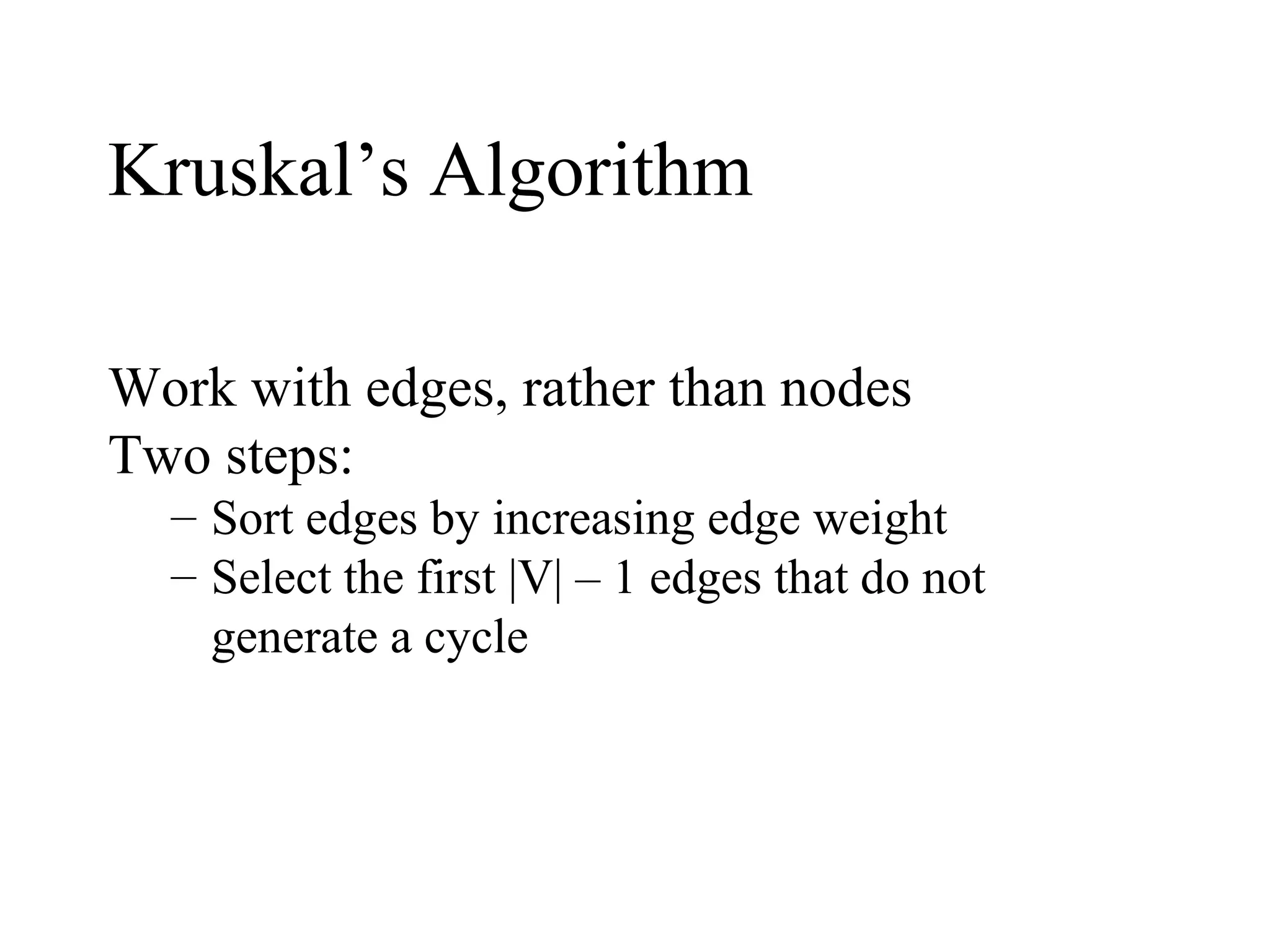
    Kruskal’s Algorithm Work withedges, rather than nodes Two steps: – Sort edges by increasing edge weight – Select the first |V| – 1 edges that do not generate a cycle
  • 72.
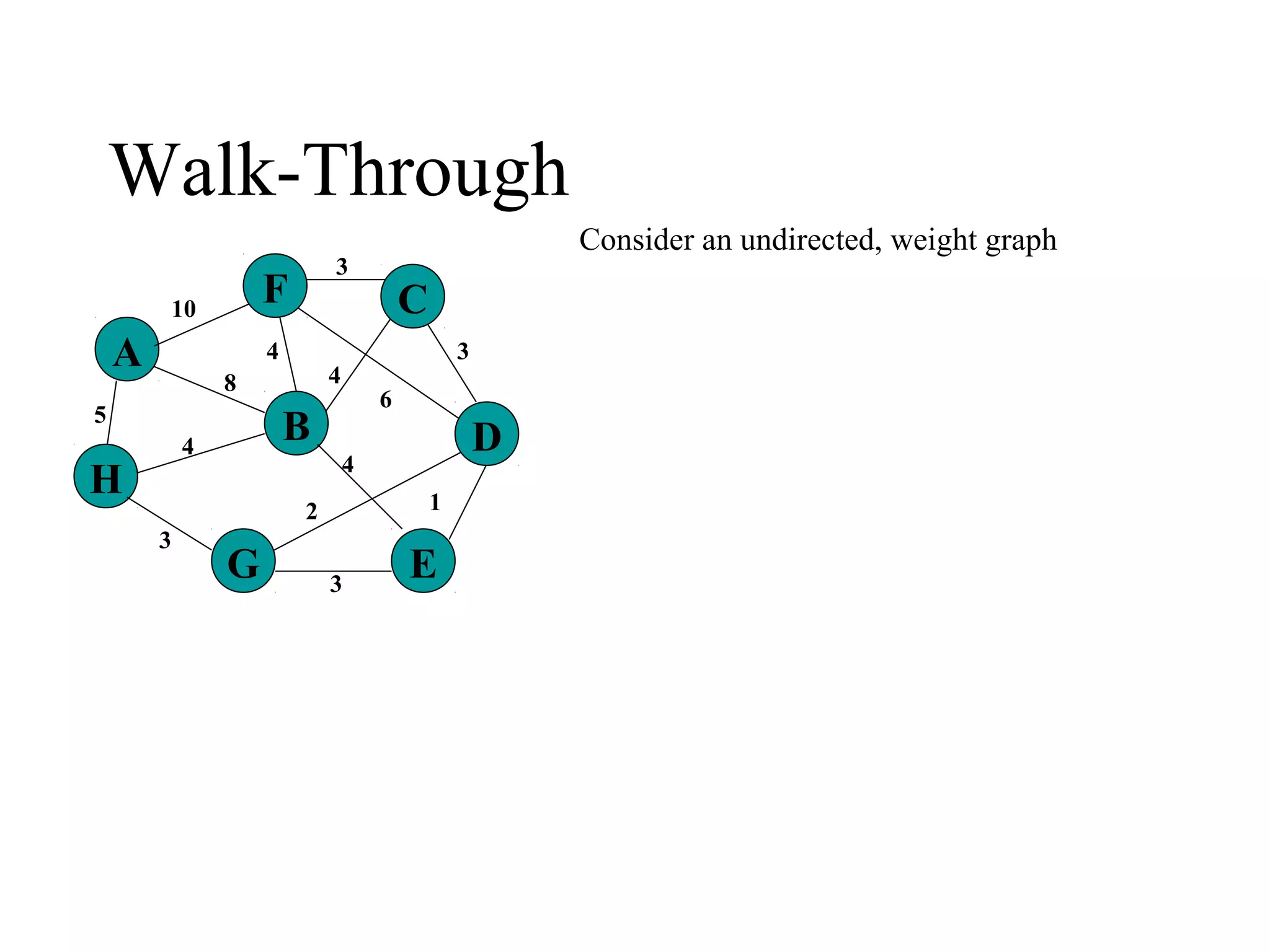
    Walk-Through Consider an undirected,weight graph 5 1 A H B F E D C G 3 2 4 6 3 4 3 4 8 4 3 10
  • 73.
    Sort the edgesby increasing edge weight edge dv (D,E) 1 (D,G) 2 (E,G) 3 (C,D) 3 (G,H) 3 (C,F) 3 (B,C) 4 5 1 A H B F E D C G 3 2 4 6 3 4 3 4 8 4 3 10 edge dv (B,E) 4 (B,F) 4 (B,H) 4 (A,H) 5 (D,F) 6 (A,B) 8 (A,F) 10
  • 74.
    Select first |V|–1edges which do not generate a cycle edge dv (D,E) 1 √ (D,G) 2 (E,G) 3 (C,D) 3 (G,H) 3 (C,F) 3 (B,C) 4 5 1 A H B F E D C G 3 2 4 6 3 4 3 4 8 4 3 10 edge dv (B,E) 4 (B,F) 4 (B,H) 4 (A,H) 5 (D,F) 6 (A,B) 8 (A,F) 10
  • 75.
    Select first |V|–1edges which do not generate a cycle edge dv (D,E) 1 √ (D,G) 2 √ (E,G) 3 (C,D) 3 (G,H) 3 (C,F) 3 (B,C) 4 5 1 A H B F E D C G 3 2 4 6 3 4 3 4 8 4 3 10 edge dv (B,E) 4 (B,F) 4 (B,H) 4 (A,H) 5 (D,F) 6 (A,B) 8 (A,F) 10
  • 76.
    Select first |V|–1edges which do not generate a cycle edge dv (D,E) 1 √ (D,G) 2 √ (E,G) 3 χ (C,D) 3 (G,H) 3 (C,F) 3 (B,C) 4 5 1 A H B F E D C G 3 2 4 6 3 4 3 4 8 4 3 10 edge dv (B,E) 4 (B,F) 4 (B,H) 4 (A,H) 5 (D,F) 6 (A,B) 8 (A,F) 10 Accepting edge (E,G) would create a cycle
  • 77.
    Select first |V|–1edges which do not generate a cycle edge dv (D,E) 1 √ (D,G) 2 √ (E,G) 3 χ (C,D) 3 √ (G,H) 3 (C,F) 3 (B,C) 4 5 1 A H B F E D C G 3 2 4 6 3 4 3 4 8 4 3 10 edge dv (B,E) 4 (B,F) 4 (B,H) 4 (A,H) 5 (D,F) 6 (A,B) 8 (A,F) 10
  • 78.
    Select first |V|–1edges which do not generate a cycle edge dv (D,E) 1 √ (D,G) 2 √ (E,G) 3 χ (C,D) 3 √ (G,H) 3 √ (C,F) 3 (B,C) 4 5 1 A H B F E D C G 3 2 4 6 3 4 3 4 8 4 3 10 edge dv (B,E) 4 (B,F) 4 (B,H) 4 (A,H) 5 (D,F) 6 (A,B) 8 (A,F) 10
  • 79.
    Select first |V|–1edges which do not generate a cycle edge dv (D,E) 1 √ (D,G) 2 √ (E,G) 3 χ (C,D) 3 √ (G,H) 3 √ (C,F) 3 √ (B,C) 4 5 1 A H B F E D C G 3 2 4 6 3 4 3 4 8 4 3 10 edge dv (B,E) 4 (B,F) 4 (B,H) 4 (A,H) 5 (D,F) 6 (A,B) 8 (A,F) 10
  • 80.
    Select first |V|–1edges which do not generate a cycle edge dv (D,E) 1 √ (D,G) 2 √ (E,G) 3 χ (C,D) 3 √ (G,H) 3 √ (C,F) 3 √ (B,C) 4 √ 5 1 A H B F E D C G 3 2 4 6 3 4 3 4 8 4 3 10 edge dv (B,E) 4 (B,F) 4 (B,H) 4 (A,H) 5 (D,F) 6 (A,B) 8 (A,F) 10
  • 81.
    Select first |V|–1edges which do not generate a cycle edge dv (D,E) 1 √ (D,G) 2 √ (E,G) 3 χ (C,D) 3 √ (G,H) 3 √ (C,F) 3 √ (B,C) 4 √ 5 1 A H B F E D C G 3 2 4 6 3 4 3 4 8 4 3 10 edge dv (B,E) 4 χ (B,F) 4 (B,H) 4 (A,H) 5 (D,F) 6 (A,B) 8 (A,F) 10
  • 82.
    Select first |V|–1edges which do not generate a cycle edge dv (D,E) 1 √ (D,G) 2 √ (E,G) 3 χ (C,D) 3 √ (G,H) 3 √ (C,F) 3 √ (B,C) 4 √ 5 1 A H B F E D C G 3 2 4 6 3 4 3 4 8 4 3 10 edge dv (B,E) 4 χ (B,F) 4 χ (B,H) 4 (A,H) 5 (D,F) 6 (A,B) 8 (A,F) 10
  • 83.
    Select first |V|–1edges which do not generate a cycle edge dv (D,E) 1 √ (D,G) 2 √ (E,G) 3 χ (C,D) 3 √ (G,H) 3 √ (C,F) 3 √ (B,C) 4 √ 5 1 A H B F E D C G 3 2 4 6 3 4 3 4 8 4 3 10 edge dv (B,E) 4 χ (B,F) 4 χ (B,H) 4 χ (A,H) 5 (D,F) 6 (A,B) 8 (A,F) 10
  • 84.
    Select first |V|–1edges which do not generate a cycle edge dv (D,E) 1 √ (D,G) 2 √ (E,G) 3 χ (C,D) 3 √ (G,H) 3 √ (C,F) 3 √ (B,C) 4 √ 5 1 A H B F E D C G 3 2 4 6 3 4 3 4 8 4 3 10 edge dv (B,E) 4 χ (B,F) 4 χ (B,H) 4 χ (A,H) 5 √ (D,F) 6 (A,B) 8 (A,F) 10
  • 85.
    Select first |V|–1edges which do not generate a cycle edge dv (D,E) 1 √ (D,G) 2 √ (E,G) 3 χ (C,D) 3 √ (G,H) 3 √ (C,F) 3 √ (B,C) 4 √ 5 1 A H B F E D C G 2 3 3 3 edge dv (B,E) 4 χ (B,F) 4 χ (B,H) 4 χ (A,H) 5 √ (D,F) 6 (A,B) 8 (A,F) 10 Done Total Cost = Σ dv = 21 4 }not considered