Graph theory
a graph is a finite set of dots called vertices (or nodes) connected by
links called edges (or arcs).
a simple graph is set of vertices V and set of unordered pairs of distinct
elements of V called edges.
Example: Graph
• Let G = (V, E) where
– V = {A, B, C, D, E},
– E = {{A, B}, {A, C}, {A, C}, {B, B}, {B, C},
{D, E}}.
D
A
B
C
E
D
A
B
C
E
kavita hatwa math 231 fall 2002
Terminology
• The edge {a, b} has endpoints a and b.
• The edge {a, b} connects the endpoints a
and b.
• Vertices that are connected by an edge are
adjacent.
Directed Graphs
• A directed graph G is a pair (V, E) where
– V is a set of vertices,
– E is a multiset of ordered pairs of vertices.
• That is, each edge has a direction.
• A directed graph is also called a digraph.
Example: Directed Graph
 Let G = (V, E) where
 V = {A, B, C, D, E},
 E = {(A, B), (A, C), (C, A), (B, B), (B, C),
(D, E)).
A
B
C D
E
Simple Graphs
• A simple graph G is a pair (V, E) where
– V is a set of vertices,
– E is a set of edges,
where each edge is a set of vertices.
Subgraphs
• A graph H = (V(H), E(H)) is a subgraph of a
graph G = (V(G), E(G)) if V(H)  V(G) and
E(H)  E(G).
A
B
C
D
E
F
G = {A, B, C, D, E, F}
H = {A, C, D, F}
Degree of a Vertex
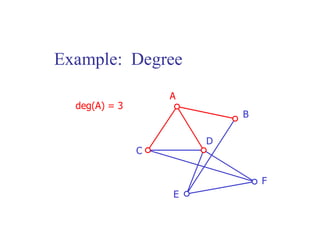
• The degree of a vertex v is the number of
edges that include v.
• The total degree of a graph G is the sum of
the degrees of its vertices.
Example: Degree
A
B
C
D
E
F
A
deg(A) = 3
• A path from v to w is a walk from v to w in which
the edges are distinct.
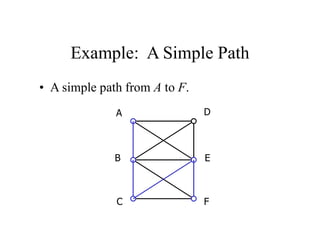
• A simple path from v to w is a path from v to w in
which the vertices are distinct.
• A circuit is a closed path.
• A simple circuit is a circuit in which the vertices are
distinct, except for the first and last vertices.
kavita hatwal math 231 fall 2002
Example: A Path
• A path from A to F.
A
B
C
D
E
F
Example: A Simple Path
• A simple path from A to F.
A
B
C
D
E
F
Example: A Circuit
• A circuit from A to A.
A
B
C
D
E
F
Example: A Simple Circuit
• A simple circuit from A to A.
A
B
C
D
E
F
An Eulerian or Euler Circuit
 An Euler circuit in a graph G is a simple circuit
containing every edge of G.
 An Euler path in G is a simple path containing every
edge of G.
An Eulerian or Euler Circuit
 An Euler path is a path that passes through each
edge of a graph exactly one time.
 An Euler circuit is a circuit that passes through each
edge of a graph exactly one time.
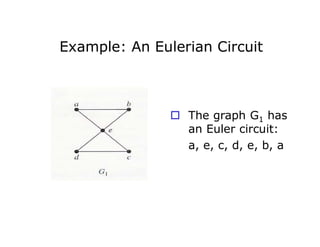
 The graph G1 has
an Euler circuit:
a, e, c, d, e, b, a
Example: An Eulerian Circuit
 The graph G2 and
G3 don’t have an
Euler circuit.
 G3 has an Euler
path:
a, c, d, e, b, d, a, b
 G2 does not have an
Euler path.
Example: An Eulerian Circuit
 H2 has an Euler
circuit:
a, g, c, b, g, e, d, f, a
 H1 nor H3 has an
Euler circuit.
 H3 has an Euler
path: c, a, b, c, d, b
 H1 does not have an
Euler path.
Example: An Eulerian Circuit
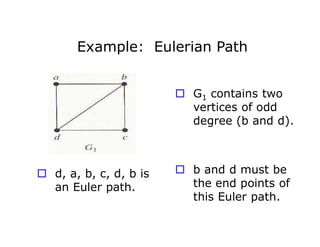
 G1 contains two
vertices of odd
degree (b and d).
 b and d must be
the end points of
this Euler path.
Example: Eulerian Path
 d, a, b, c, d, b is
an Euler path.
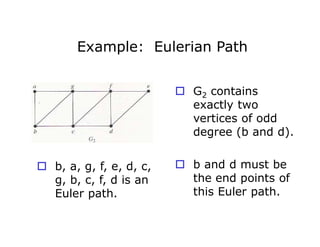
 G2 contains
exactly two
vertices of odd
degree (b and d).
 b and d must be
the end points of
this Euler path.
Example: Eulerian Path
 b, a, g, f, e, d, c,
g, b, c, f, d is an
Euler path.
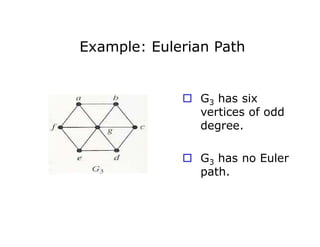
 G3 has six
vertices of odd
degree.
 G3 has no Euler
path.
Example: Eulerian Path
 A Hamilton path in a graph G is a path which visits
every vertex in G exactly once.
 A Hamilton circuit is a Hamilton path that returns to
its start.
Hamiltonian path and circuit
Find a Hamiltonian circuit for this graph starting at A.
(Remember: unlike the Euler circuit, it is not
necessary to traverse every edge.)
Solution
These are the six possible Hamiltonian circuits starting from
A. If you got a different answer, did you add a vertex where
the diagonals cross? You shouldn’t have. Since a vertex has
not been indicated, edges AC and BD do not actually
intersect. (You may think of AC as representing a highway
overpass that is on a different level from edge BD.)
ABCDA, ACDBA, and ADBCA—as well as their reversals,
ADCBA, ABDCA, and ACBDA—are all Hamiltonian circuits.
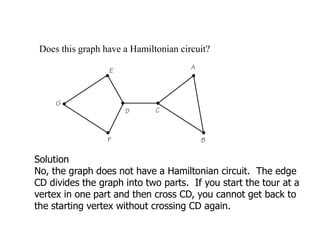
Does this graph have a Hamiltonian circuit?
Solution
No, the graph does not have a Hamiltonian circuit. The edge
CD divides the graph into two parts. If you start the tour at a
vertex in one part and then cross CD, you cannot get back to
the starting vertex without crossing CD again.
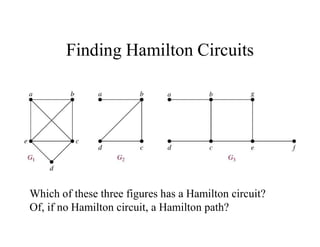
Finding Hamilton Circuits
Which of these three figures has a Hamilton circuit?
Of, if no Hamilton circuit, a Hamilton path?

Eurler_Hamilton_Path_Circuit.pdf

  • 1.
    Graph theory a graphis a finite set of dots called vertices (or nodes) connected by links called edges (or arcs). a simple graph is set of vertices V and set of unordered pairs of distinct elements of V called edges.
  • 2.
    Example: Graph • LetG = (V, E) where – V = {A, B, C, D, E}, – E = {{A, B}, {A, C}, {A, C}, {B, B}, {B, C}, {D, E}}. D A B C E D A B C E
  • 3.
    kavita hatwa math231 fall 2002 Terminology • The edge {a, b} has endpoints a and b. • The edge {a, b} connects the endpoints a and b. • Vertices that are connected by an edge are adjacent.
  • 4.
    Directed Graphs • Adirected graph G is a pair (V, E) where – V is a set of vertices, – E is a multiset of ordered pairs of vertices. • That is, each edge has a direction. • A directed graph is also called a digraph.
  • 5.
    Example: Directed Graph Let G = (V, E) where  V = {A, B, C, D, E},  E = {(A, B), (A, C), (C, A), (B, B), (B, C), (D, E)). A B C D E
  • 6.
    Simple Graphs • Asimple graph G is a pair (V, E) where – V is a set of vertices, – E is a set of edges, where each edge is a set of vertices.
  • 7.
    Subgraphs • A graphH = (V(H), E(H)) is a subgraph of a graph G = (V(G), E(G)) if V(H)  V(G) and E(H)  E(G).
  • 8.
    A B C D E F G = {A,B, C, D, E, F} H = {A, C, D, F}
  • 9.
    Degree of aVertex • The degree of a vertex v is the number of edges that include v. • The total degree of a graph G is the sum of the degrees of its vertices.
  • 10.
  • 11.
    • A pathfrom v to w is a walk from v to w in which the edges are distinct. • A simple path from v to w is a path from v to w in which the vertices are distinct. • A circuit is a closed path. • A simple circuit is a circuit in which the vertices are distinct, except for the first and last vertices.
  • 12.
    kavita hatwal math231 fall 2002 Example: A Path • A path from A to F. A B C D E F
  • 13.
    Example: A SimplePath • A simple path from A to F. A B C D E F
  • 14.
    Example: A Circuit •A circuit from A to A. A B C D E F
  • 15.
    Example: A SimpleCircuit • A simple circuit from A to A. A B C D E F
  • 16.
    An Eulerian orEuler Circuit  An Euler circuit in a graph G is a simple circuit containing every edge of G.  An Euler path in G is a simple path containing every edge of G.
  • 17.
    An Eulerian orEuler Circuit  An Euler path is a path that passes through each edge of a graph exactly one time.  An Euler circuit is a circuit that passes through each edge of a graph exactly one time.
  • 18.
     The graphG1 has an Euler circuit: a, e, c, d, e, b, a Example: An Eulerian Circuit
  • 19.
     The graphG2 and G3 don’t have an Euler circuit.  G3 has an Euler path: a, c, d, e, b, d, a, b  G2 does not have an Euler path. Example: An Eulerian Circuit
  • 20.
    Example: An EulerianCircuit  H2 has an Euler circuit: a, g, c, b, g, e, d, f, a  H1 nor H3 has an Euler circuit.  H3 has an Euler path: c, a, b, c, d, b  H1 does not have an Euler path. Example: An Eulerian Circuit
  • 21.
     G1 containstwo vertices of odd degree (b and d).  b and d must be the end points of this Euler path. Example: Eulerian Path  d, a, b, c, d, b is an Euler path.
  • 22.
     G2 contains exactlytwo vertices of odd degree (b and d).  b and d must be the end points of this Euler path. Example: Eulerian Path  b, a, g, f, e, d, c, g, b, c, f, d is an Euler path.
  • 23.
     G3 hassix vertices of odd degree.  G3 has no Euler path. Example: Eulerian Path
  • 24.
     A Hamiltonpath in a graph G is a path which visits every vertex in G exactly once.  A Hamilton circuit is a Hamilton path that returns to its start. Hamiltonian path and circuit
  • 25.
    Find a Hamiltoniancircuit for this graph starting at A. (Remember: unlike the Euler circuit, it is not necessary to traverse every edge.)
  • 26.
    Solution These are thesix possible Hamiltonian circuits starting from A. If you got a different answer, did you add a vertex where the diagonals cross? You shouldn’t have. Since a vertex has not been indicated, edges AC and BD do not actually intersect. (You may think of AC as representing a highway overpass that is on a different level from edge BD.) ABCDA, ACDBA, and ADBCA—as well as their reversals, ADCBA, ABDCA, and ACBDA—are all Hamiltonian circuits.
  • 27.
    Does this graphhave a Hamiltonian circuit? Solution No, the graph does not have a Hamiltonian circuit. The edge CD divides the graph into two parts. If you start the tour at a vertex in one part and then cross CD, you cannot get back to the starting vertex without crossing CD again.
  • 28.
    Finding Hamilton Circuits Whichof these three figures has a Hamilton circuit? Of, if no Hamilton circuit, a Hamilton path?